
Board Exam 2025
1 Mark
Q20. Assertion (A): The
quadratic equation \(x^2 + 4x + 5 = 0\) has real roots.
Reason (R): The quadratic equation \(ax^2 + bx + c = 0, a \neq 0\) has real roots if \(b^2 - 4ac \ge 0\).
Reason (R): The quadratic equation \(ax^2 + bx + c = 0, a \neq 0\) has real roots if \(b^2 - 4ac \ge 0\).
Assertion Check: \(D = b^2 - 4ac = 4^2 - 4(1)(5) = 16 - 20 = -4\).
Since \(D < 0\), roots are not real. Assertion is False.
Reason Check: Condition \(b^2 - 4ac \ge 0\) is correct for real roots. Reason is True.
Answer: (D)
Since \(D < 0\), roots are not real. Assertion is False.
Reason Check: Condition \(b^2 - 4ac \ge 0\) is correct for real roots. Reason is True.
Answer: (D)
5 Marks
Q32 (a). The denominator of a fraction is
2 more
than the numerator. If 2 is added to both its numerator and denominator, then the sum of the new
fraction and the original fraction is \(\frac{46}{35}\). Find the original fraction.
OR
Q32 (b). At present, Sourav's age is 3
years more
than the square of his son Ravi's age. When Ravi grows to his father's present age, Sourav's age
would
be 6 years less than 13 times the present age of Ravi. Find present ages of Ravi and Sourav.
(a) Let fraction be \(x/(x+2)\).
New fraction: \((x+2)/(x+4)\).
Equation: \(\frac{x}{x+2} + \frac{x+2}{x+4} = \frac{46}{35}\).
By inspection or solving quadratic: \(x=3\).
\(\frac{3}{5} + \frac{5}{7} = \frac{21+25}{35} = \frac{46}{35}\). Correct.
Original Fraction is 3/5.
(b) Let Ravi's age = \(R\), Sourav's age = \(S\).
\(S = R^2 + 3\).
Years to pass: \(S - R\).
Future Sourav Age: \(S + (S-R) = 2S - R\).
Given: \(2S - R = 13R - 6 \Rightarrow 2S = 14R - 6 \Rightarrow S = 7R - 3\).
Equating S: \(R^2 + 3 = 7R - 3 \Rightarrow R^2 - 7R + 6 = 0\).
\((R-6)(R-1) = 0\). \(R=6\) or \(R=1\).
If \(R=1\), \(S=4\) (Unlikely father age 4).
If \(R=6\), \(S=39\).
Ravi: 6 years. Sourav: 39 years.
New fraction: \((x+2)/(x+4)\).
Equation: \(\frac{x}{x+2} + \frac{x+2}{x+4} = \frac{46}{35}\).
By inspection or solving quadratic: \(x=3\).
\(\frac{3}{5} + \frac{5}{7} = \frac{21+25}{35} = \frac{46}{35}\). Correct.
Original Fraction is 3/5.
(b) Let Ravi's age = \(R\), Sourav's age = \(S\).
\(S = R^2 + 3\).
Years to pass: \(S - R\).
Future Sourav Age: \(S + (S-R) = 2S - R\).
Given: \(2S - R = 13R - 6 \Rightarrow 2S = 14R - 6 \Rightarrow S = 7R - 3\).
Equating S: \(R^2 + 3 = 7R - 3 \Rightarrow R^2 - 7R + 6 = 0\).
\((R-6)(R-1) = 0\). \(R=6\) or \(R=1\).
If \(R=1\), \(S=4\) (Unlikely father age 4).
If \(R=6\), \(S=39\).
Ravi: 6 years. Sourav: 39 years.
5 Marks
Q32. (a) The perimeter of a right
triangle is 60
cm and its hypotenuse is 25 cm. Find the lengths of other two sides of the triangle.
OR
Q32. (b)
A train travels a distance of 480 km at a uniform
speed. If
the speed had been 8 km/h less, then it would have taken 3 hours more to cover the same
distance. Find
the speed of the train.
(a) Let sides be \(a, b\). Hypotenuse \(c = 25\). Perimeter \(a + b + 25 = 60
\Rightarrow a + b = 35\).
\(a^2 + b^2 = 25^2 = 625\).
Using \((a + b)^2 = a^2 + b^2 + 2ab\): \(35^2 = 625 + 2ab \Rightarrow 1225 - 625 = 2ab \Rightarrow 2ab = 600 \Rightarrow ab = 300\).
Solving \(x^2 - 35x + 300 = 0\): \((x - 20)(x - 15) = 0\). Sides are 15 cm and 20 cm.
(b) Let usual speed be \(v\) km/h.
\(\frac{480}{v - 8} - \frac{480}{v} = 3\).
\(160 \left(\frac{1}{v - 8} - \frac{1}{v}\right) = 1 \Rightarrow 160 \frac{v - (v - 8)}{v^2 - 8v} = 1\).
\(160(8) = v^2 - 8v \Rightarrow v^2 - 8v - 1280 = 0\).
Factorize: \((v - 40)(v + 32) = 0\). Since speed > 0, \(v = 40\) km/h.
\(a^2 + b^2 = 25^2 = 625\).
Using \((a + b)^2 = a^2 + b^2 + 2ab\): \(35^2 = 625 + 2ab \Rightarrow 1225 - 625 = 2ab \Rightarrow 2ab = 600 \Rightarrow ab = 300\).
Solving \(x^2 - 35x + 300 = 0\): \((x - 20)(x - 15) = 0\). Sides are 15 cm and 20 cm.
(b) Let usual speed be \(v\) km/h.
\(\frac{480}{v - 8} - \frac{480}{v} = 3\).
\(160 \left(\frac{1}{v - 8} - \frac{1}{v}\right) = 1 \Rightarrow 160 \frac{v - (v - 8)}{v^2 - 8v} = 1\).
\(160(8) = v^2 - 8v \Rightarrow v^2 - 8v - 1280 = 0\).
Factorize: \((v - 40)(v + 32) = 0\). Since speed > 0, \(v = 40\) km/h.
1 Mark
Q18. The quadratic equation whose roots
are 7 and \(\frac{1}{7}\) is :
Sum of roots = \(7 + \frac{1}{7} = \frac{49 + 1}{7} = \frac{50}{7}\).
Product of roots = \(7 \times \frac{1}{7} = 1\).
Quadratic equation: \(x^2 - (\text{sum})x + (\text{product}) = 0\).
\(x^2 - \frac{50}{7}x + 1 = 0\). Multiply by 7:
\(7x^2 - 50x + 7 = 0\).
Answer: (A)
Product of roots = \(7 \times \frac{1}{7} = 1\).
Quadratic equation: \(x^2 - (\text{sum})x + (\text{product}) = 0\).
\(x^2 - \frac{50}{7}x + 1 = 0\). Multiply by 7:
\(7x^2 - 50x + 7 = 0\).
Answer: (A)
5 Marks
Q35. (a) The numerator of a fraction is 3
less than its denominator. If 2 is added to both numerator and denominator, then the sum of the
new fraction and the original fraction is \(1\frac{9}{20}\). Find the original fraction.
OR
Q35. (b) A train travelling at a uniform
speed for 360 km would have taken 48 minutes less to travel the same distance if its speed were
5 km/h more. Find the original speed of the train.
(a) Let denominator = \(x\), numerator = \(x - 3\).
Original fraction = \(\frac{x-3}{x}\).
New fraction = \(\frac{x-3+2}{x+2} = \frac{x-1}{x+2}\).
Sum: \(\frac{x-3}{x} + \frac{x-1}{x+2} = \frac{29}{20}\).
Cross-multiplying and solving:
\(20[(x-3)(x+2) + x(x-1)] = 29x(x+2)\).
\(20[x^2 - x - 6 + x^2 - x] = 29x^2 + 58x\).
\(40x^2 - 40x - 120 = 29x^2 + 58x\).
\(11x^2 - 98x - 120 = 0\).
Solving: \(x = 10\) (valid), \(x = -\frac{12}{11}\) (rejected).
Original fraction = \(\frac{7}{10}\).
(b) Let original speed = \(v\) km/h.
Time at speed \(v\): \(\frac{360}{v}\) hours.
Time at speed \(v+5\): \(\frac{360}{v+5}\) hours.
Difference = 48 min = \(\frac{48}{60} = \frac{4}{5}\) hours.
\(\frac{360}{v} - \frac{360}{v+5} = \frac{4}{5}\).
\(360 \times 5 \times \frac{5}{v(v+5)} = \frac{4}{5}\).
\(\frac{1800}{v(v+5)} = \frac{4}{5} \Rightarrow 9000 = 4v(v+5)\).
\(v^2 + 5v - 2250 = 0\).
\((v + 50)(v - 45) = 0 \Rightarrow v = 45\) km/h.
Original speed = 45 km/h.
Original fraction = \(\frac{x-3}{x}\).
New fraction = \(\frac{x-3+2}{x+2} = \frac{x-1}{x+2}\).
Sum: \(\frac{x-3}{x} + \frac{x-1}{x+2} = \frac{29}{20}\).
Cross-multiplying and solving:
\(20[(x-3)(x+2) + x(x-1)] = 29x(x+2)\).
\(20[x^2 - x - 6 + x^2 - x] = 29x^2 + 58x\).
\(40x^2 - 40x - 120 = 29x^2 + 58x\).
\(11x^2 - 98x - 120 = 0\).
Solving: \(x = 10\) (valid), \(x = -\frac{12}{11}\) (rejected).
Original fraction = \(\frac{7}{10}\).
(b) Let original speed = \(v\) km/h.
Time at speed \(v\): \(\frac{360}{v}\) hours.
Time at speed \(v+5\): \(\frac{360}{v+5}\) hours.
Difference = 48 min = \(\frac{48}{60} = \frac{4}{5}\) hours.
\(\frac{360}{v} - \frac{360}{v+5} = \frac{4}{5}\).
\(360 \times 5 \times \frac{5}{v(v+5)} = \frac{4}{5}\).
\(\frac{1800}{v(v+5)} = \frac{4}{5} \Rightarrow 9000 = 4v(v+5)\).
\(v^2 + 5v - 2250 = 0\).
\((v + 50)(v - 45) = 0 \Rightarrow v = 45\) km/h.
Original speed = 45 km/h.
1 Mark
Q17. If \(\frac{x}{12} - \frac{3}{x} =
0\)
then the values of x are:
\(\frac{x}{12} = \frac{3}{x} \Rightarrow x^2 = 36 \Rightarrow x = \pm
6\).
Answer: (A)
Answer: (A)
2 Marks
Q22. (a) Find the value(s) of 'k' so that
the
quadratic equation \(4x^2 + kx + 1 = 0\) has real and equal roots.
For real and equal roots, \(D = 0\).
\(b^2 - 4ac = 0 \Rightarrow k^2 - 4(4)(1) = 0\).
\(k^2 = 16 \Rightarrow k = \pm 4\).
\(b^2 - 4ac = 0 \Rightarrow k^2 - 4(4)(1) = 0\).
\(k^2 = 16 \Rightarrow k = \pm 4\).
4 Marks
Q38.
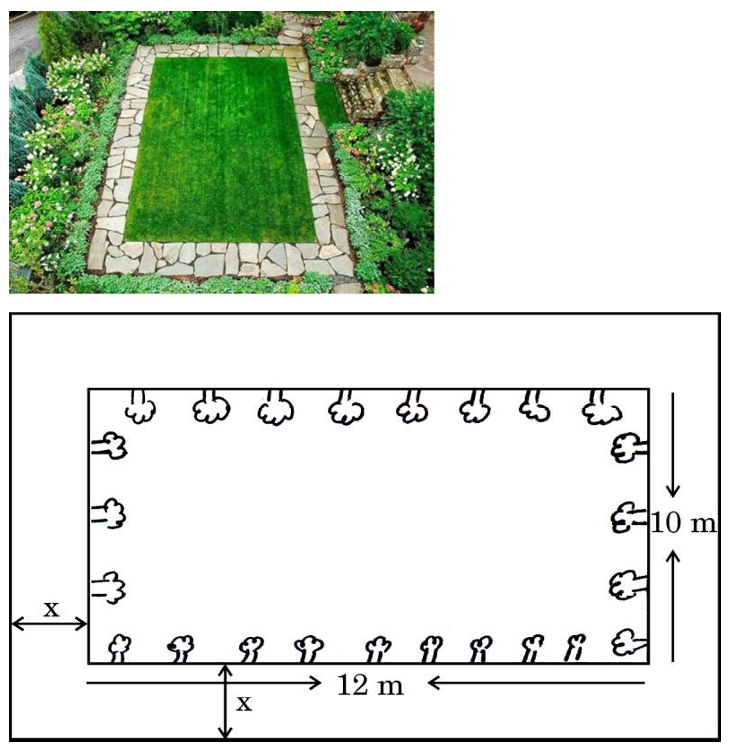 Case Study - 3: A
garden designer is planning a rectangular lawn that is to be surrounded by a uniform walkway.
Dimensions of the lawn itself are 12 metres by 10 metres. Total area of lawn and walkway is 360
sq
m.
(i) Formulate the quadratic equation representing the total area.
Case Study - 3: A
garden designer is planning a rectangular lawn that is to be surrounded by a uniform walkway.
Dimensions of the lawn itself are 12 metres by 10 metres. Total area of lawn and walkway is 360
sq
m.
(i) Formulate the quadratic equation representing the total area.
(ii) (a) Solve the quadratic equation to find the width of the walkway 'x'.
OR
(b) If the cost of paving... calculate area of walkway.
(iii) Find the perimeter of the lawn.
Case Study - 3: A
garden designer is planning a rectangular lawn that is to be surrounded by a uniform walkway.
Dimensions of the lawn itself are 12 metres by 10 metres. Total area of lawn and walkway is 360
sq
m.
(i) Formulate the quadratic equation representing the total area.(ii) (a) Solve the quadratic equation to find the width of the walkway 'x'.
OR
(b) If the cost of paving... calculate area of walkway.
(iii) Find the perimeter of the lawn.
Let width of walkway be \(x\).
Total Length \(= 12 + 2x\), Total Width \(= 10 + 2x\).
(i) Area: \((12 + 2x)(10 + 2x) = 360\).
\(120 + 24x + 20x + 4x^2 = 360 \Rightarrow 4x^2 + 44x - 240 = 0 \Rightarrow x^2 + 11x - 60 = 0\).
(ii)(a) \(x^2 + 15x - 4x - 60 = 0 \Rightarrow (x + 15)(x - 4) = 0\).
\(x = 4\) (Since width cannot be negative). Width is 4 m.
(ii)(b) Area of walkway = Total Area - Area of Lawn = \(360 - (12 \times 10) = 240\) sq m.
(iii) Perimeter of lawn = \(2(l + b) = 2(12 + 10) = 44\) m.
Total Length \(= 12 + 2x\), Total Width \(= 10 + 2x\).
(i) Area: \((12 + 2x)(10 + 2x) = 360\).
\(120 + 24x + 20x + 4x^2 = 360 \Rightarrow 4x^2 + 44x - 240 = 0 \Rightarrow x^2 + 11x - 60 = 0\).
(ii)(a) \(x^2 + 15x - 4x - 60 = 0 \Rightarrow (x + 15)(x - 4) = 0\).
\(x = 4\) (Since width cannot be negative). Width is 4 m.
(ii)(b) Area of walkway = Total Area - Area of Lawn = \(360 - (12 \times 10) = 240\) sq m.
(iii) Perimeter of lawn = \(2(l + b) = 2(12 + 10) = 44\) m.
1 Mark
Q12. The value of 'a' for which \(ax^2 +
x + a =
0\) has equal and positive roots is :
Equal roots \(\Rightarrow\) \( D = 0 \Rightarrow 1^2 - 4(a)(a) = 0 \Rightarrow 4a^2
= 1
\Rightarrow a = \pm 1/2\).
Sum of roots \(\alpha+\beta = -1/a\). For positive roots, sum must be positive.
So \(-1/a > 0 \Rightarrow a\) must be negative.
Hence \(a = -1/2\).
Answer: (d)
Sum of roots \(\alpha+\beta = -1/a\). For positive roots, sum must be positive.
So \(-1/a > 0 \Rightarrow a\) must be negative.
Hence \(a = -1/2\).
Answer: (d)
5 Marks
Q35. (A) The sides of a right triangle
are such
that the longest side is 4 m more than the shortest side and the third side is 2 m less than the
longest
side. Find the length of each side of the triangle. Also, find the difference between the
numerical
values of the area and the perimeter of the given triangle.
OR
Q35. (B) Express the equation
\(\frac{x-2}{x-3} +
\frac{x-4}{x-5} = \frac{10}{3} ; (x \neq 3, 5)\) as a quadratic equation in standard form.
Hence, find
the roots of the equation so formed.
(A): Shortest \(x\), Longest \(x+4\), Third \(x+2\).
\(x^2 + (x+2)^2 = (x+4)^2 \Rightarrow x^2 - 4x - 12 = 0\).
\((x-6)(x+2)=0 \Rightarrow x=6\).
Sides: 6, 8, 10. Area = 24. Perimeter = 24. Diff = 0.
(B): Simplify to \(2x^2 - 19x + 42 = 0\).
Roots \(x = 6, x = 3.5\).
\(x^2 + (x+2)^2 = (x+4)^2 \Rightarrow x^2 - 4x - 12 = 0\).
\((x-6)(x+2)=0 \Rightarrow x=6\).
Sides: 6, 8, 10. Area = 24. Perimeter = 24. Diff = 0.
(B): Simplify to \(2x^2 - 19x + 42 = 0\).
Roots \(x = 6, x = 3.5\).
1 Mark
Q13. Which of the following is a
Quadratic
Equation?
(A) becomes \(x^4 + ...\) (Biquadratic).
(B) expands to \(x^2 + x - 2x\sqrt{x} + 2x\sqrt{x} = 0 \Rightarrow x^2 + x = 0\). This is Quadratic.
(D) has \(\sqrt{x}\) term upon expansion.
Correct Option: (B)
(B) expands to \(x^2 + x - 2x\sqrt{x} + 2x\sqrt{x} = 0 \Rightarrow x^2 + x = 0\). This is Quadratic.
(D) has \(\sqrt{x}\) term upon expansion.
Correct Option: (B)
1 Mark
Q14. If the quadratic equation \(x^2 + bx
+ b =
0\) has distinct real
roots, then \(b\) can be:
\(D > 0 \Rightarrow b^2 - 4(1)(b) > 0 \Rightarrow b(b - 4) > 0\).
\(b\) must be \(< 0\) or \(> 4\).
0, 4, 3 are not valid. -3 satisfies \(b < 0\).
Correct Option: (D)
\(b\) must be \(< 0\) or \(> 4\).
0, 4, 3 are not valid. -3 satisfies \(b < 0\).
Correct Option: (D)
5 Marks
Q35 (a). A 2-digit number is seven times
the sum of its digits and two (2) more than 5 times the product of its digits. Find the number.
OR
Q35 (b). Find the value(s) of p for which
the quadratic equation given as \((p + 4)x^2 - (p + 1)x + 1 = 0\) has real and equal roots.
Also, find the roots of the equation(s) so obtained.
(a): Num \(10x + y\). \(10x + y = 7(x + y) \Rightarrow x =
2y\).
\(10x + y = 5xy + 2 \Rightarrow 21y = 10y^2 + 2\). \(10y^2 - 21y + 2 = 0\).
\(y = 2\) or \(0.1\). \(y = 2 \Rightarrow x = 4\). Number: 42.
(b): \(D = 0 \Rightarrow (p+1)^2 - 4(p+4) = 0 \Rightarrow p^2 - 2p - 15 = 0\).
\((p-5)(p+3) = 0 \Rightarrow p = 5\) or \(-3\).
If \(p = 5 \Rightarrow x = 1/3\). If \(p = -3 \Rightarrow x = -1\).
\(10x + y = 5xy + 2 \Rightarrow 21y = 10y^2 + 2\). \(10y^2 - 21y + 2 = 0\).
\(y = 2\) or \(0.1\). \(y = 2 \Rightarrow x = 4\). Number: 42.
(b): \(D = 0 \Rightarrow (p+1)^2 - 4(p+4) = 0 \Rightarrow p^2 - 2p - 15 = 0\).
\((p-5)(p+3) = 0 \Rightarrow p = 5\) or \(-3\).
If \(p = 5 \Rightarrow x = 1/3\). If \(p = -3 \Rightarrow x = -1\).
1 Mark
Q12. Which of the following equations
does not have a real root?
(A) \(x^2 = 0 \Rightarrow x = 0\) (Real)
(B) \(2x = 4 \Rightarrow x = 2\) (Real)
(C) \(x^2 = -1\) (Square of a real number cannot be negative, no real roots)
(D) \(x^2(x+1) = 0 \Rightarrow x = 0, -1\) (Real)
Correct Option: (C)
(B) \(2x = 4 \Rightarrow x = 2\) (Real)
(C) \(x^2 = -1\) (Square of a real number cannot be negative, no real roots)
(D) \(x^2(x+1) = 0 \Rightarrow x = 0, -1\) (Real)
Correct Option: (C)
5 Marks
Q35 (a). There is a circular park of
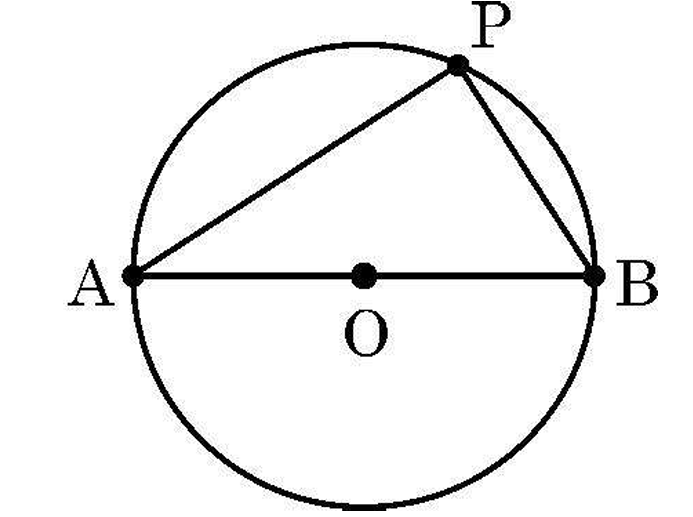 diameter 65 m as shown in the following figure, where AB is a diameter. An entry gate is to be
constructed at a point P on the boundary of the park such that distance of P from A is 35 m more
than the distance of P from B. Find distance of point P from A and B respectively.
diameter 65 m as shown in the following figure, where AB is a diameter. An entry gate is to be
constructed at a point P on the boundary of the park such that distance of P from A is 35 m more
than the distance of P from B. Find distance of point P from A and B respectively.
diameter 65 m as shown in the following figure, where AB is a diameter. An entry gate is to be
constructed at a point P on the boundary of the park such that distance of P from A is 35 m more
than the distance of P from B. Find distance of point P from A and B respectively.
OR
Q35 (b). Find the smallest value of \(p\)
for which the quadratic equation \(x^2 - 2(p+1)x + p^2 = 0\) has real roots. Hence, find the
roots of the equation so obtained.
Solution Q35 (a):
Let distance \(BP = x\) meters.
Then distance \(AP = x + 35\) meters.
Since AB is a diameter, angle \(\angle APB = 90�\) (Angle in a semicircle).
By Pythagoras Theorem in \(\Delta APB\):
\(AP^2 + BP^2 = AB^2\)
\((x+35)^2 + x^2 = (65)^2\)
\(x^2 + 70x + 1225 + x^2 = 4225\)
\(2x^2 + 70x - 3000 = 0\)
\(x^2 + 35x - 1500 = 0\)
Factorizing: \((x + 60)(x - 25) = 0\)
Since distance cannot be negative, \(x = 25\).
\(BP = 25\) m, \(AP = 25 + 35 = 60\) m.
Answer: Distance from A is 60m, Distance from B is 25m.
Solution Q35 (b):
For real roots, Discriminant \(D \ge 0\).
\([-2(p+1)]^2 - 4(1)(p^2) \ge 0\)
\(4(p^2 + 2p + 1) - 4p^2 \ge 0\)
\(8p + 4 \ge 0 \Rightarrow p \ge -0.5\)
The smallest value is \(p = -0.5\).
Substitute \(p = -0.5\) in the equation:
\(x^2 - x + 0.25 = 0\)
\((x - 0.5)^2 = 0\)
\(x = 0.5, 0.5\)
Answer: Smallest \(p = -0.5\); Roots are \(0.5, 0.5\).
Let distance \(BP = x\) meters.
Then distance \(AP = x + 35\) meters.
Since AB is a diameter, angle \(\angle APB = 90�\) (Angle in a semicircle).
By Pythagoras Theorem in \(\Delta APB\):
\(AP^2 + BP^2 = AB^2\)
\((x+35)^2 + x^2 = (65)^2\)
\(x^2 + 70x + 1225 + x^2 = 4225\)
\(2x^2 + 70x - 3000 = 0\)
\(x^2 + 35x - 1500 = 0\)
Factorizing: \((x + 60)(x - 25) = 0\)
Since distance cannot be negative, \(x = 25\).
\(BP = 25\) m, \(AP = 25 + 35 = 60\) m.
Answer: Distance from A is 60m, Distance from B is 25m.
Solution Q35 (b):
For real roots, Discriminant \(D \ge 0\).
\([-2(p+1)]^2 - 4(1)(p^2) \ge 0\)
\(4(p^2 + 2p + 1) - 4p^2 \ge 0\)
\(8p + 4 \ge 0 \Rightarrow p \ge -0.5\)
The smallest value is \(p = -0.5\).
Substitute \(p = -0.5\) in the equation:
\(x^2 - x + 0.25 = 0\)
\((x - 0.5)^2 = 0\)
\(x = 0.5, 0.5\)
Answer: Smallest \(p = -0.5\); Roots are \(0.5, 0.5\).
Board Exam 2024
2 Marks
Find the LCM and HCF of 6 and 20 by the prime factorization method.
\( 6 = 2 \times 3 \)
\( 20 = 2^2 \times 5 \)
HCF = \( 2 \) (lowest power of common factors)
LCM = \( 2^2 \times 3 \times 5 = 60 \)
\( 20 = 2^2 \times 5 \)
HCF = \( 2 \) (lowest power of common factors)
LCM = \( 2^2 \times 3 \times 5 = 60 \)
Board Exam 2023
3 Marks
Prove that \( 5 - \sqrt{3} \) is irrational, given that \( \sqrt{3} \) is
irrational.
Assume \( 5 - \sqrt{3} \) is rational, say \( = r \).
Then \( \sqrt{3} = 5 - r \), which is rational (difference of two rationals).
Contradiction: \( \sqrt{3} \) is given to be irrational.
? \( 5 - \sqrt{3} \) is irrational. ?
Then \( \sqrt{3} = 5 - r \), which is rational (difference of two rationals).
Contradiction: \( \sqrt{3} \) is given to be irrational.
? \( 5 - \sqrt{3} \) is irrational. ?
Board Exam 2022
2 Marks
Explain why \( 7 \times 11 \times 13 + 13 \) is a composite number.
\( 7 \times 11 \times 13 + 13 = 13(7 \times 11 + 1) = 13 \times 78 \)
Since it has factors other than 1 and itself, it is composite.
Since it has factors other than 1 and itself, it is composite.