Vardaan Learning Institute
Class 10 Mathematics • Chapter Notes
🌐 vardaanlearning.com
📞 9508841336
QUADRATIC EQUATIONS
1. Introduction to Quadratic Equations
1.1 Standard Form
A quadratic equation in the variable $x$ is an equation of the form:
$ax^2 + bx + c = 0$
where $a, b, c$ are real numbers and $\mathbf{a \neq 0}$.
- $a$ is the coefficient of $x^2$ (quadratic coefficient).
- $b$ is the coefficient of $x$ (linear coefficient).
- $c$ is the constant term.
1.2 Verification of Quadratic Equations
In board exams, you are often asked to determine if an equation is quadratic. The trick is to simplify completely. Do not just look at the highest power initially, as terms may cancel out.
Example 1: Check whether $(x - 2)^2 + 1 = 2x - 3$ is a quadratic equation.
Solution:
LHS: $(x - 2)^2 + 1 = x^2 - 4x + 4 + 1 = x^2 - 4x + 5$
RHS: $2x - 3$
Equating LHS and RHS: $x^2 - 4x + 5 = 2x - 3 \implies x^2 - 6x + 8 = 0$
It is of the form $ax^2 + bx + c = 0$ (where $a=1, b=-6, c=8$). Therefore, yes, it is a quadratic equation.
Example 2 (HOTS): Check whether $x(x + 1) + 8 = (x + 2)(x - 2)$ is a quadratic equation.
Solution:
LHS: $x^2 + x + 8$
RHS: $x^2 - 4$
Equating: $x^2 + x + 8 = x^2 - 4$
Cancelling $x^2$ from both sides gives $x + 12 = 0$.
Here, the $x^2$ term is eliminated. The highest degree is 1. Therefore, no, it is a linear equation, not quadratic.
Example 3 (HOTS): Check whether $(x + 2)^3 = x^3 - 4$ is quadratic.
Solution:
Using $(a+b)^3 = a^3 + b^3 + 3a^2b + 3ab^2$:
LHS: $x^3 + 8 + 6x^2 + 12x$
RHS: $x^3 - 4$
Equating: $x^3 + 6x^2 + 12x + 8 = x^3 - 4$
Cancelling $x^3$: $6x^2 + 12x + 12 = 0 \implies x^2 + 2x + 2 = 0$
Despite the initial appearance of a cubic equation, it simplifies to a degree 2 equation. Yes, it is a quadratic equation.
2. Solving Quadratic Equations
A real number $\alpha$ is called a root of the quadratic equation $ax^2 + bx + c = 0$ if $a\alpha^2 + b\alpha + c = 0$. A quadratic equation can have at most two real roots.
2.1 Method 1: Factorization (Middle Term Splitting)
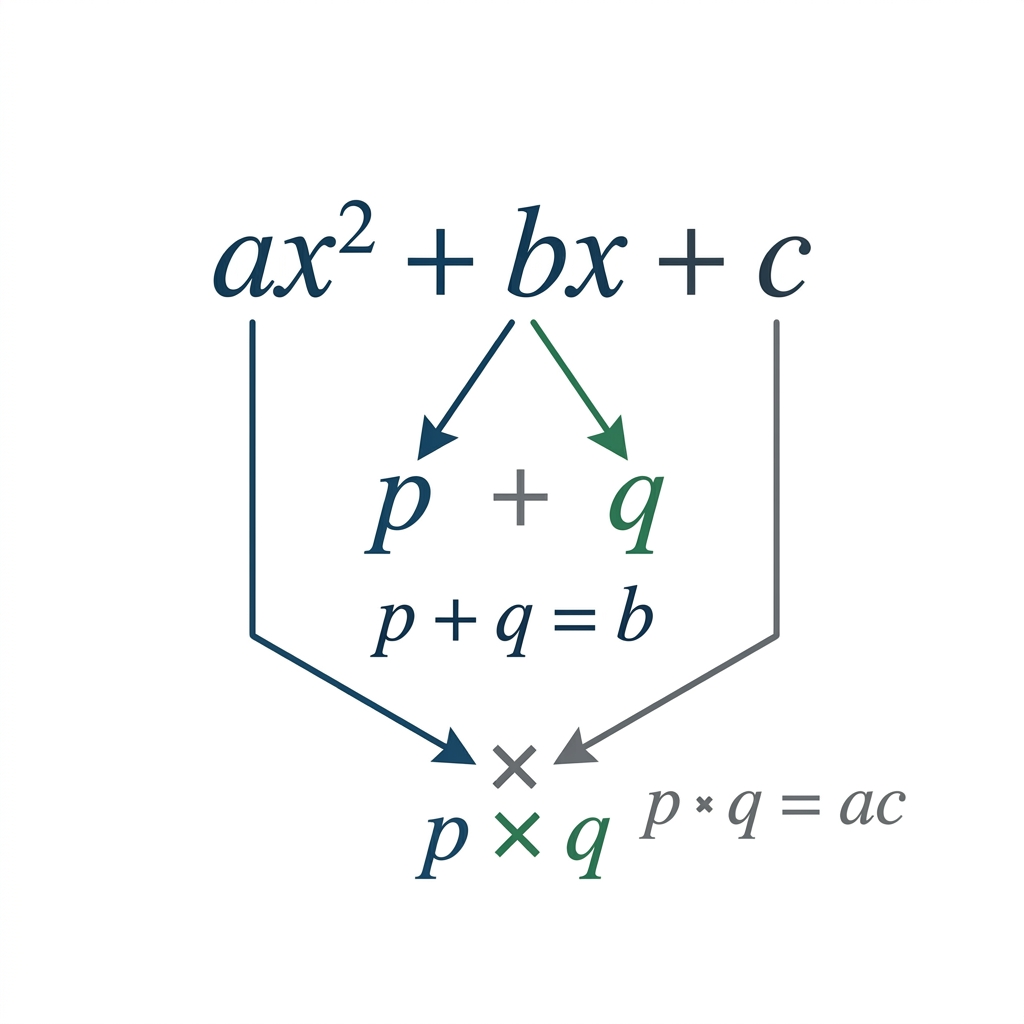
To solve $ax^2 + bx + c = 0$, we find two numbers $p$ and $q$ such that:
- $p + q = b$ (Sum)
- $p \times q = a \times c$ (Product)
Advanced Example (Irrational Coefficients - RD Sharma): Solve $4\sqrt{3}x^2 + 5x - 2\sqrt{3} = 0$
Step 1: Product $ac = (4\sqrt{3})(-2\sqrt{3}) = -8 \times 3 = -24$. Sum $b = 5$.
Step 2: We need two numbers that multiply to $-24$ and add to $5$. The numbers are $8$ and $-3$.
Step 3: Split the middle term: $4\sqrt{3}x^2 + 8x - 3x - 2\sqrt{3} = 0$
Step 4: Factorize by grouping.
Take common from first two terms: $4x(\sqrt{3}x + 2)$
Take common from last two terms: Note that $3 = \sqrt{3} \times \sqrt{3}$. So, $-\sqrt{3}(\sqrt{3}x + 2)$
Step 5: Combine: $(\sqrt{3}x + 2)(4x - \sqrt{3}) = 0$
Roots: $x = -\frac{2}{\sqrt{3}}$ (or $-\frac{2\sqrt{3}}{3}$) and $x = \frac{\sqrt{3}}{4}$.
Advanced Example (Algebraic Coefficients): Solve $abx^2 + (b^2 - ac)x - bc = 0$
Step 1: Simply open the bracket and group! The middle term is already split for you.
Step 2: $abx^2 + b^2x - acx - bc = 0$
Step 3: Group: $bx(ax + b) - c(ax + b) = 0$
Step 4: $(ax + b)(bx - c) = 0$
Roots: $x = -\frac{b}{a}$ and $x = \frac{c}{b}$.
2.2 Method 2: The Quadratic Formula (Sridharacharya’s Method)
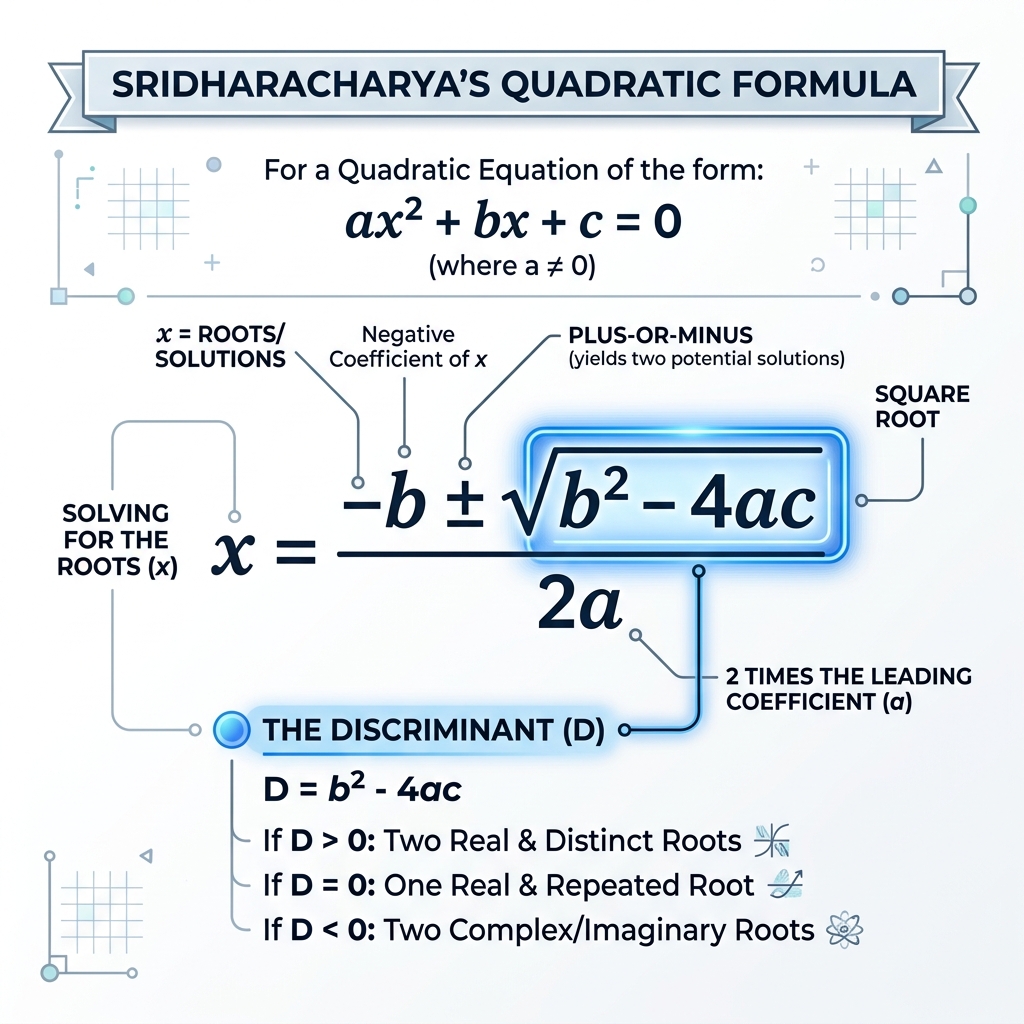
When factorization becomes too complex, we can use the universal Quadratic Formula. For $ax^2 + bx + c = 0$:
$x = \frac{-b \pm \sqrt{b^2 - 4ac}}{2a}$
2.3 Proof of the Quadratic Formula (By Completing the Square)
Note: The "Completing the Square" method for solving problems has been removed from the CBSE syllabus, but understanding the derivation of the Quadratic Formula is excellent for concept building and HOTS applications.
Derivation:
Let $ax^2 + bx + c = 0$ where $a \neq 0$.
Step 1: Divide the entire equation by $a$ to make the coefficient of $x^2$ equal to 1.
$x^2 + \frac{b}{a}x + \frac{c}{a} = 0$
Step 2: Shift the constant term to the RHS.
$x^2 + \frac{b}{a}x = -\frac{c}{a}$
Step 3: Add the square of half the coefficient of $x$ to both sides. The coefficient of $x$ is $\frac{b}{a}$. Half of it is $\frac{b}{2a}$. Add $(\frac{b}{2a})^2$ to both sides.
$x^2 + \frac{b}{a}x + (\frac{b}{2a})^2 = (\frac{b}{2a})^2 - \frac{c}{a}$
Step 4: The LHS is now a perfect square: $(x + \frac{b}{2a})^2$.
$(x + \frac{b}{2a})^2 = \frac{b^2}{4a^2} - \frac{c}{a}$
$(x + \frac{b}{2a})^2 = \frac{b^2 - 4ac}{4a^2}$
Step 5: Take the square root of both sides.
$x + \frac{b}{2a} = \pm\sqrt{\frac{b^2 - 4ac}{4a^2}}$
$x + \frac{b}{2a} = \frac{\pm\sqrt{b^2 - 4ac}}{2a}$
Step 6: Isolate $x$.
$x = -\frac{b}{2a} \pm \frac{\sqrt{b^2 - 4ac}}{2a} \implies \mathbf{x = \frac{-b \pm \sqrt{b^2 - 4ac}}{2a}}$
Hence proved!
3. Nature of Roots (The Discriminant)
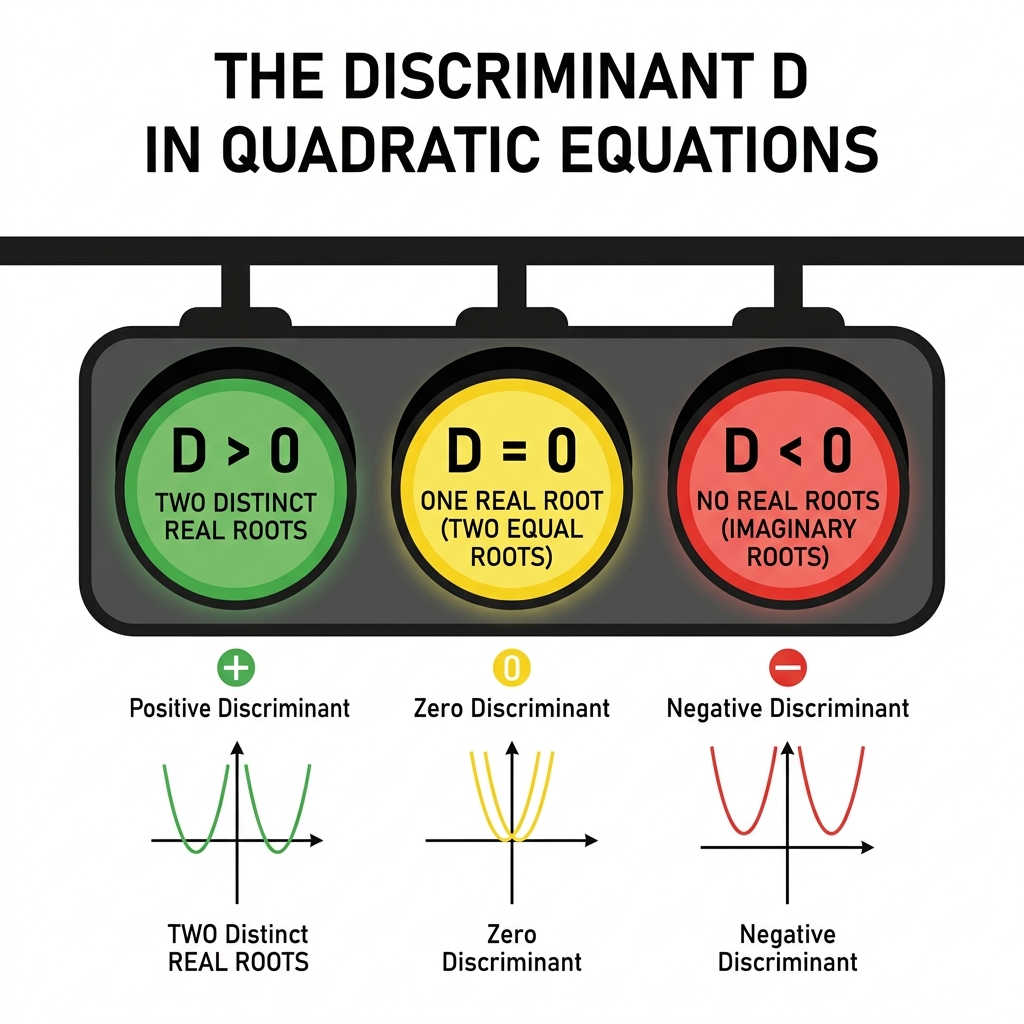
The term inside the square root in the quadratic formula, $\mathbf{D = b^2 - 4ac}$, is known as the Discriminant. It dictates the "nature" of the roots without actually calculating them.
- Case 1: $D > 0$
The equation has Two Distinct Real Roots.
Roots are $x = \frac{-b + \sqrt{D}}{2a}$ and $x = \frac{-b - \sqrt{D}}{2a}$.
- Case 2: $D = 0$
The equation has Two Equal Real Roots (Coincident roots).
Roots are $x = \frac{-b}{2a}$ and $x = \frac{-b}{2a}$.
- Case 3: $D < 0$
The equation has No Real Roots (Roots are imaginary/complex numbers).
3.1 Finding Unknown Variables ('k' or 'p')
A guaranteed 2-3 mark question in the board exam asks you to find an unknown variable given the nature of the roots.
Example (Equal Roots): Find the value(s) of $k$ for which the quadratic equation $kx(x - 2) + 6 = 0$ has two equal roots. (NCERT/CBSE 2017)
Step 1: Expand into standard form: $kx^2 - 2kx + 6 = 0$
Here, $a = k, b = -2k, c = 6$.
Step 2: For equal roots, the condition is $D = 0 \implies b^2 - 4ac = 0$.
Step 3: Substitute: $(-2k)^2 - 4(k)(6) = 0 \implies 4k^2 - 24k = 0$
Step 4: Factorize: $4k(k - 6) = 0$
This gives $k = 0$ or $k = 6$.
Step 5 (Critical Trap): If $k = 0$, the $x^2$ term disappears, and the equation becomes $6 = 0$, which is absurd. Therefore, $k$ cannot be 0.
Final Answer: $k = 6$
4. Word Problem Masterclass (The Encyclopedia)
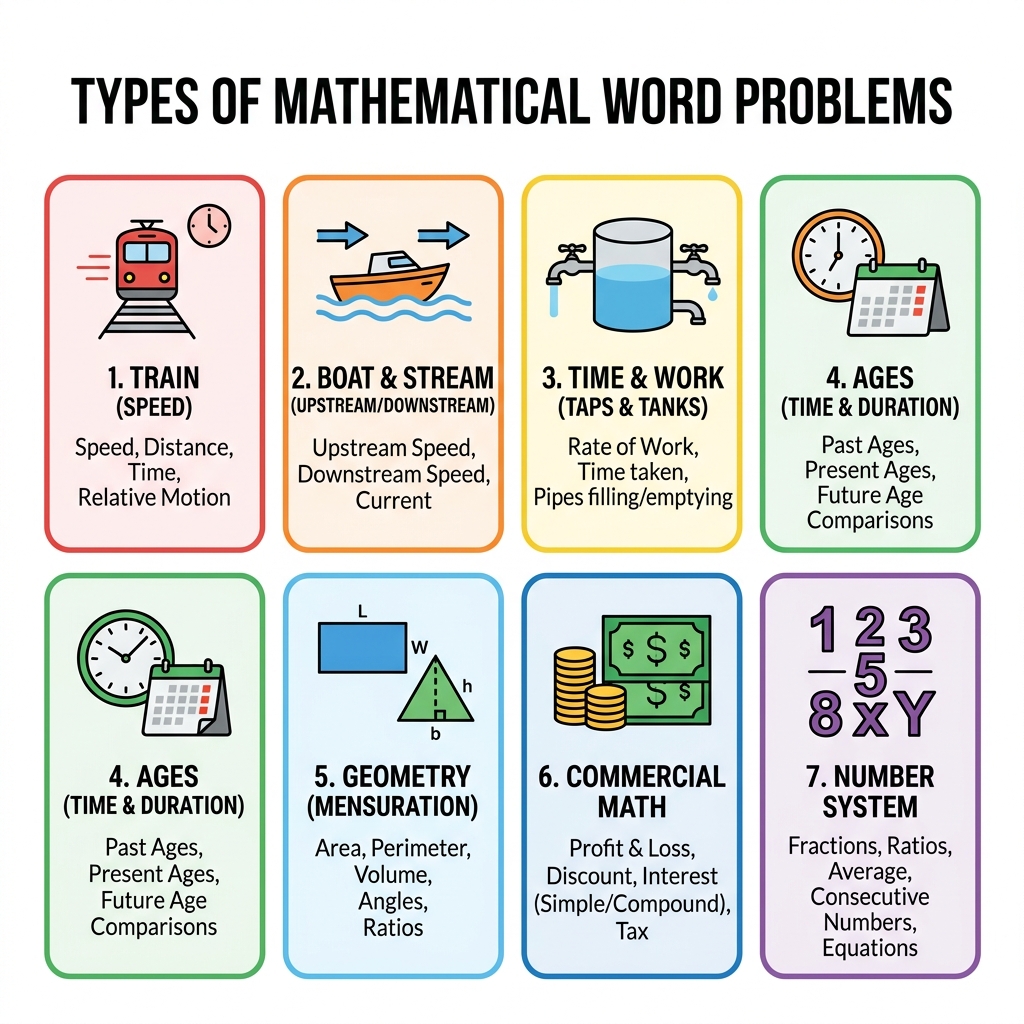
Word problems form the core of the 4-marker/5-marker section in the board exams. We have categorized every possible word problem into 7 Archetypes.
Type 1: Numbers, Digits & Fractions
Key Concepts:
- Two consecutive natural numbers: $x$ and $x+1$.
- Two consecutive odd/even numbers: $x$ and $x+2$.
- Two-digit number with tens digit $x$ and units digit $y$: Value $= 10x + y$.
Example: The sum of the squares of two consecutive odd positive integers is 290. Find them.
Let integers be $x$ and $x+2$.
$x^2 + (x+2)^2 = 290$
$x^2 + x^2 + 4x + 4 = 290 \implies 2x^2 + 4x - 286 = 0 \implies x^2 + 2x - 143 = 0$
Splitting middle term ($13 \times -11 = -143$): $x^2 + 13x - 11x - 143 = 0 \implies (x+13)(x-11)=0$
Since they are positive, $x = 11$. The numbers are 11 and 13.
Type 2: Age Problems
Key Concepts: Always assume the present age to be $x$. If age 5 years ago, use $(x-5)$. If age 3 years from now, use $(x+3)$.
Example: The sum of the reciprocals of Rehman's age (in years) 3 years ago and 5 years from now is 1/3. Find his present age.
Present age $= x$. Age 3 years ago $= x - 3$. Age 5 years from now $= x + 5$.
Equation: $\frac{1}{x-3} + \frac{1}{x+5} = \frac{1}{3}$
LCM: $\frac{(x+5) + (x-3)}{(x-3)(x+5)} = \frac{1}{3} \implies \frac{2x+2}{x^2+2x-15} = \frac{1}{3}$
Cross multiply: $6x + 6 = x^2 + 2x - 15 \implies x^2 - 4x - 21 = 0$
Factorize: $(x-7)(x+3) = 0$. Since age cannot be negative, $x = 7$ years.
Type 3: Speed, Distance & Time (The Classic Train Problem)
Key Formula: $\text{Time} = \frac{\text{Distance}}{\text{Speed}}$
Example: A train travels 360 km at a uniform speed. If the speed had been 5 km/h more, it would have taken 1 hour less for the same journey. Find the speed.
Let uniform speed be $x$ km/h. Distance $= 360$ km.
Original Time $t_1 = \frac{360}{x}$. New Time $t_2 = \frac{360}{x+5}$.
Equation (Original Time - New Time = Difference): $\frac{360}{x} - \frac{360}{x+5} = 1$
$360[\frac{x+5-x}{x(x+5)}] = 1 \implies 360(5) = x^2 + 5x \implies x^2 + 5x - 1800 = 0$
Factors of 1800 with diff 5: $45 \times 40 = 1800$.
$(x+45)(x-40) = 0$. Speed cannot be negative, so $x = 40$ km/h.
Type 4: Upstream & Downstream (Boats & Streams)
Key Concepts: Let speed of boat in still water be $x$, speed of stream be $y$.
Upstream Speed (against current) $= x - y$. Downstream Speed (with current) $= x + y$.
Example: A motor boat whose speed is 18 km/h in still water takes 1 hour more to go 24 km upstream than to return downstream. Find the speed of the stream.
Boat speed $x = 18$. Let stream speed be $y$.
Upstream speed $= 18-y$. Downstream speed $= 18+y$. Distance $= 24$.
Time Upstream = Time Downstream + 1
$\frac{24}{18-y} - \frac{24}{18+y} = 1$
$24 [\frac{18+y-(18-y)}{(18-y)(18+y)}] = 1 \implies 24[\frac{2y}{324-y^2}] = 1 \implies 48y = 324 - y^2$
$y^2 + 48y - 324 = 0$. Factors: $54 \times -6$. $(y+54)(y-6) = 0$.
Speed of stream cannot be negative, so $y = 6$ km/h.
Type 5: Time & Work (Pipes & Cisterns)
Key Concepts: If a pipe fills a tank in $x$ hours, the part of tank filled in 1 hour is $\frac{1}{x}$.
Example: Two water taps together can fill a tank in $9\frac{3}{8}$ hours (75/8 hours). The tap of larger diameter takes 10 hours less than the smaller one to fill the tank separately. Find the time in which each tap can separately fill the tank.
Let smaller tap take $x$ hours. Larger tap takes $(x-10)$ hours.
In 1 hour, smaller tap fills $1/x$, larger fills $1/(x-10)$.
Together they fill in 1 hour: $\frac{1}{x} + \frac{1}{x-10} = \frac{1}{\text{Total Time}} = \frac{1}{75/8} = \frac{8}{75}$
$\frac{x-10+x}{x(x-10)} = \frac{8}{75} \implies \frac{2x-10}{x^2-10x} = \frac{8}{75}$
Cross multiply: $75(2x-10) = 8(x^2-10x) \implies 150x - 750 = 8x^2 - 80x \implies 8x^2 - 230x + 750 = 0$
Divide by 2: $4x^2 - 115x + 375 = 0$
Solving yields $x=25$ or $x=3.75$. If $x=3.75$, larger tap takes $3.75-10$ (negative time, impossible).
So smaller tap takes 25 hours, larger takes 15 hours.
Type 6: Geometry & Mensuration
Key Concepts: Use Pythagoras theorem ($H^2 = P^2 + B^2$) for right triangles. Use Area $= l \times b$ and Perimeter $= 2(l+b)$ for rectangles.
Example: The altitude of a right triangle is 7 cm less than its base. If the hypotenuse is 13 cm, find the other two sides.
Let base be $x$. Altitude $= x - 7$. Hypotenuse $= 13$.
Pythagoras theorem: $(x)^2 + (x-7)^2 = (13)^2$
$x^2 + x^2 - 14x + 49 = 169 \implies 2x^2 - 14x - 120 = 0 \implies x^2 - 7x - 60 = 0$
Factors: $(x-12)(x+5) = 0$. Since side $> 0$, $x = 12$.
Base = 12 cm, Altitude = 5 cm.
Type 7: Commercial Mathematics (Cost & Quantity)
Key Concepts: $\text{Total Cost} = \text{Price per item} \times \text{Number of items}$
Example: A shopkeeper buys a number of books for ₹80. If he had bought 4 more books for the same amount, each book would have cost ₹1 less. Find the original number of books.
Let original number of books be $x$. Original cost per book $= \frac{80}{x}$.
New number of books $= x+4$. New cost per book $= \frac{80}{x+4}$.
Difference in cost $= 1$
$\frac{80}{x} - \frac{80}{x+4} = 1$
$80[\frac{x+4-x}{x(x+4)}] = 1 \implies \frac{320}{x^2+4x} = 1 \implies x^2+4x-320 = 0$
Factors of -320 with difference 4: 20 and -16.
$(x+20)(x-16) = 0 \implies x=16$.
Original number of books = 16.
5. Board Exam Scenarios & HOTS Masterclass
This section covers questions that frequently appear in the board exams but require advanced algebraic manipulation.
5.1 Equations Reducible to Quadratic Form (Substitution Method)
Sometimes an equation looks like a degree 4 polynomial or has complex repeating blocks. We solve these by substituting the complex block with a single variable (e.g., $y$).
Example: Solve $3^{(x+2)} + 3^{-x} = 10$
Step 1: Use exponent laws $a^{m+n} = a^m \cdot a^n$
$3^x \cdot 3^2 + \frac{1}{3^x} = 10 \implies 9(3^x) + \frac{1}{3^x} = 10$
Step 2: Let $3^x = y$. The equation becomes:
$9y + \frac{1}{y} = 10 \implies \frac{9y^2+1}{y} = 10 \implies 9y^2 - 10y + 1 = 0$
Step 3: Solve for $y$:
$9y^2 - 9y - y + 1 = 0 \implies 9y(y-1) - 1(y-1) = 0 \implies (9y-1)(y-1) = 0$
$y = 1/9$ or $y = 1$.
Step 4: Re-substitute $y = 3^x$:
Case 1: $3^x = 1/9 \implies 3^x = 3^{-2} \implies x = -2$
Case 2: $3^x = 1 \implies 3^x = 3^0 \implies x = 0$
Roots: $x = -2, 0$
5.2 Unknown Variables in Roots Relationships
If $\alpha$ and $\beta$ are roots of $ax^2 + bx + c = 0$, remember from Polynomials:
- $\alpha + \beta = -b/a$
- $\alpha \times \beta = c/a$
Example: If roots of the quadratic equation $x^2 - px + q = 0$ differ by 1, prove that $p^2 = 1 + 4q$. (NCERT Exemplar)
Let the roots be $\alpha$ and $\beta$.
Sum: $\alpha + \beta = p$. Product: $\alpha\beta = q$.
Given: $\alpha - \beta = 1$
Square both sides: $(\alpha - \beta)^2 = 1$
Use identity: $(\alpha + \beta)^2 - 4\alpha\beta = 1$
Substitute sum and product: $(p)^2 - 4(q) = 1$
$p^2 = 1 + 4q$. Proved!

© 2026 Vardaan Learning Institute. All rights reserved.
Designed exclusively for CBSE Class 10 Board Preparation.