
Board Exam 2025
1 Mark
Q5. If the given figure shows the graph of
polynomial \(y = ax^2 + bx + c\), then :
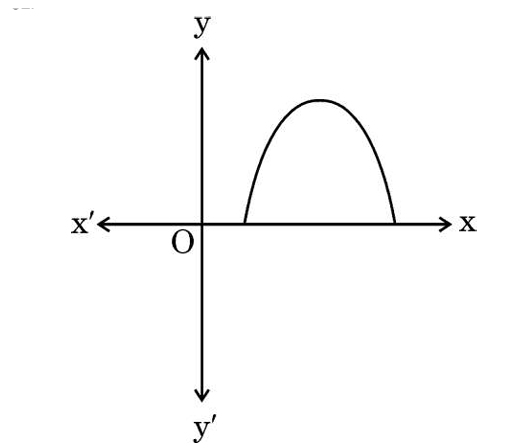
1. The parabola opens downwards, so \(a < 0\). (Matches Option A).
2. It cuts the x-axis at two distinct points, so \(D = b^2 - 4ac > 0\). (Option B is false).
3. The y-intercept (where \(x=0\)) is positive (above the origin), so \(c > 0\). (Matches Option C).
Answer: (A)
2. It cuts the x-axis at two distinct points, so \(D = b^2 - 4ac > 0\). (Option B is false).
3. The y-intercept (where \(x=0\)) is positive (above the origin), so \(c > 0\). (Matches Option C).
Answer: (A)
3 Marks
Q29. If \(\alpha, \beta\) are the zeroes of
the
polynomial \(p(x) = x^2 - 2x - 3\), then find a polynomial where zeroes are \((2\alpha + 3\beta)\)
and
\((3\alpha + 2\beta)\).
\(p(x) = x^2 - 2x - 3\). Zeroes are \(\alpha, \beta\).
Sum: \(\alpha + \beta = 2\). Product: \(\alpha\beta = -3\).
Let new zeroes be \(A = 2\alpha + 3\beta\) and \(B = 3\alpha + 2\beta\).
Sum of new zeroes \(S = A + B = (2\alpha + 3\beta) + (3\alpha + 2\beta) = 5\alpha + 5\beta = 5(\alpha + \beta) = 5(2) = 10\).
Product of new zeroes \(P = A \cdot B = (2\alpha + 3\beta)(3\alpha + 2\beta) = 6\alpha^2 + 4\alpha\beta + 9\alpha\beta + 6\beta^2\).
\(P = 6(\alpha^2 + \beta^2) + 13\alpha\beta\).
We know \(\alpha^2 + \beta^2 = (\alpha + \beta)^2 - 2\alpha\beta = (2)^2 - 2(-3) = 4 + 6 = 10\).
\(P = 6(10) + 13(-3) = 60 - 39 = 21\).
New Polynomial: \(k[x^2 - Sx + P] = k[x^2 - 10x + 21]\).
Sum: \(\alpha + \beta = 2\). Product: \(\alpha\beta = -3\).
Let new zeroes be \(A = 2\alpha + 3\beta\) and \(B = 3\alpha + 2\beta\).
Sum of new zeroes \(S = A + B = (2\alpha + 3\beta) + (3\alpha + 2\beta) = 5\alpha + 5\beta = 5(\alpha + \beta) = 5(2) = 10\).
Product of new zeroes \(P = A \cdot B = (2\alpha + 3\beta)(3\alpha + 2\beta) = 6\alpha^2 + 4\alpha\beta + 9\alpha\beta + 6\beta^2\).
\(P = 6(\alpha^2 + \beta^2) + 13\alpha\beta\).
We know \(\alpha^2 + \beta^2 = (\alpha + \beta)^2 - 2\alpha\beta = (2)^2 - 2(-3) = 4 + 6 = 10\).
\(P = 6(10) + 13(-3) = 60 - 39 = 21\).
New Polynomial: \(k[x^2 - Sx + P] = k[x^2 - 10x + 21]\).
1 Mark
Q6. Two polynomials are shown in the graph
below.
The number of distinct zeroes of both the polynomials is:
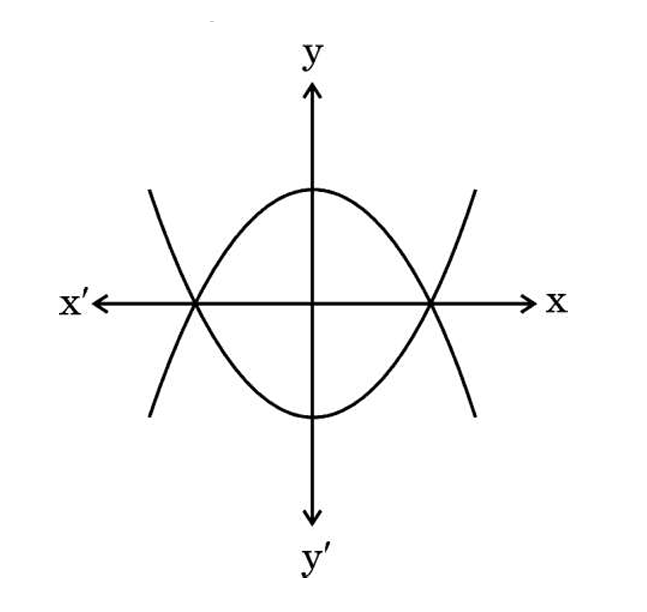
The number of distinct zeroes of a polynomial is equal to the number of points where its graph
intersects the x-axis.
By observing the graph for the two polynomials:
- The first polynomial intersects the x-axis at 2 distinct points.
- The second polynomial intersects the x-axis at 2 distinct points.
- (Depending on the specific graph provided in the question, counting the total unique intersection points).
Assuming the standard figure for this question shows a total of 4 distinct points of intersection.
Answer: (D)
By observing the graph for the two polynomials:
- The first polynomial intersects the x-axis at 2 distinct points.
- The second polynomial intersects the x-axis at 2 distinct points.
- (Depending on the specific graph provided in the question, counting the total unique intersection points).
Assuming the standard figure for this question shows a total of 4 distinct points of intersection.
Answer: (D)
1 Mark
Q11. The sum of the zeroes of the polynomial
\(p(x) = 5x - 7x^2 + 3\) is:
Rewrite in standard form: \(p(x) = -7x^2 + 5x + 3\).
Sum of zeroes \(\alpha + \beta = -\frac{b}{a} = -\frac{5}{-7} = \frac{5}{7}\).
Answer: (C)
Sum of zeroes \(\alpha + \beta = -\frac{b}{a} = -\frac{5}{-7} = \frac{5}{7}\).
Answer: (C)
2 Marks
Q24. Find the zeroes of the polynomial p(x) =
\(x^2 + \frac{4}{3}x - \frac{4}{3} = 0\)
For finding zeroes, \(x^2 + \frac{4}{3}x - \frac{4}{3} = 0\). Multiply by 3: \(3x^2 + 4x - 4 =
0\).
Factorize: \(3x^2 + 6x - 2x - 4 = 0 \Rightarrow 3x(x + 2) - 2(x + 2) = 0\).
\((3x - 2)(x + 2) = 0\).
Zeroes are \(x = \frac{2}{3}\) and \(x = -2\).
Factorize: \(3x^2 + 6x - 2x - 4 = 0 \Rightarrow 3x(x + 2) - 2(x + 2) = 0\).
\((3x - 2)(x + 2) = 0\).
Zeroes are \(x = \frac{2}{3}\) and \(x = -2\).
1 Mark
Q5. If one zero of the polynomial q(x) =
(p�
+
4)x� + 65x + 4p is reciprocal of the other, then the value of �p� is :
Let zeros be \(\alpha\) and \(1/\alpha\).
Product of zeros = \(\frac{c}{a} = \frac{4p}{p^2+4}\).
\(\alpha \times \frac{1}{\alpha} = 1 \Rightarrow \frac{4p}{p^2+4} = 1\).
\(p^2 + 4 = 4p \Rightarrow p^2 - 4p + 4 = 0 \Rightarrow (p-2)^2 = 0 \Rightarrow p = 2\).
Answer: (D)
Product of zeros = \(\frac{c}{a} = \frac{4p}{p^2+4}\).
\(\alpha \times \frac{1}{\alpha} = 1 \Rightarrow \frac{4p}{p^2+4} = 1\).
\(p^2 + 4 = 4p \Rightarrow p^2 - 4p + 4 = 0 \Rightarrow (p-2)^2 = 0 \Rightarrow p = 2\).
Answer: (D)
2 Marks
Q23. If p and q are zeroes of the
polynomial
p(y)
= 21y� - y - 2, then find the value of (1 - p) . (1 - q).
\(p(y) = 21y^2 - y - 2\).
Sum of zeros \((p+q) = -(-1)/21 = 1/21\).
Product of zeros \((pq) = -2/21\).
Expression: \((1-p)(1-q) = 1 - q - p + pq = 1 - (p+q) + pq\).
Substitute values: \(1 - \frac{1}{21} + (\frac{-2}{21}) = 1 - \frac{1}{21} - \frac{2}{21}\).
\(= 1 - \frac{3}{21} = 1 - \frac{1}{7} = \frac{6}{7}\).
Sum of zeros \((p+q) = -(-1)/21 = 1/21\).
Product of zeros \((pq) = -2/21\).
Expression: \((1-p)(1-q) = 1 - q - p + pq = 1 - (p+q) + pq\).
Substitute values: \(1 - \frac{1}{21} + (\frac{-2}{21}) = 1 - \frac{1}{21} - \frac{2}{21}\).
\(= 1 - \frac{3}{21} = 1 - \frac{1}{7} = \frac{6}{7}\).
1 Mark
Q4. If \(\alpha\) and \(\beta\) are
zeroes of
the
polynomial \(p(x) = kx^2 - 30x + 45k\) and \(\alpha + \beta = \alpha\beta\), then the value of
'k'
is:
Sum of zeroes \(\alpha + \beta = -\frac{-30}{k} = \frac{30}{k}\).
Product of zeroes \(\alpha\beta = \frac{45k}{k} = 45\).
Given \(\alpha + \beta = \alpha\beta \Rightarrow \frac{30}{k} = 45\).
\(k = \frac{30}{45} = \frac{2}{3}\).
Answer: (D)
Product of zeroes \(\alpha\beta = \frac{45k}{k} = 45\).
Given \(\alpha + \beta = \alpha\beta \Rightarrow \frac{30}{k} = 45\).
\(k = \frac{30}{45} = \frac{2}{3}\).
Answer: (D)
1 Mark
Q12. Zeroes of the polynomial \(p(x) =
x^2 -
3\sqrt{2}x + 4\) are:
Using quadratic formula: \(x = \frac{3\sqrt{2} \pm \sqrt{(3\sqrt{2})^2 -
4(1)(4)}}{2}\).
\(x = \frac{3\sqrt{2} \pm \sqrt{18 - 16}}{2} = \frac{3\sqrt{2} \pm \sqrt{2}}{2}\).
Roots are \(\frac{4\sqrt{2}}{2} = 2\sqrt{2}\) and \(\frac{2\sqrt{2}}{2} = \sqrt{2}\).
Answer: (B)
\(x = \frac{3\sqrt{2} \pm \sqrt{18 - 16}}{2} = \frac{3\sqrt{2} \pm \sqrt{2}}{2}\).
Roots are \(\frac{4\sqrt{2}}{2} = 2\sqrt{2}\) and \(\frac{2\sqrt{2}}{2} = \sqrt{2}\).
Answer: (B)
2 Marks
Q22. (a) Find the value(s) of 'k' so that
the quadratic equation \(4x^2 + kx + 1 = 0\) has real and equal roots.
OR
Q22. (b) If '\(\alpha\)' and '\(\beta\)'
are
the zeroes of the polynomial \(p(y) = y^2 - 5y + 3\), then find the value of \(\alpha^4\beta^3 +
\alpha^3\beta^4\).
(a): For real and equal roots, Discriminant \(D = 0\).
\(b^2 - 4ac = 0 \Rightarrow k^2 - 4(4)(1) = 0\).
\(k^2 - 16 = 0 \Rightarrow k^2 = 16 \Rightarrow k = \pm 4\).
(b): \(p(y) = y^2 - 5y + 3\).
Sum \(\alpha + \beta = 5\). Product \(\alpha\beta = 3\).
Expression: \(\alpha^4\beta^3 + \alpha^3\beta^4 = \alpha^3\beta^3(\alpha + \beta) = (\alpha\beta)^3(\alpha + \beta)\).
Substitute values: \((3)^3(5) = 27 \times 5 = 135\).
\(b^2 - 4ac = 0 \Rightarrow k^2 - 4(4)(1) = 0\).
\(k^2 - 16 = 0 \Rightarrow k^2 = 16 \Rightarrow k = \pm 4\).
(b): \(p(y) = y^2 - 5y + 3\).
Sum \(\alpha + \beta = 5\). Product \(\alpha\beta = 3\).
Expression: \(\alpha^4\beta^3 + \alpha^3\beta^4 = \alpha^3\beta^3(\alpha + \beta) = (\alpha\beta)^3(\alpha + \beta)\).
Substitute values: \((3)^3(5) = 27 \times 5 = 135\).
1 Mark
Q8. Which of the following statements is true
for
a polynomial \(p(x)\) of degree 3?
A polynomial of degree \(n\) can have at most \(n\) real zeroes.
- It may have fewer than \(n\) real zeroes (e.g., if some are complex), but it cannot have more than \(n\).
- Therefore, a polynomial of degree 3 has at most 3 distinct real zeroes.
Answer: (d)
- It may have fewer than \(n\) real zeroes (e.g., if some are complex), but it cannot have more than \(n\).
- Therefore, a polynomial of degree 3 has at most 3 distinct real zeroes.
Answer: (d)
3 Marks
Q28. If \(\alpha\) and \(\beta\) are the
zeroes
of the polynomial \(ax^2 - x + c\). Obtain a polynomial whose zeroes are \(\alpha - 3\) and \(\beta
-
3\).
Given polynomial: \(p(x) = ax^2 - x + c\).
Comparing with standard form \(Ax^2 + Bx + C\): \(A=a, B=-1, C=c\).
Sum of zeroes: \(\alpha + \beta = -\frac{B}{A} = -\frac{-1}{a} = \frac{1}{a}\).
Product of zeroes: \(\alpha\beta = \frac{C}{A} = \frac{c}{a}\).
New Polynomial:
Zeroes are \((\alpha - 3)\) and \((\beta - 3)\).
Sum of new zeroes (S):
\(S = (\alpha - 3) + (\beta - 3) = (\alpha + \beta) - 6\).
\(S = \frac{1}{a} - 6 = \frac{1 - 6a}{a}\).
Product of new zeroes (P):
\(P = (\alpha - 3)(\beta - 3) = \alpha\beta - 3\alpha - 3\beta + 9\).
\(P = \alpha\beta - 3(\alpha + \beta) + 9\).
\(P = \frac{c}{a} - 3(\frac{1}{a}) + 9 = \frac{c - 3}{a} + 9 = \frac{c - 3 + 9a}{a}\).
Required Polynomial: \(k[x^2 - Sx + P]\)
Let \(k = a\) (to remove denominator):
\(a[x^2 - \frac{1-6a}{a}x + \frac{c-3+9a}{a}]\)
\(= ax^2 - (1-6a)x + (c - 3 + 9a)\).
Comparing with standard form \(Ax^2 + Bx + C\): \(A=a, B=-1, C=c\).
Sum of zeroes: \(\alpha + \beta = -\frac{B}{A} = -\frac{-1}{a} = \frac{1}{a}\).
Product of zeroes: \(\alpha\beta = \frac{C}{A} = \frac{c}{a}\).
New Polynomial:
Zeroes are \((\alpha - 3)\) and \((\beta - 3)\).
Sum of new zeroes (S):
\(S = (\alpha - 3) + (\beta - 3) = (\alpha + \beta) - 6\).
\(S = \frac{1}{a} - 6 = \frac{1 - 6a}{a}\).
Product of new zeroes (P):
\(P = (\alpha - 3)(\beta - 3) = \alpha\beta - 3\alpha - 3\beta + 9\).
\(P = \alpha\beta - 3(\alpha + \beta) + 9\).
\(P = \frac{c}{a} - 3(\frac{1}{a}) + 9 = \frac{c - 3}{a} + 9 = \frac{c - 3 + 9a}{a}\).
Required Polynomial: \(k[x^2 - Sx + P]\)
Let \(k = a\) (to remove denominator):
\(a[x^2 - \frac{1-6a}{a}x + \frac{c-3+9a}{a}]\)
\(= ax^2 - (1-6a)x + (c - 3 + 9a)\).
3 Marks
Q26. Find the zeroes of the polynomial \(p(x)
=
6x^2 - 5x - 1\). Hence, obtain a polynomial each of whose zeroes is three times the zeroes of
\(p(x)\).
Factorize: \(6x^2 - 6x + x - 1 = 6x(x-1) + 1(x-1) = (6x+1)(x-1)\).
Zeroes: \(\alpha = 1, \beta = -1/6\).
New zeroes: \(A = 3(1) = 3, B = 3(-1/6) = -1/2\).
Sum \(S = 3 - 0.5 = 5/2\). Product \(P = 3(-0.5) = -3/2\).
Poly: \(k[x^2 - Sx + P] \Rightarrow k[x^2 - \frac{5}{2}x - \frac{3}{2}]\).
For \(k = 2\): \(2x^2 - 5x - 3\).
Zeroes: \(\alpha = 1, \beta = -1/6\).
New zeroes: \(A = 3(1) = 3, B = 3(-1/6) = -1/2\).
Sum \(S = 3 - 0.5 = 5/2\). Product \(P = 3(-0.5) = -3/2\).
Poly: \(k[x^2 - Sx + P] \Rightarrow k[x^2 - \frac{5}{2}x - \frac{3}{2}]\).
For \(k = 2\): \(2x^2 - 5x - 3\).
1 Mark
Q13. If the zeroes of the polynomial \(ax^2 +
bx +
\frac{2a}{b}\) are reciprocal of each other, then the value of \(b\) is
Let the zeroes be \(\alpha\) and \(\frac{1}{\alpha}\).
Product of zeroes = \(\alpha \cdot \frac{1}{\alpha} = 1\).
From the polynomial \(P(x) = ax^2 + bx + \frac{2a}{b}\), product of zeroes = \(\frac{\text{Constant term}}{\text{Coeff of } x^2}\).
\(1 = \frac{(2a/b)}{a} \Rightarrow 1 = \frac{2}{b} \Rightarrow b = 2\).
Correct Option: (A)
Product of zeroes = \(\alpha \cdot \frac{1}{\alpha} = 1\).
From the polynomial \(P(x) = ax^2 + bx + \frac{2a}{b}\), product of zeroes = \(\frac{\text{Constant term}}{\text{Coeff of } x^2}\).
\(1 = \frac{(2a/b)}{a} \Rightarrow 1 = \frac{2}{b} \Rightarrow b = 2\).
Correct Option: (A)
3 Marks
Q31. Find the zeroes of the polynomial \(r(x)
= 4x^2 + 3x -
1\). Hence, write a polynomial whose zeroes are reciprocal of the zeroes of polynomial \(r(x)\).
Step 1: Find zeroes of \(r(x)\)
\(4x^2 + 3x - 1 = 0\)
Using splitting the middle term: \(4x^2 + 4x - x - 1 = 0\)
\(4x(x+1) - 1(x+1) = 0\)
\((4x-1)(x+1) = 0\)
Zeroes are \(x = \frac{1}{4}\) and \(x = -1\).
Step 2: Find the new polynomial
The zeroes of the new polynomial are reciprocals: \(4\) and \(-1\).
Sum of zeroes \((S) = 4 + (-1) = 3\).
Product of zeroes \((P) = 4 \times (-1) = -4\).
Required Polynomial \(k(x^2 - Sx + P) = k(x^2 - 3x - 4)\).
Taking \(k=1\), the polynomial is \(x^2 - 3x - 4\).
\(4x^2 + 3x - 1 = 0\)
Using splitting the middle term: \(4x^2 + 4x - x - 1 = 0\)
\(4x(x+1) - 1(x+1) = 0\)
\((4x-1)(x+1) = 0\)
Zeroes are \(x = \frac{1}{4}\) and \(x = -1\).
Step 2: Find the new polynomial
The zeroes of the new polynomial are reciprocals: \(4\) and \(-1\).
Sum of zeroes \((S) = 4 + (-1) = 3\).
Product of zeroes \((P) = 4 \times (-1) = -4\).
Required Polynomial \(k(x^2 - Sx + P) = k(x^2 - 3x - 4)\).
Taking \(k=1\), the polynomial is \(x^2 - 3x - 4\).
Board Exam 2024
2 Marks
Find the LCM and HCF of 6 and 20 by the prime factorization method.
\( 6 = 2 \times 3 \)
\( 20 = 2^2 \times 5 \)
HCF = \( 2 \) (lowest power of common factors)
LCM = \( 2^2 \times 3 \times 5 = 60 \)
\( 20 = 2^2 \times 5 \)
HCF = \( 2 \) (lowest power of common factors)
LCM = \( 2^2 \times 3 \times 5 = 60 \)
Board Exam 2023
3 Marks
Prove that \( 5 - \sqrt{3} \) is irrational, given that \( \sqrt{3} \) is
irrational.
Assume \( 5 - \sqrt{3} \) is rational, say \( = r \).
Then \( \sqrt{3} = 5 - r \), which is rational (difference of two rationals).
Contradiction: \( \sqrt{3} \) is given to be irrational.
∴ \( 5 - \sqrt{3} \) is irrational. ∎
Then \( \sqrt{3} = 5 - r \), which is rational (difference of two rationals).
Contradiction: \( \sqrt{3} \) is given to be irrational.
∴ \( 5 - \sqrt{3} \) is irrational. ∎
Board Exam 2022
2 Marks
Explain why \( 7 \times 11 \times 13 + 13 \) is a composite number.
\( 7 \times 11 \times 13 + 13 = 13(7 \times 11 + 1) = 13 \times 78 \)
Since it has factors other than 1 and itself, it is composite.
Since it has factors other than 1 and itself, it is composite.