Vardaan Learning Institute
Class 10 Mathematics • Chapter Notes
🌐 vardaanlearning.com
📞 9508841336
CHAPTER 2 — POLYNOMIALS
STRICTLY BASED ON CBSE RATIONALISED SYLLABUS
Reference: NCERT + R.D. Sharma + R.S. Aggarwal
1. Introduction to Polynomials
1.1 What is a Polynomial?
→ Definition: A polynomial is an algebraic expression consisting of variables and coefficients, involving only the operations of addition, subtraction, multiplication, and non-negative integer exponents of variables.
In general, a polynomial in variable $x$ is an expression of the form:
$$ p(x) = a_n x^n + a_{n-1} x^{n-1} + \dots + a_1 x + a_0 $$
Where $a_n, a_{n-1}, \dots, a_0$ are real numbers (called coefficients), $a_n \neq 0$, and $n$ is a non-negative integer.
Important
What is NOT a polynomial?
If a variable has a negative power, a fractional power, or is inside a square root, it is NOT a polynomial.
- $\sqrt{x} + 3$ $\implies$ Power is $1/2$ (fraction). Not a polynomial.
- $x^{-1} + 2x$ $\implies$ Power is $-1$ (negative). Not a polynomial.
- $\frac{1}{x-1}$ $\implies$ Variable in denominator. Not a polynomial.
- Terms: The individual parts separated by $+$ or $-$ signs. E.g., in $5x^2 - 3x + 2$, the terms are $5x^2$, $-3x$, and $2$.
- Constant Term: The term with no variable (e.g., the $2$ in the above expression).
1.2 Degree of a Polynomial
→ Definition: The highest power of the variable $x$ in a polynomial $p(x)$ is called the degree of the polynomial.
- Degree of a constant polynomial: For a non-zero constant like $7$, we can write it as $7x^0$. Hence, its degree is 0.
- Degree of the zero polynomial: The polynomial $0$ is called the zero polynomial. Its degree is not defined.
Examples of Degree:
- $p(x) = 4x + 2$ $\implies$ Highest power is 1. Degree = 1
- $q(y) = 5y^2 - 3y + 1$ $\implies$ Highest power is 2. Degree = 2
- $r(x) = \sqrt{2}x^3 + 5x - 8$ $\implies$ Highest power is 3. Degree = 3 (Note: $\sqrt{2}$ is a coefficient, which is fine!)
- $s(u) = 15$ $\implies$ Highest power is 0. Degree = 0
- $t(x) = x^5 - x^7 + 2$ $\implies$ Highest power is 7. Degree = 7
1.3 Types of Polynomials Based on Degree
| Type of Polynomial |
Degree |
General Form |
Examples |
| Linear |
1 |
$ax + b \quad (a \neq 0)$ |
$2x - 3$, $\sqrt{3}y + 5$, $z$ |
| Quadratic |
2 |
$ax^2 + bx + c \quad (a \neq 0)$ |
$x^2 - 5x + 6$, $4y^2 - 9$, $3z^2$ |
| Constant |
0 |
$c \quad (c \neq 0)$ |
$5, -12, \pi$ |
1.4 Types of Polynomials Based on Number of Terms
- Monomial: A polynomial with exactly ONE term. (e.g., $5x^2, -3y, 7$)
- Binomial: A polynomial with exactly TWO terms. (e.g., $x^2 - 4, 3y + 1$)
- Trinomial: A polynomial with exactly THREE terms. (e.g., $x^2 + 5x + 6$)
1.5 Value of a Polynomial
→ Definition: If $p(x)$ is a polynomial in $x$, and if $k$ is any real number, then the value obtained by replacing $x$ by $k$ in $p(x)$, is called the value of $p(x)$ at $x = k$, denoted by $p(k)$.
Worked Examples: Find the value of polynomials.
1. Let $p(x) = x^2 - 3x - 4$. Find $p(0)$.
$p(0) = (0)^2 - 3(0) - 4 = -4$.
2. Find $p(1)$ for the same polynomial.
$p(1) = (1)^2 - 3(1) - 4 = 1 - 3 - 4 = -6$.
3. Find $p(-1)$ for the same polynomial.
$p(-1) = (-1)^2 - 3(-1) - 4 = 1 + 3 - 4 = 0$.
4. Let $q(y) = 2y^3 - 4y + 5$. Find $q(2)$.
$q(2) = 2(2)^3 - 4(2) + 5 = 2(8) - 8 + 5 = 16 - 8 + 5 = 13$.
5. Let $r(t) = 5t^2 - t$. Find $r(-2)$.
$r(-2) = 5(-2)^2 - (-2) = 5(4) + 2 = 20 + 2 = 22$.
Practice Problems (Section 1)
- Identify if $\frac{1}{x} + x$ is a polynomial. (Ans: No, $1/x = x^{-1}$)
- Write the degree of $p(x) = 4x^3 - 2x^5 + 7$. (Ans: 5)
- Classify based on terms and degree: $3x^2 - x$. (Ans: Binomial, Quadratic)
- Find $p(-3)$ if $p(x) = 2x^2 + x - 1$. (Ans: $2(9) - 3 - 1 = 14$)
- What is the degree of the zero polynomial? (Ans: Not defined)
2. Zeros of a Polynomial
2.1 What is a Zero of a Polynomial?
→ Definition: A real number $k$ is said to be a zero of a polynomial $p(x)$, if $p(k) = 0$.
→ Explanation: A "zero" is simply a "root" or "solution" to the equation $p(x) = 0$. It is the specific value of $x$ that, when plugged into the expression, destroys the entire expression and makes the final answer exactly $0$.
Warning: Do not confuse the "number 0" with "the zero of a polynomial". A polynomial's zero can be $5, -3/2$, or even the number $0$ itself.
Fact
How many zeros can a polynomial have?
A polynomial of degree $n$ can have
at most $n$ real zeros.
- Linear (Degree 1): Exactly 1 zero.
- Quadratic (Degree 2): At most 2 zeros.
2.2 Finding Zeros of a Linear Polynomial
General form: $p(x) = ax + b \quad (a \neq 0)$.
To find the zero, set $p(x) = 0$.
$ax + b = 0 \implies ax = -b \implies x = \frac{-b}{a}$
Worked Examples (Linear Zeros):
1. $p(x) = 2x - 6 \implies 2x - 6 = 0 \implies 2x = 6 \implies x = 3$. (Verify: $p(3) = 2(3)-6 = 0$)
2. $p(x) = 3x + 5 \implies 3x + 5 = 0 \implies x = -5/3$.
3. $p(x) = -4x + 8 \implies -4x + 8 = 0 \implies 4x = 8 \implies x = 2$.
4. $p(x) = \sqrt{2}x - 2 \implies \sqrt{2}x = 2 \implies x = \frac{2}{\sqrt{2}} = \sqrt{2}$.
5. $p(x) = 5x \implies 5x = 0 \implies x = 0$.
2.3 Finding Zeros of a Quadratic Polynomial
General form: $p(x) = ax^2 + bx + c$. There are three primary algebraic methods to find its zeros.
METHOD 1: Factorisation (Splitting the Middle Term)
To factorise $ax^2 + bx + c$:
1. Find the product $a \times c$.
2. Find two numbers whose product is $ac$ and whose sum is $b$ (the middle coefficient).
3. Split the middle term $bx$ using these two numbers.
4. Take common factors from pairs of terms.
Examples using Splitting the Middle Term:
1. Find zeros of $p(x) = x^2 - 5x + 6$.
Here $a=1, b=-5, c=6$. Product $ac = 6$. We need two numbers that multiply to 6 and add to -5. The numbers are -2 and -3.
$x^2 - 2x - 3x + 6 = 0$
$x(x - 2) - 3(x - 2) = 0$
$(x - 2)(x - 3) = 0$
Either $x-2=0 \implies x=2$, OR $x-3=0 \implies x=3$. Zeros are 2 and 3.
2. Find zeros of $p(x) = 2x^2 - 8x + 6$.
Product $ac = 12$. Sum = -8. Numbers: -6 and -2.
$2x^2 - 6x - 2x + 6 = 0$
$2x(x - 3) - 2(x - 3) = 0 \implies (x - 3)(2x - 2) = 0$. Zeros are 3 and 1.
3. Find zeros of $p(x) = 6x^2 - 3 - 7x$.
Rearrange standard form: $6x^2 - 7x - 3 = 0$. Product = -18, Sum = -7. Numbers: -9 and 2.
$6x^2 - 9x + 2x - 3 = 0 \implies 3x(2x - 3) + 1(2x - 3) = 0$
$(2x - 3)(3x + 1) = 0$. Zeros are 3/2 and -1/3.
4. Find zeros of $p(x) = x^2 - 3$. (Difference of squares shortcut)
$x^2 - (\sqrt{3})^2 = 0 \implies (x - \sqrt{3})(x + \sqrt{3}) = 0$. Zeros are $\sqrt{3}$ and $-\sqrt{3}$.
5. Find zeros of $p(x) = 4u^2 + 8u$. (Taking common term shortcut)
$4u(u + 2) = 0$. Either $4u=0 \implies u=0$, OR $u+2=0 \implies u=-2$. Zeros are 0 and -2.
6. Find zeros of $p(x) = \sqrt{3}x^2 + 10x + 7\sqrt{3}$.
Product $= \sqrt{3} \times 7\sqrt{3} = 21$. Sum = 10. Numbers: 7 and 3.
$\sqrt{3}x^2 + 3x + 7x + 7\sqrt{3} = 0 \implies \sqrt{3}x(x + \sqrt{3}) + 7(x + \sqrt{3}) = 0$
$(x + \sqrt{3})(\sqrt{3}x + 7) = 0$. Zeros are $-\sqrt{3}$ and $-7/\sqrt{3}$.
7. Find zeros of $p(x) = x^2 - 2x - 8$.
$(x-4)(x+2) = 0 \implies x=4, x=-2$.
8. Find zeros of $p(x) = 3x^2 - x - 4$.
$(3x-4)(x+1) = 0 \implies x = 4/3, x = -1$.
METHOD 2: Quadratic Formula (Shridharacharya Formula)
Derivation
Deriving the Quadratic Formula (Completing the Square)
Let $ax^2 + bx + c = 0 \quad (a \neq 0)$.
Step 1: Divide entire equation by $a$:
$x^2 + \frac{b}{a}x + \frac{c}{a} = 0$
Step 2: Keep variable terms on LHS, move constant to RHS:
$x^2 + \frac{b}{a}x = -\frac{c}{a}$
Step 3: Add square of half the coefficient of $x$ on both sides. (Coefficient of $x$ is $b/a$, half is $b/2a$, square is $b^2/4a^2$):
$x^2 + \frac{b}{a}x + \left(\frac{b}{2a}\right)^2 = \left(\frac{b}{2a}\right)^2 - \frac{c}{a}$
Step 4: The LHS is now a perfect square $(A+B)^2$:
$\left(x + \frac{b}{2a}\right)^2 = \frac{b^2}{4a^2} - \frac{c}{a} = \frac{b^2 - 4ac}{4a^2}$
Step 5: Take the square root of both sides:
$x + \frac{b}{2a} = \pm \frac{\sqrt{b^2 - 4ac}}{2a}$
Step 6: Isolate $x$:
$$ x = \frac{-b \pm \sqrt{b^2 - 4ac}}{2a} $$
This is the celebrated Quadratic Formula. The term $D = b^2 - 4ac$ is called the
Discriminant.
• $D > 0$: Two distinct real zeros.
• $D = 0$: Two equal real zeros.
• $D < 0$: No real zeros.
Examples using Quadratic Formula:
1. Find zeros of $2x^2 - 7x + 3 = 0$.
$a=2, b=-7, c=3$. $D = (-7)^2 - 4(2)(3) = 49 - 24 = 25$.
$x = \frac{-(-7) \pm \sqrt{25}}{2(2)} = \frac{7 \pm 5}{4}$.
$x_1 = \frac{12}{4} = 3$. $x_2 = \frac{2}{4} = 1/2$.
2. Find zeros of $x^2 + 4x + 5 = 0$.
$a=1, b=4, c=5$. $D = 4^2 - 4(1)(5) = 16 - 20 = -4$.
Since $D < 0$, this polynomial has no real zeros.
3. Find zeros of $4x^2 - 12x + 9 = 0$.
$a=4, b=-12, c=9$. $D = (-12)^2 - 4(4)(9) = 144 - 144 = 0$.
$x = \frac{12 \pm \sqrt{0}}{8} = \frac{12}{8} = \frac{3}{2}$. (Two equal zeros of $3/2$).
4. Solve $x^2 - 2\sqrt{2}x + 2 = 0$.
$a=1, b=-2\sqrt{2}, c=2$. $D = (-2\sqrt{2})^2 - 4(1)(2) = 8 - 8 = 0$.
$x = \frac{2\sqrt{2} \pm 0}{2} = \sqrt{2}$.
5. Solve $3x^2 - 5x + 2 = 0$.
$D = 25 - 24 = 1$. $x = \frac{5 \pm 1}{6}$. $x_1 = 1, x_2 = 2/3$.
METHOD 3: Completing the Square Method (Direct Application)
1. Solve $2x^2 - 5x + 3 = 0$ by completing the square.
Divide by 2: $x^2 - \frac{5}{2}x + \frac{3}{2} = 0 \implies x^2 - \frac{5}{2}x = -\frac{3}{2}$.
Add $(5/4)^2 = 25/16$ to both sides:
$x^2 - \frac{5}{2}x + \frac{25}{16} = \frac{25}{16} - \frac{3}{2} \implies \left(x - \frac{5}{4}\right)^2 = \frac{25 - 24}{16} = \frac{1}{16}$.
$x - \frac{5}{4} = \pm \frac{1}{4}$.
$x = \frac{5}{4} + \frac{1}{4} = \frac{6}{4} = \frac{3}{2}$ OR $x = \frac{5}{4} - \frac{1}{4} = \frac{4}{4} = 1$.
2. Solve $5x^2 - 6x - 2 = 0$.
$x^2 - \frac{6}{5}x = \frac{2}{5} \implies x^2 - \frac{6}{5}x + \left(\frac{3}{5}\right)^2 = \frac{2}{5} + \frac{9}{25}$.
$\left(x - \frac{3}{5}\right)^2 = \frac{10 + 9}{25} = \frac{19}{25} \implies x - \frac{3}{5} = \pm\frac{\sqrt{19}}{5} \implies x = \frac{3 \pm \sqrt{19}}{5}$.
3. Solve $x^2 + 4x - 5 = 0$.
$x^2 + 4x = 5 \implies x^2 + 4x + 2^2 = 5 + 4 \implies (x+2)^2 = 9$.
$x+2 = \pm 3 \implies x = 1$ or $x = -5$.
3. Geometrical Meaning of Zeros
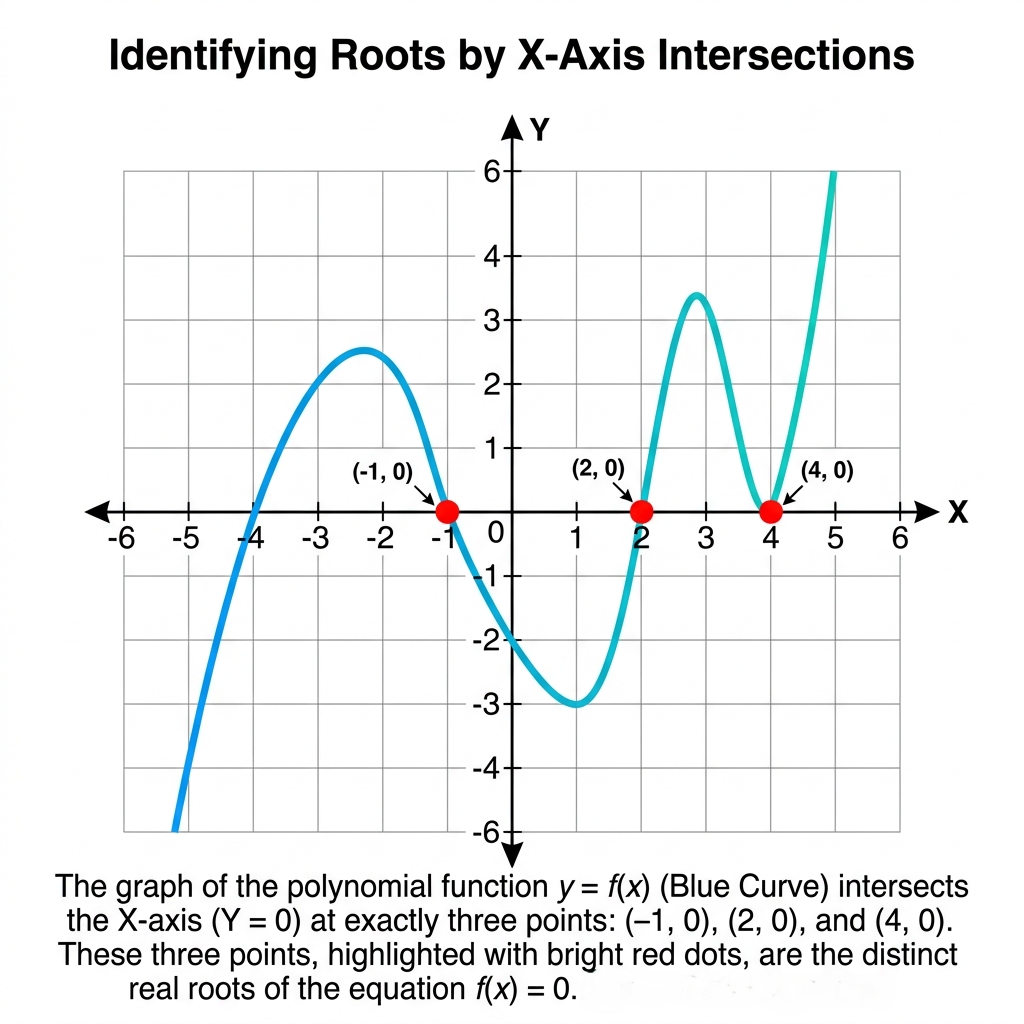
The zeros of a polynomial $p(x)$ are precisely the $x$-coordinates of the points where the graph of $y = p(x)$ intersects the $x$-axis.
3.1 Graph of a Linear Polynomial
- Shape: A straight line.
- For $y = ax + b$, the graph crosses the x-axis at exactly one point: $(-b/a, 0)$.
- Example: $y = 2x - 4$. If we plot this, it crosses the x-axis at $x=2$. Therefore, the zero is 2.
3.2 Graph of a Quadratic Polynomial — Parabola
- Shape: A curve called a Parabola (U-shaped or inverted U-shaped).
- If $a > 0$ (e.g., $y = 2x^2 + \dots$), the parabola opens UPWARDS.
- If $a < 0$ (e.g., $y = -x^2 + \dots$), the parabola opens DOWNWARDS.
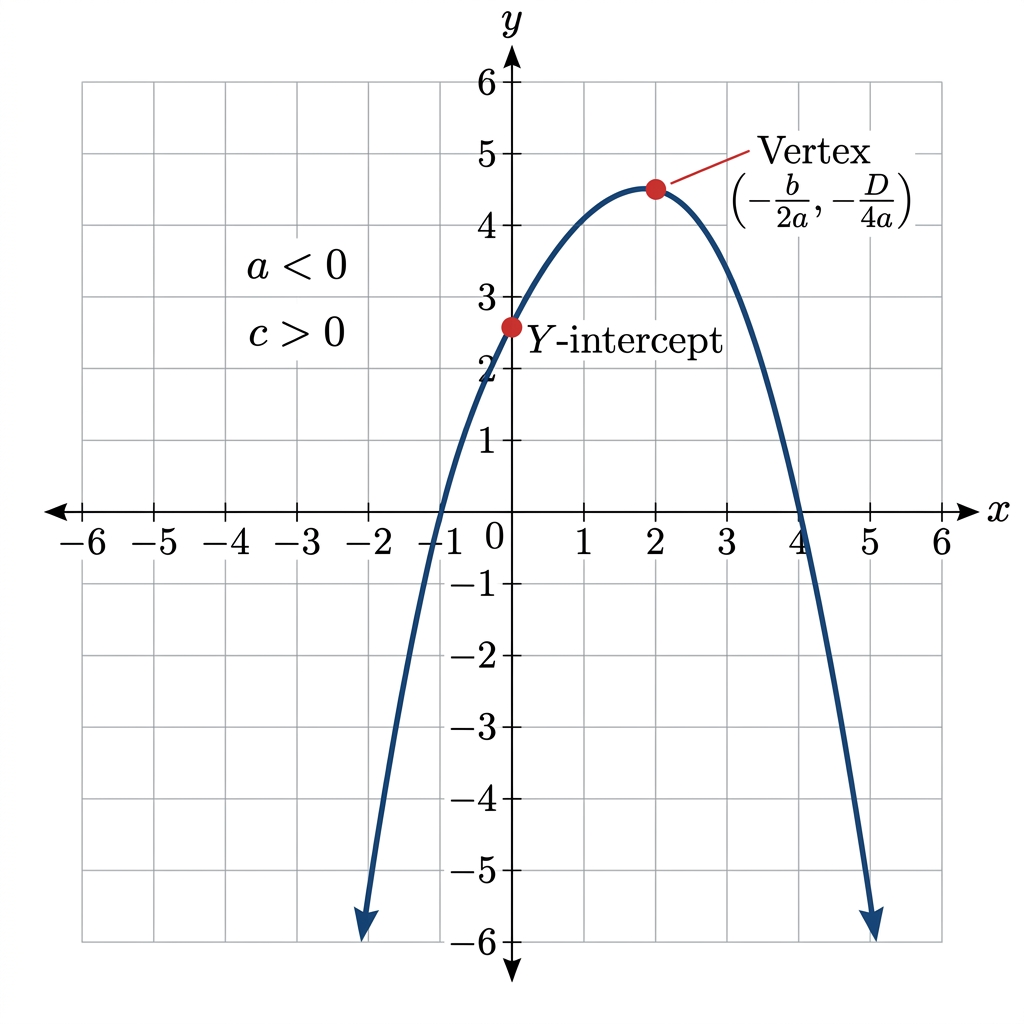
- Vertex: The turning point of the parabola. Its coordinates are $\left(-\frac{b}{2a}, -\frac{D}{4a}\right)$.
- Axis of Symmetry: The vertical line dividing the parabola into two identical halves is $x = -b/2a$.
Graph Cases
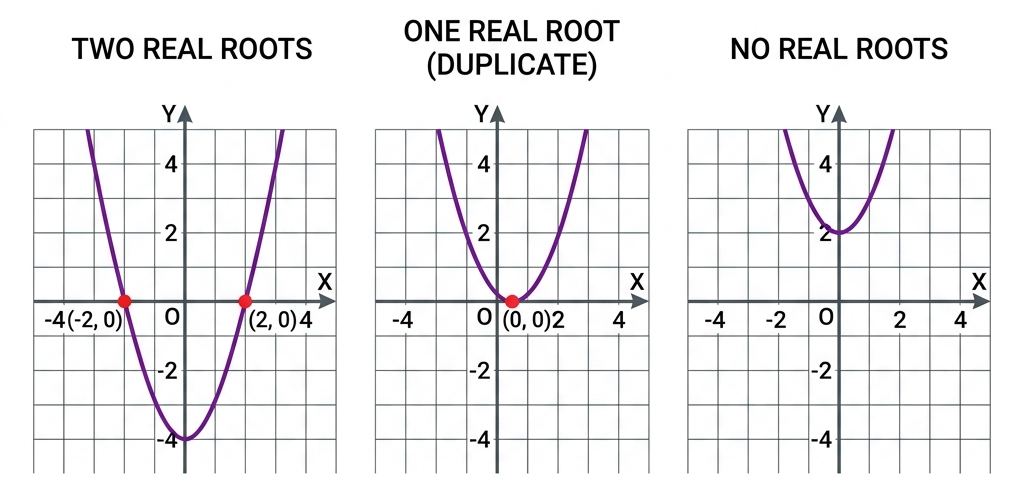
CASE 1 (D > 0): Parabola cuts x-axis at TWO distinct points. The polynomial has two distinct real zeros.
CASE 2 (D = 0): Parabola touches x-axis at exactly ONE point. The polynomial has two equal real zeros (repeated root).
CASE 3 (D < 0): Parabola lies entirely above or entirely below the x-axis and NEVER touches it. The polynomial has NO real zeros.
Worked Examples (Describing Quadratic Graphs):
1. Describe graph of $y = x^2 - 4x + 3$.
$a=1 > 0$, so it opens UPWARDS. $D = (-4)^2 - 4(1)(3) = 4 > 0$. It intersects the x-axis at two distinct points. Zeros are 1 and 3.
2. Describe graph of $y = -x^2 + 4x - 4$.
$a=-1 < 0$, opens DOWNWARDS. $D = 16 - 16 = 0$. It touches the x-axis at exactly one point ($x=2$).
3. Describe graph of $y = 2x^2 + 3$.
$a=2 > 0$, opens UPWARDS. $D = 0 - 24 = -24 < 0$. It does not intersect the x-axis. No real zeros.
4. Find the vertex of $y = x^2 - 6x + 5$.
$x$-coord $= -b/2a = -(-6)/2 = 3$. $y$-coord $= p(3) = 9 - 18 + 5 = -4$. Vertex is $(3, -4)$.
3.4 Reading Zeros from a Graph
To find the number of zeros from a graph, simply count how many times the curve touches or crosses the horizontal X-axis. Ignore the Y-axis!
Graph-reading Questions (Visualised in Words):
Q1: A straight line passes through $(0, 4)$ and $(-2, 0)$. How many zeros does the polynomial have?
Ans: It cuts the x-axis at exactly one point $(-2, 0)$. It has 1 zero (which is $x=-2$).
Q2: A parabola opens upwards and its vertex is at $(3, -5)$. It cuts the x-axis twice.
Ans: Since it cuts the x-axis twice, it has 2 real zeros.
Q3: A squiggly curve crosses the x-axis at -3, touches it at 1, and crosses it again at 4.
Ans: Total interaction with x-axis is 3 times. It has 3 zeros.
Q4: A U-shaped parabola is floating completely above the x-axis.
Ans: 0 intersections. The polynomial has 0 real zeros.
Q5: A graph cuts the Y-axis at $y=5$ and the X-axis at $x=3$.
Ans: Number of zeros = 1 (we only care about the X-axis cut).
4. Relationship between Zeros and Coefficients
4.1 Relationship for a Quadratic Polynomial
Let $p(x) = ax^2 + bx + c$ be a quadratic polynomial ($a \neq 0$), and let its two zeros be $\alpha$ and $\beta$.
Formulas
Sum of zeros: $\alpha + \beta = \frac{-b}{a} = \frac{-(\text{Coefficient of } x)}{\text{Coefficient of } x^2}$
Product of zeros: $\alpha \beta = \frac{c}{a} = \frac{\text{Constant term}}{\text{Coefficient of } x^2}$
Derivation
Full Derivation of Relations:
If $\alpha$ and $\beta$ are zeros of $ax^2 + bx + c$, then by the Factor Theorem, $(x - \alpha)$ and $(x - \beta)$ are factors of the polynomial.
Therefore, we can write the polynomial as:
$ax^2 + bx + c = k(x - \alpha)(x - \beta)$, where $k$ is a constant.
Expand the RHS:
$ax^2 + bx + c = k[x^2 - \beta x - \alpha x + \alpha\beta]$
$ax^2 + bx + c = kx^2 - k(\alpha + \beta)x + k\alpha\beta$
Now, compare the coefficients of corresponding powers of $x$ on both sides:
Coefficient of $x^2$: $a = k$
Coefficient of $x$: $b = -k(\alpha + \beta)$
Constant term: $c = k\alpha\beta$
Substitute $k = a$ into the other equations:
$b = -a(\alpha + \beta) \implies \mathbf{\alpha + \beta = \frac{-b}{a}}$
$c = a(\alpha\beta) \implies \mathbf{\alpha\beta = \frac{c}{a}}$. Hence derived.
Forming a Quadratic Polynomial when zeros are given:
If $\alpha$ and $\beta$ are the zeros, the quadratic polynomial is given by:
$p(x) = k[x^2 - (\text{Sum of zeros})x + (\text{Product of zeros})]$
$p(x) = k[x^2 - (\alpha + \beta)x + \alpha\beta]$, where $k$ is any non-zero real number (usually taken as 1 to clear denominators).
Worked Examples:
1. Find zeros of $x^2 - 2x - 8$ and verify relationship.
Zeros found earlier: $x=4, x=-2$. Let $\alpha=4, \beta=-2$.
Sum: $\alpha+\beta = 4+(-2) = 2$. By formula: $-b/a = -(-2)/1 = 2$. Verified.
Product: $\alpha\beta = 4(-2) = -8$. By formula: $c/a = -8/1 = -8$. Verified.
2. Find a quadratic polynomial whose zeros are 5 and -3.
$\alpha=5, \beta=-3$. Sum $S = 5-3=2$. Product $P = 5(-3)=-15$.
Polynomial: $x^2 - Sx + P = \mathbf{x^2 - 2x - 15}$.
3. Find a quadratic polynomial, the sum and product of whose zeros are -3 and 2.
Warning: Here Sum and Product are given directly! Do not add them again.
$S = -3, P = 2$.
Polynomial: $x^2 - (-3)x + 2 = \mathbf{x^2 + 3x + 2}$.
4. Find quadratic polynomial with sum $1/4$ and product $-1$.
$S = 1/4, P = -1$.
$p(x) = k[x^2 - \frac{1}{4}x - 1]$. Let $k=4$ to remove fraction.
$p(x) = \mathbf{4x^2 - x - 4}$.
5. If 1 is a zero of $p(x) = ax^2 - 3(a-1)x - 1$, find the value of a.
Since 1 is a zero, $p(1) = 0$.
$a(1)^2 - 3(a-1)(1) - 1 = 0$
$\implies a - 3a + 3 - 1 = 0$
$\implies -2a + 2 = 0 \implies a = 1$.
6. If one zero of $2x^2 - 3x + k$ is reciprocal to the other, find k.
Let zeros be $\alpha$ and $1/\alpha$.
Product of zeros = $\alpha \times (1/\alpha) = 1$.
By formula, Product = $c/a = k/2$.
So, $k/2 = 1 \implies \mathbf{k = 2}$.
7. If $\alpha$ and $\beta$ are zeros of $x^2 - 5x + 6$, find the value of $\alpha^2 + \beta^2$.
From polynomial: $\alpha+\beta = 5$, $\alpha\beta = 6$.
Identity: $\alpha^2 + \beta^2 = (\alpha+\beta)^2 - 2\alpha\beta = (5)^2 - 2(6) = 25 - 12 = \mathbf{13}$.
8. Find a quadratic polynomial whose zeros are exactly the squares of the zeros of $x^2 - 2x - 3$.
Let original zeros be $\alpha, \beta$. $\alpha+\beta = 2, \alpha\beta = -3$.
New zeros are $\alpha^2$ and $\beta^2$.
New Sum = $\alpha^2 + \beta^2 = (\alpha+\beta)^2 - 2\alpha\beta = (2)^2 - 2(-3) = 4 + 6 = 10$.
New Product = $\alpha^2 \beta^2 = (\alpha\beta)^2 = (-3)^2 = 9$.
New polynomial: $\mathbf{x^2 - 10x + 9}$.
4.3 Important Algebraic Identities
You must memorize these for HOTS (Higher Order Thinking Skills) questions:
- $\alpha^2 + \beta^2 = (\alpha+\beta)^2 - 2\alpha\beta$
- $(\alpha-\beta)^2 = (\alpha+\beta)^2 - 4\alpha\beta \implies \alpha-\beta = \sqrt{(\alpha+\beta)^2 - 4\alpha\beta}$
- $\alpha^3 + \beta^3 = (\alpha+\beta)^3 - 3\alpha\beta(\alpha+\beta)$
- $\frac{1}{\alpha} + \frac{1}{\beta} = \frac{\alpha+\beta}{\alpha\beta}$
5. Board Exam Scenarios & HOTS Masterclass
To score 100/100, knowing the theory is not enough. You must master how examiners twist the concepts. Below are the most frequently tested Higher Order Thinking Skills (HOTS) scenarios.
5.1 Scenario 1: The "Special Roots" Trick
Examiners often give you a polynomial with an unknown $k$ and give a condition about the roots without giving their exact values.
Case A: "Zeros are equal in magnitude but opposite in sign"
Trick: Let zeros be $\alpha$ and $-\alpha$. Then Sum of zeros = $0$.
Q: If the zeros of $p(x) = 4x^2 - 8kx + 9$ are negative of each other, find $k$.
Ans: Sum $= -b/a = -(-8k)/4 = 2k$. Since Sum = 0, $2k = 0 \implies k = 0$.
Case B: "One zero is the reciprocal of the other"
Trick: Let zeros be $\alpha$ and $1/\alpha$. Then Product of zeros = $1$.
Q: If one zero of $(k^2 + 9)x^2 + 13x + 6k$ is the reciprocal of the other, find $k$.
Ans: Product $= c/a = \frac{6k}{k^2+9}$. Since Product = 1, $\frac{6k}{k^2+9} = 1 \implies k^2 - 6k + 9 = 0 \implies (k-3)^2 = 0 \implies k = 3$.
5.2 Scenario 2: Symmetrical Expressions of Zeros
You will be asked to evaluate expressions like $\frac{1}{\alpha} + \frac{1}{\beta}$ without actually finding $\alpha$ and $\beta$. You must rewrite these using only $(\alpha+\beta)$ and $\alpha\beta$.
HOTS Cheat Sheet
- $\frac{1}{\alpha} + \frac{1}{\beta} = \frac{\alpha+\beta}{\alpha\beta}$
- $\alpha^2 + \beta^2 = (\alpha+\beta)^2 - 2\alpha\beta$
- $\frac{\alpha}{\beta} + \frac{\beta}{\alpha} = \frac{\alpha^2+\beta^2}{\alpha\beta} = \frac{(\alpha+\beta)^2 - 2\alpha\beta}{\alpha\beta}$
- $\alpha^2\beta + \alpha\beta^2 = \alpha\beta(\alpha+\beta)$
- $\alpha - \beta = \sqrt{(\alpha+\beta)^2 - 4\alpha\beta}$
5.3 Scenario 3: Forming New Polynomials from Old Zeros
A classic 3-to-5 mark question asks you to form a new polynomial based on the zeros of an existing one.
Q: If $\alpha$ and $\beta$ are zeros of $p(x) = x^2 - 3x + 2$, form a quadratic polynomial whose zeros are $2\alpha$ and $2\beta$.
Step 1: From $p(x)$, find original sum and product.
$\alpha + \beta = -(-3)/1 = 3$
$\alpha\beta = 2/1 = 2$
Step 2: Find the Sum ($S'$) and Product ($P'$) of the NEW zeros.
$S' = 2\alpha + 2\beta = 2(\alpha+\beta) = 2(3) = 6$
$P' = (2\alpha)(2\beta) = 4\alpha\beta = 4(2) = 8$
Step 3: Use the formula $k[x^2 - S'x + P']$.
New Polynomial: $k[x^2 - 6x + 8]$.
5.4 Scenario 4: Graph Analysis Case Studies
In competency-based questions, you are shown a parabola $y = ax^2 + bx + c$ and asked to determine the signs (positive or negative) of $a, b,$ and $c$ just by looking at it.
- Sign of $a$: Look at how the parabola opens. Upwards $\implies a > 0$. Downwards $\implies a < 0$.
- Sign of $c$: Look at where it cuts the Y-axis. Cuts above origin $\implies c > 0$. Cuts below $\implies c < 0$.
- Sign of $b$: Look at the $x$-coordinate of the vertex (the turning point), which is $x = -b/2a$. Using the sign of $x$ (left or right of Y-axis) and the known sign of $a$, determine $b$.