Vardaan Learning Institute
Class Notes • Science and Technology (212)
Chapter 27: Metals and Non-metals
1. Physical Properties & Key Exceptions
Elements are electrochemically classified based on their electron transfer tendencies:
- Metals (Electropositive): Readily lose valence electrons to form cations ($\text{M} \to \text{M}^{n+} + ne^-$).
- Non-Metals (Electronegative): Readily gain or share electrons to complete an octet ($\text{X} + ne^- \to \text{X}^{n-}$).
| Property |
Metals |
Non-Metals |
Crucial Exceptions |
| Malleability & Ductility |
Malleable (beaten into sheets) and ductile (drawn into wires). Gold ($\text{Au}$) is most malleable & ductile. |
Neither malleable nor ductile; brittle (e.g., sulphur, coal). |
Zinc is brittle at room temperature. |
| Metallic Lustre |
Lustrous shiny surface. |
Dull appearance. |
Iodine ($\text{I}_2$) is a non-metal with metallic lustre. |
| Hardness & State |
Hard solids with high tensile strength. |
Exist as solids, liquid ($\text{Br}_2$), and gases. |
• Mercury ($\text{Hg}$) is liquid at room temperature.
• Alkali metals ($\text{Na, K, Li}$) are soft; can be cut with a knife.
• Diamond (carbon allotrope) is the hardest natural substance. |
| Melting & Boiling Points |
Generally very high. |
Generally low. |
Gallium ($\text{Ga}$) and Caesium ($\text{Cs}$) melt in the palm of your hand ($<30^\circ\text{C}$). Diamond has an extremely high MP ($>3500^\circ\text{C}$). |
| Conductivity |
Good conductors of heat and electricity. |
Poor conductors (insulators). |
• Best conductors: Silver ($\text{Ag}$) and Copper ($\text{Cu}$).
• Poor conductors: Lead ($\text{Pb}$) and Mercury ($\text{Hg}$).
• Graphite (carbon allotrope) is an excellent electrical conductor. |
| Sonorous & Density |
Sonorous (produce ringing sound); high density. |
Non-sonorous; low density. |
$\text{Na}$ and $\text{K}$ have densities lower than water (float on water). |
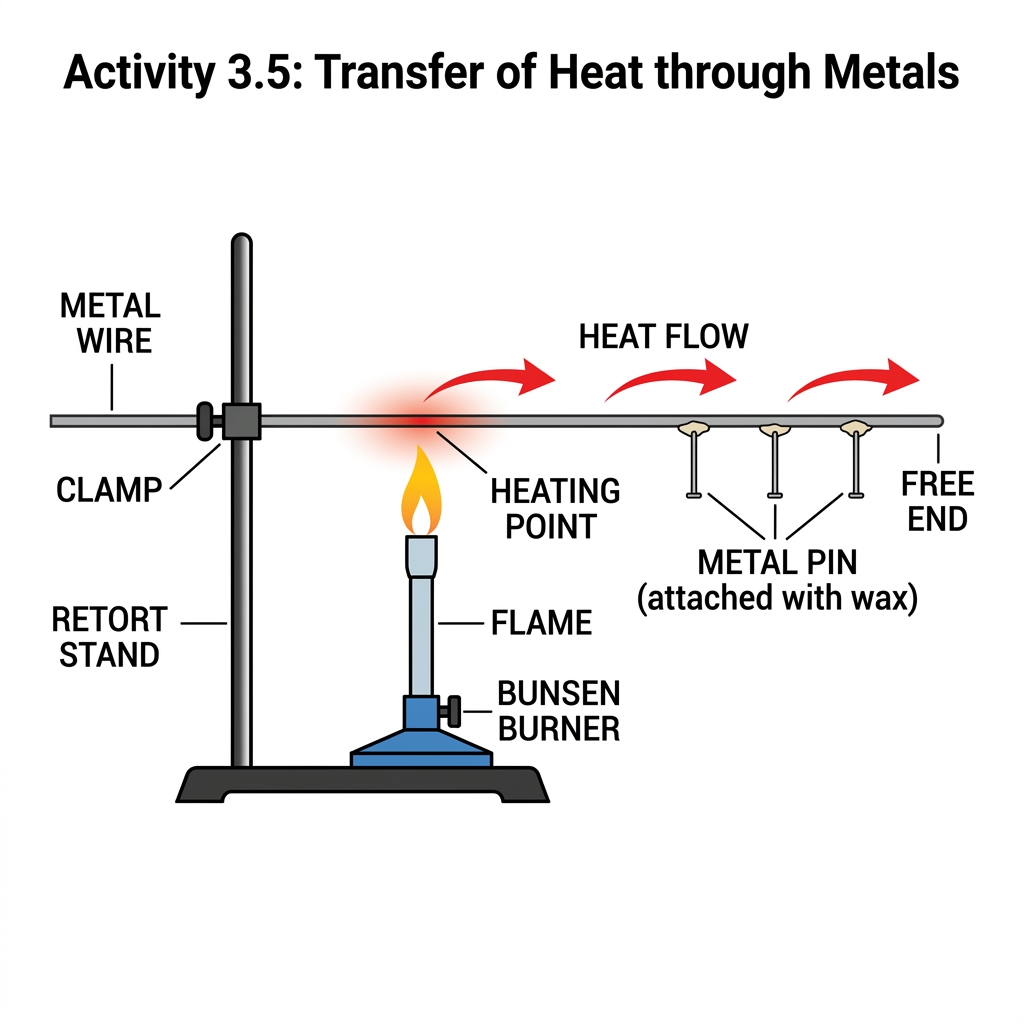
Figure 27.1: Demonstration of Thermal Conductivity in Metals
2. Chemical Properties & Key Reactions
A. Reaction with Oxygen (Air):
Metals form basic oxides. Sodium and potassium react vigorously and are stored under kerosene oil:
$$4\text{Na} + \text{O}_2 \;\longrightarrow\; 2\text{Na}_2\text{O}$$
$$\text{Na}_2\text{O} + \text{H}_2\text{O} \;\longrightarrow\; 2\text{NaOH} \quad (\text{Alkaline base, turns red litmus blue})$$
$$2\text{Mg} + \text{O}_2 \;\longrightarrow\; 2\text{MgO}$$
B. Amphoteric Oxides (Dual Acidic & Basic Behavior):
Certain metallic oxides react with both acids and bases to produce salt and water:
- Aluminium Oxide ($\text{Al}_2\text{O}_3$):
$$\text{Al}_2\text{O}_3 + 6\text{HCl} \;\longrightarrow\; 2\text{AlCl}_3 + 3\text{H}_2\text{O} \quad (\text{Basic action})$$
$$\text{Al}_2\text{O}_3 + 2\text{NaOH} \;\longrightarrow\; 2\text{NaAlO}_2 + \text{H}_2\text{O} \quad (\text{Acidic action: Sodium Aluminate})$$
- Zinc Oxide ($\text{ZnO}$):
$$\text{ZnO} + 2\text{NaOH} \;\longrightarrow\; \text{Na}_2\text{ZnO}_2 + \text{H}_2\text{O} \quad (\text{Sodium Zincate})$$
- Tin ($\text{Sn}$) with Excess Base (NIOS Specific Equation):
$$\text{Sn} + 2\text{NaOH} + \text{H}_2\text{O} \;\longrightarrow\; \underset{\text{Sodium Stannate}}{\text{Na}_2\text{SnO}_3} + 2\text{H}_2\uparrow$$
C. Reaction with Water & Steam:
- Cold Water: $\text{Na}$ and $\text{K}$ react violently; $\text{Ca}$ floats:
$$2\text{Na} + 2\text{H}_2\text{O} \;\longrightarrow\; 2\text{NaOH} + \text{H}_2\uparrow + \text{Heat}$$
- Hot Water: $\text{Mg} + 2\text{H}_2\text{O(l)} \;\longrightarrow\; \text{Mg(OH)}_2 + \text{H}_2\uparrow$
- Steam Only ($\text{Al, Fe, Zn}$): Form metal oxides (not hydroxides) and $\text{H}_2$:
$$3\text{Fe} + 4\text{H}_2\text{O(g)} \;\longrightarrow\; \text{Fe}_3\text{O}_4 + 4\text{H}_2\uparrow$$
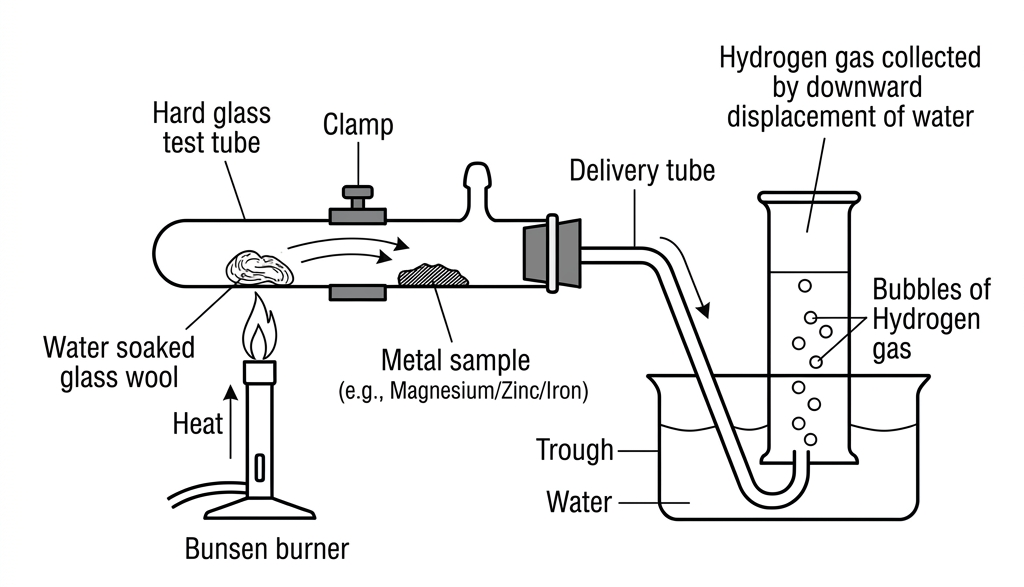
Figure 27.2: Action of Steam on a Metal Sample
D. Reaction with Acids & The Reactivity Series:
$$\text{Metal} + \text{Dilute Acid} \;\longrightarrow\; \text{Salt} + \text{H}_2\uparrow$$
$$\text{Mg} + 2\text{HCl} \;\longrightarrow\; \text{MgCl}_2 + \text{H}_2\uparrow$$
- Nitric Acid Exception: $\text{HNO}_3$ is a strong oxidizing agent; oxidizes $\text{H}_2$ to $\text{H}_2\text{O}$. Only $\text{Mg}$ and $\text{Mn}$ liberate $\text{H}_2$ with very dilute $\text{HNO}_3$.
- Reactivity Series: $\text{K} > \text{Na} > \text{Ca} > \text{Mg} > \text{Al} > \text{Zn} > \text{Fe} > \text{Pb} > [\text{H}] > \text{Cu} > \text{Hg} > \text{Ag} > \text{Au}$.
- Displacement: A more reactive metal displaces a less reactive metal from its salt solution:
$$\text{Fe} + \text{CuSO}_4\text{ (blue)} \;\longrightarrow\; \text{FeSO}_4\text{ (pale green)} + \text{Cu (reddish-brown)}$$
3. Ionic Compounds & Their Properties
Formed by complete transfer of electrons from a metal atom to a non-metal atom (e.g., $\text{NaCl}, \text{MgCl}_2$).
| Property |
Observed Trait |
Scientific Explanation |
| Physical State |
Hard, crystalline, brittle solids. |
Strong electrostatic forces between interlocked cations and anions. |
| Melting & Boiling Points |
High ($\text{NaCl}$ MP $= 801^\circ\text{C}$). |
High lattice energy required to overcome ionic attractions. |
| Solubility |
Soluble in water; insoluble in kerosene/petrol. |
Polar water molecules hydrate ions; non-polar solvents cannot overcome lattice energy. |
| Electrical Conductivity |
Insulators in solid state; conduct in molten state or aqueous solution. |
Ions fixed rigidly in solid lattice; in molten/solution state, ions become free and mobile to carry current. |
4. Metallurgy: Extraction and Refining of Metals
Definitions: Mineral = Naturally occurring compound in earth's crust. Ore = Mineral from which metal is extracted profitably. Gangue = Unwanted earthy impurities (sand, clay).
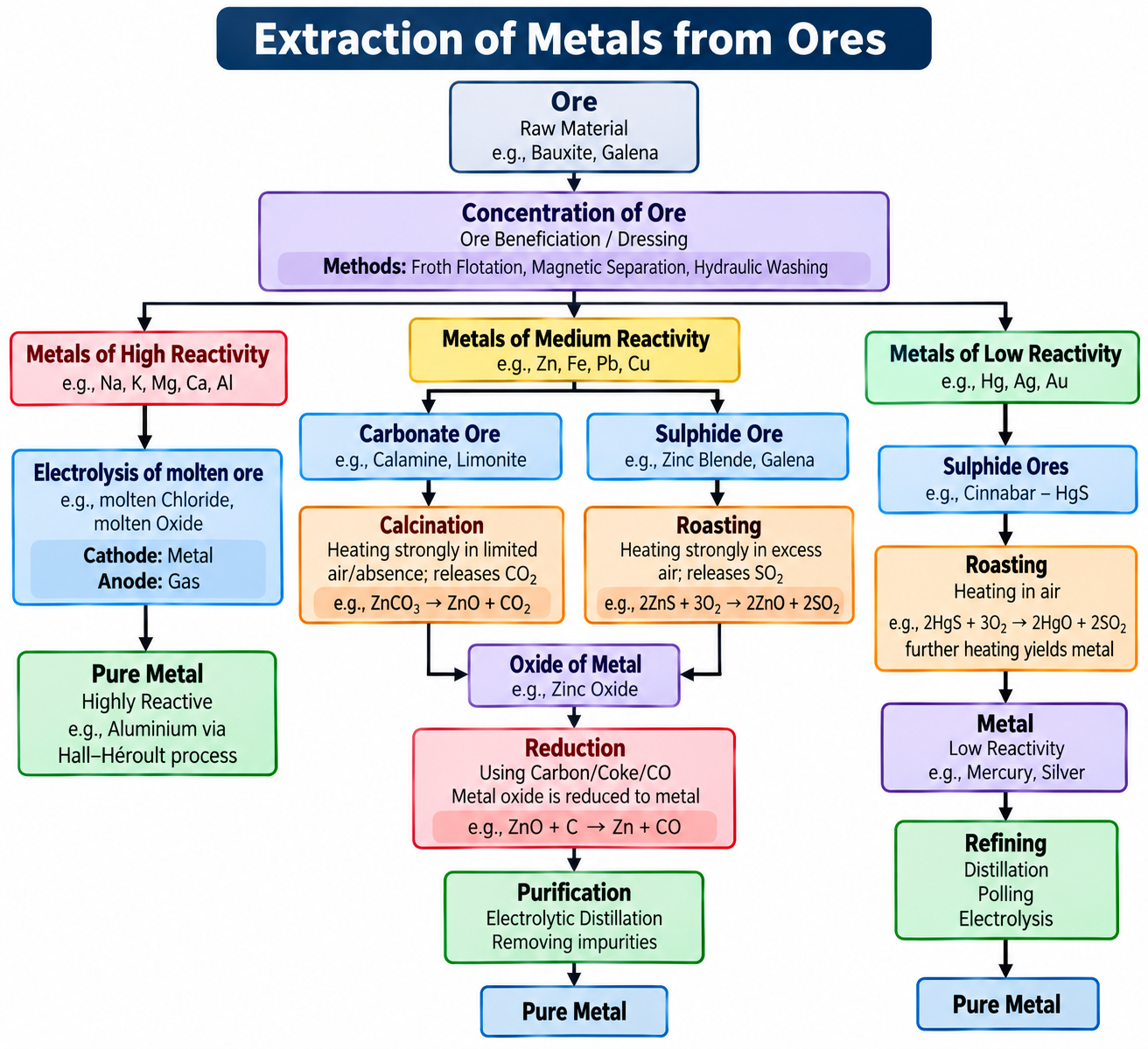
Figure 27.3: Flowchart for Extraction of Metals Based on Reactivity
Extraction Methods by Reactivity Level:
- Low Reactivity Metals ($\text{Hg, Cu}$): Reduced by thermal heating alone:
$$2\text{HgS (Cinnabar)} + 3\text{O}_2 \;\overset{\Delta}{\longrightarrow}\; 2\text{HgO} + 2\text{SO}_2\uparrow \quad\implies\quad 2\text{HgO} \;\overset{\Delta}{\longrightarrow}\; 2\text{Hg(l)} + \text{O}_2\uparrow$$
- Medium Reactivity Metals ($\text{Zn, Fe}$):
• Roasting (Sulphides in excess air): $2\text{ZnS} + 3\text{O}_2 \;\overset{\Delta}{\longrightarrow}\; 2\text{ZnO} + 2\text{SO}_2\uparrow$
• Calcination (Carbonates in limited air): $\text{ZnCO}_3 \;\overset{\Delta}{\longrightarrow}\; \text{ZnO} + \text{CO}_2\uparrow$
• Reduction by Carbon: $\text{ZnO} + \text{C} \;\overset{\Delta}{\longrightarrow}\; \text{Zn} + \text{CO}\uparrow$
• Thermite Process: $\text{Fe}_2\text{O}_3 + 2\text{Al} \;\overset{\Delta}{\longrightarrow}\; 2\text{Fe(l)} + \text{Al}_2\text{O}_3 + \text{Heat}$ (used to weld railway tracks).
- High Reactivity Metals ($\text{Na, Ca, Al}$): Extracted by Electrolytic Reduction of molten chlorides/oxides (Cathode: $\text{Na}^+ + e^- \to \text{Na}$; Anode: $2\text{Cl}^- \to \text{Cl}_2 + 2e^-$).
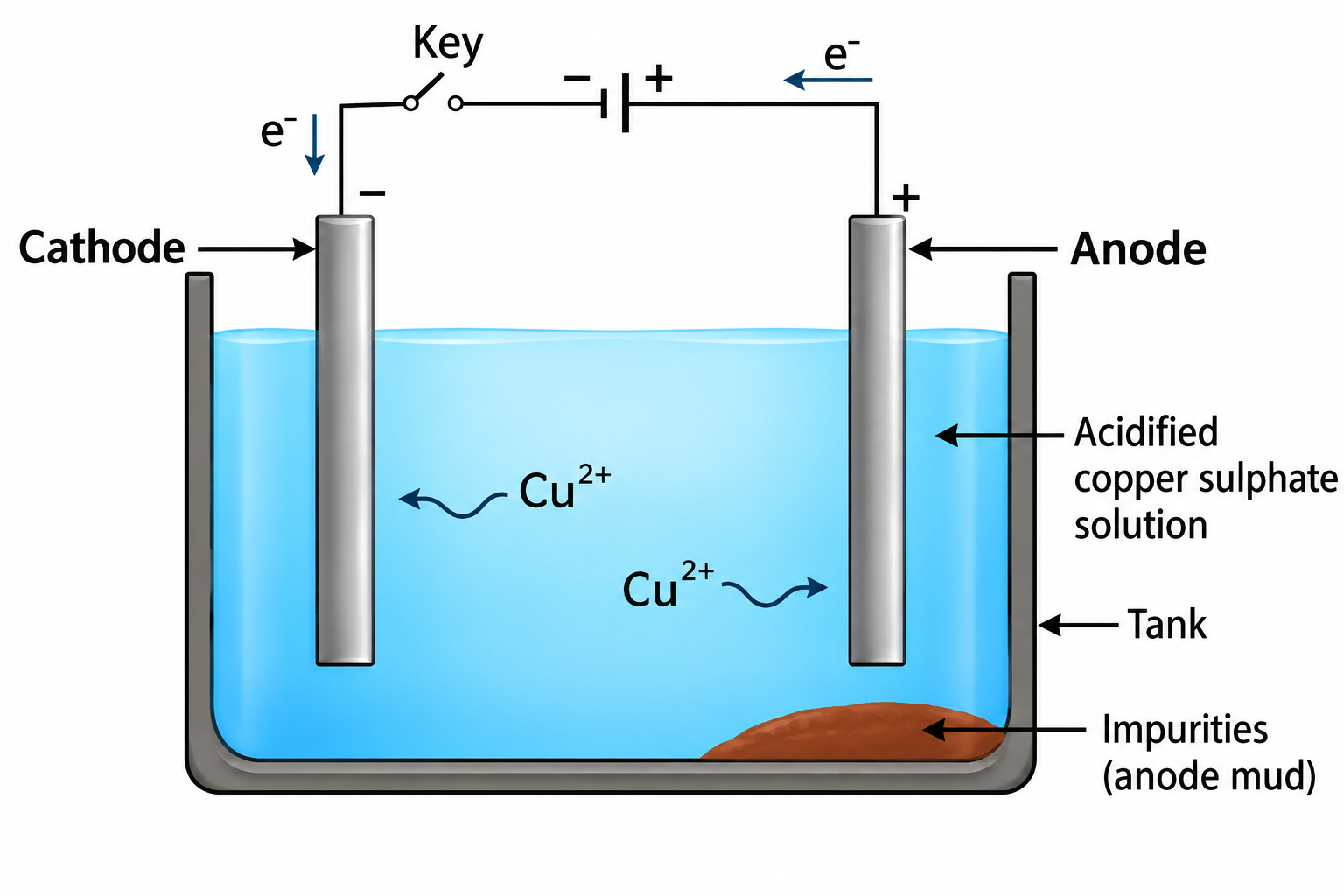
Figure 27.4: Electrolytic Refining of Copper
Electrolytic Refining Setup:
- Anode: Impure copper block ($\text{Cu} \to \text{Cu}^{2+} + 2e^-$).
- Cathode: Thin strip of pure copper ($\text{Cu}^{2+} + 2e^- \to \text{Cu}$).
- Electrolyte: Acidified $\text{CuSO}_4$ solution.
- Anode Mud: Insoluble impurities ($\text{Ag, Au, Pt}$) settling below the anode.
5. Corrosion of Metals and Prevention
Corrosion: Deterioration of metals through atmospheric oxidation and moisture exposure.
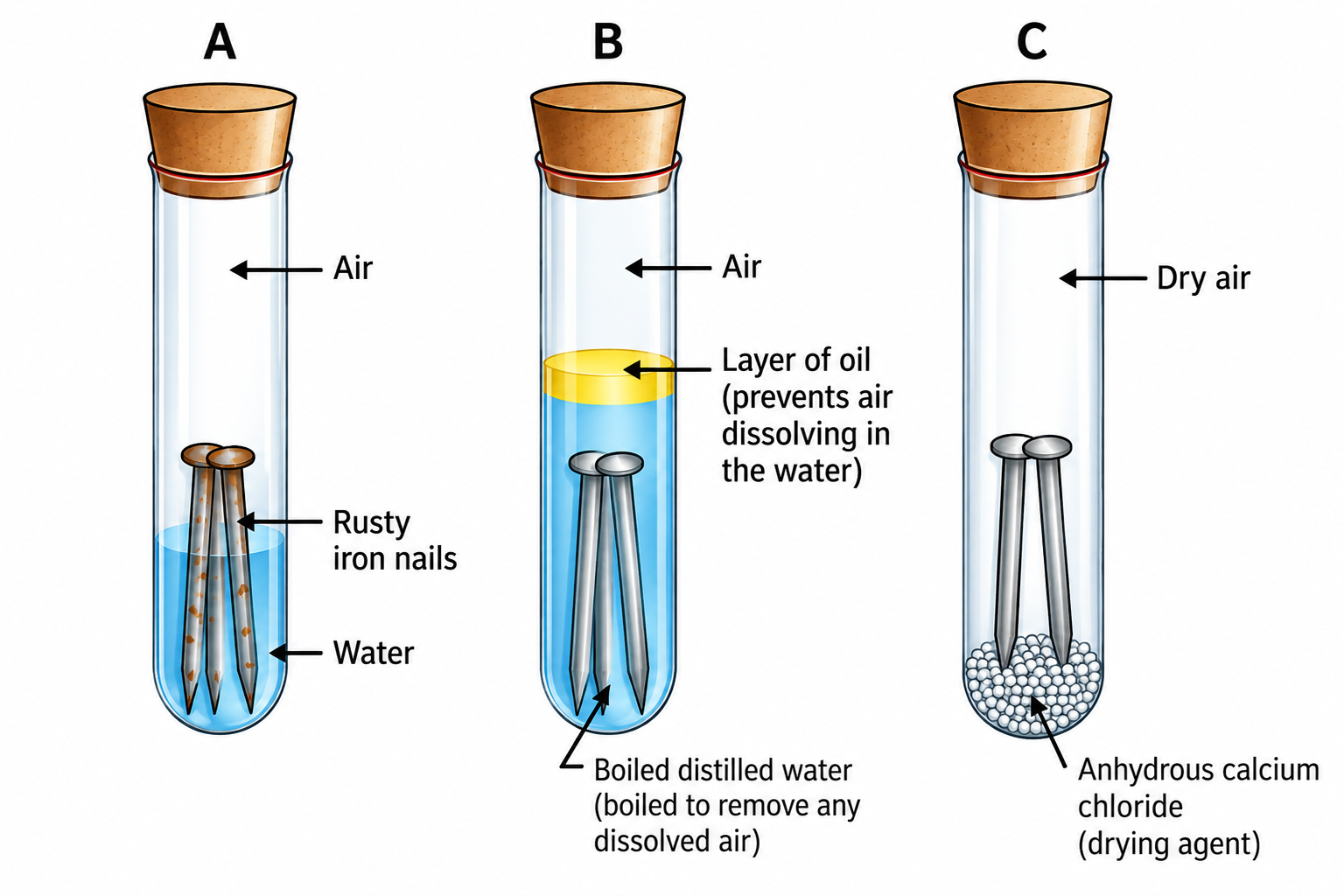
Figure 27.5: Investigating Conditions for Rusting of Iron: Both Air and Moisture are Necessary
- Rusting of Iron (Official NIOS Equation):
$$4\text{Fe} + x\text{H}_2\text{O} + \text{O}_2 \;\longrightarrow\; \underset{\text{Hydrated Ferric Oxide (Rust)}}{2\text{Fe}_2\text{O}_3 \cdot x\text{H}_2\text{O}}$$
- Green Patina on Copper: $2\text{Cu} + \text{H}_2\text{O} + \text{CO}_2 + \text{O}_2 \;\longrightarrow\; \underset{\text{Basic Copper Carbonate}}{\text{CuCO}_3 \cdot \text{Cu(OH)}_2}$
- Black Tarnish on Silver: $2\text{Ag} + \text{H}_2\text{S} \;\longrightarrow\; \text{Ag}_2\text{S} + \text{H}_2$
- Prevention Methods: (1) Painting, (2) Oiling and Greasing, (3) Galvanization (coating with molten Zinc; sacrificial cathodic protection), (4) Alloying.
6. Alloys & Uses of Metals and Non-Metals (NIOS Syllabus)
| Alloy |
Composition |
Key Property & Application |
| Steel |
$\text{Fe} + \text{C} (0.1\text{--}1.5\%)$ |
High tensile strength; construction, infrastructure. |
| Stainless Steel |
$\text{Fe} + \text{Cr} + \text{Ni} + \text{C}$ |
Does not rust; surgical tools, utensils. |
| Brass |
$\text{Cu} + \text{Zn}$ |
Malleable, golden lustre; hardware, musical instruments. |
| Bronze |
$\text{Cu} + \text{Sn}$ |
Corrosion resistant; statues, medals, coins. |
| Solder |
$\text{Pb} + \text{Sn}$ |
Low melting point ($~183^\circ\text{C}$); welding electrical wires. |
| Amalgam |
Any alloy with Mercury ($\text{Hg}$) |
Dental fillings ($\text{Ag-Sn-Hg}$). |
| $22\text{ Carat Gold}$ |
$22\text{ parts Au} + 2\text{ parts Cu/Ag}$ |
Provides hardness for crafting jewellery ($24\text{ carat}$ is too soft). |
Direct Industrial & Practical Uses (From NIOS Book):
- Metals:
• Utensils: Iron, Aluminium (good thermal conductor).
• Electrical wires: Copper, Aluminium (high electrical conductivity, ductile).
• Heavy machinery & sheets: Iron, Aluminium (high malleability).
• Jewellery: Gold, Silver, Platinum (lustrous, non-corroding).
• Cells & batteries: Lead, Zinc.
- Non-Metals:
• Fertilizers: Nitrogen ($\text{N}$) and Phosphorus ($\text{P}$) for plant growth.
• Electronics: Silicon ($\text{Si}$) for transistors, computer microchips, solar cells.
• Match Industry: White phosphorus used in match manufacture.
• Chemicals & Agriculture: Sulphur ($\text{S}$) used as fungicide, for gun powder, and manufacture of $\text{H}_2\text{SO}_4$.
7. NIOS "Test Yourself" & "Stretch Yourself" Exam Solutions
- Why are metals good conductors of electricity while non-metals are not?
Answer: Metals contain a large number of free, delocalized valence electrons that can drift when a voltage is applied. Non-metals hold their valence electrons tightly in localized bonds with no free mobile electrons (except graphite).
- What are the main conditions for corrosion? How to prevent it?
Answer: Simultaneous presence of both oxygen (air) and moisture (water). Prevented by painting, oiling/greasing, galvanization (zinc coating), and alloying.
- How will you prove metal oxides are basic and non-metal oxides are acidic?
Answer: Dissolve magnesium oxide ($\text{MgO}$) in water to form $\text{Mg(OH)}_2$; it turns red litmus blue (basic). Dissolve sulphur dioxide ($\text{SO}_2$) in water to form $\text{H}_2\text{SO}_3$; it turns blue litmus red (acidic).
- Why is Tin ($\text{Sn}$) soluble in excess $\text{NaOH}$? Give equation.
Answer: Tin is amphoteric. It reacts with strong base to form soluble sodium stannate:
$$\text{Sn} + 2\text{NaOH} + \text{H}_2\text{O} \;\longrightarrow\; \text{Na}_2\text{SnO}_3 + 2\text{H}_2\uparrow$$
- Why is it better to use copper than carbon in electrical wires?
Answer: Copper is highly ductile (can be drawn into flexible wires), has lower electrical resistivity, and does not break, unlike brittle graphite.
- Why is aluminium used for cooking utensils?
Answer: Excellent thermal conductivity, high melting point, and self-protecting oxide layer ($\text{Al}_2\text{O}_3$) preventing corrosion.
- Why does a copper coin develop a green layer in open air?
Answer: Reacts with atmospheric $\text{CO}_2$, $\text{O}_2$, and moisture to form basic copper carbonate:
$$2\text{Cu} + \text{H}_2\text{O} + \text{CO}_2 + \text{O}_2 \;\longrightarrow\; \text{CuCO}_3 \cdot \text{Cu(OH)}_2 \text{ (green)}$$

 VARDAAN COMET