Vardaan Learning Institute
Master Notes • Science and Technology (212)
Chapter 27: Metals and Non-metals
Physical & Chemical Properties, Amphoteric Oxides, Ionic Bonding, Metallurgy, Corrosion & Alloys
1. Classification and Physical Properties of Elements
All 118 known elements are broadly categorized based on their electronic configuration, physical characteristics, and chemical behavior into Metals, Non-metals, and Metalloids.
Fundamental Electro-chemical Nature:
- Metals (Electropositive Elements): Possess $1, 2,$ or $3$ electrons in their valence shell. They exhibit a strong electropositive tendency to readily lose valence electrons and form positively charged cations ($\text{M} \to \text{M}^{n+} + n e^-$).
- Non-Metals (Electronegative Elements): Possess $4, 5, 6,$ or $7$ valence electrons. They exhibit a pronounced electronegative tendency to gain or share electrons to complete their stable octet, forming negatively charged anions ($\text{X} + n e^- \to \text{X}^{n-}$).
| Physical Property |
Metals |
Non-Metals |
Critical Exceptions (High-Yield Exam Points) |
| Malleability |
Malleable: Can be beaten into ultra-thin sheets without fracturing (Gold $\text{Au}$ and Silver $\text{Ag}$ are the most malleable). |
Non-malleable (Brittle): Shatter into fine powder upon hammering (e.g., Coal, Sulphur). |
Zinc is brittle at room temperature; malleable between $100^\circ\text{C}\text{--}150^\circ\text{C}$. |
| Ductility |
Ductile: Can be drawn into extremely thin wires ($1\text{ gram}$ of gold can be drawn into a $2\text{ km}$ long wire). |
Non-ductile: Cannot be drawn into wires; fragile and brittle. |
Carbon fibres possess high tensile strength but are not conventionally ductile. |
| Metallic Lustre |
Display bright reflective sheen in pure, unoxidized state due to free surface electrons. |
Dull surface; absorb light and lack lustre. |
Iodine ($\text{I}_2$) is a non-metal that possesses a brilliant metallic lustre. Diamond exhibits exceptional adamantine brilliance. |
| Hardness & Physical State |
Generally hard solids possessing high tensile strength. |
Exist in all three states: Solids ($\text{C, S, P}$), Liquid ($\text{Br}_2$), and Gases ($\text{H}_2, \text{O}_2, \text{N}_2, \text{Cl}_2$). Soft solids. |
• Mercury ($\text{Hg}$) is the only metal that is liquid at room temperature.
• Alkali Metals ($\text{Na, K, Li}$): Soft enough to be easily sliced with a knife.
• Diamond: Carbon allotrope; the hardest known natural substance. |
| Melting & Boiling Points |
Generally high melting and boiling points (Tungsten $\text{W}$ melts at $3422^\circ\text{C}$). |
Generally low melting and boiling points. |
• Gallium ($\text{Ga}$) and Caesium ($\text{Cs}$) have such low melting points ($29.8^\circ\text{C}$ and $28.5^\circ\text{C}$) that they melt in the palm of your hand.
• Diamond & Graphite: Have extraordinarily high melting points ($>3500^\circ\text{C}$). |
| Electrical & Thermal Conductivity |
Excellent conductors: Abundant delocalized valence electrons enable efficient thermal and electrical transport. |
Poor conductors (Insulators): Bound valence electrons prevent thermal and electrical conduction. |
• Silver ($\text{Ag}$) and Copper ($\text{Cu}$) are the best electrical conductors.
• Lead ($\text{Pb}$) and Mercury ($\text{Hg}$) are comparatively poor conductors.
• Graphite: Non-metal allotrope of carbon; exceptional conductor of electricity due to free delocalized $\pi$-electrons. |
| Sonorous Nature |
Sonorous: Emit a resonant ringing musical sound when struck with a hard object (used in temple bells and guitar strings). |
Non-sonorous: Produce a dull thud upon impact. |
Mercury (liquid) cannot produce sonorous sound. |
| Density |
High density (e.g., Iron $= 7.8\text{ g/cm}^3$, Osmium $= 22.6\text{ g/cm}^3$). |
Low density (e.g., Sulphur $= 2.0\text{ g/cm}^3$). |
Lithium ($\text{Li}$), Sodium ($\text{Na}$), and Potassium ($\text{K}$) have densities less than water ($<1\text{ g/cm}^3$) and float on water. |
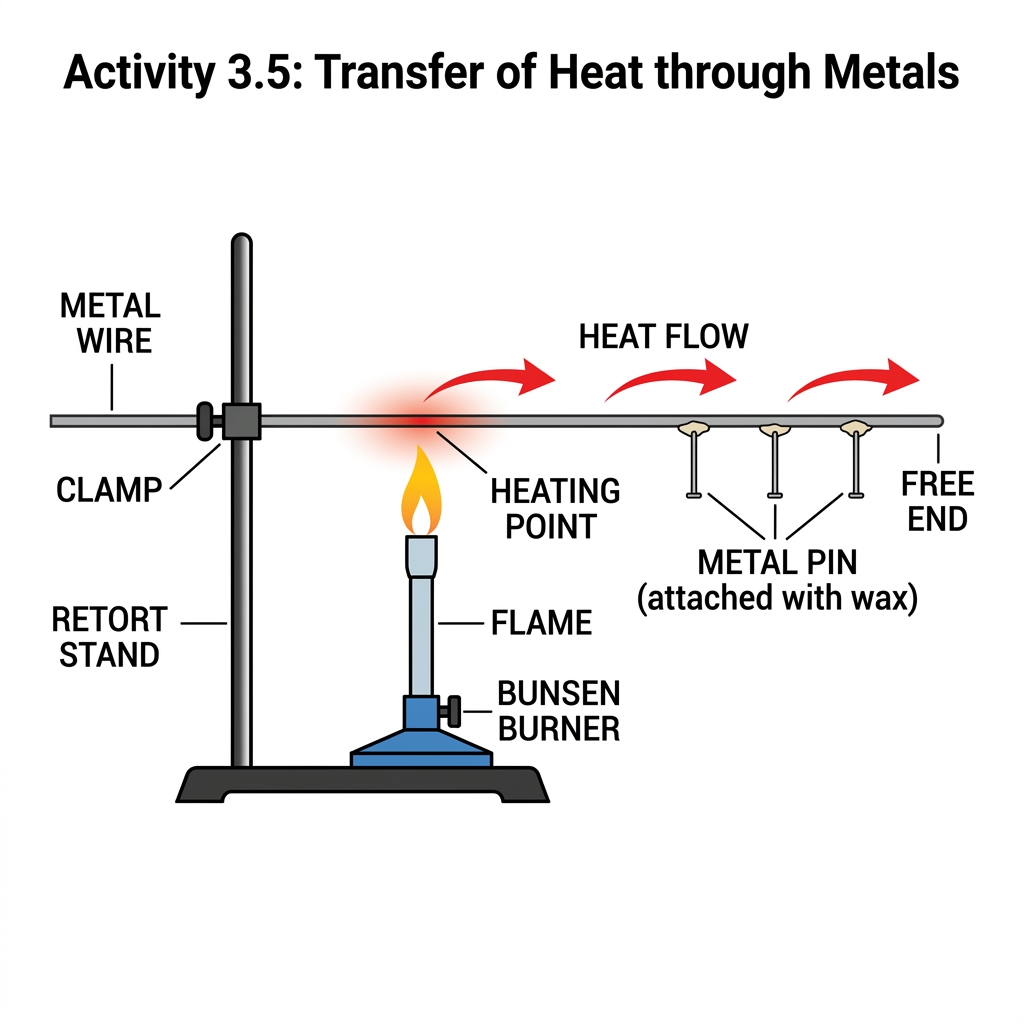
Figure 27.1: Experimental Demonstration of Thermal Conductivity: Heat conducts rapidly along a metallic rod, melting wax and dropping the pin
2. Chemical Properties of Metals
A. Reaction with Oxygen (Combustion in Air)
Almost all metals combine with oxygen to form metal oxides. Metal oxides are predominantly basic in nature because they dissolve in water or react with dilute acids to produce basic metal hydroxides or salts.
- Alkali Metals ($\text{Na, K}$): React so vigorously and exothermically with atmospheric oxygen and moisture at room temperature that they spontaneously ignite. To prevent accidental fires, they are stored submerged under kerosene oil:
$$4\text{Na} + \text{O}_2 \;\longrightarrow\; 2\text{Na}_2\text{O}$$
$$\text{Na}_2\text{O} + \text{H}_2\text{O} \;\longrightarrow\; 2\text{NaOH} \quad (\text{Water-soluble basic alkali})$$
- Magnesium ($\text{Mg}$): Burns in air with a dazzling white flame to form basic magnesium oxide:
$$2\text{Mg} + \text{O}_2 \;\longrightarrow\; 2\text{MgO}$$
- Copper ($\text{Cu}$): Does not burn in air, but prolonged heating coats the surface with a black layer of Copper(II) oxide:
$$2\text{Cu} + \text{O}_2 \;\overset{\Delta}{\longrightarrow}\; 2\text{CuO} \quad (\text{Black oxide})$$
- Silver and Gold ($\text{Ag, Au}$): Do not combine with oxygen even at elevated temperatures (noble metals).
While most metal oxides are basic, certain metallic oxides react with both acids and bases to yield corresponding salts and water. Such metal oxides are termed Amphoteric Oxides.
Primary Examples: Aluminium oxide ($\text{Al}_2\text{O}_3$), Zinc oxide ($\text{ZnO}$), and Tin oxide ($\text{SnO}$).
1. Reactions of Aluminium Oxide ($\text{Al}_2\text{O}_3$):
- Basic behavior (reacting with an acid):
$$\text{Al}_2\text{O}_3 + 6\text{HCl} \;\longrightarrow\; 2\text{AlCl}_3 + 3\text{H}_2\text{O}$$
- Acidic behavior (reacting with a strong base):
$$\text{Al}_2\text{O}_3 + 2\text{NaOH} \;\longrightarrow\; \underset{\text{Sodium Aluminate}}{2\text{NaAlO}_2} + \text{H}_2\text{O}$$
2. Reactions of Zinc Oxide ($\text{ZnO}$):
- With Acid: $\text{ZnO} + 2\text{HCl} \;\longrightarrow\; \text{ZnCl}_2 + \text{H}_2\text{O}$
- With Base: $\text{ZnO} + 2\text{NaOH} \;\longrightarrow\; \underset{\text{Sodium Zincate}}{\text{Na}_2\text{ZnO}_2} + \text{H}_2\text{O}$
3. Reaction of Tin ($\text{Sn}$) with Excess Base:
Tin dissolves in excess concentrated hot sodium hydroxide to liberate hydrogen gas, forming soluble sodium stannate:
$$\text{Sn} + 2\text{NaOH} + \text{H}_2\text{O} \;\longrightarrow\; \underset{\text{Sodium Stannate}}{\text{Na}_2\text{SnO}_3} + 2\text{H}_2\uparrow$$
Protective Anodizing of Aluminium:
Fresh aluminium naturally reacts with atmospheric oxygen to develop a microscopic, non-porous passivation layer of aluminium oxide ($\text{Al}_2\text{O}_3$) that prevents further corrosion. Anodizing is an industrial electrochemical process in which aluminium articles are made the anode in an electrolytic cell of dilute sulphuric acid. Oxygen evolved at the anode reacts with aluminium to build a thick, durable, scratch-resistant oxide film that can be dyed with attractive colors for cookware, window frames, and consumer electronics.
B. Reaction of Metals with Water
Metals react with water to produce metal oxides or metal hydroxides and liberate hydrogen gas:
- Reactivity with Cold Water: Potassium ($\text{K}$), Sodium ($\text{Na}$), and Calcium ($\text{Ca}$) react vigorously with cold water. The reaction of $\text{K}$ and $\text{Na}$ is so violent and exothermic that the liberated $\text{H}_2$ gas instantly catches fire:
$$2\text{K} + 2\text{H}_2\text{O} \;\longrightarrow\; 2\text{KOH} + \text{H}_2\uparrow + \text{Heat}$$
$$2\text{Na} + 2\text{H}_2\text{O} \;\longrightarrow\; 2\text{NaOH} + \text{H}_2\uparrow + \text{Heat}$$
Behavior of Calcium: The reaction with calcium is less violent; heat is insufficient for $\text{H}_2$ to ignite. Calcium begins to float on water because bubbles of hydrogen gas stick to its surface:
$$\text{Ca} + 2\text{H}_2\text{O} \;\longrightarrow\; \text{Ca(OH)}_2 + \text{H}_2\uparrow$$
- Reactivity with Hot Water: Magnesium ($\text{Mg}$) does not react with cold water. It reacts with boiling water to form magnesium hydroxide and hydrogen gas, and also floats due to clinging bubbles:
$$\text{Mg} + 2\text{H}_2\text{O(l)} \;\longrightarrow\; \text{Mg(OH)}_2 + \text{H}_2\uparrow$$
- Reactivity with Steam Only: Metals like Aluminium ($\text{Al}$), Iron ($\text{Fe}$), and Zinc ($\text{Zn}$) do not react with cold or hot liquid water; they react exclusively with gaseous steam to form insoluble metal oxides (not hydroxides) and hydrogen gas:
$$2\text{Al} + 3\text{H}_2\text{O(g)} \;\longrightarrow\; \text{Al}_2\text{O}_3 + 3\text{H}_2\uparrow$$
$$3\text{Fe} + 4\text{H}_2\text{O(g)} \;\longrightarrow\; \underset{\text{Magnetic Iron Oxide}}{\text{Fe}_3\text{O}_4} + 4\text{H}_2\uparrow$$
- Inert Metals: Lead ($\text{Pb}$), Copper ($\text{Cu}$), Silver ($\text{Ag}$), and Gold ($\text{Au}$) do not react with water or steam under any conditions.
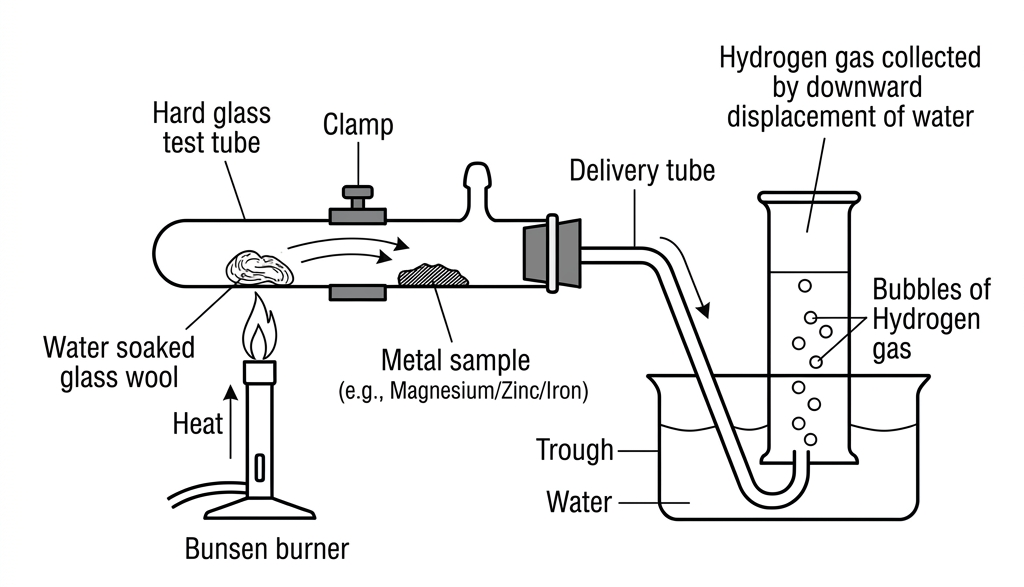
Figure 27.2: Laboratory Apparatus for Investigating the Action of Steam on a Metal Sample
C. Reaction of Metals with Dilute Acids
Metals positioned above hydrogen in the activity series displace hydrogen from dilute mineral acids ($\text{HCl, H}_2\text{SO}_4$) to form corresponding metallic salts and liberate hydrogen gas:
$$\text{Mg} + 2\text{HCl} \;\longrightarrow\; \text{MgCl}_2 + \text{H}_2\uparrow$$
$$\text{Zn} + \text{H}_2\text{SO}_4 \;\longrightarrow\; \text{ZnSO}_4 + \text{H}_2\uparrow$$
$$2\text{Al} + 6\text{HCl} \;\longrightarrow\; 2\text{AlCl}_3 + 3\text{H}_2\uparrow$$
$$\text{Fe} + 2\text{HCl} \;\longrightarrow\; \text{FeCl}_2 + \text{H}_2\uparrow$$
Critical Note on Nitric Acid ($\text{HNO}_3$):
Hydrogen gas is not liberated when most metals react with dilute nitric acid ($\text{HNO}_3$). Nitric acid is a powerful oxidizing agent. It oxidizes the produced hydrogen instantly into water ($\text{H}_2\text{O}$) while itself undergoing reduction to oxides of nitrogen ($\text{NO}_2, \text{NO},$ or $\text{N}_2\text{O}$).
Exception: Only Magnesium ($\text{Mg}$) and Manganese ($\text{Mn}$) react with very dilute ($~1\%$) nitric acid to liberate hydrogen gas:
$$\text{Mg} + 2\text{HNO}_3\text{ (very dil.)} \;\longrightarrow\; \text{Mg(NO}_3)_2 + \text{H}_2\uparrow$$
Aqua Regia is a freshly prepared, highly fuming, and corrosive yellow-orange mixture consisting of 3 parts Concentrated Hydrochloric Acid ($\text{HCl}$) and 1 part Concentrated Nitric Acid ($\text{HNO}_3$) by volume ($3:1$ ratio). Even though neither pure acid can dissolve noble metals alone, aqua regia readily dissolves inert gold ($\text{Au}$) and platinum ($\text{Pt}$) by generating nascent chlorine:
$$\text{HNO}_3 + 3\text{HCl} \;\longrightarrow\; \text{NOCl} + 2\text{H}_2\text{O} + 2[\text{Cl}] \quad (\text{Nascent Chlorine})$$
3. The Reactivity (Activity) Series of Metals
The Reactivity Series is an experimental arrangement of metals in descending order of their chemical electropositivity and chemical reactivity. Any metal higher in the series is a more powerful reducing agent and can spontaneously displace any lower metal from its aqueous salt solution.
| Metal Element |
Chemical Symbol |
Relative Reactivity & Chemical Characteristics |
| Potassium |
$\text{K}$ |
Most Reactive Metals:
• React vigorously with cold water and dilute acids.
• Possess extraordinarily strong affinity for oxygen.
• Oxides cannot be reduced by carbon; extracted exclusively by electrolytic reduction. |
| Sodium |
$\text{Na}$ |
| Calcium |
$\text{Ca}$ |
| Magnesium |
$\text{Mg}$ |
| Aluminium |
$\text{Al}$ |
Moderately Reactive Metals:
• React with steam and dilute acids at moderate rates.
• Occur in earth's crust as sulphide, carbonate, or oxide ores.
• Oxides can be reduced by heating with carbon or more electropositive metals (Thermite). |
| Zinc |
$\text{Zn}$ |
| Iron |
$\text{Fe}$ |
| Lead |
$\text{Pb}$ |
| [HYDROGEN] |
$[\text{H}]$ |
| Copper |
$\text{Cu}$ |
Least Reactive (Noble) Metals:
• Cannot displace hydrogen from water or dilute acids.
• Oxides easily reduced to elemental metal by gentle heating.
• Found in native free state or as simple sulphides. |
| Mercury |
$\text{Hg}$ |
| Silver |
$\text{Ag}$ |
| Gold |
$\text{Au}$ |
Displacement Reaction Example:
When an iron nail is immersed in a blue solution of copper(II) sulphate, iron displaces copper because iron is more electropositive than copper. The solution turns light pale-green due to formation of $\text{FeSO}_4$, and a reddish-brown crust of copper deposits on the iron nail:
$$\text{Fe(s)} + \text{CuSO}_4\text{(aq)} \;\longrightarrow\; \underset{\text{Pale Green}}{\text{FeSO}_4\text{(aq)}} + \underset{\text{Reddish-brown deposit}}{\text{Cu(s)}}$$
4. Chemical Bonding: Reaction Between Metals and Non-Metals
Elements react to attain the stable octet electronic configuration ($8$ electrons in the valence shell, or $2$ in helium) of the nearest noble gas. When an electropositive metal reacts with an electronegative non-metal, electrons are completely transferred from the metal atom to the non-metal atom, forming an Ionic (Electrovalent) Bond.
Electron Transfer Mechanics in Ionic Bond Formation:
- Formation of Sodium Chloride ($\text{NaCl}$):
Sodium ($\text{Na}_{11}: 2, 8, 1$) loses $1$ electron to achieve the neon configuration ($2, 8$):
$$\text{Na} \;\longrightarrow\; \text{Na}^+ + e^-$$
Chlorine ($\text{Cl}_{17}: 2, 8, 7$) accepts $1$ electron to attain the argon configuration ($2, 8, 8$):
$$\text{Cl} + e^- \;\longrightarrow\; \text{Cl}^-$$
The oppositely charged cations ($\text{Na}^+$) and anions ($\text{Cl}^-$) are held together by strong, non-directional electrostatic forces of attraction to form a crystalline lattice:
$$\text{Na}^+ + \text{Cl}^- \;\longrightarrow\; \text{NaCl}$$
- Formation of Magnesium Chloride ($\text{MgCl}_2$):
Magnesium ($\text{Mg}_{12}: 2, 8, 2$) transfers $2$ valence electrons to two chlorine atoms ($2 \times \text{Cl}_{17}$):
$$\text{Mg} \;\longrightarrow\; \text{Mg}^{2+} + 2e^-$$
$$2\text{Cl} + 2e^- \;\longrightarrow\; 2\text{Cl}^-$$
$$\text{Mg}^{2+} + 2\text{Cl}^- \;\longrightarrow\; \text{MgCl}_2$$
| Characteristic Property |
Observed Behavior in Ionic Compounds |
Underlying Chemical Explanation |
| Physical Nature |
Hard, crystalline solids; brittle. |
Strong electrostatic attraction between interlocked cations and anions. When mechanical shear force is applied, like charges align and repel, causing crystal cleaving. |
| Melting & Boiling Points |
Very high (e.g., $\text{NaCl}$ melts at $801^\circ\text{C}$ and boils at $1413^\circ\text{C}$). |
Tremendous amounts of thermal energy are required to overcome the strong electrostatic attractions binding the 3D crystal lattice. |
| Solubility |
Soluble in polar solvents (water); insoluble in non-polar solvents (kerosene, petrol, benzene). |
Polar water molecules hydrate ions, releasing solvation energy sufficient to disrupt the ionic lattice. Non-polar solvents cannot overcome lattice energy. |
| Electrical Conductivity |
Insulators in solid state; excellent conductors in molten state and aqueous solution. |
In solid crystals, ions are rigidly fixed in place. In the molten state or aqueous solution, electrostatic bonds break, liberating free mobile ions that carry electrical current. |
5. Extraction of Metals (Metallurgy)
Metallurgy is the scientific and technological process of extracting pure metals from their naturally occurring ores and refining them for commercial use.
Key Definitions:
- Mineral: Naturally occurring inorganic homogeneous chemical substances found within the Earth's crust.
- Ore: A mineral from which a particular metal can be extracted conveniently, commercially, and profitably. All ores are minerals, but not all minerals are ores.
- Gangue (Matrix): Unwanted, commercially worthless earthy impurities (sand, clay, quartz, limestone) associated with mined ore.
- Flux: A chemical substance added to the ore during smelting to react with non-fusible gangue and convert it into a light, fusible molten mass called Slag ($\text{Gangue} + \text{Flux} \to \text{Slag}$).
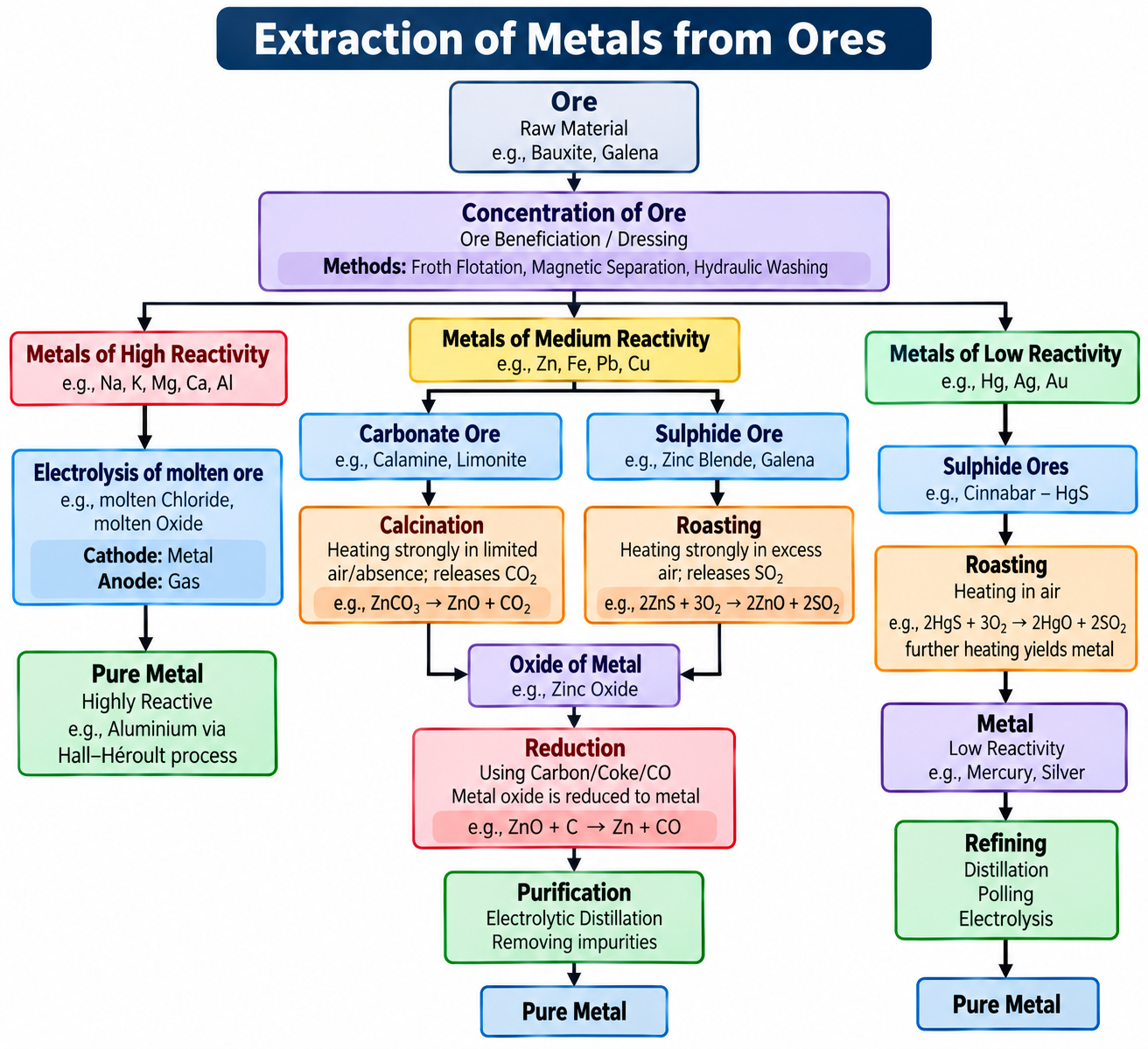
Figure 27.3: Comprehensive Flowchart of Metallurgical Extraction Strategies According to Chemical Reactivity
A. Extraction of Metals Low in the Reactivity Series
Metals low in the activity series ($\text{Hg, Cu}$) are unreactive. Their oxides can be reduced to pure elemental metal simply by thermal heating in air:
- Extraction of Mercury from Cinnabar ($\text{HgS}$):
Cinnabar is heated in air to convert it into mercuric oxide ($\text{HgO}$), which on further heating decomposes into liquid mercury:
$$2\text{HgS} + 3\text{O}_2 \;\overset{\Delta}{\longrightarrow}\; 2\text{HgO} + 2\text{SO}_2\uparrow$$
$$2\text{HgO} \;\overset{\Delta}{\longrightarrow}\; 2\text{Hg(l)} + \text{O}_2\uparrow$$
- Extraction of Copper from Copper Glance ($\text{Cu}_2\text{S}$):
$$2\text{Cu}_2\text{S} + 3\text{O}_2 \;\overset{\Delta}{\longrightarrow}\; 2\text{Cu}_2\text{O} + 2\text{SO}_2\uparrow$$
$$2\text{Cu}_2\text{O} + \text{Cu}_2\text{S} \;\overset{\Delta}{\longrightarrow}\; 6\text{Cu} + \text{SO}_2\uparrow \quad (\text{Auto-reduction to Blister Copper})$$
B. Extraction of Metals in the Middle of the Reactivity Series
Metals like Iron, Zinc, Lead, and Copper usually exist in the crust as sulphide ores or carbonate ores. Since reducing metal oxides is far easier than reducing sulphides or carbonates, the ores are first converted into metal oxides using two distinct pyrometallurgical methods:
| Process |
Applicable Ore Type |
Thermal Conditions |
Representative Chemical Equation |
| Roasting |
Sulphide Ores ($\text{ZnS, PbS, Cu}_2\text{S}$) |
Heating strongly below melting point in excess supply of air; volatile sulphur dioxide gas escapes. |
$$2\text{ZnS} + 3\text{O}_2 \;\overset{\Delta}{\longrightarrow}\; 2\text{ZnO} + 2\text{SO}_2\uparrow$$ |
| Calcination |
Carbonate & Hydrated Ores ($\text{ZnCO}_3, \text{CaCO}_3, \text{Al}_2\text{O}_3 \cdot 2\text{H}_2\text{O}$) |
Heating strongly below melting point in limited or complete absence of air; carbon dioxide and moisture escape. |
$$\text{ZnCO}_3 \;\overset{\Delta}{\longrightarrow}\; \text{ZnO} + \text{CO}_2\uparrow$$ |
- 1. Reduction using Carbon (Coke): Oxides of zinc, iron, and lead are heated with carbon reducing agent:
$$\text{ZnO} + \text{C} \;\overset{\Delta}{\longrightarrow}\; \text{Zn} + \text{CO}\uparrow$$
- 2. Displacement using Reactive Metals (Thermite Process): Highly reactive metals like Aluminium powder ($\text{Al}$) are used to reduce metal oxides. The reaction is so intensely exothermic that the reduced metal is produced in the molten liquid state:
$$\text{Fe}_2\text{O}_3\text{(s)} + 2\text{Al(s)} \;\overset{\Delta}{\longrightarrow}\; 2\text{Fe(l)} + \text{Al}_2\text{O}_3\text{(s)} + \text{Tremendous Heat}$$
Industrial Application: The liquid iron produced on-site in the Thermite Reaction is used to weld cracked railway tracks and heavy industrial machine frames.
C. Extraction of Metals High in the Reactivity Series
Metals high in the reactivity series ($\text{K, Na, Ca, Mg, Al}$) possess a greater affinity for oxygen than carbon does. Carbon cannot reduce their oxides. Therefore, they are extracted by Electrolytic Reduction of their molten chlorides or oxides:
Example: Extraction of Sodium from Molten $\text{NaCl}$ (Down's Cell):
- At Cathode (Reduction, Gain of electrons): $\text{Na}^+ + e^- \;\longrightarrow\; \text{Na(s)}$ (Pure metal deposits)
- At Anode (Oxidation, Loss of electrons): $2\text{Cl}^- \;\longrightarrow\; \text{Cl}_2\uparrow + 2e^-$ (Chlorine gas evolves)
D. Refining of Crude Metals: Electrolytic Refining
The extracted crude metal contains residual impurities and must be refined. The most widely employed industrial refining technique is Electrolytic Refining (e.g., for Copper, Zinc, Tin, Nickel, Silver, Gold).
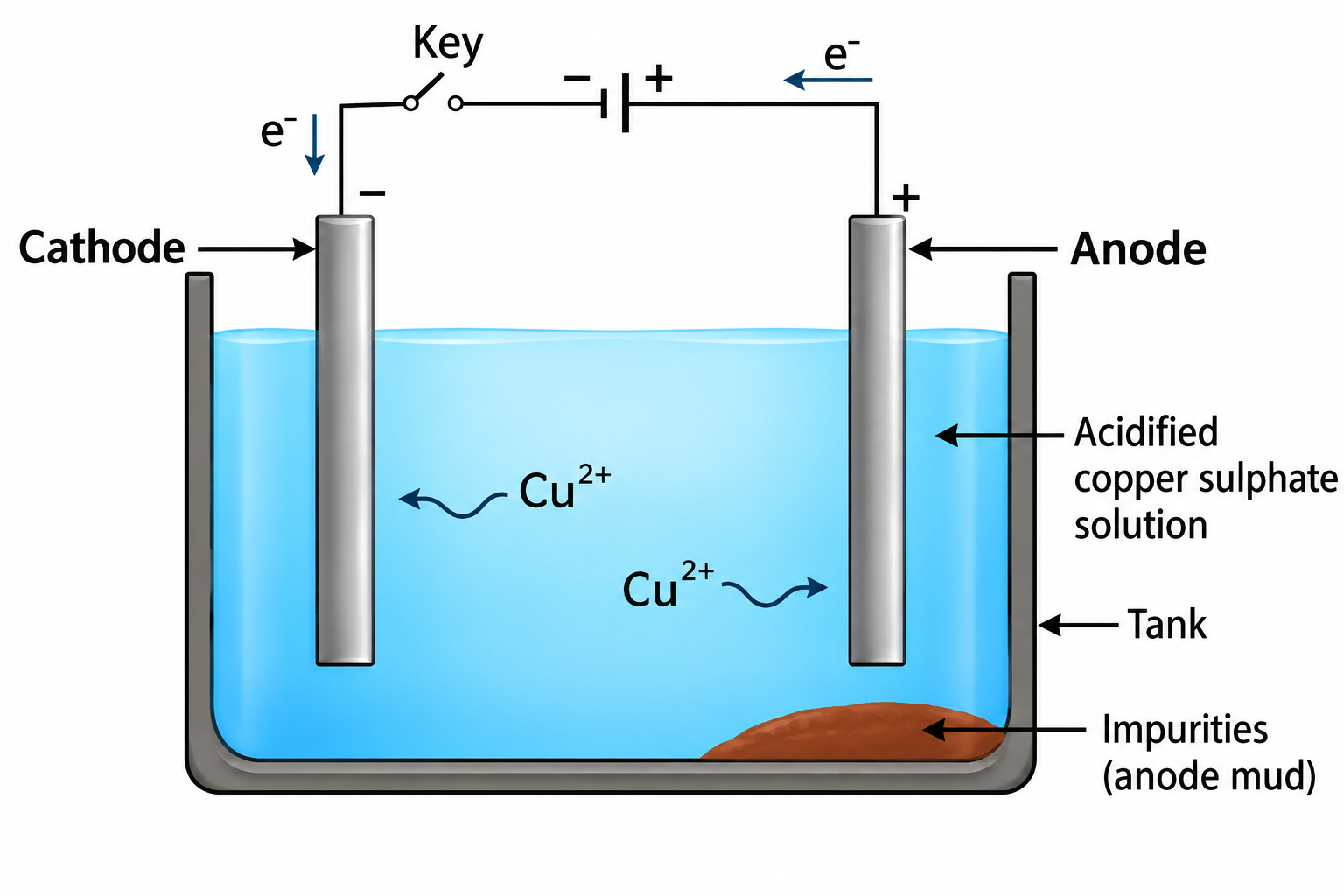
Figure 27.4: Electrolytic Refining of Impure Copper: Pure copper deposits on the cathode while insoluble impurities settle as anode mud
Electrolytic Refining of Copper Setup:
- Anode (+): A thick slab of crude, impure copper.
- Cathode (-): A thin strip of pure refined copper.
- Electrolyte: An aqueous acidified solution of Copper(II) sulphate ($\text{CuSO}_4 + \text{dil. } \text{H}_2\text{SO}_4$).
- Electrochemical Process:
• Upon passing direct electric current, pure copper from the anode dissolves into the electrolyte:
$$\text{Anode: } \text{Cu(impure)} \;\longrightarrow\; \text{Cu}^{2+} + 2e^-$$
• An equivalent amount of pure $\text{Cu}^{2+}$ ions from the electrolyte deposits onto the cathode:
$$\text{Cathode: } \text{Cu}^{2+} + 2e^- \;\longrightarrow\; \text{Cu(pure)}$$
• Soluble impurities go into solution, while noble insoluble impurities (Gold, Silver, Platinum) fall to the bottom of the anode tank and accumulate as Anode Mud (which is commercially recovered to offset refining costs).
6. Corrosion of Metals and Its Prevention
Corrosion is the slow and continuous deterioration of a metal's surface caused by electrochemical reactions with atmospheric gases (oxygen, carbon dioxide, sulphur compounds) and moisture.
Common Examples of Metallic Corrosion:
- 1. Rusting of Iron: Iron reacts with oxygen and water vapour to form a reddish-brown, soft, crumbly, non-adherent coating of hydrated iron(III) oxide (Rust):
$$4\text{Fe} + 3\text{O}_2 + 2x\text{H}_2\text{O} \;\longrightarrow\; \underset{\text{Rust (Reddish-brown)}}{2\text{Fe}_2\text{O}_3 \cdot x\text{H}_2\text{O}}$$
Because rust flakes off and exposes fresh underlying metal, rusting continues relentlessly until the entire iron article is destroyed.
- 2. Corrosion of Copper: Copper reacts slowly with atmospheric carbon dioxide, moisture, and oxygen to develop a protective green surface patina of Basic Copper Carbonate:
$$2\text{Cu} + \text{CO}_2 + \text{O}_2 + \text{H}_2\text{O} \;\longrightarrow\; \underset{\text{Green Coating}}{\text{CuCO}_3 \cdot \text{Cu(OH)}_2}$$
- 3. Tarnishing of Silver: Silver reacts with trace hydrogen sulphide gas ($\text{H}_2\text{S}$) in polluted air to form a black surface film of Silver Sulphide:
$$2\text{Ag} + \text{H}_2\text{S} \;\longrightarrow\; \underset{\text{Black Tarnish}}{\text{Ag}_2\text{S}} + \text{H}_2\uparrow$$
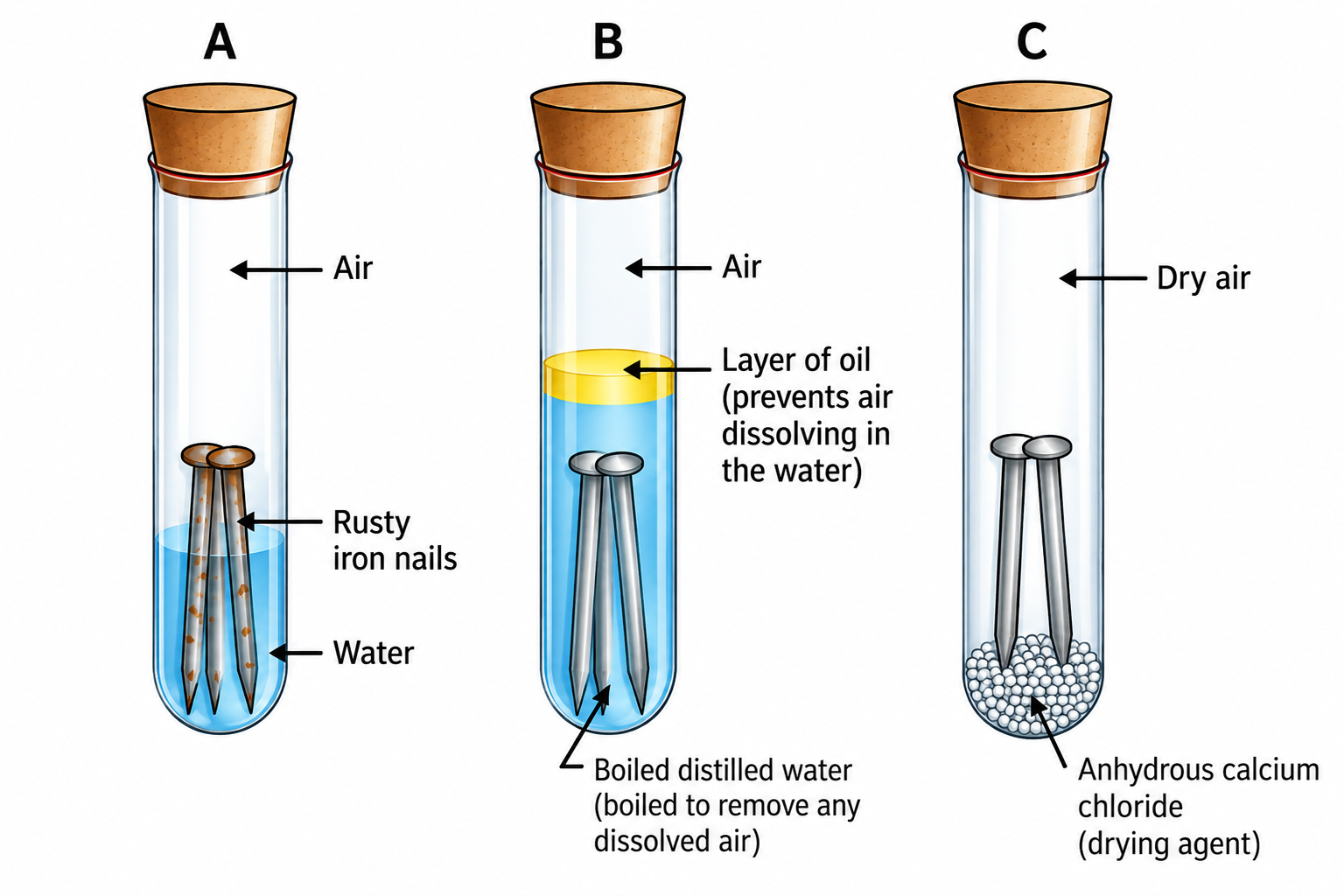
Figure 27.5: Classical Three-Test-Tube Experiment: Proving that BOTH Air (Oxygen) and Water are Essential for Rusting
Investigation into Conditions for Rusting (Figure 27.5):
- Test Tube A (Air + Water): Iron nails are partially submerged in water with air above. Result: Nails rust extensively.
- Test Tube B (Water only, No Air): Iron nails are submerged in boiled distilled water (expelling dissolved oxygen) sealed under a layer of mineral oil. Result: Nails do NOT rust.
- Test Tube C (Dry Air only, No Moisture): Iron nails are placed in dry air over anhydrous calcium chloride ($\text{CaCl}_2$, which absorbs all moisture). Result: Nails do NOT rust.
Conclusion: Neither air alone nor water alone causes rusting; both oxygen and liquid water are simultaneously necessary for iron corrosion.
Techniques for Preventing Corrosion
- Barrier Protection (Painting, Oiling, Greasing): Applying paint, grease, enamel, or varnish creates a physical barrier excluding moisture and air from metal surfaces.
- Galvanization: The industrial method of protecting iron and steel by coating them with a thin layer of molten Zinc ($\text{Zn}$). Zinc forms a protective zinc carbonate barrier. Even if the coating is scratched and iron is exposed, zinc corrodes preferentially because it is more electropositive than iron (Sacrificial Cathodic Protection).
- Electroplating & Tinning: Coating iron articles with non-corroding metals like Tin ($\text{Sn}$), Chromium ($\text{Cr}$), or Nickel ($\text{Ni}$) via electrolytic deposition (e.g., tin cans for edible oils).
- Anodizing: Electrically thickening the natural protective oxide layer on aluminium articles.
- Alloying: Modifying the chemical composition by creating homogeneous mixtures with other elements to enhance corrosion resistance and strength.
7. Alloys and Practical Uses of Elements
An alloy is a homogeneous solid mixture of two or more metals, or a metal and a non-metal, prepared by melting the primary metal and dissolving other elements in definite proportions.
| Alloy Name |
Elemental Composition |
Enhanced Properties |
Industrial & Engineering Uses |
| Steel |
$\text{Fe} (99.9\%) + \text{C} (0.1\text{--}1.5\%)$ |
Significantly harder and higher tensile strength than pure iron. |
Construction beams, ships, vehicles, bridges. |
| Stainless Steel |
$\text{Fe} (74\%) + \text{Cr} (18\%) + \text{Ni} (8\%) + \text{C}$ |
Exceptionally hard; does not rust or corrode in air, water, or acids. |
Cutlery, cooking utensils, surgical instruments. |
| Brass |
$\text{Cu} (70\text{--}80\%) + \text{Zn} (20\text{--}30\%)$ |
Malleable, corrosion-resistant, attractive golden appearance. |
Musical instruments, decorative hardware, screws, cartridge cases. |
| Bronze |
$\text{Cu} (88\text{--}90\%) + \text{Sn} (10\text{--}12\%)$ |
Highly ductile, extremely resistant to saltwater corrosion, low friction. |
Statues, medals, coins, heavy-duty marine ship propellers. |
| Solder |
$\text{Pb} (50\%) + \text{Sn} (50\%)$ |
Very low melting point ($~183^\circ\text{C}$); excellent electrical bonding. |
Welding and joining electrical wires and electronics circuit boards. |
| Amalgam |
Any alloy containing Mercury ($\text{Hg}$) (e.g., Dental Amalgam: $\text{Ag-Sn-Hg}$) |
Easily mouldable paste that hardens rapidly with high compressive strength. |
Dental fillings for tooth cavities. |
Purity of Gold ($24\text{ Carat vs }22\text{ Carat}$):
Pure gold is known as $24\text{ carat gold}$. Pure gold is extremely soft, pliable, and easily deformed, making it completely unsuitable for crafting delicate jewellery. To give it mechanical hardness and rigidity, gold is alloyed with Silver ($\text{Ag}$) or Copper ($\text{Cu}$). In India, jewellery is commonly made using $22\text{ carat gold}$, meaning $22\text{ parts}$ by weight of pure gold are alloyed with $2\text{ parts}$ of copper or silver.
Industrial & Biological Uses of Metals and Non-Metals (NIOS Syllabus)
| Category |
Element |
Specific Industrial / Practical Applications |
| Metals |
Copper & Aluminium |
Manufacture of high-efficiency electrical cables and household cooking utensils due to high thermal/electrical conductivity. |
| Iron & Steel |
Automobile construction, machinery, bridges, railway infrastructure, and industrial fabrication. |
| Lead & Zinc |
Automotive lead-acid storage batteries; galvanization coating to prevent steel corrosion. |
| Gold, Silver & Platinum |
High-value jewellery, international bullion reserves, corrosion-proof electrical micro-contacts. |
| Non-Metals |
Silicon ($\text{Si}$) |
Semiconductor material essential for computer microprocessors, transistors, integrated circuits, and photovoltaic solar cells. |
| Phosphorus ($\text{P}$) |
Manufacture of matches (red phosphorus on matchbox striking strip), safety flares, and NPK chemical fertilizers. |
| Sulphur ($\text{S}$) |
Manufacture of sulphuric acid ($\text{H}_2\text{SO}_4$, the "King of Chemicals"), vulcanization of rubber tires, agricultural fungicides, and gunpowder. |
| Nitrogen & Hydrogen |
Haber's process synthesis of ammonia ($\text{NH}_3$) for nitrogenous fertilizers; liquid hydrogen as cryogenic rocket propellant. |
8. NIOS Textbook Solutions: "Test Yourself" & "Stretch Yourself"
Question 1 (Test Yourself): Metals are good conductors of electricity, but non-metals are not. Why?
Model Answer:
- Electrical conductivity in any substance requires the presence of free, mobile electric charges capable of drifting under an applied electrical potential.
- In metals, valence electrons are loosely held and dissociate into a communal "sea of delocalized electrons" that freely flow through the crystal lattice when a voltage is applied, providing high electrical conductivity.
- In non-metals, all valence electrons are tightly held within localized covalent bonds or atomic shells. There are no free electrons to conduct electric current, making non-metals insulators (with the lone exception of graphite, which contains delocalized $\pi$-electrons).
Question 2 (Test Yourself): What are the main conditions for corrosion? How will you prevent it?
Model Answer:
- Conditions: The two mandatory conditions necessary for metallic corrosion (such as rusting of iron) are the simultaneous presence of Oxygen ($\text{O}_2$) and Water / Moisture ($\text{H}_2\text{O}$). Neither dry air nor air-free water can corrode iron alone.
- Prevention Methods:
- Barrier Coating: Painting, oiling, or greasing metal surfaces to exclude air and water.
- Galvanization: Coating iron surfaces with a protective layer of molten zinc ($\text{Zn}$), providing barrier and sacrificial cathodic protection.
- Electroplating: Depositing a corrosion-resistant metal layer ($\text{Cr, Ni, Sn}$) via electrolysis.
- Alloying: Transforming iron into stainless steel by combining it with chromium and nickel.
Question 3 (Test Yourself): How will you prove that metal oxides are basic but non-metal oxides are acidic in nature?
Model Answer:
- Testing Metal Oxides: Burn a strip of magnesium ribbon in air. Collect the white ash ($\text{MgO}$) and dissolve it in water to form magnesium hydroxide:
$$\text{MgO} + \text{H}_2\text{O} \;\longrightarrow\; \text{Mg(OH)}_2$$
When red litmus paper is dipped into this solution, it turns blue, proving that metal oxides form alkaline solutions and are fundamentally basic.
- Testing Non-Metal Oxides: Burn a small piece of sulphur in a deflagrating spoon inside a gas jar. Dissolve the collected sulphur dioxide gas in water to form sulphurous acid:
$$\text{SO}_2 + \text{H}_2\text{O} \;\longrightarrow\; \text{H}_2\text{SO}_3$$
When blue litmus paper is introduced, it turns red, conclusively proving that non-metal oxides dissolve in water to yield acids and are fundamentally acidic.
Question 4 (Test Yourself): Tin ($\text{Sn}$) is soluble in excess $\text{NaOH}$. Why? Explain with the balanced equation.
Model Answer:
- Tin ($\text{Sn}$) is an amphoteric metal capable of exhibiting both basic and acidic behavior. When heated with excess concentrated hot sodium hydroxide solution, tin reacts as an acidic component, displacing hydrogen and dissolving to form a soluble complex salt called sodium stannate ($\text{Na}_2\text{SnO}_3$).
- Balanced Chemical Equation:
$$\text{Sn(s)} + 2\text{NaOH(aq)} + \text{H}_2\text{O(l)} \;\longrightarrow\; \underset{\text{Sodium Stannate}}{\text{Na}_2\text{SnO}_3\text{(aq)}} + 2\text{H}_2\uparrow\text{(g)}$$
Question 5 (Stretch Yourself): Why is it better to use copper than carbon in electrical wires?
Model Answer:
- While carbon in the form of graphite conducts electricity, it is extremely brittle, lacks ductility, and cannot be drawn into continuous flexible wires.
- Copper, on the other hand, is highly ductile (drawn into thin, flexible wires without snapping), possesses substantially lower electrical resistivity than graphite (minimizing energy loss as $I^2Rt$ heat), and exhibits high tensile strength and ease of soldering.
Question 6 (Stretch Yourself): Aluminium is used to make cooking utensils in houses. Why?
Model Answer:
- Aluminium is widely preferred for cookware because it is an excellent thermal conductor (ensuring rapid, uniform heat distribution), has a high melting point ($660^\circ\text{C}$), and is lightweight and malleable.
- Although aluminium is chemically reactive, upon exposure to air it immediately develops an inert, non-toxic, and impermeable passivation surface layer of Aluminium Oxide ($\text{Al}_2\text{O}_3$) that shields the utensil from further oxidation or corrosion by food juices.
Question 7 (Stretch Yourself): A copper coin left exposed to open air develops a green coating after one month. Why does this occur?
Model Answer:
- When copper is exposed to moist atmospheric air over a prolonged period, it undergoes slow chemical corrosion by reacting with atmospheric carbon dioxide ($\text{CO}_2$), water vapour ($\text{H}_2\text{O}$), and oxygen ($\text{O}_2$).
- This reaction produces a basic, insoluble green patina consisting of Basic Copper Carbonate ($\text{CuCO}_3 \cdot \text{Cu(OH)}_2$):
$$2\text{Cu} + \text{H}_2\text{O} + \text{CO}_2 + \text{O}_2 \;\longrightarrow\; \underset{\text{Basic Copper Carbonate (Green)}}{\text{CuCO}_3 \cdot \text{Cu(OH)}_2}$$

 VARDAAN COMET