Vardaan Learning Institute
Heat and Energy
ICSE Class 9 Physics • Chapter 6 Master Notes
Syllabus Scope & Reference
Covering: ICSE Class 9 Physics Syllabus (Chapter 6: Heat and Energy) • Concepts of Heat and Temperature • SI and CGS Units • Anomalous Expansion of Water • Hope's Experiment • Energy Flow in Ecosystems • Laws of Thermodynamics in Ecosystems • Renewable & Non-Renewable Energy Sources • Production of Electricity • Energy Degradation • Greenhouse Effect & Global Warming.
(A) Heat and Temperature; Anomalous Expansion
1. Concept of Heat (Heat as Energy)
In daily life, mechanical work or energy input generates heat: rubbing palms makes them warm, pumping air into a bicycle tube heats the pump barrel, passing electric current through a resistance wire heats it, and burning coal produces heat. Thus, heat is a form of energy (internal kinetic and potential energy of constituent molecules).
Microscopic View of Internal Energy
Every body is made up of molecules in continuous random motion possessing internal kinetic energy. Molecules also exert attractive forces on each other, giving internal potential energy.
$$\text{Total Internal Energy} = \text{Internal Kinetic Energy} + \text{Internal Potential Energy}$$
Definition of Heat: Heat is the internal energy of the molecules constituting a body. It is the energy in transit that flows from a body at higher temperature to a body at lower temperature when kept in contact.
Units of Heat:
- SI Unit: Joule ($\text{J}$).
- CGS Unit: erg ($1\text{ J} = 10^7\text{ erg}$).
- Calorie ($\text{cal}$): Quantity of heat required to raise the temperature of $1\text{ g}$ of water from $14.5^\circ\text{C}$ to $15.5^\circ\text{C}$.
- Kilocalorie ($\text{kcal}$): Quantity of heat required to raise the temperature of $1\text{ kg}$ of water from $14.5^\circ\text{C}$ to $15.5^\circ\text{C}$ ($1\text{ kcal} = 1000\text{ cal}$).
- Mechanical Equivalent / Relation:
$$\mathbf{1\text{ cal} = 4.186\text{ J} \approx 4.2\text{ J}}, \quad \mathbf{1\text{ kcal} = 4186\text{ J} \approx 4200\text{ J}}$$
2. Concept of Temperature
When a hot body is kept in thermal contact with a cold body, heat flows from the hot body to the cold body until thermal equilibrium is attained. The thermal state which determines the direction of heat flow is called temperature.
Definition of Temperature
Temperature: Temperature is a physical quantity which measures the degree of hotness or coldness of a body. Microscopically, temperature is a measure of the average kinetic energy of the molecules of a body due to their random motion.
Units & Scales of Temperature:
- SI Unit: Kelvin ($\text{K}$).
- Common Units: Degree Celsius ($^\circ\text{C}$) and Degree Fahrenheit ($^\circ\text{F}$).
- Absolute Zero ($0\text{ K}$): The temperature at which all molecular motion in a substance completely ceases ($0\text{ K} = -273.15^\circ\text{C} \approx -273^\circ\text{C}$).
- Relation between Kelvin and Celsius Scales:
$$\mathbf{T\text{ (K)} = t\text{ (}^\circ\text{C)} + 273}$$
- Relation between Celsius and Fahrenheit Scales:
$$\mathbf{\frac{C}{5} = \frac{F - 32}{9}}$$
3. Master Comparison: Heat vs Temperature
| S.No. |
Heat |
Temperature |
| 1. |
Heat is a form of energy obtained due to random motion of molecules in a substance. |
Temperature is a quantity which determines the direction of flow of heat between two bodies in contact. |
| 2. |
S.I. Unit: Joule ($\text{J}$). |
S.I. Unit: Kelvin ($\text{K}$). |
| 3. |
The amount of heat contained in a body depends on its mass, temperature, and material. |
The temperature of a body depends on the average kinetic energy of its molecules due to random motion. |
| 4. |
Heat is measured by the principle of calorimetry. |
Temperature is measured by a thermometer. |
| 5. |
Two bodies having the same quantity of heat may differ in their temperatures. |
Two bodies at the same temperature may differ in the total quantities of heat contained in them. |
| 6. |
When two bodies are in contact, total heat is equal to the sum of heat of individual bodies. |
When two bodies at different temperatures are in contact, resultant temperature lies between the two temperatures. |
4. Thermal Expansion
Almost all substances (solids, liquids, and gases) expand on heating and contract on cooling. The expansion of a substance on heating is called thermal expansion.
- Solids: Possess definite shape $\implies$ undergo linear expansion (length), superficial expansion (area), and cubical expansion (volume).
- Liquids & Gases: Do not possess definite shape $\implies$ undergo cubical (volume) expansion only.
- Relative Extent: Gases expand much more than liquids, and liquids expand more than solids for the same rise in temperature ($\text{Gases} > \text{Liquids} > \text{Solids}$).
5. Anomalous Expansion of Water
Unusual behavior of water: Most liquids expand on heating and contract on cooling throughout all temperature ranges. However, water shows an exceptional behavior between $0^\circ\text{C}$ and $4^\circ\text{C}$.
Definition of Anomalous Expansion
Anomalous Expansion of Water: When water at $0^\circ\text{C}$ is heated, it contracts instead of expanding in the temperature range from $0^\circ\text{C}$ to $4^\circ\text{C}$. Beyond $4^\circ\text{C}$, it expands normally. Conversely, when water is cooled from $4^\circ\text{C}$ to $0^\circ\text{C}$, it expands.
• Volume of $1\text{ g}$ of water is minimum at $4^\circ\text{C}$ ($1.0000\text{ cm}^3$).
• Density of water is maximum at $4^\circ\text{C}$ ($1\text{ g cm}^{-3} = 1000\text{ kg m}^{-3}$).
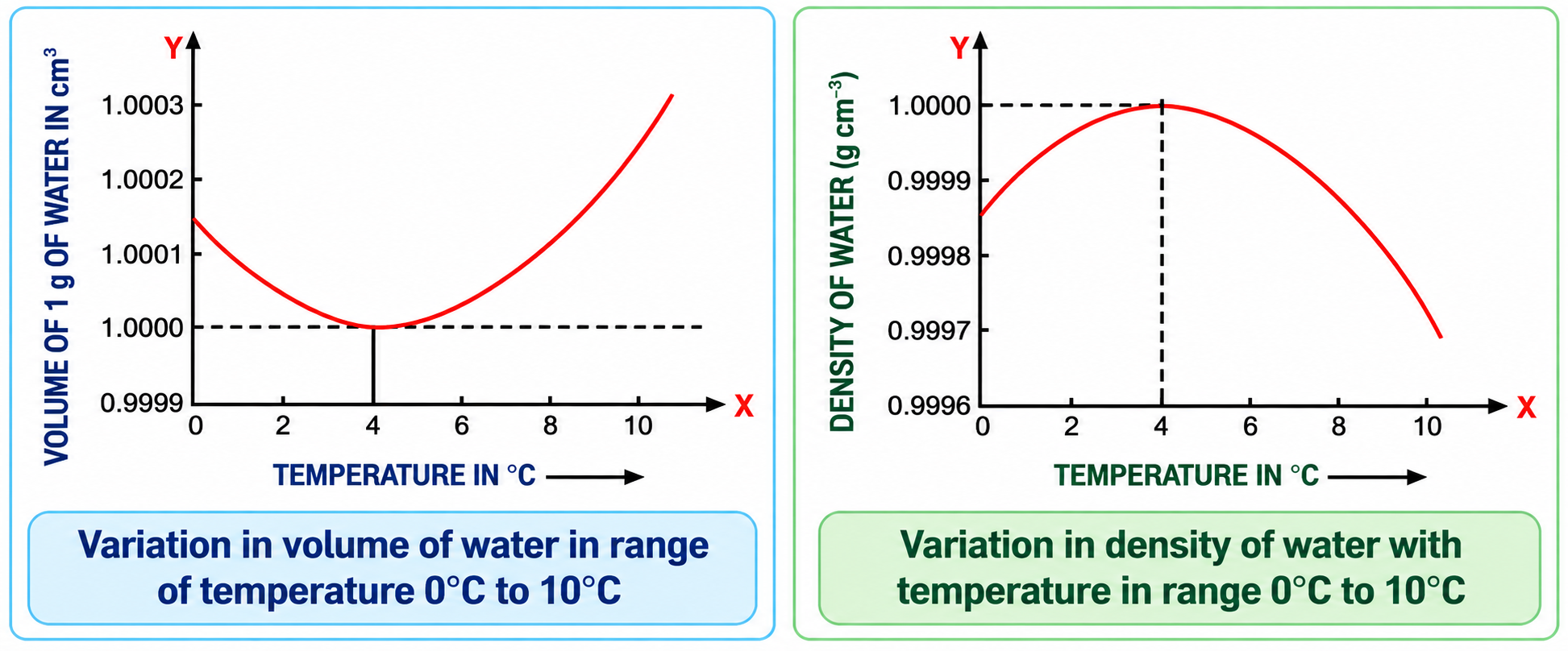
Fig. 6.1 & Fig. 6.2: Anomalous Expansion Graphs (Volume & Density vs. Temperature)
6. Hope's Experiment (Demonstrating Anomalous Expansion)
In 1805, T.C. Hope devised a classic apparatus to demonstrate the anomalous expansion of water and determine its temperature of maximum density.
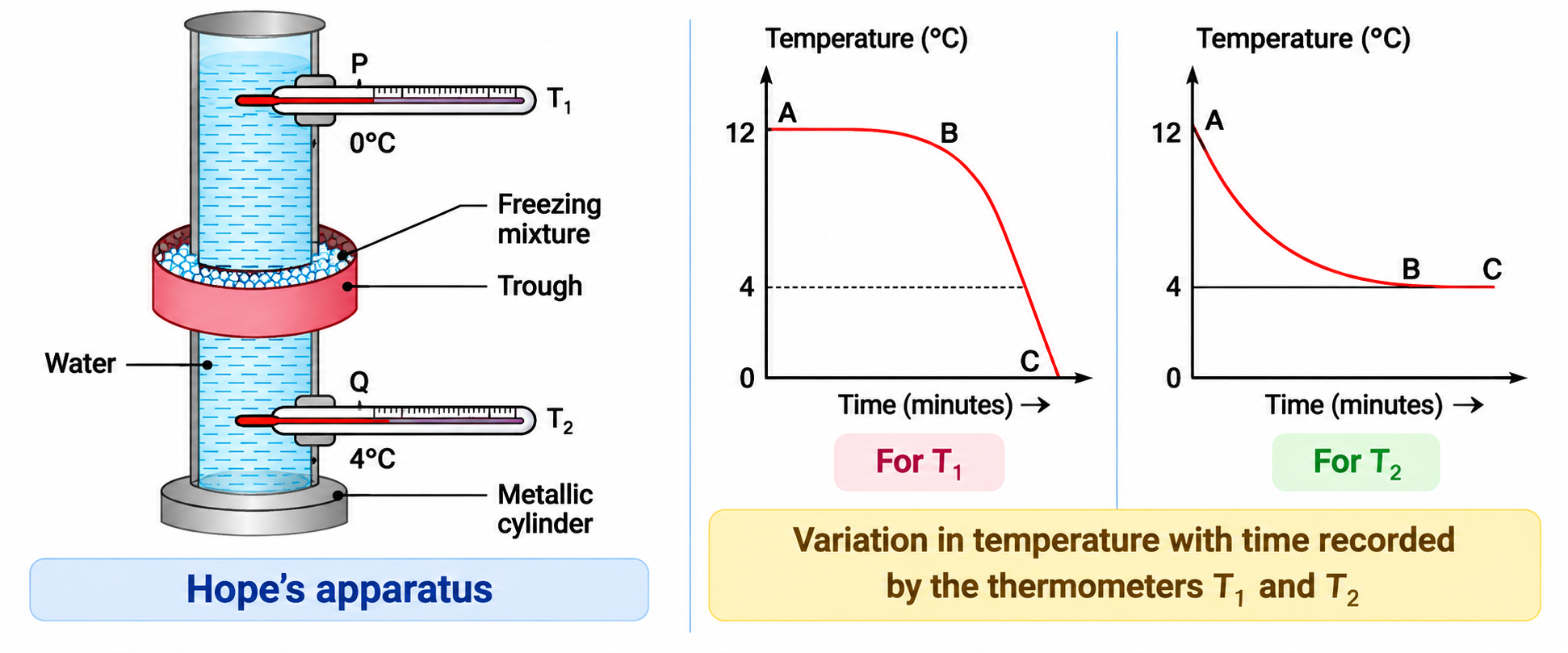
Fig. 6.3 & Fig. 6.4: Hope's Apparatus & Temperature-Time Readings Graph
Apparatus & Setup:
- A tall metallic cylinder fitted with two thermometers: $T_1$ near the top (P) and $T_2$ near the bottom (Q).
- A central cylindrical trough surrounding the middle portion of the cylinder, filled with a freezing mixture of ice and salt.
- Cylinder is initially filled with water at room temperature ($\approx 12^\circ\text{C}$).
Observations & Working Steps:
- Initial State: Both thermometers $T_1$ and $T_2$ show room temperature ($\approx 12^\circ\text{C}$).
- First Phase ($12^\circ\text{C} \to 4^\circ\text{C}$): Freezing mixture cools water in the central portion. Water contracts, its density increases, and it sinks to the bottom. Warm water from the bottom rises up. Convection currents cause the lower thermometer $T_2$ to fall rapidly until it reaches $4^\circ\text{C}$ and becomes steady. $T_1$ remains almost unchanged.
- Second Phase ($4^\circ\text{C} \to 0^\circ\text{C}$): On further cooling below $4^\circ\text{C}$, water in central portion undergoes anomalous expansion, density decreases, and cold water rises to the top. Lower thermometer $T_2$ remains steady at $4^\circ\text{C}$ (maximum density water at bottom). Upper thermometer $T_1$ falls rapidly from $4^\circ\text{C} \to 0^\circ\text{C}$ and stays at $0^\circ\text{C}$, where water at top freezes to ice.
7. Consequences of Anomalous Expansion of Water in Nature & Life
Q1. How does the anomalous expansion of water preserve aquatic life in cold climates during severe winter?
Ans: In winter, when atmospheric temperature drops below $0^\circ\text{C}$, water at the surface of a lake/pond cools first. As it cools to $4^\circ\text{C}$, its density increases and it sinks to the bottom.
When top layer water cools below $4^\circ\text{C} \to 0^\circ\text{C}$, it expands (anomalous expansion), density decreases, and it remains at the surface. Surface layer freezes into ice at $0^\circ\text{C}$.
Since ice and water are poor conductors of heat, the ice layer insulates the water underneath. Water at the bottom remains at $4^\circ\text{C}$, allowing fish and aquatic creatures to survive comfortably.
Q2. Why do water pipes burst and plant capillaries get destroyed on very cold winter nights?
Ans: When atmospheric temperature falls below $4^\circ\text{C} \to 0^\circ\text{C}$, water inside narrow metal pipes or plant capillaries undergoes anomalous expansion (volume increases). Due to rigid pipe walls/cell walls, immense pressure is exerted, causing water pipes to burst and plant capillaries to rupture.
Q3. Why do rocks crumble/split in winter in cold regions?
Ans: Water trapped in small cracks/crevices of rocks freezes into ice at $0^\circ\text{C}$. As water expands during freezing below $4^\circ\text{C}$, it exerts tremendous outward pressure, widening cracks and causing rocks to crumble (weathering).
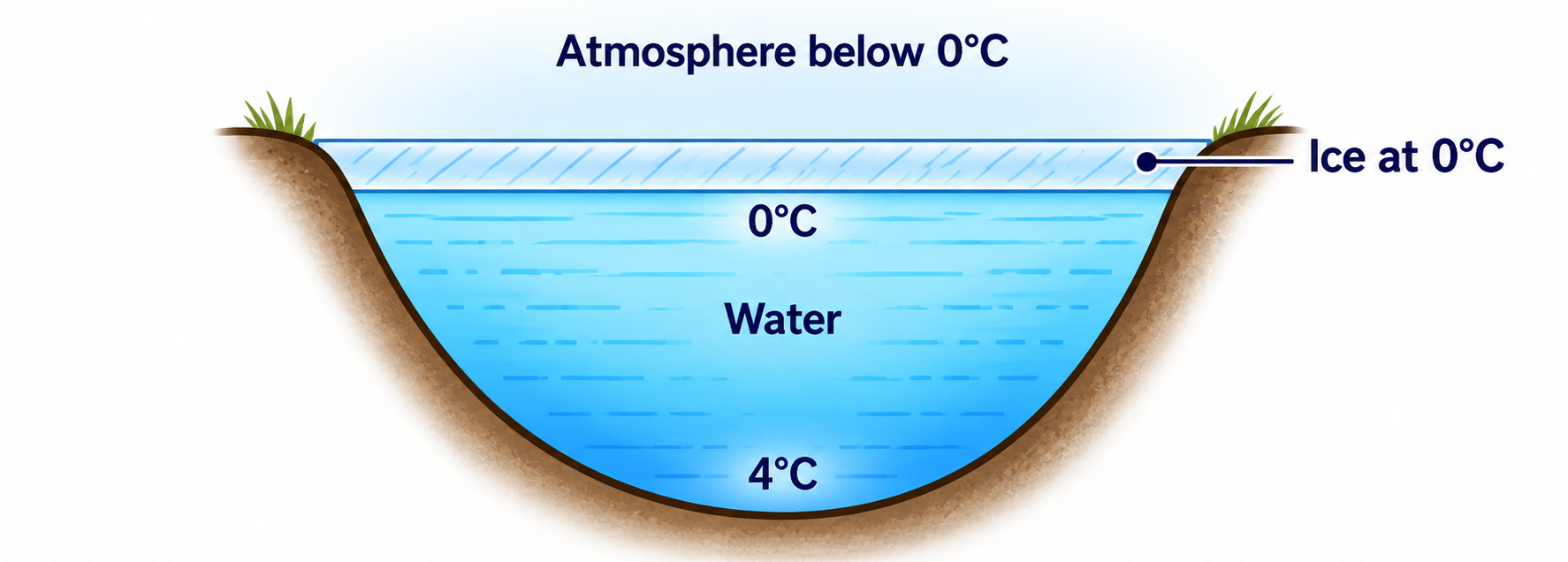
Fig. 6.5: Formation of Ice Layer at the Surface of a Pond Insulating Aquatic Life
(B) Energy Flow and Its Importance
1. Energy Flow in an Ecosystem
An ecosystem is a structural and functional unit composed of biotic components (producers, consumers, decomposers) and abiotic components (solar radiation, heat, air, water, soil, minerals).
Solar Energy Input & Utilization:
- Sun is the ultimate primary source of energy for all ecosystems.
- Nearly 56-60% of incident solar energy is absorbed by the atmosphere and land.
- Nearly 10% is used in heating water bodies and land.
- Only 8% falls on green plants.
- Plants absorb most of this energy, but utilize only about 0.02% in photosynthesis to produce food (carbohydrates). Plants are called producers.
Gross vs Net Primary Production
Gross Primary Production (GPP): Total chemical energy synthesized by producers through photosynthesis.
Net Primary Production (NPP): Energy stored by producers for growth after accounting for energy lost during respiration ($R$).
$$\mathbf{\text{NPP} = \text{GPP} - R}$$
Numerical Example from Book: Out of $20,810\text{ cal}$ gross production, $11,977\text{ cal}$ is used in respiration, leaving $8,833\text{ cal}$ as net primary production.
Trophic Levels & Food Chain:
- Producers (Trophic Level 1): Green plants & photosynthetic bacteria.
- Primary Consumers / Herbivores (Trophic Level 2): Krill, grasshopper, deer, cow (obtain energy by eating producers).
- Secondary Consumers / Small Carnivores (Trophic Level 3): Small fish, frog, heron (eat primary consumers).
- Tertiary Consumers / Top Carnivores (Trophic Level 4): Large fish, snake, tiger, man (eat secondary consumers).
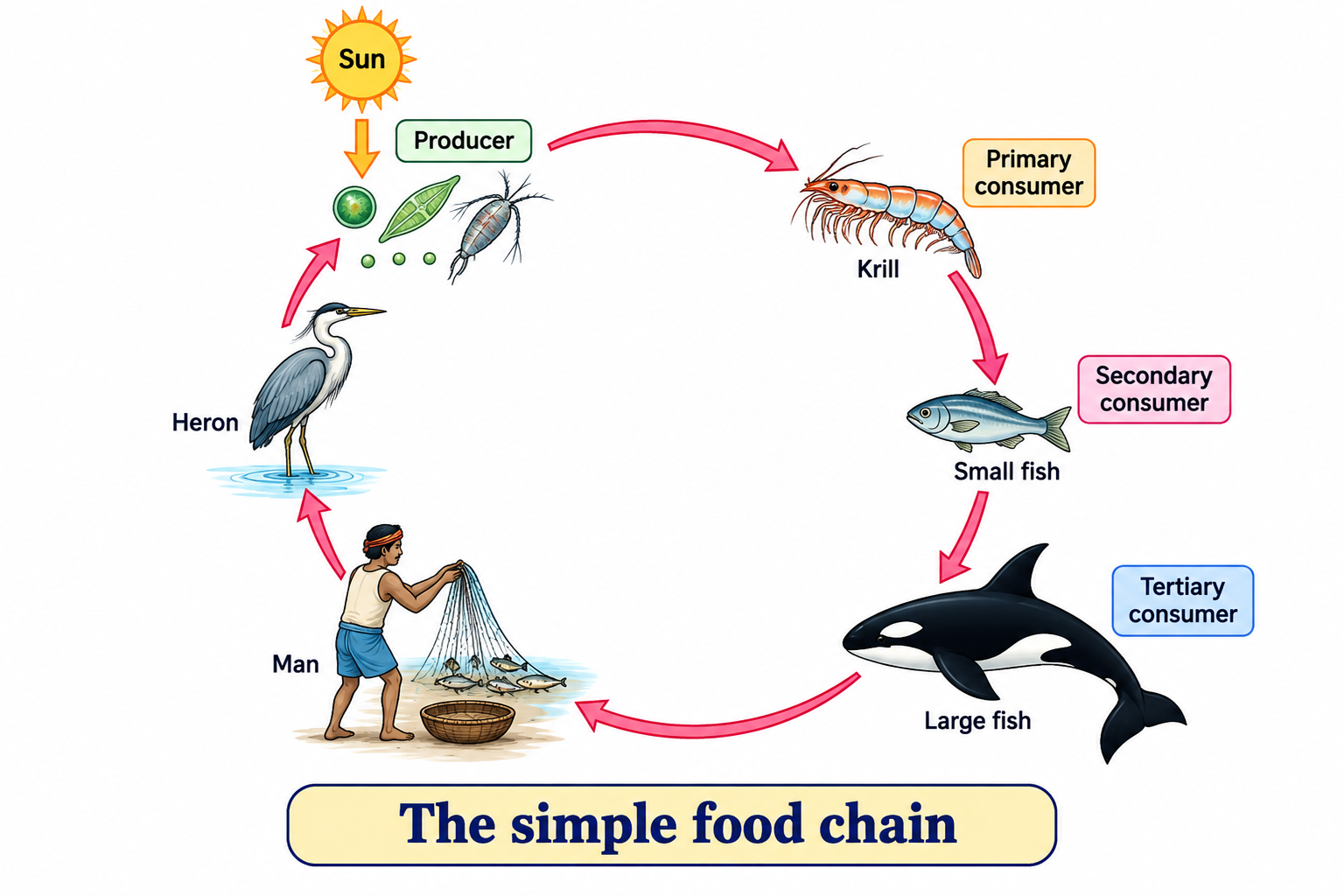
Fig. 6.6: Trophic Levels in a Simple Marine Food Chain
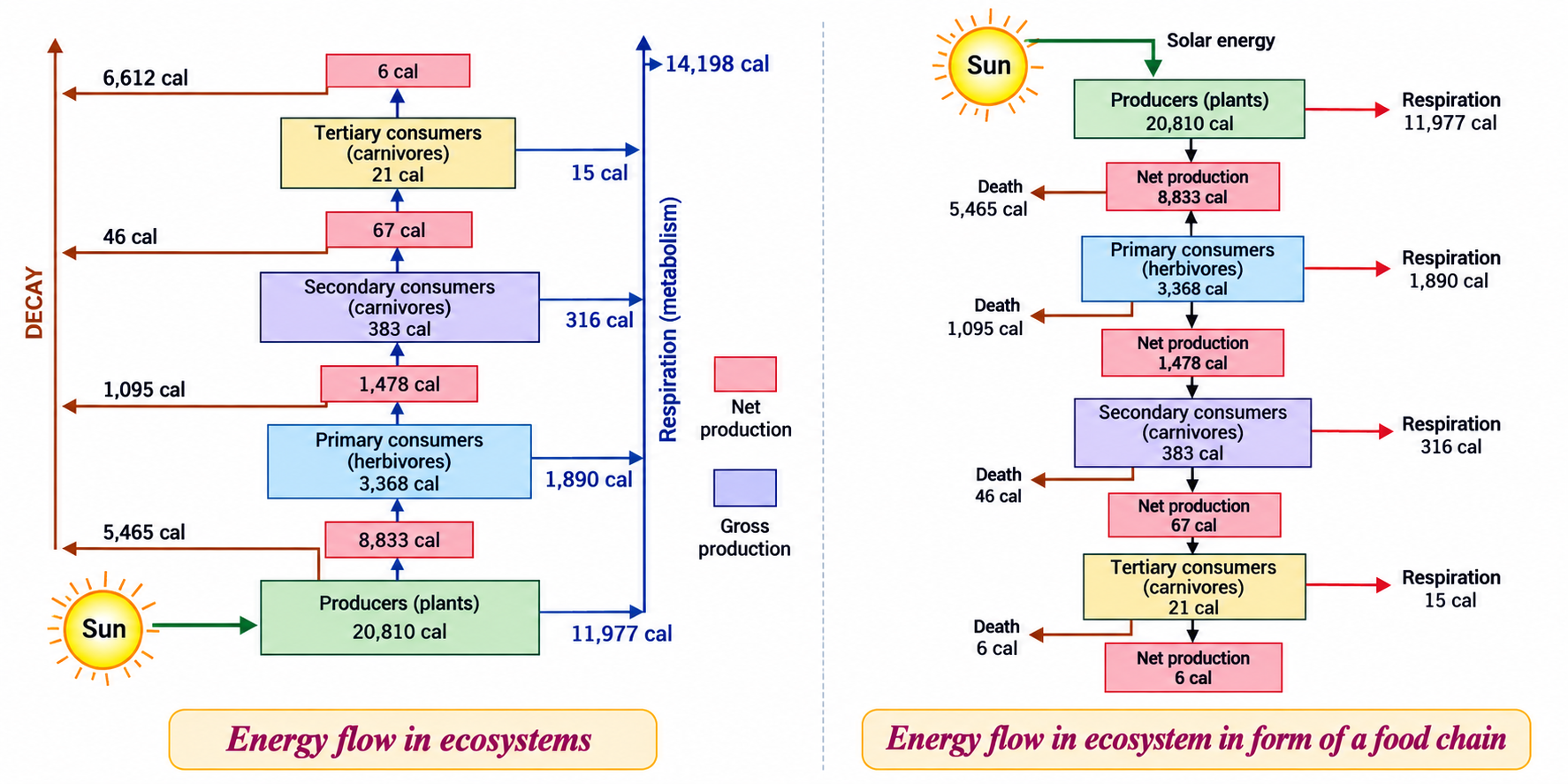
Fig. 6.7 & Fig. 6.8: Energy Flow in Ecosystems & Trophic Level Energy Distribution
2. Application of Laws of Thermodynamics in Energy Flow
Thermodynamics in Ecosystems
First Law of Thermodynamics: Energy can neither be created nor destroyed; it can only be transformed from one form to another. Solar energy absorbed by plants is transformed into chemical energy of food, which is subsequently converted into mechanical energy, heat, and metabolic energy in animals.
Second Law of Thermodynamics: Whenever energy is transformed from one form to another, a part of it is always dissipated into non-useful heat energy (unusable form). Energy transfer is never 100% efficient. A large portion of energy is lost as heat during respiration and metabolic decay at each trophic level.
Q. Why is the flow of energy in an ecosystem described as linear or unidirectional, unlike nutrients?
Ans: Energy enters the ecosystem from the Sun and passes sequentially from producers to primary, secondary, and tertiary consumers. At each step, energy is dissipated as heat into the atmosphere. This degraded heat energy cannot revert back to solar energy or be reused by producers. Hence, energy flow is strictly unidirectional (linear) and non-cyclic.
(C) Energy Sources & Electricity Generation
1. Sources of Energy & Characteristics
A good source of energy should provide an adequate amount of useful energy at a steady rate over a long period, be safe, convenient to use, economical, easy to store and transport, and cause minimal pollution.
2. Distinction: Renewable vs Non-Renewable Energy Sources
| S.No. |
Renewable (Non-Conventional) Sources |
Non-Renewable (Conventional) Sources |
| 1. |
Sources from which energy can be obtained continuously over a long period of time. |
Sources accumulated in nature over millions of years and cannot be quickly replaced when exhausted. |
| 2. |
They are non-conventional sources. |
They are conventional sources. |
| 3. |
These sources will not get exhausted (inexhaustible). |
These sources will get exhausted with time. |
| 4. |
Can be regenerated continuously. |
Cannot be regenerated once consumed. |
| 5. |
Examples: Sun, wind, flowing water (hydro), biomass, tides, ocean thermal, geothermal, nuclear fuel. |
Examples: Coal, petroleum (crude oil), natural gas. |
3. Detailed Study of Energy Sources
A. Renewable Sources:
- Solar Energy: Energy received from the sun due to nuclear fusion ($4\mathrm{H} \to \mathrm{He} + \text{Energy}$). Solar Constant: Energy reaching upper atmosphere per second per unit area $\approx \mathbf{1.34\text{ kW m}^{-2}}$.
- Wind Energy: Kinetic energy possessed by huge moving air masses due to uneven heating of earth by sun.
- Hydro Energy: Kinetic energy of flowing water in rivers or potential energy of water stored in high dams.
- Bio-mass & Bio-gas: Organic wastes (cattle dung, crop residues). Bio-gas (Gobar gas) produced by anaerobic decomposition contains 65% Methane ($\mathrm{CH_4}$) as main constituent.
- Tidal Energy: Gravitational pull of moon and sun causing high and low tides in oceans twice daily.
- Ocean Energy:
- Ocean Thermal Energy (OTE/OTEC): Harnesses temperature difference between warm surface water ($20-25^\circ\text{C}$) and cold deep water ($4-5^\circ\text{C}$). Requires $\Delta T \ge 20^\circ\text{C}$.
- Oceanic Wave Energy: Harnesses kinetic energy of high-speed wind-driven sea waves.
- Geothermal Energy: Heat energy possessed by hot rocks deep inside the Earth's crust at hot spots.
- Nuclear Energy: Energy released during Nuclear Fission (splitting of heavy nucleus like $\text{U-235}$ into lighter nuclei, releasing $\approx 200\text{ MeV}$ per fission) or Nuclear Fusion (combining light nuclei at $10^7\text{ K}$). Mass defect $\Delta m$ converts to energy via Einstein's mass-energy equation:
$$\mathbf{E = m c^2} \quad (c = 3 \times 10^8\text{ m s}^{-1})$$
B. Non-Renewable Sources (Fossil Fuels):
- Coal: Complex mixture of carbon, hydrogen, oxygen, nitrogen, and sulfur compounds formed from ancient buried vegetation.
- Petroleum (Crude Oil): Dark, viscous liquid mixture of hydrocarbons. Refined by fractional distillation into petrol, diesel, kerosene, and LPG (Liquefied Petroleum Gas).
Note: LPG contains butane, propane, and ethane. A strong smelling substance Ethyl Mercaptan ($\mathrm{C_2H_5SH}$) is added to detect gas leakage.
- Natural Gas: Found deep under earth above petroleum reservoirs. Contains up to 95% Methane ($\mathrm{CH_4}$).
4. Production of Electricity from Renewable Sources
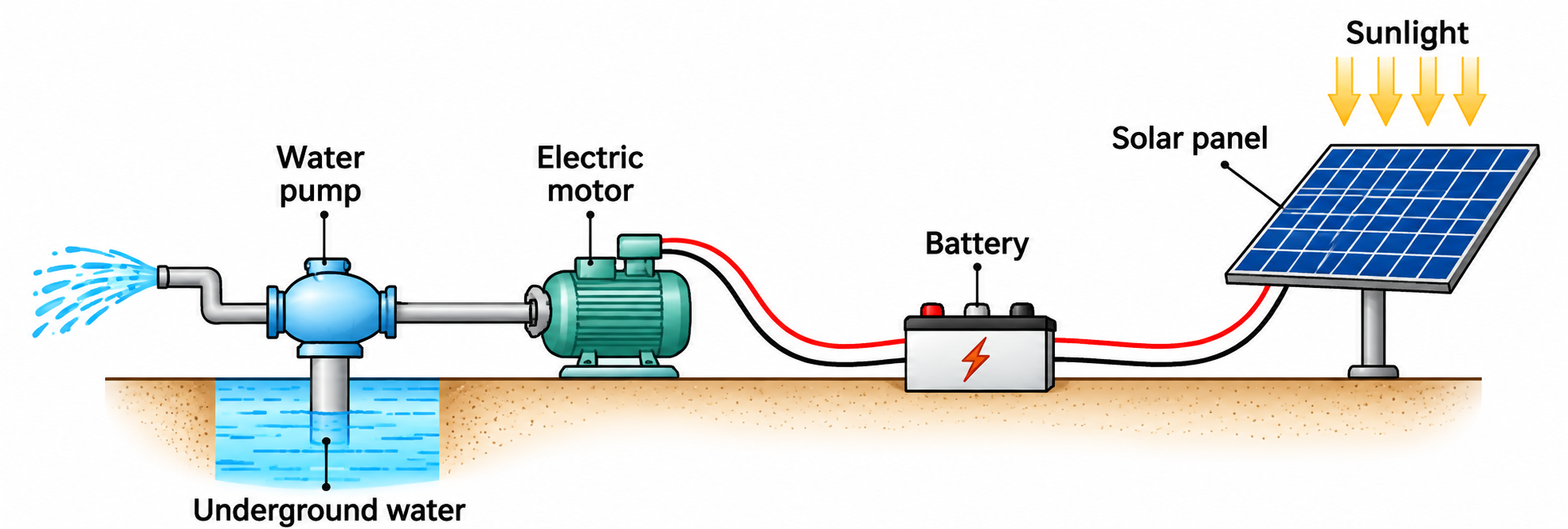
Fig. 6.9: Solar Panel Running a Water Pump System
1. Solar Energy (Solar Cell & Solar Panel):
- Solar Cell: Semiconductor device (made of Silicon/Gallium) that converts solar light directly into d.c. electricity. Single cell ($4\text{ cm}^2$) gives $0.4 - 0.5\text{ V}$ voltage and $60\text{ mA}$ current.
- Solar Panel: Large arrangement of interconnected solar cells. Charges storage batteries during daytime. Used in artificial satellites, remote water pumps, and street lights.
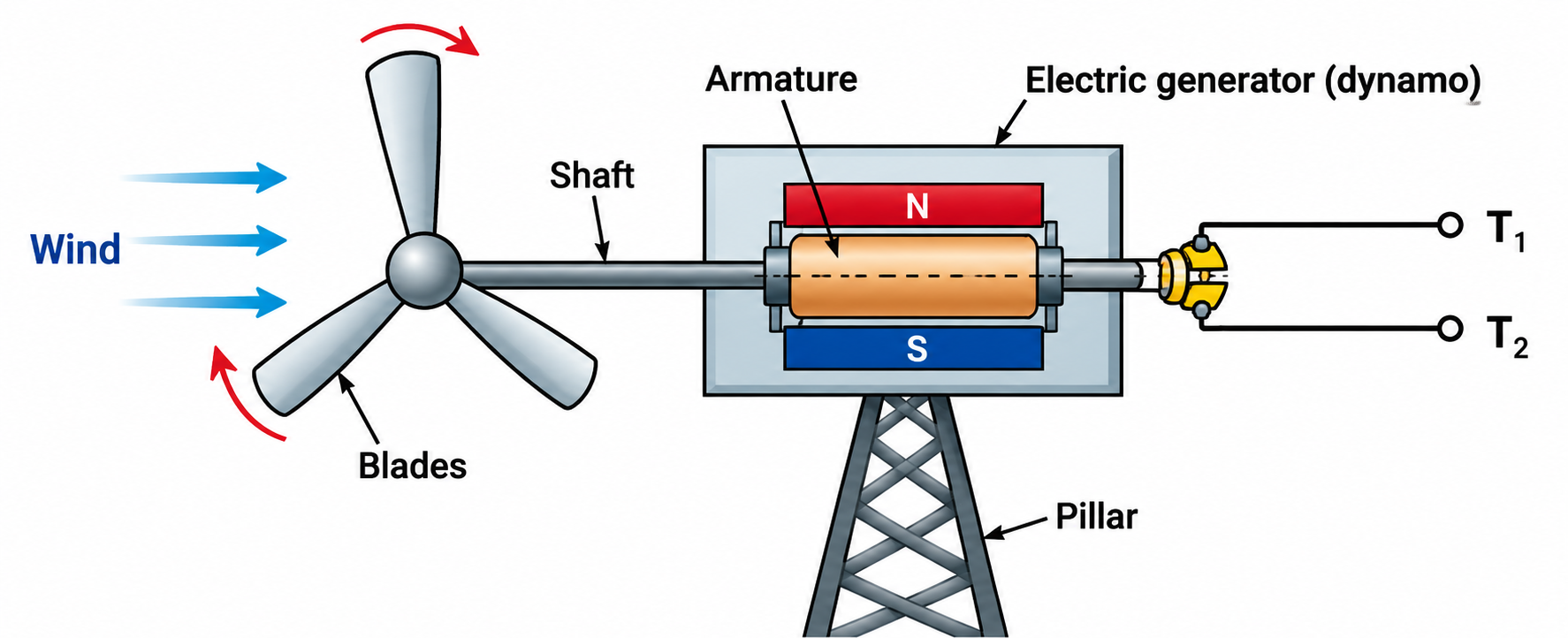
Fig. 6.10: Wind Turbine Generator Schematic & Components
2. Wind Energy (Wind Generator):
- Blowing wind rotates blades of a wind turbine, converting kinetic energy of wind into rotational kinetic energy.
- Turbine shaft rotates armature of an electric generator in a magnetic field, producing alternating current (a.c.).
- Limitation: Requires continuous wind speed of at least $15\text{ km h}^{-1}$ and large land area (wind farms).
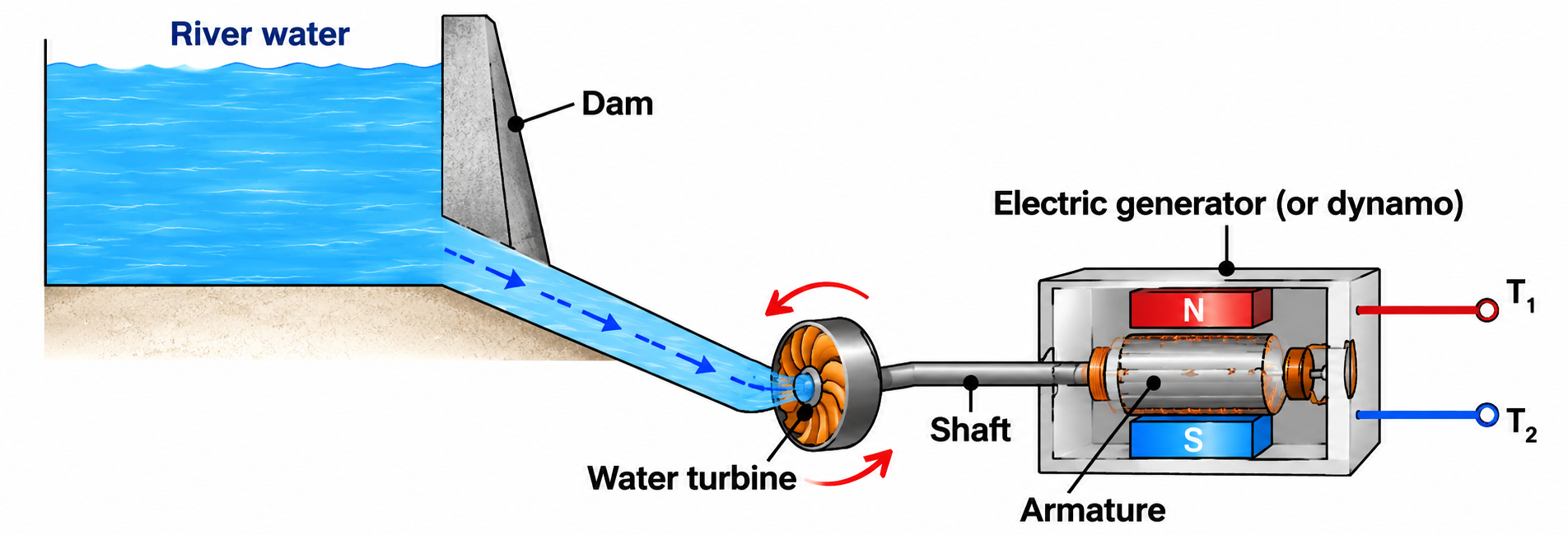
Fig. 6.11: Hydroelectric Power Plant Operation Schematic
3. Hydro Energy (Hydroelectric Power Plant):
- Water stored in high altitude dam possesses potential energy. Falling water rotates turbine blades, converting potential $\to$ kinetic $\to$ mechanical energy $\to$ electrical energy.
- Provides $\approx 23\%$ of total electricity generated in India.
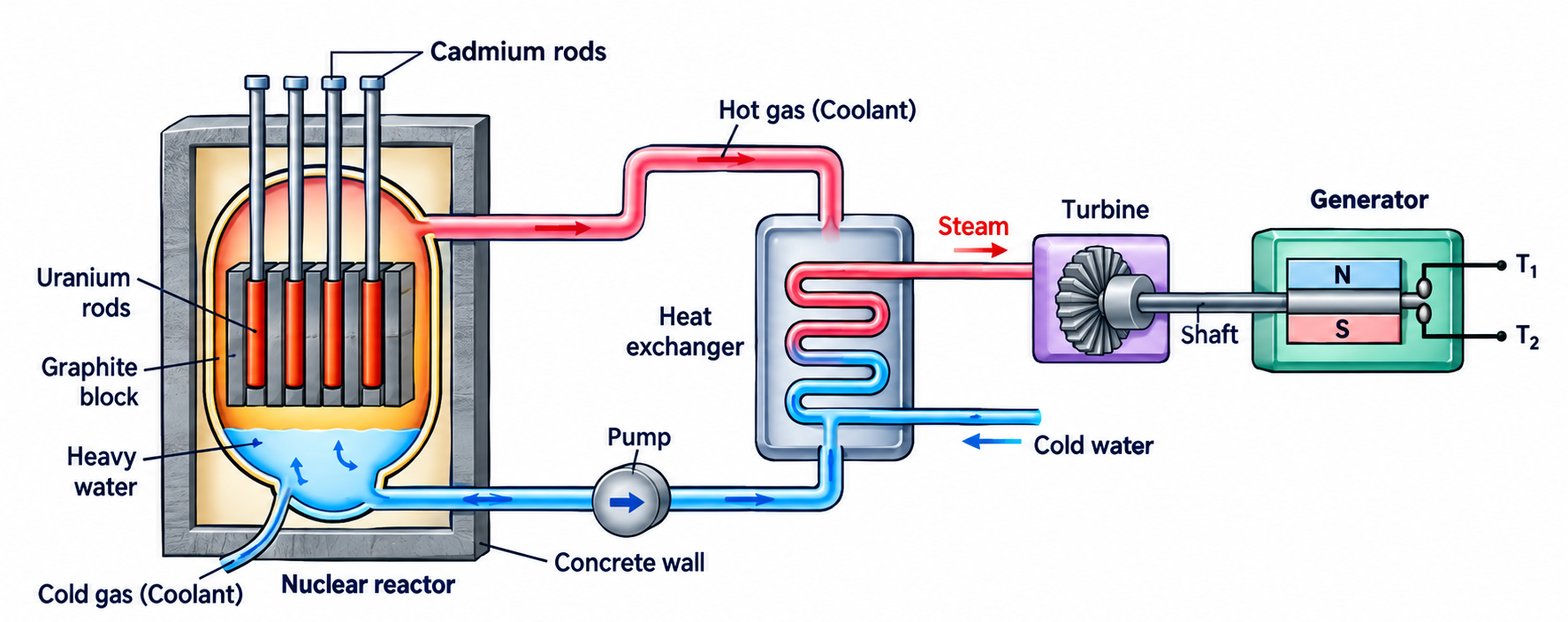
Fig. 6.12: Nuclear Power Plant Operation Schematic & Reactor Core
4. Nuclear Energy (Nuclear Power Plant):
- Controlled chain reaction of nuclear fission ($\text{U-235}$) inside a nuclear reactor produces immense heat energy.
- Cadmium Rods: Act as neutron absorbers to control the fission rate.
- Heavy Water / Graphite Block: Act as moderators to slow down fast neutrons.
- Heat exchanger boils water into high-pressure steam, which rotates a steam turbine connected to an electric generator.
- Nuclear power stations in India: Tarapur (Maharashtra), Rana Pratap Sagar (Kota, Rajasthan), Kalpakkam (Tamil Nadu), Narora (UP).
5. Energy Degradation
Definition of Energy Degradation
Energy Degradation (Dissipation of Energy): The gradual conversion of useful available energy into non-useful, unrecoverable forms (such as low-temperature heat radiated into surroundings, friction loss, sound, and radiation) during any energy transformation or transfer.
Daily Life Examples:
1. In an electric bulb, less than $25\%$ of electrical energy turns to light; over $75\%$ degrades into useless heat.
2. In motor vehicles, major part of fuel energy is degraded as heat in engine parts and sound against friction.
3. In cooking over fire, major heat is radiated into the atmosphere.
4. In long-distance electrical power transmission, energy is degraded as heat in transmission line wires ($I^2 R t$).
(D) Green House Effect and Global Warming
1. Greenhouse Effect
Discovered by Joseph Fourier in 1824. The greenhouse effect is the natural process of warming of the Earth's surface and lower atmosphere due to the absorption and trapping of long-wavelength infrared radiation emitted by the Earth by greenhouse gases.
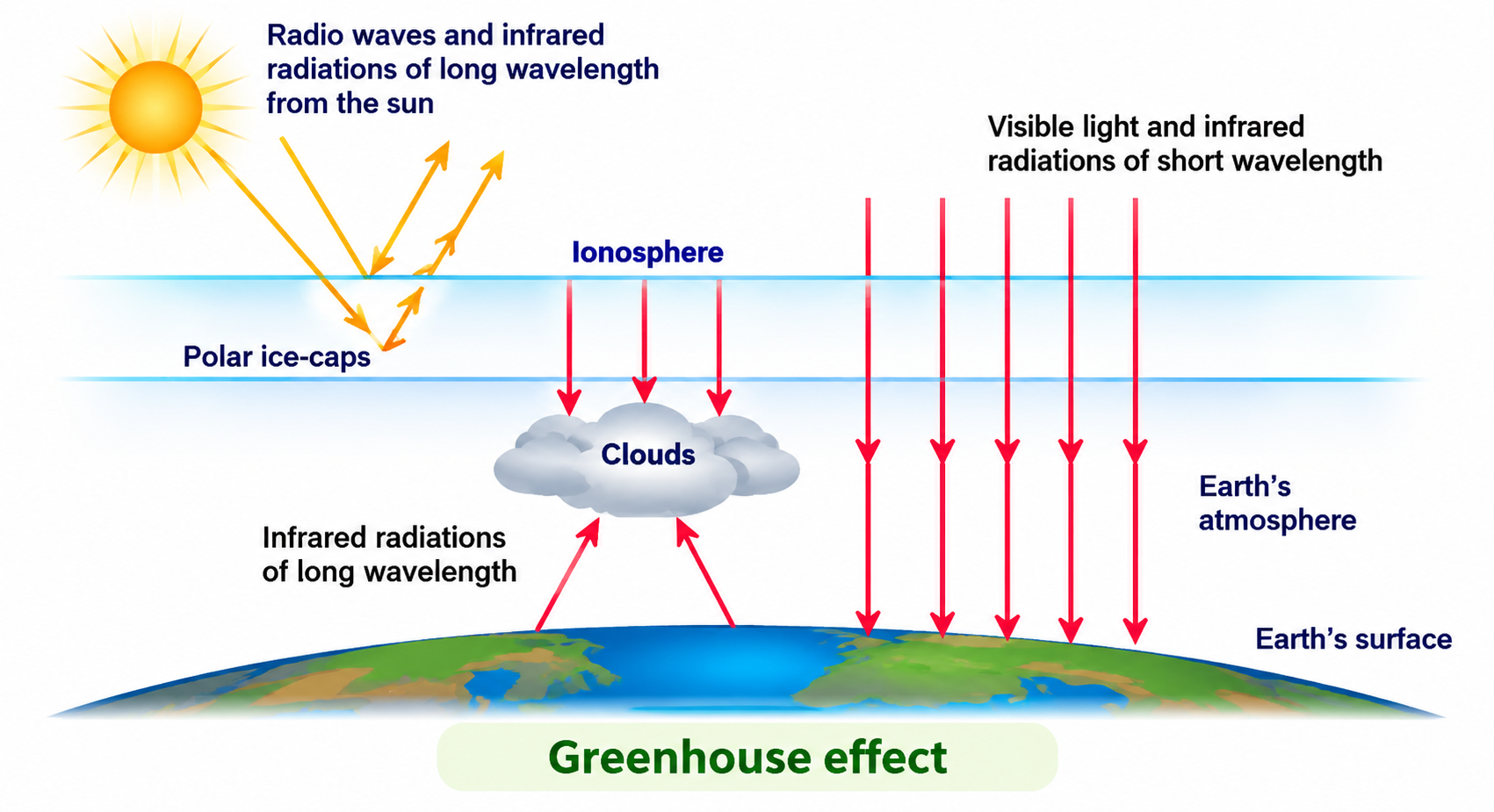
Fig. 6.13: Mechanism of Greenhouse Effect & Solar Energy Trapping
Mechanism of Greenhouse Effect
- The Earth's atmosphere is transparent to incoming short-wavelength solar radiations (visible light and UV rays). These pass through and heat the Earth's surface.
- The heated Earth's surface re-radiates energy back into space in the form of long-wavelength infrared (heat) radiations.
- Greenhouse gases ($\mathrm{CO_2, H_2O\text{ vapour}, CH_4, CFCs}$) and clouds in the lower atmosphere are opaque to long-wavelength IR radiation. They absorb and reflect these heat radiations back to Earth's surface.
- Natural Importance: The natural greenhouse effect keeps the average temperature of Earth's surface at $+15.5^\circ\text{C} \quad (60^\circ\text{F})$. Without greenhouse gases, Earth's average temperature would be a frozen $-18^\circ\text{C} \quad (0^\circ\text{F})$!
Greenhouse Gases: Carbon dioxide ($\mathrm{CO_2}$ — main contributor $60\%$), Water vapour ($\mathrm{H_2O}$), Methane ($\mathrm{CH_4}$), Chlorofluorocarbons ($\mathrm{CFCs}$), Nitrous oxide ($\mathrm{N_2O}$).
2. Global Warming
Definition: Global warming means the gradual increase in the average effective temperature near the Earth's surface and lower atmosphere due to an artificial increase in the concentration of greenhouse gases caused by human activities.
Causes of Global Warming:
- Excessive burning of fossil fuels (coal, petroleum, natural gas) in power plants, transport, and industries ($\mathrm{CO_2}$ increased by $25\%$).
- Deforestation (reducing $\mathrm{CO_2}$ absorption by trees).
- Agricultural activities, paddy fields, and cattle farming (doubled $\mathrm{CH_4}$ concentration).
- Release of Chlorofluorocarbons ($\mathrm{CFCs}$) from refrigerators and air conditioners (increasing at $5\%$ per year).
Impacts & Future Projections of Global Warming:
- Dislocation & Extinction of Species: Nearly $30\%$ of plant and animal species projected to vanish by 2050, and up to $70\%$ by 2100.
- Warming of Oceans & Sea Level Rise: Melting of glaciers in Siberia, Greenland, and polar ice caps causes sea levels to rise at $3.1\text{ mm per year}$, threatening coastal cities with flooding.
- Shift in Farming & Agriculture: A rise of $3^\circ\text{C}$ will cause poor crop yields in low latitude regions.
- Extreme Weather Events: Increase in frequency of heat waves, severe droughts, hurricanes, and tropical storms.
- Spread of Diseases: Extended distribution of mosquitoes causing malaria/dengue.
3. Ways to Minimise Global Warming
| Category |
Measures & Actions |
| 1. Technological Measures |
• Switch electricity generation from fossil fuels to renewable sources (solar, wind, hydro, nuclear).
• Transition from petrol/diesel vehicles to electric & battery-operated vehicles.
• Use smokeless bio-char stoves for domestic cooking in rural areas.
|
| 2. Economic Measures |
• Large-scale reforestation and sustainable land management.
• Impose Carbon Tax on industries based on their carbon emissions to promote energy-efficient practices.
|
| 3. Policy & Lifestyle Measures |
• Educate children and community to live a sustainable, less competitive lifestyle.
• Control population growth through family planning, welfare reforms, and women empowerment.
• Adhere to international climate treaties (e.g. COP21 Paris Agreement to limit global warming below $2.0^\circ\text{C}$).
|
5. Master Rapid Summary & Formula Guide
| Concept / Relation |
Formula / Value |
Exam Tip |
| Joule to Erg |
$1\text{ J} = 10^7\text{ erg}$ |
Remember 1 Joule is $10^7$ ergs. |
| Calorie to Joule |
$1\text{ cal} = 4.186\text{ J} \approx 4.2\text{ J}$ |
$1\text{ kcal} = 1000\text{ cal} = 4186\text{ J}$. |
| Celsius to Kelvin |
$T\text{ (K)} = t\text{ (}^\circ\text{C)} + 273$ |
$0\text{ K} = -273^\circ\text{C}$ is Absolute Zero. |
| Celsius to Fahrenheit |
$\frac{C}{5} = \frac{F - 32}{9}$ |
At $-40^\circ$, Celsius and Fahrenheit scales read identical ($-40^\circ\text{C} = -40^\circ\text{F}$). |
| Anomalous Expansion of Water |
Max Density at $4^\circ\text{C}$ ($1\text{ g cm}^{-3}$); Min Volume at $4^\circ\text{C}$ |
Water contracts from $0^\circ\text{C} \to 4^\circ\text{C}$ and expands above $4^\circ\text{C}$. |
| Einstein Mass-Energy Relation |
$E = m c^2$ ($c = 3 \times 10^8\text{ m s}^{-1}$) |
Applied in nuclear fission and fusion. |

 VARDAAN COMET