Vardaan Learning Institute
Upthrust in Fluids, Archimedes' Principle and Floatation
ICSE Class 9 Physics • Chapter 5 • Detailed Chapter Notes
Part A: Upthrust, Buoyancy & Archimedes' Principle
1. Buoyancy & Upthrust ($F_B$)
When a body is partially or wholly immersed in a fluid (liquid or gas), it experiences an upward force exerted by the fluid. This upward force is called upthrust or buoyant force ($F_B$).
Definition & Units
- Buoyancy: The natural property of a fluid to exert an upward force on any body immersed in it.
- SI Unit: Newton ($\text{N}$).
- Gravitational Units: $\text{kgf}$ and $\text{gf}$ ($1\text{ kgf} = 9.8\text{ N}$, $1\text{ gf} = 980\text{ dyne}$).
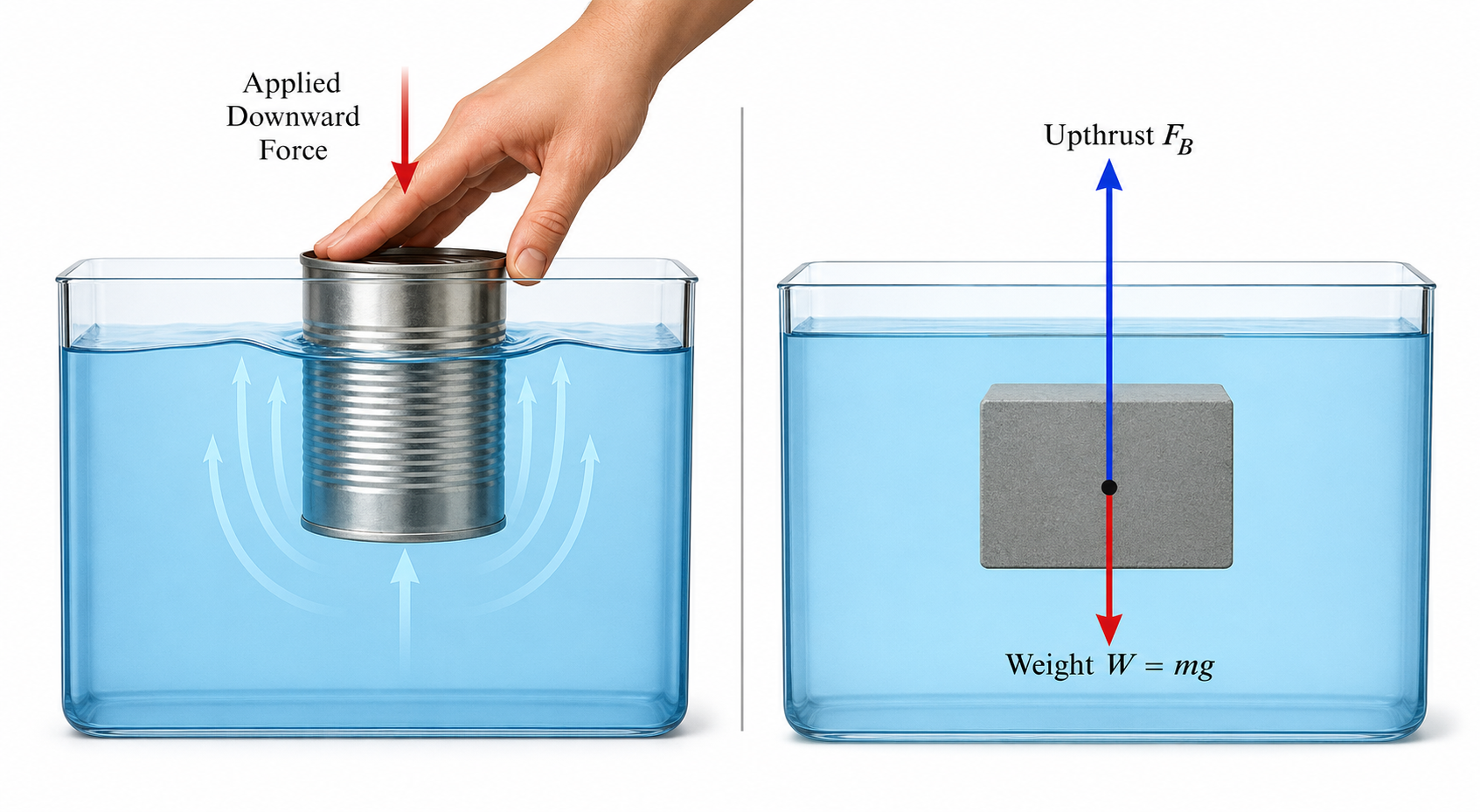
Fig 5.1: Upthrust demonstration — pushing an empty can or cork into water requires external downward effort to overcome buoyant force
2. Characteristic Properties of Upthrust
Key Factors Affecting Upthrust
- Volume of Submerged Body ($v$): Upthrust is directly proportional to the volume of the body submerged inside the liquid ($F_B \propto v$). For example, a larger block displaces more liquid and experiences greater upward force than a smaller one of the same mass.
- Density of the Fluid ($\rho_L$): Upthrust is directly proportional to the density of the liquid ($F_B \propto \rho_L$). For example, a piece of cork experiences greater upthrust in denser glycerine ($\rho = 1.26\text{ g cm}^{-3}$) than in water ($\rho = 1.0\text{ g cm}^{-3}$).
- Acceleration due to Gravity ($g$): $F_B \propto g$.
- Centre of Buoyancy ($B$): Upthrust acts vertically upwards at the centre of buoyancy, which is the centre of gravity of the liquid displaced by the submerged part of the body.
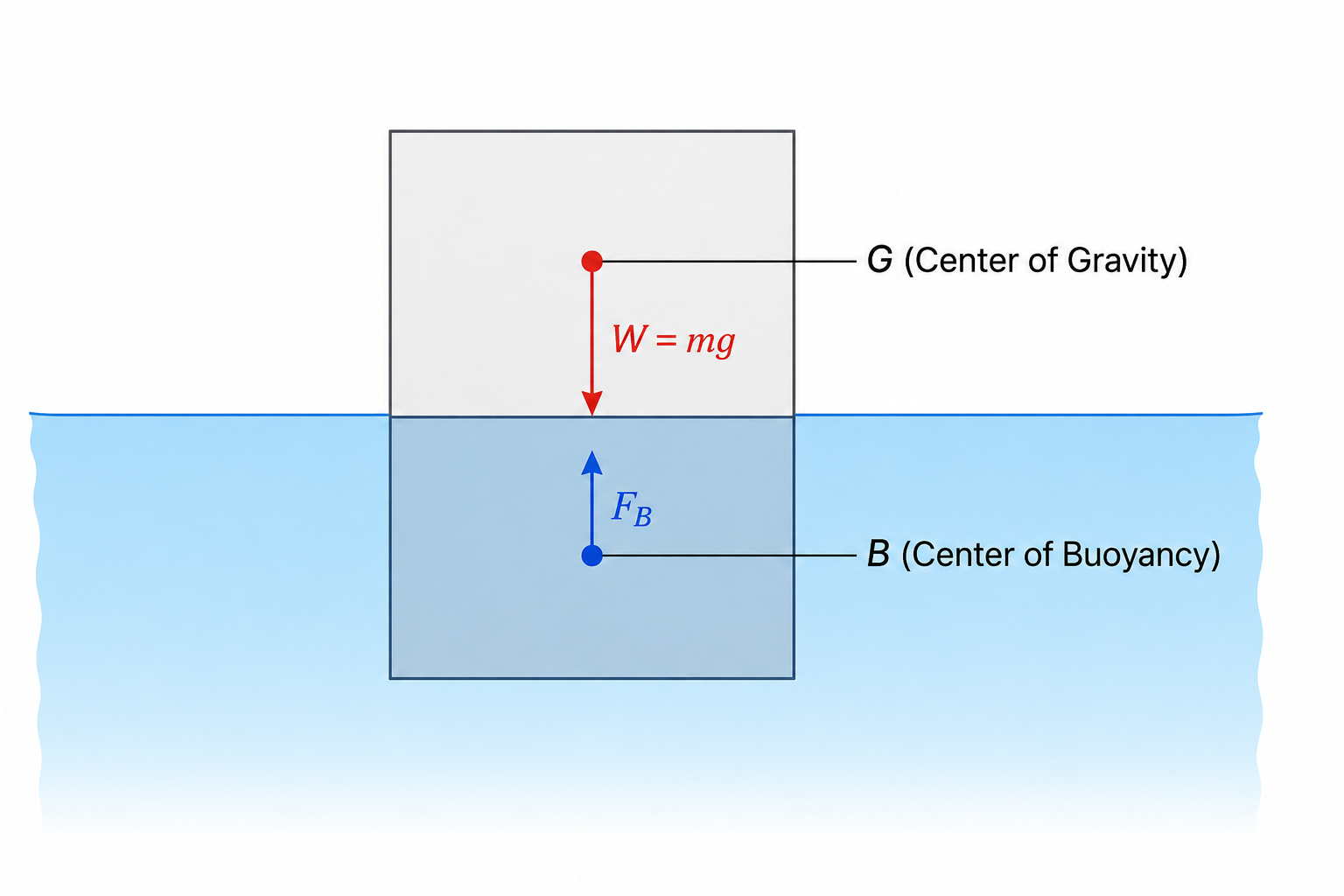
Fig 5.2: Center of Gravity ($G$) of the floating block acting downwards and Center of Buoyancy ($B$) of the submerged part acting upwards
3. Cause & Mathematical Derivation of Upthrust
A fluid exerts pressure in all directions, and pressure increases linearly with depth ($P = h \rho g$).
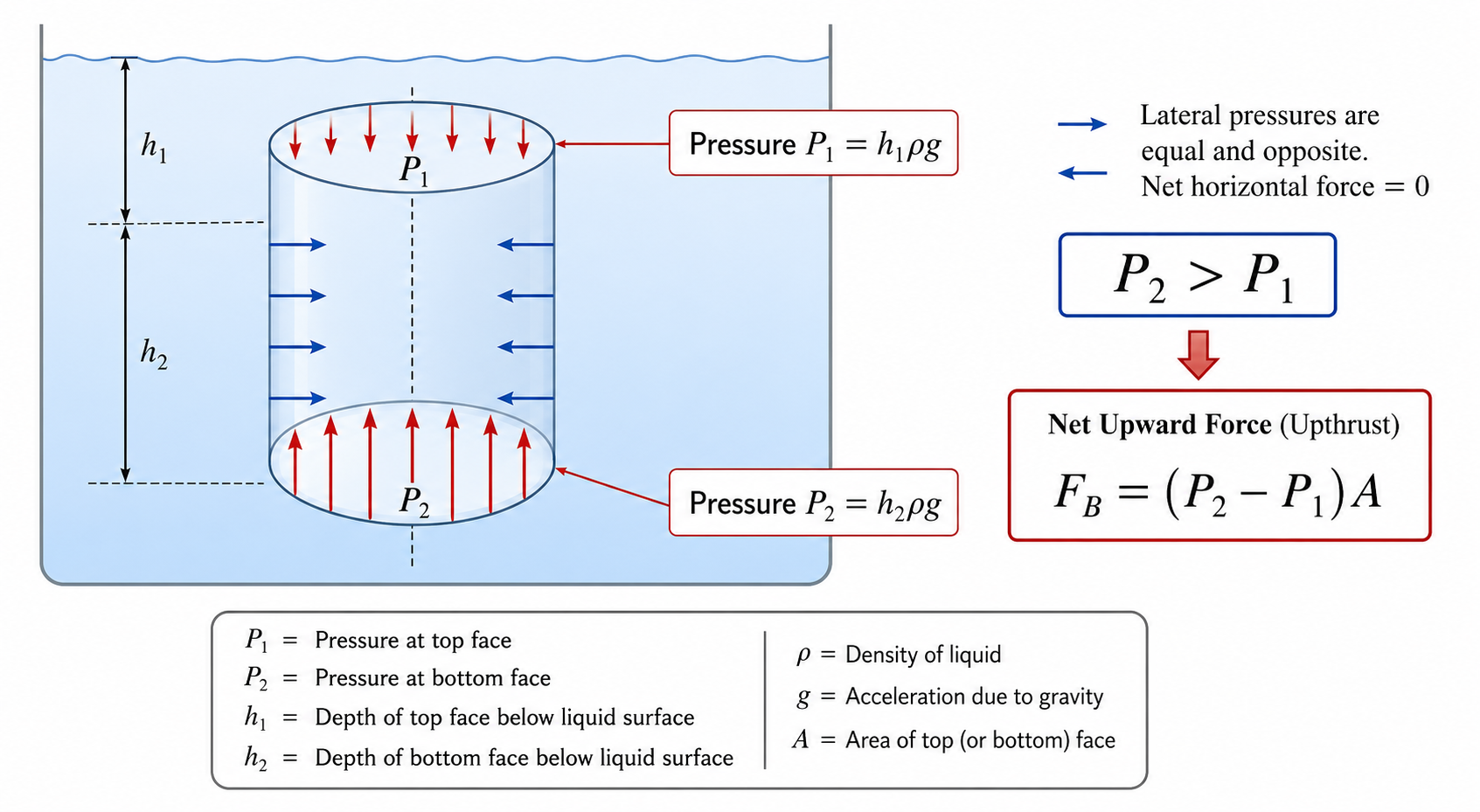
Fig 5.3: Difference in liquid pressure between the bottom face ($P_2$) and top face ($P_1$) creates a net upward force (Upthrust)
Mathematical Derivation
Consider a cylindrical body of cross-sectional area $A$ and height $h$ completely immersed in a liquid of density $\rho$:
- Let the top face be at depth $h_1 \implies$ Downward thrust on top face: $F_1 = P_1 \times A = h_1 \rho g A$.
- Let the bottom face be at depth $h_2 \implies$ Upward thrust on bottom face: $F_2 = P_2 \times A = h_2 \rho g A$.
- Lateral forces acting on the sides cancel out in pairs because at any given depth, lateral pressure is equal and opposite in all horizontal directions.
- Net Upward Force (Upthrust $F_B$):
$$F_B = F_2 - F_1 = (h_2 - h_1) \rho g A$$
- Since $(h_2 - h_1) \times A = V$ (Volume of the cylinder):
$$F_B = V \rho g$$
- Since $V \rho = \text{Mass of liquid displaced}$ ($M_L$):
$$F_B = M_L g = \mathbf{\text{Weight of the liquid displaced by the body}}$$
4. Archimedes' Principle
Archimedes' Principle
"When a body is immersed partially or completely in a fluid at rest, it experiences an upthrust (or apparent loss in weight) which is equal to the weight of the fluid displaced by it."
$$\mathbf{\text{Upthrust } (F_B) = \text{Weight of displaced liquid} = \text{True weight in air } (W_{\text{air}}) - \text{Apparent weight in liquid } (W_{\text{liquid}})}$$
5. Experimental Verification using Eureka Can
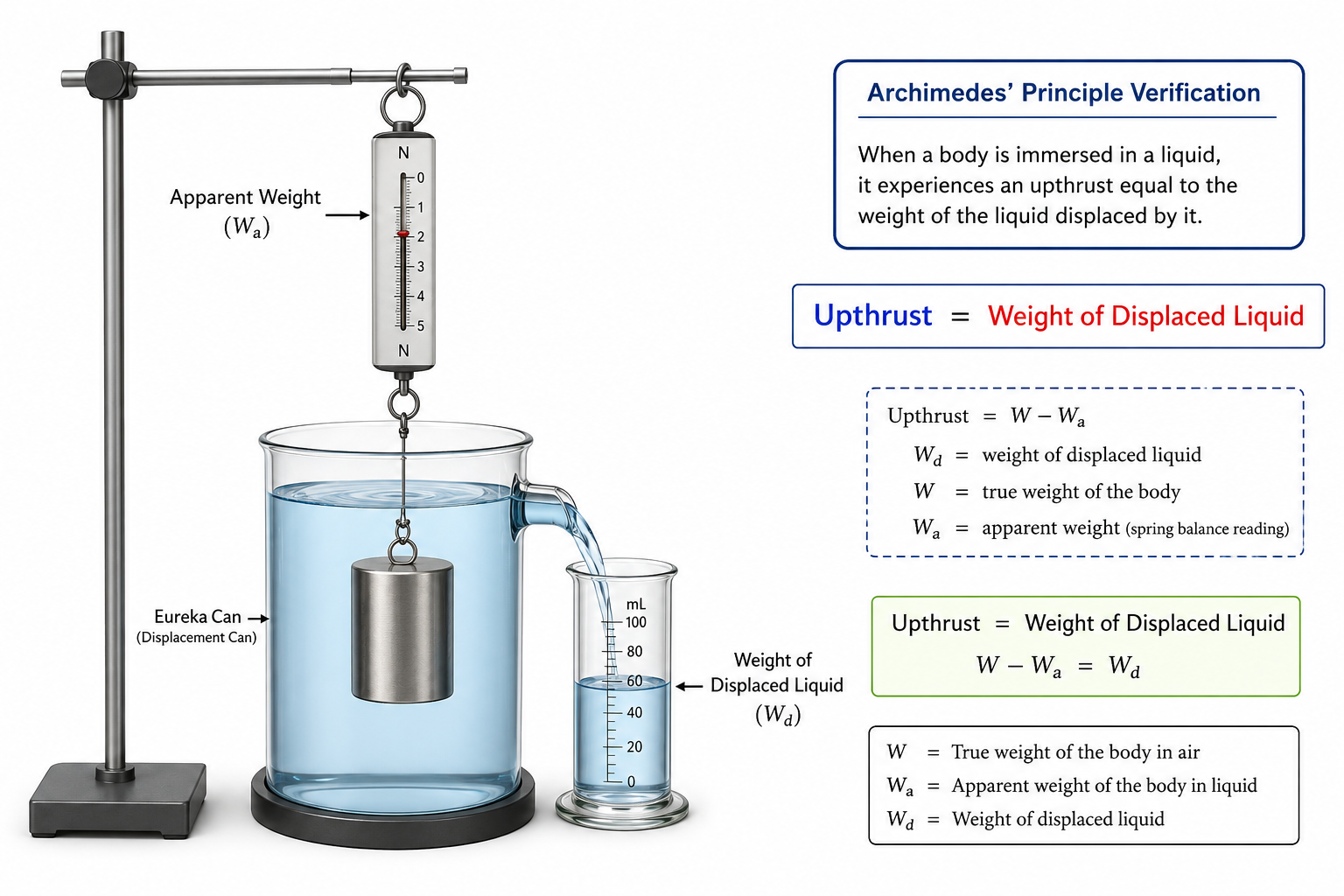
Fig 5.4: Experimental verification of Archimedes' principle using a Eureka (displacement) can and spring balance
Experimental Verification Steps
- Suspend a solid from a spring balance and note its true weight in air: $W_1 = 300\text{ gf}$.
- Fill a Eureka can with water up to its side overflow spout and place an empty measuring cylinder beneath the spout.
- Immerse the solid completely into the can. The spring balance now shows an apparent weight: $W_2 = 200\text{ gf}$.
$\implies \text{Apparent loss in weight (Upthrust)} = W_1 - W_2 = 300 - 200 = 100\text{ gf}$.
- The overflow water collected in the measuring cylinder measures a volume of $100\text{ cm}^3$.
- Since the density of water is $1.0\text{ g cm}^{-3}$, the weight of displaced water is:
$\text{Weight of displaced water} = 100\text{ cm}^3 \times 1\text{ g cm}^{-3} = 100\text{ gf}$.
- Inference: Apparent loss in weight ($100\text{ gf}$) equals the weight of displaced water ($100\text{ gf}$), proving Archimedes' Principle.
Part B: Relative Density & Measurement using Archimedes' Principle
1. Density vs Relative Density
| Property |
Density ($\rho$) |
Relative Density ($R.D.$) |
| Definition |
Mass per unit volume of a substance ($\rho = M / V$) |
Ratio of the density of the substance to the density of pure water at $4^\circ\text{C}$ |
| Formula |
$$\rho = \frac{\text{Mass } (M)}{\text{Volume } (V)}$$
|
$$R.D. = \frac{\text{Density of substance}}{\text{Density of water at } 4^\circ\text{C}}$$
$\text{or } R.D. = \frac{\text{Mass of substance}}{\text{Mass of equal vol. of water at } 4^\circ\text{C}}$
|
| SI Unit |
$\text{kg m}^{-3}$ (or $\text{g cm}^{-3}$) |
No units (pure dimensionless ratio) |
| Relationship |
$\text{Density in kg m}^{-3} = R.D. \times 1000$ |
$R.D.$ is numerically equal to density expressed in $\text{g cm}^{-3}$ |
2. Measurement of R.D. using a Physical Balance
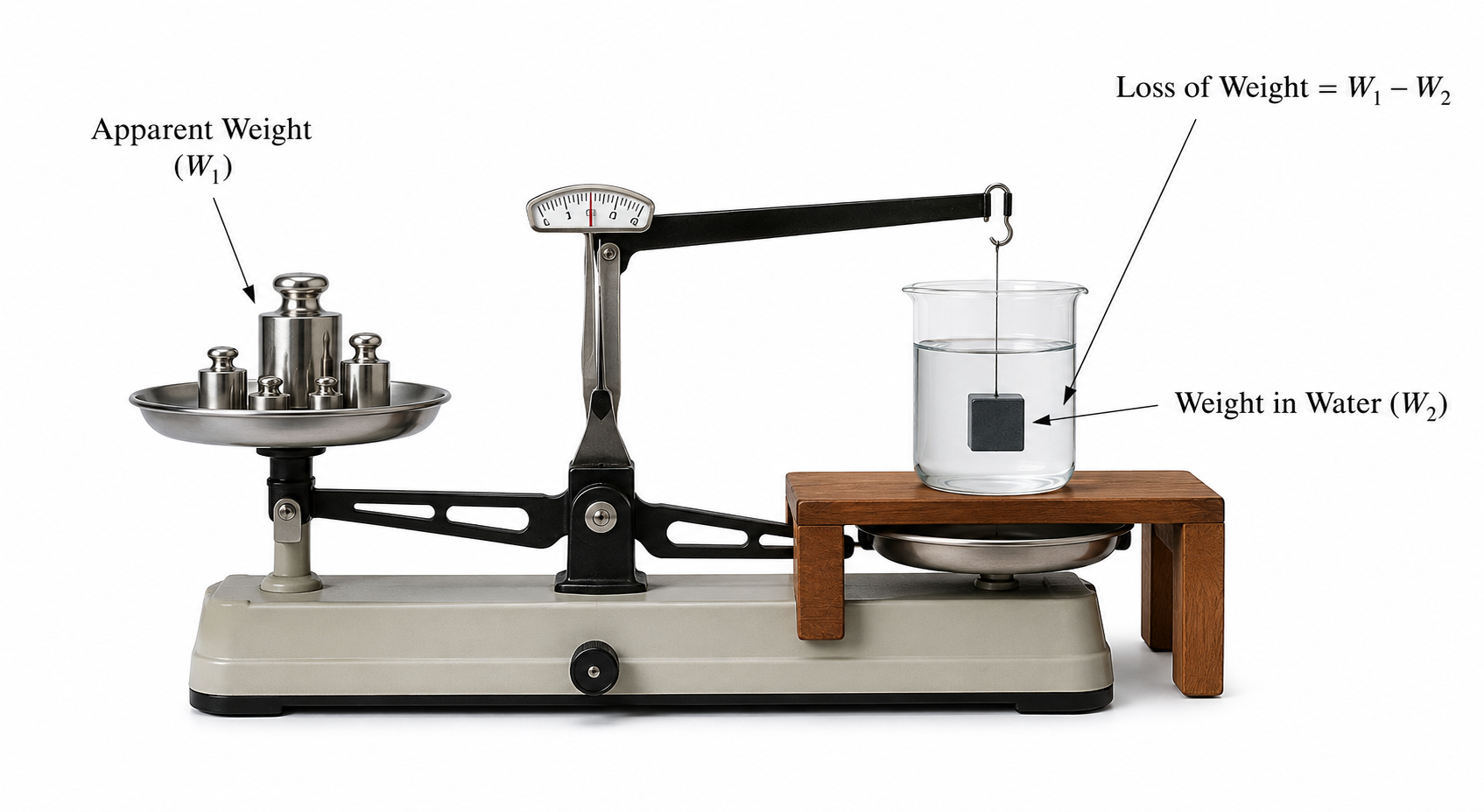
Fig 5.5: Laboratory setup for measuring relative density using a hydrostatic physical balance and wooden bridge
R.D. Measurement Formulas
Case 1: Solid denser than water and insoluble in it:
- Weight of solid in air = $W_1$
- Weight of solid completely immersed in water = $W_2$
- Loss of weight in water = $W_1 - W_2$
- $$R.D. = \frac{\text{Weight of solid in air}}{\text{Loss of weight in water}} = \mathbf{\frac{W_1}{W_1 - W_2}}$$
Case 2: Solid soluble in water (insoluble in another liquid $L$):
- Weigh solid in air ($W_1$) and in a known liquid $L$ of relative density $R.D._L$ ($W_2$):
- $$R.D. = \frac{W_1}{W_1 - W_2} \times R.D._L$$
Case 3: Solid lighter than water (e.g. Cork) using a Sinker:
- Weight of cork alone in air = $w_1$
- Weight of sinker alone in water = $w_2$
- Weight of (cork in air + sinker in water) = $w_1 + w_2$
- Weight of (cork + sinker) both completely immersed in water = $w_3$
- Loss of weight of cork alone in water = $(w_1 + w_2) - w_3$
- $$R.D._{\text{cork}} = \mathbf{\frac{w_1}{(w_1 + w_2) - w_3}}$$
Case 4: Relative Density of a Liquid:
- Weigh a solid in air ($W_1$), completely in liquid ($W_2$), and completely in water ($W_3$):
- $$R.D._{\text{liquid}} = \frac{\text{Loss of weight in liquid}}{\text{Loss of weight in water}} = \mathbf{\frac{W_1 - W_2}{W_1 - W_3}}$$
Part C: Floatation & Practical Applications
1. Principle of Floatation
When a body of volume $V$ and density $\rho_s$ is placed in a liquid of density $\rho_L$, two opposing forces act:
- Downward Weight ($W$): $W = V \rho_s g$, acting downwards through the center of gravity ($G$).
- Upward Maximum Buoyant Force ($F'_B$): $F'_B = V \rho_L g$, acting upwards through the center of buoyancy ($B$).
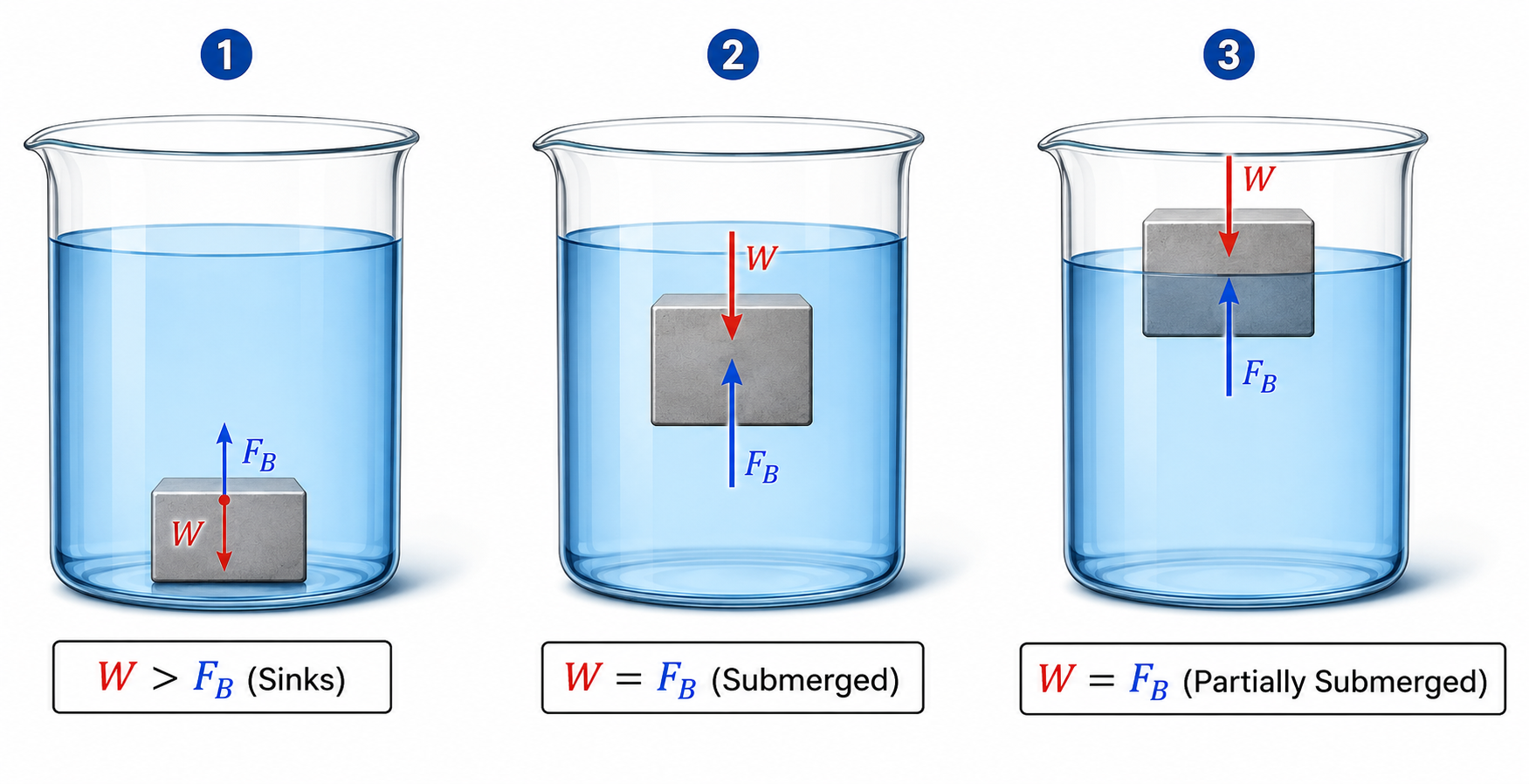
Fig 5.6: Three conditions — (1) Sinking when $\rho_s > \rho_L$, (2) Floating fully submerged when $\rho_s = \rho_L$, (3) Floating partially submerged when $\rho_s < \rho_L$
The Principle of Floatation
"For a floating body, the weight of the floating body is exactly equal to the weight of the liquid displaced by its submerged part."
$$\mathbf{\text{Weight of floating body } (W) = \text{Upthrust } (F_B)}$$
Apparent Weight: Since $W = F_B$, the apparent weight of any floating body is zero ($W_{\text{apparent}} = W - F_B = 0$).
Mathematical Relation for Floatation
Let a body of total volume $V$ float with volume $v$ submerged in a liquid of density $\rho_L$:
- Weight of body: $W = V \rho_s g$
- Upthrust on submerged part: $F_B = v \rho_L g$
- By Principle of Floatation: $V \rho_s g = v \rho_L g$
- $$\mathbf{\frac{v}{V} = \frac{\rho_s}{\rho_L} = \frac{\text{Density of solid}}{\text{Density of liquid}} = \frac{R.D._{\text{solid}}}{R.D._{\text{liquid}}}}$$
- Fraction Submerged: $\text{Fraction of volume submerged} = \frac{\text{Density of solid}}{\text{Density of liquid}}$.
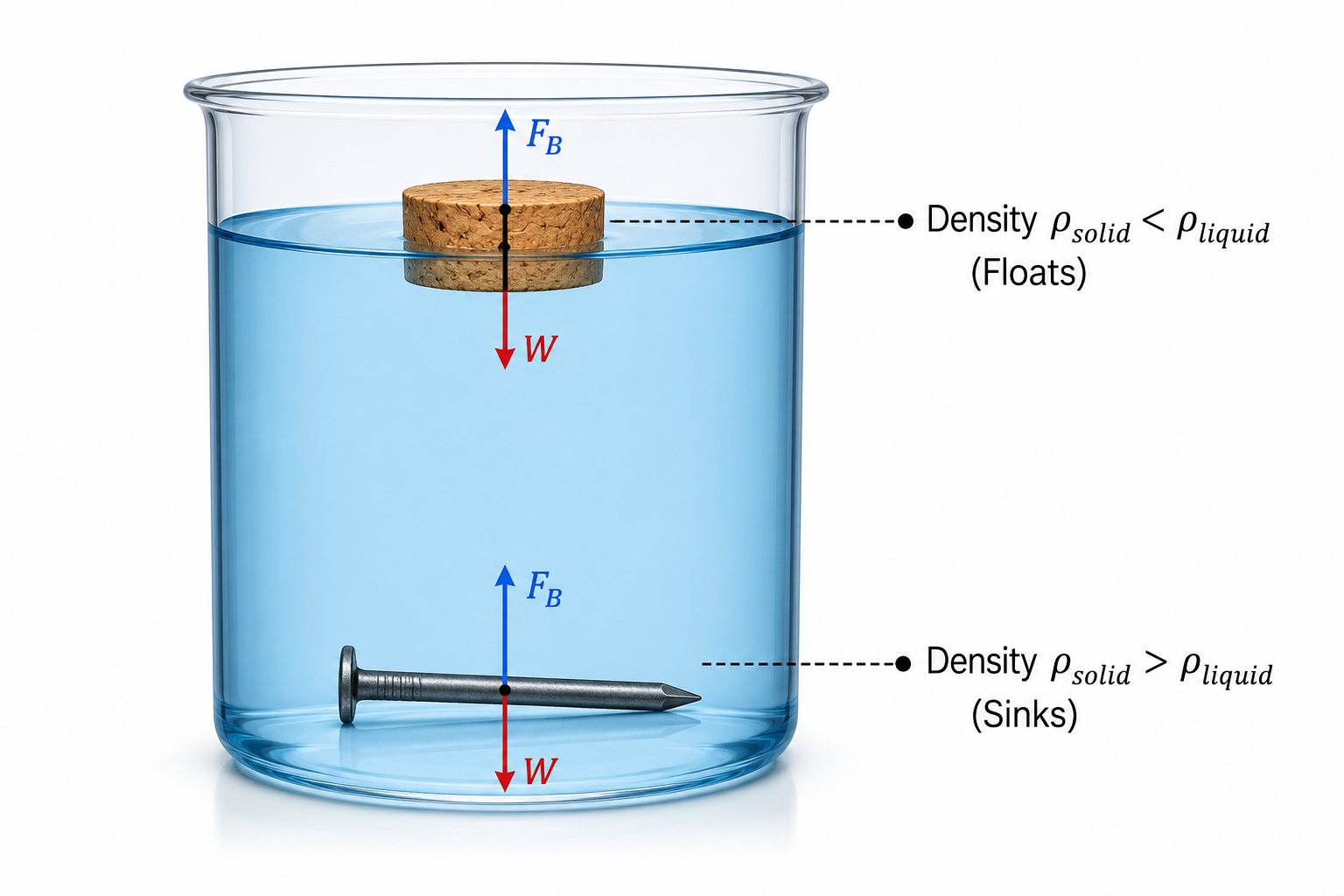
Fig 5.7: Floating cork with a small fraction submerged versus a sinking iron nail
2. Practical Applications of Floatation
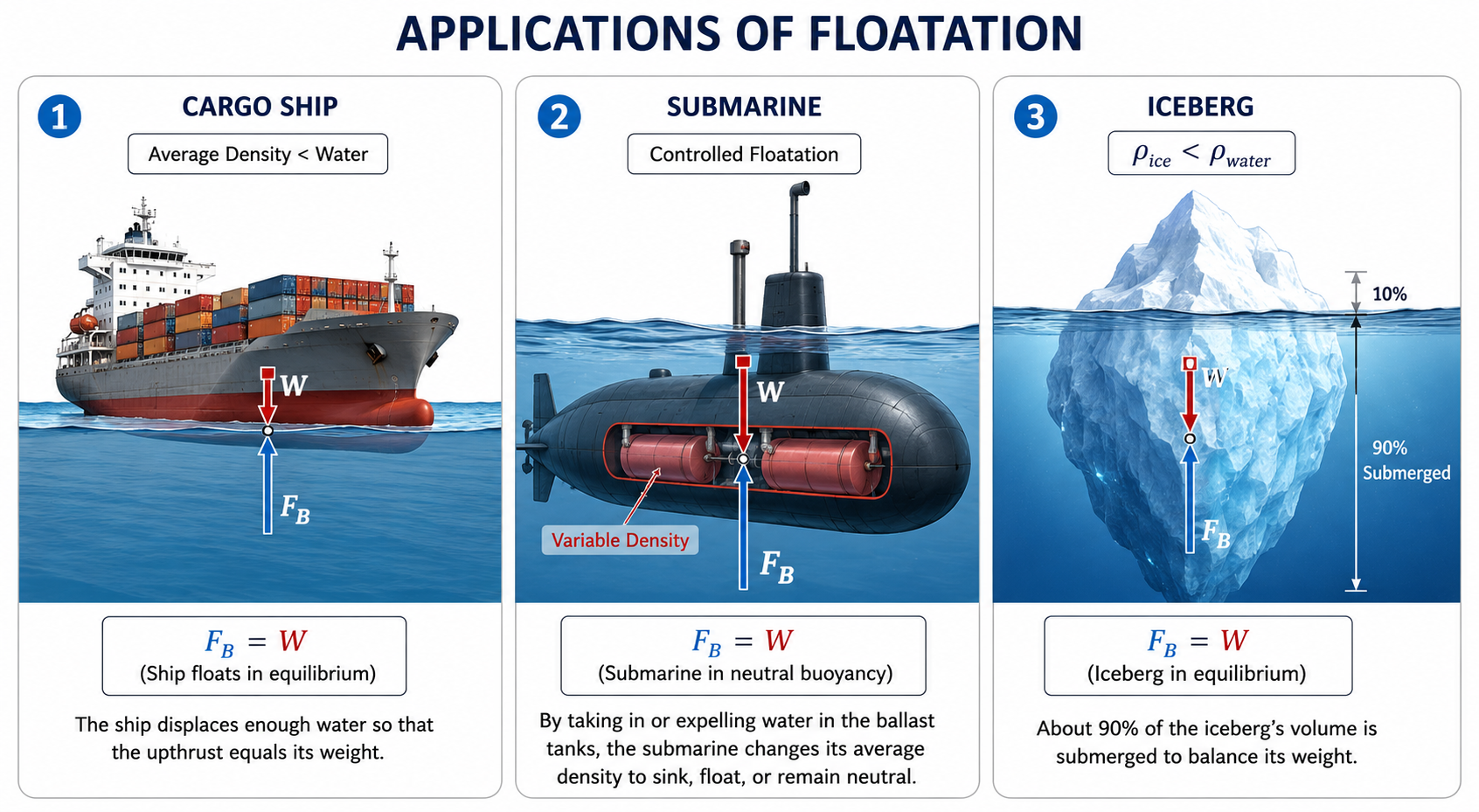
Fig 5.8: Floatation applications — (1) Iron ship with large hollow volume, (2) Submarine with ballast tanks, (3) Iceberg with ~90% volume underwater
Conceptual Reasonings
- Why does an iron nail sink while a heavy iron ship floats?
An iron nail is solid; its density ($7.8\text{ g cm}^{-3}$) is greater than water ($1.0\text{ g cm}^{-3}$), so it sinks. An iron ship is hollow and contains a large volume of air inside. Its average density ($\text{total mass} / \text{total volume}$) is much lower than that of water, allowing it to displace water equal to its own weight while only partially submerged.
- Plimsoll Line & Ship moving from Sea Water to River Water:
Sea water is denser ($\rho = 1.026\text{ g cm}^{-3}$) than river water ($\rho = 1.0\text{ g cm}^{-3}$). When a ship sails from sea water into river water, it sinks deeper because it must displace a larger volume of less dense river water to balance its weight. The Plimsoll line marked on ship hulls indicates safe loading levels across different water types and seasons.
- Why is it easier to swim in sea water than in river water?
Due to dissolved salts, sea water has a higher density than fresh river water. As a result, sea water exerts a greater upthrust per unit submerged volume, requiring less of the human body to be submerged to balance body weight.
- Submarines (Ballast Tanks):
A submarine has large ballast tanks. To dive, water is taken into the tanks, increasing average density until it exceeds water density. To surface, compressed air is used to blow water out of the tanks, reducing average density so upthrust pushes it back up.
- Icebergs:
Density of ice is $0.917\text{ g cm}^{-3}$ and water is $1.0\text{ g cm}^{-3}$. The fraction submerged is $\frac{v}{V} = \frac{0.917}{1.0} \approx 91.7\%$. Thus, about $90\%$ of an iceberg remains submerged, posing a hidden hazard to ships.
- Why does water level remain unchanged when floating ice melts?
Let mass of floating ice be $M$. It displaces a volume of water $V_{\text{disp}} = \frac{M}{\rho_{\text{water}}}$. When this ice melts, it becomes water of the same mass $M$, having volume $V_{\text{melt}} = \frac{M}{\rho_{\text{water}}}$. Since $V_{\text{disp}} = V_{\text{melt}}$, the melted water exactly fills the submerged cavity without changing the water level.
- Fish (Swim Bladder):
Fish regulate their depth using an internal organ called a swim bladder (air bladder). By diffusing gas into the bladder, they increase volume and decrease average density to rise; by emptying gas, they increase density to dive.
- Weather Balloons:
Balloons filled with hydrogen or helium rise because the weight of the balloon is less than the upthrust exerted by cold, dense air near the ground. As the balloon ascends, air density decreases until upthrust equals balloon weight, at which point the balloon reaches equilibrium and floats horizontally.
Part D: Solved ICSE Board Practice Numericals
Practice Numerical 1
A metal cube of edge $5\text{ cm}$ and density $9.0\text{ g cm}^{-3}$ is suspended by a thread in a liquid of density $1.2\text{ g cm}^{-3}$. Find: (i) the volume of the cube, (ii) the mass of the cube, (iii) the upthrust on the cube, and (iv) the tension in the thread ($g = 10\text{ m s}^{-2}$).
Solution:
(i) Volume: $V = 5 \times 5 \times 5 = \mathbf{125\text{ cm}^3} = 1.25 \times 10^{-4}\text{ m}^3$
(ii) Mass: $M = V \times \rho = 125\text{ cm}^3 \times 9.0\text{ g cm}^{-3} = 1125\text{ g} = \mathbf{1.125\text{ kg}}$
(iii) Upthrust: $F_B = V \rho_L g = (1.25 \times 10^{-4}\text{ m}^3) \times (1200\text{ kg m}^{-3}) \times 10\text{ m s}^{-2} = \mathbf{1.5\text{ N}}$ (or $150\text{ gf}$)
(iv) Tension in thread (Apparent Weight):
$\text{Weight in air} = 1.125 \times 10 = 11.25\text{ N}$
$T = W - F_B = 11.25\text{ N} - 1.5\text{ N} = \mathbf{9.75\text{ N}}$ (or $975\text{ gf}$).
Practice Numerical 2
A solid of mass $60\text{ g}$ and relative density $2.5$ is completely immersed in water. Find the apparent weight of the solid in water.
Solution:
$\text{Volume of solid } V = \frac{\text{Mass}}{\text{Density}} = \frac{60\text{ g}}{2.5\text{ g cm}^{-3}} = 24\text{ cm}^3$
$\text{Volume of water displaced} = 24\text{ cm}^3$
$\text{Weight of displaced water (Upthrust)} = 24\text{ cm}^3 \times 1\text{ g cm}^{-3} = 24\text{ gf}$
$\text{Apparent Weight} = \text{True Weight} - \text{Upthrust} = 60\text{ gf} - 24\text{ gf} = \mathbf{36\text{ gf}}$ (or $0.353\text{ N}$).
Practice Numerical 3
A piece of alloy weighs $96\text{ gf}$ in air, $80\text{ gf}$ in water, and $84\text{ gf}$ in a liquid. Calculate: (i) the relative density of the alloy, and (ii) the relative density of the liquid.
Solution:
Given: $W_1 = 96\text{ gf}$, $W_2 (\text{liquid}) = 84\text{ gf}$, $W_3 (\text{water}) = 80\text{ gf}$.
(i) R.D. of Alloy:
$$R.D._{\text{alloy}} = \frac{W_1}{W_1 - W_3} = \frac{96}{96 - 80} = \frac{96}{16} = \mathbf{6.0}$$
(ii) R.D. of Liquid:
$$R.D._{\text{liquid}} = \frac{W_1 - W_2}{W_1 - W_3} = \frac{96 - 84}{96 - 80} = \frac{12}{16} = \mathbf{0.75}$$
Practice Numerical 4
A wooden block of volume $1000\text{ cm}^3$ and density $0.8\text{ g cm}^{-3}$ floats in a liquid of density $1.2\text{ g cm}^{-3}$. Calculate: (i) the volume of the block submerged in the liquid, and (ii) the mass of water which the block will displace when floated in water.
Solution:
(i) Submerged Volume in liquid:
$\frac{v}{V} = \frac{\rho_s}{\rho_L} \implies v = V \times \frac{\rho_s}{\rho_L} = 1000 \times \frac{0.8}{1.2} = \mathbf{666.67\text{ cm}^3}$
(ii) Mass of water displaced:
By the principle of floatation, a floating body displaces liquid equal to its own mass.
$\text{Mass of block} = V \times \rho_s = 1000\text{ cm}^3 \times 0.8\text{ g cm}^{-3} = \mathbf{800\text{ g}}$.
Therefore, the block will displace $\mathbf{800\text{ g}}$ of water.

 VARDAAN COMET