
Covering: Dobereiner's Triads • Newland's Law of Octaves • Mendeleev's Contributions & Periodic Law • Discovery of Atomic Number (Moseley) • Modern Periodic Law • Structure of Modern Periodic Table (Groups 1–18, Periods 1–7) • Special reference to Alkali Metals (Group 1), Alkaline Earth Metals (Group 2), Halogens (Group 17), Noble Gases (Group 18) • Periodic Trends in Properties.
Towards the end of the 18th and early 19th centuries, numerous chemical elements were discovered. To study their physical and chemical properties systematically and find logical relationships among them, classification became indispensable.
William Prout (1815) suggested that atomic mass of an element never differs and hypothesized that all elements were built from hydrogen atoms. This provided the initial spark for mass-based classification.
German chemist Johann Wolfgang Dobereiner observed that certain elements showing close chemical similarities could be arranged in groups of three, called triads.
Law of Triads: When chemically similar elements are arranged in increasing order of their atomic masses in groups of three (triads), the atomic mass of the middle element is approximately equal to the arithmetic mean (average) of the atomic masses of the other two elements.
Classic Examples of Dobereiner's Triads:
| Triad Name | Elements & Symbol | Atomic Mass | Arithmetic Mean Calculation | Similar Chemical Properties |
|---|---|---|---|---|
| 1. Alkali Metal Triad | Lithium ($\mathrm{Li}$) Sodium ($\mathrm{Na}$) Potassium ($\mathrm{K}$) |
$7.0$ $23.0$ $39.0$ |
\(\frac{7.0 + 39.0}{2} = \mathbf{23.0}\) (Exact match for $\mathrm{Na}$) | All are soft metals, monovalent (+1), react with water to form soluble hydroxides (alkalies) and hydrogen gas. |
| 2. Alkaline Earth Triad | Calcium ($\mathrm{Ca}$) Strontium ($\mathrm{Sr}$) Barium ($\mathrm{Ba}$) |
$40.0$ $87.6 \approx 88$ $137.0$ |
\(\frac{40.0 + 137.0}{2} = \mathbf{88.5}\) (Close to $\mathrm{Sr} = 87.6$) | All are reactive metals, divalent (+2), oxides are alkaline in nature. |
| 3. Halogen Triad | Chlorine ($\mathrm{Cl}$) Bromine ($\mathrm{Br}$) Iodine ($\mathrm{I}$) |
$35.5$ $80.0$ $127.0$ |
\(\frac{35.5 + 127.0}{2} = \mathbf{81.25}\) (Close to $\mathrm{Br} = 80.0$) | All are non-metals, monovalent (-1), react with water to form acids, form salts with metals. |
1. Limited Applicability: Dobereiner failed to classify all the known elements of his time into triads. Only a few triads could be identified.
2. Failure within Same Family: The law did not hold good even within the same group of elements. For example, in the halogen family starting with Fluorine ($\mathrm{F}=19$), Chlorine ($\mathrm{Cl}=35.5$), and Bromine ($\mathrm{Br}=80$):
$$\frac{19 + 80}{2} = 49.5 \neq 35.5 \quad (\text{Mean does not match Chlorine!})$$
English chemist John Newland arranged all known elements (56 elements at that time) in ascending order of their atomic masses and noticed a striking periodic pattern resembling musical notes.
Law of Octaves: When elements are arranged in increasing order of their atomic masses, the physical and chemical properties of every eighth element are a repetition of the properties of the first element, just as the eighth note of a musical octave is a repetition of the first note.
Musical Scale Analogy: Sa (Do), Re (Re), Ga (Mi), Ma (Fa), Pa (So), Dha (La), Ni (Ti), Sa (Do).
| Western Musical Note | Do | Re | Mi | Fa | So | La | Ti |
|---|---|---|---|---|---|---|---|
| Indian Musical Note | Sa | Re | Ga | Ma | Pa | Dha | Ni |
| Elements Row 1 | $\mathrm{H}$ (1) | $\mathrm{Li}$ (2) | $\mathrm{Be}$ (3) | $\mathrm{B}$ (4) | $\mathrm{C}$ (5) | $\mathrm{N}$ (6) | $\mathrm{O}$ (7) |
| Elements Row 2 | $\mathrm{F}$ (8) | $\mathrm{Na}$ (9) | $\mathrm{Mg}$ (10) | $\mathrm{Al}$ (11) | $\mathrm{Si}$ (12) | $\mathrm{P}$ (13) | $\mathrm{S}$ (14) |
| Elements Row 3 | $\mathrm{Cl}$ (15) | $\mathrm{K}$ (16) | $\mathrm{Ca}$ (17) | $\mathrm{Cr}$ (18) | $\mathrm{Ti}$ (19) | $\mathrm{Mn}$ (20) | $\mathrm{Fe}$ (21) |
Merits of Newland's Classification:
1. Inapplicable to Heavier Elements: The law was applicable only up to Calcium ($\mathrm{Ca}$). Beyond Calcium, every eighth element did not possess properties similar to the first.
2. Pairing Dissimilar Elements: To fit elements into his table, Newland adjusted two elements into the same slot (e.g., Cobalt $\mathrm{Co}$ and Nickel $\mathrm{Ni}$) and placed them in the same column as Fluorine, Chlorine, and Bromine, which have completely different properties.
3. Separation of Similar Elements: Iron ($\mathrm{Fe}$), which resembles Cobalt and Nickel in properties, was placed far away in a separate column.
4. Discovery of Noble Gases: With the later discovery of noble gases ($\mathrm{He, Ne, Ar}$), the eighth element no longer had similar properties; instead, it became the ninth element!
Russian chemist Dmitri Ivanovich Mendeleev published his famous periodic table in 1869. He arranged all the 63 elements known at that time in increasing order of atomic masses in horizontal rows and vertical columns.
Mendeleev's Periodic Law: The physical and chemical properties of elements are a periodic function of their atomic masses.
Meaning: When elements are arranged in increasing order of their atomic masses, elements with similar physical and chemical properties recur at regular intervals (periodically).
Essential Features of Mendeleev's Periodic Table:
| Groups $\to$ | Group I | Group II | Group III | Group IV | Group V | Group VI | Group VII | Group VIII |
|---|---|---|---|---|---|---|---|---|
| Oxide: | $\mathrm{R_2O}$ | $\mathrm{RO}$ | $\mathrm{R_2O_3}$ | $\mathrm{RO_2}$ | $\mathrm{R_2O_5}$ | $\mathrm{RO_3}$ | $\mathrm{R_2O_7}$ | $\mathrm{RO_4}$ |
| Hydride: | $\mathrm{RH}$ | $\mathrm{RH_2}$ | $\mathrm{RH_3}$ | $\mathrm{RH_4}$ | $\mathrm{RH_3}$ | $\mathrm{RH_2}$ | $\mathrm{RH}$ | — |
| Period 1 | $\mathrm{H} = 1.008$ | — | — | — | — | — | — | — |
| Period 2 | $\mathrm{Li} = 6.94$ | $\mathrm{Be} = 9.01$ | $\mathrm{B} = 10.81$ | $\mathrm{C} = 12.01$ | $\mathrm{N} = 14.01$ | $\mathrm{O} = 16.00$ | $\mathrm{F} = 19.00$ | — |
| Period 3 | $\mathrm{Na} = 22.99$ | $\mathrm{Mg} = 24.31$ | $\mathrm{Al} = 29.98$ | $\mathrm{Si} = 28.09$ | $\mathrm{P} = 30.97$ | $\mathrm{S} = 32.06$ | $\mathrm{Cl} = 35.45$ | — |
| Period 4 (Series 1 & 2) |
$\mathrm{K} = 39.10$ $\mathrm{Cu} = 63.54$ |
$\mathrm{Ca} = 40.08$ $\mathrm{Zn} = 65.37$ |
[Eka-Al] $\mathrm{Ga}=69.72$ | [Eka-Si] $\mathrm{Ge}=72.59$ | $\mathrm{As} = 74.92$ | $\mathrm{Se} = 78.96$ | $\mathrm{Br} = 79.91$ | $\mathrm{Fe}=55.85$, $\mathrm{Co}=58.93$, $\mathrm{Ni}=58.71$ |
| Period 5 (Series 1 & 2) |
$\mathrm{Rb} = 85.47$ $\mathrm{Ag} = 107.87$ |
$\mathrm{Sr} = 87.62$ $\mathrm{Cd} = 112.41$ |
$\mathrm{In} = 114.82$ | $\mathrm{Sn} = 118.69$ | $\mathrm{Sb} = 121.75$ | $\mathrm{Te} = 127.60$ | $\mathrm{I} = 126.90$ | $\mathrm{Ru}=101.1$, $\mathrm{Rh}=102.9$, $\mathrm{Pd}=106.4$ |
| Property | Predicted: Eka-Aluminium | Discovered: Gallium ($\mathrm{Ga}$) | Predicted: Eka-Silicon | Discovered: Germanium ($\mathrm{Ge}$) |
|---|---|---|---|---|
| Atomic Mass | $68$ | $69.7$ | $72$ | $72.6$ |
| Density | $5.9\text{ g cm}^{-3}$ | $5.91\text{ g cm}^{-3}$ | $5.5\text{ g cm}^{-3}$ | $5.36\text{ g cm}^{-3}$ |
| Melting Point | Low | $302\text{ K } (29.8^\circ\text{C})$ | High | $1231\text{ K}$ |
| Valency | 3 | 3 | 4 | 4 |
| Oxide Formula | $\mathrm{E_2O_3}$ | $\mathrm{Ga_2O_3}$ | $\mathrm{EO_2}$ | $\mathrm{GeO_2}$ |
1. Anomalous Pairs (Inversion of Atomic Weights): Certain elements with higher atomic masses were placed BEFORE elements with lower atomic masses to keep similar elements together:
• Argon ($\text{Mass } 39.9$, $Z=18$) placed BEFORE Potassium ($\text{Mass } 39.1$, $Z=19$).
• Cobalt ($\text{Mass } 58.9$, $Z=27$) placed BEFORE Nickel ($\text{Mass } 58.6$, $Z=28$).
• Tellurium ($\text{Mass } 127.6$, $Z=52$) placed BEFORE Iodine ($\text{Mass } 126.9$, $Z=53$).
2. Position of Isotopes: Isotopes are atoms of the same element having different atomic masses (e.g., $\mathrm{^{35}Cl}$ and $\mathrm{^{37}Cl}$). If classification is based on atomic mass, isotopes must occupy separate positions, which would destroy the table layout. Mendeleev gave no separate position to isotopes.
3. Grouping of Chemically Dissimilar Elements: Coinage metals ($\mathrm{Cu, Ag, Au}$) were placed in Group IB together with highly reactive alkali metals ($\mathrm{Li, Na, K}$) in Group IA.
4. Separation of Chemically Similar Elements: Elements with similar properties were placed in different groups, e.g., Copper ($\mathrm{Cu}$) and Mercury ($\mathrm{Hg}$); Platinum ($\mathrm{Pt}$) and Gold ($\mathrm{Au}$).
5. Uncertain Position of Hydrogen: Hydrogen resembles alkali metals (monovalent, forms $\mathrm{H^+}$) as well as halogens (forms diatomic $\mathrm{H_2}$, forms hydrides $\mathrm{NaH}$). Its position was left ambiguous.
In 1913, English physicist Henry Moseley studied the characteristic X-ray spectra emitted by different metal anodes when bombarded by cathode rays in a discharge tube. He observed that the square root of the frequency ($\sqrt{\nu}$) of characteristic X-rays was directly proportional to the atomic number ($Z$) of the element, NOT its atomic mass.
Atomic Number ($Z$): The magnitude of positive charge present in the nucleus of an atom (number of protons) is called its atomic number.
Moseley's Finding: Atomic number is a more fundamental property of an element than its atomic mass!
Modern Periodic Law: The physical and chemical properties of elements are a periodic function of their atomic numbers ($Z$).
Significance: When elements are arranged in increasing order of atomic numbers, elements with similar electronic configurations (same number of valence electrons) recur at regular intervals.
| Mendeleev's Anomaly | Explanation by Modern Periodic Law ($Z$) |
|---|---|
| 1. Inverted Pair: Argon & Potassium | Argon has $Z=18$ and Potassium has $Z=19$. Arranging by atomic number naturally places Argon ($Z=18$) before Potassium ($Z=19$), resolving the mass discrepancy ($\text{Ar}=39.9, \text{K}=39.1$). |
| 2. Inverted Pair: Cobalt & Nickel | Cobalt has $Z=27$ and Nickel has $Z=28$. Cobalt ($Z=27$) comes before Nickel ($Z=28$) automatically. |
| 3. Position of Isotopes | All isotopes of an element have the same atomic number ($Z$) (e.g., $\mathrm{^{35}_{17}Cl}$ and $\mathrm{^{37}_{17}Cl}$ both have $Z=17$). Thus, all isotopes naturally occupy the same single slot in the periodic table. |
The Long Form of Periodic Table (Bohr's Table) is based on the electronic configuration of elements. It consists of vertical columns called Groups and horizontal rows called Periods.
| Block | Group 1 (IA) |
Group 2 (IIA) |
Groups 3 to 12 (d-block) |
Group 13 (IIIA) |
Group 14 (IVA) |
Group 15 (VA) |
Group 16 (VIA) |
Group 17 (VIIA) |
Group 18 (Zero) |
|---|---|---|---|---|---|---|---|---|---|
| Period 1 | 1H 2,1 |
— | d-block Transition Metals (3 outer shells filling, variable valencies) |
— | — | — | — | — | 2He 2 |
| Period 2 | 3Li 2,1 |
4Be 2,2 |
5B 2,3 |
6C 2,4 |
7N 2,5 |
8O 2,6 |
9F 2,7 |
10Ne 2,8 |
|
| Period 3 | 11Na 2,8,1 |
12Mg 2,8,2 |
13Al 2,8,3 |
14Si 2,8,4 |
15P 2,8,5 |
16S 2,8,6 |
17Cl 2,8,7 |
18Ar 2,8,8 |
|
| Period 4 | 19K | 20Ca | 21Sc ... 30Zn | 31Ga | 32Ge | 33As | 34Se | 35Br | 36Kr |
| Period 5 | 37Rb | 38Sr | 39Y ... 48Cd | 49In | 50Sn | 51Sb | 52Te | 53I | 54Xe |
| Period 6 | 55Cs | 56Ba | 57La – 80Hg | 81Tl | 82Pb | 83Bi | 84Po | 85At | 86Rn |
| Period 7 | 87Fr | 88Ra | 89Ac – 112Cn | 113Nh | 114Fl | 115Mc | 116Lv | 117Ts | 118Og |
| f-block Series: |
Lanthanides (Period 6): 58Ce ... 71Lu (14 Rare Earth elements) Actinides (Period 7): 90Th ... 103Lr (14 Radioactive elements) |
||||||||
A. GROUPS (18 Vertical Columns):
B. PERIODS (7 Horizontal Rows):
| Period No. | Type of Period | Number of Elements | Atomic Number Range | Electron Shells Involved | Elements Present |
|---|---|---|---|---|---|
| 1 | Shortest Period | 2 | Z = 1 to 2 | K shell (n = 1) | Hydrogen (H1) to Helium (He2) |
| 2 | Short Period | 8 | Z = 3 to 10 | L shell (n = 2) | Lithium (Li3) to Neon (Ne10) |
| 3 | Short Period | 8 | Z = 11 to 18 | M shell (n = 3) | Sodium (Na11) to Argon (Ar18) |
| 4 | Long Period | 18 | Z = 19 to 36 | N shell (n = 4) | Potassium (K19) to Krypton (Kr36) |
| 5 | Long Period | 18 | Z = 37 to 54 | O shell (n = 5) | Rubidium (Rb37) to Xenon (Xe54) |
| 6 | Longest Period | 32 | Z = 55 to 86 | P shell (n = 6) | Caesium (Cs55) to Radon (Rn86) Includes Lanthanides (Ce58 → Lu71) |
| 7 | Incomplete / Longest | 32 | Z = 87 to 118 | Q shell (n = 7) | Francium (Fr87) to Oganesson (Og118) Includes Actinides (Th90 → Lr103) |
Based on electronic configurations and shell completion, elements are classified into four main categories:
Elements of Group 1, 2, 13, 14, 15, 16, and 17. They have their outermost shell incomplete. They include both metals, metalloids, and non-metals.
Elements of Groups 3, 4, 5, 6, 7, 8, 9, 10, 11, and 12. They have their two outermost shells incomplete. All are metals having high melting/boiling points, variable valencies, and forming colored ions/compounds.
Elements having their three outermost shells incomplete. Placed separately at the bottom of the periodic table in two horizontal series of 14 elements each:
Elements $\mathrm{He_2, Ne_{10}, Ar_{18}, Kr_{36}, Xe_{54}, Rn_{86}}$. They have their outermost shell completely filled ($8$ valence electrons, except Helium which has $2$). Owing to stable octet/duplet, they are unreactive monoatomic gases.
Elements of Period 2 show resemblance in properties with elements of the next group in Period 3 diagonally adjacent to them. Such Period 2 elements are called bridge elements.
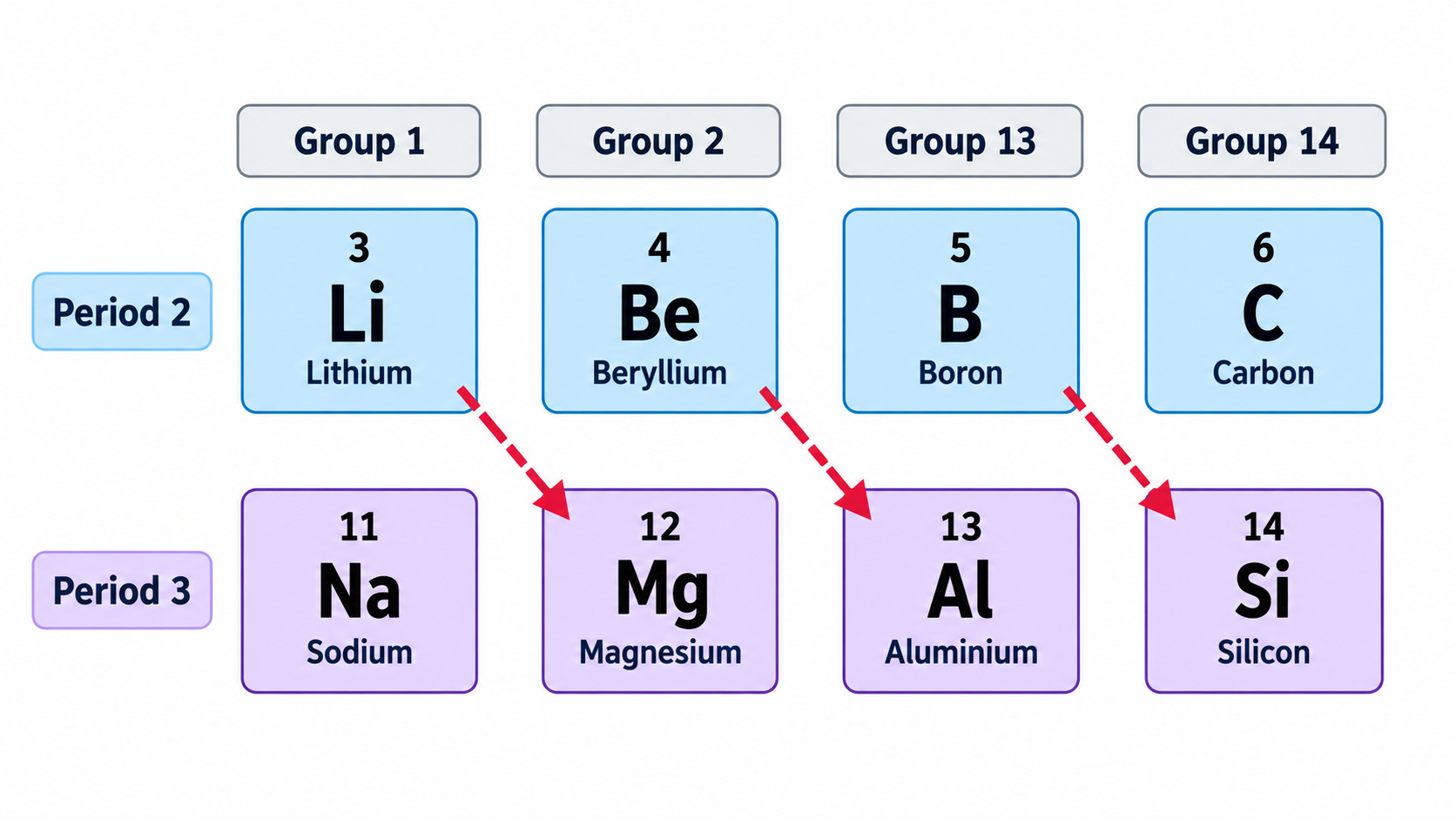
Elements of Period 3 ($\mathrm{Na_{11}, Mg_{12}, Al_{13}, Si_{14}, P_{15}, S_{16}, Cl_{17}}$) are called typical elements because each summarizes the general characteristics of its respective group.
Periodicity: The regular recurrence of elements with similar properties at definite intervals when arranged in increasing order of atomic numbers is called periodicity.
Cause of Periodicity: Recurrence of similar valence shell electronic configurations (same number of outermost electrons) at regular intervals.
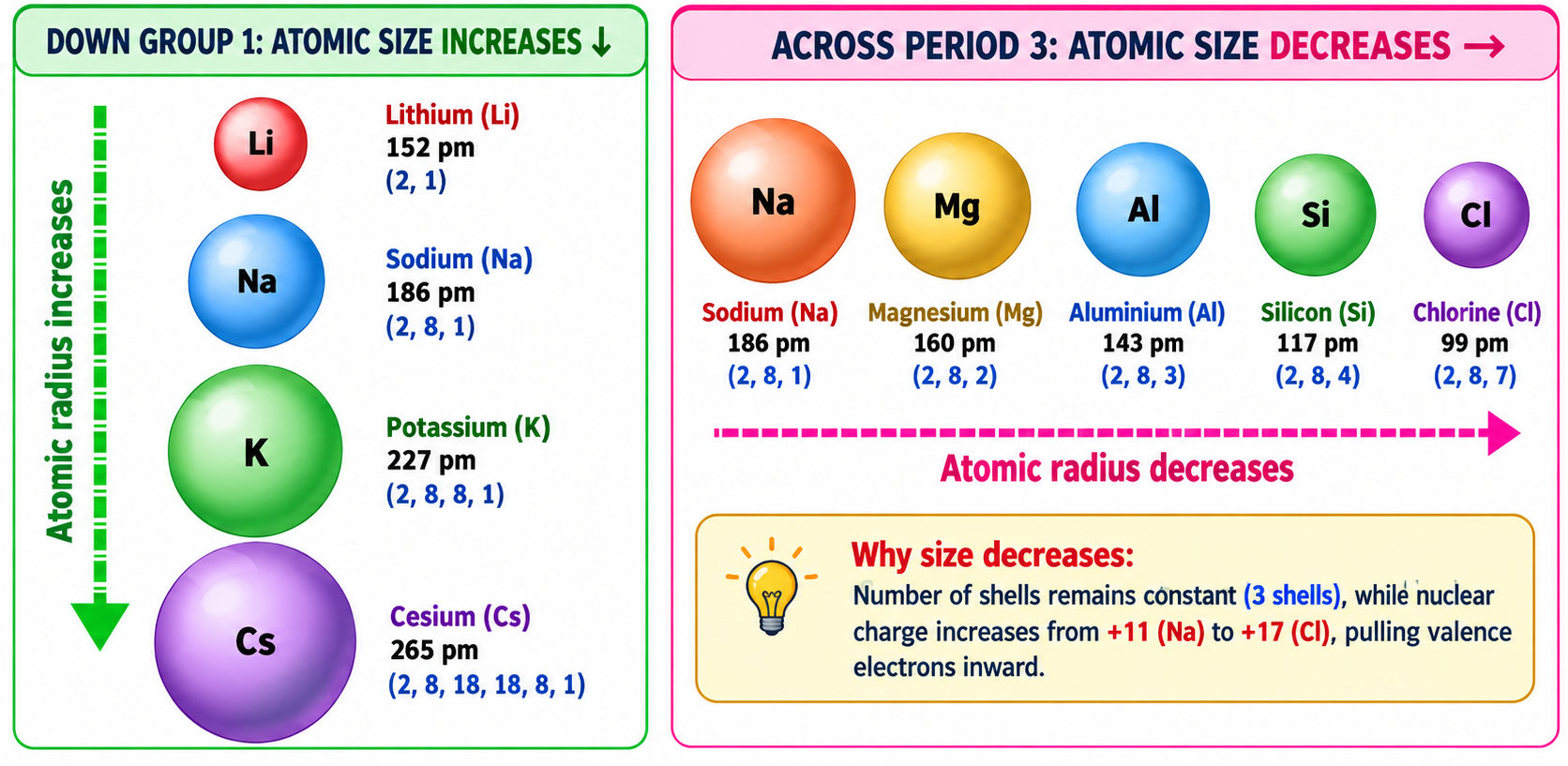
| Property | Trend Down a Group (↓) | Reason / Mechanism |
|---|---|---|
| 1. Number of Shells | Increases by 1 at each successive step. | New shell added at each period (e.g., Li: 2,1 → Na: 2,8,1 → K: 2,8,8,1). |
| 2. Valence Electrons | Remains SAME. | Group number equals valence electrons (e.g., all Group 1 elements have 1 valence electron). |
| 3. Valency | Remains SAME. | Depends on valence electrons, which stay constant down the group. |
| 4. Atomic Size (Radius) | Increases down the group. | Addition of a new electron shell at each step increases distance between nucleus and outermost shell, dominating the nuclear charge pull. |
| 5. Metallic Character | Increases down the group. | As atomic size increases, nuclear attraction on valence electrons decreases, making it easier for atom to lose electrons (electropositive). |
| 6. Non-Metallic Character | Decreases down the group. | Tendency to gain electrons decreases due to increased atomic radius and weaker nuclear pull. |
| 7. Chemical Reactivity |
• Metals: Increases (Li < Na < K < Rb < Cs) • Non-Metals: Decreases (F > Cl > Br > I) |
• Metals: Lower ionization energy down the group increases reactivity. • Non-Metals: Smaller atomic size attracts electrons better, so Fluorine (F) is most reactive. |
| Property | Trend Across a Period (→) | Reason / Mechanism |
|---|---|---|
| 1. Number of Shells | Remains SAME. | All elements in a period have the same number of electron shells (equal to period number). |
| 2. Valence Electrons | Increases from 1 to 8. | Protons and valence electrons increase by 1 at each element across Period. |
| 3. Valency w.r.t. Hydrogen | Increases from 1 to 4, then decreases to 0. | NaH(1), MgH2(2), AlH3(3), SiH4(4), PH3(3), H2S(2), HCl(1), Ar(0). |
| 4. Atomic Size (Radius) | Decreases across the period. | Nuclear charge (protons) increases while number of shells remains constant, pulling valence shell closer to nucleus. |
| 5. Metallic Character | Decreases from left to right. | Elements transition from Metals → Metalloids → Non-metals → Inert gases across period. |
| 6. Nature of Oxides | Strongly Basic → Basic → Amphoteric → Acidic → Strongly Acidic. | Period 3 Oxides: • Na2O (Strong basic), MgO (Basic) • Al2O3 (Amphoteric), SiO2 (Weak acidic) • P2O5 (Acidic), SO3 (Acidic), Cl2O7 (Strong acidic) |
Q1. Elements A, B, and C form a Dobereiner's triad. If the atomic mass of A is 7 and that of C is 39, calculate the atomic mass of element B. Name elements A, B, and C.
Q2. What names were given by Mendeleev to the undiscovered elements corresponding to Gallium and Germanium? What was the basis of his predictions?
Q3. Explain why the atomic radius of Sodium ($\mathrm{Na}$, $Z=11$) is larger than that of Chlorine ($\mathrm{Cl}$, $Z=17$), even though Chlorine has more protons.
Q4. An element X has atomic number 17. State: (a) Its electronic configuration, (b) Its period number, (c) Its group number (IUPAC), (d) Valency, (e) Whether it is a metal or non-metal.
| Concept / Law | Key Formula / Definition | ICSE Exam Tip |
|---|---|---|
| Dobereiner's Triad Formula | Mass of middle element = (Mass1 + Mass3) / 2 |
Applies to Li-Na-K, Ca-Sr-Ba, Cl-Br-I. Fails for F-Cl-Br. |
| Mendeleev's Law | Properties = Periodic function of Atomic Mass | Inverted pairs: Ar-K, Co-Ni, Te-I. Left gaps for Eka-Al, Eka-Si. |
| Modern Periodic Law | Properties = Periodic function of Atomic Number ($Z$) | Discovered by Henry Moseley (1913) via X-ray spectra of metal anodes. |
| Period Number | Period Number = Total number of electron shells |
7 Periods (Period 1 shortest: 2 elements; Period 6 longest: 32 elements). |
| Group Number (IUPAC) | Group No. = Valence electrons (for valence ≥ 3, add 10) |
18 Groups (Group 1 Alkali, Group 2 Alkaline earth, Group 17 Halogens, Group 18 Noble gases). |
| Atomic Radius Trend | • Down Group: Increases • Across Period: Decreases |
Down group: Shell addition dominates. Across period: Nuclear charge pull dominates. |
| Bridge Elements | Period 2 elements (Li, Be, B) resemble Period 3 (Mg, Al, Si) |
Diagonal relationship due to similar ionic radii and polarising power. |
| Typical Elements | Period 3 elements (Na, Mg, Al, Si, P, S, Cl) |
Summarize properties of their respective main groups. |
 VARDAAN COMET