A brief outline of the five Kingdom classification: Main characteristics of each kingdom with suitable examples — Monera, Protista, Fungi, Plantae (Thallophyta, Bryophyta, Pteridophyta and Spermatophyta: Gymnosperms & Angiosperms — Monocots and Dicots), Animalia (Non-chordates from Porifera to Echinodermata and Chordates — all five classes: Pisces, Amphibia, Reptilia, Aves, Mammalia). Concept of Species and Binomial Nomenclature.
1. What is Species? & Concept of Biological Diversity
There are millions of distinct types of living organisms starting from microscopic single-celled bacteria to massive redwoods, pine trees, elephants, and blue whales. While the wide variation in size is striking, it is their complexity of internal structure, cellular organization, and evolutionary relationships that form the true foundation of biological classification.
Core Board Definition
“Species means an organism of a particular kind whose members can interbreed freely among themselves under natural conditions to produce fertile young ones.”
Key biological principles governing a species:
Natural Reproductive Interbreeding: All individuals belonging to a particular species can normally breed with one another to produce fertile offspring. Members of different species are naturally reproductively isolated.
Intraspecific Variations: Individuals within a single species may differ in superficial traits such as skin colour, height, facial features, or fur patterns, yet they readily interbreed:
All mankind across the world belongs to the single species Homo sapiens. Marriages between people of different continents produce normal, healthy, fertile children.
All domestic cats belong to Felis domesticus despite varying coat colours, sizes, and breeds.
All mango trees belong to Mangifera indica, and all peepal trees belong to Ficus religiosa.
Interspecific Crosses & Why Hybrids Are Sterile
Horses and donkeys are two separate species. All breeds of horses can interbreed with each other, and all breeds of donkeys can interbreed with each other. However, when humans intentionally cross a horse with a donkey, the resulting offspring is invariably sterile (incapable of reproducing), proving they are separate biological species.
Parental Cross
Hybrid Name
Anatomical Features & Biological Status
Male Donkey (Equus asinus) × Female Horse / Mare (Equus caballus)
MULE
Ears, legs, hooves, tail shape, and short mane resemble donkey; height and shoulder resemble horse. Sterile organism (cannot reproduce).
Male Horse / Stallion × Female Donkey / Jenny
HINNY
Smaller than a mule, different vocalization. Sterile (incapable of breeding).
Zebra × Donkey
ZENKEY
Ears and back like donkey, striped legs and hips like zebra. Sterile.
Male Tiger × Female Lion (Lioness)
TIGON
Shows faint stripes and spots; intermediate mane. Sterile.
Male Lion × Female Tiger (Tigress)
LIGER
Largest of all extant felines; sterile.
Goat × Sheep
GEEP
Patchy fleece combining coarse hair and wool. Sterile.
Potato plant × Tomato plant (Somatic hybrid)
POMATO
Produces underground tubers and aerial tomatoes; produces no viable seeds (sterile).
Classic ICSE Board Trap
Question:Is a mule considered a separate species? Give reasons.
Answer:No, a mule is not a species. By biological definition, a species is composed of individuals that can interbreed to produce fertile offspring. A mule is an interspecific hybrid between a male donkey and a female horse and is sterile (cannot reproduce). Hence, it is a living organism, but not a biological species.
2. Taxonomic Hierarchy (Categories Higher Than Species)
For systematic study, organisms are classified into an ascending hierarchy of categories:
Memory Mnemonic for Ascending / Descending Ranks
King Philip Came Over For Good Soup
Kingdom → Phylum (or Division in plants) → Class → Order → Family → Genus → Species
Detailed Definitions of Taxonomic Categories
Species (Basic & Lowest Unit): A natural group of individuals having identical structural characteristics that can interbreed freely to produce fertile young (e.g. sapiens, leo, indica).
Genus (Plural: Genera): A group of closely related species with common general characteristics.
House crow (Corvus splendens) and Jungle/Hill crow (Corvus macrorhynchos) differ in size, bill, and plumage, but share core crow features → Genus Corvus.
Lion (Panthera leo) and Tiger (Panthera tigris) belong to Genus Panthera.
Family: A group of closely related genera.
Genus Panthera (lion, tiger, leopard) and Genus Felis (domestic cat) share retracted claws and skull features → Family Felidae (the cat family).
Genus Canis (dog, wolf, jackal) belongs to Family Canidae (the dog family).
Order: A group of related families exhibiting common dietary and anatomical traits.
Felidae (cats) and Canidae (dogs) both have sharp canines and flesh-cutting teeth → Order Carnivora.
Class: A group of related orders sharing major physiological features.
Orders Carnivora, Primates (monkeys, apes, humans), Rodentia (rats), and Cetacea (whales) all possess hair and mammary glands → Class Mammalia.
Phylum (Plural: Phyla): The largest division of an animal kingdom (termed Division in plants).
Classes Mammalia, Aves (birds), Reptilia, Amphibia, and Pisces (fishes) all possess a dorsal notochord / backbone → Phylum Chordata.
Kingdom: The highest and broadest category of living beings (e.g. Kingdom Animalia, Kingdom Plantae).
Sample Complete Classifications of Living Organisms (Textbook Page 64)
The animal and plant classifications are presented in two concise, highly readable reference grids with zero horizontal scrolling:
Modern Man (Homo sapiens)
Kingdom:Animalia
Phylum:Chordata (Vertebrata)
Class:Mammalia
Order:Primates
Family:Hominidae
Genus:Homo
Species:sapiens
House Cat (Felis domesticus)
Kingdom:Animalia
Phylum:Chordata (Vertebrata)
Class:Mammalia
Order:Carnivora
Family:Felidae
Genus:Felis
Species:domesticus
Tiger (Panthera tigris)
Kingdom:Animalia
Phylum:Chordata (Vertebrata)
Class:Mammalia
Order:Carnivora
Family:Felidae
Genus:Panthera
Species:tigris
Mango Tree (Mangifera indica)
Kingdom:Plantae
Division:Spermatophyta (Angiospermae)
Class:Dicotyledonae
Order:Sapindales
Family:Anacardiaceae
Genus:Mangifera
Species:indica
3. Drawbacks of the Old Two-Kingdom Classification
In the 18th century, Swedish naturalist Carolus Linnaeus (1707–1778) divided all living organisms into just two kingdoms:
Kingdom Animalia: All organisms lacking cell walls and capable of locomotion (animals, protozoans).
Frequent Board Exam Question (3 Marks)
State the five major drawbacks of the Two-Kingdom system:
Misplacement of Bacteria & Fungi: Fungi and bacteria were grouped under Plantae purely because they possess an outer cell wall. However, fungi and bacteria completely lack chlorophyll and do not carry out photosynthesis. Fungi are saprophytic absorptive heterotrophs.
Ambiguous Position of Euglena: The unicellular organism Euglena possesses chloroplasts with chlorophyll (like plants) to photosynthesise in light, but in the dark feeds on organic food through a cell mouth (cytostome) like animals, moves actively with a flagellum, and possesses a contractile vacuole. It cannot be exclusively placed in either kingdom.
Anomalies in Chlamydomonas: It contains a cellulosic cell wall and chloroplasts (plant features), but actively swims with flagella and possesses a light-sensitive eyespot (animal features).
Failure to Distinguish Cellular Organization: It made no distinction between Prokaryotes (bacteria lacking an organized nucleus and membrane-bound organelles) and Eukaryotes (organisms with a well-defined membrane-bound nucleus).
No Real Plant Organs in Molds: Bread mould is multicellular, but has no true roots, stems, leaves, flowers, seeds, or vascular tissues.
4. R.H. Whittaker's Five Kingdom Classification (1969)
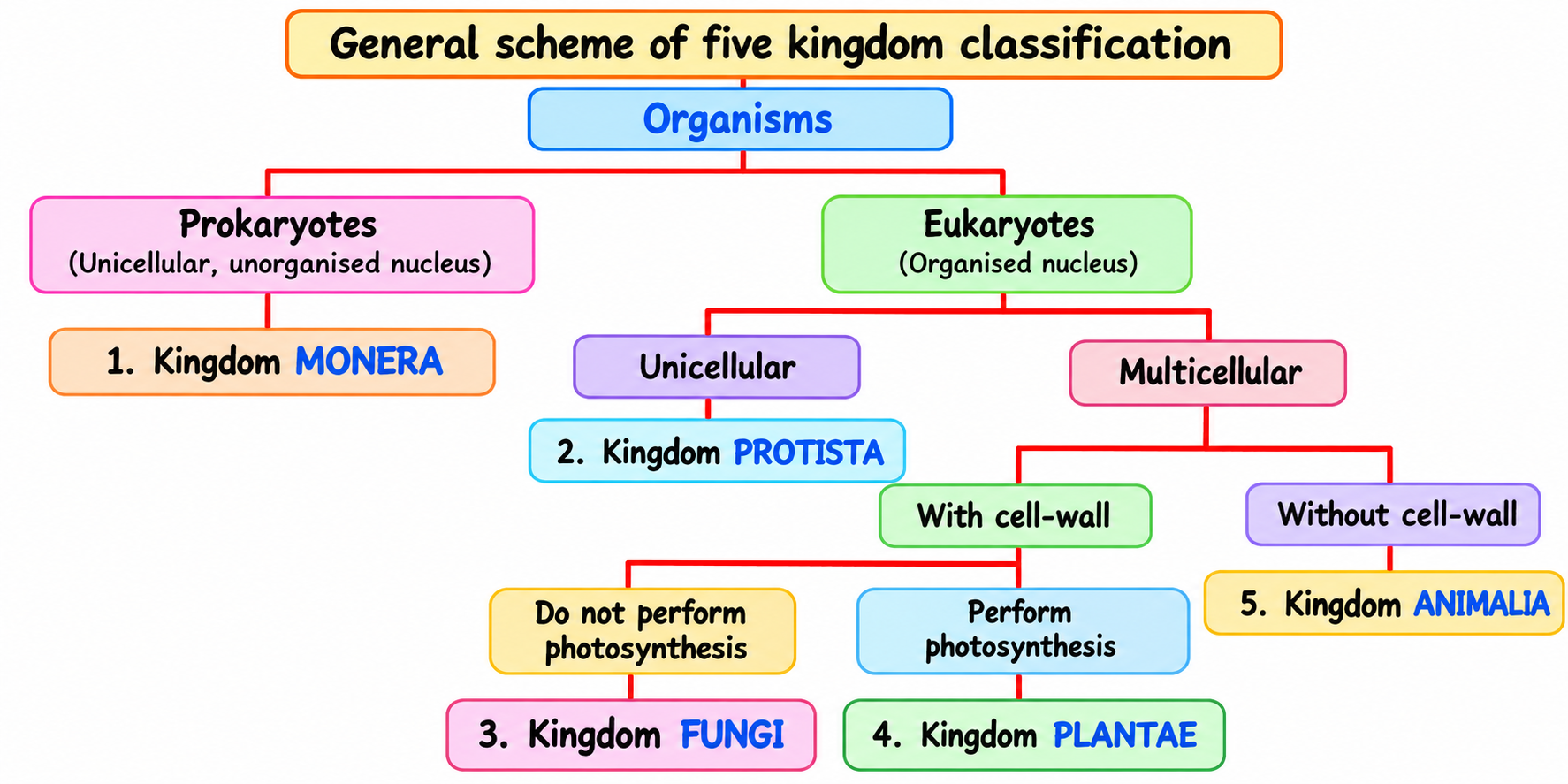
To overcome the anomalies of the two-kingdom system, American ecologist Robert H. Whittaker (1969) established the modern Five Kingdom System based on four fundamental scientific criteria:
Complexity of cell structure: Prokaryotic vs Eukaryotic.
Complexity of body organization: Unicellular vs Multicellular.
Mode of nutrition: Autotrophic (photosynthetic) vs Absorptive Heterotrophic (saprophytic) vs Ingestive Heterotrophic (holozoic).
Presence or absence of cell wall.
Fig. 8.7: The Five Kingdom Classification Scheme — Hierarchical flowchart dividing all living organisms into Monera, Protista, Fungi, Plantae, and Animalia.
The Five Kingdoms at a Glance
1. Kingdom Monera
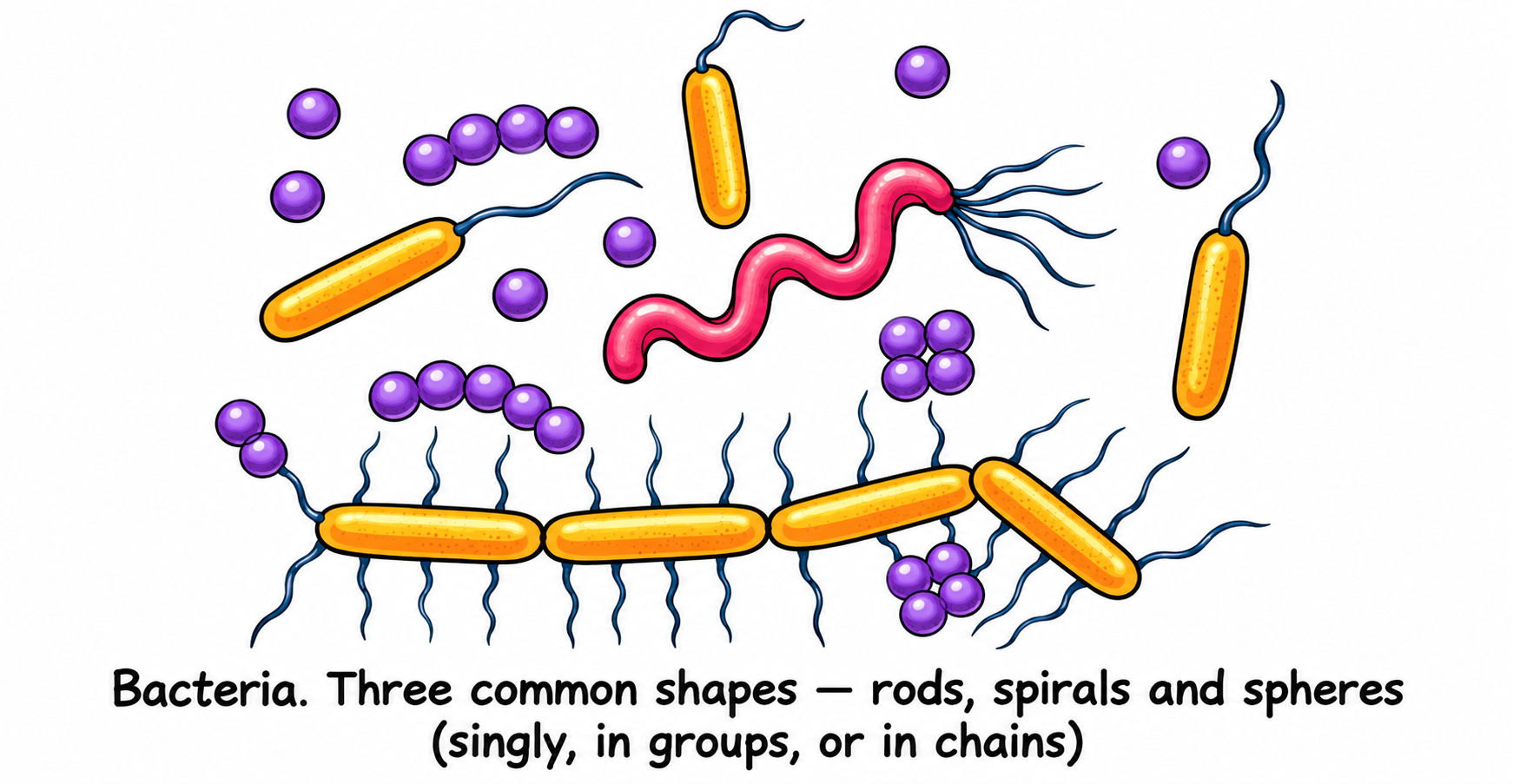
Cell Type:Prokaryotic (Unorganised nucleus, no nuclear membrane, naked DNA)
Organization:Unicellular
Cell Wall:Present (non-cellulosic peptidoglycan); no membrane-bound organelles
Nutrition:Autotrophic or Heterotrophic (saprophytic / parasitic)
Prokaryotic organization: Lacks an organized nucleus. Genetic material consists of a single circular DNA molecule that lies naked in the cytoplasm (termed a nucleoid).
Devoid of membrane-bound organelles: Lacks mitochondria, chloroplasts, endoplasmic reticulum, and Golgi bodies. Ribosomes are of the 70S type.
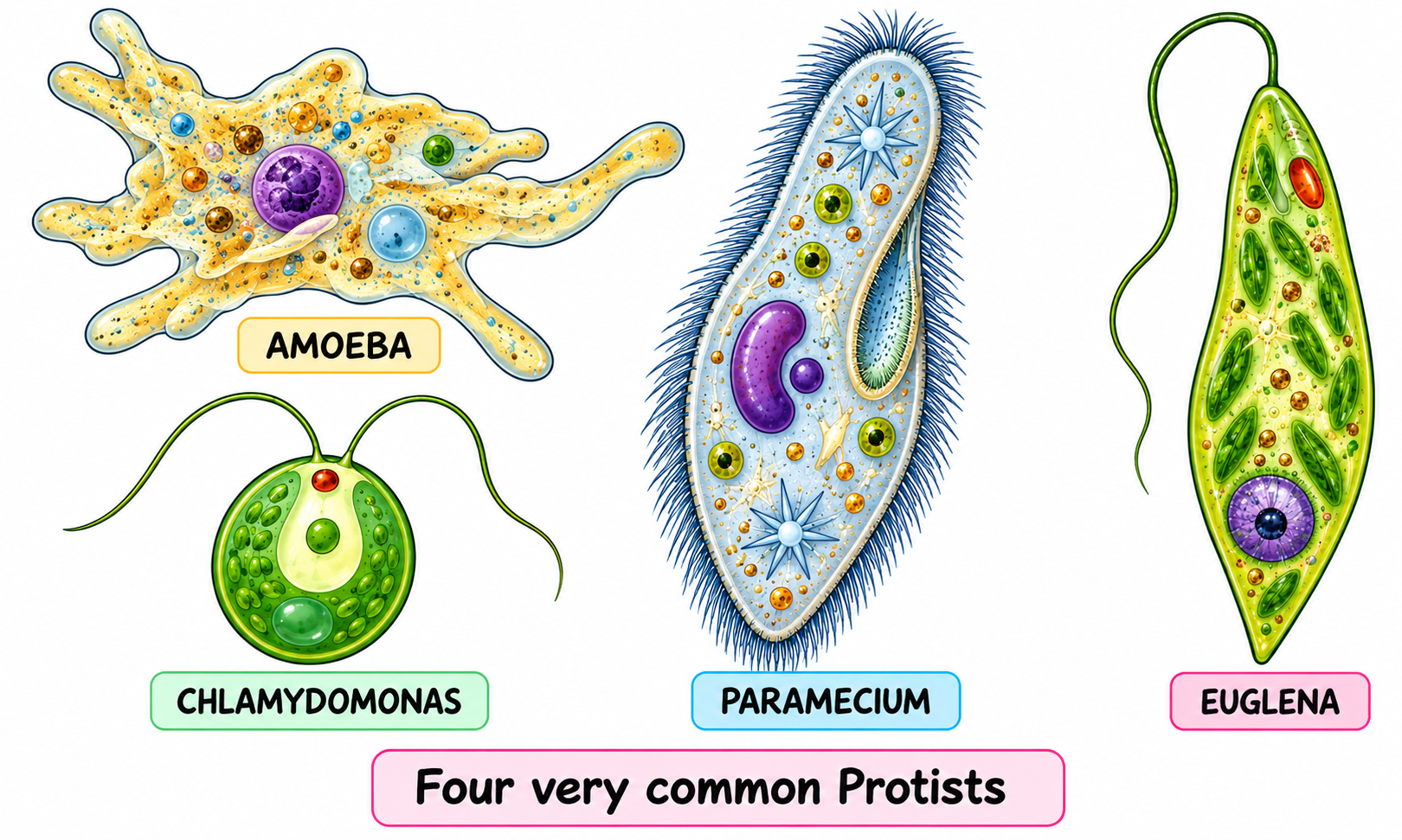
Microscopic, unicellular eukaryotes possessing a well-defined membrane-bound nucleus and true organelles.
Locomotion by pseudopodia (Amoeba), cilia (Paramecium), or flagella (Euglena, Chlamydomonas).
Some forms are colonial photosynthetic descendants like Pandorina.
3. Kingdom Fungi
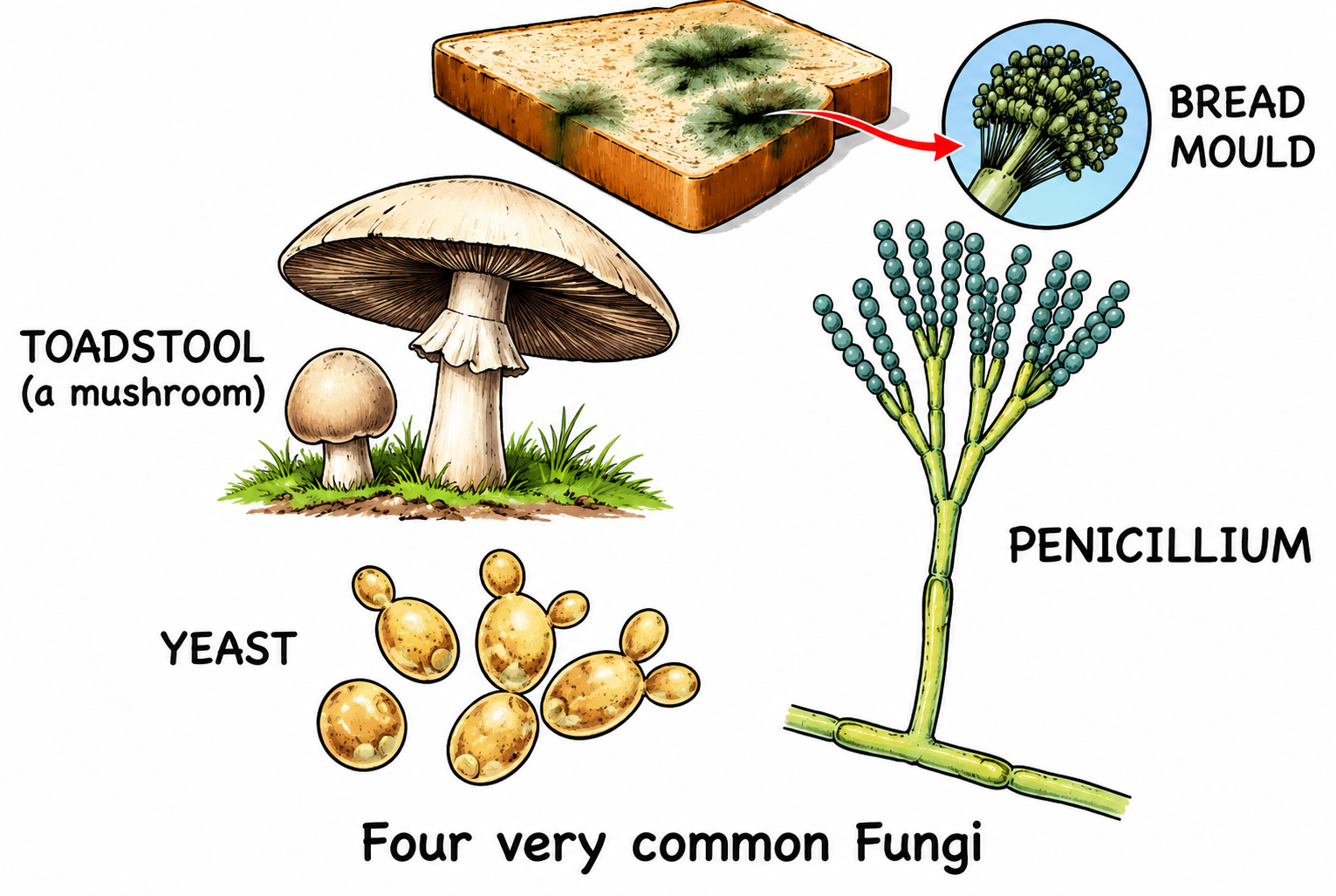
Non-green, non-photosynthetic, eukaryotic organisms with an absorptive heterotrophic mode of nutrition.
Structure: The plant body is called a mycelium, which consists of a network of branched thread-like filament tubes called hyphae with continuous cytoplasm containing many nuclei (coenocytic).
Cell Wall: Composed of tough, insoluble chitin (fungal cellulose).
Food Storage: Reserve food is stored as glycogen and oil globules (never starch).
Reproduction: By microscopic spores produced in sporangia or conidiophores.
4. Kingdom Plantae — The Five Major Divisions
Multicellular autotrophic eukaryotes possessing chlorophyll and cellulosic cell walls:
1. Division Thallophyta (Algae)
Plant Body:Undifferentiated thallus (no true roots, stem, or leaves)
Vascular Tissue:Absent
Reproduction:Single-celled gametangia; no seeds
Key Traits:Primarily aquatic; autotrophic with chlorophyll
5. Kingdom Animalia & Comprehensive Plant vs Animal Comparison
Eukaryotic, multicellular organisms that ingest readymade organic food (holozoic). Cells lack cell walls and plastids. They display active locomotion, sensory coordination, and determinate growth.
Table 8.1: General Differences Between Plants (Plantae) and Animals (Animalia)
Characteristic
Plants (Kingdom Plantae)
Animals (Kingdom Animalia)
1. Chlorophyll
Contain green pigment chlorophyll in chloroplasts.
Completely lack chlorophyll.
2. Locomotion / Mobility
Usually fixed to soil; cannot move freely from place to place (organs bend only).
Can move freely from place to place (except sedentary sponges and corals).
3. Mode of Nutrition
Autotrophic: Synthesise food from $CO_2$ and $H_2O$ in sunlight (photosynthesis).
Heterotrophic: Must feed on plants or animals (ingestive/holozoic).
4. Digestive System
Have no specialized digestive organs or tract.
Have dedicated digestive organs/canal to ingest, digest, and absorb food.
5. Cell Wall
Cells are bounded by a rigid external cell wall made of cellulose.
No cell wall; outermost boundary is the living cell membrane.
6. Vacuoles
Possess large, permanent central sap vacuoles providing turgidity.
Vacuoles absent, or small, temporary, and non-permanent (excretory/secretory).
7. Organization Level
Relatively low (root system and shoot system).
High level of organization with complex organ systems.
8. Growth Pattern
Indeterminate growth: Grow throughout life by adding new organs.
Determinate growth: Growth ceases after reaching mature adult size.
9. Growth Region
Localized: Confined to growing apices/meristems at root and shoot tips.
Uniform: Growth occurs proportionately across all body parts.
10. Body Form
Spreading type with large surfaces for gas, water, and light absorption.
Compact body shape to facilitate mobility and reduce resistance.
11. Response to Stimuli
Respond slowly to external environmental changes.
Respond quickly and actively via specialized nervous system.
5. Naming an Organism: Binomial Nomenclature
In different countries and regional languages, organisms are known by different common names. For example, pumpkin is known in India as sitaphal, kashiphal, kumhra, petha, and kaddu, while custard apple is also colloquially called sitaphal in certain regions! To eliminate this confusion, Swedish naturalist Carolus Linnaeus (1707–1778) devised the universal system of Binomial Nomenclature.
The Four Universal Rules of Binomial Nomenclature
Two-Word Name: Every scientific name consists of two parts:
Generic Name (Genus): The first word, identifying the genus.
Specific Name (Species): The second word, identifying the specific organism.
Capitalization: The Generic name must ALWAYS begin with a Capital letter, while the Specific name must ALWAYS begin with a small letter (e.g. Homo sapiens, NOTHomo Sapiens).
Typography:
When printed in text, scientific names must always be in italics.
When handwritten in exam papers, the genus and species MUST BE UNDERLINED SEPARATELY (e.g. Homosapiens).
Latin Language: The names are in Latin (or Latinized), because Latin is a dead language whose vocabulary and grammar never change.
Master Scientific Names for ICSE Examinations (Must Memorize)
Common Animal
Scientific Name
Common Plant
Scientific Name
Modern Man
Homo sapiens
Peepal Tree
Ficus religiosa
Domestic Cat
Felis domesticus
Mango Tree
Mangifera indica
Domestic Dog
Canis familiaris
Potato
Solanum tuberosum
Indian Honeybee
Apis indica
China Rose
Hibiscus rosa-sinensis
Housefly
Musca domestica
Okra (Bhindi)
Hibiscus esculentus
Indian Peacock
Pavo cristatus
Pineapple
Ananas comosus
Indian Cobra
Naja naja
Pigeon Pea (Arhar)
Cajanus cajan
Hoopoe (Bird)
Upapa epops
Lentil (Masur)
Lens esculenta
Tiger
Panthera tigris
Maize (Corn)
Zea mays
Lion
Panthera leo
Silk Moth
Bombyx mori
6. Major Groups of Animals: Invertebrates vs Vertebrates
Kingdom Animalia is divided into nine major phyla. Phyla 1 to 8 represent Invertebrates (animals without a backbone), while Phylum 9 (Chordata) contains the Vertebrates.
Table 8.2: Major Differences Between Vertebrates and Invertebrates
Feature
Vertebrates (Chordates)
Invertebrates (Non-Chordates)
1. Internal Skeleton
Internal living skeleton (endoskeleton) made of bone or cartilage.
No internal living skeleton; external exoskeleton (chitin/shell) may exist.
2. Backbone (Vertebral Column)
Present (notochord is replaced by a backbone composed of vertebrae).
Completely absent.
3. Tail
A post-anal tail is usually present behind the anus.
Tail is absent (anus is at terminal posterior tip of the body).
4. Heart Position
Heart is located on the ventral side (belly/front side) of the body.
Heart, when present, is located on the dorsal side (back side).
5. Central Nerve Cord
Nerve cord (spinal cord) is dorsal and hollow (single tube).
Nerve cord is ventral, solid, and double with segmental ganglia.
6. Limbs / Appendages
Possess two pairs of limbs (tetrapods: 4 limbs or fins).
May have three or more pairs of limbs (insects: 3; spiders: 4).
7. Haemoglobin Pigment
Contained inside specialized red blood cells (erythrocytes).
When present (e.g. earthworm), haemoglobin is dissolved in blood plasma.
7. Systematic Study of Non-Chordate (Invertebrate) Phyla
1. Phylum Porifera (Pore-Bearers — Sponges)
Simplest multicellular animals displaying cellular grade of organization without true tissues.
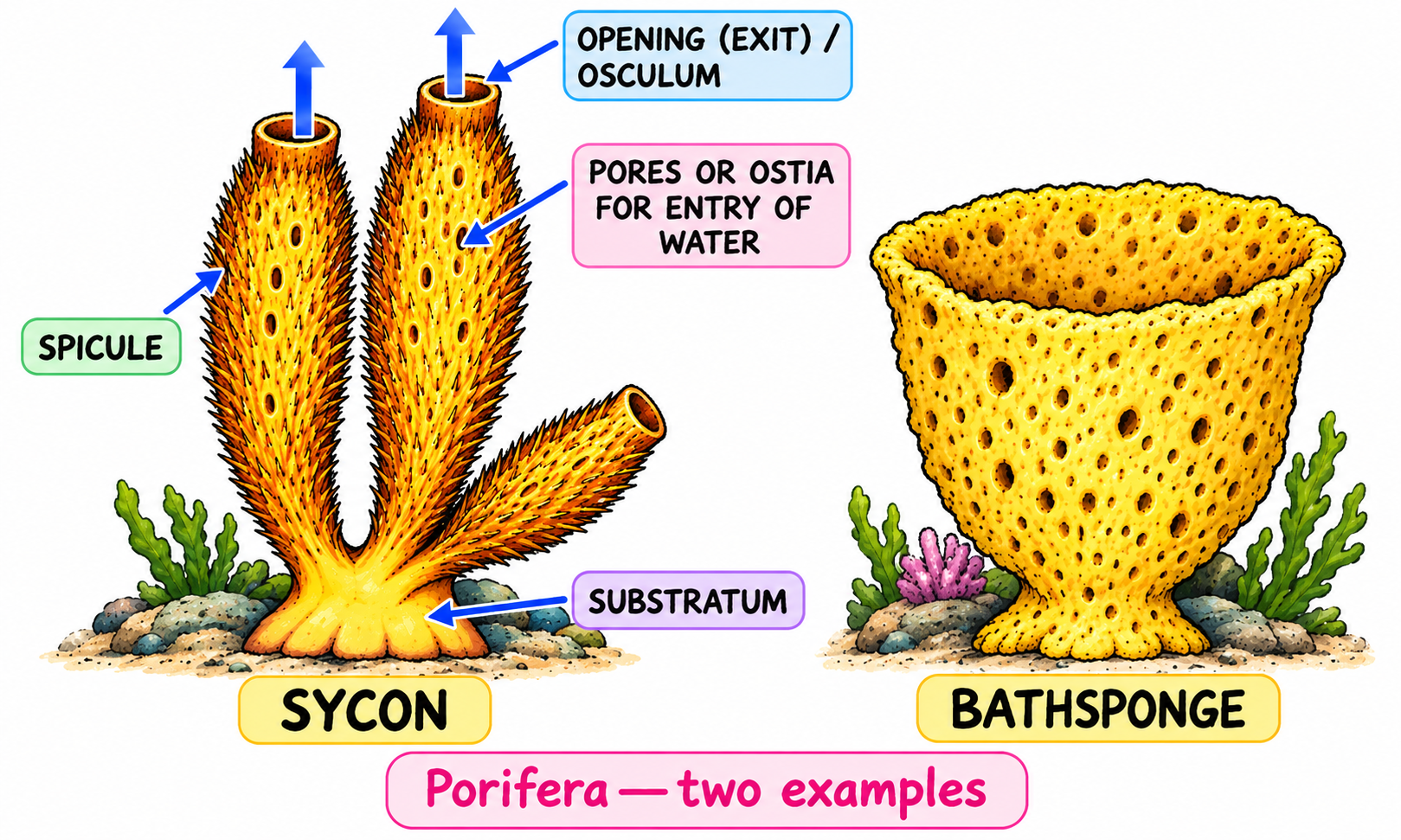
Body Structure: Hollow vase-shaped body perforated by innumerable microscopic incurrent pores called ostia, and a single large exit opening at the top called the osculum.
Canal System: Water enters through ostia bringing in microscopic food and dissolved oxygen, circulates through the central cavity (spongocoel), and exits through the osculum.
Skeleton: Internal skeleton composed of microscopic calcareous/siliceous spicules or flexible proteinaceous spongin fibres.
Habitat: Sedentary (attached to rocks); exclusively aquatic; mostly marine except the freshwater sponge (Spongilla).
Tissue level of organization: Body is diploblastic, consisting of outer ectoderm and inner endoderm enclosing a non-cellular jelly layer called mesoglea.
Gastrovascular Cavity (Coelenteron): Single central blind sac body cavity that functions for digestion and circulation. It has only one opening — the mouth (no anus).
Tentacles with Stinging Cells: Tentacles circle the mouth, bearing specialized explosive stinging cells called cnidoblasts (nematocysts) used for paralyzing prey, defense, and attachment.
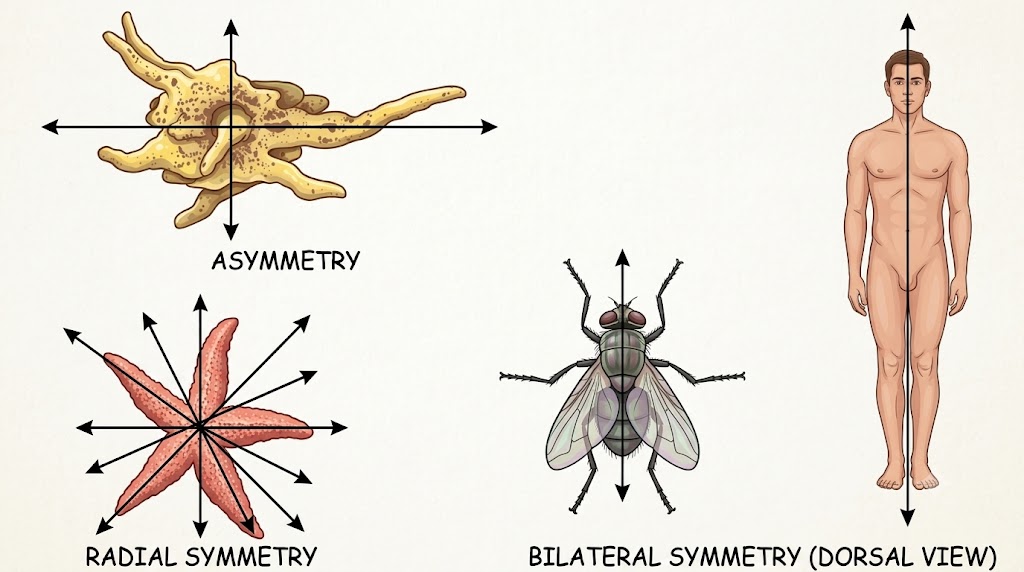
Body Symmetry: Radially symmetrical.
Corals: Marine colonial cnidarians that secrete massive hard exoskeletons of calcium carbonate ($CaCO_3$), forming ocean reefs.
Body Cavity:Acoelomate (true body cavity completely absent; space packed with parenchyma mesenchyme).
Digestive System: Incomplete alimentary canal with only one opening (mouth); anus is absent. In endoparasites like tapeworm, the digestive canal is completely absent (food absorbed directly across body surface).
Parasitic Adaptations: Possess adhesive suckers and chitinous hooks on the head (scolex) for firm anchorage to host intestinal walls, covered with a thick protective cuticle.
Body is cylindrical, elongated, unsegmented, and tapering at both ends (spindle-shaped).
Body Cavity: Possess a pseudocoelom (false body cavity derived from blastocoel; not lined with mesoderm).
Digestive System: Complete straight alimentary canal with two openings: mouth at anterior end and anus at posterior end.
Mostly endoparasitic in animals, plants, and humans; sexes are separate (dioecious) with sexual dimorphism (female is longer with a straight tail; male has a curved tail with penial spicules).
Key Examples:Ascaris lumbricoides (common roundworm of human intestine), Hookworm (Ancylostoma), Eelworm (parasite of potato roots), Filarial worm (Wuchereria bancrofti — causes elephantiasis).
5. Phylum Annelida (Segmented or Ringed Worms)
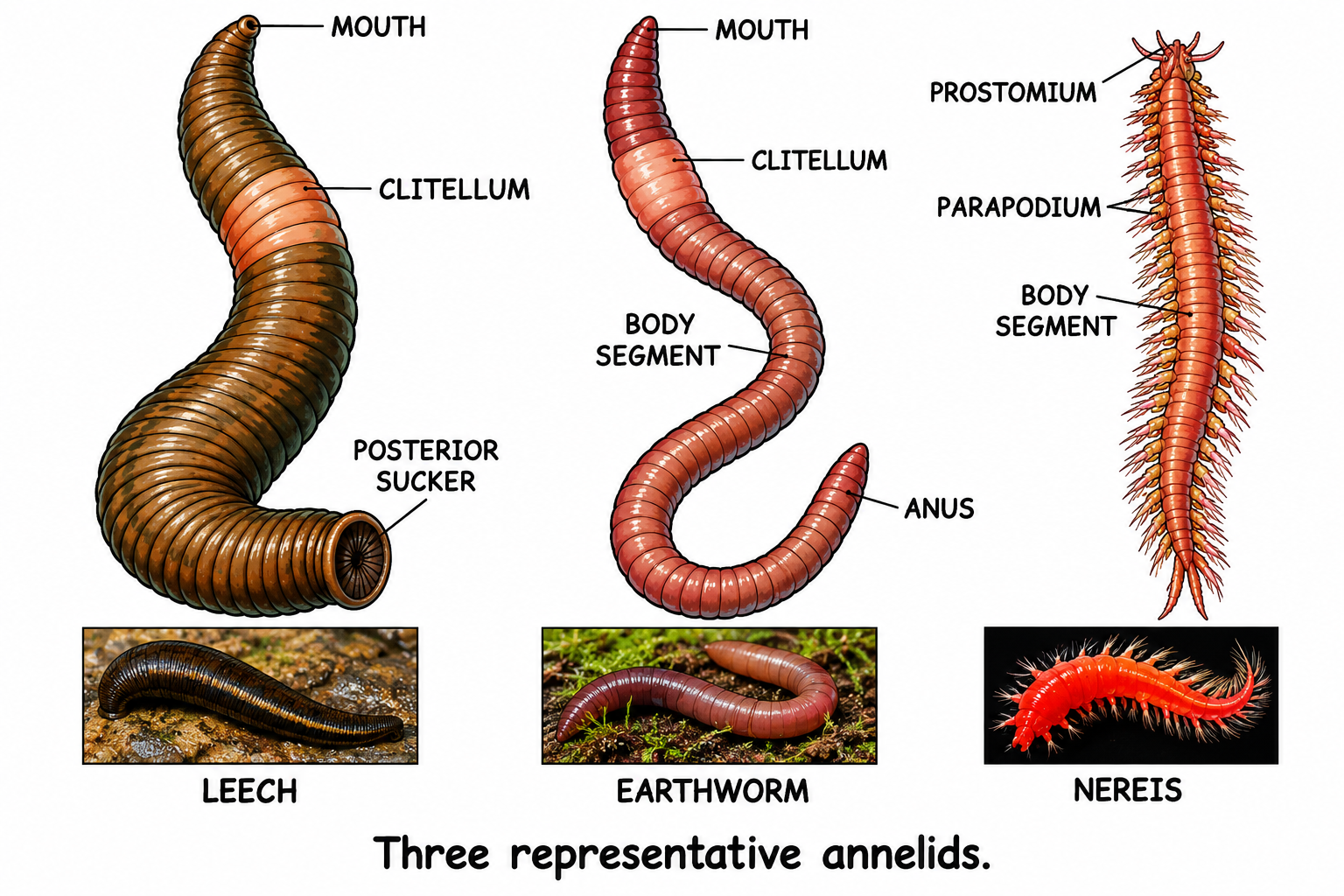
Body is elongated, cylindrical, and divided into a series of ring-like segments internally and externally by septa — termed metameric segmentation.
True Coelom: First animals to possess a true coelom (coelomate) lined with mesodermal coelomic epithelium.
Organ Systems: Well-developed digestive tube with mouth and anus; closed circulatory system with pulsating lateral pseudo-hearts; excretion by coiled tubules called nephridia.
Locomotion: By chitinous bristles called setae (chaetae) or lateral fleshy flaps called parapodia (in Nereis).
1. Habits: Nocturnal; lives in damp soil burrows. Must keep its skin moist with mucus and coelomic fluid for cutaneous respiration (exchange of gases across moist skin into capillary networks). In dry soil, an earthworm suffocates and dies.
2. Clitellum: A prominent, dark, saddle-shaped band of thick glandular skin surrounding segments 14, 15, and 16. It secretes mucus and albumin to form a protective cocoon during copulation and egg laying.
3. Economic Importance to Agriculture (Why Called Farmer's Friend):
Soil Aeration: By burrowing deep channels, earthworms loosen and aerate the soil, facilitating air exchange to root systems and enhancing water absorption.
Natural Tilling: They ingest dense soil and organic matter, bringing subsoil up and depositing pulverized topsoil as worm castings.
Soil Fertility: Castings are rich in bio-available nitrogen, potassium, and phosphorus.
Vermicomposting: Farmed extensively in vermiculture to recycle farm waste into rich organic manure.
Comparison Among the Three Worm Phyla (Table 8.3)
1. Flatworms (Platyhelminthes)
Body Shape:Flat, thin, ribbon-like; unsegmented
Body Cavity (Coelom):Absent (Acoelomate); packed with parenchyma
Alimentary Canal:Only one opening (mouth); anus absent
Circulation:Absent
Excretory Organs:Flame cells (protonephridia)
Examples:Planaria, Liver fluke, Tapeworm
2. Roundworms (Nematoda)
Body Shape:Round, cylindrical, tapering; unsegmented
Body Cavity (Coelom):Pseudocoelomate (false body cavity)
Alimentary Canal:Two separate openings: mouth and anus
Circulation:Absent
Excretory Organs:Excretory canals / Renette cells
Examples:Ascaris, Hookworm, Eelworm, Filaria
3. Ringed Segmented Worms (Annelida)
Body Shape:Cylindrical; divided into ring-like metameric segments
Body Cavity (Coelom):True Coelom (Coelomate) lined with mesodermal epithelium
Alimentary Canal:Complete digestive tract with two openings and organs
Circulation:Present (closed circulatory system with dissolved haemoglobin)
Excretory Organs:Coiled microscopic Nephridia in each segment
Largest Phylum: Represents over 80% of all described animal species on earth.
Jointed Limbs: (arthros = joint; podos = foot) Limbs are multi-jointed for walking, grasping, swimming, and feeding.
Chitinous Exoskeleton: The body is completely encased in a tough, waterproof, non-living cuticle made of chitin.
Moulting / Ecdysis: Because the rigid chitin exoskeleton cannot stretch, animals must periodically cast off their old exoskeleton and synthesize a larger one during juvenile growth stages.
Body Symmetry & Circulation: Bilateral symmetry; open circulatory system with a dorsal tubular heart and open haemocoel cavity.
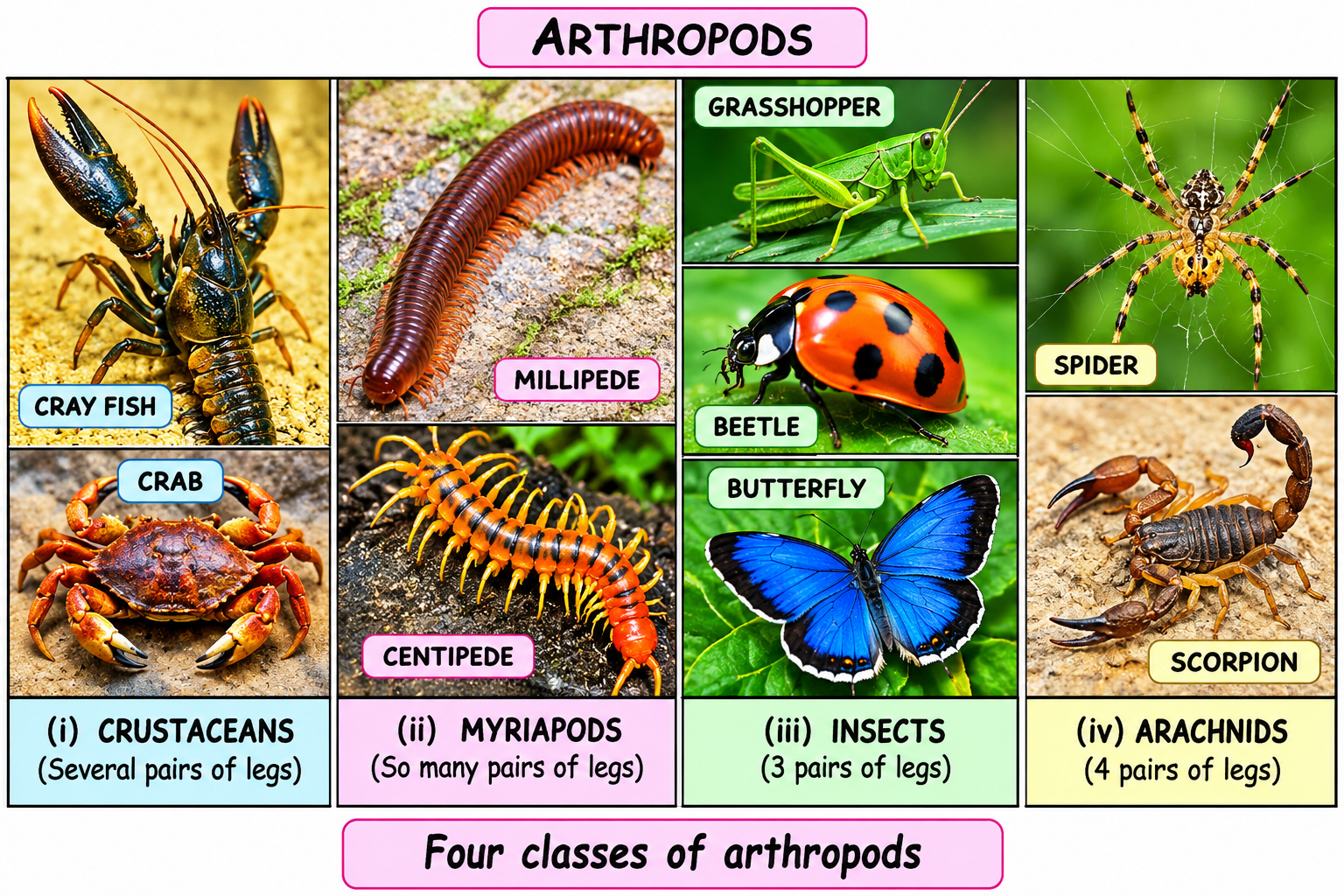
Fig. 8.12: The Four Classes of Arthropoda — Crustacea, Myriapoda, Insecta, and Arachnida.
1. Class Crustacea
Body Regions:Cephalothorax (fused head + thorax) & abdomen
Body Regions:Three distinct regions: Head, Thorax, and Abdomen
Walking Legs:Three pairs of jointed legs (6 legs) on thorax
Antennae & Wings:One pair of antennae; usually two pairs of wings
Respiration:Tracheal tubes with spiracles
Examples:Housefly, Butterfly, Cockroach, Beetle, Grasshopper, Ant
4. Class Arachnida
Body Regions:Cephalothorax and abdomen
Walking Legs:Four pairs of walking legs (8 legs)
Antennae & Wings:No wings; no antennae
Respiration:Book lungs or tracheae
Examples:Spider, Scorpion, Tick, Mite
7. Phylum Mollusca (Soft-Bodied Animals)
Body is soft, unsegmented, and typically encased in a protective external calcareous shell ($CaCO_3$) secreted by a fleshy fold of skin called the mantle. (In cuttlefish, shell is internal; in octopus and slug, shell is absent/reduced).
Muscular Foot: Located ventrally, modified for creeping, burrowing, or swimming.
Mantle Cavity: Space between mantle and visceral mass housing respiratory gills called ctenidia.
Exclusively Marine: Found strictly in oceanic saltwater (no freshwater or terrestrial forms exist).
Spiny Skin: Underneath the delicate epidermis lies an endoskeleton of hard calcareous plates and spines (echinos = spine; derma = skin).
Radial Pentamerous Symmetry: Adult bodies exhibit five-rayed radial symmetry around a central disc; however, their swimming larvae exhibit bilateral symmetry!
Water Vascular (Ambulacral) System: A unique hydraulic network of seawater canals terminating in hundreds of tiny, contractile suction-tipped tube-feet (podia) used for locomotion, food handling, and gas exchange.
Unsegmented body with no distinct head or brain. Mouth is on the ventral oral side; anus on the dorsal aboral side.
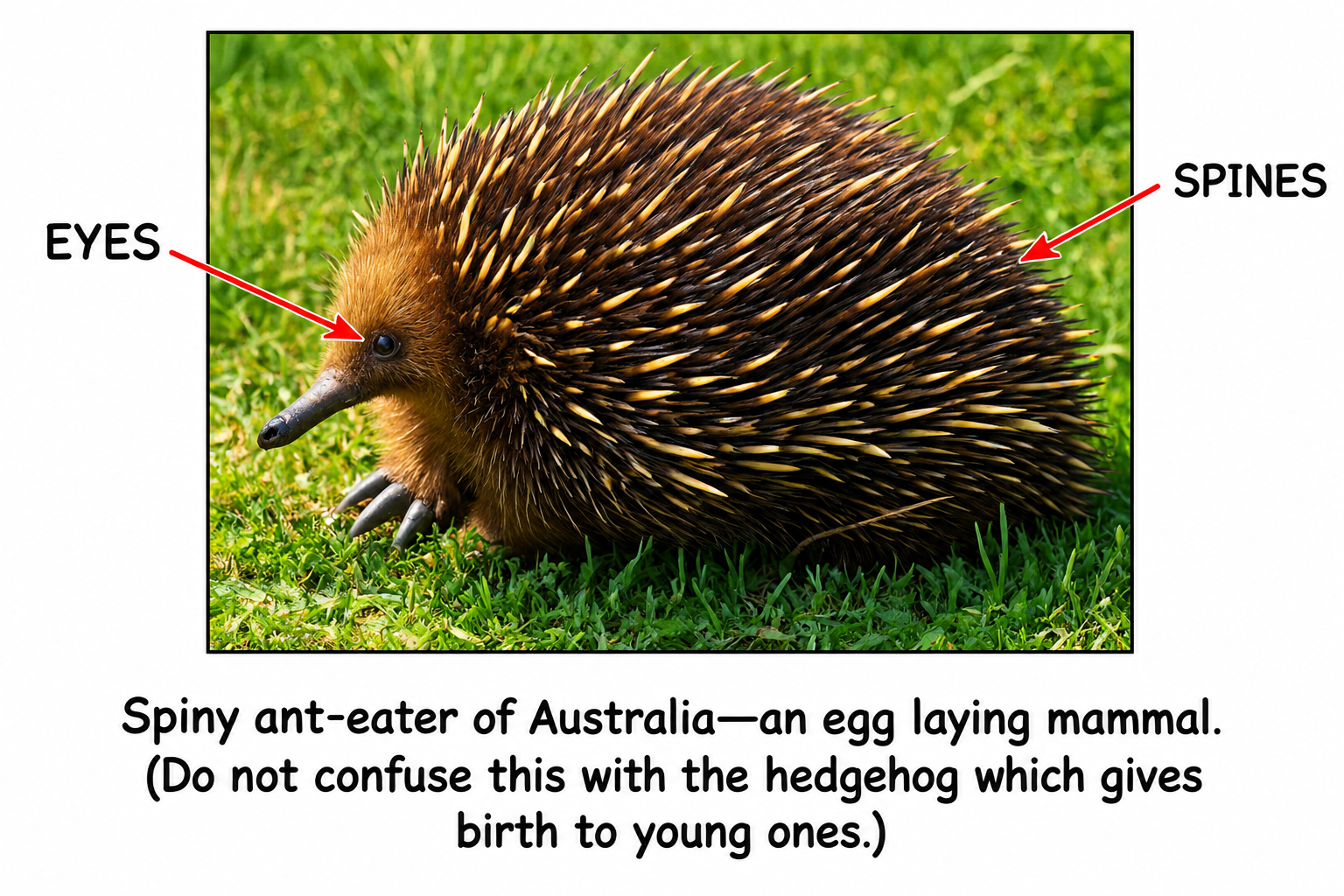
Egg-Laying Mammals (Monotremes):Duck-billed Platypus (Ornithorhynchus) and Spiny Ant-eater (Echidna) lay eggs, yet suckle hatched young with milk!
Pouched Mammals (Marsupials):Kangaroo gives birth to tiny, immature young that complete development inside a maternal abdominal pouch (marsupium).
Aquatic Mammals:Whales, Dolphins, Porpoises, and Seals live in water but breathe air with lungs, possess a 4-chambered heart, and suckle calves with milk.
Flying Mammal:Bat flies with a skin flap (patagium), but has fur, pinnae, gives birth to live young, and feeds them with milk.
Quick-Glance Summary: Five Vertebrate Classes
1. Class Pisces
Skin:Scaly & slimy
Respiration:Gills
Heart:2-chambered (venous)
Temperature:Cold-blooded
Eggs:Soft, in water
2. Class Amphibia
Skin:Moist, non-scaly
Respiration:Gills (larva), lungs/skin (adult)
Heart:3-chambered
Temperature:Cold-blooded
Eggs:Jelly-coated, in water
3. Class Reptilia
Skin:Dry, horny scales
Respiration:Lungs
Heart:3-chambered (Crocodile: 4)
Temperature:Cold-blooded
Eggs:Leathery shells, on land
4. Class Aves
Skin:Feathers & scaly legs
Respiration:Lungs with air sacs
Heart:4-chambered
Temperature:Warm-blooded
Eggs:Calcareous shells
5. Class Mammalia
Skin & Exoskeleton:Hair or fur; sweat & oil glands
9. Scientific Curiosities & Myths (“To Believe or Not to Believe”)
Textbook Page 72 & 75 Insights
Cuckoo (Koel) Brood Parasitism: The glossy black male sings “koo-oo-koo-oo”, while the brownish female emits a dull call and secretly lays her eggs in a crow's nest. The crow incubates them and raises the cuckoo chicks as its own.
Hawk Cuckoo (Papiha): Lays its eggs in the nests of “seven-sisters” (babblers).
Swan (Hans) Milk Myth: Folklore claims a swan can drink pure milk and leave water behind. Fact: A swan has no physiological mechanism to separate milk and water; it also does not eat pearls.
Spiny Ant-eater vs Hedgehog: The spiny ant-eater of Australia is an egg-laying mammal (monotreme), whereas the common hedgehog is a placental mammal that gives birth to live young.
The “Sarp Mani” Myth: Contrary to popular myth, there is no jewel (mani) inside a cobra's head. Fraudulent snake-charmers used to cut a small slit in the snake's head skin, glue a piece of cut glass inside, and display it to deceive spectators. Snake-keeping and performances are now legally banned.
Gecko Wall Adhesion: Wall lizards do not use vacuum suction cups. Their toes possess millions of microscopic spatulae that produce van der Waals atomic attraction forces against the molecules of the wall.
1. Rearrange the following categories of animal grouping in a sequence starting from the highest downward to the lowest: Class, Phylum, Species, Genus, Kingdom
Correct Sequence: Kingdom → Phylum → Class → Genus → Species
2. Tick-mark the features that characterise vertebrates:
(i) Dorsal nerve cord (ii) Haemoglobin dissolved (iii) Three or more pairs of limbs (iv) A tail behind the level of the anus (v) Dorsal heart
Vertebrate Features:
• (i) Dorsal nerve cord (True — hollow dorsal spinal cord).
• (iv) A tail behind the level of the anus (True — post-anal tail present). (Note: Haemoglobin is in RBCs, limbs are two pairs, and heart is ventral).
Progress Check 2 (Page 69)
1. Mention the name of the phylum against the following characteristics:
(i) No single mouth but numerous pores as water inlets: Phylum Porifera
(ii) Jointed appendages: Phylum Arthropoda
(iii) Unsegmented body with a protective calcareous shell: Phylum Mollusca
(iv) Locomotion by tube feet: Phylum Echinodermata
(v) Long, cylindrical and unsegmented body: Phylum Nematoda
(vi) Small flat unsegmented worms: Phylum Platyhelminthes
2. Name the phylum of each of the following invertebrates:
1. Match at least two characteristics with each class of Chordata:
• (a) Pisces: (iii) Two-chambered heart, (v) Scales, (vii) Gills.
• (b) Amphibia: (i) Three chambered heart, (viii) Moist skin.
• (c) Reptilia: (iv) Eardrum in a pit, (ix) Horny scales on skin.
• (d) Aves: (ii) Feathers, (x) Homeothermal.
• (e) Mammalia: (vi) External ears, (xi) Testes in scrotum.
2. Mention the class of vertebrates against each:
(i) Crocodile: Class Reptilia (ii) Penguin: Class Aves (iii) Toad: Class Amphibia
(iv) Shark: Class Pisces (v) Whale: Class Mammalia (vi) Bat: Class Mammalia (vii) House lizard: Class Reptilia
The animals (Kingdom Animalia) are mainly grouped under two categories:
(a) bilaterally symmetrical and radially symmetrical (b) coelomate and acoelomate
(c) aquatic and terrestrial (d) vertebrates and invertebrates
Correct Answer: (d) vertebrates and invertebrates.
MCQ 2
Which one of the following examples does not come under the particular group?
(a) Mushroom, yeast, fern — Fungi
(b) Paramecium, Euglena, sponge — Protista
(c) Starfish, Cuttlefish, Dogfish — Pisces
(d) Bat, Parrot, Oyster — Vertebrates
Analysis & Answer: All four options list mismatched organisms:
In (a) fern is a Pteridophyte (Plantae).
In (b) sponge is Porifera (Animalia).
In (c) Starfish is Echinodermata and Cuttlefish is Mollusca.
In (d) Oyster is an Invertebrate (Mollusca). (Standard textbooks target (a) as the primary fungi question error).
MCQ 3
Which one of the following is an example of a binomial scientific name?
(a) Green alga (b) Snow leopard (c) Rana tigrina (d) China-rose
Correct Answer: (c) Rana tigrina (comprises generic name Rana and specific name tigrina).
MCQ 4
Which one of the following is the correct statement about the respective animal(s)?
(a) Donkey and horse should be considered one single species because they can successfully mate and produce an offspring.
(b) Donkey and horse are two different genuses.
(c) Mule is a separate species.
(d) Mule is neither a donkey nor a horse.
Correct Answer: (d) Mule is neither a donkey nor a horse. (It is a sterile interspecific hybrid between a male donkey and female horse).
B. Very Short Answer Questions
VSA 1
Who had introduced the binomial system of naming living beings?
Answer:Carolus Linnaeus.
VSA 2
Which two characters out of (a)–(e) given below are common to dog, humans, squirrel, bat, camel, and monkey?
(a) scales on the skin (b) wings (c) external ears (d) give birth to young ones (e) a functional tail.
Answer:(c) external ears (pinnae) and (d) give birth to young ones (viviparous).
C. Short Answer Questions
Short Answer 1
Rearrange the following categories of classification in their proper sequence starting with the highest: species, family, genus, class, order, phylum, kingdom
Correct Descending Sequence: Kingdom → Phylum → Class → Order → Family → Genus → Species
Short Answer 2
Give the scientific names of man, domestic cat, and peepal tree.
Why are scientific names of living beings considered better than their common names?
Answer:
1. Universal Uniformity: Scientific names are identical across all countries and languages, allowing scientists worldwide to communicate without ambiguity.
2. Eliminates Regional Confusion: A single organism often has several vernacular names (e.g. pumpkin has over five names in India alone; custard apple and pumpkin share local names), leading to misidentification. Scientific names assign one unique name to one species.
3. Shows Evolutionary Relationships: The binomial name reveals the genus, immediately demonstrating evolutionary closeness to related species.
Short Answer 4
Rewrite the following scientific names correctly according to binomial conventions:
(i) ficus religiosa (peepal) (ii) zea Mays (maize) (iii) Bombyx Mori (silk moth)
Corrected Names:
(i) Ficus religiosa (Generic name must begin with a Capital letter).
(ii) Zea mays (Specific name must begin with a small letter).
(iii) Bombyx mori (Specific name must begin with a small letter).
Short Answer 5
All humans on earth today may differ widely in their facial features, colour, height, etc. Yet, they belong to a single species Homo sapiens. Give one reason why they are not considered belonging to different species.
Answer: Because human beings of different races and geographical origins can freely interbreed with each other under natural conditions and produce healthy, fertile children.
Short Answer 6: Group Names
What are the group names of the following categories of animals?
(a) Animals with a backbone (b) Animals with a hairy skin (c) Animals with three pairs of legs (d) Animals with feathers
Answer:
(a) Animals with a backbone: Vertebrates (Phylum Chordata)
(b) Animals with a hairy skin: Class Mammalia
(c) Animals with three pairs of legs: Class Insecta (Phylum Arthropoda)
(d) Animals with feathers: Class Aves (Birds)
Short Answer 7: Invertebrates Selection
Which ones of the following animals are invertebrates? Housefly, silverfish, trout, jellyfish, whale, penguin, lizard, sponge.
Invertebrates:Housefly, Silverfish, Jellyfish, and Sponge. (Trout is a fish, Whale is a mammal, Penguin is a bird, and Lizard is a reptile — all are Vertebrates).
Short Answer 8: Differentiate Terms
Give any one difference between each of the following:
(a) Protozoa and Metazoa (b) Vertebrate and Invertebrate
(c) Insecta and Arachnida (d) Flatworm and Roundworm
Answers:
(a) Protozoa vs Metazoa: Protozoa are unicellular microscopic organisms (e.g. Amoeba), while Metazoa are multicellular animals (e.g. sponges to mammals).
(b) Vertebrate vs Invertebrate: Vertebrates possess an internal backbone (vertebral column), whereas invertebrates completely lack a backbone.
(c) Insecta vs Arachnida: Insects have body divided into 3 parts (head, thorax, abdomen) and possess 3 pairs of walking legs; Arachnids have cephalothorax and abdomen with 4 pairs of legs.
(d) Flatworm vs Roundworm: Flatworms are dorso-ventrally flattened and acoelomate with a single opening to gut; Roundworms are cylindrical and pseudocoelomate with mouth and anus.
Short Answer 9: Odd One Out with Justification
Underline the term which does not match with the animal:
(i) Amoeba — Nucleus, tentacle, food vacuole.
(ii) Hydra — Invertebrata, Cnidaria, Crustacea.
(iii) Fish — Gills, paired fins, ear drum.
(iv) Earthworm — Invertebrata, Annelida, Insecta.
(v) Grasshopper — Wings, trachea, proboscis.
(vi) Butterfly — Insecta, Invertebrata, Mollusca.
(vii) Whale — Gills, mammary glands, fat under the skin.
(viii) Pigeon — Feathers, wings, hair.
(ix) Monkey — External ear, sweat glands, lateral line.
(x) Bat — Aves, Mammalia, Chordata.
Answers:
(i) Tentacle: Amoeba moves using pseudopodia; tentacles are found in Hydra.
(ii) Crustacea: Hydra belongs to Phylum Cnidaria.
(iii) Ear drum: Fishes have no eardrum (tympanum); only an internal ear.
(iv) Insecta: Earthworm belongs to Phylum Annelida.
(v) Proboscis: Grasshoppers have biting and chewing mouthparts, not a proboscis.
(vi) Mollusca: Butterfly belongs to Phylum Arthropoda.
(vii) Gills: Whale is a mammal that breathes atmospheric air with lungs.
(viii) Hair: Birds have feathers, not hair.
(ix) Lateral line: Lateral line sense organs are found in fishes, not monkeys.
(x) Aves: Bat is a mammal (Class Mammalia), not a bird (Class Aves).
Short Answer 10: Definitions
Explain the meaning of the terms cold-blooded and warm-blooded (homeothermal).
Answers:
• Cold-blooded (Poikilothermal): Animals whose body temperature fluctuates directly with the temperature of the external environment (e.g. Fishes, Amphibians, Reptiles).
• Warm-blooded (Homeothermal): Animals that maintain a constant, relatively high internal body temperature irrespective of the environmental temperature (e.g. Birds and Mammals).
Short Answer 11
Name three animals (belonging to different classes) which breathe by means of lungs but have no external ears (pinnae).
Mention one major similarity and one major difference in the following pairs of animals:
(a) Insects and Birds:
• Similarity: Both possess wings and have the capability of aerial flight.
• Difference: Insects are invertebrates with chitinous exoskeleton and 3 pairs of legs; Birds are vertebrates with an internal bony skeleton, feathers, and a backbone.
(b) Whales and Fishes:
• Similarity: Both have streamlined aquatic bodies with fins/flippers for swimming.
• Difference: Whale is a warm-blooded viviparous mammal breathing air through lungs; Fish is a cold-blooded oviparous vertebrate breathing through gills.
(c) Snakes and Earthworms:
• Similarity: Both possess long, cylindrical, limbless bodies that crawl on the ground.
• Difference: Snake is a vertebrate with a backbone and dry scaly skin; Earthworm is an invertebrate with metameric segments and moist glandular skin.
(d) Bat and Pigeon:
• Similarity: Both are warm-blooded vertebrates adapted for flight with 4-chambered hearts.
• Difference: Bat is a viviparous mammal with hair, pinnae, and mammary glands; Pigeon is an oviparous bird with feathers and a toothless beak.
(e) Cuttlefish and Dogfish:
• Similarity: Both are marine aquatic predators.
• Difference: Cuttlefish is an invertebrate mollusc with tentacles; Dogfish is a vertebrate cartilaginous fish with a backbone and gills.
(f) Wall Lizard and Frog:
• Similarity: Both are cold-blooded vertebrates with 3-chambered hearts.
• Difference: Wall lizard is a terrestrial reptile with dry scaly skin laying leathery eggs; Frog is an amphibian with moist slimy skin laying eggs in water.
Long Answer 2: Group Matching & Left Out Analysis
Match the names of animal groups in Column I with the names of animals in Column II. Which names are left out that do not match and why? Column I (Group): Annelida, Porifera, Mollusca, Reptilia, Amphibia, Pisces, Mammal. Column II (Animal): Pigeon, Snake, Earthworm, Sponge, Octopus, Trout, Rabbit.
Left Out:
• From Column I: Amphibia is left out because there is no amphibian representative (like frog or toad) in Column II.
• From Column II: Pigeon is left out because its corresponding class (Aves) is not listed in Column I.
E. Structured & Application Type Questions
Application 1: Tyrannosaurus rex
Tyrannosaurus was an extinct animal which lived on the Earth about 100,000,000 years ago. It was about six metres long and preyed upon other animals.
(i) What do you think about its classification — was it an amphibian, a reptile, or a mammal?
(ii) Can you call it a relative of the kangaroo? Give reason.
Answer:
(i) It was a Reptile. Dinosaurs were giant prehistoric terrestrial reptiles that possessed dry scaly skin, claws, and laid cleidoic leathery eggs on land.
(ii) No, it cannot be called a relative of the kangaroo. Although both shared bipedal locomotion (standing on two large hind legs with short front limbs), this is merely convergent adaptation. The kangaroo is a warm-blooded viviparous mammal with fur and a marsupial pouch, whereas Tyrannosaurus was a cold-blooded, egg-laying, scaly reptile.
Application 2: Gecko Adhesion & Atomic Forces
Geckos (the common wall lizards) stick to walls and ceilings not by any vacuum cup but by innumerable microscopic “hairs” called spatulae projecting from setae on the underside of their feet. How do these spatulae enable the lizard to defy gravity?
Answer: Each gecko foot bears millions of microscopic setae terminating in billions of nanoscopic spatulae. When these spatulae make close contact with the wall, they generate powerful van der Waals forces (electrostatic intermolecular / atomic attractions) between the molecules of the spatulae and the wall surface. The cumulative adhesive force of these billions of contact points is strong enough to support the gecko's entire body weight even on smooth ceilings.

 VARDAAN COMET