
Plant Physiology – Seeds: Structure and Germination is a crucial chapter in the ICSE Class 9 Biology syllabus. It explores the transition from a dormant seed to a thriving seedling, investigating the anatomical differences between dicot and monocot seeds, the physiological processes of germination, and the experiments demonstrating the requirements for life.
Before studying the structures, we must clarify the scientific differences between three commonly confused botanical terms: Fruit, Seed, and Grain.
, a Seed (Bean), and a Grain (Maize).png)
Why is Maize called a Grain and not a Seed?
In exams, you are frequently asked: "Why is a maize grain called a grain and not a seed?" The answer is: "Because the fruit wall (pericarp) and the seed coat are completely fused together to form a single protective layer, representing a single-seeded fruit."
Seeds can be classified based on three criteria: the number of cotyledons, seed size, and the presence or absence of endosperm.
This is a major classification based on whether the endosperm (food-storing tissue formed during double fertilization) persists in the mature seed.
| Parameter | Albuminous (Endospermic) Seeds | Exalbuminous (Non-Endospermic) Seeds |
|---|---|---|
| Food Storage | Food is stored in the Endosperm. | Food is stored in the thick, fleshy Cotyledons. |
| Cotyledon Nature | Cotyledons are thin, papery, and membranous. | Cotyledons are thick, fleshy, and food-laden. |
| Dicot Examples | Poppy, Custard apple, Castor. | Gram, Pea, Bean, Mango, Mustard. |
| Monocot Examples | Cereals (Maize, Wheat, Rice), Millets, Palm. | Vallisneria, Orchids, Amorphophallus. |
Students often assume all monocots are albuminous and all dicots are exalbuminous. Watch out for the exceptions!
• Dicot Albuminous: Castor, Poppy, Custard apple.
• Monocot Exalbuminous: Vallisneria, Orchids, Amorphophallus.
In the ICSE syllabus, you must study the detailed structure of a representative Dicot seed (Bean Seed) and a Monocot grain (Maize Grain).
A bean seed is kidney-shaped with a convex outer surface and a concave inner side. Its structure includes:
.png)
Do NOT misspell Radicle as "Radical" in your exam.
• Radicle is the embryonic root.
• Radical is a chemical species or a political stance.
Spelling errors in key biological terms will result in immediate loss of marks!
A maize grain is flat, triangular/wedge-shaped, and light yellow. Its structure consists of:
 of a Maize Grain showing Aleurone layer, Endosperm, and protected Embryonal Axis.png)
Students often swap the sheaths in exams. Remember this simple trick:
• Coleorhiza protects the Radicle (Both contain 'R' — Radicle/Rhiza).
• Coleoptile protects the Plumule (Both contain 'P' — Plumule/Ptile).
This comparison is highly important for differences-based questions in the ICSE Board Exam.
| Feature | Bean Seed | Maize Grain |
|---|---|---|
| Type of Seed | Dicotyledonous (Dicot) | Monocotyledonous (Monocot) |
| Endosperm | Non-endospermic (Exalbuminous) | Endospermic (Albuminous) |
| Number of Cotyledons | Two cotyledons (store food, fleshy) | One cotyledon called Scutellum (shield-like) |
| Outer Covering | Seed coat (testa and tegmen) is separate from fruit wall. | Seed coat is fused with the fruit wall (Fused Pericarp & Testa). |
| Embryo Size | Large embryo, occupying the entire space. | Small embryo, confined to one side of the grain. |
| Plumule Leaves | Plumule leaves are folded. | Plumule leaves are rolled. |
| Hilum and Micropyle | Clearly visible on the seed surface. | Not visible externally (hidden under fused coat). |
| Protective Sheaths | Coleoptile and Coleorhiza are absent. | Coleoptile and Coleorhiza are present. |
Seed Dormancy: It is a state of temporary metabolic inactivity or rest period of the embryo in dry seeds.
Significance of Dormancy:
1. Allows seeds to withstand unfavorable environmental conditions (drought, winter, heat).
2. Gives time for physiological maturation of the embryo.
3. Prevents premature germination on the parent plant.
Germination: It is the physiological process by which the dormant embryo awake, absorbs water, resumes active growth, and develops into a young seedling capable of independent existence.
Three external factors must be present simultaneously for a seed to germinate: Water, Suitable Temperature, and Oxygen.
Question: Why do seeds sown very deep in the soil fail to germinate?
Answer:
1. Lack of Oxygen: Deep soil layers are poorly aerated, depriving the seed of the oxygen needed for respiration.
2. Insufficient Pushing Force: The growing plumule/hypocotyl doesn't possess enough mechanical strength/energy to pierce through thick layers of soil to reach sunlight, causing the embryo to die.
ICSE Biology theory paper frequently includes diagram-based questions based on these experiments.
Procedure:
1. Take two conical flasks, label them A and B. Place wet cotton wool with soaked gram seeds in both.
2. In Flask B, suspend a small test tube containing alkaline pyrogallic acid (by means of a thread). Alkaline pyrogallic acid absorbs oxygen from the air inside the flask.
3. In Flask A, suspend a test tube containing plain water (serves as the control).
4. Cork both flasks tightly and keep them in a warm place.
Observation: After 2 days, seeds in Flask A germinate, whereas seeds in Flask B do not germinate.
Inference: Oxygen is essential for seed germination.
 for germination.png)
This classic experiment demonstrates the joint requirements of water, air, and suitable temperature using a single beaker setup.
Procedure:
1. Tie three dry mature bean seeds to a glass slide at different heights.
2. Place the slide in a beaker containing water such that:
• Top Seed (A): Remains completely above the water level.
• Middle Seed (B): Lies exactly at the water level (partially submerged, partially exposed).
• Bottom Seed (C): Lies completely submerged at the bottom of the beaker.
3. Keep the beaker at room temperature for a few days.
| Seed Position | Water Availability | Oxygen Availability | Temperature/Warmth | Result & Explanation |
|---|---|---|---|---|
| Top Seed (A) | Absent (only humidity) | Present (ample air) | Present | No Germination (fails to hydrate, enzymes remain inactive). |
| Middle Seed (B) | Present (absorbs from wet slide) | Present (exposed to air) | Present | Normal Germination (gets both water and oxygen). |
| Bottom Seed (C) | Present (submerged) | Absent (dissolved oxygen is negligible) | Present | No Germination (fails to respire; may swell and decay). |
Note: Though this experiment proves that water and oxygen are necessary, it does not prove that a suitable temperature is necessary because all three seeds are kept at the same room temperature. To test temperature, a duplicate setup must be placed in a refrigerator.
Germination is classified based on whether the cotyledons are pushed above the ground or remain below it. This depends on which part of the embryonic axis elongates faster.
Detailed Process:
1. Imbibition: The pea seed absorbs water and swells considerably. The hard outer testa softens and bursts.
2. Root System Formation: The radicle emerges first, growing downwards into the soil to establish the root system.
3. Shoot Emergence: The epicotyl (region above cotyledons) elongates rapidly. It forms an arched structure that pulls the plumule upwards, protecting the delicate growing tip from physical injury as it emerges through the soil.
4. Cotyledon Position: Since the hypocotyl does not elongate, the cotyledons remain buried underground. They supply food to the seedling and eventually shrivel up once it is fully independent.
.png)
Detailed Process:
1. Imbibition: The bean seed absorbs water, swells, and the seed coat ruptures.
2. Radicle growth: The radicle grows downwards, forming the primary tap root system.
3. Hypocotyl Elongation: The hypocotyl (region below cotyledons) elongates rapidly and arches upwards, forming a loop above the soil. This upward arch pulls the cotyledons and the plumule out of the soil.
4. Cotyledons Emerge: The hypocotyl straightens, pushing the cotyledons above the ground. The cotyledons turn green, expand, and serve as the first photosynthetic leaves. They shrivel and drop off once the true foliage leaves develop from the plumule.
Detailed Process:
1. Water Absorption: The maize grain imbibes water and swells.
2. Root Development: The radicle pierces through its protective root sheath (coleorhiza) and the fruit wall, growing downwards to form the temporary root system. This primary root soon dies off, and is replaced by a cluster of permanent fibrous roots arising from the base of the stem.
3. Shoot Development: The plumule pierces through its protective sheath (coleoptile) and grows straight upwards to form the shoot. The sheaths remain as a thin membranous covering around the seedling axis.
4. Nourishment: The single cotyledon (scutellum) absorbs nutrients from the large endosperm and transfers them to the growing axis. The hypocotyl does not elongate, keeping the scutellum underground.
 and Maize (Hypogeal) — Combined Side-by-Side Comparison.png)
| Feature | Epigeal Germination | Hypogeal Germination |
|---|---|---|
| Elongating Axis | The Hypocotyl elongates rapidly. | The Epicotyl elongates rapidly. |
| Position of Cotyledons | Cotyledons are pushed above the ground. | Cotyledons remain underground in the soil. |
| Foliage function | Cotyledons turn green, open up, and perform photosynthesis. | Cotyledons remain pale, act only as food stores, and rot. |
| Examples | Bean, Castor, Cotton, Mustard, Tamarind | Pea, Gram, Maize, Wheat |
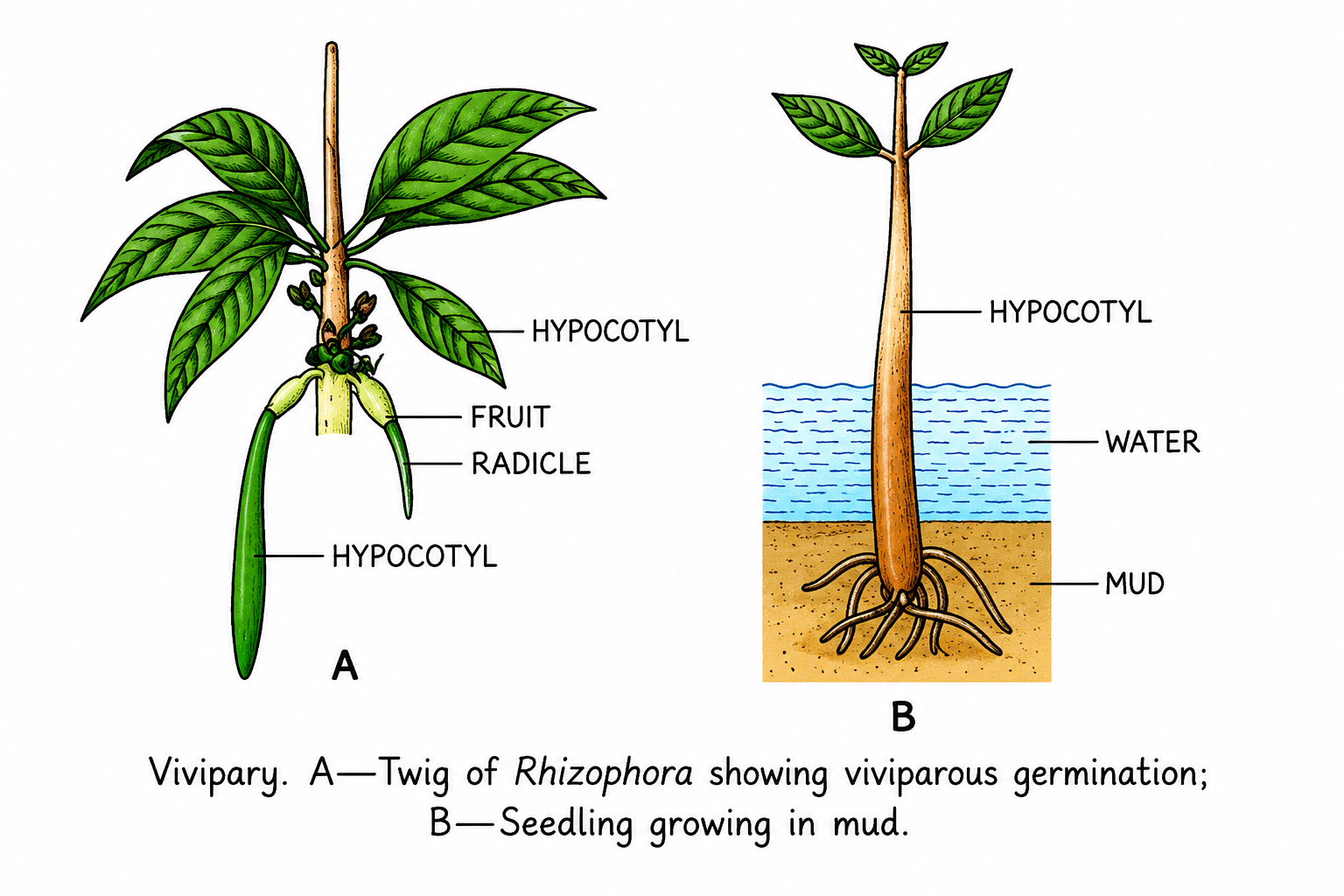
In certain environments, standard seed germination is impossible. This led to the evolutionary adaptation of Vivipary.
Definition: Viviparous germination is the germination of a seed while it is still attached to the parent plant.
Why is it necessary?
It occurs in halophytic (salt-marsh) plants like mangroves (e.g., Rhizophora, Sonneratia). The muddy wetlands are highly saline, waterlogged, and deficient in oxygen. Seeds falling directly onto this mud would rot or float away with high tides without germinating.
Mechanism of Vivipary:
1. The embryo grows while the fruit is still attached to the maternal branch.
2. The radicle elongates considerably, growing downwards, and becomes heavy, thick, and club-shaped.
3. Due to gravity and weight, the seedling eventually detaches and falls vertically down into the soft mud.
4. The pointed, heavy radicle immediately pierces and anchors itself in the mud, preventing the seedling from being washed away. Lateral roots develop rapidly to secure the plant, and the plumule grows upwards.
Germination marks the birth of a seedling.
A seedling is a young stage of development of a plant from the embryo, which is dependent on the food stored in the seed (in cotyledons or endosperm) before it develops green foliage and establishes a root system to synthesize its own food and absorb water independently.
Once the stored food is completely exhausted, the cotyledons shrivel and fall off, and the seedling enters the vegetative phase of an independent mature plant.
Q1. Differentiate between Epicotyl and Hypocotyl.
Ans:
• Epicotyl is the region of the embryonal axis above the point of attachment of cotyledons, which elongates rapidly during hypogeal germination.
• Hypocotyl is the region of the embryonal axis below the point of attachment of cotyledons, which elongates rapidly during epigeal germination.
Q2. State two functions of the cotyledons in exalbuminous seeds.
Ans:
1. Food Storage: They store starch and proteins to nourish the developing embryo.
2. Protection: They fold over and protect the delicate growing points (radicle and plumule) of the embryo.
Q3. A beaker containing germinating seeds is kept in a dark room. Will the seeds germinate? Explain.
Ans: Yes, the seeds will germinate normally. Light is not a necessary condition for the early stages of seed germination. Seeds only require Water, Suitable Temperature, and Oxygen to germinate. However, once the seedling develops green leaves, light will be required for photosynthesis.
Q4. Explain what role the Aleurone Layer plays in Maize Grain.
Ans: The Aleurone layer is the outermost protein-rich layer of the endosperm. During germination, it secretes enzymes (such as amylase) that digest the starch stored in the endosperm into soluble sugars, which are then absorbed by the scutellum to nourish the growing embryo axis.
 VARDAAN COMET