
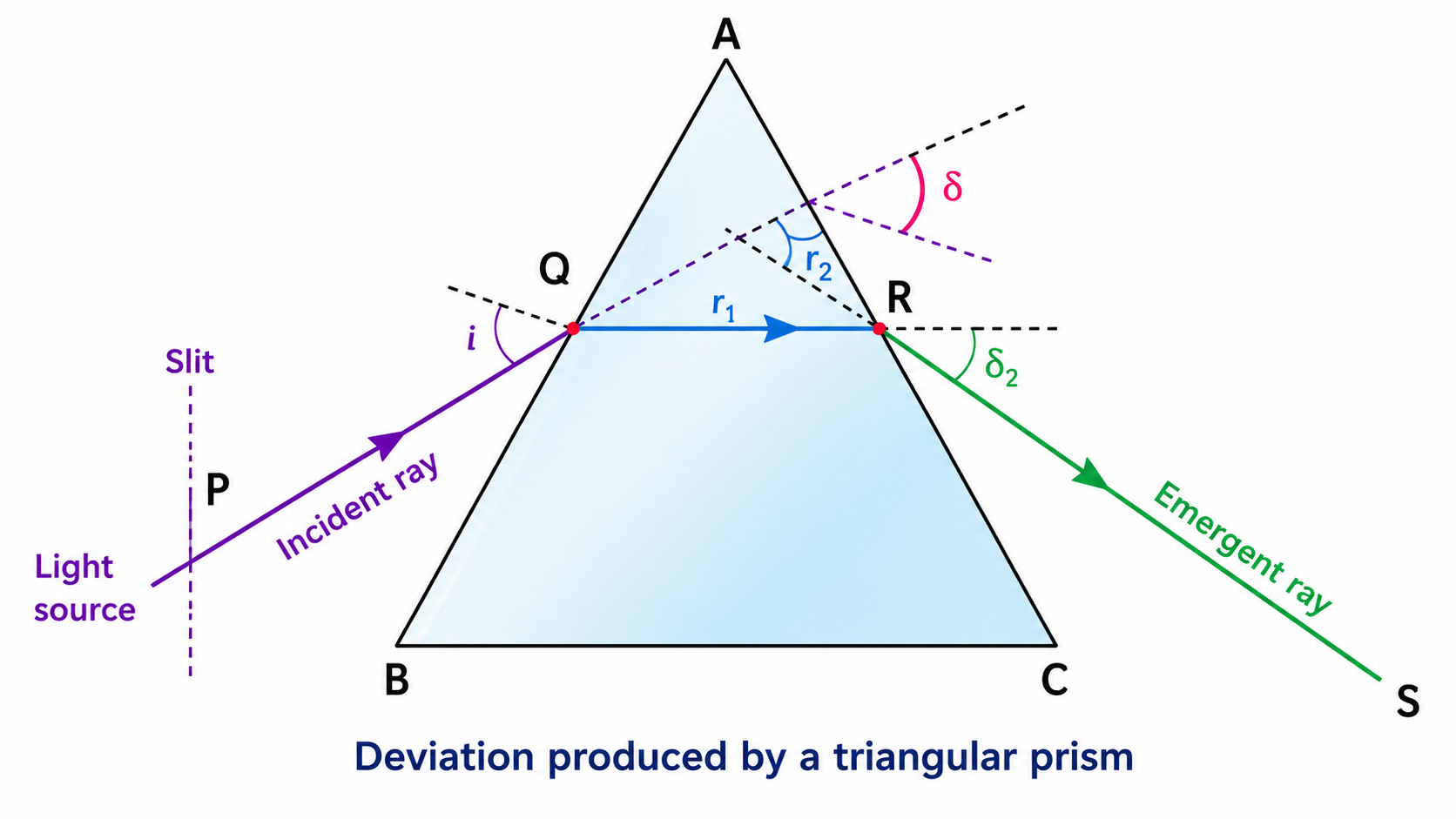
1. Angle of Deviation ($\delta$): Angle between incident ray produced forward and emergent ray produced backward through a prism.
$$\delta = i + e - A \implies A + \delta = i + e$$Factors Affecting Total Deviation ($\delta$):
1. Prism Formula for Refractive Index ($\mu$) & Minimum Deviation ($\delta_m$):
$${}_a\mu_g = \frac{\sin\left(\frac{A + \delta_m}{2}\right)}{\sin\left(\frac{A}{2}\right)}$$Where: $A = \text{Angle of Prism}$, $\delta_m = \text{Angle of Minimum Deviation}$, ${}_a\mu_g = \text{Refractive index of glass w.r.t air}$.
2. Small Angle Prism Formula (When Angle $A$ is very small):
$$\delta = (\mu - 1) A$$3. Fundamental Proportionality Chain:
$$\delta \propto \mu \propto \frac{1}{v} \propto \frac{1}{\lambda}$$Conditions for Minimum Deviation ($\delta = \delta_m$):
As angle of incidence $i$ increases, deviation $\delta$ first decreases, reaches minimum value $\delta_m$ when $i = e$, and then increases.
Cause of Dispersion (Wavelength & Speed Link):
High-Yield ICSE Exam Definitions:
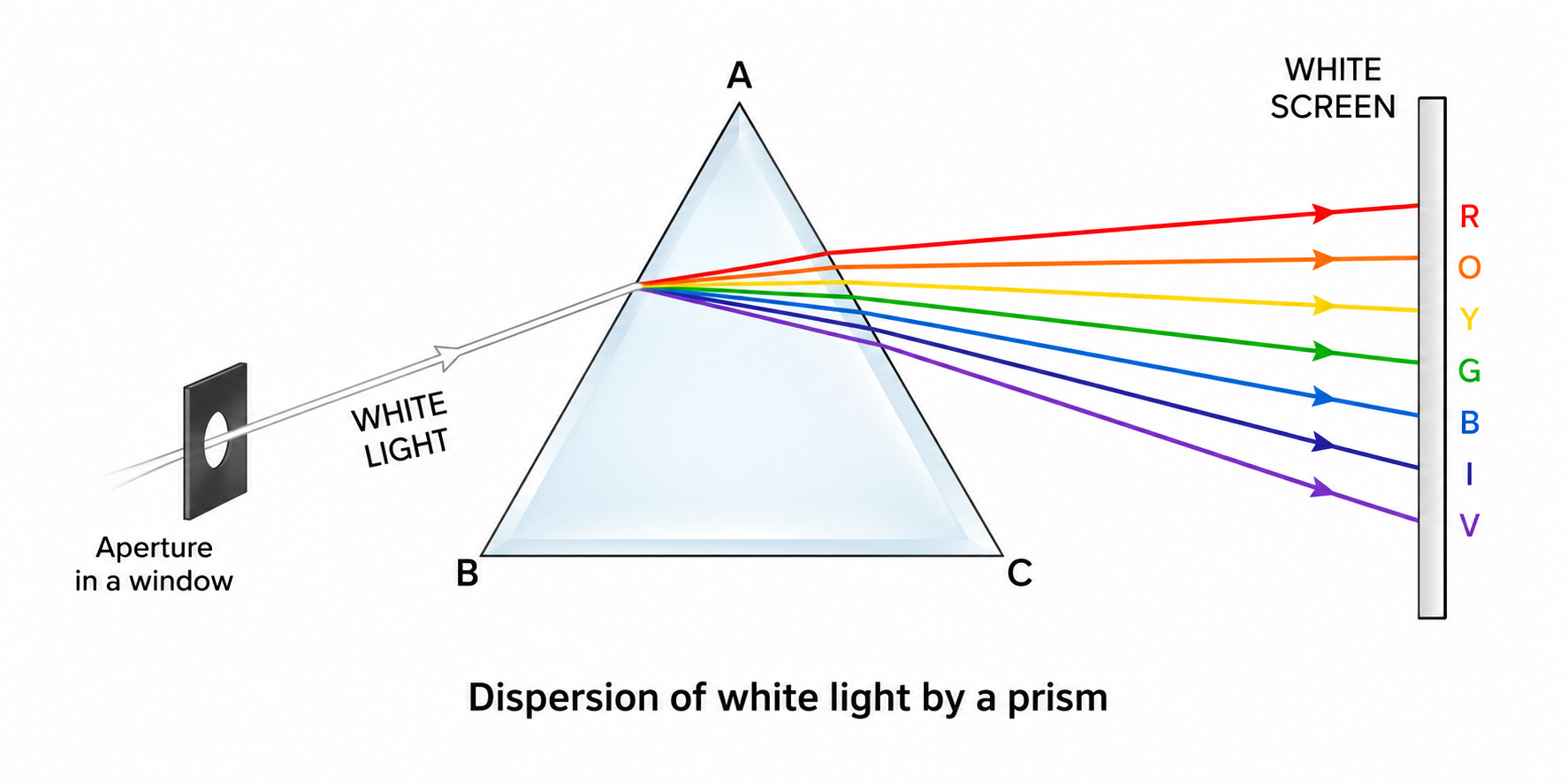
| Colour | Wavelength ($\text{Å}$) | Wavelength ($\text{nm}$) | Speed in Glass | Deviation ($\delta$) |
|---|---|---|---|---|
| Violet | $4000\text{ Å} - 4460\text{ Å}$ | $400\text{ nm} - 446\text{ nm}$ | Slowest | Maximum |
| Green | $5000\text{ Å} - 5780\text{ Å}$ | $500\text{ nm} - 578\text{ nm}$ | Moderate | Mean Deviation |
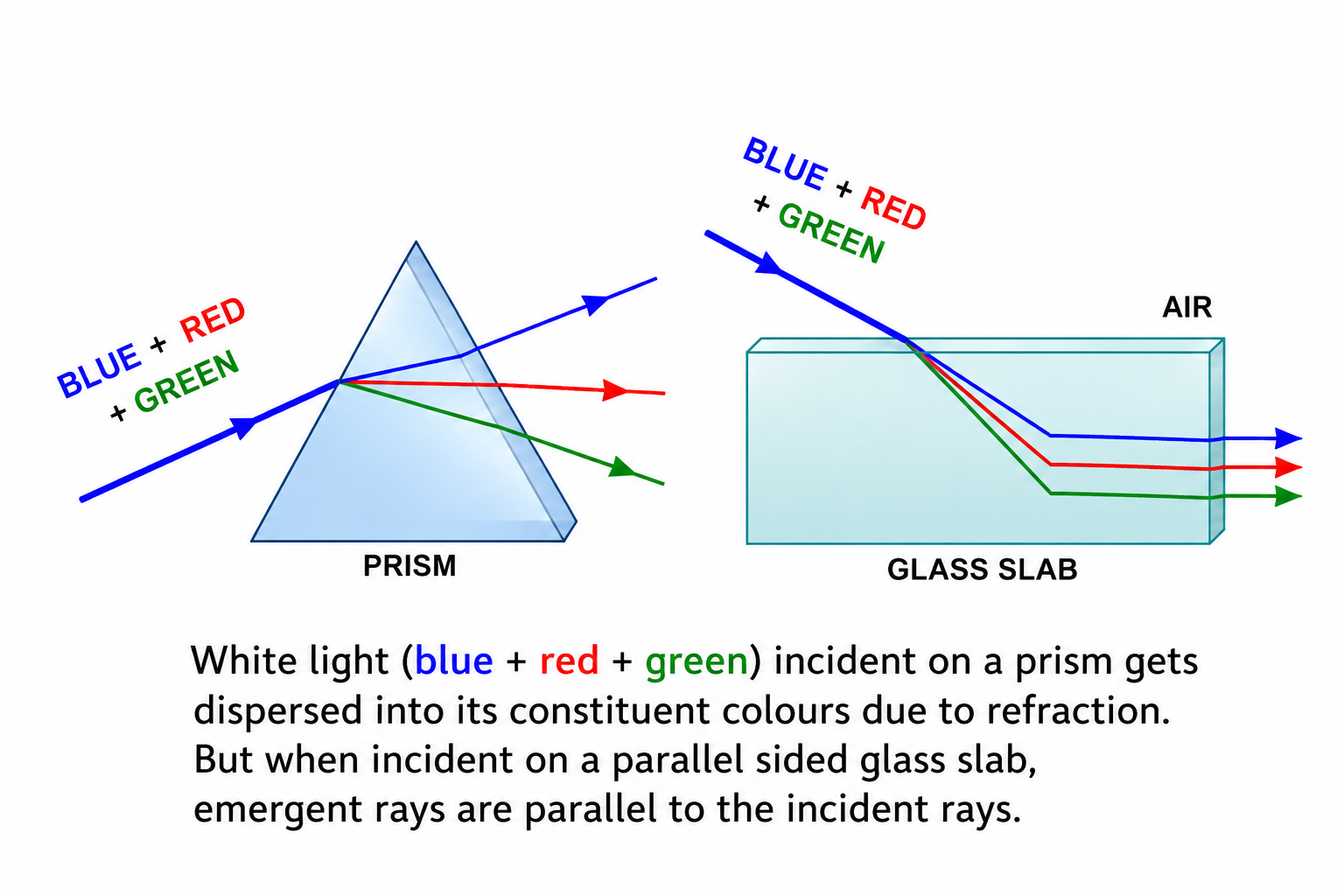
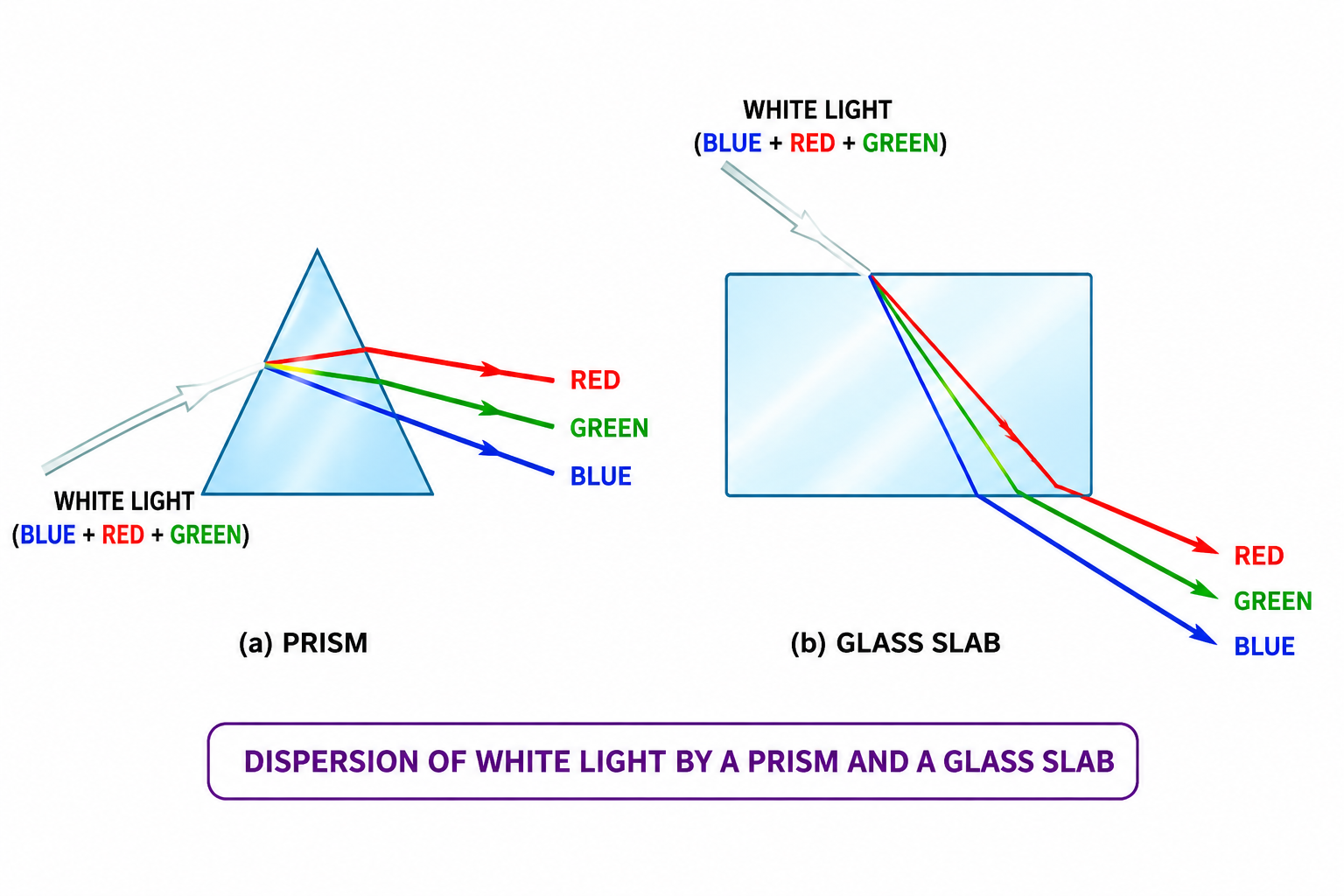
| Red | $6200\text{ Å} - 8000\text{ Å}$ | $620\text{ nm} - 800\text{ nm}$ | Fastest | Minimum |
 in right-angled isosceles prism.png)
ICSE Board Ray Diagram Explanation ($45^\circ - 90^\circ - 45^\circ$ Prism with $C_{\text{yellow}} = 45^\circ$):
A composite ray of Red, Yellow, and Blue light is incident normally ($i = 0^\circ$) on face $AB$. It enters face $AB$ undeviated ($r = 0^\circ$) and strikes hypotenuse face $AC$ at an angle of incidence $i = 45^\circ$:
Wave Equation:
$$c = f \lambda \implies f = \frac{c}{\lambda}$$
Where $c = 3 \times 10^8\text{ m/s}$ (speed of ALL EM waves in vacuum).
Complete Electromagnetic Spectrum (In Increasing Order of Wavelength $\lambda$ / Decreasing Order of Frequency $f$):
⚡ Golden Board Rule: These EM waves have different wavelengths, but each wave travels with the exact SAME speed equal to $3 \times 10^8\text{ m s}^{-1}$ in vacuum (or air)!

| Radiation | Wavelength Range ($\lambda$) | Detection Method | High-Yield Board Uses |
|---|---|---|---|
| Gamma ($\gamma$) Rays | $< 0.1\text{ Å}$ | Penetrating power / Geiger Counter | Medical radiotherapy (killing cancer cells), inspecting welding joints. |
| X-Rays | $0.1\text{ Å} - 100\text{ Å}$ | Fluorescence on ZnS / Photographic plate | Radiography for detecting bone fractures, CAT scans, studying crystal structures. |
| Ultraviolet (UV) | $100\text{ Å} - 4000\text{ Å}$ | Silver chloride solution (turns dark brown/black) | Sterilising surgical instruments, detecting fake currency/gems, Vitamin D synthesis. Requires Quartz Prism! |
| Visible Light | $4000\text{ Å} - 8000\text{ Å}$ | Human retina / Photographic film | Enables human vision, photography, photosynthesis in green plants. |
| Infrared (IR) | $8000\text{ Å} - 10^7\text{ Å}$ | Thermopile / Blackened bulb thermometer | Photography in dark/fog, TV remote controls, signals in war, heat therapy. Requires Rock-Salt Prism! |
| Microwaves | $10^7\text{ Å} - 10^{11}\text{ Å}$ | Oscillatory tuned electrical circuit | Radar communication, satellite TV, microwave cooking ovens. |
| Radio Waves | $> 10^{11}\text{ Å}$ | Receiving antenna / Aerials | Radio and television broadcasting transmissions. |
ICSE Board Reasons to Remember:
Scattering of Light: The phenomenon by which fine dust particles and air molecules in atmosphere absorb light energy and re-emit it in all random directions.
Rayleigh's Law of Scattering ($d \ll \lambda$): The intensity of scattered light ($I$) is inversely proportional to the 4th power of wavelength ($\lambda$).
$$I \propto \frac{1}{\lambda^4}$$
Short wavelength blue/violet light scatters nearly 16 times more than long wavelength red light!
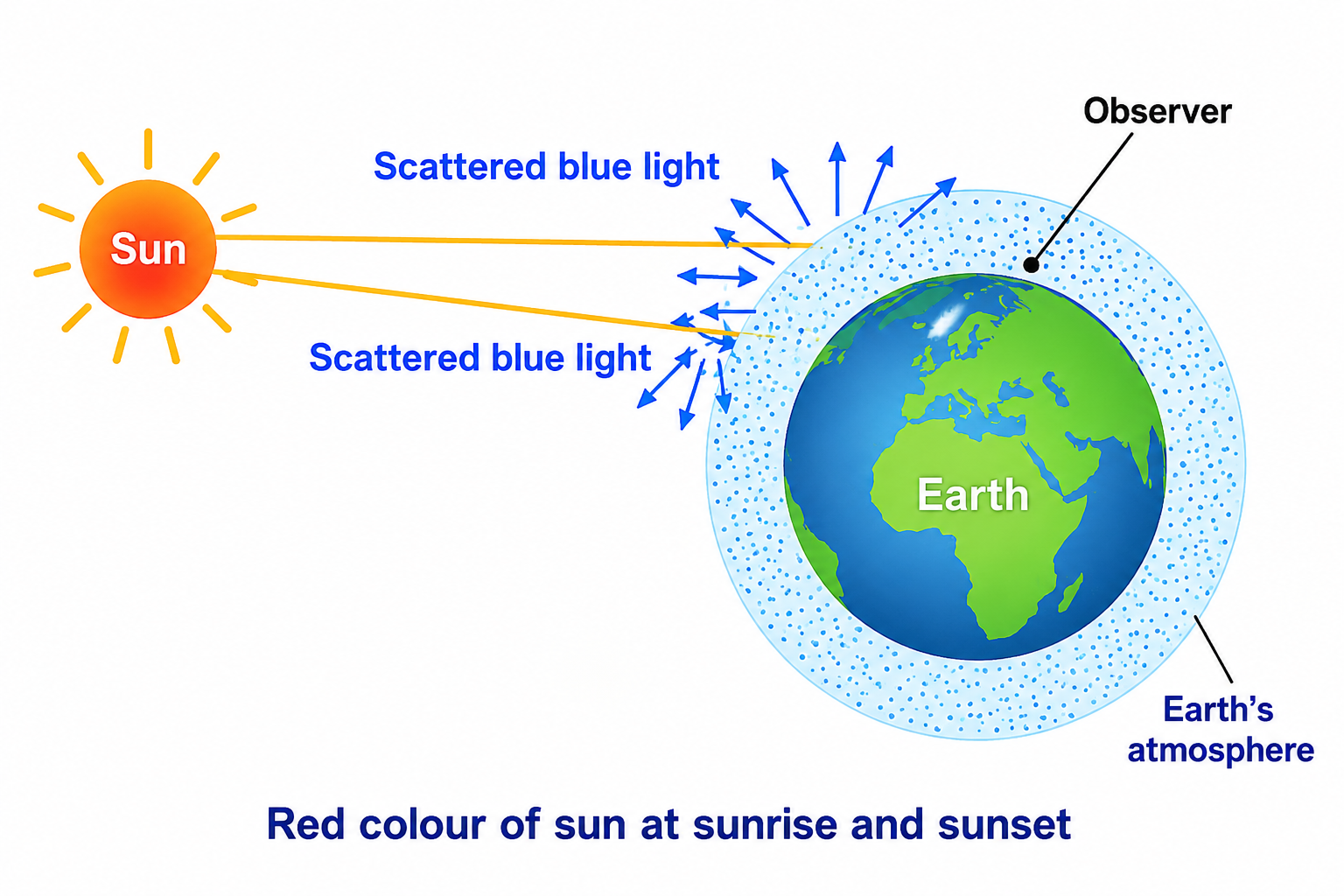
1. Why the Sun appears Red at Sunrise and Sunset:
At sunrise and sunset, the Sun is near the horizon. Therefore, sunlight has to travel through a maximum distance (thickness) of the Earth's atmosphere to reach an observer. As light passes through the atmosphere, shorter wavelengths (violet, indigo, blue) are scattered away in all directions according to Rayleigh's Law ($I \propto 1/\lambda^4$). Light of longest wavelength (Red, $\lambda \approx 8000\text{ Å}$) is scattered the least and reaches the observer's eyes directly. Thus, the Sun appears red.
2. Why the Sky appears Blue during a Clear Day:
The Earth's atmosphere contains fine air molecules ($\text{N}_2, \text{O}_2$) whose size ($d$) is much smaller than the wavelength of visible light ($d \ll \lambda$). According to Rayleigh's Law ($I \propto 1/\lambda^4$), short wavelength blue light is scattered nearly 16 times more strongly than long wavelength red light in all directions. When we look at the sky, this scattered blue light enters our eyes, making the sky appear blue.
3. Why Clouds appear White:
Clouds consist of water droplets, ice crystals, and dust aggregates whose size ($d$) is much larger than the wavelength of visible light ($d \gg \lambda$). When particle size is large, Rayleigh's Law fails, and light of all wavelengths is scattered equally. Since all 7 constituent colours of white light are scattered in equal proportions, clouds appear white.
4. Why the Sky appears Black to an Astronaut in Space or on the Moon:
Outer space and the surface of the Moon do not possess an atmosphere. In the absence of air molecules or dust particles, no scattering of sunlight takes place. Since no scattered light enters the astronaut's eyes from the surrounding space, the sky appears completely dark or jet black.
5. Why Danger Signals and Stop Lights are Always Red:
Among all colours of visible light, red light has the longest wavelength ($\lambda \approx 8000\text{ Å}$). By Rayleigh's Law ($I \propto 1/\lambda^4$), red light is scattered the least by atmospheric fog, smoke, or dust particles. It can penetrate through fog over maximum distances without losing intensity, remaining visible from far away.
6. Why the Sun appears White at Noon:
At noon, the Sun is directly overhead. Sunlight travels the shortest distance through the atmosphere to reach an observer. Due to this short path length, only a negligible amount of light of any colour gets scattered. Sunlight reaching our eyes directly contains all 7 constituent colours in almost equal proportions, so the Sun appears white.
NUMERICAL Yellow light wavelength $\lambda = 5800\text{ Å}$. Calculate frequency $f$ ($c = 3 \times 10^8\text{ m/s}$).
NUMERICAL Radio station frequency $f = 100\text{ MHz}$. Find wavelength $\lambda$.
BOARD (a) Name waves used to study crystal structure. (b) State one more use.
Ans: (a) X-Rays. (b) Bone fracture detection in radiography.
BOARD Name radiation used for: (i) photography in dark/fog, (ii) sterilizing surgical tools.
Ans: (i) Infrared radiations. (ii) Ultraviolet radiations.
BOARD Why quartz prism for UV light and rock-salt prism for IR light?
Ans: Glass absorbs both UV and IR. Quartz is transparent to UV, rock-salt is transparent to IR.
BOARD Name radiation detected by: (i) thermopile, (ii) silver chloride solution.
Ans: (i) Infrared radiation. (ii) Ultraviolet radiation.
 VARDAAN COMET