
Work
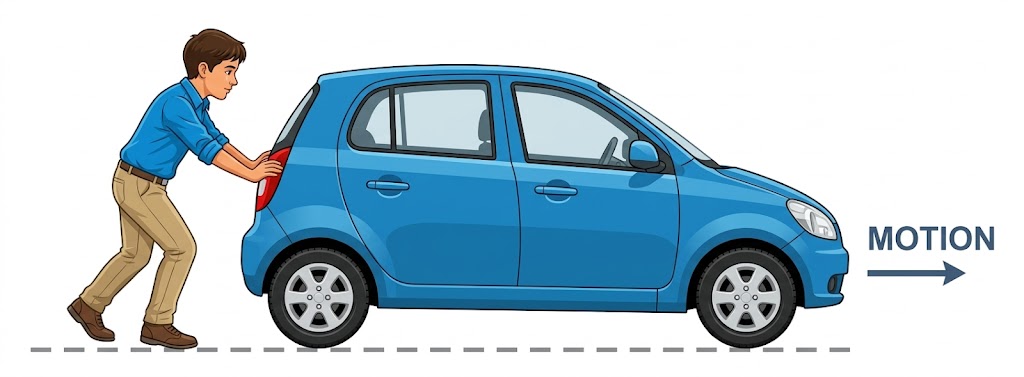
Work is done when a force applied on a body produces displacement.
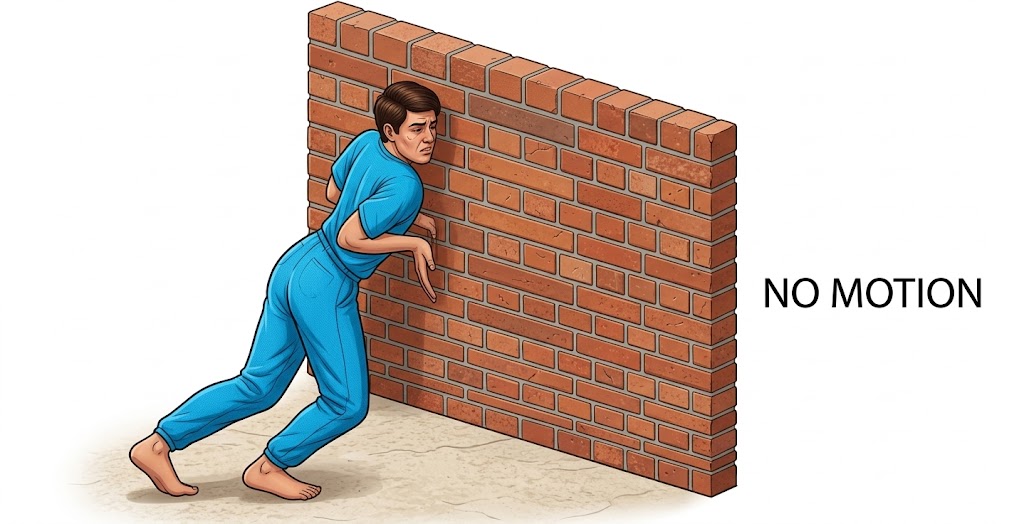
General Formula:
$$ W = F \times S \cos \theta $$- $F$: Force applied
- $S$: Displacement
- $\theta$: Angle between force and displacement
Special Cases ($\theta$)
1. Positive Work ($\theta = 0^\circ$)
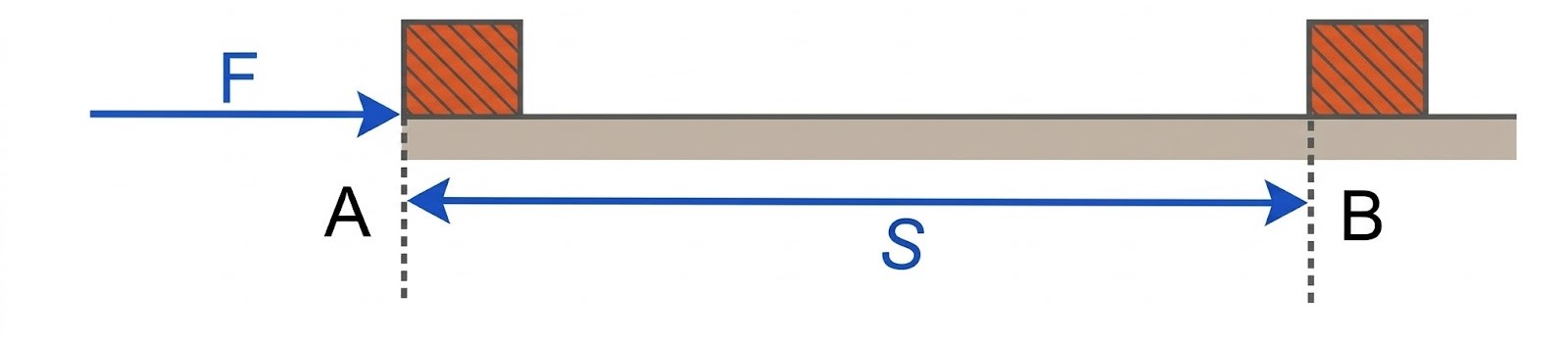
Direction of displacement is same as force.
$W = F \times S$
2. Zero Work ($\theta = 90^\circ$)
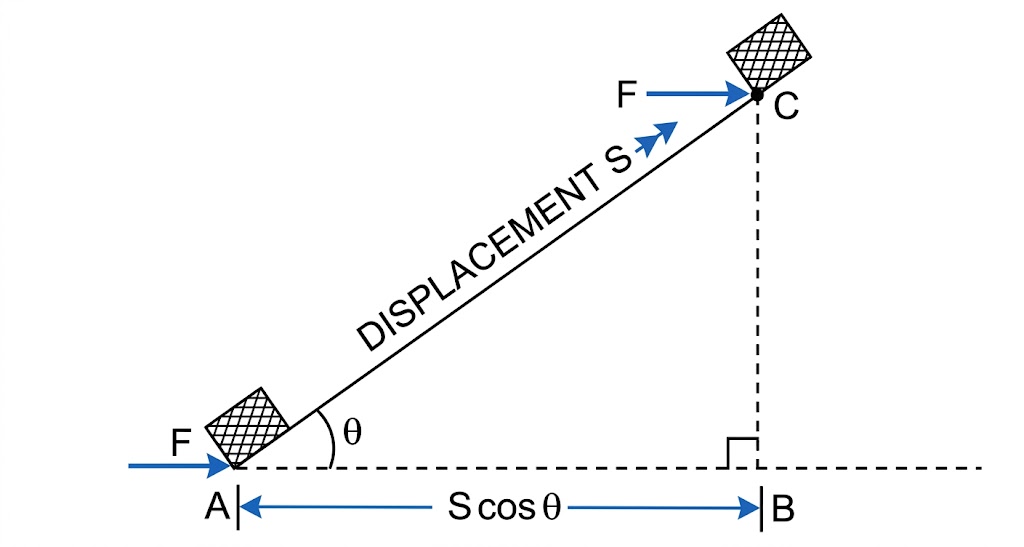
Displacement is perpendicular to force (e.g. Earth orbit).
$W = 0$
3. Negative Work ($\theta = 180^\circ$)
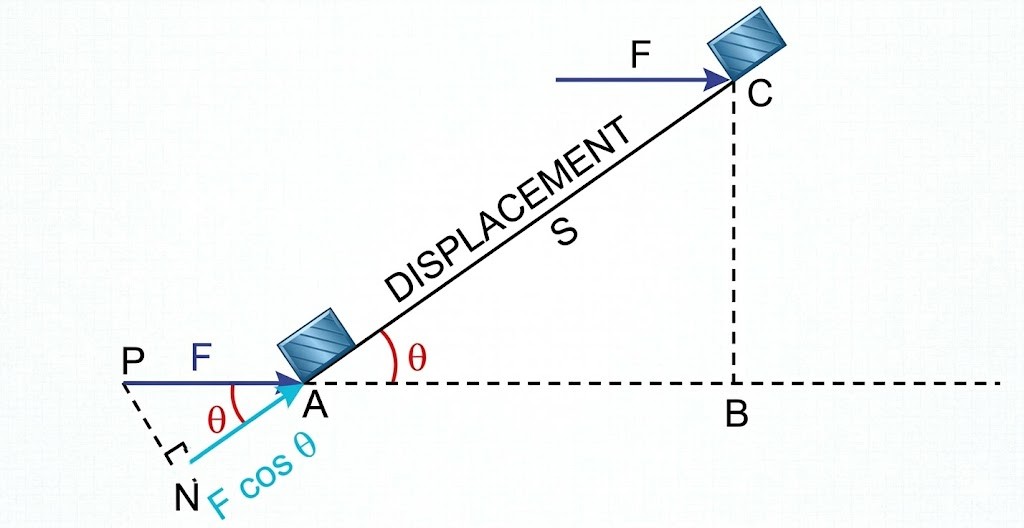
Displacement is opposite to force (e.g. friction).
$W = -F \times S$
Work & Graphs
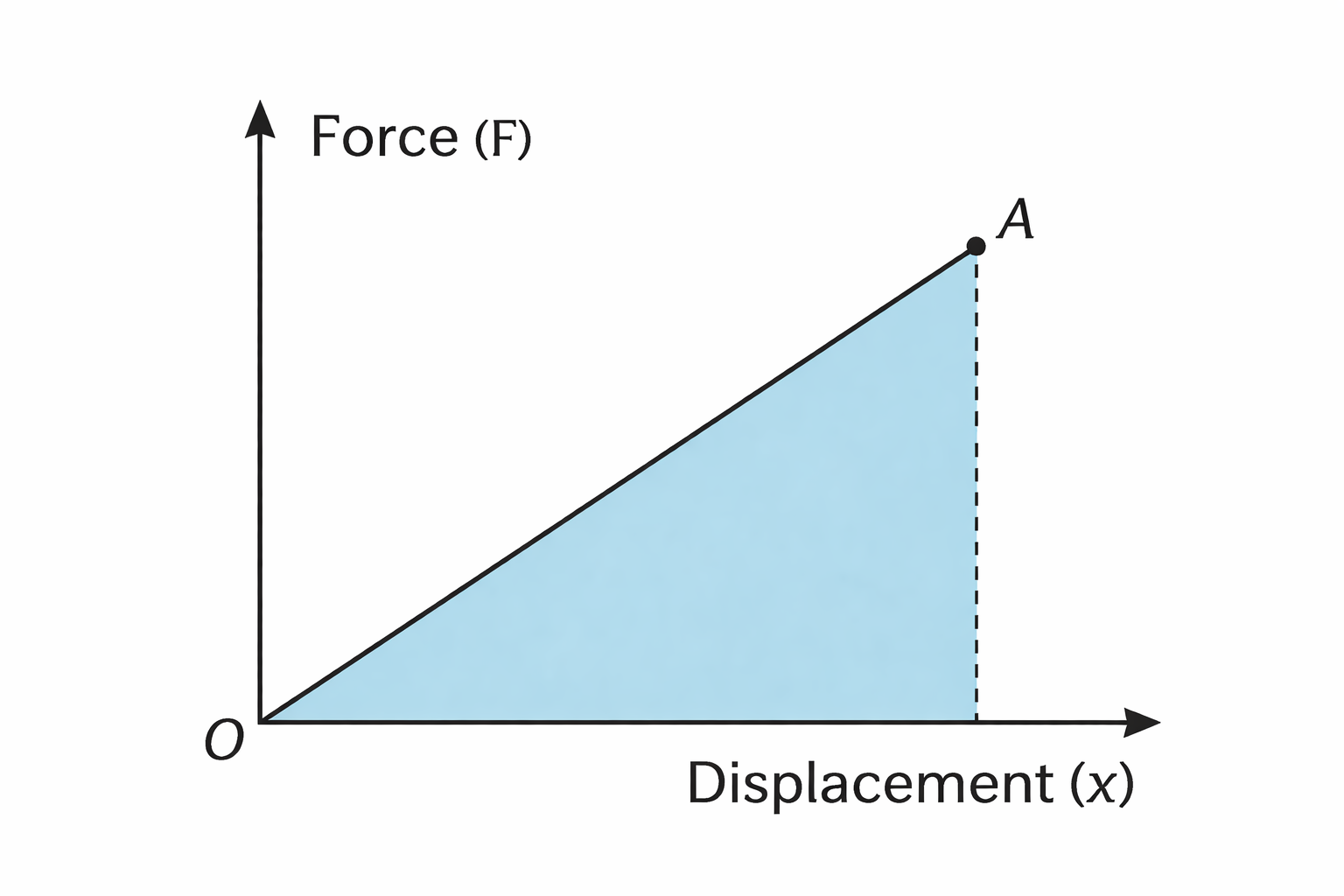
Work by Variable Force
The area under a Force-Displacement Graph gives the work done.
Work Against Gravity
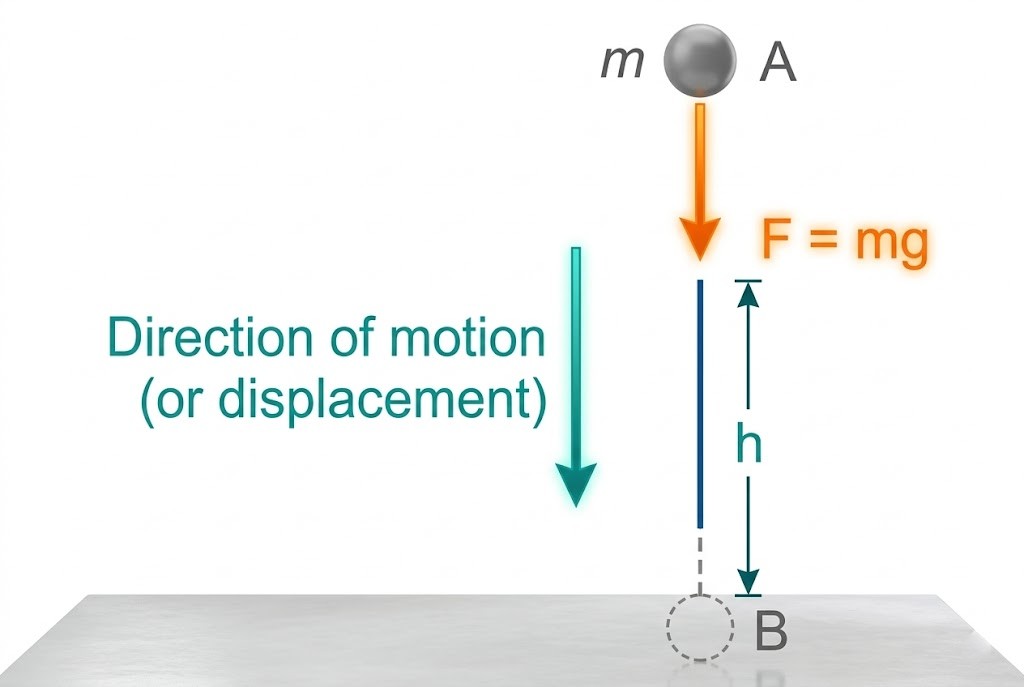
Lifting a body vertically:
$$ W = mgh $$*Work done by gravity while moving horizontally is ZERO.
Power
Power is the rate of doing work.
Formula:
$$ P = \frac{W}{t} $$Since $W = F \times S$, we can also write:
$$ P = F \times v $$(Power = Force $\times$ average speed)
Work is independent of time, but Power depends on time.
Energy & P.E.
Energy
Energy is the capacity to do work. Units are same as work (Joule, erg, kWh, eV).
Mechanical Energy exists in two forms: Potential and Kinetic.
Potential Energy ($U$)
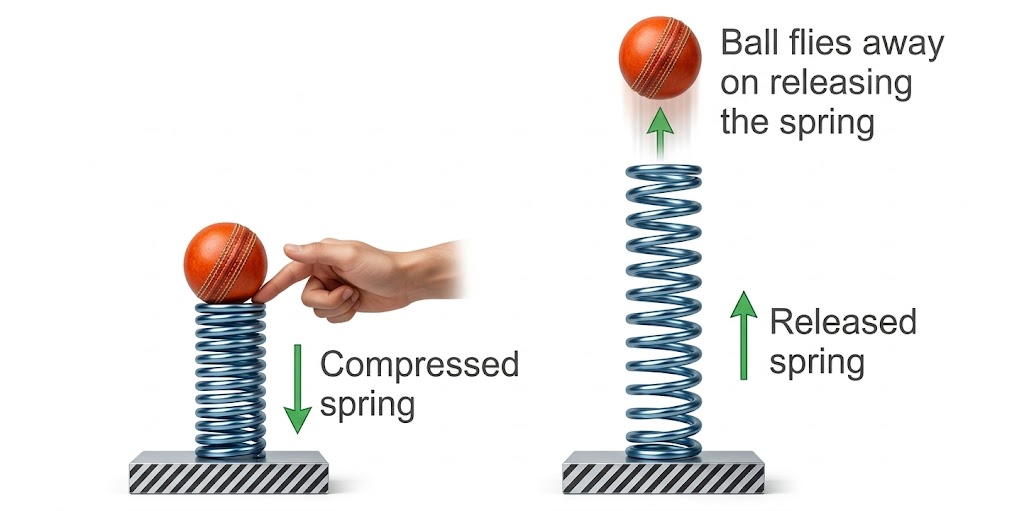
Energy possessed by virtue of position or configuration.
- Gravitational PE: $U = mgh$
- Elastic PE: Deformed state (e.g. spring).
Kinetic Energy
Energy possessed by virtue of state of motion.
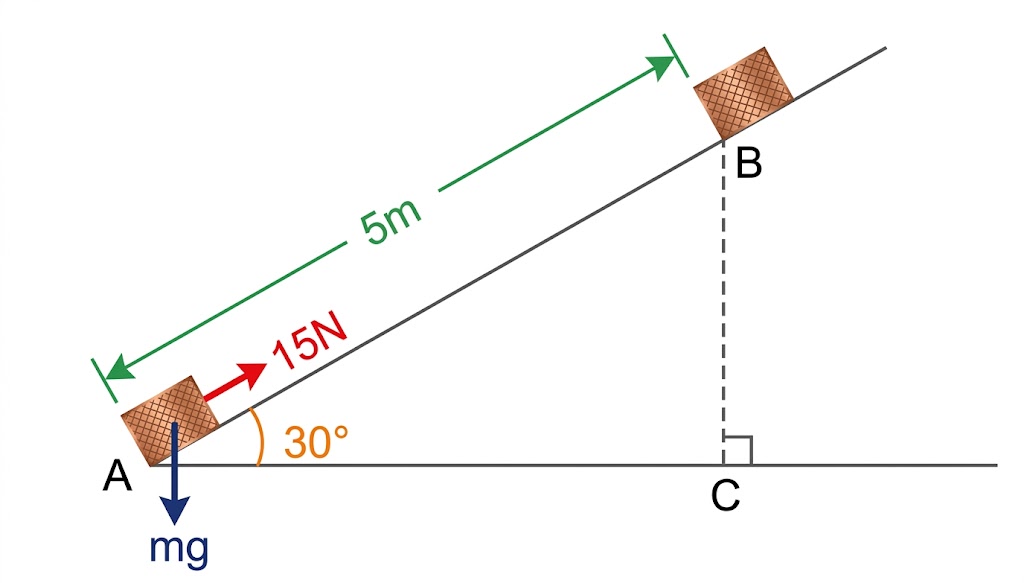
Formula:
$$ K = \frac{1}{2} mv^2 $$Forms of KE: Translational, Rotational, Vibrational.
Relation: KE & Momentum ($p$)
$$ K = \frac{p^2}{2m} \quad \text{or} \quad p = \sqrt{2mK} $$Work-Energy Theorem
The work done by a force on a moving body is equal to the increase in its kinetic energy.
$$ W = K_f - K_i = \Delta K $$Energy Conversions
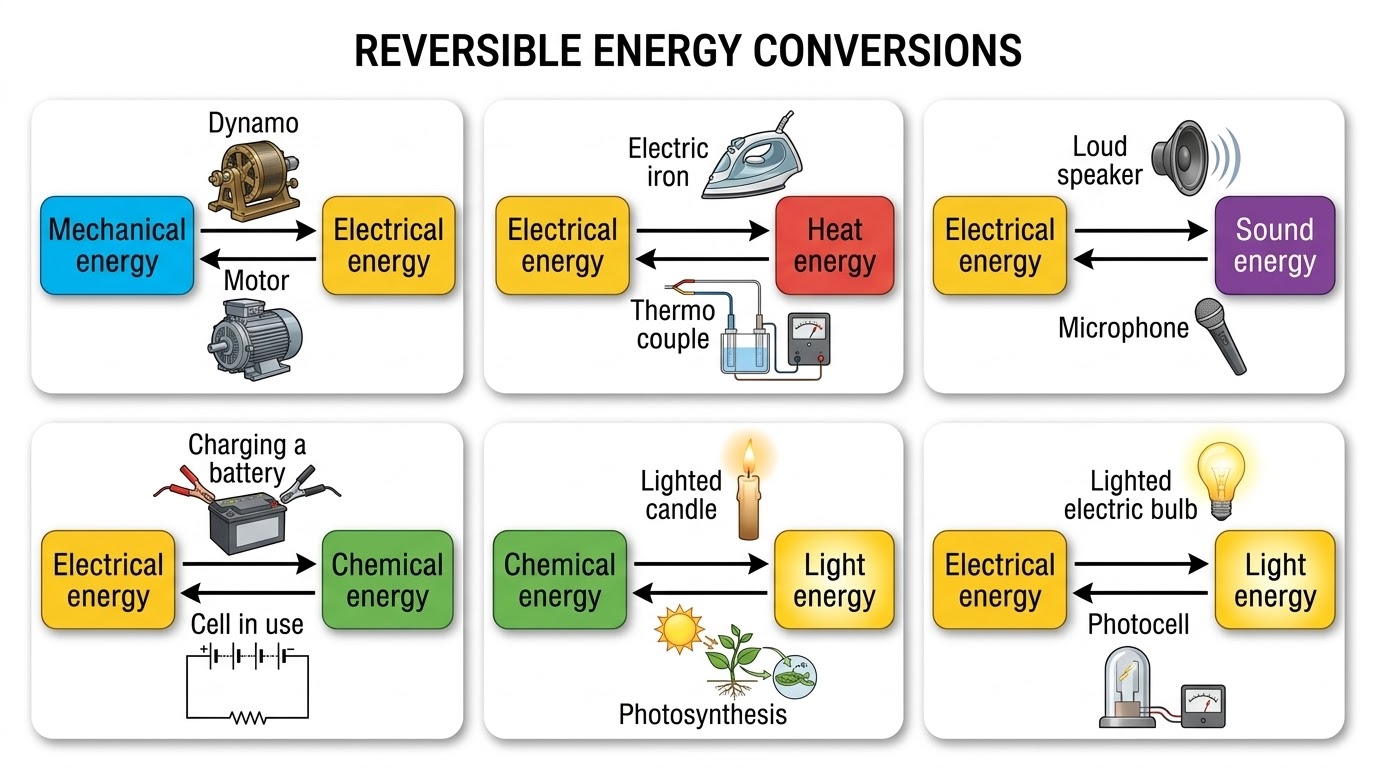
- Dry Cell: Chemical $\to$ Electric
- Solar Cell: Light $\to$ Electric
- Motor: Electric $\to$ Mechanical
Conservation of Energy
Energy can neither be created nor destroyed. In absence of friction: $K + U = \text{constant}$
Freely Falling Body
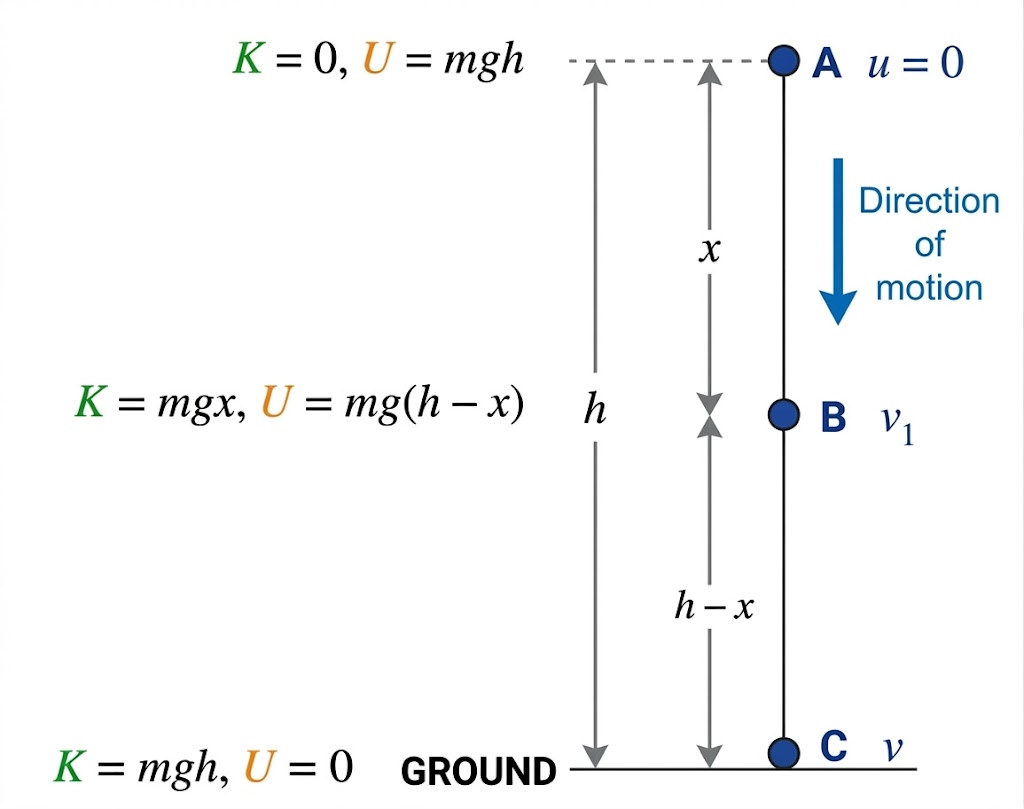
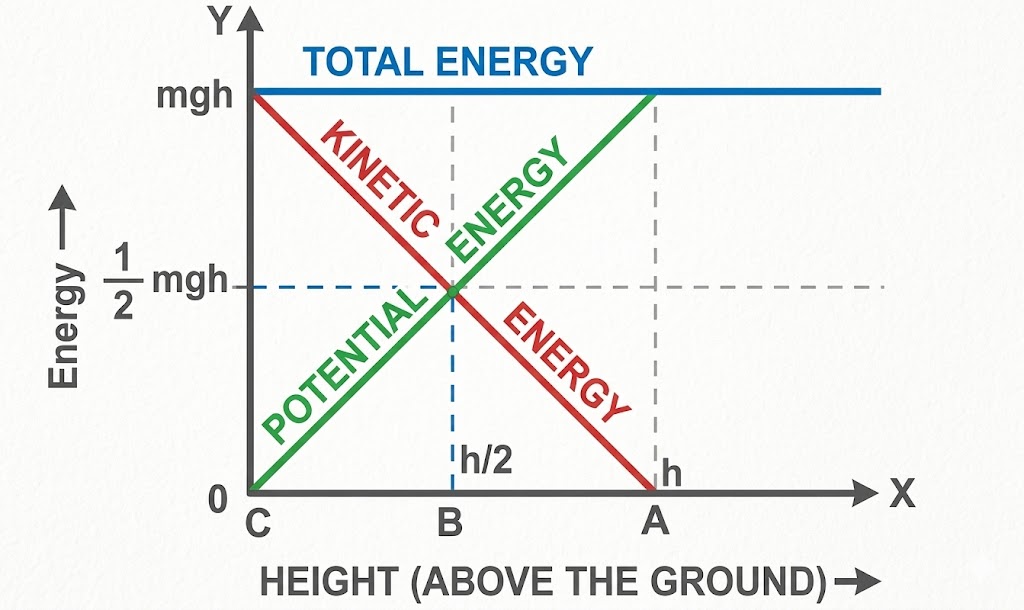
Total energy ($E = mgh$) remains constant everywhere!
Simple Pendulum
Energy oscillates between PE and KE.
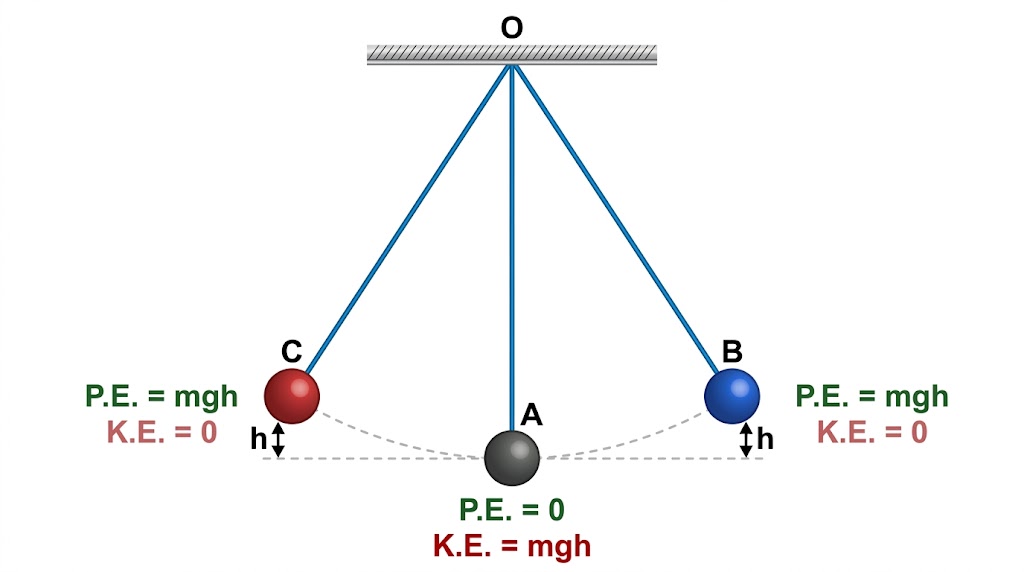
- Mean Position (A): Height is 0. KE is Maximum, PE is zero.
- Extreme Positions (B & C): Bob momentarily stops. KE is zero, PE is Maximum ($mgh$).