
Organic Chemistry: The branch of chemistry that studies covalent compounds of Carbon (excluding oxides, carbonates, hydrogen carbonates, and carbides).
• Wohler's Synthesis (1828): Friedrich Wöhler disproved the "Vital Force Theory" by synthesizing Urea (an organic compound) from an inorganic salt Ammonium Cyanate:
$$\text{NH}_4\text{CNO} \xrightarrow{\Delta} \text{NH}_2\text{CONH}_2 \quad (\text{Ammonium Cyanate } \rightarrow \text{ Urea})$$1. Tetravalency of Carbon: Carbon ($Z=6$, config: $2,4$) forms 4 covalent bonds by sharing 4 valence electrons to complete its octet.
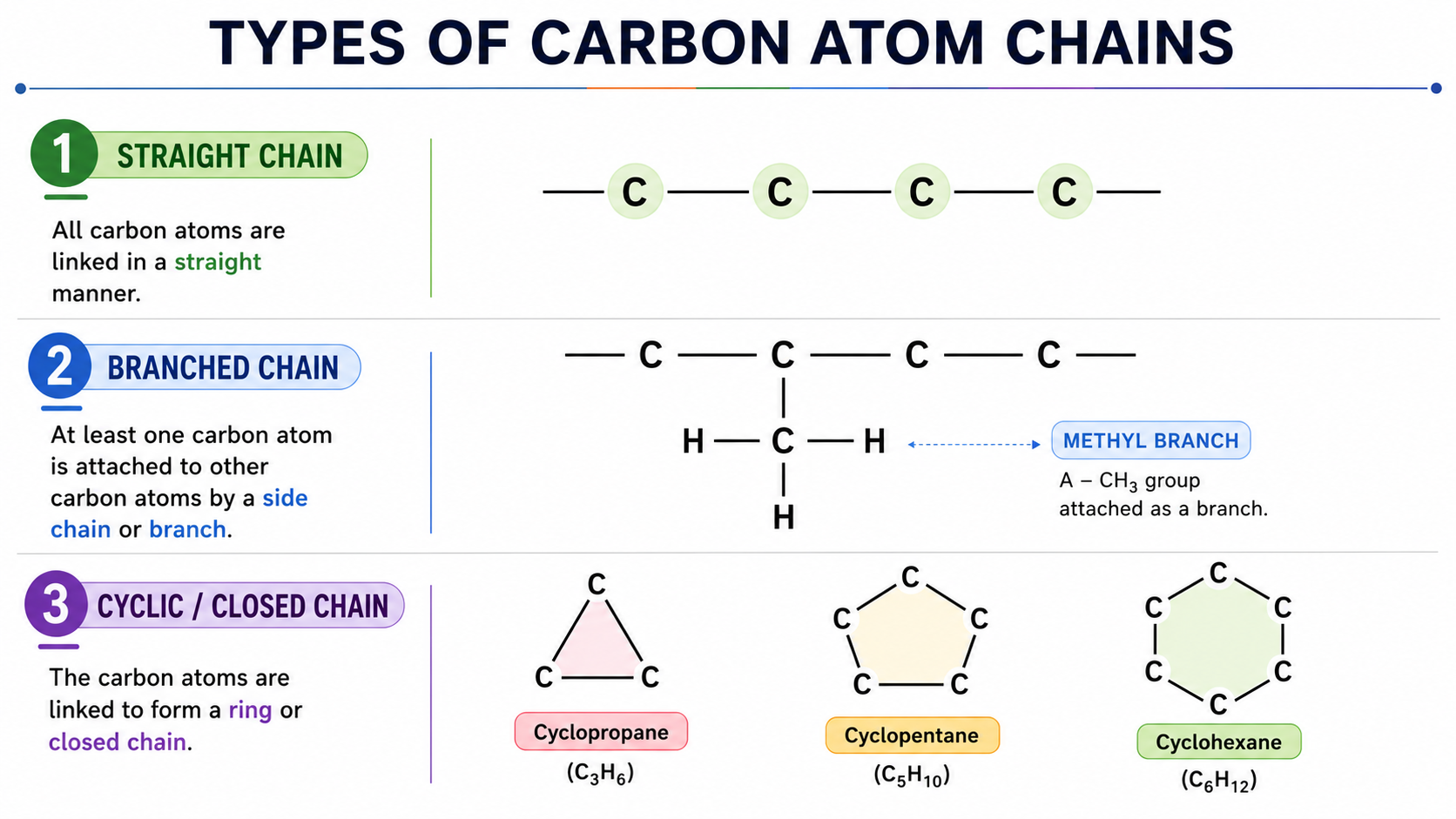
2. Catenation: The self-linking capacity of carbon atoms to form long straight, branched, or cyclic ring chains through strong covalent bonds ($C-C \text{ bond energy} = 348\text{ kJ/mol}$).
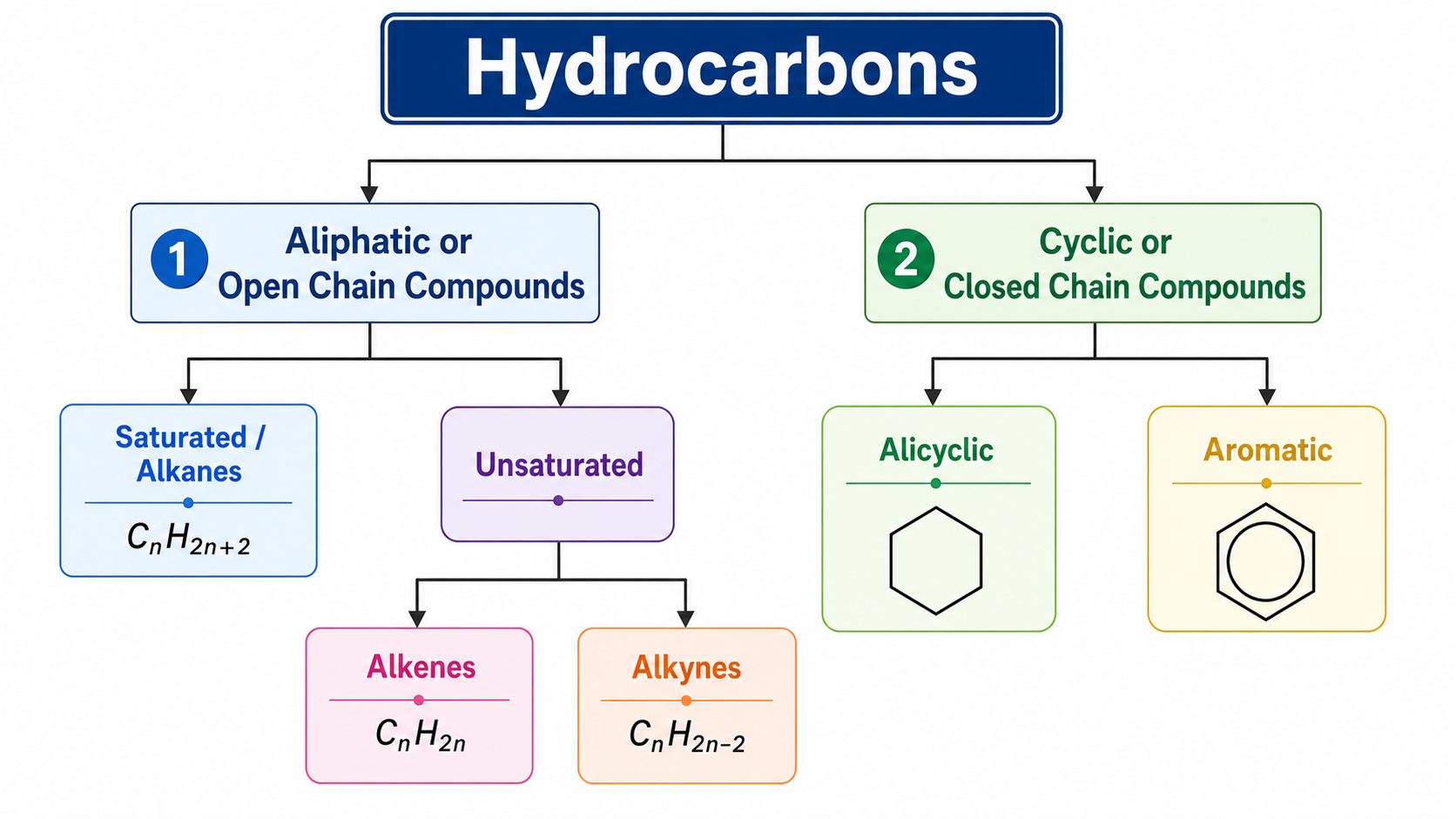
| Property | Saturated (Alkanes $C_n H_{2n+2}$) | Unsaturated (Alkenes/Alkynes) |
|---|---|---|
| Bonding | Single $C-C$ bonds only. | Double ($C=C$) or Triple ($C\equiv C$) bonds. |
| Reactivity | Less reactive; undergo Substitution. | Highly reactive; undergo Addition. |
| Flame Test | Clean blue non-sooty flame. | Yellow soot-producing flame (higher $\%C$). |
| $\text{Br}_2 / \text{CCl}_4$ Test | Does not decolourise orange bromine water. | Decolourises orange $\text{Br}_2$ water to colorless. |
Homologous Series: A series of organic compounds sharing the same general formula, functional group, and chemical properties, where successive members differ by $-\text{CH}_2-$ unit and $14\text{ amu}$ mass.
Alkyl Group ($C_n H_{2n+1}$): Univalent radical formed by removing one H from alkane (e.g., Methyl $-\text{CH}_3$, Ethyl $-\text{C}_2\text{H}_5$).
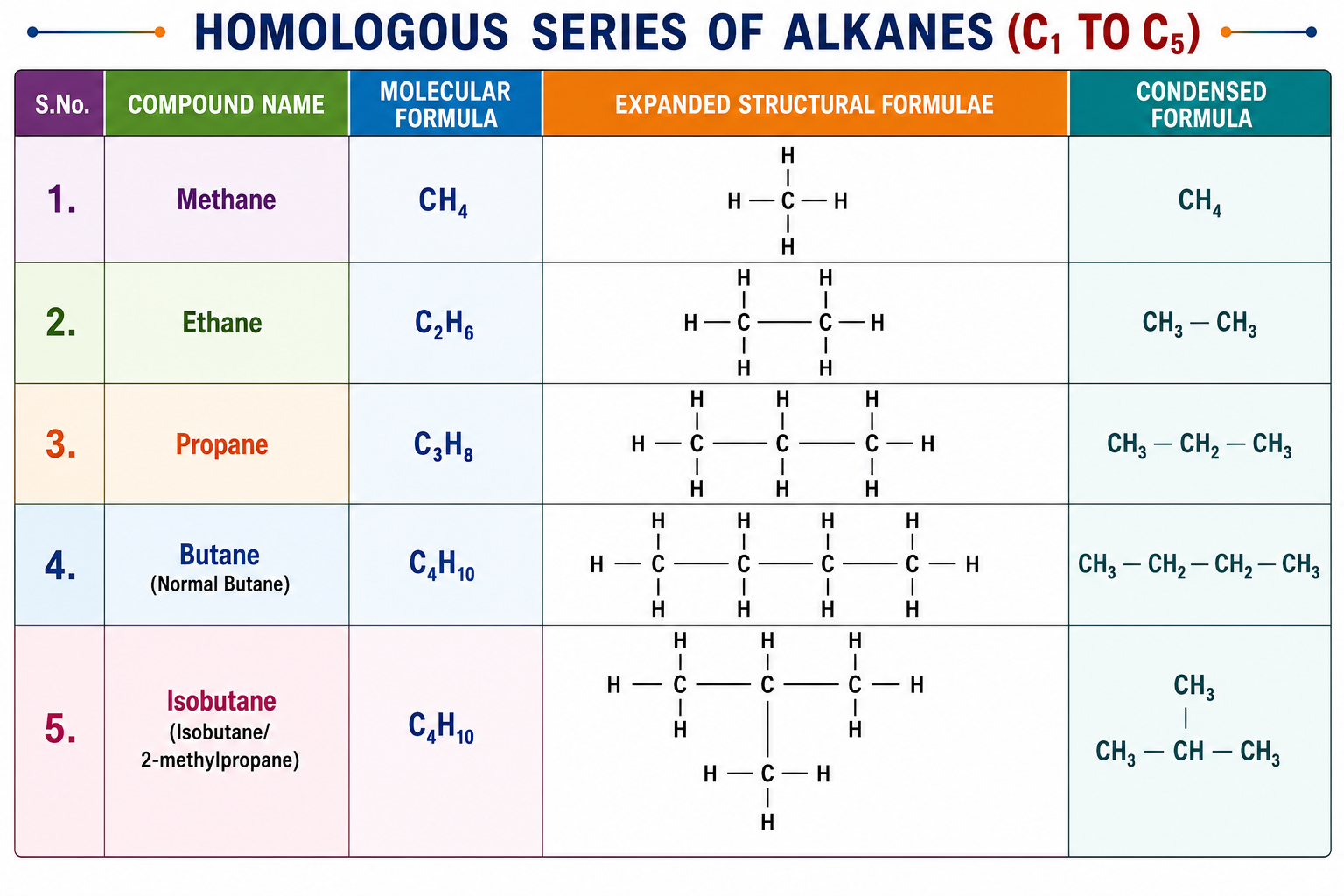
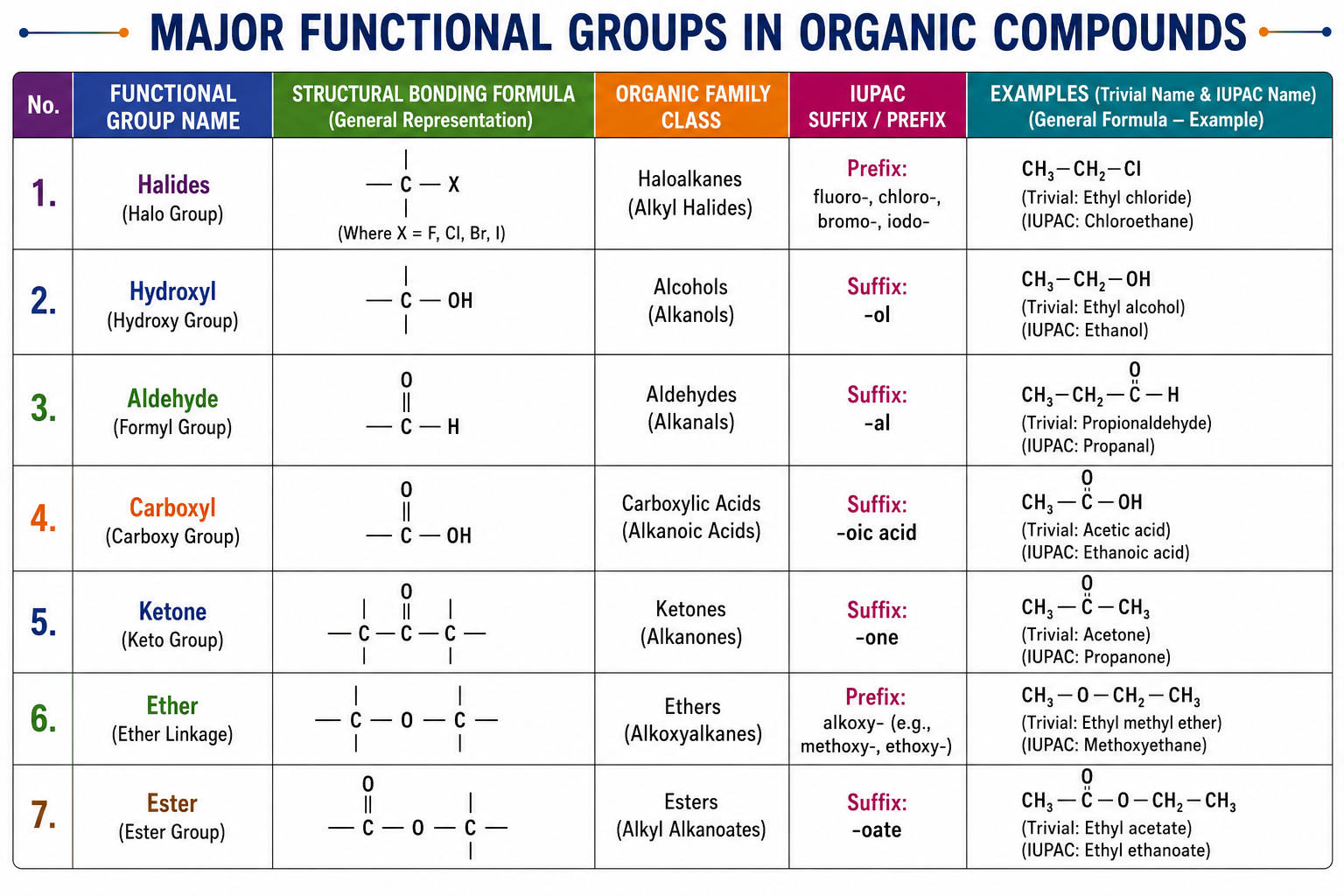
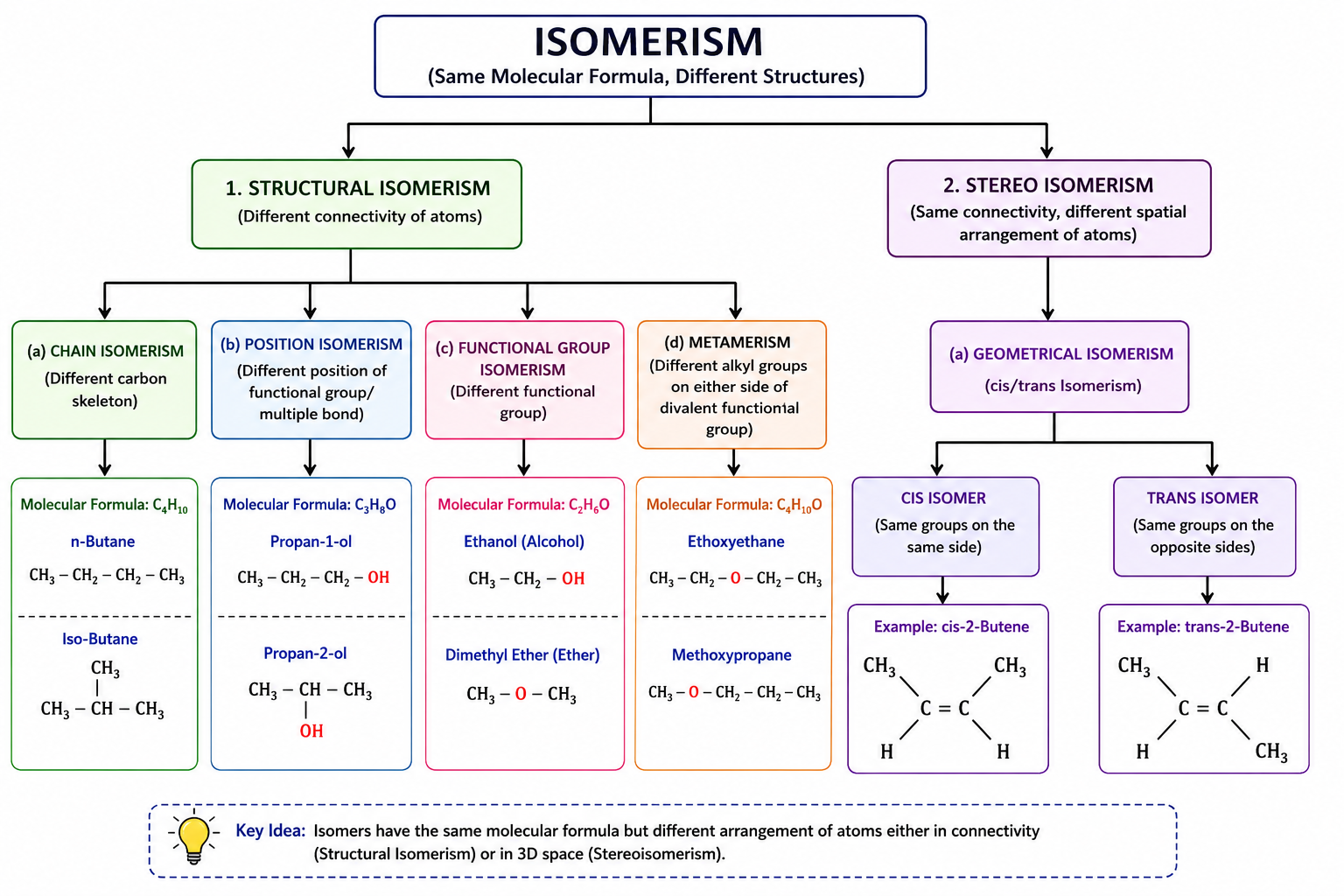
Isomerism: Phenomenon where compounds have the same molecular formula but different structural formulas and physical/chemical properties.
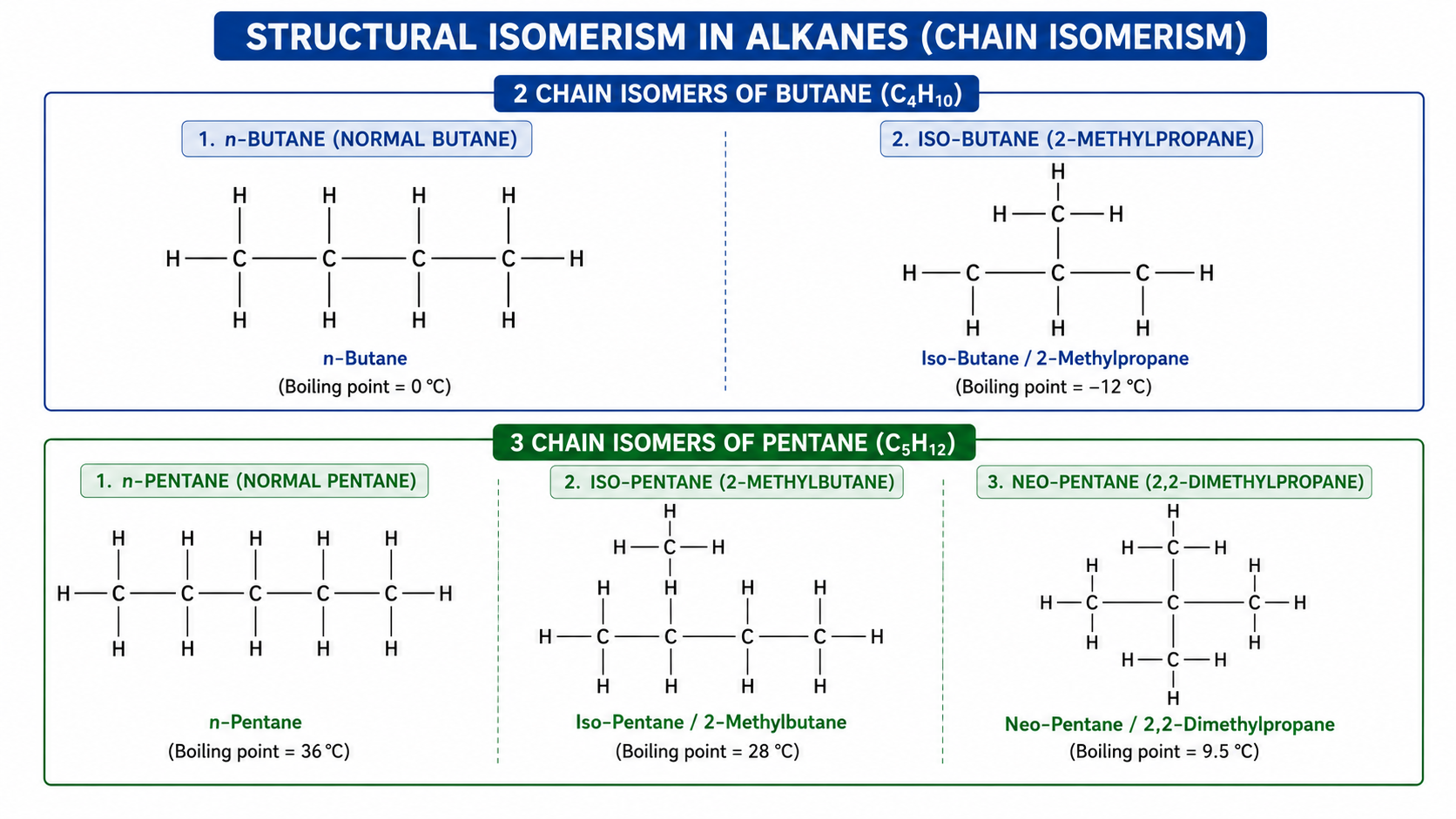
IUPAC Name = Prefix + Root Word + Primary Suffix + Secondary Suffix
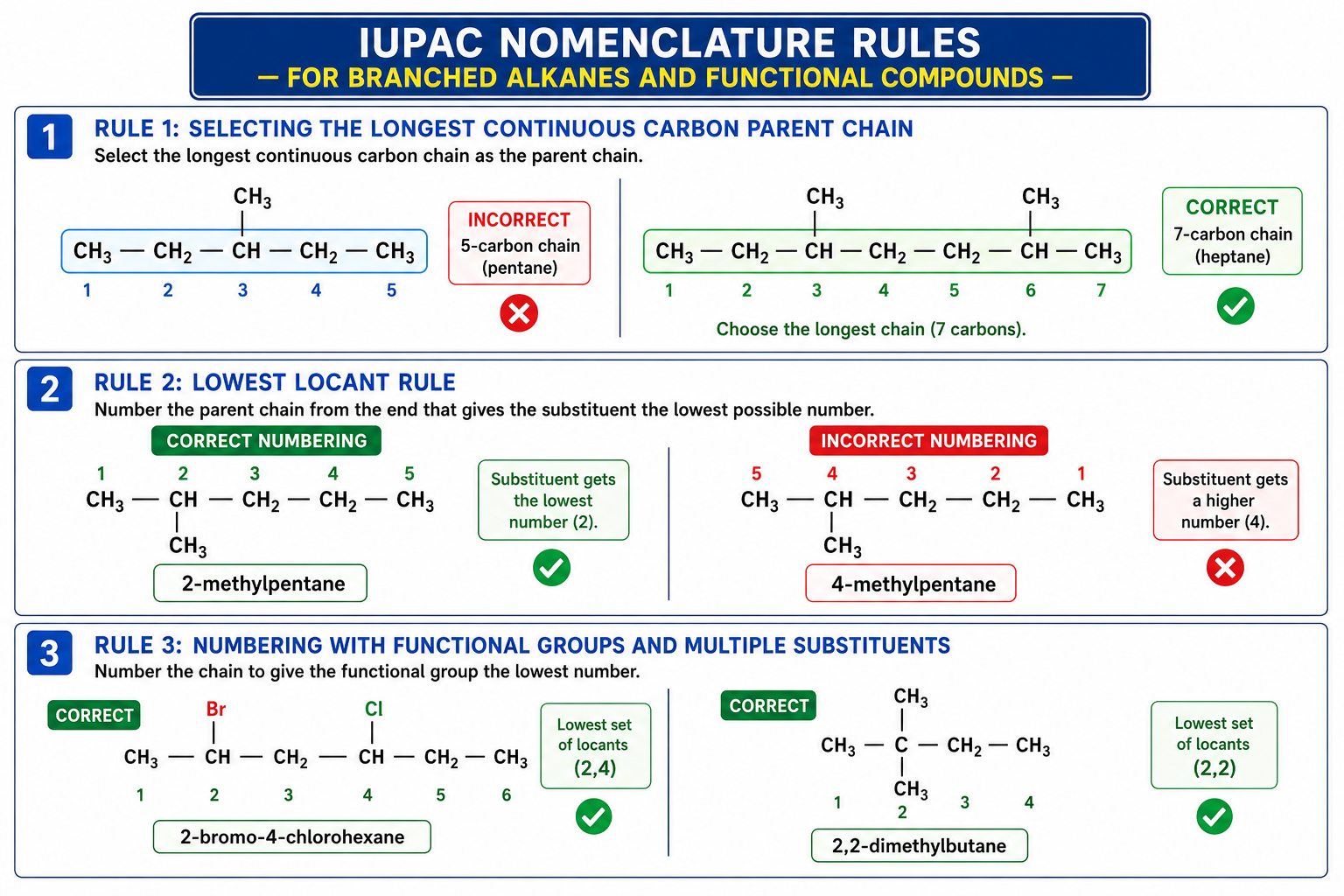
Lab Preparation of Methane ($CH_4$): Heating Sodium Acetate with Soda Lime ($\text{NaOH} + \text{CaO}$):
$$\text{CH}_3\text{COONa} + \text{NaOH} \xrightarrow[\Delta]{\text{CaO}} \text{Na}_2\text{CO}_3 + \text{CH}_4\uparrow$$• Collection: Downward displacement of water (insoluble in water).
• Role of CaO: Keeps soda lime dry, non-deliquescent, and prevents glass cracking.
Substitution Reaction (Chlorination of Methane in Sunlight):
$$\text{CH}_4 + \text{Cl}_2 \xrightarrow{h\nu} \text{CH}_3\text{Cl} + \text{HCl} \xrightarrow{\text{Cl}_2} \text{CH}_2\text{Cl}_2 \xrightarrow{\text{Cl}_2} \text{CHCl}_3 \xrightarrow{\text{Cl}_2} \text{CCl}_4$$Catalytic Oxidation of Methane:
$$\text{1. } 2\text{CH}_4 + \text{O}_2 \xrightarrow[475\text{ K}, 120\text{ atm}]{\text{Cu tube}} 2\text{CH}_3\text{OH} \quad (\text{Methanol})$$ $$\text{2. } \text{CH}_4 + \text{O}_2 \xrightarrow[\Delta]{\text{MoO catalyst}} \text{HCHO} + \text{H}_2\text{O} \quad (\text{Methanal})$$ $$\text{3. } 2\text{CH}_4 + 3\text{O}_2 \xrightarrow[100^\circ\text{C}]{\text{Mn catalyst}} 2\text{HCOOH} + 2\text{H}_2\text{O} \quad (\text{Methanoic Acid})$$1. Lab Preparation of Ethene ($C_2H_4$): Dehydration of Ethanol with conc. $H_2SO_4$ at $170^\circ C$:
$$\text{C}_2\text{H}_5\text{OH} \xrightarrow{\text{conc. } \text{H}_2\text{SO}_4, 170^\circ\text{C}} \text{CH}_2=\text{CH}_2\uparrow + \text{H}_2\text{O}$$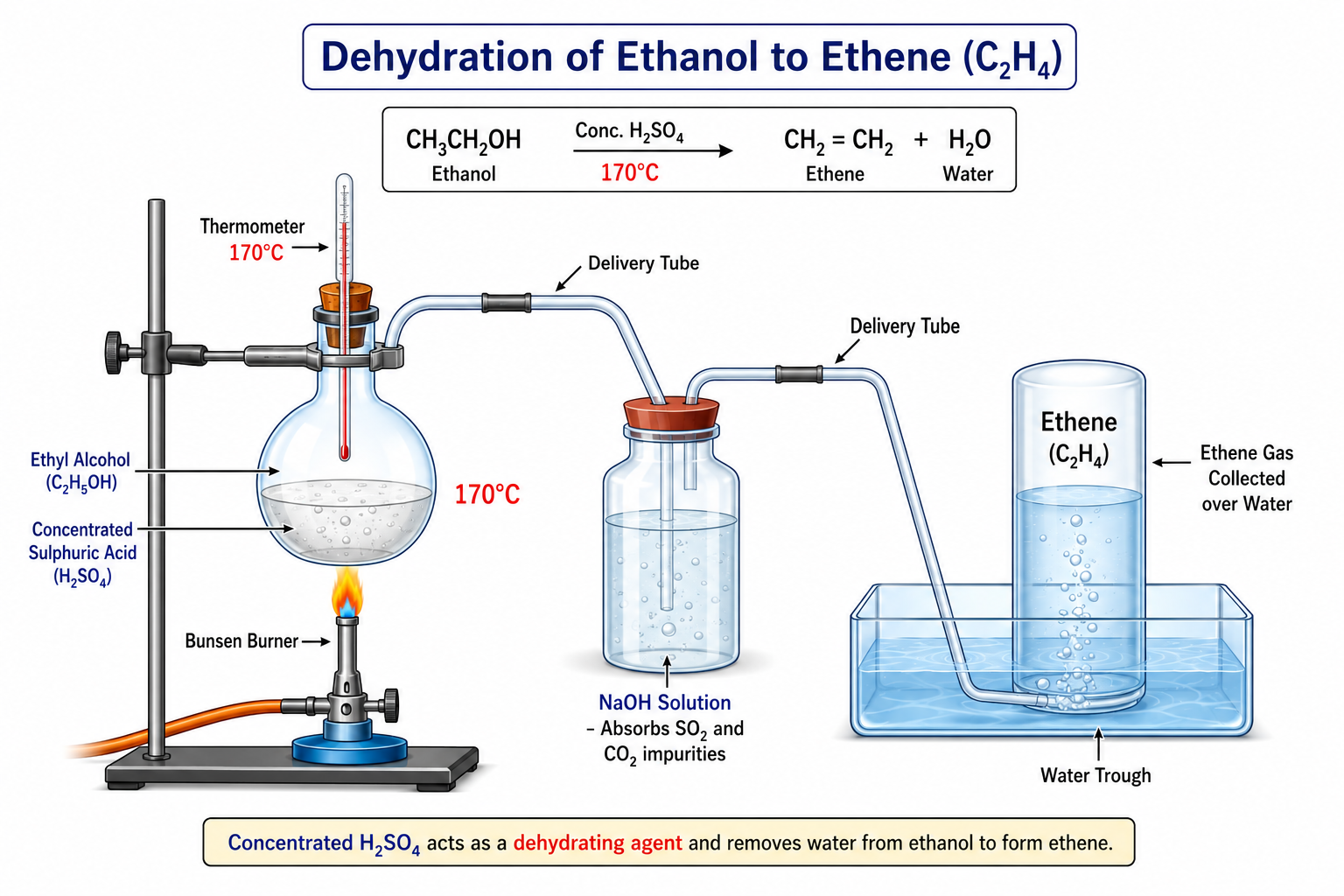
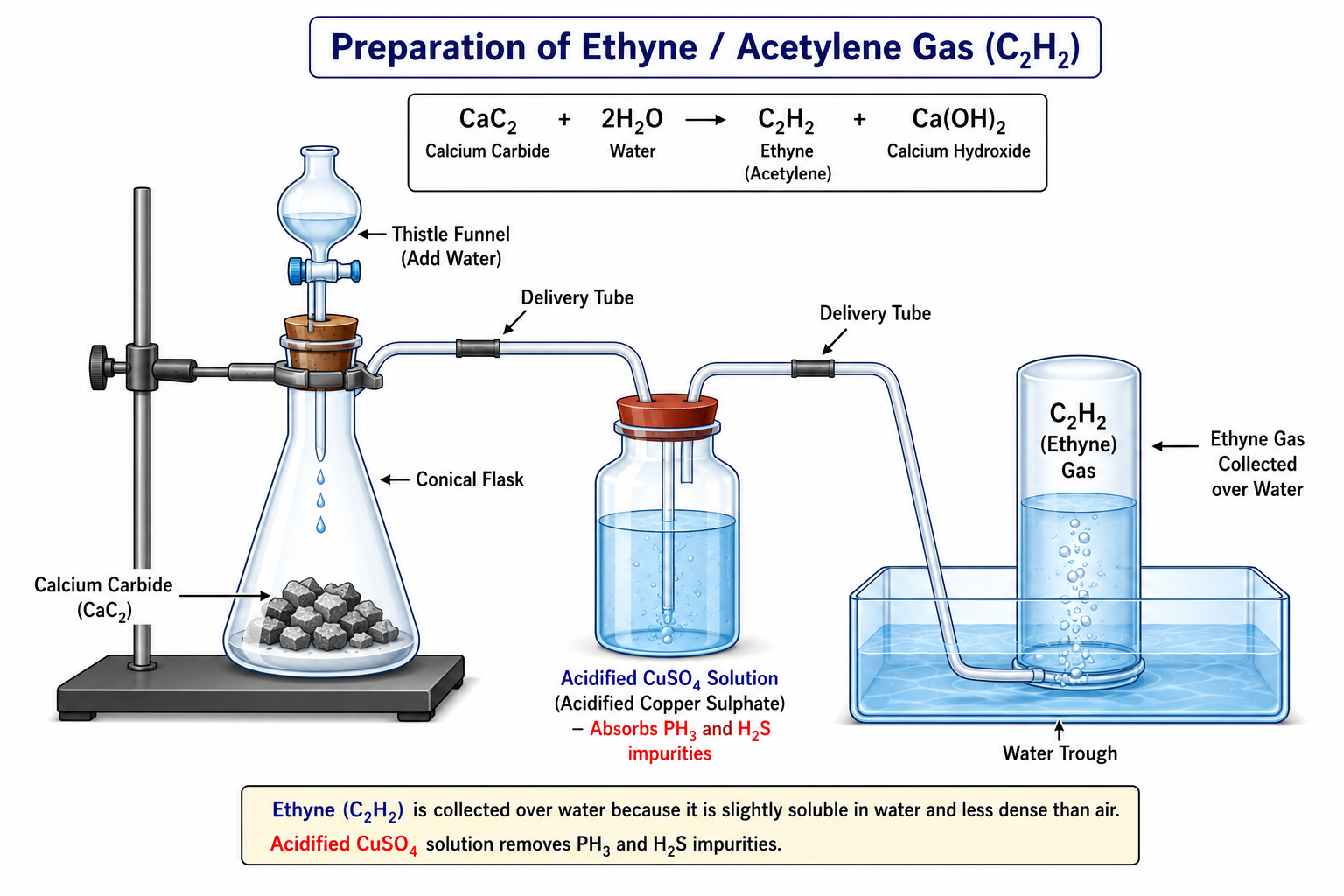
2. Lab Preparation of Ethyne ($C_2H_2$): Action of water on Calcium Carbide ($CaC_2$):
$$\text{CaC}_2 + 2\text{H}_2\text{O} \rightarrow \text{Ca(OH)}_2 + \text{HC}\equiv\text{CH}\uparrow$$• Purification: Passed through $CuSO_4$ solution to absorb $PH_3$, $H_2S$, and $NH_3$ impurities.
| Test Reagent | Alkane (Ethane) | Alkene (Ethene) | Alkyne (Ethyne) |
|---|---|---|---|
| 1. $\text{Br}_2 / \text{CCl}_4$ | No change (orange stays) | Decolourises orange solution | Decolourises orange solution |
| 2. Alk. $\text{KMnO}_4$ (Baeyer's) | No change (purple stays) | Decolourises purple to green/brown | Decolourises purple solution |
| 3. Ammoniacal $\text{Cu}_2\text{Cl}_2$ | No reaction | No reaction | Red ppt of $\text{Cu}_2\text{C}_2\downarrow$ |
| 4. Ammoniacal $\text{AgNO}_3$ | No reaction | No reaction | White ppt of $\text{Ag}_2\text{C}_2\downarrow$ |
1. Esterification Reaction (Sweet Fruity Smell Test):
$$\text{C}_2\text{H}_5\text{OH} + \text{CH}_3\text{COOH} \xrightarrow{\text{conc. } \text{H}_2\text{SO}_4, \Delta} \text{CH}_3\text{COOC}_2\text{H}_5 \text{ (Ethyl Acetate)} + \text{H}_2\text{O}$$2. Sodium Metal Test (Brisk Effervescence):
$$2\text{C}_2\text{H}_5\text{OH} + 2\text{Na} \rightarrow 2\text{C}_2\text{H}_5\text{ONa} + \text{H}_2\uparrow$$3. Carbonate Test for Ethanoic Acid (Effervescence of $\text{CO}_2$):
$$\text{CH}_3\text{COOH} + \text{NaHCO}_3 \rightarrow \text{CH}_3\text{COONa} + \text{H}_2\text{O} + \text{CO}_2\uparrow$$4. Neutral $\text{FeCl}_3$ Test for Acetic Acid: Produces a characteristic wine-red color solution.
| Compound | Core ICSE Board Exam Uses |
|---|---|
| Methane ($CH_4$) | Domestic CNG fuel; Carbon Black for printing inks & tires. |
| Ethene ($C_2H_4$) | Artificial fruit ripening; Oxy-ethylene welding flame; Polyethene manufacture. |
| Ethyne ($C_2H_2$) | Oxy-acetylene cutting flame ($3000^\circ C$); Fruit ripening; Synthetic rubber. |
| Ethanol ($C_2H_5OH$) | Solvent for paints/tinctures; Power Alcohol motor fuel (20% ethanol + 80% petrol). |
| Ethanoic Acid ($CH_3COOH$) | Food preservative as Vinegar (4-5% aqueous solution); Coagulant for rubber latex. |