Vardaan Learning Institute
Hydrogen Chloride
Hydrogen chloride is a compound of hydrogen and chlorine. In the gaseous state, it exists as covalent molecules, while in aqueous solution it completely ionizes to form hydrochloric acid.
1. General Properties & Molecular Profile
Molecular Profile
- Molecular Formula: $HCl$
- Molecular Mass: $1 + 35.5 = 36.5\text{ a.m.u.}$
- Bonding: Polar covalent single bond ($H^{\delta+} - Cl^{\delta-}$).
- Vapour Density ($V.D.$): $\frac{36.5}{2} = 18.25$. Since the vapour density of air is $14.4$, hydrogen chloride gas is about 1.28 times heavier than air.
- Solubility: Highly soluble in water ($1\text{ volume of water dissolves } \approx 452\text{ volumes of } HCl\text{ gas at } 20^\circ\text{C}$).
- Physical Nature: Colourless gas with a pungent, suffocating smell. Corrosive in nature and fumes strongly in moist air.
2. Laboratory Preparation of Hydrogen Chloride Gas
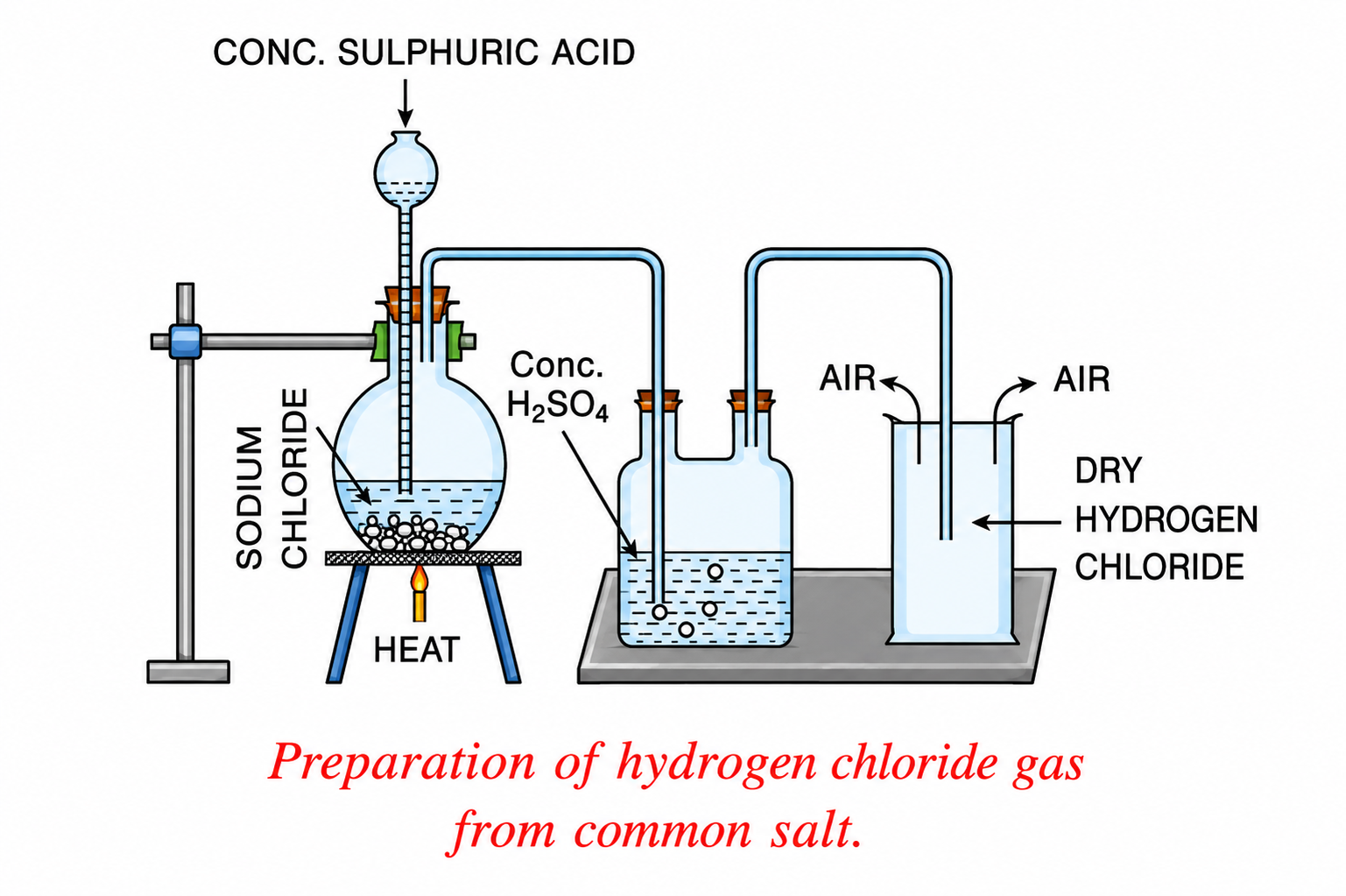
Fig 8.1: Laboratory apparatus for the preparation of hydrogen chloride gas from sodium chloride and conc. sulphuric acid
Reaction & Setup
Reactants: Sodium chloride ($NaCl$) and Concentrated sulphuric acid ($H_2SO_4$).
Chemical Equations:
- Below $200^\circ\text{C}$ (Preferred):
$NaCl + H_2SO_4\text{ (conc.)} \xrightarrow{< 200^\circ\text{C}} NaHSO_4 + HCl\uparrow$
- Above $200^\circ\text{C}$:
$2NaCl + H_2SO_4\text{ (conc.)} \xrightarrow{> 200^\circ\text{C}} Na_2SO_4 + 2HCl\uparrow$
Important Technical Details
- Why maintain temperature below $200^\circ\text{C}$?
At higher temperatures, sodium sulphate ($Na_2SO_4$) forms a hard crust that sticks to the glass flask and is difficult to remove. Also, heating beyond $200^\circ\text{C}$ wastes fuel and risks cracking the glass flask.
- Why use conc. $H_2SO_4$ and not conc. $HNO_3$?
Sulphuric acid is a non-volatile acid with a high boiling point ($338^\circ\text{C}$) which displaces the volatile $HCl$. Nitric acid is volatile and distills over with $HCl$, contaminating the gas. It also acts as an oxidising agent, converting $HCl$ to chlorine gas.
- Thistle Funnel Safety Seal: The bottom tip of the thistle funnel must dip well below the concentrated acid in the flask to prevent the generated gas from escaping back through it.
- Drying of $HCl$ Gas: The moist gas is dried by passing it through a wash bottle containing concentrated sulphuric acid. Basic drying agents like quicklime ($CaO$) or phosphorus pentoxide ($P_2O_5$) cannot be used because they react chemically with $HCl$:
$CaO + 2HCl \to CaCl_2 + H_2O$
$2P_2O_5 + 6HCl \to 2POCl_3 + 6HPO_3$
- Collection Method: Collected by upward displacement of air (downward delivery) because it is denser than air ($V.D. = 18.25$) and highly soluble in water (hence cannot be collected over water).
- Identification of Gas: When a glass rod dipped in ammonium hydroxide solution ($NH_4OH$) is brought near the mouth of the jar, dense white fumes of ammonium chloride ($NH_4Cl$) are formed:
$NH_3 + HCl \to NH_4Cl\text{ (dense white fumes)}$
3. Physical Properties & Experiments
A. Demonstration of High Density
Hydrogen chloride gas is denser than air ($V.D. = 18.25$). When poured into a jar containing a burning candle, the gas settles at the bottom and extinguishes the flame because it neither burns nor supports combustion.
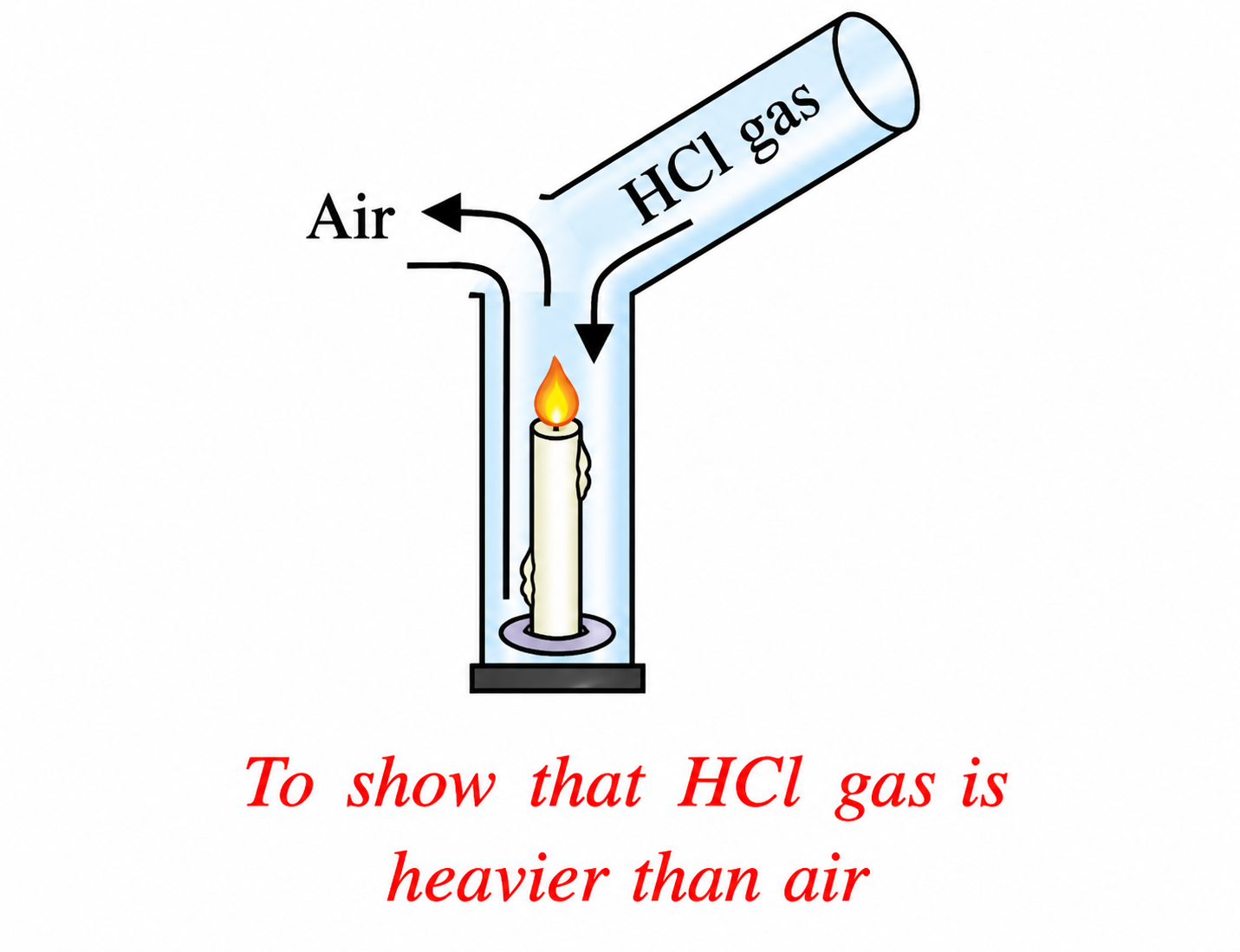
Fig 8.2: Demonstration of density of hydrogen chloride gas extinguishing a candle by downward displacement
B. Extreme Solubility — The Fountain Experiment
The fountain experiment demonstrates two vital properties of hydrogen chloride gas:
- Hydrogen chloride gas is extremely soluble in water.
- Aqueous solution of hydrogen chloride is acidic in nature.
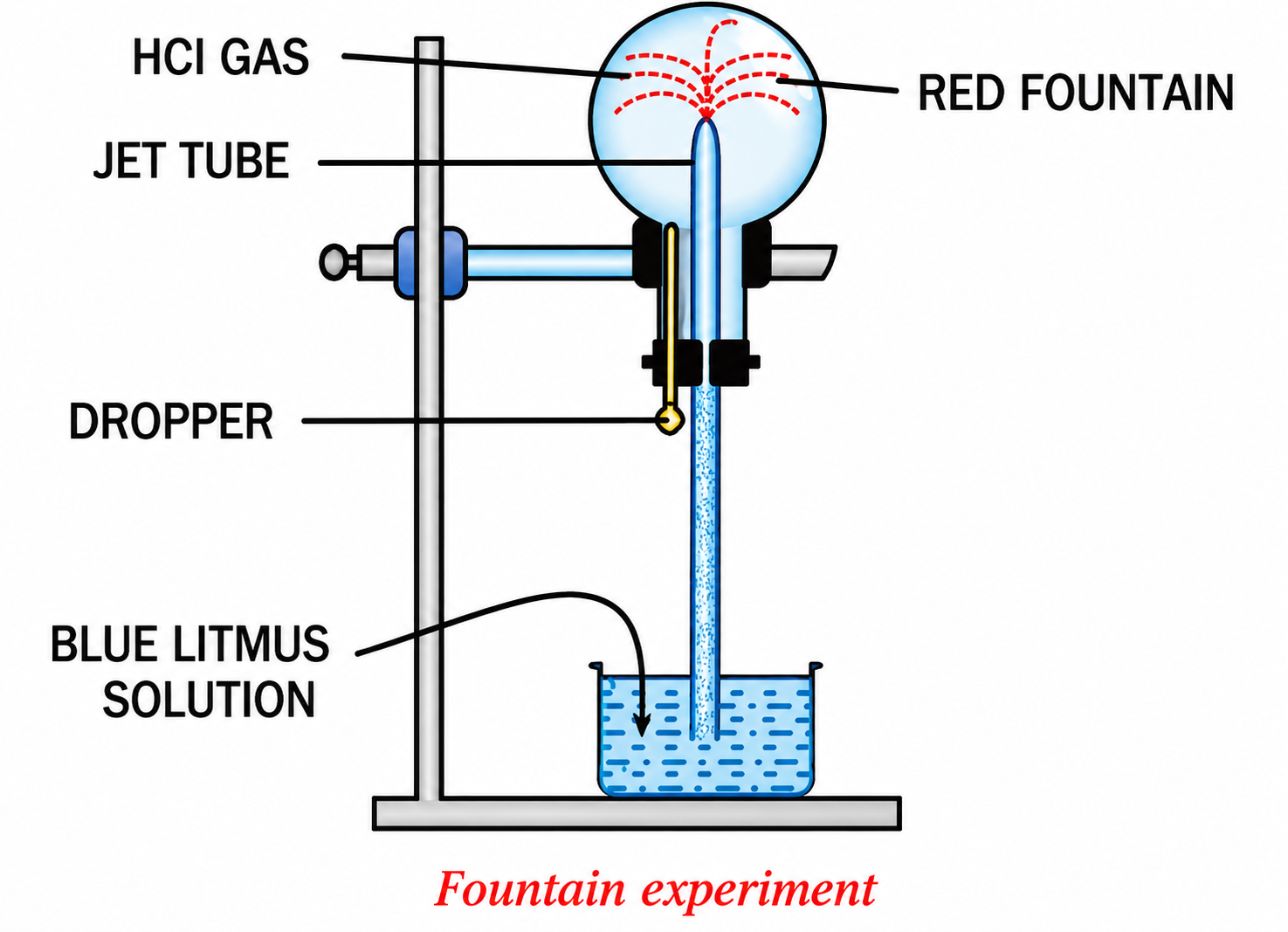
Fig 8.3: The Fountain Experiment showing the creation of a partial vacuum and a red fountain
Mechanism of the Fountain
- A dry round-bottom flask filled with dry $HCl$ gas is inverted and connected via a jet tube to a trough containing blue litmus solution.
- When a few drops of water from a dropper are introduced into the flask, a large volume of $HCl$ gas dissolves instantly due to its high solubility.
- This rapid dissolution creates a partial vacuum inside the flask.
- Outside atmospheric pressure forces the blue litmus solution up through the jet tube, creating a red fountain as the acidic solution enters the flask.
4. Preparation of Hydrochloric Acid & The Funnel Arrangement
Hydrochloric acid is prepared by dissolving hydrogen chloride gas in water. Directly bubbling the gas into water causes a serious problem called back-suction.
Back-Suction Problem & Funnel Solution
The Hazard of Back-Suction:
Because $HCl$ dissolves in water at a rate much faster than it is supplied, a vacuum forms in the delivery tube. Atmospheric pressure then pushes water back into the hot generating flask, which can shatter the glass.
The Inverted Funnel Arrangement:
An inverted funnel is connected to the delivery tube with its rim just touching the water surface in the trough. This arrangement provides two key benefits:
- Large Surface Area: Increases the rate of absorption of $HCl$ gas into water.
- Prevents Back-Suction: If water begins to rise inside the funnel, the water level in the trough drops below the rim. The air gap breaks the seal, atmospheric pressure equalises, and the water falls back into the trough automatically.
Azeotropic (Constant Boiling) Mixture
- Hydrochloric acid cannot be concentrated beyond $22.2\%\ HCl$ by simple boiling.
- At $22.2\%\ HCl$ and $77.8\%\ H_2O$, it forms a constant boiling mixture with a boiling point of $109.8^\circ\text{C}$ ($110^\circ\text{C}$).
- On boiling, this mixture distills over unchanged in composition and temperature.
5. Chemical Properties of Hydrochloric Acid
A. Action on Indicators
| Indicator |
Original Colour |
Colour in Dilute $HCl$ |
| Blue Litmus |
Blue |
Red |
| Methyl Orange |
Orange |
Pink / Red |
| Phenolphthalein |
Colourless |
Colourless |
B. Reaction with Active Metals
Metals placed above hydrogen in the activity series react with dilute hydrochloric acid to form metallic chlorides and release hydrogen gas:
- $Mg + 2HCl \to MgCl_2 + H_2\uparrow$
- $Zn + 2HCl \to ZnCl_2 + H_2\uparrow$
- $2Al + 6HCl \to 2AlCl_3 + 3H_2\uparrow$
- $Fe + 2HCl \to FeCl_2 + H_2\uparrow$ (Forms iron(II) chloride, as hydrogen prevents oxidation to $Fe^{3+}$)
C. Reaction with Basic Oxides & Hydroxides (Neutralisation)
Dilute hydrochloric acid neutralises basic oxides and hydroxides to form soluble chloride salts and water:
- $CuO\text{ (Black)} + 2HCl \to CuCl_2\text{ (Blue-green solution)} + H_2O$
- $ZnO + 2HCl \to ZnCl_2 + H_2O$
- $NaOH + HCl \to NaCl + H_2O$
- $Ca(OH)_2 + 2HCl \to CaCl_2 + 2H_2O$
- $Fe(OH)_3 + 3HCl \to FeCl_3 + 3H_2O$
- $PbO\text{ (Yellow)} + 2HCl\text{ (dil.)} \to PbCl_2\downarrow\text{ (White ppt)} + H_2O$
D. Action on Carbonates & Bicarbonates
Decomposes carbonates and bicarbonates with brisk effervescence of carbon dioxide gas ($CO_2$):
- $CaCO_3 + 2HCl \to CaCl_2 + H_2O + CO_2\uparrow$
- $Na_2CO_3 + 2HCl \to 2NaCl + H_2O + CO_2\uparrow$
- $NaHCO_3 + HCl \to NaCl + H_2O + CO_2\uparrow$
- $CuCO_3 + 2HCl \to CuCl_2 + H_2O + CO_2\uparrow$
Test for $CO_2$: Turns lime water milky and has no effect on acidified potassium dichromate solution.
E. Action on Sulphites & Bisulphites
Liberates sulphur dioxide gas ($SO_2$) with a suffocating smell of burning sulphur:
- $Na_2SO_3 + 2HCl \to 2NaCl + H_2O + SO_2\uparrow$
- $CaSO_3 + 2HCl \to CaCl_2 + H_2O + SO_2\uparrow$
- $NaHSO_3 + HCl \to NaCl + H_2O + SO_2\uparrow$
Test for $SO_2$: Turns acidified potassium dichromate paper from orange to clear green ($Cr^{3+}$).
F. Action on Sulphides
Liberates hydrogen sulphide gas ($H_2S$) having a rotten egg odour:
- $FeS + 2HCl \to FeCl_2 + H_2S\uparrow$
- $ZnS + 2HCl \to ZnCl_2 + H_2S\uparrow$
- $Na_2S + 2HCl \to 2NaCl + H_2S\uparrow$
Test for $H_2S$: Turns moist lead acetate paper silvery black due to formation of lead sulphide ($PbS$):
$(CH_3COO)_2Pb + H_2S \to PbS\downarrow\text{ (Black)} + 2CH_3COOH$
G. Action on Thiosulphates
Decomposes thiosulphates releasing sulphur dioxide gas and depositing a yellow precipitate of sulphur:
$Na_2S_2O_3 + 2HCl \to 2NaCl + H_2O + SO_2\uparrow + S\downarrow\text{ (Yellow precipitate)}$
6. Precipitation Reactions with Silver & Lead Salts
Silver Nitrate Reaction
When dilute $HCl$ is added to silver nitrate solution, a curdy white precipitate of silver chloride is formed:
$AgNO_3 + HCl \to AgNO_3 + AgCl\downarrow\text{ (Curdy white ppt)}$
- Solubility in Nitric Acid: Insoluble in dilute nitric acid ($HNO_3$).
- Solubility in Ammonium Hydroxide: Soluble in ammonium hydroxide ($NH_4OH$), forming a clear complex solution of diamminesilver(I) chloride:
$AgCl + 2NH_4OH \to [Ag(NH_3)_2]Cl + 2H_2O$
- Re-precipitation: When dilute nitric acid is added to this clear solution, the white precipitate of $AgCl$ reappears:
$[Ag(NH_3)_2]Cl + 2HNO_3 \to AgCl\downarrow + 2NH_4NO_3$
Lead Nitrate Reaction
When dilute $HCl$ is added to lead nitrate solution, a white precipitate of lead(II) chloride is formed:
$Pb(NO_3)_2 + 2HCl \to PbCl_2\downarrow\text{ (White ppt)} + 2HNO_3$
- Temperature Effect: The white precipitate of $PbCl_2$ is soluble in hot water and dissolves on boiling.
- On cooling the clear solution, $PbCl_2$ crystallises out in the form of shiny white needles.
7. Oxidation of Concentrated $HCl$ & Aqua Regia
A. Oxidation by Powerful Oxidising Agents
Concentrated hydrochloric acid is oxidised to greenish-yellow chlorine gas ($Cl_2$) when heated with oxidising agents:
- With Manganese Dioxide ($MnO_2$):
$MnO_2 + 4HCl\text{ (conc.)} \xrightarrow{\Delta} MnCl_2 + 2H_2O + Cl_2\uparrow$
- With Lead Dioxide ($PbO_2$):
$PbO_2 + 4HCl\text{ (conc.)} \xrightarrow{\Delta} PbCl_2 + 2H_2O + Cl_2\uparrow$
- With Red Lead ($Pb_3O_4$):
$Pb_3O_4 + 8HCl\text{ (conc.)} \xrightarrow{\Delta} 3PbCl_2 + 4H_2O + Cl_2\uparrow$
- With Potassium Permanganate ($KMnO_4$ - reacts without heating):
$2KMnO_4 + 16HCl\text{ (conc.)} \to 2KCl + 2MnCl_2 + 8H_2O + 5Cl_2\uparrow$
- With Potassium Dichromate ($K_2Cr_2O_7$):
$K_2Cr_2O_7 + 14HCl\text{ (conc.)} \xrightarrow{\Delta} 2KCl + 2CrCl_3 + 7H_2O + 3Cl_2\uparrow$
B. Aqua Regia (Royal Water)
Aqua Regia
- Composition: A mixture of 3 parts concentrated hydrochloric acid and 1 part concentrated nitric acid by volume ($3:1$ ratio).
- Reaction:
$3HCl\text{ (conc.)} + HNO_3\text{ (conc.)} \to NOCl\text{ (Nitrosyl chloride)} + 2H_2O + 2[Cl]\text{ (Nascent chlorine)}$
- Dissolution of Noble Metals: Nascent chlorine attacks noble metals like gold ($Au$) and platinum ($Pt$) to convert them into soluble chloro-complexes:
$Au + 3[Cl] \to AuCl_3 \xrightarrow{HCl} HAuCl_4\text{ (Tetrachloroauric acid)}$
$Pt + 4[Cl] \to PtCl_4 \xrightarrow{2HCl} H_2PtCl_6\text{ (Hexachloroplatinic acid)}$
8. Tests for Hydrogen Chloride Gas & Hydrochloric Acid
A. Identification Tests for $HCl$ Gas
- Ammonium Hydroxide Rod: Glass rod dipped in $NH_4OH$ gives dense white fumes of ammonium chloride ($NH_4Cl$).
- Silver Nitrate: Passes into $AgNO_3$ solution to yield a curdy white precipitate soluble in $NH_4OH$.
- Litmus: No effect on dry blue litmus paper; turns moist blue litmus paper red.
B. Comparison: Dry $HCl$ Gas vs Aqueous Hydrochloric Acid
| Property |
Dry $HCl$ Gas / Liquid $HCl$ (in Toluene) |
Hydrochloric Acid ($HCl$ in Water) |
| Nature of Bonding |
Covalent molecules (no free ions) |
Ionised into $H_3O^+$ and $Cl^-$ ions |
| Action on Dry Blue Litmus |
No change |
Turns red immediately |
| Electrical Conductivity |
Non-conductor |
Good conductor of electricity |
| Action on Metals |
No reaction |
Liberates hydrogen gas |
9. Uses of Hydrochloric Acid
- Pickling of Metals: Cleaning oxide scale from sheet iron before galvanising or tinning.
- Manufacture of Chemicals: Preparation of chlorine, chlorides (such as $NH_4Cl$), glucose from starch, and dyes.
- Industrial Extraction: Extracting glue from animal bones and purifying bone black.
- Tanning & Dyeing: Used in the leather tanning and textile processing industries.
- Laboratory Reagent: Standard analytical and volumetric laboratory reagent.
10. Solved Board Exam Questions
ICSE Board Question 1
(a) Write a balanced chemical equation for the laboratory preparation of hydrogen chloride gas below $200^\circ\text{C}$.
(b) Why is concentrated nitric acid not used in place of concentrated sulphuric acid?
(c) Name the drying agent used and explain why quicklime cannot be used.
Solution:
(a) $NaCl + H_2SO_4\text{ (conc.)} \xrightarrow{< 200^\circ\text{C}} NaHSO_4 + HCl\uparrow$
(b) Nitric acid is volatile and distills over with $HCl$, contaminating it. It is also an oxidising agent that oxidises $HCl$ to chlorine gas.
(c) Concentrated sulphuric acid is used as the drying agent. Quicklime ($CaO$) is basic and reacts chemically with acidic $HCl$ gas to form calcium chloride ($CaO + 2HCl \to CaCl_2 + H_2O$), so it cannot be used.
ICSE Board Question 2
(a) State two properties of hydrogen chloride gas demonstrated by the fountain experiment.
(b) Explain the inverted funnel arrangement used to prepare hydrochloric acid and state how it prevents back-suction.
Solution:
(a) The fountain experiment demonstrates that hydrogen chloride gas is extremely soluble in water and its aqueous solution is acidic in nature.
(b) An inverted funnel connected to the gas delivery tube just touches the water surface in a trough. If water begins to rise inside the funnel due to fast absorption, the water level in the trough drops below the rim. The resulting air gap breaks the suction, atmospheric pressure equalises, and the water column falls back into the trough.
ICSE Board Question 3
State your observations when dilute hydrochloric acid is added to:
(a) Sodium carbonate crystals
(b) Iron(II) sulphide
(c) Silver nitrate solution followed by excess ammonium hydroxide
(d) Lead nitrate solution followed by heating
Solution:
(a) Brisk effervescence of a colourless, odourless gas ($CO_2$) that turns lime water milky.
(b) Evolution of a colourless gas ($H_2S$) with a rotten egg smell that turns moist lead acetate paper silvery black.
(c) A curdy white precipitate of silver chloride ($AgCl$) is formed, which completely dissolves in excess ammonium hydroxide to form a clear solution.
(d) A white precipitate of lead chloride ($PbCl_2$) is formed, which dissolves on heating and recrystallises as white needles upon cooling.
ICSE Board Question 4
(a) What is aqua regia? Give its composition by volume.
(b) Explain why gold dissolves in aqua regia but not in concentrated hydrochloric acid alone.
Solution:
(a) Aqua regia is a mixture of 3 parts concentrated hydrochloric acid and 1 part concentrated nitric acid by volume ($3:1$).
(b) The reaction between concentrated $HCl$ and concentrated $HNO_3$ produces active nascent chlorine ($[Cl]$). Nascent chlorine attacks the unreactive gold metal to form soluble gold(III) chloride ($AuCl_3$) and tetrachloroauric acid ($HAuCl_4$).

 VARDAAN COMET