Electrolysis is a chemical process that establishes a fundamental relationship between electrical energy and chemical change. The word electrolysis is derived from 'electro' (flow of electrons or electricity) and 'lysis' (separating or breaking down chemically).
Electrolysis: The process of chemical decomposition of an electrolyte in its molten (fused) or aqueous solution state accompanied by a chemical change by the passage of direct electric current.
| Property | Metallic Conductors (e.g. Cu wire, Al, Fe) | Electrolytic Conductors (e.g. $CuSO_4$ aq, molten $PbBr_2$) |
|---|---|---|
| Flow of Current | Consists of a single stream of free mobile electrons moving from negative pole to positive pole. | Consists of two streams of free mobile ions: positive cations flowing towards cathode and negative anions flowing towards anode. |
| State of Matter | Conduct electricity in both solid and liquid (molten) states. | Conduct electricity only in aqueous solution or molten state (never in solid state). |
| Chemical Change | No chemical change occurs; no change in form or composition (only a physical process). | Chemical decomposition occurs; new chemical substances are formed at the electrodes. |
| Matter Transfer | No transfer of matter takes place during conduction. | Transfer of matter takes place in the form of ions moving towards electrodes. |

| Term | Definition & Key Concept |
|---|---|
| Electrolyte | A chemical compound which in aqueous solution or in molten state conducts electricity and undergoes chemical decomposition (e.g. $HCl, H_2SO_4, NaOH, NaCl, CuSO_4, PbBr_2$). |
| Non-electrolyte | A compound which neither in solution nor in molten state conducts electric current, and does not decompose at electrodes (e.g. distilled water, cane sugar, glucose, urea, alcohol, $CCl_4$, benzene). |
| Electrolytic Cell (Voltameter) | A non-conducting vessel (glass/silica) in which electrolysis is carried out. It converts electrical energy into chemical energy. |
| Electrochemical Cell | A device that converts chemical energy into electrical energy (e.g. Simple Voltaic cell, Daniel cell). |
| Electrodes | Graphite or metal rods/plates immersed in the electrolyte through which electric current enters or leaves the cell. |
| Anode | The electrode connected to the positive terminal of the battery. Anions migrate to anode and undergo oxidation (loss of electrons). |
| Cathode | The electrode connected to the negative terminal of the battery. Cations migrate to cathode and undergo reduction (gain of electrons). |
| Feature | Anode (+ Positive Electrode) | Cathode (- Negative Electrode) |
|---|---|---|
| Terminal Connection | Connected to positive terminal of battery. | Connected to negative terminal of battery. |
| Migrating Ions | Negative ions (Anions) migrate to anode. | Positive ions (Cations) migrate to cathode. |
| Electrode Reaction | Oxidation takes place (loss of electrons). | Reduction takes place (gain of electrons). |
| Nature of Electrode | Acts as an oxidising electrode. | Acts as a reducing electrode. |
| Property | Strong Electrolytes | Weak Electrolytes |
|---|---|---|
| Degree of Ionisation ($\alpha$) | Almost completely dissociated in aqueous/molten state ($\alpha \approx 100\%$). | Partially dissociated in aqueous/molten state ($\alpha < 5\%$). |
| Particles Present in Solution | Contains (almost) only free mobile ions. | Contains both ions AND unionised molecules. |
| Electrical Conductivity & Bulb Test | High conductivity; causes testing bulb to glow brightly. | Poor conductivity; causes testing bulb to glow dimly. |
| Strong Acids | $HCl, H_2SO_4, HNO_3$ | $CH_3COOH, H_2CO_3, H_3PO_4$, Oxalic acid |
| Strong Bases | $NaOH, KOH$ (molten or aq) | $NH_4OH, Ca(OH)_2, Mg(OH)_2$ |
| Salts | $NaCl, PbBr_2, CuCl_2, CuSO_4, AgNO_3$ | $Na_2CO_3, KHCO_3, (CH_3COO)_2Pb$ |
Exam Tip — Non-Electrolytes: Non-electrolytes are purely covalent compounds. They do not possess ions even in solution. Examples: Pure distilled water, alcohol, kerosene, carbon disulfide ($CS_2$), cane sugar, glucose, urea, benzene.
Oxidation: A chemical process in which an atom or an ion loses electron(s).
$Zn - 2e^- \rightarrow Zn^{2+}$ | $Na - e^- \rightarrow Na^+$
$Fe^{2+} - e^- \rightarrow Fe^{3+}$ | $S^{2-} - 2e^- \rightarrow S$
Reduction: A chemical process in which an atom or an ion gains electron(s).
$Cu^{2+} + 2e^- \rightarrow Cu$ | $Fe^{3+} + e^- \rightarrow Fe^{2+}$ | $S + 2e^- \rightarrow S^{2-}$
Oxidation involves: (i) Addition of oxygen ($C + O_2 \rightarrow CO_2$, $2Mg + O_2 \rightarrow 2MgO$), (ii) Removal of hydrogen ($H_2S + Cl_2 \rightarrow 2HCl + S$), or (iii) Loss of electrons.
Reduction involves: (i) Removal of oxygen ($CuO + H_2 \rightarrow Cu + H_2O$, $ZnO + C \rightarrow Zn + CO$), (ii) Addition of hydrogen ($Cl_2 + H_2S \rightarrow 2HCl + S$), or (iii) Gain of electrons.
Oxidising Agents: Substances that accept electrons or supply oxygen (Solids: $MnO_2, PbO_2$; Liquids: $H_2O_2$, conc. $HNO_3$, conc. $H_2SO_4, Br_2$; Gases: $O_2, O_3, Cl_2, SO_2$).
Reducing Agents: Substances that donate electrons or supply hydrogen (Solids: $C, Zn, Al, Cu, Na, SnCl_2$; Liquids: $H_2O_2, HI, HBr$; Gases: $H_2S, CO, SO_2$).
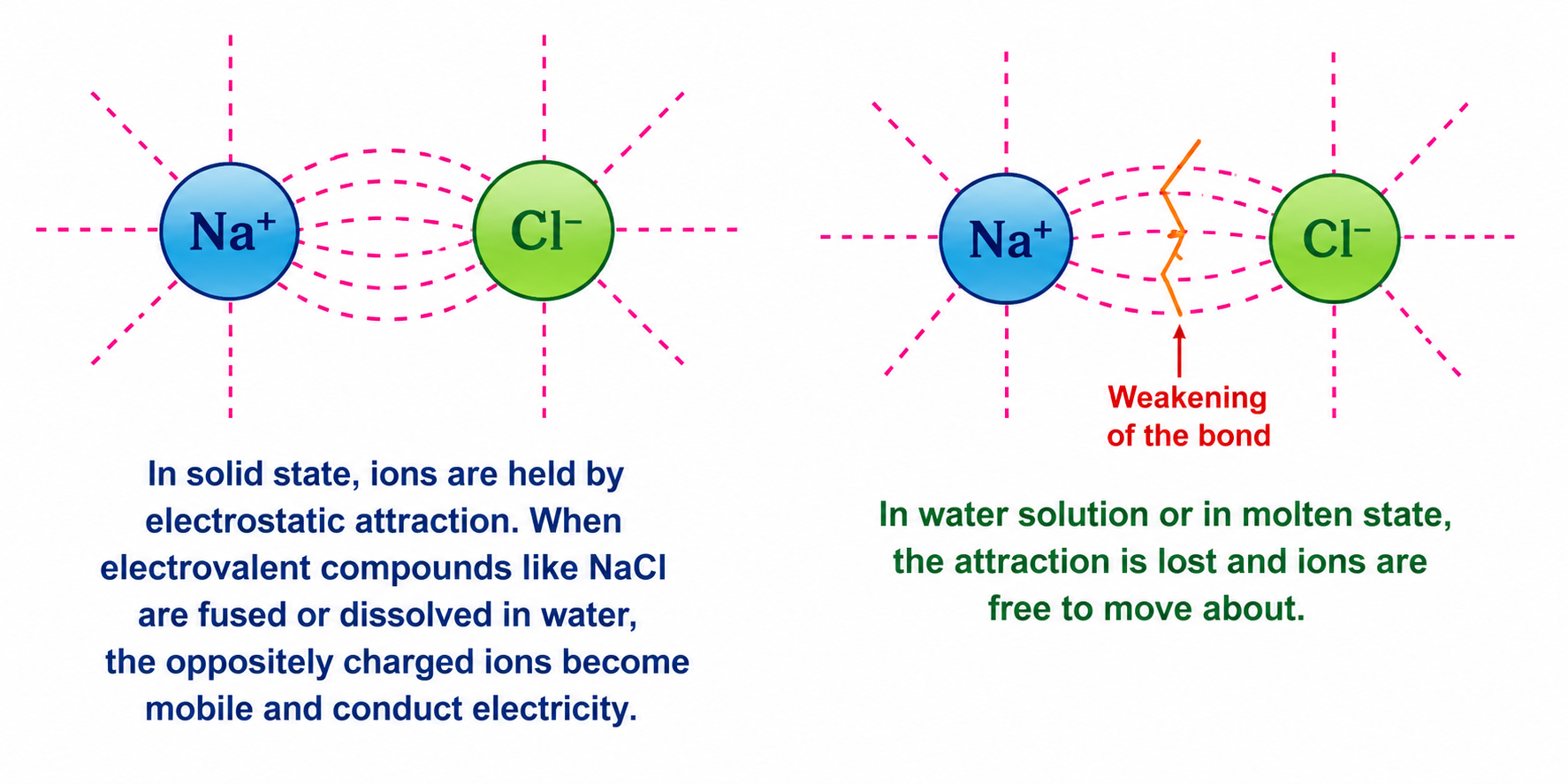
Svante Arrhenius (1887) proposed the ionic theory of electrolytic dissociation:
Arrhenius vs Modern Concept of Dissociation:
Arrhenius Concept: Assumed water ionises electrolytes.
Modern Concept: Electrovalent compounds are ionic even in solid state, held by strong electrostatic forces making ions immobile. Water (having high dielectric constant $\approx 81$) breaks electrostatic attraction, setting ions free to move!
| Feature | Ionisation | Electrolytic Dissociation |
|---|---|---|
| Definition | Process by which polar covalent molecules are converted into ions in aqueous solution. | Process by which electrovalent (ionic) compounds separate into pre-existing ions in fused or aqueous state. |
| Original State | Molecules were not initially in ionic state. | Ions were already present in solid crystal lattice. |
| Examples | $HCl + H_2O \rightarrow H_3O^+ + Cl^-$ $NH_3 + H_2O \rightleftharpoons NH_4^+ + OH^-$ |
$NaCl \xrightarrow{\text{water}} Na^+ + Cl^-$ $PbBr_2 \xrightarrow{\text{heat}} Pb^{2+} + 2Br^-$ |
| Metal Atom | Cation Formed | Ease of Discharge at Cathode |
|---|---|---|
| Potassium ($K$) | $K^+$ | Most Electropositive (Difficult to discharge) |
| Calcium ($Ca$) | $Ca^{2+}$ | |
| Sodium ($Na$) | $Na^+$ | |
| Magnesium ($Mg$) | $Mg^{2+}$ | |
| Aluminium ($Al$) | $Al^{3+}$ | $\downarrow$ Increasing ease of gain of electrons & discharge at Cathode $\downarrow$ |
| Zinc ($Zn$) | $Zn^{2+}$ | |
| Iron ($Fe$) | $Fe^{2+} / Fe^{3+}$ | |
| Lead ($Pb$) | $Pb^{2+}$ | |
| Hydrogen ($H$) | $H^+$ | Reference Metal / Non-metal |
| Copper ($Cu$) | $Cu^{2+}$ | Least Electropositive (Easiest to discharge) |
| Mercury ($Hg$) | $Hg^{2+}$ | |
| Silver ($Ag$) | $Ag^+$ | |
| Gold / Platinum ($Au/Pt$) | $Au^{3+} / Pt^{4+}$ |
| Anion Symbol | Anion Name | Ease of Discharge at Anode |
|---|---|---|
| $SO_4^{2-}$ | Sulphate ion | Most difficult to oxidize/discharge |
| $NO_3^-$ | Nitrate ion | Difficult |
| $Cl^-$ | Chloride ion | $\downarrow$ Increasing ease of loss of electrons & discharge at Anode $\downarrow$ |
| $Br^-$ | Bromide ion | Easier |
| $I^-$ | Iodide ion | Very easy |
| $OH^-$ | Hydroxyl ion | Easiest to oxidize/discharge |
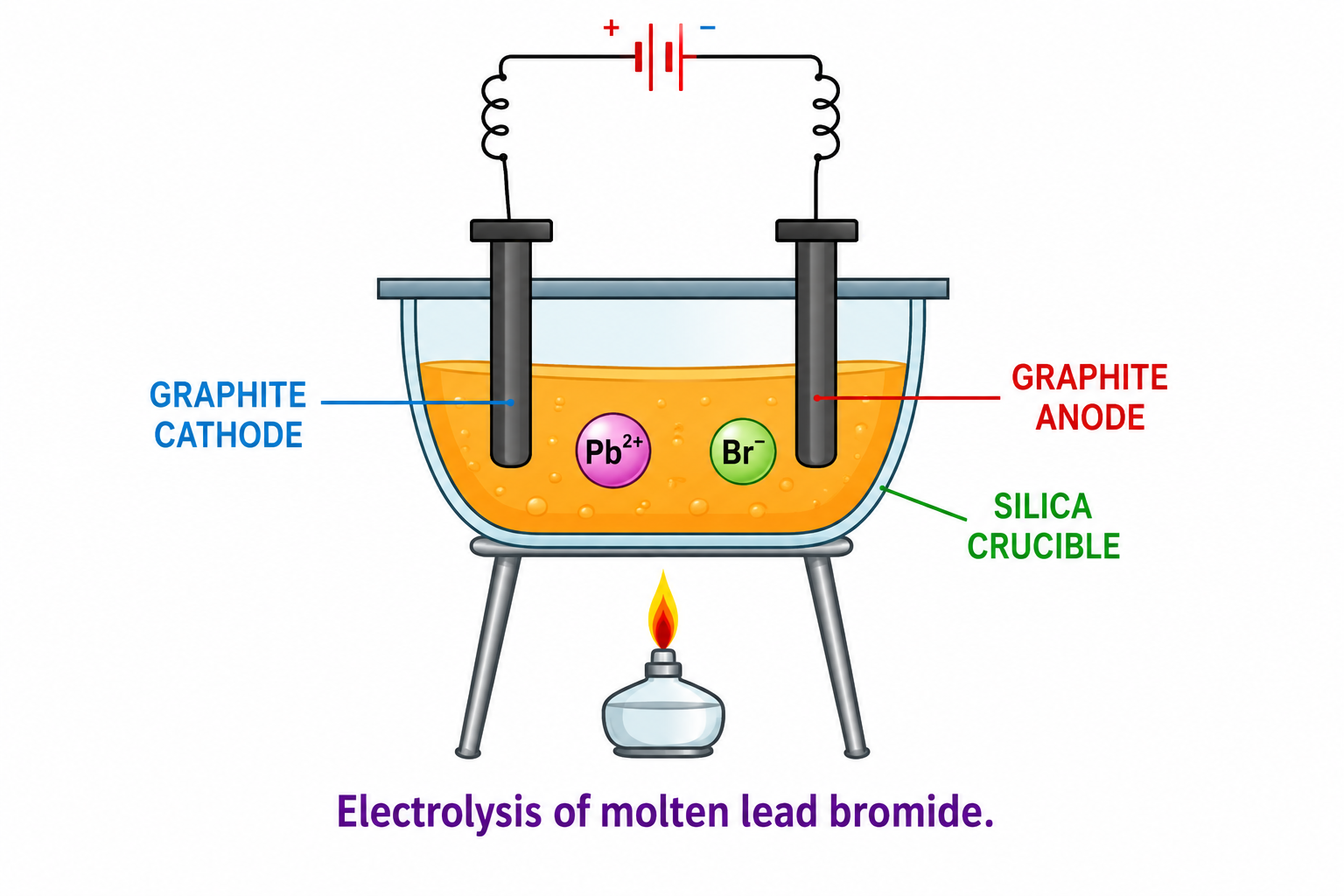
When an electrolyte contains multiple cations or anions competing for discharge at the same electrode, selective discharge depends on three critical factors:
.png)
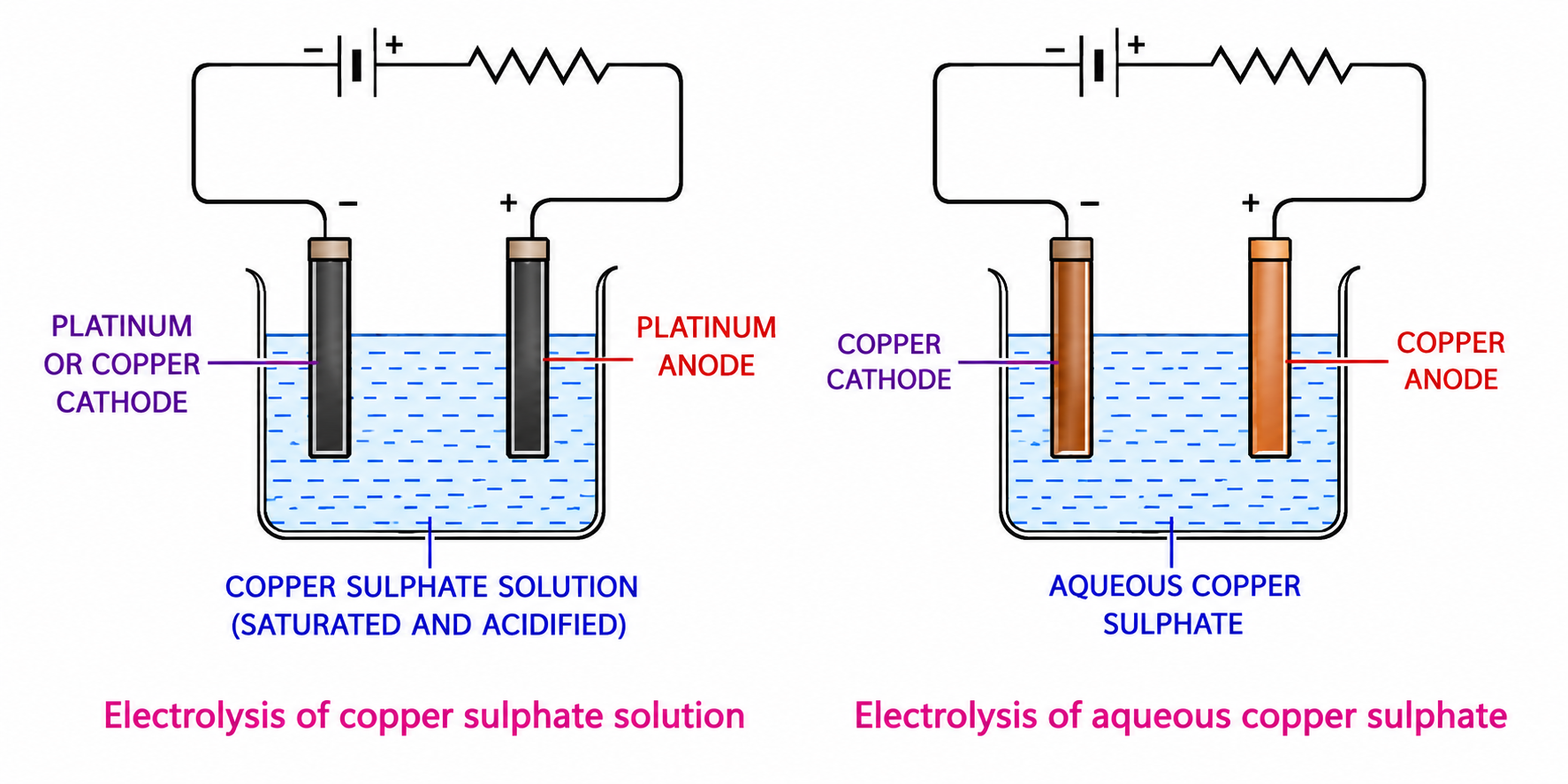
Case III: Using Platinum (Inert) Electrodes
Case IV: Using Active Copper Electrodes
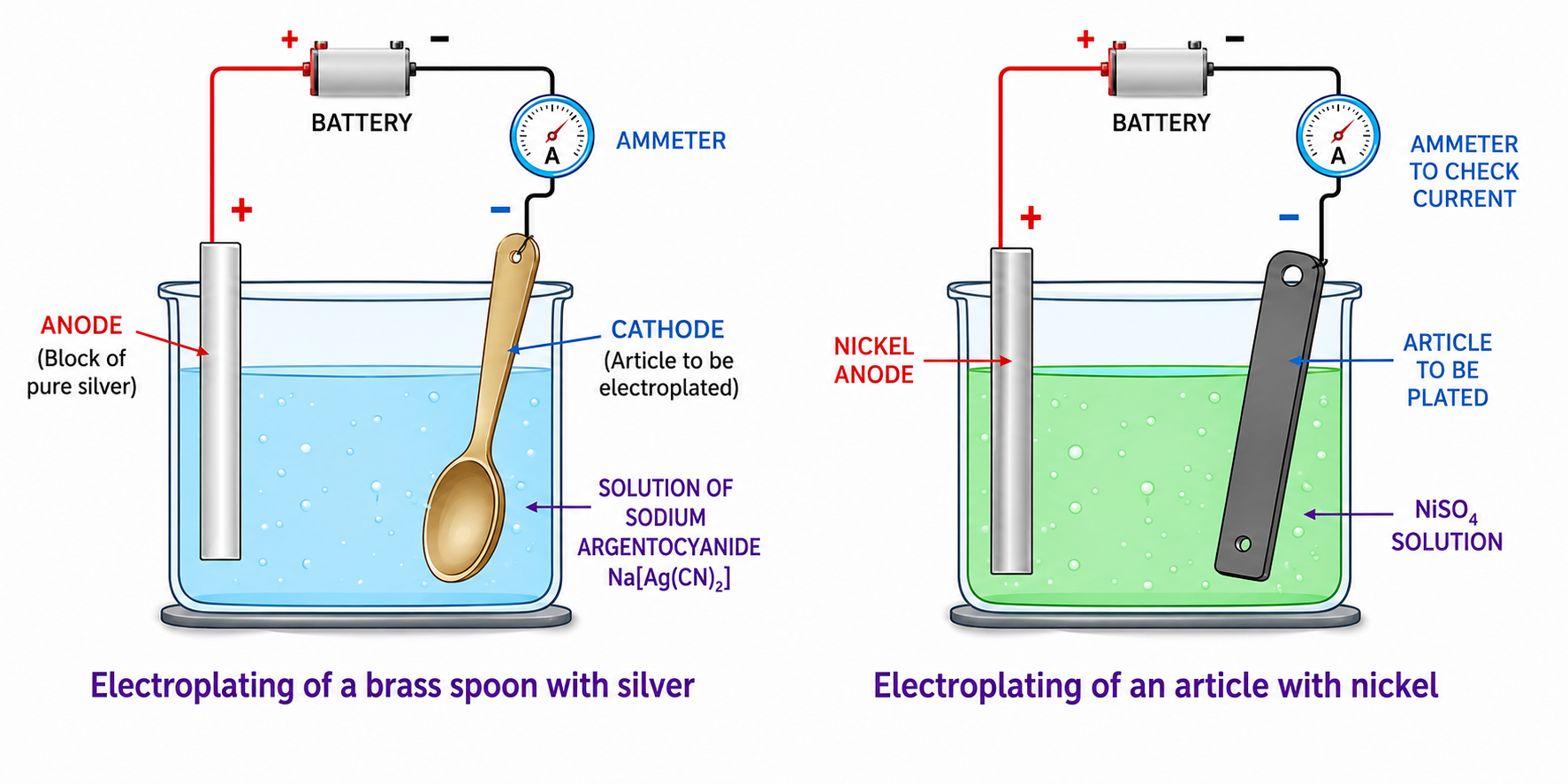
Electroplating: Process of depositing a thin, smooth, and firm layer of a superior metal (gold, silver, nickel, chromium) on an inferior metallic article with the help of electricity.
Reasons: (i) Decoration / aesthetic appeal, (ii) Protection from rusting and corrosion.
5 Essential Rules for Electroplating:
| Electroplating Process | Anode (+ve) | Cathode (-ve) | Electrolyte Used & Key Equations |
|---|---|---|---|
| Silver Plating (e.g. Brass spoon) |
Block of pure Silver ($Ag$) | Cleaned article (Brass spoon) |
Sodium Argentocyanide solution $Na[Ag(CN)_2]$ Preparation: $AgNO_3 + NaCN \rightarrow AgCN\downarrow + NaNO_3$ $AgCN + NaCN \rightarrow Na[Ag(CN)_2]$ Cathode: $Ag^+ + e^- \rightarrow Ag$ Anode: $Ag - e^- \rightarrow Ag^+$ Why not $AgNO_3$ directly? $AgNO_3$ causes fast, rough & non-uniform deposit! |
| Nickel Plating (e.g. Iron key) |
Block of pure Nickel ($Ni$) | Cleaned iron article | Nickel Sulphate solution ($NiSO_4$ acidified with dil. $H_2SO_4$) Cathode: $Ni^{2+} + 2e^- \rightarrow Ni$ Anode: $Ni - 2e^- \rightarrow Ni^{2+}$ |
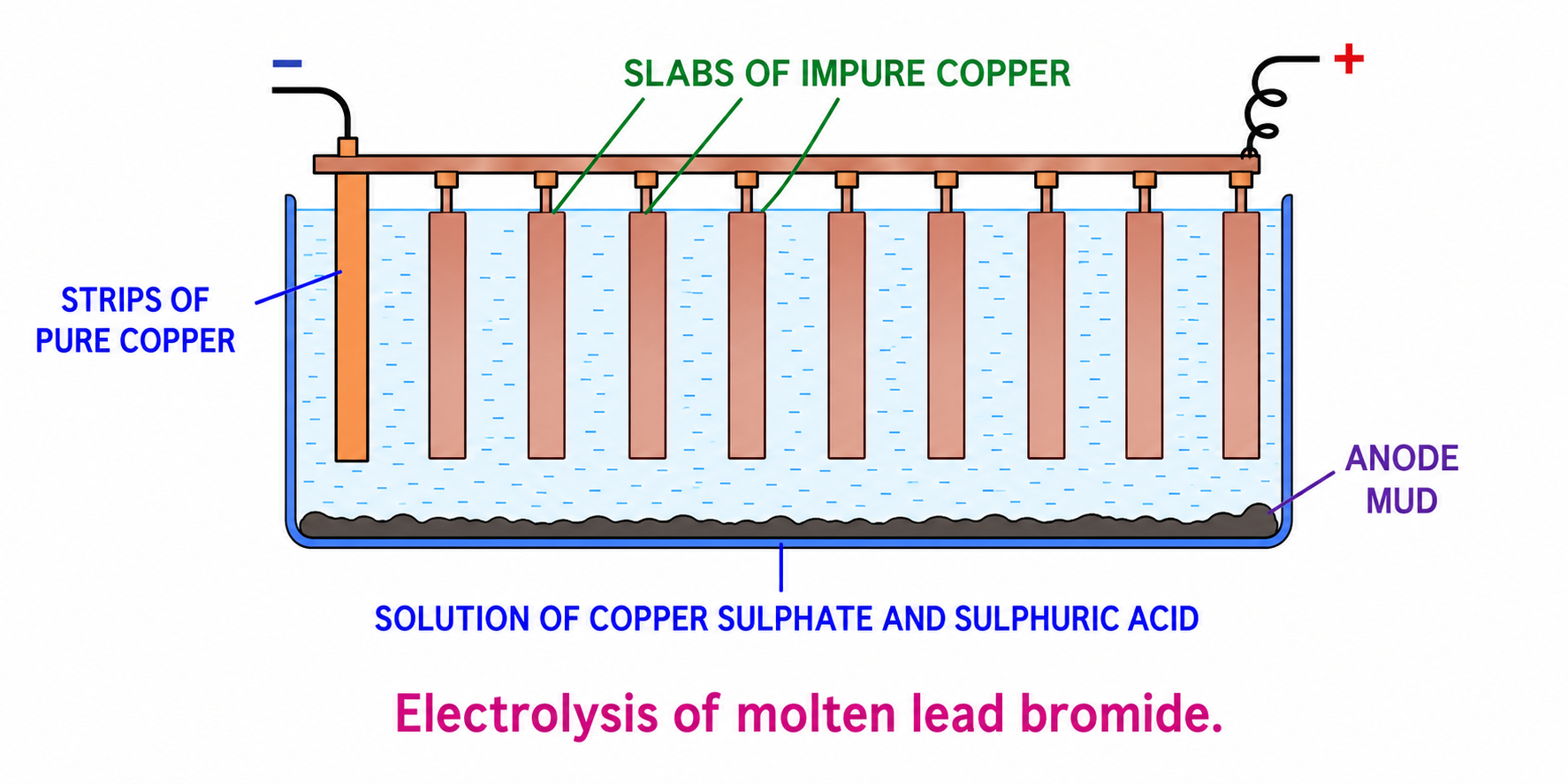
Objective: Obtaining 99.99% pure commercial copper for electrical transmission wires.
Highly electropositive metals ($K, Na, Ca, Mg, Al$) have strong affinity for oxygen and cannot be reduced by carbon or $CO$. They are extracted by electrolysis of their fused (molten) halides or oxides.
Why fused state instead of aqueous solution? In aqueous solution, $H^+$ ions are discharged at cathode preferentially over $Na^+, K^+, Al^{3+}$, so no metal would be obtained!
Extraction of Aluminium (Hall-Héroult Process):
| Class of Compound | Strong Electrolytes (Ionise completely) |
Weak Electrolytes (Ionise partially) |
Non-Electrolytes (Do not ionise) |
|---|---|---|---|
| Acids | $HCl, HNO_3, H_2SO_4$ | $CH_3COOH, HCOOH,$ $H_2CO_3, H_3PO_4$ |
— |
| Bases | $NaOH, KOH, LiOH$ | $NH_4OH, Ca(OH)_2,$ $Mg(OH)_2$ |
— |
| Salts | $NaCl, PbBr_2,$ $CuSO_4, AgNO_3$ |
$Na_2CO_3, KHCO_3,$ $(CH_3COO)_2Pb$ |
Organic covalent compounds ($CCl_4$, Benzene, Sugar) |