Vardaan Learning Institute
Mole Concept & Stoichiometry
- (i) Gay-Lussac’s Law of Combining Volumes & Avogadro’s Law: Statements, explanations, atomicity of gases ($H_2, O_2, N_2, Cl_2$), volume-volume calculations.
- (ii) Relative Atomic Mass & Relative Molecular Mass: $C-12$ standard scale, Gram Atomic Mass, Gram Molecular Mass, relation between Molecular Mass and Vapour Density ($RMM = 2 \times VD$), Molar Volume ($22.4 \text{ L}$ at STP).
- (iii) Mole Concept: Avogadro's number ($N_A = 6.022 \times 10^{23}$), mole-mass, mole-volume, and mole-particle conversions.
- (iv) Percentage Composition, Empirical & Molecular Formulae: Step-by-step calculations from percentage composition to empirical and molecular formulae.
- (v) Stoichiometry & Chemical Equations: Mass-mass, mass-volume, and volume-volume calculations based on balanced chemical equations.
5A. GAY-LUSSAC’S LAW AND AVOGADRO’S LAW
5.1 INTRODUCTION & GAS LAWS RECAP
All gases exhibit similar physical behavior under varying conditions of temperature ($T$) and pressure ($P$), governed by fundamental gas laws:
1. Boyle's Law (Pressure-Volume Relationship): At constant temperature, the volume ($V$) of a given mass of dry gas is inversely proportional to its pressure ($P$).
$$P_1 V_1 = P_2 V_2 = k \quad \text{(at constant } T\text{)}$$
2. Charles's Law (Temperature-Volume Relationship): At constant pressure, the volume ($V$) of a given mass of dry gas is directly proportional to its absolute temperature ($T$ in Kelvin).
$$\frac{V_1}{T_1} = \frac{V_2}{T_2} = k \quad \text{(at constant } P\text{)}$$
3. Combined Gas Equation:
$$\frac{P_1 V_1}{T_1} = \frac{P_2 V_2}{T_2} = \text{constant}$$
Standard Temperature and Pressure (STP / NTP):
- Standard Temperature: $0^\circ C = 273 \text{ K}$
- Standard Pressure: $1 \text{ atm} = 760 \text{ mm Hg} = 76 \text{ cm Hg}$
5.2 GAY-LUSSAC’S LAW OF COMBINING VOLUMES
CRITICAL EXAM RULE: Gay-Lussac’s Law is valid ONLY FOR GASES. The volumes of solids and liquids produced or reacting in a chemical equation are considered ZERO in Gay-Lussac volume calculations!
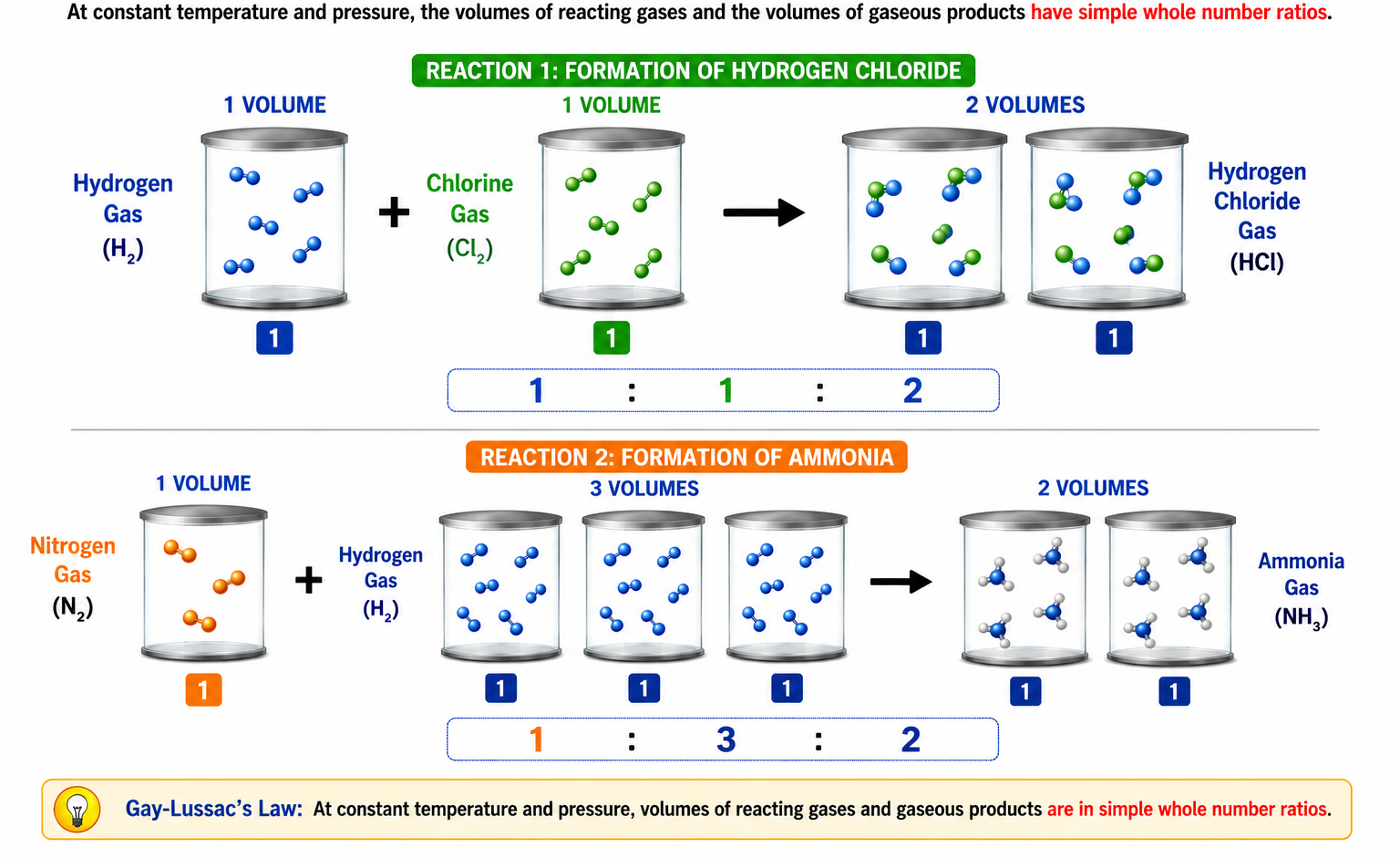
Illustrations of Gay-Lussac's Law
1. Formation of Hydrogen Chloride Gas:
$$H_2(g) + Cl_2(g) \rightarrow 2HCl(g)$$
$$\text{Vol. Ratio: } 1 : 1 : 2 \quad \text{(Simple whole number ratio)}$$
2. Synthesis of Ammonia Gas:
$$N_2(g) + 3H_2(g) \rightarrow 2NH_3(g)$$
$$\text{Vol. Ratio: } 1 : 3 : 2$$
3. Combustion of Carbon Monoxide:
$$2CO(g) + O_2(g) \rightarrow 2CO_2(g)$$
$$\text{Vol. Ratio: } 2 : 1 : 2$$
Limiting Reagent Concept: The reactant that is completely consumed first in a chemical reaction is called the Limiting Reagent (or Limiting Reactant). It limits and dictates the total amount of product formed!
SOLVED EXAMPLE 1 What volume of oxygen is required to burn completely $200 \text{ mL}$ of acetylene ($C_2H_2$), and what is the volume of carbon dioxide formed?
$$\text{Equation: } 2C_2H_2(g) + 5O_2(g) \rightarrow 4CO_2(g) + 2H_2O(l)$$
Step-by-Step Solution:
By Gay-Lussac's Law, volume ratio of $C_2H_2 : O_2 : CO_2 = 2 : 5 : 4$ (Water is liquid $\implies$ volume = 0).
2 volumes of $C_2H_2$ require 5 volumes of $O_2$.
$$\implies \text{Volume of } O_2 \text{ required} = \frac{5}{2} \times 200 \text{ mL} = \mathbf{500 \text{ mL}}$$
2 volumes of $C_2H_2$ produce 4 volumes of $CO_2$.
$$\implies \text{Volume of } CO_2 \text{ formed} = \frac{4}{2} \times 200 \text{ mL} = \mathbf{400 \text{ mL}}$$
SOLVED EXAMPLE 2 $80 \text{ cm}^3$ of methane ($CH_4$) is mixed with $200 \text{ cm}^3$ of pure oxygen at room temperature and ignited. Calculate the composition of the resulting gaseous mixture cooled to room temperature.
$$\text{Equation: } CH_4(g) + 2O_2(g) \rightarrow CO_2(g) + 2H_2O(l)$$
Step-by-Step Solution:
Volume ratio $CH_4 : O_2 : CO_2 = 1 : 2 : 1$.
1 vol. $CH_4$ requires 2 vols. $O_2 \implies 80 \text{ cm}^3 \text{ } CH_4$ requires $2 \times 80 = 160 \text{ cm}^3 \text{ } O_2$.
• Unreacted $O_2$ remaining: $200 - 160 = \mathbf{40 \text{ cm}^3}$
• $CO_2$ gas formed: $1 \times 80 = \mathbf{80 \text{ cm}^3}$
• Water ($H_2O$): Liquid at room temp $\implies$ volume negligible.
Final Composition of Gaseous Mixture: $80 \text{ cm}^3 \text{ } CO_2$ + $40 \text{ cm}^3 \text{ unreacted } O_2$ = $120 \text{ cm}^3$ total gas.
5.3 AVOGADRO’S LAW & ATOMICITY
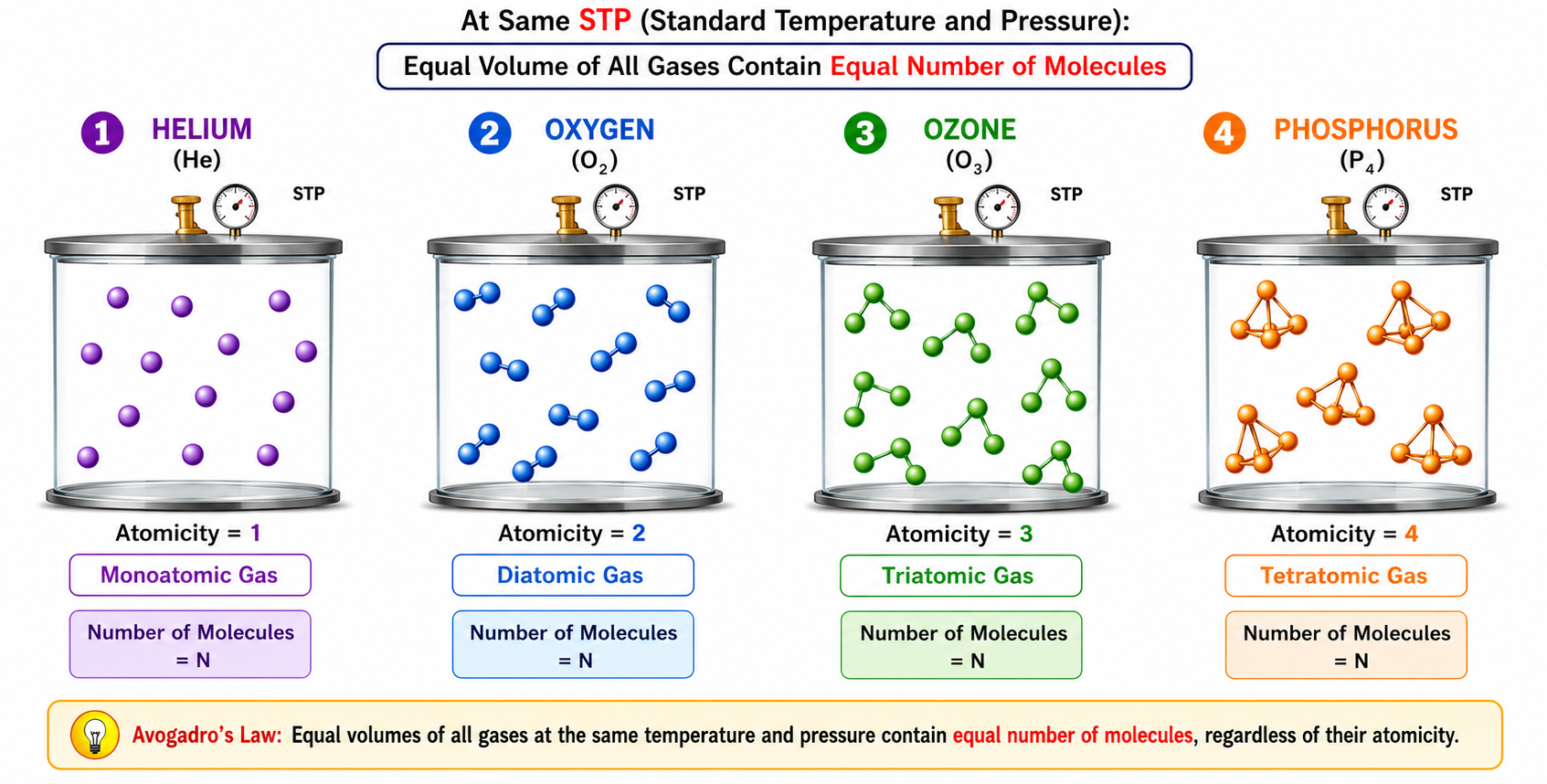
Avogadro’s Law: Equal volumes of all gases under similar conditions of temperature and pressure contain the same number of molecules.
Avogadro distinguished clearly between atoms and molecules:
- Atom: Smallest particle of an element that takes part in a chemical reaction; it may or may not exist independently.
- Molecule: Smallest particle of an element or compound that can exist independently and retains all chemical properties of the substance.
- Atomicity: The number of atoms present in one molecule of an element.
| Atomicity Type |
Number of Atoms per Molecule |
Examples |
| Monoatomic | 1 atom | Inert gases ($He, Ne, Ar, Kr, Xe$) |
| Diatomic | 2 atoms | $H_2, O_2, N_2, Cl_2, Br_2, I_2, CO, NO$ |
| Triatomic | 3 atoms | Ozone ($O_3$), $CO_2, H_2O, SO_2$ |
| Tetratomic | 4 atoms | Phosphorus ($P_4$), $NH_3$ |
| Octatomic | 8 atoms | Sulphur ($S_8$) |
Applications of Avogadro's Law
- Explains Gay-Lussac’s Law: Shows why gas reaction volumes are in simple whole-number ratios.
- Deduces Atomicity of Elementary Gases: Proves $H_2, Cl_2, N_2, O_2$ are diatomic.
- Relates Relative Molecular Mass (RMM) and Vapour Density (VD): $\mathbf{RMM = 2 \times VD}$.
- Establishes Molar Volume of Gases at STP: 1 mole of ANY gas at STP occupies $22.4 \text{ Litres}$.
Formal Proof 1: Relationship Between Molecular Mass & Vapour Density
$$\text{Vapour Density (VD)} = \frac{\text{Mass of volume } v \text{ of gas at STP}}{\text{Mass of volume } v \text{ of } H_2 \text{ gas at STP}}$$
According to Avogadro's Law, equal volumes contain equal number of molecules ($n$). Let volume $v$ contain $n$ molecules:
$$\text{VD} = \frac{\text{Mass of } n \text{ molecules of gas}}{\text{Mass of } n \text{ molecules of } H_2} = \frac{\text{Mass of 1 molecule of gas}}{\text{Mass of 1 molecule of } H_2}$$
Since a Hydrogen molecule is diatomic ($\text{Mass of 1 molecule of } H_2 = 2 \times \text{Mass of 1 atom of } H$):
$$\text{VD} = \frac{\text{Mass of 1 molecule of gas}}{2 \times \text{Mass of 1 atom of } H}$$
Multiplying both sides by 2:
$$2 \times \text{VD} = \frac{\text{Mass of 1 molecule of gas}}{\text{Mass of 1 atom of } H} = \mathbf{\text{Relative Molecular Mass (RMM)}}$$
$$\mathbf{\text{RMM} = 2 \times \text{Vapour Density (VD)}}$$
Formal Proof 2: Deduction of Atomicity of Elementary Gases ($H_2, Cl_2$)
Consider the reaction between Hydrogen and Chlorine gas:
$$\text{Hydrogen} + \text{Chlorine} \rightarrow \text{Hydrogen Chloride}$$
$$\text{Vol. Ratio: } 1 \text{ vol.} + 1 \text{ vol.} \rightarrow 2 \text{ vols. (by Gay-Lussac's Law)}$$
Applying Avogadro's Law (let 1 vol. contain $n$ molecules):
$$n \text{ molecules of } H_2 + n \text{ molecules of } Cl_2 \rightarrow 2n \text{ molecules of } HCl$$
$$\text{Dividing by } n: 1 \text{ molecule of } H_2 + 1 \text{ molecule of } Cl_2 \rightarrow 2 \text{ molecules of } HCl$$
$$\text{Dividing by } 2: \frac{1}{2} \text{ molecule of } H_2 + \frac{1}{2} \text{ molecule of } Cl_2 \rightarrow 1 \text{ molecule of } HCl$$
1 molecule of $HCl$ contains at least 1 atom of H and 1 atom of Cl. Therefore, $\frac{1}{2}$ molecule of Hydrogen contains 1 atom of H $\implies$ 1 full molecule of Hydrogen contains 2 atoms ($H_2$). Hence, Hydrogen and Chlorine are diatomic!
5B. RELATIVE ATOMIC MASS, RELATIVE MOLECULAR MASS AND MOLE CONCEPT
5.4 RELATIVE ATOMIC MASS (RAM) & FRACTIONAL ATOMIC MASS
Relative Atomic Mass (RAM / Atomic Weight): The number of times one atom of an element is heavier than $\frac{1}{12}\text{th}$ the mass of an atom of Carbon-12 ($^{12}C$).
$$\text{RAM} = \frac{\text{Mass of 1 atom of the element}}{\frac{1}{12} \times \text{Mass of 1 atom of } ^{12}C}$$
Atomic Mass Unit (amu or u): Defined as exactly $\frac{1}{12}\text{th}$ the mass of a Carbon-12 atom ($1 \text{ amu} = 1.6605 \times 10^{-24} \text{ g}$).
Why are Atomic Masses Fractional? Most elements exist in nature as a mixture of two or more isotopes in fixed natural abundance. RAM is the weighted average of isotopic masses!
Example (Chlorine): Contains $^{35}Cl$ and $^{37}Cl$ in $3 : 1$ ratio.
$$\text{Average RAM of Chlorine} = \frac{(35 \times 3) + (37 \times 1)}{3 + 1} = \frac{105 + 37}{4} = \mathbf{35.5 \text{ amu}}$$
5.5 RELATIVE MOLECULAR MASS (RMM)
5.6 & 5.7 GRAM ATOMIC MASS AND GRAM MOLECULAR MASS
- Gram Atomic Mass (GAM / 1 g-atom): The atomic mass of an element expressed in grams. (e.g. GAM of Oxygen = $16 \text{ g}$).
- Gram Molecular Mass (GMM / 1 g-molecule / Molar Mass): The molecular mass of a substance expressed in grams. (e.g. GMM of $H_2O = 18 \text{ g}$, GMM of $H_2SO_4 = 98 \text{ g}$).
5.8 THE MOLE CONCEPT & AVOGADRO'S NUMBER
Mole: A mole is the amount of pure substance that contains as many elementary entities (atoms, molecules, ions, electrons) as there are atoms in exactly $12 \text{ grams}$ of Carbon-12.
Avogadro’s Number ($N_A$): The fixed number of particles present in one mole of any substance.
$$\mathbf{N_A = 6.022 \times 10^{23} \text{ particles/mole}}$$
| 1 Mole of Substance |
Mass Equivalent |
Particle Equivalent ($N_A$) |
STP Gas Volume Equivalent |
| 1 Mole of Atoms (e.g. $Na$) |
Gram Atomic Mass ($23 \text{ g}$) |
$6.022 \times 10^{23}$ atoms |
— |
| 1 Mole of Molecules (e.g. $O_2$) |
Gram Molecular Mass ($32 \text{ g}$) |
$6.022 \times 10^{23}$ molecules |
$22.4 \text{ Litres}$ at STP |
| 1 Mole of Ionic Compound ($NaCl$) |
Gram Formula Mass ($58.5 \text{ g}$) |
$6.022 \times 10^{23}$ formula units |
— |
MASTER MOLE CONVERSION FORMULAS:
- $$\text{Moles } (n) = \frac{\text{Given Mass } (m)}{\text{Molar Mass } (M)}$$
- $$\text{Moles } (n) = \frac{\text{Given Volume at STP in Litres } (V)}{22.4 \text{ L}}$$
- $$\text{Moles } (n) = \frac{\text{Given Number of Particles } (N)}{6.022 \times 10^{23}}$$
- $$\text{Mass of 1 single atom} = \frac{\text{Gram Atomic Mass}}{6.022 \times 10^{23}}$$
- $$\text{Mass of 1 single molecule} = \frac{\text{Gram Molecular Mass}}{6.022 \times 10^{23}}$$
SOLVED EXAMPLE 1 Calculate the relative molecular mass of hydrated copper sulphate ($CuSO_4 \cdot 5H_2O$). [Given: $Cu = 63.5, S = 32, O = 16, H = 1$]
Solution:
$$\text{RMM of } CuSO_4 \cdot 5H_2O = 63.5 + 32 + (4 \times 16) + 5 \times (2 \times 1 + 16)$$
$$= 63.5 + 32 + 64 + 5 \times 18 = 159.5 + 90 = \mathbf{249.5 \text{ amu}}$$
SOLVED EXAMPLE 2 Calculate: (i) the mass of $0.2 \text{ moles}$ of $H_2O$, (ii) the number of molecules in $1.8 \text{ g}$ of $H_2O$, (iii) the volume occupied by $8.8 \text{ g}$ of $CO_2$ gas at STP.
Step-by-Step Solutions:
(i) Molar mass of $H_2O = 18 \text{ g/mol}$.
$$\text{Mass} = \text{Moles} \times \text{Molar Mass} = 0.2 \times 18 = \mathbf{3.6 \text{ grams}}$$
(ii) Moles in $1.8 \text{ g } H_2O = \frac{1.8}{18} = 0.1 \text{ mole}$.
$$\text{Molecules} = 0.1 \times 6.022 \times 10^{23} = \mathbf{6.022 \times 10^{22} \text{ molecules}}$$
(iii) Molar mass of $CO_2 = 12 + 32 = 44 \text{ g/mol}$.
$$\text{Moles of } CO_2 = \frac{8.8}{44} = 0.2 \text{ mole}$$
$$\text{Volume at STP} = 0.2 \times 22.4 \text{ L} = \mathbf{4.48 \text{ Litres}}$$
SOLVED EXAMPLE 3 A gas cylinder holds $50 \text{ g}$ of hydrogen gas. The same cylinder holds $200 \text{ g}$ of Gas X under identical conditions of temperature and pressure. Calculate the relative molecular mass of Gas X.
Solution:
By Avogadro's Law, equal volumes of gases under identical conditions contain equal number of moles.
$$\text{Vapour Density (VD) of Gas X} = \frac{\text{Mass of gas X}}{\text{Mass of equal vol. of } H_2} = \frac{200 \text{ g}}{50 \text{ g}} = 4$$
$$\text{Molecular Mass of Gas X} = 2 \times \text{VD of Gas X} = 2 \times 4 = \mathbf{8 \text{ amu}}$$
(since Relative Molecular Mass $RMM = 2 \times VD$)
SOLVED EXAMPLE 4 Calculate the total number of electrons present in $1.6 \text{ g}$ of methane gas ($CH_4$). [Given: $C = 12, H = 1$]
Solution:
$$\text{Molar mass of } CH_4 = 12 + (4 \times 1) = 16 \text{ g/mol}$$
$$\text{Moles of } CH_4 = \frac{1.6}{16} = 0.1 \text{ mole}$$
$$\text{Number of } CH_4 \text{ molecules} = 0.1 \times 6.022 \times 10^{23} = 6.022 \times 10^{22} \text{ molecules}$$
1 molecule of $CH_4$ contains $6 + 4(1) = 10 \text{ electrons}$.
$$\text{Total number of electrons} = 10 \times 6.022 \times 10^{22} = \mathbf{6.022 \times 10^{23} \text{ electrons}}$$
SOLVED EXAMPLE 5 Find the number of $Na^+$ ions and $SO_4^{2-}$ ions in $14.2 \text{ g}$ of sodium sulphate ($Na_2SO_4$). [Given: $Na = 23, S = 32, O = 16$]
Solution:
$$\text{Molar mass of } Na_2SO_4 = (2 \times 23) + 32 + (4 \times 16) = 142 \text{ g/mol}$$
$$\text{Moles of } Na_2SO_4 = \frac{14.2}{142} = 0.1 \text{ mole}$$
$$\text{Total formula units} = 0.1 \times 6.022 \times 10^{23} = 6.022 \times 10^{22} \text{ units}$$
Each unit of $Na_2SO_4$ dissociates into $2 Na^+$ ions and $1 SO_4^{2-}$ ion.
$$\text{Number of } Na^+ \text{ ions} = 2 \times 6.022 \times 10^{22} = \mathbf{1.204 \times 10^{23} \text{ ions}}$$
$$\text{Number of } SO_4^{2-} \text{ ions} = 1 \times 6.022 \times 10^{22} = \mathbf{6.022 \times 10^{22} \text{ ions}}$$
5C. PERCENTAGE COMPOSITION, EMPIRICAL AND MOLECULAR FORMULAE
5.10 PERCENTAGE COMPOSITION
Percentage Composition: The percentage by weight of each constituent element present in a compound.
$$\text{Percentage of Element} = \left( \frac{\text{Mass of Element in 1 Mole}}{\text{Gram Molecular Mass of Compound}} \right) \times 100$$
5.11 EMPIRICAL FORMULA vs MOLECULAR FORMULA
| Feature |
Empirical Formula |
Molecular Formula |
| Definition |
Simplest whole-number ratio of atoms of different elements present in one molecule. |
Actual number of atoms of each element present in one molecule of the compound. |
| Example (Glucose) |
$CH_2O$ (Ratio $C:H:O = 1:2:1$) |
$C_6H_{12}O_6$ |
| Example (Hydrogen Peroxide) |
$HO$ (Ratio $H:O = 1:1$) |
$H_2O_2$ |
| Mathematical Relation |
$\mathbf{\text{Molecular Formula} = n \times (\text{Empirical Formula})}$
$\text{where } n = \frac{\text{Molecular Weight}}{\text{Empirical Formula Weight}}$
|
5.12 STEP-BY-STEP PROCEDURE FOR DETERMINING EMPIRICAL FORMULA
- List Elements & Percentages: Note the percentage by mass of each element. (If sum $< 100\%$, the remainder is Oxygen).
- Calculate Atomic Ratios: Divide percentage of each element by its atomic mass ($Ratio = \frac{\%}{Atomic Mass}$).
- Find Simplest Ratio: Divide all atomic ratios by the smallest ratio value obtained.
- Convert to Whole Numbers: If ratios are fractional (e.g. $1.5$), multiply all numbers by a suitable integer (e.g. $\times 2$) to obtain whole numbers.
- Write Formula: Combine element symbols with their respective simplest whole-number subscripts.
SOLVED EXAMPLE 1 Calculate the percentage of water of crystallisation in washing soda crystals ($Na_2CO_3 \cdot 10H_2O$). [Given: $Na = 23, C = 12, O = 16, H = 1$]
Solution:
$$\text{Molar mass of } Na_2CO_3 \cdot 10H_2O = (23 \times 2) + 12 + (16 \times 3) + 10 \times (2 + 16)$$
$$= 46 + 12 + 48 + 180 = 286 \text{ g/mol}$$
$$\text{Mass of water of crystallisation } (10H_2O) = 180 \text{ g}$$
$$\text{Percentage of } H_2O = \frac{180}{286} \times 100 = \mathbf{62.94\%}$$
SOLVED EXAMPLE 2 An organic compound contains $40.0\%$ Carbon, $6.7\%$ Hydrogen, and the rest Oxygen. Its vapour density is $30$. Find its empirical formula and molecular formula.
Step 1: Calculate Percentage of Oxygen:
$$\% \text{ Oxygen} = 100 - (40.0 + 6.7) = 53.3\%$$
Step 2: Tabular Empirical Formula Calculation:
| Element |
% Composition |
Atomic Mass |
Atomic Ratio ($\%/At.Mass$) |
Simplest Ratio |
| Carbon (C) | $40.0\%$ | $12$ | $40.0 / 12 = 3.33$ | $3.33 / 3.33 = \mathbf{1}$ |
| Hydrogen (H) | $6.7\%$ | $1$ | $6.7 / 1 = 6.70$ | $6.70 / 3.33 = \mathbf{2}$ |
| Oxygen (O) | $53.3\%$ | $16$ | $53.3 / 16 = 3.33$ | $3.33 / 3.33 = \mathbf{1}$ |
$$\mathbf{\text{Empirical Formula} = CH_2O}$$
Step 3: Determine Molecular Formula:
$$\text{Empirical Formula Weight } (EFW) = 12 + (2 \times 1) + 16 = 30 \text{ amu}$$
$$\text{Molecular Weight } (MW) = 2 \times \text{Vapour Density} = 2 \times 30 = 60 \text{ amu}$$
$$n = \frac{MW}{EFW} = \frac{60}{30} = 2$$
$$\mathbf{\text{Molecular Formula} = n \times (CH_2O) = (CH_2O)_2 = C_2H_4O_2 \quad (\text{Acetic Acid})}$$
SOLVED EXAMPLE 3 On heating $10 \text{ g}$ of copper sulphate crystals ($CuSO_4 \cdot xH_2O$), $6.4 \text{ g}$ of anhydrous copper sulphate is left. Find the formula of the crystalline salt. [Given: $Cu = 63.5, S = 32, O = 16, H = 1$]
Solution:
• Mass of anhydrous $CuSO_4 = 6.4 \text{ g}$
• Mass of water lost ($xH_2O$) = $10 - 6.4 = 3.6 \text{ g}$
• Molar mass of $CuSO_4 = 63.5 + 32 + 64 = 159.5 \text{ g/mol}$
• Molar mass of $H_2O = 18 \text{ g/mol}$
$$\text{Moles of } CuSO_4 = \frac{6.4}{159.5} = 0.0401 \text{ moles}$$
$$\text{Moles of } H_2O = \frac{3.6}{18} = 0.20 \text{ moles}$$
$$\text{Mole ratio of } H_2O : CuSO_4 = \frac{0.20}{0.0401} = 5$$
$$\mathbf{\text{Formula of crystalline salt} = CuSO_4 \cdot 5H_2O}$$
5D. CALCULATIONS BASED ON CHEMICAL EQUATIONS (STOICHIOMETRY)
5.14 STOICHIOMETRIC CALCULATIONS
Stoichiometry measures quantitative relationships between reactants and products in a balanced chemical equation.
3-STEP STOICHIOMETRIC SOLVING TECHNIQUE:
- Write a Balanced Equation: Ensure coefficients correctly represent mole and volume ratios.
- Convert Given Quantity to Moles: Use mass/molar mass or volume/22.4 L at STP.
- Apply Mole Ratio: Multiply by product/reactant mole ratio to determine required mass or volume.
SOLVED EXAMPLE 1 (MASS-MASS) Calculate the mass of quicklime (calcium oxide, $CaO$) obtained by heating $200 \text{ g}$ of pure limestone ($CaCO_3$). [Given: $Ca = 40, C = 12, O = 16$]
$$\text{Reaction: } CaCO_3(s) \xrightarrow{\Delta} CaO(s) + CO_2(g)$$
Solution:
$$\text{Molar mass of } CaCO_3 = 40 + 12 + (3 \times 16) = 100 \text{ g/mol}$$
$$\text{Molar mass of } CaO = 40 + 16 = 56 \text{ g/mol}$$
According to the balanced equation, $100 \text{ g}$ of $CaCO_3$ yields $56 \text{ g}$ of $CaO$.
$$\implies \text{Mass of } CaO = \frac{56}{100} \times 200 = \mathbf{112 \text{ grams}}$$
SOLVED EXAMPLE 2 (MASS-VOLUME) Calculate the volume of oxygen gas liberated at STP by the complete thermal decomposition of $24.5 \text{ g}$ of potassium chlorate ($KClO_3$). [Given: $K = 39, Cl = 35.5, O = 16$]
$$\text{Reaction: } 2KClO_3(s) \xrightarrow{MnO_2, \Delta} 2KCl(s) + 3O_2(g)$$
Solution:
• Molar mass of $KClO_3 = 39 + 35.5 + 48 = 122.5 \text{ g/mol}$
• $2 \text{ moles of } KClO_3 = 2 \times 122.5 = 245 \text{ g}$
• $3 \text{ moles of } O_2 \text{ gas at STP} = 3 \times 22.4 \text{ L} = 67.2 \text{ Litres}$
Since $245 \text{ g}$ of $KClO_3$ liberates $67.2 \text{ L}$ of $O_2$ at STP:
$$\text{Volume liberated from } 24.5 \text{ g } KClO_3 = \frac{67.2}{245} \times 24.5 = \mathbf{6.72 \text{ Litres of } O_2 \text{ at STP}}$$
SOLVED EXAMPLE 3 (PERCENTAGE YIELD) On heating $12.4 \text{ g}$ of copper(II) carbonate ($CuCO_3$) in a crucible, only $7.0 \text{ g}$ of copper(II) oxide ($CuO$) was obtained. Calculate the percentage yield of copper(II) oxide. [Given: $Cu = 64, C = 12, O = 16$]
$$\text{Reaction: } CuCO_3(s) \xrightarrow{\Delta} CuO(s) + CO_2(g)$$
Step 1: Calculate Theoretical Yield:
• Molar mass of $CuCO_3 = 64 + 12 + 48 = 124 \text{ g/mol}$
• Molar mass of $CuO = 64 + 16 = 80 \text{ g/mol}$
$124 \text{ g}$ of $CuCO_3$ produces $80 \text{ g}$ of $CuO$.
$$\text{Theoretical Yield} = \frac{80}{124} \times 12.4 = \mathbf{8.0 \text{ grams of } CuO}$$
Step 2: Calculate Percentage Yield:
$$\text{Percentage Yield} = \frac{\text{Actual Yield}}{\text{Theoretical Yield}} \times 100$$
$$\text{Percentage Yield} = \frac{7.0 \text{ g}}{8.0 \text{ g}} \times 100 = \mathbf{87.5\%}$$