Vardaan Learning Institute
Acids, Bases and Salts
- (i) Simple definitions in terms of the molecules and their characteristic properties.
- (ii) Ions present in mineral acids, alkalis and salts and their solutions; use of common acid-base indicator (litmus, methyl orange and phenolphthalein) and pH paper to test for acidity and alkalinity. Examples with equation for the ionisation/dissociation of ions of acids, bases and salts.
- Acids form hydronium ions (only positive ions) which turn blue litmus red, alkalis form hydroxyl ions (only negative ions) with water which turns red litmus blue.
- Salts are formed by partial or complete replacement of the hydrogen ion of an acid by a metal. (To be explained with suitable examples).
- Introduction to pH scale to test for acidity, neutrality and alkalinity by using pH paper or Universal indicator.
- (iii) Definition of salt; types of salts: normal salts, acid salt, basic salt, complex salts (definition and examples).
- (iv) Action of dilute acids on salts: Decomposition of hydrogen carbonates, carbonates, hydrogen sulphites, sulphites and sulphides by appropriate acids with heating if necessary. (Relevant laboratory work must be done).
- (v) Methods of preparation of Normal salts with relevant equations. (Details of apparatus or procedures not required). Methods included are: Direct combination, Displacement, Precipitation (double decomposition), Neutralization of insoluble base, Neutralisation of an alkali (titration), Action of dilute acids on carbonates and bi-carbonates.
3A. ACIDS AND BASES (INTRODUCTION)
Lavoisier and Davy studied the terms acids, bases and salts on more scientific lines. Their findings say that:
- All acids compulsorily have hydrogen as their constituent element in the form of proton ($H^+$). Examples: Hydrochloric acid, sulphuric acid and nitric acid.
- All bases are either metallic oxide ($O^{2-}$), metallic hydroxide ($OH^-$) or ammonia solution. Examples: Copper oxide, sodium hydroxide and ammonium hydroxide.
- All salts are chemical compounds formed by the interaction of acid and base replacing hydrogen ions present in an acid, by metallic ion [or non-metallic ammonium ions ($NH_4^+$)]. Examples: Sodium chloride, calcium carbonate.
3.2 ACIDS
The word 'acid' comes from the Latin word acidus, meaning 'sour'. In fact, the sour taste of some foods is due to the acids they contain.
| Some Naturally Occurring Acids | Source |
|---|
| Acetic acid | Vinegar |
| Citric acid | Citrus fruits (oranges and lemons) |
| Butyric acid | Rancid butter |
| Hydrochloric acid | Gastric juice |
| Formic acid | Sting of bees and ants |
| Lactic acid | Sour milk |
| Maleic acid | Apples |
| Oleic acid | Olive oil |
| Oxalic acid | Tomatoes |
| Stearic acid | Fats |
| Tartaric acid | Grapes, tamarind and apples |
| Uric acid | Urine |
Definition of Acids: Acids are defined as compounds which contain one or more hydrogen atoms and when dissolved in water, produce hydronium ions ($H_3O^+$) as the only positively charged ions.
At first, the acid molecule furnishes hydrogen ion (or proton), i.e., $H^+$ ion in aqueous solution. But this $H^+$ ion cannot exist independently. Therefore, it combines with a water molecule to form hydronium ion $(H_3O^+)$. This hydrated ion can now exist independently in solution.
$H^+ + H_2O \rightarrow H_3O^+$
Hydrogen ion + Water molecule $\rightarrow$ Hydronium ion (or simply $H^+$)
Examples of ionisation in water:
- $HCl + H_2O \rightarrow H_3O^+ + Cl^-$
- $H_2SO_4 + 2H_2O \rightleftharpoons 2H_3O^+ + SO_4^{2-}$
- $HNO_3 + H_2O \rightleftharpoons H_3O^+ + NO_3^-$
- $CH_3COOH + H_2O \rightleftharpoons H_3O^+ + CH_3COO^-$
Note: In fact, the hydronium ion, $H_3O^+$, can also be written as $OH_3^+$ since the positive charge is due to the presence of extra hydrogen ion ($H^+$) with water, which is neutral. The acidic properties of an acid are actually the properties of hydronium ions present in it.
3.3 CLASSIFICATION OF ACIDS
Acids can be classified in different ways.
1. Depending on their sources
- (i) Organic acids: Acids which are obtained usually from plants are called organic acids. They contain carbon atom also alongwith hydrogen atom. Examples: Oxalic acid $(COOH)_2$, Acetic acid $CH_3COOH$. They are weak acids and they do not ionise completely in solution.
- (ii) Inorganic acids (mineral acids): Acids which are obtained usually from minerals. They do not contain carbon (except carbonic acid $H_2CO_3$). Examples: Hydrochloric acid (HCl), Sulphuric acid ($H_2SO_4$), Nitric acid ($HNO_3$). They are strong acids and ionise completely producing a high concentration of hydronium ions.
Note: Carbonic acid ($H_2CO_3$) is a weak mineral acid. It turns blue litmus pink. It is non-corrosive, and so used in soft drinks.
Oxy-acids vs Hydracids: Acids which contain oxygen along with hydrogen and some other element are oxy-acids (e.g., $HNO_3, H_2SO_4$). Hydracids contain hydrogen and a non-metallic element, and no oxygen (e.g., HCl, HBr).
2. Depending on their concentration
Concentration of an acid means the amount of acid present in a definite amount of its aqueous solution.
- Concentrated acid: An acid which contains a very small amount of water or no water.
- Dilute acid: An acid which contains far more amount of water than its mass.
Rule of Dilution: In order to dilute an acid, pour acid into water in small amounts and stir constantly. Water is NOT added to acid as it is an exothermic process and in this process so much heat is produced that splashing of acidic solution may occur, also the container may break which can be fatal.
Strength vs Concentration: Concentration simply tells us the amount of water present in the acid and not at all the strength of the acid. Strength of an acid is the measure of concentration of hydronium ions it produces in its aqueous solution. Thus dil. HCl is a stronger acid than highly concentrated acetic acid.
Degree of ionisation ($\alpha$):
$\alpha = \frac{\text{No. of acid molecules ionised}}{\text{Total no. of acid molecules present in aqueous solution}} \times 100$
If the degree of ionisation ($\alpha$) for an acid, base or salt in aqueous solution is greater than 30%, it is strong and if it is less than 30%, it is weak.
3. Depending on their basicity
The basicity of an acid is defined as the number of hydronium ions ($H_3O^+$) that can be produced by the ionisation of one molecule of that acid in aqueous solution.
- (i) Monobasic acids: Acids which on ionisation in water produce one hydronium ion per molecule of the acid. Example: $HCl + H_2O \rightarrow H_3O^+ + Cl^-$. Other examples: HBr, $HNO_3$, HI, $CH_3COOH$.
(Note: Acetic acid contains 4 hydrogen atoms, but it is a monobasic acid because its molecule ionises by liberating only one hydronium ion.) Monobasic acids ionise in one step and so form only one normal salt.
- (ii) Dibasic acids: Acids which, on ionisation in water, produce two hydronium ions ($H_3O^+$) per molecule. Examples: $H_2SO_4$, Oxalic acid $(H_2C_2O_4)$, Sulphurous acid $(H_2SO_3)$, Carbonic acid $(H_2CO_3)$. They ionise in two steps and form one acid salt or one normal salt.
Step 1: $H_2SO_4 + H_2O \rightleftharpoons H_3O^+ + HSO_4^-$
Step 2: $HSO_4^- + H_2O \rightleftharpoons H_3O^+ + SO_4^{2-}$
- (iii) Tribasic acids: Acids which, on ionisation in water, produce three hydronium ions per molecule. Example: Phosphoric acid ($H_3PO_4$), Citric acid ($C_6H_8O_7$). They ionise in three steps and can form two different acid salts and one normal salt.
Exception Note: Phosphorous acid ($H_3PO_3$) is a dibasic acid because in oxyacids of phosphorus, hydrogen atoms which are attached to oxygen atoms are replaceable. Hydrogen atoms directly bonded to phosphorus atoms are not replaceable. Silicic acid $H_4SiO_4$ has basicity four.
3.5 PROPERTIES OF ACIDS
Physical properties
1. Taste: Acids have a sour taste. Mineral acids like $H_2SO_4$ and $HNO_3$ are highly corrosive in nature. Therefore, they should not be tasted.
2. Physical state: Some acids are solids and some are liquids at room temperature.
- Solid Acids: Boric acid ($H_3BO_3$), Oxalic acid ($(COOH)_2$), Tartaric acid, Citric acid, Phosphoric acid ($H_3PO_4$).
- Liquid Acids: Volatile acids vaporise easily (Acetic acid, Formic acid, Carbonic acid, Hydrochloric acid, Nitric acid, Sulphurous acid). Non-volatile acids ($H_2SO_4$ conc.).
3. Effect on skin: All strong mineral acids have corrosive action on the skin and cause painful burns. Conc. $H_2SO_4$ stains the skin black, conc. $HNO_3$ makes it yellow and conc. HCl amber colour.
4. Effect on Indicators: Indicators are complex substances that acquire separate colours in acidic and basic mediums.
| Indicator | Colour change in acidic medium |
|---|
| Litmus | Blue to red |
| Methyl orange | Orange to pink |
| Phenolphthalein | Remains colourless |
Olfactory Indicators: Those substances whose smell (or odour) changes in acidic or basic solutions. For example, onion, vanilla and clove oil. An acidic solution does not destroy the smell of the onion, but a basic solution does.
5. Electrolytes: They conduct electricity in the aqueous state.
Chemical properties
- Reaction with active metals: Both dilute HCl and dilute $H_2SO_4$ react explosively with active metals (K, Na, Ca) and moderately with less active metals (Mg, Zn, Fe) producing metallic salts and hydrogen.
$Mg + 2HCl \rightarrow MgCl_2 + H_2\uparrow$
Note: Nitric acid is a very strong oxidising agent so it is not used in the preparation of hydrogen. It oxidises hydrogen and form water. Only Mg and Mn can produce hydrogen with very dilute nitric acid (1% acid).
- Reaction with bases - Neutralisation: Acids neutralise bases to form salt and water only.
$CuO + H_2SO_4 \rightarrow CuSO_4 + H_2O$
- Reaction with carbonates and bicarbonates: Acids liberate carbon dioxide on reaction with metallic carbonates and bicarbonates.
$CaCO_3 + 2HCl \rightarrow CaCl_2 + H_2O + CO_2\uparrow$
Note: If the salt produced is insoluble, then the reaction does not proceed (e.g. Lead carbonate with HCl).
- Reaction with sulphites and bisulphites: Acids react with sulphites and bisulphites of metals to liberate sulphur dioxide.
$CaSO_3 + 2HCl \rightarrow CaCl_2 + H_2O + SO_2\uparrow$
- Reaction with sulphides: Acids react with metal sulphides to liberate hydrogen sulphide.
$ZnS + 2HCl \rightarrow ZnCl_2 + H_2S\uparrow$
Q1 (a) What do you understand by the term, acid? (b) Name the positive ion formed when an acid is dissolved in water. (c) Draw the structure of this ion.
Solution:
(a) An acid is a compound which when dissolved in water yields hydronium ions ($H_3O^+$) as the only positively charged ions.
(b) Hydronium ion ($H_3O^+$).
(c) Structure: $[H - \underset{\downarrow}{\overset{\bullet \bullet}{O}} - H]^+$ (the arrow represents a coordinate bond from Oxygen to Hydrogen).
Q4 Define the term 'basicity' of an acid. Give the basicity of nitric acid, sulphuric acid and phosphoric acid.
Solution:
Basicity is the number of hydronium ions ($H_3O^+$) that can be produced by the ionisation of one molecule of that acid in aqueous solution.
• Nitric acid ($HNO_3$): Monobasic (Basicity = 1)
• Sulphuric acid ($H_2SO_4$): Dibasic (Basicity = 2)
• Phosphoric acid ($H_3PO_4$): Tribasic (Basicity = 3)
Q6 Name the (a) acidic anhydride of the following acids: (i) sulphurous acid, (ii) nitric acid, (iii) phosphoric acid, (iv) carbonic acid.
Solution:
(i) Sulphurous acid: Sulphur dioxide ($SO_2$)
(ii) Nitric acid: Dinitrogen pentoxide ($N_2O_5$)
(iii) Phosphoric acid: Phosphorus pentoxide ($P_2O_5$)
(iv) Carbonic acid: Carbon dioxide ($CO_2$)
Q7 What do you understand by the statement 'acetic acid is a monobasic acid'?
Solution:
It means that one molecule of acetic acid ($CH_3COOH$) on ionisation in water produces only one hydronium ion ($H_3O^+$). Even though its molecule contains four hydrogen atoms, only the one hydrogen atom in the carboxyl (-COOH) group is ionisable.
Q10 Explain the following: (b) Dil. HCl acid is stronger than highly concentrated acetic acid. (c) $H_3PO_3$ is not a tribasic acid. (e) Nitrogen dioxide is a double acid anhydride.
Solution:
(b) The strength of an acid depends on its degree of ionisation, not its concentration. Dilute HCl is a strong acid and ionises almost completely to give a high concentration of hydronium ions. Concentrated acetic acid is a weak acid and ionises only slightly.
(c) $H_3PO_3$ (phosphorous acid) is a dibasic acid because only two of its three hydrogen atoms are attached to oxygen and are ionisable. The third hydrogen atom is attached directly to the central phosphorus atom and is not replaceable.
(e) $NO_2$ dissolves in water to give a mixture of two acids: Nitric acid ($HNO_3$) and Nitrous acid ($HNO_2$). Since it corresponds to two acids, it is known as a mixed or double acid anhydride.
3.7 BASES
Base: A base is either a metallic oxide ($O^{2-}$), metallic hydroxide ($OH^-$) or ammonium hydroxide which reacts with hydronium ions of an acid to form salt and water only.
Example: $CuO + 2HCl \rightarrow CuCl_2 + H_2O$
Basic oxide: A basic oxide is a metallic oxide which contains the ion $O^{2-}$ and reacts with an acid to form salt and water only. Note the importance of the word only. Lead (IV) oxide ($PbO_2$) reacts with hydrochloric acid to produce lead (II) chloride, water, AND Chlorine gas ($Cl_2$). Thus Lead (IV) oxide is not a base.
Basic hydroxide: It is a metallic hydroxide which contains $OH^-$ and will react with an acid to give salt and water only. Example: NaOH and $Al(OH)_3$.
3.8 ALKALIS
Alkali: An alkali is a basic hydroxide which when dissolved in water produces hydroxyl ($OH^-$) ions as the only negatively charged ions. An alkali is a base soluble in water.
$NaOH (aq) \rightarrow Na^+ + OH^-$
All metallic oxides and hydroxides are insoluble except of sodium, potassium, calcium (slightly soluble). Thus the most common soluble bases i.e. alkalis are: Sodium hydroxide (NaOH), Potassium hydroxide (KOH), Calcium hydroxide ($Ca(OH)_2$), and Ammonium hydroxide ($NH_4OH$).
Crucial Distinction: All alkalis are bases but all bases are not alkalis. For example: Ferric hydroxide [$Fe(OH)_3$] and Cupric hydroxide [$Cu(OH)_2$] are bases, but not alkalis because they are insoluble in water.
3.9 CLASSIFICATION & PROPERTIES OF BASES
3.9.1 On the basis of their strength
- A strong base: It undergoes almost complete dissociation in aqueous solution to produce a high concentration of $OH^-$. Examples: NaOH, KOH.
- A weak base: It undergoes only partial dissociation or ionisation in aqueous solution. Examples: $NH_4OH$, $Ca(OH)_2$.
2. On the basis of their acidity
The acidity of a base is the number of hydroxyl ions ($OH^-$) which can be produced per molecule of the base in aqueous solution.
- Monoacidic base: 1 $OH^-$ ion (NaOH, KOH).
- Diacidic base: 2 $OH^-$ ions ($Ca(OH)_2, Cu(OH)_2$).
- Triacidic base: 3 $OH^-$ ions ($Al(OH)_3, Fe(OH)_3$).
3.9.3 Properties of bases/alkalis
Physical properties:
- They have a sharp and bitter taste.
- They change the colour of indicators (Litmus: Red to blue. Methyl orange: Orange to yellow. Phenolphthalein: Colourless to pink. Insoluble bases do not affect indicators).
- They are soapy substances, i.e., they are slippery to touch. Caustic soda and caustic potash react with oil (fat) in our skin to form soapy solutions.
- They are strong electrolytes.
- They show a mild corrosive action on the skin.
Chemical properties:
- Absorb $CO_2$: Strong alkalis absorb $CO_2$ to form carbonates. $2NaOH + CO_2 \rightarrow Na_2CO_3 + H_2O$.
- Neutralisation: Base + Acid $\rightarrow$ Salt + Water.
- Precipitate heavy metals: Add to salt solutions to get insoluble hydroxides. $CuSO_4 + 2NH_4OH \rightarrow (NH_4)_2SO_4 + Cu(OH)_2\downarrow$ (pale blue ppt). Note: Hydroxides of zinc, aluminium and lead, being amphoteric by nature, dissolve in excess of NaOH or KOH.
- With ammonium salts: When alkalis are warmed with an ammonium salt, ammonia gas is given out. $NH_4Cl + NaOH \xrightarrow{\Delta} NaCl + H_2O + NH_3\uparrow$.
3.10 STRENGTH OF ACIDIC AND BASIC SOLUTIONS (pH SCALE)
Water ionises slightly. The concentration of $[H_3O^+]$ and $[OH^-]$ ions in pure water is found to be $1 \times 10^{-7}$ mol/L. The ionic product of water ($K_w$) is $1 \times 10^{-14}$.
pH Scale: A Danish biochemist (1909) devised a scale which represents the $[H_3O^+]$ ion concentration. The 'p' in pH stands for 'Potenz' in German meaning power. The pH of a solution is the negative logarithm to the base 10 of the hydrogen ion concentration. $$\text{pH} = -\log_{10}[H^+]$$
• pH = 7 represents Neutrality.
• pH < 7 indicates Acidic nature is increasing as numbers decrease.
• pH > 7 indicates Alkalinity is increasing as numbers increase.
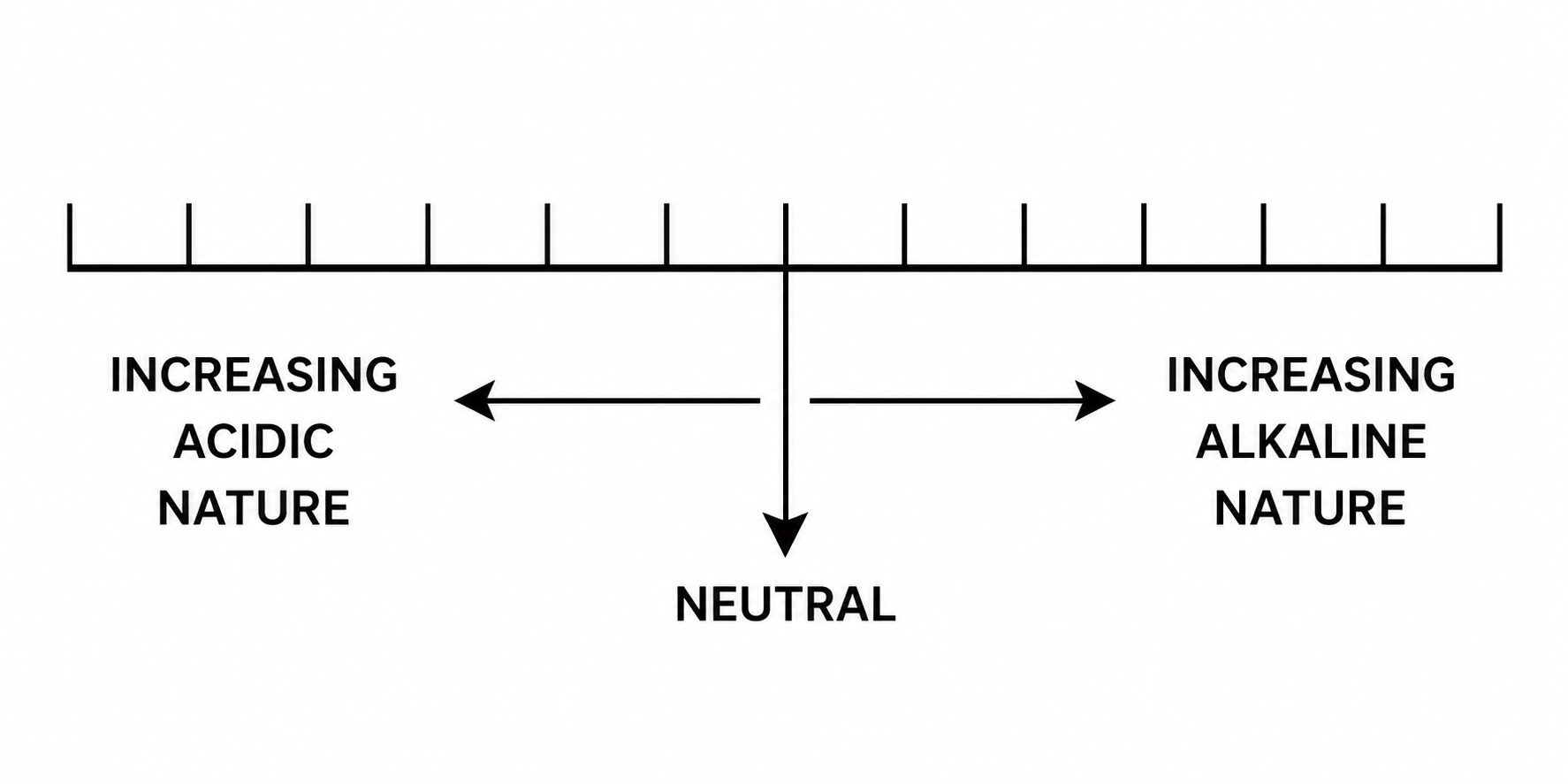
Fig 3.1 The pH Scale
Universal Indicator: A mixture of indicator dyes that gives a spectrum of colours depending on how acidic or alkaline a solution is. Green at pH 7. Progressively blue to indigo to violet as pH increases (basic). Progressively yellow to pink to red as pH decreases (acidic).
.png)
Fig 3.2 Colour changes in the universal indicator
Importance of pH in everyday life
- Our body works within a narrow pH range of 7.0 to 7.8. Plants and animals also survive in a narrow range.
- In agriculture: Every crop grows better in a particular pH range. Rice grows better in slightly acidic soil, sugarcane in neutral and citrus fruits in alkaline soil.
- In medicines: Certain diseases are diagnosed only on the basis of the pH value of blood and urine.
- In digestive system: Hydrochloric acid is produced in the stomach which helps in the digestion of food but if it becomes excess, the pH falls, and pain and irritation occurs. To get rid of this ANTACIDS like milk of magnesia ($Mg(OH)_2$) is generally used to adjust the pH.
- In saving tooth decay: When the pH falls to 5.5 tooth decay starts. Tooth enamel (calcium phosphate) is corroded by bacteria degrading sweets. Saliva is slightly alkaline to help, but tooth paste is used to neutralise excess acid.
- Bee sting leaves acid in the body. Baking soda, a base, gives relief.
Q2 What is the difference between (a) an alkali and a base.
Solution:
A base is a metallic oxide or hydroxide that reacts with an acid to give salt and water only. An alkali is a specific type of base that is soluble in water and yields hydroxyl ions ($OH^-$) as the only negatively charged ions in an aqueous solution. All alkalis are bases, but all bases are not alkalis.
Q4 Give one example in each case: (a) A basic oxide which is soluble in water, (c) A basic oxide which is insoluble in water, (e) A weak mineral acid, (f) A base which is not an alkali, (i) A base which does not contain a metal ion.
Solution:
(a) Basic oxide soluble in water: Sodium oxide ($Na_2O$)
(c) Basic oxide insoluble in water: Copper(II) oxide ($CuO$)
(e) Weak mineral acid: Carbonic acid ($H_2CO_3$)
(f) Base which is not an alkali: Copper(II) hydroxide ($Cu(OH)_2$)
(i) Base without a metal ion: Ammonium hydroxide ($NH_4OH$)
Q7 (b) Is $PbO_2$ a base or not? Comment. (c) Do basic solutions also have $H^+(aq)$? Explain why are they basic.
Solution:
(b) $PbO_2$ (Lead IV oxide) is not a base. It reacts with concentrated hydrochloric acid to produce $PbCl_2$, water, and chlorine gas ($Cl_2$). A true base must react with an acid to produce salt and water only.
(c) Yes, basic solutions also have $H^+(aq)$ ions due to the auto-ionisation of water. However, they are basic because the concentration of $OH^-(aq)$ ions in the solution is much greater than the concentration of $H^+(aq)$ ions.
Q12 What do you understand by pH value? Two solutions X and Y have pH values of 4 and 10 respectively. Which one of these two will give a pink colour with phenolphthalein indicator?
Solution:
The pH value is a measure of the hydrogen ion concentration of a solution, which indicates its acidity or alkalinity ($\text{pH} = -\log_{10}[H^+]$).
Solution Y (pH = 10) is alkaline, so it will give a pink colour with the phenolphthalein indicator. Solution X (pH = 4) is acidic and will remain colourless.
3B. SALTS AND THEIR LABORATORY PREPARATIONS
Salt: A compound formed by the partial or total replacement of the ionisable hydrogen atoms of an acid by a metallic ion or an ammonium ion.
Ionic Definition: Salt is an ionic compound, which dissociates in water to yield a positive ion other than hydrogen ion ($H^+$) and a negative ion other than hydroxyl ion ($OH^-$). (e.g. NaCl $\rightarrow$ $Na^+$ + $Cl^-$).
3.11.1 Classification of salts
- Normal salts: Formed by the complete replacement of the ionisable hydrogen atoms. No ionisable hydrogen. Examples: $NaCl, Na_2SO_4$.
- Acid salts: Formed by the partial replacement of the ionisable hydrogen atoms of a polybasic acid. Contains replaceable hydrogen. Examples: $NaHSO_4, NaH_2PO_4$. They show all properties of an acid in solution.
- Basic salts: Formed by the partial replacement of the hydroxyl group of a di- or a tri-acidic base by an acid radical. Contains $OH^-$. Examples: $Pb(OH)Cl, Mg(OH)Cl$.
- Complex salts: Dissociate to give one simple ion and one complex ion. Example: Sodium argentocyanide $Na[Ag(CN)_2]$.
3.11.2 General properties of salts
(i) Electrovalent: Salts are electrovalent compounds. They conduct electricity in their molten state as well as in their aqueous solutions.
(ii) Non-volatile solids that form crystals.
(iii) Solubility of salts: Most are soluble in water. Their degree of solubility varies with temperature.
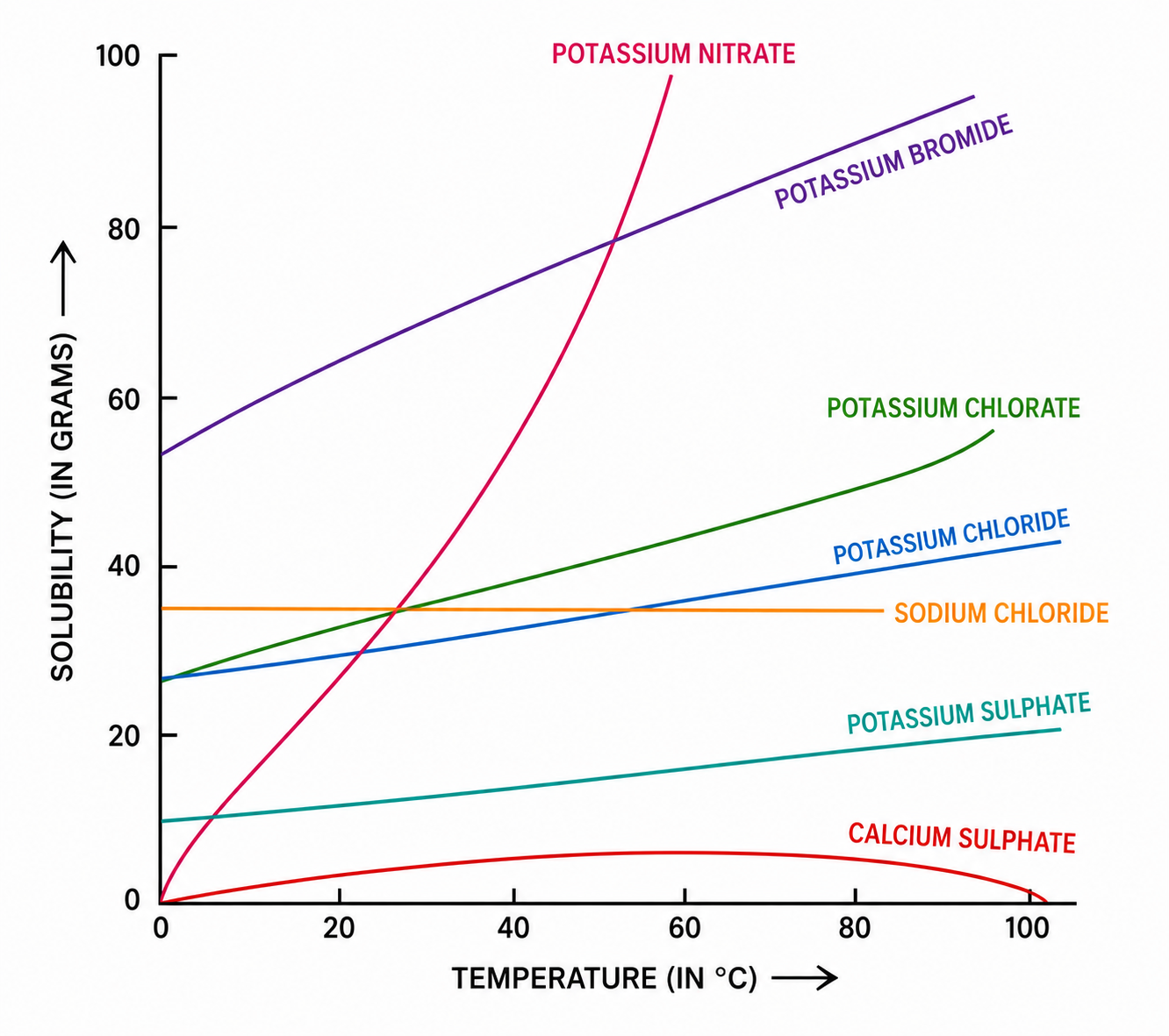
Fig 3.3 Variation in solubility of some salts
Table 3.1: Solubility of salts
| Salts | Exceptions (Insoluble) |
|---|
| 1. All the compounds of ammonium, sodium and potassium are soluble in water. | None |
| 2. All nitrates and nitrites are soluble. | None |
| 3. All chlorides, bromides and iodides are soluble in water. | $AgCl, PbCl_2, Hg_2Cl_2$ ($PbCl_2$ is soluble in hot water, not in cold water). |
| 4. All sulphates are soluble. | $CaSO_4, PbSO_4, BaSO_4$ |
| 5. All carbonates, sulphides, sulphites and phosphates are insoluble. | Except of ammonium, sodium and potassium. |
Note: All metallic oxides and hydroxides are insoluble except of sodium, potassium and ammonium. Calcium hydroxide is slightly soluble.
3.12 METHODS OF PREPARATION OF NORMAL SALTS
The following methods are used for the preparation of normal salts (details of apparatus/procedures are not required, only relevant equations):
- Direct Combination: Heating two elements together.
- $2Fe + 3Cl_2 \xrightarrow{\Delta} 2FeCl_3$
- $2Al + 3Cl_2 \xrightarrow{\Delta} 2AlCl_3$
- $Fe + S \xrightarrow{\Delta} FeS$
- Displacement: Active metal on dilute acid.
- $Fe + H_2SO_4(dil.) \rightarrow FeSO_4 + H_2\uparrow$
- $Zn + 2HCl(dil.) \rightarrow ZnCl_2 + H_2\uparrow$
- Precipitation (Double decomposition): Mixing solutions of two soluble salts to form an insoluble salt.
- $BaCl_2(aq) + H_2SO_4(aq) \rightarrow BaSO_4\downarrow + 2HCl(aq)$
- $Pb(NO_3)_2(aq) + 2NaCl(aq) \rightarrow PbCl_2\downarrow + 2NaNO_3(aq)$
- Neutralization of insoluble base: Action of dilute acid on insoluble metallic oxide or hydroxide.
- $CuO + H_2SO_4(dil.) \rightarrow CuSO_4 + H_2O$
- Neutralisation of an alkali (Titration): Neutralisation of a soluble base (alkali) by an acid.
- $NaOH(aq) + HCl(aq) \rightarrow NaCl(aq) + H_2O$
- $2NaOH(aq) + H_2SO_4(aq) \rightarrow Na_2SO_4(aq) + 2H_2O$
- Action of dilute acids on carbonates and bi-carbonates:
- $Na_2CO_3 + 2HCl \rightarrow 2NaCl + H_2O + CO_2\uparrow$
- $CuCO_3 + H_2SO_4 \rightarrow CuSO_4 + H_2O + CO_2\uparrow$
Q2 Answer related to preparations: (b) What kind of salt is prepared by precipitation? (c) Name a salt prepared by direct combination and write the equation.
Solution:
(b) Insoluble salts are prepared by precipitation (also known as double decomposition) by mixing solutions of two soluble salts.
(c) Iron (III) chloride ($FeCl_3$) is prepared by direct combination.
Equation: $2Fe + 3Cl_2 \xrightarrow{\Delta} 2FeCl_3$
Q5 Name: (a) a chloride insoluble in cold water but dissolves in hot water. (d) a basic salt. (e) an acidic salt.
Solution:
(a) Lead(II) chloride ($PbCl_2$)
(d) Basic lead chloride ($Pb(OH)Cl$) or Basic magnesium chloride ($Mg(OH)Cl$)
(e) Sodium hydrogen sulphate ($NaHSO_4$)