Population — The Increasing Numbers and Rising Problems
ICSE Class 10 Biology — Chapter 12
12.1 Rising Population — A Global Threat
Human population throughout the world and in India, in particular, has been rising at an alarming rate. This
is by far the most serious problem the world is facing today. If not solved, it will lead to grave
consequences in the future.
Today, we hear a lot about the population problem in developing countries including India. All the media of
mass communication — radio, television, stage, press, etc. — are trying their best to educate people
about the grave dangers of rising population. It is becoming a serious threat, not for any one country in
particular, but for the world as a whole.
12.2 World Population Through the Ages
It is estimated that the total world population about 50,000 years ago would have been around one million
(1,000,000). At that time, man lived a very primitive life. He knew nothing about farming, but he had begun
to use tools which he made from stones, sticks, and bones. He was a wanderer and took shelter in caves. He
used to kill animals and eat them raw or roast them on fire. He used to catch fish from waters. He collected
eggs from birds' nests or gathered fruits, roots, and leaves from wild plants.
Meanwhile, due to safety reasons, he had learnt to live in groups and to use his intellect in many ways as in
hunting large animals like the mammoths.
The Three Great Cultural Revolutions
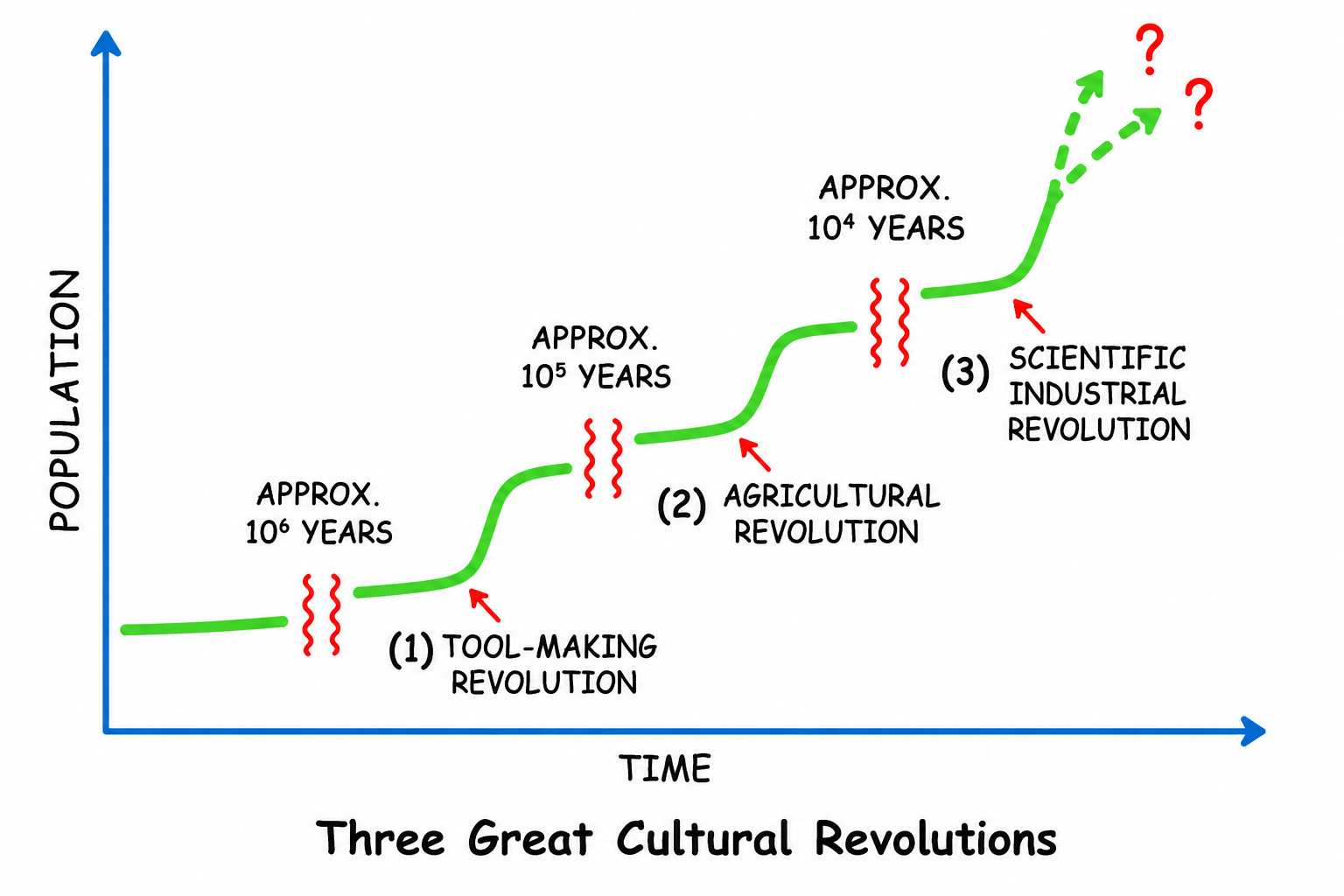
The human population began to grow faster as a result of three significant cultural revolutions:
1. Tool-making revolution: About 1 million years ago, primitive human species
(Homo erectus) improved their tools from mainly stones (stone age) to hunt and scrape
flesh, which helped man to improve his life.
2. Agricultural revolution: About 10,000 years ago, the total world population had
reached approximately 5.3 million. Man's way of life underwent a remarkable change:
He started living in settled communities in primitive huts.
He started domesticating animals (dog being the first).
He learnt to sow crops and store food (beginning of agriculture).
His primitive stone tools and weapons were gradually replaced by those of bronze and iron
(metal age).
3. Scientific industrial revolution: Began around the seventeenth century. Rapidly
growing industries made human life more comfortable, with greater opportunities for jobs and more
food production. However, there was a drawback: as community groups increased, there were
widespread outbreaks of infectious diseases due to close contact. Nutritional
diseases also appeared due to unbalanced diets.
12.3 Rapid Rise in Population
Two major phases in the recent past significantly favored population rise:
(i) Industrial revolution: As discussed above, it brought comfortable living, jobs, and
food.
(ii) New Discoveries in Medical Science: The twentieth century (1901-2000) witnessed
remarkable discoveries in medical science, especially the antibiotics and prophylactic
vaccinations against many diseases ("prophylactic" means guarding beforehand). This
resulted in a sharp reduction in the number of deaths of all age groups, especially the infants and the
old. More children per family began to reach the reproductive age, and as they reproduced, the
rate of growth of population began to rise very rapidly.
12.4 Population Explosion — A Serious Global Concern
Population Explosion: The abnormally high rate of population growth is termed as
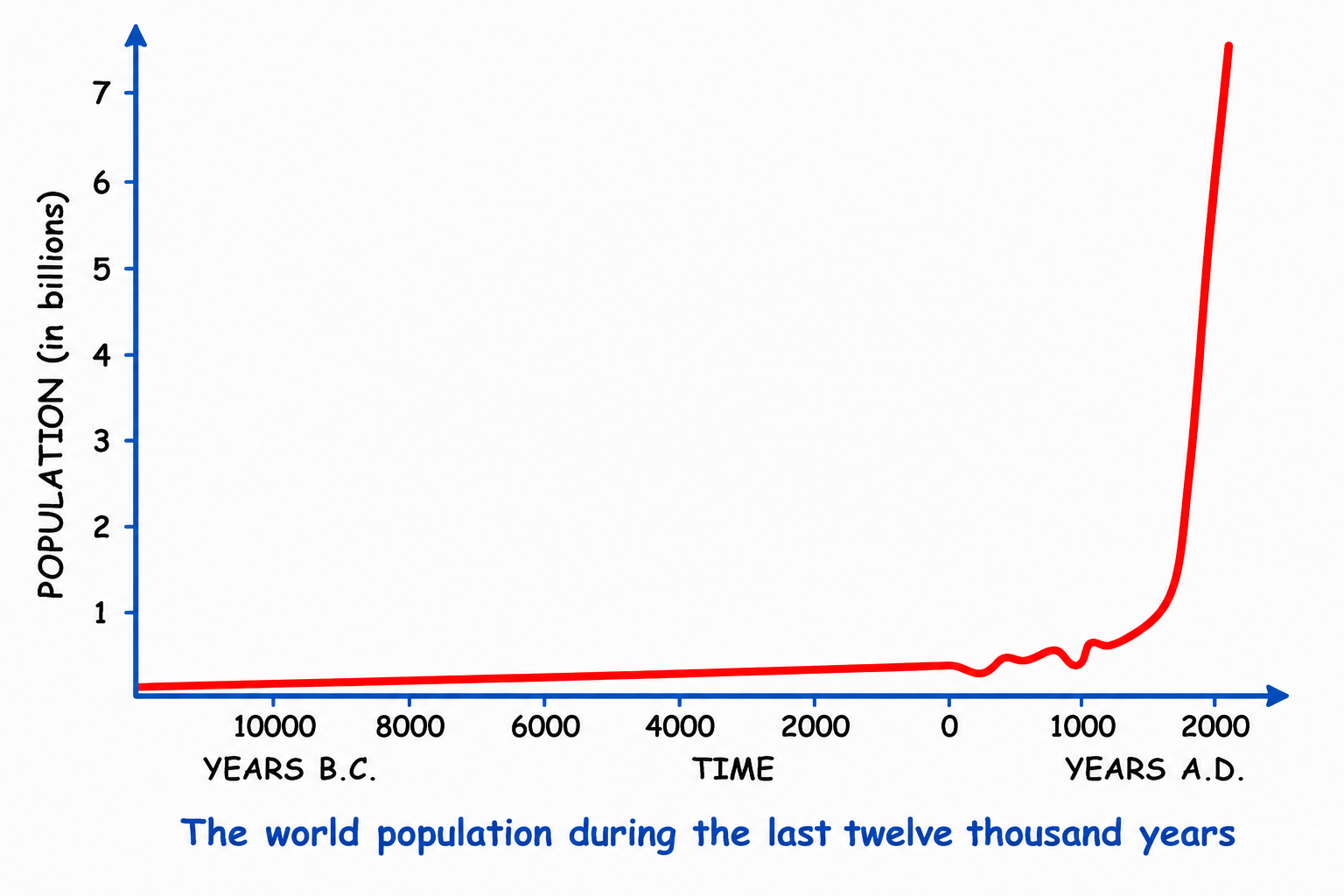
population explosion. It began in the middle of the nineteenth century.
According to demographers, about one-third of the total number of all the people who have ever lived on earth
are alive today. Two-thirds of the present world population belong to the developing nations where more than
half the people live below the poverty line. India and China make one-third of the total world population.
In earlier years, the human population remained fairly constant. The sharp dip shortly after 1000 A.D. is due
to severe epidemics, especially the Black Death (Plague, caused by a bacterium spread by the ratflea bite).
Later, the scientific and industrial age gave a fresh momentum to the population rise. Today, the rate of
growth of population has reached a point such that the population more than doubles in about 35
years.
Six main reasons for sharp rise in WORLD HUMAN POPULATION in the recent past:
Better health care: For all age groups. There are more health care centres,
hospitals, and practising doctors available for help.
Fewer deaths: Due to better medical aid. This is for two reasons: regular
vaccination programmes have controlled or wiped out many diseases, and more patients get cured and
live longer.
Food shortages minimised: Green revolution has ensured that more food is produced
and stored. There are very few starvation deaths.
Improved nutrition: Specially for growing children. They keep healthy, suffer less
from diseases, and live longer.
Large scale immunisation: Against fatal diseases.
Fewer infant deaths: In older times, an average family used to get 4-6 children out
of which 1 or more would not survive. Today, most new born babies survive due to better health care.
Maternity homes provide safety for both the child as well as the mother.
Conclusion: More and more children are reaching the reproductive age and they contribute to
population growth.
12.5 A Highly Simplified Model of Population Growth
A hypothetical model shows that starting with 20 individuals (10 couples) who have an average of 4 children,
the population grows exponentially. By the fourth generation at the end of 60 years, the population
multiplies ten times (from 60 total to 600 total). At this rate, food and other requirements of life simply
cannot keep pace with the rising population.
1 square foot of earth per person!
If there are no further checks or controls, the population in the next 700 years would become so much
that only 1 sq. foot of earth per person would be available. Can this situation really come? If not,
what would be the cause of this? No one can answer at present.
Population vs Food Production
Population Growth: Grows in a Geometrical progression (1, 2, 4, 8,
16...). The numbers at each step are being multiplied.
Food Production: Rises in an Arithmetic progression (1, 2, 3, 4,
5...). The numbers are added up at each step.
This indicates that food would be running short for the unchecked rising population.
12.6 Population in India
The trend of rise of population in India is as alarming as in the rest of the world. Except for a slight fall
in 1911-21, the population of India has been steadily increasing for the last 100 years. Since 1951, the
growth rate has been very high.
Current Indian population is a little more than 1.32 billion and is growing rapidly (approx. 52 per
minute, 74,480 per day).
India has already numbered more than 1.21 billion and would overtake China in the near future to become
TOP MOST in population.
12.7 Factors Responsible for Population Explosion in India
The major factors driving the rapid population growth in India are:
Illiteracy: Most of the rural population which forms the bulk of our society are still
illiterate, ignorant, and superstitious. They do not know the functioning of the human reproductive
system.
Traditional beliefs: Among the people from lower strata of society, children are
regarded as a gift of God and a sign of prosperity. Therefore, they make no effort to avoid pregnancy.
Mortality rate: Due to high infant mortality rate in our country, people from the
economically weaker section think it safer to produce more children so that at least some may survive.
Economic reasons: Children are considered to be helping hands to increase the family
income.
Religious and social customs: India is a centre of various religious and social
customs, and as such most people do not accept family planning norms.
Desire for a male child: Most Indian families still hold the view that a male child is
essential for keeping up the name of the family. Further, a male child is usually a great help to the
aged parents.
Lack of recreation: Poor standard of living and poverty provide no recreation other
than sex.
12.8 Rising Population — Pressure on Natural Resources
Resource: Resource is any substance (natural or artificial), energy or organism which is
used by humans for their welfare.
In the context of rising human population, the six main resources under pressure are:
1. FOOD: One most important need of humans. We are bringing more land under cultivation
and using better farming methods, but food production rises arithmetically while population grows
geometrically.
2. WATER: Availability of clean and germ-free water for drinking purpose would be more
and more scarce with the increase in population. The reason would be mainly the pollution of rivers,
ponds, lakes, etc.
3. LAND: Man is bringing more land under cultivation and also using up land for
building more residential colonies, factories, and industries. Usable land would thus become less and
less available.
4. FORESTS: Forests provide timber, firewood, resins, medicines, and wood-pulp. They
are the main contributors of life-sustaining oxygen (Natural air purifiers). They bring rain (adding
moisture by transpiration) and prevent floods (holding soil particles).
Deforestation (cutting down of forests) to get land for cultivation/housing leads
to: Droughts, Flash floods, Soil erosion, Extinction of wild animals, and Global warming.
5. ENERGY: We need energy for cooking, running factories, transportation, etc. Major
sources are coal and petroleum (fossil fuels). These reserves underground are fast depleting.
6. MINERALS: More population means more requirements, more industries, more means of
transportation. Minerals like iron and copper are non-renewable resources. Once finished, they can never
be replaced.
12.9 Population Growth and Urbanisation Causing Serious Pressure on Resources
12.9.1 Changing Face of the Earth
Urbanisation: The process where villages turn into towns, towns into cities, and cities into
megacities or the metropols. Some of the major changes occurring are:
More and more residential buildings, markets, schools, hospitals, etc.
More streets and roads, more highways, railway lines, and airports.
More industrial installations, godowns, and reservoirs.
All such developmental activities are encroaching upon the open land, agricultural land, and forests. There
is a loss of natural vegetation which is degrading the environment.
12.9.2 Rising Living Standards of Growing Population
Living standards of the people are rising very fast, leading to the usage of:
More and more household equipment — furniture, crockery, electric gadgets.
More clothes (shirts, suits, sarees, shoes).
Means of personal conveyance (cycles, motor cycles, cars, taxis).
12.9.3 Need to Check Exploitative Use of Resources
The increasing numbers and rising standards of modern living are causing very rapid depletion of natural
resources. Therefore, it is absolutely necessary that every citizen becomes conscious and contributes to the
sustainable use of natural resources.
Sustainable Development: Sustainable development means the kind of development that
meets the need of the present without compromising the ability of the future generations to meet their
own needs.
Sustainable development can be achieved mainly by:
Reduction of excessive use of natural resources.
Recycling and reuse of resources wherever possible.
More use of renewable resources such as solar energy, wind power, etc.
Non-Conventional Sources of Energy
Conventional Sources of Energy
Solar energy, nuclear energy, tidal
energy, wind energy. Solar cookers and solar batteries harness solar energy. Biogas is produced from
organic wastes. These are renewable and should be further popularised.
Coal and petroleum. They have been in
use since long. They are non-renewable; once finished, they cannot be formed again during a
lifetime.
12.10 Rate of Population Growth Must be Reduced
A Few Statistical Terms (Demography):
Demography (demos: people + graphos: measurement): Statistical study of human
population, specially with reference to size, density, distribution, and other vital statistics.
Population density: Number of individuals per square kilometre (km²) at any given
time.
Birth rate or natality: Number of live births per 1000 people of population per
year.
Death rate or mortality: Number of deaths per 1000 of population per year.
Growth rate of population: The difference between the birth rate and the death
rate. If birth rate > death rate, population grows. If birth rate < death rate, population
declines.
12.11 Need for Adopting Control Measures
As the population density increases in a country beyond its means, it brings many problems, for example:
Per capita income comes down.
Natural resources like land, minerals, wood, fuel, etc., decrease.
General health goes down.
Therefore, there is pressing need for adopting population control measures.
12.12 Population Education and Population Control
It is necessary that the people should be educated about the need to limit the population. Steps include:
The message about the population problem should reach as many people as possible, including those in
remote areas.
People should be made aware of the advantages of having small families. China is almost reaching the
norm of 1 child per family, whereas India has to strive hard even to reach the 2 children per family
norm.
The orthodox view, to have at least one son specially in Indian society, should be modified by
education.
Marriageable age should be higher. [The age restriction of at least 18 years for girls and 21 years for
boys under the law must be followed strictly].
Married couples should be educated to delay the birth of their first child, to space the second with a
sufficient interval, and to stop the third.
People should be advised to adopt family planning methods (contraception).
Family Welfare Symbol: The inverted red triangle has become a popular
sign in India for family welfare. It is prominently displayed at all such offices and hospitals where
any help or advice about family planning is available free of cost.
The term FAMILY WELFARE has three aspects:
Family planning in terms of having a small family.
Total welfare of the small family, including the diet and nutrition of the child and of the pregnant
mother.
Subsequent care of the children, e.g., immunisation and oral rehydration therapy, to ensure
survival.
12.13 Methods of Contraception
The common methods of contraception to prevent pregnancy are as follows:
Hormonal Methods (Pills): Various hormonal preparations come in the form of tablets or
pills (commonly called contraceptive pills). These hormones prevent the release of the egg from the
ovary.
Barrier Methods:
(a) Condom (e.g. Nirodh): It is used by men. Made of latex (rubber sheath). It
prevents the sperms from being deposited in the vagina.
(b) Diaphragms: Round latex caps with coil spring. Fitted deep in the vagina on
the mouth of the uterus (cervix). They prevent the entry of sperms into the uterus.
(c) Sperm-killing (spermicidal) agents: Chemicals placed in the vagina near the
cervix, which kill the sperms if they are there.
Intra-Uterine Devices (IUDs): The two devices commonly used in India are Lippe's Loop
and Copper-T. These are fitted inside the uterus. These do not stop fertilisation but prevent
implantation of the blastocyst (embryo).
Surgical Methods:
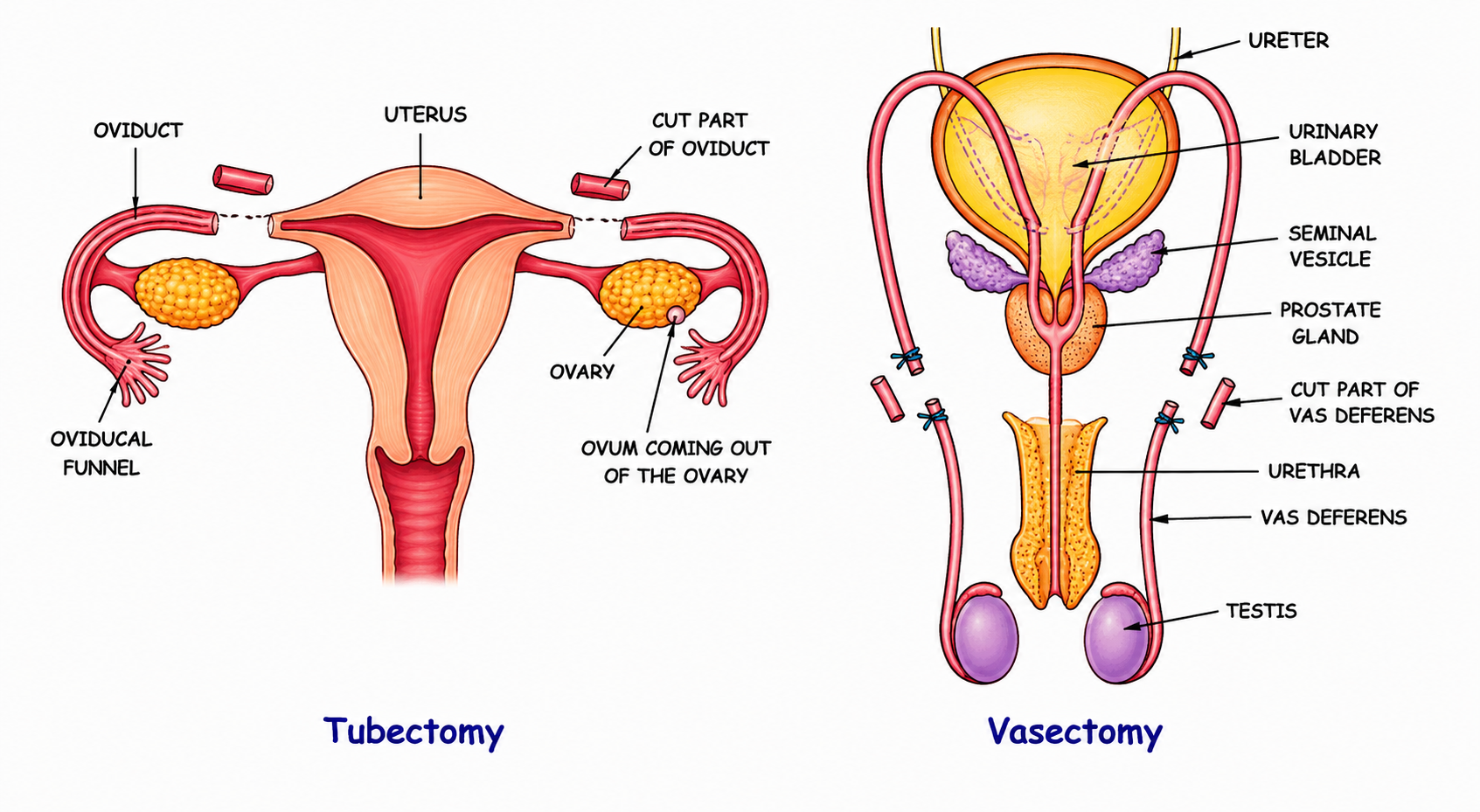
(a) Tubectomy (for female): In this, the abdomen is opened and the fallopian
tubes (oviducts) are cut or ligated i.e. tied with nylon thread to close the passage of the egg.
(b) Vasectomy (in male): In this surgery, a small cut is made in the scrotum,
vas deferens (sperm duct) from each testis is ligated and a small piece between the two
ligatures is removed. This surgery is easier, quicker and safer. (No harmful effect on manliness
or libido).
5. Induced Abortion or Medical Termination of Pregnancy (MTP)
If the woman has somehow become pregnant and there is definite evidence of any serious genetic disease in the
embryo based on a special test, then the foetus can be removed. This method should not be considered a
contraceptive method, but as a last step. This operation (forced abortion) should be performed only by a
trained doctor at a hospital. Abortion is legally permitted (only within 5 months of pregnancy) and can be
requested at any government hospital at no cost.
Progress Check Summary
ICSE PREPQ: State whether the following are true or false:
(i) Some vitamin preparations prevent the release of the egg from the ovary. [False -
Hormonal pills do]
(ii) Use of a condom for contraception is a barrier method. [True]
(iii) IUDs prevent implantation of embryo in vagina. [False - They prevent implantation in
the uterus]