
ICSE Class 10 Biology • Chapter 04 • Detailed Master Notes
Plant physiology is the branch of biology which deals with the life functions of the plant. It includes the functioning of cells, tissues, organs, organ-systems and the organism as a whole. This chapter deals with fundamental processes like osmosis, which have tremendous significance in the life of all organisms.
The roots fix the plant in the soil giving it support, but the most important and life-supporting function of the roots is to absorb:
These are absorbed from the soil and conducted into the stem for supply to the leaves, flowers, fruits, etc.
Besides being a constituent of protoplasm, water is needed inside the plant body for four main purposes:
Mineral nutrients required by the plant are absorbed from the soil by the roots. Some of these are absorbed as salts (nitrates, phosphates, sulphates, etc.) and some simply as ions (potassium, calcium, magnesium, chlorine, etc.). They are required as constituents of cells and in the synthesis of a variety of compounds or enzymes.
The ability of the roots to draw water from the soil is dependent on three characteristics:
(i) Surface area of roots is enormous: A small garden
plant when uprooted shows a thick bunch of rootlets. Each rootlet has
hundreds of root hairs.
Fact: A botanist H.J. Dittmer (1937) worked out that a
four-month-old rye plant had an aggregate root length of about 600 km,
with over 14 billion root hairs, providing a huge surface area to
facilitate absorption.
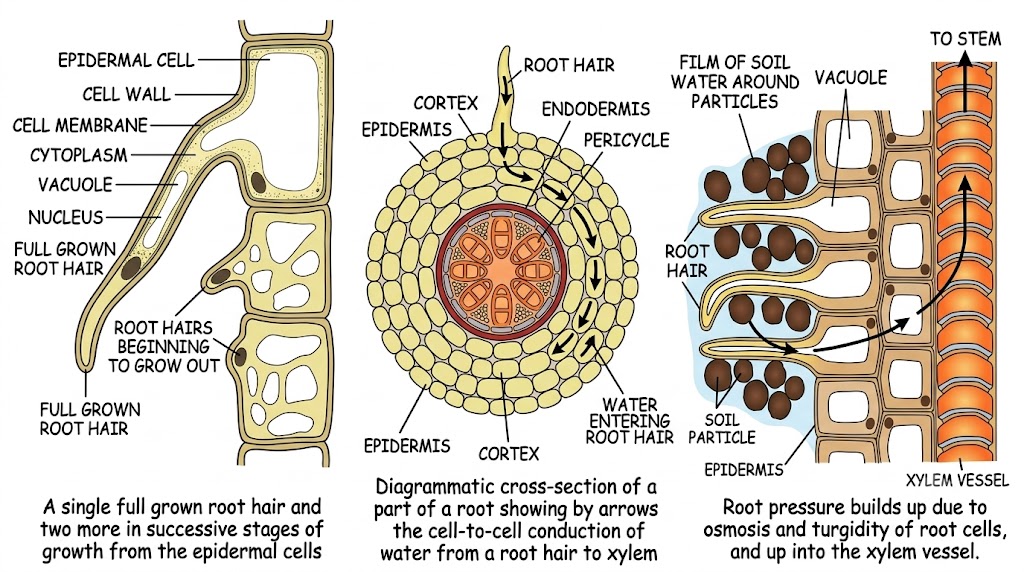
(ii) Root-hairs contain cell sap of a higher concentration: Root hairs are the extensions of the outer (epidermal) cells of the root. They contain large vacuoles filled with a solution called cell sap. Because of dissolved salts, this cell sap usually has a concentration higher than that of the surrounding soil water. This is an important requirement for osmosis to occur.
(iii) Root-hairs have thin walls: Like all plant
cells, root-hairs have two outer layers:
The cell wall is thin and
freely permeable. It allows the movement of water molecules
and dissolved substances freely in and out.
The cell membrane is very thin and
semi-permeable. It allows water molecules to pass through,
but not the larger molecules of the dissolved salts. The secret of
water absorption lies mainly in this characteristic.
The entire mechanism of absorbing water and minerals is the result of five main phenomena: Imbibition, Diffusion, Osmosis, Active transport, and Turgidity & Flaccidity (Plasmolysis).
Imbibition: A phenomenon by which the living or dead plant cells absorb water by surface attraction.
Substances made of cellulose or proteins are hydrophilic (strong affinity for water). They imbibe moisture and swell up (e.g., dry seeds, wooden doors swelling during rains). Due to imbibitional pressure, the seed coat ruptures in germinating seeds. It is also an important force in the ascent of sap.
Diffusion: The free movement of molecules of a substance (solute or solvent, gas, liquid) from the region of their higher concentration to the region of their lower concentration when the two are in direct contact.
Experiment: Place a sugar cube, soluble dye, or potassium permanganate crystal in a beaker of water. The molecules move away from where they are more concentrated to where they are less concentrated until uniformly distributed. Stirring hastens the process.
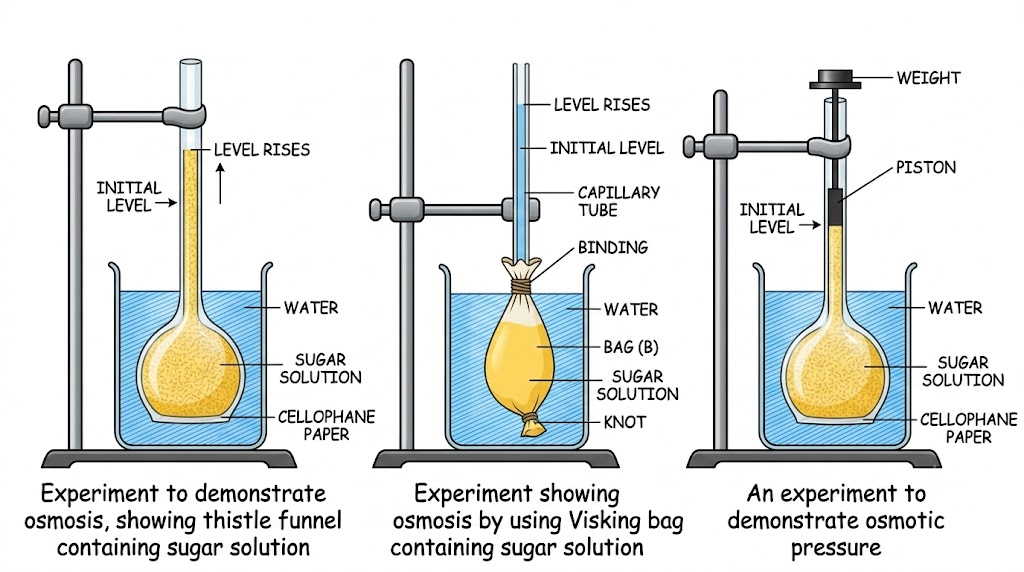
Osmosis: The movement of water molecules from their region of higher concentration (dilute solution) to their region of lower concentration (concentrated solution) through a semi-permeable membrane.
Take concentrated sugar solution in a thistle funnel. Cover its mouth with cellophane paper (or egg membrane/animal bladder - acting as a semi-permeable membrane) and invert it in a beaker containing pure water.
Results: After a few hours, the level of sugar solution in the thistle funnel rises because water from the beaker passes through the cellophane paper into the funnel. Sugar cannot pass out into the beaker.
What if we change the membrane in the Thistle Funnel experiment?
Theoretically, osmosis should continue until concentrations equalise. However, in the thistle funnel, the rising column of water creates weight/pressure that eventually stops osmosis.
Osmotic pressure: The minimum pressure that must be exerted to prevent the passage of the pure solvent into the solution when the two are separated by a semi-permeable membrane.
Very simply: Osmotic pressure of a solution is a measure of its tendency to take in water by osmosis.
Relative concentration of the solutions that determine the direction and extent of diffusion is called tonicity.
..jpg)
Swelling of Raisins & Shrinking of Grapes???
Raisins left in water swell up due to endosmosis and passive absorption (imbibition). But if you place fresh grapes in a strong sugar/salt solution, books often claim they shrink via exosmosis. In reality, intact grape skin (cuticle) is highly impermeable. Often, they do not shrink unless the skin is degraded or damaged!
| DIFFUSION | OSMOSIS |
|---|---|
| 1. Liquids and gases can diffuse over considerable distances. | 1. Water only transported over a short distance. |
| 2. Movement of the molecules of solute or solvent. | 2. Movement of the molecules of only water as a solvent. |
| 3. Rapid in gases, but slow in solutions. | 3. Slow process. |
| 4. Occurs with or without a non-living permeable membrane. | 4. Either a living or non-living semi-permeable membrane is needed. |
Active transport: The passage of a substance (salt or ion) from its lower to higher concentration (opposite to what happens in diffusion), using energy from the cell, through a living cell membrane.
Certain nutrients like ions of nitrates, sulphates, potassium, and zinc are in low concentrations outside in the soil, but high inside the root cells. They must be "forcibly" carried inward against the concentration gradient, which requires energy supplied by the cell in the form of ATP.
When a cell reaches a state where it cannot accommodate any more water (is fully distended), it is called turgid and the condition is turgidity.
If a cell wall cannot bear the turgor pressure, it ruptures (e.g., fruits and vegetables sometimes bursting). When fully turgid, Turgor Pressure counter-balances Wall Pressure, and no further water is absorbed.
Plasmolysis: The contraction of cytoplasm from the cell wall caused due to the withdrawal of water when placed in a strong (hypertonic) solution.
Flaccidity: The condition in which the cell content is shrunken and the cell is no more "tight". The cell is said to be flaccid (the exact reverse of turgidity).
Deplasmolysis: The recovery or reversal of plasmolysis when a flaccid cell is returned to ordinary water before it dies.
1. Salting of meat/pickles: Addition of salt kills bacteria by causing exosmosis. Water is drawn out of the bacterial cells, killing them.
2. Killing weeds: Sprinkling excessive salts around their base damages the roots via exosmosis.
3. A "biological" Trick: Cheats bury gram seeds under the soil with a fake idol mounted on top. As the seeds imbibe water and undergo endosmosis, the massive turgor pressure generated pushes the earth up, making the idol "miraculously" emerge from the ground!
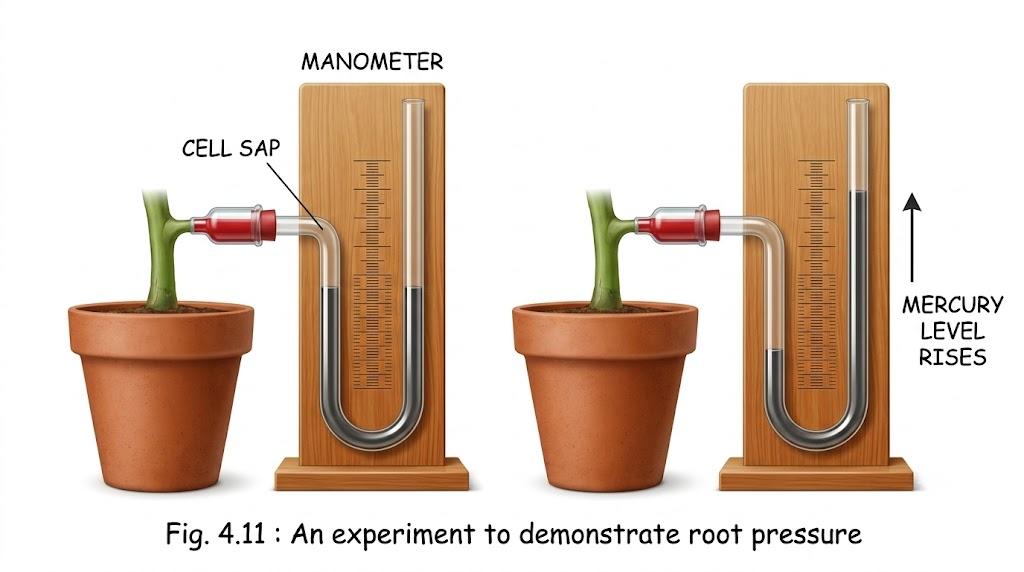
Root pressure: The pressure developed in the roots due to the inflow of water, brought about due to the alternate turgidity and flaccidity of the cells of the cortex and the root hair cell, which helps in pushing the plant sap upwards.
Bleeding: Loss of water (cell sap) through a cut stem due to root pressure.
Guttation: Loss of excessive water appearing as tiny drops along the margins or tips of the leaves (e.g., in tomato, grass, banana) in early mornings due to high root pressure.
Water absorbed by the root hairs passes from cell to cell via osmosis until it reaches the xylem vessels. The turgidity acquired by the cells helps push the water upwards. Minerals are absorbed by active transport as ions. This solution travels upwards exclusively through the xylem.
Experiment 1. To show that roots absorb water:
Place a young leafy plant in test-tube A with water. Add a few drops of
oil to prevent evaporation. Set up test-tube B
identically but without a plant (Control). After a day, the water level
falls in A but not B, proving roots absorb the water.
, and downward conduc.jpg)
Experiment 2. To show water is conducted upwards through the xylem
(Eosin test):
Submerge the roots of a young balsam plant in an
eosin solution (pink dye) for 3-4 hours. Cut transverse
sections of the root, stem, and leaves. Under a microscope,
only the xylem vessels will appear stained red, proving
they are the exclusive tissue for water conduction.
Experiment 3. Ringing / Girdling Experiment:
Take two leafy shoots. In beaker A, remove the outer ring (phloem)
keeping the central part (xylem) intact. In beaker B, remove the central
xylem, keeping the peripheral phloem intact. The leaves in twig A remain
turgid and normal, while those in twig B quickly wilt and droop. This
proves water is conducted upwards through the deeper part (xylem).
Experiment 4. To show food from leaves is conducted downwards through
phloem:
Cut a ring around the stem (girdling) deep enough to remove the phloem
but leaving the xylem intact. After some weeks, the part of the stem
above the ring swells due to accumulated food from the
leaves. The stem below the girdle stops growing and dies because the
downward flow of organic sap is blocked.
Four main forces contribute to the upward movement of sap:
ICSE FAVOURITE Differentiate between the following pairs: