Cell - The Structural and Functional Unit of Life
ICSE Class 10 Biology Detailed Master Notes
1. Cells - A Basic Study in Biology
Cell: The cell is the fundamental, structural, and
functional unit of all living beings. Every organism begins its life
as a single cell.
The Cell Theory
The formulation of the Cell Theory is a cornerstone in biology,
postulated by three scientists:
-
Matthias Schleiden (1838): A botanist who announced
that all plants are made of cells.
-
Theodor Schwann (1839): A zoologist who declared that
all animals are made of cells.
-
Rudolf Virchow (1858): Added the final touch by
stating "Omnis cellula e cellula" (All cells arise from
pre-existing cells).
2. Cells - How Numerous?
The overall size of an organism depends entirely on the
number of cells it contains, not on the size of its
individual cells.
-
Single-celled (Unicellular): Made up of just one
single cell. Examples: Bacteria, yeast, and amoeba.
-
Few-celled: Made up of just a few hundred or a few
thousand cells. Examples: Spirogyra, Volvox.
-
Multi-celled (Multicellular): Made up of millions and
billions of cells. Examples: Humans, mango trees.
3. Cells - How Small?
Most cells are microscopic. Being small provides a high
Surface Area to Volume ratio, which is essential for
the rapid exchange of materials (nutrients in, waste out) across the
cell membrane.
-
Smallest cells: Mycoplasma (PPLO), bacteria, and red
blood cells (RBCs) in the human body.
-
Longest cells: Nerve cells (Neurons) - can be over a
meter long.
-
Largest cells: Birds' eggs (specifically the central
yellow yolk). The ostrich egg is the largest single living cell.
Fascinating Facts (Adult Human Body):
-
1000 million million cells in the whole body.
-
10,000 million nerve cells in the brain cortex.
- 25 million million red blood cells.
- 30 thousand million white blood cells.
4. Cell Shapes and Their Functions
The shape of a cell is intimately related to the specific function it
performs in the body:
-
Human Red Blood Cells (RBCs):
Circular and biconcave. This shape
increases surface area for oxygen absorption and allows them to
squeeze through narrow capillaries.
-
White Blood Cells (WBCs):
Amoeboid (capable of changing
shape). This allows them to squeeze out through capillary walls (a
process called diapedesis) to fight infections.
-
Nerve Cells (Neurons):
Long and branched. Designed to
conduct electrical impulses from distant parts of the body to the
central nervous system.
-
Guard Cells:
Bean-shaped in dicots. Regulates the
opening and closing of stomata for gas exchange and transpiration.
5. Gross Structure of Cell - The Essential Parts
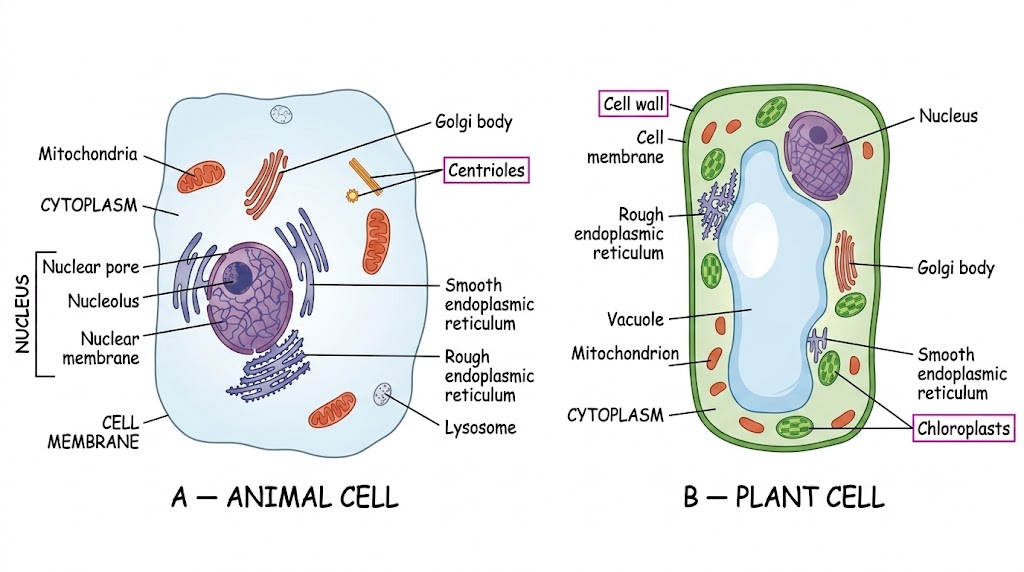
Fig. 1.1: A generalised animal cell and a generalised plant cell.
1. Cell Membrane (Plasma Membrane)
-
It is a living, extremely thin, and flexible membrane made of
lipoproteins.
-
It is Selectively Permeable (or
differentially permeable), meaning it strictly regulates the entry and
exit of specific substances.
-
In plant cells, an outermost, non-living, rigid layer called the
Cell Wall surrounds the membrane.
- Made primarily of cellulose.
- It provides shape, rigidity, and protection.
-
It is Freely Permeable (allows
everything in solution to pass through).
2. Cytoplasm
The semi-liquid jelly-like substance occupying most of the cell space
inside the cell membrane.
-
It is the site where all metabolic activities (chemical reactions)
take place.
-
It contains embedded living structures called
Organelles.
-
The liquid part of the cytoplasm, minus the organelles, is called the
Cytosol.
3. Nucleus (The Brain of the Cell)
A dense, spherical body that serves as the command center of the cell.
-
Surrounded by a double-layered
Nuclear Membrane containing pores.
-
Filled with a semi-solid ground substance called
Nucleoplasm.
-
Contains a dark, round body called the
Nucleolus (which produces ribosomes).
-
Contains a tangled mass of thread-like structures called the
Chromatin Network. During cell division, these
condense to form thick structures called
Chromosomes (the bearers of hereditary genes).
Protoplasm vs Cytoplasm & Protoplast:
Protoplasm = Cytoplasm + Nucleus. It refers to the
entire living substance of the cell.
Protoplast is the term more appropriately used for a
plant cell after the removal of its non-living cell wall.
Cytoplasm is only the living substance
outside the nucleus but inside
the cell membrane.
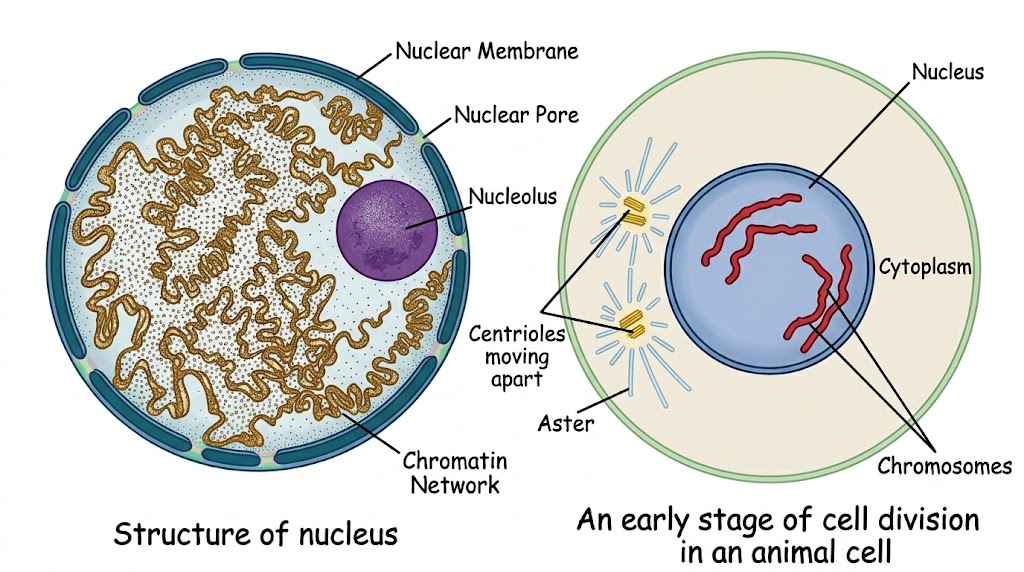
Fig. 1.2: Structure of nucleus.
Fig. 1.3: An early stage of cell division in an animal cell showing
chromosomes condensing from the chromatin network.
6. Finer Structure of Cell - The Organelles
Organelles: The specialized, membrane-bound, living
structures suspended in the cytoplasm, each concerned with a definite
function (just like organs in our body).
Cell Organelles: ICSE Board Keywords & Functions
| Organelle |
Characteristics |
Chief Function(s) [ICSE Focus] |
| Endoplasmic Reticulum (ER) |
Irregular network of double-membrane tubules. Can be Smooth (SER)
or Rough (RER - with attached ribosomes).
|
Acts as the
Supportive framework of the
cell. Helps in intracellular transport and protein/fat synthesis.
|
| Mitochondria |
Sausage-shaped, double-walled. Inner wall has finger-like folds
called cristae. Has its own DNA.
|
Powerhouse of the cell. Site of
cellular aerobic respiration. Releases energy in the form of ATP.
|
| Golgi Apparatus (Dictyosomes in plants) |
Stacks of flattened membrane sacs (cisternae) and vesicles. |
Synthesis and Secretion of
enzymes and hormones. Forms the acrosome of the sperm.
|
| Ribosomes |
Dense, spherical, non-membrane bound bodies made of RNA. Found
free or on RER.
|
Protein factories. Site of
protein synthesis.
|
| Lysosomes |
Membranous sacs containing powerful hydrolytic (digestive)
enzymes.
|
Intracellular digestion. Known as
Suicide bags because they burst
to destroy old/injured cells.
|
| Centrosome (Animal cells only) |
Located near the nucleus. Contains two
centrioles surrounded by aster rays.
|
Initiates cell division by forming
Spindle fibres in animal cells.
|
| Plastids (Plant cells only) |
Double-membraned. Types:
1.
Chloroplasts (Green)
2.
Chromoplasts (Red/Yellow/Orange)
3.
Leucoplasts
(Colourless).
|
1. Traps solar energy for photosynthesis.
2. Imparts colour
to flowers/fruits for pollination.
3. Stores starch.
|
| Vacuoles (Non-living inclusion) |
Clear spaces filled with water/cell sap. Surrounded by a membrane
called Tonoplast. Large in plants, small/absent
in animals.
|
Stores water, cell sap, and provides
Turgidity to plant cells.
|
| Granules (Non-living inclusion) |
Small particles, crystals, or droplets scattered in the cytoplasm.
|
Serve as food storage for the cell:
Starch (in plants),
Glycogen (in animals), and fat
droplets.
|
Note on Pigments: Chlorophyll is found in
Chloroplasts. Xanthophyll (yellow) and Carotene (orange) are found in
Chromoplasts. However, Anthocyanin (blue/purple
pigment of many petals) is NOT found in plastids; it is dissolved in
the cell sap of the vacuole.
Crucial Differences: Plant Cell vs Animal Cell
| Feature |
Plant Cells |
Animal Cells |
| 1. Cell wall |
Present (made of cellulose); rigid. |
Absent. |
| 2. Centrosome |
Absent. (Cell division driven by analog structures). |
Present (contains centrioles to form spindle fibres). |
| 3. Vacuoles |
Large, prominent, usually a single central vacuole. |
Small, temporary, or completely absent. |
| 4. Plastids |
Present (Chloroplasts, Chromoplasts, etc.). |
Absent. |
| 5. Cytoplasm |
Pushed to the periphery as a thin lining due to the large vacuole.
|
Dense, granular, and fills the entire cell. |
7. Microscopic Examination of Onion Peel (Practical Application)
A classic biological experiment involves preparing a temporary mount of
an onion epidermal peel to observe plant cells.
-
Procedure: A thin, transparent strip is torn from the
inner concave side of an onion scale leaf. It is mounted on a slide in
a drop of water.
-
Staining: The peel is stained using
Iodine or Eosin solution.
Reason: This stains the cell components, specifically making
the nucleus more distinct under the microscope.
-
Observations under Microscope:
-
The cells have a somewhat regular,
linear or rectangular shape.
-
They are firmly bound together with a prominent, thick
cell wall.
- A large central vacuole is present.
-
Due to this large vacuole, the
nucleus is pushed to the periphery (one side) of
the cell.
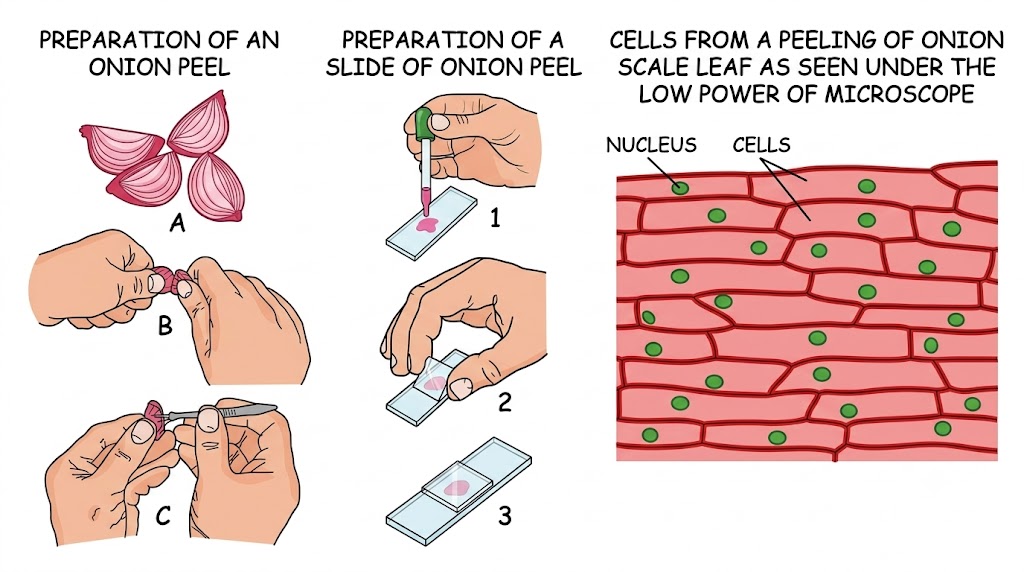
Fig. 1.4 & 1.5: Preparation of an onion peel slide.
Fig. 1.6: Cells from an onion scale leaf peeling seen under a
low-power microscope, showing the nucleus pushed to the side.
8. The Nucleus - Key to the Life of a Cell
To prove that the nucleus is the absolute master of the cell, scientists
conducted a famous experiment on the Amoeba.
-
Observation 1: An intact Amoeba grows, functions,
and divides normally.
-
Observation 2: If the nucleus is carefully
surgically removed (enucleated), the Amoeba immediately stops
growing and dies.
-
Observation 3: If a nucleus from a donor Amoeba is
transplanted into the enucleated Amoeba before it dies, the
recipient Amoeba recovers, survives, and divides normally.
Conclusion: The nucleus regulates all metabolic and
reproductive activities of the cell. Without it, the cell cannot
survive.
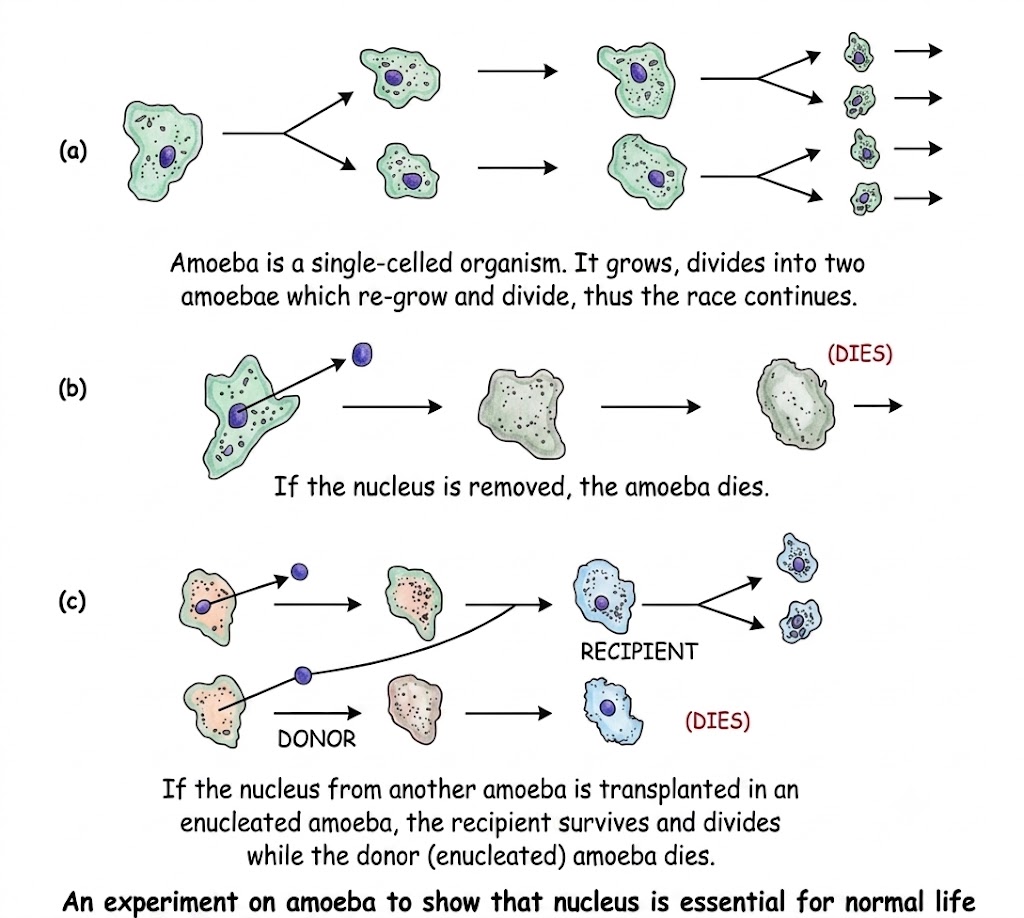
Fig. 1.7: An experiment on amoeba to show that nucleus is essential
for normal life.
9. ICSE Board Exam Practice Questions (PYQ Patterns)
The following questions are strictly designed per the ICSE Class 10
Board Examination pattern to help you secure maximum marks in Section
A and Section B.
-
The structural and functional unit of life.
Ans: Cell
-
The organelle known as the 'suicide bag' of the cell.
Ans: Lysosome
-
The organelle known as the 'powerhouse' of the cell.
Ans: Mitochondria
-
The network of thread-like structures present in the nucleoplasm
that condenses during cell division.
Ans: Chromatin fibres (or Chromatin network)
-
The plastid which stores starch.
Ans: Leucoplast
-
The non-living granules in animal cells that store reserve food.
Ans: Glycogen granules
-
The blue-violet pigment dissolved in the cell sap.
Ans: Anthocyanin
-
The non-living, rigid layer surrounding the plasma membrane in plant
cells.
Ans: Cell wall
-
The membrane surrounding the large central vacuole of a plant cell.
Ans: Tonoplast
-
The specific stain used to make the nucleus of an onion peel
distinct.
Ans: Iodine or Eosin solution
ICSE FAVOURITE State the exact location and
the main function of the following:
-
Centrosome:
-
Location: In the cytoplasm, near the nucleus, found
only in animal cells.
-
Function: It initiates cell division by forming spindle
fibres.
-
Ribosomes:
-
Location: Scattered freely in the cytoplasm or attached
to the rough endoplasmic reticulum.
-
Function: They are the sites of protein synthesis.
-
Chloroplasts:
-
Location: In the cytoplasm of plant cells (specifically
in the green parts/leaves).
-
Function: Traps solar energy and helps in
photosynthesis.
-
Why is the cell membrane called a selectively permeable
membrane?
Ans: It allows only certain selective substances
(solvent and some solutes) to pass through it while preventing the
passage of other harmful or large substances.
-
Why is the nucleus mostly pushed to the periphery in a plant
cell?
Ans: Plant cells contain a single, large, and
prominent central vacuole filled with cell sap, which occupies most
of the space and pushes the cytoplasm and nucleus to the periphery.
-
Why are lysosomes called 'suicide bags'?
Ans: Lysosomes contain powerful digestive enzymes.
When a cell gets damaged, old, or infected, the lysosomes burst and
their enzymes digest their own cell, hence the name.
-
Why are mitochondria called the 'powerhouses' of the
cell?
Ans: They are the sites of cellular aerobic
respiration where glucose is broken down to release energy. This
energy is stored in the form of ATP molecules for cellular
activities.
-
Why do plant cells have a rigid shape compared to animal
cells?
Ans: Plant cells possess an outermost, non-living,
and rigid cell wall made of cellulose that provides a fixed shape,
which is absent in animal cells.
CRITICAL THINKING Differentiate between the
following pairs based on the criteria given in the brackets:
-
Cell Wall and Cell Membrane (Permeability):
Ans: Cell wall is freely permeable,
whereas the cell membrane is selectively permeable.
-
Plant Cell and Animal Cell (Centrosome):
Ans: Plant cells lack a centrosome,
whereas animal cells contain
a centrosome near the nucleus.
-
Chromoplast and Leucoplast (Function):
Ans: Chromoplasts impart colour to flowers
and fruits to attract pollinators, whereas leucoplasts
store food primarily in the form of starch.
-
Cytoplasm and Protoplasm (Composition):
Ans: Cytoplasm is the living substance
excluding the nucleus, whereas protoplasm is the entire
living substance including the cytoplasm and the nucleus.
10. Visual / Diagram-Based Assessment
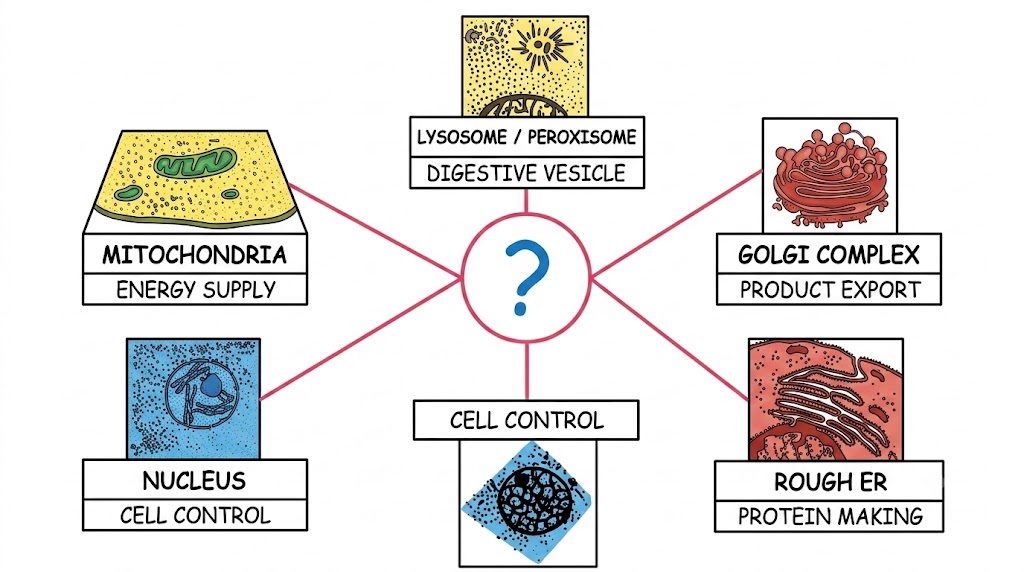
VISUAL EXERCISE In the ICSE boards, you are
frequently asked to identify organelles based on structural diagrams.
Study the organelle structures below (e.g., stacked cisternae, double
membrane with folds) and recall their functions.