Class 12 Physics • CBSE Comprehensive Chapter Notes
🌐 vardaanlearning.com📞 9508841336
Chapter 8: Electromagnetic Waves
Dear Class 12 Scholar, welcome to Chapter 8 of Physics! Up to this point in electromagnetism, you studied electric fields produced by charges and magnetic fields produced by currents. In Chapter 6, Faraday revealed that a time-varying magnetic field induces an electric field. James Clerk Maxwell asked the profound converse question: Does a time-varying electric field produce a magnetic field? The affirmative answer led to the discovery of Displacement Current, completed the unification of Electricity, Magnetism, and Optics, and predicted the existence of Electromagnetic Waves. Let us master this concise, conceptual, and highly scoring chapter.
1. Displacement Current
1.1 Historical Context & The Inconsistency in Ampere's Circuital Law
According to Ampere's Circuital Law, the line integral of magnetic field $\vec{B}$ around any closed loop is equal to $\mu_0$ times the total steady conduction current passing through any surface bounded by that loop:
$$\oint \vec{B} \cdot d\vec{l} = \mu_0 i(t)$$
Maxwell examined this law for a circuit containing a parallel plate capacitor being charged by a time-varying current $i(t)$. Let us consider a point $P$ outside the plates and examine two different surfaces sharing the exact same circular boundary (rim) of radius $r$ centered symmetrically on the wire:
Surface 1 (Flat Circular Disc Surface): Passes through the conducting wire outside the plates. The wire carries conduction current $i(t)$, which pierces through this surface. Therefore:
$$\oint \vec{B} \cdot d\vec{l} = B(2\pi r) = \mu_0 i(t) \neq 0$$
Surface 2 (Pot-shaped or Tiffin-box Surface without Lid): Has the exact same circular rim as Surface 1, but bulges out so that its bottom surface $S$ lies in the region between the capacitor plates where no conducting wire exists. No conduction current passes through this surface ($i = 0$). Applying Ampere's circuital law:
$$\oint \vec{B} \cdot d\vec{l} = B(2\pi r) = \mu_0 (0) = 0$$
The Fundamental Contradiction
Two open surfaces sharing the exact same perimeter give two conflicting values of magnetic field at the very same point $P$: non-zero according to the flat surface, and zero according to the pot-shaped surface! Because magnetic field at a given point cannot have two simultaneous values, Maxwell concluded that Ampere's Circuital Law was incomplete and logically inconsistent for time-varying situations.
1.2 Maxwell's Resolution: Derivation of Displacement Current
Maxwell observed that while no electric charges flow through the insulating gap between capacitor plates, there is a time-varying electric field passing through the surface $S$.
If $A$ is the area of each capacitor plate and $Q(t)$ is the instantaneous charge on the plates, the electric field between the plates is uniform and given by:
Since $\frac{dQ}{dt} = i$ is the rate at which charge accumulates on the capacitor plate (which equals the conduction current $i_c$ entering the plate):
$$i_c = \epsilon_0 \frac{d\Phi_E}{dt}$$
To eliminate the contradiction in Ampere's law, Maxwell proposed that this term represents an effective current arising from the rate of change of electric flux, which he termed the Displacement Current ($I_d$ or $i_d$):
Definition of Displacement CurrentDisplacement Current ($I_d$) is that current which comes into existence in any region where the electric field and hence electric flux changes with time. It is mathematically defined as:
$$I_d = \epsilon_0 \frac{d\Phi_E}{dt}$$
Where:
$\epsilon_0$ is the permittivity of free space ($8.854 \times 10^{-12} \text{ C}^2\text{N}^{-1}\text{m}^{-2}$).
$\frac{d\Phi_E}{dt}$ is the time rate of change of electric flux through the surface.
1.3 The Ampere-Maxwell Law (Generalised Ampere's Law)
Maxwell modified Ampere's circuital law by asserting that the total effective current passing through any surface bounded by a closed loop is the sum of the conduction current ($I_c$) and the displacement current ($I_d$):
A crucial outcome of Maxwell's formulation is the principle of continuity of total current across any complete circuit:
Outside the capacitor plates (in connecting wires): There is steady flow of electrons, so $I_c = i$, while the electric field outside does not vary with time, so $I_d = 0$. Hence, $I_{total} = I_c + 0 = i$.
Inside the capacitor plates (in the dielectric/vacuum gap): No free electrons cross the gap, so $I_c = 0$, but the electric flux changes rapidly at the rate $\epsilon_0 \frac{d\Phi_E}{dt} = i$. Thus, $I_d = i$. Hence, $I_{total} = 0 + I_d = i$.
Continuity Rule
Although conduction current drops to zero across the gap of a capacitor, displacement current takes over with the exact same magnitude! Therefore, the total current $(I_c + I_d)$ is continuous throughout the entire circuit. Kirchhoff's first rule (junction rule) remains valid at each plate of the capacitor when generalized to include displacement current.
1.5 Comparison: Conduction Current ($I_c$) vs. Displacement Current ($I_d$)
Property
Conduction Current ($I_c$)
Displacement Current ($I_d$)
Origin / Cause
Flow of actual electric charge carriers (electrons or ions) through a conductor.
Time-varying electric field / changing electric flux across space or dielectric.
Governing Formula
$I_c = \frac{dq}{dt} = n e A v_d = \frac{V}{R}$
$I_d = \epsilon_0 \frac{d\Phi_E}{dt}$
Medium Required
Requires a conducting medium (metals, electrolytes, ionized gases).
Exists in vacuum as well as in dielectrics and insulators.
Steady State (DC)
Can exist under steady direct current (DC) conditions.
Becomes strictly zero under steady DC conditions ($\frac{d\Phi_E}{dt} = 0$).
Magnetic Effect
Produces a surrounding magnetic field ($\oint \vec{B} \cdot d\vec{l} = \mu_0 I_c$).
Produces the exact same magnetic field as conduction current ($\oint \vec{B} \cdot d\vec{l} = \mu_0 I_d$).
SI Unit
Ampere ($\text{A}$)
Ampere ($\text{A}$)
2. Maxwell's Equations
Maxwell synthesized all basic laws of electricity and magnetism into four elegant differential/integral equations. Together with the Lorentz Force equation $\vec{F} = q(\vec{E} + \vec{v} \times \vec{B})$, these equations form the foundation of classical electrodynamics.
Relates net electric flux through any closed surface to the enclosed charge. Electric field lines originate on positive charges and terminate on negative charges (electrostatic fields are non-conservative when charges are localized).
2. Gauss's Law for Magnetism
$$\oint \vec{B} \cdot d\vec{A} = 0$$
The net magnetic flux through any closed surface is identically zero. This proves that isolated magnetic monopoles do not exist; magnetic field lines are continuous closed loops with no beginning or end.
A time-varying magnetic field induces a circulating, non-conservative electric field. The induced electromotive force (emf) equals the negative rate of change of magnetic flux.
A magnetic field is generated not only by conduction electric currents but also by a time-varying electric field.
Grand Symmetry of Nature
Notice the sublime symmetry between equations (3) and (4):
Faraday's Law: A time-varying magnetic field generates an electric field ($\frac{\partial \vec{B}}{\partial t} \to \vec{E}$).
Ampere-Maxwell Law: A time-varying electric field generates a magnetic field ($\frac{\partial \vec{E}}{\partial t} \to \vec{B}$).
This mutual regeneration implies that neither field can remain static when changing in time. They regenerate each other through space, giving birth to a self-propagating disturbance: the Electromagnetic Wave!
3. Electromagnetic Waves
3.1 Sources of Electromagnetic Waves
A crucial question in physics is: What physical situation produces an electromagnetic wave?
Stationary Charge: Produces only a static electric field ($\vec{E}$) in its surrounding space. No magnetic field is produced, hence no wave is radiated.
Charge in Uniform Motion (Steady Current): Produces a constant electric field and a time-invariant magnetic field ($\vec{B}$). The fields do not change with time, so no wave radiation occurs.
Accelerated Charge: Produces time-varying electric and magnetic fields. An oscillating charge (such as an electron in an LC oscillator or an oscillating electric dipole) is continuously accelerating. This creates a time-varying $\vec{E}$, which creates a time-varying $\vec{B}$, which in turn regenerates $\vec{E}$, and so on. Energy is radiated away from the source as an Electromagnetic Wave.
Key Rule on Frequency
The frequency of the electromagnetic wave radiated by an accelerated charge is precisely equal to the frequency of oscillation of the charge:
$$\nu_{wave} = \nu_{oscillator}$$
The energy carried by the wave comes at the expense of the energy of the source (the accelerated charge).
Why couldn't Hertz produce visible light using laboratory LC circuits?
The frequency of visible light is about $6 \times 10^{14} \text{ Hz}$. Even with modern electronic oscillator circuits, the highest frequencies achievable are around $10^{11} \text{ Hz}$ (microwaves/radio). Therefore, Heinrich Hertz in 1887 demonstrated Maxwell's theory in the lower-frequency radio wave region (wavelength of a few meters).
Figure 8.3: A linearly polarised plane electromagnetic wave propagating along the \(z\)-direction with oscillating electric field \(\vec{E}\) along the \(x\)-direction and oscillating magnetic field \(\vec{B}\) along the \(y\)-direction (\(\vec{E} \perp \vec{B} \perp \vec{c}\)).
3.2 Nature and Mathematical Description of EM Waves
Maxwell proved that electromagnetic waves are transverse waves in which electric and magnetic fields oscillate perpendicular to each other and perpendicular to the direction of wave propagation.
For a plane electromagnetic wave propagating along the positive $z$-direction:
Electric field vector oscillates along the $x$-axis:
$$E_x(z, t) = E_0 \sin(kz - \omega t) = E_0 \sin\left[2\pi\left(\frac{z}{\lambda} - \nu t\right)\right]$$
Magnetic field vector oscillates along the $y$-axis:
$$B_y(z, t) = B_0 \sin(kz - \omega t) = B_0 \sin\left[2\pi\left(\frac{z}{\lambda} - \nu t\right)\right]$$
No field components exist along the direction of propagation: $E_z = 0$ and $B_z = 0$.
Here:
$E_0$ and $B_0$ are the peak amplitudes of the electric and magnetic fields.
$k = \frac{2\pi}{\lambda}$ is the propagation constant (wave vector magnitude).
$\omega = 2\pi\nu$ is the angular frequency.
The speed of propagation is:
$$v = \frac{\omega}{k} = \nu \lambda$$
3.3 Direction of Propagation & The Poynting Vector
The direction of wave propagation is always given by the cross product of the electric field and magnetic field vectors:
For example, if $\vec{E}$ is along $+\hat{i}$ and $\vec{B}$ is along $+\hat{j}$, the wave travels along $\hat{i} \times \hat{j} = +\hat{k}$ (along $+z$).
3.4 Fundamental Characteristics of Electromagnetic Waves
Essential Characteristics (Must-Know for Boards)
No Material Medium Required: EM waves are self-sustaining oscillations of coupled electric and magnetic fields that propagate through vacuum (free space) as well as matter.
Universal Speed in Vacuum ($c$): In vacuum, all electromagnetic waves, regardless of wavelength or frequency, travel at the fundamental physical speed:
$$c = \frac{1}{\sqrt{\mu_0 \epsilon_0}} \approx 3.00 \times 10^8 \text{ m/s}$$
Speed in a Material Medium ($v$): In a dielectric material medium with absolute permittivity $\epsilon$ and magnetic permeability $\mu$:
$$v = \frac{1}{\sqrt{\mu \epsilon}} = \frac{c}{\sqrt{\mu_r \epsilon_r}} = \frac{c}{n}$$
Where $n = \sqrt{\mu_r \epsilon_r}$ is the refractive index of the medium. For non-magnetic transparent media, $\mu_r \approx 1$, so $n \approx \sqrt{\epsilon_r}$.
Constant Amplitude Ratio: At any point and any instant, the ratio of electric field to magnetic field equals the speed of light:
$$\frac{E_0}{B_0} = c \quad \text{and} \quad \frac{E(z,t)}{B(z,t)} = c$$
Note: In SI units, $E_0 = c B_0$ implies that numerically $E_0 \gg B_0$ (e.g. $B_0 = 10^{-7}\text{ T}$ corresponds to $E_0 = 30\text{ V/m}$).
Equal Distribution of Energy: The energy of an EM wave is shared equally between the electric and magnetic fields:
Average Electric Energy Density: $\langle u_E \rangle = \frac{1}{4} \epsilon_0 E_0^2$
Average Magnetic Energy Density: $\langle u_B \rangle = \frac{B_0^2}{4\mu_0}$
Since $E_0 = c B_0$ and $c^2 = \frac{1}{\mu_0 \epsilon_0}$:
$$\langle u_E \rangle = \frac{1}{4} \epsilon_0 (c B_0)^2 = \frac{1}{4} \epsilon_0 \left(\frac{1}{\mu_0 \epsilon_0}\right) B_0^2 = \frac{B_0^2}{4\mu_0} = \langle u_B \rangle$$
Total average energy density:
$$\langle u \rangle = \langle u_E \rangle + \langle u_B \rangle = \frac{1}{2} \epsilon_0 E_0^2 = \frac{B_0^2}{2\mu_0}$$
Wave Intensity ($I$): The energy transmitted per unit area per unit time perpendicular to the propagation direction is:
$$I = \langle u \rangle c = \frac{1}{2} \epsilon_0 E_0^2 c = \frac{E_{rms}^2}{\mu_0 c}$$
Linear Momentum & Radiation Pressure: An electromagnetic wave carries linear momentum. When an EM wave delivering total energy $U$ is incident normally on a surface:
For a completely absorbing surface: Momentum transferred is $p = \frac{U}{c}$. The radiation pressure exerted is $P_{rad} = \frac{I}{c}$.
For a completely reflecting surface: The wave rebounds with opposite momentum, so momentum transferred is $p = \frac{2U}{c}$. The radiation pressure is $P_{rad} = \frac{2I}{c}$.
Optical Effect (Light Vector): The electric field vector $\vec{E}$ is primarily responsible for the optical sensations and chemical reactions (like photographic plates and photoreceptors in the human eye). Hence, $\vec{E}$ is called the light vector.
4. The Electromagnetic Spectrum
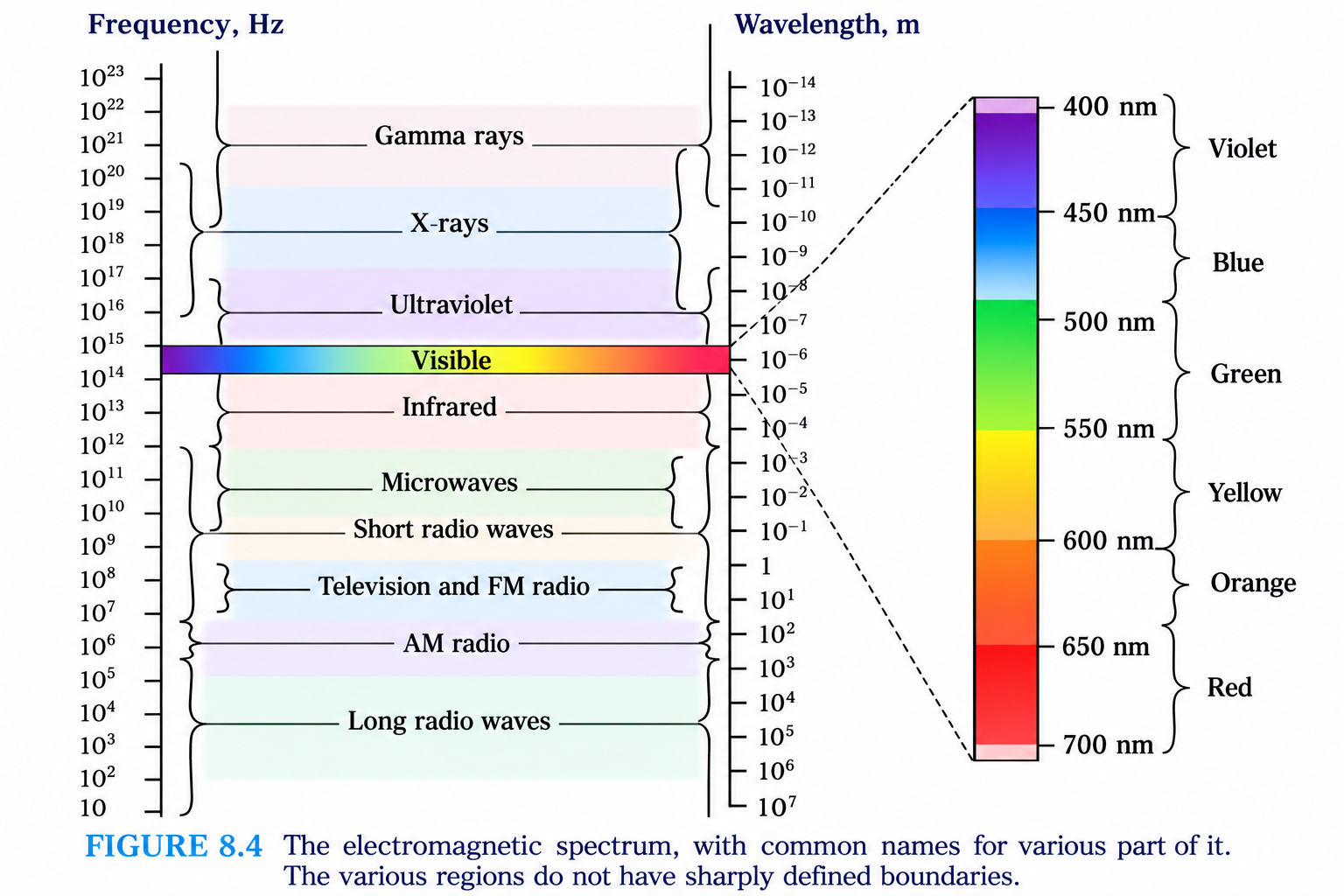
The Electromagnetic Spectrum is the continuous classification of all electromagnetic waves arranged systematically according to their frequency ($\nu$) or wavelength ($\lambda$). There are no sharp, distinct boundaries separating adjacent bands; the bands overlap, and classification is based primarily on how the waves are produced and detected.
Figure 8.4: The electromagnetic spectrum, with common names for various parts of it. The various regions do not have sharply defined boundaries.
4.1 Master Classification Table (NCERT Table 8.1)
Type
Wavelength Range ($\lambda$)
Frequency Range ($\nu$)
Method of Production
Method of Detection
Radio Waves
$> 0.1 \text{ m}$
$< 3 \times 10^9 \text{ Hz}$
Rapid acceleration and deceleration of electrons in conducting aerials/antennas.
Production: Generated using specialized vacuum tubes such as klystrons, magnetrons, and solid-state Gunn diodes.
Key Properties: Short wavelengths allow microwaves to be beamed into narrow, highly directional beams with minimal diffraction.
Primary Applications:
Aircraft Navigation & Radar: Used in radar systems for detecting and tracking aircraft, ships, and weather formations.
Speed Guns: Utilizes Doppler radar shift of microwaves to measure the speed of tennis serves, cricket balls, and speeding automobiles.
Microwave Ovens: A domestic marvel of resonant energy transfer.
Board Exam Concept: Physics of Microwave Oven
How does a Microwave Oven heat food so quickly and efficiently?
Water molecules ($\text{H}_2\text{O}$) are permanent electric dipoles. In a microwave oven, the operating microwave frequency ($\approx 2.45 \text{ GHz}$) is chosen to match the natural resonant rotational frequency of water molecules. The alternating electric field forces the water dipoles to rotate back and forth rapidly. This transferred energy drastically increases the kinetic energy and thermal motion of the water molecules, heating up any food containing moisture uniformly from within. Glass or porcelain containers do not contain water molecules and have no matching resonance, hence they do not get heated directly!
Production: Emitted by hot bodies and thermal vibrations/rotations of molecules.
Why are they termed "Heat Waves"? Water molecules present in virtually all organic substances and tissues (along with $\text{CO}_2, \text{NH}_3$) readily absorb infrared radiation. Upon absorption, their thermal internal kinetic energy increases, raising the temperature of the object and its surroundings.
Key Applications & Phenomena:
Greenhouse Effect: Incoming visible sunlight easily penetrates the atmosphere and heats the Earth's surface. The Earth re-radiates this energy as longer-wavelength infrared radiation. Atmospheric greenhouse gases (carbon dioxide, water vapor, methane) trap this IR radiation by absorption and re-emission, maintaining the Earth's life-sustaining average temperature ($\approx 15^\circ\text{C}$).
Remote Controllers: Infrared LEDs are used in remote switches for TV sets, AC units, video recorders, and home hi-fi systems.
Physical Therapy: Infrared heat lamps are applied in medicine to relax muscles and soothe muscular sprains and arthritis.
Earth Observation Satellites: Infrared sensors monitor healthy vegetation, agricultural crop yields, and military movements.
Haze & Fog Penetration: According to Rayleigh's scattering law, scattering is inversely proportional to $\lambda^4$ ($S \propto \frac{1}{\lambda^4}$). Because infrared has longer wavelength than visible light, it scatters far less and easily penetrates fog, mist, and smoke. Used in night vision goggles and aerial photography.
Wavelength Range: From about $700 \text{ nm}$ ($0.7 \ \mu\text{m}$, deep red) to $400 \text{ nm}$ ($0.4 \ \mu\text{m}$, violet). Corresponding frequencies: $4 \times 10^{14} \text{ Hz}$ to $7.5 \times 10^{14} \text{ Hz}$.
Production: Emitted by valence electrons in atoms undergoing transitions from higher to lower energy levels, and by incandescent hot solids (glowing filaments).
Detection: The human retina (rod and cone photoreceptors), photocells, and photographic emulsions.
Evolutionary Connection: The peak sensitivity of the human eye ($\approx 550 \text{ nm}$, yellow-green light) coincides precisely with the wavelength of maximum solar radiation emission reaching Earth's surface!
Animal Vision Diversity: Different organisms have evolved distinct optical sensitivities. For instance, snakes have pit organs that detect infrared radiation (hunting warm-blooded prey in darkness), while honeybees and many insects can see well into the ultraviolet range to locate floral nectar guides.
Production: Emitted by very hot bodies (the Sun), mercury and xenon discharge lamps, and high-current electrical welding arcs.
Key Applications:
Water Purification & Germicidal Action: UV lamps kill bacteria, viruses, and pathogens in drinking water purifiers by disrupting their cellular DNA.
LASIK Eye Surgery: Due to their very short wavelengths, UV excimer lasers can be focused into exceptionally narrow beams for high-precision cornea sculpting (Laser-Assisted in Situ Keratomileusis).
Forensic & Mineral Detection: UV induces fluorescence in minerals, currency security threads, and counterfeit note detection.
Biological Hazards & Important Facts:
Atmospheric Ozone Shield: The stratospheric ozone layer ($40-50 \text{ km}$ altitude) absorbs harmful solar UV-C and UV-B rays, protecting terrestrial life. Depletion by chlorofluorocarbons (CFCs / Freon) causes serious ecological risk.
Melanin Production & Sunburn: Prolonged exposure stimulates skin melanin, causing tanning and potential skin carcinoma.
Glass Absorption Rule: Ordinary window glass absorbs ultraviolet rays strongly. Therefore, one cannot get tanned or sunburned through closed glass windows!
Welder's Goggles: Electric welding arcs emit massive amounts of UV radiation. Welders must wear specialized glass goggles or full face masks to protect eyes from severe corneal burns.
Discovery: Discovered by Wilhelm Conrad Röntgen in 1895.
Production: Generated when fast-moving, high-energy electrons are suddenly decelerated upon colliding with a target metal of high atomic number and high melting point (e.g. Tungsten) inside an evacuated Coolidge X-ray tube.
Key Applications:
Medical Diagnostics: Radiography to image bone fractures, joint dislocations, and dental caries (dense bone tissue absorbs X-rays more strongly than soft fleshy tissue).
Radiation Oncology: Controlled doses are used in radiation therapy to treat malignant tumors and kill cancer cells.
Crystallography & Materials Science: Wavelength of X-rays ($~1 \text{ Å} = 10^{-10}\text{ m}$) is comparable to interatomic spacing in crystals. X-ray diffraction (Bragg's Law) reveals the 3D atomic structure of solids and biomolecules (e.g., DNA double helix).
Origin / Production: Nuclear in origin. Emitted during radioactive transitions of excited atomic nuclei (such as Cobalt-60 decay) and during high-energy nuclear reactions and cosmic events.
Key Characteristics: Highest frequency, highest photon energy ($E = h\nu$), and deepest penetration power of all electromagnetic radiations.
Primary Applications:
Cancer Radiotherapy: Targeted gamma ray beams (e.g. Cobalt-60 Gamma Knife) are used to destroy localized deep-seated malignant cancer tumors.
Industrial Sterilization: Cold sterilization of packaged surgical instruments, syringes, and perishable foodstuffs to eradicate microbes without applying heat.
Nuclear Structure Probing: Investigating nuclear energy levels and fundamental particle physics.
5. Key Insights & NCERT "Points to Ponder"
Board High-Yield Takeaways
Universal Velocity vs. Diverse Interaction: All electromagnetic waves travel at the exact same velocity $c$ in free space. The monumental differences in their physical effects and applications arise solely from their different wavelengths ($\lambda$) or photon energies ($E = h\nu$). High-frequency gamma rays interact with atomic nuclei; X-rays interact with core electrons; visible and UV light interact with valence electrons; infrared vibrates whole molecular bonds; radio waves accelerate free conduction electrons in bulk conductors.
Radiator Size Principle: The wavelength of the radiated EM wave is intrinsically correlated with the physical size of the radiating system:
Radio waves ($\text{m}$ to $\text{km}$) $\to$ Radiated by macroscopic aerial antennas ($\sim \text{meters}$).
Infrared waves ($\mu\text{m}$) $\to$ Radiated by whole molecular structures.
Visible / UV light ($\text{nm}$) $\to$ Radiated by transitions in atomic shells.
Current Continuity: The sum $(I_c + I_d)$ maintains uninterrupted continuity across any cross section of a closed electric circuit.
6. Fully Solved NCERT Examples & Board Practice Problems
NCERT Example 8.1
Problem: A plane electromagnetic wave of frequency $25 \text{ MHz}$ travels in free space along the $x$-direction. At a particular point in space and time, the electric field vector is $\vec{E} = 6.3 \, \hat{j} \text{ V/m}$. What is the magnetic field vector $\vec{B}$ at this point?
Step-by-step Solution: 1. Magnitude of $\vec{B}$ field:
The relationship between electric and magnetic field amplitudes in free space is:
$$B = \frac{E}{c}$$
Given: $E = 6.3 \text{ V/m}$ and $c = 3 \times 10^8 \text{ m/s}$.
$$B = \frac{6.3}{3 \times 10^8} = 2.1 \times 10^{-8} \text{ T}$$
2. Direction of $\vec{B}$ field:
The electromagnetic wave propagates along the positive $x$-direction ($\hat{i}$). The electric field is along the positive $y$-direction ($\hat{j}$).
The direction of wave propagation is given by the unit vector of $\vec{E} \times \vec{B}$:
$$\hat{n}_{prop} = \hat{E} \times \hat{B} = \hat{i}$$
Since $\hat{j} \times \hat{k} = \hat{i}$, the vector $\vec{B}$ must point along the positive $z$-direction ($\hat{k}$).
Problem: The magnetic field in a plane electromagnetic wave is given by:
$$B_y = (2 \times 10^{-7} \text{ T}) \sin\left(0.5 \times 10^3 x + 1.5 \times 10^{11} t\right)$$
(a) What is the wavelength and frequency of the wave?
(b) Write an expression for the electric field.
Step-by-step Solution: (a) Wavelength and Frequency:
The general equation for a sinusoidal wave traveling along the negative $x$-direction is:
$$B_y = B_0 \sin(kx + \omega t)$$
Comparing the coefficients:
Amplitude $B_0 = 2 \times 10^{-7} \text{ T}$
Wave number $k = 0.5 \times 10^3 \text{ m}^{-1}$
Angular frequency $\omega = 1.5 \times 10^{11} \text{ rad/s}$
Wavelength ($\lambda$):
$$\lambda = \frac{2\pi}{k} = \frac{2 \times 3.1416}{0.5 \times 10^3} = 1.257 \times 10^{-2} \text{ m} \approx \mathbf{1.26 \text{ cm}}$$
Frequency ($\nu$):
$$\nu = \frac{\omega}{2\pi} = \frac{1.5 \times 10^{11}}{2 \times 3.1416} = 2.387 \times 10^{10} \text{ Hz} \approx \mathbf{23.9 \text{ GHz}}$$
(b) Expression for Electric Field:
The amplitude of electric field is:
$$E_0 = c B_0 = (3 \times 10^8 \text{ m/s}) \times (2 \times 10^{-7} \text{ T}) = 60 \text{ V/m}$$
Direction analysis: The wave travels along $-\hat{i}$. The magnetic field oscillates along $+\hat{j}$.
Since $\hat{E} \times \hat{B} = -\hat{i}$, and $(+\hat{k}) \times (+\hat{j}) = -\hat{i}$, the electric field must oscillate along the $z$-axis ($E_z$).
Final Expression for $\vec{E}$:
$$\mathbf{E_z = 60 \sin\left(0.5 \times 10^3 x + 1.5 \times 10^{11} t\right) \text{ V/m}}$$
NCERT Exercise 8.1
Problem: A parallel plate capacitor made of two circular plates each of radius $R = 12 \text{ cm}$, separated by $d = 5.0 \text{ cm}$, is being charged by a constant current $I = 0.15 \text{ A}$.
(a) Calculate the capacitance and the rate of change of potential difference between the plates.
(b) Obtain the displacement current across the plates.
(c) Is Kirchhoff's first rule (junction rule) valid at each plate of the capacitor? Explain.
(a) Capacitance and rate of change of potential difference:
$$C = \frac{\epsilon_0 A}{d} = \frac{8.854 \times 10^{-12} \times 0.04524}{0.05} = \mathbf{8.01 \times 10^{-12} \text{ F} \approx 8.0 \text{ pF}}$$
Since $q = C V$, differentiating with respect to time gives $I = C \frac{dV}{dt}$:
$$\frac{dV}{dt} = \frac{I}{C} = \frac{0.15}{8.01 \times 10^{-12}} = \mathbf{1.87 \times 10^{10} \text{ V/s}}$$
(b) Displacement current across the plates:
$$I_d = \epsilon_0 \frac{d\Phi_E}{dt} = \epsilon_0 \frac{d}{dt}(E \cdot A) = \epsilon_0 A \frac{d}{dt}\left(\frac{V}{d}\right) = \frac{\epsilon_0 A}{d} \frac{dV}{dt} = C \frac{dV}{dt} = I_c$$
Hence:
$$\mathbf{I_d = 0.15 \text{ A}}$$
(c) Validity of Kirchhoff's Junction Rule: Yes, absolutely. At either capacitor plate, the conduction current arriving from the wire ($I_c$) equals the displacement current leaving the plate across the gap ($I_d$). The generalized total current is strictly conserved, so Kirchhoff's junction rule holds valid.
NCERT Exercise 8.2
Problem: A parallel plate capacitor made of circular plates each of radius $R = 6.0 \text{ cm}$ has capacitance $C = 100 \text{ pF}$. It is connected to a $230 \text{ V}$ AC supply with angular frequency $\omega = 300 \text{ rad/s}$.
(a) What is the rms value of the conduction current?
(b) Is the conduction current equal to the displacement current?
(c) Determine the amplitude of $\vec{B}$ at a point $r = 3.0 \text{ cm}$ from the central axis between the plates.
Step-by-step Solution: (a) RMS value of conduction current:
Capacitive reactance $X_C = \frac{1}{\omega C} = \frac{1}{300 \times 100 \times 10^{-12}} = \frac{10^9}{300} = \frac{10^7}{3} \, \Omega$.
$$I_{rms} = \frac{V_{rms}}{X_C} = V_{rms} \cdot (\omega C) = 230 \times (300 \times 100 \times 10^{-12}) = 230 \times 3 \times 10^{-8} = \mathbf{6.9 \times 10^{-6} \text{ A} = 6.9 \ \mu\text{A}}$$
(b) Equality of currents: Yes. In all AC circuits, $I_c = I_d$ at every instant. Hence, the rms value of displacement current is also $6.9 \ \mu\text{A}$.
(c) Amplitude of $\vec{B}$ at radial distance $r = 3.0 \text{ cm}$ ($r < R$):
The peak value of total displacement current is:
$$I_0 = \sqrt{2} I_{rms} = \sqrt{2} \times 6.9 \times 10^{-6} \text{ A} \approx 9.76 \times 10^{-6} \text{ A}$$
For a concentric circular Amperian loop of radius $r \le R$, the displacement current enclosed is proportional to area:
$$I_{d,enc} = I_0 \left(\frac{\pi r^2}{\pi R^2}\right) = I_0 \left(\frac{r^2}{R^2}\right)$$
Applying the Ampere-Maxwell law:
$$\oint \vec{B} \cdot d\vec{l} = B_0 (2\pi r) = \mu_0 I_{d,enc} = \mu_0 I_0 \frac{r^2}{R^2}$$
$$B_0 = \frac{\mu_0 I_0 r}{2\pi R^2}$$
Substitute numerical values ($r = 0.03 \text{ m}$, $R = 0.06 \text{ m}$):
$$B_0 = \frac{(4\pi \times 10^{-7}) \times (9.76 \times 10^{-6}) \times 0.03}{2\pi \times (0.06)^2} = \frac{2 \times 10^{-7} \times 9.76 \times 10^{-6} \times 0.03}{0.0036} = \mathbf{1.63 \times 10^{-11} \text{ T}}$$
NCERT Exercise 8.7 & 8.8 (Combined Practice)
Part A: The amplitude of the magnetic field part of a harmonic electromagnetic wave in vacuum is $B_0 = 510 \text{ nT}$. What is the amplitude of the electric field part of the wave?
Part B: Suppose an electromagnetic wave has electric field amplitude $E_0 = 120 \text{ N/C}$ and frequency $\nu = 50.0 \text{ MHz}$.
(a) Determine $B_0, \omega, k,$ and $\lambda$.
(b) Find expressions for $\vec{E}$ and $\vec{B}$ if the wave propagates along $+x$, with $\vec{E}$ along $+y$.
Solution to Part A:
$$E_0 = c B_0 = (3 \times 10^8 \text{ m/s}) \times (510 \times 10^{-9} \text{ T}) = \mathbf{153 \text{ N/C (or V/m)}}$$
Solution to Part B: (a) Wave parameters:
(b) Vector expressions:
Propagation along $+x$ ($\hat{i}$); $\vec{E}$ oscillates along $+y$ ($\hat{j}$). Therefore, $\vec{B}$ must oscillate along $+z$ ($\hat{k}$) because $\hat{j} \times \hat{k} = \hat{i}$.
$$\mathbf{\vec{E} = (120 \text{ N/C}) \sin\left(1.05 x - 3.14 \times 10^8 t\right) \hat{j}}$$
$$\mathbf{\vec{B} = (4.0 \times 10^{-7} \text{ T}) \sin\left(1.05 x - 3.14 \times 10^8 t\right) \hat{k}}$$
NCERT Exercise 8.10
Problem: In a plane electromagnetic wave, the electric field oscillates sinusoidally at a frequency of $2.0 \times 10^{10} \text{ Hz}$ and amplitude $E_0 = 48 \text{ V m}^{-1}$.
(a) What is the wavelength of the wave?
(b) What is the amplitude of the oscillating magnetic field?
(c) Show that the average energy density of the $\vec{E}$ field equals the average energy density of the $\vec{B}$ field.
Step-by-step Solution: (a) Wavelength:
$$\lambda = \frac{c}{\nu} = \frac{3 \times 10^8 \text{ m/s}}{2.0 \times 10^{10} \text{ Hz}} = 1.5 \times 10^{-2} \text{ m} = \mathbf{1.5 \text{ cm}}$$
(b) Magnetic field amplitude:
$$B_0 = \frac{E_0}{c} = \frac{48}{3 \times 10^8} = \mathbf{1.6 \times 10^{-7} \text{ T}}$$
(c) Proof of equal average energy densities:
Average electric energy density:
$$\langle u_E \rangle = \frac{1}{4} \epsilon_0 E_0^2$$
Average magnetic energy density:
$$\langle u_B \rangle = \frac{B_0^2}{4\mu_0}$$
Substituting $E_0 = c B_0$ into the electric energy density:
$$\langle u_E \rangle = \frac{1}{4} \epsilon_0 (c B_0)^2 = \frac{1}{4} \epsilon_0 c^2 B_0^2$$
Since $c = \frac{1}{\sqrt{\mu_0 \epsilon_0}} \implies c^2 = \frac{1}{\mu_0 \epsilon_0}$, we get:
$$\langle u_E \rangle = \frac{1}{4} \epsilon_0 \left(\frac{1}{\mu_0 \epsilon_0}\right) B_0^2 = \frac{B_0^2}{4\mu_0} = \langle u_B \rangle$$
Hence proved: $\langle u_E \rangle = \langle u_B \rangle$. The wave's energy is partitioned equally between electric and magnetic fields.
7. Quick Formula & Revision Sheet
Master Formula Summary
Displacement Current: $I_d = \epsilon_0 \frac{d\Phi_E}{dt} = \epsilon_0 A \frac{dE}{dt} = C \frac{dV}{dt}$