Created by Team Vardaan with ♥|Powered byVARDAAN COMET
Chapter 5: Magnetism and Matter
Dear Class 12 Student! While Chapter 4 focused on magnetic fields created by moving charges and electric currents, Chapter 5 investigates magnetism as an intrinsic property of matter. We explore the bar magnet, its equivalence to a finite solenoid, magnetic field intensity along axial and equatorial directions, torque and potential energy of a dipole in a uniform magnetic field, magnetic field lines, Gauss's law in magnetism, macroscopic magnetisation parameters ($M, H, \chi, \mu_r$), and the classification of magnetic substances (Diamagnetic, Paramagnetic, Ferromagnetic) along with the effect of temperature. Master every concept below!
1. Introduction & Fundamental Ideas of Magnetism
Magnetic phenomena are universal across nature—from vast galaxies and planetary cores to microscopic atoms. Historical and foundational concepts from NCERT include:
Etymology & History: The word magnet is derived from the name of an island in ancient Greece called Magnesia where natural magnetic iron ore deposits (magnetite / lodestone) were discovered as early as 600 BC.
Earth's Magnetism: Earth behaves like a giant natural magnet whose magnetic field points approximately from the geographic South to the geographic North.
Directive Property: When a bar magnet is freely suspended horizontally, it aligns in the geographic North-South direction. The end pointing towards the geographic north is termed the North-seeking pole (North pole, N), and the opposite end is the South-seeking pole (South pole, S).
Fundamental Law of Magnetic Poles: Like magnetic poles repel each other (N-N or S-S), whereas unlike poles attract each other (N-S).
Non-Existence of Magnetic Monopoles: Magnetic poles always occur in inseparable pairs. Slicing a bar magnet into two halves produces two smaller complete magnets, each with its own North and South poles. Isolated magnetic monopoles do not exist in nature.
Artificial Magnets: Magnetic materials can be manufactured from iron, steel, and specialized ferromagnetic alloys (e.g., Alnico).
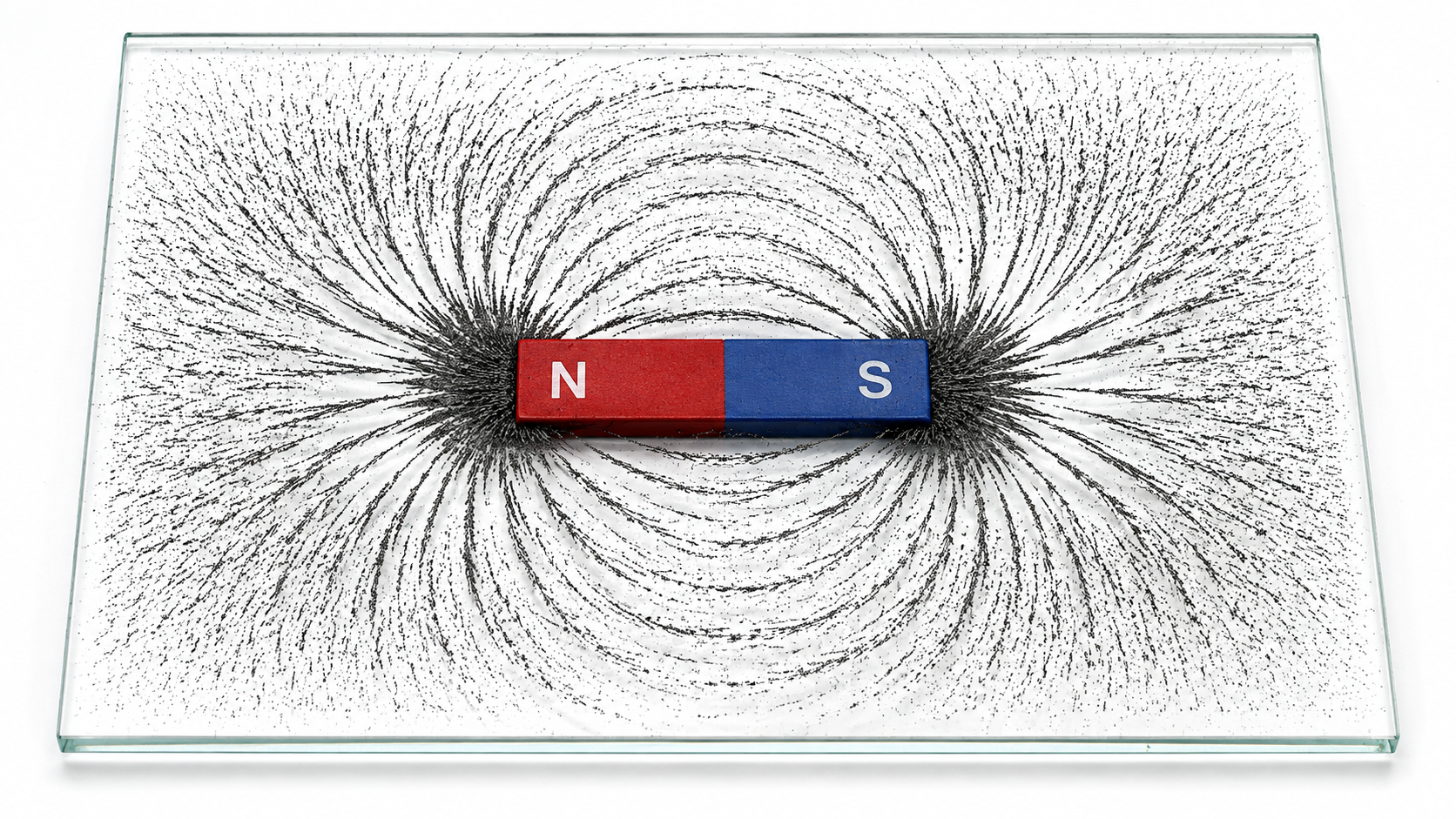
Figure 5.1: Magnetic dipole field lines demonstrated by iron filings sprinkled around a bar magnet. The filings align along magnetic field lines, displaying highest line density at the poles.
2. The Bar Magnet and Magnetic Field Lines
A bar magnet acts as a magnetic dipole. The pattern of magnetic field lines allows us to visualize the strength and orientation of the magnetic field in space.
Properties of Magnetic Field Lines (Crucial for CBSE Boards)
Continuous Closed Loops: Magnetic field lines form unbroken continuous loops. Externally, they emerge from the North pole and enter the South pole. Internally (inside the body of the magnet), they run continuously from the South pole to the North pole. (This contrasts sharply with electrostatic field lines, which start at positive charges and terminate on negative charges or extend to infinity).
Direction of Field: The tangent drawn to a magnetic field line at any point gives the direction of the net magnetic field vector $\vec{B}$ at that point.
No Intersection Rule: Two magnetic field lines never cross each other. If they intersected, there would be two distinct tangents at the point of intersection, implying two different directions of the net magnetic field at the same point, which is physically impossible.
Line Density & Field Strength: The relative density (number of lines passing per unit normal area) represents the magnitude of the field. A crowded region signifies a strong magnetic field (e.g., near the pole tips), while sparse spacing denotes a weak field.
NCERT Conceptual Note: Why "Lines of Force" is Avoided
In classical literature, magnetic field lines were occasionally called "magnetic lines of force". However, modern physics strictly avoids this terminology. In electrostatics, the electric force $\vec{F}_e = q\vec{E}$ acts directly along the electric field line. In contrast, the magnetic force on a moving charge is $\vec{F}_m = q(\vec{v} \times \vec{B})$, which is always perpendicular to the magnetic field $\vec{B}$. Hence, magnetic field lines do not represent the direction of force on a moving particle.
Figure 5.2: Magnetic field line configurations: (a) A permanent bar magnet, (b) A finite current-carrying solenoid, and (c) An electric dipole. Notice that magnetic field lines form continuous closed loops without start or end points, whereas electric lines originate and terminate on electric charges.
Fundamental Concepts: Magnetic Dipole, Pole Strength & Magnetic Moment
1. What is a Magnetic Dipole?
A magnetic dipole consists of two equal and opposite magnetic poles (a North pole of strength $+q_m$ and a South pole of strength $-q_m$) separated by a small finite distance $2l$.
Examples: A bar magnet, a compass needle, a current-carrying loop, and an orbiting electron inside an atom.
Isolated Monopoles: Unlike electrostatics where isolated positive and negative charges exist, isolated magnetic poles (monopoles) do not exist in nature. Magnetic poles always exist as dipoles.
2. Pole Strength ($q_m$) & Magnetic Length ($2l$)
Pole Strength ($q_m$ or $m_p$): The ability of a magnetic pole to attract or repel magnetic material.
Convention: North pole $= +q_m$, South pole $= -q_m$.
SI Unit: $\text{A}\cdot\text{m}$ (Ampere-metre) or $\text{N}\cdot\text{T}^{-1}$ (Newton per Tesla).
Scalar Nature: Pole strength is a scalar quantity. It depends directly on the cross-sectional area ($A$) and material of the magnet ($q_m \propto A$). It is independent of the magnet's length.
Magnetic Length ($2l$) vs Geometric Length ($L_g$):
Because the magnetic poles are not located at the exact physical edges but slightly inside the magnet:
$$\text{Magnetic Length } (2l) \approx \frac{5}{6} \times L_g \approx 0.84 \times \text{Geometric Length}$$
Magnetic Coulomb's Law: The magnetic force between two isolated hypothetical magnetic poles $q_{m1}$ and $q_{m2}$ separated by distance $r$ in vacuum is:
$$F = \frac{\mu_0}{4\pi} \frac{q_{m1} q_{m2}}{r^2}$$
3. Magnetic Dipole Moment ($\vec{m}$ or $\vec{M}$)
The magnetic dipole moment $\vec{m}$ of a bar magnet is defined as the product of its pole strength ($q_m$) and the magnetic length vector ($2\vec{l}$):
$$\vec{m} = q_m (2\vec{l})$$
Vector Direction: Points along the magnetic axis from the South pole ($-q_m$) to the North pole ($+q_m$) (analogous to the electric dipole moment $\vec{p}$ from $-q$ to $+q$).
SI Units: $\text{A}\cdot\text{m}^2$ (Ampere-metre$^2$) or $\text{J}\cdot\text{T}^{-1}$ (Joule per Tesla).
Dimensional Formula: $[M^0 L^2 T^0 A^1]$.
4. Board Special: Effect of Cutting & Bending a Bar Magnet
Let an initial bar magnet have length $L = 2l$, pole strength $q_m$, and dipole moment $m = q_m (2l)$.
Cut Transversely (Perpendicular to length into $n$ equal parts):
Cross-sectional area is unchanged $\implies$ Pole strength remains the same: $q_m' = q_m$.
New length of each piece $= \frac{2l}{n}$.
New magnetic moment: $m' = q_m \left(\frac{2l}{n}\right) = \frac{m}{n}$.
Cut Longitudinally (Parallel to length into $n$ equal thin strips):
Length remains unchanged: $l' = 2l$.
Cross-sectional area becomes $A/n \implies$ Pole strength becomes: $q_m' = \frac{q_m}{n}$.
New magnetic moment: $m' = \left(\frac{q_m}{n}\right) (2l) = \frac{m}{n}$.
Bending into a Semicircular Arc:
Original length $L = \pi R \implies R = \frac{L}{\pi}$.
Distance between new poles (diameter) $= 2R = \frac{2L}{\pi}$.
New magnetic moment: $m' = q_m (2R) = q_m \left(\frac{2L}{\pi}\right) = \frac{2}{\pi}m \approx 0.637 m$.
Bending at Midpoint at Angle $\theta$:
Two halves of length $l/2$ each with moment $m_0 = m/2$ inclined at angle $\theta$.
Resultant magnetic moment: $m' = 2 \left(\frac{m}{2}\right) \sin\left(\frac{\theta}{2}\right) = m \sin\left(\frac{\theta}{2}\right)$.
5. Magnetic Field of a Short Bar Magnet (Axial & Equatorial Fields)
Using the dipole formulation (where poles $+q_m$ and $-q_m$ are separated by $2l$):
Field on Axial Line (End-on position, at distance $r$ from center):
$$B_{axial} = \frac{\mu_0}{4\pi} \frac{2m r}{(r^2 - l^2)^2}$$
For a short magnet ($r \gg l$):
$$\vec{B}_{axial} = \frac{\mu_0}{4\pi} \frac{2\vec{m}}{r^3}$$(Direction is along the direction of $\vec{m}$, i.e., South to North).
Field on Equatorial Line (Broadside-on position, at distance $r$ from center):
$$B_{equatorial} = \frac{\mu_0}{4\pi} \frac{m}{(r^2 + l^2)^{3/2}}$$
For a short magnet ($r \gg l$):
$$\vec{B}_{equatorial} = -\frac{\mu_0}{4\pi} \frac{\vec{m}}{r^3}$$(Direction is opposite to the direction of $\vec{m}$, i.e., North to South).
Fundamental Ratio: At the same distance $r$ from a short bar magnet:
$$B_{axial} = 2 B_{equatorial}$$
Field at Any General Point $(r, \theta)$ in polar coordinates:$$B = \frac{\mu_0}{4\pi} \frac{m}{r^3} \sqrt{1 + 3\cos^2\theta}$$
$$\tan\alpha = \frac{1}{2}\tan\theta \quad (\alpha \text{ is the angle made by }\vec{B}\text{ with the position vector }\vec{r})$$
3. Bar Magnet as an Equivalent Solenoid (Board Derivation)
Ampere hypothesized that all magnetic phenomena are fundamentally caused by circulating electric currents. A finite current-carrying solenoid and a bar magnet produce mathematically identical magnetic fields at large distances ($r \gg a, r \gg l$).
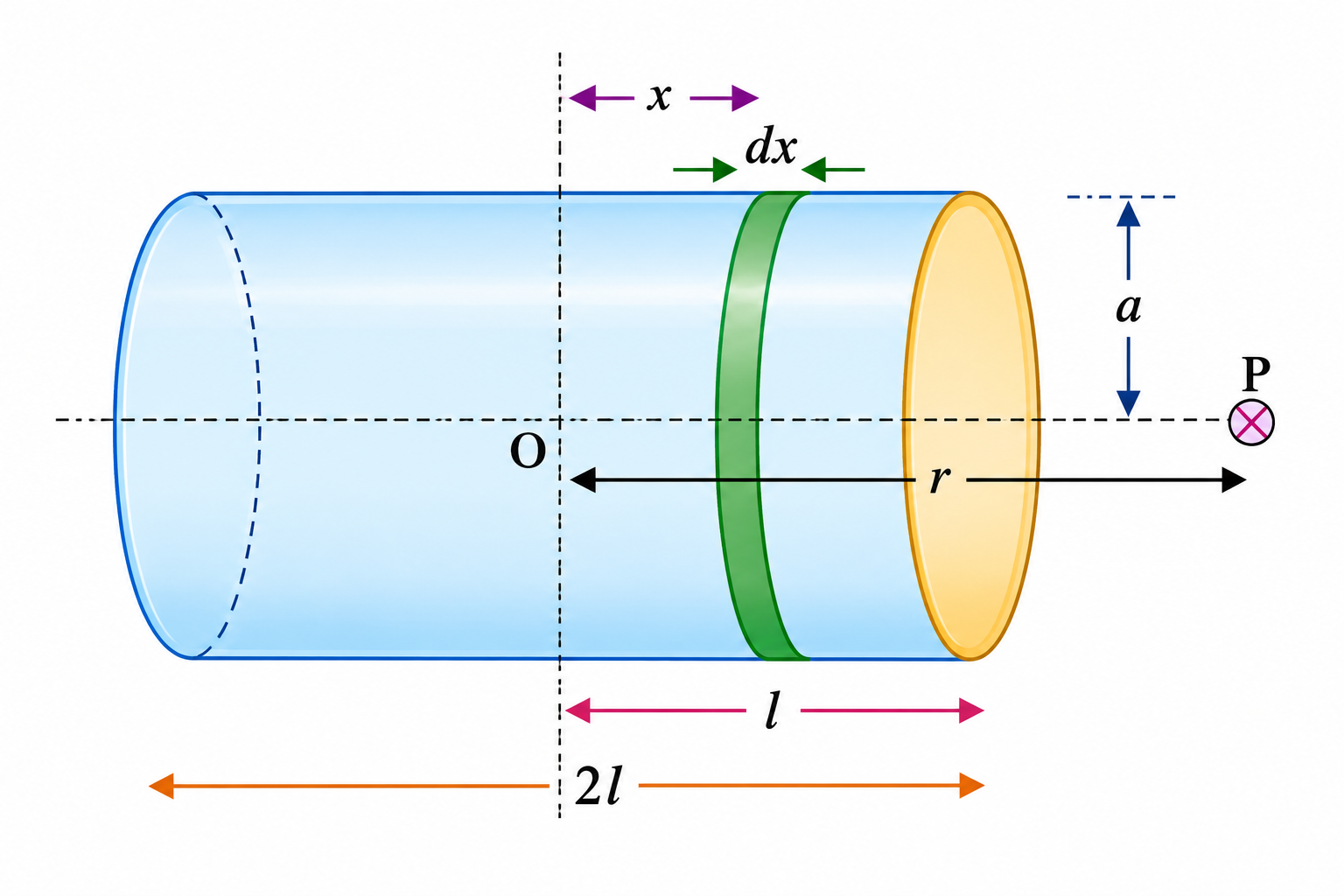
Figure 5.3: Geometry for deriving the axial magnetic field of a finite solenoid of length $2l$ and radius $a$ at a distant point $P$ ($r \gg a, r \gg l$) by integrating elemental current slices of width $dx$.
Derivation: Axial Field of a Finite Solenoid
Let a finite solenoid have:
Total length $= 2l$, Radius $= a$, Center $= O$
Number of turns per unit length $= n$ (Total turns $N = n \times 2l$)
Current flowing through each turn $= I$
Consider a circular element of width $dx$ located at distance $x$ from the center $O$.
Number of turns in this small element $= n\,dx$.
Using the formula for the axial field of a single circular coil carrying current ($B = \frac{\mu_0 I a^2}{2(a^2 + d^2)^{3/2}}$), the field $dB$ at an axial point $P$ at distance $r$ from $O$ (distance from slice $= r - x$) is:
$$dB = \frac{\mu_0 (n\,dx) I a^2}{2 [(r - x)^2 + a^2]^{3/2}}$$
Approximation for a distant point ($r \gg a$ and $r \gg l$):
$[(r - x)^2 + a^2]^{3/2} \approx (r^2)^{3/2} = r^3$.
Hence:
$$dB \approx \frac{\mu_0 n I a^2}{2 r^3} dx$$
Integrating over the entire length of the solenoid from $x = -l$ to $x = +l$:
$$B = \frac{\mu_0 n I a^2}{2 r^3} \int_{-l}^{l} dx = \frac{\mu_0 n I a^2}{2 r^3} [x]_{-l}^{l} = \frac{\mu_0 n I a^2 (2l)}{2 r^3}$$
Multiply the numerator and denominator by $2\pi$:
$$B = \frac{\mu_0}{4\pi} \frac{2 [n (2l) I (\pi a^2)]}{r^3}$$
Since the total magnetic dipole moment of the solenoid is $m = N I A = (n \times 2l) I (\pi a^2)$, we get:
$$B = \frac{\mu_0}{4\pi} \frac{2m}{r^3}$$
Conclusion: This expression is identical to the axial magnetic field of a short bar magnet, proving that a bar magnet and a finite solenoid are magnetically equivalent!
4. The Magnetic Dipole in a Uniform Magnetic Field
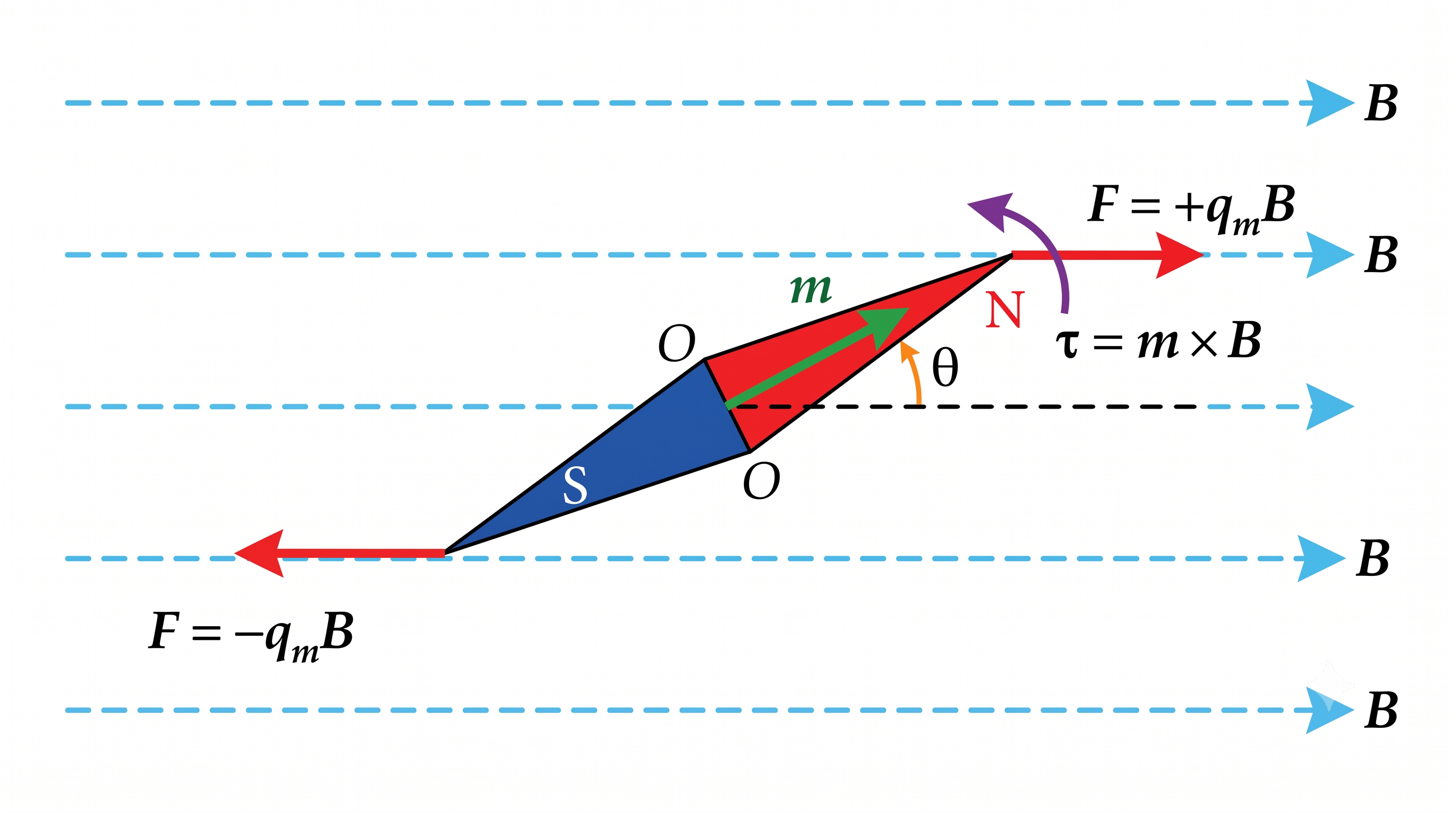
Figure 5.4: A magnetic needle with magnetic dipole moment $\vec{m}$ placed at an angle $\theta$ in a uniform magnetic field $\vec{B}$, experiencing equal and opposite forces ($\pm q_m \vec{B}$) that form a couple and produce a restoring torque $\vec{\tau} = \vec{m} \times \vec{B}$.
When a magnetic needle or dipole with magnetic moment $\vec{m}$ is placed in a uniform magnetic field $\vec{B}$:
Net Translational Force: $\vec{F}_{net} = \vec{F}_N + \vec{F}_S = q_m \vec{B} - q_m \vec{B} = \mathbf{0}$. (No linear acceleration in a uniform field).
Torque ($\vec{\tau}$): The equal and opposite forces at different points form a couple:
$$\vec{\tau} = \vec{m} \times \vec{B} \implies \tau = m B \sin\theta$$
This torque tends to align the dipole moment $\vec{m}$ parallel to the magnetic field $\vec{B}$.
Magnetic Potential Energy ($U_m$): Work done by external agent in rotating the dipole against the restoring torque:
$$U_m = \int \tau(\theta) d\theta = \int m B \sin\theta \, d\theta = -m B \cos\theta = -\vec{m} \cdot \vec{B}$$
Angular Simple Harmonic Motion (Oscillations of Dipole):
For a small angular displacement $\theta$, the restoring torque is $\tau = -mB\sin\theta \approx -mB\theta$.
Using $\tau = I \frac{d^2\theta}{dt^2}$ (where $I$ is the moment of inertia):
$$I \frac{d^2\theta}{dt^2} = -mB\theta \implies \frac{d^2\theta}{dt^2} = -\left(\frac{mB}{I}\right)\theta$$
Comparing with $\frac{d^2\theta}{dt^2} = -\omega^2\theta$, the angular frequency is $\omega = \sqrt{\frac{mB}{I}}$.
Therefore, the time period of oscillation is:
$$T = 2\pi\sqrt{\frac{I}{mB}} \implies B = \frac{4\pi^2 I}{m T^2}$$
NCERT Example 5.1 (Comprehensive Conceptual)
(a) What happens if a bar magnet is cut into two pieces: (i) transverse to its length, (ii) along its length? (b) A magnetised needle in a uniform magnetic field experiences a torque but no net force. An iron nail near a bar magnet, however, experiences a force of attraction in addition to a torque. Why? (c) Must every magnetic configuration have a north pole and a south pole? What about the field due to a toroid? (d) Two identical looking iron bars A and B are given, one of which is definitely known to be magnetised. How would one ascertain whether or not both are magnetised? If only one is magnetised, how does one ascertain which one using nothing else?
NCERT Step-by-Step Solution: (a) In either case, cutting creates two complete magnets, each with its own North and South poles.
Longitudinal cut: Length remains $l$, pole strength halves to $q_m/2 \implies M' = (q_m/2)l = M/2$.
(b) In a uniform field, forces on the two poles are equal and opposite, giving zero net force. Near a bar magnet, the field is non-uniform. The magnetic field induces magnetic dipole moment in the iron nail. Because the induced unlike pole is closer to the magnet's pole than the induced like pole, the attractive force exceeds the repulsive force, yielding a net force of attraction in addition to torque. (c) Not necessarily. A magnetic field configuration possesses distinct North and South poles only if it has a net non-zero magnetic moment. For a continuous toroid or a straight infinite conductor, the magnetic field lines form closed concentric loops with no beginning or end; hence they have no poles. (d)
Bring one end of A near both ends of B. If repulsion occurs in any orientation, both bars are magnetised (since repulsion is the sure test of magnetisation).
If only attraction occurs in all combinations, only one bar is magnetised. To find which one: Touch one end of bar A to the middle of bar B. In a bar magnet, magnetic field strength is concentrated at the pole ends and is near zero at the neutral center. If A experiences attractive force at B's midpoint, then A is the magnet (and B is unmagnetised iron). If A experiences no force at B's midpoint, then B is the magnet (and A is unmagnetised iron).
5. The Electrostatic Analog & Dipole Equations
Many equations for magnetic dipoles at large distances ($r \gg l$) can be directly deduced from electrostatic dipole equations by replacing electrostatic quantities with their magnetic counterparts:
The Direct Replacement Rules
$$\vec{E} \longrightarrow \vec{B}, \quad \vec{p} \longrightarrow \vec{m}, \quad \frac{1}{4\pi\epsilon_0} \longrightarrow \frac{\mu_0}{4\pi}$$
Equatorial Field (Normal Bisector):
$$\vec{B}_E = -\frac{\mu_0}{4\pi} \frac{\vec{m}}{r^3}$$
Axial Field:
$$\vec{B}_A = \frac{\mu_0}{4\pi} \frac{2\vec{m}}{r^3}$$
Comparison Table: The Dipole Analogy (Electrostatics vs Magnetism)
In electrostatics, Gauss's Law states that the electric flux through any closed surface is proportional to the enclosed electric charge: $\oint \vec{E} \cdot d\vec{S} = \frac{q_{enclosed}}{\epsilon_0}$.
In magnetism, because magnetic field lines are continuous closed loops with no beginning or ending point, the number of field lines entering any closed surface must precisely equal the number of field lines leaving it.
Figure 5.5: Magnetic flux through an elemental area $\Delta \vec{S}$ on a closed Gaussian surface $S$. Net flux over the entire closed surface is identically zero.
Statement of Gauss's Law in Magnetism"The net magnetic flux ($\Phi_B$) through any closed surface is always zero."$$\Phi_B = \oint \vec{B} \cdot d\vec{S} = \sum_{\text{all}} \vec{B} \cdot \Delta\vec{S} = 0$$
Physical Significance: This law mathematically establishes that isolated magnetic monopoles do not exist. There are no sources or sinks of magnetic field lines. The simplest magnetic element is a magnetic dipole or a circulating current loop.
Biographical Note: Karl Friedrich Gauss (1777 – 1855)
Karl Friedrich Gauss was a legendary German mathematician and physicist. He made monumental contributions to number theory, differential geometry, celestial mechanics, and electromagnetism. Together with Wilhelm Weber, he built the first practical electric telegraph in 1833. His mathematical formulation of flux integrals is one of Maxwell's four fundamental equations of electromagnetism.
NCERT Example 5.4 (Advanced Conceptuals)
(a) Do magnetic field lines represent lines of force on a moving charged particle at every point? (b) If magnetic monopoles existed, how would Gauss's Law in magnetism be modified? (c) Does a bar magnet exert a torque on itself due to its own field? Does one element of a current-carrying wire exert a force on another element of the same wire? (d) Can a system have a magnetic moment even though its net electric charge is zero?
Solution: (a)No. The magnetic force $\vec{F} = q(\vec{v} \times \vec{B})$ is always perpendicular to $\vec{B}$, whereas a line of force implies force along the tangent. (b) If isolated magnetic monopoles with magnetic charge $q_m$ existed, Gauss's Law for magnetism would become:
$$\oint \vec{B} \cdot d\vec{S} = \mu_0 q_{m,\text{enclosed}}$$
(c)No, a bar magnet does not exert a net torque or force on itself. However, for a curved current-carrying wire, distinct elements of the wire do exert magnetic forces on one another (though the vector sum of all internal forces is zero by Newton's third law). For a straight wire, this mutual force is zero. (d)Yes. Even when total net charge is zero (e.g., a neutral atom or a neutron), charges of opposite signs may move in distinct orbits/configurations such that their microscopic magnetic dipole moments add up to a non-zero net magnetic moment.
7. Magnetisation and Magnetic Intensity
When matter is placed in an external magnetic field, its microscopic atomic magnetic moments respond and modify the total interior magnetic field.
Magnetisation Vector ($\vec{M}$): The net magnetic dipole moment developed per unit volume of the material.
$$\vec{M} = \frac{\vec{m}_{net}}{V}$$
SI Unit: $\text{A m}^{-1}$ (or $\text{A/m}$). Dimensions: $[L^{-1} A]$.
Magnetic Intensity ($\vec{H}$): A vector representing the external magnetising capability independent of the medium. For a solenoid carrying current $I$ with $n$ turns per unit length, $H = nI$.
$$\vec{H} = \frac{\vec{B}}{\mu_0} - \vec{M}$$
SI Unit: $\text{A m}^{-1}$. Dimensions: $[L^{-1} A]$.
Total Magnetic Field ($\vec{B}$): Inside a magnetic material, $\vec{B}$ is the sum of the external field ($\mu_0 \vec{H}$) and the field produced by the medium ($\mu_0 \vec{M}$):
$$\vec{B} = \mu_0(\vec{H} + \vec{M})$$
Magnetic Susceptibility ($\chi$): A dimensionless quantity measuring the responsiveness of a substance to an applied magnetising field:
$$\vec{M} = \chi \vec{H} \implies \chi = \frac{M}{H}$$
Relative Magnetic Permeability ($\mu_r$) and Magnetic Permeability ($\mu$):
$$B = \mu_0 (H + \chi H) = \mu_0(1 + \chi)H = \mu H$$
$$\mu_r = 1 + \chi, \quad \mu = \mu_0 \mu_r = \mu_0(1 + \chi)$$
$\mu_r$ is dimensionless (analog of dielectric constant $K$ in electrostatics). $\mu$ has units $\text{T m A}^{-1}$ (or $\text{N A}^{-2}$).
NCERT Example 5.5 (Numerical Calculation)
Question: A solenoid has a core of a material with relative permeability $\mu_r = 400$. The insulated windings carry a current of $2\text{ A}$. The number of turns is $1000\text{ turns/m}$. Calculate: (a) $H$, (b) $M$, (c) $B$, and (d) the magnetising current $I_m$.
Solution:
Given: $n = 1000\text{ m}^{-1}$, $I = 2\text{ A}$, $\mu_r = 400$. (a) Magnetic Intensity $H$:
$$H = n I = 1000 \times 2.0 = \mathbf{2 \times 10^3 \text{ A m}^{-1}}$$
(b) Magnetisation $M$:
$$\chi = \mu_r - 1 = 400 - 1 = 399$$
$$M = \chi H = 399 \times (2 \times 10^3) = \mathbf{7.98 \times 10^5 \text{ A m}^{-1}} \approx 8 \times 10^5 \text{ A m}^{-1}$$
(c) Total Magnetic Field $B$:
$$B = \mu_r \mu_0 H = 400 \times (4\pi \times 10^{-7}) \times (2 \times 10^3) = 32\pi \times 10^{-2} \approx \mathbf{1.0 \text{ T}}$$
(d) Magnetising Current $I_m$:
The magnetising current $I_m$ is the extra equivalent current that would produce the same field $B$ in an empty solenoid:
$$B = \mu_0 n (I + I_m) \implies 1.0 = (4\pi \times 10^{-7}) \times 1000 \times (2 + I_m)$$
$$2 + I_m = \frac{1.0}{4\pi \times 10^{-4}} = \frac{10^4}{1.2566} \approx 796 \implies I_m = 796 - 2 = \mathbf{794 \text{ A}}$$
8. Magnetic Properties of Materials (Dia, Para, Ferro)
Substances are classified into three primary categories based on their behavior in external magnetic fields:
NCERT Table 5.2: Master Comparison of Magnetic Materials
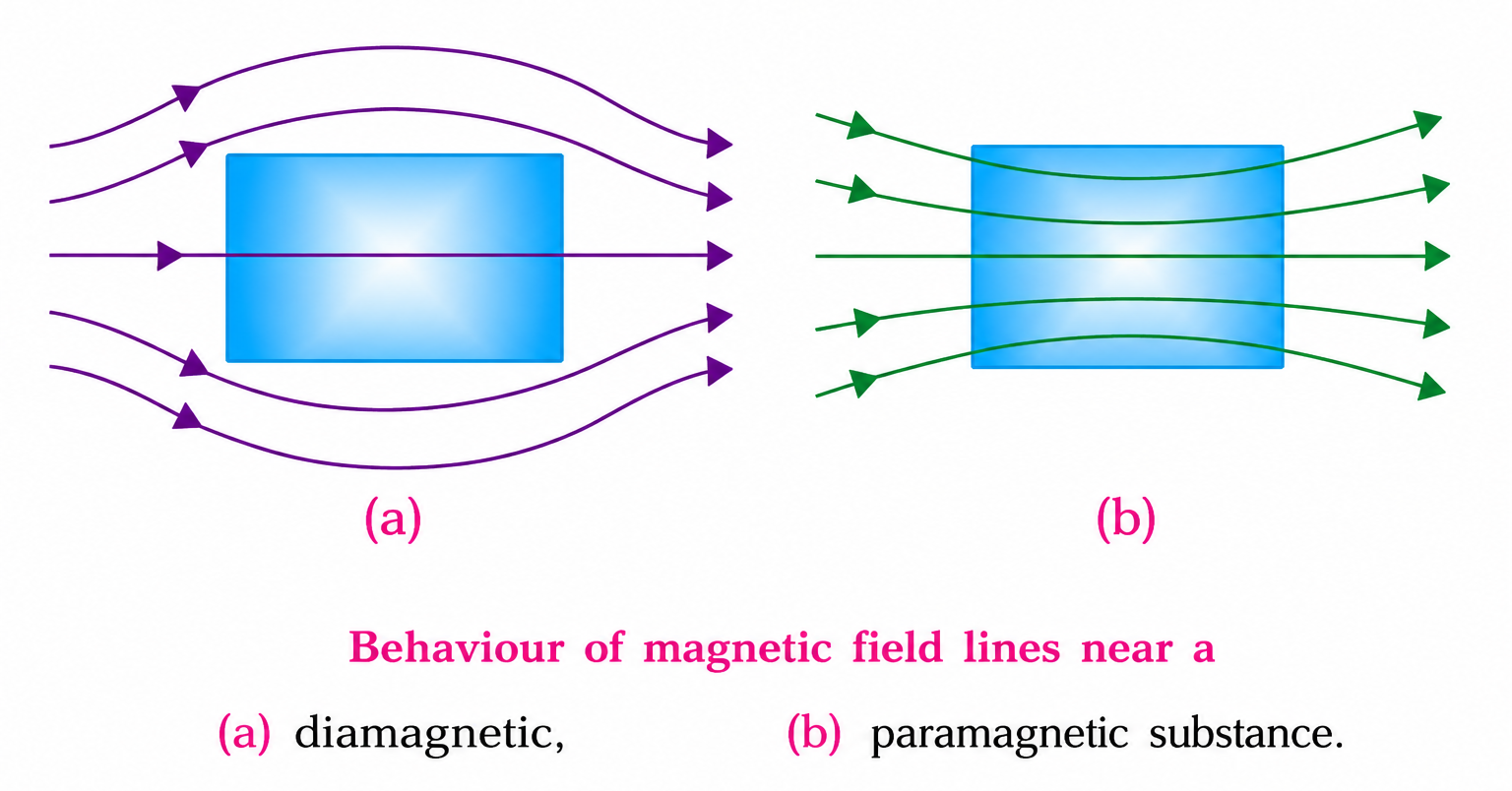
Figure 5.6: Behavior of magnetic field lines: (a) Diamagnetic material expels field lines outwards ($B < B_0$), showing feeble repulsion; (b) Paramagnetic material pulls field lines inward ($B > B_0$), showing feeble attraction.
A. Detailed Study: Diamagnetism
Mechanism: In diamagnetic atoms, the vector sum of orbital magnetic moments of electrons in complete shells is zero. When an external field $\vec{B}_{ext}$ is applied, by Lenz's Law, orbiting electrons whose magnetic moments oppose the field are accelerated, while those whose moments aid the field are slowed down. This induces a net magnetic moment $\vec{m}_{ind}$ strictly opposing $\vec{B}_{ext}$, causing repulsion.
Universality: Diamagnetism is present in all substances. However, in paramagnetic and ferromagnetic materials, the stronger alignment effects completely overshadow the weak diamagnetic response.
Superconductors & The Meissner Effect: Superconductors cooled below their critical temperature exhibit perfect diamagnetism ($\chi = -1, \mu_r = 0, \mu = 0$). They completely expel all internal magnetic field lines. This leads to magnetic levitation (used in Maglev superfast trains). Explained quantum-mechanically by BCS theory (Bardeen, Cooper, Schrieffer).
B. Detailed Study: Paramagnetism & Curie's Law
Mechanism: Individual atoms have net permanent dipole moments due to unpaired electrons. Under normal conditions, thermal agitation keeps them randomly oriented (Net $M = 0$). An external field aligns them against thermal randomization.
Curie's Law: At temperature $T$ (in Kelvin) in field $B_0$:
$$M = C \frac{B_0}{T} \quad \text{or} \quad \chi = C \frac{\mu_0}{T}$$
where $C$ is the Curie Constant. As $B_0/T$ increases, magnetisation reaches a maximum saturation value ($M_s$) where all atomic dipoles are fully aligned.
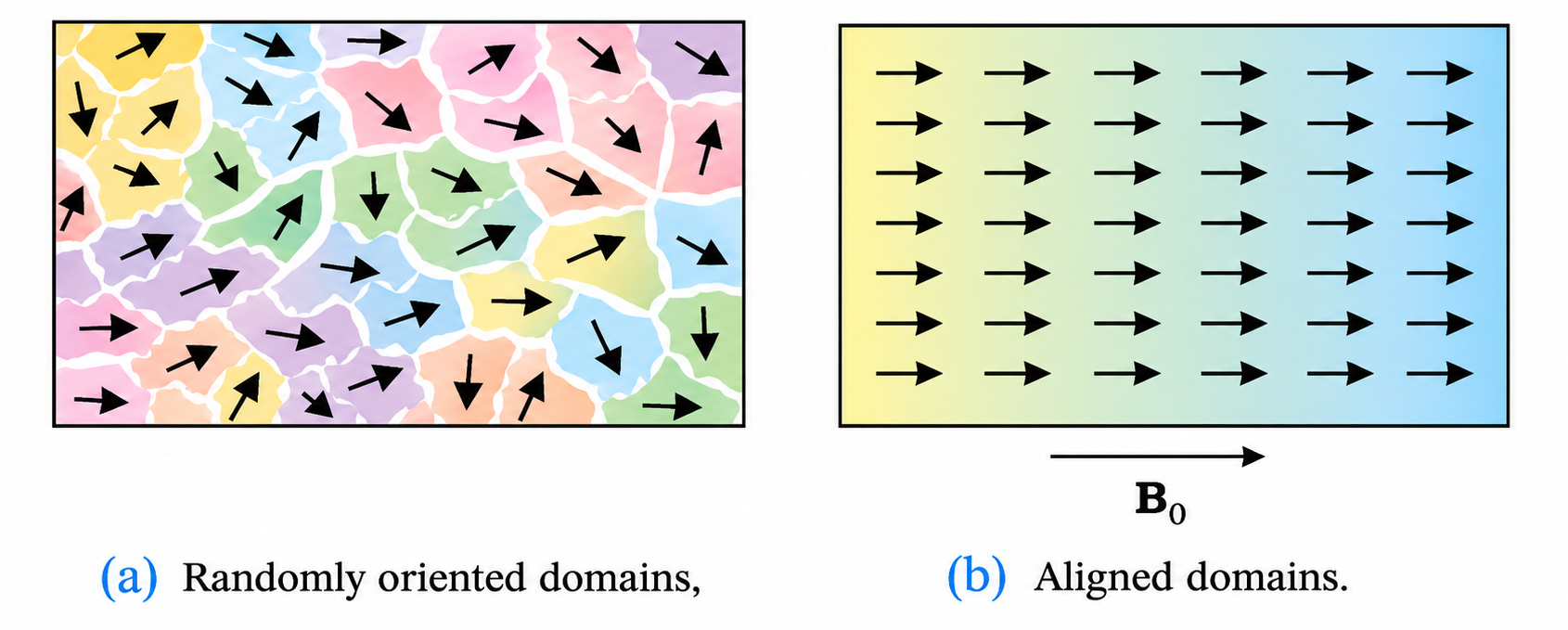
Figure 5.7: Ferromagnetic domains: (a) Randomly oriented microscopic domains in the unmagnetized state ($\sum \vec{M} = 0$), (b) Alignment of domain magnetization vectors parallel to the external field $\vec{B}_0$, yielding high net magnetization ($\vec{M} \gg 0$).
C. Detailed Study: Ferromagnetism
Domain Theory: Atoms have strong permanent dipoles that spontaneously align parallel to each other over microscopic regions called domains (size $\sim 1\text{ mm}$, containing $\sim 10^{11}$ atoms) due to quantum-mechanical exchange coupling.
Under External Field: Magnetisation occurs via two processes:
Domain Wall Displacement: Domains aligned with the field expand at the expense of non-aligned domains.
Domain Rotation: Entire domain magnetization vectors rotate to align with $\vec{B}_0$.
Curie Temperature ($T_c$): As temperature rises, thermal agitation disrupts domain alignment. At $T > T_c$, the ferromagnetic material transitions into a paramagnetic material, obeying the Curie-Weiss Law:
$$\chi = \frac{C}{T - T_c} \quad (T > T_c)$$
Hard vs Soft Ferromagnets:
Hard Ferromagnets: Retain high magnetisation after field removal (High Retentivity, High Coercivity). Used for permanent magnets (e.g., Alnico, Lodestone).
Soft Ferromagnets: Magnetisation collapses immediately when external field is removed (High Permeability, Low Retentivity, Low Coercivity). Used for transformer cores, electromagnets (e.g., Soft Iron).
Exotic Magnetic Materials: Beyond dia, para, and ferro, advanced condensed matter includes ferrimagnetic (e.g., ferrites), anti-ferromagnetic (e.g., $\text{MnO}$), and spin glass systems.
9. Master Summary Table: Physical Quantities
Physical Quantity
Symbol
Nature
Dimensions
SI Units
Key Definition / Remarks
Permeability of Free Space
$\mu_0$
Scalar
$[M L T^{-2} A^{-2}]$
$\text{T m A}^{-1}$ (or $\text{N A}^{-2}$)
$\mu_0/4\pi = 10^{-7} \text{ T m A}^{-1}$
Magnetic Field / Induction
$\vec{B}$
Vector
$[M T^{-2} A^{-1}]$
$\text{Tesla (T)}$
$1\text{ T} = 10^4\text{ Gauss (G)}$
Magnetic Dipole Moment
$\vec{m}$
Vector
$[L^2 A]$
$\text{A m}^2$ (or $\text{J T}^{-1}$)
$\vec{m} = I\vec{A} = q_m(2\vec{l})$
Magnetic Flux
$\Phi_B$
Scalar
$[M L^2 T^{-2} A^{-1}]$
$\text{Weber (Wb)}$
$1\text{ Wb} = 1\text{ T m}^2$
Magnetisation
$\vec{M}$
Vector
$[L^{-1} A]$
$\text{A m}^{-1}$
$\vec{M} = \vec{m}_{net}/V$
Magnetic Intensity
$\vec{H}$
Vector
$[L^{-1} A]$
$\text{A m}^{-1}$
$\vec{B} = \mu_0(\vec{H} + \vec{M})$
Magnetic Susceptibility
$\chi$
Scalar
Dimensionless
None
$\vec{M} = \chi \vec{H}$
Relative Permeability
$\mu_r$
Scalar
Dimensionless
None
$\mu_r = 1 + \chi = \mu/\mu_0$
Magnetic Permeability
$\mu$
Scalar
$[M L T^{-2} A^{-2}]$
$\text{T m A}^{-1}$
$\vec{B} = \mu \vec{H}$
10. Key Conceptual Takeaways (Points to Ponder)
NCERT Crucial Takeaways
Science vs. Engineering Timeline: Practical utilization of magnetic compasses predated scientific understanding by nearly 2000 years. Oersted's discovery in 1820 AD established the link between currents and magnetism.
Absence of Monopoles vs Charge Quantisation: Slicing a magnet produces two smaller dipoles. Isolated electric charges exist and are quantized in multiples of $e = 1.6 \times 10^{-19}\text{ C}$, but isolated magnetic charges have never been discovered.
Continuous Closed Loops: Because monopoles do not exist, magnetic field lines must form continuous unbroken loops with zero net flux through any closed Gaussian surface ($\oint \vec{B}\cdot d\vec{S} = 0$).
Tiny Susceptibility Difference: A minuscule numerical variation in $\chi$ ($\approx -10^{-5}$ vs $+10^{-5}$) determines completely opposite macroscopic behavior: diamagnetic repulsion vs paramagnetic attraction.
Superconductivity & BCS Theory: In a superconductor ($\chi = -1, \mu_r = 0$), the magnetic field is totally expelled (Meissner Effect). It is explained by quantum-mechanical BCS theory (Nobel Prize, 1972).
Universality of Diamagnetism: Diamagnetism is present in all materials, but is masked whenever paramagnetic or ferromagnetic effects are present.
11. Fully Solved NCERT Exercises (5.1 to 5.7)
NCERT Exercise 5.1
Question: A short bar magnet placed with its axis at $30^\circ$ with a uniform external magnetic field of $0.25\text{ T}$ experiences a torque of magnitude equal to $4.5 \times 10^{-2}\text{ J}$. What is the magnitude of magnetic moment of the magnet?
Question: A short bar magnet of magnetic moment $m = 0.32\text{ J T}^{-1}$ is placed in a uniform magnetic field of $0.15\text{ T}$. If the bar is free to rotate in the plane of the field, which orientation corresponds to its (a) stable, and (b) unstable equilibrium? What is the potential energy of the magnet in each case?
Solution:
Potential Energy formula: $U = -m B \cos\theta$. (a) Stable Equilibrium: Occurs when $\vec{m}$ is aligned parallel to $\vec{B}$ ($\theta = 0^\circ$).
$$U = -m B \cos 0^\circ = -(0.32)(0.15)(1) = \mathbf{-4.8 \times 10^{-2} \text{ J}}$$
(b) Unstable Equilibrium: Occurs when $\vec{m}$ is aligned antiparallel to $\vec{B}$ ($\theta = 180^\circ$).
$$U = -m B \cos 180^\circ = -(0.32)(0.15)(-1) = \mathbf{+4.8 \times 10^{-2} \text{ J}}$$
NCERT Exercise 5.3
Question: A closely wound solenoid of $800\text{ turns}$ and area of cross section $2.5 \times 10^{-4}\text{ m}^2$ carries a current of $3.0\text{ A}$. Explain the sense in which the solenoid acts like a bar magnet. What is its associated magnetic moment?
Solution: Equivalence Explanation: Along the central axis of the solenoid, the magnetic field lines emerge from one face (acting as a North pole) and enter the opposite face (acting as a South pole), looping back continuously inside the solenoid. At distances large compared to its size, the magnetic field pattern is identical to that of a bar magnet. Magnetic Moment Calculation:
Given: $N = 800$, $A = 2.5 \times 10^{-4}\text{ m}^2$, $I = 3.0\text{ A}$.
$$m = N I A = 800 \times 3.0 \times (2.5 \times 10^{-4}) = \mathbf{0.60 \text{ J T}^{-1}} \text{ (or A m}^2\text{)}$$
The direction of $\vec{m}$ is along the axis of the solenoid, given by the right-hand curl rule.
NCERT Exercise 5.4
Question: If the solenoid in Exercise 5.3 is free to turn about the vertical direction and a uniform horizontal magnetic field of $0.25\text{ T}$ is applied, what is the magnitude of torque on the solenoid when its axis makes an angle of $30^\circ$ with the direction of applied field?
Question: A bar magnet of magnetic moment $1.5\text{ J T}^{-1}$ lies aligned with the direction of a uniform magnetic field of $0.22\text{ T}$. (a) What is the amount of work required by an external torque to turn the magnet so as to align its magnetic moment: (i) normal to the field direction, (ii) opposite to the field direction? (b) What is the torque on the magnet in cases (i) and (ii)?
Solution:
Given: $m = 1.5\text{ J T}^{-1}$, $B = 0.22\text{ T}$, Initial angle $\theta_1 = 0^\circ$.
Work done formula: $W = m B (\cos\theta_1 - \cos\theta_2)$.
(a) (i) Normal to field ($\theta_2 = 90^\circ$):
$$\begin{aligned}
W &= (1.5)(0.22)(\cos 0^\circ - \cos 90^\circ) \\
&= 0.33 \times (1 - 0) = \mathbf{0.33 \text{ J}}
\end{aligned}$$
(a) (ii) Opposite to field ($\theta_2 = 180^\circ$):
$$\begin{aligned}
W &= (1.5)(0.22)(\cos 0^\circ - \cos 180^\circ) \\
&= 0.33 \times [1 - (-1)] = 0.33 \times 2 = \mathbf{0.66 \text{ J}}
\end{aligned}$$
(b) Torque in each case:
(i) At $\theta = 90^\circ$: $\tau = m B \sin 90^\circ = (1.5)(0.22)(1) = \mathbf{0.33 \text{ N m}}$
(ii) At $\theta = 180^\circ$: $\tau = m B \sin 180^\circ = (1.5)(0.22)(0) = \mathbf{0 \text{ N m}}$.
NCERT Exercise 5.6
Question: A closely wound solenoid of $2000\text{ turns}$ and area of cross-section $1.6 \times 10^{-4}\text{ m}^2$, carrying a current of $4.0\text{ A}$, is suspended through its centre allowing it to turn in a horizontal plane. (a) What is the magnetic moment associated with the solenoid? (b) What is the force and torque on the solenoid if a uniform horizontal magnetic field of $7.5 \times 10^{-2}\text{ T}$ is set up at an angle of $30^\circ$ with the axis of the solenoid?
Solution: (a) Magnetic Moment $m$:
$$m = N I A = 2000 \times 4.0 \times (1.6 \times 10^{-4}) = \mathbf{1.28 \text{ A m}^2} \text{ (or J T}^{-1}\text{)}$$
Net Force: In a uniform magnetic field, the net translational force on any magnetic dipole is Zero ($\vec{F}_{net} = 0$).
Torque $\tau$:
$$\begin{aligned}
\tau &= m B \sin\theta \\
&= 1.28 \times (7.5 \times 10^{-2}) \times \sin 30^\circ \\
&= 0.096 \times 0.5 = \mathbf{0.048 \text{ N m}} = \mathbf{4.8 \times 10^{-2} \text{ N m}}
\end{aligned}$$
NCERT Exercise 5.7
Question: A short bar magnet has a magnetic moment of $0.48\text{ J T}^{-1}$. Give the direction and magnitude of the magnetic field produced by the magnet at a distance of $10\text{ cm}$ from the centre of the magnet on (a) the axis, (b) the equatorial lines (normal bisector) of the magnet.
(a) On the Axis ($B_A$):
$$\begin{aligned}
B_A &= \frac{\mu_0}{4\pi} \frac{2m}{r^3} \\
&= 10^{-7} \times \frac{2 \times 0.48}{(0.1)^3} \\
&= 10^{-7} \times \frac{0.96}{10^{-3}} = 0.96 \times 10^{-4}\text{ T} = \mathbf{0.96 \text{ G}}
\end{aligned}$$
Direction: Directed along the axis from South pole to North pole (along $\vec{m}$).
(b) On the Equatorial Line ($B_E$):
$$\begin{aligned}
B_E &= \frac{\mu_0}{4\pi} \frac{m}{r^3} = \frac{B_A}{2} \\
&= \frac{0.96 \times 10^{-4}}{2} = \mathbf{0.48 \times 10^{-4} \text{ T}} = \mathbf{0.48 \text{ G}}
\end{aligned}$$
Direction: Directed parallel to the axis from North pole to South pole (opposite to $\vec{m}$).

 a bar magnet, (b) a current-carrying finite solenoid and.png)
 VARDAAN COMET