
Vardaan Learning Institute
vardaanlearning.com | 9508841336
Chapter 3: Current Electricity - Challenger (Level 3)
Section A: Complex Circuit Analysis & Symmetry
1.
Find the equivalent resistance of an infinite ladder network consisting of series resistors $R_1$ and parallel shunt resistors $R_2$. Express your answer in terms of $R_1$ and $R_2$.
2.
Twelve identical wires, each of resistance $r$, are joined to form a skeleton cube. Calculate the equivalent resistance across: (a) a face diagonal, and (b) an edge of the cube.
3.
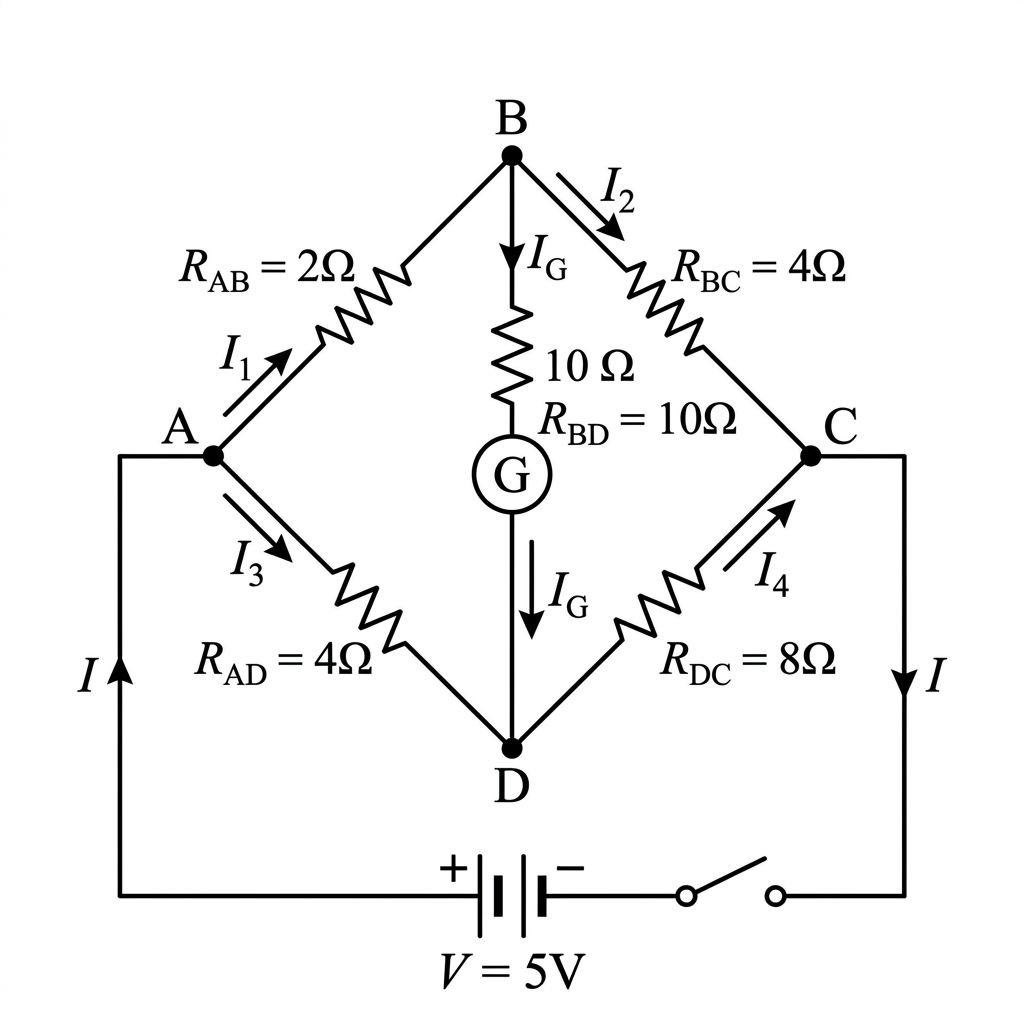 Analyze the unbalanced Wheatstone bridge shown above. Calculate the equivalent resistance of the network across nodes A and C using Kirchhoff's laws or the Delta-Star transformation.
4.
An infinite square grid is made of uniform wire. If the resistance of each segment of the grid is $R$, find the equivalent resistance between two adjacent nodes using the superposition theorem of currents.
5.
A circuit contains a non-ideal capacitor $C$ in series with a resistor $R$ and battery $V$. The capacitor has a leakage resistance $R_L$ parallel to it. Find the steady-state charge on the capacitor.
6.
In a generic Wheatstone bridge, the galvanometer and battery are swapped. Mathematically prove that the current through the galvanometer branch in the unbalanced state changes, but the condition for balance ($I_g = 0$) remains identical.
7.
Apply Nodal Analysis to find the potential of a central node connected to three batteries: $E_1 = 10\text{V}, r_1 = 1\text{ }\Omega$; $E_2 = 20\text{V}, r_2 = 2\text{ }\Omega$; $E_3 = 30\text{V}, r_3 = 3\text{ }\Omega$, with all negative terminals grounded.
8.
Determine the equivalent resistance between two diametrically opposite points on a uniform circular wire ring of total resistance $R_0$, which is connected with a straight diametrical wire of resistance $R_d$.
9.
If a battery of EMF $E$ and internal resistance $r$ is connected across a variable external load $R$, show that the current $I$ and voltage $V$ obey the equation of a straight line. What is the maximum power dissipated in $r$?
10.
A regular tetrahedron is formed by 6 wires, each of resistance $R$. Find the equivalent resistance between any two vertices.
Section B: Calculus-Based Microscopic Dynamics
11.
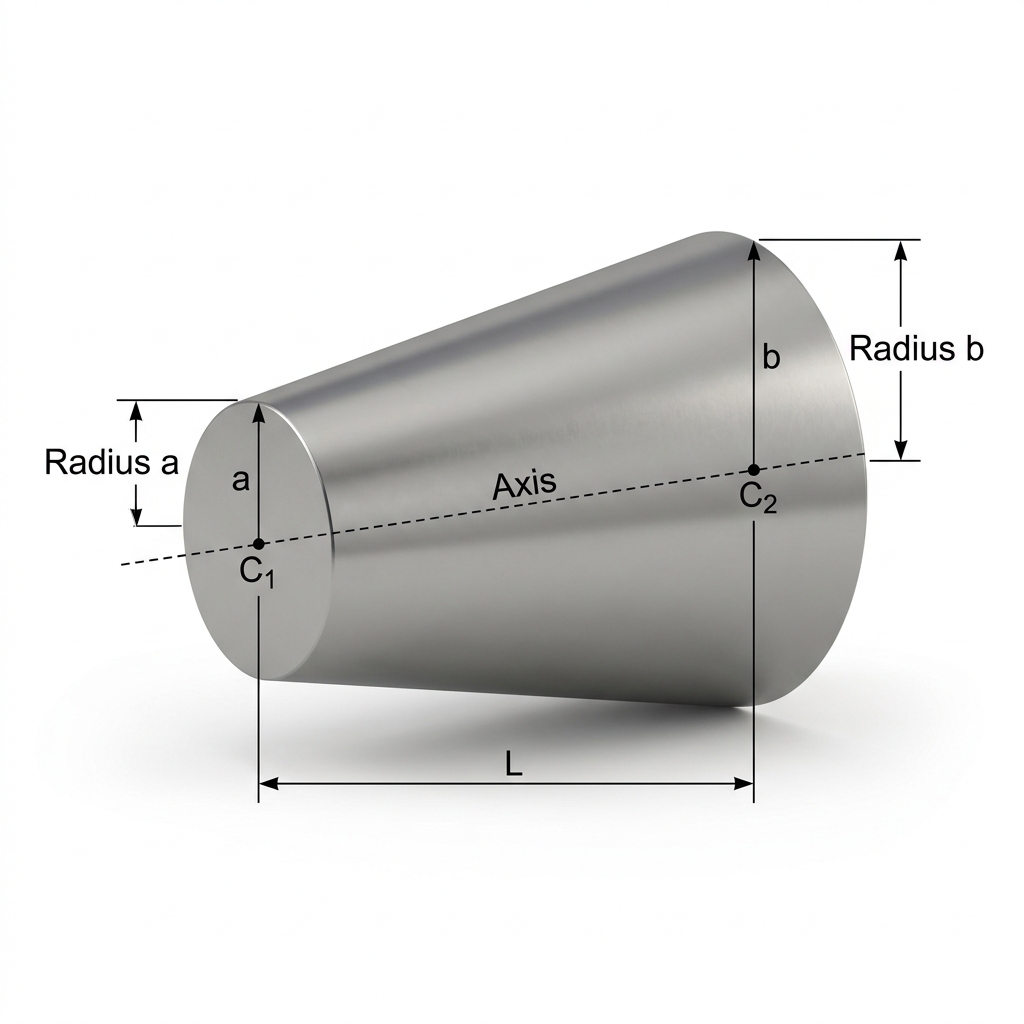 Derive the expression for the electrical resistance $R$ of the solid truncated cone shown above, assuming the material has a uniform resistivity $\rho$. Current flows along the axis.
12.
For the truncated cone in Q11, if a steady current $I$ flows through it, derive an expression for the drift velocity $v_d$ of electrons as a function of the axial distance $x$ from the smaller face (radius $a$).
13.
A spherical shell of inner radius $r_1$ and outer radius $r_2$ is made of a material of resistivity $\rho$. Calculate its resistance if the current flows radially outward from the inner surface to the outer surface.
14.
Repeat the radial resistance calculation for a highly elongated cylindrical shell of inner radius $a$, outer radius $b$, length $L$, and resistivity $\rho$.
15.
The current density $\vec{J}$ inside a long solid cylindrical wire of radius $R$ is directed parallel to its axis and its magnitude varies with radial distance $r$ from the axis as $J = J_0(1 - r/R)$. Find the total current $I$ through the wire.
16.
A conductor has a temperature-dependent resistivity given by $\rho(T) = \rho_0 e^{\beta/T}$. It is connected to a constant voltage source $V$. As Joule heating increases the temperature, does the current increase or decrease? Explain the limit of this process.
17.
In a semiconductor, the current density is given by $J = e(n\mu_e + p\mu_h)E$, where $n, p$ are carrier densities and $\mu_e, \mu_h$ are mobilities. If $n_i$ is the intrinsic carrier concentration, derive the conductivity $\sigma$ for an intrinsic semiconductor.
18.
An alternating electric field $E = E_0 \cos(\omega t)$ is applied to a metal. Neglecting collisions momentarily, what is the amplitude of the oscillatory velocity of the electrons?
19.
Assuming the Drude model, if the average kinetic energy of an electron gas in a metal is $\frac{3}{2}kT$, estimate the thermal speed of an electron at $300\text{ K}$ and compare it with a typical drift speed of $1\text{ mm/s}$.
20.
The resistivity of a material varies along its length $L$ as $\rho(x) = \rho_0 (1 + \alpha x)$. Find the total resistance of the wire if its cross-sectional area $A$ is uniform.
Section C: Advanced Measuring Instruments
21.
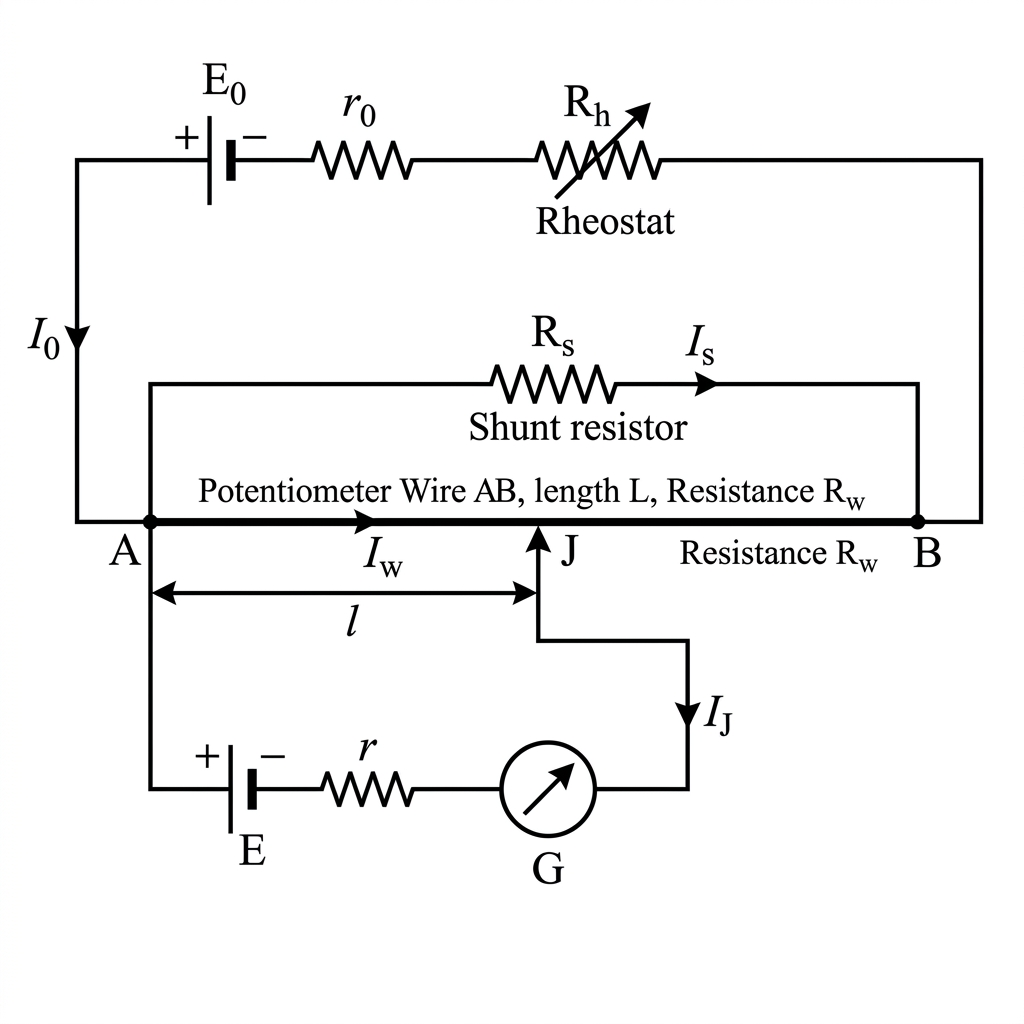 In the circuit shown, derive the expression for the potential gradient $k$ across the wire AB in terms of $E_0, r_0, R_h, R_w, R_s$, and $L$.
22.
A metre bridge wire has non-uniform resistance. Its resistance per unit length varies as $\lambda = \lambda_0 (1 + \alpha x)$, where $x$ is the distance from end A. If a balance point is found at $x = l$ for known resistances $P$ and $Q$ in the gaps, find the relation between $P$ and $Q$.
23.
A real voltmeter of resistance $R_v$ is used to measure the potential difference across a resistor $R_1$ which is in series with $R_2$ and a battery $E$. Show that the voltmeter will read a value lower than the true potential difference, and find the fractional error.
24.
In a Carey Foster bridge used to measure the difference between two nearly equal resistances, deduce the formula linking the difference in resistances to the shift in the balance point and the resistance per unit length of the wire.
25.
A potentiometer wire of length $10\text{ m}$ has a resistance of $20\text{ }\Omega$. It is connected in series with a $5\text{ V}$ battery and a resistance box. Find the resistance to be introduced in the box to get a potential gradient of $1\text{ }\mu\text{V/mm}$.
26.
Two cells $E_1$ and $E_2$ are compared using a potentiometer. The balance point is $l_1$. If a resistor $R$ is placed in parallel with $E_1$, the balance point shifts to $l_2$. Express the internal resistance $r_1$ of the first cell in terms of $R, l_1,$ and $l_2$.
27.
How can a potentiometer be calibrated to measure a steady current in a circuit? Draw the necessary supplementary circuit diagram conceptually and write the governing equation.
28.
An ammeter of resistance $R_A$ and a voltmeter of resistance $R_V$ are connected in series across a battery of EMF $E$ and internal resistance $r$. What will each instrument read?
29.
What is the "end error" in a metre bridge? If the end corrections at the left and right ends are $e_1$ and $e_2$ respectively, write the modified balanced condition formula.
30.
A moving coil galvanometer has $N$ turns, area $A$, and magnetic field $B$. If the torsional constant of the suspension is $k$, derive the current sensitivity and voltage sensitivity. How does changing $N$ affect both?
Section D: Power, Heating, & Cell Grouping
31.
For the mixed grouping of cells shown, derive the strict condition required to deliver maximum power to the external load $R$. Prove that this condition implies internal resistance equals external resistance.
[Image skipped due to API quota limits]
32.
The current through a resistor of resistance $R$ varies with time as $I = I_0(1 - t/t_0)$ for $0 \le t \le t_0$, and $I=0$ for $t > t_0$. Calculate the total heat dissipated in the resistor.
33.
A fuse wire has radius $r$ and length $L$. By considering the balance between Joule heating ($I^2R$) and heat loss via radiation (proportional to surface area), prove that the steady-state melting current $I$ is independent of $L$ and varies as $I \propto r^{3/2}$.
34.
Two electric bulbs of $100\text{W}$ and $200\text{W}$, both rated at $220\text{V}$, are connected in series across a $220\text{V}$ supply. Find the total power consumed by the combination.
35.
A DC motor operates at a voltage $V$ and draws a steady current $I$. If its internal coil resistance is $r$, what is the mechanical power output and its electrical efficiency?
36.
A capacitor $C$ is fully charged to voltage $V_0$ and then discharged through a resistor $R$. Show by integrating $I^2R dt$ from $0$ to $\infty$ that the total heat produced is exactly equal to the initial energy stored in the capacitor ($\frac{1}{2}CV_0^2$).
37.
Two batteries of EMFs $10\text{V}$ and $8\text{V}$, and internal resistances $1\text{ }\Omega$ and $2\text{ }\Omega$ respectively, are connected in parallel to supply a $5\text{ }\Omega$ load. Calculate the power dissipated in the load.
38.
A heater coil is cut into two equal halves, and only one half is used in the heater. What is the percentage change in the power dissipated?
39.
If the two halves from Q38 are connected in parallel, what is the new power dissipated compared to the original uncut coil?
40.
A source of EMF $E$ and internal resistance $r$ delivers power to a variable load $R$. Plot a graph of Power $P$ vs Resistance $R$ and clearly mark the coordinates of the peak point.
Section E: Numerical Value Type (Calculate and Write integer/decimal)
41.
A uniform wire of resistance $36\text{ }\Omega$ is bent into a perfect circle. Find the equivalent resistance between two points on the circle separated by an angle of $60^\circ$ at the center.
42.
In a Wheatstone bridge, $P = 10\text{ }\Omega, Q = 20\text{ }\Omega, R = 15\text{ }\Omega, S = 30\text{ }\Omega$. A galvanometer of resistance $50\text{ }\Omega$ is connected. A $10\text{ V}$ battery of negligible internal resistance is connected. What is the current (in mA) through the galvanometer?
43.
A potentiometer wire has length $10\text{ m}$ and resistance $20\text{ }\Omega$. A battery of EMF $6\text{ V}$ and internal resistance $5\text{ }\Omega$ is connected in series with a $15\text{ }\Omega$ rheostat. Find the potential gradient of the wire in $\text{mV/cm}$.
44.
The current density in a cylindrical wire of radius $R = 2\text{ mm}$ varies as $J = 10^5 r^2 \text{ A/m}^2$. The total current through the wire is $X \times 10^{-6}\text{ A}$. Find $X$. (Take $\pi = 3.14$).
45.
A galvanometer has $G = 100\text{ }\Omega$ and full-scale current $10\text{ mA}$. A shunt of $0.1\text{ }\Omega$ is connected. The maximum current this ammeter can read is $I_0$. Find $I_0$ in Amperes.
46.
Twelve $1\text{ }\Omega$ resistors are connected to form a cube. A battery of $2.5\text{ V}$ is connected across a body diagonal. What is the total current drawn from the battery in Amperes?
47.
A $50\text{ V}$ battery of internal resistance $2\text{ }\Omega$ is being charged by a $110\text{ V}$ DC supply using a series resistor of $28\text{ }\Omega$. Find the terminal voltage of the $50\text{ V}$ battery during charging.
48.
The equivalent resistance of two resistors in series is $S$ and in parallel is $P$. If $S = nP$, find the minimum possible value of integer $n$.
49.
Two cells of EMFs $1.5\text{ V}$ and $2.0\text{ V}$, having internal resistances $0.2\text{ }\Omega$ and $0.3\text{ }\Omega$ respectively, are connected in parallel. Calculate the equivalent EMF in Volts.
50.
A carbon resistor has color bands: Brown, Black, Red, Silver. What is its maximum possible resistance in $\Omega$?
51.
In a metre bridge, the balance point is at $40\text{ cm}$. If the unknown resistance $S$ is in the right gap and a known $R=15\text{ }\Omega$ is in the left gap, find $S$.
52.
Two heaters, rated $1000\text{W}, 250\text{V}$ and $2000\text{W}, 250\text{V}$ are connected in series across $250\text{V}$. Find the total power consumed.
53.
A cylindrical wire is stretched to increase its length by $0.2\%$. Find the percentage increase in its resistance.
54.
A potentiometer wire of length $L$ and resistance $10r$ is connected in series with a battery of EMF $E$ and internal resistance $r$. A primary cell of EMF $E/2$ is balanced at a length $l$. Find the ratio $l/L$.
55.
A steady current $I$ flows through a wire of length $L$, area $A$, and resistivity $\rho$. The electric field inside the wire is $E$. If the area is halved keeping $I$ constant, the new field is $nE$. Find $n$.
56.
A heating coil boils a certain mass of water in 10 minutes. If the operating voltage is reduced to $80\%$ of its original value, how many minutes will it take to boil the same mass of water?
57.
Find the equivalent resistance (in $\Omega$) of an infinite square grid of $1\text{ }\Omega$ resistors between two adjacent nodes.
58.
The temperature coefficient of resistance of a wire is $0.00125\text{ }^\circ\text{C}^{-1}$. At $300\text{ K}$, its resistance is $1\text{ }\Omega$. At what temperature (in K) will its resistance become $2\text{ }\Omega$?
59.
In a purely resistive circuit, if the applied voltage is increased by $10\%$, the percentage increase in the power dissipated is $P\%$. Find $P$.
60.
A battery has an open-circuit EMF of $12.0\text{ V}$. When a current of $50\text{ A}$ is drawn, the terminal voltage drops to $10.0\text{ V}$. Find the internal resistance of the battery in Ohms.