
Vardaan Learning Institute
vardaanlearning.com | 9508841336
Chapter 3: Current Electricity - Medium / Standard (Level 2)
Topic 3.1: Electric Current & Current Density
1.
The charge flowing through a conductor varies with time as $q = at^2 + bt + c$, where $a, b, c$ are constants. Find the instantaneous current at time $t$ and the initial current.
2.
An alternating current is given by $I = I_0 \sin(\omega t)$. Calculate the total charge that flows through the circuit in the time interval from $t = 0$ to $t = T/2$, where $T$ is the time period.
3.
A steady current $I$ flows through a metallic wire whose area of cross-section gradually tapers from radius $r_1$ at one end to $r_2$ at the other. State how the current and current density vary along the length of the wire.
4.
In the Bohr model of a hydrogen atom, an electron revolves around the nucleus in a circular orbit of radius $5.3 \times 10^{-11}\text{ m}$ at a frequency of $6.8 \times 10^{15}\text{ Hz}$. Calculate the equivalent electric current.
5.
A current of $3.2\text{ A}$ flows in a conductor having a cross-sectional area of $10^{-6}\text{ m}^2$. Calculate the current density and state its vector direction relative to the electron flow.
6.
If the current passing through a wire is plotted against time, the graph forms a triangle with a base of $10\text{ s}$ and a peak current of $5\text{ A}$ at $t = 5\text{ s}$. Determine the total charge that passed through the wire.
Topic 3.2: Ohm’s Law & Resistance
7.
A wire of resistance $R$ is stretched such that its length increases by $10\%$. Calculate the percentage change in its electrical resistance, assuming the volume remains constant.
8.
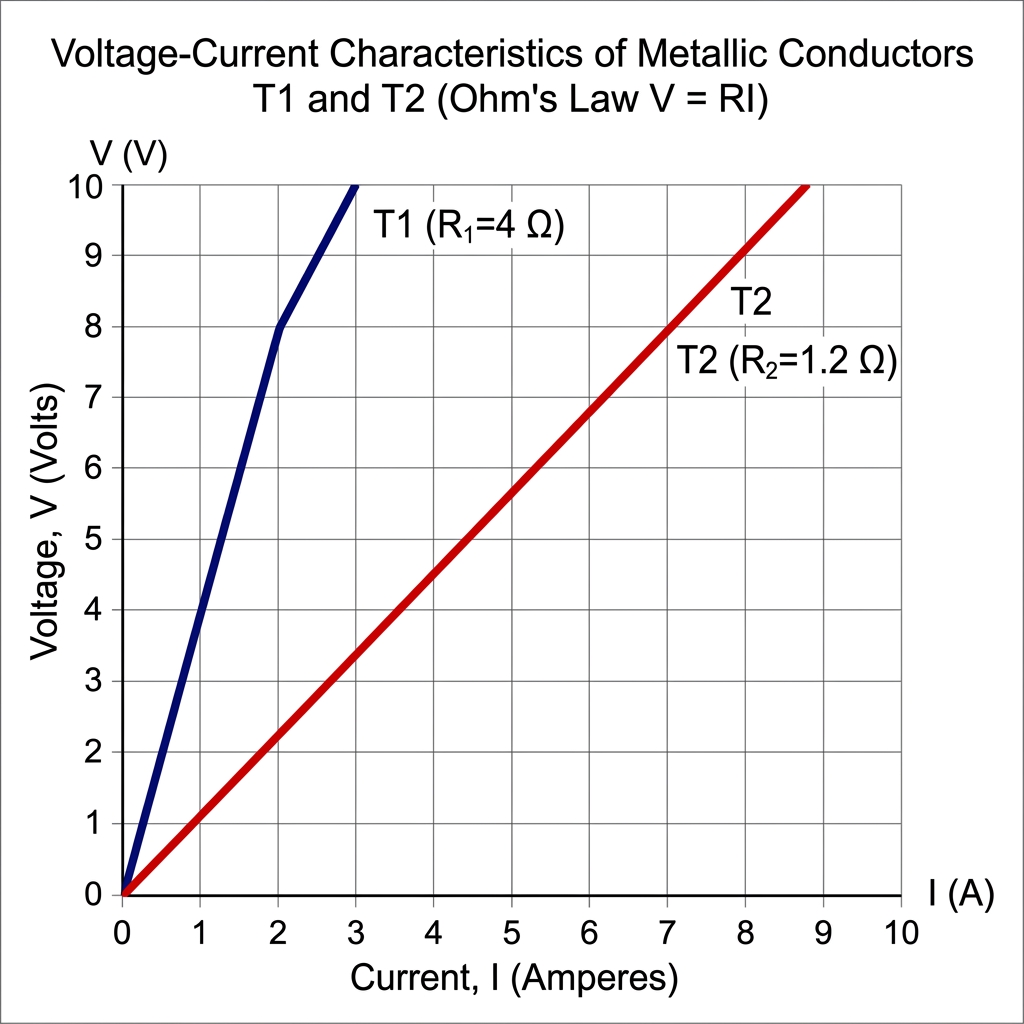 The V-I graphs for a metallic wire at two different temperatures $T_1$ and $T_2$ are shown. Which temperature is higher, $T_1$ or $T_2$? Give a detailed physical reason.
9.
A rectangular carbon block has dimensions $a \times b \times c$ where $a < b < c$. Across which pair of opposite faces should a potential difference be applied to yield the maximum and minimum electrical resistance? Justify your choice.
10.
A hollow cylindrical conductor has an inner radius $r_1$, outer radius $r_2$, and length $L$. If the material has resistivity $\rho$, write the expression for its resistance when current flows longitudinally (along the length $L$).
11.
Define conductance and conductivity. Write their respective SI units.
12.
Draw a generic V-I characteristic curve for a non-ohmic device such as a GaAs semiconductor. Mark the linear region and the negative resistance region.
Topic 3.3: Drift of Electrons & Mobility
13.
Define mobility of charge carriers. Prove that the electrical conductivity of a material is given by $\sigma = ne\mu_e$, where $n$ is electron density and $\mu_e$ is electron mobility.
14.
Two wires of the same material, having lengths in the ratio $1:2$ and radii in the ratio $1:2$, are connected in series across a battery. Compare the drift velocities of electrons in the two wires.
15.
If the temperature of a metallic conductor increases, how do the following parameters change: (a) Relaxation time ($\tau$), (b) Drift velocity ($v_d$), and (c) Electron density ($n$)?
16.
The number density of free electrons in a copper conductor is estimated at $8.5 \times 10^{28}\text{ m}^{-3}$. How long does an electron take to drift from one end of a wire $3.0\text{ m}$ long to its other end? The area of cross-section of the wire is $2.0 \times 10^{-6}\text{ m}^2$ and it is carrying a current of $3.0\text{ A}$.
17.
Despite the drift velocity of electrons being extremely small (in the order of $\text{mm/s}$), an electric bulb lights up almost instantaneously when the switch is turned on. Explain this apparent paradox.
18.
Establish a relation between current density ($\vec{J}$) and drift velocity ($\vec{v}_d$). Are these two vectors parallel or antiparallel?
Topic 3.4: Temperature Dependence of Resistivity
19.
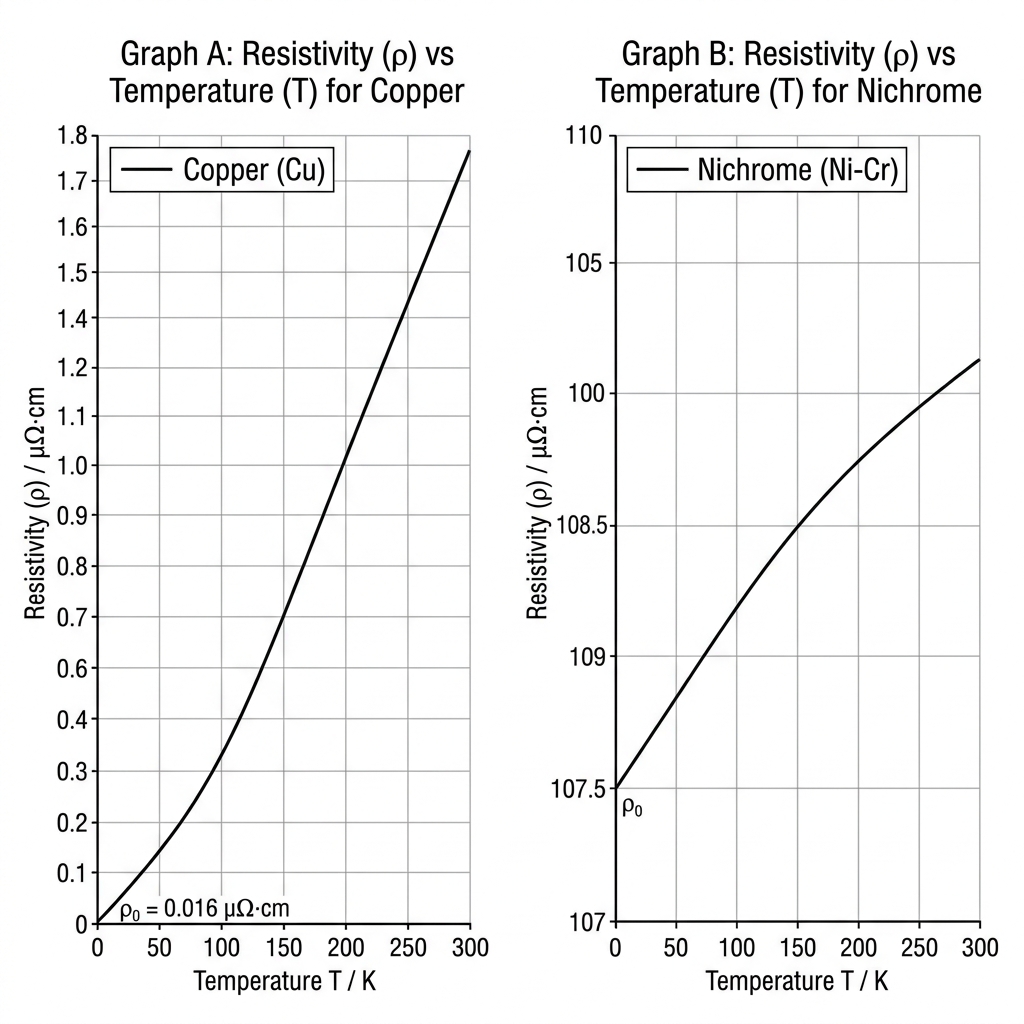 Based on the $\rho-T$ graphs for Copper and Nichrome, explain why Nichrome is preferred for making standard wire-bound resistors.
20.
Two metallic resistors $R_1$ and $R_2$ have temperature coefficients of resistance $\alpha_1$ and $\alpha_2$ respectively. If they are connected in series, deduce the condition under which their equivalent resistance remains independent of temperature.
21.
The resistance of a conductor is $R_0$ at $0^\circ\text{C}$. If its temperature coefficient of resistance is $\alpha$, at what temperature will its resistance become exactly twice its original value?
22.
Explain from a microscopic viewpoint (in terms of relaxation time and number density) why the resistivity of a semiconductor decreases with an increase in temperature.
23.
At room temperature ($27.0^\circ\text{C}$) the resistance of a heating element is $100\text{ }\Omega$. What is the temperature of the element if the resistance is found to be $117\text{ }\Omega$, given that the temperature coefficient of the material is $1.70 \times 10^{-4}\text{ }^\circ\text{C}^{-1}$?
24.
A typical thermistor has a highly negative temperature coefficient of resistivity. Mention one practical application where this specific property is highly advantageous.
Topic 3.5: Electrical Energy and Power
25.
State the Maximum Power Transfer Theorem. Deduce the condition under which a cell of EMF $E$ and internal resistance $r$ delivers maximum power to an external load resistor $R$.
26.
Two electric bulbs rated $P_1$ Watts and $P_2$ Watts at a standard voltage $V$ are connected in series across the same voltage $V$. Derive an expression for the equivalent power consumed by the combination.
27.
Two heater coils, A and B, when connected individually across a source, take time $t_1$ and $t_2$ respectively to boil a certain quantity of water. Calculate the time taken to boil the same quantity of water if both coils are connected in parallel across the same source.
28.
For the same two coils in Q27, what would be the time taken if they were connected in series?
29.
A $100\text{ W}$, $220\text{ V}$ bulb is operated on a $110\text{ V}$ supply line. What is the actual power consumed by the bulb? Assume the resistance remains constant.
30.
What is the electrical efficiency of a cell delivering maximum power to an external circuit?
Topic 3.6: Cells and EMF
31.
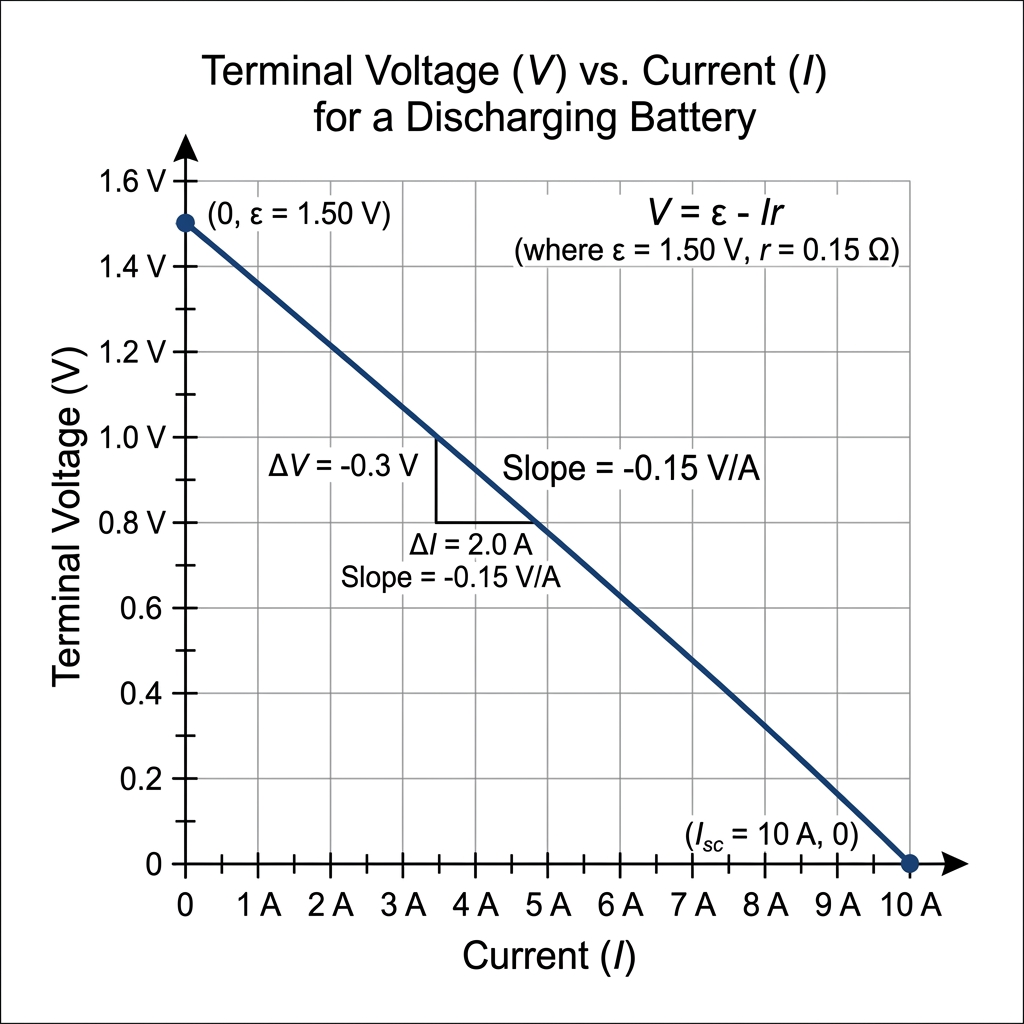 The V-I graph for a discharging cell is given. What physical quantities are represented by (a) the Y-intercept, (b) the X-intercept, and (c) the negative slope of the graph?
32.
A cell of EMF $E$ and internal resistance $r$ is short-circuited. Calculate the terminal potential difference and the current drawn from the cell.
33.
Two cells of EMFs $E_1$ and $E_2$ ($E_1 > E_2$) and internal resistances $r_1$ and $r_2$ are connected in parallel. Determine the equivalent EMF of the combination and identify the condition under which the equivalent EMF is equal to $E_1$.
34.
$N$ identical cells, each of EMF $E$ and internal resistance $r$, are joined in series to form a closed circuit. However, $n$ cells out of $N$ are connected with reverse polarity. Find the total equivalent EMF of the circuit.
35.
In a mixed grouping of cells, there are $m$ rows connected in parallel, and each row contains $n$ identical cells in series. Derive the condition to draw maximum current through an external resistor $R$.
36.
Explain conceptually why the terminal potential difference of a cell is higher than its true EMF during the charging process.
Topic 3.7: Kirchhoff’s Rules
37.
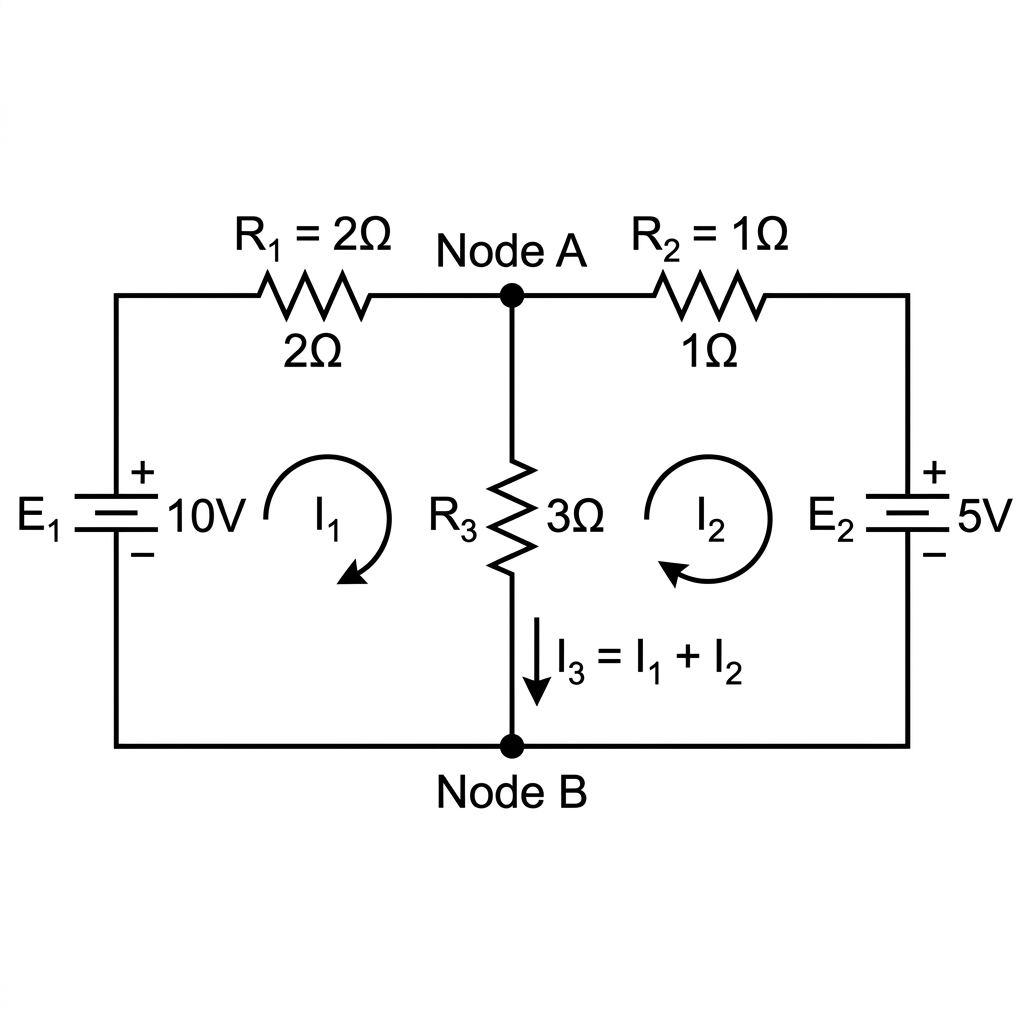 Apply Kirchhoff's rules to write the required independent equations to find the current flowing through the central resistor $R_3$.
38.
State Kirchhoff's rules. What role does the assumption of steady-state current play in the validity of the Junction rule?
39.
Consider a branch of a circuit containing a resistor $R = 5\text{ }\Omega$ and a battery of EMF $E = 12\text{ V}$ opposing the current. If a steady current of $2\text{ A}$ flows from point A to point B through this branch, calculate the potential difference $(V_A - V_B)$.
40.
Can Kirchhoff's loop rule be applied to an open circuit? Explain your reasoning.
41.
Use Kirchhoff's rules to conceptually explain how an unbalanced Wheatstone bridge distributes current differently from a balanced one. Which specific rule dictates the current through the galvanometer branch?
42.
Twelve identical wires of resistance $R$ each are joined to form a skeleton cube. Find the equivalent resistance across the longest body diagonal using Kirchhoff's laws and symmetry.
Topic 3.8: Wheatstone Bridge
43.
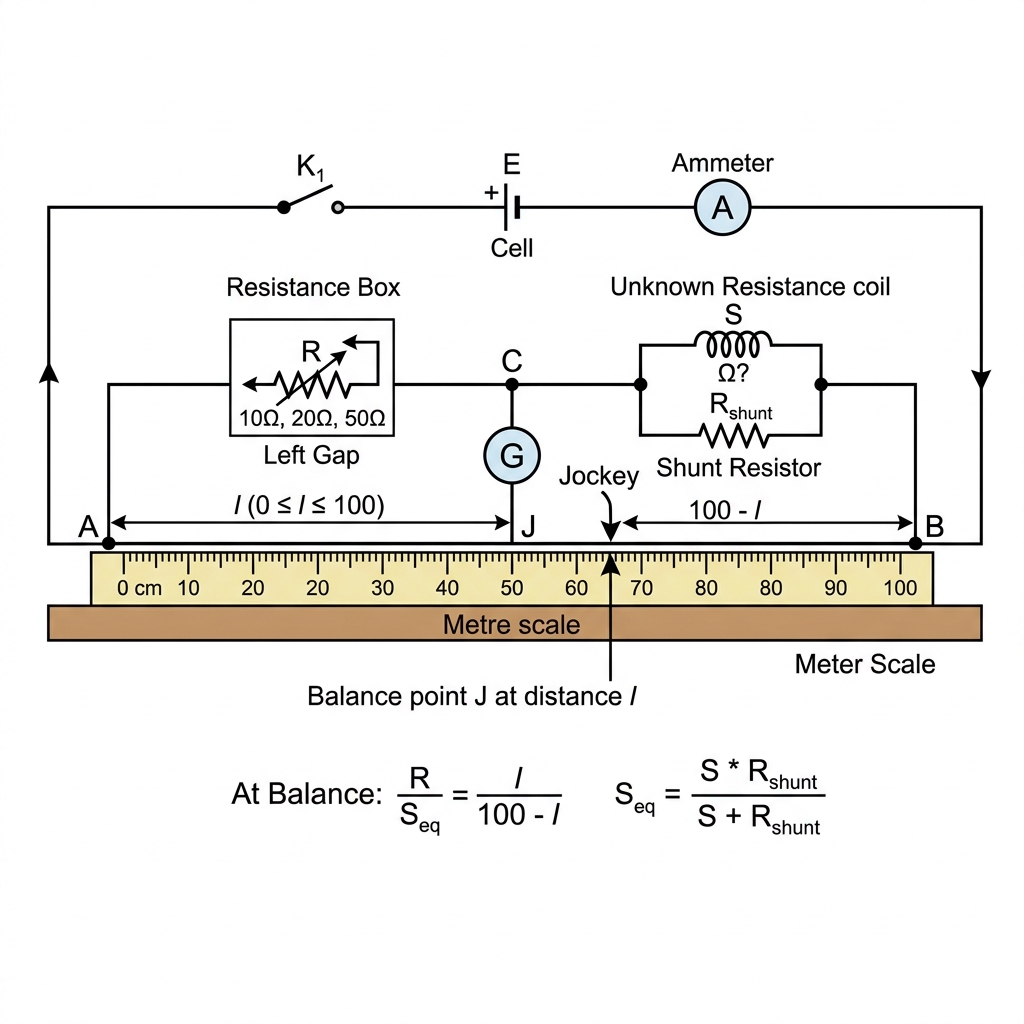 In a metre bridge experiment, the balance point is at $l$. If the unknown resistance $S$ is shunted by an equal resistance $S$, in which direction will the balance point shift? Justify.
44.
Derive the balanced condition for a Wheatstone bridge ($\frac{P}{Q} = \frac{R}{S}$) strictly using Kirchhoff's junction and loop rules.
45.
Why is the accuracy of a metre bridge relatively poor if the balance point is obtained very close to one of the ends (e.g., $5\text{ cm}$ or $95\text{ cm}$)?
46.
What are "end errors" in a practical metre bridge, and how can they be minimized or eliminated during an experiment?
47.
In a metre bridge, the null point is found at a distance of $33.7\text{ cm}$ from A. If a resistance of $12\text{ }\Omega$ is connected in parallel with the unknown resistance $S$, the null point shifts to $51.9\text{ cm}$. Determine the values of $R$ and $S$.
48.
Explain why a Wheatstone bridge cannot be used to precisely measure the internal resistance of a standard chemical cell.
Topic 3.9: Potentiometer
49.
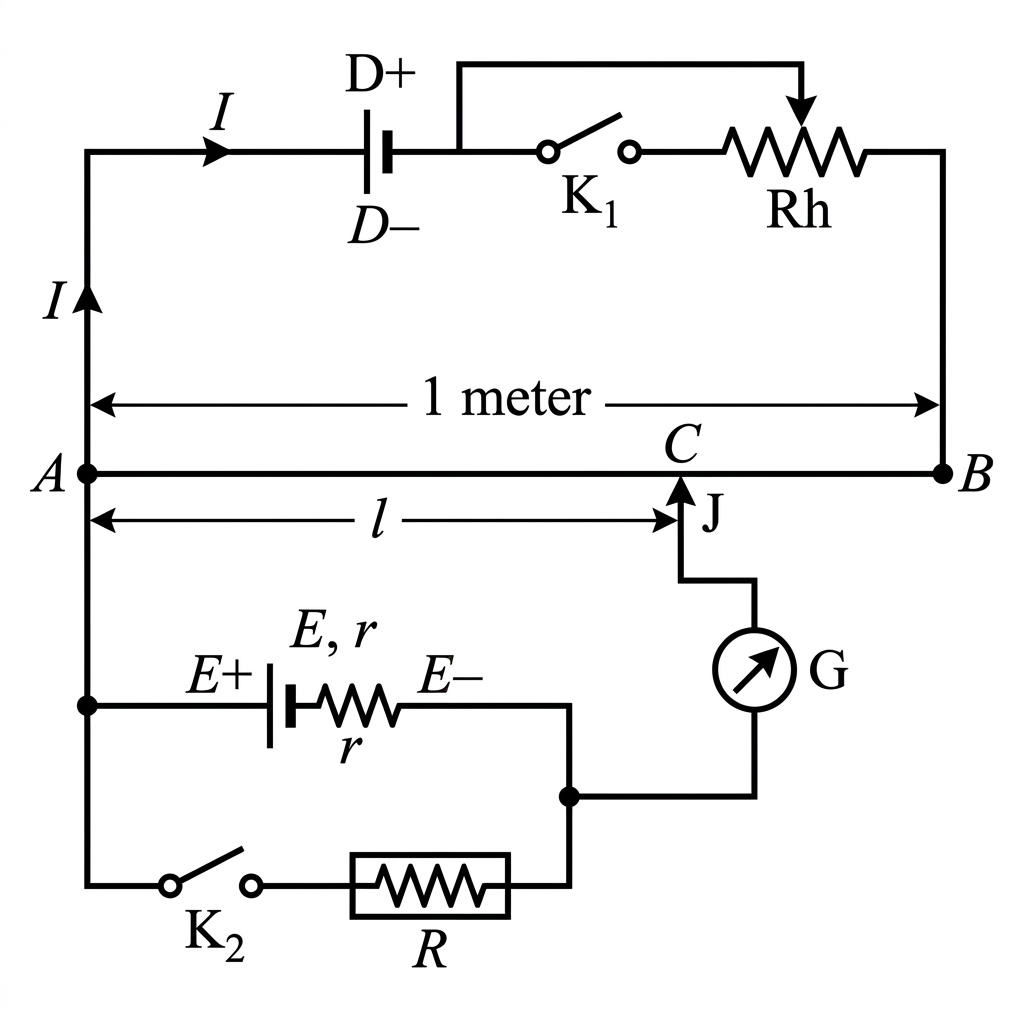 Based on the circuit above, describe the two-step experimental procedure to find the internal resistance of the cell. Derive the formula $r = R(\frac{l_1}{l_2} - 1)$.
50.
Why is a potentiometer considered an "ideal" voltmeter? State two distinct reasons.
51.
In a potentiometer experiment, what will happen to the position of the null point if the resistance of the primary circuit's rheostat is gradually increased? Explain.
52.
What is the essential condition for the EMF of the driver cell compared to the EMF of the experimental cells in a potentiometer setup? What happens if this condition is violated?
53.
In a potentiometer, two cells of EMFs $E_1$ and $E_2$ are connected in series to assist each other, giving a balancing length of $8\text{ m}$. When connected to oppose each other, the balancing length becomes $2\text{ m}$. Compare their EMFs ($E_1 / E_2$).
54.
Define the sensitivity of a potentiometer. Suggest two practical ways to increase the sensitivity of a given potentiometer wire.
Topic 3.10: Galvanometer Conversion
55.
A moving coil galvanometer has a resistance of $G\text{ }\Omega$ and gives full-scale deflection for a current of $I_g$. Derive the expression for the shunt resistance $S$ needed to convert it into an ammeter reading up to $I_0$ Amperes.
56.
For the galvanometer in Q55, find the effective equivalent resistance of the newly formed ammeter. Why must an ammeter always have a very low resistance?
57.
A galvanometer with a coil resistance of $12.0\text{ }\Omega$ shows full-scale deflection for a current of $2.5\text{ mA}$. Calculate the value of the resistance required to convert it into a voltmeter of range $0$ to $7.5\text{ V}$.
58.
In Q57, what is the effective equivalent resistance of the resulting voltmeter? Explain why a voltmeter must be connected in parallel across a component.
59.
A galvanometer has a resistance of $50\text{ }\Omega$. What shunt resistance is required so that only $1\%$ of the total main circuit current passes through the galvanometer coil?
60.
If an ammeter is accidentally connected in parallel across a high-voltage battery, what is the likely physical consequence, and why?