
Vardaan Learning Institute
vardaanlearning.com | 9508841336
Chapter 3: Current Electricity - Easy / Standard (Level 1)
Topic 3.1: Electric Current & Current Density
1.
Distinguish between average electric current and instantaneous electric current using mathematical expressions.
2.
A steady current of $1.5\text{ A}$ flows through a copper wire. Calculate the number of electrons crossing any cross-section of the wire per second.
3.
The charge flowing through a conductor varies with time as $q = \alpha t - \frac{1}{2}\beta t^2$, where $\alpha$ and $\beta$ are positive constants. Find the initial current and the time after which the current becomes zero.
4.
Define current density. Under what condition is the current density uniform across a cross-section?
5.
An electron moves in a circular orbit of radius $0.5 \text{ \AA}$ with a speed of $2.2 \times 10^6\text{ m/s}$. Find the equivalent electric current produced by its motion.
6.
A wire has a non-uniform cross-section. Does the current density remain constant along the length of the wire when a steady current flows through it? Justify your answer.
Topic 3.2: Ohm’s Law & Resistance
7.
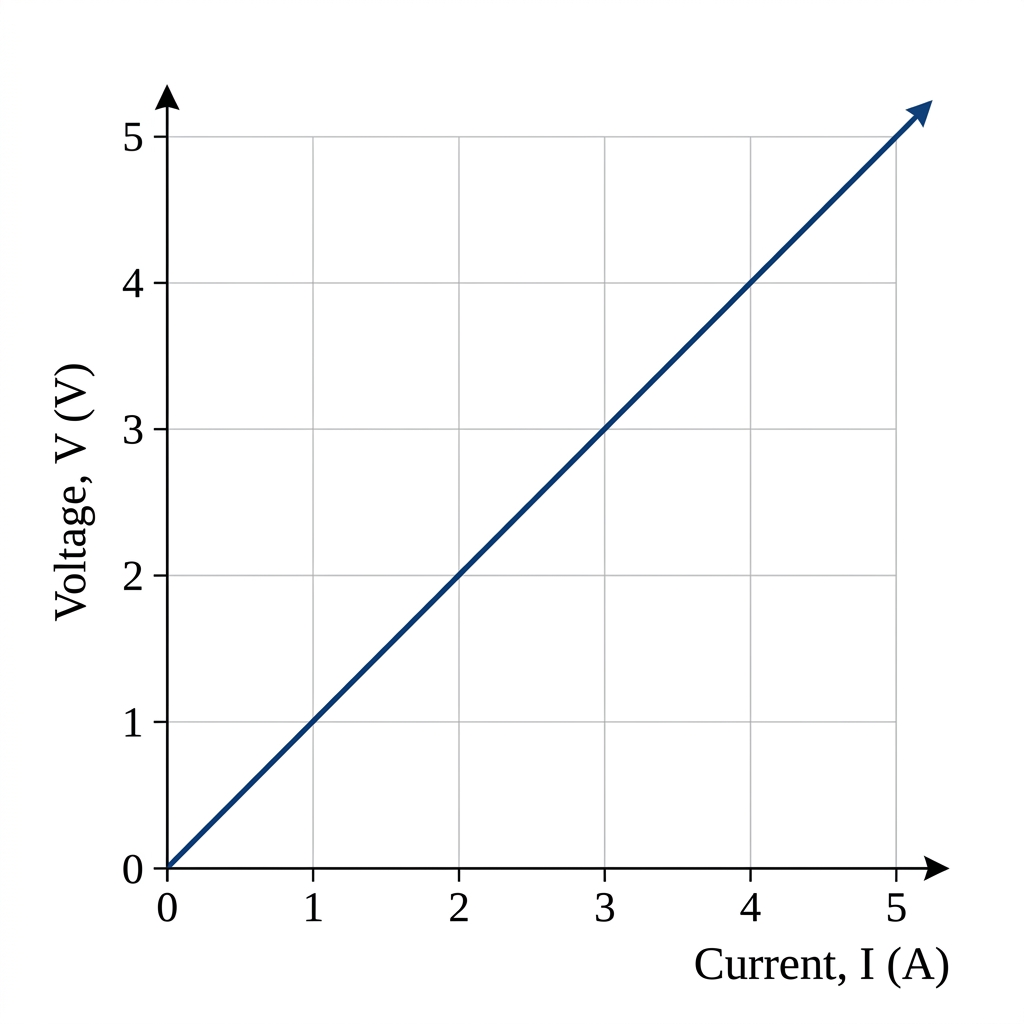 The graph above shows the V-I characteristic for an Ohmic conductor. What physical quantity does the slope of this graph represent? If the axes were swapped (I on Y-axis, V on X-axis), what would the slope represent?
8.
A wire of resistance $10\text{ }\Omega$ is stretched uniformly so that its length becomes three times its original length. What will be its new resistance?
9.
Derive the vector form of Ohm's Law ($\vec{J} = \sigma\vec{E}$) starting from the scalar macroscopic form $V = IR$.
10.
Two wires $A$ and $B$ are made of the same material. Wire $A$ has twice the length and half the radius of wire $B$. Compare their electrical resistances.
11.
Identify the factors on which the resistivity of a given conducting material intrinsically depends.
12.
A potential difference $V$ is applied across a copper wire of length $l$ and diameter $d$. How is the resistance of the wire affected if the diameter $d$ is doubled?
Topic 3.3: Drift of Electrons & Mobility
13.
Derive the expression linking electric current ($I$) to drift velocity ($v_d$): $I = neAv_d$. State the meaning of each symbol clearly.
14.
What is meant by the "relaxation time" of free electrons? How does an increase in temperature affect the relaxation time in a metallic conductor?
15.
Using the expression for drift velocity $v_d = \frac{eE}{m}\tau$ and $I = neAv_d$, deduce Ohm's law and express resistivity ($\rho$) in terms of microscopic parameters ($n, e, m, \tau$).
16.
A steady current flows in a metallic conductor of non-uniform cross-section. State which of the following quantities remains constant along the conductor: Current, Current Density, Drift Speed, Electric Field.
17.
Calculate the drift velocity of free electrons in a copper wire of cross-sectional area $1.0\text{ mm}^2$ carrying a current of $1.5\text{ A}$. (Assume electron density of copper $n = 8.5 \times 10^{28}\text{ m}^{-3}$).
18.
Define mobility ($\mu$) of a charge carrier. Write its SI unit and its relation with relaxation time.
Topic 3.4: Temperature Dependence of Resistivity
19.
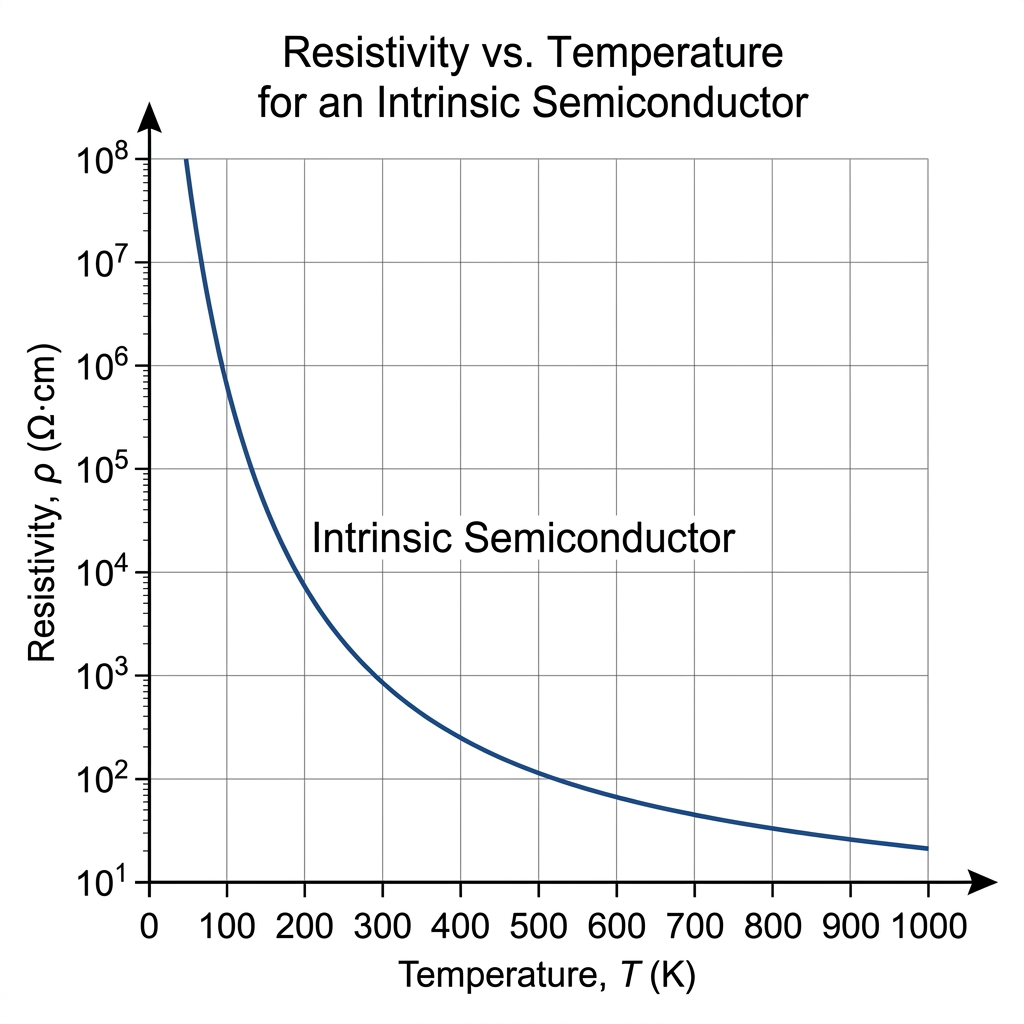 The graph above represents the temperature dependence of resistivity for a semiconductor. Explain physically why the resistivity decreases as temperature increases for semiconductors.
20.
The resistance of a platinum wire is $5.0\text{ }\Omega$ at ice point ($0^\circ\text{C}$) and $5.23\text{ }\Omega$ at steam point ($100^\circ\text{C}$). When inserted in a hot bath, its resistance becomes $5.795\text{ }\Omega$. Calculate the temperature of the bath.
21.
Why are standard resistance coils (used in resistance boxes) made of alloys like manganin or constantan instead of pure metals like copper?
22.
A heating element using nichrome connected to a $230\text{ V}$ supply draws an initial current of $3.2\text{ A}$ which settles after a few seconds to a steady value of $2.8\text{ A}$. What is the steady temperature of the heating element if the room temperature is $27^\circ\text{C}$? (Temperature coefficient of resistance of nichrome is $1.7 \times 10^{-4}\text{ }^\circ\text{C}^{-1}$).
23.
At what temperature would the resistance of a copper conductor be double its resistance at $0^\circ\text{C}$? (Given $\alpha_{\text{copper}} = 3.9 \times 10^{-3}\text{ }^\circ\text{C}^{-1}$).
Topic 3.5: Electrical Energy and Power
24.
Two bulbs are rated $60\text{ W}, 220\text{ V}$ and $100\text{ W}, 220\text{ V}$. Which of the two has a higher resistance?
25.
If the two bulbs from Q24 are connected in series across a $220\text{ V}$ supply, which bulb will glow brighter and why?
26.
If the two bulbs from Q24 are connected in parallel across a $220\text{ V}$ supply, which bulb will glow brighter and why?
27.
An electric heater is connected to the $220\text{ V}$ mains supply. The current drawn is $5\text{ A}$. Calculate the power of the heater and the electrical energy consumed by it in $2\text{ hours}$ (in $\text{kWh}$).
28.
A coil of resistance $100\text{ }\Omega$ is connected across a $10\text{ V}$ battery. Calculate the heat produced in the coil in $5\text{ minutes}$.
29.
What happens to the power dissipated by a resistor if the voltage across it is halved? Provide mathematical reasoning.
Topic 3.6: Cells and EMF
30.
Distinguish between the Electromotive Force (EMF) and the Terminal Potential Difference of a cell.
31.
A battery of EMF $10\text{ V}$ and internal resistance $3\text{ }\Omega$ is connected to a resistor. If the current in the circuit is $0.5\text{ A}$, what is the resistance of the resistor?
32.
In Q31, what is the terminal voltage of the battery when the circuit is closed?
33.
When is the terminal voltage of a cell strictly greater than its EMF? Write the governing equation.
34.
Two cells of EMFs $E_1$ and $E_2$ and internal resistances $r_1$ and $r_2$ are connected in parallel. Derive the expression for the equivalent EMF ($E_{eq}$) of the combination.
35.
Four identical cells, each of EMF $2\text{ V}$ and internal resistance $0.2\text{ }\Omega$, are connected in series. The combination is connected to an external resistance of $7.2\text{ }\Omega$. Calculate the current flowing in the circuit.
Topic 3.7: Kirchhoff’s Rules
36.
State Kirchhoff's Junction Rule. Which fundamental conservation law does it represent?
37.
State Kirchhoff's Loop Rule. Which fundamental conservation law does it represent?
38.
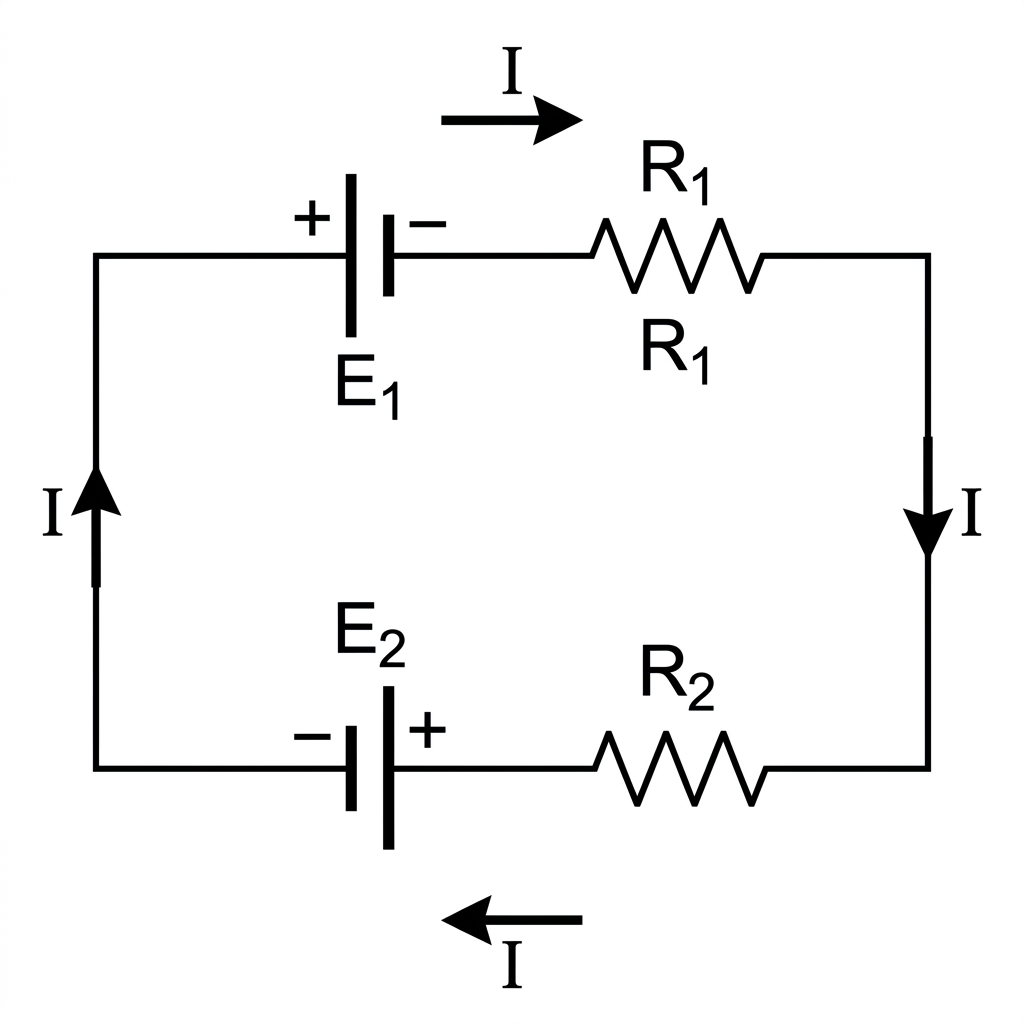 Apply Kirchhoff's Loop Rule to write the voltage equation for the closed loop shown in the diagram, tracing in the clockwise direction.
39.
A network has two junctions and three parallel branches connecting them. Branch 1 has $10\text{ V}$ and $2\text{ }\Omega$, Branch 2 has $5\text{ V}$ and $1\text{ }\Omega$, Branch 3 has a $5\text{ }\Omega$ resistor. Write the Kirchhoff's junction equation for one of the nodes, assuming current directions.
40.
Why is a sign convention absolutely necessary when applying Kirchhoff's Loop rule? Briefly explain your standard convention.
Topic 3.8: Wheatstone Bridge
41.
Draw a basic circuit diagram of a Wheatstone bridge and state its balanced condition mathematically.
42.
Using Kirchhoff's rules, derive the balanced condition for a Wheatstone bridge ($P/Q = R/S$).
43.
In a practical Wheatstone bridge, what happens to the balance point if the positions of the battery and the galvanometer are interchanged? Explain briefly.
44.
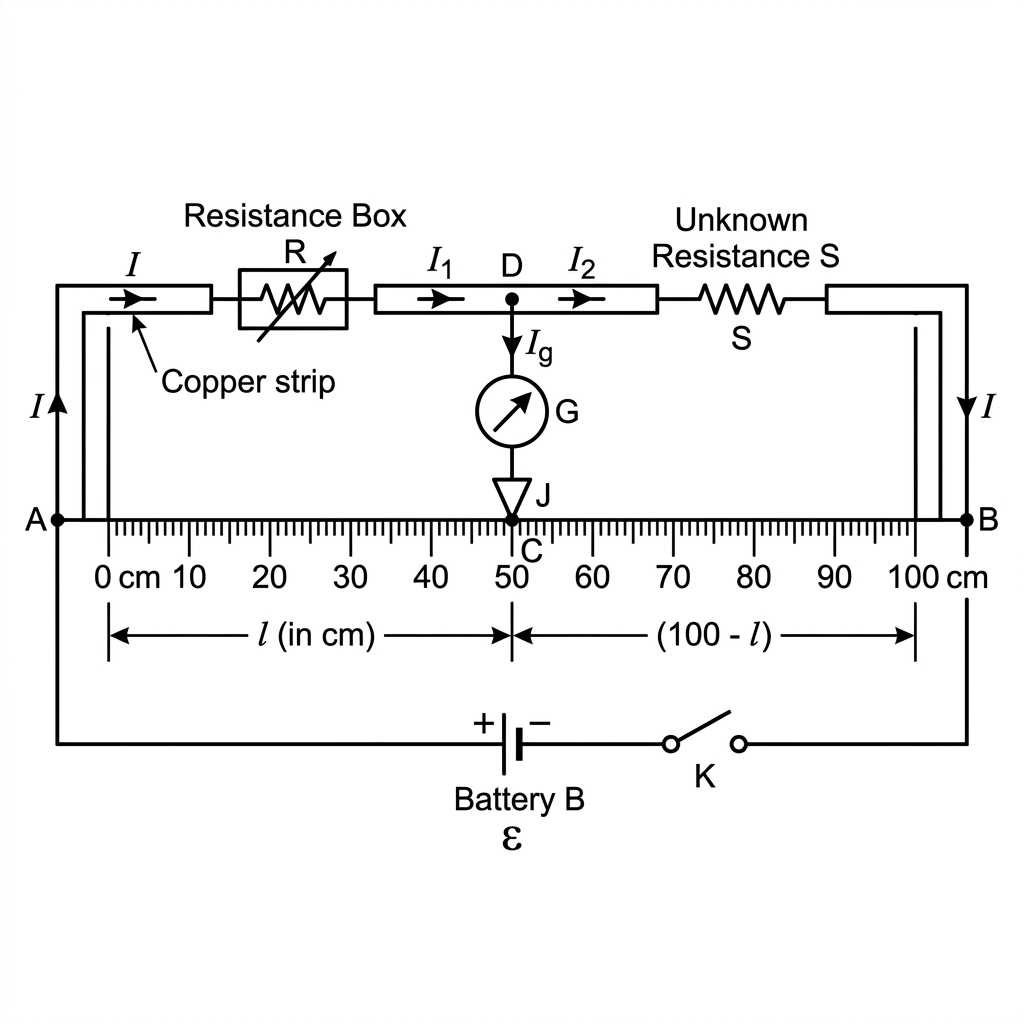 Based on the Metre Bridge diagram, if the balance point is found at a distance $l$ from end A, write the formula to calculate the unknown resistance $S$ in terms of $R$ and $l$.
45.
In a metre bridge, the balance point is found to be at $39.5\text{ cm}$ from the left end when the resistor in the left gap is $Y$ and the right gap contains a $12.5\text{ }\Omega$ resistor. Determine the value of $Y$.
46.
Why are the connections between resistors in a metre bridge made of thick copper strips?
Topic 3.9: Potentiometer
47.
State the underlying principle of a potentiometer. What are the essential conditions for this principle to hold true?
48.
Why is a potentiometer preferred over a high-resistance voltmeter to measure the EMF of a cell?
49.
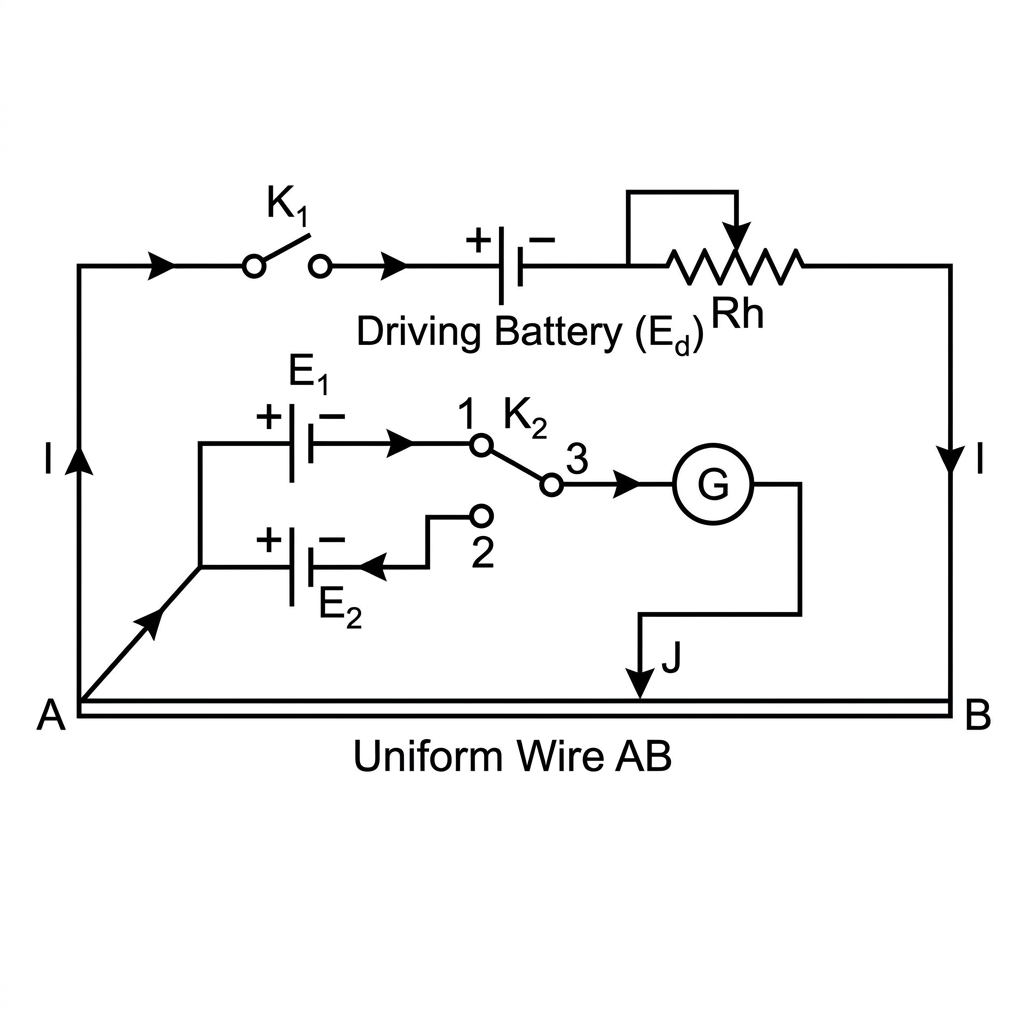 In the potentiometer experiment to compare EMFs, balancing lengths $l_1$ and $l_2$ are obtained. Derive the relation $\frac{E_1}{E_2} = \frac{l_1}{l_2}$.
50.
In a potentiometer arrangement, a cell of EMF $1.25\text{ V}$ gives a balance point at $35.0\text{ cm}$ length of the wire. If the cell is replaced by another cell and the balance point shifts to $63.0\text{ cm}$, what is the EMF of the second cell?
51.
Briefly explain how a potentiometer is used to determine the internal resistance of a primary cell. Write the working formula.
52.
How can the sensitivity of a potentiometer be increased?
Topic 3.10: Galvanometer Conversion
53.
Explain with the help of a theoretical diagram how a moving coil galvanometer can be converted into an ammeter.
54.
Derive the mathematical expression for the shunt resistance $S$ required to convert a galvanometer of resistance $G$ into an ammeter measuring up to a maximum current $I$.
55.
Explain why an ammeter must always be connected in series in a circuit, and why it should ideally have very low resistance.
56.
Derive the mathematical expression for the series resistance $R$ required to convert a galvanometer of resistance $G$ into a voltmeter measuring up to a maximum voltage $V$.
57.
A galvanometer has a resistance of $30\text{ }\Omega$ and gives a full-scale deflection for a current of $2.5\text{ mA}$. How will you convert it into an ammeter of range $0$ to $7.5\text{ A}$?
58.
Using the same galvanometer from Q57, how will you convert it into a voltmeter capable of reading up to $10\text{ V}$?
59.
If the resistance of an ammeter is increased slightly, how will it affect the current reading in a given circuit?
60.
What is the effective resistance of a Voltmeter constructed from a galvanometer $G$ and a series resistance $R$?