
Vardaan Learning Institute
vardaanlearning.com | 9508841336
Chapter 3: Current Electricity - Foundation Drill (Level 0)
Topic 3.1: Electric Current & Current Density
1.
The rate of flow of electric charge through any cross-section of a conductor is called ____________.
2.
The SI unit of Current Density ($J$) is ____________.
3.
Electric current is a:
(A) Vector quantity (B) Scalar quantity (C) Tensor quantity (D) Dimensionless quantity
(A) Vector quantity (B) Scalar quantity (C) Tensor quantity (D) Dimensionless quantity
4.
Calculate the electric current if a charge of $20\text{ C}$ flows through a wire in $5\text{ seconds}$.
5.
Define current density at a point. Is it a scalar or a vector?
6.
If a current of $2\text{ A}$ flows uniformly through a wire of cross-sectional area $1\text{ mm}^2$, what is its current density?
Topic 3.2: Ohm’s Law
7.
According to Ohm's law, the current flowing through a conductor is directly proportional to the ____________ applied across its ends, provided physical conditions remain constant.
8.
The SI unit of electrical resistivity ($\rho$) is ____________.
9.
The vector form of Ohm's Law is correctly written as:
(A) $\vec{V} = \vec{I}R$ (B) $\vec{J} = \sigma\vec{E}$ (C) $\vec{E} = \sigma\vec{J}$ (D) $\vec{J} = \rho\vec{E}$
(A) $\vec{V} = \vec{I}R$ (B) $\vec{J} = \sigma\vec{E}$ (C) $\vec{E} = \sigma\vec{J}$ (D) $\vec{J} = \rho\vec{E}$
10.
A potential difference of $12\text{ V}$ is applied across a resistor, and a current of $3\text{ A}$ flows through it. Calculate its resistance.
11.
Write the formula relating resistance ($R$), resistivity ($\rho$), length ($l$), and cross-sectional area ($A$).
12.
If the length of a wire is doubled and its cross-sectional area is also doubled, what happens to its resistance?
Topic 3.3: Drift of Electrons
13.
The average velocity with which free electrons get drifted towards the positive end of a conductor is called ____________.
14.
The SI unit of electron mobility ($\mu$) is ____________.
15.
The relationship between electric current ($I$) and drift velocity ($v_d$) is:
(A) $I = neAv_d$ (B) $I = nAv_d$ (C) $I = nev_d$ (D) $I = neA/v_d$
(A) $I = neAv_d$ (B) $I = nAv_d$ (C) $I = nev_d$ (D) $I = neA/v_d$
16.
Define relaxation time ($\tau$) for free electrons in a conductor.
17.
Write the formula for drift velocity ($v_d$) in terms of electric field ($E$), relaxation time ($\tau$), mass ($m$), and charge ($e$).
18.
Calculate the drift velocity if the mobility of electrons is $2.0 \times 10^{-4}\text{ m}^2\text{V}^{-1}\text{s}^{-1}$ in an applied electric field of $5 \times 10^3\text{ V/m}$.
Topic 3.4: Temperature Dependence of Resistivity
19.
For typical metals (conductors), the temperature coefficient of resistivity ($\alpha$) is generally ____________ (positive/negative).
20.
For semiconductors like Silicon, as temperature increases, their resistivity ____________.
21.
Write the mathematical formula showing the variation of resistance ($R_T$) with a change in temperature ($\Delta T$).
22.
Match the material type to its resistivity-temperature behavior:
| (a) Metals (Copper) | (i) Resistivity decreases exponentially with temp |
| (b) Alloys (Nichrome) | (ii) Resistivity increases linearly with temp |
| (c) Semiconductors | (iii) Resistivity is high and nearly independent of temp |
23.
A silver wire has a resistance of $2.1\text{ }\Omega$ at $27.5^\circ\text{C}$, and a resistance of $2.7\text{ }\Omega$ at $100^\circ\text{C}$. Determine the temperature coefficient of resistivity of silver.
Topic 3.5: Electrical Energy and Power
24.
The commercial unit of electrical energy is the ____________.
25.
One kilowatt-hour ($1\text{ kWh}$) is exactly equal to ____________ Joules.
26.
Which of the following does NOT represent electrical power ($P$)?
(A) $I^2 R$ (B) $IR^2$ (C) $VI$ (D) $V^2 / R$
(A) $I^2 R$ (B) $IR^2$ (C) $VI$ (D) $V^2 / R$
27.
Calculate the power of an electric bulb rated at $220\text{ V}$ if it draws a current of $0.5\text{ A}$.
28.
What is the resistance of the bulb mentioned in Question 27?
29.
Write Joule's law of heating formula.
Topic 3.6: Cells and EMF
30.
The potential difference across the terminals of a cell when no current is drawn from it is called its ____________.
31.
When a cell is discharging, its Terminal Potential Difference ($V$) is ____________ (greater/less) than its EMF ($E$).
32.
Write the formula relating EMF ($E$), Terminal Voltage ($V$), internal resistance ($r$), and current ($I$) for a discharging cell.
33.
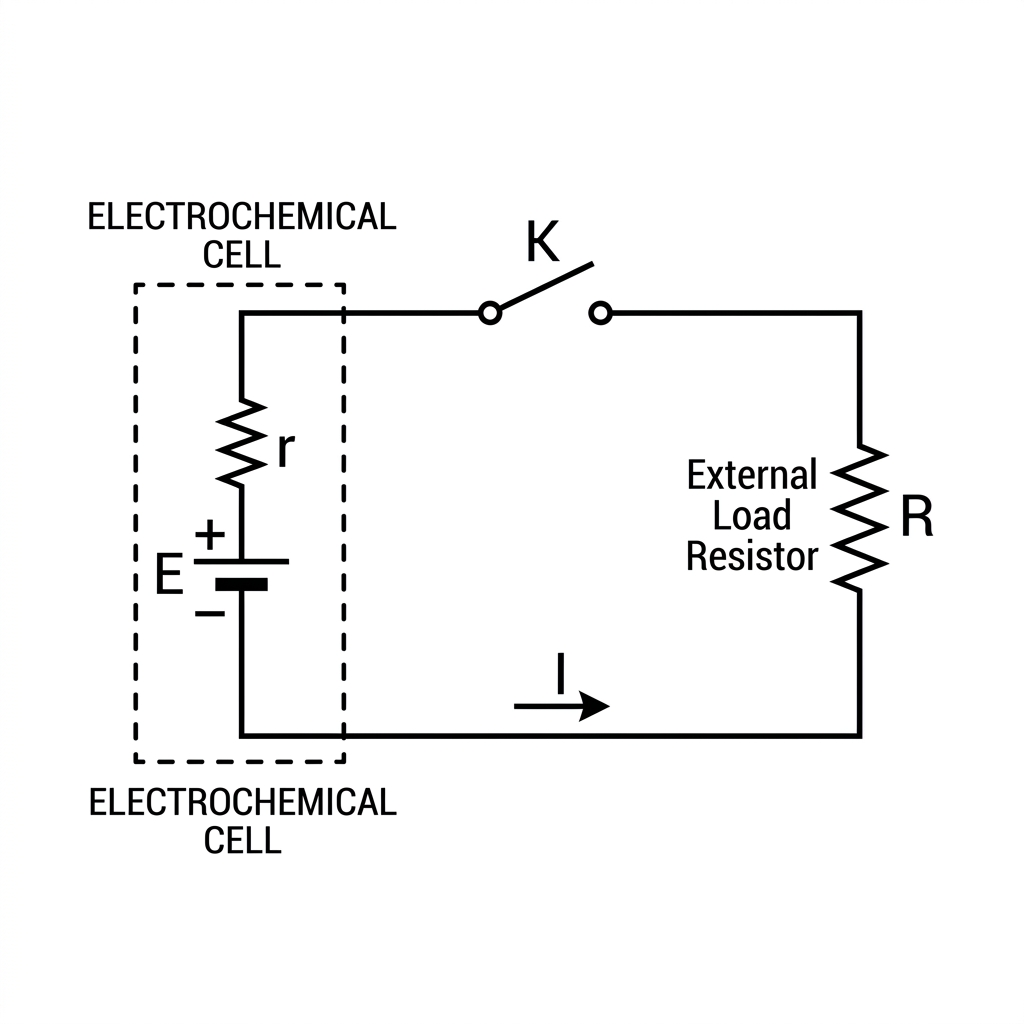 Identify the components labeled $E$, $r$, and $R$ in the basic cell circuit.
34.
Calculate the terminal voltage of a $1.5\text{ V}$ cell having an internal resistance of $0.5\text{ }\Omega$ when it supplies a current of $1\text{ A}$.
35.
If two identical cells of EMF $E$ and internal resistance $r$ are connected in series, what is the equivalent EMF and equivalent internal resistance?
Topic 3.7: Kirchhoff’s Rules
36.
Kirchhoff's First Rule (Junction Rule) is based on the law of conservation of ____________.
37.
Kirchhoff's Second Rule (Loop Rule) is based on the law of conservation of ____________.
38.
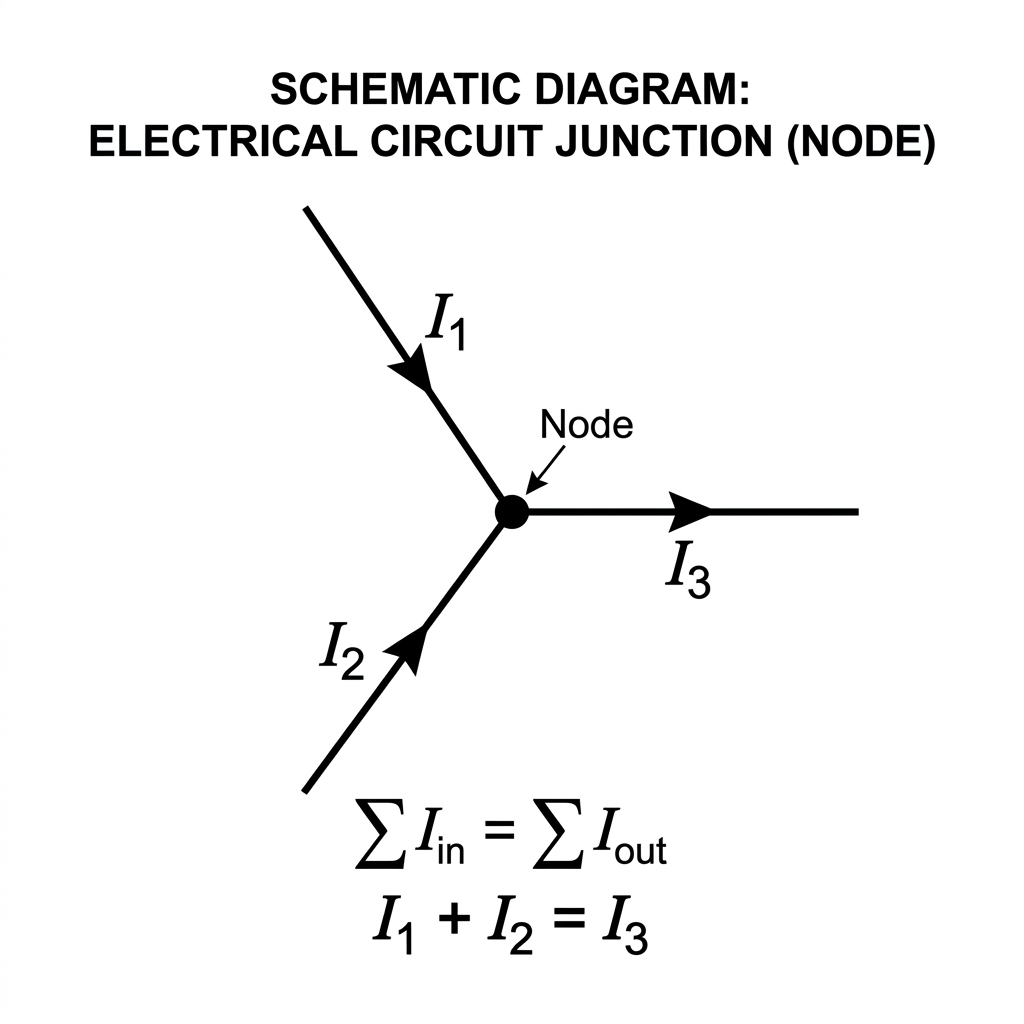 Write the mathematical equation for Kirchhoff's Junction Rule for the currents $I_1, I_2$ (entering) and $I_3$ (leaving) shown in the diagram.
39.
In Kirchhoff's loop rule, the algebraic sum of changes in potential around any closed loop is:
(A) Infinity (B) Zero (C) Equal to the EMF (D) Equal to total resistance
(A) Infinity (B) Zero (C) Equal to the EMF (D) Equal to total resistance
40.
While applying the loop rule, if we traverse a resistor in the direction of the current, is the potential change taken as positive or negative?
Topic 3.8: Wheatstone Bridge
41.
The balanced condition formula for a Wheatstone bridge with four arms $P, Q, R, S$ is ____________.
42.
A Metre Bridge works on the principle of a balanced ____________.
43.
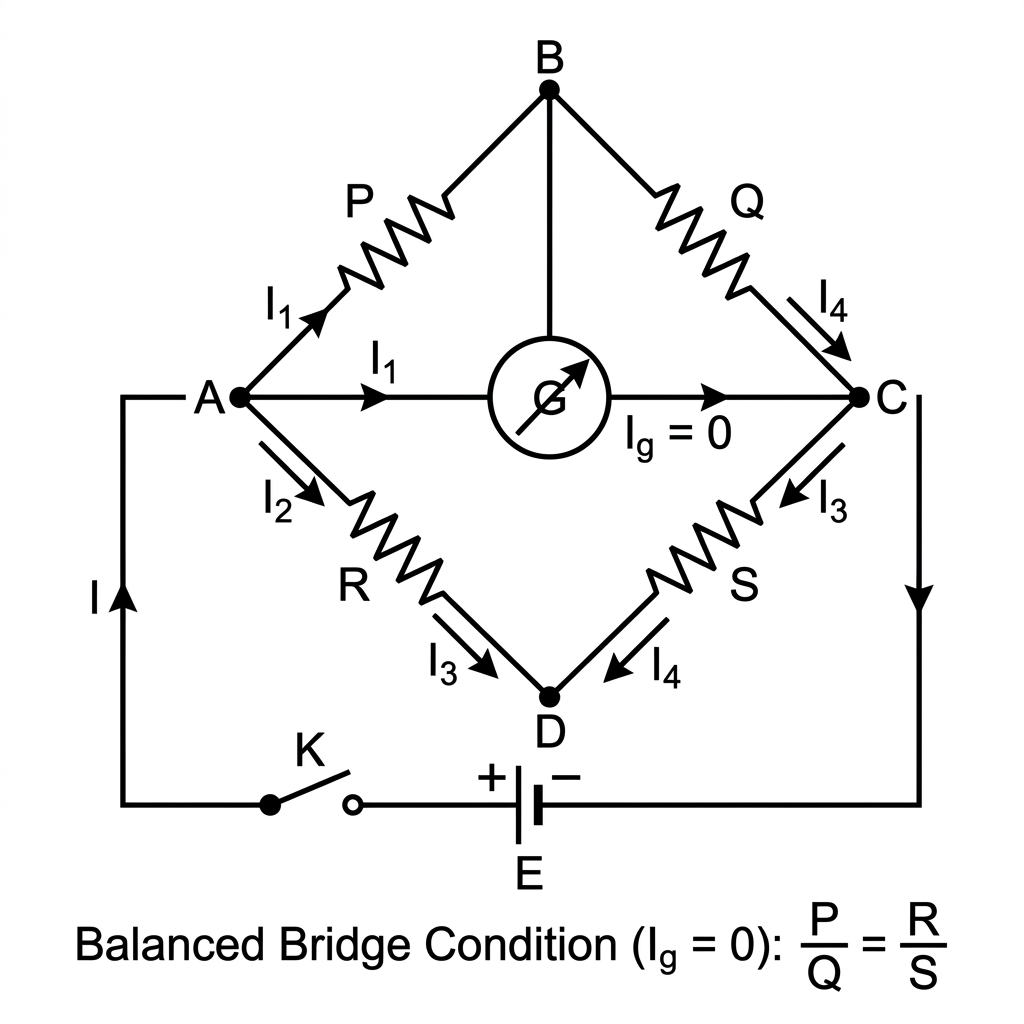 In a perfectly balanced Wheatstone bridge, the current flowing through the central Galvanometer ($G$) branch is exactly ____________.
44.
In a Wheatstone bridge setup, $P = 10\text{ }\Omega$, $Q = 20\text{ }\Omega$, and $R = 30\text{ }\Omega$. Calculate the value of $S$ required to balance the bridge.
45.
Why is the Wheatstone bridge method largely unsuitable for measuring extremely low resistances?
46.
What is the total length of the resistance wire used in a standard Metre Bridge apparatus?
Topic 3.9: Potentiometer
47.
The basic principle of a potentiometer is that the potential drop across any portion of the wire is directly proportional to its ____________, provided the wire has uniform cross-section and constant current.
48.
The fall of potential per unit length of the potentiometer wire is called the ____________.
49.
Which instrument is preferred for measuring the exact EMF of a cell without drawing any current?
(A) Voltmeter (B) Ammeter (C) Potentiometer (D) Galvanometer
(A) Voltmeter (B) Ammeter (C) Potentiometer (D) Galvanometer
50.
Write the formula used to compare the EMFs ($E_1$ and $E_2$) of two cells using a potentiometer, in terms of balancing lengths $l_1$ and $l_2$.
51.
Write the formula to calculate the internal resistance ($r$) of a cell using a potentiometer.
52.
In a potentiometer experiment, the balancing length for a cell of EMF $1.5\text{ V}$ is $300\text{ cm}$. Find the potential gradient of the wire.
Topic 3.10: Galvanometer Conversion
53.
To convert a moving coil galvanometer into an Ammeter, a very low resistance called a ____________ is connected in ____________ with the galvanometer.
54.
To convert a galvanometer into a Voltmeter, a very high resistance is connected in ____________ with the galvanometer.
55.
The ideal resistance of a perfect Ammeter should theoretically be:
(A) Infinity (B) Zero (C) Very high (D) Equal to galvanometer resistance
(A) Infinity (B) Zero (C) Very high (D) Equal to galvanometer resistance
56.
The ideal resistance of a perfect Voltmeter should theoretically be:
(A) Infinity (B) Zero (C) Very low (D) Depends on the circuit
(A) Infinity (B) Zero (C) Very low (D) Depends on the circuit
57.
Write the mathematical formula to calculate the value of shunt resistance ($S$) required to convert a galvanometer of resistance $G$ and full-scale current $I_g$ into an ammeter of range $I$.
58.
Write the formula for the high series resistance ($R$) required to convert the same galvanometer into a voltmeter of range $V$.
59.
A galvanometer has a resistance of $50\text{ }\Omega$ and gives full-scale deflection for $2\text{ mA}$. Calculate the shunt required to convert it to an ammeter of range $0$ to $2\text{ A}$. (Approximate value).
60.
For the same galvanometer in Q59, calculate the series resistance required to convert it into a voltmeter of range $0$ to $100\text{ V}$.