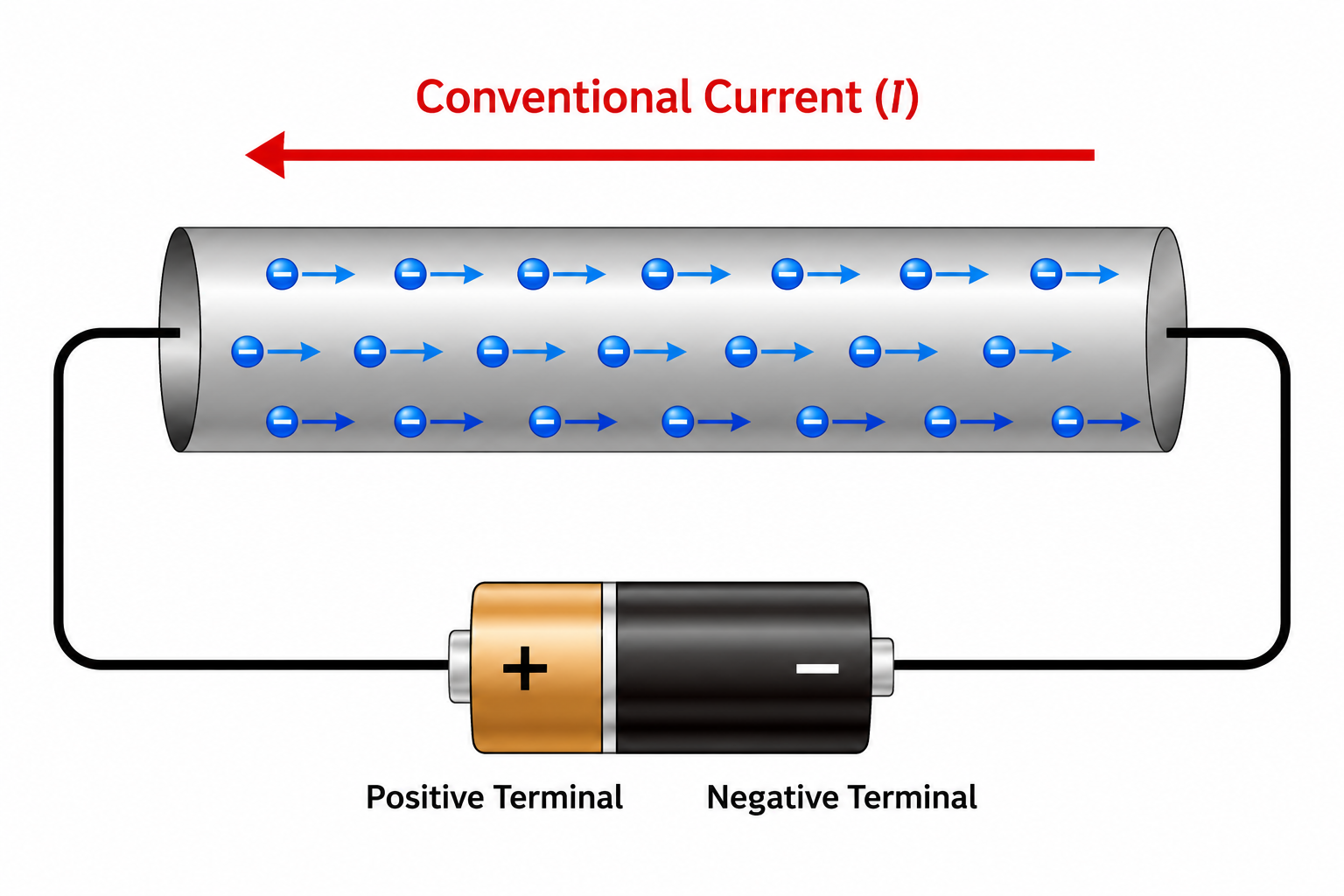
Electric Current ($I$)
Rate of flow of electric charge through a cross-section.
$$ I = \frac{dq}{dt} $$Unit: Ampere (A). It's a scalar quantity!
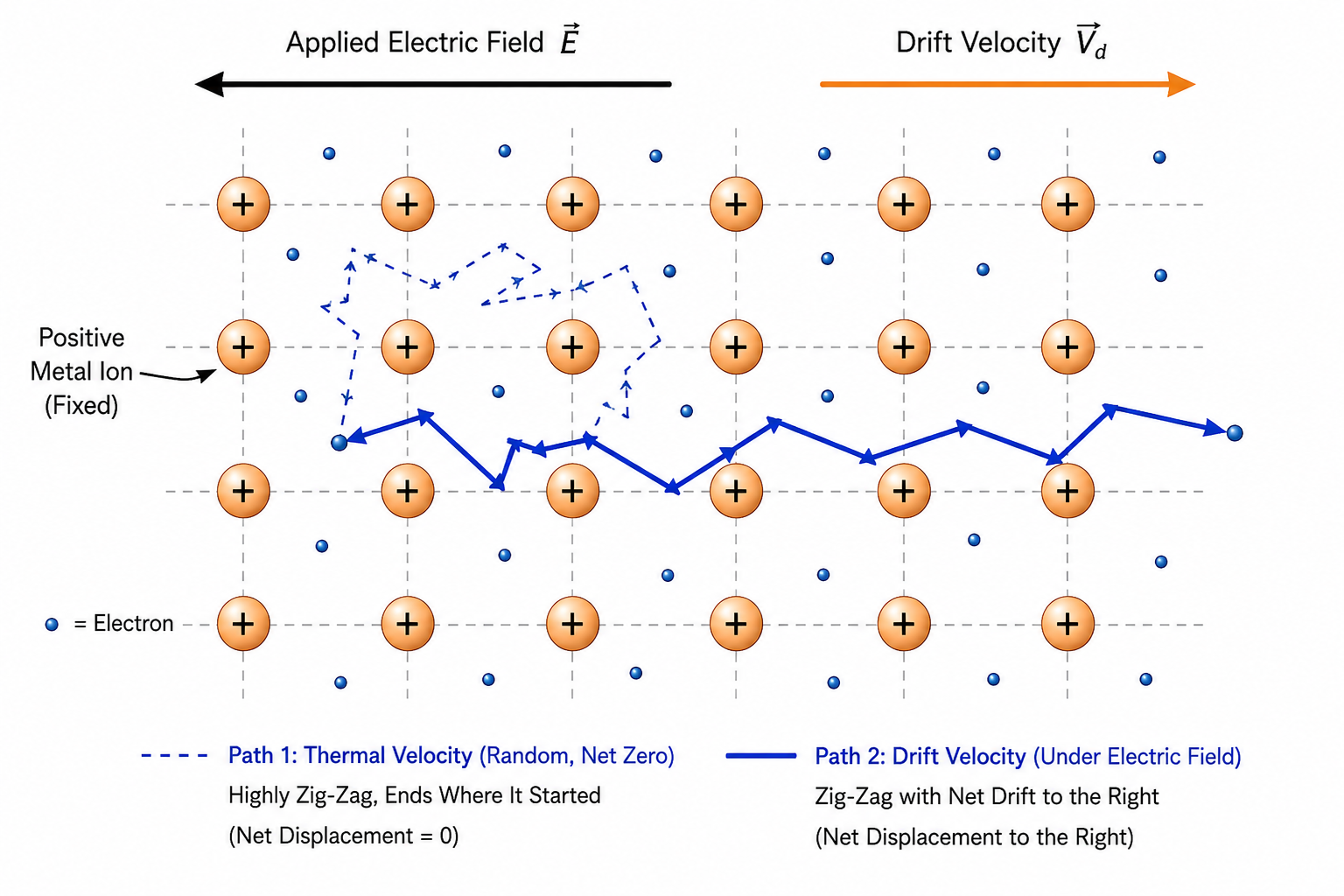
Drift Velocity ($v_d$)
Average velocity of free electrons in a conductor under external electric field.
$$ v_d = -\frac{eE}{m}\tau $$$\tau = $ Relaxation time (time between collisions).
Relation with Current
$$ I = neAv_d $$Ohm's Law
Current is directly proportional to potential difference (at constant temp).
$$ V = IR $$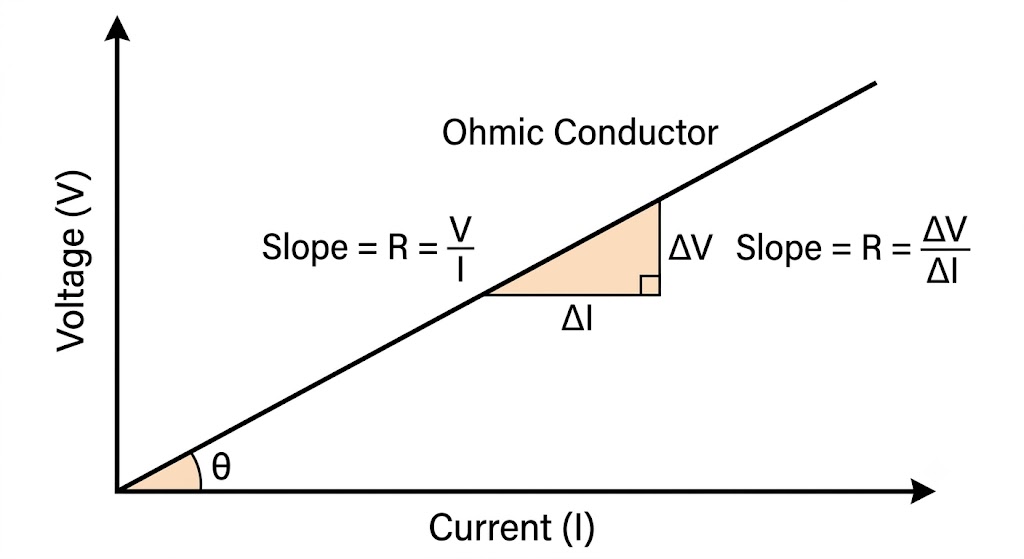
Limitations
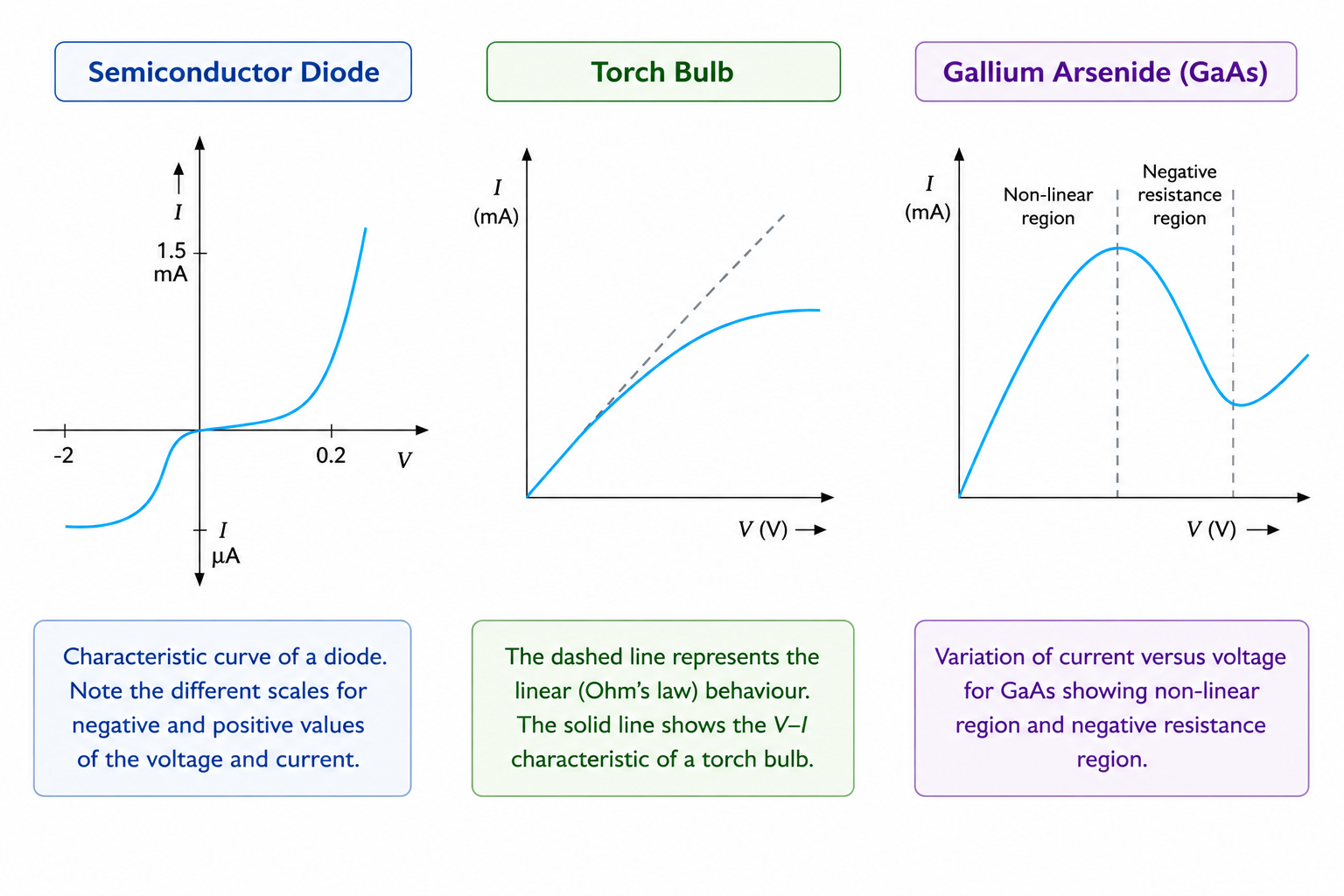
Fails for non-ohmic devices (diodes, transistors, GaAs).
Resistivity ($\rho$)
Depends on material & temperature, NOT geometry.
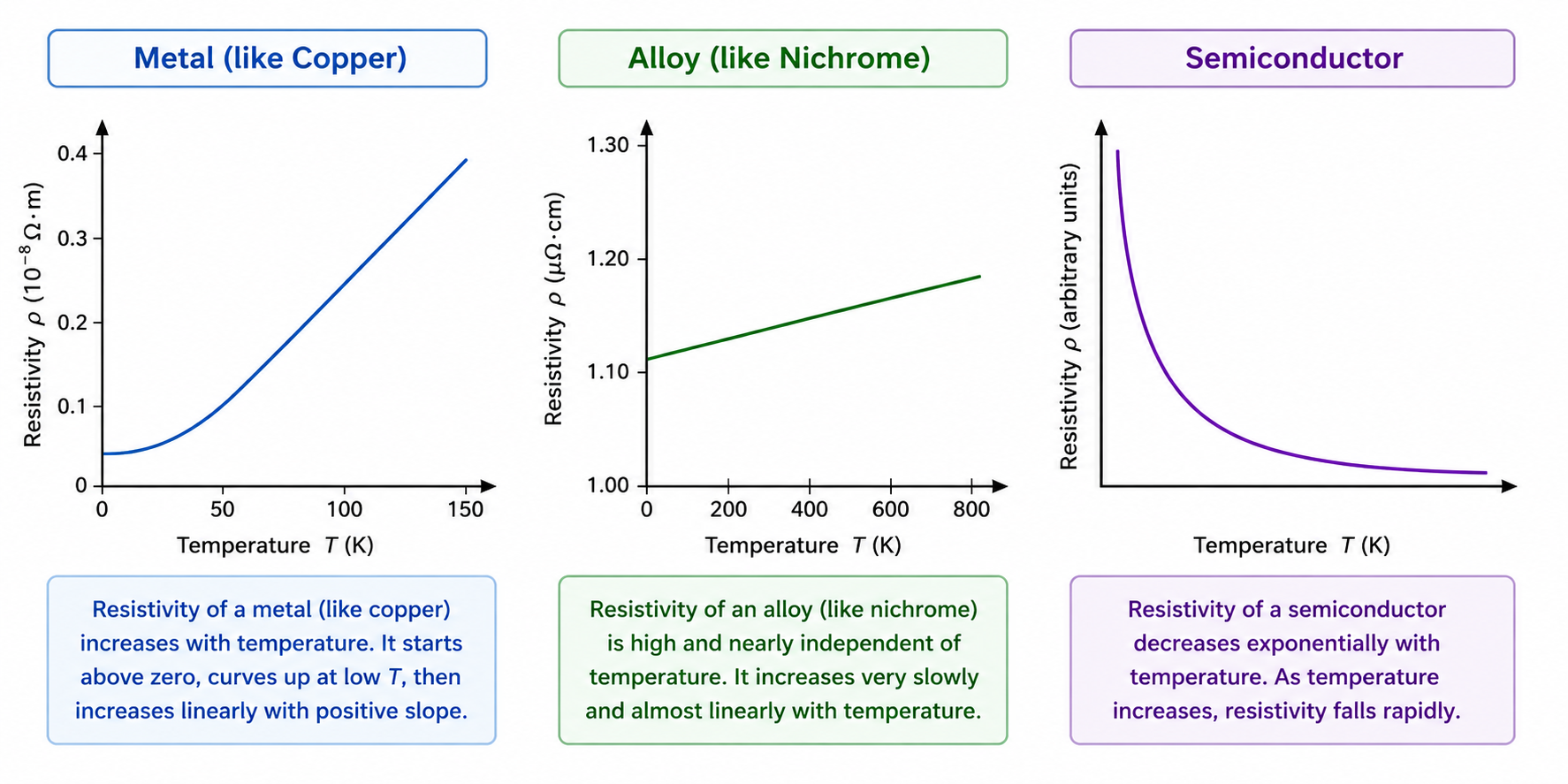
Metals: $\rho$ increases with T.
Semiconductors: $\rho$ decreases with T.
Electrical Power ($P$)
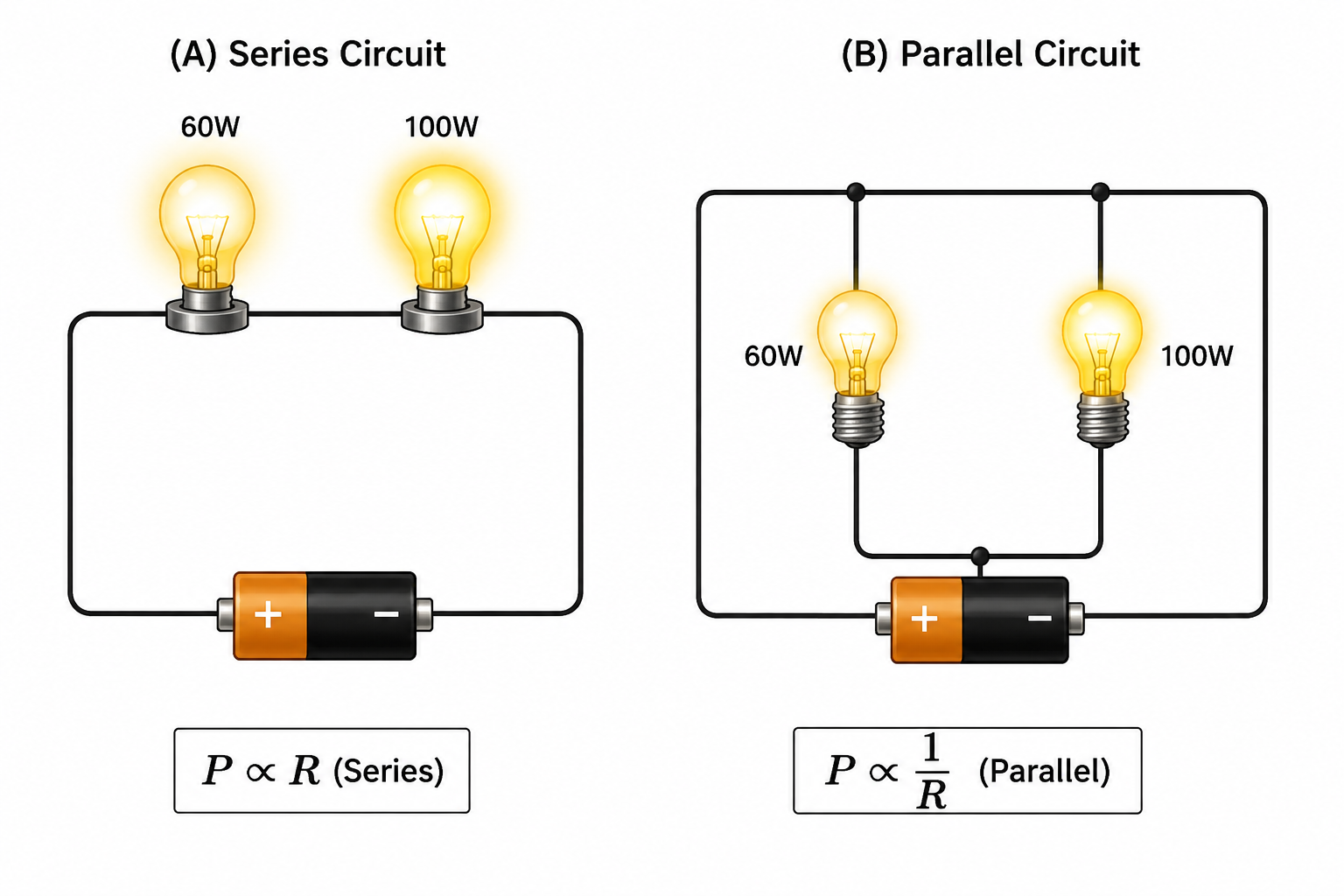
Series: Use $I^2R$ (higher R glows brighter).
Parallel: Use $V^2/R$ (lower R glows brighter).
Carbon Resistors
Color Coding Mnemonic:
B B R O Y Great Britain Very Good Wife
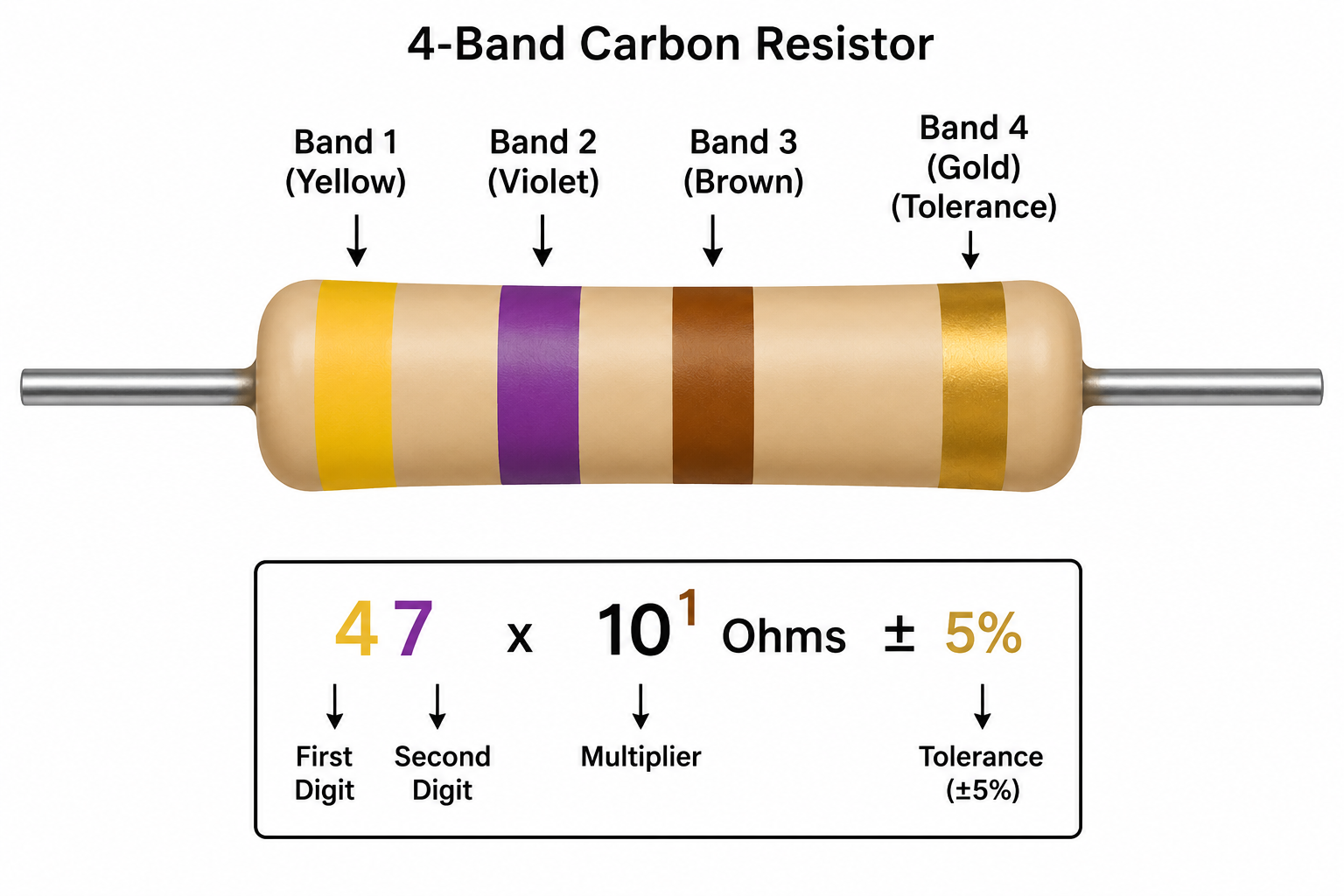
- Band 1 & 2: Sig Figs (0-9)
- Band 3: Multiplier ($10^x$)
- Band 4: Tolerance (Gold 5%, Silver 10%)
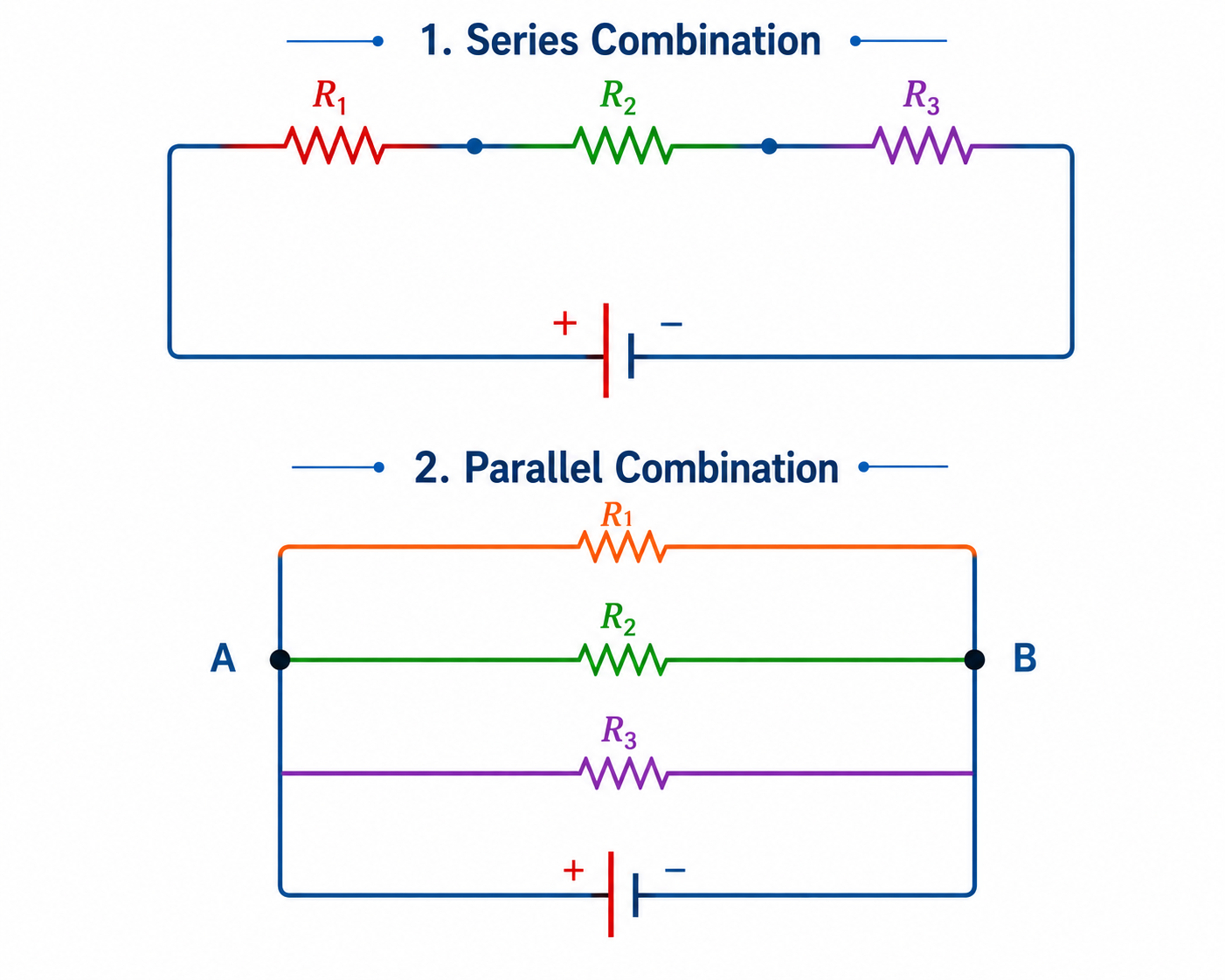
Resistors Combo
Series
$$ R_{eq} = R_1 + R_2 + \dots $$Current is same across all.
Parallel
$$ \frac{1}{R_{eq}} = \frac{1}{R_1} + \frac{1}{R_2} + \dots $$Voltage is same across all.
Cells & EMF
EMF ($\varepsilon$): Potential difference when no current is drawn.
Terminal Voltage ($V$): Potential diff when current $I$ is drawn.
$$ V = \varepsilon - Ir $$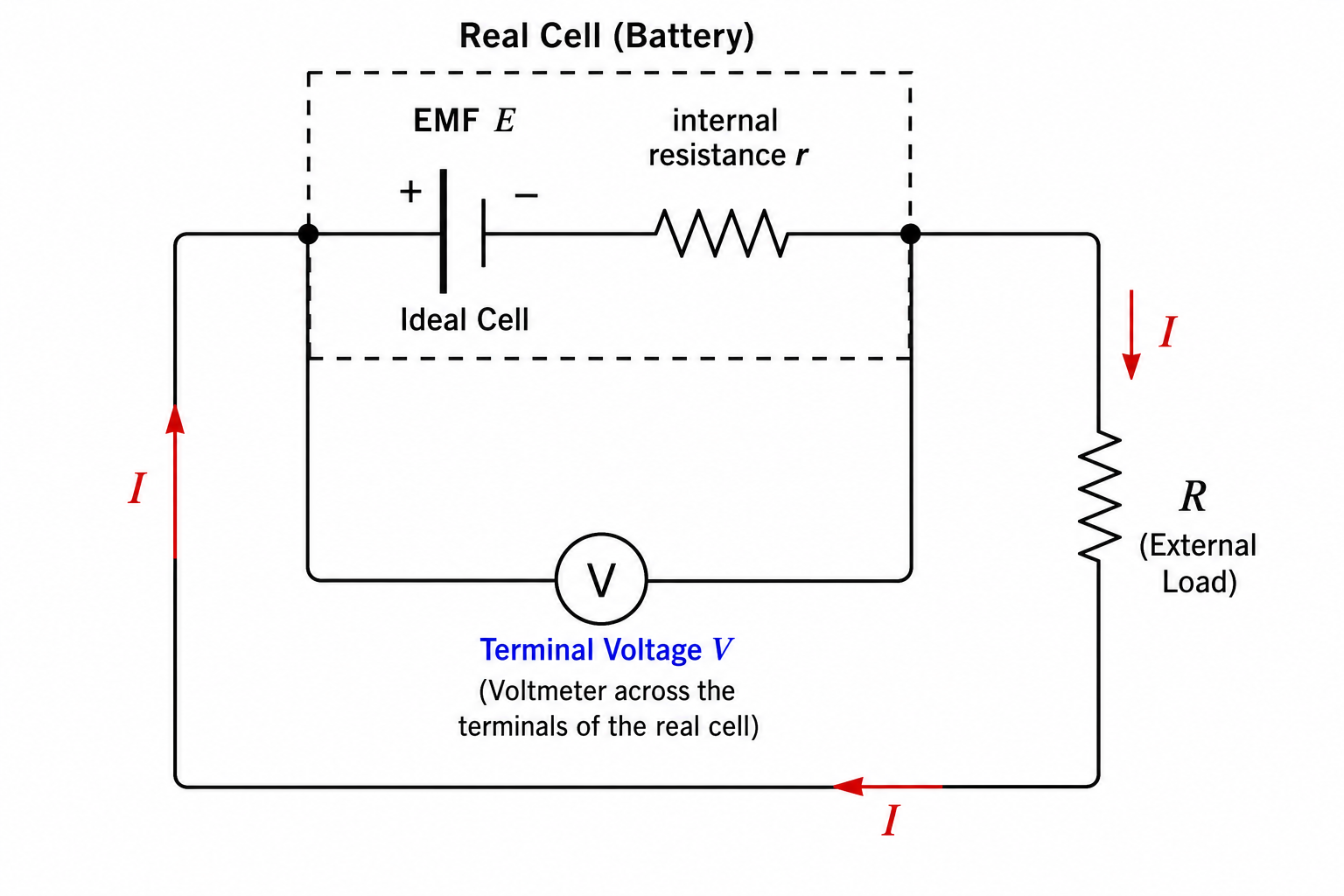
Combination of Cells
Series
$$ \varepsilon_{eq} = \varepsilon_1 + \varepsilon_2 $$ $$ r_{eq} = r_1 + r_2 $$Parallel
$$ \varepsilon_{eq} = \frac{\varepsilon_1/r_1 + \varepsilon_2/r_2}{1/r_1 + 1/r_2} $$ $$ \frac{1}{r_{eq}} = \frac{1}{r_1} + \frac{1}{r_2} $$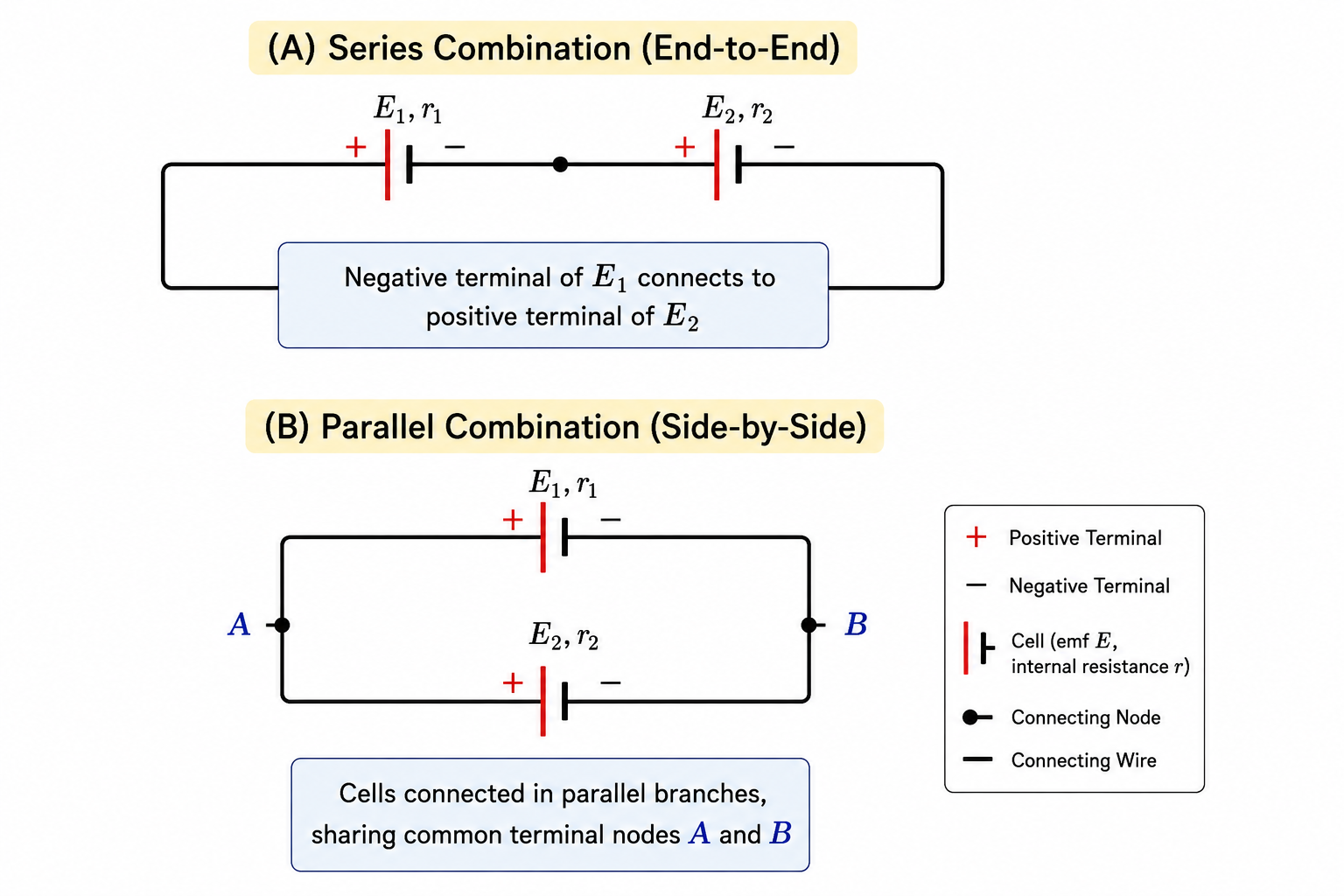
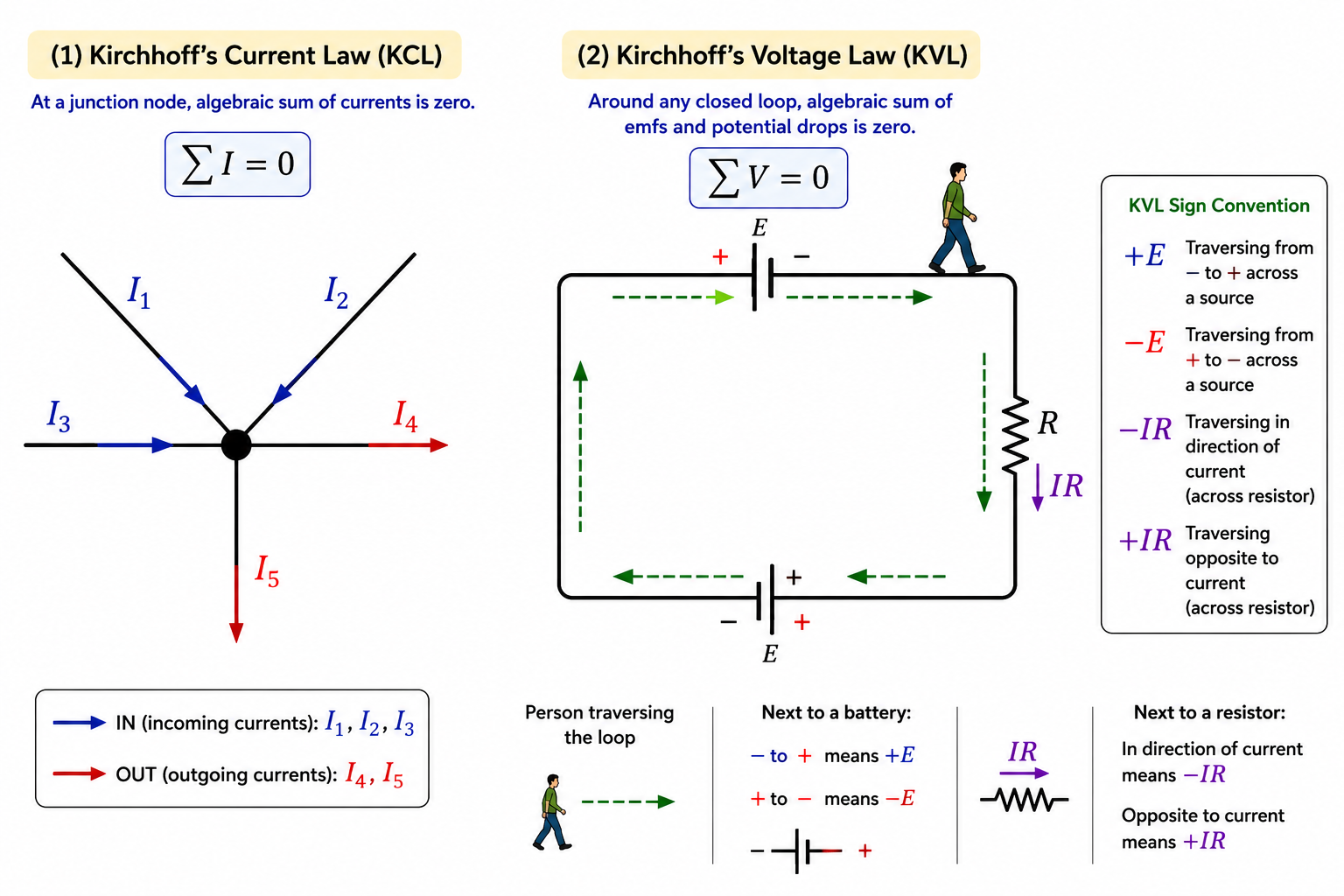
Kirchhoff's Laws
1. Junction Rule (KCL)
Sum of currents entering = Sum leaving. (Conservation of Charge)
2. Loop Rule (KVL)
Algebraic sum of changes in potential around closed loop is zero. (Conservation of Energy)
JEE Tip: Nodal Analysis
Assign a reference node (0V), name unknown nodes ($x$), and apply KCL:
$$ \sum I_{leaving} = 0 $$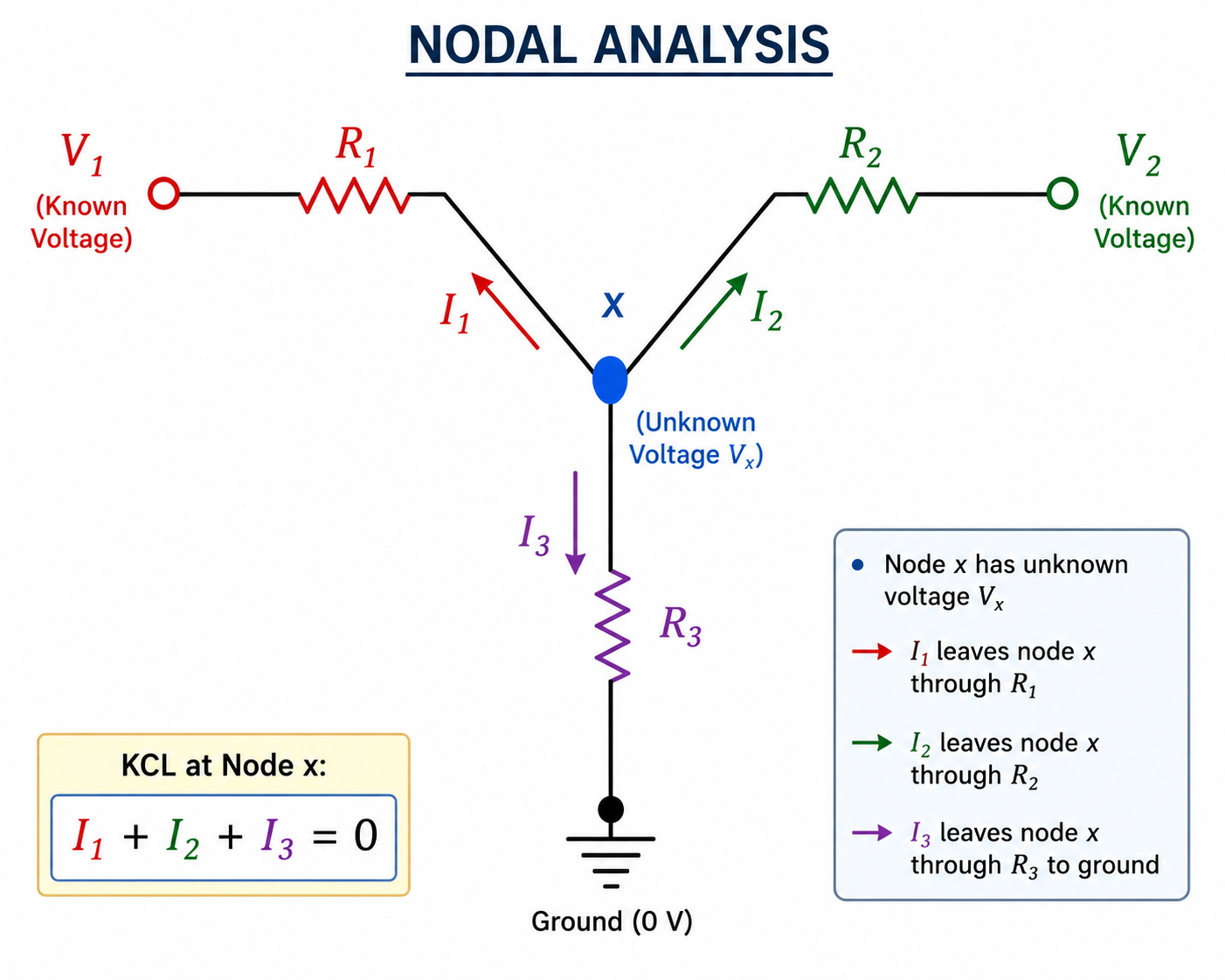
Faster than KVL for complex circuits!
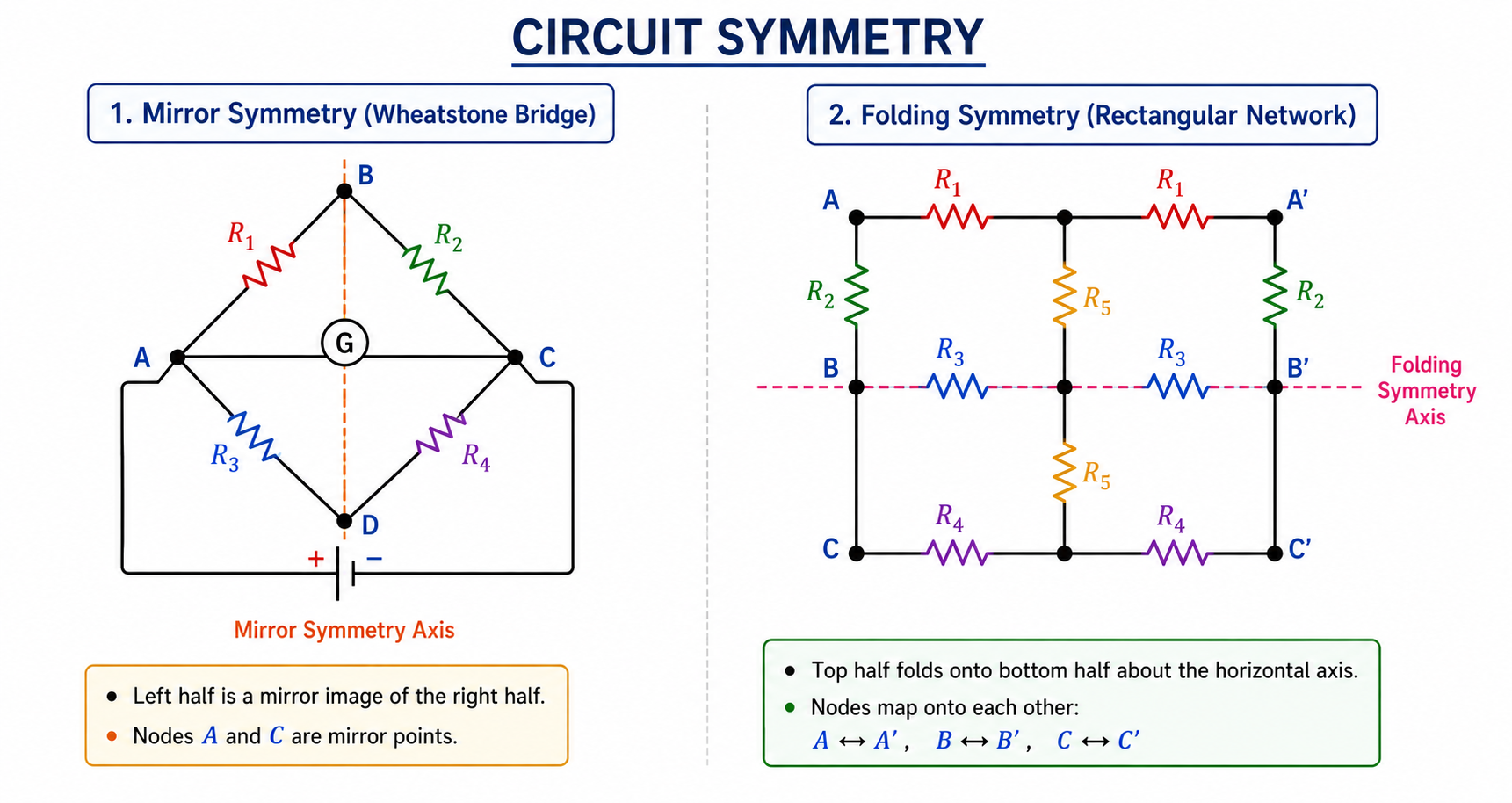
JEE Tip: Symmetry
- Mirror Symmetry: Points mirror symmetric to axis have same potential.
- Folding Symmetry: Fold circuit along axis parallel to current flow.
Wheatstone Bridge
Balanced Condition ($I_g = 0$):
$$ \frac{R_1}{R_2} = \frac{R_3}{R_4} $$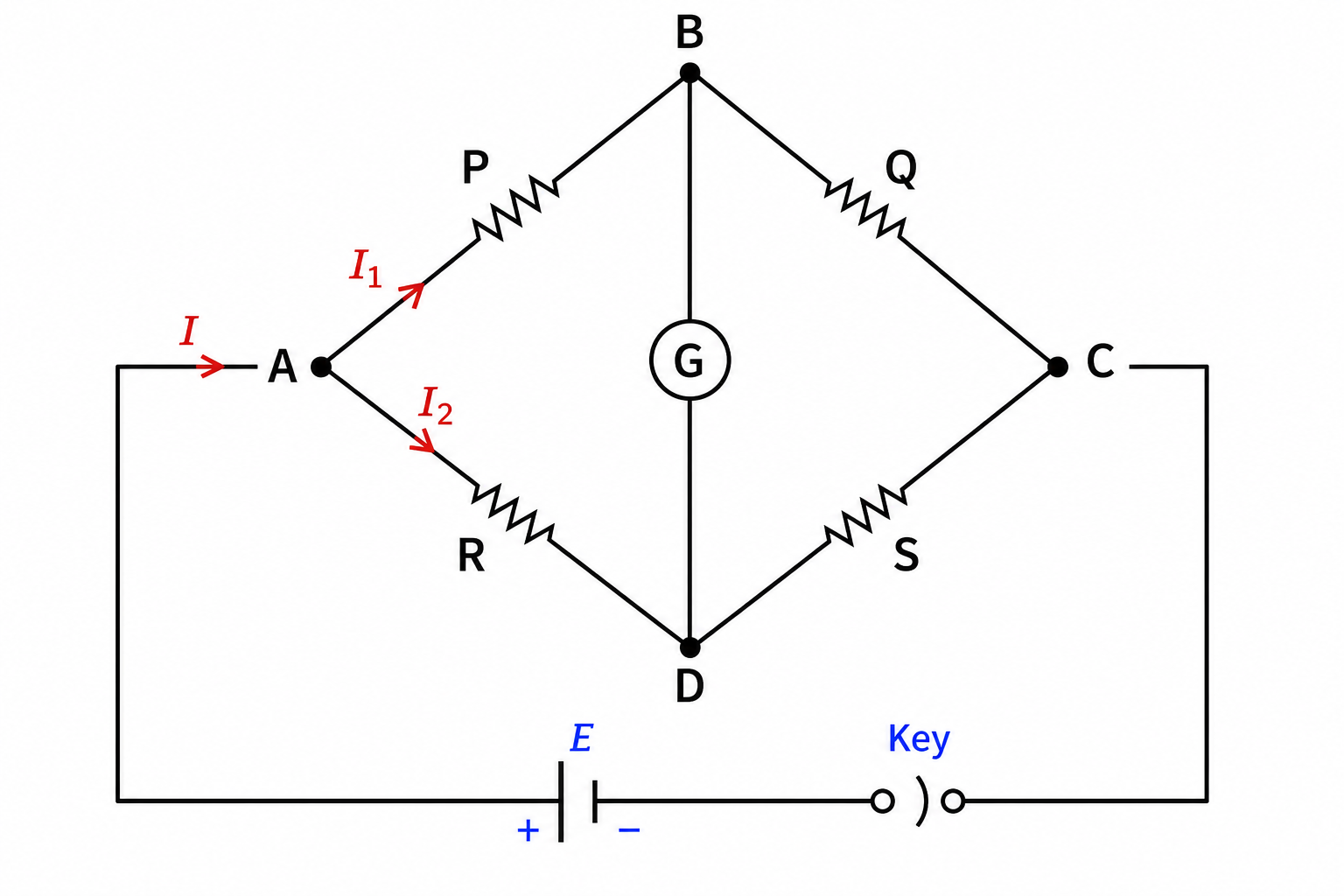
Used to measure unknown resistance accurately.
Meter Bridge
Practical application of Wheatstone bridge. Null point at length $l$ cm:
$$ S = R \left( \frac{100 - l}{l} \right) $$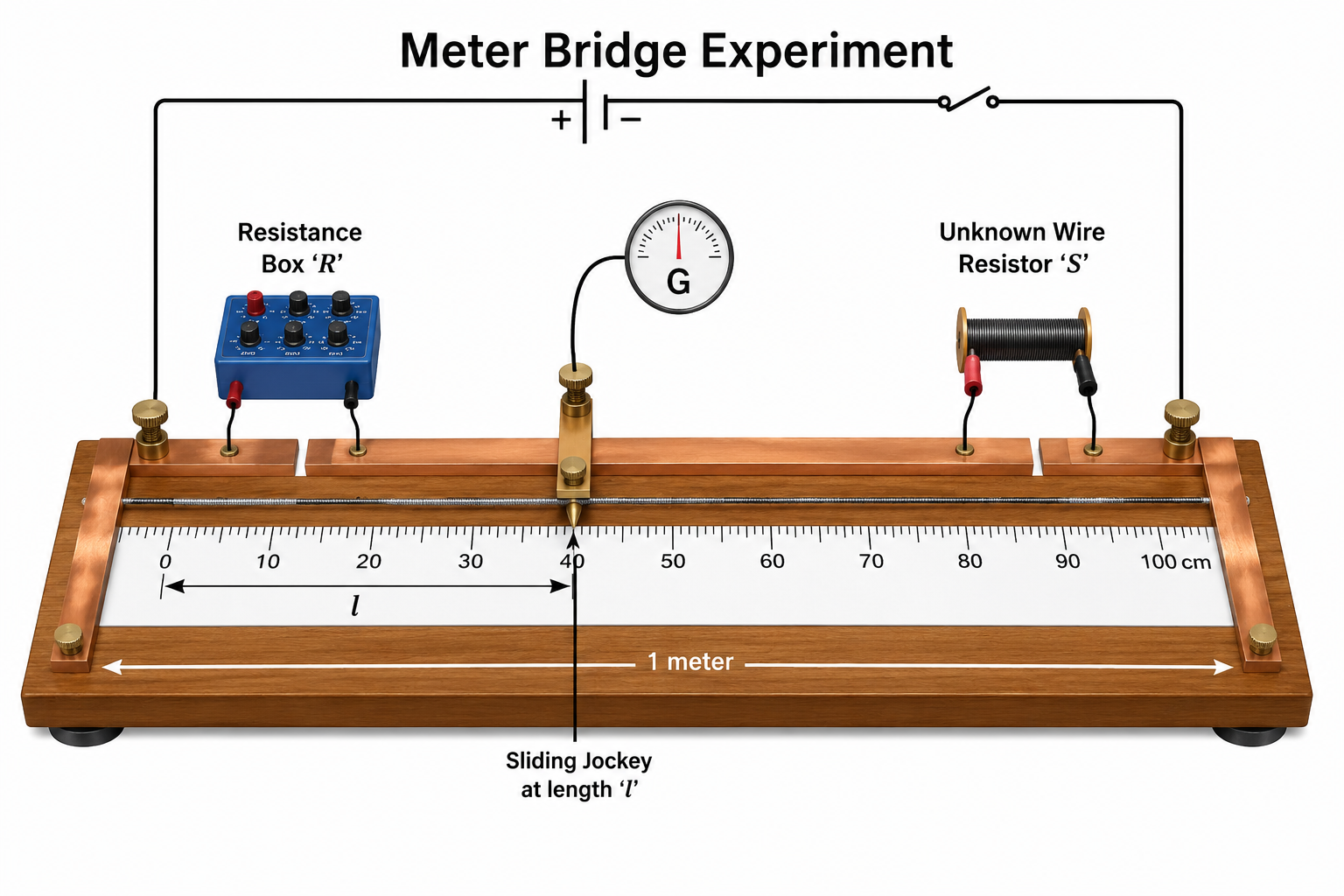
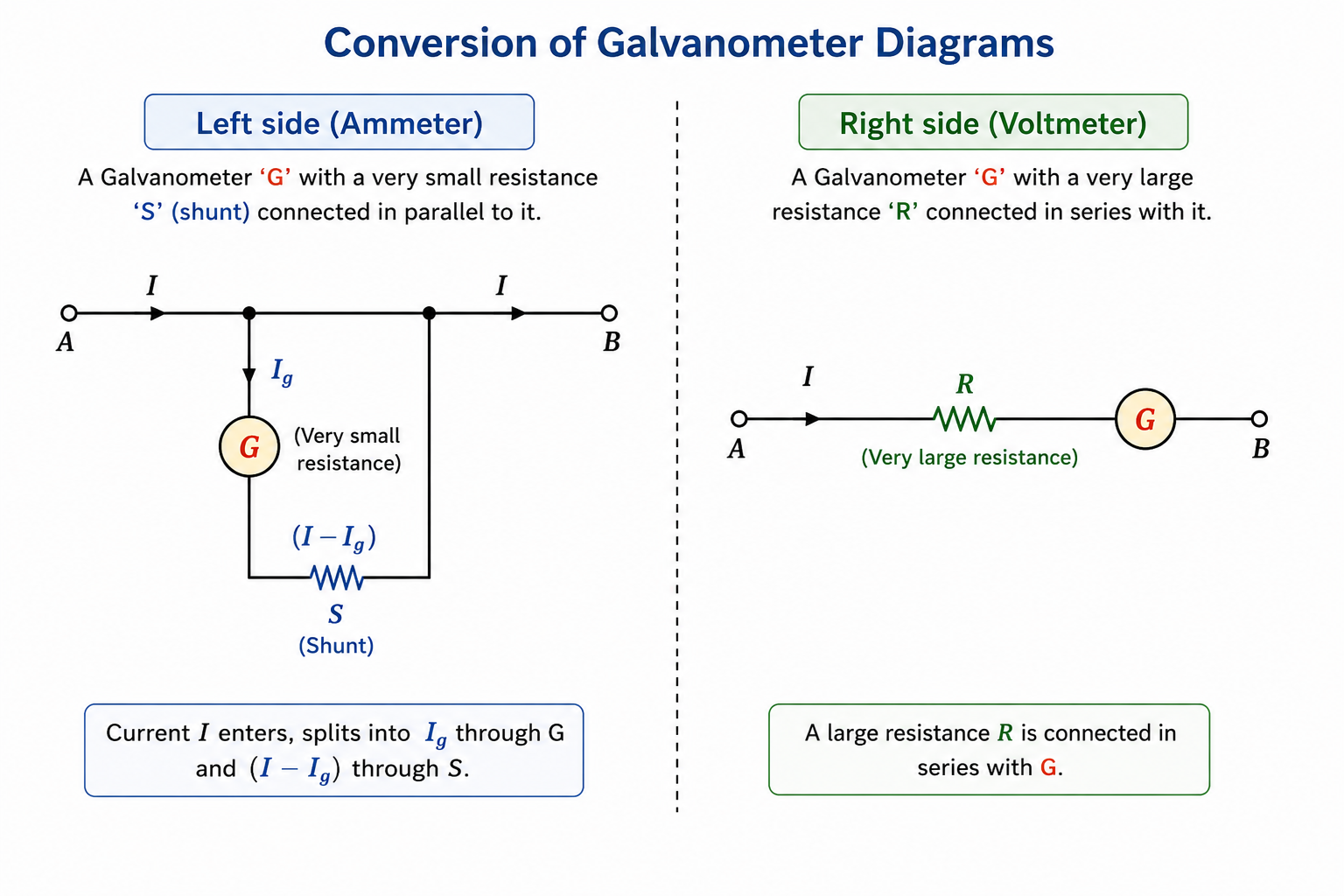
Galvanometer Conv.
Into Ammeter
Connect low resistance (Shunt $S$) in parallel.
$$ S = \left( \frac{I_g}{I - I_g} \right) G $$Into Voltmeter
Connect high resistance ($R$) in series.
$$ R = \frac{V}{I_g} - G $$