
Electric Potential
Amount of work done in bringing a unit positive charge from infinity to a point.
$$ V = \frac{W}{q_0} $$Unit: Volt (V) or J/C. It is a scalar quantity.
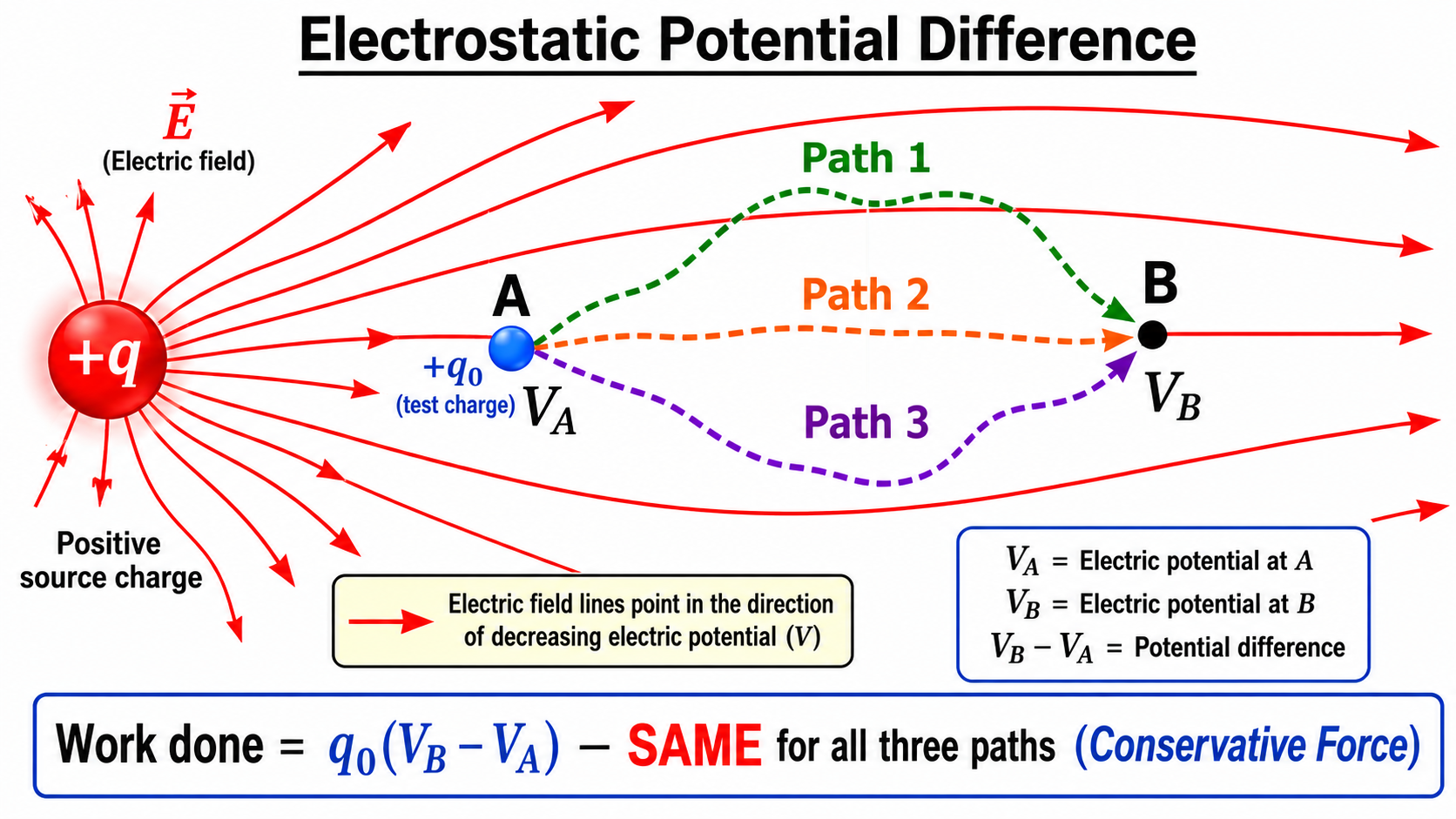
Potential: Dipole
At any point P at distance $r$ making angle $\theta$ with dipole moment $\vec{p}$:
$$ V = \frac{1}{4\pi\varepsilon_0} \frac{p \cos\theta}{r^2} $$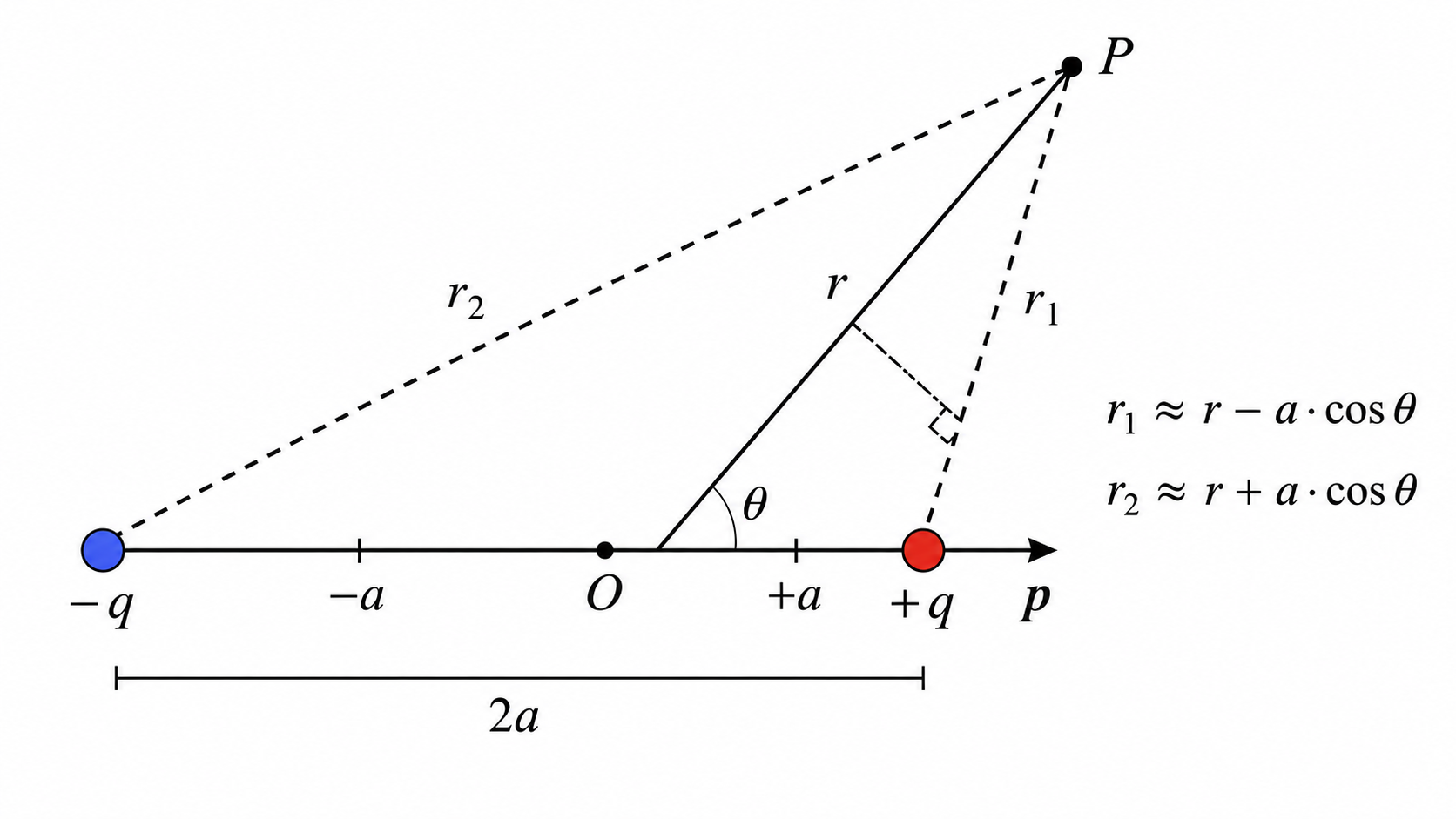
- Axial ($\theta=0^\circ$): $V = \pm \frac{1}{4\pi\varepsilon_0}\frac{p}{r^2}$
- Equatorial ($\theta=90^\circ$): $V = 0$ (Everywhere on plane!)
Equipotential Surfaces
A surface with a constant value of potential at all points. Work done to move a charge on it is ZERO.
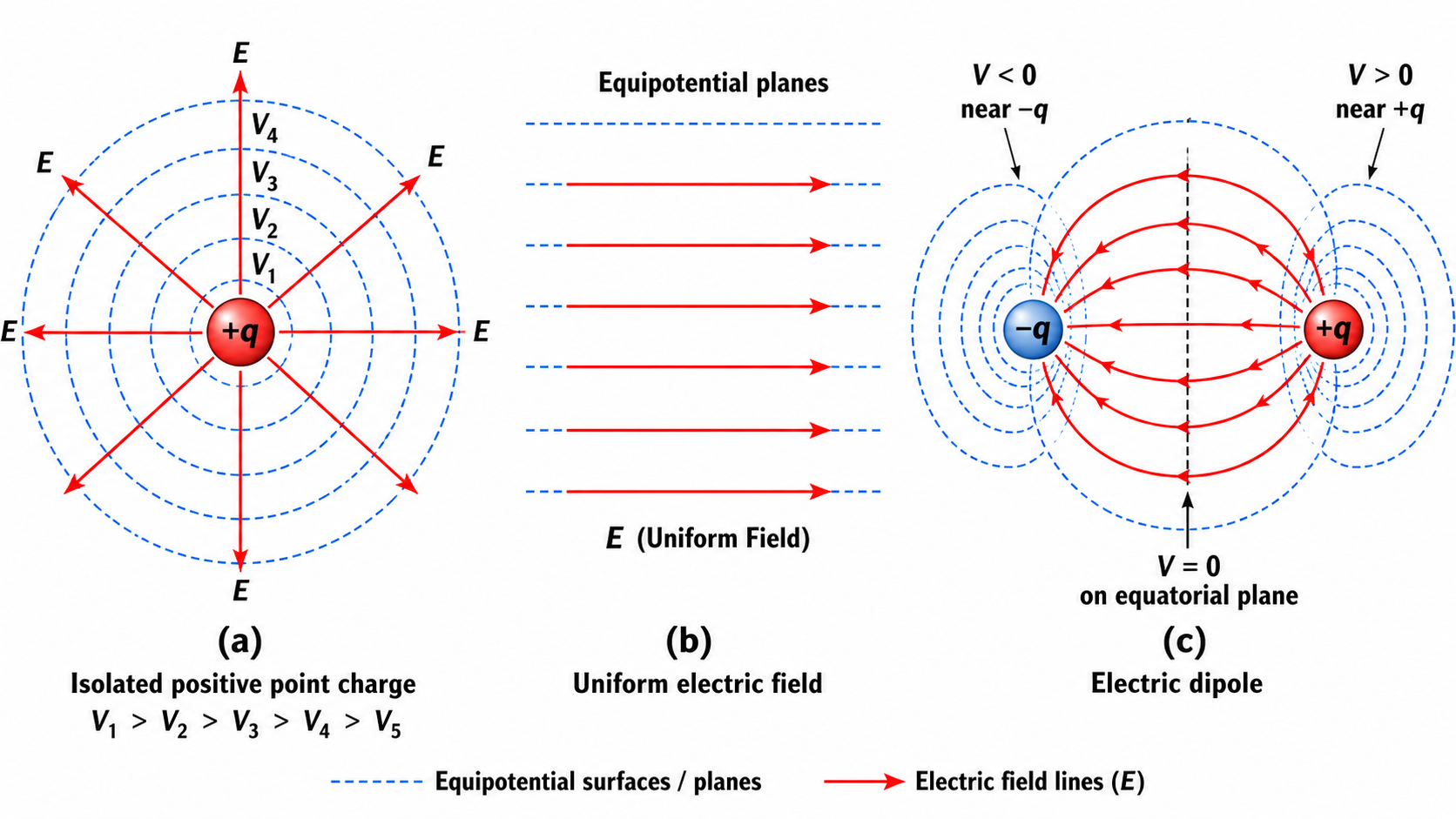
Properties
- Electric field is always perpendicular to it.
- Two such surfaces never intersect.
Dipole P.E. in Field
Work done in rotating dipole in external field:
$$ U = -\vec{p} \cdot \vec{E} = -pE \cos\theta $$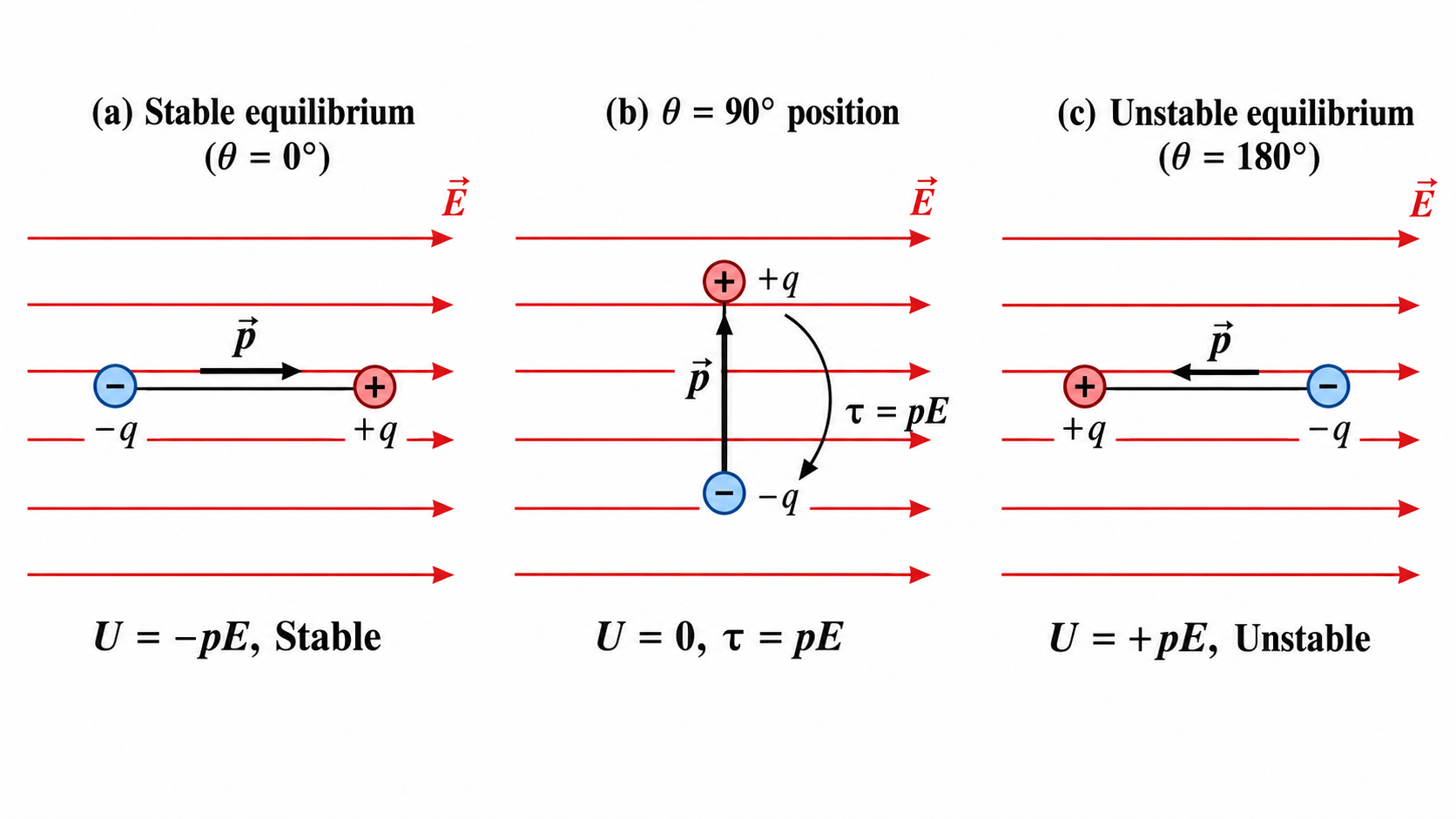
Conductors & Shielding
- Inside a conductor, $\vec{E} = 0$.
- Surface of a conductor is an equipotential surface.
- $\vec{E}$ at surface is perpendicular to it.
- Interior has no excess charge.
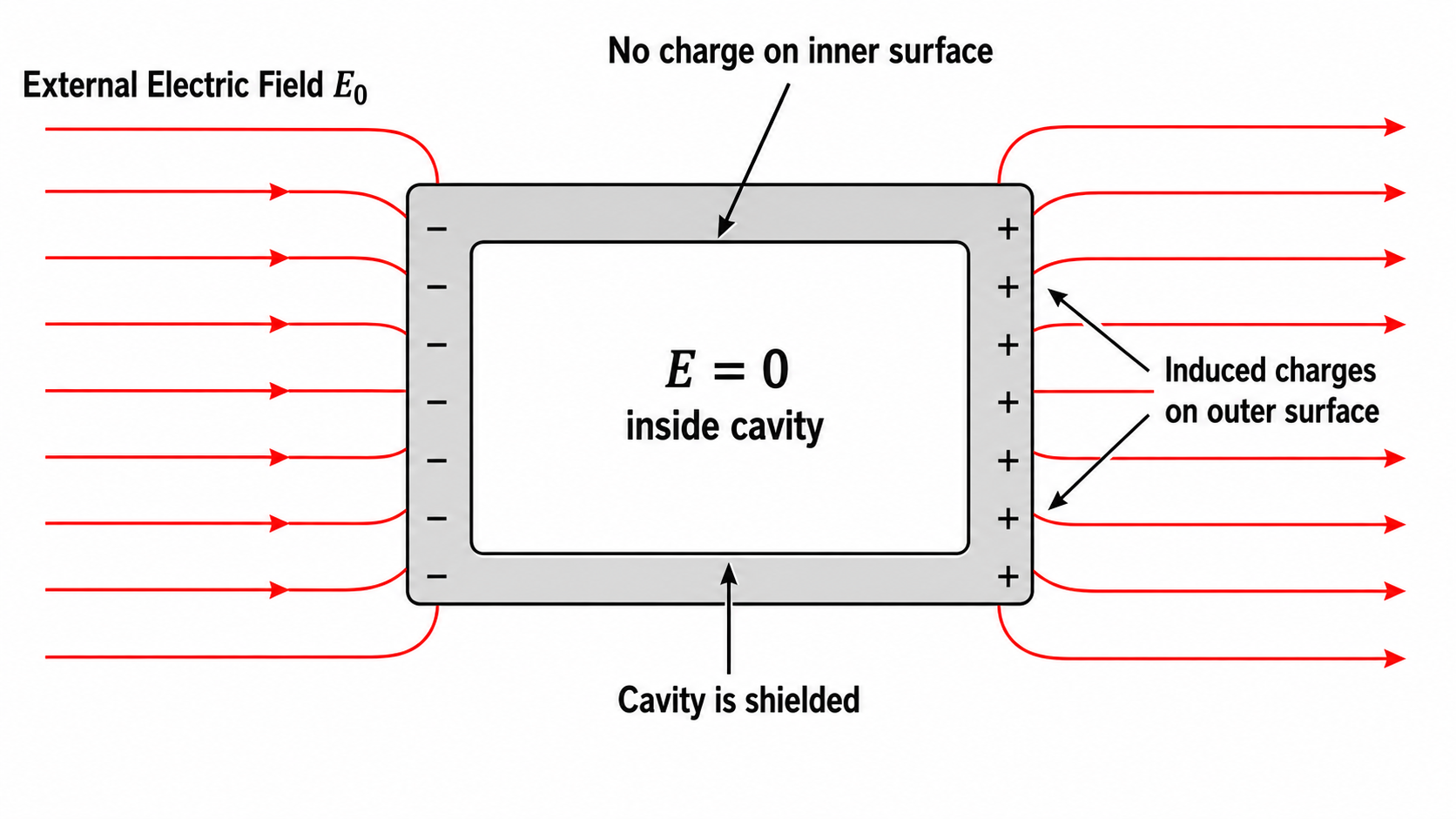
Electrostatic Shielding
Cavity inside conductor has zero field. Protects sensitive instruments.
Dielectrics & Polarisation
Non-conducting substances. In external $\vec{E}$, they develop induced dipole moment.
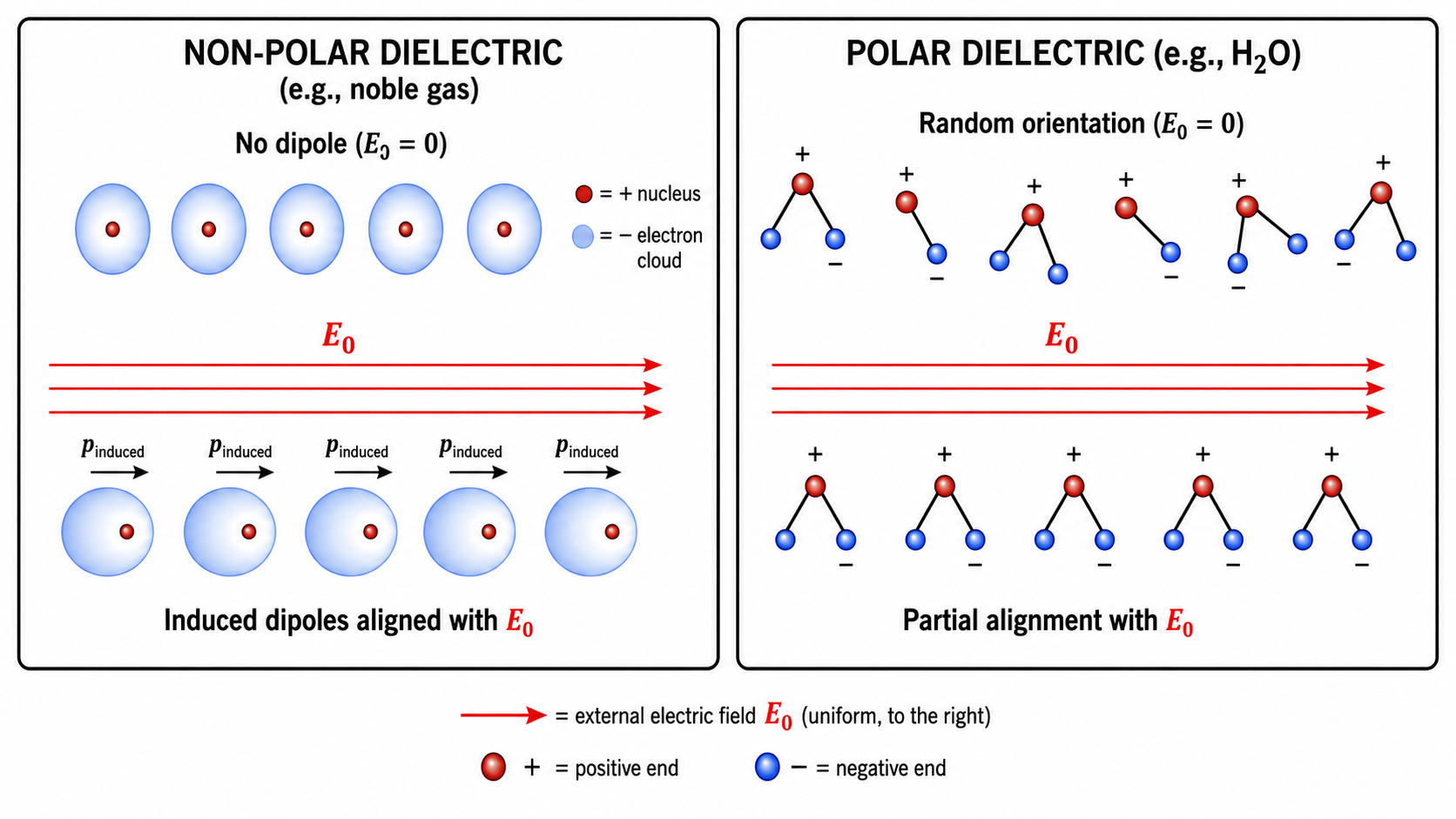
Polarisation ($P$): Dipole moment per unit volume. $P = \chi_e E$ ($\chi_e$ = electric susceptibility).
Parallel Plate Capacitor
A = Area of plates, d = Distance between them.
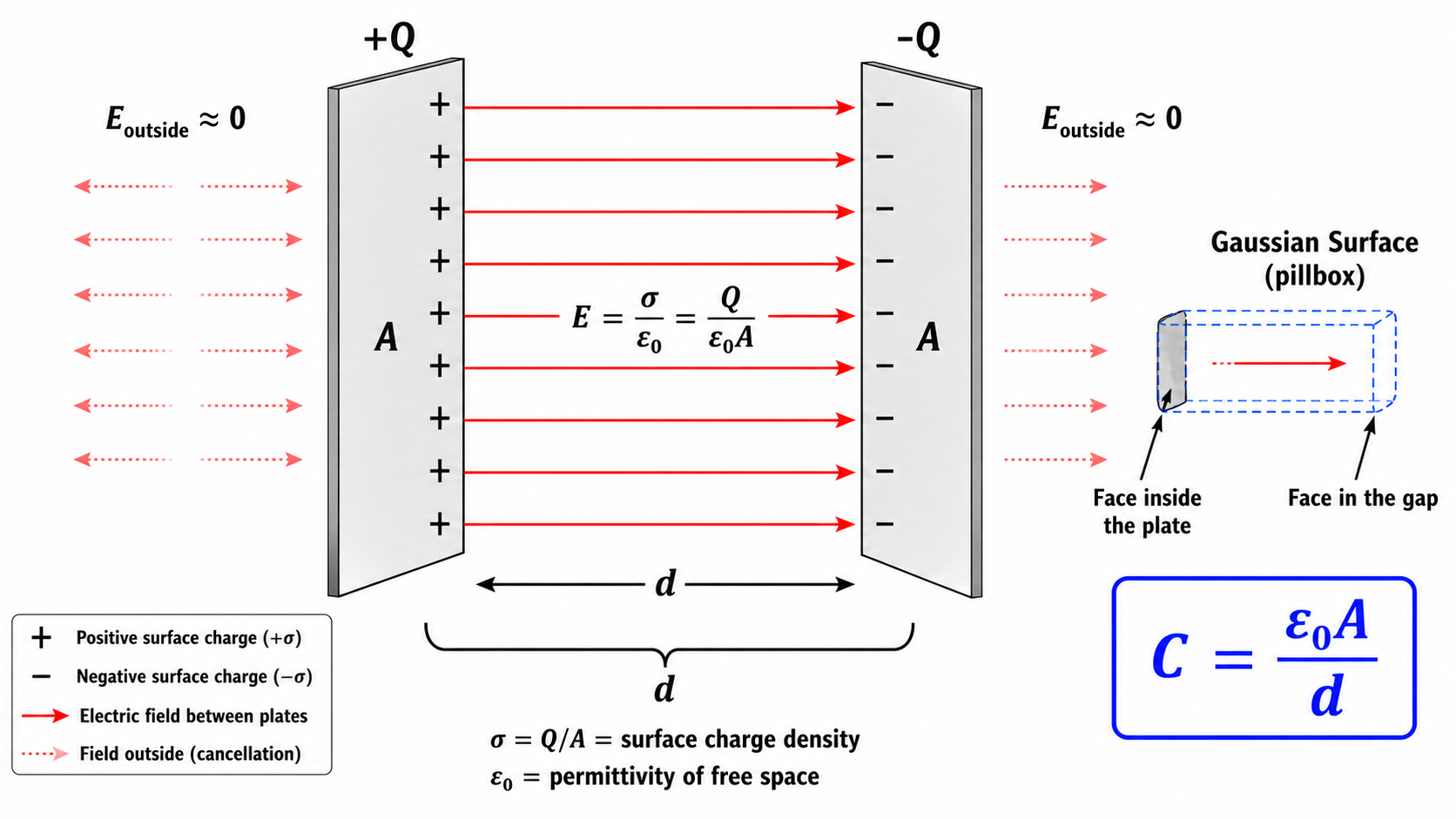
Electric Field Between Plates
$$ E = \frac{\sigma}{\varepsilon_0} = \frac{Q}{A\varepsilon_0} $$Effect of Dielectric
Inserting a dielectric slab (constant $K$) completely fills space:
$$ C = \frac{K\varepsilon_0 A}{d} = K \cdot C_{vacuum} $$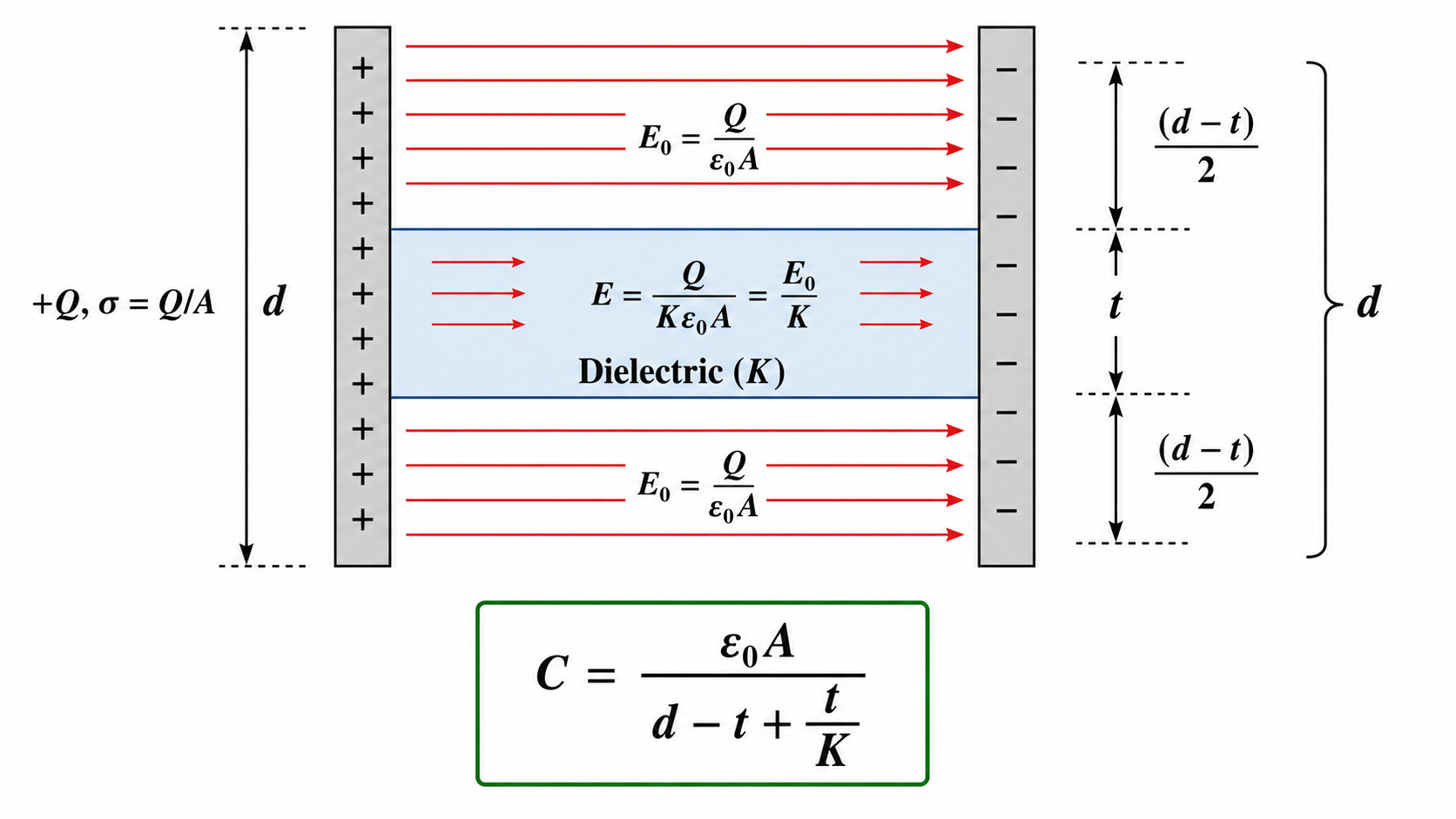
Partial slab thickness $t$:
$$ C = \frac{\varepsilon_0 A}{d - t(1 - \frac{1}{K})} $$Capacitors Combination
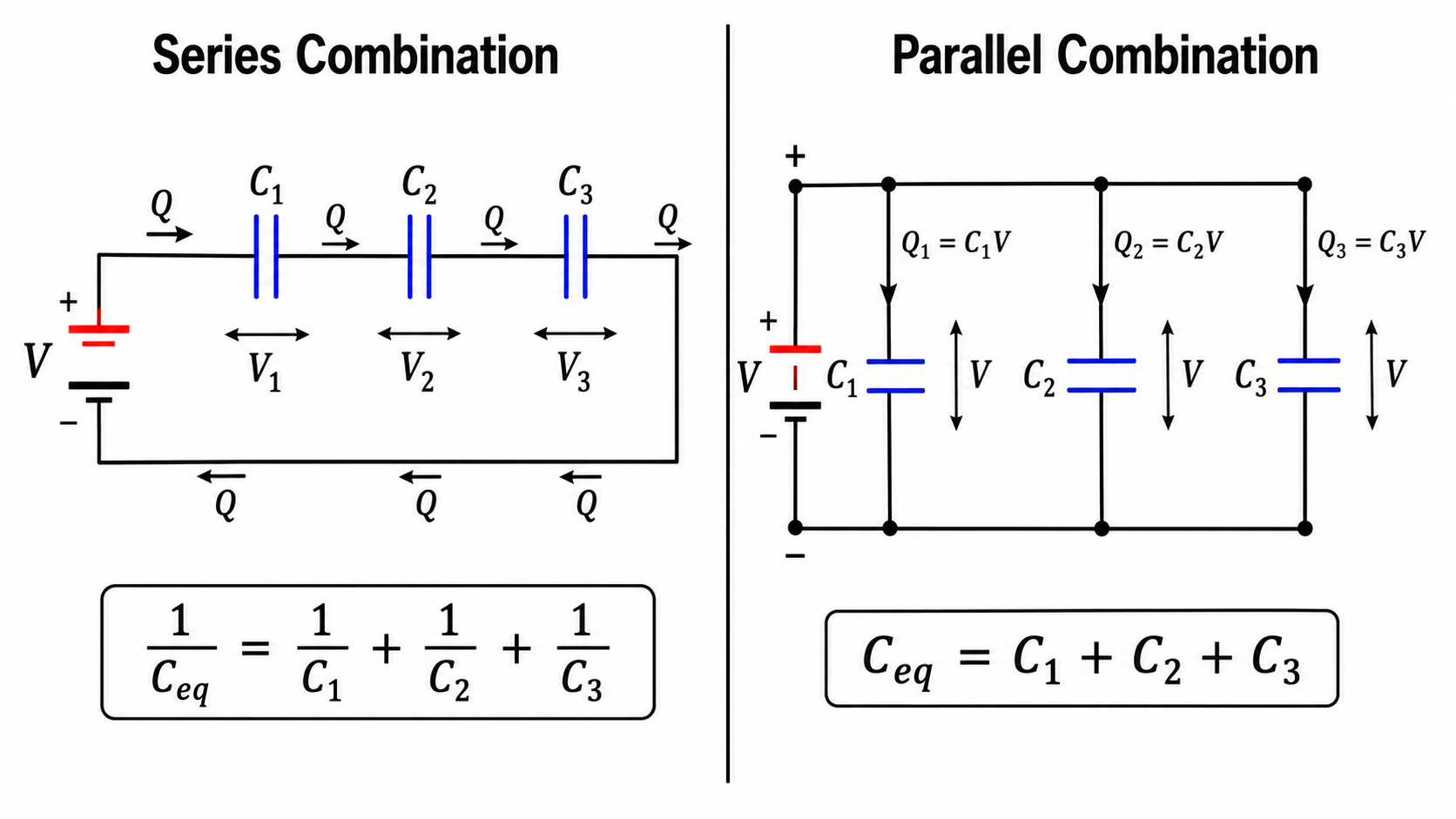
Series
$$ \frac{1}{C_{eq}} = \frac{1}{C_1} + \frac{1}{C_2} + \dots $$Charge $Q$ is same on all.
Parallel
$$ C_{eq} = C_1 + C_2 + \dots $$Voltage $V$ is same across all.
Energy Stored
Energy Density $u = \frac{1}{2}\varepsilon_0 E^2$
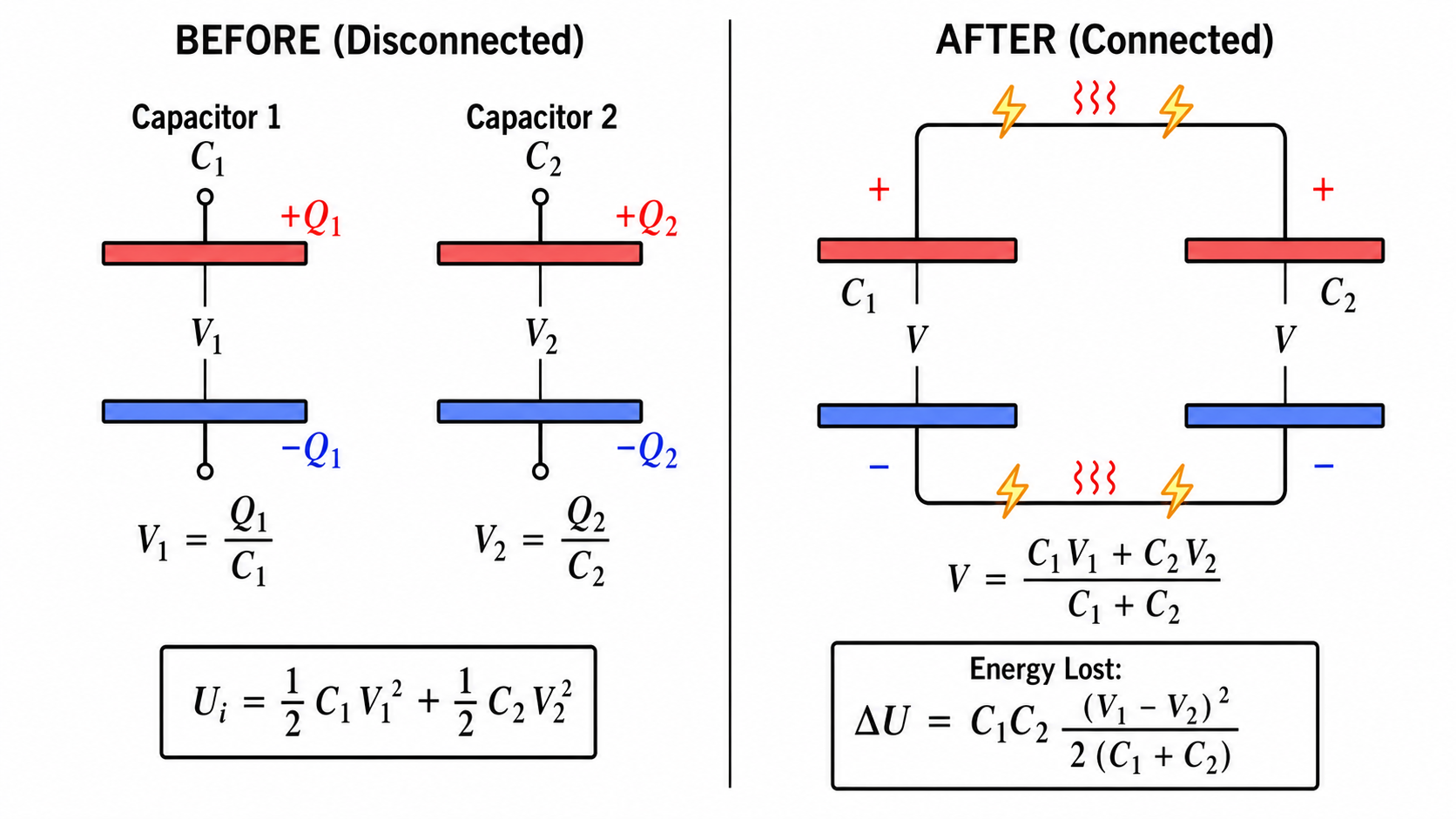
Sharing of Charge
Common Potential: $V = \frac{C_1V_1 + C_2V_2}{C_1 + C_2}$
Energy Loss: $\Delta U = \frac{C_1C_2(V_1-V_2)^2}{2(C_1+C_2)}$