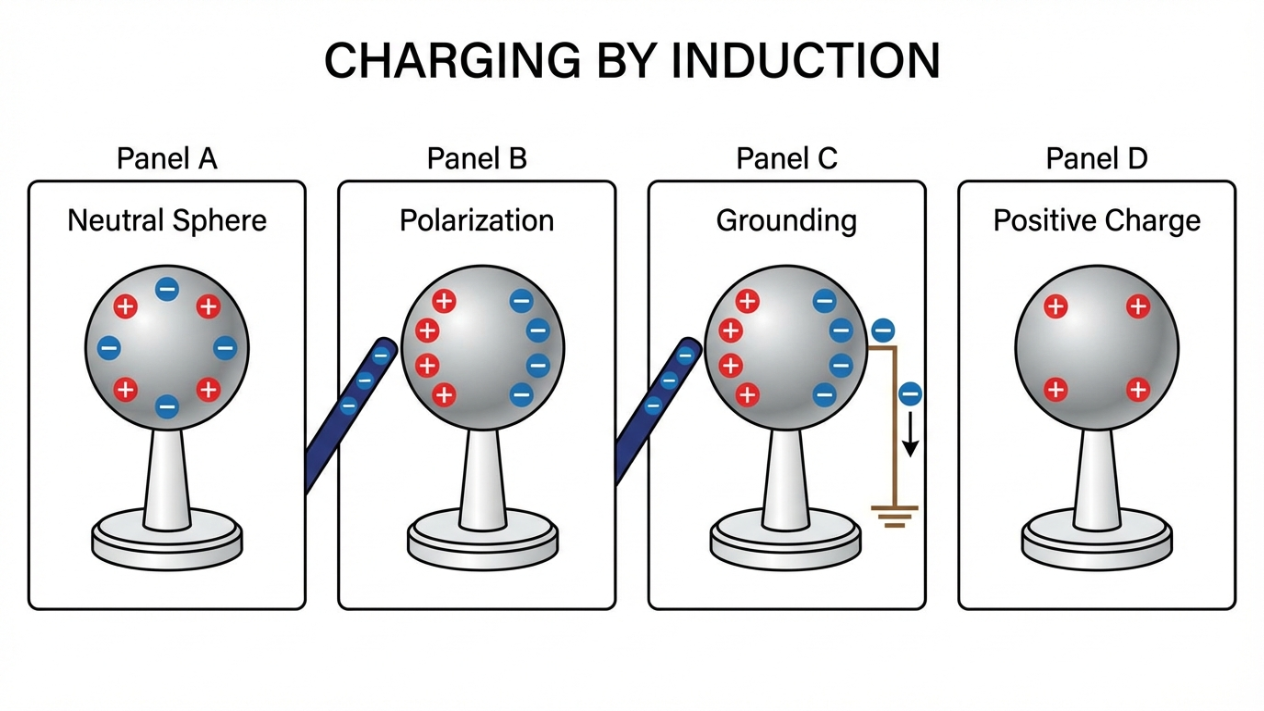
Methods of Charging
- Friction: Rubbing two insulators. e- transfer.
- Conduction: Direct physical contact between conductors.
- Induction: Charging without contact. Charges are redistributed due to presence of a nearby charged body.
Coulomb's Law
Scalar Form
$$ F = \frac{1}{4\pi\varepsilon_0} \frac{|q_1 q_2|}{r^2} $$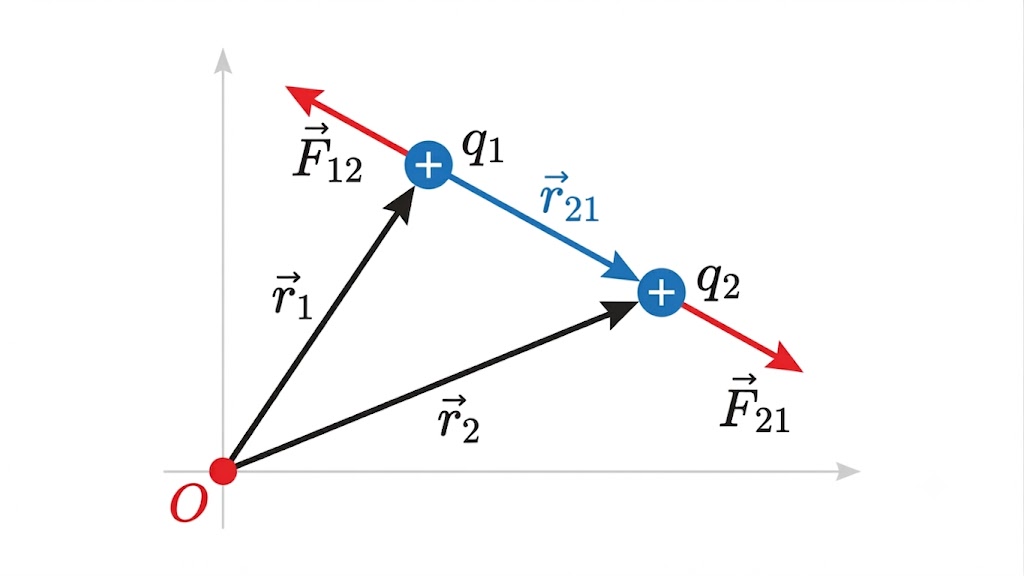
Vector Form
$$ \vec{F}_{12} = \frac{1}{4\pi\varepsilon_0} \frac{q_1 q_2}{r^2} \hat{r}_{21} $$Shows that $\vec{F}_{12} = -\vec{F}_{21}$ (Newton's 3rd Law).
Continuous Charge
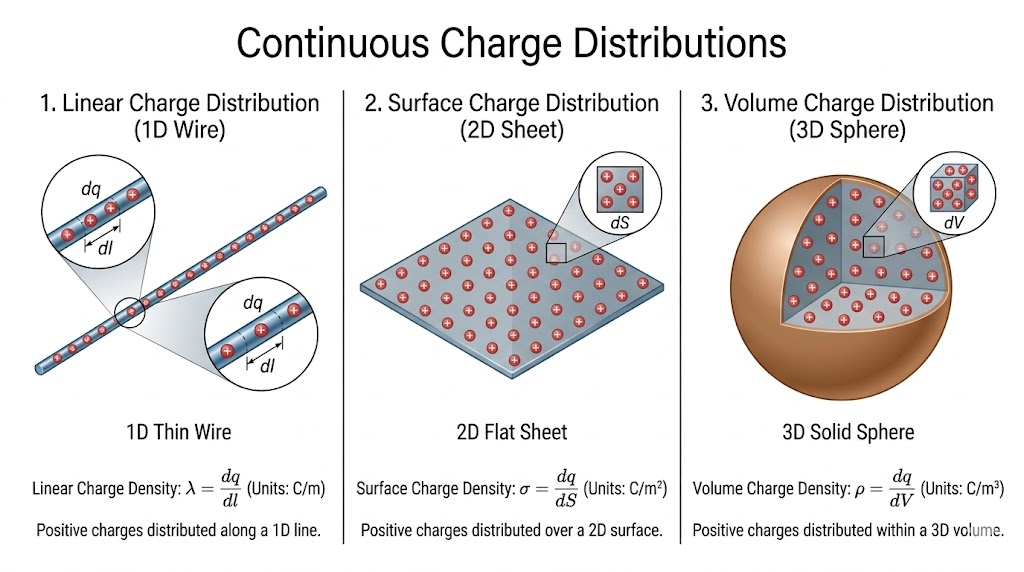
When charge is distributed over a region, we use charge densities:
- Linear ($\lambda$): Charge per unit length. (C/m)
- Surface ($\sigma$): Charge per unit area. (C/m²)
- Volume ($\rho$): Charge per unit volume. (C/m³)
Electric Field
Definition
Force experienced by a unit positive test charge.
$$ \vec{E} = \frac{\vec{F}}{q_0} $$Field due to Point Charge
$$ E = \frac{1}{4\pi\varepsilon_0} \frac{q}{r^2} $$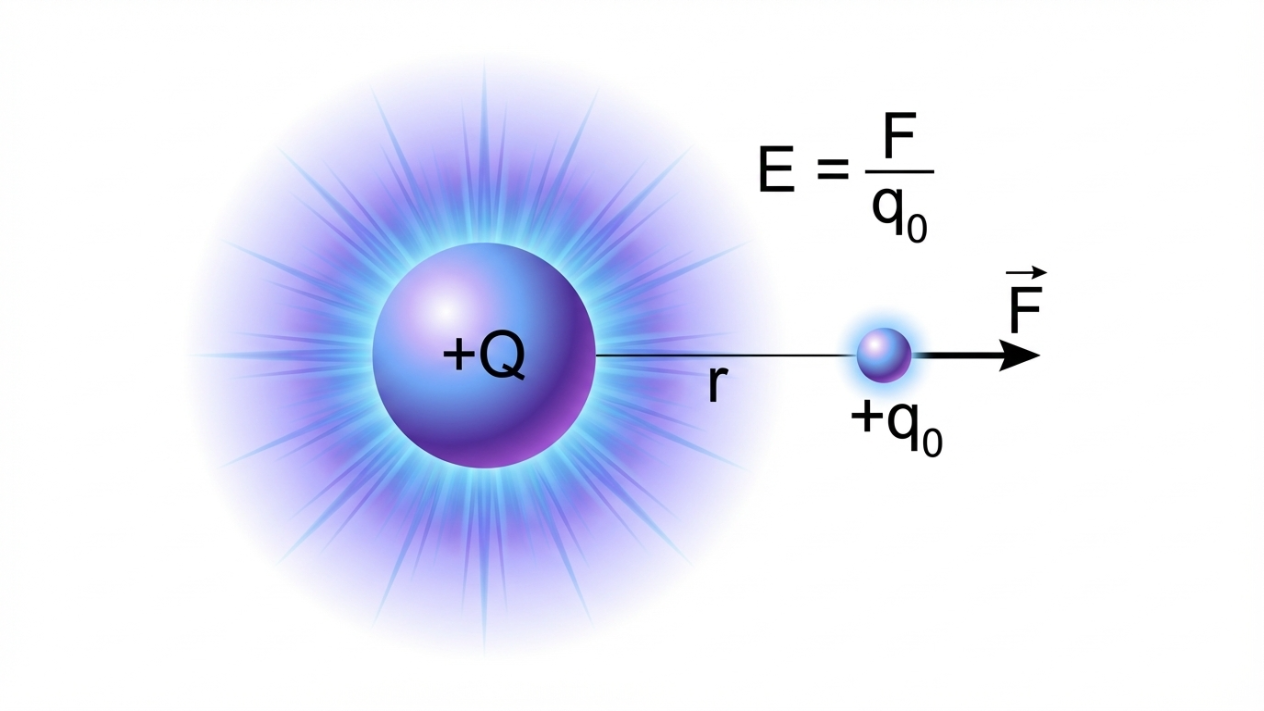
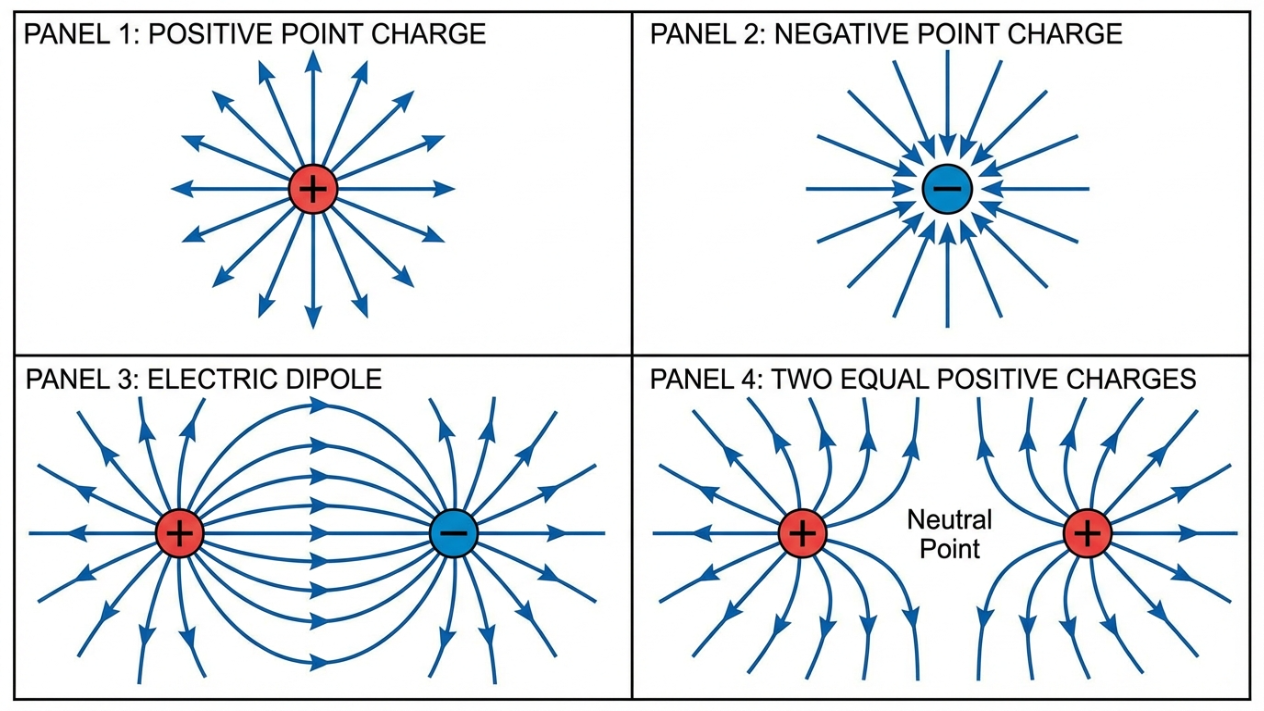
Electric Field Lines
Key Properties
- Originate from +ve, terminate at -ve.
- Do not form closed loops.
- Two field lines never intersect.
- Relative closeness indicates field strength.
Electric Dipole
Dipole Moment ($\vec{p}$)
$$ \vec{p} = q \times 2\vec{a} $$Direction: -ve to +ve charge.
Unit: C·m.
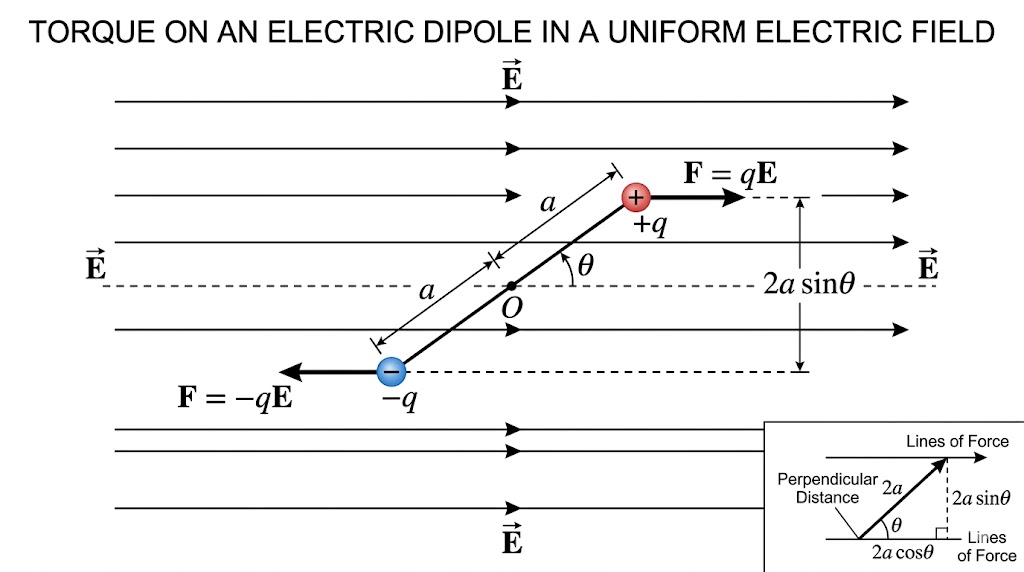
Dipole in Uniform Field
- Net Force: $F_{net} = 0$
- Torque: $\vec{\tau} = \vec{p} \times \vec{E}$
- Magnitude: $\tau = pE \sin\theta$
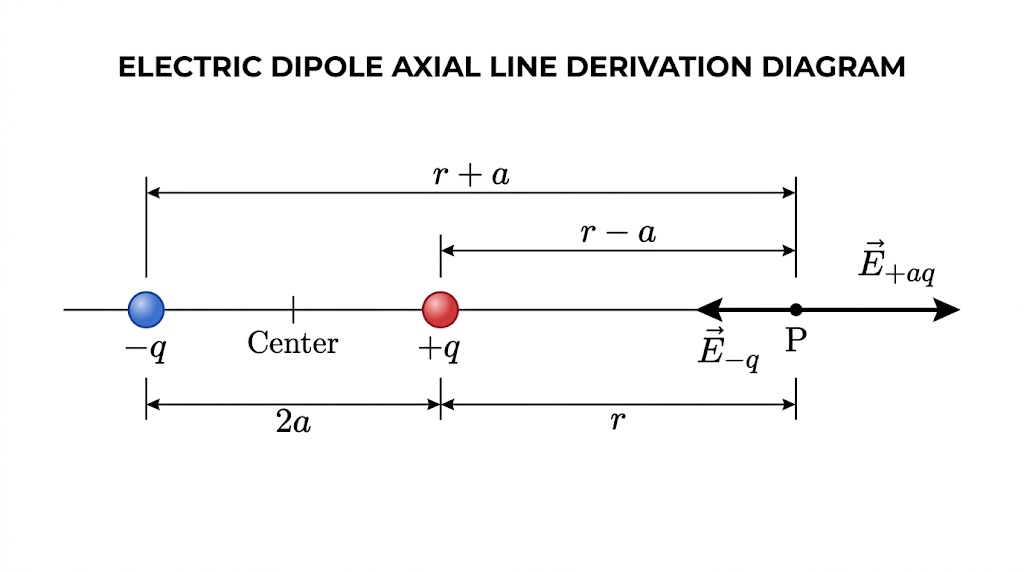
Dipole Field: Axial
For a short dipole ($r \gg a$):
$$ E_{axial} = \frac{1}{4\pi\varepsilon_0} \frac{2p}{r^3} $$Direction: Same as $\vec{p}$
Dipole Field: Equat.
For a short dipole ($r \gg a$):
$$ E_{eq} = \frac{1}{4\pi\varepsilon_0} \frac{p}{r^3} $$Direction: Opposite to $\vec{p}$
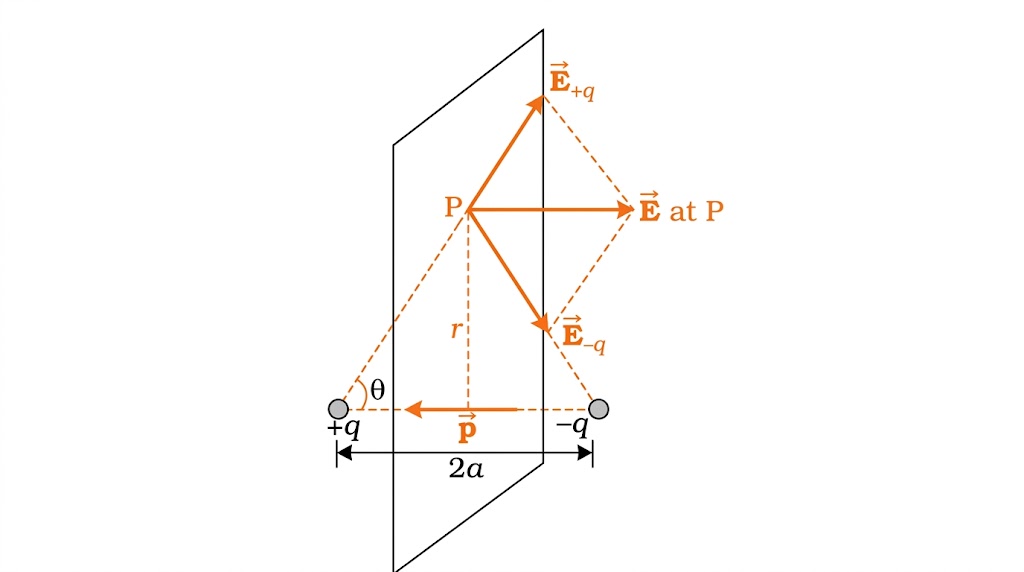
Relation
$$ E_{axial} = 2 \times E_{eq} $$Electric Flux ($\Phi$)
Formula
$$ \Phi = \vec{E} \cdot \vec{A} = EA \cos\theta $$Where $\theta$ is angle between E-field and Area Vector.
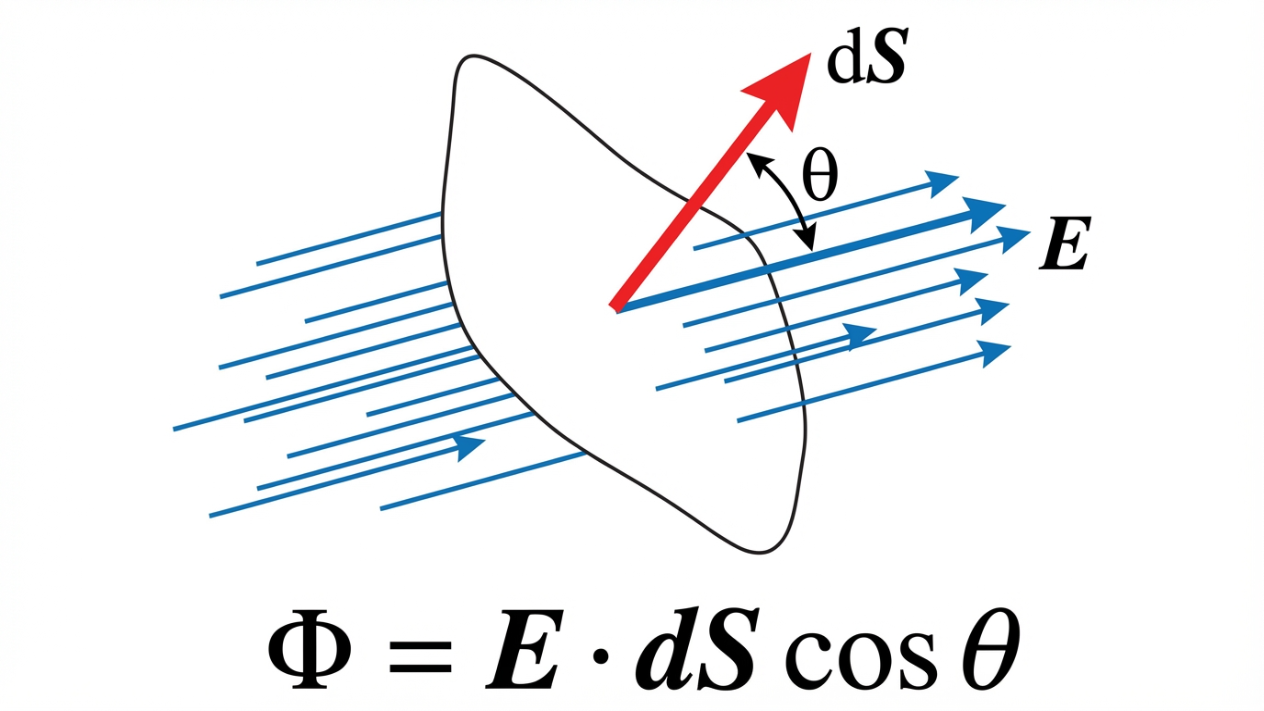
For non-uniform field over closed surface:
$$ \Phi = \oint \vec{E} \cdot d\vec{S} $$
Gauss's Law
The total flux through a closed surface is $1/\varepsilon_0$ times the net charge enclosed.
$$ \oint \vec{E} \cdot d\vec{S} = \frac{q_{enclosed}}{\varepsilon_0} $$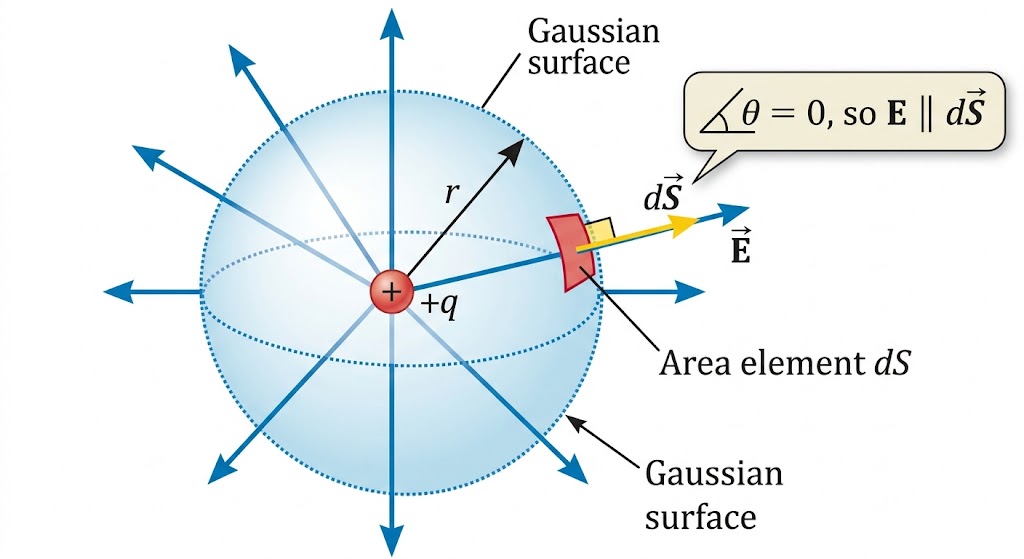
Charges outside the surface do not contribute to total flux.
Gauss: Infinite Wire
Linear charge density $\lambda$:
$$ E = \frac{\lambda}{2\pi\varepsilon_0 r} $$$E \propto 1/r$
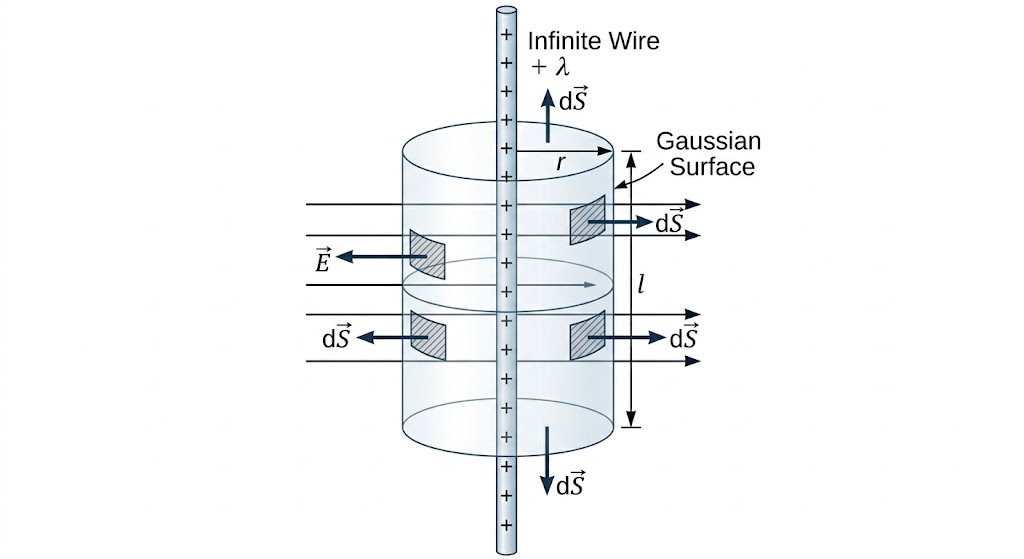
Gauss: Infinite Sheet
Surface charge density $\sigma$:
$$ E = \frac{\sigma}{2\varepsilon_0} $$(Independent of distance $r$!)
Gauss: Spherical Shell
- Outside ($r > R$): $E = \frac{1}{4\pi\varepsilon_0}\frac{q}{r^2}$
- Surface ($r = R$): $E = \frac{1}{4\pi\varepsilon_0}\frac{q}{R^2}$
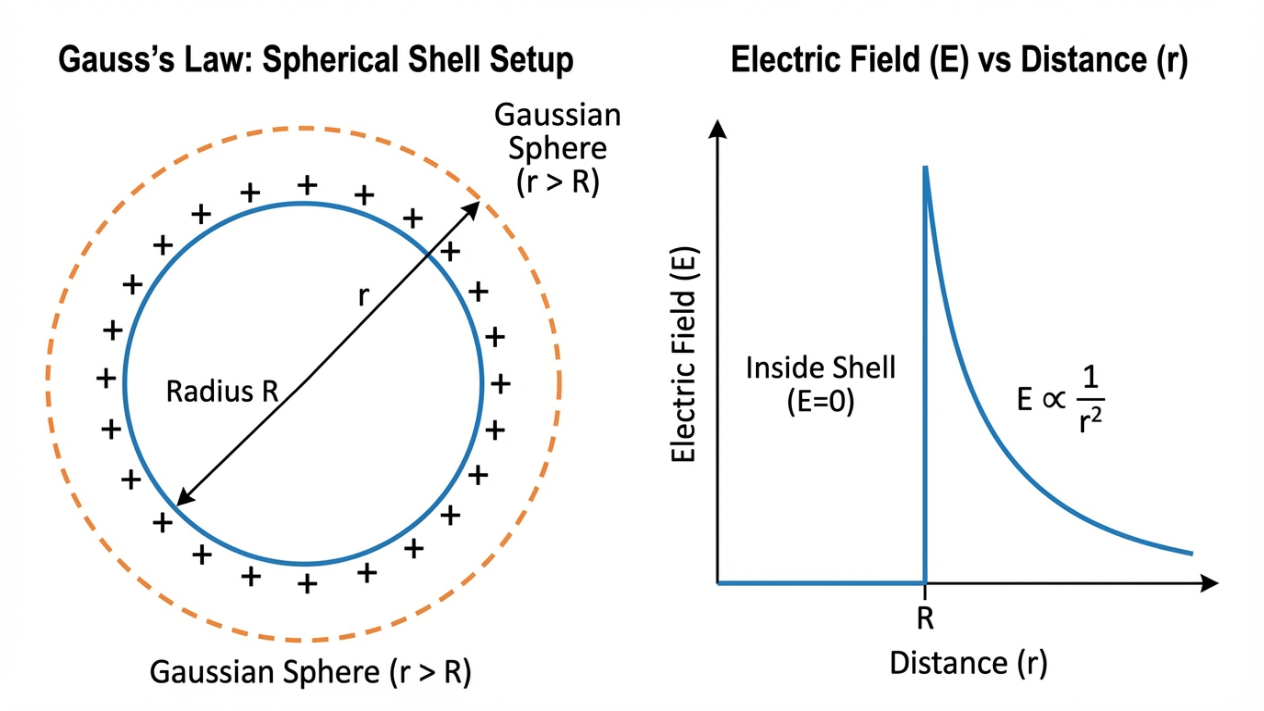
- Inside ($r < R$): $E = 0$ (electrostatic shielding!)