Probability in Class 12 carries significant weightage (typically 8 to 10 marks) in the Board Examination across multiple sections, including 1-mark objective questions, 2-mark and 3-mark analytical problems, and prominent 5-mark or Case-Study questions on Bayes' Theorem and Probability Distributions. Below is the comprehensive chapter framework required for complete mastery in board examinations.
1. Foundations & Axiomatic Set Operations
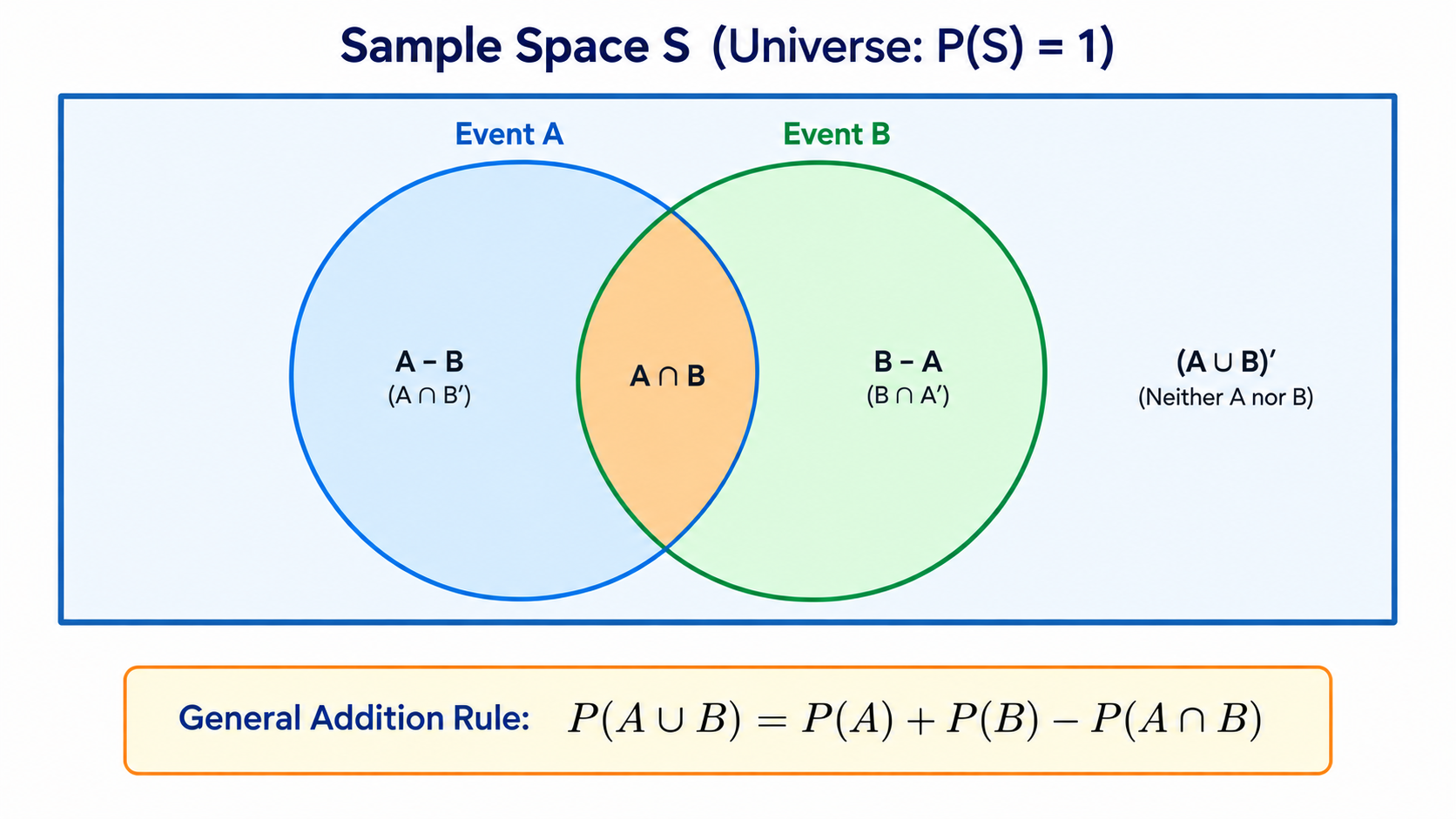
Fig. 1: Sample Space $S$, Set Operations ($A \cup B, A \cap B, A - B$), and Kolmogorov's Probability Axioms.
Essential Set-Theoretic Terminology
Sample Space ($S$): The set of all possible outcomes of a random experiment. For a fair die, $S = \{1, 2, 3, 4, 5, 6\}$, $n(S) = 6$.
Event ($E$): Any subset of sample space $S$ ($E \subseteq S$).
Complementary Event ($A'$ or $\bar{A}$): Event 'not $A$', containing all outcomes in $S$ that are not in $A$.
$$P(A') = 1 - P(A)$$
Union ($A \cup B$): Event 'at least one of $A$ or $B$ occurs' ($A$ or $B$).
Intersection ($A \cap B$): Event 'both $A$ and $B$ occur simultaneously' ($A$ and $B$).
Mutually Exclusive (Disjoint) Events: Events that cannot occur together:
$$A \cap B = \phi \implies P(A \cap B) = 0$$
Exhaustive Events: Events whose union constitutes the entire sample space:
$$E_1 \cup E_2 \cup \cdots \cup E_n = S \implies P(E_1 \cup E_2 \cup \cdots \cup E_n) = 1$$
Universal Probability Addition Rules
For any two events $A$ and $B$ in sample space $S$:
$$\boxed{P(A \cup B) = P(A) + P(B) - P(A \cap B)}$$
$$\boxed{P(A - B) = P(A \cap B') = P(A) - P(A \cap B)}$$
$$\boxed{P(B - A) = P(A' \cap B) = P(B) - P(A \cap B)}$$
De Morgan's Laws:
$$\boxed{P(A' \cap B') = P((A \cup B)') = 1 - P(A \cup B)}$$
$$\boxed{P(A' \cup B') = P((A \cap B)') = 1 - P(A \cap B)}$$
2. Conditional Probability
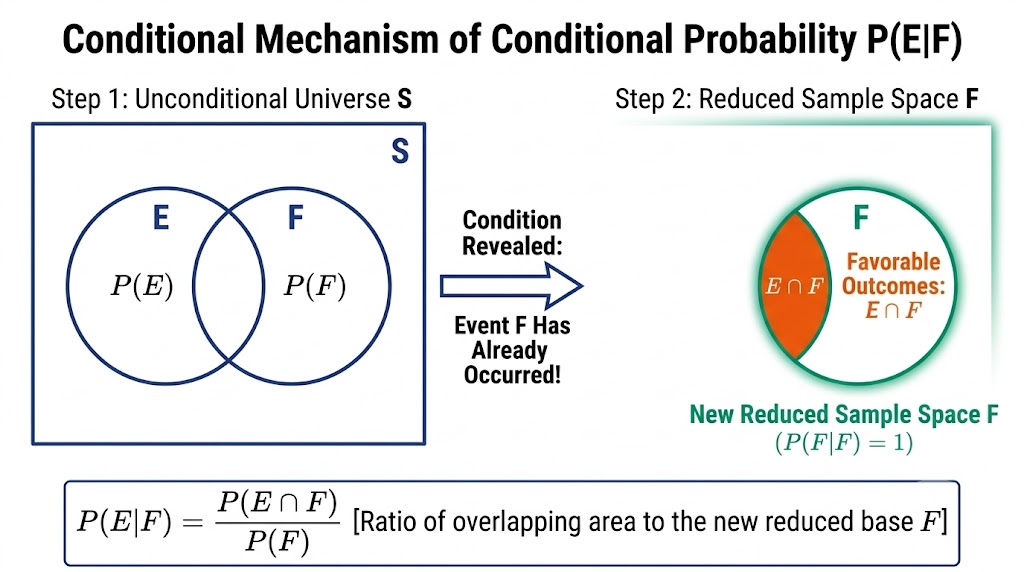
Fig. 2: The mechanism of conditional probability: condition $B$ collapses the sample space from $S$ to $B$, isolating favorable outcomes to $A \cap B$.
Conditional probability calculates the probability of an event $A$ given that another event $B$ has already occurred.
Mathematical Definition
Let $A$ and $B$ be two events associated with a random experiment. The conditional probability of event $A$ given event $B$ has already occurred is defined as:
$$\boxed{P(A|B) = \frac{P(A \cap B)}{P(B)}, \quad \text{provided } P(B) \neq 0}$$
Similarly, the conditional probability of $B$ given $A$ is:
$$\boxed{P(B|A) = \frac{P(A \cap B)}{P(A)}, \quad \text{provided } P(A) \neq 0}$$
Geometric Intuition: The occurrence of $B$ reduces the effective sample space from the universal set $S$ to the subset $B$. The only outcomes favorable to $A$ within this new universe are those in $A \cap B$.
Three Inviolable Properties of Conditional ProbabilityProperty 1 (Certainty of Condition):
$$P(S|B) = 1 \quad \text{and} \quad P(B|B) = 1$$
Proof: $P(S|B) = \frac{P(S \cap B)}{P(B)} = \frac{P(B)}{P(B)} = 1$.
Property 2 (Conditional Union Formula):
For any events $E$ and $F$ and conditioning event $B$:
$$P((E \cup F)|B) = P(E|B) + P(F|B) - P((E \cap F)|B)$$
If $E$ and $F$ are mutually exclusive: $P((E \cup F)|B) = P(E|B) + P(F|B)$.
Property 3 (Conditional Complement Rule):
$$P(E'|B) = 1 - P(E|B)$$
Proof: Since $S = E \cup E'$ and $E \cap E' = \phi$, $P(S|B) = P(E|B) + P(E'|B) \implies 1 = P(E|B) + P(E'|B)$.
🎯 Common Board Trap: Conditioning Order Matters!
Remember that $P(A|B) \ne P(B|A)$ in general. The denominator is ALWAYS the probability of the already occurred (given) event:
$$P(A|B) \text{ has } P(B) \text{ in denominator; } \quad P(B|A) \text{ has } P(A) \text{ in denominator.}$$
Board Question • 2 Marks
If $P(A) = \frac{7}{13}$, $P(B) = \frac{9}{13}$, and $P(A \cap B) = \frac{4}{13}$, evaluate:
(i) $P(A|B)$ (ii) $P(B|A)$ (iii) $P(A'|B)$ (iv) $P(A'|B')$
Final Answers: (i) 4/9 (ii) 4/7 (iii) 5/9 (iv) 1/4
Board Question • 2 Marks
A family has two children. What is the probability that both children are boys, given that at least one of them is a boy?
Step-by-Step Solution
Let $b$ represent boy and $g$ represent girl. The sample space is:
$$S = \{bb, bg, gb, gg\}, \quad n(S) = 4$$
Let $E$ = both children are boys $\implies E = \{bb\} \implies n(E) = 1$.
Let $F$ = at least one child is a boy $\implies F = \{bb, bg, gb\} \implies n(F) = 3$.
Notice $E \cap F = \{bb\} \implies n(E \cap F) = 1$.
The required conditional probability is:
$$P(E|F) = \frac{P(E \cap F)}{P(F)} = \frac{n(E \cap F)}{n(F)} = \mathbf{\frac{1}{3}}$$
Final Answer: 1/3 (Note: Not 1/2, because condition F collapses the sample space to 3 elements!)
3. Multiplication Theorem on Probability
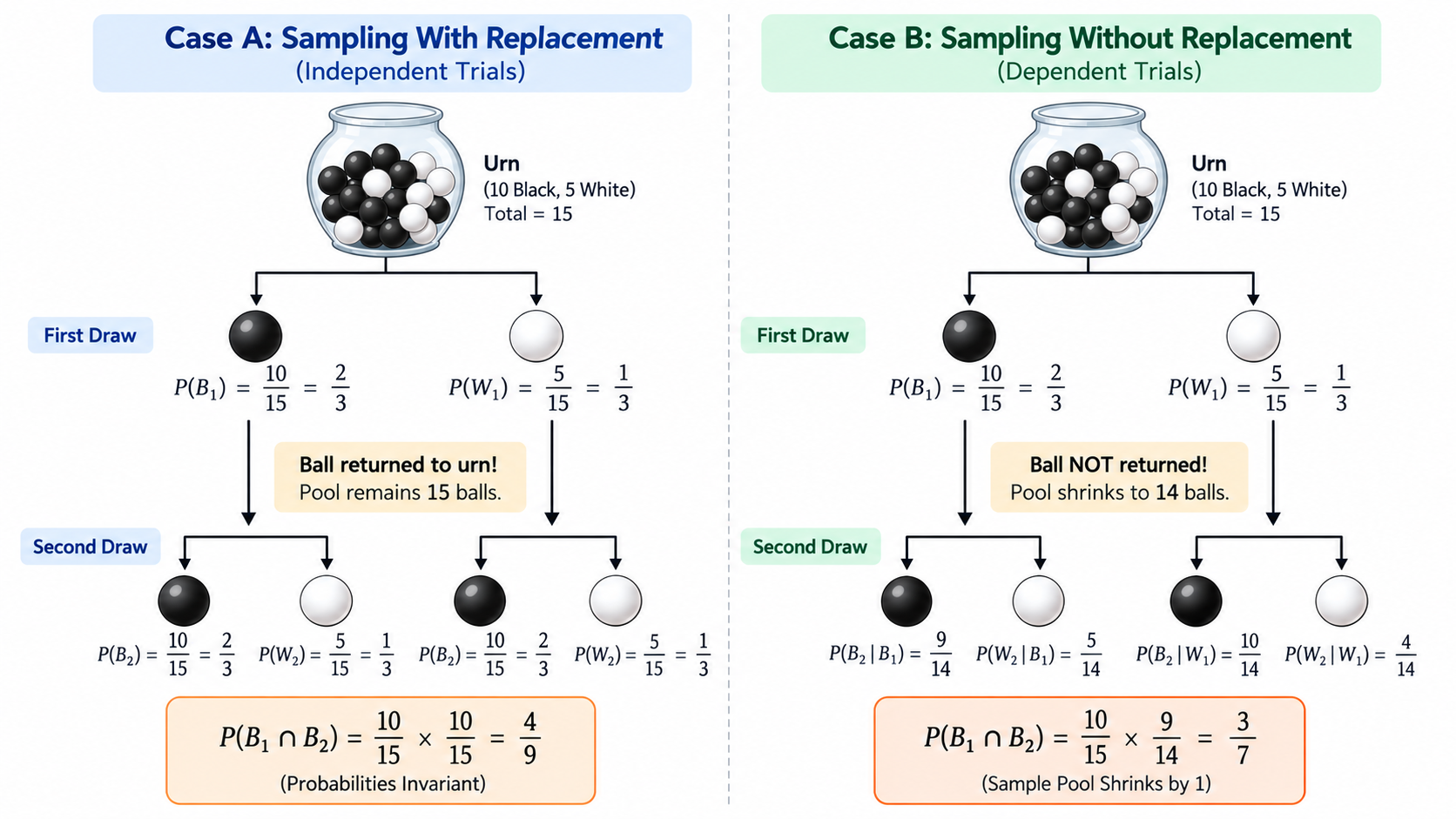
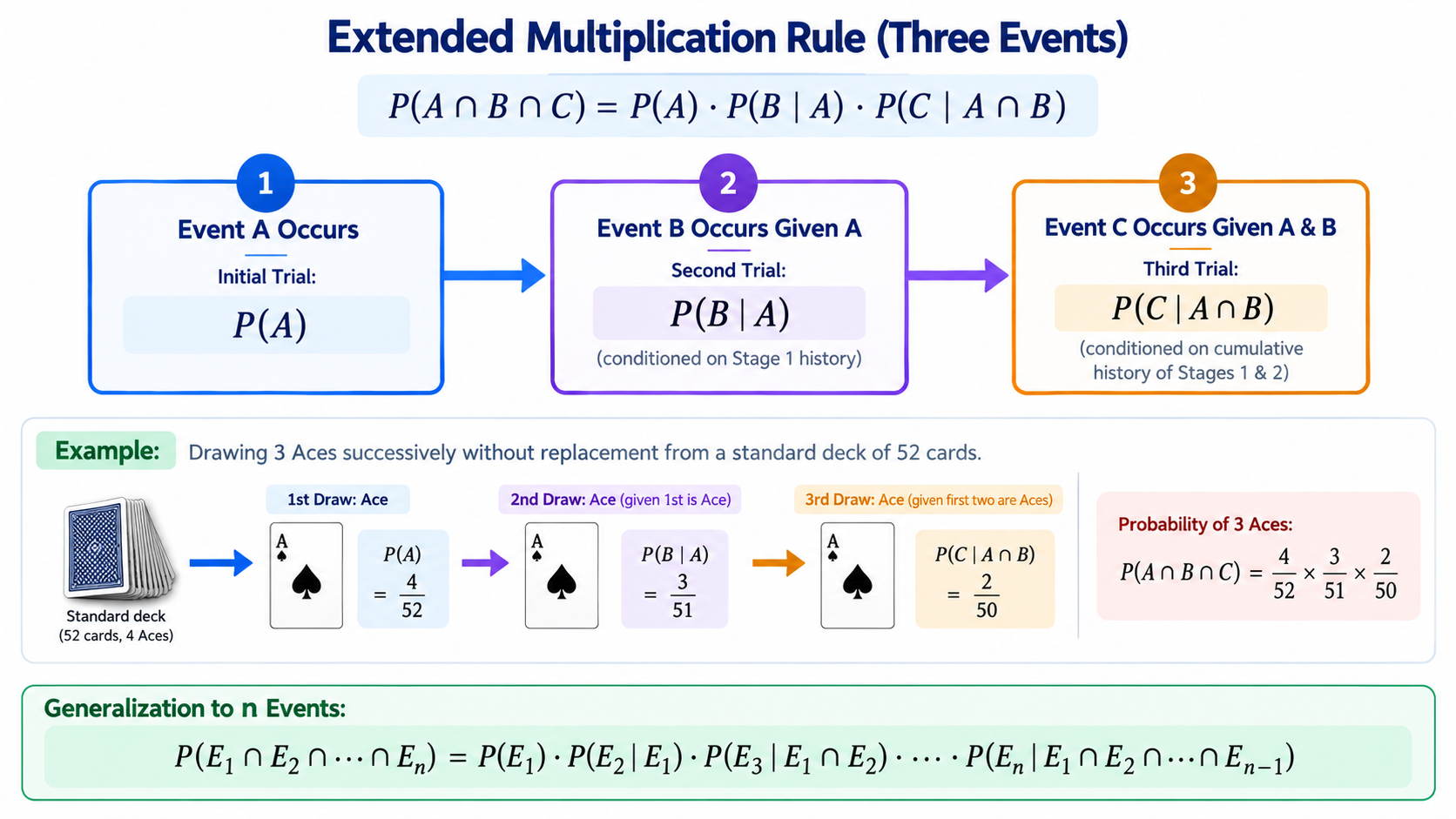
Fig. 3: Sequential probability tree demonstrating the difference between draws with replacement (constant probabilities) and without replacement (conditional dependencies).Fig. 4: 3-Stage sequential path representing the generalized multiplication theorem $P(A \cap B \cap C) = P(A) \cdot P(B|A) \cdot P(C|A \cap B)$.
Theorem Statement & Generalization
Rearranging the conditional probability formula gives the Multiplication Theorem:
$$\boxed{P(A \cap B) = P(A) \cdot P(B|A) = P(B) \cdot P(A|B)}$$
Extension to Three Events:
For any three events $A, B,$ and $C$:
$$\boxed{P(A \cap B \cap C) = P(A) \cdot P(B|A) \cdot P(C|A \cap B)}$$
where $P(A) > 0$ and $P(A \cap B) > 0$.
Board Question • 3 Marks
Three cards are drawn successively, without replacement, from a well-shuffled pack of 52 cards. What is the probability that the first two cards are kings and the third card is an ace?
Step-by-Step Solution
Let $K_1$ = first card drawn is a King.
Let $K_2$ = second card drawn is a King.
Let $A_3$ = third card drawn is an Ace.
We must find $P(K_1 \cap K_2 \cap A_3)$.
Step 1: Probability that the 1st card is a King:
$$P(K_1) = \frac{4}{52}$$
Step 2: Given 1 King is drawn, 51 cards remain with 3 Kings left:
$$P(K_2|K_1) = \frac{3}{51}$$
Step 3: Given 2 Kings are drawn, 50 cards remain with all 4 Aces intact:
$$P(A_3|K_1 \cap K_2) = \frac{4}{50}$$
Applying the Multiplication Theorem:
$$P(K_1 \cap K_2 \cap A_3) = \frac{4}{52} \times \frac{3}{51} \times \frac{4}{50}$$
$$= \frac{1}{13} \times \frac{1}{17} \times \frac{2}{25} = \mathbf{\frac{2}{5525}}$$
Final Answer: 2/5525
4. Independent Events
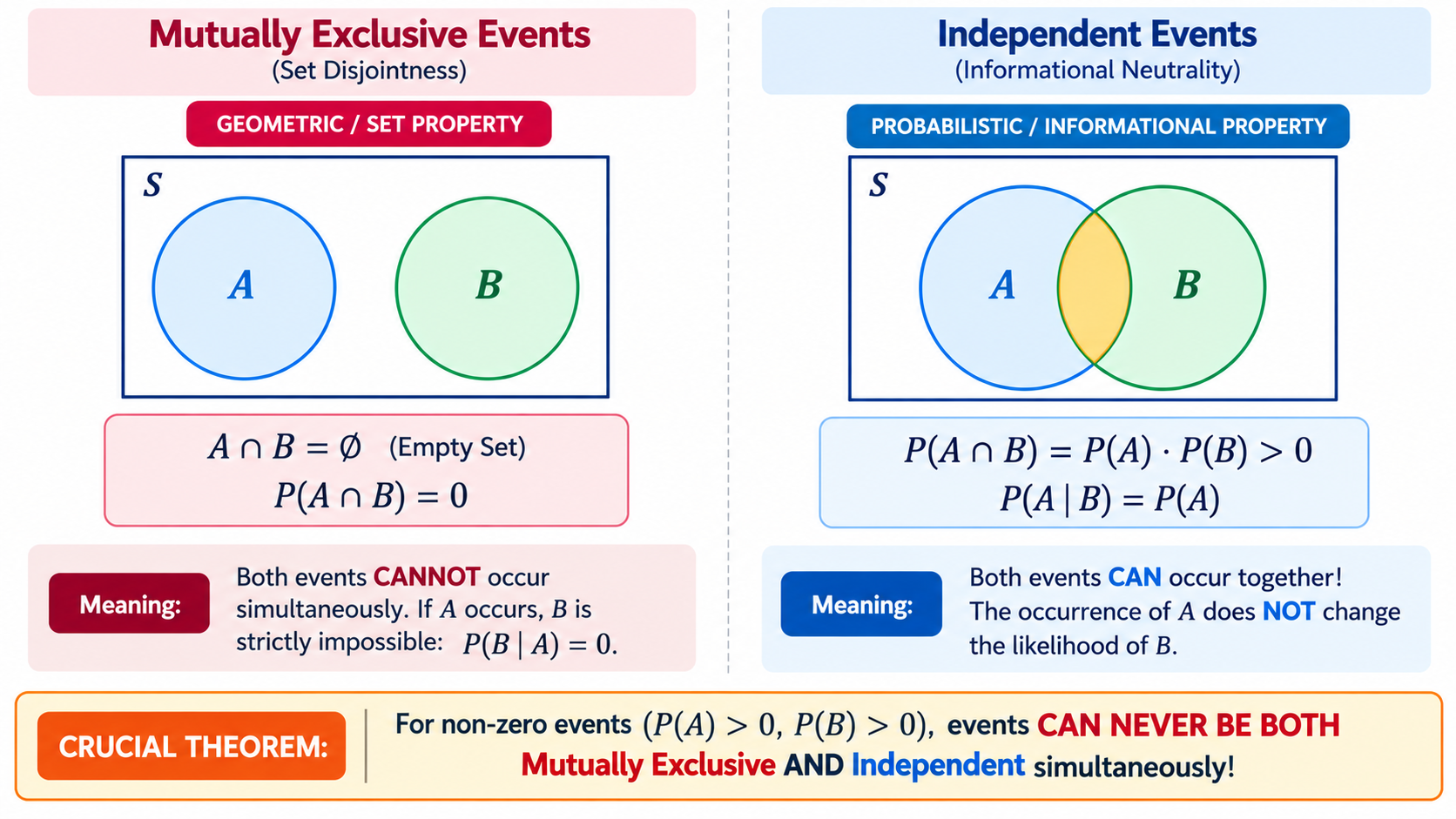
Fig. 5: Mutually exclusive events cannot occur simultaneously ($A \cap B = \phi$), whereas independent events can and do overlap such that $P(A \cap B) = P(A) \cdot P(B)$.
Two events are independent if the occurrence of one does not alter the probability of occurrence of the other.
Universal Test for Independence
Two events $A$ and $B$ are defined to be independent if:
$$P(A|B) = P(A) \quad \text{and} \quad P(B|A) = P(B)$$
Substituting into the multiplication theorem gives the standard test:
$$\boxed{A \text{ and } B \text{ are independent} \iff P(A \cap B) = P(A) \cdot P(B)}$$
If $P(A \cap B) \neq P(A) \cdot P(B)$, the events are strictly dependent.
Crucial Board Theorem: Two events with non-zero probabilities ($P(A) > 0, P(B) > 0$) CAN NEVER BE BOTH MUTUALLY EXCLUSIVE AND INDEPENDENT. Proof: If mutually exclusive, $P(A \cap B) = 0$. If independent, $P(A \cap B) = P(A)P(B) > 0$. Since $0 \ne P(A)P(B)$, they can never hold simultaneously.
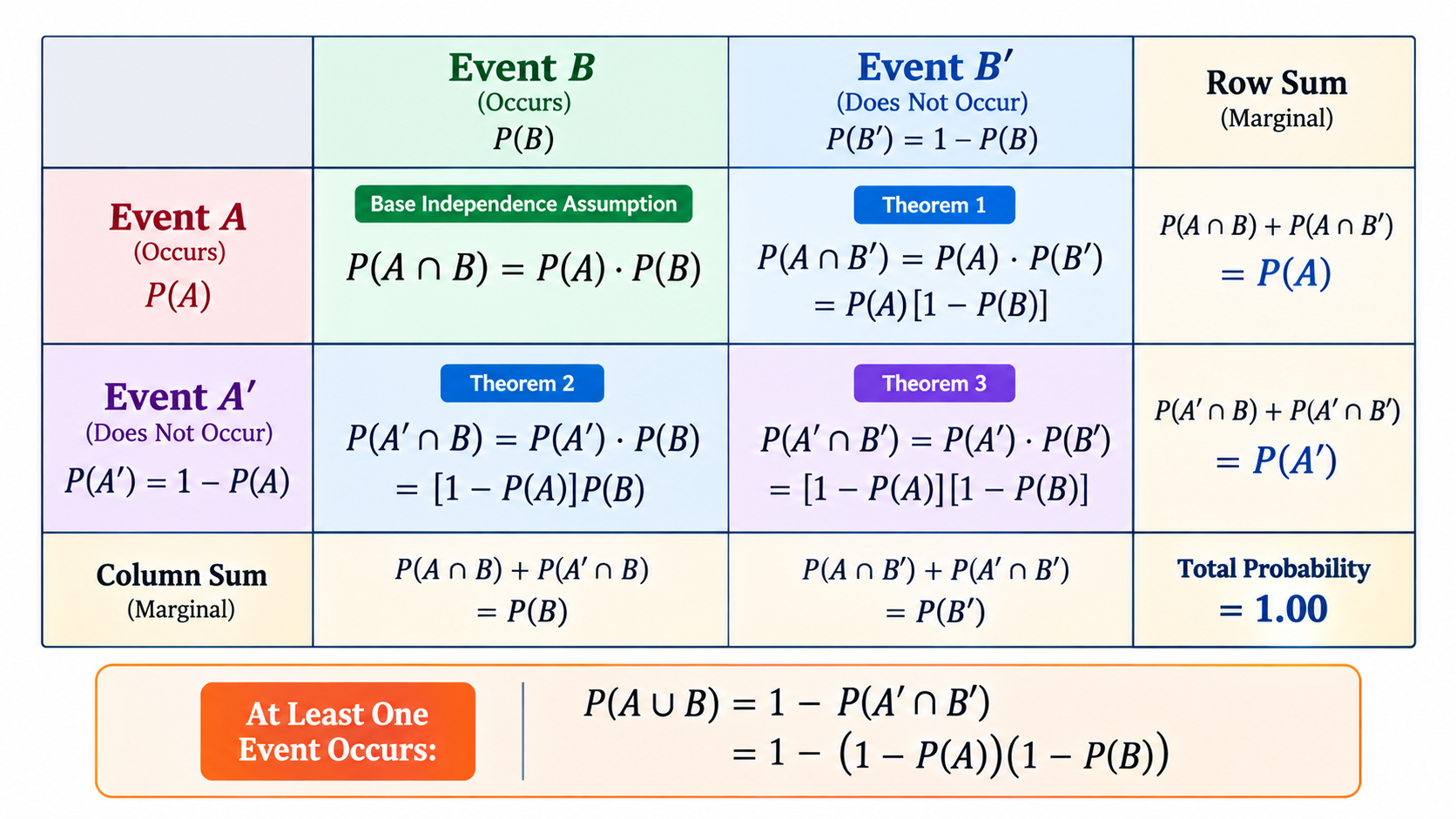
Fig. 6: Four-quadrant independence contingency matrix demonstrating that independence of $A$ and $B$ guarantees the mutual independence of their complements.
Four Core Board Independence TheoremsTheorem 1: If $A$ and $B$ are independent, then $A$ and $B'$ are independent. Proof: Note that $A = (A \cap B) \cup (A \cap B')$, where $(A \cap B)$ and $(A \cap B')$ are disjoint.
$\implies P(A) = P(A \cap B) + P(A \cap B') \implies P(A \cap B') = P(A) - P(A \cap B)$.
Using independence: $P(A \cap B') = P(A) - P(A)P(B) = P(A)[1 - P(B)] = \mathbf{P(A)P(B')}$. (Hence proved)
Theorem 2: If $A$ and $B$ are independent, then $A'$ and $B$ are independent. Proof: Identical by symmetry: $P(A' \cap B) = P(B) - P(A \cap B) = P(B)[1 - P(A)] = \mathbf{P(A')P(B)}$.
Theorem 3: If $A$ and $B$ are independent, then $A'$ and $B'$ are independent. Proof: Using De Morgan's Law:
$$P(A' \cap B') = 1 - P(A \cup B) = 1 - [P(A) + P(B) - P(A)P(B)]$$
$$= 1 - P(A) - P(B)[1 - P(A)] = [1 - P(A)][1 - P(B)] = \mathbf{P(A')P(B')}. \quad \text{(Hence proved)}$$ Theorem 4 (At Least One Event Occurs): If $A$ and $B$ are independent events, then:
$$\boxed{P(\text{At least one of } A \text{ or } B) = P(A \cup B) = 1 - P(A')P(B')}$$
For $n$ independent events $A_1, A_2, \ldots, A_n$:
$$\boxed{P(\text{At least one occurs}) = 1 - P(A_1')P(A_2') \cdots P(A_n')}$$
Board Question • 3 Marks (Classic Board Problem)
A problem in mathematics is given to three students $A, B,$ and $C$ whose chances of solving it independently are $\frac{1}{2}, \frac{1}{3},$ and $\frac{1}{4}$ respectively. Find the probability that:
(i) the problem is solved.
(ii) exactly one of them solves the problem.
Step-by-Step Solution
Given: $P(A) = \frac{1}{2}, P(B) = \frac{1}{3}, P(C) = \frac{1}{4}$.
Their failure probabilities are:
$$P(A') = 1 - \frac{1}{2} = \frac{1}{2}, \quad P(B') = 1 - \frac{1}{3} = \frac{2}{3}, \quad P(C') = 1 - \frac{1}{4} = \frac{3}{4}$$
Part (i): Problem is solved.
The problem is solved if at least one student solves it:
$$P(\text{Problem solved}) = 1 - P(\text{None of them solves it}) = 1 - P(A' \cap B' \cap C')$$
Since the students solve independently, their complements are also independent:
$$P(A' \cap B' \cap C') = P(A') \cdot P(B') \cdot P(C') = \frac{1}{2} \times \frac{2}{3} \times \frac{3}{4} = \frac{1}{4}$$
$$P(\text{Problem solved}) = 1 - \frac{1}{4} = \mathbf{\frac{3}{4}}$$
Part (ii): Exactly one of them solves it.
This can happen in three mutually exclusive ways:
$$E = (A \cap B' \cap C') \cup (A' \cap B \cap C') \cup (A' \cap B' \cap C)$$
$$P(E) = P(A)P(B')P(C') + P(A')P(B)P(C') + P(A')P(B')P(C)$$
$$P(E) = \left(\frac{1}{2} \times \frac{2}{3} \times \frac{3}{4}\right) + \left(\frac{1}{2} \times \frac{1}{3} \times \frac{3}{4}\right) + \left(\frac{1}{2} \times \frac{2}{3} \times \frac{1}{4}\right)$$
$$P(E) = \frac{6}{24} + \frac{3}{24} + \frac{2}{24} = \mathbf{\frac{11}{24}}$$
Final Answers: (i) 3/4 (ii) 11/24
5. Partition of Sample Space & Theorem of Total Probability
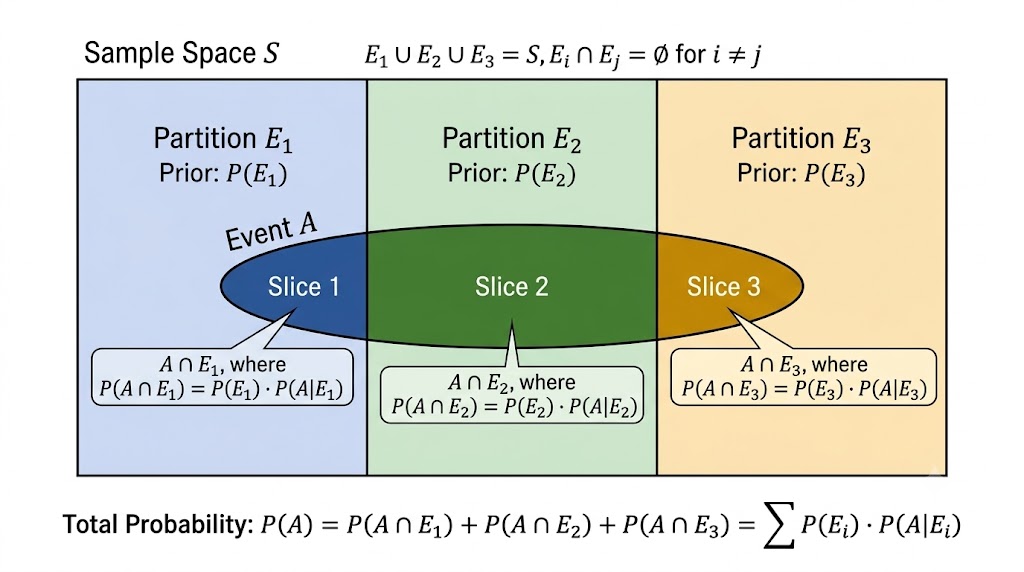
Fig. 7: Partition of sample space into mutually exclusive, exhaustive sets $E_1, E_2, E_3$ slicing event $A$ to establish the Law of Total Probability.
Definition: Partition of a Sample Space
A set of events $\{E_1, E_2, \ldots, E_n\}$ is said to form a partition of sample space $S$ if:
Pairwise Disjoint (Mutually Exclusive): $E_i \cap E_j = \phi$ for all $i \neq j$.
Non-Zero Probability: $P(E_i) > 0$ for each $i = 1, 2, \ldots, n$.
The Law / Theorem of Total Probability
Let $\{E_1, E_2, \ldots, E_n\}$ be a partition of the sample space $S$, and let $A$ be any event associated with $S$. Then:
$$\boxed{P(A) = \sum_{j=1}^n P(E_j) \cdot P(A|E_j)}$$
$$= P(E_1)P(A|E_1) + P(E_2)P(A|E_2) + \cdots + P(E_n)P(A|E_n)$$
Board Proof:
Since $\{E_1, \ldots, E_n\}$ partitions $S$, $S = E_1 \cup E_2 \cup \cdots \cup E_n$.
Intersecting with event $A$:
$$A = A \cap S = A \cap (E_1 \cup E_2 \cup \cdots \cup E_n)$$
$$= (A \cap E_1) \cup (A \cap E_2) \cup \cdots \cup (A \cap E_n)$$
Since $E_i$ are pairwise disjoint, $(A \cap E_i)$ are also mutually disjoint:
$$P(A) = \sum_{j=1}^n P(A \cap E_j) = \sum_{j=1}^n P(E_j) \cdot P(A|E_j) \quad \text{(Hence proved)}$$
6. Bayes' Theorem (Core 5-Mark Board Topic)
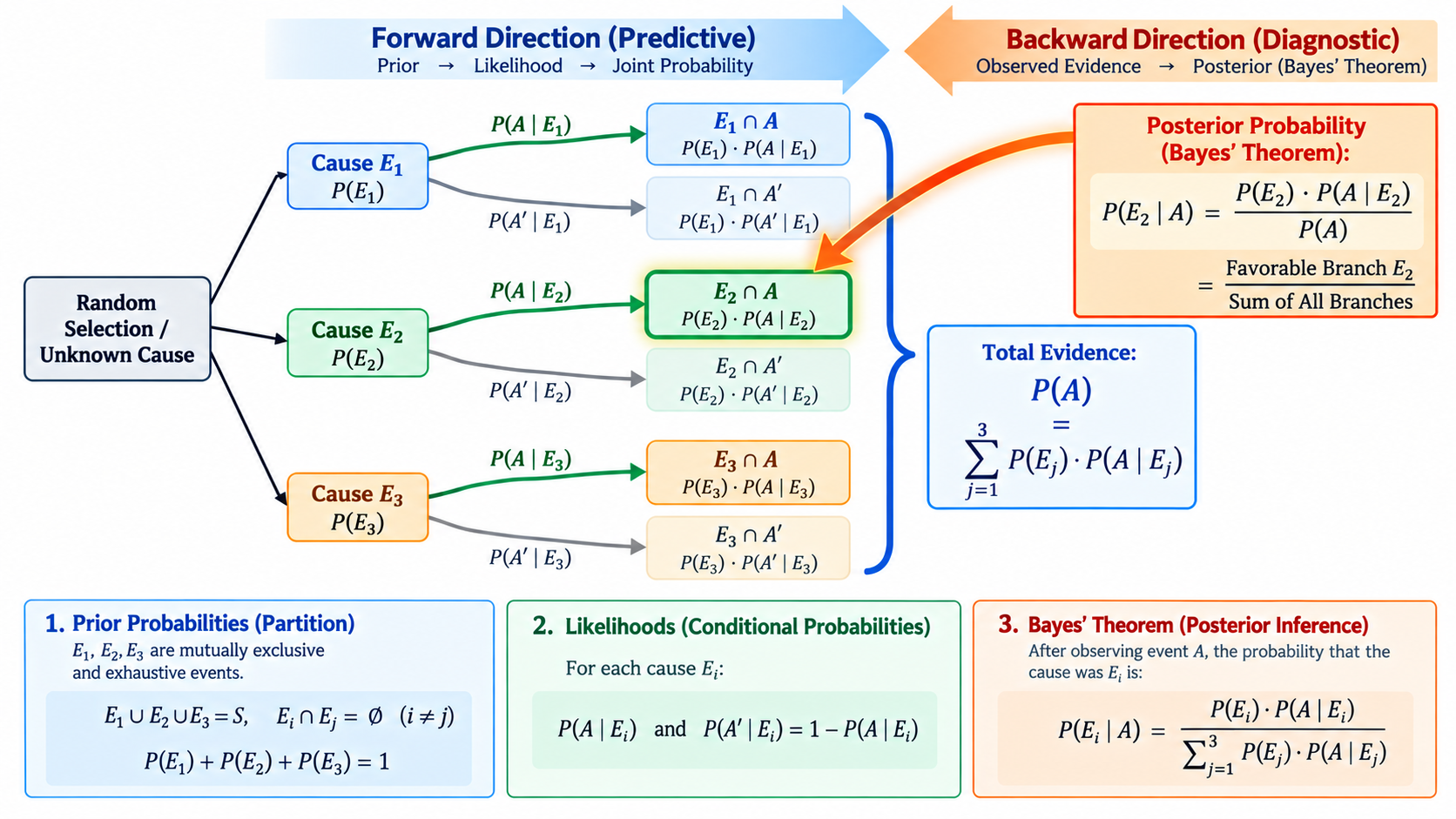
Fig. 8: Bayes' Theorem probability tree contrasting forward predictive likelihood branches with the inverse diagnostic posterior computation.
While the Law of Total Probability computes the forward probability of an observed event $A$, Bayes' Theorem solves the inverse probability problem: given that event $A$ has occurred, what is the probability that it arose from a specific cause $E_i$?
Bayes' Theorem Formula
If $E_1, E_2, \ldots, E_n$ form a partition of the sample space $S$, and $A$ is any non-zero event associated with $S$, then for any cause $E_i$:
$$\boxed{P(E_i|A) = \frac{P(E_i) \cdot P(A|E_i)}{\displaystyle\sum_{j=1}^n P(E_j) \cdot P(A|E_j)}}$$
Terminology:
$P(E_i)$: Prior Probability of hypothesis $E_i$ (before evidence is observed).
$P(A|E_i)$: Likelihood of observing evidence $A$ given cause $E_i$.
$P(E_i|A)$: Posterior Probability of cause $E_i$ after evidence $A$ is observed.
Denominator $\sum P(E_j)P(A|E_j) = P(A)$: Total Probability of evidence $A$.
The 4-Step Board Exam Blueprint (Guaranteed 5/5 Marks)
To secure full step-marks in CBSE Board evaluations, strictly follow this structure:
Step 1 (Define Partitions): State events $E_1, E_2, \ldots$ clearly in words. State prior probabilities $P(E_1), P(E_2), \ldots$ and verify that $\sum P(E_i) = 1$. (1 Mark)
Step 2 (Define Observed Event A): Write down event $A$ in words (e.g. "drawn item is defective", "reported number is 6"). (1/2 Mark)
Step 3 (Write Conditional Likelihoods): State each $P(A|E_i)$ with logical reason. (1 Mark)
Step 4 (State Formula & Compute): Write out the complete Bayes' formula symbolically first (mandatory for 1 mark in CBSE scheme), substitute numbers, and evaluate to the final reduced fraction. (2.5 Marks)
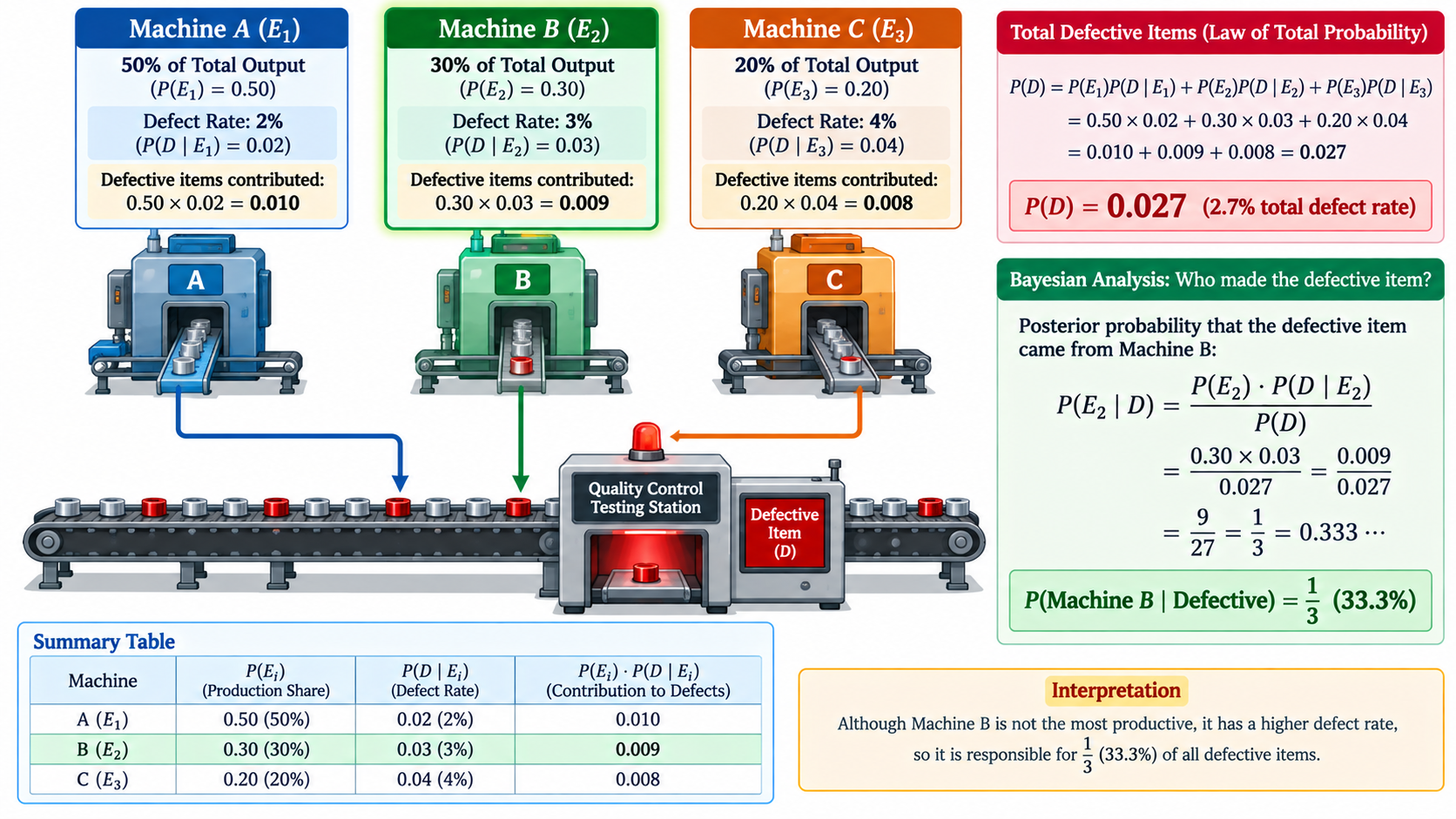
Bayes Archetype 1 • 5 Marks (Factory Defect Rate)
An industrial manufacturing plant has three machines $A, B,$ and $C$. Machine $A$ produces $50\%$ of the total items, Machine $B$ produces $30\%$, and Machine $C$ produces $20\%$. The percentages of defective items produced by these machines are $2\%, 3\%,$ and $4\%$ respectively.
An item is selected at random from the total output and is found to be defective. What is the probability that it was manufactured by Machine $B$?
Fig. 9: Bayes Factory 3-machine production pipeline and quality diagnostic workflow calculating the posterior probability of Machine $B$ given a defective item.
Step-by-Step Board Solution Step 1: Define the partition events:
Let $E_1$ = item is manufactured by Machine $A \implies P(E_1) = \frac{50}{100} = 0.50$
Let $E_2$ = item is manufactured by Machine $B \implies P(E_2) = \frac{30}{100} = 0.30$
Let $E_3$ = item is manufactured by Machine $C \implies P(E_3) = \frac{20}{100} = 0.20$ Check: $0.50 + 0.30 + 0.20 = 1.00$ (Exhaustive & Disjoint).
Step 2: Define the observed event:
Let $D$ = randomly chosen item is defective.
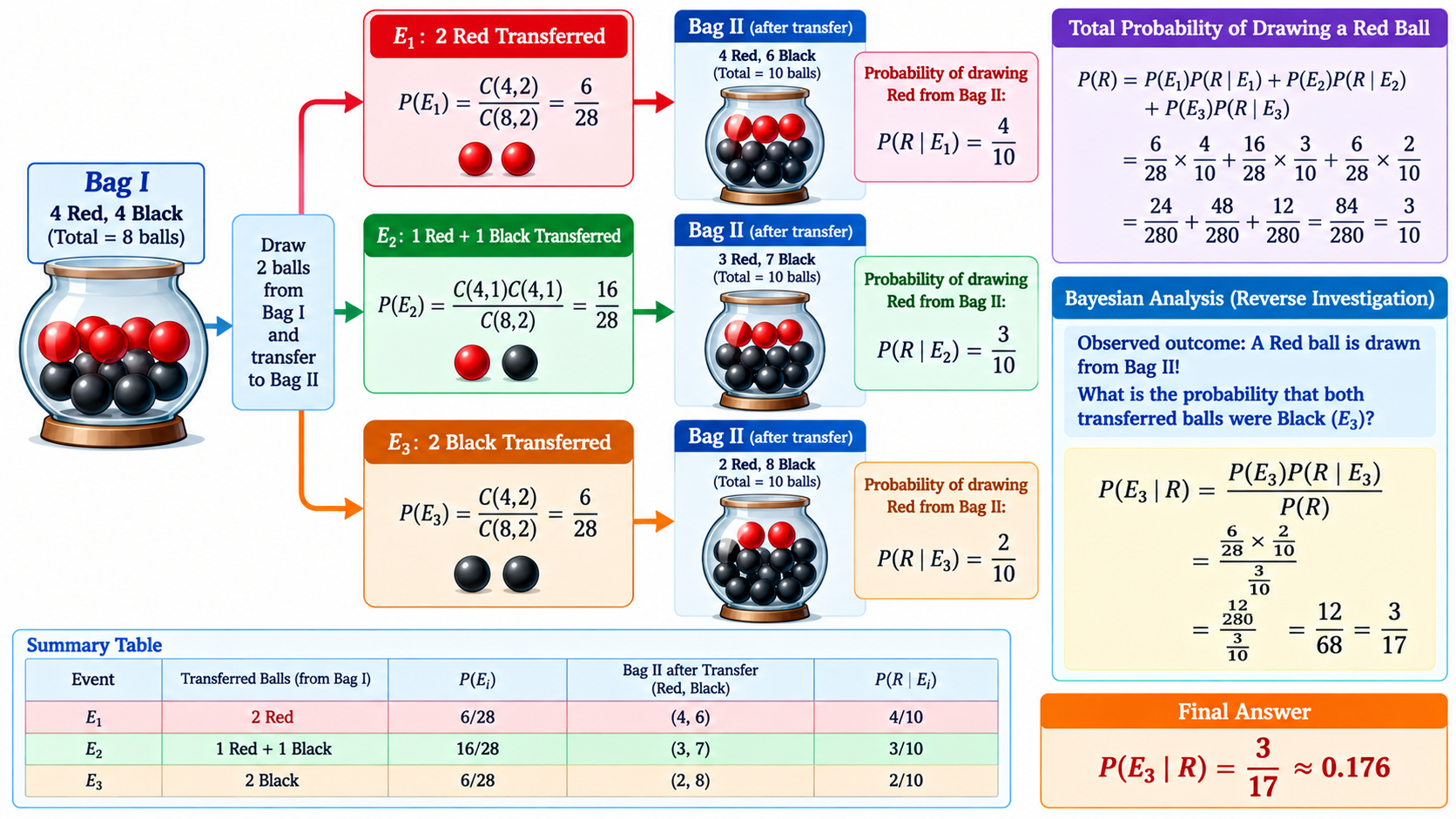
Bayes Archetype 2 • 5 Marks (Ball Transfer Between Urns)
Bag I contains 4 red and 4 black balls, while Bag II contains 2 red and 6 black balls. Two balls are drawn at random from Bag I and transferred to Bag II. A ball is then drawn at random from Bag II and is found to be red in colour.
Find the probability that the two transferred balls were both black.
Fig. 10: Two-urn ball transfer mechanism breaking down prior draw combinations and posterior probability computation for Bag II.
Step-by-Step Board Solution Step 1: Total ways to draw 2 balls from Bag I (8 balls: 4R, 4B) $= \binom{8}{2} = \frac{8 \times 7}{2} = 28$.
Define the partition events for the transferred balls:
• $E_1$ = 2 Red transferred $\implies P(E_1) = \frac{\binom{4}{2}}{\binom{8}{2}} = \frac{6}{28}$
• $E_2$ = 1 Red and 1 Black transferred $\implies P(E_2) = \frac{\binom{4}{1}\binom{4}{1}}{\binom{8}{2}} = \frac{16}{28}$
• $E_3$ = 2 Black transferred $\implies P(E_3) = \frac{\binom{4}{2}}{\binom{8}{2}} = \frac{6}{28}$ Check: $\frac{6}{28} + \frac{16}{28} + \frac{6}{28} = \frac{28}{28} = 1$.
Step 2: Define observed event $A$ = A ball drawn from Bag II is RED.
After transfer, Bag II contains $8 + 2 = 10$ balls.
Step 3: Conditional likelihoods from Bag II:
• Under $E_1$: $(2+2)=4$ Red out of 10 $\implies P(A|E_1) = \frac{4}{10}$
• Under $E_2$: $(2+1)=3$ Red out of 10 $\implies P(A|E_2) = \frac{3}{10}$
• Under $E_3$: $(2+0)=2$ Red out of 10 $\implies P(A|E_3) = \frac{2}{10}$
Bayes Archetype 3 • 5 Marks (Speaking Truth vs Lie)
A man is known to speak the truth 3 out of 4 times. He throws a standard 6-sided die and reports that it is a six. Find the probability that it is actually a six.
Step-by-Step Board Solution Step 1: Define the partition of actual die outcomes:
Let $E_1$ = Die actually shows a six $\implies P(E_1) = \frac{1}{6}$
Let $E_2$ = Die shows a number other than six $\implies P(E_2) = 1 - \frac{1}{6} = \frac{5}{6}$
Step 2: Define observed event:
Let $A$ = Man reports that a six has turned up.
Step 3: Conditional likelihoods:
• $P(A|E_1)$: Probability he reports six when it IS six = Probability he tells truth $= \frac{3}{4}$.
• $P(A|E_2)$: Probability he reports six when it IS NOT six = Probability he lies $= 1 - \frac{3}{4} = \frac{1}{4}$.
Bayes Archetype 4 • 5 Marks (The Lost Card Problem)
A card from a pack of 52 cards is lost. From the remaining cards of the pack, two cards are drawn and are found to be both diamonds. Find the probability of the lost card being a diamond.
Step-by-Step Board Solution Step 1: Define partitions for the lost card:
Let $E_1$ = Lost card is a diamond $\implies P(E_1) = \frac{13}{52} = \frac{1}{4}$
Let $E_2$ = Lost card is not a diamond $\implies P(E_2) = \frac{39}{52} = \frac{3}{4}$
Step 2: Define observed event $A$ = Two cards drawn from the remaining 51 cards are both diamonds.
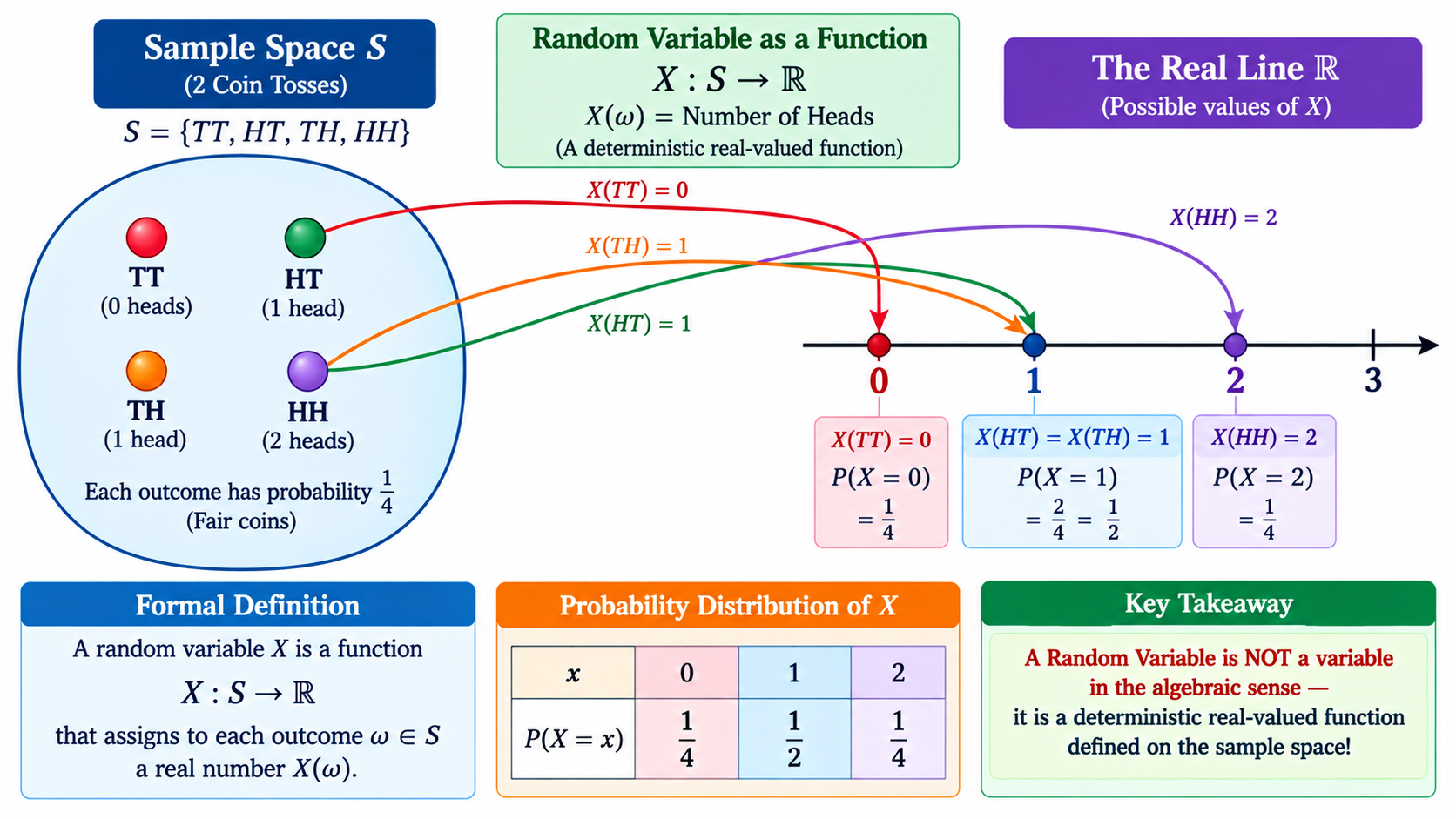
Fig. 11: Mathematical definition of a random variable as a deterministic function mapping sample space outcomes to the real number line ($X: S \to \mathbb{R}$).
Definition of Random Variable
A Random Variable $X$ is a real-valued function whose domain is the sample space $S$ of a random experiment:
$$X: S \to \mathbb{R}$$
In Class 12, we work with discrete random variables, which assume finite or countably isolated integer values.
Probability Distribution of a Discrete Random Variable
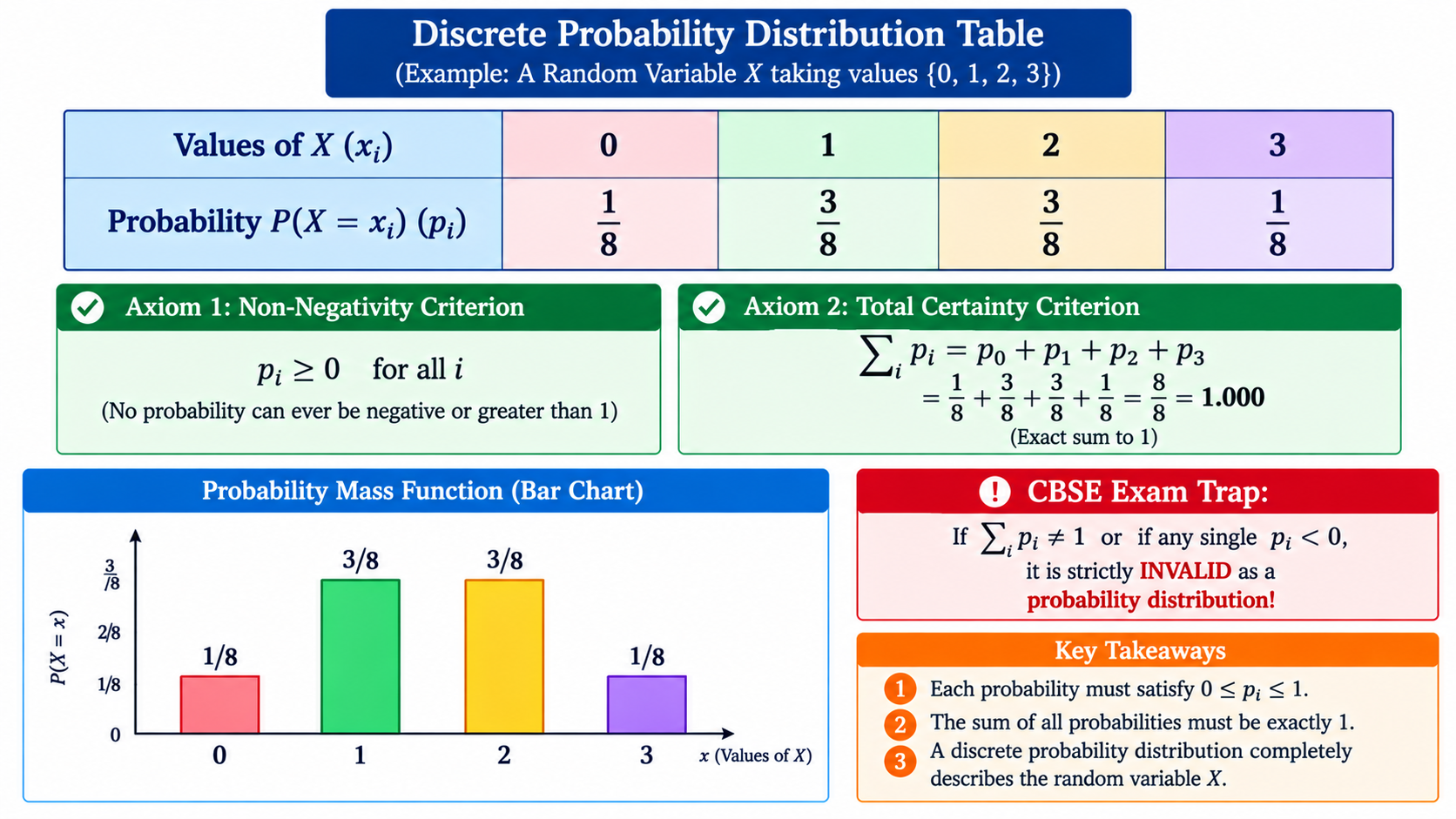
Fig. 12: Structural blueprint and axiomatic verification criteria ($p_i \ge 0$, $\sum p_i = 1$) for a discrete probability distribution.
If a discrete random variable $X$ assumes values $x_1, x_2, \ldots, x_n$ with corresponding probabilities $p_1, p_2, \ldots, p_n$ such that $P(X = x_i) = p_i$, the distribution is expressed in table form:
Values of $X$ ($x_i$)
$x_1$
$x_2$
$x_3$
$\cdots$
$x_n$
$P(X = x_i)$ ($p_i$)
$p_1$
$p_2$
$p_3$
$\cdots$
$p_n$
Two Inviolable Axiomatic Validation Conditions
For any table to be a valid probability distribution:
$$\boxed{1. \quad p_i \ge 0 \quad \text{for all } i = 1, 2, \ldots, n}$$
$$\boxed{2. \quad \sum_{i=1}^n p_i = p_1 + p_2 + \cdots + p_n = 1}$$
If any probability is negative, or if the sum $\sum p_i \neq 1$, it is NOT a valid probability distribution.
Board Question • 3 Marks (Finding Constant k)
A random variable $X$ has the following probability distribution:
$X$
0
1
2
3
4
5
6
7
$P(X)$
0
$k$
$2k$
$2k$
$3k$
$k^2$
$2k^2$
$7k^2 + k$
Find: (i) $k$ (ii) $P(X < 3)$ (iii) $P(X \ge 6)$ (iv) $P(0 < X < 5)$
Step-by-Step Solution (i) Finding $k$:
Since $\sum P(X) = 1$:
$$0 + k + 2k + 2k + 3k + k^2 + 2k^2 + (7k^2 + k) = 1$$
$$10k^2 + 9k = 1 \implies 10k^2 + 9k - 1 = 0$$
Factorizing the quadratic:
$$10k^2 + 10k - k - 1 = 0 \implies 10k(k + 1) - 1(k + 1) = 0$$
$$\implies (10k - 1)(k + 1) = 0$$
$\implies k = \frac{1}{10}$ or $k = -1$.
Since $p_i \ge 0$, probability cannot be negative, so $k \neq -1$.
$$\mathbf{k = \frac{1}{10} = 0.1}$$
Final Answers: (i) $k = \frac{1}{10}$ (ii) $\frac{3}{10}$ (iii) $\frac{19}{100}$ (iv) $\frac{4}{5}$
Board Question • 4 Marks (Constructing Distribution)
Two cards are drawn simultaneously (or successively without replacement) from a well-shuffled pack of 52 cards. Find the probability distribution of the number of aces.
Step-by-Step Solution
Let $X$ denote the number of aces drawn in 2 cards.
Possible values of $X$ are $0, 1, 2$.
Total cards = 52. Number of aces = 4. Number of non-aces = $52 - 4 = 48$.
Total ways to draw 2 cards from 52 $= \binom{52}{2} = \frac{52 \times 51}{2} = 1326$.
Case 1: $X = 0$ (No aces drawn, both non-aces):
$$P(X = 0) = \frac{\binom{4}{0}\binom{48}{2}}{\binom{52}{2}} = \frac{1 \times \frac{48 \times 47}{2}}{1326} = \frac{1128}{1326} = \mathbf{\frac{188}{221}}$$
Case 2: $X = 1$ (Exactly one ace and one non-ace):
$$P(X = 1) = \frac{\binom{4}{1}\binom{48}{1}}{\binom{52}{2}} = \frac{4 \times 48}{1326} = \frac{192}{1326} = \mathbf{\frac{32}{221}}$$
Case 3: $X = 2$ (Both cards are aces):
$$P(X = 2) = \frac{\binom{4}{2}\binom{48}{0}}{\binom{52}{2}} = \frac{6 \times 1}{1326} = \frac{6}{1326} = \mathbf{\frac{1}{221}}$$
Verification Check:
$$\sum P(X) = \frac{188}{221} + \frac{32}{221} + \frac{1}{221} = \frac{221}{221} = 1 \quad \checkmark$$
Probability Distribution Table:
$X$ (Number of Aces)
0
1
2
$P(X)$
$\frac{188}{221}$
$\frac{32}{221}$
$\frac{1}{221}$
Verification: Total sum = 188/221 + 32/221 + 1/221 = 1. Valid distribution!
Forgetting to verify $\sum P(E_i) = 1$ in Bayes' problems: Ensure your partitions are exhaustive and disjoint.
Writing only the numerical answer in Bayes' Theorem: CBSE marking guidelines assign 1 mark for stating the formula symbolically before substituting values. Always write the symbolic formula first!
Confusing Independent with Mutually Exclusive: Independent means $P(A \cap B) = P(A)P(B)$, NOT $P(A \cap B) = 0$.
Rejecting $k$ values incorrectly: In probability distribution quadratic equations, always reject negative $k$ values because probabilities $p_i \ge 0$ must hold.

 VARDAAN COMET