🎯 Strictly Included in CBSE Class 12 Board Exam (100% Tested):
✓ Conditional Probability & Properties✓ Multiplication Rule on Probability✓ Independent Events (Pairwise & Mutual)✓ Law of Total Probability✓ Bayes' Theorem (5-Mark Crown Jewel)✓ Random Variables & Probability Distributions
✂️ Deleted from CBSE Board Exams (Included in Section 8 for JEE / CUET / NDA):
✗ Mean of Random Variable (E(X))✗ Variance & Standard Deviation (Var(X))✗ Bernoulli Trials & Binomial Distribution
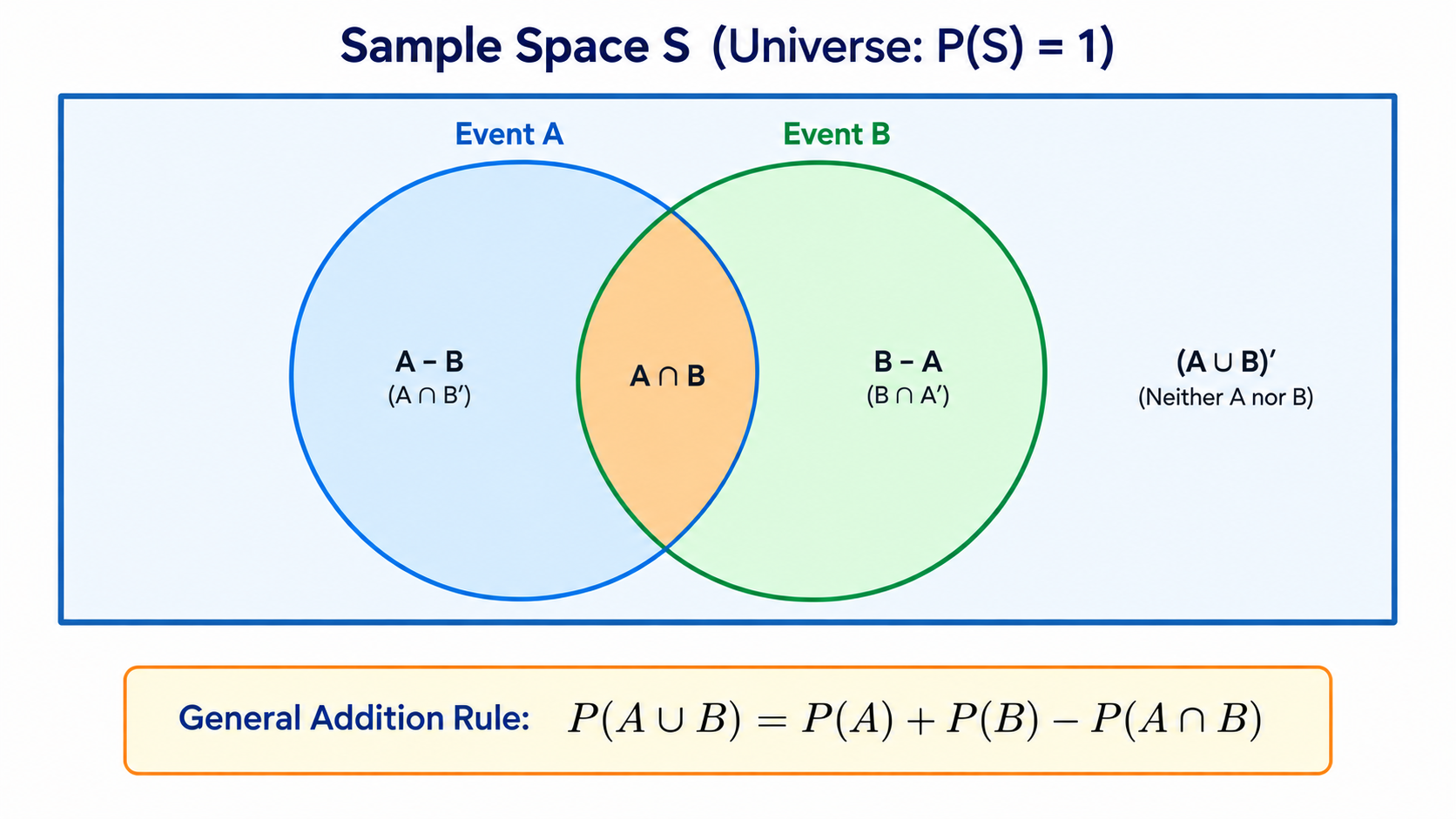
Fig. 1: Foundations of Probability. Set operations on the sample space universe $S$, showing $A \cap B$, differences, complement, and the General Addition Rule.
In Class 11, probability was defined as the numerical measurement of uncertainty associated with random experiments. Before diving into the advanced conditional mechanisms of Class 12, let us review the essential set-theoretic language and foundational laws.
Foundational Definitions
Random Experiment: An experiment whose outcomes cannot be predicted with certainty in advance, but all possible outcomes are known beforehand.
Sample Space ($S$): The exhaustive set of all possible fundamental outcomes of a random experiment. For a coin tossed twice, $S = \{HH, HT, TH, TT\}$, $n(S) = 4$.
Event ($E$): Any subset of the sample space ($E \subseteq S$). An event occurs if the actual outcome belongs to $E$.
Equally Likely Outcomes: Outcomes that have identical theoretical chances of occurring. For equally likely outcomes, the classical probability is given by:
$$P(E) = \frac{n(E)}{n(S)} = \frac{\text{Number of outcomes favorable to } E}{\text{Total number of possible outcomes in } S}$$
Axioms & Addition Theorems1. Fundamental Probability Bounds: For any event $E \subseteq S$,
$$0 \le P(E) \le 1, \quad P(\phi) = 0, \quad P(S) = 1$$
2. General Addition Theorem (Any Two Events):
$$P(A \cup B) = P(A) + P(B) - P(A \cap B)$$
3. Addition Theorem for Mutually Exclusive Events ($A \cap B = \phi \implies P(A \cap B) = 0$):
$$P(A \cup B) = P(A) + P(B)$$
4. Three Events Addition Theorem:
$$P(A \cup B \cup C) = P(A) + P(B) + P(C) - P(A \cap B) - P(B \cap C) - P(C \cap A) + P(A \cap B \cap C)$$
5. Difference of Events ($A$ occurs but $B$ does not):
$$P(A - B) = P(A \cap B') = P(A) - P(A \cap B)$$
6. De Morgan's Probability Identities:
$$\text{"Neither } A \text{ nor } B\text{": } P(A' \cap B') = P((A \cup B)') = 1 - P(A \cup B)$$
$$\text{"Not } A \text{ or not } B\text{": } P(A' \cup B') = P((A \cap B)') = 1 - P(A \cap B)$$
2. Conditional Probability — Concept, Formula & 4 Properties
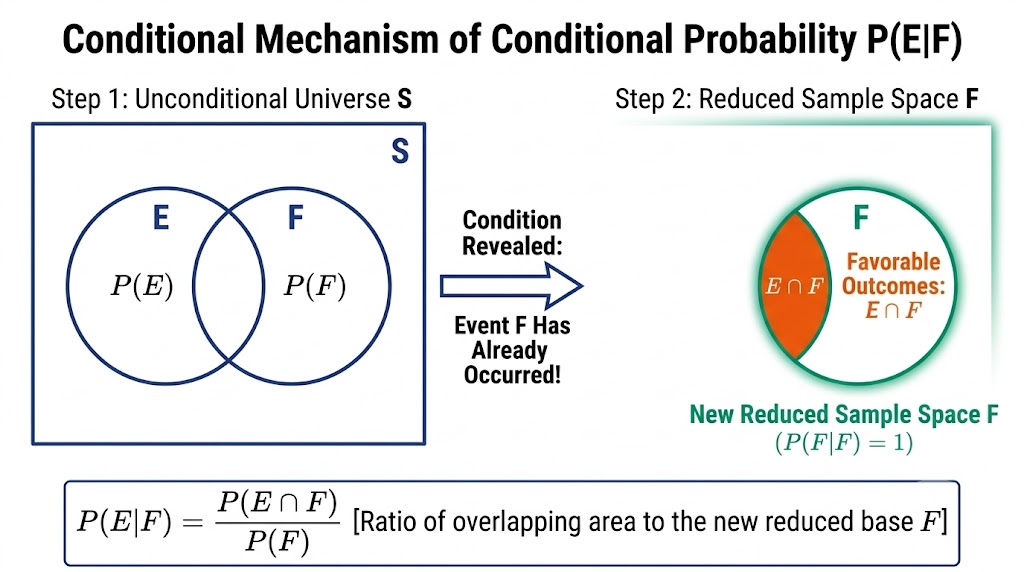
Fig. 2: The Venn mechanism of Conditional Probability. Once event $F$ occurs, the sample space collapses to $F$, and the only valid region of $E$ is the intersection $E \cap F$.
In real-world stochastic processes, we rarely compute probabilities in a vacuum. Instead, we continually incorporate fresh information. If an event $F$ is known to have already occurred, the uncertainty of another event $E$ must be updated.
The Core Intuition: Reduced Sample Space
Prior to knowing anything, the universe of possibilities is the full sample space $S$. But the moment we are informed that event $F$ has already occurred, all outcomes outside $F$ become impossible.
Hence, the original sample space $S$ immediately collapses (shrinks) to the subset $F$. In this new reduced sample space $F$, the only favorable outcomes for event $E$ are those that lie in the common intersection $E \cap F$.
Mathematical Definition
Let $E$ and $F$ be two events associated with the same sample space $S$ of a random experiment. Then the conditional probability of event $E$ given that $F$ has already occurred is denoted by $P(E|F)$ and is defined by:
$$\boxed{P(E|F) = \frac{P(E \cap F)}{P(F)}, \quad \text{provided } P(F) \neq 0}$$
Similarly, if $P(E) \ne 0$, the conditional probability of $F$ given $E$ is:
$$P(F|E) = \frac{P(E \cap F)}{P(E)}$$
The Four Fundamental Properties of Conditional Probability
Conditional probabilities satisfy every mathematical axiom of ordinary probability. The following four properties are repeatedly tested in CBSE Board 1-mark and 2-mark questions:
Properties & Rigorous ProofsProperty 1: The Certainty of the Reduced Sample Space
$$P(S|F) = P(F|F) = 1$$
Proof: $P(S|F) = \frac{P(S \cap F)}{P(F)} = \frac{P(F)}{P(F)} = 1$, since $S \cap F = F$. Similarly, $P(F|F) = \frac{P(F \cap F)}{P(F)} = \frac{P(F)}{P(F)} = 1$. (Hence proved)
Property 2: Union Rule in Conditional Probability
If $A$ and $B$ are any two events and $F$ is an event such that $P(F) \neq 0$, then:
$$P((A \cup B)|F) = P(A|F) + P(B|F) - P((A \cap B)|F)$$
Corollary: If $A$ and $B$ are mutually exclusive, then $(A \cap B) \cap F = \phi \implies P((A \cup B)|F) = P(A|F) + P(B|F)$.
Property 3: Complementary Event Theorem
$$P(E'|F) = 1 - P(E|F)$$
Proof: From Property 1, $P(S|F) = 1$. Since $S = E \cup E'$ and $E \cap E' = \phi$, by Property 2:
$$P((E \cup E')|F) = P(E|F) + P(E'|F)$$
$$\implies 1 = P(E|F) + P(E'|F)$$
$$\implies P(E'|F) = 1 - P(E|F). \quad \text{(Hence proved)}$$ Property 4: Probability Bounds
$$0 \le P(E|F) \le 1 \quad \text{for any event } E \text{ and } F \text{ with } P(F) > 0$$
Worked Board Archetype 1 • Two-Child Family Paradox
A family has two children. What is the conditional probability that both children are boys, given that:
(i) the youngest child is a boy?
(ii) at least one child is a boy?
Step-by-Step Solution
Let $B$ denote a boy and $G$ denote a girl. The order of elements represents (older, younger).
The sample space is: $S = \{ (B, B), (B, G), (G, B), (G, G) \}$, hence $n(S) = 4$. Each outcome has equal probability $\frac{1}{4}$.
Let event $E$ = "Both children are boys" = $\{ (B, B) \}$. Thus $P(E) = \frac{1}{4}$.
Part (i): Let $F_1$ = "The youngest child is a boy" = $\{ (B, B), (G, B) \}$.
Then $n(F_1) = 2 \implies P(F_1) = \frac{2}{4} = \frac{1}{2}$.
The intersection is: $E \cap F_1 = \{ (B, B) \} \implies P(E \cap F_1) = \frac{1}{4}$.
$$P(E|F_1) = \frac{P(E \cap F_1)}{P(F_1)} = \frac{1/4}{2/4} = \mathbf{\frac{1}{2}}$$
Part (ii): Let $F_2$ = "At least one child is a boy" = $\{ (B, B), (B, G), (G, B) \}$.
Then $n(F_2) = 3 \implies P(F_2) = \frac{3}{4}$.
The intersection is: $E \cap F_2 = \{ (B, B) \} \implies P(E \cap F_2) = \frac{1}{4}$.
$$P(E|F_2) = \frac{P(E \cap F_2)}{P(F_2)} = \frac{1/4}{3/4} = \mathbf{\frac{1}{3}}$$
Final Answers: (i) 1/2 (ii) 1/3
Worked Board Archetype 2 • Pair of Dice Sum Condition
A pair of fair dice is thrown. If the sum of the numbers appearing on the dice is observed to be 8, find the conditional probability that the number 5 has appeared on at least one of the dice.
Step-by-Step Solution
When a pair of dice is thrown, $n(S) = 6 \times 6 = 36$.
Let event $F$ = "Sum is 8" = $\{ (2,6), (3,5), (4,4), (5,3), (6,2) \}$.
Therefore, $n(F) = 5 \implies P(F) = \frac{5}{36}$.
Let event $E$ = "Number 5 appears on at least one die".
We inspect the reduced sample space $F$ to find the elements containing 5:
$$E \cap F = \{ (3,5), (5,3) \} \implies n(E \cap F) = 2 \implies P(E \cap F) = \frac{2}{36}$$
Applying the conditional probability formula:
$$P(E|F) = \frac{P(E \cap F)}{P(F)} = \frac{2/36}{5/36} = \mathbf{\frac{2}{5}}$$
Final Answer: 2/5
3. Multiplication Theorem on Probability
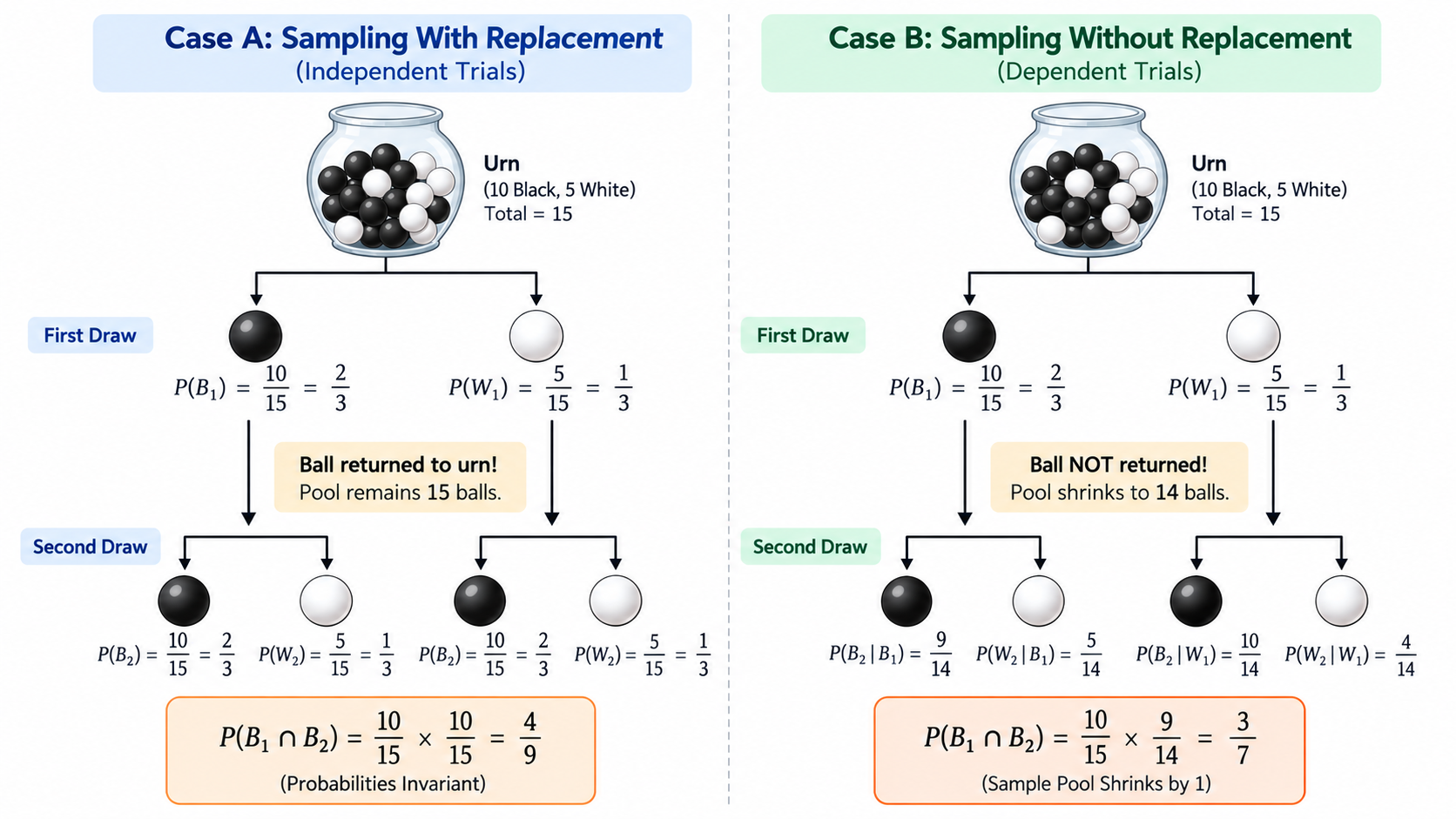
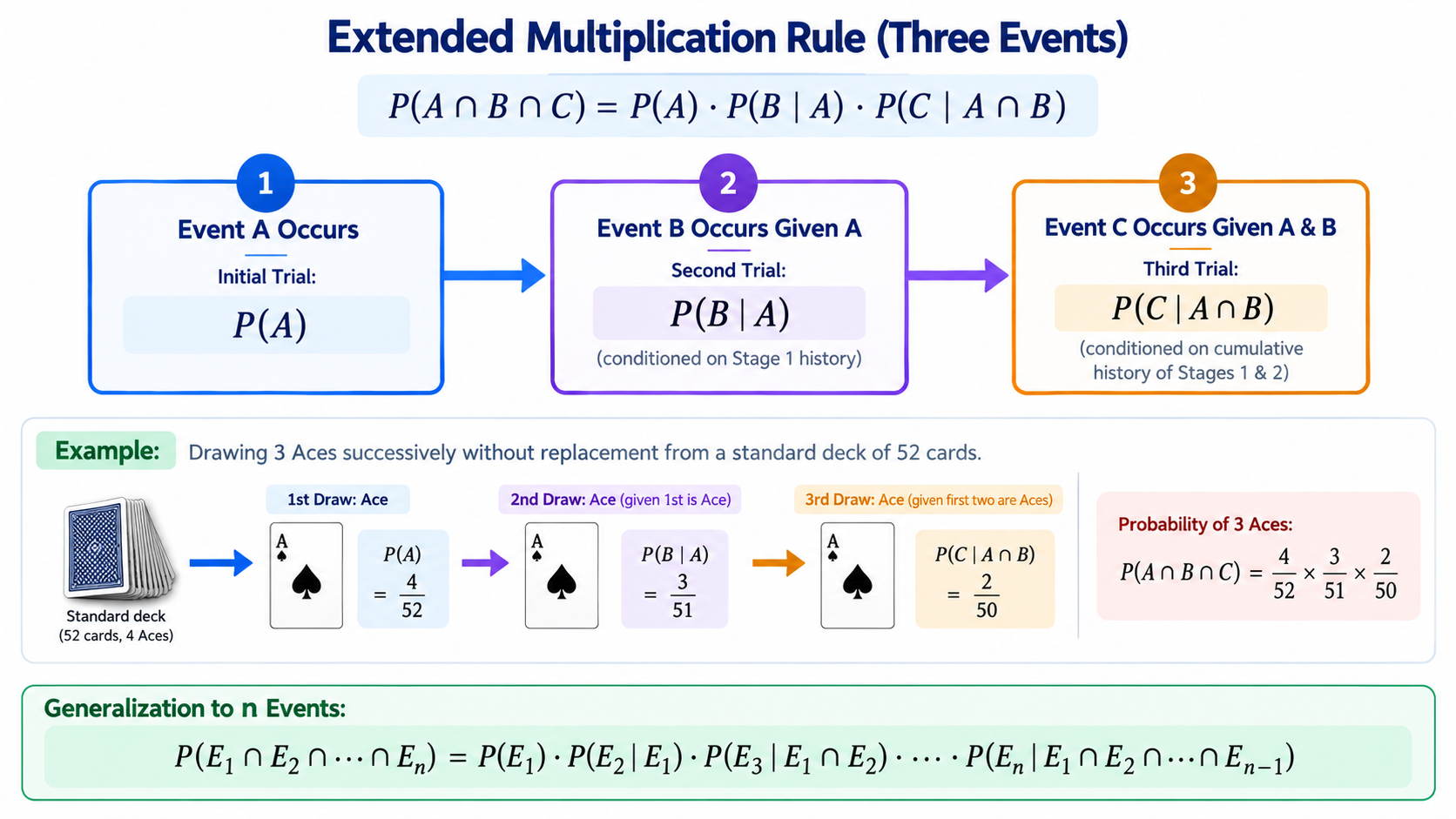
Fig. 3: Sequential probability tree comparison. With replacement, probabilities stay invariant; without replacement, the sample pool decreases after every stage.Fig. 4: Extended Multiplication Rule. Sequential conditioning on cumulative history $P(A \cap B \cap C) = P(A) \cdot P(B|A) \cdot P(C|A \cap B)$ demonstrated with consecutive card draws without replacement.
By cross-multiplying the conditional probability definition, we obtain the fundamental rule for calculating the joint probability of two or more sequential events.
Multiplication Rule of ProbabilityFor Two Events:
$$\boxed{P(A \cap B) = P(A) \cdot P(B|A) = P(B) \cdot P(A|B)}$$
Extension to Three Events:
$$\boxed{P(A \cap B \cap C) = P(A) \cdot P(B|A) \cdot P(C|A \cap B)}$$
Generalization to $n$ Events:
$$P(E_1 \cap E_2 \cap \cdots \cap E_n) = P(E_1) \cdot P(E_2|E_1) \cdot P(E_3|E_1 \cap E_2) \cdots P(E_n|E_1 \cap \cdots \cap E_{n-1})$$
⚠️ Board Exam Critical Warning: Sampling With vs Without Replacement
1. Sampling With Replacement: The extracted object is returned to the container before the next draw. The pool of favorable and total outcomes remains constant. The trials are independent:
$$P(\text{Draw 1 } \cap \text{ Draw 2}) = P(\text{Draw 1}) \times P(\text{Draw 2})$$
2. Sampling Without Replacement: The extracted object is NOT returned. The total sample space shrinks by 1 after each draw, and the favorable count changes according to what was drawn. The trials are dependent:
$$P(\text{Draw 1 } \cap \text{ Draw 2}) = P(\text{Draw 1}) \times P(\text{Draw 2} \mid \text{Draw 1})$$
Worked Board Archetype 3 • Sequential Ball Extraction Without Replacement
An urn contains 10 black balls and 5 white balls. Two balls are drawn from the urn one after the other without replacement. What is the probability that both drawn balls are black?
Step-by-Step Solution
Total number of balls initially in the urn $= 10 + 5 = 15$.
Let $B_1$ = event that the first ball drawn is black.
Let $B_2$ = event that the second ball drawn is black.
Probability of drawing a black ball on the first draw:
$$P(B_1) = \frac{10}{15} = \frac{2}{3}$$
Because the first ball is NOT replaced, there are now 9 black balls and 14 total balls remaining in the urn.
Probability of drawing a black ball on the second draw given the first was black:
$$P(B_2|B_1) = \frac{9}{14}$$
By the Multiplication Theorem on Probability:
$$P(B_1 \cap B_2) = P(B_1) \cdot P(B_2|B_1) = \frac{10}{15} \times \frac{9}{14} = \frac{2}{3} \times \frac{9}{14} = \frac{18}{42} = \mathbf{\frac{3}{7}}$$
Final Answer: 3/7
4. Independent Events vs Mutually Exclusive Events
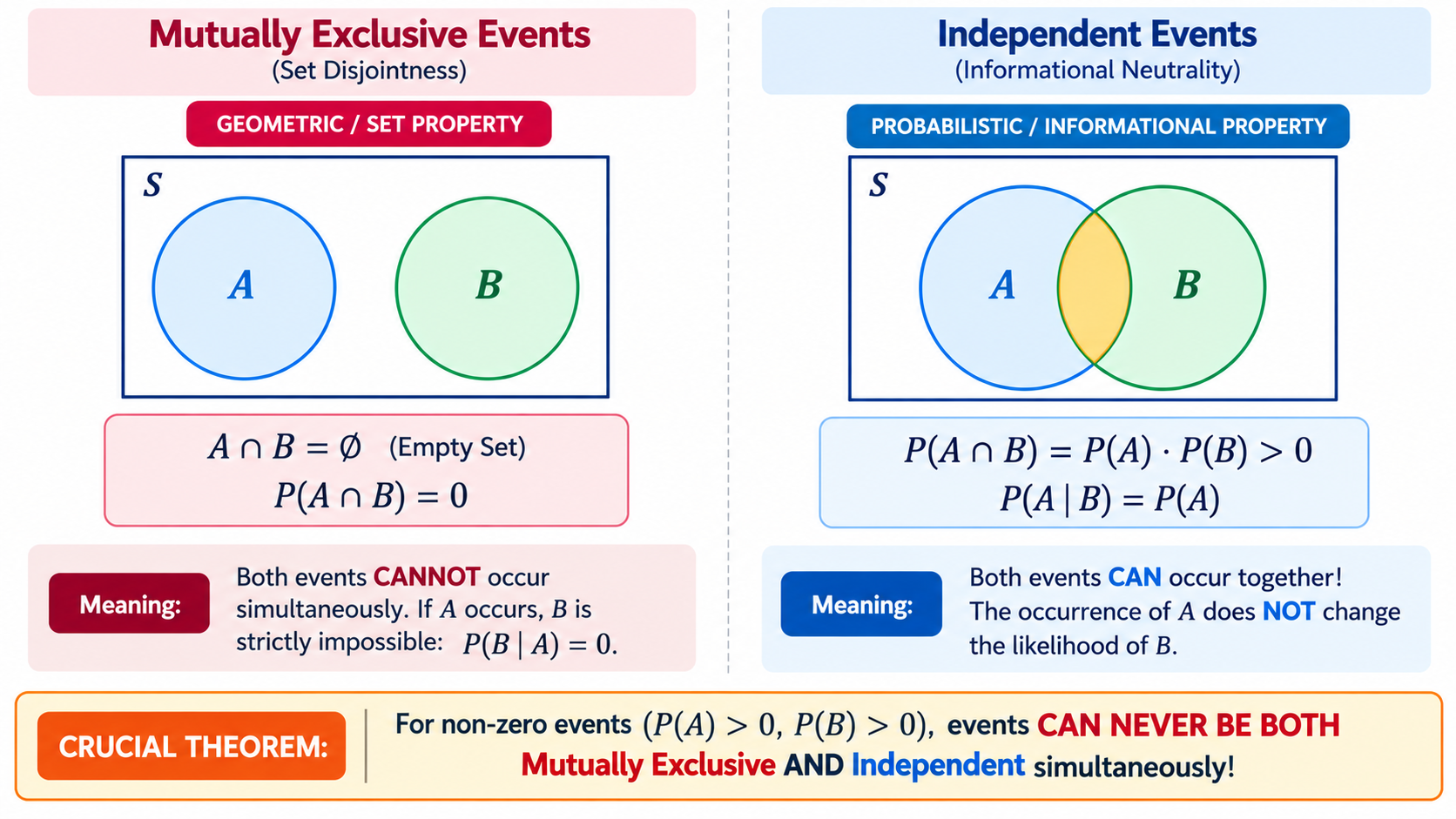
Fig. 5: Mutually exclusive events cannot occur simultaneously ($A \cap B = \phi$), whereas independent events can and do overlap such that $P(A \cap B) = P(A) \cdot P(B)$.
Two events are said to be independent if the occurrence or non-occurrence of one event has absolutely no effect on the probability of the occurrence of the other event.
Mathematical Criterion of Independence
Two events $A$ and $B$ are defined to be independent if:
$$P(A|B) = P(A) \quad \text{and} \quad P(B|A) = P(B)$$
Substituting this into the Multiplication Theorem $P(A \cap B) = P(A) \cdot P(B|A)$ yields the Universal Test for Independence:
$$\boxed{A \text{ and } B \text{ are independent} \iff P(A \cap B) = P(A) \cdot P(B)}$$
If $P(A \cap B) \ne P(A) \cdot P(B)$, the events are strictly dependent.
Students frequently confuse these two distinct concepts:
Mutually Exclusive: Events cannot occur simultaneously ($A \cap B = \phi \implies P(A \cap B) = 0$). This is a set-theoretic geometric property of disjointness.
Independent: Occurrence of one does not affect the probability of the other ($P(A \cap B) = P(A) \cdot P(B)$). This is an informational probabilistic property.
Crucial Theorem: Two events $A$ and $B$ with non-zero probabilities ($P(A) > 0, P(B) > 0$) CAN NEVER BE BOTH MUTUALLY EXCLUSIVE AND INDEPENDENT.
Proof: If mutually exclusive, $P(A \cap B) = 0$. But if independent, $P(A \cap B) = P(A)P(B) > 0$. Since $0 \ne P(A)P(B)$, they cannot hold simultaneously! (Hence proved)
The Four Fundamental Independence Theorems
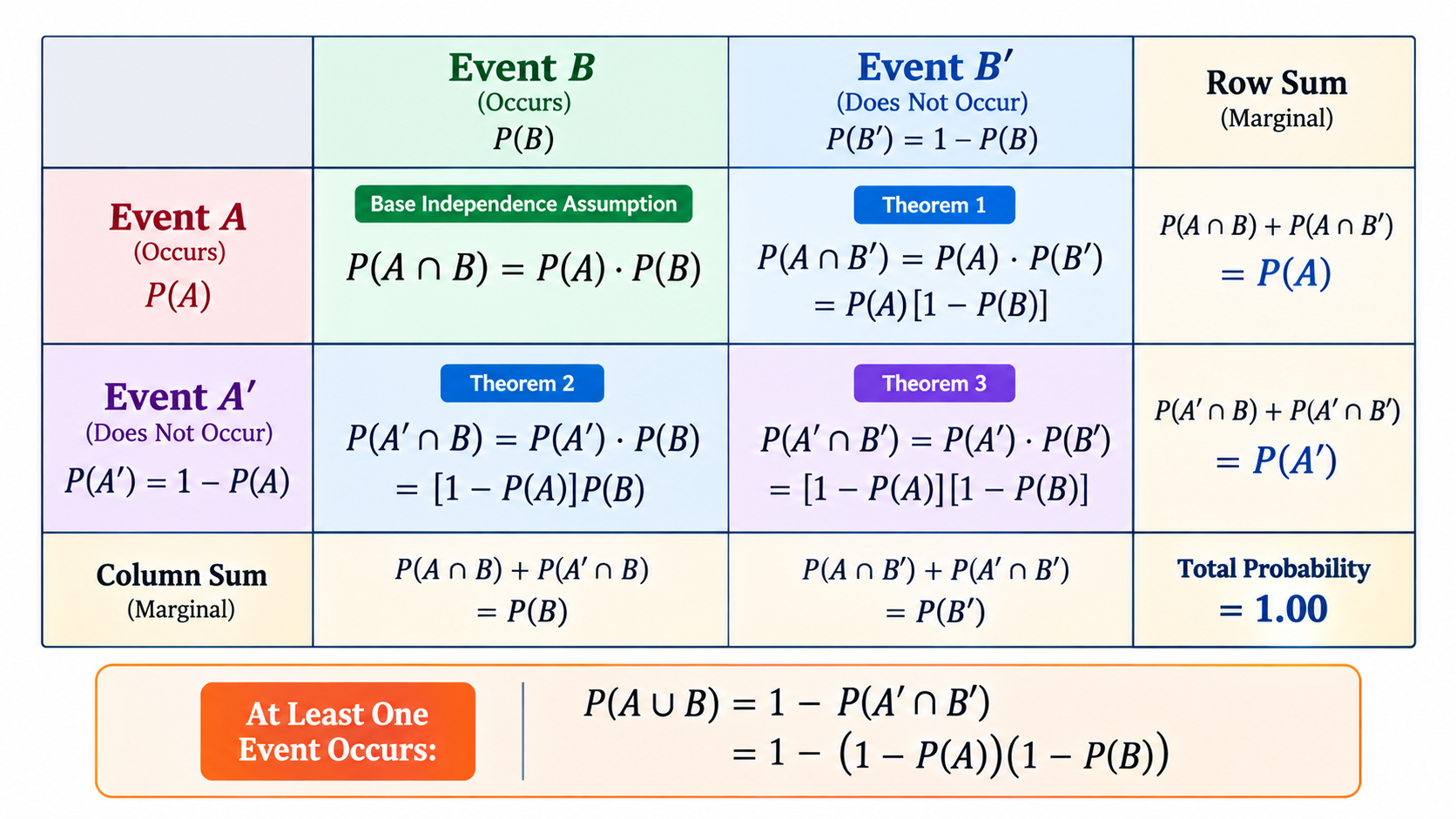
Fig. 6: Four-quadrant independence contingency matrix demonstrating that independence of $A$ and $B$ guarantees the mutual independence of their complements.
Theorems & Complete ProofsTheorem 1: If $A$ and $B$ are independent events, then $A$ and $B'$ are also independent. Proof: Note that $A = (A \cap B) \cup (A \cap B')$, where $(A \cap B)$ and $(A \cap B')$ are disjoint.
$\implies P(A) = P(A \cap B) + P(A \cap B')$
$\implies P(A \cap B') = P(A) - P(A \cap B)$
Since $A$ and $B$ are independent, $P(A \cap B) = P(A)P(B)$:
$\implies P(A \cap B') = P(A) - P(A)P(B) = P(A)[1 - P(B)] = P(A)P(B')$.
Hence, $A$ and $B'$ are independent. (Hence proved)
Theorem 2: If $A$ and $B$ are independent, then $A'$ and $B$ are independent. Proof: Symmetrical to Theorem 1. (Hence proved)
Theorem 3: If $A$ and $B$ are independent, then $A'$ and $B'$ are independent. Proof: Using De Morgan's Law:
$$P(A' \cap B') = P((A \cup B)') = 1 - P(A \cup B)$$
$$= 1 - [P(A) + P(B) - P(A \cap B)]$$
$$= 1 - P(A) - P(B) + P(A)P(B)$$
$$= [1 - P(A)] - P(B)[1 - P(A)]$$
$$= [1 - P(A)][1 - P(B)] = \mathbf{P(A')P(B')}. \quad \text{(Hence proved)}$$ Theorem 4 (At Least One Event Occurs): If $A$ and $B$ are independent events, then:
$$\boxed{P(\text{At least one of } A \text{ or } B) = P(A \cup B) = 1 - P(A')P(B')}$$
For $n$ independent events $A_1, A_2, \ldots, A_n$:
$$\boxed{P(\text{At least one event occurs}) = 1 - P(A_1')P(A_2') \cdots P(A_n')}$$
Worked Board Archetype 4 • Independent Problem Solving
A problem in mathematics is given to three students $A, B,$ and $C$ whose chances of solving it independently are $\frac{1}{2}, \frac{1}{3},$ and $\frac{1}{4}$ respectively. Find the probability that:
(i) the problem is solved.
(ii) exactly one of them solves the problem.
Step-by-Step Solution
Let $A, B, C$ denote the events that students $A, B, C$ solve the problem respectively.
Given: $P(A) = \frac{1}{2}, P(B) = \frac{1}{3}, P(C) = \frac{1}{4}$.
The probabilities of their failure are:
$P(A') = 1 - \frac{1}{2} = \frac{1}{2}, \quad P(B') = 1 - \frac{1}{3} = \frac{2}{3}, \quad P(C') = 1 - \frac{1}{4} = \frac{3}{4}$.
Part (i): Probability that the problem is solved.
The problem is solved if at least one of them solves it. Using the complement rule:
$$P(\text{Problem is solved}) = 1 - P(\text{None of them solves the problem})$$
Since $A, B, C$ work independently, their complements $A', B', C'$ are also independent:
$$P(A' \cap B' \cap C') = P(A') \cdot P(B') \cdot P(C') = \frac{1}{2} \times \frac{2}{3} \times \frac{3}{4} = \frac{1}{4}$$
$$P(\text{Problem is solved}) = 1 - \frac{1}{4} = \mathbf{\frac{3}{4}}$$
Part (ii): Probability that exactly one of them solves it.
This event is the union of three mutually exclusive scenarios:
$$E = (A \cap B' \cap C') \cup (A' \cap B \cap C') \cup (A' \cap B' \cap C)$$
$$P(E) = P(A)P(B')P(C') + P(A')P(B)P(C') + P(A')P(B')P(C)$$
$$P(E) = \left(\frac{1}{2} \times \frac{2}{3} \times \frac{3}{4}\right) + \left(\frac{1}{2} \times \frac{1}{3} \times \frac{3}{4}\right) + \left(\frac{1}{2} \times \frac{2}{3} \times \frac{1}{4}\right)$$
$$P(E) = \frac{6}{24} + \frac{3}{24} + \frac{2}{24} = \frac{11}{24}$$
Final Answers: (i) 3/4 (ii) 11/24
5. Partitions of Sample Space & Theorem of Total Probability
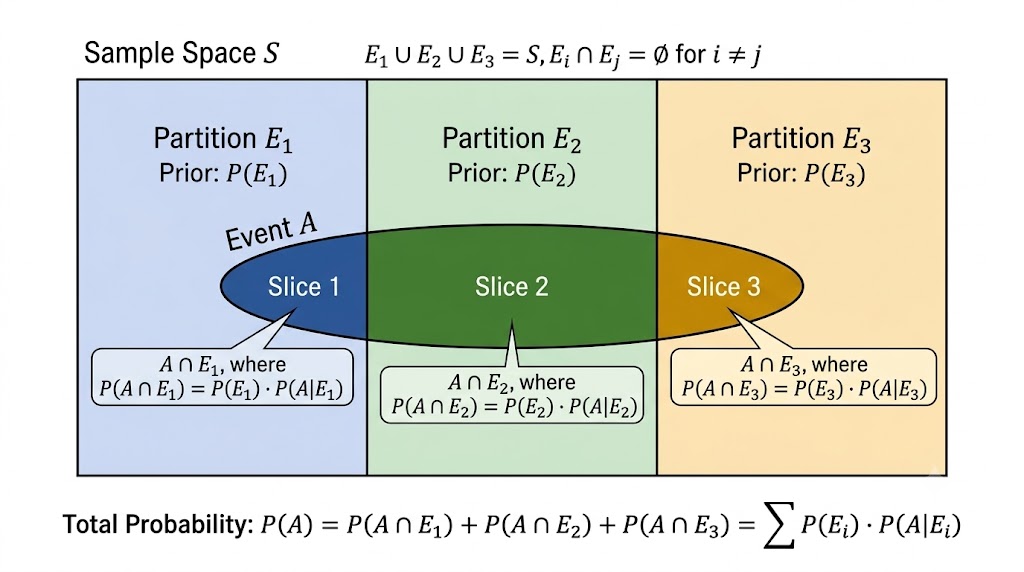
Fig. 7: Partition of sample space into mutually exclusive, exhaustive sets $E_1, E_2, E_3$ slicing event $A$ to establish the Law of Total Probability.
Before stating Bayes' Theorem, we must understand how a sample space can be decomposed into mutually non-overlapping, exhaustive scenarios.
Formal Definition: Partition of a Sample Space
A collection of events $\{E_1, E_2, \ldots, E_n\}$ is said to form a partition of the sample space $S$ if it satisfies three strict mathematical requirements:
Pairwise Disjoint (Mutually Exclusive): $E_i \cap E_j = \phi$ for all $i \neq j$. (No two scenarios can occur at once).
Exhaustive: $E_1 \cup E_2 \cup \cdots \cup E_n = \bigcup_{i=1}^n E_i = S$. (They cover all possible outcomes).
Non-Zero Probabilities: $P(E_i) > 0$ for each $i = 1, 2, \ldots, n$.
The Law / Theorem of Total Probability
Let $\{E_1, E_2, \ldots, E_n\}$ be a partition of the sample space $S$, and let $A$ be any event associated with $S$. Then:
$$\boxed{P(A) = \sum_{j=1}^n P(E_j) \cdot P(A|E_j) = P(E_1)P(A|E_1) + P(E_2)P(A|E_2) + \cdots + P(E_n)P(A|E_n)}$$
Proof: Since $\{E_1, E_2, \ldots, E_n\}$ partitions $S$, we have $S = E_1 \cup E_2 \cup \cdots \cup E_n$.
Intersecting with event $A$:
$$A = A \cap S = A \cap (E_1 \cup E_2 \cup \cdots \cup E_n) = (A \cap E_1) \cup (A \cap E_2) \cup \cdots \cup (A \cap E_n)$$
Since the partitions are pairwise disjoint, the events $(A \cap E_i)$ are also mutually disjoint. Therefore:
$$P(A) = \sum_{j=1}^n P(A \cap E_j)$$
By the Multiplication Theorem, $P(A \cap E_j) = P(E_j) \cdot P(A|E_j)$. Substituting gives the theorem. (Hence proved)
6. Bayes' Theorem — Complete Theory & 7 Board Archetypes
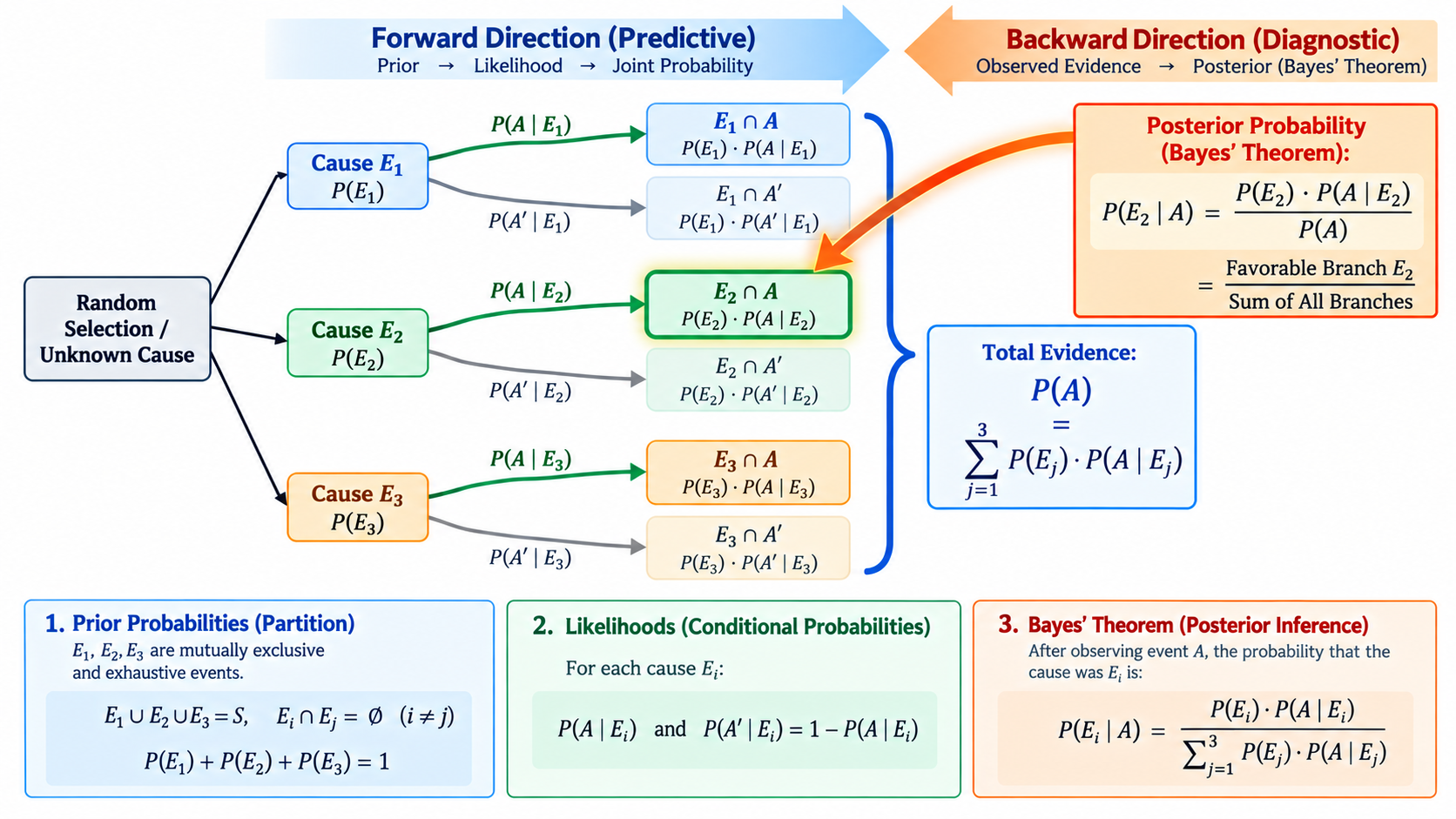
Fig. 8: Bayes' Theorem probability tree contrasting forward predictive likelihood branches with the inverse diagnostic posterior computation.
In Total Probability, we compute the forward probability of an outcome $A$ given known causes $E_i$. Bayes' Theorem addresses the reverse inverse problem: Given that event $A$ has already occurred, what is the probability that it was produced by a specific cause $E_i$?
Bayes' Theorem Statement & Formula
If $E_1, E_2, \ldots, E_n$ form a partition of the sample space $S$ (mutually exclusive and exhaustive with $P(E_i) > 0$), and $A$ is any non-zero event associated with $S$, then for any specific partition $E_i$:
$$\boxed{P(E_i|A) = \frac{P(E_i) \cdot P(A|E_i)}{\displaystyle\sum_{j=1}^n P(E_j) \cdot P(A|E_j)}}$$
Key Terminology: • $P(E_i)$ is called the Prior Probability of hypothesis $E_i$ (before evidence $A$ is observed).
• $P(A|E_i)$ is called the Likelihood of observing $A$ given hypothesis $E_i$.
• $P(E_i|A)$ is called the Posterior Probability of hypothesis $E_i$ (after evidence $A$ is observed).
• The denominator $\sum P(E_j)P(A|E_j)$ is the Total Probability $P(A)$.
Step 1 (Define Partitions): Clearly write $E_1, E_2, \ldots$ in words as mutually exclusive and exhaustive causes. State their prior probabilities $P(E_1), P(E_2), \ldots$ and verify that $\sum P(E_i) = 1$.
Step 2 (Define Event A): State event $A$ in words as the observed or confirmed occurrence (e.g., "drawn ball is red", "item is defective").
Step 3 (Write Conditional Likelihoods): Write down each $P(A|E_i)$ with clear mathematical reasoning.
Step 4 (State Formula & Compute): Write out the complete Bayes' formula symbolically first (mandatory for 1 step mark in CBSE), compute the denominator, and obtain the final reduced fraction.
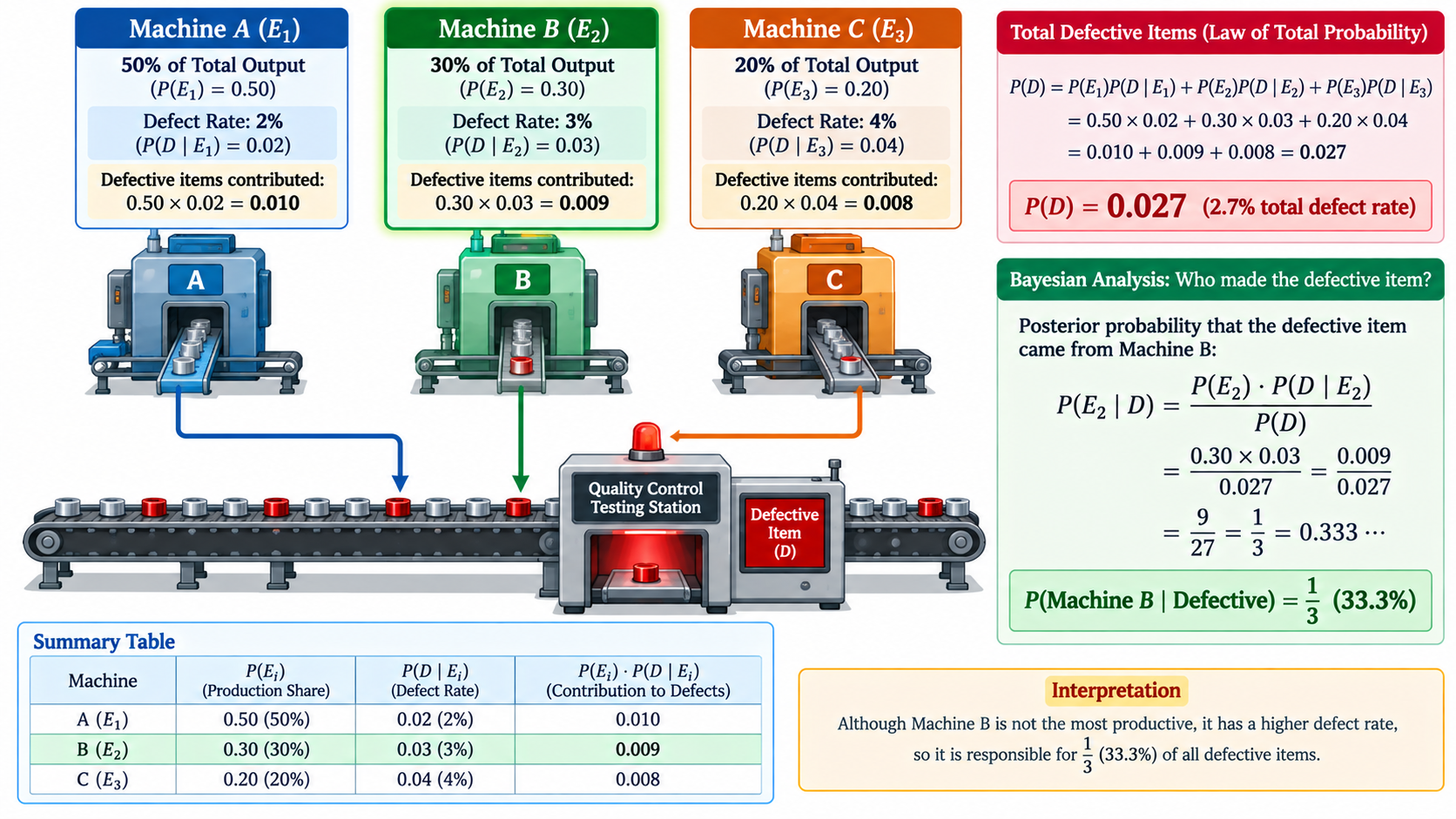
Bayes Archetype 1 • Factory Machine Defect Rate
An industrial manufacturing plant has three machines $A, B,$ and $C$. Machine $A$ produces $50\%$ of the total items, Machine $B$ produces $30\%$, and Machine $C$ produces $20\%$. The percentage of defective items produced by these machines are $2\%, 3\%,$ and $4\%$ respectively.
An item is selected at random from the total output and is found to be defective. What is the probability that it was manufactured by Machine $B$?
Fig. 9: Bayes Factory 3-machine production pipeline and quality diagnostic workflow calculating the posterior probability of Machine $B$ given a defective item.
Step-by-Step Board Solution Step 1: Define the partition events:
Let $E_1$ = item is manufactured by Machine $A \implies P(E_1) = \frac{50}{100} = 0.50$
Let $E_2$ = item is manufactured by Machine $B \implies P(E_2) = \frac{30}{100} = 0.30$
Let $E_3$ = item is manufactured by Machine $C \implies P(E_3) = \frac{20}{100} = 0.20$ Check: $0.50 + 0.30 + 0.20 = 1.00$ (Exhaustive & Disjoint).
Step 2: Define the observed event:
Let $D$ = event that the randomly selected item is defective.
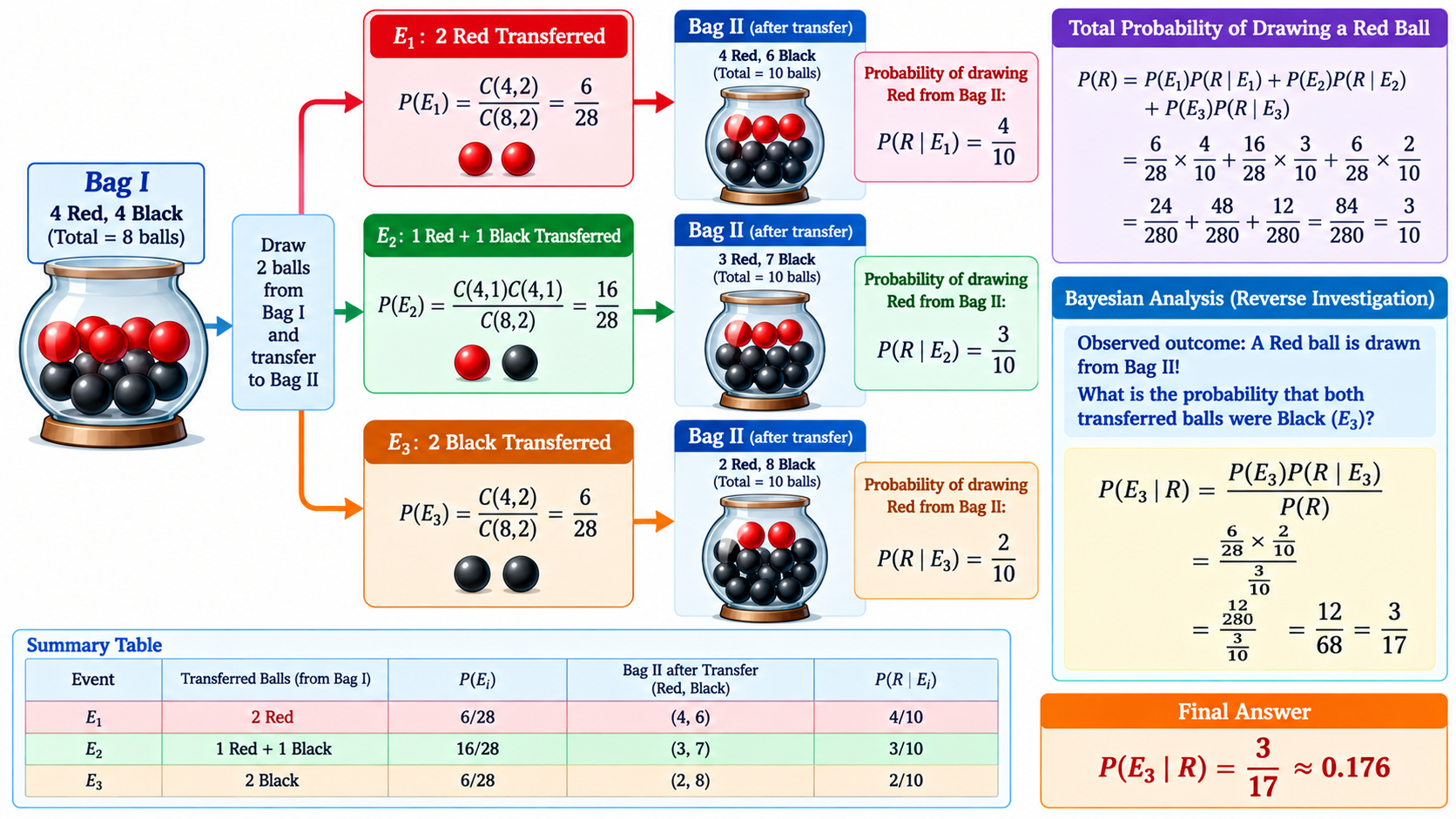
Bayes Archetype 2 • The Famous Ball Transfer Problem (CBSE Most Repeated)
Bag I contains 4 red and 4 black balls, while Bag II contains 2 red and 6 black balls. Two balls are drawn at random from Bag I and transferred to Bag II. A ball is then drawn at random from Bag II and is found to be red in colour.
Find the probability that the two transferred balls were both black.
Fig. 10: Two-urn ball transfer mechanism breaking down prior draw combinations and posterior probability computation for Bag II.
Step-by-Step Board Solution Step 1: Define the partitions based on the composition of the 2 transferred balls from Bag I (total 8 balls: 4R, 4B):
Total ways to choose 2 balls from 8 $= \binom{8}{2} = \frac{8 \times 7}{2} = 28$.
• $E_1$ = both transferred balls are red:
$$P(E_1) = \frac{\binom{4}{2}}{\binom{8}{2}} = \frac{6}{28}$$
• $E_2$ = one red and one black ball transferred:
$$P(E_2) = \frac{\binom{4}{1}\binom{4}{1}}{\binom{8}{2}} = \frac{4 \times 4}{28} = \frac{16}{28}$$
• $E_3$ = both transferred balls are black:
$$P(E_3) = \frac{\binom{4}{2}}{\binom{8}{2}} = \frac{6}{28}$$
Check: $\frac{6}{28} + \frac{16}{28} + \frac{6}{28} = \frac{28}{28} = 1$.
Step 2: Define event $A$ = A ball drawn from Bag II is RED.
Initially, Bag II has 2 red and 6 black balls (total 8 balls). After 2 transferred balls, Bag II contains $8 + 2 = 10$ balls.
Step 3: Conditional likelihoods from Bag II:
• If $E_1$ occurred: 2 red added $\implies$ Bag II has $(2+2)=4$ red out of 10 $\implies P(A|E_1) = \frac{4}{10}$.
• If $E_2$ occurred: 1 red added $\implies$ Bag II has $(2+1)=3$ red out of 10 $\implies P(A|E_2) = \frac{3}{10}$.
• If $E_3$ occurred: 0 red added $\implies$ Bag II has 2 red out of 10 $\implies P(A|E_3) = \frac{2}{10}$.
Bayes Archetype 3 • Medical Diagnostic Testing (Base Rate Fallacy)
A laboratory blood test is $99\%$ effective in detecting a certain disease when it is, in fact, present. However, the test also yields a 'false positive' result for $0.5\%$ of the healthy persons tested. If $0.1\%$ of the population actually has the disease, what is the probability that a person has the disease given that his test result is positive?
Step-by-Step Board Solution Step 1: Define the partition of health status:
Let $E_1$ = Person actually has the disease $\implies P(E_1) = 0.1\% = \frac{0.1}{100} = 0.001$.
Let $E_2$ = Person is healthy (does not have disease) $\implies P(E_2) = 1 - 0.001 = 0.999$.
Step 2: Define event $A$ = Test result is positive.
Step 3: Conditional test accuracies:
$P(A|E_1)$ = Probability of positive test given person is diseased (True Positive) $= 99\% = 0.99$.
$P(A|E_2)$ = Probability of positive test given person is healthy (False Positive) $= 0.5\% = 0.005$.
Bayes Archetype 4 • Truth-Telling Observer Problem
A man is known to speak the truth 3 out of 4 times. He throws a die and reports that it is a six. Find the probability that it is actually a six.
Step-by-Step Board Solution Step 1: Define the actual outcome partitions on the die:
Let $E_1$ = A six actually appears on the die $\implies P(E_1) = \frac{1}{6}$.
Let $E_2$ = A six does NOT appear on the die $\implies P(E_2) = 1 - \frac{1}{6} = \frac{5}{6}$.
Step 2: Define event $A$ = The man reports that a six has appeared.
Step 3: Conditional reporting probabilities:
• $P(A|E_1)$ = Man reports six when six actually appeared = Probability he speaks the truth $= \frac{3}{4}$.
• $P(A|E_2)$ = Man reports six when six did NOT appear = Probability he lies $= 1 - \frac{3}{4} = \frac{1}{4}$.
7. Random Variables & Probability Distributions (CBSE Board Scope)
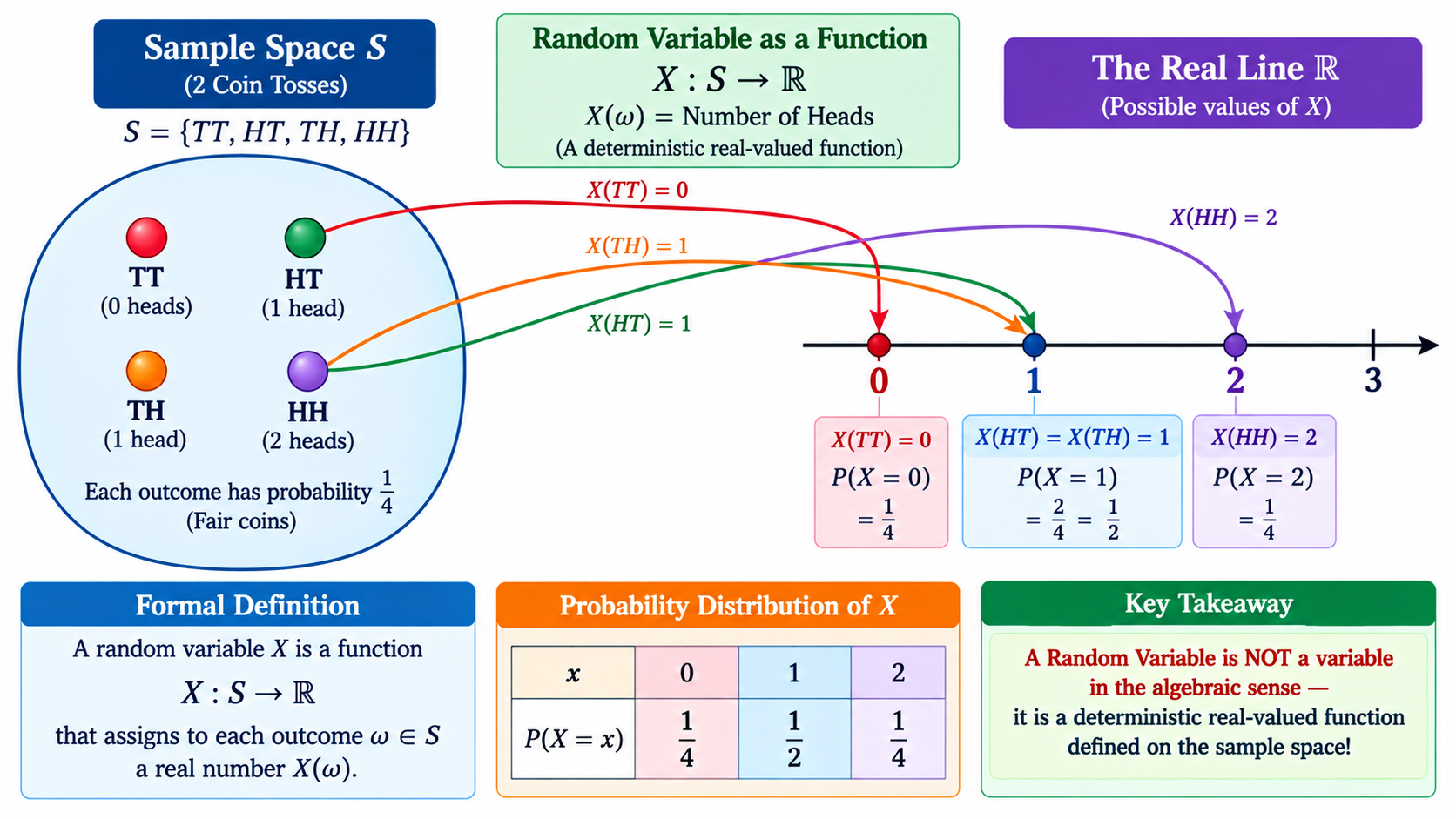
Fig. 11: Mathematical definition of a random variable as a deterministic function mapping sample space outcomes to the real number line ($X: S \to \mathbb{R}$).
In many random experiments, we are not interested in the qualitative outcome itself (such as $HTH$ or $THH$), but rather in a real numerical quantity associated with it (such as the number of heads).
Definition of Random Variable
A Random Variable $X$ is a real-valued function whose domain is the sample space $S$ of a random experiment:
$$X: S \to \mathbb{R}$$
A random variable is discrete if it can assume only a finite or countably infinite number of distinct isolated values. In Class 12 CBSE, we deal exclusively with discrete random variables.
Probability Distribution of a Discrete Random Variable
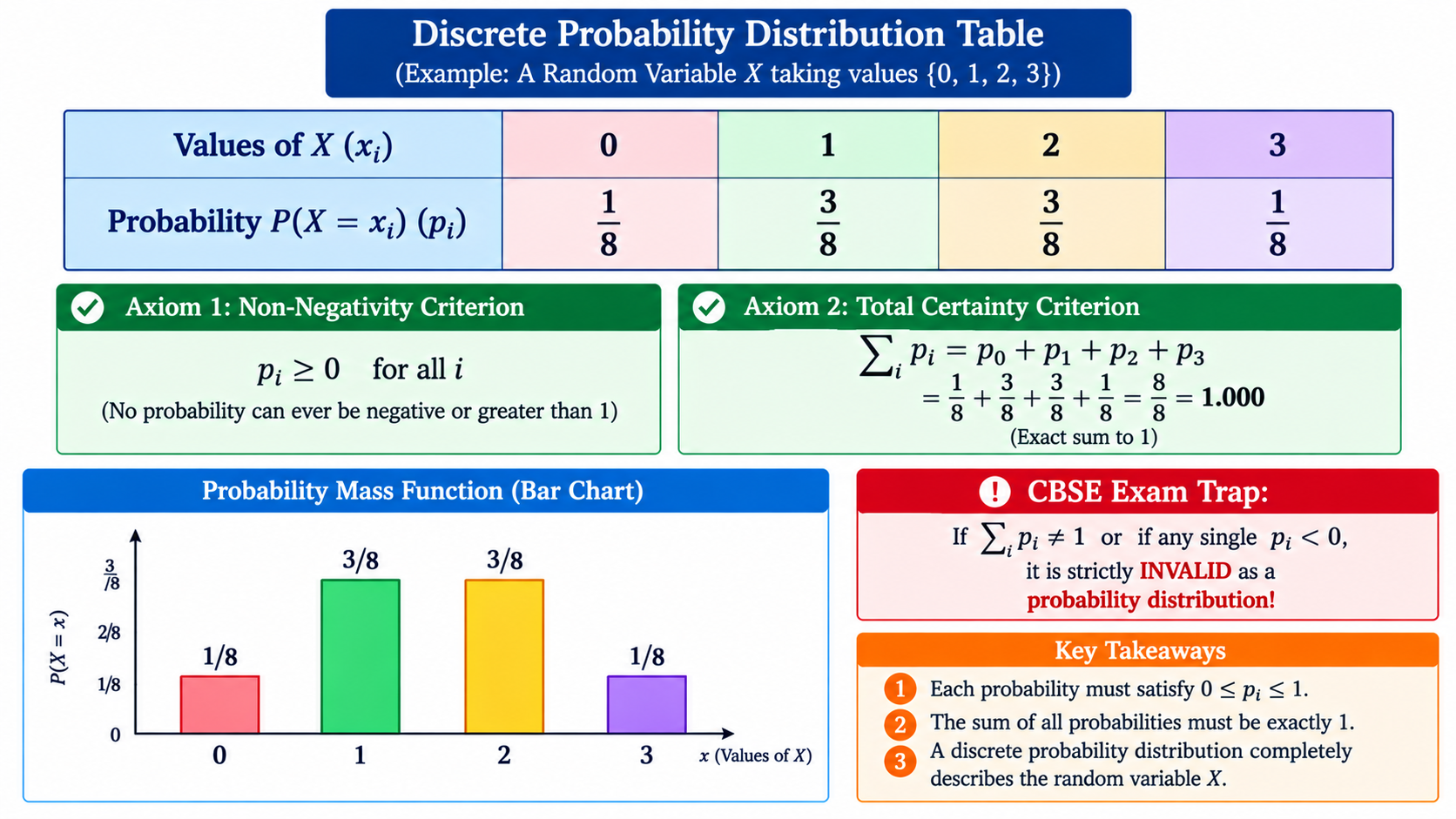
Fig. 12: Structural blueprint and axiomatic verification criteria ($p_i \ge 0$, $\sum p_i = 1$) for a discrete probability distribution.
If a discrete random variable $X$ assumes values $x_1, x_2, \ldots, x_n$ with corresponding probabilities $p_1, p_2, \ldots, p_n$ such that $P(X = x_i) = p_i$, then the arrangement:
Values of $X$ ($x_i$)
$x_1$
$x_2$
$x_3$
$\cdots$
$x_n$
$P(X = x_i)$ ($p_i$)
$p_1$
$p_2$
$p_3$
$\cdots$
$p_n$
Two Inviolable Axiomatic Conditions for a Valid Distribution
For any table to be a mathematically legitimate probability distribution:
$$\boxed{1. \quad p_i \ge 0 \quad \text{for all } i = 1, 2, \ldots, n}$$
$$\boxed{2. \quad \sum_{i=1}^n p_i = p_1 + p_2 + \cdots + p_n = 1}$$
If any probability is negative, or if the sum $\sum p_i \neq 1$, it is NOT a valid probability distribution.
Worked Board Archetype 5 • Finding Unknown Constant $k$ and Interval Probabilities
A random variable $X$ has the following probability distribution:
$X$
0
1
2
3
4
5
6
7
$P(X)$
0
$k$
$2k$
$2k$
$3k$
$k^2$
$2k^2$
$7k^2 + k$
Determine: (i) the value of $k$, (ii) $P(X < 3)$, (iii) $P(X \ge 6)$, (iv) $P(0 < X < 5)$.
Answers: (i) k = 1/10 (ii) 0.3 (iii) 0.19 (iv) 0.8
Worked Board Archetype 6 • Constructing Probability Distribution from Cards Draw
Two cards are drawn simultaneously (or successively without replacement) from a well-shuffled pack of 52 cards. Find the probability distribution of the number of aces drawn.
Step-by-Step Solution
Total cards in deck $= 52$. Number of aces $= 4$. Number of non-aces $= 52 - 4 = 48$.
Let random variable $X$ denote the number of aces drawn.
Since 2 cards are drawn, $X$ can take the values: $X = 0, 1, 2$.
• For $X = 0$ (No aces drawn; both are non-aces):
$$P(X = 0) = \frac{\binom{4}{0} \binom{48}{2}}{\binom{52}{2}} = \frac{1 \times \frac{48 \times 47}{2}}{\frac{52 \times 51}{2}} = \frac{1128}{1326} = \frac{188}{221}$$
• For $X = 1$ (Exactly one ace and one non-ace):
$$P(X = 1) = \frac{\binom{4}{1} \binom{48}{1}}{\binom{52}{2}} = \frac{4 \times 48}{1326} = \frac{192}{1326} = \frac{32}{221}$$
• For $X = 2$ (Both are aces):
$$P(X = 2) = \frac{\binom{4}{2} \binom{48}{0}}{\binom{52}{2}} = \frac{6 \times 1}{1326} = \frac{6}{1326} = \frac{1}{221}$$
Check Sum: $\frac{188}{221} + \frac{32}{221} + \frac{1}{221} = \frac{221}{221} = 1.00$. ✅
Syllabus GuidanceNote for CBSE Board Examinees: Sections 8.1, 8.2, and 8.3 were deleted from the NCERT textbook under the rationalised syllabus and are NOT tested in CBSE Class 12 Board examinations. However, they are compulsory for JEE Mains, JEE Advanced, NDA, and CUET. We include them here for complete mathematical mastery.
8.1 Mean (Mathematical Expectation) of a Random Variable
The Mean $\mu$ (or Expected Value $E(X)$) represents the long-term weighted average of a random variable:
Expectation Formula
$$\boxed{\mu = E(X) = \sum_{i=1}^n x_i p_i = x_1 p_1 + x_2 p_2 + \cdots + x_n p_n}$$
Key Properties of Expectation: • $E(c) = c$ for any constant $c$.
• $E(aX + b) = a E(X) + b$.
• $E(X + Y) = E(X) + E(Y)$ (always holds, even if $X$ and $Y$ are dependent).
8.2 Variance & Standard Deviation of a Random Variable
Fig. 13: Physical analogy of mathematical expectation as the gravitational center of mass (balance fulcrum) and variance as the moment of dispersion.
The Variance $\text{Var}(X)$ (or $\sigma^2$) measures the spread or dispersion of values around the mean:
Variance & SD Formulas
$$\boxed{\text{Var}(X) = \sigma^2 = \sum_{i=1}^n (x_i - \mu)^2 p_i = E(X^2) - [E(X)]^2}$$
where $E(X^2) = \sum_{i=1}^n x_i^2 p_i$.
$$\boxed{\text{Standard Deviation: } \sigma = \sqrt{\text{Var}(X)}}$$
Key Properties of Variance: • $\text{Var}(X) \ge 0$ always.
• $\text{Var}(c) = 0$ for any constant $c$.
• $\text{Var}(aX + b) = a^2 \text{Var}(X)$ (adding a constant shifts the mean but does not change the spread!).
8.3 Bernoulli Trials & Binomial Distribution
Fig. 14: Binomial Probability Mass Function $B(n=10, p=0.5)$ showcasing discrete bar probabilities with an envelope Gaussian normal bell curve.
A sequence of trials is called Bernoulli Trials if it satisfies 4 conditions:
The number of trials $n$ is finite and fixed.
The trials are mutually independent.
Each trial results in exactly two mutually exclusive outcomes: Success ($S$) or Failure ($F$).
The probability of success $p$ remains constant in every trial ($q = 1 - p$).
Binomial Probability Mass Function
If $X$ represents the number of successes in $n$ Bernoulli trials with success probability $p$:
$$\boxed{P(X = r) = \binom{n}{r} p^r q^{n-r} = {^n}C_r \cdot p^r (1-p)^{n-r}, \quad r = 0, 1, 2, \ldots, n}$$
Notation: $X \sim B(n, p)$.
$$\boxed{\text{Mean: } \mu = np \qquad \text{Variance: } \sigma^2 = npq \qquad \text{SD: } \sigma = \sqrt{npq}}$$
Universal Binomial Inequality: Since $q < 1$, we always have:
$$\text{Variance} = npq < np = \text{Mean}$$
In any Binomial Distribution, Variance is strictly less than the Mean!
Competitive Practice Problem 7 • Finding Parameters from Mean and Variance
For a binomial distribution, the mean is 4 and the variance is 3. Find:
(i) the parameters $n$ and $p$.
(ii) $P(X \ge 1)$.
Always state events in written English: Writing "$E_1 =$ Machine A is chosen" before assigning fractions is mandatory. CBSE marking schemes reserve 1 mark solely for event statements.
Write symbolic Bayes formula before substitution: Directly plugging in numbers without writing $P(E_i|A) = \frac{P(E_i)P(A|E_i)}{\sum P(E_j)P(A|E_j)}$ results in a 1-mark deduction.
Always verify $\sum P(E_i) = 1$: Ensure your prior probabilities sum to exactly 1. If they do not, your partition definition is incorrect.
Check for "With" vs "Without" Replacement: Re-read the problem twice. Without replacement changes the denominator after every draw.
Leave final answers as reduced fractions: Unless the question specifies decimals or percentages, leave answers as irreducible rational fractions (e.g. $\frac{22}{133}$).

%20%26%20Variance%20(Dispersion)%20Physical%20Analogy.png)
%20%26%20Gaussian%20Bell%20Curve.png)
 VARDAAN COMET