Created by Team Vardaan with ♥|Powered byVARDAAN COMET
Chapter 11: Three Dimensional Geometry
Dear Class 12 Student! Three Dimensional Geometry seamlessly elevates Vector Algebra into geometric coordinate space. For the CBSE Class 12 Board Examination, the curriculum has been streamlined: the chapter concentrates centrally on the geometry of Straight Lines in Space (Direction Cosines & Ratios, Cartesian & Vector forms, Angle between lines, Shortest Distance between Skew/Parallel lines, Coplanarity, and Foot of Perpendicular). The "Planes" portion has been completely rationalised from the CBSE syllabus, allowing you to master straight lines with 100% precision.
1. Direction Cosines and Direction Ratios of a Line
In three-dimensional space, the orientation of any directed line is uniquely governed by the angles it forms with the positive coordinate axes.
Figure 1.1: Position vector $\vec{OP}$ making direction angles $\alpha, \beta, \gamma$ with the coordinate axes.
Definitions & Fundamental Relations
1. Direction Angles ($\alpha, \beta, \gamma$): The angles made by a directed line $L$ with the positive directions of $x$, $y$, and $z$ axes respectively, where $0 \le \alpha, \beta, \gamma \le \pi$.
2. Direction Cosines (DCs - $l, m, n$): The cosines of these direction angles:
$$ l = \cos\alpha, \quad m = \cos\beta, \quad n = \cos\gamma $$
Fundamental Identity:
$$\mathbf{l^2 + m^2 + n^2 = 1} \quad \iff \quad \cos^2\alpha + \cos^2\beta + \cos^2\gamma = 1$$
Important Consequence (Frequently tested in 1-mark board MCQs):
$$\begin{aligned}
\sin^2\alpha + \sin^2\beta + \sin^2\gamma &= (1 - \cos^2\alpha) + (1 - \cos^2\beta) + (1 - \cos^2\gamma) \\
&= 3 - (l^2 + m^2 + n^2) = 3 - 1 = \mathbf{2}
\end{aligned}$$
3. Direction Ratios (DRs - $a, b, c$): Any three numbers proportional to the direction cosines $l, m, n$. That is:
$$ \frac{l}{a} = \frac{m}{b} = \frac{n}{c} = \pm \frac{1}{\sqrt{a^2 + b^2 + c^2}} $$
Hence, given direction ratios $a, b, c$, the direction cosines are:
$$\begin{aligned}
l &= \pm \frac{a}{\sqrt{a^2 + b^2 + c^2}}, \quad m = \pm \frac{b}{\sqrt{a^2 + b^2 + c^2}}, \\
n &= \pm \frac{c}{\sqrt{a^2 + b^2 + c^2}}
\end{aligned}$$
4. Line Passing through Two Points $P(x_1, y_1, z_1)$ and $Q(x_2, y_2, z_2)$:
- Direction ratios of line $PQ$: $\mathbf{a = x_2 - x_1, \; b = y_2 - y_1, \; c = z_2 - z_1}$
- Length $PQ = |\vec{PQ}| = \sqrt{(x_2 - x_1)^2 + (y_2 - y_1)^2 + (z_2 - z_1)^2}$
- Direction cosines of line $PQ$:
$$ l = \frac{x_2 - x_1}{PQ}, \quad m = \frac{y_2 - y_1}{PQ}, \quad n = \frac{z_2 - z_1}{PQ} $$
Board Exam Distinction TipDirection Cosines vs Direction Ratios:
- Direction cosines $(l, m, n)$ are unique for a directed line (up to a sign for an undirected line), and their sum of squares must strictly equal 1.
- Direction ratios $(a, b, c)$ are infinitely many (any non-zero scalar multiple $ka, kb, kc$ works), and $a^2 + b^2 + c^2$ does not necessarily equal 1.
- The unit vector in the direction of the line is simply: $\mathbf{\hat{u} = l\hat{i} + m\hat{j} + n\hat{k}}$.
Board Question 1: Direction Angles (1 Mark)Question: If a line makes angles $90^\circ, 135^\circ, 45^\circ$ with the $x, y$ and $z$ axes respectively, find its direction cosines.
Step-by-step Board Solution:
Given direction angles are $\alpha = 90^\circ$, $\beta = 135^\circ$, and $\gamma = 45^\circ$.
The direction cosines $l, m, n$ are given by:
1. $l = \cos\alpha = \cos 90^\circ = 0$
2. $m = \cos\beta = \cos 135^\circ = \cos(180^\circ - 45^\circ) = -\cos 45^\circ = -\frac{1}{\sqrt{2}}$
3. $n = \cos\gamma = \cos 45^\circ = \frac{1}{\sqrt{2}}$ Check: $l^2 + m^2 + n^2 = 0^2 + \left(-\frac{1}{\sqrt{2}}\right)^2 + \left(\frac{1}{\sqrt{2}}\right)^2 = 0 + \frac{1}{2} + \frac{1}{2} = 1$. (Verified) Answer: The direction cosines of the line are $\mathbf{\left(0, -\frac{1}{\sqrt{2}}, \frac{1}{\sqrt{2}}\right)}$.
2. Equation of a Straight Line in Space
A straight line in three-dimensional space is uniquely determined under two geometric conditions:
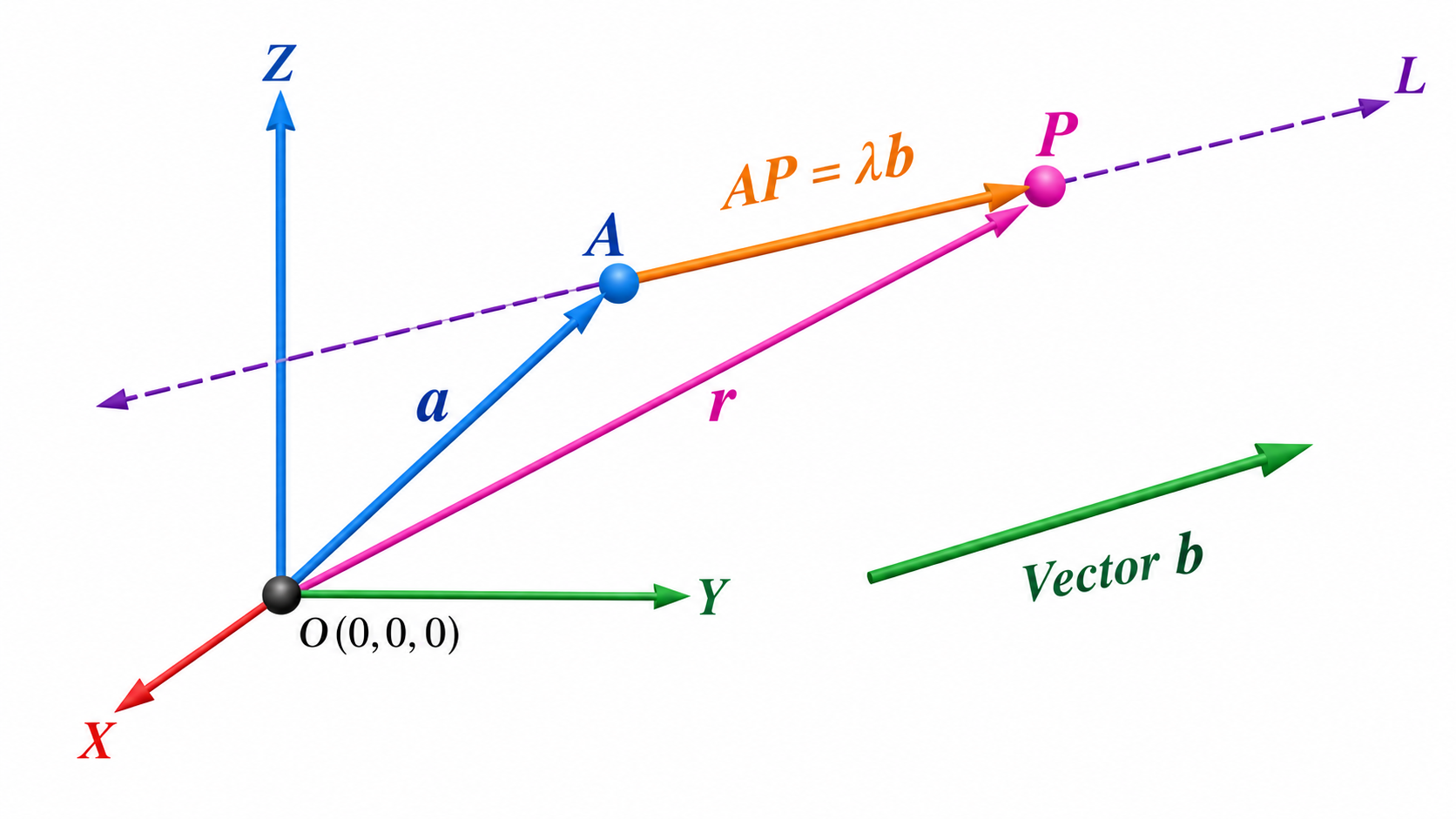
Figure 2.1: Line $L$ passing through point $A(\vec{a})$ and parallel to given vector $\vec{b}$.
Case A: Point-Direction Form
Equation of a line passing through a given point $A(x_1, y_1, z_1)$ with position vector $\vec{a}$ and parallel to a given vector $\vec{b} = a\hat{i} + b\hat{j} + c\hat{k}$ (having direction ratios $a, b, c$):
Note: If direction cosines $l, m, n$ are used instead of ratios, the equation is:
$$\frac{x - x_1}{l} = \frac{y - y_1}{m} = \frac{z - z_1}{n} = r$$
where $|r|$ represents the actual directed distance from point $(x_1, y_1, z_1)$ to any point $(x, y, z)$ on the line.
Case B: Two-Point Form
Equation of a line passing through two distinct points $A(x_1, y_1, z_1)$ and $B(x_2, y_2, z_2)$ with position vectors $\vec{a}$ and $\vec{b}$ respectively:
Crucial Board Alert: Standard vs Non-Standard Forms
In CBSE Board questions, lines are frequently given in non-standard Cartesian forms designed to trap students. In the standard Cartesian form:
$$\frac{x - x_1}{a} = \frac{y - y_1}{b} = \frac{z - z_1}{c}$$
The coefficients of $x, y, z$ MUST BE EXACTLY $+1$.
To find the coordinates of any arbitrary point on the line $\frac{x - x_1}{a} = \frac{y - y_1}{b} = \frac{z - z_1}{c}$, equate each ratio to a scalar parameter $\lambda$:
The general point is $\mathbf{(a\lambda + x_1, \; b\lambda + y_1, \; c\lambda + z_1)}$. This parametric representation is the master key to solving intersection, foot of perpendicular, and reflection problems.
3. Collinearity of Three Points
Methods to Prove Collinearity
Three given points $A(x_1, y_1, z_1)$, $B(x_2, y_2, z_2)$, and $C(x_3, y_3, z_3)$ are collinear if:
Method 1 (Proportional Direction Ratios): The direction ratios of segment $AB$ and segment $BC$ are directly proportional:
$$ \frac{x_2 - x_1}{x_3 - x_2} = \frac{y_2 - y_1}{y_3 - y_2} = \frac{z_2 - z_1}{z_3 - z_2} $$
Since point $B$ is common to both segments, $A, B, C$ must lie on a single line.
Method 3 (Point Satisfaction): Form the two-point line equation through $A$ and $B$, then show that the coordinates of $C$ satisfy this line equation.
Board Question 2: Collinearity Check (2 Marks)Question: Show that the points $P(2, 3, 4)$, $Q(-1, -2, 1)$, and $R(5, 8, 7)$ are collinear.
Step-by-step Board Solution:
1. Direction ratios of segment $PQ$ ($a_1, b_1, c_1$):
$a_1 = -1 - 2 = -3, \quad b_1 = -2 - 3 = -5, \quad c_1 = 1 - 4 = -3$
So DRs of $PQ$ are $(-3, -5, -3)$ or $(3, 5, 3)$.
2. Direction ratios of segment $QR$ ($a_2, b_2, c_2$):
$a_2 = 5 - (-1) = 6, \quad b_2 = 8 - (-2) = 10, \quad c_2 = 7 - 1 = 6$
So DRs of $QR$ are $(6, 10, 6)$.
3. Check proportionality of direction ratios:
$\frac{a_1}{a_2} = \frac{-3}{6} = -\frac{1}{2}, \quad \frac{b_1}{b_2} = \frac{-5}{10} = -\frac{1}{2}, \quad \frac{c_1}{c_2} = \frac{-3}{6} = -\frac{1}{2}$
Since $\frac{a_1}{a_2} = \frac{b_1}{b_2} = \frac{c_1}{c_2}$, the lines $PQ$ and $QR$ are parallel. Since point $Q$ is common to both segments, the points $P, Q,$ and $R$ must lie along the same straight line. Hence, $P, Q, R$ are collinear.
4. Angle Between Two Lines
The acute angle $\theta$ between two lines is equal to the angle between their respective direction vectors $\vec{b_1}$ and $\vec{b_2}$.
Board Question 3: Unknown Parameter for Orthogonality (3 Marks)Question: Find the value of $k$ so that the lines $\frac{x - 1}{-3} = \frac{y - 2}{2k} = \frac{z - 3}{2}$ and $\frac{x - 1}{3k} = \frac{y - 1}{1} = \frac{6 - z}{5}$ are perpendicular to each other.
Step-by-step Board Solution:
1. Standardise Line Equations:
- Line 1: $\frac{x - 1}{-3} = \frac{y - 2}{2k} = \frac{z - 3}{2}$. Already in standard form.
Direction ratios: $a_1 = -3, \; b_1 = 2k, \; c_1 = 2$.
5. Shortest Distance Between Two Lines (5-Mark CBSE Guarantee)
In 3D space, two straight lines can be parallel, intersecting, or skew. Lines that are neither parallel nor intersecting are called Skew Lines. They lie in non-parallel, distinct planes.
Figure 5.1: Skew lines $L_1$ and $L_2$ with common perpendicular segment $ST$ measuring shortest distance $d$.
Shortest Distance Formulas
1. Between Two Skew Lines:
For $L_1: \vec{r} = \vec{a_1} + \lambda\vec{b_1}$ and $L_2: \vec{r} = \vec{a_2} + \mu\vec{b_2}$:
$$\mathbf{d = \left| \frac{(\vec{b_1} \times \vec{b_2}) \cdot (\vec{a_2} - \vec{a_1})}{|\vec{b_1} \times \vec{b_2}|} \right|}$$
2. Between Two Parallel Lines:
If lines are parallel, their direction vectors are identical or scalar multiples: $L_1: \vec{r} = \vec{a_1} + \lambda\vec{b}$ and $L_2: \vec{r} = \vec{a_2} + \mu\vec{b}$:
$$\mathbf{d = \left| \frac{\vec{b} \times (\vec{a_2} - \vec{a_1})}{|\vec{b}|} \right|}$$
Board Strategy: Skew vs Parallel Lines
Before calculating shortest distance, ALWAYS inspect the direction vectors $\vec{b_1}$ and $\vec{b_2}$:
- If $\vec{b_1} \propto \vec{b_2}$, the lines are parallel. You MUST use the cross-product formula $\left|\frac{\vec{b} \times (\vec{a_2} - \vec{a_1})}{|\vec{b}|}\right|$. Applying the skew formula will yield $\vec{b_1} \times \vec{b_2} = \vec{0}$ in the denominator ($0/0$, indeterminate).
- If $\vec{b_1} \not\propto \vec{b_2}$, the lines are skew or intersecting. Use the standard skew line formula.
Board Question 4: Shortest Distance Between Skew Lines (5 Marks)Question: Find the shortest distance between the following lines:
$L_1: \frac{x + 1}{7} = \frac{y + 1}{-6} = \frac{z + 1}{1}$
$L_2: \frac{x - 3}{1} = \frac{y - 5}{-2} = \frac{z - 7}{1}$
Step-by-step Board Solution:
1. Extract points and direction vectors:
- For $L_1$: Point $\vec{a_1} = -\hat{i} - \hat{j} - \hat{k}$; direction vector $\vec{b_1} = 7\hat{i} - 6\hat{j} + \hat{k}$.
- For $L_2$: Point $\vec{a_2} = 3\hat{i} + 5\hat{j} + 7\hat{k}$; direction vector $\vec{b_2} = \hat{i} - 2\hat{j} + \hat{k}$.
Two lines are said to be coplanar if they lie within the same plane. Two non-parallel lines in space are coplanar if and only if they intersect.
Conditions for Coplanarity
Vector Condition: Lines $L_1: \vec{r} = \vec{a_1} + \lambda\vec{b_1}$ and $L_2: \vec{r} = \vec{a_2} + \mu\vec{b_2}$ are coplanar if and only if their shortest distance is zero:
$$\mathbf{(\vec{a_2} - \vec{a_1}) \cdot (\vec{b_1} \times \vec{b_2}) = 0}$$
Standard Algorithm: Finding Point of Intersection of Two Lines
If two lines intersect, their point of intersection can be determined systematically:
Express a general point on Line 1 in terms of parameter $\lambda$: $P(a_1\lambda + x_1, \; b_1\lambda + y_1, \; c_1\lambda + z_1)$.
Express a general point on Line 2 in terms of parameter $\mu$: $Q(a_2\mu + x_2, \; b_2\mu + y_2, \; c_2\mu + z_2)$.
Equate corresponding $x, y, z$ coordinates to form three linear equations in $\lambda$ and $\mu$.
Solve any two equations simultaneously for $\lambda$ and $\mu$.
Substitute the values of $\lambda$ and $\mu$ into the third (unused) equation. If it is satisfied, the lines intersect; if not satisfied, they are skew.
Substitute $\lambda$ into point $P$ to obtain the exact coordinates of the intersection point.
Board Question 6: Intersection of Two Lines (3/5 Marks)Question: Check whether the lines $\frac{x - 1}{2} = \frac{y - 2}{3} = \frac{z - 3}{4}$ and $\frac{x - 4}{5} = \frac{y - 1}{2} = z$ intersect. If they do, find their point of intersection.
Step-by-step Board Solution:
1. Let general point on Line 1 be $P$ in terms of $\lambda$:
$\frac{x - 1}{2} = \frac{y - 2}{3} = \frac{z - 3}{4} = \lambda \implies P(2\lambda + 1, \; 3\lambda + 2, \; 4\lambda + 3)$.
2. Let general point on Line 2 be $Q$ in terms of $\mu$ (standardise $z = \frac{z - 0}{1}$):
$\frac{x - 4}{5} = \frac{y - 1}{2} = \frac{z - 0}{1} = \mu \implies Q(5\mu + 4, \; 2\mu + 1, \; \mu)$.
4. Solve equations (i) and (ii):
Multiply (i) by 3 and (ii) by 2:
$6\lambda - 15\mu = 9$
$6\lambda - 4\mu = -2$
Subtract: $-11\mu = 11 \implies \mu = -1$.
Substitute $\mu = -1$ into (i): $2\lambda - 5(-1) = 3 \implies 2\lambda + 5 = 3 \implies 2\lambda = -2 \implies \lambda = -1$.
5. Check consistency in equation (iii):
LHS = $4\lambda - \mu = 4(-1) - (-1) = -4 + 1 = -3 =$ RHS. (Satisfied!)
Since the values satisfy all three equations, the lines intersect.
6. Substitute $\lambda = -1$ into coordinates of $P$:
$x = 2(-1) + 1 = -1, \quad y = 3(-1) + 2 = -1, \quad z = 4(-1) + 3 = -1$. Point of Intersection: $\mathbf{(-1, -1, -1)}$.
7. Foot of Perpendicular, Length, and Image of a Point
A classic, high-frequency 5-mark question in Class 12 Boards requires finding the foot of the perpendicular from a given point to a line, the perpendicular distance (length), and the reflected image.
Figure 7.1: Geometry of Foot of Perpendicular $Q$ and Reflected Image $P'$.
Board Step-by-Step Algorithm
Write parametric point $Q$: Express general coordinates of foot $Q$ on line $L$ in terms of parameter $\lambda$.
Direction Ratios of $PQ$: Form DRs of segment $PQ$:
$$ (x_Q - x_P, \quad y_Q - y_P, \quad z_Q - z_P) $$
Apply Perpendicularity Condition: Since $PQ \perp \text{Line } L$, the dot product of their direction ratios is zero:
$$ a(x_Q - x_P) + b(y_Q - y_P) + c(z_Q - z_P) = 0 $$
Solve for $\lambda$: Substitute $\lambda$ back into $Q$ to get the Foot of the Perpendicular.
Board Question 7: Complete Foot, Length & Image Problem (5 Marks)Question: Find the coordinates of the foot of the perpendicular, length of the perpendicular, and the image of the point $P(1, 6, 3)$ with respect to the line $\frac{x}{1} = \frac{y - 1}{2} = \frac{z - 2}{3}$.
8. CBSE Board Pattern Case-Based Practice Question
Board Case Study: Air Traffic Navigation (4 Marks)Context: Two commercial aircraft $F_1$ and $F_2$ are operating within a high-altitude air corridor monitored by radar from an air traffic control (ATC) tower located at the origin $(0, 0, 0)$. At a given moment, their flight trajectories are modeled by straight lines:
Flight $F_1: \vec{r} = (3\hat{i} + 8\hat{j} + 3\hat{k}) + \lambda(3\hat{i} - \hat{j} + \hat{k})$
Flight $F_2: \vec{r} = (-3\hat{i} - 7\hat{j} + 6\hat{k}) + \mu(-3\hat{i} + 2\hat{j} + 4\hat{k})$
(Coordinates represent distances in kilometers).
Sub-questions:
(i) Find the direction ratios of the trajectories of flights $F_1$ and $F_2$. (1 Mark)
(ii) Check whether the flight paths are parallel to each other. (1 Mark)
(iii) Find the shortest distance between the two flight paths to ensure safe vertical/lateral separation. (2 Marks)
Step-by-step Solution: (i) Direction Ratios:
- For Flight $F_1$: Direction vector $\vec{b_1} = 3\hat{i} - \hat{j} + \hat{k} \implies$ DRs are $\mathbf{(3, -1, 1)}$.
- For Flight $F_2$: Direction vector $\vec{b_2} = -3\hat{i} + 2\hat{j} + 4\hat{k} \implies$ DRs are $\mathbf{(-3, 2, 4)}$.
(ii) Check for Parallelism:
Examine ratio of direction ratios: $\frac{a_1}{a_2} = \frac{3}{-3} = -1$; $\frac{b_1}{b_2} = \frac{-1}{2} = -0.5$.
Since $\frac{a_1}{a_2} \neq \frac{b_1}{b_2}$, the flight paths are not parallel.
9. Extended Competitive Corner: The Plane (JEE Main / State Boards)
Excluded from CBSE Board ExamNote: While Planes have been completely omitted from the CBSE Class 12 Rationalised Board syllabus, they remain syllabus-active in JEE Main, JEE Advanced, and select State CETs. This compact summary serves your competitive reference.
Plane Equations & Formulas
1. General First Degree Cartesian Equation: $Ax + By + Cz + D = 0$, where $(A, B, C)$ are the direction ratios of the normal vector $\vec{n} = A\hat{i} + B\hat{j} + C\hat{k}$.
2. Normal Form: $\mathbf{\vec{r} \cdot \hat{n} = d}$ (Vector) $\iff \mathbf{lx + my + nz = d}$ (Cartesian), where $d$ is the perpendicular distance from the origin and $\hat{n}$ is the unit normal.
3. Point & Normal Form: Passing through $\vec{a}(x_1, y_1, z_1)$ with normal $\vec{n}(A, B, C)$:
$\mathbf{(\vec{r} - \vec{a}) \cdot \vec{n} = 0} \iff \mathbf{A(x - x_1) + B(y - y_1) + C(z - z_1) = 0}$.
4. Intercept Form: If intercepts on axes are $a, b, c$: $\mathbf{\frac{x}{a} + \frac{y}{b} + \frac{z}{c} = 1}$.
5. Distance of Point from Plane: Distance of $(x_1, y_1, z_1)$ from $Ax + By + Cz + D = 0$ is $\mathbf{d = \left|\frac{Ax_1 + By_1 + Cz_1 + D}{\sqrt{A^2 + B^2 + C^2}}\right|}$.
6. Angle Between Line and Plane: Between line with direction $\vec{b}$ and plane with normal $\vec{n}$:
$$\mathbf{\sin\theta = \left| \frac{\vec{b} \cdot \vec{n}}{|\vec{b}| |\vec{n}|} \right|}$$