Vardaan Watermark
Vardaan Learning Institute
Class 12 Mathematics • Comprehensive Chapter Notes
🌐 vardaanlearning.comπŸ“ž 9508841336

Chapter 7: Integrals

Board | JEE Mains | NDA/CDS β€” All Concepts, All Methods, All Problem Types with Detailed Solutions

πŸ“– To the Student: Integration is the most skill-intensive chapter of Class 12 Mathematics. Unlike differentiation (which follows rigid rules), integration requires creativity β€” choosing the right method is everything. Boards guarantee 10–12 marks from this chapter. JEE tests 3–4 tricky questions. NDA/CDS tests standard substitutions and definite integral properties. This file covers every concept from scratch. Build each method step by step.


1. The Big Picture: What is Integration?

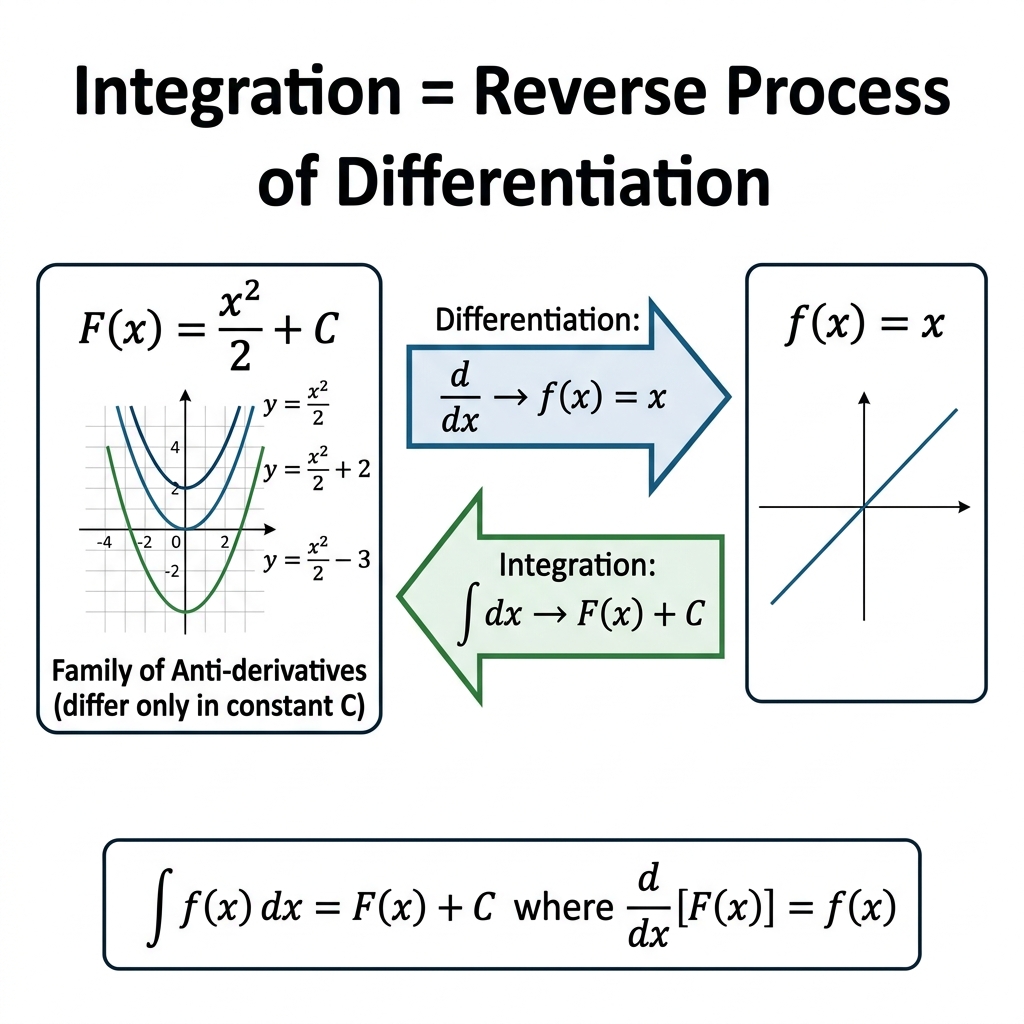
Integration as reverse of differentiation diagram

Fig 1.1 β€” Integration reverses differentiation. The constant C arises because the derivative of any constant is zero, giving a family of parallel curves.

Core Definition If $\dfrac{d}{dx}[F(x)] = f(x)$, then $F(x)$ is called an antiderivative (or primitive) of $f(x)$.

The Indefinite Integral of $f(x)$: $$\int f(x)\,dx = F(x) + C$$ where $C$ = Constant of Integration (any real number).

Why $+C$? The derivative of any constant is zero. So $\dfrac{d}{dx}(x^2) = 2x$, $\dfrac{d}{dx}(x^2+5) = 2x$, $\dfrac{d}{dx}(x^2-100) = 2x$. All are valid antiderivatives of $2x$. So $\int 2x\,dx = x^2 + C$ represents the entire family.
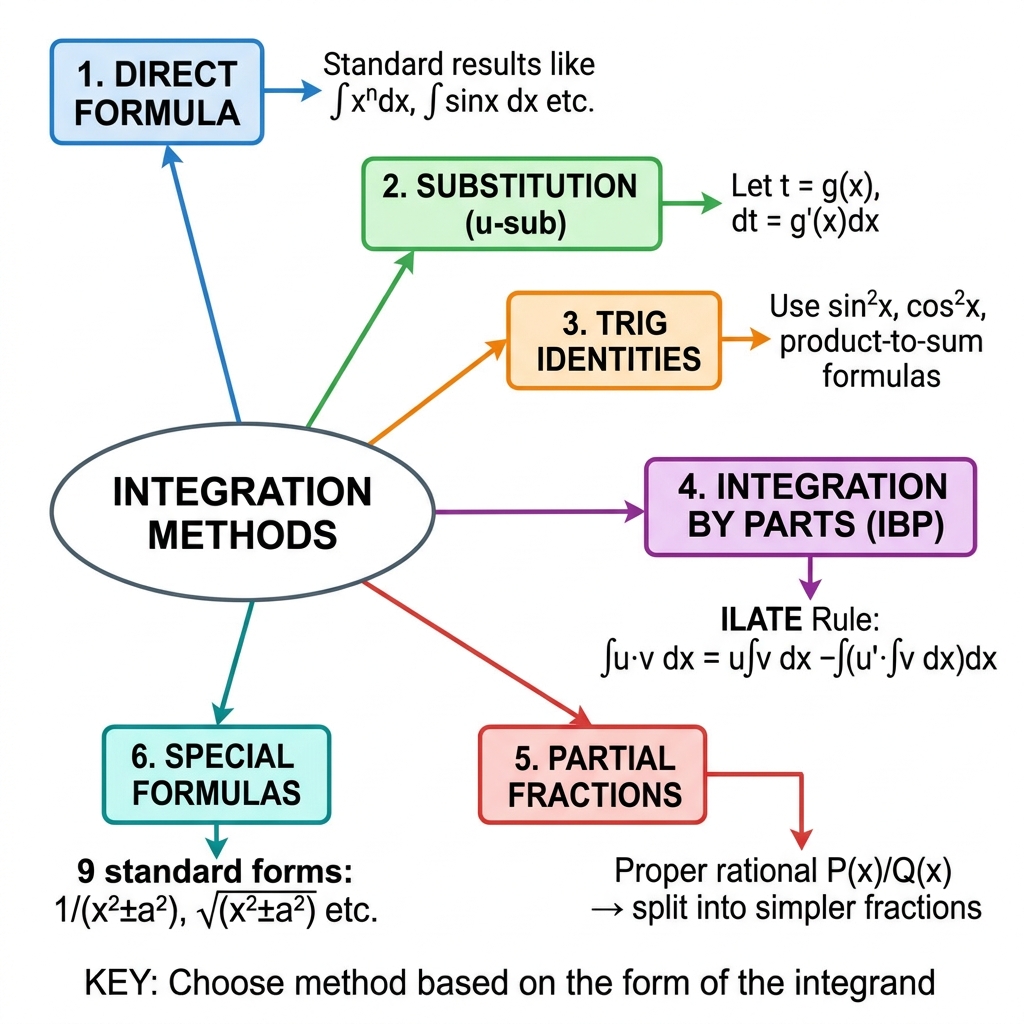
Methods of Integration mindmap

Fig 1.2 β€” All 6 methods of integration. The key skill is identifying which method applies to a given integrand.

Properties of Indefinite Integrals

Basic Properties P1: $\int [f(x) \pm g(x)]\,dx = \int f(x)\,dx \pm \int g(x)\,dx$   (Sum/Difference splits)
P2: $\int k \cdot f(x)\,dx = k\int f(x)\,dx$   (Constants factor out)
P3: $\dfrac{d}{dx}\left[\int f(x)\,dx\right] = f(x)$   (Differentiation undoes integration)
P4: $\int f'(x)\,dx = f(x) + C$   (Integration undoes differentiation)
P5 (Chain Rule Reverse): $\int f(ax+b)\,dx = \dfrac{1}{a}F(ax+b) + C$ where $F' = f$
Example: $\int \sin(3x+2)\,dx = \dfrac{-\cos(3x+2)}{3} + C$

Standard Integration Formulas β€” Complete Table (Must Memorize All)

$f(x)$$\int f(x)\,dx$$f(x)$$\int f(x)\,dx$
$x^n$  $(n \ne -1)$$\dfrac{x^{n+1}}{n+1} + C$$\sin^{-1}x$(use IBP)
$\dfrac{1}{x}$$\ln|x| + C$$\dfrac{1}{\sqrt{1-x^2}}$$\sin^{-1}x + C$
$e^x$$e^x + C$$\dfrac{-1}{\sqrt{1-x^2}}$$\cos^{-1}x + C$
$a^x$$\dfrac{a^x}{\ln a} + C$$\dfrac{1}{1+x^2}$$\tan^{-1}x + C$
$\sin x$$-\cos x + C$$\dfrac{-1}{1+x^2}$$\cot^{-1}x + C$
$\cos x$$\sin x + C$$\dfrac{1}{x\sqrt{x^2-1}}$$\sec^{-1}x + C$
$\tan x$$\ln|\sec x| + C$$\dfrac{-1}{x\sqrt{x^2-1}}$$\csc^{-1}x + C$
$\cot x$$\ln|\sin x| + C$$\sinh x$$\cosh x + C$
$\sec x$$\ln|\sec x + \tan x| + C$$\cosh x$$\sinh x + C$
$\csc x$$\ln|\csc x - \cot x| + C$$e^{ax}$$\dfrac{e^{ax}}{a} + C$
$\sec^2 x$$\tan x + C$$\dfrac{1}{x^2+a^2}$$\dfrac{1}{a}\tan^{-1}\!\left(\dfrac{x}{a}\right) + C$
$\csc^2 x$$-\cot x + C$$\dfrac{1}{\sqrt{a^2-x^2}}$$\sin^{-1}\!\left(\dfrac{x}{a}\right) + C$
$\sec x\tan x$$\sec x + C$$\sqrt{x}$$\dfrac{2}{3}x^{3/2} + C$
$\csc x\cot x$$-\csc x + C$$\dfrac{1}{\sqrt{x}}$$2\sqrt{x} + C$

2. Method 1 β€” Direct Integration & Simplification

Many integrals can be solved by first simplifying/expanding the expression algebraically or trigonometrically so that each term matches a standard formula.

Problem 1 β€” Expand First Board Q: Evaluate $\displaystyle\int \!\left(\sqrt{x} + \frac{1}{\sqrt{x}}\right)^2 dx$
Expand: $\left(\sqrt{x}+x^{-1/2}\right)^2 = x + \dfrac{1}{x} + 2$
$\displaystyle\int\!\left(x + \frac{1}{x} + 2\right)dx = \frac{x^2}{2} + \ln|x| + 2x + C$
Problem 2 β€” Trig Simplify First Board Q: Evaluate $\displaystyle\int \frac{\cos 2x - \cos 2\alpha}{\cos x - \cos\alpha}\,dx$
Use $\cos 2\theta = 2\cos^2\theta - 1$: Numerator $= (2\cos^2 x - 1) - (2\cos^2\alpha - 1) = 2(\cos^2 x - \cos^2\alpha)$
$= 2(\cos x + \cos\alpha)(\cos x - \cos\alpha)$
After cancellation: $\displaystyle\int 2(\cos x + \cos\alpha)\,dx = 2\sin x + 2x\cos\alpha + C$
Problem 3 β€” Chain Rule Direct Board Q: Evaluate $\displaystyle\int (4x+5)^7\,dx$
Using $\displaystyle\int f(ax+b)\,dx = \dfrac{F(ax+b)}{a} + C$:
$= \dfrac{(4x+5)^8}{8 \times 4} + C = \boxed{\dfrac{(4x+5)^8}{32} + C}$
Problem 4 β€” Partial Simplification NDA Q: Evaluate $\displaystyle\int \frac{x^4 - 1}{x^2 + 1}\,dx$
$\dfrac{x^4-1}{x^2+1} = \dfrac{(x^2+1)(x^2-1)}{x^2+1} = x^2 - 1$
$\displaystyle\int(x^2-1)\,dx = \dfrac{x^3}{3} - x + C$

3. Method 2 β€” Integration by Substitution (u-Substitution)

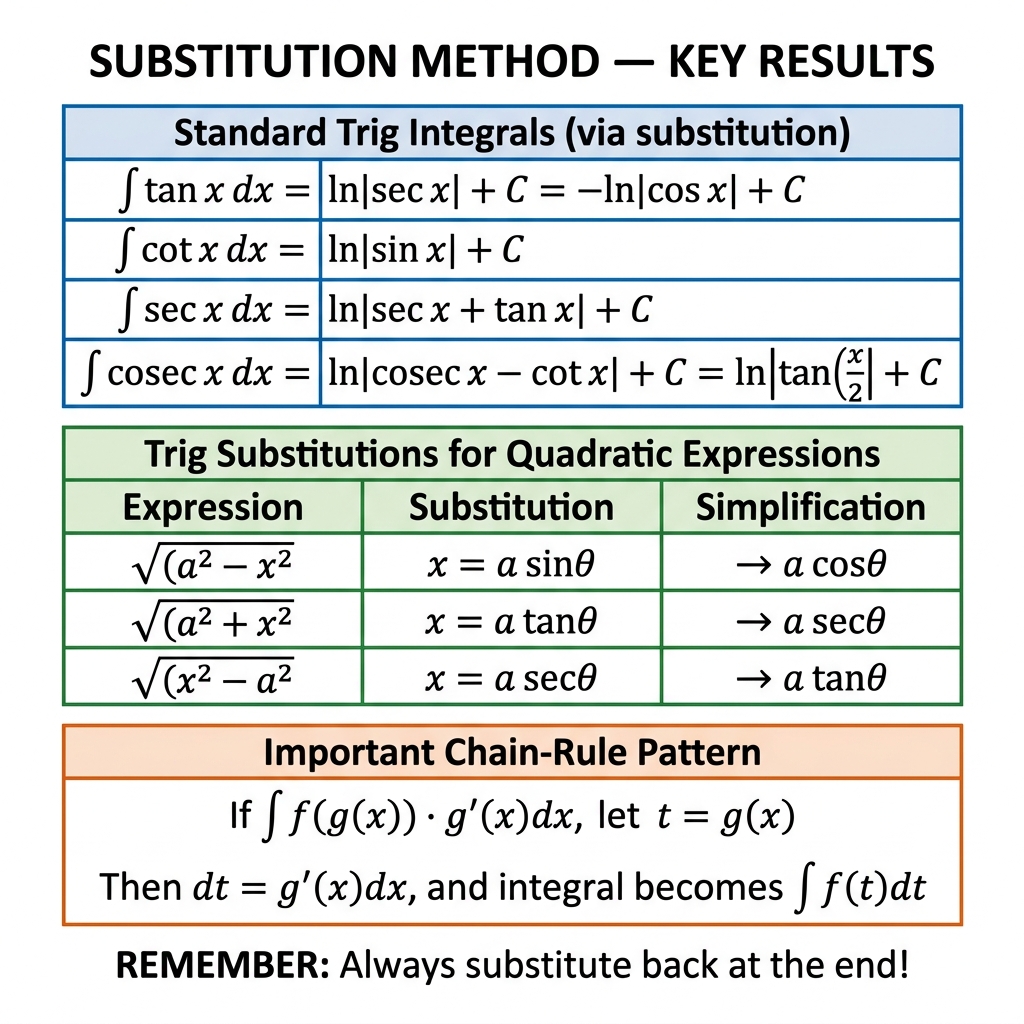
Substitution method key results

Fig 3.1 β€” Key substitution results including standard trig integrals and trigonometric substitutions for quadratic expressions.

The Substitution Algorithm Recognition: Look for $\displaystyle\int f(g(x)) \cdot g'(x)\,dx$ β€” a composite function multiplied by the derivative of its inner function.

Step 1: Let $t = g(x)$ (the inner/complicated part).
Step 2: Differentiate: $\dfrac{dt}{dx} = g'(x)$, so $\mathbf{g'(x)\,dx = dt}$.
Step 3: Substitute EVERYTHING: replace $g(x)$ with $t$, replace $g'(x)\,dx$ with $dt$.
Step 4: Integrate in $t$ (simpler!). Then back-substitute $t = g(x)$.

Key Insight: If $\displaystyle\int \frac{f'(x)}{f(x)}\,dx$ β€” this always gives $\ln|f(x)| + C$ (substitute $t = f(x)$).

Standard Trig Integrals Derived via Substitution

Derivations (Understand, Not Just Memorize) $\int\tan x\,dx$: $= \displaystyle\int\dfrac{\sin x}{\cos x}\,dx$. Let $t = \cos x$, $dt = -\sin x\,dx$. $= -\int\dfrac{dt}{t} = -\ln|t| = \ln|\sec x| + C$

$\int\cot x\,dx$: $= \displaystyle\int\dfrac{\cos x}{\sin x}\,dx$. Let $t = \sin x$. $= \ln|\sin x| + C$

$\int\sec x\,dx$: Multiply by $\dfrac{\sec x+\tan x}{\sec x+\tan x}$: Let $t = \sec x+\tan x$, $dt = \sec x(\tan x+\sec x)\,dx$. $= \ln|\sec x+\tan x| + C$

$\int\csc x\,dx$: Multiply by $\dfrac{\csc x-\cot x}{\csc x-\cot x}$: $= \ln|\csc x-\cot x| + C$
Problem 5 β€” Direct Substitution Board Q: Evaluate $\displaystyle\int \frac{e^{\tan^{-1}x}}{1+x^2}\,dx$
Let $t = \tan^{-1}x \Rightarrow dt = \dfrac{dx}{1+x^2}$
$= \displaystyle\int e^t\,dt = e^t + C = \boxed{e^{\tan^{-1}x} + C}$
Problem 6 β€” Numerator is Derivative of Denominator Board Q: Evaluate $\displaystyle\int \frac{2x}{x^2+1}\,dx$
Numerator $= \dfrac{d}{dx}(x^2+1)$. So Let $t = x^2+1$, $dt = 2x\,dx$.
$= \displaystyle\int\dfrac{dt}{t} = \ln|t| + C = \boxed{\ln(x^2+1) + C}$
Key pattern: $\displaystyle\int\dfrac{f'(x)}{f(x)}\,dx = \ln|f(x)| + C$
Problem 7 β€” Power with Composite Board NDA Q: Evaluate $\displaystyle\int \frac{\sin(\ln x)}{x}\,dx$
Let $t = \ln x \Rightarrow dt = \dfrac{dx}{x}$
$= \displaystyle\int\sin t\,dt = -\cos t + C = \boxed{-\cos(\ln x) + C}$
Problem 8 β€” Substitution with Adjustment Board Q: Evaluate $\displaystyle\int x\,e^{x^2}\,dx$
Let $t = x^2 \Rightarrow dt = 2x\,dx \Rightarrow x\,dx = \dfrac{dt}{2}$
$= \dfrac{1}{2}\displaystyle\int e^t\,dt = \dfrac{1}{2}e^t + C = \boxed{\dfrac{1}{2}e^{x^2} + C}$
Problem 9 β€” Trig Substitution JEE NDA Q: Evaluate $\displaystyle\int \frac{dx}{\sqrt{a^2-x^2}}$ using trig substitution.
Let $x = a\sin\theta \Rightarrow dx = a\cos\theta\,d\theta$, $\sqrt{a^2-x^2} = a\cos\theta$.
$= \displaystyle\int\dfrac{a\cos\theta\,d\theta}{a\cos\theta} = \int d\theta = \theta + C = \sin^{-1}\!\left(\dfrac{x}{a}\right) + C$

Three Key Trig Substitutions

When to Use Each Expression $\sqrt{a^2 - x^2}$: Substitute $x = a\sin\theta$   β†’   $\sqrt{a^2-a^2\sin^2\theta} = a\cos\theta$
Expression $\sqrt{a^2 + x^2}$: Substitute $x = a\tan\theta$   β†’   $\sqrt{a^2+a^2\tan^2\theta} = a\sec\theta$
Expression $\sqrt{x^2 - a^2}$: Substitute $x = a\sec\theta$   β†’   $\sqrt{a^2\sec^2\theta-a^2} = a\tan\theta$

4. Integration Using Trigonometric Identities

Power Reduction & Product-to-Sum

Essential Trig Identities for Integration Power Reduction (Most Tested):
$\sin^2 x = \dfrac{1-\cos 2x}{2}$    $\cos^2 x = \dfrac{1+\cos 2x}{2}$    $\tan^2 x = \sec^2 x - 1$
$\sin^3 x = \dfrac{3\sin x - \sin 3x}{4}$    $\cos^3 x = \dfrac{3\cos x + \cos 3x}{4}$

Product to Sum/Difference:
$2\sin A\cos B = \sin(A+B) + \sin(A-B)$
$2\cos A\sin B = \sin(A+B) - \sin(A-B)$
$2\cos A\cos B = \cos(A+B) + \cos(A-B)$
$2\sin A\sin B = \cos(A-B) - \cos(A+B)$
Problem 10 β€” Power of sin Board Q: Evaluate $\displaystyle\int\sin^2 x\,dx$
$\sin^2 x = \dfrac{1-\cos 2x}{2}$
$= \dfrac{1}{2}\displaystyle\int(1-\cos 2x)\,dx = \dfrac{1}{2}\left[x - \dfrac{\sin 2x}{2}\right] + C = \boxed{\dfrac{x}{2} - \dfrac{\sin 2x}{4} + C}$
Problem 11 β€” Power of cosΒ³ Board Q: Evaluate $\displaystyle\int\cos^3 x\,dx$
Method 1 (Formula): $\cos^3 x = \dfrac{3\cos x + \cos 3x}{4}$
$= \dfrac{1}{4}\left[3\sin x + \dfrac{\sin 3x}{3}\right] + C = \boxed{\dfrac{3\sin x}{4} + \dfrac{\sin 3x}{12} + C}$

Method 2 (Substitution): $\cos^3 x = \cos^2 x \cdot \cos x = (1-\sin^2 x)\cos x$
Let $t = \sin x$, $dt = \cos x\,dx$: $= \displaystyle\int(1-t^2)\,dt = t - \dfrac{t^3}{3} + C = \sin x - \dfrac{\sin^3 x}{3} + C$
Problem 12 β€” Product sinΒ·cos Board Q: Evaluate $\displaystyle\int\sin 3x\cos 4x\,dx$
$2\sin 3x\cos 4x = \sin(3x+4x) + \sin(3x-4x) = \sin 7x + \sin(-x) = \sin 7x - \sin x$
$= \dfrac{1}{2}\displaystyle\int(\sin 7x - \sin x)\,dx = \dfrac{1}{2}\left[-\dfrac{\cos 7x}{7} + \cos x\right] + C = \boxed{-\dfrac{\cos 7x}{14} + \dfrac{\cos x}{2} + C}$

Weierstrass Substitution (t = tan x/2) β€” For ∫dx/(a + b sin x)

Weierstrass / Half-Angle Substitution (JEE Favorite) For integrals of type $\displaystyle\int \dfrac{dx}{a + b\sin x}$, $\displaystyle\int \dfrac{dx}{a + b\cos x}$, $\displaystyle\int \dfrac{dx}{a\sin x + b\cos x}$:

Let $t = \tan\dfrac{x}{2}$, then: $$\sin x = \dfrac{2t}{1+t^2}, \quad \cos x = \dfrac{1-t^2}{1+t^2}, \quad dx = \dfrac{2\,dt}{1+t^2}$$ This converts ANY rational trig function into a rational function of $t$.
Problem 13 β€” Weierstrass JEE Board Q: Evaluate $\displaystyle\int \dfrac{dx}{1 + \sin x}$
Let $t = \tan(x/2)$: $\sin x = \dfrac{2t}{1+t^2}$, $dx = \dfrac{2\,dt}{1+t^2}$.
$= \displaystyle\int \dfrac{1}{1 + \frac{2t}{1+t^2}} \cdot \dfrac{2\,dt}{1+t^2} = \int \dfrac{2\,dt}{(1+t)^2} = -\dfrac{2}{1+t} + C = \boxed{-\dfrac{2}{1+\tan(x/2)} + C}$

Alternative faster method: Multiply by $\dfrac{1-\sin x}{1-\sin x}$: $\displaystyle\int\dfrac{1-\sin x}{\cos^2 x}\,dx = \int(\sec^2 x - \sec x\tan x)\,dx = \tan x - \sec x + C$
Problem 14 β€” aΒ·sinx + bΒ·cosx type Board Q: Evaluate $\displaystyle\int \dfrac{dx}{3\sin x + 4\cos x}$
Write $3\sin x + 4\cos x = R\sin(x+\phi)$ where $R = \sqrt{9+16} = 5$, $\tan\phi = 4/3$.
$= \dfrac{1}{5}\displaystyle\int\csc(x+\phi)\,dx = \dfrac{1}{5}\ln|\csc(x+\phi) - \cot(x+\phi)| + C$

Or using Weierstrass: Let $t = \tan(x/2)$, $= \int\dfrac{2\,dt/(1+t^2)}{3 \cdot \frac{2t}{1+t^2} + 4 \cdot \frac{1-t^2}{1+t^2}} = \int\dfrac{2\,dt}{6t+4-4t^2} = \int\dfrac{dt}{3t+2-2t^2}$. Complete the square and integrate.

5. The 9 Standard Special Forms β€” The Backbone of Integration

These 9 formulas appear repeatedly across Board, JEE, and NDA papers. Every quadratic integral eventually reduces to one of these. Memorize all 9.

Group 1 β€” Without Square Roots (Algebraic Forms) $$\int \frac{dx}{x^2 - a^2} = \frac{1}{2a}\ln\left|\frac{x-a}{x+a}\right| + C \qquad\qquad (1)$$ $$\int \frac{dx}{a^2 - x^2} = \frac{1}{2a}\ln\left|\frac{a+x}{a-x}\right| + C \qquad\qquad (2)$$ $$\int \frac{dx}{x^2 + a^2} = \frac{1}{a}\tan^{-1}\!\left(\frac{x}{a}\right) + C \qquad\qquad (3)$$
Group 2 β€” With Square Root in Denominator $$\int \frac{dx}{\sqrt{x^2 - a^2}} = \ln\!\left|x + \sqrt{x^2 - a^2}\right| + C \qquad\qquad (4)$$ $$\int \frac{dx}{\sqrt{x^2 + a^2}} = \ln\!\left|x + \sqrt{x^2 + a^2}\right| + C \qquad\qquad (5)$$ $$\int \frac{dx}{\sqrt{a^2 - x^2}} = \sin^{-1}\!\left(\frac{x}{a}\right) + C \qquad\qquad (6)$$
Group 3 β€” Square Root in Numerator (Derived via IBP) $$\int \sqrt{a^2 - x^2}\,dx = \frac{x}{2}\sqrt{a^2-x^2} + \frac{a^2}{2}\sin^{-1}\!\left(\frac{x}{a}\right) + C \qquad\qquad (7)$$ $$\int \sqrt{x^2 - a^2}\,dx = \frac{x}{2}\sqrt{x^2-a^2} - \frac{a^2}{2}\ln\!\left|x+\sqrt{x^2-a^2}\right| + C \qquad\qquad (8)$$ $$\int \sqrt{x^2 + a^2}\,dx = \frac{x}{2}\sqrt{x^2+a^2} + \frac{a^2}{2}\ln\!\left|x+\sqrt{x^2+a^2}\right| + C \qquad\qquad (9)$$ Memory trick: Every formula starts with $\dfrac{x}{2}(\text{same root})$. Second term: $\pm\dfrac{a^2}{2} \times (\text{corresponding denominator formula 4,5,6})$.

Completing the Square β€” Converting Quadratics to Standard Forms

Algorithm For $\displaystyle\int \dfrac{dx}{ax^2+bx+c}$ or $\displaystyle\int \dfrac{dx}{\sqrt{ax^2+bx+c}}$:
Step 1: Make coefficient of $x^2$ unity: take $a$ common.
Step 2: Complete the square: $x^2 + \dfrac{b}{a}x + \dfrac{c}{a} = \left(x + \dfrac{b}{2a}\right)^2 + \left(\dfrac{c}{a} - \dfrac{b^2}{4a^2}\right)$
Step 3: Identify: Does it match form (1), (2), or (3)? Formula (4), (5), or (6)?
Problem 15 β€” Completing the Square Board β˜…β˜… Q: Evaluate $\displaystyle\int \dfrac{dx}{x^2-6x+13}$
Complete the square: $x^2 - 6x + 13 = (x-3)^2 - 9 + 13 = (x-3)^2 + 4 = (x-3)^2 + 2^2$
Using Formula (3) with $X = x-3$, $a = 2$:
$= \dfrac{1}{2}\tan^{-1}\!\left(\dfrac{x-3}{2}\right) + C$
Problem 16 β€” Negative Discriminant Board Q: Evaluate $\displaystyle\int \dfrac{dx}{\sqrt{3-2x-x^2}}$
$3 - 2x - x^2 = -(x^2+2x-3) = -[(x+1)^2 - 4] = 4 - (x+1)^2 = 2^2 - (x+1)^2$
Using Formula (6) with $X = x+1$, $a = 2$:
$= \sin^{-1}\!\left(\dfrac{x+1}{2}\right) + C$

Linear Numerator Type: ∫(px+q)/(ax²+bx+c)dx

Key Algorithm (Board β˜…β˜…β˜… β€” Guaranteed) Express the linear numerator as: $px + q = A \cdot \dfrac{d}{dx}(ax^2+bx+c) + B$
i.e., $px + q = A(2ax+b) + B$
Equate coefficients to find $A$ and $B$. Then split: $$\int\frac{px+q}{ax^2+bx+c}\,dx = A\int\frac{2ax+b}{ax^2+bx+c}\,dx + B\int\frac{dx}{ax^2+bx+c}$$ The first part = $A\ln|ax^2+bx+c|$; second part uses completing-the-square.
Problem 17 β€” Linear/Quadratic Board β˜…β˜…β˜… Q: Evaluate $\displaystyle\int \dfrac{x+3}{x^2+4x+5}\,dx$
Let $x+3 = A(2x+4) + B$: Comparing: $2A = 1 \Rightarrow A = 1/2$; $4A+B = 3 \Rightarrow B = 1$.
$= \dfrac{1}{2}\displaystyle\int\dfrac{2x+4}{x^2+4x+5}\,dx + \int\dfrac{dx}{x^2+4x+5}$
First part: $\dfrac{1}{2}\ln(x^2+4x+5)$
Second: $x^2+4x+5 = (x+2)^2+1$ β†’ $\tan^{-1}(x+2)$
$$= \boxed{\dfrac{1}{2}\ln(x^2+4x+5) + \tan^{-1}(x+2) + C}$$
Problem 18 β€” Linear/Square Root Board Q: Evaluate $\displaystyle\int \dfrac{x+2}{\sqrt{x^2+4x+5}}\,dx$
$x+2 = A \cdot \dfrac{d}{dx}(x^2+4x+5) + B = A(2x+4)+B$
$2A = 1 \Rightarrow A=1/2$; $4A+B=2 \Rightarrow B=0$
$= \dfrac{1}{2}\displaystyle\int\dfrac{2x+4}{\sqrt{x^2+4x+5}}\,dx = \dfrac{1}{2} \cdot 2\sqrt{x^2+4x+5} + C = \boxed{\sqrt{x^2+4x+5} + C}$
(Using $\int\dfrac{f'(x)}{2\sqrt{f(x)}}\,dx = \sqrt{f(x)} + C$)

6. Method 3 β€” Integration by Partial Fractions

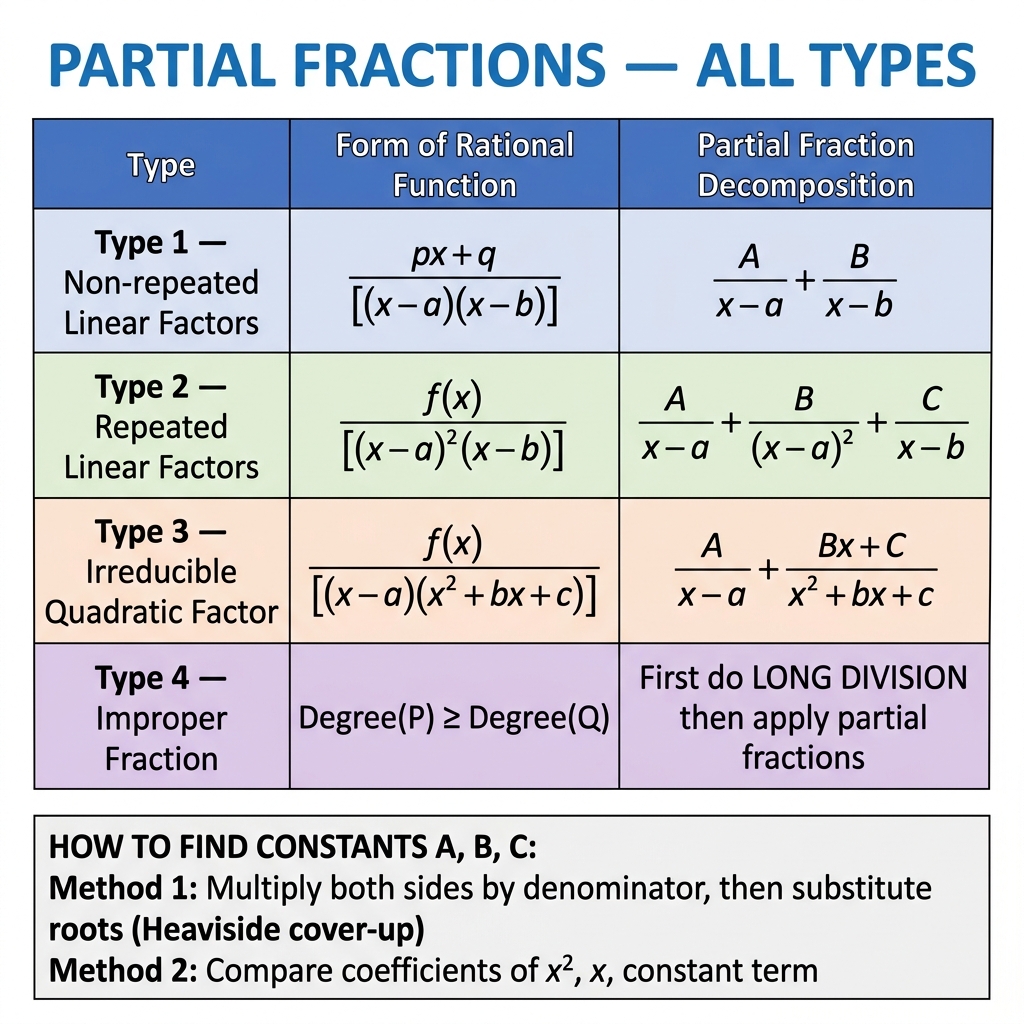
Partial fractions all types

Fig 6.1 β€” All four types of partial fraction decomposition. Always check if the fraction is proper first (degree of numerator < degree of denominator).

When to Use Use when the integrand is a rational function $\dfrac{P(x)}{Q(x)}$ where the denominator factors into linear or quadratic factors.

First check: Is it proper? (deg P < deg Q). If not, do long division first!

All Four Types

TypeDenominator FormDecomposition
Type 1 Non-repeated linear$(x-a)(x-b)$$\dfrac{A}{x-a} + \dfrac{B}{x-b}$
Type 2 Repeated linear$(x-a)^2(x-b)$$\dfrac{A}{x-a} + \dfrac{B}{(x-a)^2} + \dfrac{C}{x-b}$
Type 3 Irreducible quadratic$(x-a)(x^2+bx+c)$$\dfrac{A}{x-a} + \dfrac{Bx+C}{x^2+bx+c}$
Type 4 Improper fractiondeg(P) $\ge$ deg(Q)Long Division first, then decompose remainder
Problem 19 β€” Type 1: Non-repeated Linear Board Q: Evaluate $\displaystyle\int \dfrac{x}{(x-1)(x-2)}\,dx$
$\dfrac{x}{(x-1)(x-2)} = \dfrac{A}{x-1} + \dfrac{B}{x-2}$
Multiply both sides by $(x-1)(x-2)$: $x = A(x-2) + B(x-1)$
Put $x=1$: $1 = A(-1) \Rightarrow A = -1$.   Put $x=2$: $2 = B(1) \Rightarrow B = 2$.
$= \displaystyle\int\left(\dfrac{-1}{x-1} + \dfrac{2}{x-2}\right)dx = -\ln|x-1| + 2\ln|x-2| + C = \ln\dfrac{(x-2)^2}{|x-1|} + C$
Problem 20 β€” Type 2: Repeated Linear Board JEE Q: Evaluate $\displaystyle\int \dfrac{x^2+1}{x^2(x+1)}\,dx$
Decompose: $\dfrac{x^2+1}{x^2(x+1)} = \dfrac{A}{x} + \dfrac{B}{x^2} + \dfrac{C}{x+1}$
Multiply: $x^2+1 = Ax(x+1) + B(x+1) + Cx^2$
Put $x=0$: $1 = B$.   Put $x=-1$: $2 = C$.   Compare $x^2$: $A+C=1 \Rightarrow A=-1$.
$= \displaystyle\int\left(\dfrac{-1}{x} + \dfrac{1}{x^2} + \dfrac{2}{x+1}\right)dx = -\ln|x| - \dfrac{1}{x} + 2\ln|x+1| + C$
Problem 21 β€” Type 3: Quadratic Factor JEE Q: Evaluate $\displaystyle\int \dfrac{x^2+x+1}{(x+1)(x^2+1)}\,dx$
$\dfrac{x^2+x+1}{(x+1)(x^2+1)} = \dfrac{A}{x+1} + \dfrac{Bx+C}{x^2+1}$
Multiply: $x^2+x+1 = A(x^2+1) + (Bx+C)(x+1)$
Put $x=-1$: $1 = 2A \Rightarrow A=1/2$. Compare $x^2$: $A+B=1 \Rightarrow B=1/2$. Compare constant: $A+C=1 \Rightarrow C=1/2$.
$= \dfrac{1}{2}\displaystyle\int\dfrac{dx}{x+1} + \dfrac{1}{2}\int\dfrac{x+1}{x^2+1}\,dx$
$= \dfrac{1}{2}\ln|x+1| + \dfrac{1}{4}\ln(x^2+1) + \dfrac{1}{2}\tan^{-1}x + C$

Type 4 β€” Improper Fractions (Long Division First)

Problem 22 β€” Improper Fraction Board Q: Evaluate $\displaystyle\int \dfrac{x^3+1}{x^2-3x+2}\,dx$
deg(numerator) = 3 > deg(denominator) = 2. Do long division:
$x^3+1 \div (x^2-3x+2)$: Quotient $= x+3$, Remainder $= 7x-5$.
$\dfrac{x^3+1}{x^2-3x+2} = x+3 + \dfrac{7x-5}{(x-1)(x-2)}$
Now decompose $\dfrac{7x-5}{(x-1)(x-2)} = \dfrac{A}{x-1} + \dfrac{B}{x-2}$: $A=2, B=9$.
$= \displaystyle\int\!(x+3)\,dx + 2\int\dfrac{dx}{x-1} + 9\int\dfrac{dx}{x-2}$
$= \dfrac{x^2}{2} + 3x + 2\ln|x-1| + 9\ln|x-2| + C$

7. Method 4 β€” Integration by Parts (IBP)

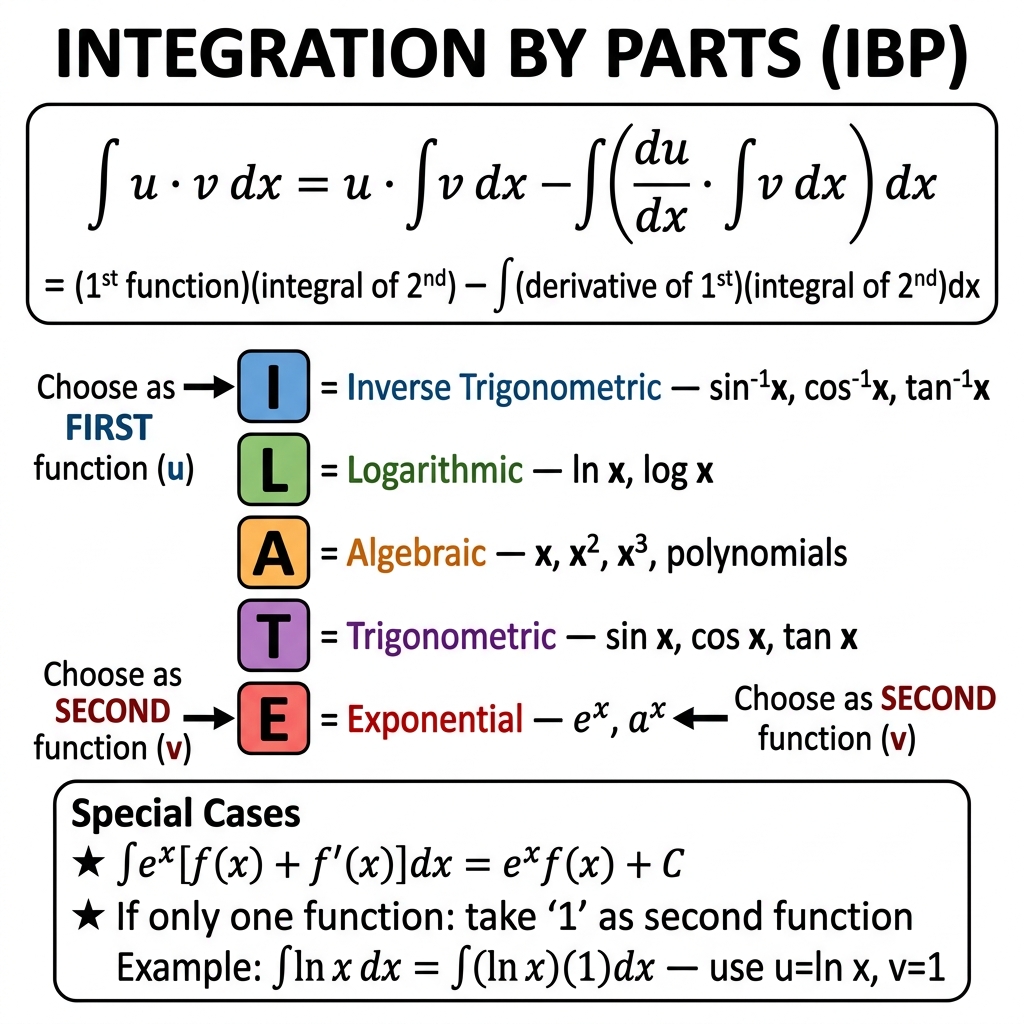
ILATE rule and IBP formula

Fig 7.1 β€” The ILATE rule determines which function to choose as the first function (u). The function appearing first in ILATE order is always u.

IBP Formula + ILATE Rule $$\int u \cdot v\,dx = u\int v\,dx - \int\!\left(\frac{du}{dx}\int v\,dx\right)dx$$ "I Love All To Eat" β€” choose the function appearing earlier in ILATE as $u$:
Inverse trig β†’ Logarithm β†’ Algebraic β†’ Trigonometric β†’ Exponential

Special Cases:
β€’ If only ONE function (like $\int\ln x\,dx$): take $v = 1$ (an Algebraic "1" as second function).
β€’ If function appears cyclically (like $\int e^x\sin x\,dx$): see Cyclic IBP below.
Problem 23 β€” Classic IBP Board Q: Evaluate $\displaystyle\int x\log x\,dx$
ILATE: L(og) before A(lgebraic), so $u = \log x$, $v = x$.
$= \log x \cdot \dfrac{x^2}{2} - \displaystyle\int\dfrac{1}{x} \cdot \dfrac{x^2}{2}\,dx = \dfrac{x^2\log x}{2} - \dfrac{1}{2}\int x\,dx$
$= \dfrac{x^2\log x}{2} - \dfrac{x^2}{4} + C = \boxed{\dfrac{x^2}{4}(2\log x - 1) + C}$
Problem 24 β€” Single Function (take v=1) Board Q: Evaluate $\displaystyle\int\ln x\,dx$
$u = \ln x$, $v = 1$. $\displaystyle\int\ln x \cdot 1\,dx = \ln x \cdot x - \int\dfrac{1}{x}\cdot x\,dx = x\ln x - \int 1\,dx = \boxed{x(\ln x - 1) + C}$
Problem 25 β€” Inverse Trig IBP Board Q: Evaluate $\displaystyle\int\sin^{-1}x\,dx$
$u = \sin^{-1}x$, $v = 1$.
$= \sin^{-1}x \cdot x - \displaystyle\int\dfrac{x}{\sqrt{1-x^2}}\,dx$
For $\displaystyle\int\dfrac{x}{\sqrt{1-x^2}}\,dx$: let $t = 1-x^2$, $dt = -2x\,dx$, $= -\dfrac{1}{2}\cdot 2\sqrt{t} = -\sqrt{1-x^2}$
$= \boxed{x\sin^{-1}x + \sqrt{1-x^2} + C}$
Problem 26 β€” Double IBP Board JEE Q: Evaluate $\displaystyle\int x^2 e^x\,dx$
$u = x^2$ (algebraic), $v = e^x$.
$= x^2 e^x - \displaystyle\int 2x \cdot e^x\,dx$
Apply IBP again on $\displaystyle\int 2x e^x\,dx$: $= 2[xe^x - e^x] = 2e^x(x-1)$
$= x^2 e^x - 2e^x(x-1) + C = \boxed{e^x(x^2-2x+2) + C}$

Special Form: ∫eˣ[f(x) + f'(x)]dx = eˣf(x) + C

Golden Formula (Board β˜…β˜…β˜… / JEE Guaranteed) $$\boxed{\int e^x[f(x) + f'(x)]\,dx = e^x f(x) + C}$$ How to identify: When you see $e^x$ times a sum of two terms, try to see if one term is $f(x)$ and the other is exactly $f'(x)$.

Proof: $\displaystyle\int e^x[f(x)+f'(x)]\,dx = \int e^x f(x)\,dx + \int e^x f'(x)\,dx$. Apply IBP on first: $= e^x f(x) - \int e^x f'(x)\,dx + \int e^x f'(x)\,dx = e^x f(x)+C$. $\quad\blacksquare$
Problem 27 β€” Golden Formula Board β˜…β˜…β˜… Q: Evaluate $\displaystyle\int e^x\!\left(\dfrac{1}{x} - \dfrac{1}{x^2}\right)dx$
Let $f(x) = \dfrac{1}{x}$, then $f'(x) = -\dfrac{1}{x^2}$.
The integrand $= e^x[f(x)+f'(x)]$ βœ”
$= \boxed{\dfrac{e^x}{x} + C}$
Problem 28 β€” Golden Formula Variation Board Q: Evaluate $\displaystyle\int e^x\!\left(\sin x + \cos x\right)dx$
Let $f(x) = \sin x$, then $f'(x) = \cos x$.
$= e^x[\sin x] + C = \boxed{e^x\sin x + C}$
Problem 29 β€” Golden Formula Non-Obvious JEE Q: Evaluate $\displaystyle\int e^x\!\left(\dfrac{x^2+1}{(x+1)^2}\right)dx$
$\dfrac{x^2+1}{(x+1)^2} = \dfrac{(x+1)^2 - 2x}{(x+1)^2} = 1 - \dfrac{2x}{(x+1)^2}$
$= 1 - \dfrac{2(x+1)-2}{(x+1)^2} = 1 - \dfrac{2}{x+1} + \dfrac{2}{(x+1)^2}$
Write as $\left[\dfrac{x-1}{x+1}\right] + \left[\dfrac{2}{(x+1)^2}\right]$: Let $f(x) = \dfrac{x-1}{x+1}$, $f'(x) = \dfrac{2}{(x+1)^2}$ βœ”
$= e^x \cdot \dfrac{x-1}{x+1} + C$

Cyclic IBP β€” For ∫eΛ£sin x and ∫eΛ£cos x

Cyclic IBP Technique (Board β˜…β˜… / NDA β˜…β˜…) When applying IBP to $\int e^x\sin x\,dx$ or $\int e^x\cos x\,dx$, you get the original integral back. Let $I$ be the integral, set up the equation $I = \ldots + I$ or $I = \ldots - I$, then solve for $I$.
Problem 30 β€” Cyclic IBP Board β˜…β˜…β˜… Q: Evaluate $I = \displaystyle\int e^x\sin x\,dx$
$u = \sin x$ (T), $v = e^x$ (E). (But actually either order works β€” just be consistent.)
$I = \sin x \cdot e^x - \displaystyle\int\cos x \cdot e^x\,dx$
Apply IBP again on $\displaystyle\int\cos x \cdot e^x\,dx$: $u = \cos x$, $v = e^x$:
$= \cos x \cdot e^x - \displaystyle\int(-\sin x) e^x\,dx = e^x\cos x + \int e^x\sin x\,dx = e^x\cos x + I$
So: $I = e^x\sin x - (e^x\cos x + I)$
$2I = e^x(\sin x - \cos x)$
$$\boxed{I = \frac{e^x(\sin x - \cos x)}{2} + C}$$
Standard Results (Memorize!):
$\displaystyle\int e^x\sin x\,dx = \dfrac{e^x(\sin x - \cos x)}{2} + C$      $\displaystyle\int e^x\cos x\,dx = \dfrac{e^x(\sin x + \cos x)}{2} + C$

More generally: $\displaystyle\int e^{ax}\sin bx\,dx = \dfrac{e^{ax}(a\sin bx - b\cos bx)}{a^2+b^2} + C$      $\displaystyle\int e^{ax}\cos bx\,dx = \dfrac{e^{ax}(a\cos bx + b\sin bx)}{a^2+b^2} + C$

8. Definite Integrals

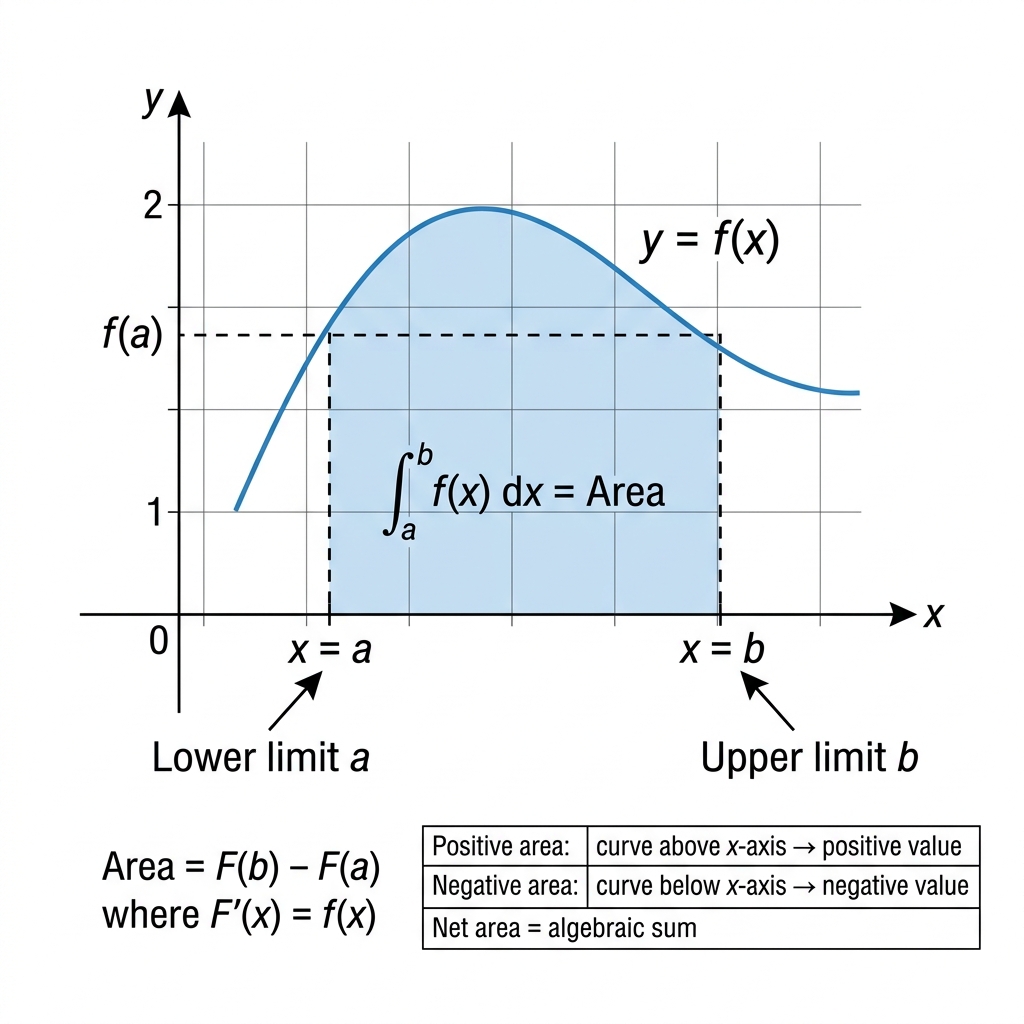
Geometric meaning of definite integral as area under curve

Fig 8.1 β€” The definite integral ∫[a,b] f(x)dx equals the algebraic area between the curve, x-axis, and vertical lines x=a, x=b. Area above x-axis is positive; area below is negative.

Fundamental Theorem of Calculus (Newton-Leibniz Formula)

The Two Fundamental Theorems First Theorem: Let $A(x) = \displaystyle\int_a^x f(t)\,dt$. Then $A'(x) = f(x)$.
(Differentiation and integration are inverse processes.)

Second Theorem (Evaluation Formula): If $F'(x) = f(x)$: $$\int_a^b f(x)\,dx = \Big[F(x)\Big]_a^b = F(b) - F(a)$$ Key Note: In definite integrals, the constant $C$ cancels out: $[F(x)+C]_a^b = F(b)-F(a)$. So $C$ is irrelevant for definite integrals!
Problem 31 β€” Basic Evaluation Board Q: Evaluate $\displaystyle\int_0^{\pi/2}\sin x\,dx$
$= [-\cos x]_0^{\pi/2} = -\cos(\pi/2) - (-\cos 0) = 0 + 1 = \boxed{1}$

Substitution in Definite Integrals β€” Change Limits!

⚠️ Critical Rule When using substitution in a definite integral, you MUST change the limits of integration to match the new variable. Never revert back to the original variable before evaluating β€” change limits instead.
If $t = g(x)$: New lower limit = $g(a)$; New upper limit = $g(b)$.
Problem 32 β€” Definite Substitution Board β˜…β˜… Q: Evaluate $\displaystyle\int_0^1 \dfrac{\tan^{-1}x}{1+x^2}\,dx$
Let $t = \tan^{-1}x$, $dt = \dfrac{dx}{1+x^2}$.
Limits: $x=0 \Rightarrow t=0$; $x=1 \Rightarrow t=\pi/4$.
$= \displaystyle\int_0^{\pi/4} t\,dt = \left[\dfrac{t^2}{2}\right]_0^{\pi/4} = \dfrac{1}{2}\left(\dfrac{\pi}{4}\right)^2 = \boxed{\dfrac{\pi^2}{32}}$
Problem 33 β€” Definite with IBP Board Q: Evaluate $\displaystyle\int_0^{\pi/2} x\cos x\,dx$
$u = x$, $v = \cos x$. IBP: $\Big[x\sin x\Big]_0^{\pi/2} - \displaystyle\int_0^{\pi/2}\sin x\,dx$
$= \left(\dfrac{\pi}{2}\cdot 1 - 0\right) - \Big[-\cos x\Big]_0^{\pi/2} = \dfrac{\pi}{2} - [0-(-1)] = \dfrac{\pi}{2} - 1$

9. Properties of Definite Integrals (Most Powerful Topic)

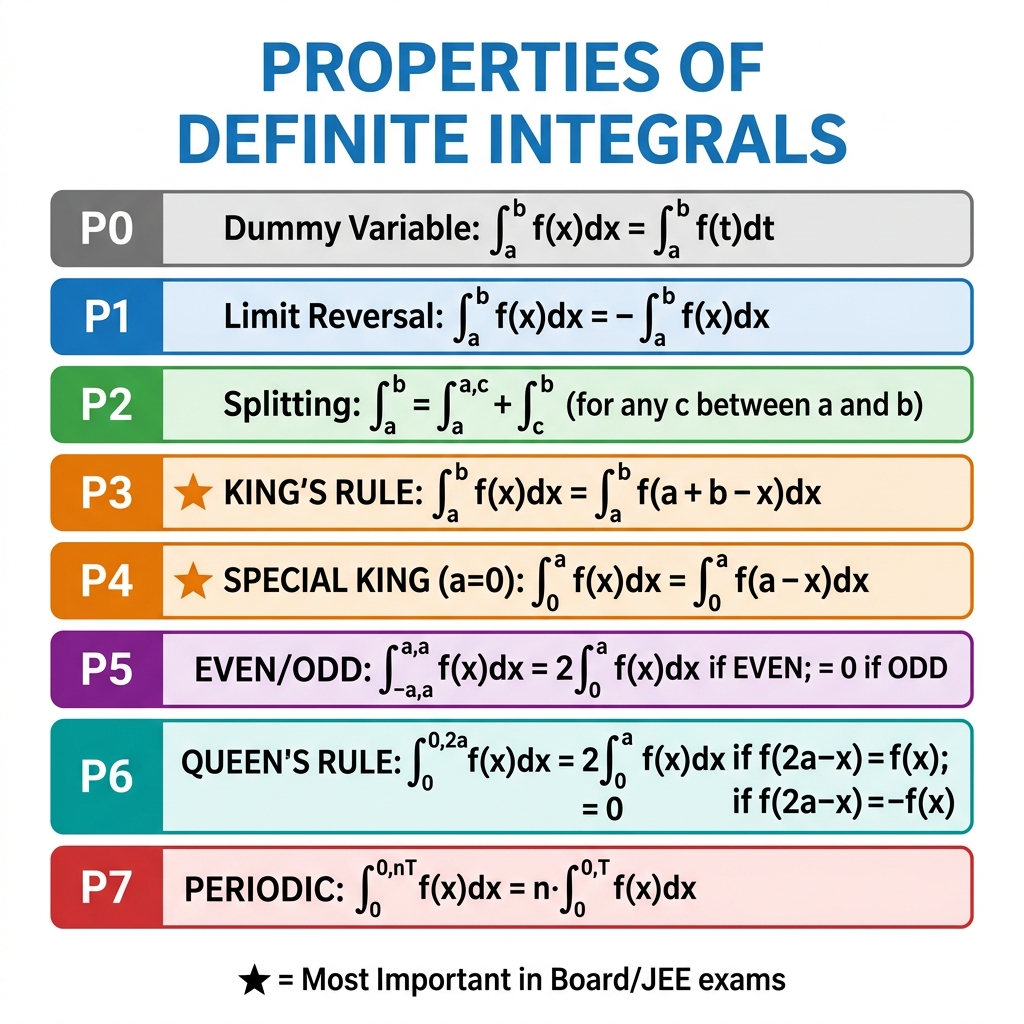
All properties of definite integrals P0-P7

Fig 9.1 β€” All 8 properties of definite integrals. P3 (King's Rule) and P5 (Even/Odd) are the most tested in Board, JEE, and NDA exams.

All Properties β€” Quick Reference P0 (Dummy Variable): $\displaystyle\int_a^b f(x)\,dx = \int_a^b f(t)\,dt$ β€” variable name is irrelevant
P1 (Limit Reversal): $\displaystyle\int_a^b f(x)\,dx = -\int_b^a f(x)\,dx$ β€” swapping limits flips sign
P2 (Splitting): $\displaystyle\int_a^b f(x)\,dx = \int_a^c f(x)\,dx + \int_c^b f(x)\,dx$ β€” for any $c$
P3 β˜… (King's Rule): $\displaystyle\int_a^b f(x)\,dx = \int_a^b f(a+b-x)\,dx$
P4 β˜… (Special King): $\displaystyle\int_0^a f(x)\,dx = \int_0^a f(a-x)\,dx$
P5 β˜… (Even/Odd): $\displaystyle\int_{-a}^a f(x)\,dx = \begin{cases}2\int_0^a f(x)\,dx & \text{if }f(-x)=f(x)\text{ (even)}\\0 & \text{if }f(-x)=-f(x)\text{ (odd)}\end{cases}$
P6 β˜… (Queen's Rule): $\displaystyle\int_0^{2a} f(x)\,dx = \begin{cases}2\int_0^a f(x)\,dx & \text{if }f(2a-x)=f(x)\\0 & \text{if }f(2a-x)=-f(x)\end{cases}$
P7 (Periodic): $\displaystyle\int_0^{nT} f(x)\,dx = n\int_0^T f(x)\,dx$ if $f(x+T)=f(x)$

King's Rule (P3, P4) β€” The Most Powerful Property

King's Rule Algorithm β˜…β˜…β˜… Step 1: Call original integral $I$.
Step 2: Apply $P4$: replace every $x$ with $(a-x)$. Call this $I$ also (since it equals $I$).
Step 3: Add both expressions for $I$: $2I = \displaystyle\int_0^a [f(x) + f(a-x)]\,dx$.
Step 4: Usually the numerator and denominator perfectly simplify or cancel!
Step 5: Solve for $I = \ldots / 2$.

Recognition: King's Rule works when the function has a "complementary" structure like $\dfrac{\sin^n x}{\sin^n x + \cos^n x}$, $\dfrac{f(x)}{f(x)+f(a-x)}$, $\dfrac{\ln(\cdot)}{\ldots}$, etc.
Problem 34 β€” Classic King's Rule Board β˜…β˜…β˜… Q: Evaluate $I = \displaystyle\int_0^{\pi/2} \dfrac{\sqrt{\sin x}}{\sqrt{\sin x}+\sqrt{\cos x}}\,dx$
$I = \displaystyle\int_0^{\pi/2} \dfrac{\sqrt{\sin x}}{\sqrt{\sin x}+\sqrt{\cos x}}\,dx$   β€” (Eq. 1)
Apply P4 (replace $x$ with $\pi/2-x$): $\sin(\pi/2-x) = \cos x$, $\cos(\pi/2-x) = \sin x$
$I = \displaystyle\int_0^{\pi/2} \dfrac{\sqrt{\cos x}}{\sqrt{\cos x}+\sqrt{\sin x}}\,dx$   β€” (Eq. 2)
Add Eq.1 + Eq.2: $2I = \displaystyle\int_0^{\pi/2}\dfrac{\sqrt{\sin x}+\sqrt{\cos x}}{\sqrt{\sin x}+\sqrt{\cos x}}\,dx = \int_0^{\pi/2}1\,dx = \dfrac{\pi}{2}$
$$I = \boxed{\dfrac{\pi}{4}}$$
Problem 35 β€” King's Rule with Log JEE β˜…β˜…β˜… Q: Evaluate $I = \displaystyle\int_0^{\pi/2}\ln(\sin x)\,dx$
$I = \displaystyle\int_0^{\pi/2}\ln(\sin x)\,dx$ β€” (1); Apply P4: $I = \displaystyle\int_0^{\pi/2}\ln(\cos x)\,dx$ β€” (2)
Add: $2I = \displaystyle\int_0^{\pi/2}\ln(\sin x\cos x)\,dx = \int_0^{\pi/2}\ln\!\left(\dfrac{\sin 2x}{2}\right)dx$
$= \displaystyle\int_0^{\pi/2}\ln(\sin 2x)\,dx - \int_0^{\pi/2}\ln 2\,dx$
For $\displaystyle\int_0^{\pi/2}\ln(\sin 2x)\,dx$: Let $u=2x$, $= \dfrac{1}{2}\int_0^{\pi}\ln(\sin u)\,du = \dfrac{1}{2}\cdot 2\int_0^{\pi/2}\ln(\sin u)\,du = I$
So: $2I = I - \dfrac{\pi}{2}\ln 2 \Rightarrow I = -\dfrac{\pi}{2}\ln 2 = \boxed{-\dfrac{\pi\ln 2}{2}}$
Problem 36 β€” Sinⁿ/(sinⁿ+cosⁿ) General JEE β˜…β˜… Q: Evaluate $\displaystyle\int_0^{\pi/2} \dfrac{\sin^n x}{\sin^n x + \cos^n x}\,dx$ for any real $n$.
Same King's Rule trick: Let $I_n = $ the integral.
Applying P4: $I_n' = \displaystyle\int_0^{\pi/2}\dfrac{\cos^n x}{\cos^n x + \sin^n x}\,dx = I_n$
$2I_n = \displaystyle\int_0^{\pi/2}1\,dx = \dfrac{\pi}{2}$
$$I_n = \boxed{\dfrac{\pi}{4}} \text{ for ALL values of }n$$
Amazing result β€” independent of $n$!

Even/Odd Property (P5) and Queen's Rule (P6)

Problem 37 β€” Odd Function (Zero Result) Board β˜…β˜… Q: Evaluate $\displaystyle\int_{-\pi/2}^{\pi/2}\sin^5 x\cos^4 x\,dx$
$f(x) = \sin^5 x\cos^4 x$. Check $f(-x) = (-\sin x)^5(\cos x)^4 = -\sin^5 x\cos^4 x = -f(x)$.
$f$ is odd. Limits are symmetric $[-\pi/2, \pi/2]$. By P5: $\displaystyle\int_{-\pi/2}^{\pi/2} f(x)\,dx = \boxed{0}$
Problem 38 β€” Even Function (Simplify) Board Q: Evaluate $\displaystyle\int_{-1}^{1}(x^2+\cos x)\,dx$
$f(x) = x^2 + \cos x$. $f(-x) = (-x)^2 + \cos(-x) = x^2 + \cos x = f(x)$. Even function!
$= 2\displaystyle\int_0^1(x^2+\cos x)\,dx = 2\left[\dfrac{x^3}{3}+\sin x\right]_0^1 = 2\left(\dfrac{1}{3}+\sin 1\right) = \boxed{\dfrac{2}{3}+2\sin 1}$
Problem 39 β€” Queen's Rule (P6) Board Q: Evaluate $\displaystyle\int_0^{\pi}\sin^4 x\,dx$ using Queen's Rule.
$a = \pi/2$, so $2a = \pi$. Check: $f(2a-x) = \sin^4(\pi-x) = (\sin x)^4 = f(x)$. βœ” (Queen's rule with double)
$\displaystyle\int_0^{\pi}\sin^4 x\,dx = 2\int_0^{\pi/2}\sin^4 x\,dx$
$\sin^4 x = (\sin^2 x)^2 = \left(\dfrac{1-\cos 2x}{2}\right)^2 = \dfrac{1-2\cos 2x+\cos^2 2x}{4}$
$\cos^2 2x = \dfrac{1+\cos 4x}{2}$, so $\sin^4 x = \dfrac{3-4\cos 2x+\cos 4x}{8}$
$\displaystyle\int_0^{\pi/2}\sin^4 x\,dx = \dfrac{1}{8}\left[3x - 2\sin 2x + \dfrac{\sin 4x}{4}\right]_0^{\pi/2} = \dfrac{3\pi}{16}$
$\therefore \displaystyle\int_0^{\pi}\sin^4 x\,dx = 2 \cdot \dfrac{3\pi}{16} = \boxed{\dfrac{3\pi}{8}}$

Periodic Functions (P7)

Problem 40 β€” Periodic JEE Q: Evaluate $\displaystyle\int_0^{100\pi}\sin^4 x\,dx$
$\sin^4 x$ has period $T = \pi$. Here $100\pi = 100 \cdot T$, so $n = 100$.
By P7: $\displaystyle\int_0^{100\pi}\sin^4 x\,dx = 100\int_0^{\pi}\sin^4 x\,dx = 100 \cdot \dfrac{3\pi}{8} = \boxed{\dfrac{375\pi}{1}}$
Wait: $100 \times 3\pi/8 = 300\pi/8 = \boxed{75\pi/2}$

10. Definite Integrals with Modulus and Piecewise Functions

Algorithm for |f(x)| Integrals Step 1: Find where $f(x) = 0$ in $[a,b]$ β€” these are the "crossover" points.
Step 2: Split the integral at each crossover using P2.
Step 3: In each sub-interval, determine the sign of $f(x)$, and remove $|$ | by putting the correct sign.
Step 4: Evaluate each part and add.
Problem 41 β€” Modulus Integral Board β˜…β˜…β˜… Q: Evaluate $\displaystyle\int_{-1}^{2}|x|\,dx$
$|x| = \begin{cases}-x & x < 0 \\ x & x \ge 0\end{cases}$. Split at $x=0$:
$= \displaystyle\int_{-1}^{0}(-x)\,dx + \int_0^2 x\,dx = \left[-\dfrac{x^2}{2}\right]_{-1}^0 + \left[\dfrac{x^2}{2}\right]_0^2$
$= \left(0 - \left(-\dfrac{1}{2}\right)\right) + (2-0) = \dfrac{1}{2} + 2 = \boxed{\dfrac{5}{2}}$
Problem 42 β€” Modulus of trig Board Q: Evaluate $\displaystyle\int_0^{\pi}|\cos x|\,dx$
$\cos x \ge 0$ on $[0,\pi/2]$ and $\cos x \le 0$ on $[\pi/2,\pi]$. Split at $x=\pi/2$:
$= \displaystyle\int_0^{\pi/2}\cos x\,dx + \int_{\pi/2}^{\pi}(-\cos x)\,dx$
$= [\sin x]_0^{\pi/2} + [-\sin x]_{\pi/2}^{\pi} = 1 + (0-(-1)) = 1+1 = \boxed{2}$
Problem 43 β€” |xΒ² - x - 2| JEE Q: Evaluate $\displaystyle\int_{-2}^{3}|x^2-x-2|\,dx$
$x^2-x-2 = (x-2)(x+1)$. Roots: $x=-1, x=2$. On $[-2,-1]$ and $[2,3]$: positive. On $[-1,2]$: negative.
$= \displaystyle\int_{-2}^{-1}(x^2-x-2)\,dx + \int_{-1}^{2}(-(x^2-x-2))\,dx + \int_2^3(x^2-x-2)\,dx$
Compute each: $\left[\dfrac{x^3}{3}-\dfrac{x^2}{2}-2x\right]$
At $x=-1$: $\dfrac{-1}{3}-\dfrac{1}{2}+2 = \dfrac{7}{6}$. At $x=-2$: $\dfrac{-8}{3}-2+4=-\dfrac{2}{3}$.
Part 1: $\dfrac{7}{6}-(-\dfrac{2}{3}) = \dfrac{7}{6}+\dfrac{4}{6}=\dfrac{11}{6}$
At $x=2$: $\dfrac{8}{3}-2-4=-\dfrac{10}{3}$. Part 2: $-[{-\dfrac{10}{3}}-\dfrac{7}{6}] = \dfrac{10}{3}+\dfrac{7}{6}=\dfrac{9}{2}$
At $x=3$: $9-\dfrac{9}{2}-6=\dfrac{3}{2}$. Part 3: $\dfrac{3}{2}-(-\dfrac{10}{3})=\dfrac{3}{2}+\dfrac{10}{3}=\dfrac{29}{6}$
Total: $\dfrac{11}{6}+\dfrac{9}{2}+\dfrac{29}{6} = \dfrac{11+27+29}{6} = \dfrac{67}{6}$

11. Walli's Formula and Reduction Formulas

Walli's Formula (NDA/JEE Shortcut) $$\int_0^{\pi/2}\sin^n x\,dx = \int_0^{\pi/2}\cos^n x\,dx = \begin{cases}\dfrac{(n-1)(n-3)\cdots 2}{n(n-2)\cdots 3}\cdot 1 & n\text{ odd}\\\dfrac{(n-1)(n-3)\cdots 1}{n(n-2)\cdots 2}\cdot\dfrac{\pi}{2} & n\text{ even}\end{cases}$$ Examples:
$\displaystyle\int_0^{\pi/2}\sin^5 x\,dx = \dfrac{4\cdot 2}{5\cdot 3\cdot 1} = \dfrac{8}{15}$
$\displaystyle\int_0^{\pi/2}\sin^4 x\,dx = \dfrac{3\cdot 1}{4\cdot 2}\cdot\dfrac{\pi}{2} = \dfrac{3\pi}{16}$
$\displaystyle\int_0^{\pi/2}\cos^6 x\,dx = \dfrac{5\cdot 3\cdot 1}{6\cdot 4\cdot 2}\cdot\dfrac{\pi}{2} = \dfrac{5\pi}{32}$
Problem 44 β€” Walli's Formula NDA β˜…β˜… Q: Using Walli's formula, evaluate $\displaystyle\int_0^{\pi/2}\sin^7 x\,dx$
$n = 7$ (odd). Formula: $\dfrac{(n-1)(n-3)(n-5)}{n(n-2)(n-4)} \cdot 1$
$= \dfrac{6 \cdot 4 \cdot 2}{7 \cdot 5 \cdot 3 \cdot 1} = \dfrac{48}{105} = \boxed{\dfrac{16}{35}}$

12. Quick Reference β€” Complete Formula Sheet

CategoryIntegralResult
Rational: No root$\int\dfrac{dx}{x^2-a^2}$$\dfrac{1}{2a}\ln\left|\dfrac{x-a}{x+a}\right|+C$
Rational: No root$\int\dfrac{dx}{a^2-x^2}$$\dfrac{1}{2a}\ln\left|\dfrac{a+x}{a-x}\right|+C$
Rational: No root$\int\dfrac{dx}{x^2+a^2}$$\dfrac{1}{a}\tan^{-1}\!\left(\dfrac{x}{a}\right)+C$
Rational: With root$\int\dfrac{dx}{\sqrt{x^2\pm a^2}}$$\ln|x+\sqrt{x^2\pm a^2}|+C$
Rational: With root$\int\dfrac{dx}{\sqrt{a^2-x^2}}$$\sin^{-1}(x/a)+C$
Root Numerator$\int\sqrt{a^2-x^2}\,dx$$\dfrac{x}{2}\sqrt{a^2-x^2}+\dfrac{a^2}{2}\sin^{-1}(x/a)+C$
Root Numerator$\int\sqrt{x^2-a^2}\,dx$$\dfrac{x}{2}\sqrt{x^2-a^2}-\dfrac{a^2}{2}\ln|x+\sqrt{x^2-a^2}|+C$
Root Numerator$\int\sqrt{x^2+a^2}\,dx$$\dfrac{x}{2}\sqrt{x^2+a^2}+\dfrac{a^2}{2}\ln|x+\sqrt{x^2+a^2}|+C$
Exponential Γ— Trig$\int e^{ax}\sin bx\,dx$$\dfrac{e^{ax}(a\sin bx - b\cos bx)}{a^2+b^2}+C$
Exponential Γ— Trig$\int e^{ax}\cos bx\,dx$$\dfrac{e^{ax}(a\cos bx + b\sin bx)}{a^2+b^2}+C$
Golden Formula$\int e^x[f(x)+f'(x)]\,dx$$e^xf(x)+C$
Trig Powers$\int\sin^2 x\,dx$$\dfrac{x}{2}-\dfrac{\sin 2x}{4}+C$
Trig Powers$\int\cos^2 x\,dx$$\dfrac{x}{2}+\dfrac{\sin 2x}{4}+C$
Trig Powers$\int\tan^2 x\,dx$$\tan x - x + C$
Walli's (even n)$\int_0^{\pi/2}\sin^n x\,dx$$\dfrac{(n-1)!!}{n!!}\cdot\dfrac{\pi}{2}$
Walli's (odd n)$\int_0^{\pi/2}\sin^n x\,dx$$\dfrac{(n-1)!!}{n!!}$

13. Mixed Practice Problems β€” Exam Level

MP-1 β€” Substitution Chain Board Q: Evaluate $\displaystyle\int\dfrac{e^x - e^{-x}}{e^x + e^{-x}}\,dx$
Let $t = e^x + e^{-x}$, $dt = (e^x - e^{-x})\,dx$.
$= \displaystyle\int\dfrac{dt}{t} = \ln|t| + C = \boxed{\ln(e^x+e^{-x}) + C}$
MP-2 β€” Combination Partial + Completing Square Board Q: Evaluate $\displaystyle\int\dfrac{2x+1}{(x+1)(x^2+4)}\,dx$
$\dfrac{2x+1}{(x+1)(x^2+4)} = \dfrac{A}{x+1} + \dfrac{Bx+C}{x^2+4}$
$2x+1 = A(x^2+4) + (Bx+C)(x+1)$. Put $x=-1$: $-1=5A \Rightarrow A=-1/5$.
Compare $x^2$: $0=A+B \Rightarrow B=1/5$. Compare constant: $1=4A+C \Rightarrow C=9/5$.
$= -\dfrac{1}{5}\ln|x+1| + \dfrac{1}{5}\displaystyle\int\dfrac{x+9}{x^2+4}\,dx$
$= -\dfrac{1}{5}\ln|x+1| + \dfrac{1}{10}\ln(x^2+4) + \dfrac{9}{10}\tan^{-1}(x/2) + C$
MP-3 β€” King's Rule with Logarithm JEE β˜…β˜…β˜… Q: Evaluate $\displaystyle\int_0^{\pi}\dfrac{x\sin x}{1+\cos^2 x}\,dx$
$I = \displaystyle\int_0^{\pi}\dfrac{x\sin x}{1+\cos^2 x}\,dx$
By King's Rule (P3, replace $x$ with $\pi-x$): $\sin(\pi-x)=\sin x$, $\cos(\pi-x)=-\cos x$:
$I = \displaystyle\int_0^{\pi}\dfrac{(\pi-x)\sin x}{1+\cos^2 x}\,dx$
$2I = \displaystyle\pi\int_0^{\pi}\dfrac{\sin x}{1+\cos^2 x}\,dx$
Let $t = \cos x$, $dt = -\sin x\,dx$; limits: $1 \to -1$:
$= \pi\displaystyle\int_1^{-1}\dfrac{-dt}{1+t^2} = \pi\int_{-1}^1\dfrac{dt}{1+t^2} = \pi[\tan^{-1}t]_{-1}^1 = \pi\left[\dfrac{\pi}{4}-\left(-\dfrac{\pi}{4}\right)\right] = \dfrac{\pi^2}{2}$
$$I = \boxed{\dfrac{\pi^2}{4}}$$
MP-4 β€” IBP + Special Form Board Q: Evaluate $\displaystyle\int e^x\!\left(\dfrac{x+\ln x}{x}\right)dx$
$= \displaystyle\int e^x\!\left(1 + \dfrac{\ln x}{x}\right)dx$. Hmm, not immediately in golden form.
Let $f(x) = \ln x$, $f'(x) = 1/x$. But we have $1 + \ln x/x = \ln x + 1/x + \ln x/x - \ln x$... Let's try differently.
Actually: write as $\displaystyle\int e^x\ln x\,dx + \int\dfrac{e^x}{x}\,dx$. Apply IBP on $\int e^x\ln x\,dx$: $u=\ln x$, $v=e^x$:
$= e^x\ln x - \displaystyle\int\dfrac{e^x}{x}\,dx + \int\dfrac{e^x}{x}\,dx = \boxed{e^x\ln x + C}$
MP-5 β€” Definite with Absolute Value Board Q: Evaluate $\displaystyle\int_0^2|x^2-3x+2|\,dx$
$x^2-3x+2 = (x-1)(x-2) = 0$ at $x=1,2$. On $[0,1]$: positive; on $[1,2]$: negative.
$= \displaystyle\int_0^1(x^2-3x+2)\,dx + \int_1^2(-(x^2-3x+2))\,dx$
$= \left[\dfrac{x^3}{3}-\dfrac{3x^2}{2}+2x\right]_0^1 + \left[-\dfrac{x^3}{3}+\dfrac{3x^2}{2}-2x\right]_1^2$
$= \left(\dfrac{1}{3}-\dfrac{3}{2}+2\right) + \left[\left(-\dfrac{8}{3}+6-4\right)-\left(-\dfrac{1}{3}+\dfrac{3}{2}-2\right)\right]$
$= \dfrac{5}{6} + \left[-\dfrac{2}{3}-(-\dfrac{7}{6})\right] = \dfrac{5}{6} + \dfrac{7}{6}-\dfrac{4}{6} = \boxed{1}$
MP-6 β€” Greatest Integer Function JEE Q: Evaluate $\displaystyle\int_0^2\lfloor x^2\rfloor\,dx$ (where $\lfloor \cdot\rfloor$ is the floor/GIF)
$x^2 = 0$ at $x=0$; $=1$ at $x=1$; $=2$ at $x=\sqrt{2}$; $=3$ at $x=\sqrt{3}$; $=4$ at $x=2$.
Intervals: $[0,1)$: $\lfloor x^2\rfloor=0$; $[1,\sqrt{2})$: $=1$; $[\sqrt{2},\sqrt{3})$: $=2$; $[\sqrt{3},2)$: $=3$; at $x=2$: $=4$ (just a point).
$= 0\cdot(1-0) + 1\cdot(\sqrt{2}-1) + 2(\sqrt{3}-\sqrt{2}) + 3(2-\sqrt{3})$
$= \sqrt{2}-1 + 2\sqrt{3}-2\sqrt{2} + 6-3\sqrt{3} = 5 - \sqrt{2} - \sqrt{3}$
MP-7 β€” Limit as Sum (Definite Integral as Sum) JEE β˜…β˜…β˜… Q: Evaluate $\displaystyle\lim_{n\to\infty}\dfrac{1}{n}\left(\sqrt{\dfrac{1}{n}} + \sqrt{\dfrac{2}{n}} + \cdots + \sqrt{\dfrac{n}{n}}\right)$
This is of the form $\displaystyle\lim_{n\to\infty}\dfrac{1}{n}\sum_{r=1}^{n}f\!\left(\dfrac{r}{n}\right) = \int_0^1 f(x)\,dx$
Here $f\!\left(\dfrac{r}{n}\right) = \sqrt{\dfrac{r}{n}}$, so $f(x) = \sqrt{x}$.
$= \displaystyle\int_0^1\sqrt{x}\,dx = \left[\dfrac{2}{3}x^{3/2}\right]_0^1 = \boxed{\dfrac{2}{3}}$
MP-8 β€” Leibniz Rule (Differentiation under Integral Sign) JEE Q: Find $\dfrac{d}{dx}\displaystyle\int_0^{x^2}\sin t^2\,dt$
By Fundamental Theorem (First Theorem), if $g(x) = \displaystyle\int_0^{h(x)} f(t)\,dt$, then $g'(x) = f(h(x)) \cdot h'(x)$.
Here $h(x) = x^2$, $f(t) = \sin t^2$.
$\dfrac{d}{dx}\displaystyle\int_0^{x^2}\sin t^2\,dt = \sin(x^2)^2 \cdot 2x = \boxed{2x\sin x^4}$

14. Common Mistakes & Exam Strategy

⚠️ Top 8 Mistakes to Avoid 1. Writing $\displaystyle\int\dfrac{1}{x^2}\,dx = \dfrac{1}{x} + C$ β€” WRONG! Use power rule: $\int x^{-2}\,dx = \dfrac{x^{-1}}{-1} = -\dfrac{1}{x}+C$.
2. Forgetting $+C$ in indefinite integrals β€” costs marks in boards every time.
3. In substitution, forgetting to change $dx$ (e.g., writing $dx$ instead of $dt$).
4. In definite integral substitution β€” NOT changing the limits. Fatal error!
5. Applying ILATE backwards β€” choosing Exponential as first function when polynomial is present.
6. $\displaystyle\int\dfrac{dx}{x^2+a^2} = \dfrac{1}{a}\tan^{-1}(x/a)$ β€” forgetting the $\dfrac{1}{a}$ factor outside.
7. $\displaystyle\int\dfrac{f'(x)}{f(x)}\,dx = \ln|f(x)|$ β€” valid only when numerator is EXACTLY the derivative of denominator (or a constant multiple). Check carefully!
8. Using King's Rule on non-symmetric limits β€” P3 works for ANY $[a,b]$, but P5 (even/odd) only works for $[-a,a]$.
🎯 Exam Strategy β€” Last Revision πŸ“Œ Direct formula: First check if it matches any standard formula directly.
πŸ“Œ Substitution check: Is there a function and its derivative present? Use sub.
πŸ“Œ IBP triggers: Algebraic Γ— Trig, Algebraic Γ— Log, Algebraic Γ— Exponential.
πŸ“Œ Partial fractions: Rational function? Degree of P < degree of Q? Factorize Q.
πŸ“Œ Completing square: Quadratic in denominator β€” always complete the square first.
πŸ“Œ Definite integral trick: Complex integrand + symmetric limits β†’ try King's Rule.
πŸ“Œ Symmetric limits $[-a,a]$: Always check even/odd first.
πŸ“Œ $\int_0^{\pi/2}\sin^n x$: Use Walli's formula directly for speed.
πŸ“Œ $e^x$ present: Try the golden formula $\int e^x[f+f']\,dx = e^xf+C$.
πŸ“Œ Boards 5-mark question: Write method name, set up substitution/IBP clearly, show all steps.