Vardaan Learning Institute
Class 12 Mathematics • Comprehensive Chapter Notes
🌐 vardaanlearning.com📞 9508841336
Chapter 4: Determinants
Dear Class 12 Student! While matrices are simple arrays of numbers, a Determinant is a scalar value that compresses an entire square matrix into a single, highly meaningful number. It tells us whether a system of equations has a unique solution, scales the area of transformations, and forms the core of calculating inverses. For the Boards, properties of determinants are a 4-to-6 mark guarantee. For JEE, Adjoint properties and Cramer's Rule are vital. Let's decode the matrix!
1. Introduction to Determinants
Definition: To every square matrix $A = [a_{ij}]$ of order $n$, we can associate a unique number (real or complex) called the determinant of the square matrix $A$.
Notation: The determinant of matrix $A$ is written as $det(A)$ or $|A|$ or $\Delta$.
Warning: $|A|$ is read as the "determinant of A", NOT the modulus of A.
Expansion of Determinants
- Order 1: If $A = [a]$, then $|A| = a$.
- Order 2: $\begin{vmatrix} a & b \\ c & d \end{vmatrix} = ad - bc$.
- Order 3: A determinant of order 3 can be expanded along any of its 3 rows or 3 columns. To minimize calculations, it is universally expanded along the row or column containing the maximum number of zeros.
Sign Convention (Checkerboard Pattern)
When expanding a $3 \times 3$ determinant, we attach a sign to each element $a_{ij}$ based on the formula $(-1)^{i+j}$. This creates an alternating checkerboard pattern of signs:
$$ \begin{vmatrix} + & - & + \\ - & + & - \\ + & - & + \end{vmatrix} $$
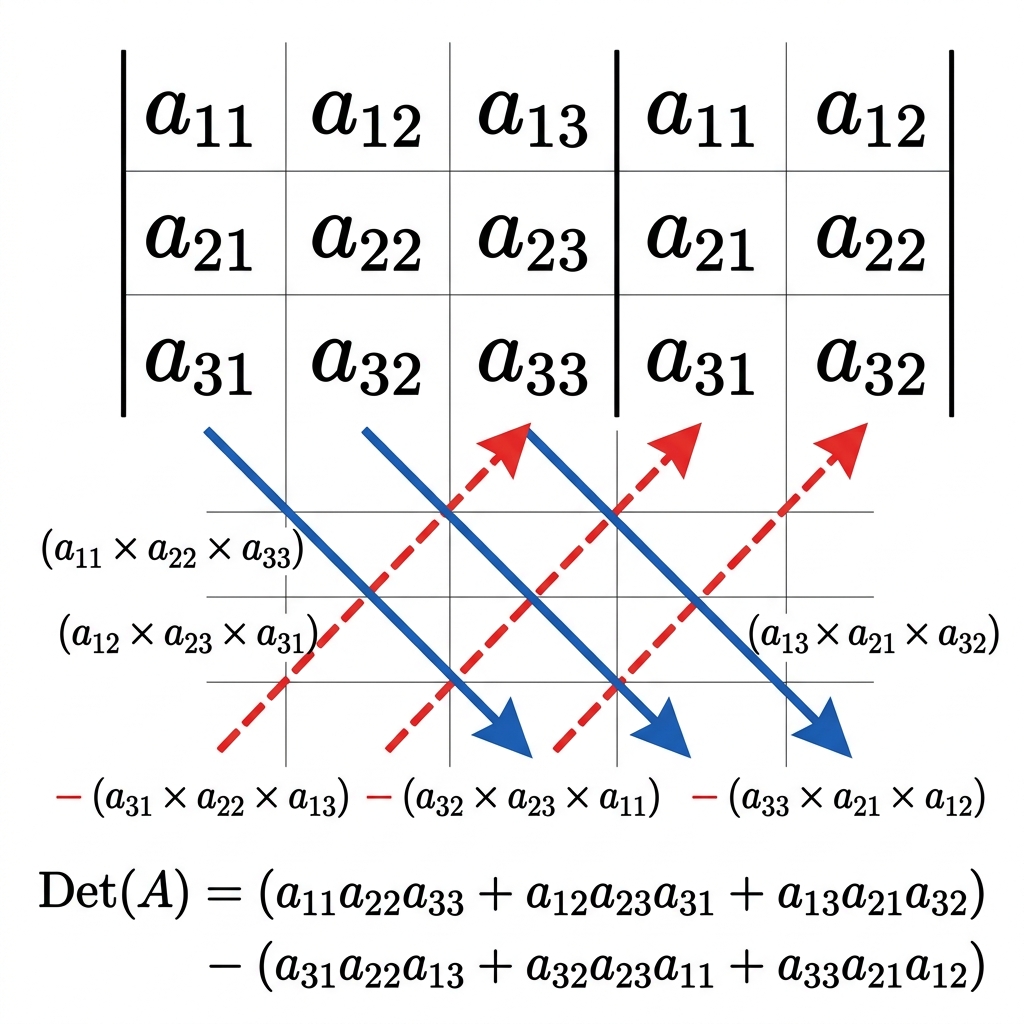
JEE Main Transition: Sarrus Rule (Shortcut)
The Sarrus Diagram is a rapid method to evaluate a $3 \times 3$ determinant without manual cofactors.
1. Write the 3 columns of the determinant.
2. Rewrite the 1st and 2nd columns next to the 3rd column.
3. Multiply elements along the 3 downward-right diagonals and ADD them.
4. Multiply elements along the 3 upward-right diagonals and SUBTRACT them.
(Note: This rule strictly works ONLY for $3 \times 3$ determinants, never for $4 \times 4$).
Practice Problem 1: Expansion
Question: Evaluate the determinant $\Delta = \begin{vmatrix} 3 & -1 & -2 \\ 0 & 0 & -1 \\ 3 & -5 & 0 \end{vmatrix}$.
Solution:
Look for the row or column with the most zeros. Row 2 ($R_2$) has two zeros.
We expand along $R_2$. The signs for $R_2$ are $(-, +, -)$.
$\Delta = -0 \begin{vmatrix} -1 & -2 \\ -5 & 0 \end{vmatrix} + 0 \begin{vmatrix} 3 & -2 \\ 3 & 0 \end{vmatrix} - (-1) \begin{vmatrix} 3 & -1 \\ 3 & -5 \end{vmatrix}$
$\Delta = 0 + 0 + 1 [ (3)(-5) - (-1)(3) ]$
$\Delta = 1 [ -15 - (-3) ] = -15 + 3 = \mathbf{-12}$.
2. Properties of Determinants (The Core of the Chapter)
These properties simplify the evaluation of complex determinants immensely. (R.D. Sharma provides an exhaustive variety of these proofs).
The 7 Fundamental Properties
P1 (Reflection Property): The value of the determinant remains completely unchanged if its rows and columns are interchanged. $\implies \mathbf{|A| = |A'|}$.
P2 (Switching Property): If any two rows (or columns) of a determinant are interchanged, the sign of the determinant changes. ($\Delta \rightarrow -\Delta$).
P3 (Repetition Property): If any two rows (or columns) of a determinant are identically equal, its value is precisely zero. ($\Delta = 0$).
P4 (Scalar Multiple Property): If each element of a specific row (or column) is multiplied by a constant $k$, the entire value of the determinant gets multiplied by $k$.
Crucial Formula extracted from P4: If matrix $A$ of order $n \times n$ is multiplied by scalar $k$, the scalar comes out of EVERY row (n times). Therefore:
$$ |kA| = k^n |A| $$
P5 (Proportionality Property): If the corresponding elements of any two rows (or columns) are proportional (e.g., $R_1 = kR_2$), the determinant is zero.
P6 (Sum Property): If some or all elements of a row or column are expressed as the sum of two terms, the determinant can be split into the sum of two distinct determinants.
P7 (Property of Invariance): The value of the determinant remains unaltered if we apply operations of the form $R_i \rightarrow R_i + k R_j$ or $C_i \rightarrow C_i + k C_j$. (This is the most heavily used property for proofs).
Practice Problem 2: |kA| Property
Question: Let $A$ be a square matrix of order $3 \times 3$. If $|A| = 4$, find the value of $|2A|$.
Solution:
We use the property $|kA| = k^n |A|$, where $n$ is the order of the matrix.
Here, $k = 2$, $n = 3$, and $|A| = 4$.
$|2A| = 2^3 \times |A|$
$|2A| = 8 \times 4 = \mathbf{32}$.
Practice Problem 3: Without Expansion Proof
Question: Without expanding, prove that $\begin{vmatrix} x & y & z \\ a & b & c \\ x+a & y+b & z+c \end{vmatrix} = 0$.
Solution:
We will use Property 7 (Invariance). Apply the row operation $R_3 \rightarrow R_3 - R_1$.
$\Delta = \begin{vmatrix} x & y & z \\ a & b & c \\ (x+a)-x & (y+b)-y & (z+c)-z \end{vmatrix} = \begin{vmatrix} x & y & z \\ a & b & c \\ a & b & c \end{vmatrix}$
Now, observe that Row 2 ($R_2$) and Row 3 ($R_3$) are identical ($a, b, c$).
According to Property 3 (Repetition Property), if two rows are identical, the determinant is strictly zero. (Proved).
3. Area of a Triangle using Determinants
If the vertices of a triangle are $(x_1, y_1)$, $(x_2, y_2)$, and $(x_3, y_3)$, the area of the triangle can be elegantly expressed using a determinant.
Area Formula & Key Conditions
$$ \text{Area} = \frac{1}{2} \begin{vmatrix} x_1 & y_1 & 1 \\ x_2 & y_2 & 1 \\ x_3 & y_3 & 1 \end{vmatrix} $$
- Since area is a strictly positive quantity, we always take the absolute value of the determinant's result.
- If the area is already given in a problem and you need to find an unknown coordinate, you MUST use both positive and negative values ($\pm \text{Area}$) for calculation.
- Condition for Collinearity: Three points are collinear (lie on a single straight line) if and only if the area of the triangle formed by them is zero. ($\Delta = 0$).
Practice Problem 4: Unknown Coordinate
Question: Find the values of $k$ if the area of the triangle is 4 sq. units and its vertices are $(k, 0), (4, 0), (0, 2)$.
Solution:
1. The area formula is: $\text{Area} = \frac{1}{2} \begin{vmatrix} k & 0 & 1 \\ 4 & 0 & 1 \\ 0 & 2 & 1 \end{vmatrix}$.
2. Since area is given as 4, we write: $\frac{1}{2} \begin{vmatrix} k & 0 & 1 \\ 4 & 0 & 1 \\ 0 & 2 & 1 \end{vmatrix} = \pm 4$.
3. Expanding along Column 2 ($C_2$) which has two zeros:
$\frac{1}{2} \left[ -0 + 0 - 2 \begin{vmatrix} k & 1 \\ 4 & 1 \end{vmatrix} \right] = \pm 4$
4. $\frac{1}{2} [ -2 (k(1) - 4(1)) ] = \pm 4$
5. $-(k - 4) = \pm 4 \implies -k + 4 = \pm 4$
6. Case 1 (+4): $-k + 4 = 4 \implies -k = 0 \implies \mathbf{k = 0}$.
7. Case 2 (-4): $-k + 4 = -4 \implies -k = -8 \implies \mathbf{k = 8}$.
The possible values of $k$ are $0$ and $8$.
4. Minors and Cofactors
These quantities act as building blocks for determining the Adjoint and Inverse of a matrix.
- Minor ($M_{ij}$): The minor of an element $a_{ij}$ is the determinant obtained by physically deleting the $i^{th}$ row and the $j^{th}$ column in which the element lies.
- Cofactor ($A_{ij}$ or $C_{ij}$): The cofactor is simply the minor attached with a specific sign. It is defined mathematically as:
$$ A_{ij} = (-1)^{i+j} M_{ij} $$
Crucial Alias/Zero-Sum Properties
Expansion Property: The sum of the products of the elements of any row (or column) with their corresponding cofactors perfectly equals the determinant.
$\Delta = a_{11}A_{11} + a_{12}A_{12} + a_{13}A_{13}$.
Zero-Sum Property (Alias Property): If elements of a row (or column) are multiplied with the cofactors of any other row (or column), their sum is strictly zero.
$a_{11}A_{21} + a_{12}A_{22} + a_{13}A_{23} = 0$.
Practice Problem 5: Cofactors
Question: Find the cofactors of the elements $a_{12}$ and $a_{22}$ of the matrix $A = \begin{bmatrix} 2 & -3 & 5 \\ 6 & 0 & 4 \\ 1 & 5 & -7 \end{bmatrix}$.
Solution:
1. For $a_{12}$ (-3):
Delete Row 1 and Col 2. The minor $M_{12} = \begin{vmatrix} 6 & 4 \\ 1 & -7 \end{vmatrix} = 6(-7) - (4)(1) = -42 - 4 = -46$.
Cofactor $A_{12} = (-1)^{1+2} M_{12} = (-1)^3 (-46) = -1(-46) = \mathbf{46}$.
2. For $a_{22}$ (0):
Delete Row 2 and Col 2. The minor $M_{22} = \begin{vmatrix} 2 & 5 \\ 1 & -7 \end{vmatrix} = 2(-7) - (5)(1) = -14 - 5 = -19$.
Cofactor $A_{22} = (-1)^{2+2} M_{22} = (-1)^4 (-19) = +1(-19) = \mathbf{-19}$.
5. Adjoint and Inverse of a Matrix
Adjoint ($adj A$) and Inverse ($A^{-1}$)
Adjoint: The adjoint of a square matrix $A$ is defined as the transpose of the matrix of cofactors of the elements of $A$.
If $A = [a_{ij}]$, and its cofactor matrix is $[A_{ij}]$, then $\mathbf{adj(A) = [A_{ji}]}$.
Inverse: A square matrix is invertible if and only if it is a non-singular matrix (meaning its determinant $|A| \neq 0$).
$$ A^{-1} = \frac{1}{|A|} adj(A) $$
Important Theorems (Standard Board Proofs)
Theorem 1: For any square matrix $A$ of order $n$, multiplying it by its adjoint yields a scalar matrix where the diagonal elements are the determinant $|A|$.
$$ A(adj A) = (adj A)A = |A|I $$
Properties of Adjoint & Inverse (JEE Favorites)
These properties are incessantly tested in JEE Mains to avoid lengthy matrix multiplications:
1. Determinant of Adjoint: $|adj A| = |A|^{n-1}$
2. Adjoint of Adjoint: $adj(adj A) = |A|^{n-2} A$
3. Determinant of Adjoint of Adjoint: $|adj(adj A)| = |A|^{(n-1)^2}$
4. Reversal Law for Adjoint: $adj(AB) = (adj B)(adj A)$
5. Inverse Reversal Law: $(AB)^{-1} = B^{-1} A^{-1}$
6. Transpose Inverse Swap: $(A')^{-1} = (A^{-1})'$
7. $(A^{-1})^{-1} = A$
Practice Problem 6: Inverse Shortcut for 2x2
Question: Find the inverse of the matrix $A = \begin{bmatrix} 2 & 3 \\ 1 & 4 \end{bmatrix}$.
Solution:
For a $2 \times 2$ matrix, there is a brilliant shortcut for the adjoint: Interchange the principal diagonal elements, and change the signs of the off-diagonal elements.
1. Find $|A|$: $|A| = (2)(4) - (3)(1) = 8 - 3 = 5$. Since $|A| \neq 0$, $A^{-1}$ exists.
2. Find $adj(A)$ using shortcut: Swap 2 and 4. Change signs of 3 and 1.
$adj(A) = \begin{bmatrix} 4 & -3 \\ -1 & 2 \end{bmatrix}$.
3. Apply formula $A^{-1} = \frac{1}{|A|} adj(A)$.
$$ A^{-1} = \frac{1}{5} \begin{bmatrix} 4 & -3 \\ -1 & 2 \end{bmatrix} $$
Practice Problem 7: JEE Adjoint Property
Question: If $A$ is a non-singular matrix of order $3 \times 3$ such that $|A| = 5$, find the value of $|adj A|$ and $|adj(adj A)|$.
Solution:
Given: $n = 3$, $|A| = 5$.
1. Using the property $|adj A| = |A|^{n-1}$:
$|adj A| = (5)^{3-1} = 5^2 = \mathbf{25}$.
2. Using the property $|adj(adj A)| = |A|^{(n-1)^2}$:
$|adj(adj A)| = (5)^{(3-1)^2} = 5^{(2)^2} = 5^4 = \mathbf{625}$.
6. Applications: System of Linear Equations
Determinants offer powerful methods to solve simultaneous linear equations and to check their consistency.
A. Matrix Method (NCERT Core Focus)
A system of linear equations can be written as $AX = B$, where $A$ is the coefficient matrix, $X$ is the variable matrix, and $B$ is the constant matrix.
Multiplying by $A^{-1}$ on both sides yields: $X = A^{-1} B$.
Consistency Conditions Matrix Method
Case 1: If $|A| \neq 0$ (Non-Singular Matrix)
The system is Consistent and has a Unique Solution given by $X = A^{-1}B$.
Case 2: If $|A| = 0$ (Singular Matrix)
We must calculate $(adj A)B$.
- If $(adj A)B \neq O$ (Zero Matrix), the system is Inconsistent (No Solution). It represents parallel lines/planes.
- If $(adj A)B = O$, the system may be either consistent (having infinitely many solutions) or inconsistent.
B. Cramer's Rule (R.D. Sharma / JEE Focus)
Cramer's rule bypasses finding the inverse entirely by using multiple determinants.
Let $\Delta$ be the determinant of coefficients. Let $\Delta_x$ be the determinant obtained by replacing the $x$-column in $\Delta$ with the constants column. Similarly for $\Delta_y$ and $\Delta_z$.
Solutions: $x = \frac{\Delta_x}{\Delta}, \ y = \frac{\Delta_y}{\Delta}, \ z = \frac{\Delta_z}{\Delta}$.
Conditions for Cramer's Rule:
- If $\Delta \neq 0$: Unique solution (Consistent).
- If $\Delta = 0$ and at least one of ($\Delta_x, \Delta_y, \Delta_z$) $\neq 0$: No solution (Inconsistent).
- If $\Delta = 0$ and $\Delta_x = \Delta_y = \Delta_z = 0$: Infinitely many solutions (Consistent).
Practice Problem 8: Matrix Method Consistency
Question: Check the consistency of the system of equations:
$2x - y = 5$
$4x - 2y = 7$
Solution:
1. Write in $AX = B$ form:
$A = \begin{bmatrix} 2 & -1 \\ 4 & -2 \end{bmatrix}, X = \begin{bmatrix} x \\ y \end{bmatrix}, B = \begin{bmatrix} 5 \\ 7 \end{bmatrix}$.
2. Calculate $|A|$:
$|A| = (2)(-2) - (-1)(4) = -4 - (-4) = -4 + 4 = 0$.
Since $|A| = 0$, we must check $(adj A)B$.
3. Find $adj A$ using the 2x2 shortcut:
$adj A = \begin{bmatrix} -2 & 1 \\ -4 & 2 \end{bmatrix}$.
4. Calculate $(adj A)B$:
$(adj A)B = \begin{bmatrix} -2 & 1 \\ -4 & 2 \end{bmatrix} \begin{bmatrix} 5 \\ 7 \end{bmatrix} = \begin{bmatrix} -10 + 7 \\ -20 + 14 \end{bmatrix} = \begin{bmatrix} -3 \\ -6 \end{bmatrix}$.
5. Since $(adj A)B \neq O$, the system is strictly Inconsistent (It has no solution).
Practice Problem 9: Solving via Cramer's Rule
Question: Solve using Cramer's rule: $3x + y = 5$, $2x - y = 5$.
Solution:
1. Find $\Delta$: $\Delta = \begin{vmatrix} 3 & 1 \\ 2 & -1 \end{vmatrix} = 3(-1) - (1)(2) = -3 - 2 = -5$. Since $\Delta \neq 0$, unique solution exists.
2. Find $\Delta_x$ (replace 1st column with 5, 5):
$\Delta_x = \begin{vmatrix} 5 & 1 \\ 5 & -1 \end{vmatrix} = 5(-1) - (1)(5) = -5 - 5 = -10$.
3. Find $\Delta_y$ (replace 2nd column with 5, 5):
$\Delta_y = \begin{vmatrix} 3 & 5 \\ 2 & 5 \end{vmatrix} = 3(5) - (5)(2) = 15 - 10 = 5$.
4. Calculate $x$ and $y$:
$x = \frac{\Delta_x}{\Delta} = \frac{-10}{-5} = \mathbf{2}$.
$y = \frac{\Delta_y}{\Delta} = \frac{5}{-5} = \mathbf{-1}$.
7. Differentiation and Integration of Determinants (R.D. Sharma/JEE Focus)
A. Differentiation of a Determinant
If the elements of a determinant $\Delta(x)$ are differentiable functions of $x$, then the derivative $\frac{d}{dx}[\Delta(x)]$ is evaluated by differentiating one row (or one column) at a time, keeping the other rows (or columns) entirely constant, and summing the resulting determinants.
If $\Delta(x) = \begin{vmatrix} f(x) & g(x) \\ h(x) & m(x) \end{vmatrix}$, then:
$$\Delta'(x) = \begin{vmatrix} f'(x) & g'(x) \\ h(x) & m(x) \end{vmatrix} + \begin{vmatrix} f(x) & g(x) \\ h'(x) & m'(x) \end{vmatrix}$$
B. Integration of a Determinant
Integration of a determinant is straightforward only if exactly one row (or one column) consists of functions of $x$, while all other rows (or columns) consist strictly of constants. You simply integrate that specific row/column.
Practice Problem 10: Calculus of Determinants
Question: Let $\Delta(x) = \begin{vmatrix} \sin x & \cos x \\ x & x^2 \end{vmatrix}$. Find $\Delta'(x)$.
Solution:
We apply the row-by-row differentiation rule.
$\Delta'(x) = (\text{Diff Row 1, Keep Row 2}) + (\text{Keep Row 1, Diff Row 2})$
$\Delta'(x) = \begin{vmatrix} \frac{d}{dx}(\sin x) & \frac{d}{dx}(\cos x) \\ x & x^2 \end{vmatrix} + \begin{vmatrix} \sin x & \cos x \\ \frac{d}{dx}(x) & \frac{d}{dx}(x^2) \end{vmatrix}$
$$\Delta'(x) = \begin{vmatrix} \cos x & -\sin x \\ x & x^2 \end{vmatrix} + \begin{vmatrix} \sin x & \cos x \\ 1 & 2x \end{vmatrix}$$
(Note: You can expand these determinants to get the final algebraic derivative expression).
8. High-Yield Determinant Simplification Techniques
In board and entrance exams, direct expansion is often the slowest route. The best method is to first create zeros or common factors using row/column operations and then expand.
Fast Reduction Strategy
1. Scan for identical patterns like $(a+b), (b+c), (c+a)$ or powers like $x^2,y^2,z^2$.
2. Use invariance operations: $R_i \rightarrow R_i + kR_j$ or $C_i \rightarrow C_i + kC_j$ (value unchanged).
3. If a row/column has a common factor, take it out immediately.
4. Try to create two zeros in one row/column and then expand there.
5. If two rows/columns become equal or proportional, stop: determinant is zero.
Most Common Mistakes
1. Writing $R_i \rightarrow kR_i$ and forgetting determinant gets multiplied by $k$.
2. Applying $R_i \leftrightarrow R_j$ but not changing sign.
3. Using Sarrus rule for order $4 \times 4$ (strictly invalid).
4. Ignoring $+$/$-$ checkerboard signs during cofactor expansion.
Practice Problem 11: Reduction First, Expansion Later
Question: Evaluate
$$ \Delta = \begin{vmatrix}
1 & 2 & 3\\
2 & 4 & 7\\
3 & 6 & 10
\end{vmatrix}. $$
Solution:
Apply $R_2 \rightarrow R_2 - 2R_1$, $R_3 \rightarrow R_3 - 3R_1$:
$$ \Delta=
\begin{vmatrix}
1 & 2 & 3\\
0 & 0 & 1\\
0 & 0 & 1
\end{vmatrix}. $$
Now $R_2$ and $R_3$ are identical. Therefore determinant is
$\Delta = 0$.
9. Special Determinants (R.D. Sharma / JEE Patterns)
A. Triangular Determinant
If a matrix is upper or lower triangular, its determinant is the product of principal diagonal elements.
B. Vandermonde Determinant (Must Know)
Vandermonde Formula
$$ \begin{vmatrix}
1 & 1 & 1 \\
a & b & c \\
a^2 & b^2 & c^2
\end{vmatrix}
= (b-a)(c-a)(c-b). $$
Consequence: if any two among $a,b,c$ are equal, determinant becomes zero.
Practice Problem 12: Vandermonde Use
Question: Evaluate
$$ \begin{vmatrix}
1 & 1 & 1\\
2 & 3 & 5\\
4 & 9 & 25
\end{vmatrix}. $$
Solution:
Compare with Vandermonde form: $a=2,\ b=3,\ c=5$.
$$ \Delta=(b-a)(c-a)(c-b)=(3-2)(5-2)(5-3)=1\cdot3\cdot2=6. $$
Therefore, $\Delta=6$.
10. Determinant Condition for Non-Trivial Solutions
For homogeneous equations (right side all zero), non-trivial solution exists only when determinant of coefficients is zero.
Non-Trivial Solution Rule
For system:
$$ a_1x+b_1y+c_1z=0,\quad a_2x+b_2y+c_2z=0,\quad a_3x+b_3y+c_3z=0 $$
non-zero solution $(x,y,z)\neq(0,0,0)$ exists iff
$$ \begin{vmatrix}
a_1 & b_1 & c_1\\
a_2 & b_2 & c_2\\
a_3 & b_3 & c_3
\end{vmatrix}=0. $$
Practice Problem 13: Parameter Condition
Question: Find $\lambda$ so that the system
$$ x+y+z=0,\quad x+2y+3z=0,\quad x+3y+\lambda z=0 $$
has a non-trivial solution.
Solution:
Required condition:
$$ \begin{vmatrix}
1 & 1 & 1\\
1 & 2 & 3\\
1 & 3 & \lambda
\end{vmatrix}=0. $$
Apply $R_2\rightarrow R_2-R_1,\ R_3\rightarrow R_3-R_1$:
$$ \begin{vmatrix}
1 & 1 & 1\\
0 & 1 & 2\\
0 & 2 & \lambda-1
\end{vmatrix}
=1\cdot\begin{vmatrix}1&2\\2&\lambda-1\end{vmatrix}
=(\lambda-1)-4=\lambda-5. $$
Set $\lambda-5=0$. Hence $\lambda=5$.
11. Cramer's Rule for Three Variables (Detailed Board Format)
Practice Problem 14: 3-Variable Cramer's Rule
Question: Solve:
$$ x+y+z=6,\quad 2x-y+z=3,\quad x+2y-z=3. $$
Solution:
Coefficient determinant:
$$ \Delta=\begin{vmatrix}
1&1&1\\
2&-1&1\\
1&2&-1
\end{vmatrix}
=1\begin{vmatrix}-1&1\\2&-1\end{vmatrix}
-1\begin{vmatrix}2&1\\1&-1\end{vmatrix}
+1\begin{vmatrix}2&-1\\1&2\end{vmatrix}
=(-1+ -2)-(-2-1)+(4+1)=5. $$
So $\Delta=5\neq0$ (unique solution).
$$ \Delta_x=\begin{vmatrix}
6&1&1\\
3&-1&1\\
3&2&-1
\end{vmatrix}=10,\quad
\Delta_y=\begin{vmatrix}
1&6&1\\
2&3&1\\
1&3&-1
\end{vmatrix}=5,\quad
\Delta_z=\begin{vmatrix}
1&1&6\\
2&-1&3\\
1&2&3
\end{vmatrix}=15. $$
Therefore:
$$ x=\frac{\Delta_x}{\Delta}=\frac{10}{5}=2,\quad
y=\frac{\Delta_y}{\Delta}=\frac{5}{5}=1,\quad
z=\frac{\Delta_z}{\Delta}=\frac{15}{5}=3. $$
Final answer: $(x,y,z)=(2,1,3)$.
12. Final Revision Capsule (One-Page Memory Sheet)
Must-Remember
1. $|A|=|A'|$, but swapping any two rows/columns changes sign.
2. Any repeated/proportional rows/columns $\Rightarrow$ determinant zero.
3. $R_i\rightarrow R_i+kR_j$ (or column version) does not change determinant value.
4. $|kA|=k^n|A|$ for order $n$.
5. Area of triangle by determinant: use absolute value and $\pm$ while solving unknowns.
6. $A^{-1}=\frac{1}{|A|}\,adj(A)$ exists only if $|A|\neq0$.
7. Homogeneous system non-trivial solution condition: coefficient determinant equals zero.
Practice Problem 15: Mixed Quick Check
Question: If $A$ is $3\times3$ and $|A|=-2$, find $|A'|$, $|adj(A)|$, and $|(-3)A|$.
Solution:
1. $|A'|=|A|=-2$.
2. $|adj(A)|=|A|^{n-1}=(-2)^{2}=4$.
3. $|(-3)A|=(-3)^3|A|=-27(-2)=54$.
Final answers: $|A'|=-2,\ |adj(A)|=4,\ |(-3)A|=54$.