Vardaan Learning Institute
Class 12 Mathematics • Comprehensive Chapter Notes
🌐 vardaanlearning.com📞 9508841336
Chapter 2: Inverse Trigonometric Functions (ITF)
Dear Class 12 Student! Building upon the concepts of "Relations and Functions," we now tackle Inverse Trigonometry. This chapter is the absolute backbone of Class 12 Calculus (Differentiation and Integration). The trickiest part isn't the formulas, but the strictly defined Domains and Principal Value Branches. R.D. Sharma highlights many "traps" where students apply formulas outside their valid domains. Let's master these boundaries!
1. Fundamentals of Inverse Functions (Review)
The Invertibility Problem
Condition for Invertibility: From Chapter 1, a mathematical function $f(x)$ must be strictly bijective (One-One and Onto) for its inverse $f^{-1}(x)$ to exist.
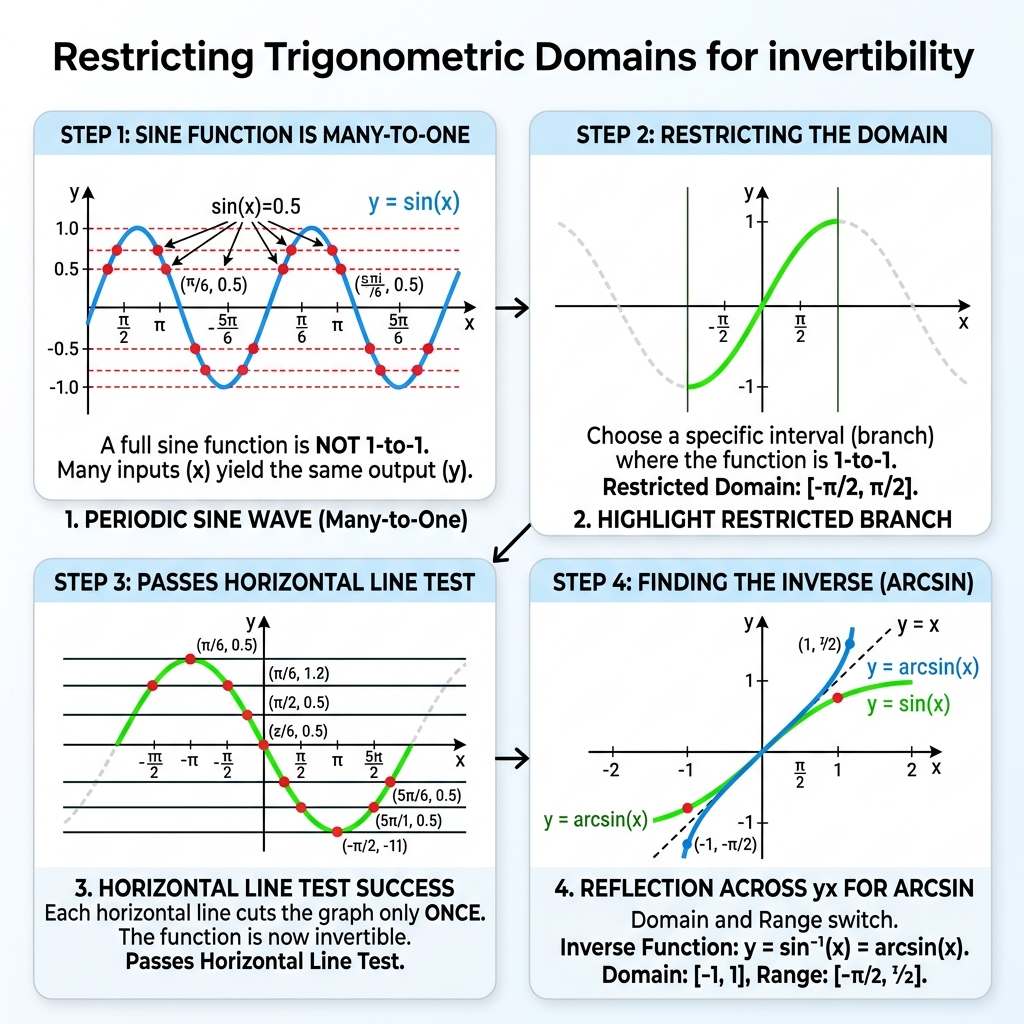
The Problem with Trigonometry: All six basic trigonometric functions (sin, cos, tan, etc.) are periodic. This means they repeat their values endlessly. For example, $\sin(0) = 0$, $\sin(\pi) = 0$, $\sin(2\pi) = 0$. Since multiple inputs give the same output, trigonometric functions are inherently Many-One, NOT One-One. Thus, naturally, their inverses do not exist!
The Solution - Restricting the Domain: To make trigonometric functions invertible, we mathematically "chop off" their repeating parts. We restrict their domains to a specific interval where the function is strictly increasing or strictly decreasing (making it One-One) and covers its entire range (making it Onto). This restricted domain allows the inverse to exist uniquely.
Concept Check (Existence)
Question: Discuss the existence of $\cos^{-1}(x)$ for $x = 2$ and $x = -1/2$.
Solution:
For $\cos^{-1}(x)$ to be defined, the input $x$ must lie in its domain, which is $[-1, 1]$.
- For $x = 2$: Since $2 \notin [-1, 1]$, $\cos^{-1}(2)$ does not exist.
- For $x = -1/2$: Since $-1/2 \in [-1, 1]$, $\cos^{-1}(-1/2)$ exists and its principal value can be calculated.
Practice Problem 1
Question: Why is the domain of $y = \sin x$ restricted to $[-\pi/2, \pi/2]$ to define its inverse, even though restricting it to $[\pi/2, 3\pi/2]$ would also make it bijective?
Solution:
Mathematically, restricting the domain to $[\pi/2, 3\pi/2]$ or $[3\pi/2, 5\pi/2]$ would indeed make $\sin x$ bijective, and an inverse could be defined. However, by universal mathematical convention, we choose the branch that is closest to the origin (zero) and generally positive. This universally accepted, standard restricted branch is called the Principal Value Branch. For $\sin x$, it is $[-\pi/2, \pi/2]$.
1.1 Review of Original Trigonometric Graphs
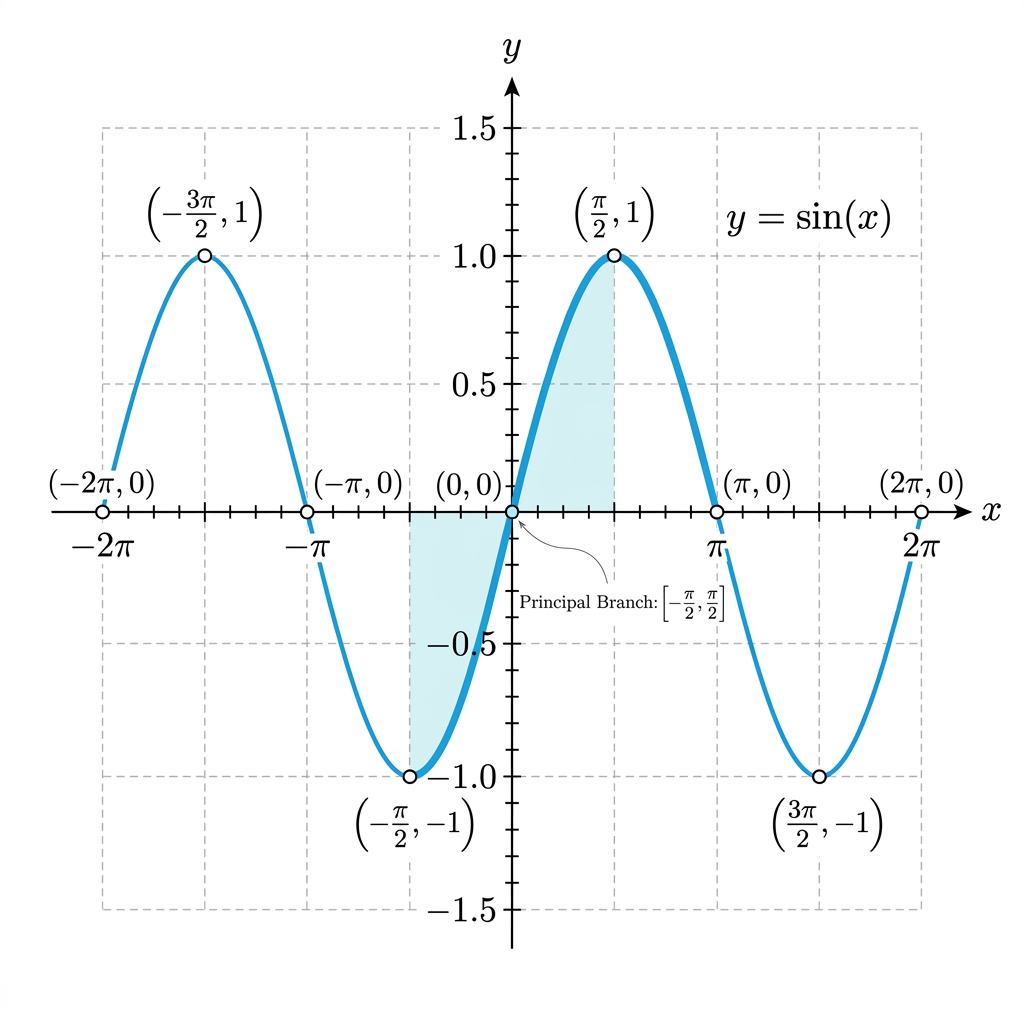
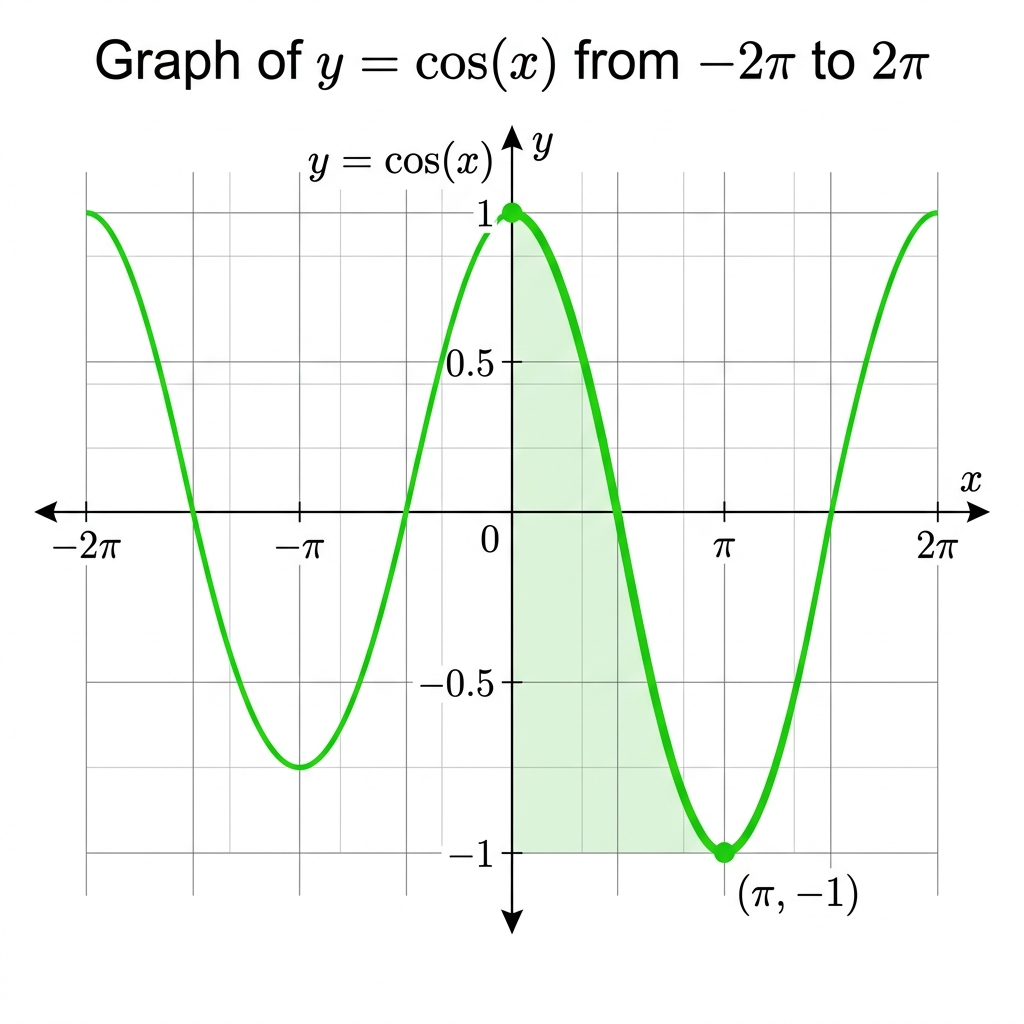
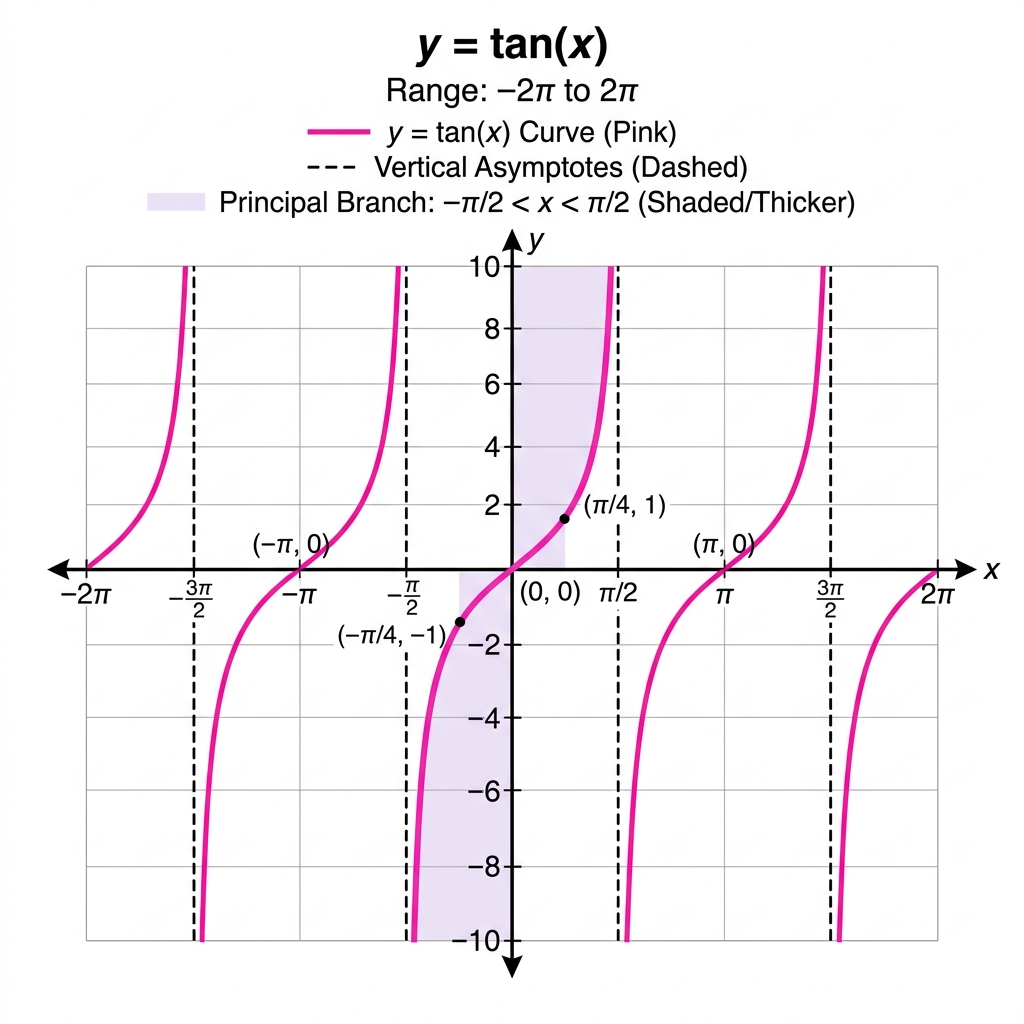
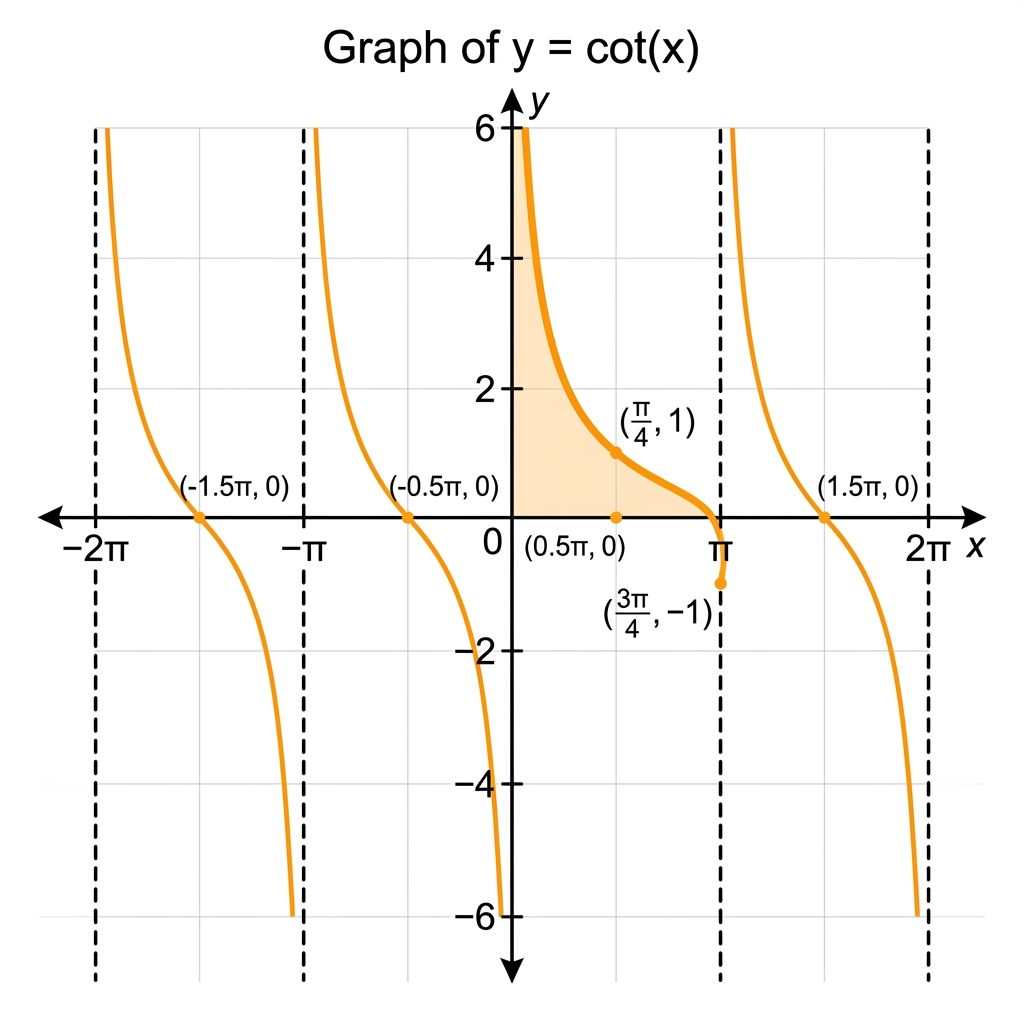
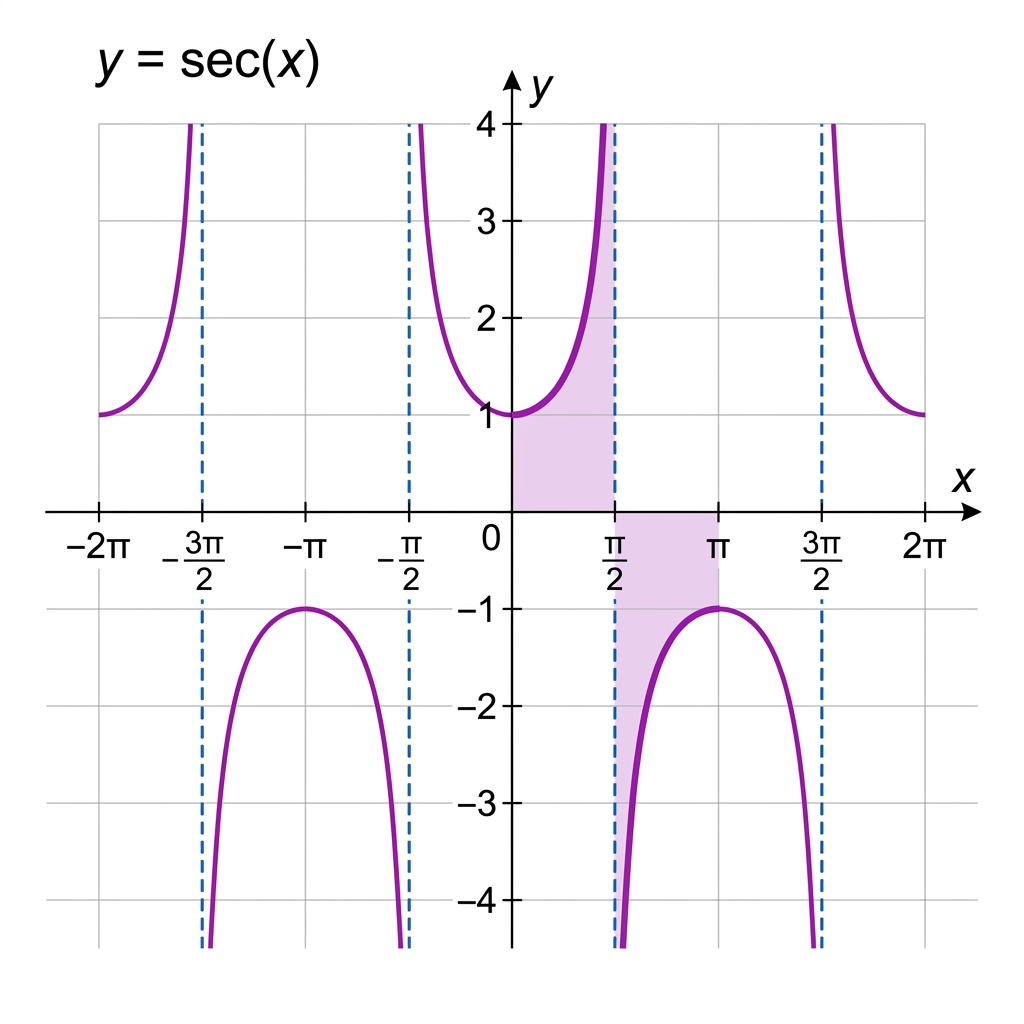
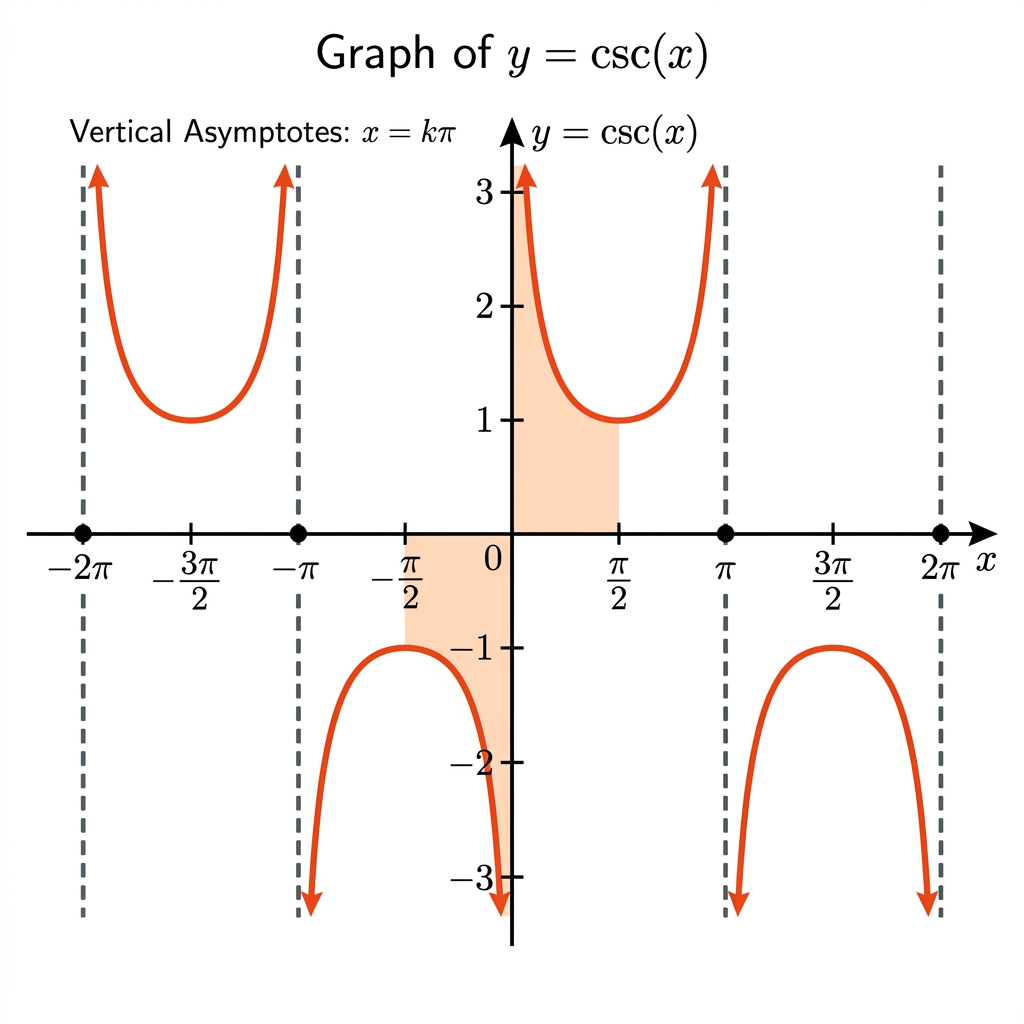
Before jumping into inverse functions, let's visually review the 6 original trigonometric functions. Notice their repeating, periodic nature and observe the principal branch (highlighted), which we must "chop off" to make them invertible.
y = sin(x)
y = cos(x)
y = tan(x)
y = cot(x)
y = sec(x)
y = csc(x)
2. Principal Value Branches (The Foundation)
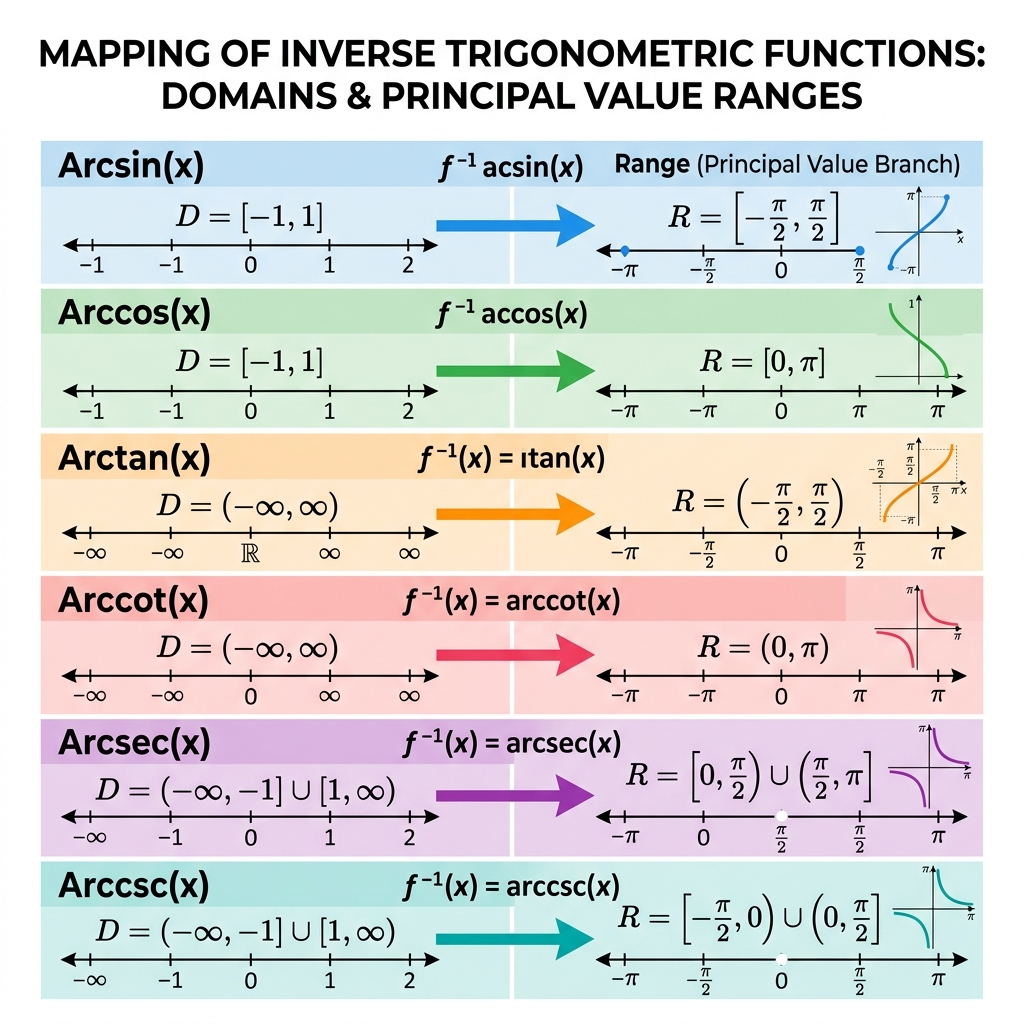
This is the most critical table in the entire chapter. Memorize it completely. Any answer you calculate for an inverse trigonometric function MUST lie within its Principal Value Range.
| Function ($y = f(x)$) |
Domain (Valid inputs for $x$) |
Range / Principal Value Branch (Output $y$) |
| $y = \sin^{-1} x$ (Arcsine) |
$[-1, 1]$ |
$\mathbf{[-\frac{\pi}{2}, \frac{\pi}{2}]}$ |
| $y = \cos^{-1} x$ (Arccosine) |
$[-1, 1]$ |
$\mathbf{[0, \pi]}$ |
| $y = \tan^{-1} x$ (Arctangent) |
$\mathbb{R}$ (All real numbers) |
$\mathbf{(-\frac{\pi}{2}, \frac{\pi}{2})}$ (Open brackets) |
| $y = \cot^{-1} x$ (Arccotangent) |
$\mathbb{R}$ |
$\mathbf{(0, \pi)}$ (Open brackets) |
| $y = \sec^{-1} x$ (Arcsecant) |
$\mathbb{R} - (-1, 1)$ or $(-\infty, -1] \cup [1, \infty)$ |
$\mathbf{[0, \pi] - \{\frac{\pi}{2}\}}$ |
| $y = \csc^{-1} x$ (Arccosecant) |
$\mathbb{R} - (-1, 1)$ or $(-\infty, -1] \cup [1, \infty)$ |
$\mathbf{[-\frac{\pi}{2}, \frac{\pi}{2}] - \{0\}}$ |
Standard Practice (R.S. Aggarwal)
Question: Find the principal value of $\cos^{-1}\left(\cos \frac{13\pi}{6}\right)$ and $\sin^{-1}\left(\sin \frac{3\pi}{5}\right)$.
Solution:
(i) $\cos^{-1}\left(\cos \frac{13\pi}{6}\right)$:
$\frac{13\pi}{6}$ is not in the principal branch $[0, \pi]$.
$\cos(\frac{13\pi}{6}) = \cos(2\pi + \frac{\pi}{6}) = \cos(\frac{\pi}{6})$.
$\cos^{-1}(\cos \frac{\pi}{6}) = \mathbf{\frac{\pi}{6}}$.
(ii) $\sin^{-1}\left(\sin \frac{3\pi}{5}\right)$:
$\frac{3\pi}{5} = 108^\circ$, which is outside $[-\frac{\pi}{2}, \frac{\pi}{2}]$.
$\sin(\frac{3\pi}{5}) = \sin(\pi - \frac{2\pi}{5}) = \sin(\frac{2\pi}{5})$.
$\sin^{-1}(\sin \frac{2\pi}{5}) = \mathbf{\frac{2\pi}{5}}$.
Practice Problem 2
Question: Find the principal values of (i) $\sin^{-1}\left(-\frac{1}{2}\right)$ and (ii) $\cos^{-1}\left(-\frac{1}{2}\right)$.
Solution:
(i) $\sin^{-1}\left(-\frac{1}{2}\right)$:
Let $y = \sin^{-1}\left(-\frac{1}{2}\right) \implies \sin y = -\frac{1}{2}$.
We know $\sin(\frac{\pi}{6}) = \frac{1}{2}$, so $\sin(-\frac{\pi}{6}) = -\frac{1}{2}$.
Since $-\frac{\pi}{6}$ lies in the principal branch $[-\frac{\pi}{2}, \frac{\pi}{2}]$, the principal value is $-\frac{\pi}{6}$.
(ii) $\cos^{-1}\left(-\frac{1}{2}\right)$:
Let $y = \cos^{-1}\left(-\frac{1}{2}\right) \implies \cos y = -\frac{1}{2}$.
We know $\cos$ is negative in the 2nd quadrant. $\cos(\pi - \frac{\pi}{3}) = -\cos(\frac{\pi}{3}) = -\frac{1}{2}$.
So, $\cos(\frac{2\pi}{3}) = -\frac{1}{2}$.
Since $\frac{2\pi}{3}$ lies in the principal branch $[0, \pi]$, the principal value is $\frac{2\pi}{3}$.
3. Graphs of Inverse Trigonometric Functions
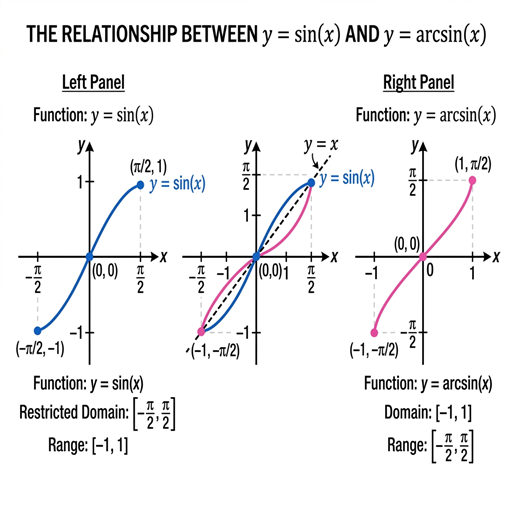
Mirror Image Property: The graph of an inverse function $f^{-1}(x)$ can be obtained by taking the mirror image of the original function $f(x)$ across the line $y = x$. This swaps the x and y axes.
y = sin⁻¹(x)
Domain: [-1, 1] | Range: [-π/2, π/2]
Strictly Increasing
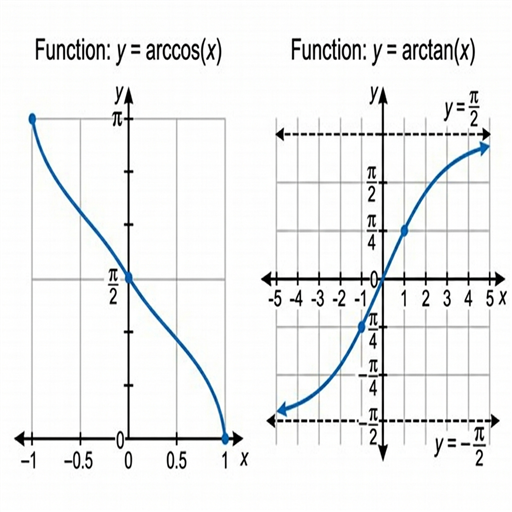
y = cos⁻¹(x)
Domain: [-1, 1] | Range: [0, π]
Strictly Decreasing
y = tan⁻¹(x)
Domain: R | Range: (-π/2, π/2)
Asymptotes at y = ±π/2
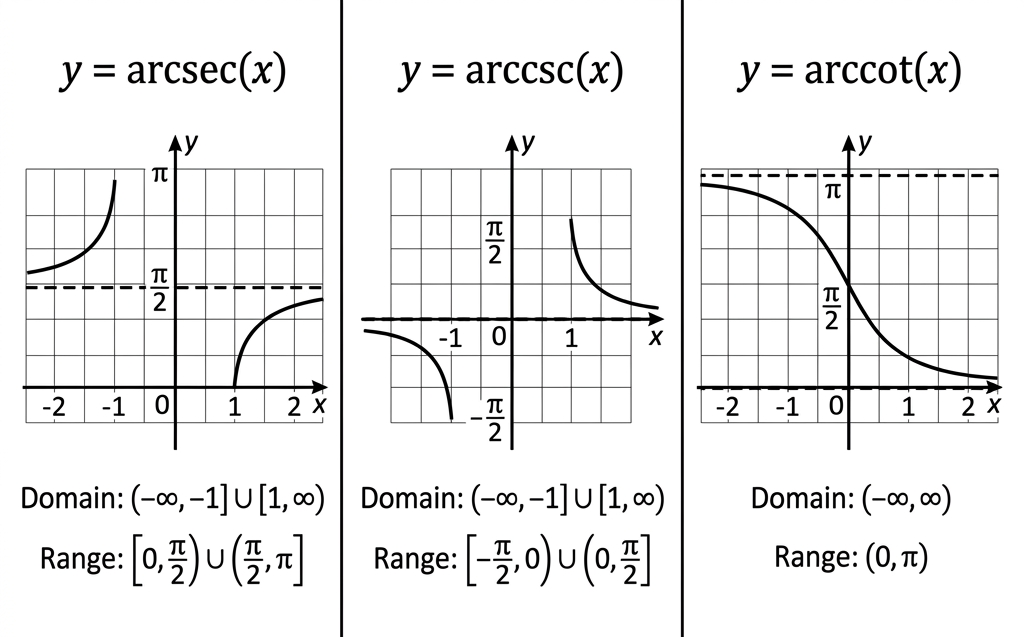
y = cot⁻¹(x)
Domain: R | Range: (0, π)
Asymptotes at y = 0, π
y = sec⁻¹(x)
Domain: (-∞, -1] ∪ [1, ∞) | Range: [0, π] - {π/2}
Two Branches
y = csc⁻¹(x)
Domain: (-∞, -1] ∪ [1, ∞) | Range: [-π/2, π/2] - {0}
Two Branches
Practice Problem 3 (JEE Focus)
Question: Using the strictly decreasing nature of $y = \cos^{-1} x$, solve the inequality: $\cos^{-1} x > \cos^{-1}(x^2)$.
Solution:
1. Let $f(x) = \cos^{-1} x$. From the graph, $f(x)$ is a strictly decreasing function on $[-1, 1]$.
2. For a strictly decreasing function, if $f(a) > f(b)$, then it MUST be true that $a < b$.
3. Therefore, $\cos^{-1} x > \cos^{-1}(x^2) \implies x < x^2$.
4. Rearranging: $x^2 - x > 0 \implies x(x - 1) > 0$.
5. The solution to this inequality is $x \in (-\infty, 0) \cup (1, \infty)$.
6. Crucial Step (Domain Intersection): The original functions $\cos^{-1} x$ and $\cos^{-1}(x^2)$ are ONLY valid if their arguments lie in $[-1, 1]$.
So, $x \in [-1, 1]$ and $x^2 \in [-1, 1]$ (which means $x \in [-1, 1]$).
7. Taking the intersection of step 5 and step 6:
$((-\infty, 0) \cup (1, \infty)) \cap [-1, 1] = \mathbf{[-1, 0)}$.
4. Properties of ITF - Part 1 (Self-Adjusting & Basic Relations)
A. Self-Adjusting Properties
These properties are the most common source of errors in exams because students blindly cancel the functions without checking the domain.
Property 1 & 2 (Check the Domain!)
Property 1: $f^{-1}(f(x)) = x$
- $\sin^{-1}(\sin x) = x$ ONLY IF $x \in [-\frac{\pi}{2}, \frac{\pi}{2}]$.
- $\cos^{-1}(\cos x) = x$ ONLY IF $x \in [0, \pi]$.
- $\tan^{-1}(\tan x) = x$ ONLY IF $x \in (-\frac{\pi}{2}, \frac{\pi}{2})$.
If $x$ is outside this branch, you MUST use allied angles (like $\pi - x, 2\pi - x$) to adjust $x$ into the principal branch before canceling.
Property 2: $f(f^{-1}(x)) = x$
- $\sin(\sin^{-1} x) = x$ ONLY IF $x \in [-1, 1]$.
- $\cos(\cos^{-1} x) = x$ ONLY IF $x \in [-1, 1]$.
- $\tan(\tan^{-1} x) = x$ for ALL $x \in \mathbb{R}$.
Practice Problem 4
Question: Evaluate (i) $\sin^{-1}(\sin \frac{2\pi}{3})$ and (ii) $\tan^{-1}(\tan \frac{3\pi}{4})$.
Solution:
(i) $\sin^{-1}(\sin \frac{2\pi}{3})$:
$\frac{2\pi}{3} = 120^\circ$, which does NOT lie in the principal branch $[-\frac{\pi}{2}, \frac{\pi}{2}]$ ($[-90^\circ, 90^\circ]$). We cannot just cancel.
Adjust using $\sin(\pi - \theta) = \sin\theta$:
$\sin(\frac{2\pi}{3}) = \sin(\pi - \frac{\pi}{3}) = \sin(\frac{\pi}{3})$.
Now, $\sin^{-1}(\sin \frac{\pi}{3}) = \mathbf{\frac{\pi}{3}}$ (Since $\frac{\pi}{3}$ is in $[-\frac{\pi}{2}, \frac{\pi}{2}]$).
(ii) $\tan^{-1}(\tan \frac{3\pi}{4})$:
$\frac{3\pi}{4}$ does NOT lie in $(-\frac{\pi}{2}, \frac{\pi}{2})$.
Adjust using $\tan(\pi - \theta) = -\tan\theta \implies \tan(\theta) = -\tan(\pi - \theta)$ (or better, use $\tan(\theta - \pi) = \tan\theta$):
$\tan(\frac{3\pi}{4}) = \tan(\frac{3\pi}{4} - \pi) = \tan(-\frac{\pi}{4})$.
Now, $\tan^{-1}(\tan(-\frac{\pi}{4})) = \mathbf{-\frac{\pi}{4}}$ (Since $-\frac{\pi}{4}$ is in $(-\frac{\pi}{2}, \frac{\pi}{2})$).
B. Reciprocal Properties
- $\sin^{-1}(1/x) = \csc^{-1} x$ (for $|x| \ge 1$)
- $\cos^{-1}(1/x) = \sec^{-1} x$ (for $|x| \ge 1$)
- The R.D. Sharma Exception:
$\tan^{-1}(1/x) = \cot^{-1} x$ (ONLY if $x > 0$)
$\tan^{-1}(1/x) = \mathbf{-\pi + \cot^{-1} x}$ (If $x < 0$)
Practice Problem 5
Question: Evaluate $\tan^{-1}(-1) + \cot^{-1}(-1)$ using reciprocal properties.
Solution:
Here, $x = -1$, which is $< 0$. We must use the exception formula.
$\tan^{-1}(1/x) = -\pi + \cot^{-1} x \implies \tan^{-1}(-1) = -\pi + \cot^{-1}(-1)$.
Substitute this into the expression:
$(-\pi + \cot^{-1}(-1)) + \cot^{-1}(-1) = -\pi + 2\cot^{-1}(-1)$.
We know $\cot^{-1}(-1) = \pi - \cot^{-1}(1) = \pi - \frac{\pi}{4} = \frac{3\pi}{4}$.
Result $= -\pi + 2(\frac{3\pi}{4}) = -\pi + \frac{3\pi}{2} = \mathbf{\frac{\pi}{2}}$.
Advanced Practice (R.D. Sharma)
Question: Evaluate $\sin(\cot^{-1} x)$.
Solution:
Let $\cot^{-1} x = \theta \implies \cot \theta = x = \frac{x}{1}$.
Using a right-angled triangle, Base $= x$ and Perpendicular $= 1$.
Hypotenuse $= \sqrt{x^2 + 1^2} = \sqrt{x^2 + 1}$.
We need $\sin(\theta)$. From the triangle, $\sin \theta = \frac{\text{Perpendicular}}{\text{Hypotenuse}} = \frac{1}{\sqrt{x^2 + 1}}$.
Therefore, $\sin(\cot^{-1} x) = \mathbf{\frac{1}{\sqrt{x^2 + 1}}}$.
C. Negative Argument Properties (Even/Odd Nature)
Negative Argument Groups
Group 1 ("Odd-like" functions): Pull the minus out directly.
- $\sin^{-1}(-x) = -\sin^{-1} x$
- $\tan^{-1}(-x) = -\tan^{-1} x$
- $\csc^{-1}(-x) = -\csc^{-1} x$
Group 2 (Functions bound to positive $[0, \pi]$ ranges): Subtract from $\pi$.
- $\cos^{-1}(-x) = \mathbf{\pi - \cos^{-1} x}$
- $\cot^{-1}(-x) = \mathbf{\pi - \cot^{-1} x}$
- $\sec^{-1}(-x) = \mathbf{\pi - \sec^{-1} x}$
5. Properties of ITF - Part 2 (Identities & Formulas)
A. Complementary Angle Properties
These are incredibly useful in Calculus (Integration/Differentiation) for rapid simplification.
- $\sin^{-1} x + \cos^{-1} x = \frac{\pi}{2}$ (for $x \in [-1, 1]$)
- $\tan^{-1} x + \cot^{-1} x = \frac{\pi}{2}$ (for $x \in \mathbb{R}$)
- $\sec^{-1} x + \csc^{-1} x = \frac{\pi}{2}$ (for $|x| \ge 1$)
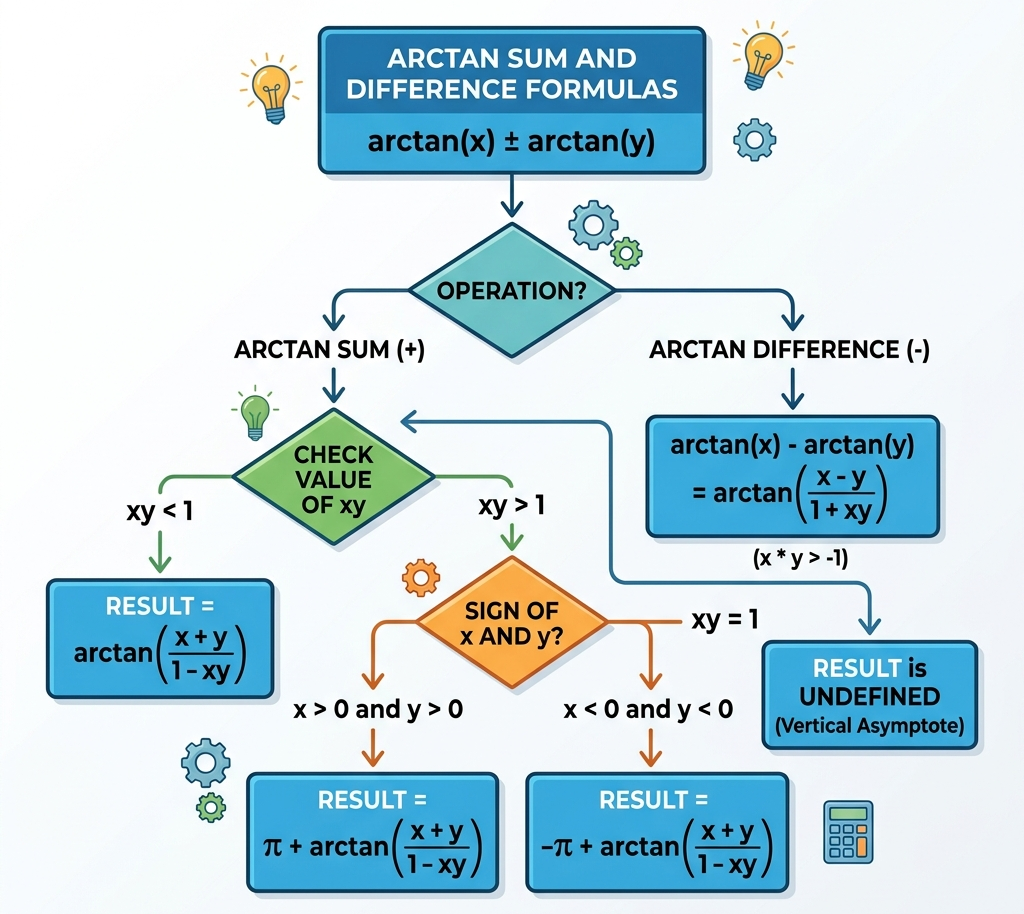
B. Addition and Subtraction Formulas (Crucial Cases)
The $\tan^{-1}$ Addition Formulas
For $\tan^{-1} x + \tan^{-1} y$:
- Case 1: If $xy < 1$ (Standard case)
$\tan^{-1} x + \tan^{-1} y = \mathbf{\tan^{-1}\left(\frac{x + y}{1 - xy}\right)}$
- Case 2: If $x > 0$, $y > 0$, and $xy > 1$ (R.D. Sharma / JEE case)
$\tan^{-1} x + \tan^{-1} y = \mathbf{\pi + \tan^{-1}\left(\frac{x + y}{1 - xy}\right)}$
For $\tan^{-1} x - \tan^{-1} y$:
- $\tan^{-1} x - \tan^{-1} y = \mathbf{\tan^{-1}\left(\frac{x - y}{1 + xy}\right)}$ (Valid if $xy > -1$)
Board Practice (R.S. Aggarwal)
Question: Prove that $\tan^{-1}\left(\frac{1}{4}\right) + \tan^{-1}\left(\frac{2}{9}\right) = \frac{1}{2}\cos^{-1}\left(\frac{3}{5}\right)$.
Solution:
LHS: Here $xy = \frac{1}{4} \times \frac{2}{9} = \frac{2}{36} = \frac{1}{18} < 1$. Use standard case.
$\tan^{-1}\left(\frac{1/4 + 2/9}{1 - (1/4)(2/9)}\right) = \tan^{-1}\left(\frac{\frac{9+8}{36}}{\frac{36-2}{36}}\right) = \tan^{-1}\left(\frac{17}{34}\right) = \tan^{-1}\left(\frac{1}{2}\right)$.
Now we must prove $\tan^{-1}\left(\frac{1}{2}\right) = \frac{1}{2}\cos^{-1}\left(\frac{3}{5}\right)$.
Let $\tan^{-1}\left(\frac{1}{2}\right) = \theta \implies \tan \theta = \frac{1}{2}$.
We know the identity: $\cos 2\theta = \frac{1 - \tan^2\theta}{1 + \tan^2\theta}$.
$\cos 2\theta = \frac{1 - (1/2)^2}{1 + (1/2)^2} = \frac{1 - 1/4}{1 + 1/4} = \frac{3/4}{5/4} = \frac{3}{5}$.
So, $2\theta = \cos^{-1}\left(\frac{3}{5}\right) \implies \theta = \frac{1}{2}\cos^{-1}\left(\frac{3}{5}\right)$.
Therefore, LHS = RHS. (Proved).
Practice Problem 6
Question: Prove that $\tan^{-1}\left(\frac{1}{2}\right) + \tan^{-1}\left(\frac{1}{3}\right) = \frac{\pi}{4}$.
Solution:
Here $x = \frac{1}{2}$ and $y = \frac{1}{3}$.
Product $xy = \frac{1}{2} \times \frac{1}{3} = \frac{1}{6}$. Since $xy < 1$, we use Case 1.
LHS $= \tan^{-1}\left(\frac{\frac{1}{2} + \frac{1}{3}}{1 - (\frac{1}{2})(\frac{1}{3})}\right)$
LHS $= \tan^{-1}\left(\frac{\frac{5}{6}}{1 - \frac{1}{6}}\right) = \tan^{-1}\left(\frac{\frac{5}{6}}{\frac{5}{6}}\right)$
LHS $= \tan^{-1}(1) = \mathbf{\frac{\pi}{4}} =$ RHS. (Proved).
Practice Problem 7
Question: Evaluate $\tan^{-1}(2) + \tan^{-1}(3)$.
Solution:
Here $x = 2$ and $y = 3$. Both are positive.
Product $xy = 2 \times 3 = 6$. Since $xy > 1$, we MUST use Case 2 (adding $\pi$).
Expression $= \pi + \tan^{-1}\left(\frac{2 + 3}{1 - (2)(3)}\right)$
$= \pi + \tan^{-1}\left(\frac{5}{1 - 6}\right) = \pi + \tan^{-1}\left(\frac{5}{-5}\right)$
$= \pi + \tan^{-1}(-1)$
Since $\tan^{-1}(-x) = -\tan^{-1}x$, this becomes $\pi - \tan^{-1}(1)$.
$= \pi - \frac{\pi}{4} = \mathbf{\frac{3\pi}{4}}$.
6. Multiple Angle Formulas (Conversion Formulas)
These formulas are directly derived from the double angle formulas of Class 11 Trigonometry ($\tan 2\theta, \sin 2\theta, \cos 2\theta$). They allow us to convert $2\tan^{-1} x$ into any other inverse function.
$2\tan^{-1} x$ Conversion Table
- $2\tan^{-1} x = \mathbf{\sin^{-1}\left(\frac{2x}{1 + x^2}\right)}$ [Condition: $|x| \le 1$]
- $2\tan^{-1} x = \mathbf{\cos^{-1}\left(\frac{1 - x^2}{1 + x^2}\right)}$ [Condition: $x \ge 0$]
- $2\tan^{-1} x = \mathbf{\tan^{-1}\left(\frac{2x}{1 - x^2}\right)}$ [Condition: $-1 < x < 1$]
Triple Angle Formulas:
- $3\sin^{-1} x = \sin^{-1}(3x - 4x^3)$
- $3\cos^{-1} x = \cos^{-1}(4x^3 - 3x)$
- $3\tan^{-1} x = \tan^{-1}\left(\frac{3x - x^3}{1 - 3x^2}\right)$
Practice Problem 8
Question: Simplify $\sin(2\tan^{-1}(\frac{3}{4}))$.
Solution:
To eliminate the outer sine function, we need the inner function to be an $\sin^{-1}$. We use the conversion formula:
$2\tan^{-1} x = \sin^{-1}\left(\frac{2x}{1 + x^2}\right)$. Here $x = 3/4$ (which satisfies $|x| \le 1$).
$2\tan^{-1}(\frac{3}{4}) = \sin^{-1}\left( \frac{2(3/4)}{1 + (3/4)^2} \right) = \sin^{-1}\left( \frac{3/2}{1 + 9/16} \right)$
$= \sin^{-1}\left( \frac{3/2}{25/16} \right) = \sin^{-1}\left( \frac{3}{2} \times \frac{16}{25} \right) = \sin^{-1}\left( \frac{24}{25} \right)$.
Now substitute back into the original expression:
$\sin\left( \sin^{-1}\left(\frac{24}{25}\right) \right) = \mathbf{\frac{24}{25}}$.
7. Simplification of ITF Expressions using Standard Substitutions
This is the most practically applied skill in calculus. When faced with complex algebraic expressions inside an ITF, substituting a trigonometric variable vastly simplifies the problem.
Standard Substitution Dictionary
| Algebraic Expression | Trigonometric Substitution | Identities Used |
|---|
| $\sqrt{a^2 - x^2}$ | $x = a\sin\theta$ or $a\cos\theta$ | $1 - \sin^2\theta = \cos^2\theta$ |
| $\sqrt{a^2 + x^2}$ | $x = a\tan\theta$ or $a\cot\theta$ | $1 + \tan^2\theta = \sec^2\theta$ |
| $\sqrt{x^2 - a^2}$ | $x = a\sec\theta$ or $a\csc\theta$ | $\sec^2\theta - 1 = \tan^2\theta$ |
| $\sqrt{\frac{a - x}{a + x}}$ or $\sqrt{\frac{a + x}{a - x}}$ | $x = a\cos 2\theta$ | $1 - \cos 2\theta = 2\sin^2\theta$
$1 + \cos 2\theta = 2\cos^2\theta$ |
Special Form: $a\cos x \pm b\sin x \longrightarrow$ Divide numerator and denominator by $\sqrt{a^2 + b^2}$ to create a $\sin(A\pm B)$ or $\cos(A\pm B)$ formula.
Practice Problem 9
Question: Write $\tan^{-1}\left(\frac{\sqrt{1+x^2}-1}{x}\right)$ in the simplest form.
Solution:
1. The expression contains $\sqrt{1+x^2}$, which maps to the form $\sqrt{a^2+x^2}$ where $a=1$.
2. Put $x = \tan\theta \implies \theta = \tan^{-1} x$.
3. Expression becomes: $\tan^{-1}\left(\frac{\sqrt{1+\tan^2\theta}-1}{\tan\theta}\right)$.
4. Using identity: $\tan^{-1}\left(\frac{\sec\theta-1}{\tan\theta}\right)$.
5. Convert to sine and cosine: $\tan^{-1}\left(\frac{\frac{1}{\cos\theta}-1}{\frac{\sin\theta}{\cos\theta}}\right) = \tan^{-1}\left(\frac{1-\cos\theta}{\sin\theta}\right)$.
6. Use half-angle formulas ($1-\cos\theta = 2\sin^2(\theta/2)$ and $\sin\theta = 2\sin(\theta/2)\cos(\theta/2)$):
$\tan^{-1}\left(\frac{2\sin^2(\theta/2)}{2\sin(\theta/2)\cos(\theta/2)}\right) = \tan^{-1}\left(\frac{\sin(\theta/2)}{\cos(\theta/2)}\right) = \tan^{-1}(\tan(\theta/2))$.
7. Assuming principal branch, this equals $\frac{\theta}{2}$.
8. Substitute $\theta$ back: $\frac{1}{2}\tan^{-1} x$.
Important Simplification (R.D. Sharma)
Question: Simplify $\tan^{-1}\left(\frac{\cos x - \sin x}{\cos x + \sin x}\right)$ for $-\frac{\pi}{4} < x < \frac{3\pi}{4}$.
Solution:
1. Divide the numerator and denominator inside the bracket by $\cos x$:
$\tan^{-1}\left(\frac{1 - \tan x}{1 + \tan x}\right)$.
2. We can rewrite $1$ as $\tan(\frac{\pi}{4})$:
$\tan^{-1}\left(\frac{\tan(\frac{\pi}{4}) - \tan x}{1 + \tan(\frac{\pi}{4})\tan x}\right)$.
3. This perfectly matches the formula for $\tan(A - B)$:
$\tan^{-1}\left(\tan(\frac{\pi}{4} - x)\right)$.
4. Since $-\frac{\pi}{4} < x < \frac{3\pi}{4}$, the angle $(\frac{\pi}{4} - x)$ falls inside the principal branch $(-\frac{\pi}{2}, \frac{\pi}{2})$.
5. Therefore, we can safely cancel the functions: $\frac{\pi}{4} - x$.
8. Solving Inverse Trigonometric Equations
An equation involving an unknown variable $x$ inside an ITF is solved by applying properties to combine terms into a single ITF, then applying normal trigonometric functions to both sides to "unlock" the variable.
Warning: Extraneous Roots
Because ITF properties have severe domain restrictions, algebraic manipulation often introduces "false" or extraneous roots. You MUST always substitute your final answers back into the original equation to check if they hold true. If LHS $\neq$ RHS, reject that root.
Practice Problem 10
Question: Solve the equation for $x$: $\tan^{-1}(2x) + \tan^{-1}(3x) = \frac{\pi}{4}$.
Solution:
1. Apply the $\tan^{-1} A + \tan^{-1} B$ formula (assuming $2x \cdot 3x < 1$):
$\tan^{-1}\left(\frac{2x + 3x}{1 - (2x)(3x)}\right) = \frac{\pi}{4}$
2. $\tan^{-1}\left(\frac{5x}{1 - 6x^2}\right) = \frac{\pi}{4}$.
3. Take $\tan$ on both sides:
$\frac{5x}{1 - 6x^2} = \tan(\frac{\pi}{4}) = 1$.
4. Cross-multiply and solve the quadratic equation:
$5x = 1 - 6x^2 \implies 6x^2 + 5x - 1 = 0$.
5. Factorize: $6x^2 + 6x - x - 1 = 0 \implies 6x(x+1) - 1(x+1) = 0 \implies (6x-1)(x+1) = 0$.
6. Roots are $x = \frac{1}{6}$ and $x = -1$.
7. Checking Roots:
- If $x = -1$: LHS $= \tan^{-1}(-2) + \tan^{-1}(-3)$. This is the sum of two negative angles, which is negative. It cannot equal $+\frac{\pi}{4}$. So, $x = -1$ is rejected.
- If $x = \frac{1}{6}$: $2x \cdot 3x = 6(\frac{1}{36}) = \frac{1}{6} < 1$. The formula condition holds, and the sum of positive angles equals $\pi/4$.
8. Final Answer: $x = \frac{1}{6}$.
Crucial Equation (R.S. Aggarwal)
Question: Solve $\sin^{-1}(1-x) - 2\sin^{-1}x = \frac{\pi}{2}$.
Solution:
1. Rearrange to avoid a messy subtraction formula:
$\sin^{-1}(1-x) = \frac{\pi}{2} + 2\sin^{-1}x$.
2. Take sine on both sides:
$1 - x = \sin(\frac{\pi}{2} + 2\sin^{-1}x)$.
3. We know $\sin(\frac{\pi}{2} + \theta) = \cos\theta$. So:
$1 - x = \cos(2\sin^{-1}x)$.
4. Let $\sin^{-1}x = \theta \implies \sin\theta = x$. Then we have $\cos(2\theta)$.
5. Apply the identity $\cos(2\theta) = 1 - 2\sin^2\theta$:
$1 - x = 1 - 2x^2$.
6. Simplify the equation:
$2x^2 - x = 0 \implies x(2x - 1) = 0$.
7. Roots are $x = 0$ and $x = \frac{1}{2}$.
8. Checking Roots:
- If $x = 0$: $\sin^{-1}(1) - 2\sin^{-1}(0) = \frac{\pi}{2} - 0 = \frac{\pi}{2}$. (Valid).
- If $x = \frac{1}{2}$: $\sin^{-1}(\frac{1}{2}) - 2\sin^{-1}(\frac{1}{2}) = -\sin^{-1}(\frac{1}{2}) = -\frac{\pi}{6} \neq \frac{\pi}{2}$. (Rejected).
9. Final Answer: $x = 0$.
9. Complete Graph Mastery of All 6 Inverse Trigonometric Functions
For top marks, do not memorize only formula values; understand the graph behavior: domain endpoints, range boundaries, increasing/decreasing nature, odd/even symmetry, and asymptotes.
Graph Summary Table
| Function |
Domain |
Range (Principal Values) |
Nature |
Special Feature |
| $y=\sin^{-1}x$ |
$[-1,1]$ |
$[-\pi/2,\pi/2]$ |
Increasing |
Odd function |
| $y=\cos^{-1}x$ |
$[-1,1]$ |
$[0,\pi]$ |
Decreasing |
Not odd/even |
| $y=\tan^{-1}x$ |
$\mathbb{R}$ |
$(-\pi/2,\pi/2)$ |
Increasing |
Horizontal asymptotes at $y=\pm\pi/2$ |
| $y=\cot^{-1}x$ |
$\mathbb{R}$ |
$(0,\pi)$ |
Decreasing |
Horizontal asymptotes at $y=0,\pi$ |
| $y=\sec^{-1}x$ |
$(-\infty,-1]\cup[1,\infty)$ |
$[0,\pi]\setminus\{\pi/2\}$ |
Increasing on each branch |
Two disconnected branches |
| $y=\csc^{-1}x$ |
$(-\infty,-1]\cup[1,\infty)$ |
$[-\pi/2,\pi/2]\setminus\{0\}$ |
Decreasing on each branch |
Two disconnected branches |
10. Value-Finding Toolkit (Most Asked in NCERT, R.S. Aggarwal, R.D. Sharma)
Standard Pattern Method
For expressions like $\sin^{-1}(\sin\theta)$, $\cos^{-1}(\cos\theta)$, $\tan^{-1}(\tan\theta)$:
- Find the principal branch of the outer inverse function.
- Shift/transform $\theta$ using allied-angle identities to an equivalent angle in that branch.
- Then cancel safely.
Never cancel directly without branch check.
Practice Problem 11
Question: Evaluate $\sin^{-1}\left(\sin\frac{7\pi}{6}\right)$.
Solution:
Principal range of $\sin^{-1}$ is $[-\pi/2,\pi/2]$.
$\sin\frac{7\pi}{6}=\sin\left(\pi+\frac{\pi}{6}\right)=-\sin\frac{\pi}{6}=-\frac12$.
So $\sin^{-1}\left(\sin\frac{7\pi}{6}\right)=\sin^{-1}\left(-\frac12\right)=-\frac{\pi}{6}$.
Practice Problem 12
Question: Evaluate $\cos^{-1}\left(\cos\frac{11\pi}{6}\right)$.
Solution:
Principal range of $\cos^{-1}$ is $[0,\pi]$.
$\cos\frac{11\pi}{6}=\cos\left(2\pi-\frac{\pi}{6}\right)=\cos\frac{\pi}{6}=\frac{\sqrt3}{2}$.
Hence $\cos^{-1}\left(\cos\frac{11\pi}{6}\right)=\cos^{-1}\left(\frac{\sqrt3}{2}\right)=\frac{\pi}{6}$.
Practice Problem 13
Question: Evaluate $\tan^{-1}\left(\tan\frac{5\pi}{6}\right)$.
Solution:
Principal range of $\tan^{-1}$ is $(-\pi/2,\pi/2)$.
$\frac{5\pi}{6}-\pi=-\frac{\pi}{6}$ lies in the principal range and $\tan(\theta-\pi)=\tan\theta$.
Therefore $\tan^{-1}\left(\tan\frac{5\pi}{6}\right)= -\frac{\pi}{6}$.
11. Advanced Identities and Problem Types
High Frequency Results
1. $\sin^{-1}x+\sin^{-1}y=\sin^{-1}\!\left(x\sqrt{1-y^2}+y\sqrt{1-x^2}\right)$ with proper range conditions.
2. $\cos^{-1}x+\cos^{-1}y=\cos^{-1}\!\left(xy-\sqrt{(1-x^2)(1-y^2)}\right)$ with valid domain checks.
3. If $x>0$, then $\tan^{-1}x+\tan^{-1}\frac1x=\frac{\pi}{2}$; if $x<0$, value is $-\frac{\pi}{2}$.
Practice Problem 14
Question: Evaluate $\tan^{-1}(5)-\tan^{-1}(2)$.
Solution:
Use subtraction formula:
$$\tan^{-1}x-\tan^{-1}y=\tan^{-1}\left(\frac{x-y}{1+xy}\right)$$
with $x=5,y=2$:
$$=\tan^{-1}\left(\frac{5-2}{1+10}\right)=\tan^{-1}\left(\frac{3}{11}\right).$$
Practice Problem 15
Question: Prove that $\sin^{-1}x+\cos^{-1}x=\frac{\pi}{2}$ for $x\in[-1,1]$.
Solution:
Let $\sin^{-1}x=\theta\Rightarrow \sin\theta=x$, where $\theta\in[-\pi/2,\pi/2]$.
Then $\cos\left(\frac{\pi}{2}-\theta\right)=\sin\theta=x$.
Since $\frac{\pi}{2}-\theta\in[0,\pi]$, it lies in range of $\cos^{-1}$.
Hence $\cos^{-1}x=\frac{\pi}{2}-\theta$. Therefore,
$$\sin^{-1}x+\cos^{-1}x=\theta+\left(\frac{\pi}{2}-\theta\right)=\frac{\pi}{2}.$$
12. Equation Solving and Domain-Safe Approach
Exam Algorithm
1. Write domain restrictions first.
2. Combine inverse terms carefully using valid formula cases.
3. Solve algebraic equation.
4. Substitute each root back into the original inverse equation.
5. Reject roots violating domain or principal-value logic.
Practice Problem 16
Question: Solve $\sin^{-1}x=\cos^{-1}(2x)$.
Solution:
Domain: $x\in[-1,1]$ and $2x\in[-1,1]\Rightarrow x\in[-1/2,1/2]$.
Using $\sin^{-1}u+\cos^{-1}u=\pi/2$:
$$\sin^{-1}x=\cos^{-1}(2x)=\frac{\pi}{2}-\sin^{-1}(2x).$$
So
$$\sin^{-1}x+\sin^{-1}(2x)=\frac{\pi}{2}.$$
Taking sine on both sides gives
$$x\sqrt{1-4x^2}+2x\sqrt{1-x^2}=1.$$
Testing standard values in domain, $x=\frac12$ gives LHS $=1$ and is valid.
No other value satisfies in allowed interval. Hence
$x=\frac12$.
Practice Problem 17
Question: Solve $\tan^{-1}x+\tan^{-1}(x+1)=\frac{\pi}{4}$.
Solution:
Apply addition formula:
$$\tan^{-1}\left(\frac{x+(x+1)}{1-x(x+1)}\right)=\frac{\pi}{4}.$$
Therefore,
$$\frac{2x+1}{1-x^2-x}=1 \Rightarrow 2x+1=1-x^2-x$$
$$\Rightarrow x^2+3x=0 \Rightarrow x=0,\ -3.$$
Check:
$x=0:\ \tan^{-1}(0)+\tan^{-1}(1)=\pi/4$ (valid).
$x=-3:\ \tan^{-1}(-3)+\tan^{-1}(-2)<0$ (not $\pi/4$), reject.
Final answer: $x=0$.
Final Revision Checklist
1. Memorize principal ranges exactly (including open/closed interval brackets).
2. Never cancel inverse and direct trig without branch checking.
3. Handle $\tan^{-1}$ addition/subtraction with case logic (especially $xy>1$ corrections).
4. Verify all equation roots in original inverse equation.
5. Use graphs to justify monotonic arguments in inequalities.
6. Practice mixed-value conversions in radians (not only degrees).
