Vardaan Watermark

Relations & Functions

Class 12 • Chapter 1
👈
👉

Class 11 Revision: Sets

Before moving to relations, recall sets:

  • Set: A well-defined collection of distinct objects.
  • Subset ($\subseteq$): $A \subseteq B$ if every element of A is in B. Number of subsets of A is $2^n$.

Operations

  • Union ($A \cup B$): Elements in A OR B.
  • Intersection ($A \cap B$): Elements in BOTH A AND B.
  • Difference ($A - B$): Elements in A but NOT B.

Cartesian Product

For two non-empty sets $A$ and $B$, the Cartesian Product is the set of all ordered pairs:

$$ A \times B = \{ (a, b) \mid a \in A, b \in B \} $$

Key Properties

  • If $n(A) = p$ and $n(B) = q$, then $n(A \times B) = p \times q$.
  • $A \times B \neq B \times A$ generally.
  • Relations are derived directly from Cartesian products!

What is a Relation?

A Relation $R$ from set A to set B is a subset of $A \times B$.

Terminology

  • Domain: Set of all first elements $\{a\}$.
  • Range: Set of all second elements $\{b\}$.
  • Co-domain: The entire set B. (Range $\subseteq$ Co-domain).
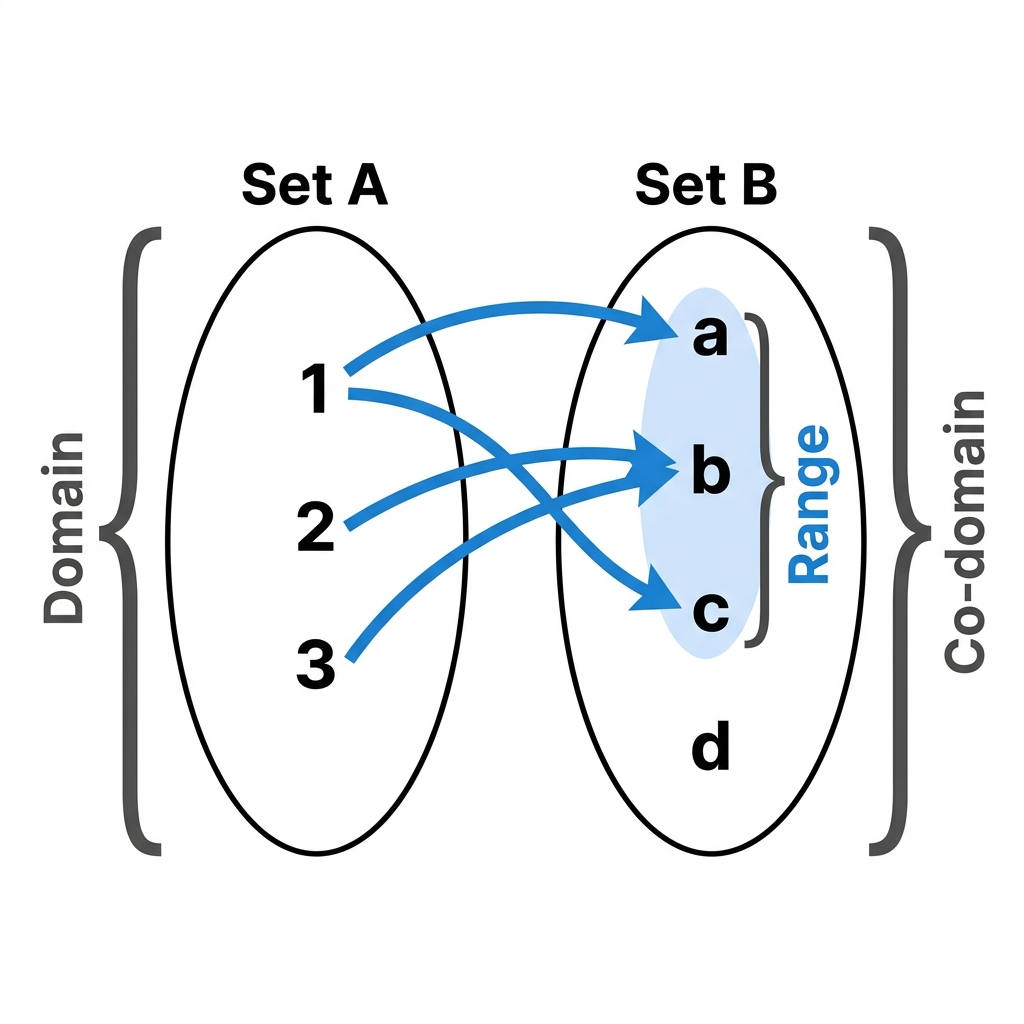
Total possible relations from A to B: $2^{pq}$
Relation Diagram

Types of Relations

Relations defined on a single set $A$ ($R \subseteq A \times A$):

Basic Types

  • Empty Relation: $R = \phi$. No element is related to any element.
  • Universal Relation: $R = A \times A$. Every element is related to every element.
  • Identity Relation ($I_A$): $R = \{(a,a) : a \in A\}$. Each element is related only to itself.

Note: Both Empty and Universal relations are symmetric and transitive!

The Big Three

Let $R$ be a relation on set $A$:

  • Reflexive: $(a, a) \in R$ for EVERY $a \in A$.
  • Symmetric: If $(a, b) \in R \implies (b, a) \in R$.
  • Transitive: If $(a, b) \in R$ AND $(b, c) \in R \implies (a, c) \in R$.

Equivalence Relation

A relation that satisfies all three: Reflexive, Symmetric, AND Transitive.

Anti-Symmetric

JEE Focus Point

A relation $R$ on $A$ is Anti-Symmetric if:

$$ (a, b) \in R \text{ and } (b, a) \in R \implies a = b $$

This means if $a \neq b$, you cannot have both $(a,b)$ and $(b,a)$ in the relation.

Classic Example: The relation $\leq$ (less than or equal to) is anti-symmetric on $\mathbb{R}$.

Equivalence Classes

If $R$ is an equivalence relation on set $A$, it partitions $A$ into disjoint subsets called Equivalence Classes.

$$ [a] = \{ x \in A : (x, a) \in R \} $$

Properties

  • Every element belongs to exactly one class.
  • $[a] = [b] \iff (a, b) \in R$.
  • Two distinct classes are always disjoint.
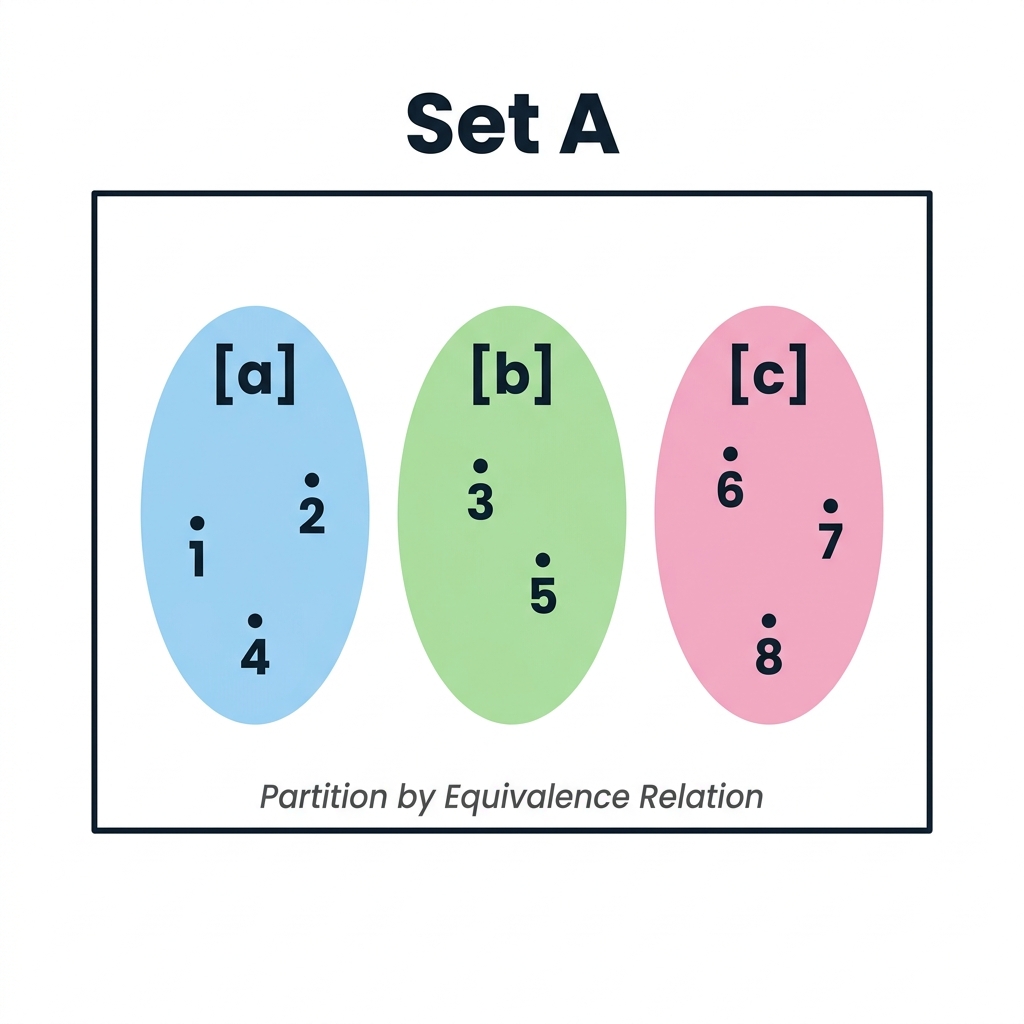
Equivalence Classes Diagram

Congruence Modulo n

The most important equivalence relation in integers!

$$a \equiv b \pmod{n} \iff n \text{ divides } (a - b)$$

Example: Modulo 3

Modulo 3 on $\mathbb{Z}$ gives 3 disjoint classes:

  • $[0] = \{\ldots, -3, 0, 3, 6, \ldots\}$
  • $[1] = \{\ldots, -2, 1, 4, 7, \ldots\}$
  • $[2] = \{\ldots, -1, 2, 5, 8, \ldots\}$

Functions & Types

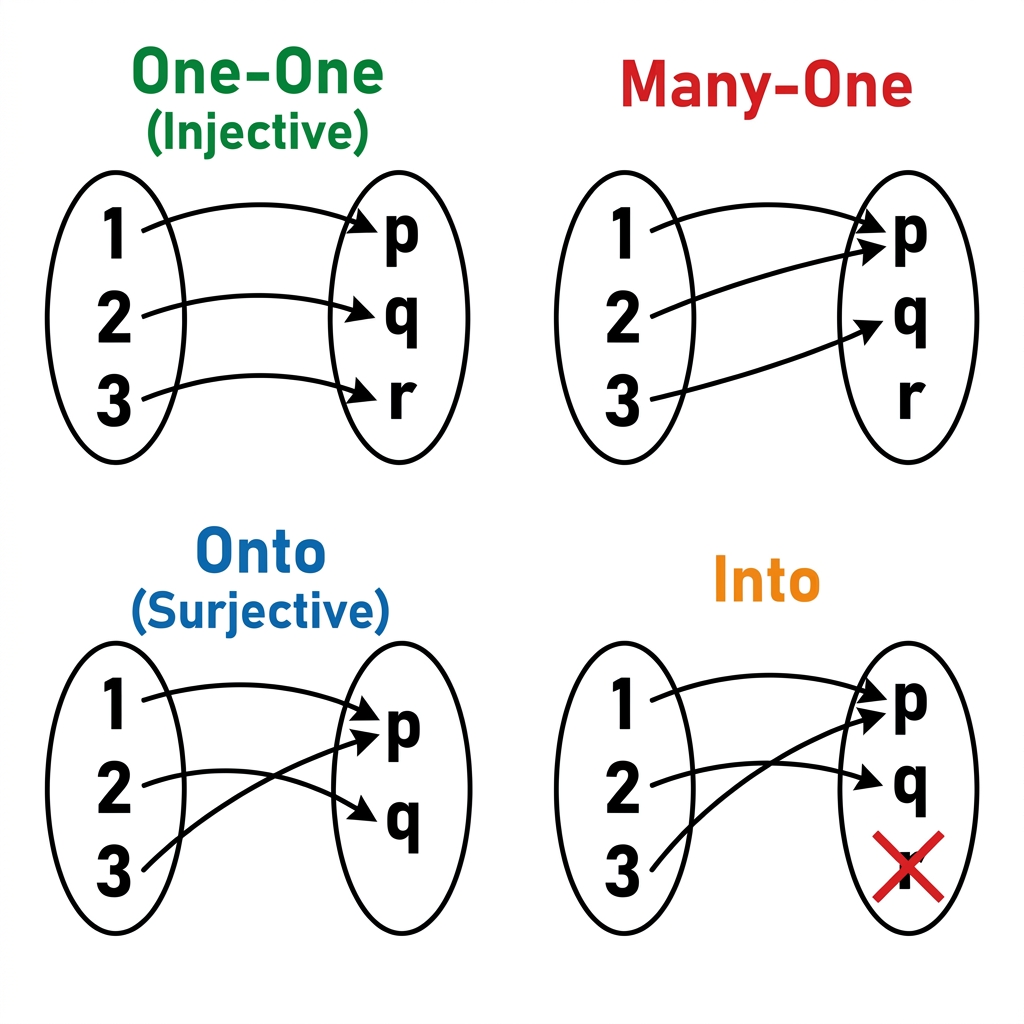
A mapping $f: A \rightarrow B$ where each element of A has exactly one image in B.

Classification

  • One-One (Injective): Distinct inputs have distinct outputs. $f(x_1) = f(x_2) \implies x_1 = x_2$.
  • Many-One: At least two inputs share an output.
  • Onto (Surjective): Range = Co-domain. Every output has a pre-image.
  • Into: Range $\subsetneq$ Co-domain.
  • Bijective: Both One-One AND Onto!
Types of Functions

Horizontal Line Test

Graphical Check for One-One

Draw any horizontal line across the graph.

  • If it intersects the graph at most once, the function is One-One.
  • If it intersects more than once, the function is Many-One (e.g., $y=x^2$).
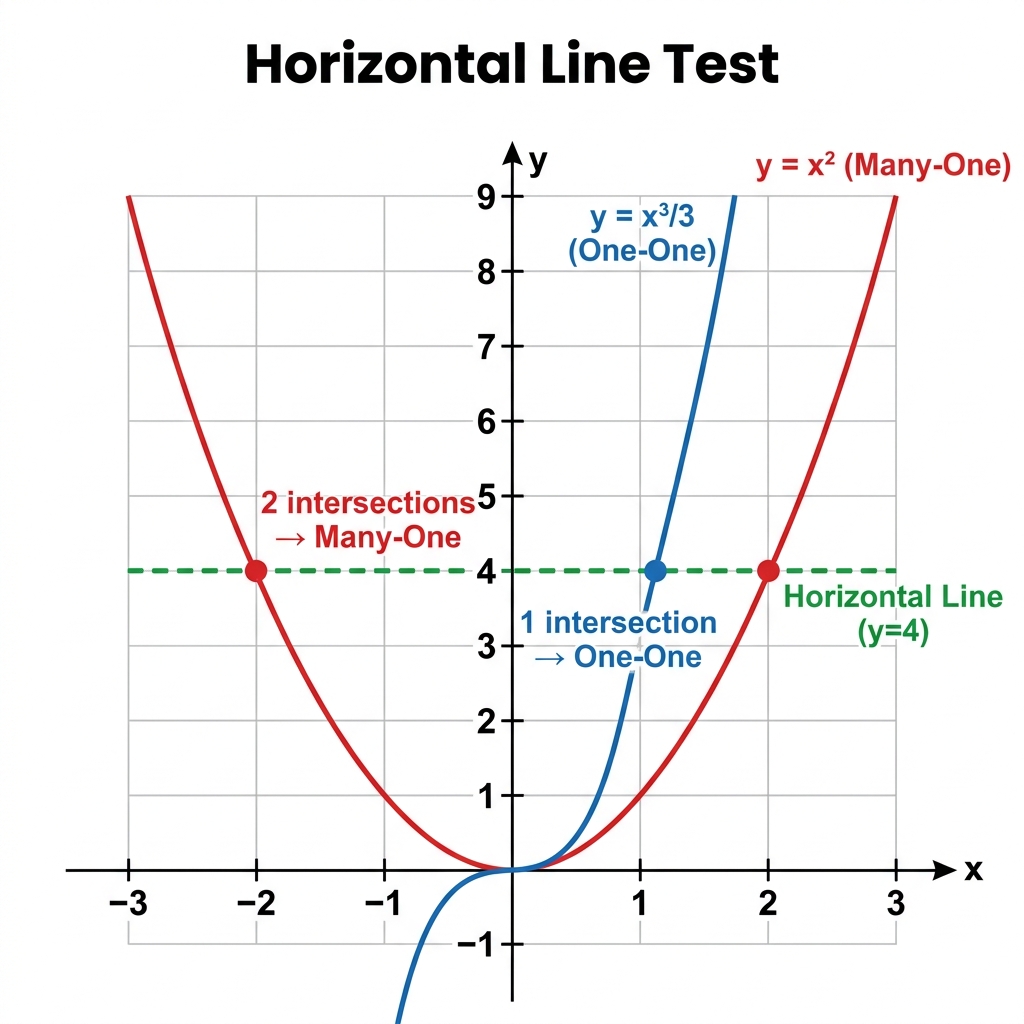
Horizontal Line Test Graph

Special Functions (1/4)

Modulus Function

Absolute value function $f(x) = |x|$.

$$ |x| = \begin{cases} x, & x \ge 0 \\ -x, & x < 0 \end{cases} $$

Shortcut for Double Modulus

$f(x) = |x - a| + |x - b|$

Graph forms a "trough" or boat shape with a flat bottom between critical points $x=a$ and $x=b$.
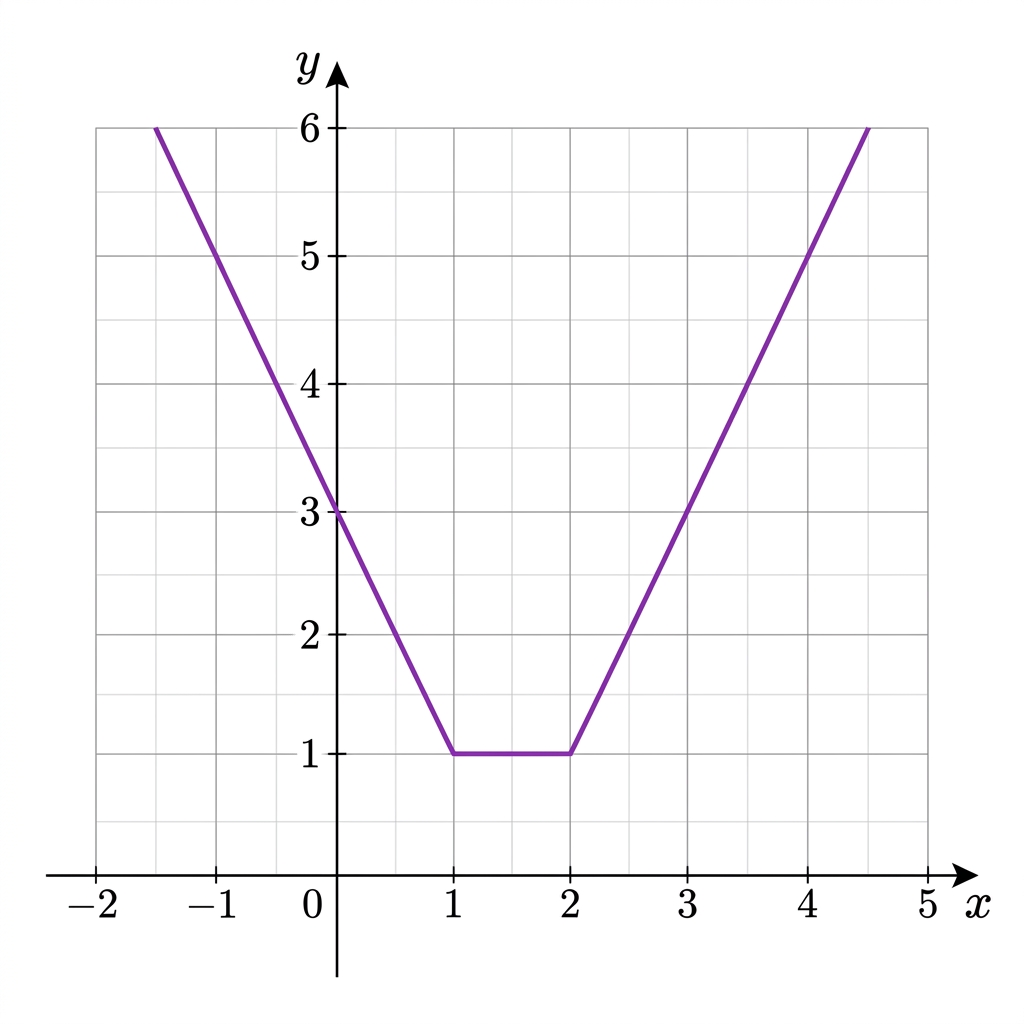
Double Modulus Graph

Special Functions (2/4)

Greatest Integer Function

Floor function $f(x) = [x]$ maps $x$ to the greatest integer $\le x$.

Key Properties

  • $x - 1 < [x] \le x$
  • $[x + n] = [x] + n$ if $n \in \mathbb{Z}$
  • $[x] + [-x] = 0$ if $x \in \mathbb{Z}$, else $-1$

Graph is a "staircase" with open right endpoints.
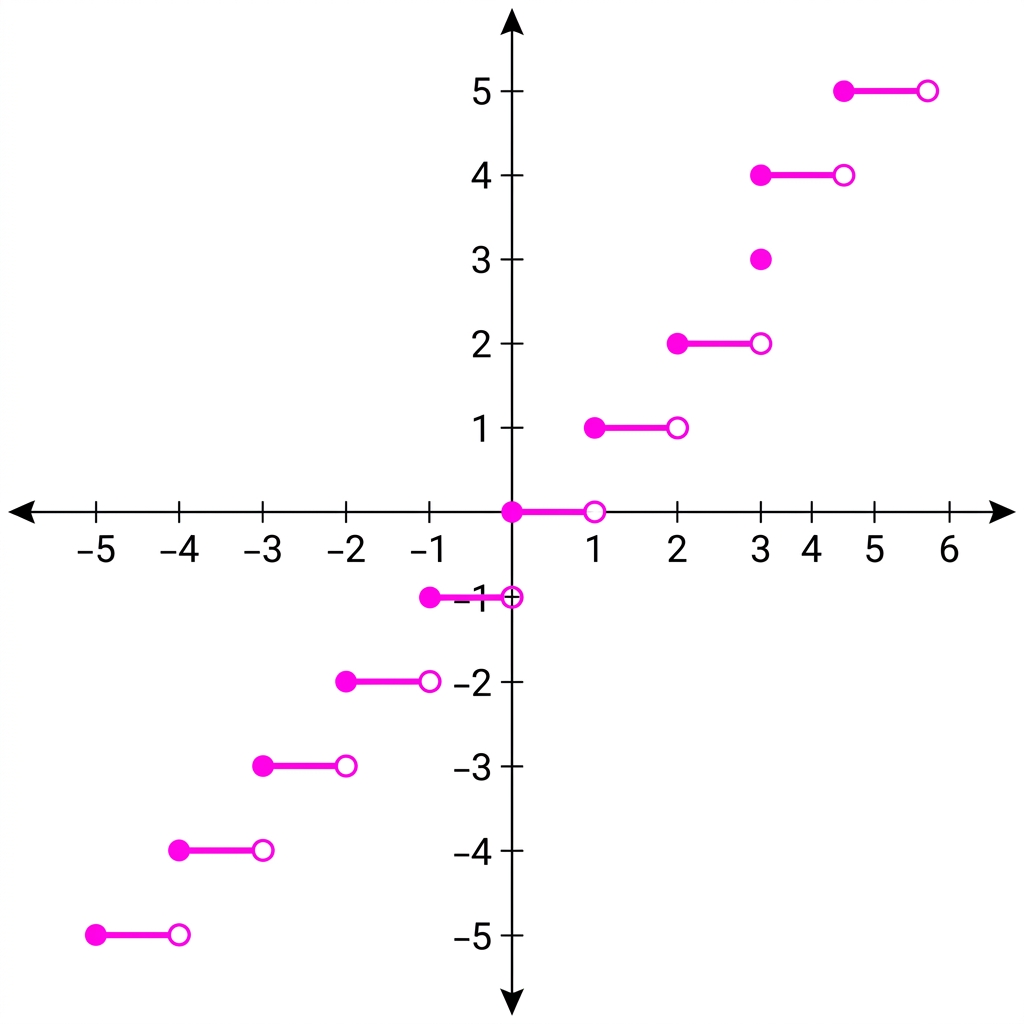
GIF Staircase Graph

Special Functions (3/4)

Fractional Part Function

$f(x) = \{x\} = x - [x]$

Key Properties

  • Range is $[0, 1)$
  • Periodic with period $1$: $\{x + n\} = \{x\}$ for $n \in \mathbb{Z}$
  • $\{x\} + \{-x\} = 0$ if $x \in \mathbb{Z}$, else $1$

Graph forms a repeating "sawtooth" pattern.
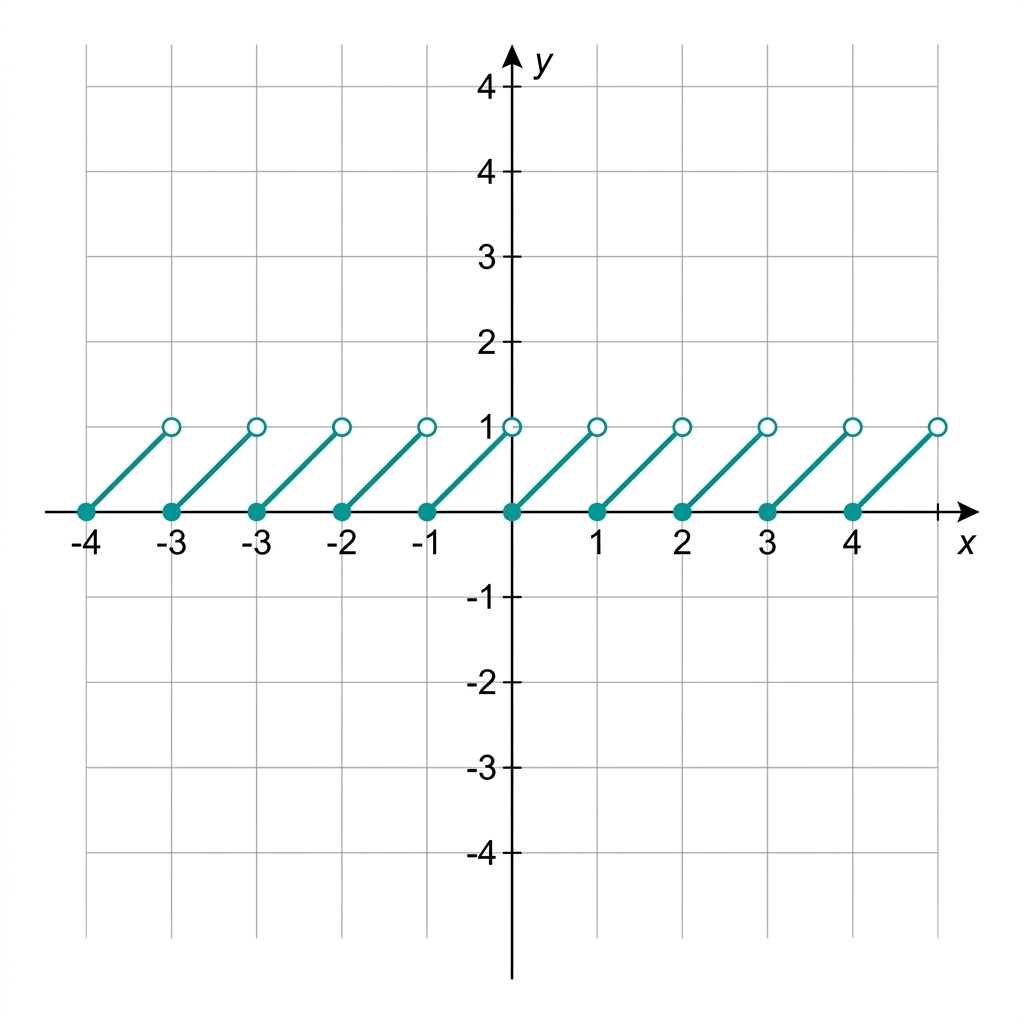
Fractional Part Sawtooth Graph

Special Functions (4/4)

Signum Function

Extracts the sign of a real number.

$$ \text{sgn}(x) = \begin{cases} 1, & x > 0 \\ 0, & x = 0 \\ -1, & x < 0 \end{cases} $$

Also written as $\text{sgn}(x) = \frac{|x|}{x}$ for $x \neq 0$.

Range contains exactly three values: $\{-1, 0, 1\}$.
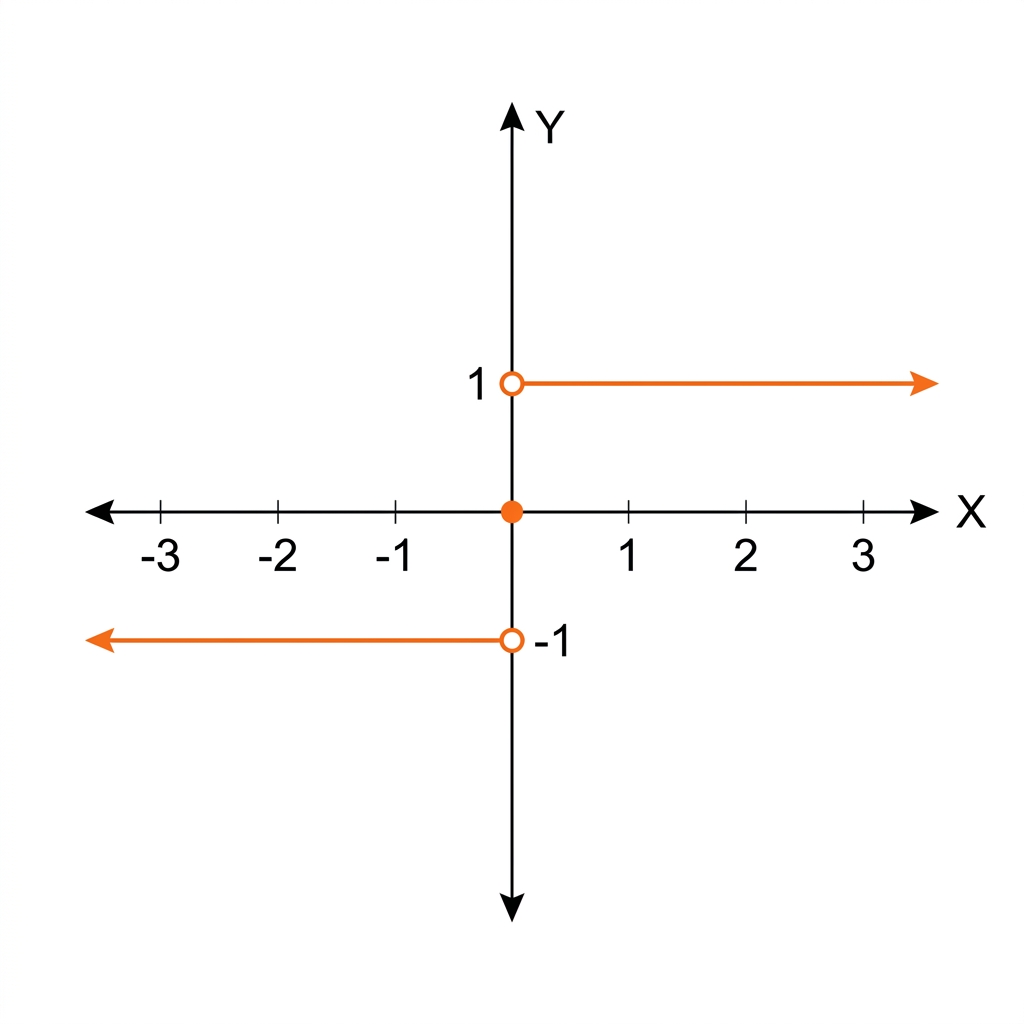
Signum Function Graph

Counting Functions

Let $n(A) = m$ and $n(B) = n$:

Formulas (JEE Important)

  • Total Functions: $n^m$
  • One-One Functions: $^nP_m$ (if $n \ge m$), else $0$
  • Onto Functions (if n=2): $2^m - 2$ (if $m \ge 2$)
  • Bijective Functions: $n!$ (if $m=n$), else $0$

Composition

Composite function $g \circ f$ maps A directly to C via B.

$$ (g \circ f)(x) = g(f(x)) $$

Properties

  • Exists if: Range of $f \subseteq$ Domain of $g$
  • Generally not commutative: $g \circ f \neq f \circ g$
  • Is associative: $h \circ (g \circ f) = (h \circ g) \circ f$
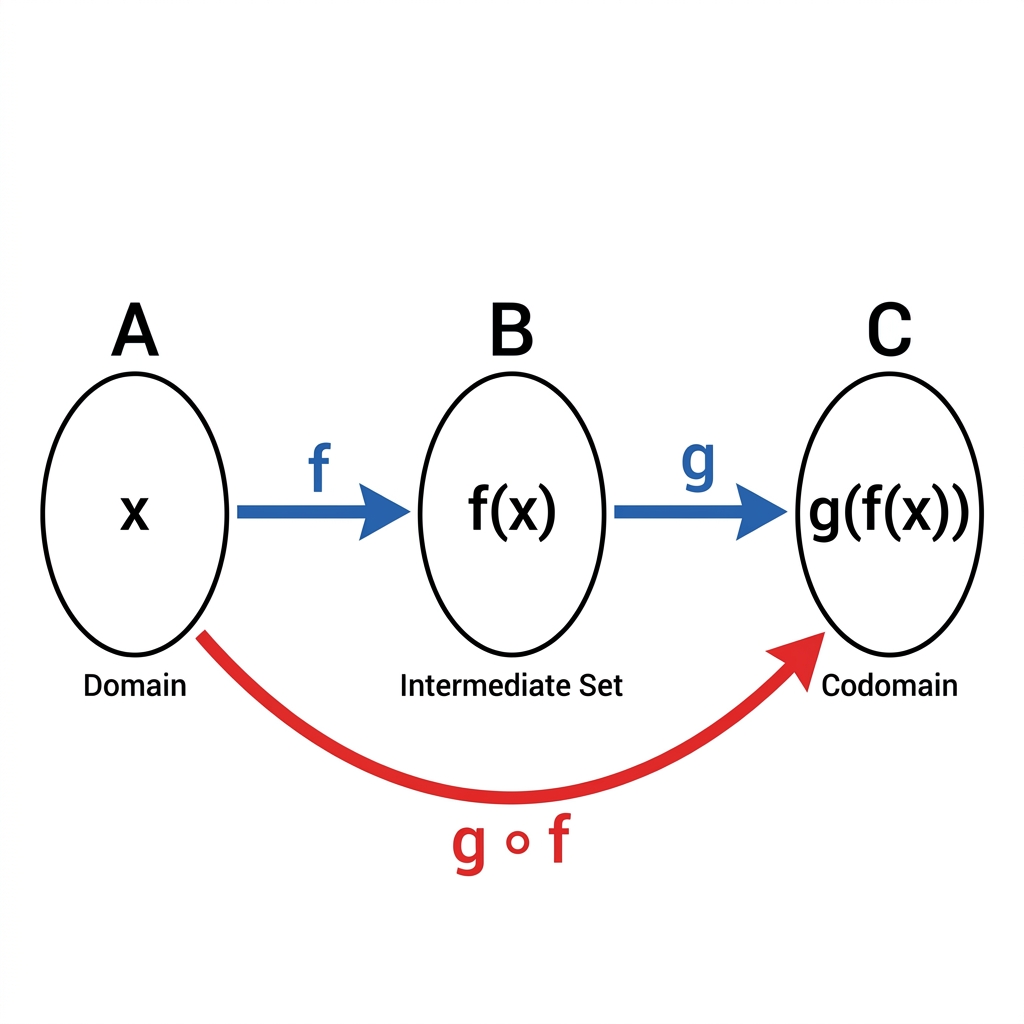
Composition of Functions Diagram

Inverse Functions

A function $f$ is invertible $\iff$ $f$ is Bijective.

$f^{-1}(y) = x \iff f(x) = y$

Key Properties

  • $(g \circ f)^{-1} = f^{-1} \circ g^{-1}$ (Reversal Rule)
  • Graphs of $f$ and $f^{-1}$ are symmetric about the line $y = x$
  • $f(f^{-1}(x)) = x$ and $f^{-1}(f(x)) = x$
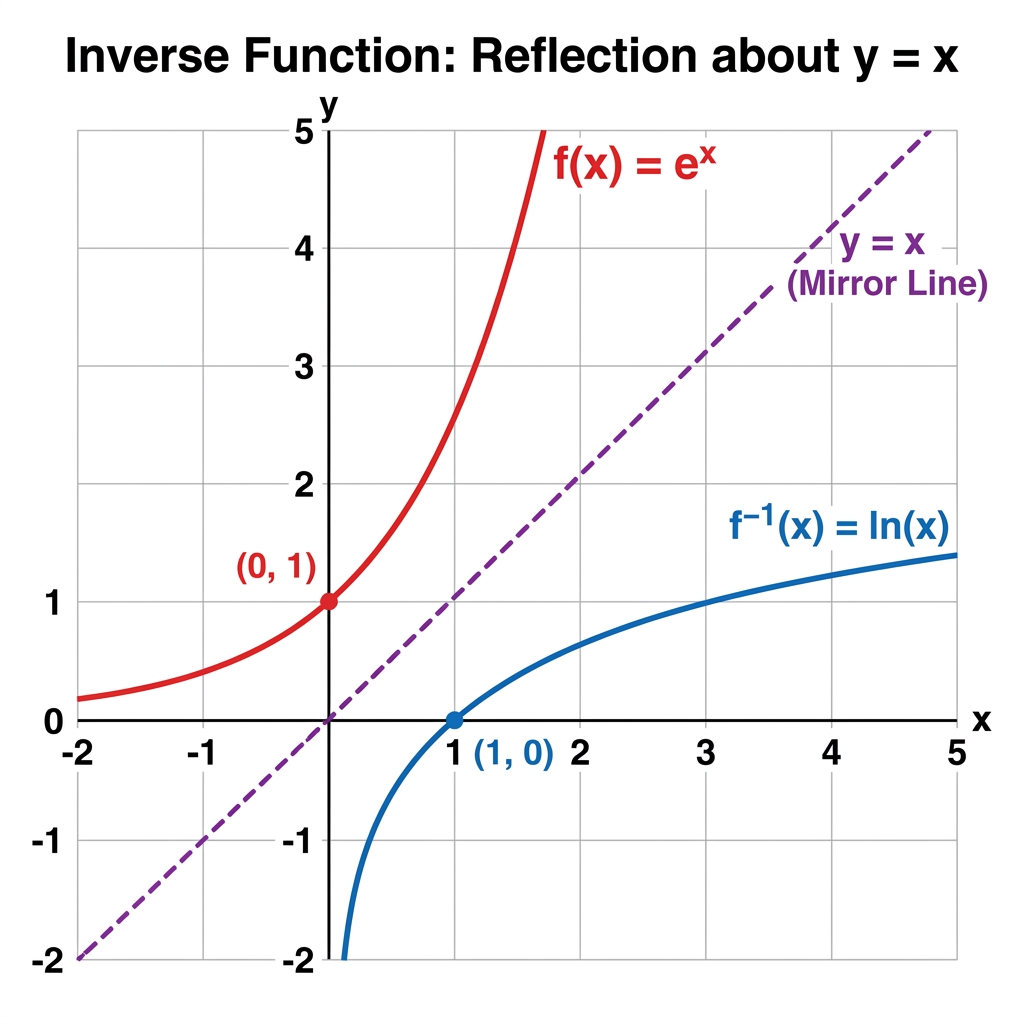
Inverse Functions Graph

Binary Operations

$*: A \times A \rightarrow A$. Takes two inputs from A and produces an output in A (Closure).

Properties

  • Commutative: $a * b = b * a$
  • Associative: $(a*b)*c = a*(b*c)$
  • Identity ($e$): $a*e = e*a = a$. (e.g. 0 for +, 1 for $\times$)
  • Inverse: $a*b = b*a = e$.

Important Theorems

For Composite $g \circ f$

  • If $f, g$ are one-one $\implies g \circ f$ is one-one.
  • If $f, g$ are onto $\implies g \circ f$ is onto.
  • If $g \circ f$ is one-one $\implies f$ MUST be one-one.
  • If $g \circ f$ is onto $\implies g$ MUST be onto.

Domain Restriction Trick

If a function isn't bijective (e.g., $y=x^2$), restrict its domain to $[0, \infty)$ to make it invertible!

Chapter Mind Map

Recap

Here's a quick visual overview of the entire chapter!
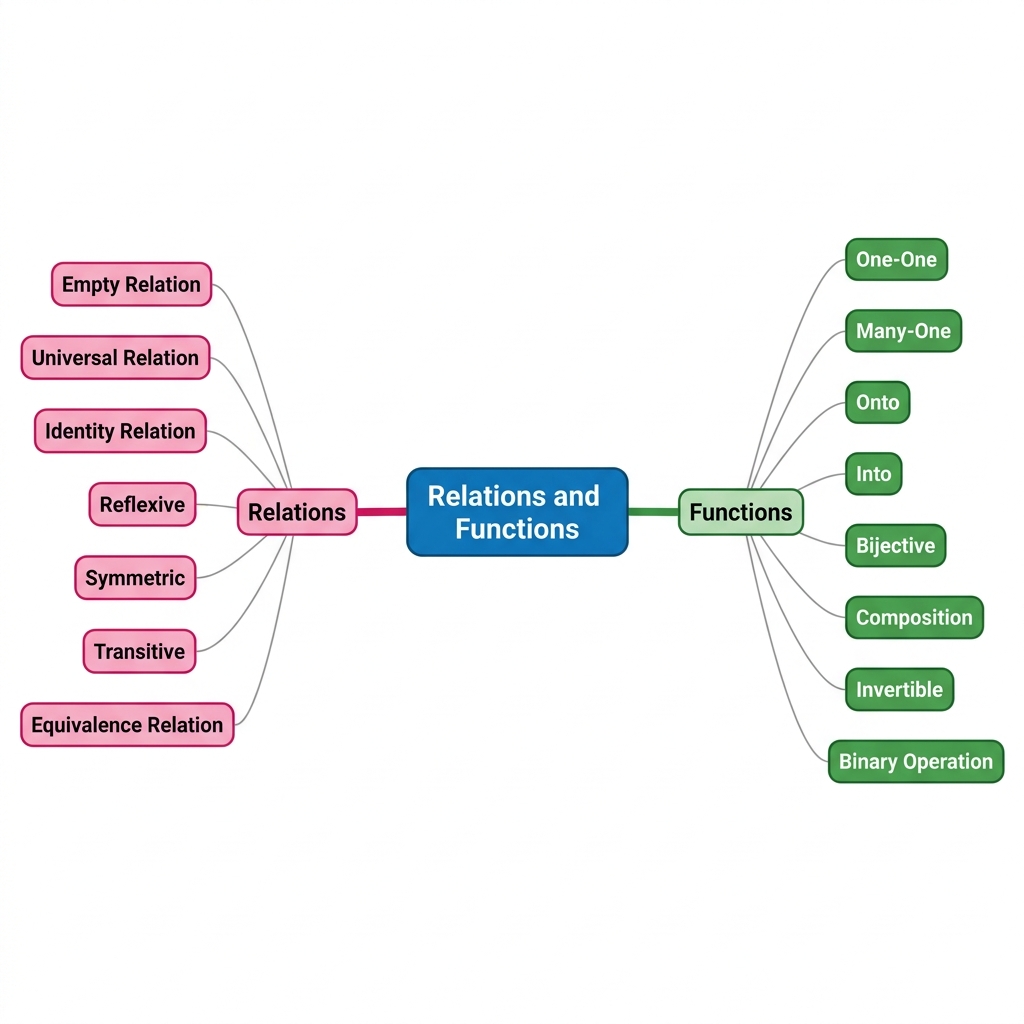
Chapter Mind Map