1. Alcohols: Organic compounds formed when one or more hydrogen atoms of an aliphatic hydrocarbon are replaced by hydroxyl (–OH) group(s). The –OH group is bonded to an sp³ hybridised carbon atom. General formula: $\text{C}_n\text{H}_{2n+1}\text{OH}$ (for monohydric alcohols).
2. Phenols: Organic compounds formed when a hydrogen atom in an aromatic ring (benzene ring) is directly replaced by a hydroxyl (–OH) group. The –OH group is bonded to an sp² hybridised carbon of the aromatic ring. General formula: $\text{Ar–OH}$.
3. Ethers: Organic compounds formed by substituting a hydrogen atom of a hydrocarbon with an alkoxy (–OR) or aryloxy (–OAr) group, represented as $\text{R–O–R}'$, $\text{Ar–O–R}$, or $\text{Ar–O–Ar}$.
7.1.0 Classification Based on Number of Hydroxyl (–OH) Groups
Alcohols and phenols may be classified as mono-, di-, tri- or polyhydric compounds depending on whether they contain one, two, three or many hydroxyl groups respectively in their structures (NCERT Introductory Classification):
NCERT Structural Classification: Monohydric, Dihydric & Trihydric Alcohols and Phenols
7.1.1 Full Structures of Allylic, Benzylic & Cyclic Alcohols
NCERT classifies alcohols into primary, secondary, tertiary, allylic, benzylic, and vinylic classes. Below are their full structural representations:
Full Structural Formulas: Allylic & Benzylic Alcohols (NCERT Classification)
Full Structural Formulas: Cyclic Alcohols (NCERT In-Text 7.1)
Vinylic Alcohols ($sp^2\text{ C–OH}$ bond)
In these alcohols, the –OH group is attached directly to a carbon–carbon double bond, i.e., to a vinylic carbon ($sp^2$ hybridised carbon atom):
According to NCERT, ethers are classified as simple (symmetrical) or mixed (unsymmetrical) depending on the nature of the alkyl or aryl groups attached to the central oxygen atom:
1. Simple or Symmetrical Ethers
Ethers in which the two groups attached to the oxygen atom are the same ($\text{R–O–R}$ or $\text{Ar–O–Ar}$):
Full Structural Formulas: Ethers (NCERT Table 7.2)
7.3 Functional Group Geometries & Resonance
The oxygen atom in alcohols, phenols, and ethers is in an $sp^3$ hybridised state. However, the exact bond lengths and bond angles differ characteristically due to hybridization differences, lone pair repulsions, steric effects, and resonance delocalization.
NCERT Fig 7.1: Structures of Methanol, Phenol and Methoxymethane (Exact Bond Parameters)
Canonical Resonance Structures of Neutral Phenol ($\mathrm{C_6H_5OH}$):
Comparative Structural Analysis & Dipole Moments
Dipole Moment of Phenol vs Methanol: • Dipole moment of Methanol ($\text{CH}_3\text{OH}$) = $1.71\text{ D}$.
• Dipole moment of Phenol ($\text{C}_6\text{H}_5\text{OH}$) = $1.54\text{ D}$ (Lower than methanol).
Reason: In phenol, the $\text{C–O}$ bond is less polar due to the electron-withdrawing nature of the $sp^2$ hybridised benzene ring (inductive and resonance effects), which opposes the $\text{O–H}$ bond dipole moment.
(i) By Acid-Catalysed Hydration (Markovnikov Addition)
Alkenes react with water in the presence of an acid catalyst (dilute $\mathrm{H_2SO_4}$) to form alcohols. In unsymmetrical alkenes, addition strictly follows Markovnikov's Rule.
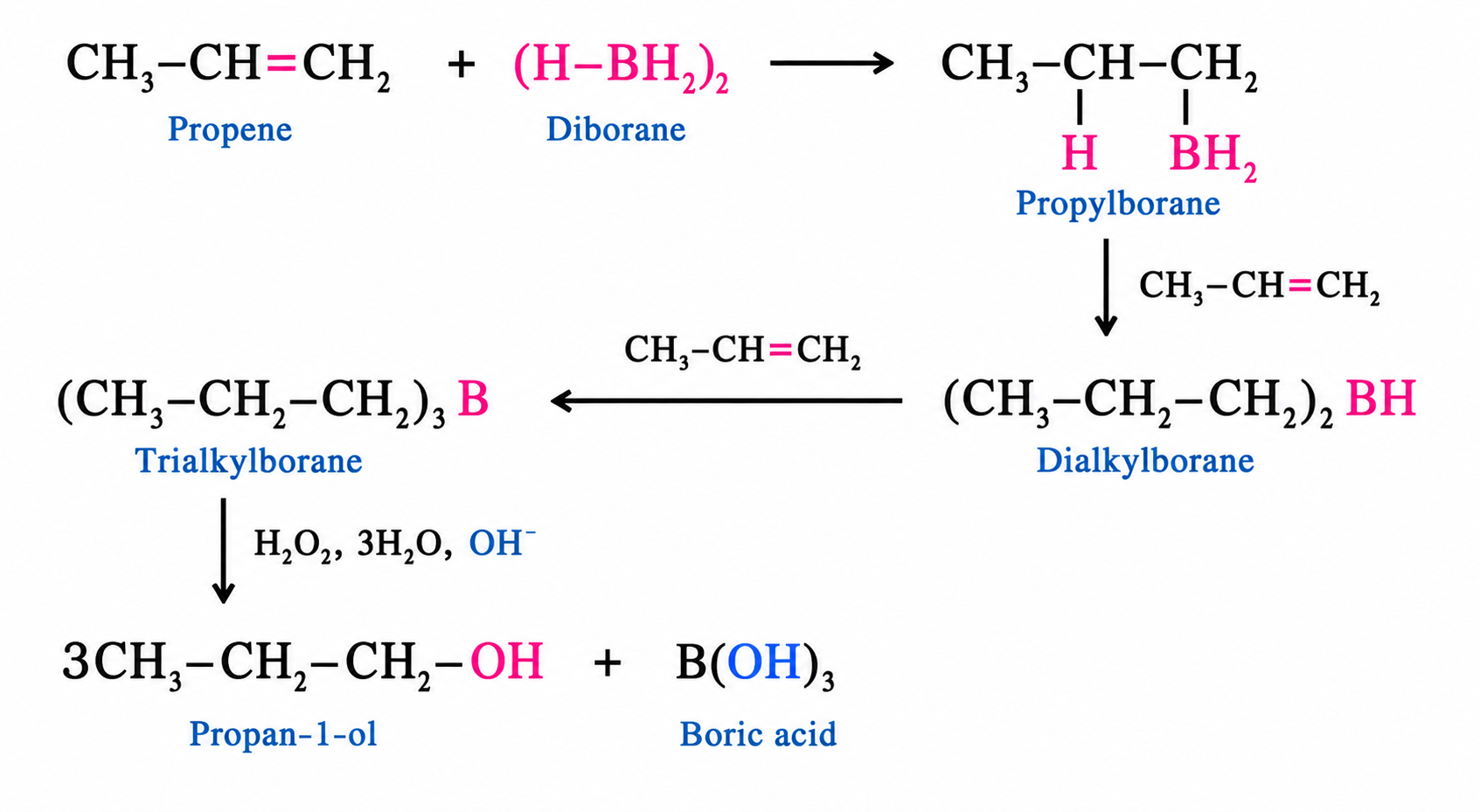
(ii) By Hydroboration–Oxidation (Anti-Markovnikov Product)
Diborane ($(\mathrm{BH_3})_2$ or $\mathrm{B_2H_6}$) reacts with alkenes to yield trialkylboranes. This is followed by alkaline oxidation with hydrogen peroxide ($\mathrm{H_2O_2}$) to yield primary ($1^\circ$) alcohols in high yield (Anti-Markovnikov addition).
2. From Carbonyl Compounds
(i) By Reduction of Aldehydes and Ketones
Aldehydes and ketones are reduced to the corresponding alcohols by addition of hydrogen in the presence of finely divided metal catalysts (catalytic hydrogenation using $\mathrm{Pt, Pd, \text{ or } Ni}$). They can also be reduced using chemical reducing agents like sodium borohydride ($\mathrm{NaBH_4}$) or lithium aluminium hydride ($\mathrm{LiAlH_4}$).
Carboxylic acids are reduced to primary ($1^\circ$) alcohols in excellent yields by lithium aluminium hydride ($\mathrm{LiAlH_4}$), a strong reducing agent:
Commercial / Industrial Production of Alcohols from Acids
However, $\mathrm{LiAlH_4}$ is an expensive reagent and is therefore used only for preparing special, high-value chemicals. Commercially, carboxylic acids are first converted to esters by reacting with an alcohol in acidic medium, followed by catalytic hydrogenation with $\mathrm{H_2}$ over a catalyst:
Alcohols are produced by the reaction of Grignard reagents ($\mathrm{RMgX}$) with aldehydes and ketones. The first step involves nucleophilic addition of the Grignard reagent to the carbonyl group to form an adduct. Hydrolysis of the adduct in the presence of dilute acid/water yields the corresponding alcohol:
General Nucleophilic Addition Mechanism (Adduct Formation & Hydrolysis):
Overall Reactions of Grignard Reagents with Different Carbonyl Compounds (Exact NCERT Structure & Color Coding):
7.4b Preparation of Phenols
In the laboratory and industry, phenols are prepared by four standard routes, all featuring full aromatic ring representations:
1. From Haloarenes (Dow's Process)
2. From Benzenesulphonic Acid
Benzene is sulphonated with oleum ($\text{conc. H}_2\text{SO}_4 + \text{SO}_3$) to form benzenesulphonic acid, which is then heated with molten sodium hydroxide ($\text{NaOH}$) and acidified with dilute acid to yield phenol:
Aniline is diazotised at low temperatures ($273–278\text{ K}$) and the resulting benzenediazonium chloride is hydrolysed with warm water or treated with dilute acids:
4. From Cumene — Industrial Method (Most Important)
7.4c Physical Properties & Hydrogen Bonding
Intramolecular vs Intermolecular H-Bonding in Nitrophenols (NCERT Figure)
Full Structural Scheme: Intramolecular Chelation vs Intermolecular H-Bonding
NCERT Table: $pK_a$ Values & Acidity Comparison of Phenols vs Alcohols
A lower $pK_a$ value indicates a stronger acid. The presence of electron-withdrawing groups (–NO₂) decreases $pK_a$ (increases acidity), especially at ortho and para positions:
Compound
Formula
$pK_a$ Value (NCERT)
Acidity Comparison & Effect
4-Nitrophenol ($p$-Nitrophenol)
$\text{O}_2\text{N–C}_6\text{H}_4\text{–OH}$
7.1
Most Acidic Strong –R & –I stabilization at para position
2-Nitrophenol ($o$-Nitrophenol)
$\text{O}_2\text{N–C}_6\text{H}_4\text{–OH}$
7.2
Strong –R & –I effect (slightly weakened by intramolecular H-bonding)
3-Nitrophenol ($m$-Nitrophenol)
$\text{O}_2\text{N–C}_6\text{H}_4\text{–OH}$
8.3
Only –I effect operates at meta position (No –R effect)
Phenol
$\text{C}_6\text{H}_5\text{OH}$
10.0
Standard aromatic reference acid ($K_a \approx 10^{-10}$)
3-Methylphenol ($m$-Cresol)
$\text{CH}_3\text{–C}_6\text{H}_4\text{–OH}$
10.1
Weak +I destabilization at meta position
4-Methylphenol ($p$-Cresol)
$\text{CH}_3\text{–C}_6\text{H}_4\text{–OH}$
10.2
+I & Hyperconjugation destabilize phenoxide ion
2-Methylphenol ($o$-Cresol)
$\text{CH}_3\text{–C}_6\text{H}_4\text{–OH}$
10.2
+I & Hyperconjugation destabilize phenoxide ion
Water ($\text{H}_2\text{O}$)
$\text{H–OH}$
15.7
More acidic than aliphatic alcohols (except Methanol)
Ethanol
$\text{C}_2\text{H}_5\text{OH}$
15.9
Weaker acid than water due to +I effect of alkyl group
★ Kolbe's Reaction: Conversion of Phenol to Salicylic Acid
★ Reimer–Tiemann Reaction: Conversion of Phenol to Salicylaldehyde
Full Structural Formulas: Picric Acid, 2,4,6-Tribromophenol & 1,4-Benzoquinone
7.5 Commercially Important Alcohols
Methanol ($\text{CH}_3\text{OH}$) — Wood Spirit
Industrial Synthesis: Produced by catalytic hydrogenation of carbon monoxide at high pressure and temperature over a $\text{ZnO–Cr}_2\text{O}_3$ catalyst:
Properties & Uses: Colourless liquid (bp $337\text{ K}$). Used as a solvent in paints, varnishes, and for making formaldehyde.
Extreme Toxicity: Ingestion of even small quantities can cause blindness due to destruction of the optic nerve. Large quantities cause death. In the body, methanol is oxidised to methanal ($\text{HCHO}$) and then to methanoic acid ($\text{HCOOH}$).
Antidote: Intravenous infusion of dilute ethanol, which competes with methanol for the alcohol dehydrogenase enzyme.
Denatured Alcohol (Methylated Spirit): Commercial alcohol made unfit for drinking by adding poisonous methanol, $\text{CuSO}_4$ (to give blue colour), and pyridine (foul smell).
7.6a Preparation of Ethers
★ Williamson Synthesis: The Golden Rule & Elimination Trap
1. The Golden Rule: The alkyl halide ($\text{R–X}$) must ALWAYS be primary ($1^\circ$). The alkoxide ($\text{R}'\text{O}^-\text{Na}^+$) may be primary, secondary, tertiary, or aryl.
2. Synthesis of tert-Butyl Ethyl Ether:
Correct Choice: Reaction of sodium tert-butoxide with ethyl bromide ($1^\circ$ halide):
$$(\text{CH}_3)_3\text{C–O}^-\text{Na}^+ + \text{CH}_3\text{CH}_2\text{Br} \xrightarrow{S_N2} (\text{CH}_3)_3\text{C–O–CH}_2\text{CH}_3\text{ (Ether)} + \text{NaBr}$$
Incorrect Choice (The Exam Trap): Reaction of sodium ethoxide with tert-butyl bromide ($3^\circ$ halide):
$$\text{CH}_3\text{CH}_2\text{O}^-\text{Na}^+ + (\text{CH}_3)_3\text{C–Br} \xrightarrow{E2} \text{CH}_3\text{–C(CH}_3)=\text{CH}_2\text{ (2-Methylpropene)} + \text{CH}_3\text{CH}_2\text{OH} + \text{NaBr}$$
Reason: Alkoxides are strong bases. Tertiary alkyl halides undergo $100\%$ elimination ($E2$) rather than substitution.
7.6c Chemical Reactions & Full EAS Schemes of Ethers
Electrophilic Aromatic Substitution of Anisole (Full NCERT Schemes)
Full Structural Scheme: Electrophilic Aromatic Substitution on Anisole (NCERT Section 7.6.2)
7.7 Distinction Tests Master Table
Pair to Distinguish
Reagent / Test
Observation for Compound 1
Observation for Compound 2
$1^\circ$ vs $2^\circ$ vs $3^\circ$ Alcohols
Lucas Test (conc. $\text{HCl} + \text{anhyd. ZnCl}_2$)
$1^\circ$: No turbidity at room temp (turbid on heating)
$2^\circ$: Turbidity in ~5 min; $3^\circ$: Immediate turbidity
$1^\circ$ vs $2^\circ$ vs $3^\circ$ Alcohols
Victor Meyer's Test ($\text{P/I}_2 \to \text{AgNO}_2 \to \text{HNO}_2 \to \text{NaOH}$)
$1^\circ$: Blood Red colour
$2^\circ$: Blue colour; $3^\circ$: Colourless (RBC rule)
Methanol ($\text{CH}_3\text{OH}$): No yellow precipitate
Ethanol ($\text{CH}_3\text{CH}_2\text{OH}$): Yellow ppt of $\text{CHI}_3$ (Iodoform)
Propan-1-ol vs Propan-2-ol
Iodoform Test ($\text{I}_2 + \text{NaOH}$)
Propan-1-ol: No yellow precipitate
Propan-2-ol: Yellow ppt of $\text{CHI}_3$ ($\text{CH}_3\text{CH(OH)–}$ group present)
Alcohol vs Ether
Sodium Metal Test ($\text{Na}$)
Alcohol: Brisk effervescence of $\text{H}_2$ gas
Ether: No reaction with sodium metal
7.8 Organic Conversions Master Roadmap
Conversion questions form a major portion of CBSE Board examinations. Below is the comprehensive step-by-step synthetic roadmap for all frequently asked transformations in this chapter:
Give the IUPAC names of the following compounds: (i) $\text{CH}_3\text{–CH(Cl)–CH(CH}_2\text{CH}_3\text{)–CH(OH)–CH}_3$ (ii) $\text{CH}_3\text{–CH(CH}_3\text{)–CH(OH)–CH}_2\text{OH}$ (iii) $\text{Cyclohexane ring with –OH at C1 and –CH}_3\text{ at C2}$ (iv) $\text{Benzene ring with –OH at C1 and –NO}_2\text{ at C2}$.
(i) 4-Chloro-3-ethylpentan-2-ol
(ii) 2-Methylbutane-1,3-diol
(iii) 2-Methylcyclohexan-1-ol
(iv) 2-Nitrophenol
Example 7.2
Show how are the following alcohols prepared by the reaction of a suitable Grignard reagent on methanal? (i) $\text{CH}_3\text{–CH(CH}_3\text{)–CH}_2\text{OH}$ (2-Methylpropan-1-ol) (ii) $\text{Cyclohexylmethanol}$ ($\text{C}_6\text{H}_{11}\text{CH}_2\text{OH}$).
(i) 2-Methylpropan-1-ol: Treat Methanal ($\text{HCHO}$) with Isopropylmagnesium halide ($(\text{CH}_3)_2\text{CH–MgBr}$), followed by acid hydrolysis:
$$\text{HCHO} + (\text{CH}_3)_2\text{CHMgBr} \xrightarrow{\text{ether}} (\text{CH}_3)_2\text{CH–CH}_2\text{OMgBr} \xrightarrow{\text{H}_3\text{O}^+} (\text{CH}_3)_2\text{CH–CH}_2\text{OH} + \text{Mg(OH)Br}$$ (ii) Cyclohexylmethanol: Treat Methanal ($\text{HCHO}$) with Cyclohexylmagnesium bromide ($\text{C}_6\text{H}_{11}\text{MgBr}$), followed by acid hydrolysis:
$$\text{HCHO} + \text{C}_6\text{H}_{11}\text{MgBr} \xrightarrow{\text{ether}} \text{C}_6\text{H}_{11}\text{CH}_2\text{OMgBr} \xrightarrow{\text{H}_3\text{O}^+} \text{C}_6\text{H}_{11}\text{CH}_2\text{OH} + \text{Mg(OH)Br}$$
Example 7.3
Write the structures of the products of the following reactions: (i) $\text{CH}_3\text{–CH=CH}_2 \xrightarrow{\text{H}_2\text{O / H}^+} \text{Product}$ (ii) $\text{Cyclohexanone} + \text{NaBH}_4 \xrightarrow{\text{H}^+} \text{Product}$ (iii) $\text{CH}_3\text{–CH}_2\text{–CH(CH}_3\text{)–CHO} \xrightarrow{\text{NaBH}_4} \text{Product}$.
(i) Propan-2-ol: $\text{CH}_3\text{–CH(OH)–CH}_3$ (Markovnikov addition of water).
(ii) Cyclohexanol: Reduction of cyclic ketone to secondary alcohol.
(iii) 2-Methylbutan-1-ol: $\text{CH}_3\text{–CH}_2\text{–CH(CH}_3\text{)–CH}_2\text{OH}$ (Selective reduction of aldehyde to primary alcohol).
Example 7.4
Arrange the following compounds in increasing order of their acid strength: Propan-1-ol, 2,4,6-trinitrophenol, 3-nitrophenol, 3,5-dinitrophenol, phenol, 4-methylphenol.
Increasing Order of Acidity:
$$\text{Propan-1-ol} < \text{4-Methylphenol} < \text{Phenol} < \text{3-Nitrophenol} < \text{3,5-Dinitrophenol} < \text{2,4,6-Trinitrophenol (Picric Acid)}$$
Explanation: Aliphatic alcohols are least acidic. In phenols, electron-donating groups (–CH₃) decrease acidity, while electron-withdrawing groups (–NO₂) strongly increase acidity by dispersing negative charge of phenoxide ion.
Example 7.5
Give the major products that are formed by heating each of the following ethers with $\text{HI}$: (i) $\text{CH}_3\text{–CH}_2\text{–CH(CH}_3\text{)–CH}_2\text{–O–CH}_2\text{CH}_3$ (ii) $\text{CH}_3\text{–CH}_2\text{–CH}_2\text{–O–C(CH}_3)_3$ (iii) $\text{Benzyl methyl ether (}\text{C}_6\text{H}_5\text{CH}_2\text{–O–CH}_3)$.
(i) $\text{CH}_3\text{–CH}_2\text{–CH(CH}_3\text{)–CH}_2\text{OH} + \text{CH}_3\text{CH}_2\text{I}$ (Both alkyl groups are $1^\circ$; $S_N2$ attack occurs on smaller ethyl group).
(ii) $\text{CH}_3\text{CH}_2\text{CH}_2\text{OH} + (\text{CH}_3)_3\text{C–I}$ (Contains a $3^\circ$ alkyl group; reaction proceeds via stable $3^\circ$ carbocation $S_N1$ mechanism yielding tert-butyl iodide).
(iii) $\text{C}_6\text{H}_5\text{CH}_2\text{I} + \text{CH}_3\text{OH}$ (Benzylic carbocation $\text{C}_6\text{H}_5\text{CH}_2^+$ is resonance stabilized; nucleophilic $\text{I}^-$ attacks benzylic carbon).
Example 7.6 & 7.7
The following is not an appropriate reaction for the preparation of t-butyl ethyl ether: $$\text{C}_2\text{H}_5\text{ONa} + (\text{CH}_3)_3\text{C–Cl} \to (\text{CH}_3)_3\text{C–O–C}_2\text{H}_5$$ (i) What would be the major product of this reaction? (ii) Write a suitable reaction for the preparation of t-butyl ethyl ether.
(i) Major Product:2-Methylpropene (Isobutylene) ($\text{CH}_2=\text{C(CH}_3)_2$). Reason: Sodium ethoxide is a strong base as well as a nucleophile. With a $3^\circ$ halide ($(\text{CH}_3)_3\text{CCl}$), elimination ($E2$) predominates over substitution. (ii) Suitable Preparation (Williamson Synthesis): React $1^\circ$ alkyl halide (Ethyl bromide) with $3^\circ$ sodium alkoxide (Sodium tert-butoxide):
$$(\text{CH}_3)_3\text{C–O}^-\text{Na}^+ + \text{CH}_3\text{CH}_2\text{Br} \xrightarrow{S_N2} (\text{CH}_3)_3\text{C–O–CH}_2\text{CH}_3 + \text{NaBr}$$
NCERT 7.1
Classify the following as primary, secondary and tertiary alcohols: (i) 1-Methylcyclohexanol (ii) But-3-en-2-ol (iii) 2-Methylpropan-2-ol (iv) Phenylmethanol (v) But-2-en-1-ol (vi) 2-Methylbut-3-en-2-ol.
Identify allylic alcohols in the above examples of question 7.1.
Allylic alcohols have the $-\text{OH}$ group attached to an $sp^3$ hybridised carbon atom next to a carbon-carbon double bond ($\text{C}=\text{C}$):
• (ii) But-3-en-2-ol ($2^\circ$ allylic)
• (v) But-2-en-1-ol ($1^\circ$ allylic)
• (vi) 2-Methylbut-3-en-2-ol ($3^\circ$ allylic)
NCERT 7.3
Name the reagents used in the following reactions: (i) Oxidation of a primary alcohol to carboxylic acid. (ii) Oxidation of a primary alcohol to aldehyde. (iii) Bromination of phenol to 2,4,6-tribromophenol. (iv) Benzyl alcohol to benzoic acid. (v) Dehydration of propan-2-ol to propene. (vi) Butan-2-one to butan-2-ol.
(i) Acidified potassium permanganate ($\text{KMnO}_4/\text{H}_2\text{SO}_4$) or acidified $\text{K}_2\text{Cr}_2\text{O}_7$. (ii) Pyridinium chlorochromate ($\text{PCC}$) in $\text{CH}_2\text{Cl}_2$ or anhydrous $\text{CrO}_3$. (iii) Aqueous bromine / Bromine water ($\text{Br}_2/\text{H}_2\text{O}$). (iv) Alkaline $\text{KMnO}_4$ followed by acidification ($\text{H}_3\text{O}^+$). (v) $85\%\ \text{H}_3\text{PO}_4$ at $440\text{ K}$ or concentrated $\text{H}_2\text{SO}_4$ at $440\text{ K}$. (vi) Sodium borohydride ($\text{NaBH}_4$) or $\text{LiAlH}_4$ or catalytic hydrogenation ($\text{H}_2/\text{Ni}$).
NCERT 7.4
Give the equations of any two reactions that show the acidic nature of phenol. Compare acidity of phenol with that of ethanol.
Comparison with Ethanol:
• Ethanol reacts with sodium metal but does not react with aqueous $\text{NaOH}$ because it is a very weak acid ($\text{p}K_a = 15.9$).
• Phenol reacts with both sodium metal and aqueous $\text{NaOH}$ ($\text{p}K_a = 10.0$). Phenol is ~1 million times more acidic than ethanol due to resonance stabilisation of the phenoxide ion ($\text{C}_6\text{H}_5\text{O}^-$) and the electron-withdrawing $sp^2$ carbon of the aromatic ring.
NCERT 7.5
Write the mechanism of the reaction of HI with methoxymethane.
Step 1: Protonation of methoxymethane (Formation of oxonium ion):
$$\text{CH}_3\text{–Ö–CH}_3 + \text{H–I} \rightleftharpoons \text{CH}_3\text{–}\overset{+}{\text{O}}\text{H–CH}_3 + \text{I}^-$$ Step 2: Nucleophilic attack by iodide ion ($S_N2$ displacement):
Iodide ion ($\text{I}^-$) attacks the carbon of one of the methyl groups from the backside, displacing a molecule of methanol:
$$\text{I}^- + \text{CH}_3\text{–}\overset{+}{\text{O}}\text{H–CH}_3 \xrightarrow{S_N2} \text{CH}_3\text{I (Methyl iodide)} + \text{CH}_3\text{OH (Methanol)}$$ Step 3: If excess HI is used: The methanol formed is further protonated and converted into a second molecule of methyl iodide:
$$\text{CH}_3\text{OH} + \text{HI} \to \text{CH}_3\text{I} + \text{H}_2\text{O}$$
✏️ Practice Questions & Detailed Solutions
Q1
Arrange the following sets of compounds in order of their increasing boiling points and give concise reasons: (a) Pentan-1-ol, butan-1-ol, butan-2-ol, ethanol, propan-1-ol, methanol. (b) Pentan-1-ol, n-butane, pentanal, ethoxyethane.
(a) Increasing Boiling Point Order:
$$\text{Methanol } (337.5\text{ K}) < \text{Ethanol } (351\text{ K}) < \text{Propan-1-ol } (370\text{ K}) < \text{Butan-2-ol } (373\text{ K}) < \text{Butan-1-ol } (391\text{ K}) < \text{Pentan-1-ol } (411\text{ K})$$
Reasoning:
1. Boiling point increases with increasing molecular mass due to increasing van der Waals dispersion forces (methanol < ethanol < propanol < butanol < pentanol).
2. Among isomeric alcohols, branching decreases boiling point by making the molecule more compact/spherical, reducing its contact surface area (butan-2-ol < butan-1-ol).
(b) Increasing Boiling Point Order:
$$\text{n-Butane } (272.5\text{ K}) < \text{Ethoxyethane } (307.6\text{ K}) < \text{Pentanal } (348\text{ K}) < \text{Pentan-1-ol } (411\text{ K})$$
Reasoning:
• n-Butane has only weak van der Waals forces.
• Ethoxyethane has weak dipole-dipole attractions but lacks intermolecular H-bonds.
• Pentanal has stronger dipole-dipole interactions due to polar $\text{C}=\text{O}$.
• Pentan-1-ol exhibits strong intermolecular hydrogen bonding ($\text{O–H}\cdots\text{O–H}$), giving it the highest boiling point.
Q2
Explain why the C–O bond length in phenol (136 pm) is significantly shorter than in methanol (142 pm).
The $\text{C–O}$ bond length in phenol is shorter due to two primary factors: 1. Partial Double Bond Character: Conjugation of the unshared pair of electrons on oxygen with the $\pi$-electrons of the aromatic ring results in resonance, giving the $\text{C–O}$ bond partial double bond character. 2. Hybridisation Difference: In phenol, the oxygen atom is bonded to an $sp^2$ hybridised carbon atom ($33.3\% \text{ s-character}$), which is more electronegative and has a smaller covalent radius than the $sp^3$ hybridised carbon ($25\% \text{ s-character}$) in methanol.
Q3
Give the chemical equations and mechanism for the acid-catalysed dehydration of ethanol to ethene at 443 K. Why is ethoxyethane formed at 413 K?
At 413 K (Lower Temperature): Intermolecular bimolecular nucleophilic substitution ($S_N2$) occurs where an unprotonated ethanol molecule attacks the protonated ethanol molecule, yielding ethoxyethane ($\text{C}_2\text{H}_5\text{OC}_2\text{H}_5$). At $443\text{ K}$, higher thermal energy favours unimolecular elimination ($E1$) to give ethene.
Q4
Explain why ortho-nitrophenol is more steam-volatile than para-nitrophenol. How does this facilitate their separation?
$o$-Nitrophenol: The $-\text{NO}_2$ and $-\text{OH}$ groups are in adjacent positions, forming an intramolecular hydrogen bond (within the same molecule). This prevents the molecule from associating with neighbouring molecules, resulting in lower boiling point and high volatility in steam.
$p$-Nitrophenol: The groups are far apart and form strong intermolecular hydrogen bonds between different molecules, causing molecular association, higher boiling point, and non-volatility in steam.
Separation: Passing steam through the mixture distils out $o$-nitrophenol as a vapour, while $p$-nitrophenol remains behind in the distillation flask.
Q5
Write the structural formula and IUPAC name of the major product when: (a) Propanone reacts with CH₃MgBr followed by hydrolysis. (b) Phenol is treated with CHCl₃ and aqueous NaOH. (c) Anisole is heated with concentrated HI.
(c) Anisole + concentrated $\text{HI}$ at 373 K:
Product: $\text{C}_6\text{H}_5\text{OH}$ (Phenol) and $\text{CH}_3\text{I}$ (Iodomethane / Methyl iodide).
Q6
Why does the reaction of tert-butyl bromide with sodium methoxide yield 2-methylpropene instead of tert-butyl methyl ether? Write the correct reaction to prepare tert-butyl methyl ether.
Sodium methoxide ($\text{CH}_3\text{ONa}$) is a strong nucleophile and also a strong base. In tert-butyl bromide ($3^\circ$ alkyl halide), steric hindrance around the tertiary carbon prevents backside nucleophilic attack ($S_N2$). Consequently, elimination ($E2$) predominates, yielding 2-methylpropene:
$$(\text{CH}_3)_3\text{C–Br} + \text{CH}_3\text{ONa} \to (\text{CH}_3)_2\text{C}=\text{CH}_2 + \text{CH}_3\text{OH} + \text{NaBr}$$ Correct Route to prepare tert-Butyl Methyl Ether: Use a $1^\circ$ alkyl halide (methyl bromide) with a $3^\circ$ alkoxide (sodium tert-butoxide):
$$\text{CH}_3\text{Br} + (\text{CH}_3)_3\text{C–O}^-\text{Na}^+ \xrightarrow{S_N2} (\text{CH}_3)_3\text{C–O–CH}_3 + \text{NaBr}$$
7.10 Assertion-Reason & Case-Based Questions
Directions: In the following questions, a statement of Assertion (A) is followed by a statement of Reason (R). Choose the correct option:
(a) Both (A) and (R) are true, and (R) is the correct explanation of (A).
(b) Both (A) and (R) are true, but (R) is NOT the correct explanation of (A).
(c) (A) is true, but (R) is false.
(d) (A) is false, but (R) is true.
AR-1
Assertion (A): Phenol is more acidic than ethanol. Reason (R): Phenoxide ion is resonance stabilised, while ethoxide ion is not.
Correct Option: (a) Explanation: Loss of $\text{H}^+$ from phenol yields the phenoxide ion ($\text{C}_6\text{H}_5\text{O}^-$), which is stabilised by delocalisation of negative charge over 5 resonance contributors. In ethoxide ion ($\text{C}_2\text{H}_5\text{O}^-$), negative charge is localised on oxygen and destabilised by the $+I$ effect of the ethyl group. Hence, (R) is the correct explanation of (A).
AR-2
Assertion (A): Boiling point of butan-1-ol is higher than that of ethoxyethane. Reason (R): There is extensive intermolecular hydrogen bonding in butan-1-ol, which is absent in ethoxyethane.
Correct Option: (a) Explanation: Butan-1-ol has a polar $-\text{OH}$ group enabling strong intermolecular $\text{O–H}\cdots\text{O–H}$ hydrogen bonds. Ethoxyethane has no hydrogen bonded to oxygen, so it cannot form intermolecular H-bonds among itself.
AR-3
Assertion (A): When tert-butyl methyl ether is heated with concentrated HI, the products formed are tert-butyl iodide and methanol. Reason (R): The reaction proceeds via an SN1 mechanism involving the formation of a stable tertiary carbocation.
Correct Option: (a) Explanation: Because one of the alkyl groups is tertiary ($3^\circ$), protonation of oxygen is followed by departure of methanol in the rate-determining step to form a stable $3^\circ$ carbocation ($(\text{CH}_3)_3\text{C}^+$) via $S_N1$ pathway, which then captures $\text{I}^-$ to form tert-butyl iodide.
AR-4
Assertion (A): The C–O–H bond angle in alcohols is slightly less than the tetrahedral angle of 109.5°. Reason (R): Repulsion between the two unshared electron pairs (lone pairs) on oxygen compresses the bond angle.
Correct Option: (a) Explanation: Oxygen in alcohols has 2 bonding pairs and 2 lone pairs. According to VSEPR theory, lone pair-lone pair repulsion is greater than bond pair-bond pair repulsion, which pushes the $\text{C–O}$ and $\text{O–H}$ bonds closer, reducing the angle to $108.9^\circ$ in methanol.
Case Study Question (Passage-Based)
Read the passage and answer the questions below:
Ethers are regarded as dialkyl derivatives of water. Williamson synthesis is the most important method for the preparation of symmetrical and unsymmetrical ethers. It involves an $S_N2$ reaction between a primary alkyl halide and a sodium alkoxide. When secondary or tertiary alkyl halides are used, elimination dominates to yield alkenes. Cleavage of ethers by hydrogen halides involves attack by halide ion on the protonated ether. In alkyl aryl ethers like anisole, cleavage always yields phenol and alkyl halide.
Questions:
1. Why does reaction of $(\text{CH}_3)_3\text{C–Cl}$ with $\text{C}_2\text{H}_5\text{ONa}$ give 2-methylpropene as the major product instead of an ether?
2. Give the IUPAC name and structure of the ether obtained when sodium phenoxide reacts with bromoethane.
3. Predict the products when anisole is treated with (a) $\text{Br}_2$ in $\text{CH}_3\text{COOH}$, (b) $\text{CH}_3\text{COCl} / \text{anhyd. AlCl}_3$.
Answers:
1. Sodium ethoxide is a strong base. With a tertiary alkyl halide, steric hindrance prevents backside $S_N2$ attack, so elimination ($E2$) occurs exclusively to yield 2-methylpropene.
2. Product: $\text{C}_6\text{H}_5\text{–O–CH}_2\text{CH}_3$ (Ethoxybenzene / Phenetole).
3. (a) $p$-Bromoanisole (Major) + $o$-Bromoanisole (Minor).
(b) 4-Methoxyacetophenone (Major) + 2-Methoxyacetophenone (Minor).
CONCEPTEase of Dehydration of Alcohols: $3^\circ > 2^\circ > 1^\circ$ (reflecting carbocation intermediate stability). $3^\circ$ alcohols require only $20\%\ \text{H}_3\text{PO}_4$ at $358\text{ K}$, whereas $1^\circ$ alcohols require concentrated $\text{H}_2\text{SO}_4$ at $443\text{ K}$.
TRAPDehydrogenation vs Dehydration with $\text{Cu}/573\text{ K}$: $1^\circ$ alcohols give Aldehydes; $2^\circ$ alcohols give Ketones; $3^\circ$ alcohols undergo dehydration to give Alkenes because they lack an $\alpha$-hydrogen.
NAMED RXNReimer–Tiemann Reaction: Phenol $+ \text{CHCl}_3 + \text{aq. NaOH} \to \text{Salicylaldehyde}$ via electrophilic dichlorocarbene intermediate ($:\text{CCl}_2$).
TRAPEther Cleavage by $\text{HI}$: With $1^\circ/2^\circ$ groups, $\text{I}^-$ attacks smaller group ($S_N2$). With a $3^\circ$ group, $S_N1$ occurs giving $3^\circ$ iodide. With anisole, cleavage gives Phenol $+$ $\text{CH}_3\text{I}$ (never iodobenzene).
 reaction and mechanism.png)