Vardaan Watermark

📋 Table of Contents

6.1 Classification of Haloalkanes & Haloarenes

When one or more hydrogen atoms of an aliphatic or aromatic hydrocarbon are replaced by halogen atoms (F, Cl, Br, I), the resulting compounds are called organohalogen compounds or organic halides.

Key Distinction

Haloalkanes (Alkyl Halides): Halogen bonded to sp³ hybridised carbon of an alkyl group. General formula: CnH2n+1X

Haloarenes (Aryl Halides): Halogen bonded directly to sp² hybridised carbon of an aromatic ring.

6.1.1 Based on Number of Halogen Atoms

Type No. of X atoms Aliphatic Example Aromatic Example
Monohalo 1 C2H5Cl (Chloroethane) C6H5Cl (Chlorobenzene)
Dihalo 2 CH2Cl2 (Dichloromethane) o-C6H4Cl2
Trihalo 3 CHCl3 (Chloroform) C6H3Cl3
Tetrahalo 4 CCl4 (Carbon tetrachloride)

Visual Examples: Haloalkanes

Monohaloalkane
C₂H₅ X
Dihaloalkane
CH₂ X CH₂ X
Trihaloalkane
CH₂ X CH X CH₂ X

Visual Examples: Haloarenes

Monohaloarene
X
Dihaloarene
X X
Trihaloarene
X X X

6.1.2 Compounds with sp³ C–X Bond

These are the most important class. Subdivided as:

(a) Alkyl Halides — Primary, Secondary, Tertiary

Classified based on the nature and degree (primary, secondary, or tertiary) of the carbon atom bearing the halogen.:

Primary (1°)
R' C H H X
One alkyl group on C bearing X
Secondary (2°)
R'' C H R' X
Two alkyl groups on C bearing X
Tertiary (3°)
R'' C R''' R' X
Three alkyl groups on C bearing X
(b) Allylic Halides

Halogen bonded to an sp³-hybridised carbon adjacent to a C=C double bond (allylic carbon). Example: CH2=CH–CH2Br (Allyl bromide, or 3-Bromopropene)

CH₂ CH CH₂ X Allylic carbon (sp³)
X Allylic C

The allylic carbon is sp³ hybridised, but is next to the sp² carbons of the double bond. This makes the C–X bond weaker due to allylic resonance stabilisation of the carbocation formed.

(c) Benzylic Halides

Halogen bonded to an sp³-hybridised carbon attached directly to an aromatic ring. Example: C6H5–CH2Cl (Benzyl chloride, Chlorophenylmethane)

Primary (1°)
CH₂ X
Secondary (2°)
CH X R'
Tertiary (3°)
C X R' R''

Similar to allylic, the benzylic C–X bond is weakened by resonance stabilisation of the benzylic carbocation through the aromatic ring.

6.1.3 Compounds with sp² C–X Bond

Vinylic Halides

Halogen bonded directly to a sp²-hybridised carbon of a C=C double bond. Example: CH2=CHCl (Vinyl chloride / Chloroethene)

CH₂ CH X CH₂=CH–X
X Cycloalkenyl–X

Extremely unreactive towards nucleophilic substitution — the C–X bond has partial double bond character due to lone pair donation from X into the π system.

Aryl Halides

Halogen directly bonded to an sp²-hybridised ring carbon. Example: C6H5Cl (Chlorobenzene)

X Haloarene
X CH₃ p-Halotoluene

Also very unreactive towards nucleophilic substitution — C–Cl bond is shorter (169 pm) than in haloalkanes (177 pm) due to higher s-character of sp² carbon. Bond is stronger and harder to break.

Special Categories for Dihalides

Category Description Common Name IUPAC Name Example
gem-Dihalide (Alkylidene halide) Both halogens on the same carbon atom Ethylidene chloride 1,1-Dichloroethane CH3CHCl2
vic-Dihalide (Alkylene halide) Halogens on adjacent carbon atoms Ethylene dichloride 1,2-Dichloroethane ClCH2CH2Cl

6.2 Nomenclature

IUPAC Rules for Haloalkanes
  1. Select the longest carbon chain as the parent. Name as halo-substituted alkane.
  2. Number the chain from the end nearest to the halogen to give it the lowest possible locant.
  3. If multiple halogens, list alphabetically with their locants (di, tri prefixes not considered for alphabetizing).
  4. Halogens are always named as prefixes: fluoro-, chloro-, bromo-, iodo-.
  5. For cycloalkanes: halogen gets lowest locant; ring carbons numbered accordingly.

Common vs IUPAC Names — Master Table

Structure Common Name IUPAC Name Classification
CH3CH2CH2Br n-Propyl bromide 1-Bromopropane 1° alkyl halide
CH3CH2CH(Cl)CH3 sec-Butyl chloride 2-Chlorobutane 2° alkyl halide
(CH3)3CBr tert-Butyl bromide 2-Bromo-2-methylpropane 3° alkyl halide
(CH3)3CCH2Br neo-Pentyl bromide 1-Bromo-2,2-dimethylpropane 1° alkyl halide
CH2=CHCl Vinyl chloride Chloroethene Vinylic halide
CH2=CHCH2Br Allyl bromide 3-Bromopropene Allylic halide
CH2Cl2 Methylene chloride Dichloromethane gem-Dihalide
CHCl3 Chloroform Trichloromethane Trihaloalkane
CHBr3 Bromoform Tribromomethane Trihaloalkane
CCl4 Carbon tetrachloride Tetrachloromethane Tetrahaloalkane
C6H5CH2Cl Benzyl chloride Chlorophenylmethane Benzylic halide
C6H5Cl Chlorobenzene Chlorobenzene Aryl halide
🧠
Memory: Classification Quick Test Count the number of carbon groups attached to the carbon bearing the halogen. 1 group = Primary, 2 groups = Secondary, 3 groups = Tertiary. The halogen and hydrogen atoms don't count as alkyl groups.

NCERT Solved Examples & Practice Questions

Example 6.1 All 8 Structural Isomers of C₅H₁₁Br

Draw the structures of all the eight structural isomers that have the molecular formula C₅H₁₁Br. Name each isomer according to IUPAC system and classify them as primary, secondary or tertiary bromide.

Structure (Condensed) IUPAC Name Type
CH₃CH₂CH₂CH₂CH₂Br 1-Bromopentane
CH₃CH₂CH₂CH(Br)CH₃ 2-Bromopentane
CH₃CH₂CH(Br)CH₂CH₃ 3-Bromopentane
(CH₃)₂CHCH₂CH₂Br 1-Bromo-3-methylbutane
(CH₃)₂CHCHBrCH₃ 2-Bromo-3-methylbutane
(CH₃)₂CBrCH₂CH₃ 2-Bromo-2-methylbutane
CH₃CH₂CH(CH₃)CH₂Br 1-Bromo-2-methylbutane
(CH₃)₃CCH₂Br 1-Bromo-2,2-dimethylpropane
💡
Tip: Vary substitution systematically — pentane skeleton → methylbutane → dimethylpropane. Total = 5 primary, 2 secondary, 1 tertiary = 8 unique isomers.
Example 6.2 IUPAC Names of Vinylic / Allylic Bromides

Write IUPAC names of the following compounds (structural diagrams from textbook):

Example 6.2 Structures
(i)
4-Bromopent-2-enepent-2-ene backbone • Br at C4
(ii)
3-Bromo-2-methylbut-1-enebut-1-ene • CH₃ at C2 • Br at C3
(iii)
4-Bromo-3-methylpent-2-enepent-2-ene • CH₃ at C3 • Br at C4
(iv)
1-Bromo-2-methylbut-2-enebut-2-ene • CH₃ at C2 • CH₂Br at C1
(v)
1-Bromobut-2-enebut-2-ene • CH₂Br at C1
(vi)
3-Bromo-2-methylpropenepropene • CH₃ at C2 • Br at C3
Intext 6.1 Write Structures of the Following Compounds
  • (i)2-Chloro-3-methylpentane
  • (ii)1-Chloro-4-ethylcyclohexane
  • (iii)4-tert.Butyl-3-iodoheptane
  • (iv)1,4-Dibromobut-2-ene
  • (v)1-Bromo-4-sec.butyl-2-methylbenzene
(i)
CH₃–CH(Cl)–CH(CH₃)–CH₂–CH₃5-carbon chain • Cl at C2 • methyl branch at C3
(ii)
Cyclohexane: Cl at C1, –CH₂CH₃ at C4Cl-bearing carbon = C1; ethyl at para (C4)
(iii)
CH₃CH₂CH(I)–CH[C(CH₃)₃]–CH₂CH₂CH₃7-carbon chain • I at C3 • tert-butyl at C4
(iv)
BrCH₂–CH=CH–CH₂Brbut-2-ene backbone • CH₂Br at C1 and C4 (both allylic)
(v)
Benzene: Br at C1, CH₃ at C2, –CH(CH₃)CH₂CH₃ at C4Br at C1 • methyl ortho at C2 • sec-butyl para at C4

6.3 Nature of the C–X Bond

Since halogen atoms are more electronegative than carbon, the C–X bond is polar covalent. The carbon atom carries a partial positive charge (δ+) and the halogen carries a partial negative charge (δ−).
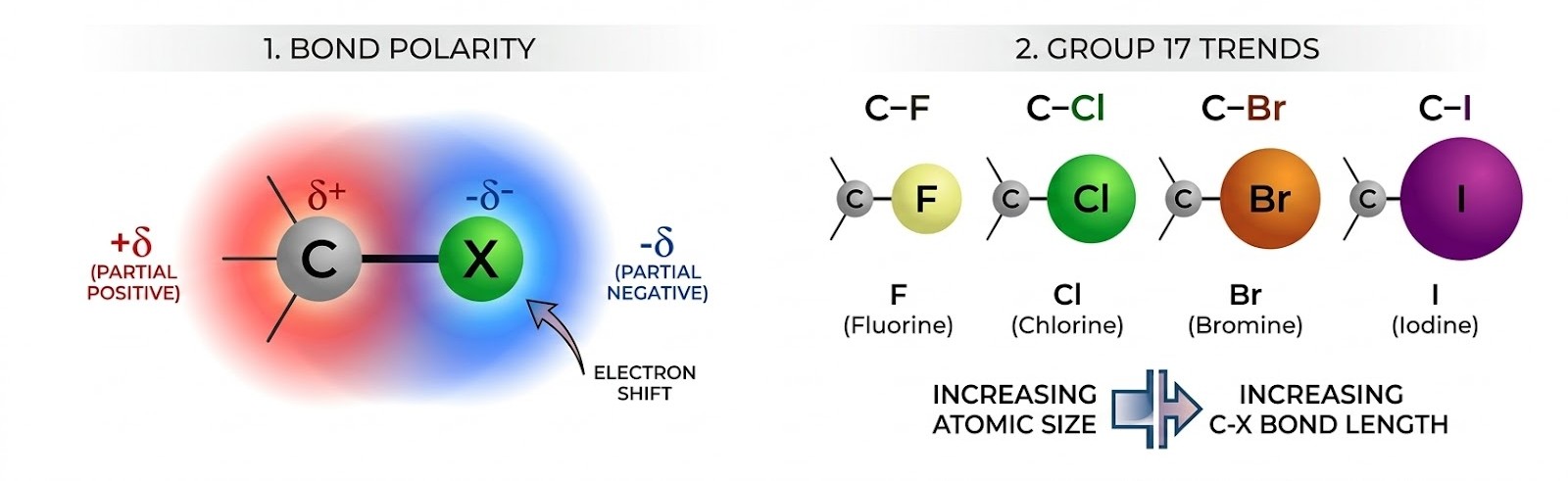
Nature of the C–X Bond
The C–X bond is polar; C is δ+ and X is δ−. The arrow shows direction of electron drift.
KEY CONCEPT — C–X Bond Data (Table 6.2)
Bond Bond Length (pm) Bond Enthalpy (kJ mol⁻¹) Dipole Moment (Debye)
CH3F 139 452 1.847
CH3Cl 178 351 1.860
CH3Br 193 293 1.830
CH3I 214 234 1.636

Trend going F → I: Bond length increases, bond enthalpy decreases (bond gets weaker), and dipole moment decreases (despite bigger size, electronegativity difference with C decreases).

Key consequence: Reactivity order in nucleophilic substitution: R–I > R–Br > R–Cl >> R–F

Comparison: Haloalkane vs Haloarene C–X Bond

Haloalkane (R–X)

Carbon is sp³ hybridised (25% s-character). Bond length of C–Cl = 177 pm. Bond is purely single bond in nature. Readily undergoes nucleophilic substitution.

Haloarene (Ar–X)

Carbon is sp² hybridised (33% s-character) → more electronegative, holds bond pair more tightly. Bond length of C–Cl = 169 pm. Bond has partial double bond character due to resonance. Very resistant to nucleophilic substitution.


6.4 Methods of Preparation of Haloalkanes

6.4.1 From Alcohols (Most Important)

The –OH group is replaced by halogen using concentrated halogen acids, phosphorus halides, or thionyl chloride. Order of reactivity of alcohols: 3° > 2° > 1°

Using HCl / ZnCl₂ catalyst (for 1° & 2°; 3° without catalyst):
R–OH  +  HCl  ZnCl₂  R–Cl  +  H2O

Using NaBr / H₂SO₄ (for bromide):
R–OH  +  NaBr  +  H2SO4  →  R–Br  +  NaHSO4  +  H2O

Using Phosphorus halides:
3R–OH  +  PX3  →  3R–X  +  H3PO3  (X = Cl, Br)
R–OH  +  PCl5  →  R–Cl  +  POCl3  +  HCl

Using Red Phosphorus + Br₂ or I₂ (in situ generation):
R–OH  red P / X₂  R–X

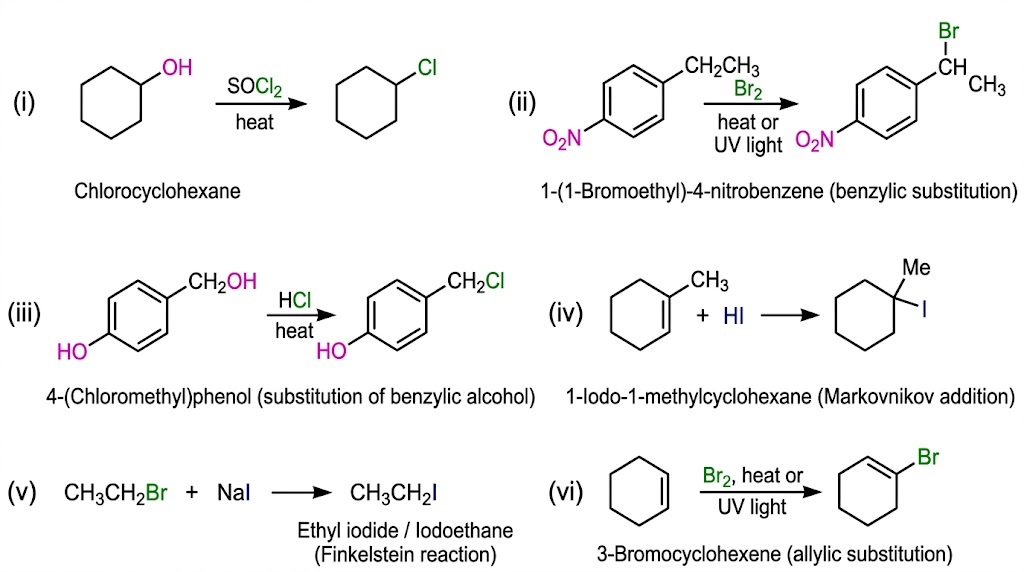
★ Best method — Thionyl Chloride (SOCl₂):
R–OH  +  SOCl2  →  R–Cl  +  SO2↑  +  HCl
Advantage: Both by-products are gases — easily removed, giving pure alkyl chloride.

6.4.2 From Hydrocarbons

(I) Free Radical Halogenation of Alkanes

Alkanes react with Cl2 or Br2 in presence of UV light or heat (free radical chain reaction).

CH3CH2CH2CH3  +  Cl2  UV light / heat  CH3CH2CH2CH2Cl  +  CH3CH2CHClCH3  +  HCl

Limitation: Gives a complex mixture of mono- and polyhalogenated isomers. Yield of any single compound is low. Useful only when a single product is expected (e.g., neopentane → neopentyl chloride).

(II) From Alkenes: Addition of Hydrogen Halides (Markovnikov)

Alkenes react with HX. For unsymmetrical alkenes, Markovnikov's rule predicts the major product: H adds to the carbon with more H atoms (forming the more stable carbocation).

C C + HX C C H X
PROPENE + H–I (MARKOVNIKOV ADDITION)
CH3CH = CH2  +  H–I  →  CH3CH2CH2I (minor)  +  CH3CHICH3 (major)
Major product: 2-iodopropane (2° carbocation intermediate is more stable)

Anti-Markovnikov addition occurs in presence of peroxides (ROOR) via free radical mechanism → H adds to more substituted carbon, X to less substituted.

(III) From Alkenes: Addition of Halogens (to form vic-Dihalides)

In the laboratory, addition of bromine in CCl₄ to an alkene resulting in discharge of reddish-brown colour of bromine constitutes an important method for the detection of double bond in a molecule. The addition results in the synthesis of vic-dibromides, which are colourless.

H H C C H H + Br₂ CCl₄ Br CH₂ CH₂ Br vic-Dibromide
H2C=CH2  +  Br2  CCl₄  BrCH2–CH2Br
Bromine's reddish-brown colour is discharged → test for C=C double bond.

6.4.3 Halogen Exchange Reactions

Finkelstein Reaction (→ Iodide)

Alkyl chlorides/bromides react with NaI in dry acetone to give alkyl iodides.

R–Cl/Br  +  NaI  dry acetone  R–I  +  NaCl/NaBr

NaCl/NaBr precipitates in acetone → drives equilibrium forward (Le Chatelier's principle).

Swarts Reaction (→ Fluoride)

Alkyl chlorides/bromides heated with metallic fluorides (AgF, Hg2F2, CoF2, SbF3) to give alkyl fluorides.

H3C–Br  +  AgF  →  H3C–F  +  AgBr

Direct fluorination is too violent; Swarts reaction provides a controlled route.


6.5 Preparation of Haloarenes

(I) Electrophilic Aromatic Substitution (Halogenation)

Aryl chlorides and bromides are prepared by electrophilic substitution in presence of a Lewis acid catalyst (Fe or FeCl3/FeBr3). The halogen acts as the electrophile after activation by Lewis acid.

CH3 + X2 Fe / dark CH3 X o-Halotoluene + CH3 X p-Halotoluene
Halogenation of toluene yield a mixture of ortho and para products.
Important Notes
  • Fluorine: Too reactive; direct fluorination cannot be controlled → not prepared this way.
  • Iodine: Reaction is reversible; requires oxidising agent (HNO3 or HIO4) to oxidise HI formed, preventing back reaction.
  • ortho and para isomers can be separated easily due to large difference in their melting points.

(II) Sandmeyer's Reaction — From Diazonium Salts

This is the most versatile method for preparing aryl halides from primary aromatic amines (anilines). The amine is first converted to a diazonium salt, then the diazonium group is replaced by halogen.

Sandmeyer's Reaction: Primary aromatic amine → diazonium salt → aryl halide. The diazonium group (–N₂⁺) is an excellent leaving group.
(STEP 1) DIAZOTIZATION
NH₂ + NaNO₂ + HX 273–278 K N₂⁺X⁻ Benzene diazonium halide
(STEP 2) SUBSTITUTION
N₂⁺X⁻ Cu₂X₂ X Aryl halide + N₂ X = Cl, Br

Replacement of the diazonium group by iodine does not require the presence of cuprous halide and is done simply by shaking the diazonium salt with potassium iodide.

N₂⁺X⁻ KI I Aryl iodide + N₂
Example 6.4 Products of the Following Reactions

Write the products of the following reactions:

(i) CH=CH2 + H Br (ii) CH3–CH2–CH=CH2 + H Cl (iii) CH2–CH=CH2 + H Br Peroxide
(i) CH–CH3 Br (Markovnikov addition) (ii) CH3–CH2–CH–CH3 Cl (Markovnikov addition) (iii) CH2–CH2–CH2Br (Anti-Markovnikov addition)
Intext 6.2 – 6.5 Haloalkanes and Haloarenes Preparation
  • 6.2
    Why is sulphuric acid not used during the reaction of alcohols with KI?
    H₂SO₄ is a strong oxidising agent. It oxidises the HI produced during the reaction to I₂, thus preventing the formation of primarily alkyl iodides from the alcohol.

    Instead of: ROH + HI ⟶ RI + H₂O
    This happens: 2HI + H₂SO₄ ⟶ I₂ + SO₂ + 2H₂O
  • 6.3
    Write structures of different dihalogen derivatives of propane.
    1,1-DihalopropaneCH3–CH2–CHX 2
    1,2-DihalopropaneCH3–CH(X)–CH2 X
    1,3-Dihalopropane XCH2 –CH 2–CH2 X
    2,2-DihalopropaneCH3–C(X 2)–CH3
  • 6.4
    Among the isomeric alkanes of molecular formula C₅H₁₂, identify the one that on photochemical chlorination yields:
    • (i) A single monochloride.
    • (ii) Three isomeric monochlorides.
    • (iii) Four isomeric monochlorides.
    (i)
    Neopentane (2,2-Dimethylpropane)All 12 hydrogens are equivalent, yielding only 1-chloro-2,2-dimethylpropane.
    (ii)
    n-PentaneYields 1-chloropentane, 2-chloropentane, and 3-chloropentane.
    (iii)
    Isopentane (2-Methylbutane)Yields 1-chloro-2-methylbutane, 2-chloro-2-methylbutane, 2-chloro-3-methylbutane, 1-chloro-3-methylbutane.
  • 6.5
    Draw the structures of major monohalo products in each of the following reactions:
    Question 6.5
    Solution 6.5

6.6 Physical Properties

State & Colour

Boiling Points

Trends in Boiling Points
  • Higher than parent hydrocarbons — due to greater polarity (dipole-dipole) and van der Waals forces from heavier halogen atoms.
  • For same alkyl group: bp order is R–I > R–Br > R–Cl > R–F (van der Waals forces increase with size & mass of halogen)
  • For same halogen: bp increases with chain length (more carbons → greater surface area → stronger van der Waals)
  • Branching decreases bp — 2-bromo-2-methylpropane (bp 346 K) < 2-bromobutane (364 K) < 1-bromobutane (375 K) CH3 CH 2 CH 2 CH 2 Br CH3 CH 2 CHCH 3 Br H3 C–C–CH 3 CH3 Br b.p./K 375 364 346
  • Dihalobenzenes: bp values very similar for o, m, p. But p-isomers have higher melting points due to better crystal packing (symmetry). Cl Cl Cl Cl Cl Cl b.p./K 453 446 448 m.p./K 256 249 323

Solubility & Density

Intext 6.6 Arrange Compounds in Order of Increasing Boiling Points
  • (i)
    Bromomethane, Bromoform, Chloromethane, Dibromomethane.
  • (ii)
    1-Chloropropane, Isopropyl chloride, 1-Chlorobutane.
(i)
CH₃Cl < CH₃Br < CH₂Br₂ < CHBr₃ Chloromethane < Bromomethane < Dibromomethane < Bromoform — heavier molecules + more polarisable halogen atoms → stronger van der Waals forces → higher bp.
(ii)
Isopropyl chloride < 1-Chloropropane < 1-Chlorobutane Branching lowers bp (isopropyl chloride, bp 308 K). n-Propyl chain (1-chloropropane, bp 319 K) is higher; longer chain 1-chlorobutane (bp 351 K) is highest.

6.7 Chemical Reactions of Haloalkanes

Three main categories of reactions:

  1. Nucleophilic Substitution (SN1 and SN2)
  2. Elimination Reactions (β-elimination → alkene formation)
  3. Reactions with Metals (Grignard, Wurtz)

6.7a Nucleophilic Substitution: SN1 & SN2

General Scheme

A nucleophile (Nu:) attacks the electron-deficient carbon bearing the halogen. The halide ion (X⁻) departs as the leaving group.

Nu  +  R–X  →  R–Nu  +  X

Common Nucleophilic Substitution Products

Reagent Nu⁻ Product Class
NaOH (aq) HO⁻ R–OH Alcohol
NaOR' R'O⁻ R–O–R' Ether (Williamson synthesis)
NaI (dry acetone) I⁻ R–I Alkyl iodide (Finkelstein)
NH3 NH3 R–NH2 1° Amine
KCN C≡N⁻ (through C) R–CN Nitrile (chain extends by 1 C)
AgCN Ag–CN (through N) R–NC Isonitrile/Isocyanide
KNO2 O=N–O⁻ (through O) R–O–N=O Alkyl nitrite
AgNO2 Ag–O–N=O (through N) R–NO2 Nitroalkane
R'COOAg R'COO⁻ R'COOR Ester
LiAlH4 H⁻ R–H Hydrocarbon (reduction)
Ambident Nucleophiles — KEY CONCEPT

Some nucleophiles have two nucleophilic centres and can attack through either atom:

  • Cyanide ion (CN⁻): Can link through C (→ nitrile R–CN) or through N (→ isocyanide R–NC). KCN gives mainly nitrile (C–C bond more stable). AgCN gives mainly isocyanide (Ag makes it covalent, freeing N).
  • Nitrite ion (NO2⁻): Can link through O (→ alkyl nitrite R–O–N=O) or through N (→ nitroalkane R–NO2). KNO2 gives nitrite; AgNO2 gives nitroalkane.

(a) SN2 Mechanism

The SN2 reaction (Substitution Nucleophilic Bimolecular) follows second-order kinetics, where the rate depends on the concentration of both the alkyl halide and the nucleophile:
Rate = k [R–X] [Nu⁻] Proposed by Hughes and Ingold in 1937, this mechanism involves a single concerted step with no intermediates.
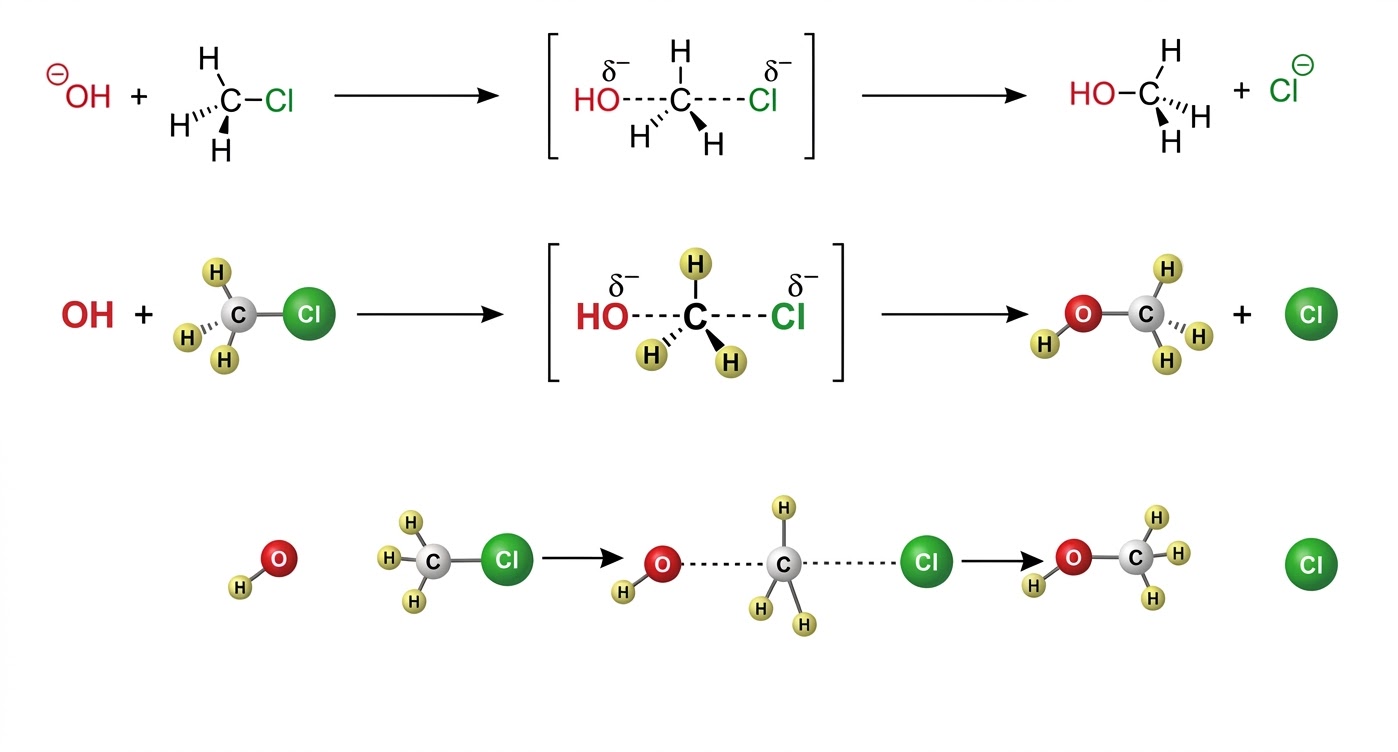
SN2 Mechanism Diagram
Key Features of SN2
  • Concerted Process: Bond-making (C–Nu) and bond-breaking (C–X) occur simultaneously.
  • Transition State: Carbon is momentarily bonded to five atoms (pentacoordinate). This state is highly unstable and cannot be isolated.
  • Umbrella Inversion: The nucleophile's backside attack forces the groups to flip, resulting in a complete inversion of configuration (Walden Inversion).

Factors Affecting SN2 Rate: Steric Hindrance

The rate of SN2 reactions is highly sensitive to the size of alkyl groups. Since the nucleophile attacks from the backside, bulky groups nearby create steric hindrance, making it harder for the nucleophile to reach the reaction center. This leads to a dramatic decrease in reactivity:
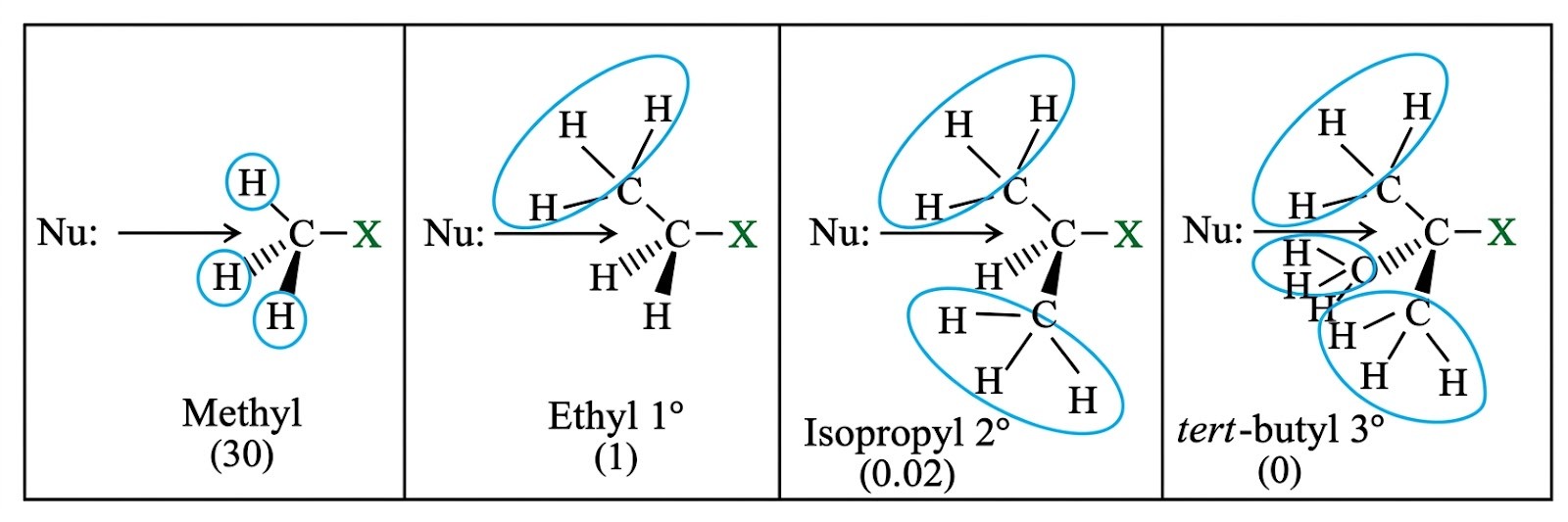
Steric effects in SN2 reaction
Stereochemical Aspect: Configuration

Configuration is the 3D arrangement of functional groups around a central carbon. In SN2, the product always has an inverted configuration because the nucleophile attacks from the side opposite to the leaving group. Consider the two structures below which are mirror images of each other:
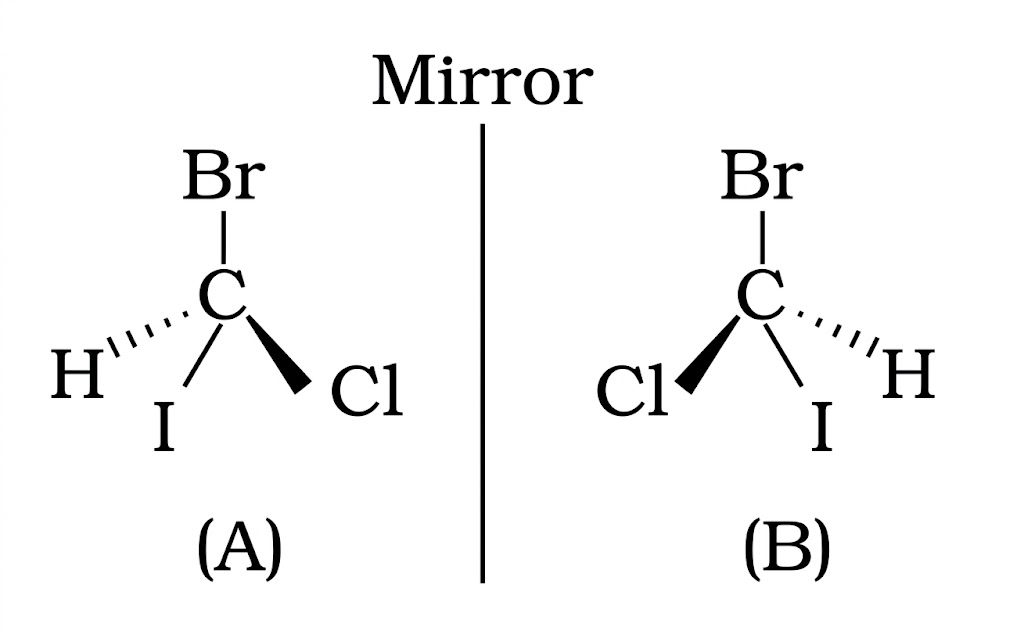
Configuration and Walden Inversion

Structure (A) is the mirror image of Structure (B).

If the reactant is optically active, this inversion results in a product with a different spatial orientation. This fundamental principle explains why SN2 reactions are stereospecific.

(b) SN1 — Substitution Nucleophilic Unimolecular

Rate = k [alkyl halide] — first order kinetics, depends on concentration of only the alkyl halide.

Occurs preferably with tertiary alkyl halides in polar protic solvents (water, alcohol, acetic acid).

Mechanism:

SN1 Mechanism Step I and II
Key Features of SN1: Part I
  • Two steps: Step I (slow, rate-determining) — ionisation to carbocation; Step II (fast) — nucleophile attacks carbocation.
  • Intermediate: A carbocation — sp² hybridised, planar (trigonal), achiral.
  • Reactivity order (SN1): Tertiary > Secondary > Primary > Methyl. Because more stable the carbocation, faster the SN1 reaction.
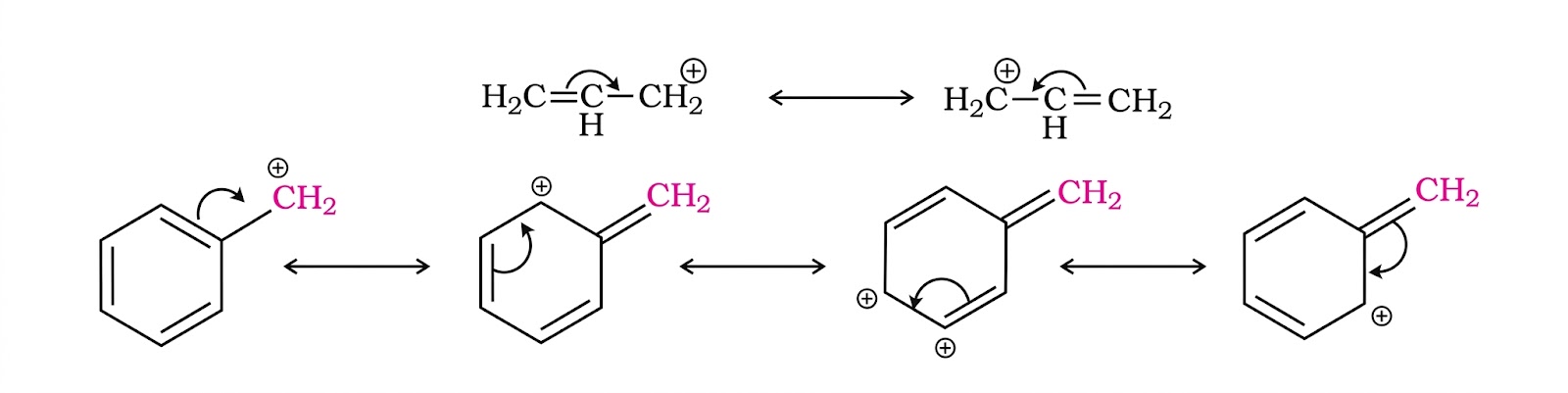
  • Allylic and benzylic halides are exceptionally reactive in SN1 due to resonance stabilisation of the carbocation.
Resonance in Allyl and Benzyl Carbocations
Key Features of SN1: Part II
  • Racemisation: Carbocation is planar (achiral) → nucleophile can attack from either face → gives equal amounts of (+) and (–) products → racemic mixture (optically inactive).
  • Polar protic solvents (water, alcohols) favour SN1 by stabilising both the carbocation and the halide ion through solvation.

Comparison: SN1 vs SN2 — Master Summary

Feature SN1 SN2
Steps 2 (stepwise) 1 (concerted)
Intermediate Carbocation None (transition state only)
Kinetics Rate = k[RX] (1st order) Rate = k[RX][Nu] (2nd order)
Best substrate 3° > 2° > 1° Methyl > 1° > 2° >> 3°
Stereochemical outcome Racemisation Inversion of configuration
Effect of steric bulk Favoured by more branching Inhibited by branching
Solvent Polar protic (water, ROH) Polar aprotic (acetone, DMSO) preferred
Effect of nucleophile Strong Nu not essential Strong, less hindered Nu required
Solved Predict SN1 / SN2 Reactivity

Arrange in increasing order of SN1 reactivity:
CH3CH2CH2CH2Br, (CH3)2CHCH2Br, CH3CH2CHBrCH3, (CH3)3CBr

6.7b Stereochemical Aspects of Nucleophilic Substitution

Optical Activity

Certain compounds rotate the plane of plane-polarised light (produced by a Nicol prism). Such compounds are optically active. The angle of rotation is measured by a polarimeter.

Chirality & Asymmetric Carbon

Key Definitions

Asymmetric carbon (stereocentre): A carbon atom bonded to four different groups. The molecule cannot be superimposed on its mirror image.

Chiral molecule: Non-superimposable on its mirror image (like left and right hands). Chiral molecules are optically active.

Achiral molecule: Superimposable on its mirror image. Optically inactive.

Enantiomers: Two non-superimposable mirror-image forms of a chiral molecule. They have identical physical properties except direction of optical rotation (one is +, other is −).
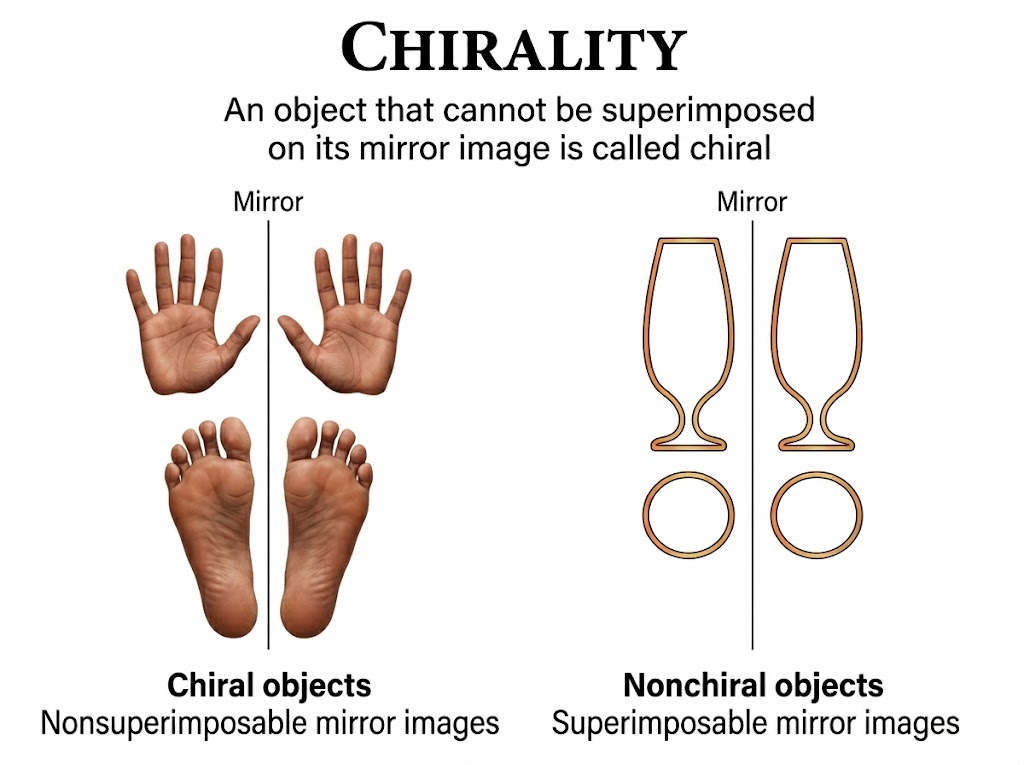
Common examples of chiral and achiral objects

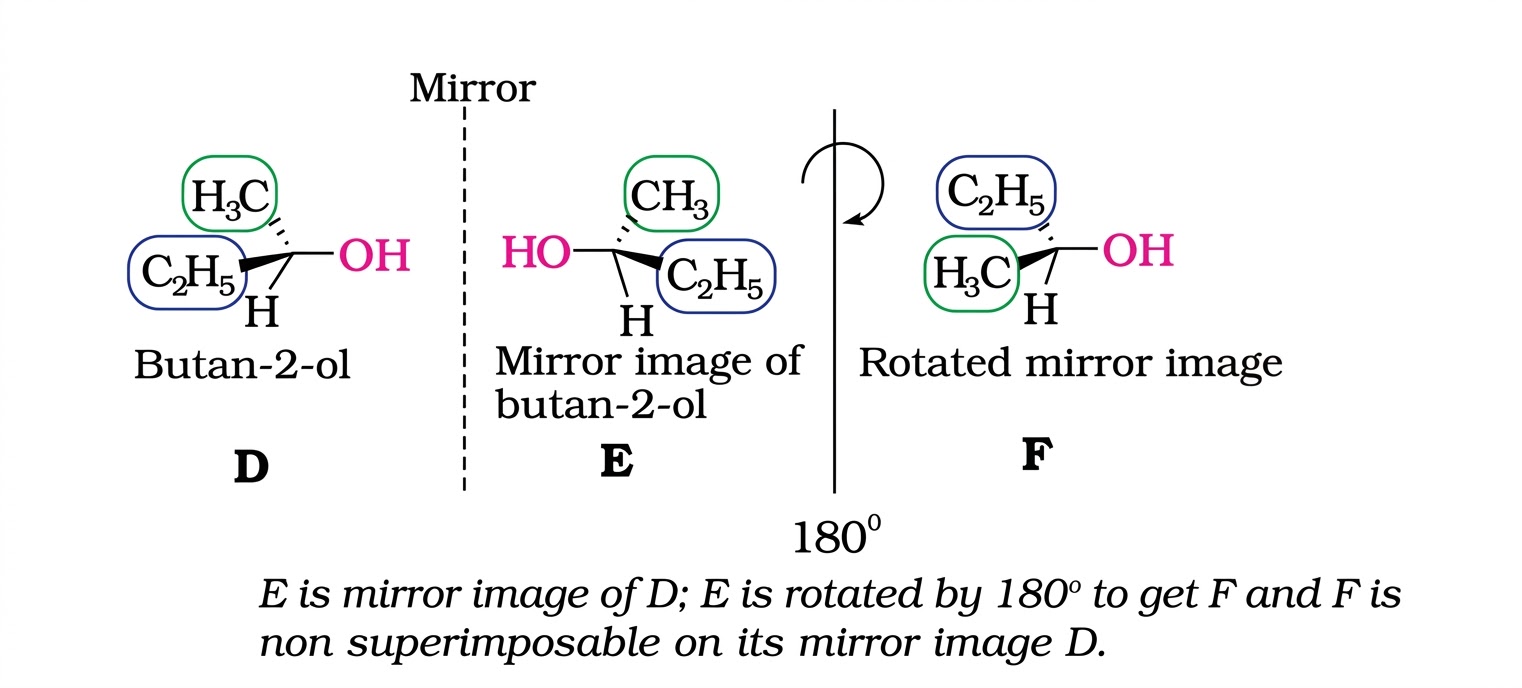
The above test of molecular chirality can be applied to organic molecules by constructing models and its mirror images or by drawing three dimensional structures and attempting to superimpose them in our minds. Let us consider two simple molecules, propan-2-ol and butan-2-ol, and their mirror images.
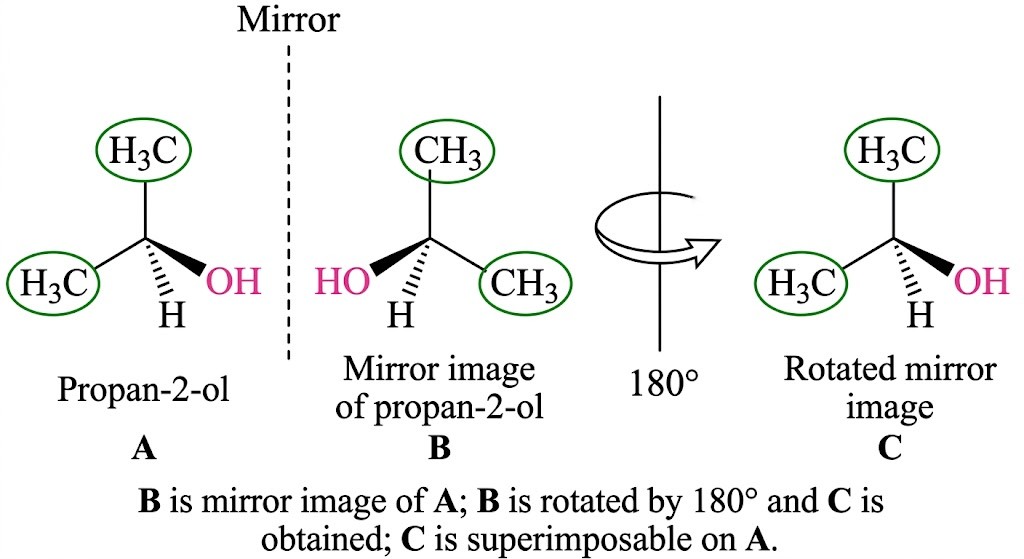
Propan-2-ol — Achiral Molecule
Propan-2-ol chirality

Observation: Structure A (Propan-2-ol) has two identical groups (–CH₃) on the central carbon. Its mirror image B, when rotated 180° to give C, is superimposable on A. Therefore, Propan-2-ol is achiral (optically inactive).
  • No asymmetric carbon: Has two identical groups attached to the central C.
  • Mirror image (B), when rotated 180° (structure C), completely overlaps with (A).
Butan-2-ol — Chiral Molecule
Butan-2-ol chirality

Observation: Structure D (Butan-2-ol) has four different groups on the central carbon (–CH₃, –C₂H₅, –OH, –H). Its mirror image E, rotated 180° to give F, is non-superimposable on D.

  • Therefore, Butan-2-ol is chiral, and the forms D and F are enantiomers.
  • Common Chiral Examples: 2-chlorobutane, 2,3-dihydroxypropanal, bromochloro-iodomethane, 2-bromopropanoic acid.

The stereoisomers related to each other as non-superimposable mirror images are called enantiomers. Enantiomers possess identical physical properties (melting point, boiling point, refractive index) but differ in the direction of optical rotation.
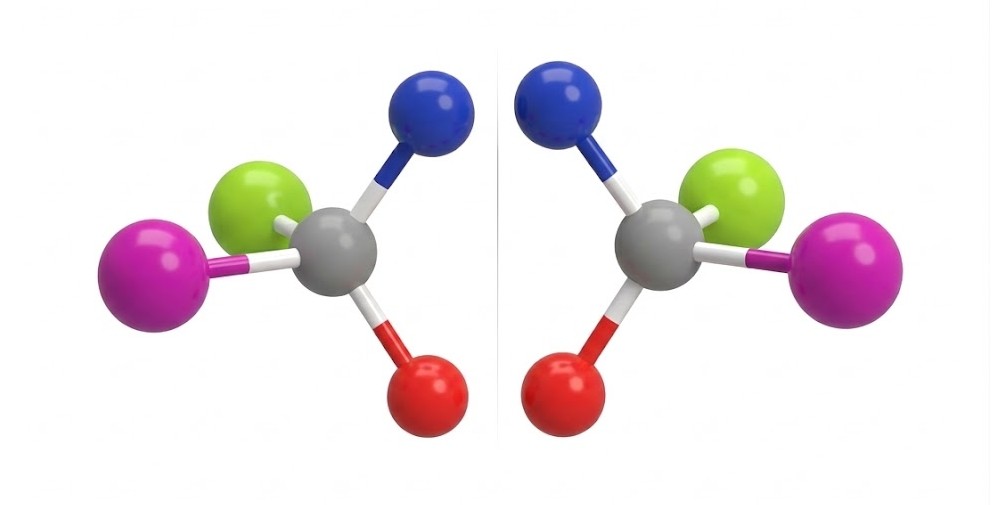
A chiral molecule and its mirror image
Pair of Chiral Enantiomers — Non-superimposable mirror images

Racemic Mixture & Racemisation

A racemic mixture (or racemic modification) is an equimolar mixture of two enantiomers. It has zero optical rotation because rotations cancel each other out. Represented by prefixing dl or (±). Example: (±)-butan-2-ol.

Racemisation = conversion of an enantiomer into a racemic mixture.

Example 6.8 Identify Chiral and Achiral Molecules

Identify chiral and achiral molecules in each of the following pair of compounds. (Wedge and Dash representations according to Class XI).
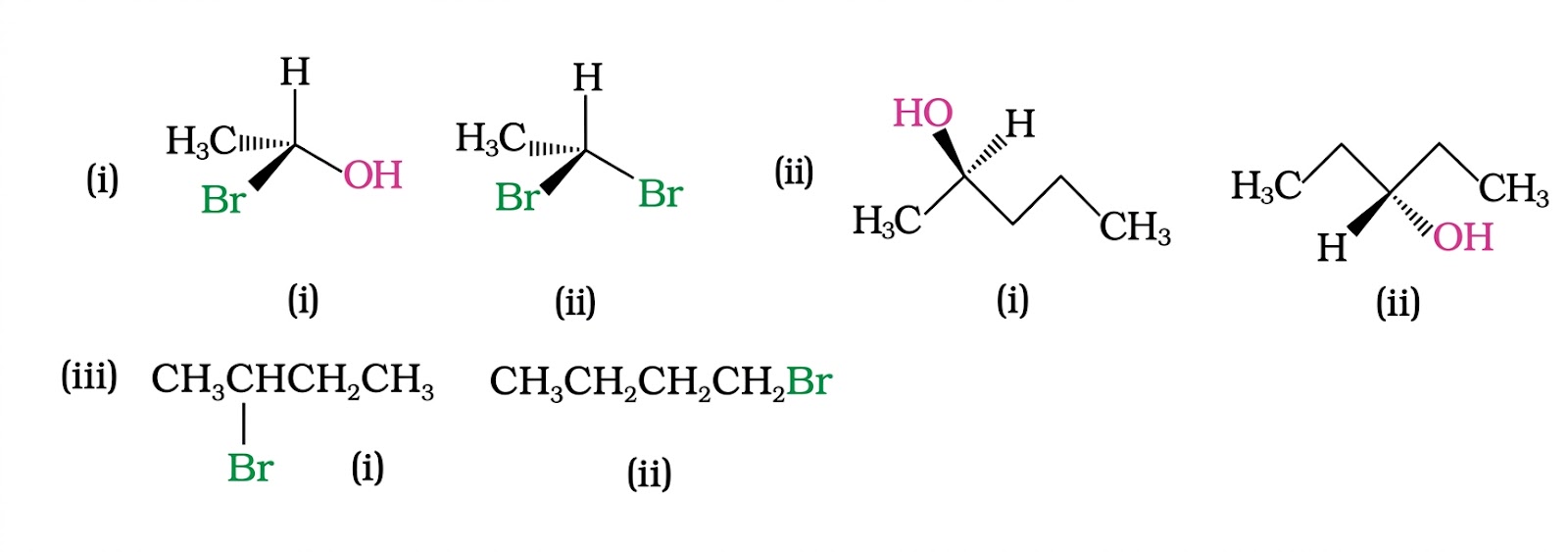
Example 6.8 Pairs of Compounds

Stereochemical Outcomes — 3 Possibilities

SN2 → Inversion of Configuration

Nucleophile attacks from the back of the C–X bond. The three remaining groups flip to the other side (like umbrella inversion). Product has opposite configuration at the asymmetric centre.
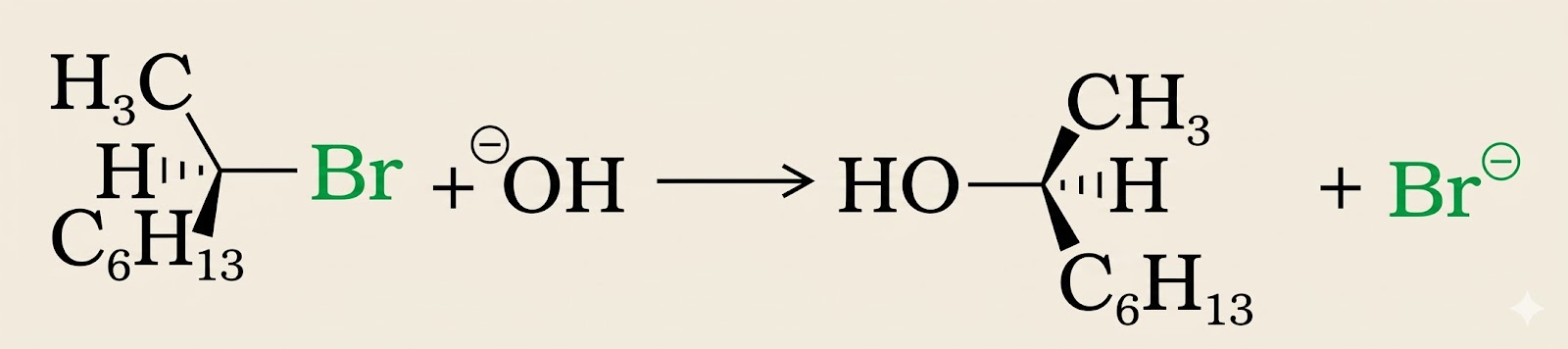
  • Product has inverted configuration.
  • Nucleophile attaches on the side opposite to the leaving halogen.
  • Example: (–)-2-bromooctane + OH → (+)-octan-2-ol.
SN2 Inversion of (-)-2-Bromooctane
SN1 → Racemisation

Carbocation intermediate is sp² hybridised, planar and achiral. Nucleophile can attack from either face with equal probability → equimolar mixture of (+) and (–) products → racemic mixture.
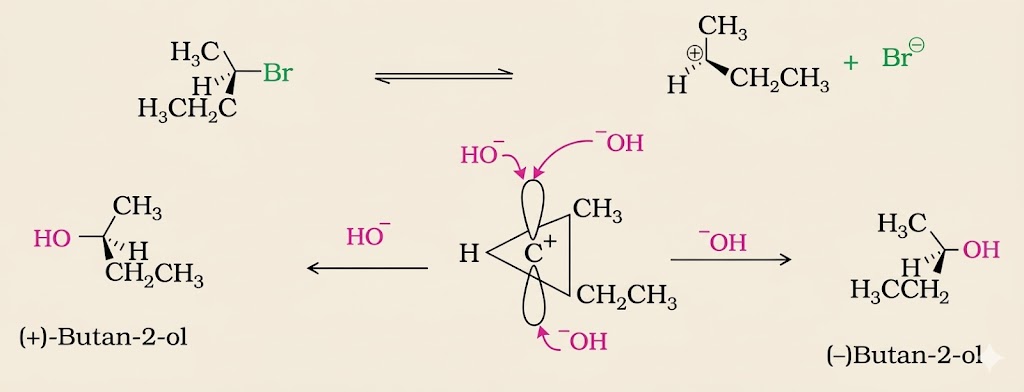
  • Accompanied by racemisation.
  • Carbocation is sp² hybridised and planar (achiral).
  • Nucleophile attacks from either face → equimolar mixture of (+) and (–) products.
  • Example: Hydrolysis of optically active 2-bromobutane → (±)-butan-2-ol.
SN1 Racemisation of (+/-)-2-Bromobutane
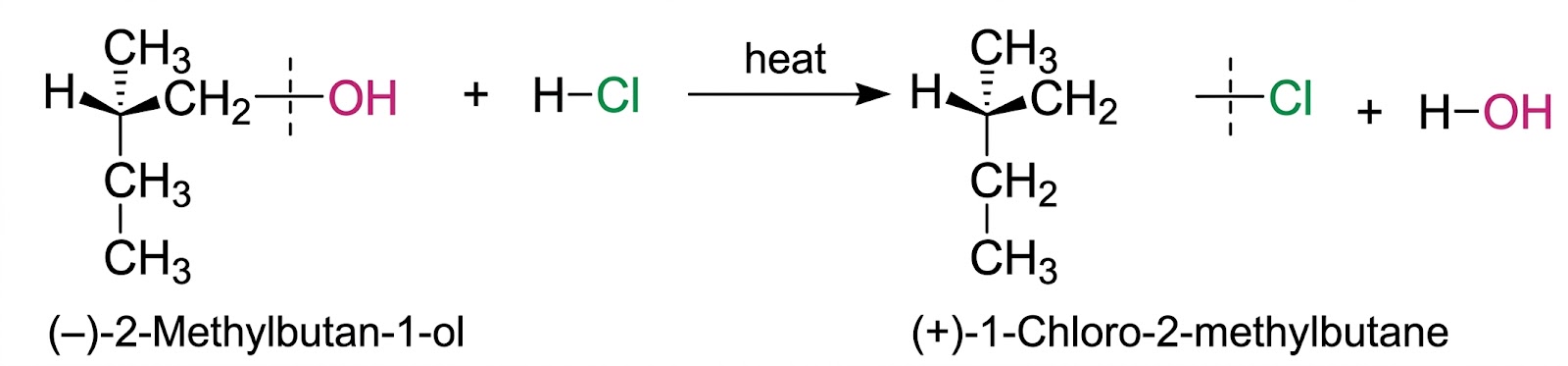
Retention of Configuration
  • Definition: Preservation of the spatial arrangement of bonds to an asymmetric centre during a reaction.
  • Occurs when no bond to the stereocentre is broken.
  • Example: (–)-2-methylbutan-1-ol + HCl → (+)-1-chloro-2-methylbutane.
(–)-2-Methylbutan-1-ol + HCl → (+)-1-Chloro-2-methylbutane (Retention)
  • Key Note: Spatial configuration remains the same, but the sign of optical rotation can change (e.g., from – to +).

Important distinction: Same configuration ≠ same sign of rotation. The sign depends on the actual groups and their priority, not just the spatial arrangement.
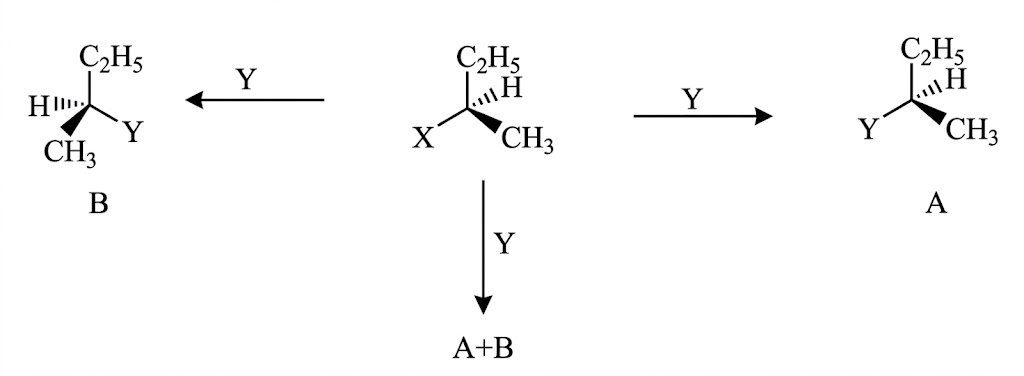
Three Outcomes when a bond to an asymmetric carbon IS broken:
  • If only product (A) is obtained → Retention of configuration
  • If only product (B) is obtained → Inversion of configuration
  • If a 50:50 mixture of (A) and (B) is obtained → Racemisation
Inversion, Retention and Racemisation — Summary Diagram (A, B, A+B)

6.7c Elimination Reactions & Reactions with Metals

β-Elimination (Dehydrohalogenation)

When a haloalkane with a β-hydrogen is heated with alcoholic KOH (not aqueous), elimination occurs: H is removed from the β-carbon and X from the α-carbon → alkene is formed.

Definition: α and β Carbon

α-carbon: The carbon directly bonded to the halogen atom.

β-carbon: The carbon adjacent to the α-carbon (one carbon further away from X).
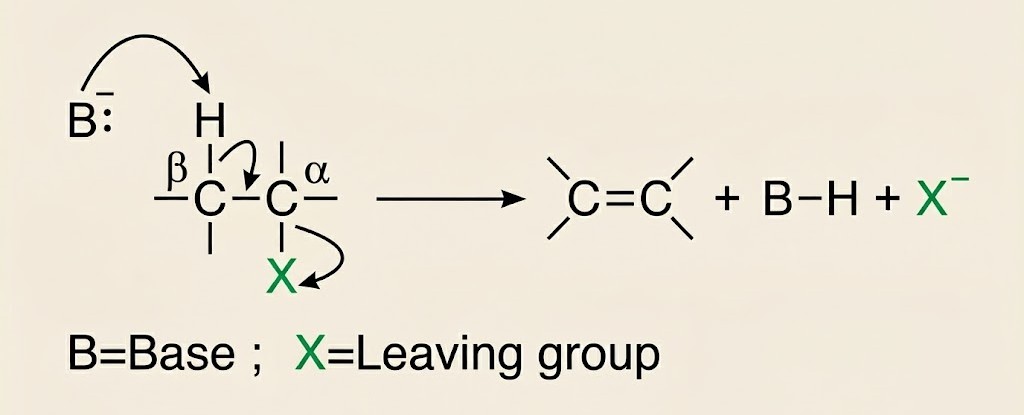
General β-Elimination:
General β-Elimination Reaction
Example — 2-Bromopentane:
2-Bromopentane Elimination Reaction
Zaitsev's Rule (1875)

In dehydrohalogenation reactions, the preferred (major) product is the alkene with the greater number of alkyl groups attached to the doubly bonded carbon atoms (more substituted, more stable alkene).

Pent-2-ene (internal double bond, 2 alkyl groups) is preferred over pent-1-ene (terminal double bond, 1 alkyl group).

Elimination vs Substitution — Competition

When does Elimination win?
  • Alcoholic KOH (concentrated, hot) → Elimination
  • Aqueous KOH (dilute, cold) → Substitution
  • Bulky nucleophile/base → Prefers elimination (cannot approach C, abstracts H instead)
  • Primary halide → Prefers SN2; secondary → SN2 or elimination; tertiary → SN1 or elimination

Reactions with Metals

Grignard Reagent Formation (Victor Grignard, 1900)

Haloalkanes react with magnesium in dry ether to form alkyl magnesium halides (Grignard reagents, RMgX). These are extremely important synthetic intermediates.

CH3CH2Br  +  Mg  dry ether  CH3CH2MgBr (Ethyl magnesium bromide)

Structure of RMgX: Rδ–—Mgδ+—Xδ–
C–Mg bond is covalent but highly polar (C is δ−, Mg is δ+). Mg–X bond is ionic.

Highly reactive: Reacts with any proton source (water, alcohols, amines) to give hydrocarbons. Must be prepared under strictly anhydrous conditions.

RMgX  +  H2O  →  R–H  +  Mg(OH)X

Grignard was awarded the Nobel Prize in Chemistry in 1912.

Wurtz Reaction

Alkyl halides react with sodium in dry ether to give hydrocarbons with double the number of carbon atoms.

2R–X  +  2Na  dry ether  R–R  +  2NaX
Example: 2CH3Br  +  2Na  →  CH3–CH3  +  2NaBr (ethane)

Limitation: Wurtz reaction works well only when both R groups are identical (to avoid mixed products). Using two different alkyl halides gives a mixture of three hydrocarbons.

6.7d Reactions of Haloarenes

1. Nucleophilic Substitution — Why Very Difficult?

Haloarenes are extremely unreactive towards nucleophilic substitution. Four reasons:

4 Reasons for Low Reactivity of Haloarenes in SN
  • 1 Resonance effect (Partial Double Bond Character): The lone pairs on the halogen are delocalised into the aromatic ring → C–X bond acquires partial double bond character → bond is stronger and harder to break.
    Resonance in Haloarenes
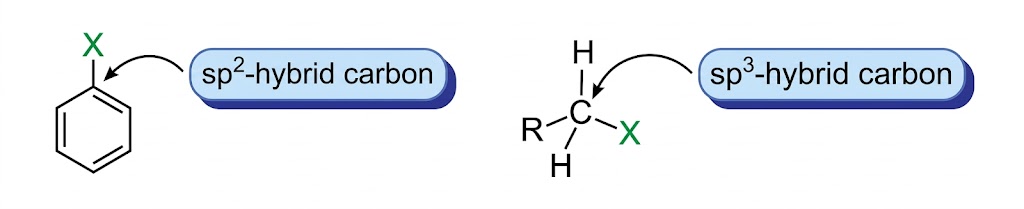
  • 2 sp² vs sp³ Hybridisation: In haloarenes, C is sp² (33% s-character, more electronegative) → holds the bonding pair more tightly → C–Cl bond is shorter (169 pm vs 177 pm in haloalkanes) → shorter bond = stronger bond = harder to break.
    sp² vs sp³ Hybridisation in Haloarenes
  • 3 Instability of Phenyl Cation: For SN1, a phenyl cation would need to form. Phenyl cation cannot be stabilised by resonance → SN1 is impossible.
  • 4 Electron Repulsion: The aromatic ring is electron-rich. An electron-rich nucleophile would be repelled by this cloud → SN2 is also unfavoured.

Nucleophilic Substitution — When It CAN Occur

The presence of strongly electron-withdrawing groups (like –NO2) at the ortho and para positions significantly activates haloarenes towards nucleophilic substitution.
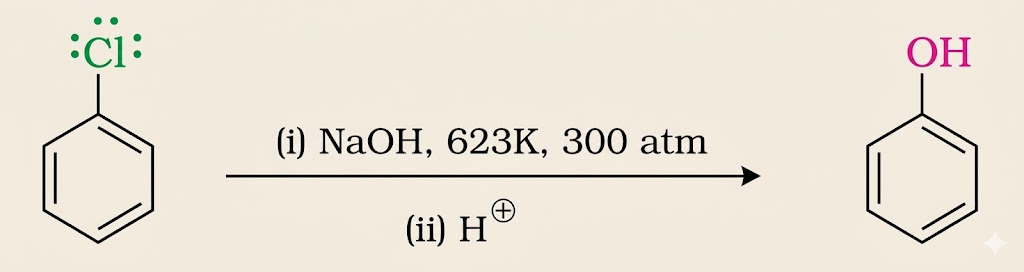
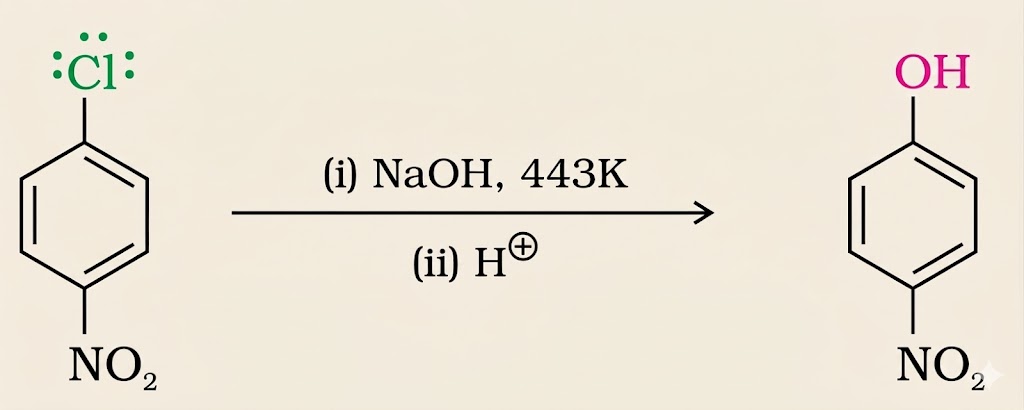
Example 1 — Chlorobenzene (requires harsh conditions):
C6H5Cl  +  NaOH(aq)  623 K, 300 atm  C6H5OH (Phenol)  +  NaCl
Chlorobenzene to Phenol Substitution
Example 2 — o-Nitrochlorobenzene (milder conditions):
o-NO2–C6H4–Cl  +  NaOH  443 K  o-NO2–C6H4–OH
o-Nitrochlorobenzene Substitution
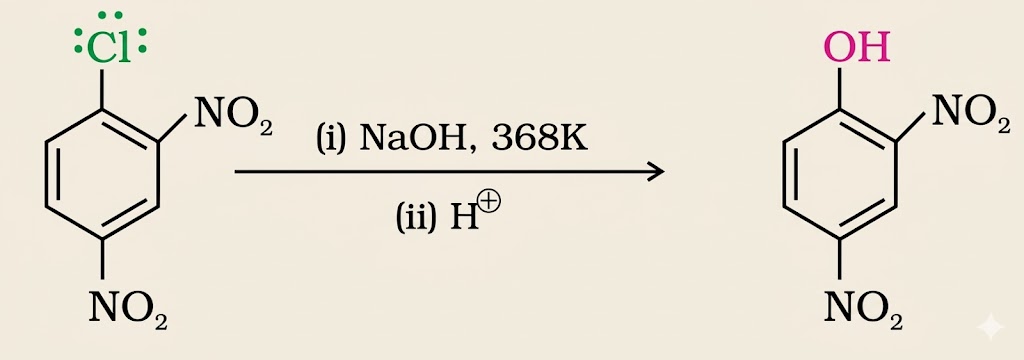
Example 3 — 2,4-Dinitrochlorobenzene (even milder):
2,4-(NO2)2–C6H3–Cl  +  NaOH  368 K, warm H₂O  2,4-(NO2)2–C6H3–OH
2,4-Dinitrochlorobenzene Substitution
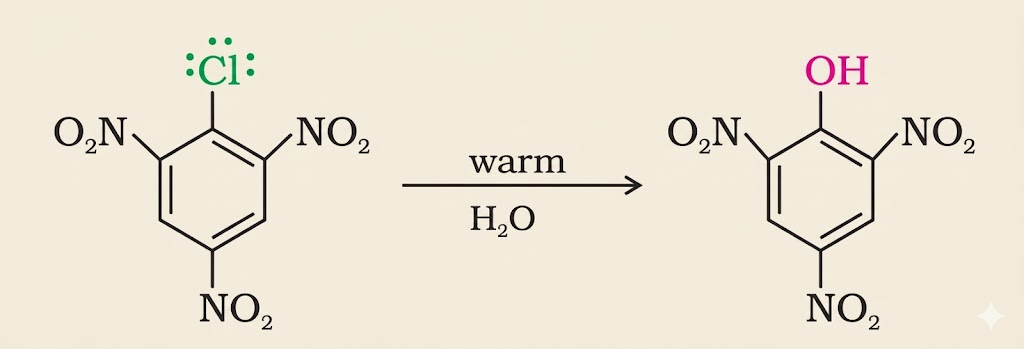
Example 4 — 2,4,6-Trinitrochlorobenzene (mildest conditions):
2,4,6-(NO2)3–C6H2–Cl  +  H2O  warm  2,4,6-(NO2)3–C6H2–OH (Picric acid)
2,4,6-Trinitrochlorobenzene Substitution
Why ONLY ortho/para NO₂ activates — NOT meta?

When –NO2 is at ortho or para position to the leaving Cl, the negative charge on the Meisenheimer complex (intermediate carbanion) can be stabilised by the –NO2 group through resonance. The negative charge at the carbon bearing Cl is delocalised onto the electronegative oxygens of the nitro group.

When –NO2 is at the meta position, the negative charge in the intermediate does not appear on the carbon bearing the nitro group, so the nitro group cannot stabilise it through resonance → no rate enhancement.
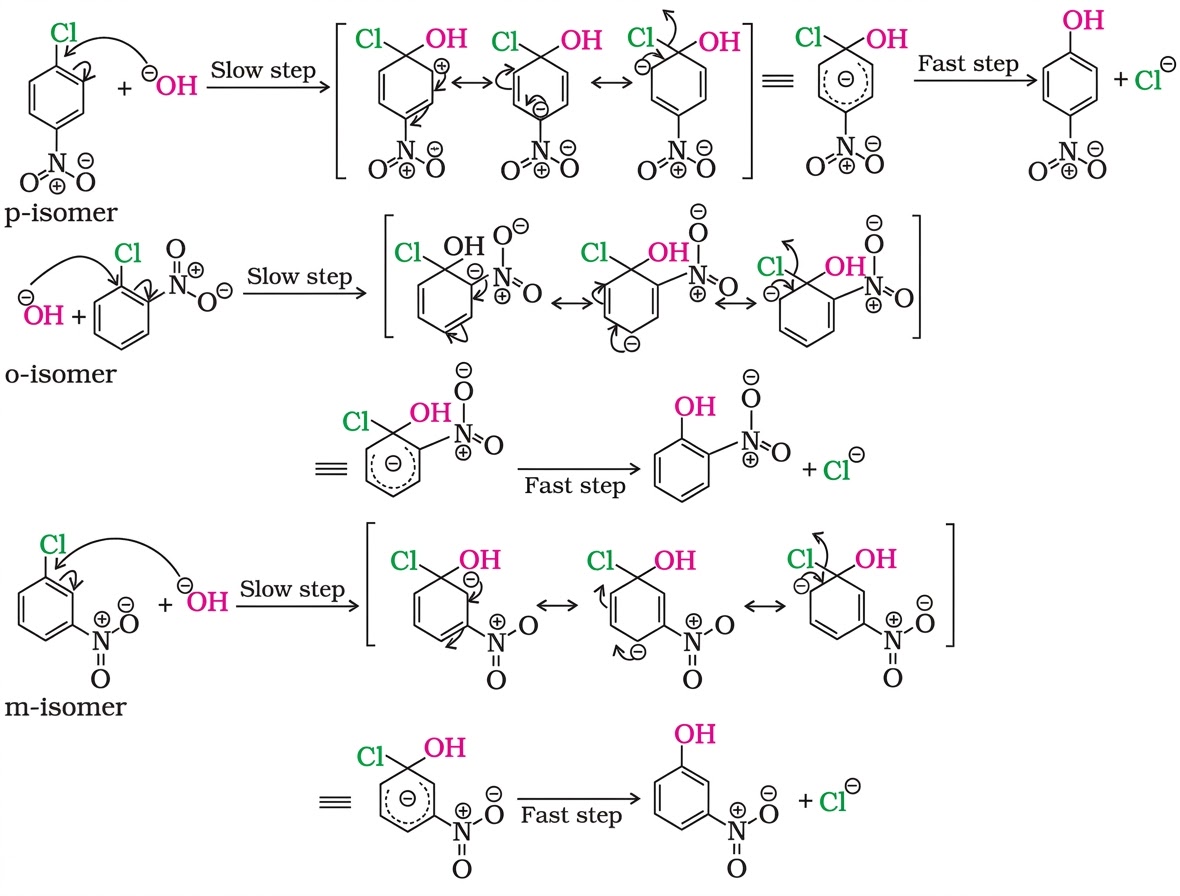
Mechanism of the Reaction

Nucleophilic Substitution Reaction Mechanism

2. Electrophilic Aromatic Substitution (EAS)

Haloarenes readily undergo the usual EAS reactions. Halogen is:

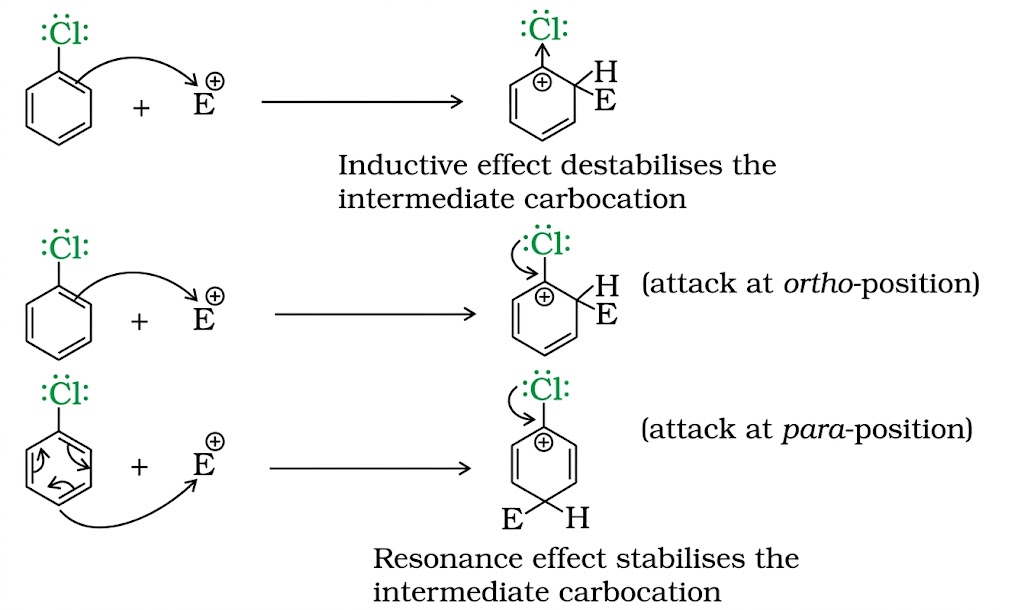
Reconciling o,p Directing but Deactivating

Two competing effects of halogens on the benzene ring:

  • Inductive effect (–I): Halogen is electronegative → withdraws electrons from ring (makes ring less nucleophilic → slower than benzene). Controls reactivity.
  • Resonance effect (+R): Halogen donates lone pair electrons into ring preferentially at ortho and para positions → stabilises the arenium ion intermediate at o,p. Controls orientation.

Net result: EAS reactions of haloarenes proceed more slowly than benzene (require more drastic conditions) but produce predominantly ortho and para products.

(i) Halogenation

Reagent: Cl2 / Anhydrous FeCl3
Products: 1,4-Dichlorobenzene (Major) + 1,2-Dichlorobenzene (Minor)
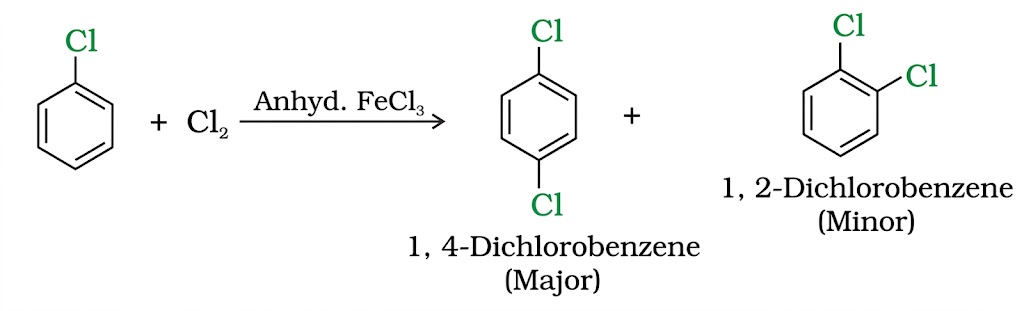
Halogenation of Chlorobenzene

(ii) Nitration

Reagent: HNO3 / conc. H2SO4 (room temp)
Products: 1-Chloro-4-nitrobenzene (Major) + 1-Chloro-2-nitrobenzene (Minor)
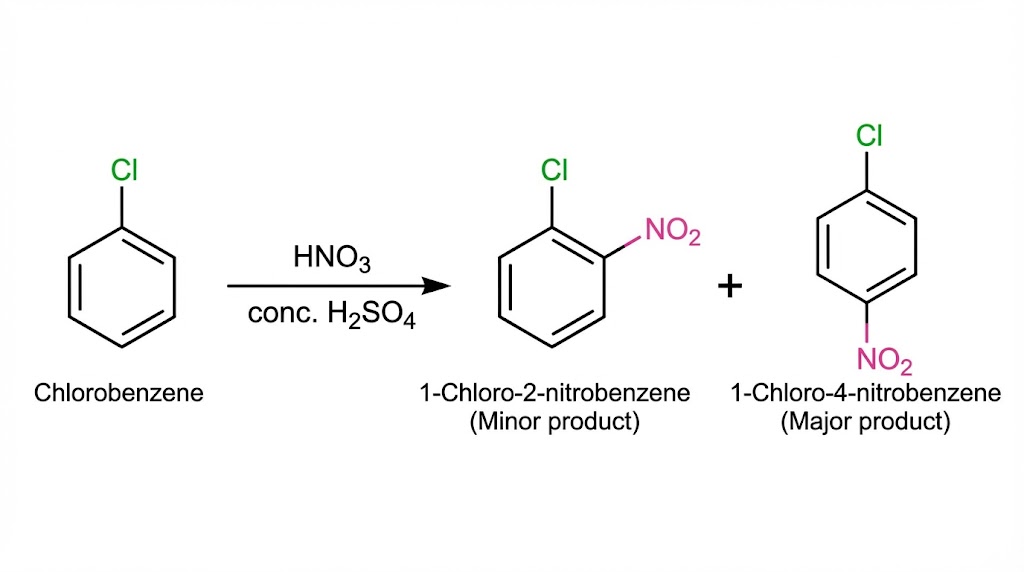
Nitration of Chlorobenzene

(iii) Sulphonation

Reagent: Conc. H2SO4 (heat / Δ)
Products: 4-Chlorobenzenesulphonic acid (Major) + 2-Chlorobenzenesulphonic acid (Minor)
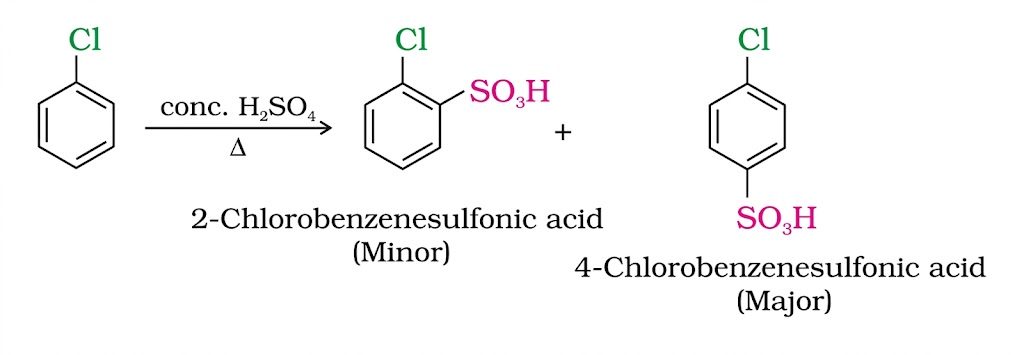
Sulphonation of Chlorobenzene

(iv) Friedel-Crafts Alkylation

Reagent: CH3Cl / Anhydrous AlCl3
Products: 1-Chloro-4-methylbenzene (Major) + 1-Chloro-2-methylbenzene (Minor)
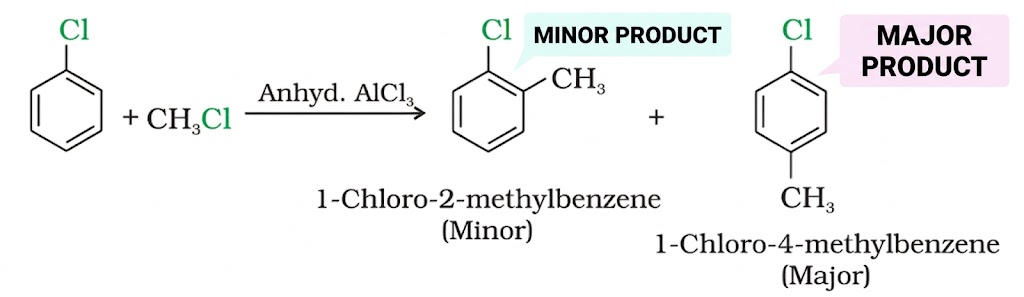
Friedel-Crafts Alkylation

(v) Friedel-Crafts Acylation

Reagent: CH3COCl / Anhydrous AlCl3
Products: 4-Chloroacetophenone (Major) + 2-Chloroacetophenone (Minor)
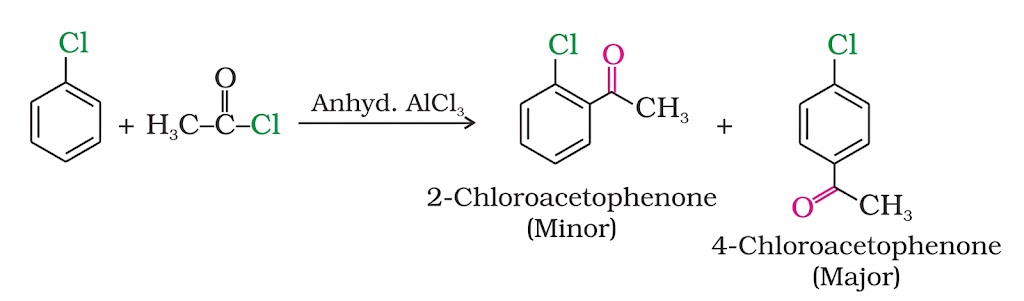
Friedel-Crafts Acylation
Example 6.9 Although chlorine is an electron withdrawing group, yet it is ortho-, para- directing in electrophilic aromatic substitution reactions. Why?

3. Reactions with Metals

Wurtz-Fittig Reaction

A mixture of aryl halide + alkyl halide with sodium in dry ether gives an alkylarene.

Ar–X  +  R–X  +  2Na  dry ether  Ar–R  +  2NaX

Example: C6H5Br + CH3Br + 2Na → C6H5CH3 (toluene) + 2NaBr

Wurtz-Fittig Reaction
Fittig Reaction

Two aryl halide molecules with sodium in dry ether join together (two aryl groups coupled).

2Ar–X  +  2Na  dry ether  Ar–Ar  +  2NaX

Example: 2C6H5Br + 2Na → C6H5–C6H5 (biphenyl) + 2NaBr
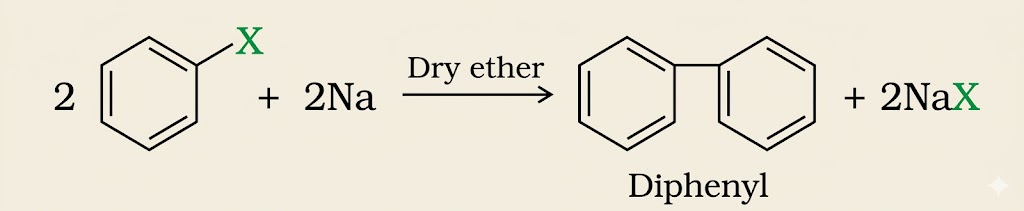
Fittig Reaction

6.8 Polyhalogen Compounds

Carbon compounds containing more than one halogen atom. Many are industrially and medicinally important but some are environmental hazards.

Compound Formula IUPAC Name Key Uses Hazards
Methylene chloride CH2Cl2 Dichloromethane Solvent for paints, pharmaceuticals, metal cleaning CNS damage; hearing/vision impairment; skin burns; corneal damage
Chloroform CHCl3 Trichloromethane Solvent for fats, alkaloids; manufacture of Freon R-22; was used as anaesthetic CNS depression; liver/kidney damage; oxidised to phosgene (COCl2) in light → stored in dark bottles filled completely with liquid
Iodoform CHI3 Triiodomethane Earlier used as antiseptic (due to liberation of free I2, not iodoform itself) Objectionable smell → replaced by other iodine formulations
Carbon tetrachloride CCl4 Tetrachloromethane Refrigerant manufacture, freons synthesis, degreasing, fire extinguisher (until 1960s) Liver cancer; dizziness, nausea; depletes ozone layer when released to atmosphere
Freons CCl2F2 (Freon-12) Dichlorodifluoromethane Refrigerants, aerosol propellants, AC systems Initiates radical chain reactions in stratosphere → depletes ozone layer → increases UV exposure → skin cancer, cataracts, immune disorders
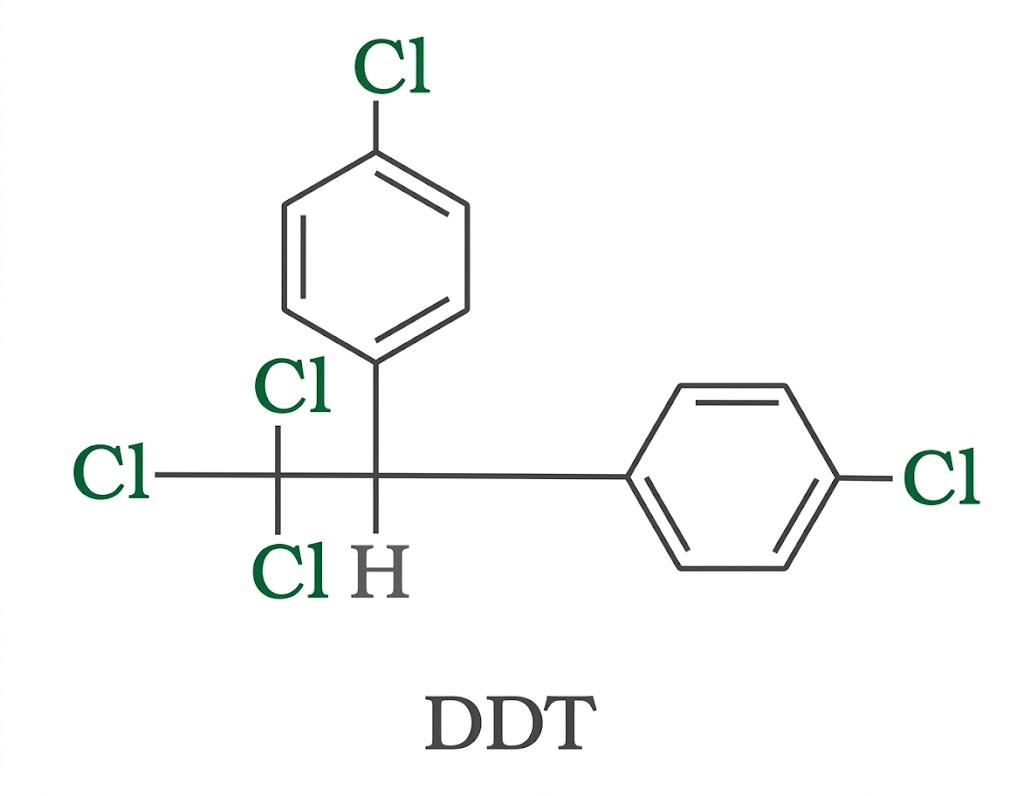
DDT Complex p,p'-Dichlorodiphenyltrichloroethane Insecticide (mosquitoes → malaria, lice → typhus); Paul Müller discovered insecticidal property (Nobel 1948) Not metabolised rapidly → accumulates in fatty tissues; develops insect resistance; toxic to fish; banned in USA 1973
Freons & Ozone Depletion — Environmental Chemistry

Freons (CFCs) are extremely stable in the troposphere. They diffuse unchanged into the stratosphere where UV radiation breaks them down, generating Cl• radicals. These radicals initiate chain reactions that convert O3 (ozone) to O2, disrupting the natural ozone balance.

Ozone depletion → increased UV-B reaching Earth's surface → increased skin cancer, cataracts, disruption of immune system and aquatic ecosystems.
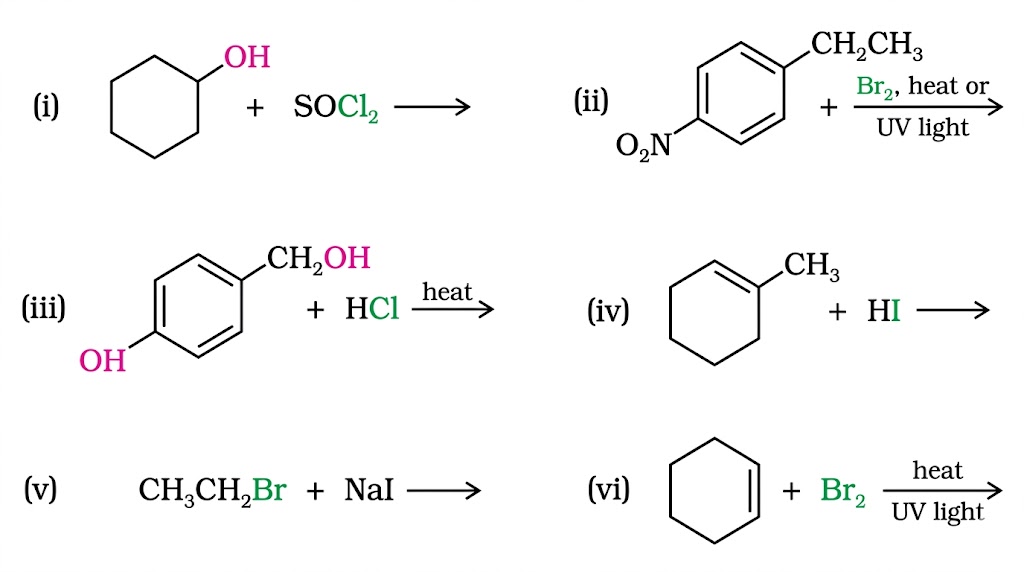
Chloroform Oxidation — Important Reaction

2CHCl3  +  O2  light  2COCl2  +  2HCl
COCl₂ = Phosgene (carbonyl chloride) — extremely poisonous gas
∴ Chloroform stored in completely filled, closed, dark-coloured bottles to exclude air and light.

DDT Structure

DDT Structure Diagram

✏️ Practice Questions

Q1
Write the IUPAC names and classify the following as 1°, 2°, 3°, vinylic, allylic, or benzylic:
(a) (CH3)2CHCH(Cl)CH3   (b) CH3CH=C(Cl)CH2CH(CH3)2   (c) C6H5CH2CH2Br
Q2
Arrange the following in increasing order of boiling points and explain:
Bromomethane (CH3Br), Bromoform (CHBr3), Chloromethane (CH3Cl), Dibromomethane (CH2Br2)
Q3
Haloalkanes react with KCN to form alkyl cyanides as the main product, while AgCN forms isocyanides as the chief product. Why?
Q4
In the following pairs, which will undergo SN2 reaction faster and why?
(a) CH3Br or CH3I    (b) (CH3)3CCl or CH3Cl
Q5
Why are aryl halides much less reactive than alkyl halides towards nucleophilic substitution reactions? Give all reasons.
Q6
p-Dichlorobenzene has a higher melting point than o- and m-dichlorobenzene, although the boiling points are very similar. Why?
Q7
Why should Grignard reagents be prepared under anhydrous conditions?
Q8
Identify which compound undergoes faster SN1 reaction and explain: C6H5CH2Cl or C6H5CHClC6H5
Q9
What happens when (i) n-butyl chloride is treated with alcoholic KOH, (ii) chlorobenzene is subjected to hydrolysis, (iii) methyl chloride is treated with KCN?
Q10
Predict the major alkene formed when 2-bromopentane is treated with alcoholic KOH. Name the rule involved.
Q11
Although chlorine is an electron-withdrawing group (–I effect), it is o,p-directing in EAS. Explain this paradox.
Q12
Give the structural formula of the primary alkyl halide C₄H₉Br (a) that undergoes SN2 with alcoholic KOH to give alkene (b); (b) reacts with HBr to give (c) — an isomer of (a); when (a) reacts with sodium it gives (d) C₈H₁₈ different from n-octane.