Vardaan Learning Institute
The d- and f-Block Elements
1. Introduction & Position in the Periodic Table
The d-block of the periodic table contains elements of Groups 3 to 12 in
which the inner penultimate $(n-1)d$ subshell orbitals are progressively filled across four long periods
($3d, 4d, 5d, 6d$). The f-block consists of elements in which $4f$ and $5f$ orbitals are
progressively filled, placed in a separate two-row panel at the bottom of the periodic table.
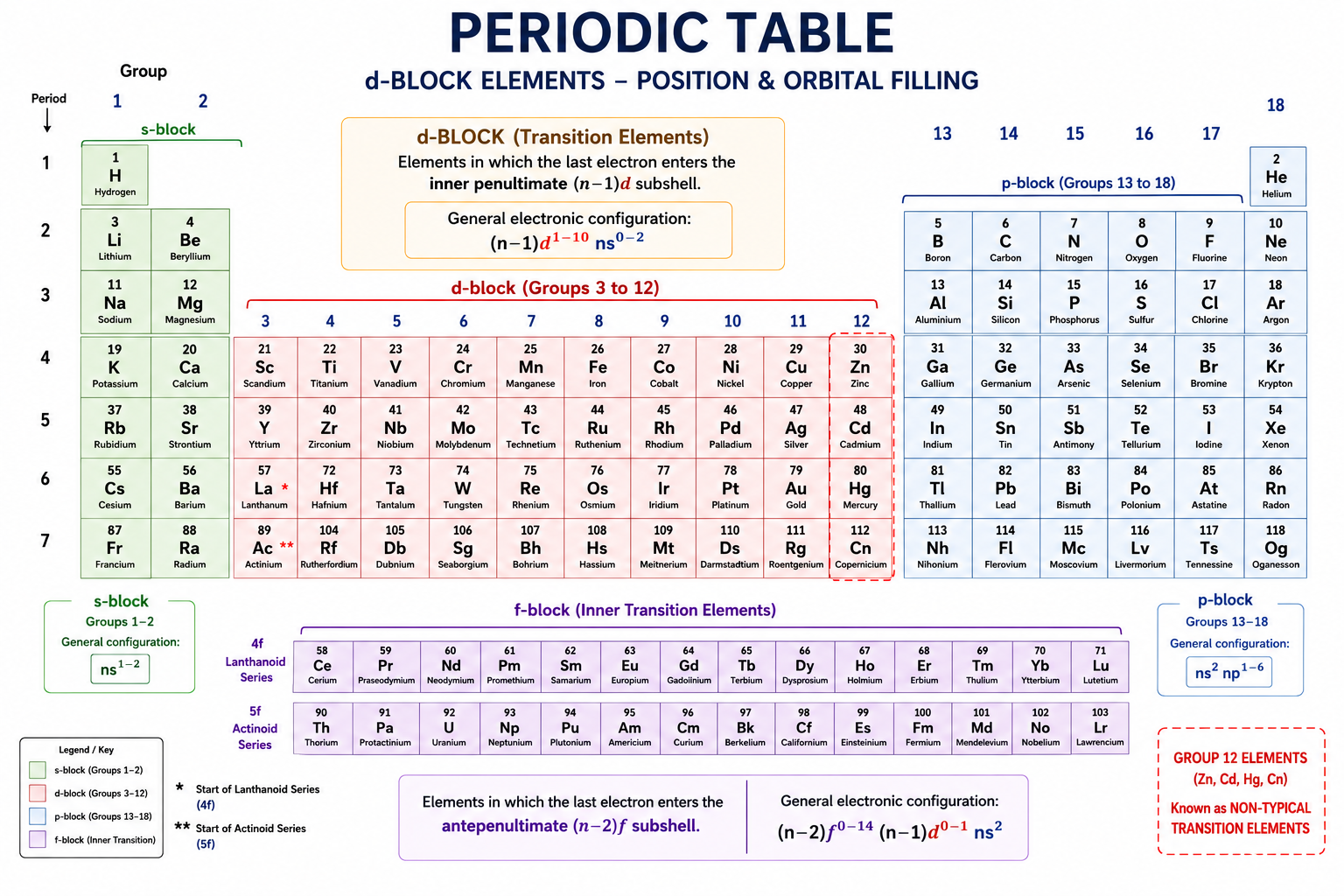
Position of
d-Block (Groups 3-12) and f-Block Elements in the Periodic Table
IUPAC Definition of Transition Elements
Transition Metal: IUPAC strictly defines a transition metal as an element that has an
incompletely (partially) filled d-subshell in its neutral ground state atom or in any one
of its common oxidation states.
Distinction: "d-Block Elements" is a structural group name (Groups 3 to 12), whereas "Transition
Metals" is a functional definition based on incomplete d-orbitals ($d^{1-9}$).
EXCEPTION 1: IUPAC DEFINITION & GROUP 12 NON-TYPICAL ELEMENTS
- IUPAC RULETransition Metal Definition: IUPAC
strictly defines a transition metal as an element that has an incompletely (partially)
filled d-subshell ($d^{1-9}$) in its neutral ground state atom or in any one of its
common oxidation states.
- EXCEPTIONWhy Zinc (Zn), Cadmium (Cd), Mercury (Hg), and
Copernicium (Cn) are NOT true transition elements:
- Ground State: Group 12 elements have a completely filled $d^{10}$ outer
configuration ($Zn: 3d^{10}4s^2$, $Cd: 4d^{10}5s^2$, $Hg: 5d^{10}6s^2$).
- Common Oxidation States: In their most common oxidation states ($Zn^{2+},
Cd^{2+}, Hg^{2+}$), they retain a fully filled $d^{10}$ subshell ($Zn^{2+}: 3d^{10}$).
NCERT Conclusion: Because they lack incompletely filled d-orbitals in both ground
and ionic states, they are non-typical transition elements.
The Four Transition Series
- 3d Series (First Transition Series): Scandium ($Sc, Z=21$) to Zinc ($Zn, Z=30$).
(Filling of $3d$ orbitals).
- 4d Series (Second Transition Series): Yttrium ($Y, Z=39$) to Cadmium ($Cd, Z=48$).
(Filling of $4d$ orbitals).
- 5d Series (Third Transition Series): Lanthanum ($La, Z=57$), Hafnium ($Hf, Z=72$) to
Mercury ($Hg, Z=80$). (Filling of $5d$ orbitals).
- 6d Series (Fourth Transition Series): Actinium ($Ac, Z=89$), Rutherfordium ($Rf,
Z=104$) to Copernicium ($Cn, Z=112$). (Incomplete/Filling of $6d$ orbitals).
NCERT Example 4.1 / Solved Problem
Question 1: On what ground can you say that Scandium ($Z = 21$) is a transition element but
Zinc ($Z = 30$) is not?
Solution:
Scandium atom in its ground state has an incompletely filled $3d$ orbital ($3d^1 4s^2$). According to
IUPAC definition, it is a transition element.
On the other hand, a Zinc atom has completely filled $d$-orbitals ($3d^{10} 4s^2$) in its ground state,
as well as in its oxidized $+2$ state ($Zn^{2+}: 3d^{10}$). Hence, Zinc is not regarded as a transition
element.
NCERT Intext Question 4.1
Question 2: Silver atom ($Ag, Z = 47$) has completely filled d-orbitals ($4d^{10} 5s^1$) in
its ground state. How can you say that it is a transition element?
Solution:
Silver exhibits a $+2$ oxidation state in compounds such as Silver(II) fluoride ($AgF_2$) and Silver(II)
oxide ($AgO$). In the $+2$ state, its electronic configuration becomes $4d^9$, which has an incompletely
filled $d$-orbital. Therefore, silver is classified as a transition element.
2. Electronic Configurations of d-Block Elements
The general outer electronic configuration of d-block elements is $(n-1)d^{1-10} ns^{1-2}$,
where $(n-1)$ stands for the inner (penultimate) d-orbitals and $n$ is the outermost principal shell.
Why the Configuration Exceptions? (Cr, Cu, Pd, Pt, Au)
The unusual configurations of Chromium ($Cr$), Copper ($Cu$), Palladium ($Pd$), Platinum ($Pt$), and Gold
($Au$) arise due to two primary factors:
1.
Very Small Energy Gap: The energy difference between the $(n-1)d$ and $ns$ orbitals is
minimal, making electron transfer energetically favorable.
2.
Extra Stability of Half-filled ($d^5, f^7$) and Fully-filled ($d^{10}, f^{14}$)
Subshells:
- Symmetrical Distribution: Symmetrical charge distribution leads to lower
inter-electronic repulsion and lower energy.
- Maximum Exchange Energy: Electrons with parallel spins in degenerate orbitals
exchange positions. The exchange energy released is proportional to the number of possible exchange
pairs $K = \frac{n(n-1)}{2}$. Exchange energy is maximum at half-filled ($d^5$) and fully-filled
($d^{10}$) states.
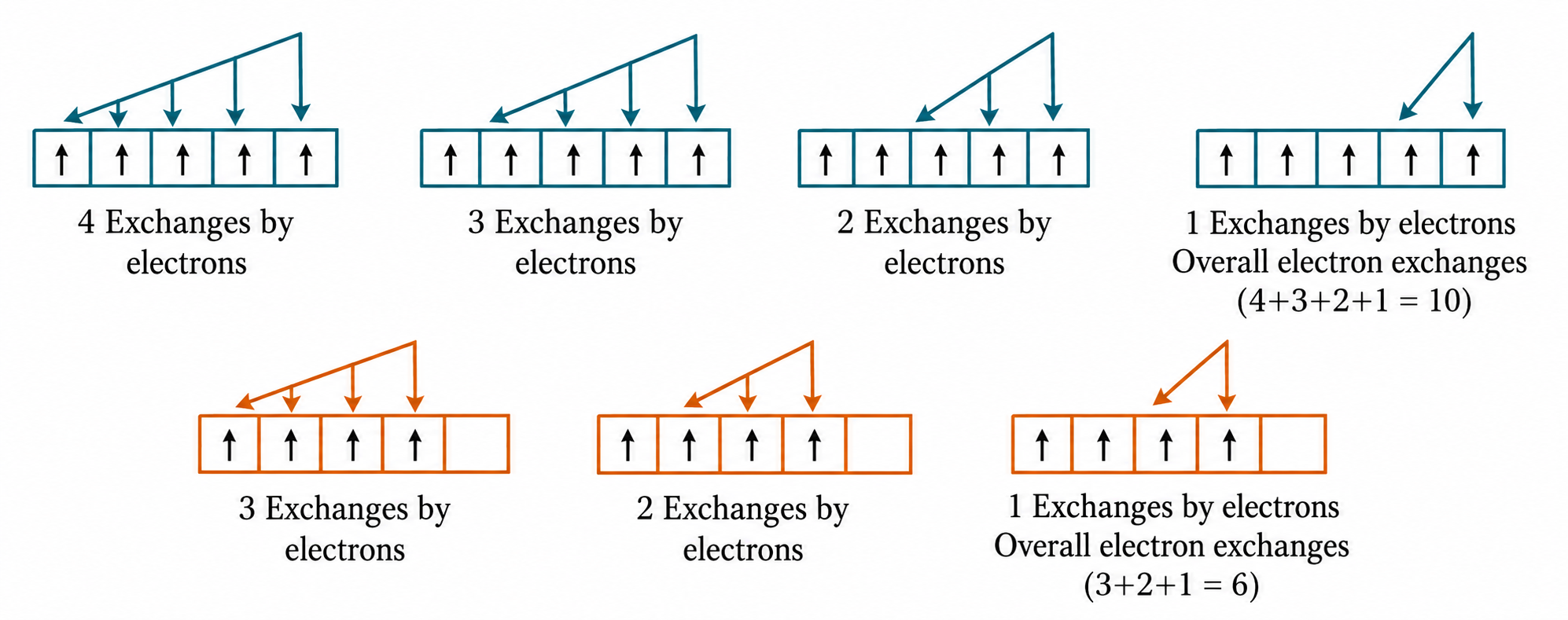
Exchange
Energy Pairs for 3d5 (10 Pairs) vs 3d4 (6 Pairs) Configurations
Key Exceptions to Memorize for Boards & Entrance Exams:
| Element |
Symbol & Z |
Expected Config |
Actual Config |
Key Exception Reason |
| Chromium |
$Cr (Z=24)$ |
$[Ar] 3d^4 4s^2$ |
$\mathbf{[Ar] 3d^5 4s^1}$ |
Half-filled $3d^5$ subshell stability |
| Copper |
$Cu (Z=29)$ |
$[Ar] 3d^9 4s^2$ |
$\mathbf{[Ar] 3d^{10} 4s^1}$ |
Fully-filled $3d^{10}$ subshell stability |
| Niobium |
$Nb (Z=41)$ |
$[Kr] 4d^3 5s^2$ |
$[Kr] 4d^4 5s^1$ |
Small $4d-5s$ energy gap |
| Molybdenum |
$Mo (Z=42)$ |
$[Kr] 4d^4 5s^2$ |
$[Kr] 4d^5 5s^1$ |
Half-filled $4d^5$ stability |
| Palladium |
$Pd (Z=46)$ |
$[Kr] 4d^8 5s^2$ |
$\mathbf{[Kr] 4d^{10} 5s^0}$ |
CRUCIAL: Only element with $5s^0$! |
| Platinum |
$Pt (Z=78)$ |
$[Xe] 4f^{14} 5d^8 6s^2$ |
$[Xe] 4f^{14} 5d^9 6s^1$ |
$5d^9 6s^1$ stability |
| Gold |
$Au (Z=79)$ |
$[Xe] 4f^{14} 5d^9 6s^2$ |
$[Xe] 4f^{14} 5d^{10} 6s^1$ |
Fully-filled $5d^{10}$ stability |
The Crucial 4s Orbital Rule (Filling vs Ionization)
- Filling (Aufbau Principle): The $4s$ orbital is filled BEFORE the $3d$ orbital because in
neutral isolated atoms, $4s$ has lower energy than $3d$.
- Ionization (Loss of Electrons): When transition metals form cations, $ns$
electrons are lost BEFORE $(n-1)d$ electrons! Once $3d$ orbitals are filled, nuclear pull
increases, making $3d$ lower in energy than $4s$.
NCERT Table 4.1 & 4.2: Electronic Configurations of 3d Transition Series
| Element |
Symbol |
Z |
Neutral Atom (M) |
$M^+$ Ion |
$M^{2+}$ Ion |
$M^{3+}$ Ion |
| Scandium |
Sc |
21 |
$[Ar] 3d^1 4s^2$ |
$[Ar] 3d^1 4s^1$ |
$[Ar] 3d^1$ |
$[Ar] 3d^0$ |
| Titanium |
Ti |
22 |
$[Ar] 3d^2 4s^2$ |
$[Ar] 3d^2 4s^1$ |
$[Ar] 3d^2$ |
$[Ar] 3d^1$ |
| Vanadium |
V |
23 |
$[Ar] 3d^3 4s^2$ |
$[Ar] 3d^3 4s^1$ |
$[Ar] 3d^3$ |
$[Ar] 3d^2$ |
| Chromium |
Cr |
24 |
$[Ar] 3d^5 4s^1$ |
$[Ar] 3d^5$ |
$[Ar] 3d^4$ |
$[Ar] 3d^3$ |
| Manganese |
Mn |
25 |
$[Ar] 3d^5 4s^2$ |
$[Ar] 3d^5 4s^1$ |
$[Ar] 3d^5$ |
$[Ar] 3d^4$ |
| Iron |
Fe |
26 |
$[Ar] 3d^6 4s^2$ |
$[Ar] 3d^6 4s^1$ |
$[Ar] 3d^6$ |
$[Ar] 3d^5$ |
| Cobalt |
Co |
27 |
$[Ar] 3d^7 4s^2$ |
$[Ar] 3d^7 4s^1$ |
$[Ar] 3d^7$ |
$[Ar] 3d^6$ |
| Nickel |
Ni |
28 |
$[Ar] 3d^8 4s^2$ |
$[Ar] 3d^8 4s^1$ |
$[Ar] 3d^8$ |
$[Ar] 3d^7$ |
| Copper |
Cu |
29 |
$[Ar] 3d^{10} 4s^1$ |
$[Ar] 3d^{10}$ |
$[Ar] 3d^9$ |
-- |
| Zinc |
Zn |
30 |
$[Ar] 3d^{10} 4s^2$ |
$[Ar] 3d^{10} 4s^1$ |
$[Ar] 3d^{10}$ |
-- |
Practice Problem 3
Question: Write the outer electronic configurations of $Fe^{3+}$, $Cu^+$, $Cr^{3+}$, and
$Mn^{2+}$.
Solution:
1. $Fe (Z=26)$: $[Ar] 3d^6 4s^2 \xrightarrow{-2e^-(4s) -1e^-(3d)} Fe^{3+}: \mathbf{[Ar] 3d^5}$ (Stable
half-filled).
2. $Cu (Z=29)$: $[Ar] 3d^{10} 4s^1 \xrightarrow{-1e^-(4s)} Cu^+: \mathbf{[Ar] 3d^{10}}$ (Stable
fully-filled).
3. $Cr (Z=24)$: $[Ar] 3d^5 4s^1 \xrightarrow{-1e^-(4s) -2e^-(3d)} Cr^{3+}: \mathbf{[Ar] 3d^3}$
(Half-filled $t_{2g}^3$ in aq medium).
4. $Mn (Z=25)$: $[Ar] 3d^5 4s^2 \xrightarrow{-2e^-(4s)} Mn^{2+}: \mathbf{[Ar] 3d^5}$ (Stable
half-filled).
3. General Physical Properties & Periodic Trends (d-Block)
3.1 Metallic Characteristics & Lattice Structures
Nearly all transition metals exhibit typical metallic properties: high tensile strength, ductility,
malleability, high thermal and electrical conductivity, and metallic lustre. With the exceptions of $Zn, Cd,
Hg,$ and $Mn$, they adopt typical metallic crystal lattices at normal temperatures:
NCERT Lattice Structures Summary
- hcp (Hexagonal Close Packed): $Sc, Ti, Y, Zr, Tc, Ru, La, Hf, Re, Os$.
- bcc (Body Centred Cubic): $V, Cr, Mn, Fe, Nb, Mo, Ta, W$.
- ccp (Cubic Close Packed / fcc): $Fe, Co, Ni, Cu, Rh, Pd, Ag, Ir, Pt, Au$.
- X (Atypical Metal Structures): $Mn, Zn, Cd, Hg$.
3.2 Melting Points & Enthalpies of Atomisation (NCERT Fig 4.1 & 4.2)
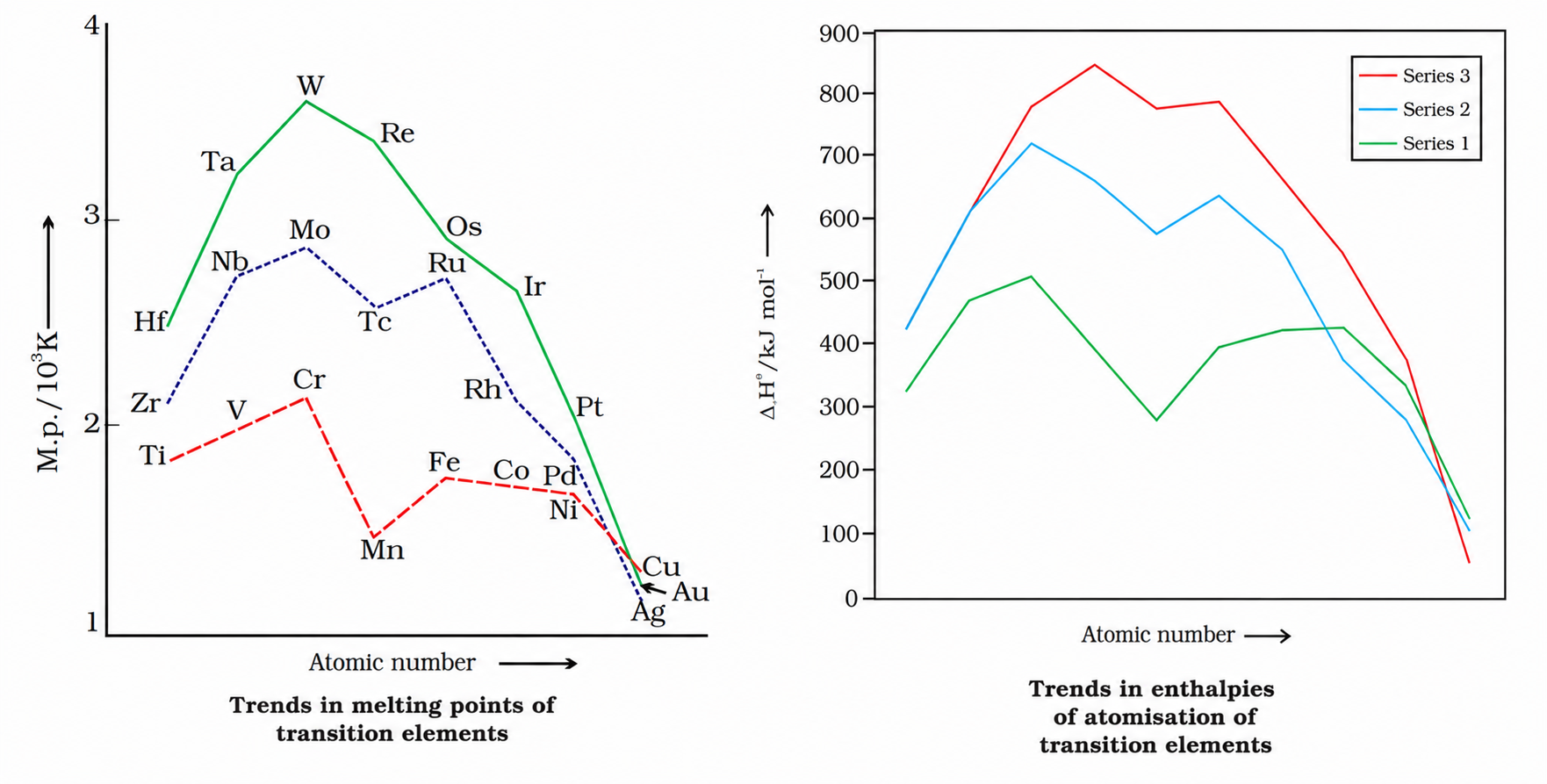
NCERT Fig. 4.1 &
4.2: Trends in Melting Points and Enthalpies of Atomisation (3d, 4d, 5d Series)
EXCEPTION 3: MELTING POINT & ATOMISATION DIPS (Mn, Tc, Zn, Hg)
- HIGH MELTING POINTSAttributed to strong interatomic metallic bonding
involving both $(n-1)d$ and $ns$ electrons. Unpaired d-electrons participate in
covalent-like d-d overlaps within the metal lattice.
- MAXIMA AT d5Melting points rise to a maximum at about the middle of
each series (e.g., $Cr, Mo, W$) because of the maximum number of unpaired d-electrons available for
bonding.
- DIP ANOMALYAnomalous Dip at Manganese ($Mn$) and Technetium
($Tc$): $Mn$ ($3d^5 4s^2$) and $Tc$ ($4d^5 5s^2$) show anomalous lower melting
points.
Reason: Their $d^5$ configuration is exceptionally stable (high exchange energy), binding
electrons tightly to the nucleus and resulting in localized electrons that participate less
effectively in metallic bonding, yielding an atypical crystal structure.
- LIQUID METALMercury ($Hg$): The ONLY liquid metal
at room temperature due to extremely weak metallic bonding ($5d^{10} 6s^2$).
- LOWEST ATOMISATIONZinc ($Zn, 126 \text{ kJ/mol}$):
Fully filled $3d^{10} 4s^2$ has no unpaired d-electrons available for interatomic bonding.
NCERT Intext Question 4.2
Question 4: In the series $Sc (Z = 21)$ to $Zn (Z = 30)$, the enthalpy of atomisation of
zinc is the lowest, i.e., $126 \text{ kJ mol}^{-1}$. Why?
Solution:
In zinc, all $3d$ orbitals are completely filled ($3d^{10} 4s^2$) and there are no unpaired d-electrons
available for interatomic bonding. Consequently, the metallic bonds in zinc are very weak, giving it the
lowest enthalpy of atomisation in the 3d series.
3.4 Variation in Atomic and Ionic Radii (NCERT Fig 4.3)
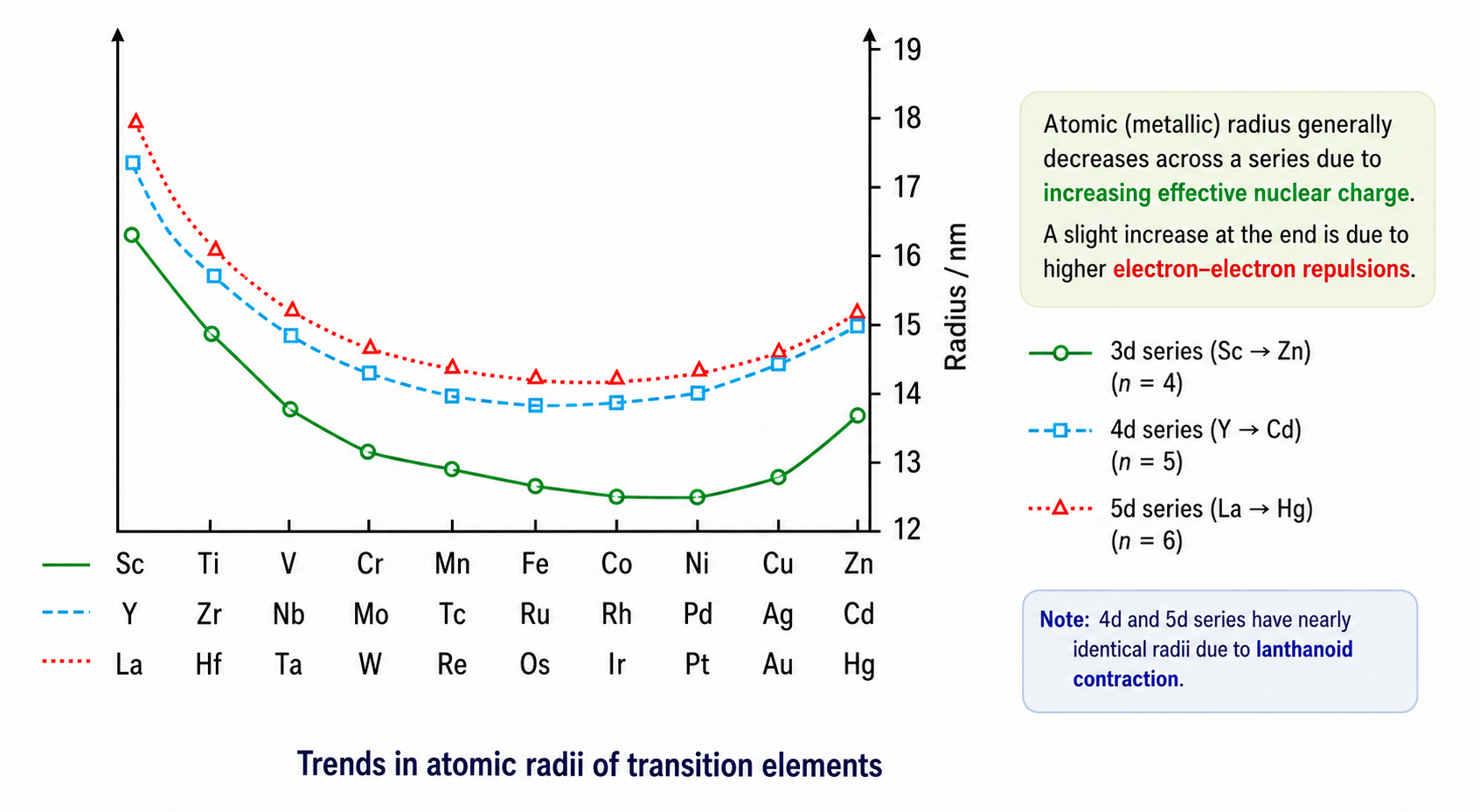
NCERT Fig. 4.3:
Trends in Atomic Radii of Transition Elements (3d, 4d, 5d Series)
The Tug-of-War: Atomic Radius along a 3d Period
The atomic radius across a transition series is governed by two opposing factors:
1.
Increasing Nuclear Charge ($Z_{eff}$): As atomic number increases, nuclear charge
increases, pulling outer electrons inward (Size $\downarrow$).
2.
Shielding (Screening) Effect: Electrons added to the inner $(n-1)d$ subshell shield
outer $ns$ electrons from nuclear pull (Size $\uparrow$).
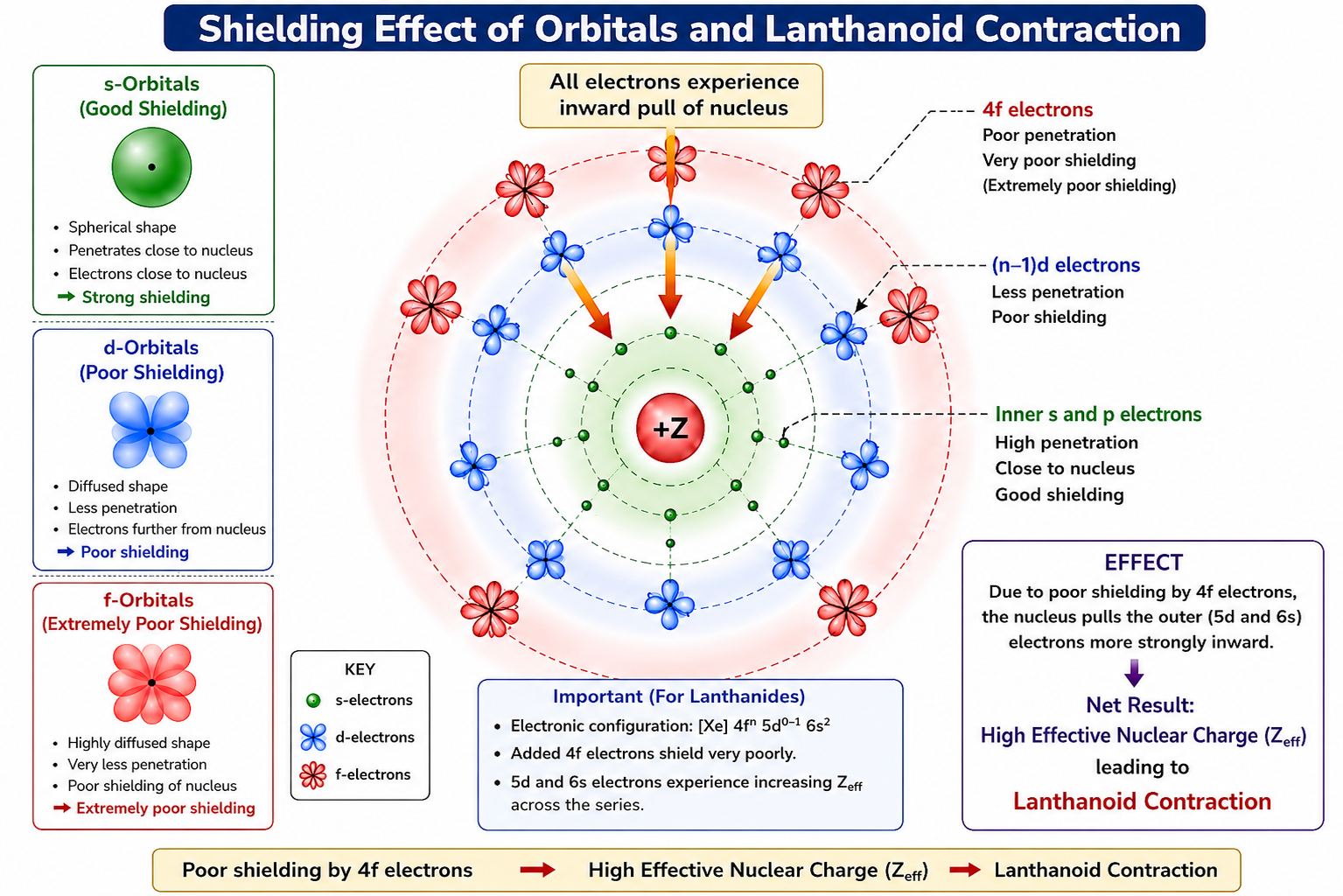
Shielding
Effect & Lanthanoid Contraction Orbital Mechanism
Three Distinct Regions in the 3d Period:
- Sc to Cr (Decrease): Increase in $Z_{eff}$ dominates over the weak screening of
$d$-electrons $\rightarrow$ Atomic radius decreases.
- Mn to Ni (Nearly Constant): As $d$-electrons increase, screening effect increases
and almost balances the increase in nuclear charge $\rightarrow$ Radii remain nearly constant.
- Cu to Zn (Slight Increase): $d$-orbitals are fully filled ($d^{10}$).
Electron-electron repulsion among paired $d$-electrons overcomes nuclear attraction $\rightarrow$
Radii increase slightly.
EXCEPTION 4: LANTHANOID CONTRACTION & IDENTICAL 4d/5d RADII
Normally, moving down a group increases atomic size due to addition of a shell ($3d < 4d$). Thus, $4d$
elements are larger than $3d$ elements.
However, $5d$ series elements have almost IDENTICAL radii to corresponding $4d$ series
elements!
Example: Zirconium ($Zr, 4d$: $160 \text{ pm}$) and Hafnium ($Hf, 5d$: $159 \text{ pm}$);
Niobium ($Nb$: $146 \text{ pm}$) and Tantalum ($Ta$: $146 \text{ pm}$); Molybdenum ($Mo$: $139 \text{
pm}$) and Tungsten ($W$: $139 \text{ pm}$).
Reason (Lanthanoid Contraction): Before the $5d$ series begins, $14$ lanthanoid
elements are filled, placing electrons into $4f$ orbitals. The $4f$ electrons have highly diffused
shapes and exert extremely poor shielding effect. Consequently, the nuclear charge
increases by $+14$ units, exerting a powerful inward pull on outer electrons. This contraction exactly
cancels out the expected shell-addition size increase from $4d$ to $5d$.
Practice Problem 5
Question: Why do Zirconium ($Zr, Z=40$) and Hafnium ($Hf, Z=72$) exhibit almost identical
atomic radii ($160 \text{ pm}$ vs $159 \text{ pm}$) and similar chemical properties?
Solution:
This phenomenon is a direct consequence of Lanthanoid Contraction. Hafnium ($5d$) is
preceded by 14 lanthanoid elements ($4f^{14}$). The poor shielding offered by $4f$ electrons causes the
effective nuclear charge on Hafnium's outer electrons to increase significantly. The resulting
contraction in size counteracts the normal size increase expected when moving down a group from $Zr$ to
$Hf$, rendering their atomic and ionic radii nearly identical.
3.5 Density Trends
From Titanium ($Z=22, d=4.1 \text{ g cm}^{-3}$) to Copper ($Z=29, d=8.9 \text{ g cm}^{-3}$), there is a
steady increase in density. This is due to the decrease in atomic radius coupled with a simultaneous
increase in atomic mass across the period. Density drops slightly at Zinc ($7.1 \text{ g cm}^{-3}$) due to
its larger atomic radius.
3.6 Ionisation Enthalpies ($\Delta_i H^\circ$)
- General Trend: First ionisation enthalpy generally increases across each series due to
increasing nuclear charge, but the increase is not as steep as in p-block elements because inner
$d$-electrons shield outer $s$-electrons.
- Irregularities in $\Delta_i H_2^\circ$ and $\Delta_i H_3^\circ$:
- Second IE ($\Delta_i H_2^\circ$): Unusually high for $Cr$ ($3d^5 \rightarrow
3d^4$) and $Cu$ ($3d^{10} \rightarrow 3d^9$) because removing the second electron disrupts
stable half-filled or fully-filled $d$-orbitals.
- Third IE ($\Delta_i H_3^\circ$): Exceptionally high for $Mn^{2+}$ ($3d^5
\rightarrow 3d^4$) and $Zn^{2+}$ ($3d^{10} \rightarrow 3d^9$). Conversely, $\Delta_i H_3^\circ$
for $Fe^{2+}$ ($3d^6 \rightarrow 3d^5$) is comparatively low because it yields the stable
half-filled $3d^5$ configuration ($Fe^{3+}$).
4. Oxidation States & Standard Electrode Potentials ($E^\circ$)
4.1 Variety of Oxidation States
One of the most notable features of transition metals is their display of variable oxidation states. This
variability arises because the energy gap between $(n-1)d$ and $ns$ orbitals is extremely
small, allowing electrons from both subshells to participate in bond formation.
NCERT Table 4.3: Oxidation States of 3d Metals
| Element |
Sc |
Ti |
V |
Cr |
Mn |
Fe |
Co |
Ni |
Cu |
Zn |
| Oxidation States |
+3 |
+2,+3,
+4 |
+2,+3,
+4,+5 |
+2,+3,
+4,+5,+6 |
+2,+3,
+4,+5,
+6,+7 |
+2,+3,
+4,+6 |
+2,+3,
+4 |
+2 |
+1,
+2 |
+2 |
*Bold numbers represent the most common / stable oxidation
states in aqueous solution or solids.
EXCEPTION 5: OXIDATION STATE ANOMALIES & GROUP STABILITY TRENDS
1.
Minimum & Maximum States: Minimum state is usually $+2$ (loss of two $ns$ electrons).
Maximum state increases up to $Mn$ in the middle ($+7$ in $MnO_4^-$), equal to the sum of $4s$ and $3d$
electrons, followed by a sharp drop ($Fe: +6$, $Co, Ni: +4$, $Cu: +2$, $Zn: +2$).
2.
NO VARIABLE STATEScandium & Zinc: Scandium exhibits ONLY
$+3$ (Forms $Sc^{3+}: 3d^0$). Zinc exhibits ONLY $+2$ ($Zn^{2+}: 3d^{10}$).
3.
d-Block vs p-Block Variability:
- d-Block: Oxidation states differ by unity (+1) (e.g., $V^{II},
V^{III}, V^{IV}, V^{V}$).
- p-Block: Oxidation states differ by two units (+2) due to the
inert pair effect (e.g., $Pb^{II}, Pb^{IV}$).
4.
PARADOX TRENDGroup Stability Trends (d-Block vs p-Block
Exception):
- In p-block, heavier members favor lower oxidation states ($Pb^{2+} > Pb^{4+}$).
- In d-block, heavier members favor HIGHER oxidation states! For Group 6, $Mo(VI)$
and $W(VI)$ are far more stable than $Cr(VI)$. Consequently, $Cr(VI)$ in $Cr_2O_7^{2-}$ is a strong
oxidising agent in acidic solution, whereas $MoO_3$ and $WO_3$ are stable and non-oxidising.
5.
ZERO STATELow Oxidation States ($0, +1$): Stabilized
when complexes contain ligands with $\pi$-acceptor character (e.g., $Ni(CO)_4$ and $Fe(CO)_5$ where
oxidation state of metal is ZERO).
4.2 Standard Electrode Potentials ($E^\circ$) (NCERT Fig 4.4)
The standard electrode potential ($E^\circ$) for the $M^{2+}/M$ couple measures the tendency of solid metal
to form hydrated divalent cations in aqueous solution. It is NOT determined by ionization energy alone, but
by a thermochemical balance of three energy terms:
The E° Energy Balance Equation
$$\mathbf{\Delta H_{\text{total}} = \Delta_a H^\circ + IE_1 + IE_2 + \Delta_{\text{hyd}}H^\circ}$$
($\Delta_a H^\circ$: Sublimation | $IE_1 + IE_2$: Ionization |
$\Delta_{\text{hyd}}H^\circ$: Hydration)
For a metal to have a negative $E^\circ$ (strong reducing agent), the energy released during
Hydration ($\Delta_{\text{hyd}}H^\circ$, negative) must overcome the energy required for
Sublimation ($\Delta_a H^\circ$, positive) and
Ionization ($IE_1+IE_2$,
positive).
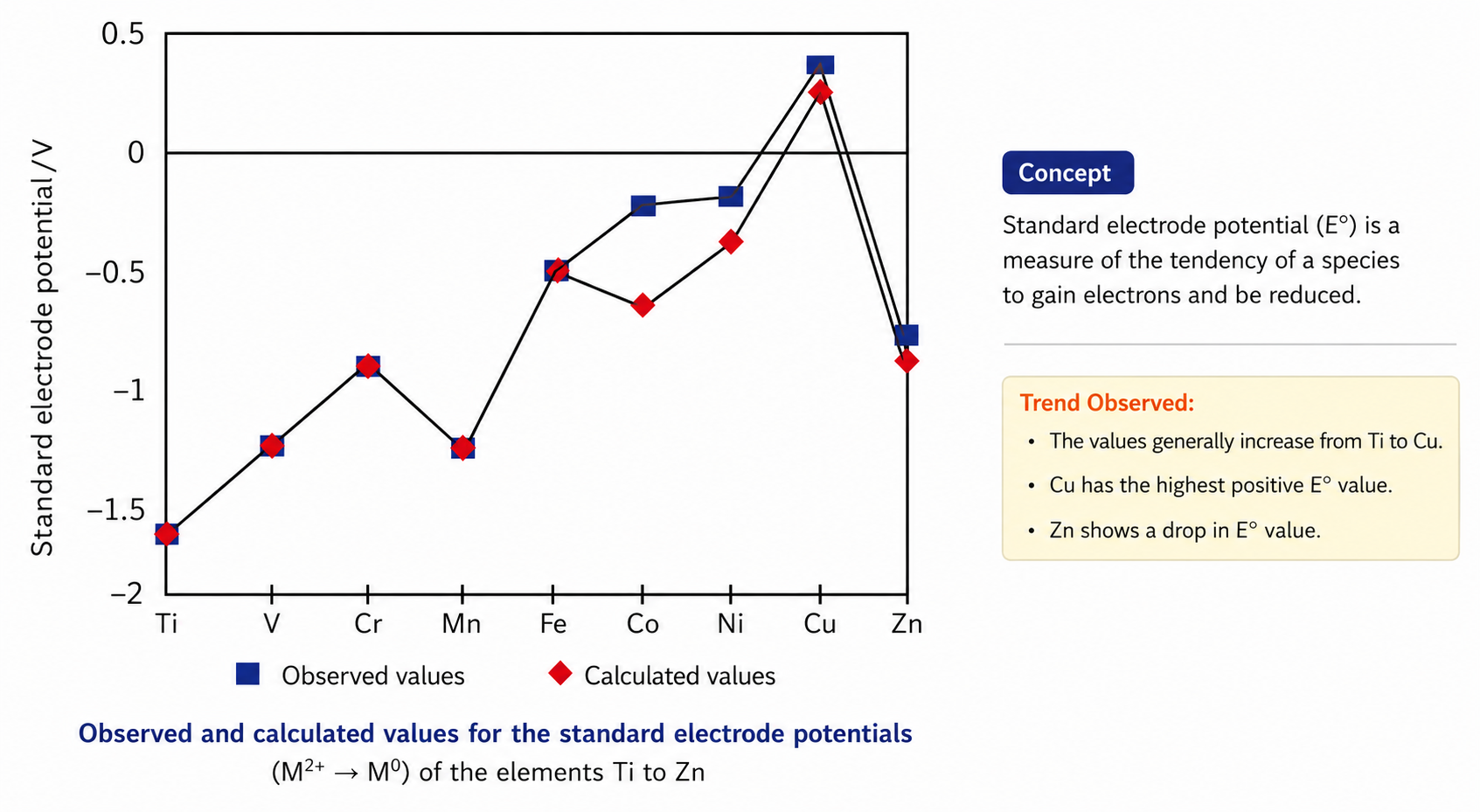
NCERT Fig. 4.4:
Standard Electrode Potential E°(M2+/M) for 3d Transition Metals
NCERT Thermochemical Parameters & E° Values (Table 4.4)
| Metal |
$\Delta_a H^\circ$ |
$IE_1$ |
$IE_2$ |
$\Delta_{hyd}H^\circ$ |
$E^\circ(M^{2+}/M)$ |
$E^\circ(M^{3+}/M^{2+})$ |
| Ti |
469 |
656 |
1309 |
-1866 |
-1.63 V |
-0.37 V |
| V |
515 |
650 |
1414 |
-1895 |
-1.18 V |
-0.26 V |
| Cr |
398 |
653 |
1592 |
-1925 |
-0.90 V |
-0.41 V |
| Mn |
279 |
717 |
1509 |
-1862 |
-1.18 V |
+1.57 V |
| Fe |
418 |
762 |
1561 |
-1998 |
-0.44 V |
+0.77 V |
| Co |
427 |
758 |
1644 |
-2079 |
-0.28 V |
+1.97 V |
| Ni |
431 |
736 |
1752 |
-2121 |
-0.25 V |
-- |
| Cu |
339 |
745 |
1958 |
-2121 |
+0.34 V |
-- |
| Zn |
130 |
906 |
1734 |
-2059 |
-0.76 V |
-- |
EXCEPTION 6: THE COPPER ANOMALY & Cr2+ / Mn3+ REDOX PARADOX
1.
COPPER ANOMALYThe Copper Anomaly ($E^\circ = +0.34 \text{
V}$): Copper is the ONLY metal in the 3d series with a positive $E^\circ(M^{2+}/M)$ value.
Thus, it cannot liberate $H_2$ gas from dilute mineral acids (reacts only with oxidising acids like
$\text{HNO}_3$ or hot conc. $\text{H}_2\text{SO}_4$).
Reason: High enthalpy of sublimation ($\Delta_a H^\circ$) combined with very high second ionization
enthalpy ($IE_1+IE_2$) is NOT balanced by its hydration enthalpy ($\Delta_{hyd}H^\circ$).
2.
More Negative $E^\circ$ for Mn, Ni, and Zn:
- $Mn^{2+}$: High stability of half-filled $d^5$ subshell.
- $Zn^{2+}$: High stability of completely filled $d^{10}$ subshell.
- $Ni^{2+}$: Exceptionally high negative hydration enthalpy ($\Delta_{hyd}H^\circ =
-2121 \text{ kJ/mol}$) due to small ionic radius.
3.
REDOX PARADOX$E^\circ(M^{3+}/M^{2+})$ Redox Couple Trends (Cr2+
vs Mn3+):
- $Cr^{2+}$ is a Strong Reducing Agent ($E^\circ = -0.41 \text{ V}$): Changes from
$d^4$ to $d^3$. In aqueous solution, $d^3$ represents a half-filled $t_{2g}^3$ configuration in
crystal field splitting, which is exceptionally stable.
- $Mn^{3+}$ is a Strong Oxidising Agent ($E^\circ = +1.57 \text{ V}$): Changes from
$d^4$ to $d^5$. Reverting to $Mn^{2+}$ yields the stable half-filled $d^5$ configuration.
NCERT Example 4.4 / Solved Problem
Question 6: Why is $Cr^{2+}$ reducing and $Mn^{3+}$ oxidising when both have a $d^4$
configuration?
Solution:
- $Cr^{2+}$ acts as a reducing agent because its configuration changes from $d^4$ to $d^3$ upon
oxidation ($Cr^{3+}$). In aqueous solution, $d^3$ corresponds to an exceptionally stable half-filled
$t_{2g}^3$ level.
- $Mn^{3+}$ acts as an oxidising agent because gaining an electron converts it from $d^4$ to $d^5$
($Mn^{2+}$), attaining the extra stability of a half-filled $d^5$ subshell.
4.3 Trends in Stability of Halides and Oxides
- Halides: Highest oxidation states are attained in tetrahalides ($TiX_4$),
pentafluorides ($VF_5$), and hexafluorides ($CrF_6$). Fluorine stabilizes high oxidation states due to
high lattice energy ($CoF_3$) or high bond enthalpy terms ($VF_5, CrF_6$). Fluorides are unstable in low
oxidation states (e.g., $VX_2$). Beyond $Mn$, no metal forms trihalides except $FeX_3$ and $CoF_3$.
- Copper Iodide Anomaly: $Cu^{2+}$ oxidises iodide ion ($I^-$) to iodine ($I_2$):
$$\mathbf{2Cu^{2+} + 4I^- \longrightarrow Cu_2I_2(s) + I_2}$$
Therefore, $CuI_2$ does not exist.
- Disproportionation of $Cu^+$ in Water: Many $Cu(I)$ compounds disproportionate in
aqueous media:
$$\mathbf{2Cu^+(aq) \longrightarrow Cu^{2+}(aq) + Cu(s)}$$
Reason: Hydration enthalpy of $Cu^{2+}(aq)$ is much more negative than $Cu^+(aq)$, which more
than compensates for the second ionization energy of copper.
- Oxides: Oxygen stabilizes highest oxidation states even better than fluorine due to its
ability to form multiple bonds ($\text{M=O}$). Highest oxide is $Mn_2O_7$ (covalent green oil). Beyond
Group 7, no higher oxides than $Fe_2O_3$ are known.
- Acidic/Basic Trend: As oxidation state increases, ionic character decreases and
covalent/acidic character increases.
- $V_2O_3$ (Basic) $\rightarrow V_2O_4$ (Less basic, gives $VO^{2+}$) $\rightarrow V_2O_5$
(Amphoteric, gives $VO_2^+$ in acid and $VO_4^{3-}$ in alkali).
- $CrO$ (Basic) $\rightarrow Cr_2O_3$ (Amphoteric) $\rightarrow CrO_3$ (Acidic).
5. Important Characteristics and Phenomena
5.1 Magnetic Properties
Transition metal ions generally exhibit magnetic behavior due to unpaired electrons. When a magnetic field is
applied, two main behaviors are observed: Diamagnetism (repelled by magnetic field, all
paired electrons) and Paramagnetism (attracted by magnetic field, unpaired electrons).
Extreme paramagnetism is called Ferromagnetism ($Fe, Co, Ni$).
The "Spin-Only" Formula
For 3d transition series elements, contribution of orbital angular momentum is effectively quenched. The
magnetic moment ($\mu$) depends solely on the spin angular momentum:
$$\mathbf{\mu = \sqrt{n(n+2)} \text{ BM}}$$
Where $n$ = number of unpaired electrons, and BM = Bohr Magneton (unit of magnetic
moment).
Quick Calculation Guide: $n=1 \rightarrow 1.73 \text{ BM}$; $n=2 \rightarrow 2.84 \text{ BM}$; $n=3
\rightarrow 3.87 \text{ BM}$; $n=4 \rightarrow 4.90 \text{ BM}$; $n=5 \rightarrow 5.92 \text{ BM}$.
NCERT Table 4.7: Calculated and Observed Magnetic Moments (BM)
| Ion |
Config |
Unpaired $e^-$ ($n$) |
Calculated $\mu$ |
Observed $\mu$ |
| $Sc^{3+}, Ti^{4+}$ |
$3d^0$ |
0 |
0 BM |
0 BM |
| $Ti^{3+}, V^{4+}$ |
$3d^1$ |
1 |
1.73 BM |
1.75 - 1.76 BM |
| $V^{3+}, Ti^{2+}$ |
$3d^2$ |
2 |
2.84 BM |
2.76 - 2.86 BM |
| $V^{2+}, Cr^{3+}$ |
$3d^3$ |
3 |
3.87 BM |
3.86 - 3.87 BM |
| $Cr^{2+}, Mn^{3+}$ |
$3d^4$ |
4 |
4.90 BM |
4.80 - 4.90 BM |
| $Mn^{2+}, Fe^{3+}$ |
$3d^5$ |
5 |
5.92 BM |
5.96 BM |
| $Fe^{2+}$ |
$3d^6$ |
4 |
4.90 BM |
5.3 - 5.5 BM |
| $Co^{2+}$ |
$3d^7$ |
3 |
3.87 BM |
4.4 - 5.2 BM |
| $Ni^{2+}$ |
$3d^8$ |
2 |
2.84 BM |
2.9 - 3.4 BM |
| $Cu^{2+}$ |
$3d^9$ |
1 |
1.73 BM |
1.8 - 2.2 BM |
| $Zn^{2+}, Cu^+$ |
$3d^{10}$ |
0 |
0 BM |
0 BM |
NCERT Intext Question 4.8
Question 7: Calculate the 'spin-only' magnetic moment of $M^{2+}(aq)$ ion where atomic
number $Z = 27$.
Solution:
1. Atomic number $Z=27$ is Cobalt ($Co$).
2. Neutral $Co$: $[Ar] 3d^7 4s^2$. Cation $Co^{2+}$: $[Ar] 3d^7$.
3. Filling $3d^7$ orbital using Hund's Rule: $\uparrow\downarrow \quad \uparrow\downarrow \quad \uparrow
\quad \uparrow \quad \uparrow \implies n = 3$ unpaired electrons.
4. $\mu = \sqrt{n(n+2)} = \sqrt{3(3+2)} = \sqrt{15} = \mathbf{3.87 \text{ BM}}$.
5.2 Formation of Coloured Ions
Most transition metal compounds display vibrant colors in solid or aquated states.
Mechanism of d-d Transition
When ligands or water molecules approach a transition metal ion, the five degenerate d-orbitals split into
sets of different energy levels ($t_{2g}$ and $e_g$). When visible light strikes the ion, an unpaired
d-electron absorbs light of a specific wavelength (frequency) and jumps from a lower energy d-orbital to a
higher energy d-orbital. This is called a d-d transition. The transmitted (unabsorbed)
light gives the complementary color.
Crucial Rule: Color requires partially filled d-orbitals ($d^{1-9}$). Ions
with $d^0$ ($Sc^{3+}, Ti^{4+}$) or $d^{10}$ ($Cu^+, Zn^{2+}$) cannot undergo d-d transitions and are
colorless / white.
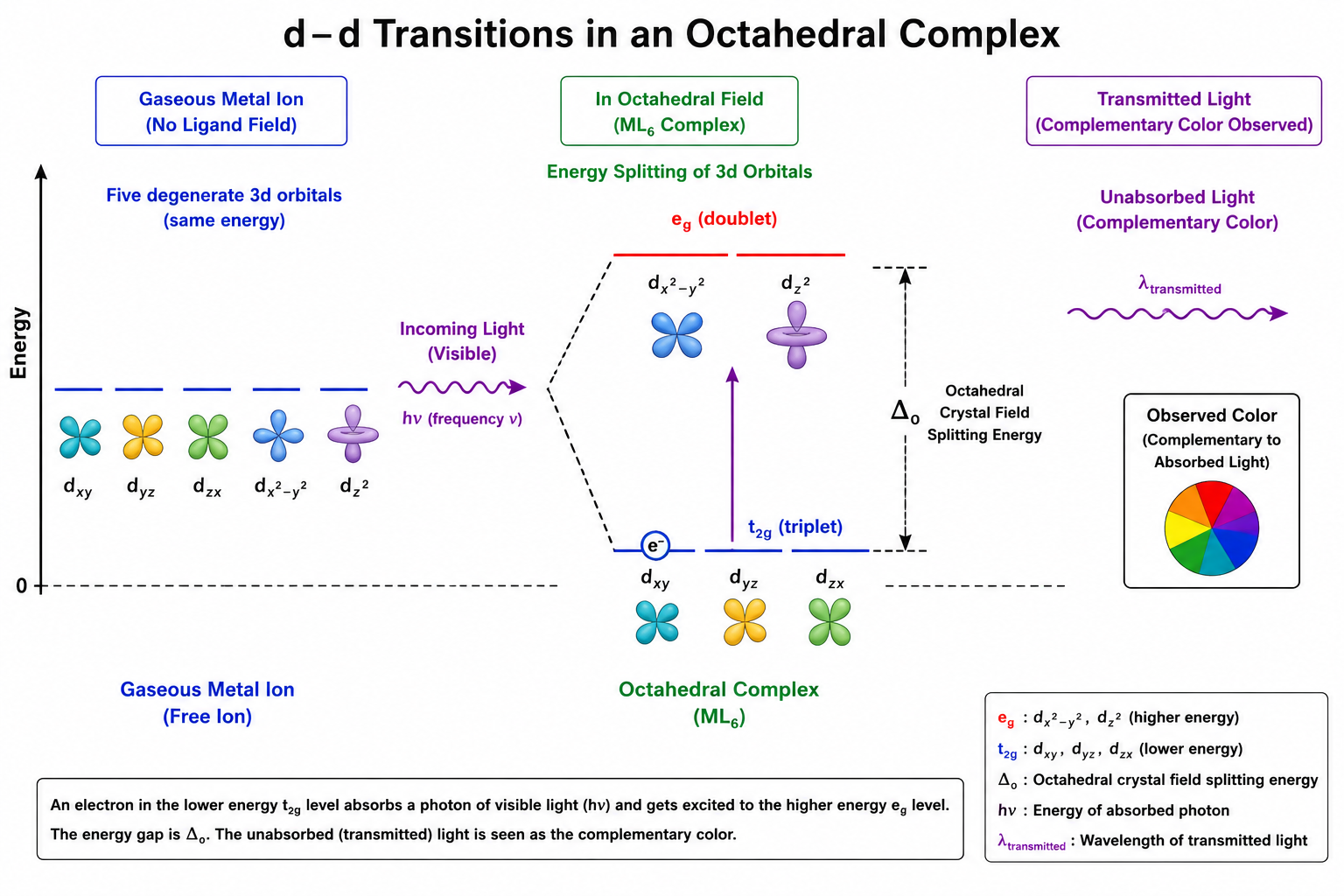
Crystal Field
Splitting of d-Orbitals & d-d Transition Mechanism
NCERT Table 4.8: Colors of Hydrated 3d Transition Metal Ions
| Ion |
Configuration |
Observed Aquated Color |
| $Sc^{3+}, Ti^{4+}$ |
$3d^0$ |
Colourless |
| $Ti^{3+}$ |
$3d^1$ |
Purple |
| $V^{4+}$ |
$3d^1$ |
Blue |
| $V^{3+}$ |
$3d^2$ |
Green |
| $V^{2+}, Cr^{3+}, Mn^{3+}$ |
$3d^3, 3d^4$ |
Violet / Purple |
| $Cr^{2+}$ |
$3d^4$ |
Blue |
| $Mn^{2+}$ |
$3d^5$ |
Pink |
| $Fe^{3+}$ |
$3d^5$ |
Yellow |
| $Fe^{2+}$ |
$3d^6$ |
Green |
| $Co^{2+}$ |
$3d^7$ |
Pink / Blue-pink |
| $Ni^{2+}$ |
$3d^8$ |
Green |
| $Cu^{2+}$ |
$3d^9$ |
Blue |
| $Zn^{2+}$ |
$3d^{10}$ |
Colourless |
5.3 Formation of Complex Compounds
Transition metals form a vast array of coordination complexes (such as $[Fe(CN)_6]^{3-}, [Fe(CN)_6]^{4-},
[Cu(NH_3)_4]^{2+}, [PtCl_4]^{2-}$). This tendency is due to:
1. Comparatively small ionic size and high nuclear charge density.
2. Availability of vacant d-orbitals of suitable energy to accept lone pairs donated by
ligands.
5.4 Catalytic Properties
Transition metals and their compounds are widely used as industrial catalysts. Reasons include:
1. Ability to adopt variable oxidation states and form unstable intermediate compounds,
lowering activation energy.
2. Providing a large surface area with free valencies for reactant molecules to adsorb onto.
NCERT Key Catalysts & Catalytic Mechanism
- $V_2O_5$ (Vanadium Pentoxide): Oxidation of $SO_2$ to $SO_3$ in Contact Process for
$\text{H}_2\text{SO}_4$.
- Finely Divided Iron ($Fe$): Synthesis of Ammonia in Haber's Process ($N_2 + 3H_2
\xrightarrow{Fe/Mo} 2NH_3$).
- Nickel ($Ni$): Catalytic Hydrogenation of fats/alkenes.
- $TiCl_4 + Al(CH_3)_3$ (Ziegler-Natta Catalyst): Polymerization of ethylene to
polythene.
- $PdCl_2$ (Wacker Process): Oxidation of ethyne to ethanal.
Mechanism Example ($Fe^{3+}$ in Iodide-Persulphate Reaction):
Overall Reaction:
$$\mathbf{2I^- + S_2O_8^{2-} \xrightarrow{Fe^{3+}} I_2 + 2SO_4^{2-}}$$
Step 1: $\mathbf{2Fe^{3+} + 2I^- \longrightarrow 2Fe^{2+} + I_2}$
Step 2: $\mathbf{2Fe^{2+} + S_2O_8^{2-} \longrightarrow 2Fe^{3+} + 2SO_4^{2-}}$
5.5 Formation of Interstitial Compounds
Interstitial compounds are formed when small non-metal atoms like Hydrogen ($H$), Carbon ($C$), or Nitrogen
($N$) get trapped inside the vacant interstitial spaces of metal crystal lattices. They are usually
non-stoichiometric (e.g., $TiC, Mn_4N, Fe_3H, VH_{0.56}, TiH_{1.7}$).
- High Melting Points: Higher than pure metals.
- Extreme Hardness: Some borides approach diamond in hardness.
- Conductivity: Retain metallic electrical conductivity.
- Inertness: Chemically inert.
5.6 Alloy Formation
An alloy is a blend of metals (solid solution). Transition metals readily form alloys with one another (e.g.,
Ferrous alloys, stainless steel, Manganese steel) and with non-transition metals (Brass: $Cu+Zn$, Bronze:
$Cu+Sn$).
Reason: Their atomic radii are within 15% of each other, allowing atoms of
one metal to substitute easily into the crystal lattice of another without major distortion.
6. Important Compounds of Transition Metals ($K_2Cr_2O_7$ & $KMnO_4$)
6.1 Potassium Dichromate ($K_2Cr_2O_7$)
Potassium dichromate is an orange crystalline solid, widely used as an oxidizing agent and primary standard
in volumetric analysis.
Preparation from Chromite Ore (FeCr2O4)
Step 1 (Roasting with Alkali): Fusion of finely powdered chromite ore with Sodium Carbonate
($Na_2CO_3$) in excess air yields yellow Sodium Chromate.
$$\mathbf{4FeCr_2O_4 + 8Na_2CO_3 + 7O_2 \longrightarrow 8Na_2CrO_4 + 2Fe_2O_3 + 8CO_2}$$
Step 2 (Acidification): The yellow solution is filtered and acidified with dilute sulfuric
acid to convert chromate to orange Sodium Dichromate.
$$\mathbf{2Na_2CrO_4 + 2H^+ \longrightarrow Na_2Cr_2O_7 + 2Na^+ + H_2O}$$
Step 3 (Potassium Salt Conversion): Sodium dichromate is highly soluble. Treatment with
Potassium Chloride ($KCl$) precipitates less soluble orange Potassium Dichromate crystals.
$$\mathbf{Na_2Cr_2O_7 + 2KCl \longrightarrow K_2Cr_2O_7(s) + 2NaCl}$$
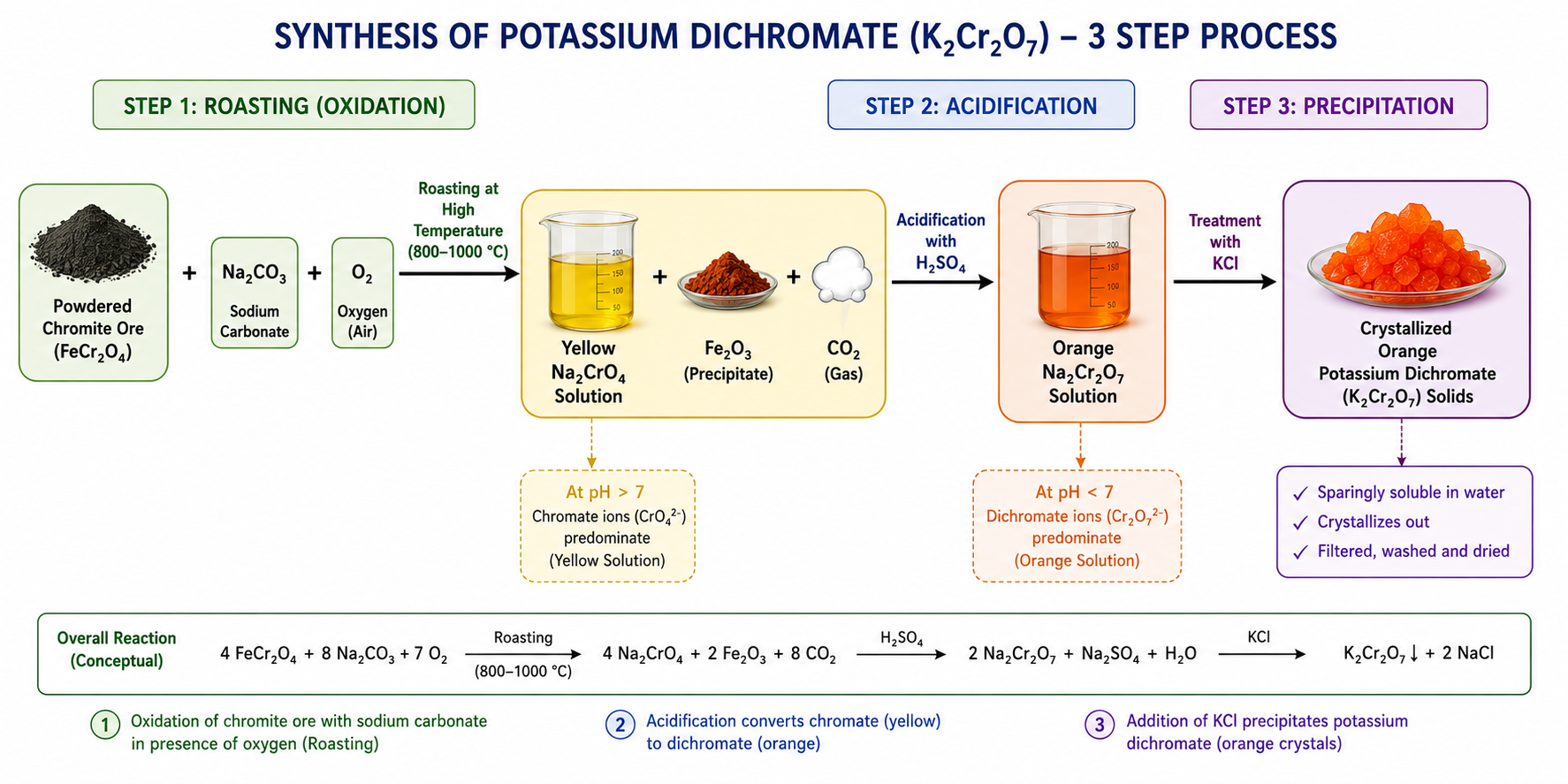
3-Step
Preparation Flowchart of Potassium Dichromate (K2Cr2O7) from Chromite Ore
Chromate-Dichromate pH Equilibrium & Structures
Chromate ($CrO_4^{2-}$, Yellow) and Dichromate ($Cr_2O_7^{2-}$, Orange) are interconvertible depending on
pH.
Oxidation state of Chromium is +6 in BOTH ions! No redox occurs.
-
Acidic Medium ($\text{pH} < 7$):
$$\mathbf{2CrO_4^{2-} \text{ (Yellow)} + 2H^+ \rightleftharpoons Cr_2O_7^{2-} \text{ (Orange)} +
H_2O}$$
-
Basic Medium ($\text{pH} > 7$):
$$\mathbf{Cr_2O_7^{2-} \text{ (Orange)} + 2OH^- \rightleftharpoons 2CrO_4^{2-} \text{ (Yellow)} +
H_2O}$$
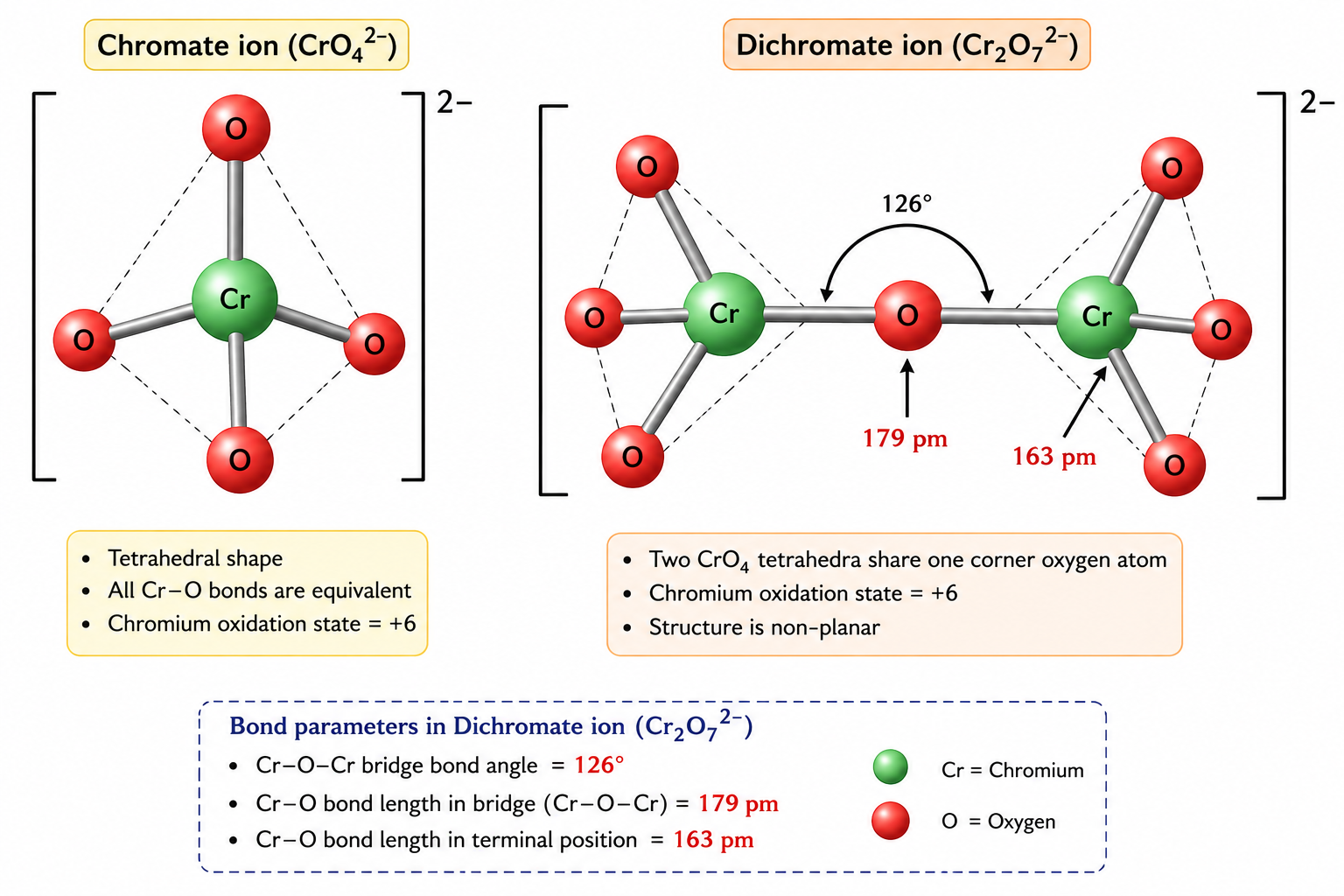
NCERT
Fig. 4.5: Structures of Chromate Ion (CrO4 2-) and Dichromate Ion (Cr2O7 2-)
Structural Parameters (NCERT Details):
-
Chromate ($CrO_4^{2-}$): Tetrahedral geometry with four identical $Cr-O$ bond
lengths due to resonance.
-
Dichromate ($Cr_2O_7^{2-}$): Consists of two $CrO_4$ tetrahedra sharing one
corner oxygen atom. The
$Cr-O-Cr$ bond angle is $126^\circ$. Bridging $Cr-O$ bond
length is $179 \text{ pm}$, whereas terminal $Cr-O$ bond length is $163 \text{ pm}$.
Oxidising Reactions of Acidified K2Cr2O7 (E° = 1.33 V)
Half-Reaction:
$$\mathbf{Cr_2O_7^{2-} + 14H^+ + 6e^- \longrightarrow 2Cr^{3+} \text{ (Green)} + 7H_2O}$$
1. Oxidises Iodide to Iodine:
$$\mathbf{Cr_2O_7^{2-} + 14H^+ + 6I^- \longrightarrow 2Cr^{3+} + 7H_2O + 3I_2}$$
2. Oxidises Iron(II) to Iron(III):
$$\mathbf{Cr_2O_7^{2-} + 14H^+ + 6Fe^{2+} \longrightarrow 2Cr^{3+} + 7H_2O + 6Fe^{3+}}$$
3. Oxidises Hydrogen Sulfide to Sulfur:
$$\mathbf{Cr_2O_7^{2-} + 8H^+ + 3H_2S \longrightarrow 2Cr^{3+} + 7H_2O + 3S}$$
4. Oxidises Tin(II) to Tin(IV):
$$\mathbf{Cr_2O_7^{2-} + 14H^+ + 3Sn^{2+} \longrightarrow 2Cr^{3+} + 7H_2O + 3Sn^{4+}}$$
6.2 Potassium Permanganate ($KMnO_4$)
Potassium permanganate is a dark purple (almost black) crystalline solid. It is an exceptionally powerful
oxidizing agent in acidic, neutral, and alkaline media.
Preparation from Pyrolusite Ore (MnO2)
Step 1 (Alkaline Fusion): Pyrolusite ore ($MnO_2$) is fused with $KOH$ in the presence of
$O_2$ or an oxidising agent ($KNO_3$) to form dark green Potassium Manganate ($K_2MnO_4$).
$$\mathbf{2MnO_2 + 4KOH + O_2 \longrightarrow 2K_2MnO_4 + 2H_2O}$$
Step 2 (Disproportionation / Electrolytic Oxidation):
- Chemical Disproportionation (Acidic / Neutral):
$$\mathbf{3MnO_4^{2-} + 4H^+ \longrightarrow 2MnO_4^- \text{ (Purple)} + MnO_2 + 2H_2O}$$
- Commercial Electrolytic Oxidation (Alkaline):
$$\mathbf{MnO_4^{2-} \xrightarrow{\text{electrolytic}} MnO_4^- + e^-}$$
Laboratory Preparation from $Mn^{2+}$ Salt (with Peroxodisulphate):
$$\mathbf{2Mn^{2+} + 5S_2O_8^{2-} + 8H_2O \longrightarrow 2MnO_4^- + 10SO_4^{2-} + 16H^+}$$
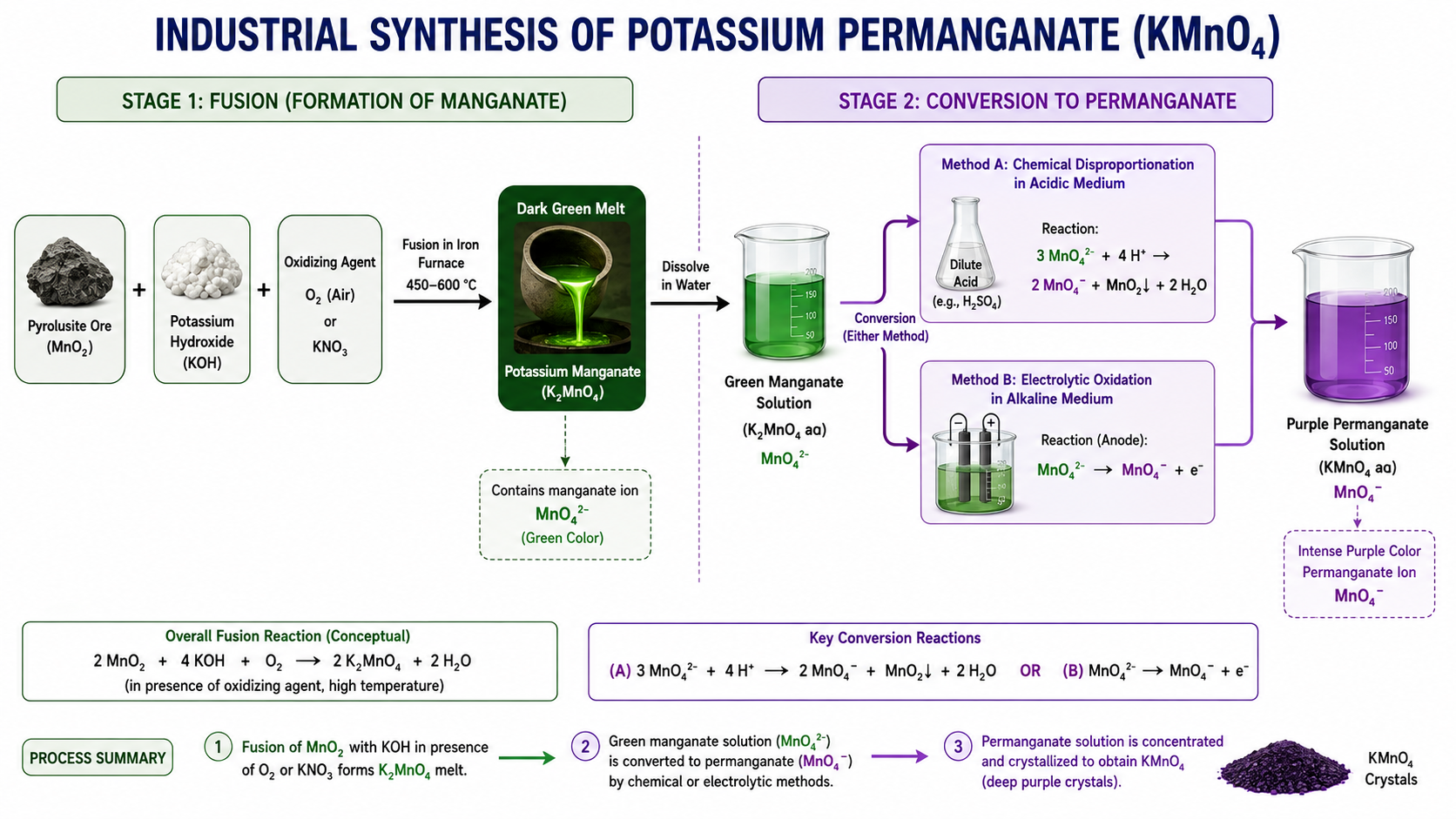
Industrial
Preparation Flowchart of Potassium Permanganate (KMnO4)
Physical & Structural Properties of KMnO4
- Isostructural: $KMnO_4$ crystals are isostructural with $KClO_4$.
- Thermal Decomposition (513 K):
$$\mathbf{2KMnO_4 \xrightarrow{513 \text{ K}} K_2MnO_4 + MnO_2 + O_2}$$
- Color & Magnetism Mechanism: Permanganate ion ($MnO_4^-$) has $Mn(VII)$ with $3d^0$
configuration. It is diamagnetic. Its intense dark purple color is NOT due to d-d
transitions, but due to Ligand-to-Metal Charge Transfer (LMCT) ($p$-orbital of $O^{2-}
\rightarrow d$-orbital of $Mn^{7+}$).
- Manganate ion ($MnO_4^{2-}$) has $Mn(VI)$ with $3d^1$ configuration. It is paramagnetic
(green).
- Both $MnO_4^-$ and $MnO_4^{2-}$ are tetrahedral.
Oxidising Reactions of KMnO4 (Acidic vs Alkaline)
1. In Acidic Medium ($E^\circ = +1.52 \text{ V}$):
$$\mathbf{MnO_4^- + 8H^+ + 5e^- \longrightarrow Mn^{2+} \text{ (Colourless)} + 4H_2O}$$
- Iodide to Iodine: $10I^- + 2MnO_4^- + 16H^+ \longrightarrow 2Mn^{2+} + 8H_2O +
5I_2$
- Iron(II) to Iron(III): $5Fe^{2+} + MnO_4^- + 8H^+ \longrightarrow Mn^{2+} + 4H_2O +
5Fe^{3+}$
- Oxalate / Oxalic Acid to CO2 (333 K): $5C_2O_4^{2-} + 2MnO_4^- + 16H^+
\longrightarrow 2Mn^{2+} + 8H_2O + 10CO_2$
- Hydrogen Sulfide to Sulfur: $5H_2S + 2MnO_4^- + 6H^+ \longrightarrow 2Mn^{2+} +
8H_2O + 5S$
- Sulphite to Sulphate: $5SO_3^{2-} + 2MnO_4^- + 6H^+ \longrightarrow 2Mn^{2+} +
3H_2O + 5SO_4^{2-}$
- Nitrite to Nitrate: $5NO_2^- + 2MnO_4^- + 6H^+ \longrightarrow 2Mn^{2+} + 3H_2O +
5NO_3^-$
2. In Neutral or Faintly Alkaline Medium ($E^\circ = +1.69 \text{ V}$):
$$\mathbf{MnO_4^- + 2H_2O + 3e^- \longrightarrow MnO_2 \text{ (Brown Solid)} + 4OH^-}$$
- Iodide to IODATE ($IO_3^-$) [Crucial NCERT Distinction!]:
$$\mathbf{2MnO_4^- + H_2O + I^- \longrightarrow 2MnO_2 + 2OH^- + IO_3^-}$$
- Thiosulphate to Sulphate: $8MnO_4^- + 3S_2O_3^{2-} + H_2O \longrightarrow 8MnO_2 +
6SO_4^{2-} + 2OH^-$
- Mn(II) Salt to MnO2: $2MnO_4^- + 3Mn^{2+} + 2H_2O \xrightarrow{ZnSO_4} 5MnO_2 +
4H^+$
Warning (Hydrochloric Acid): Permanganate titrations in the presence of $HCl$ are
unsatisfactory because $KMnO_4$ oxidises $HCl$ to chlorine gas ($Cl_2$).
7. The f-Block Elements: Lanthanoids (4f Series)
The f-block consists of two inner transition series placed at the bottom of the periodic table:
Lanthanoids (filling of $4f subshell, 14 elements from Cerium $Ce, Z=58 to Lutetium $Lu, Z=71, following Lanthanum $La, Z=57) and
Actinoids (filling of $5f subshell, 14 elements from Thorium $Th, Z=90 to Lawrencium $Lr, Z=103, following Actinium $Ac, Z=89).
7.1 Electronic Configurations & Ionisation Enthalpies
The general electronic configuration of lanthanoids is $[Xe] 4f^{1-14} 5d^{0-1} 6s^2$.
Lanthanum ($La, Z=57) has configuration $[Xe] 5d^1 6s^2$. After Lanthanum, the added electrons enter the deeply buried inner $4f subshell.
- Stable Half-Filled & Fully-Filled Configurations:
Gadolinium ($Gd, Z=64) has configuration $[Xe] 4f^7 5d^1 6s^2$ (not $[Xe] 4f^8 6s^2$) to preserve the extra stability of the half-filled $4f^7$ subshell.
Lutetium ($Lu, Z=71) has configuration $[Xe] 4f^{14} 5d^1 6s^2$ with a completely filled $4f^{14}$ subshell.
- Ionisation Enthalpy Dips ($IE_3$): The first and second ionisation enthalpies of lanthanoids are around $600 \text{ kJ/mol}$ and $1200 \text{ kJ/mol}$ (similar to Calcium).
The third ionisation enthalpy ($IE_3$) shows prominent dips at Lanthanum ($La^{3+}: 4f^0$), Gadolinium ($Gd^{3+}: 4f^7$), and Lutetium ($Lu^{3+}: 4f^{14}$) due to the extra thermodynamic stability of empty, half-filled, and fully-filled $4f$ subshells.
NCERT Table 4.9: Lanthanoids Configurations & Radii
| Z |
Name |
Sym |
Atom (Ln) |
$Ln^{2+}$ |
$Ln^{3+}$ |
$Ln^{4+}$ |
Radii (pm) |
| 57 |
Lanthanum |
La |
$[Xe]5d^1 6s^2$ |
$5d^1$ |
$4f^0$ |
-- |
106 |
| 58 |
Cerium |
Ce |
$[Xe]4f^1 5d^1 6s^2$ |
$4f^2$ |
$4f^1$ |
$4f^0$ |
103 |
| 59 |
Praseodymium |
Pr |
$[Xe]4f^3 6s^2$ |
$4f^3$ |
$4f^2$ |
$4f^1$ |
101 |
| 60 |
Neodymium |
Nd |
$[Xe]4f^4 6s^2$ |
$4f^4$ |
$4f^3$ |
$4f^2$ |
99 |
| 61 |
Promethium |
Pm |
$[Xe]4f^5 6s^2$ |
$4f^5$ |
$4f^4$ |
-- |
98 |
| 62 |
Samarium |
Sm |
$[Xe]4f^6 6s^2$ |
$4f^6$ |
$4f^5$ |
-- |
96 |
| 63 |
Europium |
Eu |
$[Xe]4f^7 6s^2$ |
$4f^7$ |
$4f^6$ |
-- |
95 |
| 64 |
Gadolinium |
Gd |
$[Xe]4f^7 5d^1 6s^2$ |
$4f^7 5d^1$ |
$4f^7$ |
-- |
94 |
| 65 |
Terbium |
Tb |
$[Xe]4f^9 6s^2$ |
$4f^9$ |
$4f^8$ |
$4f^7$ |
92 |
| 66 |
Dysprosium |
Dy |
$[Xe]4f^{10} 6s^2$ |
$4f^{10}$ |
$4f^9$ |
$4f^8$ |
91 |
| 67 |
Holmium |
Ho |
$[Xe]4f^{11} 6s^2$ |
$4f^{11}$ |
$4f^{10}$ |
-- |
89 |
| 68 |
Erbium |
Er |
$[Xe]4f^{12} 6s^2$ |
$4f^{12}$ |
$4f^{11}$ |
-- |
88 |
| 69 |
Thulium |
Tm |
$[Xe]4f^{13} 6s^2$ |
$4f^{13}$ |
$4f^{12}$ |
-- |
87 |
| 70 |
Ytterbium |
Yb |
$[Xe]4f^{14} 6s^2$ |
$4f^{14}$ |
$4f^{13}$ |
-- |
86 |
| 71 |
Lutetium |
Lu |
$[Xe]4f^{14} 5d^1 6s^2$ |
$4f^{14} 5d^1$ |
$4f^{14}$ |
-- |
86 |
7.2 Atomic and Ionic Radii — Lanthanoid Contraction (NCERT Fig 4.6)
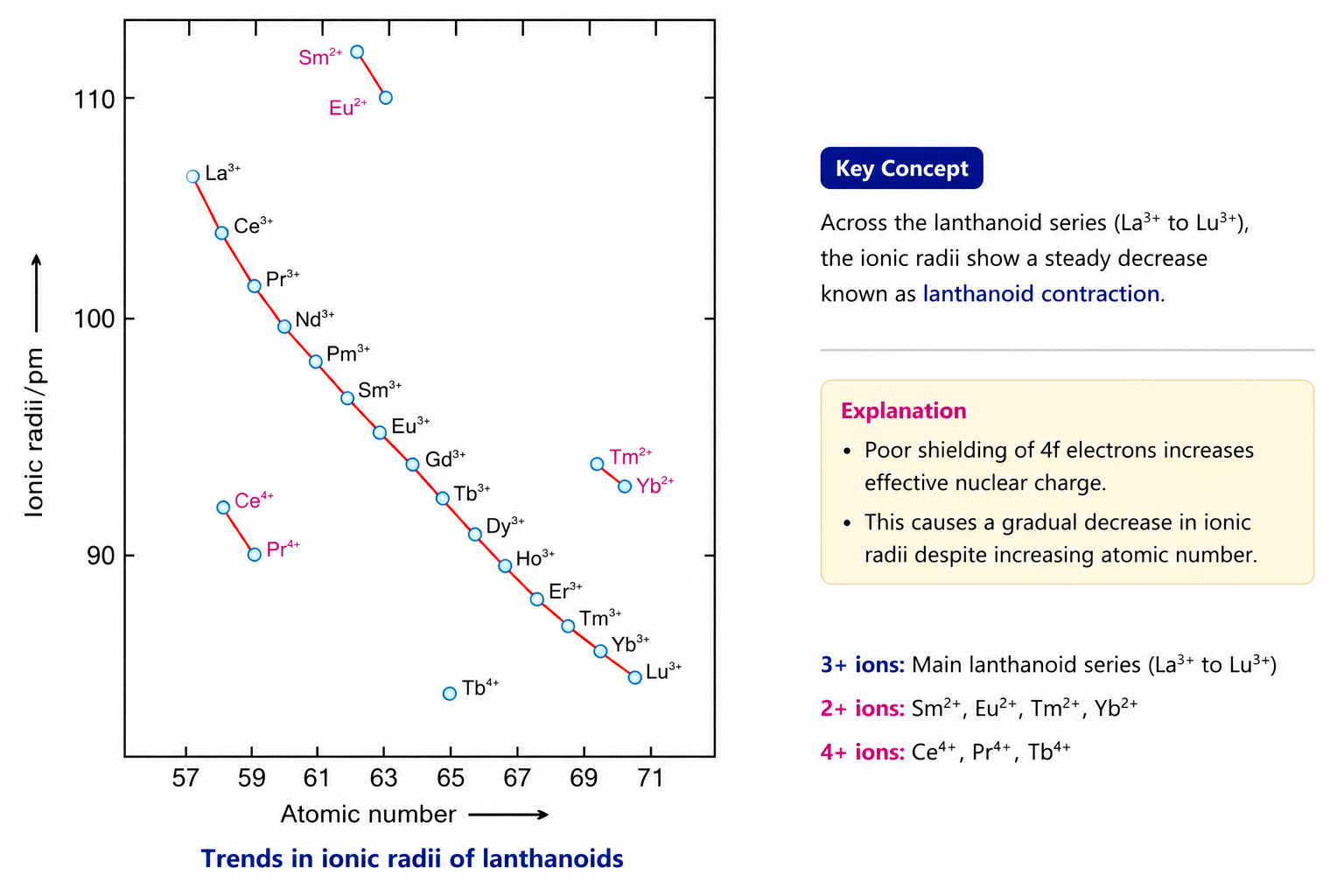
NCERT Fig. 4.6:
Trends in Ionic Radii of Ln3+ Ions (Lanthanoid Contraction)
Definition, Cause & Consequences
Lanthanoid Contraction: The steady, cumulative decrease in atomic and ionic radii
($Ln^{3+}$) across the lanthanoid series from Lanthanum ($106 \text{ pm}$) to Lutetium ($86 \text{ pm}$).
Detailed Cause: With increasing atomic number, nuclear charge increases by $+1$ unit at each step across the series. The added electron enters the inner $4f$ subshell. Because $4f$ orbitals have a diffuse, multi-lobed shape and lie deep within the atom, the
mutual shielding effect of $4f$ electrons on one another is extremely poor (even poorer than d-electrons). Consequently, the effective nuclear charge ($Z_{eff}$) increases rapidly, pulling the outer electron shells inward.
Three Major Consequences:
- Identical Radii of 4d and 5d Transition Series Pairs: The contraction in size across the 14 lanthanoids offsets the expected size expansion from $4d$ to $5d$ series. Consequently, pairs of elements in the same group of $4d$ and $5d$ series have virtually identical atomic and ionic radii:
- $Zr (160\text{ pm}) \approx Hf (159\text{ pm})$ in Group 4.
- $Nb (146\text{ pm}) \approx Ta (146\text{ pm})$ in Group 5.
- $Mo (139\text{ pm}) \approx W (139\text{ pm})$ in Group 6.
Effect: $5d$ transition elements have nearly double the density of $4d$ elements!
- Difficulty in Separation: Due to nearly identical ionic radii and chemical properties, pure separation of individual lanthanoids from natural minerals is extremely difficult and requires multi-step ion-exchange chromatography or fractional crystallization.
- Decrease in Basic Strength of Hydroxides: As the ionic radius of $Ln^{3+}$ decreases steadily from $La^{3+} (106\text{ pm})$ to $Lu^{3+} (86\text{ pm})$, the charge density increases, causing the covalent character of the $Ln-OH$ bond to increase (Fajans' Rule). Hence, $La(OH)_3$ is the most basic, while $Lu(OH)_3$ is the least basic hydroxide.
7.3 Oxidation States & Redox Roles
The $+3$ oxidation state is the predominant and most stable oxidation state for all lanthanoids in both solid state and aqueous solutions.
ANOMALOUS OXIDATION STATES & REDOX BEHAVIOR
- $+4$ Oxidation States (Oxidising Agents):
- Cerium ($Ce^{4+}$): Config $[Xe] 4f^0$ (empty $4f$ noble gas configuration). Highly stable in solid oxides ($CeO_2$), but in aqueous solution it acts as a strong analytical oxidising agent ($E^\circ(Ce^{4+}/Ce^{3+}) = +1.74 \text{ V}$) because it readily accepts an electron to revert to the favoured $+3$ state.
- Terbium ($Tb^{4+}$): Config $[Xe] 4f^7$ (half-filled $4f^7$). Acts as a strong oxidant.
- Praseodymium ($Pr^{4+}$) & Neodymium ($Nd^{4+}$): Exist only in solid fluorides and oxides ($MO_2$).
- $+2$ Oxidation States (Reducing Agents):
- Europium ($Eu^{2+}$): Config $[Xe] 4f^7$ (half-filled $4f^7$). Acts as a strong reducing agent ($Eu^{2+} \rightarrow Eu^{3+} + e^-$) in aqueous medium.
- Ytterbium ($Yb^{2+}$): Config $[Xe] 4f^{14}$ (completely filled $4f^{14}$). Acts as a strong reductant.
- Samarium ($Sm^{2+}$) & Thulium ($Tm^{2+}$): Also exhibit $+2$ state and act as reducing agents ($Sm^{2+} \rightarrow Sm^{3+}$).
7.4 Physical Properties, Colour & Magnetic Moments
- Physical Appearance & Hardness: Lanthanoids are silvery-white, soft metals. Hardness increases with atomic number ($Sm$ is as hard as steel, melting at $1623\text{ K}$). High melting points ($1000\text{ K}$ to $1200\text{ K}$). Good conductors of heat and electricity.
- Colour in Solids & Aqueous Solutions: Many $Ln^{3+}$ ions are distinctly coloured due to $f-f$ electronic transitions (absorption of visible light).
- Colourless Ions: $La^{3+} (4f^0)$ and $Lu^{3+} (4f^{14})$ are completely colourless because they have empty or fully-filled $4f$ subshells. $Ce^{3+} (4f^1)$ and $Yb^{3+} (4f^{13})$ are also colourless.
- Colour Symmetry Rule: Ions with $n$ $f$-electrons often have identical or very similar colours to ions with $(14-n)$ $f$-electrons:
- $Pr^{3+} (4f^2)$ = Green $\quad \longleftrightarrow \quad$ $Tm^{3+} (4f^{12})$ = Green
- $Nd^{3+} (4f^3)$ = Pink/Violet $\quad \longleftrightarrow \quad$ $Er^{3+} (4f^{11})$ = Pink
- $Sm^{3+} (4f^5)$ = Yellow $\quad \longleftrightarrow \quad$ $Dy^{3+} (4f^9)$ = Yellow
- Magnetic Properties:
- $La^{3+} (4f^0)$ and $Lu^{3+} (4f^{14})$ are diamagnetic.
- All other $Ln^{3+}$ ions are paramagnetic (maximum at $Nd^{3+}$ and $Dy^{3+}$).
- Crucial NCERT Distinction: In $3d$ transition metals, orbital angular momentum is quenched by crystal fields, so magnetic moment is calculated using the spin-only formula $\mu = \sqrt{n(n+2)}$. In lanthanoids, $4f$ electrons are deeply buried inside the atom, so orbital angular momentum ($L$) is NOT quenched and contributes significantly to the magnetic moment ($\mu = g \sqrt{J(J+1)}$ BM).
7.5 Chemical Reactivity & Mischmetall
Lanthanoids are highly electropositive metals with standard electrode potentials $E^\circ(Ln^{3+}/Ln) \approx -2.2 \text{ to } -2.4 \text{ V}$ (comparable to Aluminium). They react readily upon heating:
| Reactant |
Chemical Equation |
Product / Observation |
| Oxygen ($\text{O}_2$) |
$2Ln + 3O_2 \xrightarrow{\Delta} 2Ln_2O_3$ |
Basic oxides ($Ln_2O_3$) |
| Water ($\text{H}_2\text{O}$) |
$2Ln + 6H_2O \longrightarrow 2Ln(OH)_3 + 3H_2(g)$ |
Hydroxide + Hydrogen gas |
| Dilute Acids ($\text{H}^+$) |
$2Ln + 6H^+ \longrightarrow 2Ln^{3+} + 3H_2(g)$ |
Soluble salts + Hydrogen gas |
| Halogens ($\text{X}_2$) |
$2Ln + 3X_2 \longrightarrow 2LnX_3$ |
Trihalides ($LnF_3, LnCl_3$) |
| Nitrogen ($\text{N}_2$) |
$2Ln + N_2 \xrightarrow{\Delta} 2LnN$ |
Nitrides ($LnN$) |
| Carbon ($\text{C}$) |
$Ln + 2C \xrightarrow{2773\text{ K}} LnC_2$ |
Carbides ($LnC_2$) |
| Sulfur ($\text{S}$) |
$2Ln + 3S \xrightarrow{\Delta} Ln_2S_3$ |
Sulfides ($Ln_2S_3$) |
Mischmetall Composition & Applications
Mischmetall: A commercially famous lanthanoid alloy consisting of:
- Lanthanoid metal: $\approx 95\%$ (predominantly Cerium $\approx 50\%$ and Lanthanum $\approx 25\%$)
- Iron ($Fe$): $\approx 5\%$
- Traces of: $S, C, Ca,$ and $Al$.
Commercial Uses:
- Used in Magnesium-based alloys to manufacture bullets, shell casings, and lighter flints (pyrophoric alloy emitting sparks when struck).
- $CeO_2$ and $Ce_2(SO_4)_3$ are used in glass polishing and volumetric analytical titrations.
- $Nd_2O_3$ and $Pr_2O_3$ are used in protective glass goggles for welders.
- Mixed lanthanoid oxides ($Ln_2O_3$) serve as catalysts in petroleum cracking.
8. The f-Block Elements: Actinoids (5f Series)
The Actinoid series consists of 14 elements from Thorium ($Th, Z=90$) to Lawrencium ($Lr, Z=103$), involving the progressive filling of the inner $5f$ subshell following Actinium ($Ac, Z=89$).
8.1 Electronic Configurations (NCERT Table 4.11)
The general electronic configuration of actinoids is $[Rn] 5f^{1-14} 6d^{0-1} 7s^2$.
Because the energy levels of $5f, 6d,$ and $7s$ subshells are extremely close, electron distribution between $5f$ and $6d$ exhibits minor irregularities in early actinoids.
NCERT Table 4.11: Actinoids Configurations & Radii
| Z |
Name |
Sym |
Atom (An) |
$An^{3+}$ |
$An^{4+}$ |
Radii $An^{3+}$ (pm) |
Radii $An^{4+}$ (pm) |
| 89 |
Actinium |
Ac |
$[Rn] 6d^1 7s^2$ |
$5f^0$ |
-- |
111 |
-- |
| 90 |
Thorium |
Th |
$[Rn] 6d^2 7s^2$ |
$5f^1$ |
$5f^0$ |
-- |
94 |
| 91 |
Protactinium |
Pa |
$[Rn] 5f^2 6d^1 7s^2$ |
$5f^2$ |
$5f^1$ |
-- |
92 |
| 92 |
Uranium |
U |
$[Rn] 5f^3 6d^1 7s^2$ |
$5f^3$ |
$5f^2$ |
103 |
89 |
| 93 |
Neptunium |
Np |
$[Rn] 5f^4 6d^1 7s^2$ |
$5f^4$ |
$5f^3$ |
101 |
88 |
| 94 |
Plutonium |
Pu |
$[Rn] 5f^6 7s^2$ |
$5f^5$ |
$4f^4$ |
100 |
87 |
| 95 |
Americium |
Am |
$[Rn] 5f^7 7s^2$ |
$5f^6$ |
$5f^5$ |
99 |
86 |
| 96 |
Curium |
Cm |
$[Rn] 5f^7 6d^1 7s^2$ |
$5f^7$ |
$5f^6$ |
99 |
85 |
| 97 |
Berkelium |
Bk |
$[Rn] 5f^9 7s^2$ |
$5f^8$ |
$5f^7$ |
98 |
84 |
| 98 |
Californium |
Cf |
$[Rn] 5f^{10} 7s^2$ |
$5f^9$ |
$5f^8$ |
98 |
84 |
| 99 |
Einsteinium |
Es |
$[Rn] 5f^{11} 7s^2$ |
$5f^{10}$ |
$5f^9$ |
-- |
-- |
| 100 |
Fermium |
Fm |
$[Rn] 5f^{12} 7s^2$ |
$5f^{11}$ |
$5f^{10}$ |
-- |
-- |
| 101 |
Mendelevium |
Md |
$[Rn] 5f^{13} 7s^2$ |
$5f^{12}$ |
$5f^{11}$ |
-- |
-- |
| 102 |
Nobelium |
No |
$[Rn] 5f^{14} 7s^2$ |
$5f^{13}$ |
$5f^{12}$ |
-- |
-- |
| 103 |
Lawrencium |
Lr |
$[Rn] 5f^{14} 6d^1 7s^2$ |
$5f^{14}$ |
$5f^{13}$ |
-- |
-- |
8.2 Ionic Radii & Actinoid Contraction
Like lanthanoids, actinoids exhibit a gradual decrease in atomic and ionic radii ($An^{3+}$ and $An^{4+}$) across the series, known as Actinoid Contraction.
Actinoid Contraction vs Lanthanoid Contraction
Key Distinction: Actinoid contraction is GREATER from element to element than Lanthanoid contraction.
Reason: In actinoids, electrons are added to the $5f$ subshell, whereas in lanthanoids they are added to $4f$. Because $5f$ orbitals extend further out in space beyond the inner core, the mutual shielding effect of $5f$ electrons is even poorer than that of $4f$ electrons. Consequently, effective nuclear charge increases more sharply across actinoids, causing a steeper contraction in ionic size.
8.3 Wide Range of Oxidation States & Oxo-Cations
Unlike lanthanoids which show predominantly $+3$ oxidation state, actinoids exhibit a much wider range of oxidation states ($+3, +4, +5, +6, +7$).
- Cause: The $5f, 6d,$ and $7s$ energy levels are of comparable energies in early actinoids. Thus, electrons from all three subshells can participate in chemical bonding.
- Oxidation State Pattern:
- Thorium ($Th$): $+4$ (predominant)
- Protactinium ($Pa$): $+4, +5$
- Uranium ($U$): $+3, +4, +5, \mathbf{+6}$ (e.g. $UF_6, UO_2^{2+}$)
- Neptunium ($Np$) & Plutonium ($Pu$): $+3, +4, +5, +6, \mathbf{+7}$ (highest states in $NpO_5^{3-}, PuO_5^{3-}$)
- Americium ($Am$): $+2, +3, +4, +5, +6$
- Curium ($Cm$) through Lawrencium ($Lr$): $+3$ becomes progressively the most stable state.
- Formation of Oxo-Cations: High oxidation states of actinoids do not exist as simple cations in solution, but form stable oxo-cations:
$UO_2^{2+}$ (Uranyl), $\quad$ $UO_2^+$, $\quad$ $NpO_2^+$, $\quad$ $PuO_2^{2+}$.
8.4 General Physical & Chemical Characteristics
- Appearance & Density: Silvery white, highly dense metals ($U = 19.1 \text{ g/cm}^3$, $Np = 20.4 \text{ g/cm}^3$). Metallic radii are larger than lanthanoids.
- High Chemical Reactivity: Actinoids are much more reactive than lanthanoids:
- Finely divided actinoid metals ignite spontaneously in air.
- They react with boiling water to form hydroxides and oxides.
- They are rapidly attacked by Hydrochloric acid ($HCl$).
- Nitric Acid Passivity: Concentrated $HNO_3$ renders actinoids passive due to the formation of a protective insoluble oxide film on the metal surface.
- Alkalies have no action on actinoid metals.
- Paramagnetism: All actinoids are paramagnetic. Their magnetic susceptibilities are higher and more complex than lanthanoids due to active $5f$ orbital participation in bonding.
- Universal Radioactivity: ALL actinoids are strictly radioactive. Earlier members ($Th, U$) have long half-lives ($10^9$ years), while trans-uranium elements ($Z > 92$, e.g. $Lr$) are synthetic/man-made with short half-lives ranging from days to 3 minutes!
- High Complexing Tendency: Actinoids have a far higher tendency to form complexes than lanthanoids because of smaller ionic size and higher charge density of $An^{4+}$ and oxo-cations. Order of complexing power: $An^{4+} > UO_2^{2+} > An^{3+} > UO_2^+$.
8.5 Comprehensive Comparison: Lanthanoids vs. Actinoids
Comprehensive Comparison: Lanthanoids vs Actinoids
| Property |
Lanthanoids ($4f$ Series) |
Actinoids ($5f$ Series) |
| Inner Subshell Filling |
Filling of $4f$ subshell. |
Filling of $5f$ subshell. |
| Range of Oxidation States |
Mainly $+3$; occasionally $+2, +4$. |
Wide variety ($+3, +4, +5, +6, +7$) due to close $5f, 6d, 7s$ energies. |
| Shielding & Contraction |
$4f$ shielding is poor; smaller element-to-element contraction. |
$5f$ shielding is even poorer; greater element-to-element contraction. |
| Radioactivity |
Non-radioactive (except Promethium, $Pm$). |
ALL actinoids are strictly radioactive. |
| Complex Formation |
Lesser tendency to form complexes. |
Much greater tendency to form complexes (smaller size, higher charge). |
| Oxo-Cation Formation |
Do not form oxo-cations. |
Form stable oxo-cations ($\text{UO}_2^{2+}, \text{UO}_2^+, \text{NpO}_2^+, \text{PuO}_2^{2+}$). |
| Chemical Reactivity |
Less reactive than actinoids. |
Highly reactive (finely divided metals ignite spontaneously in air). |
| Action of Nitric Acid |
React with nitric acid to form nitrate salts. |
Rendered passive by concentrated $\text{HNO}_3$ due to protective oxide layer. |
| Basic Strength of Hydroxides |
Hydroxides are less basic than actinoid hydroxides. |
Hydroxides are more basic. |
| Magnetic Properties |
Paramagnetic; magnetic moments calculated by $L+S$ coupling. |
Paramagnetic; magnetic moments are higher and more complex. |
9. Applications of d- and f-Block Elements
- Structural Materials: Iron and steels are foundational construction materials ($Cr, Mn,
Ni$ added for corrosion resistance and strength).
- Pigments & Batteries: $TiO_2$ in pigment industry; $MnO_2$ in dry cell batteries; $Zn$
and $Ni/Cd$ in rechargeable batteries.
- Coinage Metals: Group 11 metals ($Cu, Ag, Au$). UK coins are copper-coated steel or
$Cu/Ni$ alloy.
- Industrial Catalysts: $V_2O_5$ (sulfuric acid), $Fe$ (ammonia), $Ni$ (hydrogenation),
Ziegler-Natta $TiCl_4+Al(CH_3)_3$ (polythene), $PdCl_2$ (Wacker process), $AgBr$ (photography).
10. High-Yield NCERT Solved Examples & Practice Problems
Practice Problem 8 (NCERT Solved Example 4.5)
Question: How would you account for the increasing oxidising power in the series $VO_2^+ <
Cr_2O_7^{2-} < MnO_4^-$?
Solution:
This trend is due to the increasing stability of the lower oxidation species to which these oxoanions
are reduced. $VO_2^+$ is reduced to $VO^{2+}$ ($V^{IV}$), $Cr_2O_7^{2-}$ is reduced to $Cr^{3+}$
($Cr^{III}$), and $MnO_4^-$ is reduced to $Mn^{2+}$ ($Mn^{II}$). As the stability of the resulting
reduced state increases across the series, the oxidising power of the parent oxoanion increases.
Practice Problem 9 (NCERT Intext 4.7)
Question: Which is a stronger reducing agent, $Cr^{2+}$ or $Fe^{2+}$, and why?
Solution:
$Cr^{2+}$ is a stronger reducing agent than $Fe^{2+}$.
Reason: Oxidation of $Cr^{2+}$ ($3d^4$) to $Cr^{3+}$ yields a $3d^3$ configuration, which
corresponds to a stable half-filled $t_{2g}^3$ level in aqueous medium. On the other hand, oxidation of
$Fe^{2+}$ ($3d^6$) to $Fe^{3+}$ yields a $3d^5$ configuration. The $d^4 \rightarrow d^3$ change involves a
larger gain in stabilization energy in water than $d^6 \rightarrow d^5$.
Practice Problem 10 (NCERT Intext 4.9)
Question: Explain why $Cu^+$ ion is not stable in aqueous solutions.
Solution:
In aqueous solution, $Cu^+$ undergoes disproportionation:
$$\mathbf{2Cu^+(aq) \longrightarrow Cu^{2+}(aq) + Cu(s)}$$
Although removing a second electron from copper requires high energy ($IE_2$), the hydration
enthalpy of $Cu^{2+}(aq)$ is much more negative than that of $Cu^+(aq)$ due to its smaller size
and higher charge. This huge hydration energy release more than compensates for $IE_2$, making $Cu^{2+}(aq)$
far more stable.
Practice Problem 11 (NCERT Solved Example 4.10)
Question: Name a member of the lanthanoid series which is well known to exhibit a $+4$
oxidation state. Why does it do so?
Solution:
Cerium ($Ce, Z=58$) is well known to exhibit a $+4$ oxidation state. Its ground state
electronic configuration is $[Xe] 4f^1 5d^1 6s^2$. By losing 4 electrons to form $Ce^{4+}$, it attains the
highly stable noble gas configuration of Xenon ($[Xe] 4f^0$).
Practice Problem 12 (NCERT Intext 4.10)
Question: Actinoid contraction is greater from element to element than lanthanoid contraction.
Why?
Solution:
In actinoids, electrons are added to $5f$ orbitals, whereas in lanthanoids they are added to $4f$ orbitals.
$5f$ orbitals extend further in space and are less buried than $4f$ orbitals, making the mutual shielding
effect of $5f$ electrons even poorer than that of $4f$ electrons. Consequently, the effective nuclear charge
increases more sharply across actinoids, causing a greater contraction from element to element.

 VARDAAN COMET