Vardaan Learning Institute
Class 12 Chemistry • Comprehensive Chapter Notes
🌐 vardaanlearning.com📞 9508841336
Chapter 3: Chemical Kinetics
Dear Class 12 Student! Thermodynamics tells us IF a reaction will happen, but Chemical Kinetics tells us HOW FAST it will happen. This chapter is purely mathematical and highly scoring. You must master the Integrated Rate Equations (Zero and First Order) and the Arrhenius Equation, as they form the core of the 5-mark board questions and JEE numericals. Let's speed up our learning!
Scope of Chemical Kinetics
Thermodynamics tells us
if a reaction is feasible (based on $\Delta G$), but
Chemical Kinetics tells us
how fast it proceeds and by what mechanism. A reaction may be thermodynamically feasible yet kinetically very slow (e.g., conversion of diamond to graphite — thermodynamically favourable but practically zero rate at room temperature).
Chemical Kinetics studies:
- The rate of chemical reactions and how it is measured.
- How rate depends on concentration, temperature, pressure, and catalysts.
- The reaction mechanism — the step-by-step path from reactants to products.
- Industrial applications: optimising reactor conditions, maximising yield and minimising time.
1. Rate of a Chemical Reaction
Definition: The rate of a chemical reaction is defined as the change in the concentration of any one of the reactants or products per unit time.
Types of Rates
1. Average Rate ($r_{avg}$): The rate of reaction measured over a measurable, macroscopic time interval ($\Delta t$).
$$r_{avg} = \frac{-\Delta[R]}{\Delta t} = \frac{+\Delta[P]}{\Delta t}$$
(The negative sign for reactants merely indicates that their concentration is decreasing over time. Rate itself is always a positive quantity).
2. Instantaneous Rate ($r_{inst}$): The rate of reaction at any specific, infinitesimally small instant of time ($dt \rightarrow 0$). It is calculated by drawing a tangent to the concentration-time curve at that specific instant.
$$r_{inst} = \frac{-d[R]}{dt} = \frac{+d[P]}{dt}$$
Units of Rate
Since Rate = Concentration / Time, the standard unit is $\text{mol} \cdot \text{L}^{-1} \cdot \text{s}^{-1}$.
For gaseous reactions, partial pressure is used instead of concentration, making the unit $\text{atm} \cdot \text{s}^{-1}$.
Expression of Rate for a General Reaction
For a balanced chemical equation: $\quad aA + bB \longrightarrow cC + dD$
To ensure the "Rate of Reaction" remains a unique, single value regardless of which component we measure, we must divide the rate of disappearance/appearance by their respective stoichiometric coefficients.
$$\text{Rate} = -\frac{1}{a}\frac{d[A]}{dt} = -\frac{1}{b}\frac{d[B]}{dt} = +\frac{1}{c}\frac{d[C]}{dt} = +\frac{1}{d}\frac{d[D]}{dt}$$
Practice Problem 1
Question: For the reaction $\text{N}_2(g) + 3\text{H}_2(g) \longrightarrow 2\text{NH}_3(g)$, the rate of appearance of ammonia ($\text{NH}_3$) is measured to be $2.0 \times 10^{-4} \text{ mol L}^{-1} \text{s}^{-1}$. Calculate the rate of reaction and the rate of disappearance of $\text{H}_2$.
Solution:
1. Write the general rate expression:
$\text{Rate} = -\frac{d[\text{N}_2]}{dt} = -\frac{1}{3}\frac{d[\text{H}_2]}{dt} = +\frac{1}{2}\frac{d[\text{NH}_3]}{dt}$
2. Given: Rate of appearance of $\text{NH}_3 = +\frac{d[\text{NH}_3]}{dt} = 2.0 \times 10^{-4} \text{ mol L}^{-1}\text{s}^{-1}$.
3. Rate of Reaction:
$\text{Rate} = \frac{1}{2} \times (2.0 \times 10^{-4}) = \mathbf{1.0 \times 10^{-4} \text{ mol L}^{-1}\text{s}^{-1}}$.
4. Rate of disappearance of $\text{H}_2$:
We know $\text{Rate} = -\frac{1}{3}\frac{d[\text{H}_2]}{dt} \implies 1.0 \times 10^{-4} = -\frac{1}{3}\frac{d[\text{H}_2]}{dt}$
Therefore, Rate of disappearance ($-\frac{d[\text{H}_2]}{dt}$) $= 3 \times (1.0 \times 10^{-4}) = \mathbf{3.0 \times 10^{-4} \text{ mol L}^{-1}\text{s}^{-1}}$.
2. Factors Influencing Rate of a Reaction
- Concentration of Reactants: Higher concentration means more molecules in a given volume, leading to a higher frequency of collisions, thereby increasing the rate. Rate generally decreases as the reaction proceeds since reactant concentration falls.
- Temperature: As a rough rule of thumb (van't Hoff rule), the rate of a chemical reaction doubles for every $10^\circ\text{C}$ rise in temperature. The precise relationship is given by the Arrhenius equation. Temperature increases rate because more molecules acquire energy $\ge E_a$.
- Nature of Reactants:
- Physical state: Gases react faster than liquids, which react faster than solids (due to mobility and contact).
- Surface Area (for heterogeneous reactions): Powdered or finely divided solids react much faster than solid blocks because a greater surface area is exposed to collisions.
- Nature of Chemical Bonds: Ionic reactions (ion–ion) are nearly instantaneous (e.g., precipitation, neutralisation) because bond rearrangement is minimal. Reactions involving covalent bonds are slower because covalent bonds must be broken and reformed, which requires more energy.
- Examples: 2Na + Cl$_2$ → 2NaCl (fast, ionic); Organic reactions like esterification (slow, covalent).
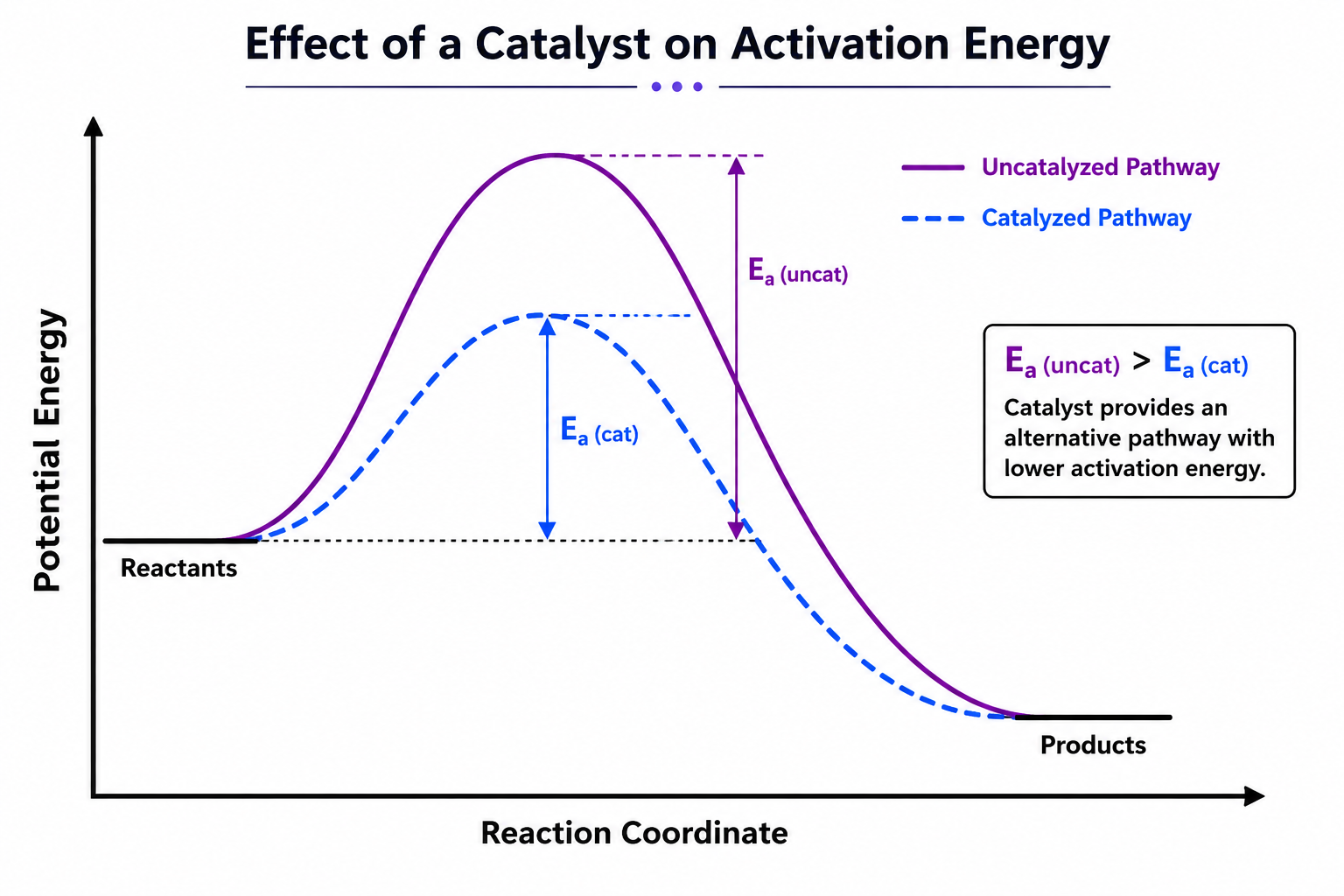
- Catalyst: A substance that alters the rate without being consumed. A positive catalyst massively increases the rate by providing an alternative pathway with a lower activation energy ($E_a$). A catalyst does NOT change $\Delta H$, $\Delta G$, or the equilibrium constant $K_c$.
- Exposure to Radiation: Certain photochemical reactions (like $\text{H}_2 + \text{Cl}_2 \rightarrow 2\text{HCl}$ in sunlight) are initiated by photons that provide activation energy.
Homogeneous vs Heterogeneous Catalyst
| Property | Homogeneous Catalyst | Heterogeneous Catalyst |
|---|
| Phase | Same phase as reactants | Different phase from reactants |
| Examples | H$^+$ in esterification; NO(g) as catalyst for SO$_2$(g) oxidation | Fe(s) in Haber process (N$_2$ + H$_2$); Pt(s) in catalytic converter |
| Mechanism | Forms intermediate compound with reactant | Adsorbs reactants on surface, lowers $E_a$ |
| Selectivity | More selective (specific reaction) | Very selective due to active sites |
Practice Problem 1A
Question: A reaction has rate $r$. Predict the new rate if (i) concentration is doubled, assuming first-order dependence on that reactant, and (ii) temperature is increased by $20^\circ\text{C}$ using the common rule of thumb.
Solution:
1. For first-order dependence, $r \propto [A]^1$. Doubling concentration doubles rate: new rate $= 2r$.
2. Approximate temperature rule: rate doubles for each $10^\circ\text{C}$ increase.
3. For $20^\circ\text{C}$ rise, rate multiplies by $2 \times 2 = 4$.
4. So, new rate $\approx 4r$ (approximate kinetic rule, not exact Arrhenius calculation).
3. Rate Law and Specific Rate Constant
The Law of Mass Action (from Class 11) is theoretical and based strictly on stoichiometry. However, in reality, the rate often does not depend on the stoichiometric coefficients. We need an experimental equation.
Rate Law / Rate Equation
Definition: An experimentally determined mathematical expression that relates the rate of a reaction to the molar concentrations of the reactants.
For a reaction $aA + bB \longrightarrow \text{Products}$, the Rate Law is:
$$\text{Rate} = k [A]^x [B]^y$$
Where $x$ and $y$ are numbers determined purely by experiment. They may or may not be equal to the stoichiometric coefficients $a$ and $b$.
Specific Rate Constant ($k$)
If we set the concentration of all reacting species to unity ($[A] = [B] = 1\text{ M}$), then Rate = $k$. Thus, the specific rate constant ($k$) is defined as the rate of the reaction when the concentration of every reactant is $1\text{ M}$.
Characteristics of $k$:
1. It is entirely independent of the initial concentrations of the reactants.
2. It is highly dependent on temperature (increases exponentially with $T$).
3. It is specific to a particular reaction. A larger value of $k$ means a faster reaction.
Practice Problem 2 (Method of Initial Rates)
Question: For a reaction $A + B \rightarrow \text{Products}$, the following initial rates were obtained:
Exp 1: $[A] = 0.1\text{ M}$, $[B] = 0.1\text{ M}$, Rate $= 2 \times 10^{-3} \text{ M s}^{-1}$
Exp 2: $[A] = 0.2\text{ M}$, $[B] = 0.1\text{ M}$, Rate $= 4 \times 10^{-3} \text{ M s}^{-1}$
Exp 3: $[A] = 0.1\text{ M}$, $[B] = 0.2\text{ M}$, Rate $= 8 \times 10^{-3} \text{ M s}^{-1}$
Determine the rate law and the overall order of the reaction.
Solution:
Let the rate law be: $\text{Rate} = k[A]^x[B]^y$
1. From Exp 1 and 2: $[B]$ is constant. $[A]$ is doubled ($0.1 \rightarrow 0.2$). The rate doubles ($2 \times 10^{-3} \rightarrow 4 \times 10^{-3}$).
Therefore, Rate $\propto [A]^1 \implies \mathbf{x = 1}$.
2. From Exp 1 and 3: $[A]$ is constant. $[B]$ is doubled ($0.1 \rightarrow 0.2$). The rate quadruples ($2 \times 10^{-3} \rightarrow 8 \times 10^{-3}$).
Therefore, Rate $\propto [B]^2 \implies \mathbf{y = 2}$.
3. Rate Law: $\text{Rate} = \mathbf{k[A]^1[B]^2}$
4. Overall Order: $n = x + y = 1 + 2 = \mathbf{3}$ (Third Order).
Practice Problem 2B — JEE Level
Question: For a reaction $A \rightarrow B + C$, it is found that the rate doubles when the concentration of A is increased four times. What is the order of the reaction?
Solution:
Let rate $= k[A]^n$.
$\frac{2r}{r} = \left(\frac{4[A]}{[A]}\right)^n \implies 2 = 4^n = 2^{2n}$
$\therefore 2^{2n} = 2^1 \implies 2n = 1 \implies \mathbf{n = \frac{1}{2}}$
This is a half-order (fractional order) reaction.
4. Order and Molecularity of a Reaction
Order of a Reaction ($n$)
Definition: The sum of the powers of the concentration of the reactants in the experimentally determined rate law expression.
If $\text{Rate} = k [A]^x [B]^y$, then Overall Order $n = x + y$.
Key Points: It is a purely experimental quantity. It can be $0, 1, 2, 3$, or even a fraction, and occasionally negative.
Units of Rate Constant ($k$)
The unit of $k$ depends strictly on the overall order ($n$).
General formula to memorize:
$$ (\text{mol} \cdot \text{L}^{-1})^{1-n} \cdot \text{s}^{-1} $$
- Zero Order ($n=0$): $(\text{mol L}^{-1})^{1-0} \text{s}^{-1} = \mathbf{\text{mol L}^{-1} \text{s}^{-1}}$
- First Order ($n=1$): $(\text{mol L}^{-1})^{1-1} \text{s}^{-1} = (\text{mol L}^{-1})^0 \text{s}^{-1} = \mathbf{\text{s}^{-1}}$
- Second Order ($n=2$): $(\text{mol L}^{-1})^{1-2} \text{s}^{-1} = (\text{mol L}^{-1})^{-1} \text{s}^{-1} = \mathbf{\text{L mol}^{-1} \text{s}^{-1}}$
Practice Problem 3
Question: Identify the reaction order from each of the following rate constants:
(i) $k = 2.3 \times 10^{-5} \text{ L mol}^{-1} \text{s}^{-1}$
(ii) $k = 3 \times 10^{-4} \text{ s}^{-1}$
Solution:
We determine the order strictly by looking at the units of $k$.
(i) The unit is $\text{L mol}^{-1} \text{s}^{-1}$. This matches the formula for $n=2$. Therefore, it is a Second Order reaction.
(ii) The unit is $\text{s}^{-1}$. This matches the formula for $n=1$. Therefore, it is a First Order reaction.
Molecularity of a Reaction
Definition: The number of reacting species (atoms, ions, or molecules) taking part in an elementary reaction (a single-step reaction) that must collide simultaneously to bring about a chemical reaction.
Key Points: It is a purely theoretical concept derived from the reaction mechanism. It must be a positive whole number ($1, 2, 3$). It can never be zero, negative, or fractional. Reactions with molecularity greater than 3 are extremely rare.
Order vs Molecularity — Key Differences
| Property | Order | Molecularity |
|---|
| Definition | Sum of powers in the experimentally determined rate law | No. of molecules in an elementary step |
| Nature | Experimental quantity | Theoretical concept |
| Values | 0, 1, 2, 3, fraction, or even negative | Only 1, 2, or 3 (positive integers only) |
| Defined for | Overall (complex) reaction | Elementary steps only |
| Can it be zero? | Yes (zero-order reactions exist) | No — at least one molecule must react |
Complex Reactions & Rate Determining Step (RDS)
Most reactions do not occur in a single step; they are "Complex Reactions" consisting of a sequence of elementary steps (a mechanism).
Rate Determining Step (RDS): The slowest step in a multi-step complex reaction perfectly dictates the overall rate of the reaction and dictates the overall order. For the overall reaction, order = molecularity of the RDS.
Practice Problem 3B — Board Level
Question: Distinguish between order and molecularity. Give one example each of a reaction where order = molecularity and where they differ.
Solution:
Where they are equal: Elementary reactions (single-step).
Example: $\text{H}_2 + \text{I}_2 \rightarrow 2\text{HI}$ — molecularity = 2 (bimolecular), order = 2 (experimentally confirmed). Here order = molecularity = 2.
Where they differ: Complex (multi-step) reactions.
Example: $\text{H}_2 + \text{Br}_2 \rightarrow 2\text{HBr}$ — overall molecularity of reaction = 2, but experimental order = $\frac{3}{2}$ (fractional). The mechanism involves multiple steps, so the order ($\frac{3}{2}$) does not match molecularity.
5. Integrated Rate Equations (High Board Priority)
Differential rate laws tell us the rate at an instant, but they are hard to use if we want to find the concentration after a certain time $t$. We integrate them to get equations linking Concentration $[R]$ and Time $t$.
.png)
A. Zero Order Reactions
In a zero-order reaction, the rate is entirely independent of the concentration of the reactants.
Zero Order Derivation
Reaction: $R \longrightarrow P$
Rate law: $\frac{-d[R]}{dt} = k[R]^0 = k(1) = k$
$d[R] = -k \, dt$
Integrating both sides:
$\int d[R] = -k \int dt$
$[R] = -kt + I$ (where $I$ is the integration constant).
At $t=0$, $[R] = [R]_0$ (initial concentration). Substituting this, we get $I = [R]_0$.
Final Equation: $\quad [R] = -kt + [R]_0 \quad \text{or} \quad k = \frac{[R]_0 - [R]}{t}$
Graph: Plotting $[R]$ vs $t$ gives a straight line ($y = mx + c$) with slope $= -k$ and y-intercept $= [R]_0$.
Examples: Decomposition of $\text{NH}_3$ gas on a hot Platinum surface at high pressure; Decomposition of HI on gold surface; Photochemical decomposition of HBr.
Practice Problem 3C — Board Level
Question: The rate constant of a zero-order reaction is $2 \times 10^{-2}\text{ mol L}^{-1}\text{s}^{-1}$. If the initial concentration of the reactant is $0.10\text{ mol/L}$, how long will the reaction take to complete?
Solution:
For zero order: $[R]_t = [R]_0 - kt$
Reaction completes when $[R]_t = 0$:
$$t = \frac{[R]_0}{k} = \frac{0.10}{2 \times 10^{-2}} = \mathbf{5\text{ seconds}}$$
Note: Unlike first-order reactions (which are theoretically never complete), zero-order reactions complete in finite time.
B. First Order Reactions
The rate of the reaction is directly proportional to the first power of the reactant concentration.
First Order Derivation
Reaction: $R \longrightarrow P$
Rate law: $\frac{-d[R]}{dt} = k[R]^1$
$\frac{d[R]}{[R]} = -k \, dt$
Integrating both sides:
$\int \frac{d[R]}{[R]} = -k \int dt$
$\ln[R] = -kt + I$
At $t=0$, $[R] = [R]_0$. Thus, $I = \ln[R]_0$.
$\ln[R] = -kt + \ln[R]_0$
Rearranging: $kt = \ln\frac{[R]_0}{[R]}$
Converting natural log ($\ln$) to base 10 ($\log$) by multiplying by $2.303$:
Final Equation: $\quad k = \frac{2.303}{t} \log \frac{[R]_0}{[R]}$
Graph: Plotting $\log[R]$ vs $t$ gives a straight line with slope $= \frac{-k}{2.303}$ and y-intercept $= \log[R]_0$.
Examples: All natural and artificial radioactive decays follow first-order kinetics strictly. Also: decomposition of $\text{N}_2\text{O}_5$, hydrolysis of sucrose (pseudo-first order).
Important: Exponential Decay Form
The first-order integrated equation can also be written in the exponential form:
$$\mathbf{[R]_t = [R]_0 \cdot e^{-kt}}$$
This means concentration decreases exponentially with time — a hallmark of all first-order reactions. This is why the $[R]$ vs $t$ graph is an exponential decay curve, but the $\ln[R]$ vs $t$ (or $\log[R]$ vs $t$) graph is a straight line.
Practice Problem 4
Question: A first-order reaction is $40\%$ complete in $50\text{ minutes}$. Calculate the value of the rate constant. In what time will the reaction be $80\%$ complete?
Solution:
Part 1: Find $k$
1. Let initial concentration $[R]_0 = 100$.
2. Reaction is $40\%$ complete, meaning $40$ parts have reacted. Amount remaining $[R] = 100 - 40 = 60$.
3. $t = 50\text{ min}$.
4. Use formula: $k = \frac{2.303}{t} \log \frac{[R]_0}{[R]} = \frac{2.303}{50} \log \frac{100}{60} = \frac{2.303}{50} \log(1.667)$.
5. $k = \frac{2.303}{50} \times 0.2218 = \mathbf{0.0102\text{ min}^{-1}}$.
Part 2: Find time for $80\%$ completion
1. $[R]_0 = 100$. For $80\%$ completion, $[R] = 100 - 80 = 20$.
2. $t = \frac{2.303}{k} \log \frac{[R]_0}{[R]} = \frac{2.303}{0.0102} \log \frac{100}{20} = \frac{2.303}{0.0102} \log(5)$.
3. $t = \frac{2.303}{0.0102} \times 0.6990 = \mathbf{157.8\text{ minutes}}$.
Gas Phase First Order Reaction
For a typical gas phase reaction: $A(g) \longrightarrow B(g) + C(g)$.
Let $P_i$ be the initial pressure of $A$. Let $P_t$ be the total pressure of the mixture at time $t$.
The integrated rate equation modifies to:
$$k = \frac{2.303}{t} \log \frac{P_i}{2P_i - P_t}$$
Practice Problem 5
Question: For the reaction $SO_2Cl_2(g) \rightarrow SO_2(g) + Cl_2(g)$, the initial pressure was $0.5\text{ atm}$. After $100\text{ s}$, the total pressure was $0.6\text{ atm}$. Calculate the rate constant $k$.
Solution:
1. Given: $P_i = 0.5\text{ atm}$, $P_t = 0.6\text{ atm}$, $t = 100\text{ s}$.
2. Use the gas phase formula: $k = \frac{2.303}{t} \log \frac{P_i}{2P_i - P_t}$.
3. $k = \frac{2.303}{100} \log \frac{0.5}{2(0.5) - 0.6} = \frac{2.303}{100} \log \frac{0.5}{1.0 - 0.6} = \frac{2.303}{100} \log \frac{0.5}{0.4}$.
4. $k = \frac{2.303}{100} \log(1.25) = \frac{2.303}{100} \times 0.0969 = \mathbf{2.23 \times 10^{-3}\text{ s}^{-1}}$.
C. Second Order Reactions (JEE / NEET Important)
In a second-order reaction, the rate is proportional to the square of the reactant concentration: $\text{Rate} = k[R]^2$.
Second Order Derivation
Rate law: $\frac{-d[R]}{dt} = k[R]^2$
$\frac{d[R]}{[R]^2} = -k\,dt$
Integrating: $\int [R]^{-2}\,d[R] = -k \int dt$
$\frac{-1}{[R]} = -kt + I$
At $t = 0$, $[R] = [R]_0 \implies I = \frac{-1}{[R]_0}$
$$\frac{1}{[R]_t} - \frac{1}{[R]_0} = kt \quad \text{or} \quad k = \frac{1}{t}\left(\frac{1}{[R]_t} - \frac{1}{[R]_0}\right)$$
Graph: Plotting $\frac{1}{[R]}$ vs $t$ gives a straight line with slope $= +k$ and y-intercept $= \frac{1}{[R]_0}$.
Examples: $\text{NO}_2 + \text{CO} \rightarrow \text{NO} + \text{CO}_2$; Saponification of esters; $\text{H}_2 + \text{I}_2 \rightarrow 2\text{HI}$ (at certain conditions).
Units of $k$: $\text{L mol}^{-1}\text{s}^{-1}$
Master Comparison Table — Zero, First, Second Order
| Property | Zero Order | First Order | Second Order |
|---|
| Rate Law | $k$ | $k[R]$ | $k[R]^2$ |
| Integrated Equation | $[R]_t = [R]_0 - kt$ | $\ln[R]_t = \ln[R]_0 - kt$ | $\frac{1}{[R]_t} = \frac{1}{[R]_0} + kt$ |
| Straight-Line Graph | $[R]$ vs $t$ | $\ln[R]$ vs $t$ (or $\log[R]$ vs $t$) | $\frac{1}{[R]}$ vs $t$ |
| Slope of Graph | $-k$ | $-k$ | $+k$ |
| Half-Life ($t_{1/2}$) | $\dfrac{[R]_0}{2k}$ | $\dfrac{0.693}{k}$ | $\dfrac{1}{k[R]_0}$ |
| $t_{1/2}$ depends on $[R]_0$? | Yes (directly) | No — constant | Yes (inversely) |
| Units of $k$ | $\text{mol L}^{-1}\text{s}^{-1}$ | $\text{s}^{-1}$ | $\text{L mol}^{-1}\text{s}^{-1}$ |
Practice Problem 5A — JEE Level
Question: A second-order reaction has $k = 0.5\text{ L mol}^{-1}\text{s}^{-1}$. If initial concentration is $1\text{ mol/L}$, find the half-life. How does $t_{1/2}$ change if the initial concentration is doubled?
Solution:
For second order: $t_{1/2} = \frac{1}{k[R]_0}$
$t_{1/2} = \frac{1}{0.5 \times 1} = \mathbf{2\text{ seconds}}$
If $[R]_0$ is doubled to $2\text{ mol/L}$:
$t_{1/2} = \frac{1}{0.5 \times 2} = 1\text{ second}$
$\therefore$ $t_{1/2}$ is halved when $[R]_0$ is doubled. (For 2nd order: $t_{1/2} \propto \frac{1}{[R]_0}$)
6. Half-Life of a Reaction ($t_{1/2}$)
Definition: The time required for the initial concentration of the reactant to reduce to exactly half of its initial value. (i.e., at $t = t_{1/2}$, $[R] = \frac{[R]_0}{2}$).
- Zero Order Half-Life: Substitute into $[R] = -kt + [R]_0 \implies \frac{[R]_0}{2} = -k(t_{1/2}) + [R]_0$.
$$t_{1/2} = \frac{[R]_0}{2k}$$
Note: $t_{1/2}$ for zero-order is directly proportional to the initial concentration.
- First Order Half-Life: Substitute into $k = \frac{2.303}{t} \log \frac{[R]_0}{[R]} \implies k = \frac{2.303}{t_{1/2}} \log \frac{[R]_0}{[R]_0/2} = \frac{2.303}{t_{1/2}} \log(2)$. Since $\log(2) = 0.3010$:
$$t_{1/2} = \frac{0.693}{k}$$
Crucial Note: $t_{1/2}$ for first-order is completely independent of the initial concentration! This is why radioactive carbon dating works reliably regardless of how much carbon is left.
- Second Order Half-Life: Substituting $[R] = \frac{[R]_0}{2}$ into $\frac{1}{[R]_t} - \frac{1}{[R]_0} = kt$:
$$t_{1/2} = \frac{1}{k[R]_0}$$
Note: $t_{1/2}$ for second-order is inversely proportional to initial concentration — it gets shorter as concentration decreases.
JEE Main Foundation: $n^{th}$ Order Half-Life & Fractions
General dependence: For any $n^{th}$ order reaction (where $n \neq 1$):
$$t_{1/2} \propto \frac{1}{[R]_0^{n-1}}$$
Amount left after $n$ half-lives (First Order):
$$[R] = \frac{[R]_0}{2^n}$$
Practice Problem 6
Question: Show that for a first-order reaction, the time required for $99.9\%$ completion of the reaction is roughly 10 times its half-life.
Solution:
1. For half-life ($t_{1/2}$): $t_{1/2} = \frac{0.693}{k} \quad \text{--- (Eq 1)}$.
2. For $99.9\%$ completion, $[R]_0 = 100$ and $[R] = 100 - 99.9 = 0.1$.
3. $t_{99.9\%} = \frac{2.303}{k} \log \frac{100}{0.1} = \frac{2.303}{k} \log(1000) = \frac{2.303}{k} \log(10^3)$.
4. $t_{99.9\%} = \frac{2.303 \times 3}{k} = \frac{6.909}{k} \quad \text{--- (Eq 2)}$.
5. Divide Eq 2 by Eq 1: $\frac{t_{99.9\%}}{t_{1/2}} = \frac{6.909 / k}{0.693 / k} = \frac{6.909}{0.693} \approx 9.96 \approx \mathbf{10}$. (Hence Proved).
Practice Problem 7
Question: The half-life for radioactive decay of ${}^{14}\text{C}$ is $5730\text{ years}$. An archaeological artifact containing wood had only $80\%$ of the ${}^{14}\text{C}$ found in a living tree. Estimate the age of the sample.
Solution:
1. Radioactive decay follows First Order kinetics.
2. Calculate $k$: $k = \frac{0.693}{t_{1/2}} = \frac{0.693}{5730} = 1.209 \times 10^{-4}\text{ yr}^{-1}$.
3. Initial amount $[R]_0 = 100\%$. Amount remaining $[R] = 80\%$.
4. Use time formula: $t = \frac{2.303}{k} \log \frac{[R]_0}{[R]}$.
5. $t = \frac{2.303}{1.209 \times 10^{-4}} \log \frac{100}{80} = 1.904 \times 10^4 \times \log(1.25)$.
6. $t = 1.904 \times 10^4 \times 0.0969 = \mathbf{1845\text{ years}}$.
Practice Problem 6A — JEE Level
Question: A second order reaction has $k = 0.5\text{ L mol}^{-1}\text{min}^{-1}$. If initial concentration is $1\text{ mol/L}$, find the concentration after 2 minutes.
Solution:
$$\frac{1}{[R]_t} = \frac{1}{[R]_0} + kt = \frac{1}{1} + 0.5 \times 2 = 1 + 1 = 2$$
$$[R]_t = \frac{1}{2} = \mathbf{0.5\text{ mol/L}}$$
Practice Problem 6B — NEET Level
Question: A radioactive isotope has a half-life of 10 years. In how many years will only 6.25% of the original amount remain?
Solution:
$6.25\% = \frac{1}{16} = \left(\frac{1}{2}\right)^4$
So, 4 half-lives are required.
$$\text{Time} = 4 \times 10 = \mathbf{40\text{ years}}$$
7. Pseudo First Order Reactions
Definition: Reactions that are not truly of the first order (their molecularity is $\ge 2$), but under certain specific experimental conditions, they mathematically behave as first-order reactions. This typically happens when one of the reacting molecules is present in such massive excess that its concentration practically does not change during the reaction.
Classic Examples
1. Acid-catalyzed hydrolysis of ethyl acetate (ester):
$\text{CH}_3\text{COOC}_2\text{H}_5 + \text{H}_2\text{O} \xrightarrow{H^+} \text{CH}_3\text{COOH} + \text{C}_2\text{H}_5\text{OH}$
The exact rate law is $\text{Rate} = k [\text{Ester}]^1 [\text{Water}]^1$. (Order = 2).
However, water is the solvent and is present in massive excess (say $55.5\text{ M}$), so its concentration remains essentially constant.
We merge $k$ and $[\text{Water}]$ into a new pseudo constant $k'$.
$\text{Rate} = k' [\text{Ester}]^1$ (Now it behaves as First Order).
2. Inversion of Cane Sugar:
$\text{C}_{12}\text{H}_{22}\text{O}_{11} (\text{Sucrose}) + \text{H}_2\text{O} \xrightarrow{H^+} \text{Glucose} + \text{Fructose}$
Similarly, water is in excess. $\text{Rate} = k' [\text{Sucrose}]^1$.
NCERT Exam Link
Pseudo-first-order reactions are experimentally handled using first-order plots and equations because the concentration of one reactant remains effectively constant.
If actual law is $\text{Rate} = k[A][B]$ and $[B] \gg [A]$, then $k' = k[B]_{constant}$ and:
$$\text{Rate} = k'[A]$$
This is why hydrolysis in aqueous medium is often treated as first order.
Practice Problem 7A
Question: For a reaction with actual rate law $\text{Rate} = k[A][B]$, reactant $B$ is taken in very large excess such that $[B]$ remains $0.50\text{ M}$ throughout. If $k = 4.0 \times 10^{-3}\text{ L mol}^{-1}\text{s}^{-1}$, find pseudo-first-order constant $k'$ and its unit.
Solution:
1. Under pseudo-first-order condition: $\text{Rate} = k[A][B] = (k[B])[A] = k'[A]$.
2. Therefore, $k' = k[B] = (4.0 \times 10^{-3})(0.50) = \mathbf{2.0 \times 10^{-3}}$.
3. Unit: $(\text{L mol}^{-1}\text{s}^{-1})(\text{mol L}^{-1}) = \mathbf{\text{s}^{-1}}$.
Practice Problem 7B — JEE Level
Question: For a reaction with actual rate law $\text{Rate} = k[A][B]$, reactant $B$ is taken in $100\times$ excess compared to $A$. Write the effective rate law. Is it truly first order? Explain.
Solution:
Since $[B]_0 \gg [A]_0$, $[B]$ remains essentially constant throughout the reaction, say $[B] \approx [B]_0$.
$\text{Rate} = k[A][B] \approx k[B]_0 \cdot [A] = k'[A]$
where $k' = k[B]_0$ is the pseudo-first-order rate constant (units: s$^{-1}$).
Is it truly first order? No — it is mechanistically second order (bimolecular), but it behaves as (and is experimentally indistinguishable from) a first-order reaction under these conditions. This is pseudo-first order.
8. Temperature Dependence of the Rate of a Reaction
It is observed that the rate constant ($k$) of a reaction generally doubles for every $10^\circ\text{C}$ rise in temperature. This extreme sensitivity cannot be explained by simple collision frequency increases; it requires the concept of Activation Energy.
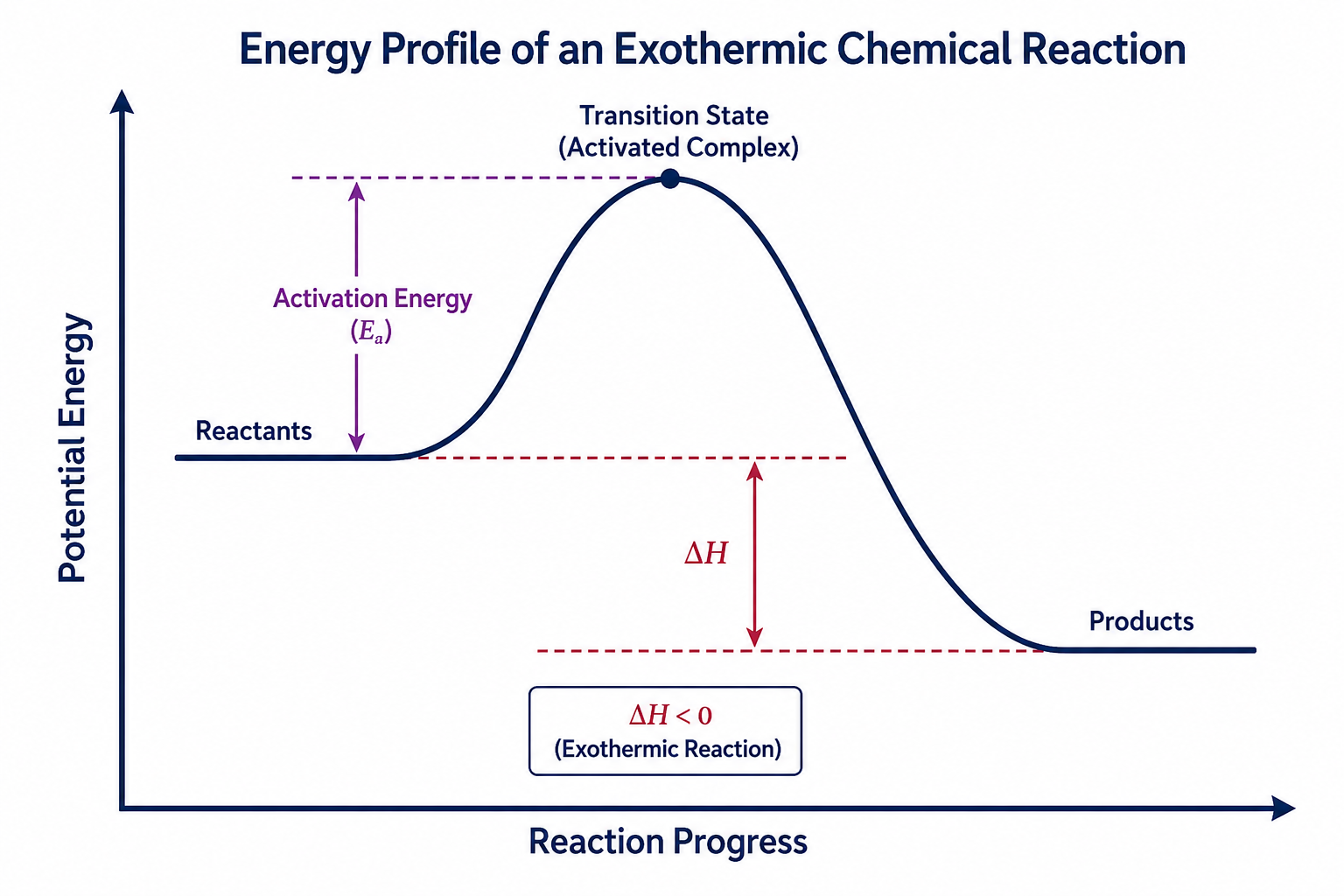
Activation Energy ($E_a$)
When molecules collide, they don't automatically react. Their collision energy must be equal to or greater than a specific barrier called Threshold Energy. The molecules must absorb extra energy to reach this barrier.
Activation Energy ($E_a$): The minimum extra amount of energy absorbed by the reactant molecules to form the unstable intermediate (Activated Complex) and cross the energy barrier.
$E_{\text{threshold}} = E_{\text{reactants}} + E_a$.
Role of Catalyst: A positive catalyst actively participates in the reaction to provide an entirely new, alternate pathway that has a lower Activation Energy. It does not alter the initial energies of reactants or products, meaning $\Delta H$, $\Delta G$, and the Equilibrium Constant ($K_c$) remain utterly unchanged.
Arrhenius Equation (Must-Know for Numericals)
Svante Arrhenius provided the exact mathematical relationship between temperature ($T$) and the rate constant ($k$):
$$k = A e^{-E_a / RT}$$
Where:
- $A$ is the Arrhenius factor (Frequency factor or pre-exponential factor).
- $R$ is universal gas constant ($8.314\text{ J K}^{-1}\text{mol}^{-1}$).
- The term $e^{-E_a/RT}$ represents the fraction of molecules having kinetic energy $\ge E_a$.
Logarithmic Forms:
Taking natural log ($\ln$): $\quad \ln k = -\frac{E_a}{RT} + \ln A$
Converting to base 10 log: $\quad \mathbf{\log k = -\frac{E_a}{2.303 RT} + \log A}$
Graph: Plotting $\log k$ vs $1/T$ gives a straight line with $\text{slope} = -\frac{E_a}{2.303 R}$.
Calculating $E_a$ from Two Temperatures
If $k_1$ is the rate constant at $T_1$, and $k_2$ is the rate constant at $T_2$, integrating the Arrhenius equation yields:
$$\log \frac{k_2}{k_1} = \frac{E_a}{2.303 R} \left[ \frac{T_2 - T_1}{T_1 T_2} \right]$$
Practice Problem 8
Question: The rate of a reaction quadruples when the temperature changes from $293\text{ K}$ to $313\text{ K}$. Calculate the energy of activation of the reaction assuming that it does not change with temperature. ($R = 8.314\text{ J K}^{-1}\text{mol}^{-1}$).
Solution:
1. Given: $T_1 = 293\text{ K}$, $T_2 = 313\text{ K}$. Rate quadruples means $k_2 = 4k_1$, so $k_2/k_1 = 4$.
2. Use the two-temperature formula:
$\log \frac{k_2}{k_1} = \frac{E_a}{2.303 R} \left[ \frac{T_2 - T_1}{T_1 T_2} \right]$
3. $\log(4) = \frac{E_a}{2.303 \times 8.314} \left[ \frac{313 - 293}{293 \times 313} \right]$
4. $0.6021 = \frac{E_a}{19.147} \left[ \frac{20}{91709} \right]$
5. $0.6021 = \frac{E_a \times 20}{1755955}$
6. $E_a = \frac{0.6021 \times 1755955}{20} = \mathbf{52863\text{ J/mol} = 52.86\text{ kJ/mol}}$.
Practice Problem 9
Question: The specific reaction rate of a reaction is $1.5 \times 10^{-4}\text{ s}^{-1}$ at $300\text{ K}$. Its activation energy is $83.14\text{ kJ/mol}$. Calculate the specific reaction rate at $320\text{ K}$.
Solution:
1. Given: $k_1 = 1.5 \times 10^{-4}\text{ s}^{-1}$, $T_1 = 300\text{ K}$, $T_2 = 320\text{ K}$, $E_a = 83.14\text{ kJ/mol} = 83140\text{ J/mol}$.
2. Apply the two-temperature formula:
$\log \frac{k_2}{1.5 \times 10^{-4}} = \frac{83140}{2.303 \times 8.314} \left[ \frac{320 - 300}{300 \times 320} \right]$
3. $\log \frac{k_2}{1.5 \times 10^{-4}} = \frac{83140}{19.147} \left[ \frac{20}{96000} \right] = 4342.19 \times 0.0002083 = 0.904$
4. Take antilog of 0.904: $\frac{k_2}{1.5 \times 10^{-4}} = 8.016$
5. $k_2 = 8.016 \times 1.5 \times 10^{-4} = \mathbf{1.2 \times 10^{-3}\text{ s}^{-1}}$.
Practice Problem 9A — NCERT (Q4.15 Type)
Question: The rate constant for the first order decomposition of $\text{H}_2\text{O}_2$ is given by: $\log k = 14.34 - \frac{1.25 \times 10^4}{T}$. Calculate $E_a$ for the reaction. Also find the temperature at which $t_{1/2} = 256\text{ min}$.
Solution:
Comparing with $\log k = \log A - \frac{E_a}{2.303R} \cdot \frac{1}{T}$:
$\frac{E_a}{2.303R} = 1.25 \times 10^4$
$$E_a = 1.25 \times 10^4 \times 2.303 \times 8.314 = \mathbf{239,339\text{ J mol}^{-1} \approx 239.34\text{ kJ mol}^{-1}}$$
For $t_{1/2} = 256\text{ min}$: $k = \frac{0.693}{256} = 2.707 \times 10^{-3}\text{ min}^{-1}$
$\log(2.707 \times 10^{-3}) = 14.34 - \frac{1.25 \times 10^4}{T}$
$-2.567 = 14.34 - \frac{1.25 \times 10^4}{T}$
$\frac{1.25 \times 10^4}{T} = 16.907 \implies \mathbf{T = 739.5\text{ K}}$
Practice Problem 9B — JEE Advanced Level
Question: For a reaction, $\log k = -\frac{5000}{T} + 6$. Find: (a) Activation energy, (b) Frequency factor $A$, (c) Rate constant at $500\text{ K}$.
Solution:
Compare with $\log k = \log A - \frac{E_a}{2.303R} \cdot \frac{1}{T}$.
(a) Slope $= -\frac{E_a}{2.303R} = -5000$
$E_a = 5000 \times 2.303 \times 8.314 = \mathbf{95,710\text{ J mol}^{-1} \approx 95.71\text{ kJ mol}^{-1}}$
(b) Intercept $= \log A = 6 \implies \mathbf{A = 10^6}$ (in appropriate units of $k$)
(c) At $T = 500\text{ K}$:
$\log k = -\frac{5000}{500} + 6 = -10 + 6 = -4$
$\mathbf{k = 10^{-4}}$ (in appropriate units)
9. Collision Theory of Chemical Reaction Rates
Developed by Max Trautz and William Lewis to explain why rates depend on temperature and concentration on a microscopic level.
Basic Postulates
- Reactant molecules are assumed to be hard spheres.
- Reactions strictly occur only when these molecules physically collide with each other.
- Collision Frequency ($Z_{AB}$): The number of collisions per second per unit volume of the reaction mixture. (Typically extremely high, $\sim 10^{25} \text{ collisions/s/cm}^3$).
Effective Collisions
If every collision led to a reaction, all reactions would finish in fractions of a microsecond. This isn't true. For a collision to be effective (actually yield products), it must satisfy two absolute criteria:
- Energy Criterion: The colliding molecules must possess a kinetic energy equal to or greater than the Threshold Energy (which means they must overcome Activation Energy $E_a$). The fraction of molecules satisfying this is $e^{-E_a/RT}$.
- Orientation Criterion: The molecules must be oriented in space perfectly so that the old bonds can break and new bonds can form simultaneously. If they hit "sideways", they just bounce off. We introduce a Probability or Steric factor ($P$) to account for this. $P$ is always $\le 1$; for simple atoms, $P \approx 1$; for complex molecules, $P \ll 1$.
Modified Arrhenius Equation
Combining collision frequency, energy fraction, and orientation factor, the full theoretical rate equation becomes:
$$\text{Rate} = P \cdot Z_{AB} \cdot e^{-E_a/RT}$$
Comparing this with Arrhenius ($k = A e^{-E_a/RT}$), we see that the pre-exponential factor $A$ is related to collision frequency and proper orientation ($A = P \cdot Z_{AB}$).
Maxwell-Boltzmann Energy Distribution
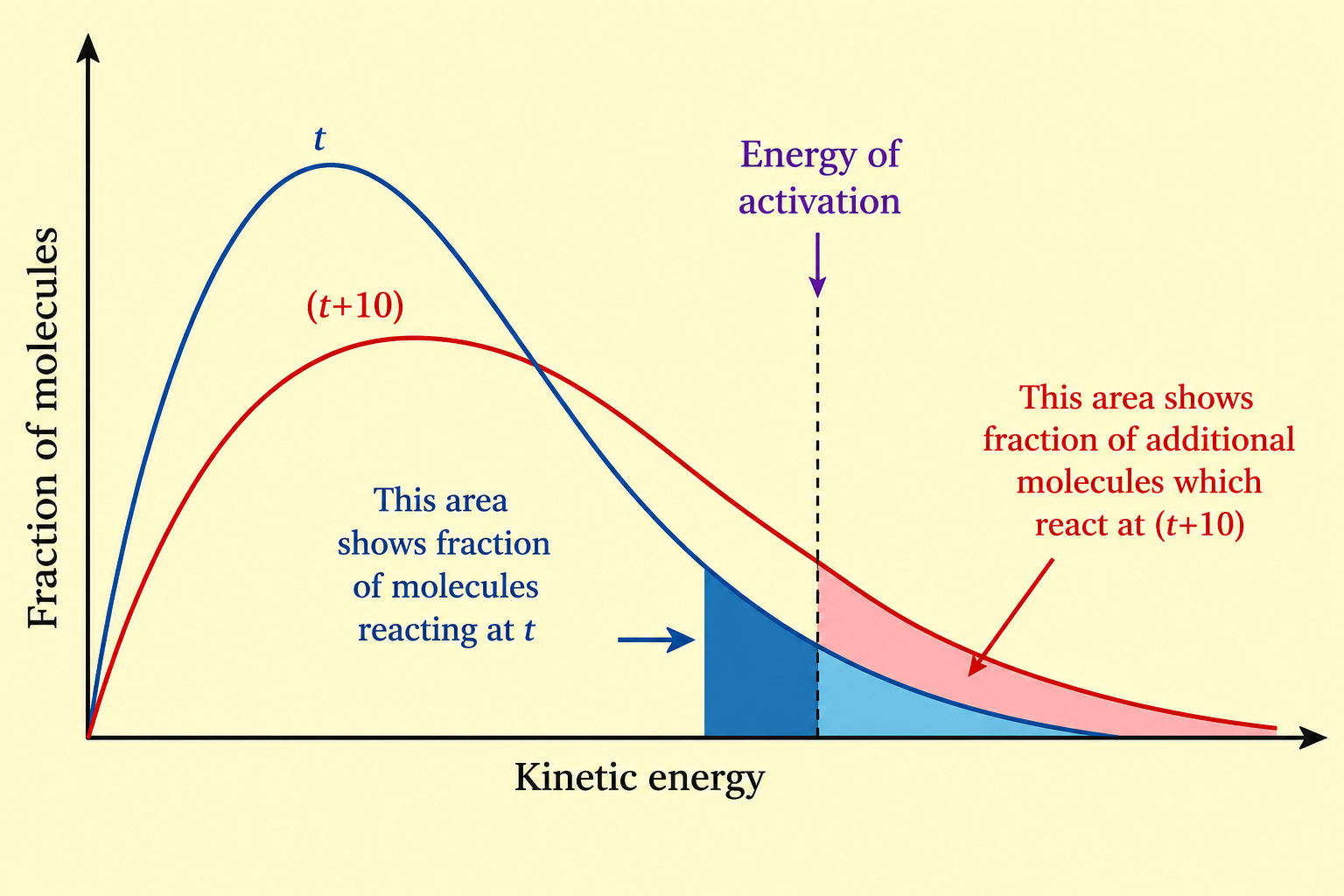 Key Points about Maxwell-Boltzmann Distribution:
- The curve is asymmetric (not a normal bell curve) — skewed to the right.
- At higher temperature $T_2$: the curve flattens and the peak shifts to higher energy.
- The shaded area to the right of $E_a$ (the activation energy) represents the fraction of molecules with enough energy to react.
- Even a small rise in temperature significantly increases this shaded area — explaining why rate roughly doubles per 10°C.
- Mathematically, this fraction $= e^{-E_a/RT}$ (the Boltzmann factor in the Arrhenius equation).
Practice Problem 10A
Question: Two reactions have nearly same collision frequency and steric factor. Reaction X has lower activation energy than reaction Y. Which one is faster at the same temperature, and why?
Solution:
1. Rate contribution from energy term is $e^{-E_a/RT}$.
2. Lower $E_a$ means exponent is less negative, so $e^{-E_a/RT}$ becomes larger.
3. Therefore, a larger fraction of collisions become effective.
4. Hence Reaction X is faster at the same temperature.
Practice Problem 10
Question: Why do most molecular reactions have a very small value of pre-exponential factor ($A$) compared to atomic reactions, even if their activation energies are identical?
Solution:
The pre-exponential factor $A$ depends heavily on the Probability/Steric factor ($P$). For simple atomic reactions, any collision angle is fine (spheres hitting spheres), so $P \approx 1$. However, for complex molecular reactions, the molecules must align in highly specific, awkward geometries for the reaction to occur. Therefore, the probability of proper orientation ($P$) is very, very small, causing the overall value of $A$ (which equals $P \times Z_{AB}$) to be vastly smaller.
10. Key Graphs Summary
All Important Straight-Line Graphs at a Glance
| Order | Graph (Straight Line) | Slope | Y-Intercept |
|---|
| Zero | $[R]$ vs $t$ | $-k$ | $[R]_0$ |
| First | $\log[R]$ vs $t$ | $-k/2.303$ | $\log[R]_0$ |
| First | $\ln[R]$ vs $t$ | $-k$ | $\ln[R]_0$ |
| Second | $1/[R]$ vs $t$ | $+k$ | $1/[R]_0$ |
| Arrhenius | $\log k$ vs $1/T$ | $-E_a/2.303R$ | $\log A$ |
11. Master Formula Sheet & Quick Revision
All Key Formulas in One Place
Rate of Reaction (general):
$$\text{Rate} = -\frac{1}{a}\frac{d[A]}{dt} = -\frac{1}{b}\frac{d[B]}{dt} = +\frac{1}{c}\frac{d[C]}{dt} = +\frac{1}{d}\frac{d[D]}{dt}$$
Units of $k$: $(\text{mol L}^{-1})^{1-n} \cdot \text{s}^{-1}$
Zero Order: $[R]_t = [R]_0 - kt$ ; $\quad t_{1/2} = \dfrac{[R]_0}{2k}$
First Order: $k = \dfrac{2.303}{t}\log\dfrac{[R]_0}{[R]_t}$ ; $\quad t_{1/2} = \dfrac{0.693}{k}$ ; $\quad [R]_t = [R]_0 e^{-kt}$
Second Order: $\dfrac{1}{[R]_t} - \dfrac{1}{[R]_0} = kt$ ; $\quad t_{1/2} = \dfrac{1}{k[R]_0}$
Arrhenius: $k = Ae^{-E_a/RT}$ ; $\quad \log\dfrac{k_2}{k_1} = \dfrac{E_a}{2.303R}\cdot\dfrac{T_2-T_1}{T_1 T_2}$
After $n$ half-lives (First Order): $[R]_n = \dfrac{[R]_0}{2^n}$
Collision Theory: $k = P \cdot Z_{AB} \cdot e^{-E_a/RT}$ ; $\quad A = P \cdot Z_{AB}$
10 Critical Points to Remember for Board & JEE
- $t_{1/2}$ of first order is independent of initial concentration — unique, crucial, and always asked.
- Order is experimental; molecularity is theoretical (only for elementary steps).
- Rate constant $k$ increases with temperature; it does NOT depend on concentration.
- Catalyst lowers $E_a$ but does NOT change $\Delta H$, $\Delta G$, or $K_c$.
- Pseudo-first order: One reactant in huge excess keeps its concentration constant.
- For first order: $\log[R]$ vs $t$ is straight line with slope $= -k/2.303$.
- $A$ and $k$ have the same units (since $e^{-E_a/RT}$ is dimensionless).
- $t_{99\%} = 6.64\,t_{1/2}$ and $t_{99.9\%} \approx 10\,t_{1/2}$ for first order.
- Radioactive decay — always first order, always constant $t_{1/2}$.
- Rate law cannot be written from balanced equation alone — must be determined experimentally.
Common Mistakes to Avoid (Board & JEE)
- ❌ Never equate order with stoichiometric coefficient unless the reaction is elementary.
- ❌ Never confuse rate (depends on $[R]$) with rate constant $k$ (independent of $[R]$).
- ❌ Never use °C in the Arrhenius equation — always convert to Kelvin.
- ❌ $t_{1/2}$ is constant only for first order — not for zero or second order.
- ❌ A catalyst does not change the equilibrium position — only speeds up equilibrium approach.
- ❌ For second order, $1/[R]$ vs $t$ has a positive slope $(+k)$, unlike zero and first order which have negative slopes.
12. NCERT Exercise — Selected Important Questions
NCERT Q4.4 — Board Level
Question: The initial concentration of $\text{N}_2\text{O}_5$ in the first-order reaction $\text{N}_2\text{O}_5(g) \rightarrow 2\text{NO}_2(g) + \frac{1}{2}\text{O}_2(g)$ was $1.24 \times 10^{-2}\text{ mol L}^{-1}$ at 318 K. The concentration after 60 minutes was $0.20 \times 10^{-2}\text{ mol L}^{-1}$. Calculate the rate constant.
Solution:
$$k = \frac{2.303}{t}\log\frac{[R]_0}{[R]_t} = \frac{2.303}{60}\log\frac{1.24 \times 10^{-2}}{0.20 \times 10^{-2}}$$
$= \frac{2.303}{60} \times \log(6.2) = 0.03838 \times 0.7924 = \mathbf{3.04 \times 10^{-2}\text{ min}^{-1}}$
NCERT Q4.13 — Board Level
Question: The rate of a reaction quadruples when temperature changes from 293 K to 313 K. Calculate $E_a$, assuming it does not change with temperature. ($R = 8.314\text{ J K}^{-1}\text{mol}^{-1}$)
Solution:
$k_2/k_1 = 4$, $T_1 = 293\text{ K}$, $T_2 = 313\text{ K}$
$$\log(4) = \frac{E_a}{2.303 \times 8.314}\left[\frac{313 - 293}{293 \times 313}\right]$$
$0.6021 = \frac{E_a}{19.147} \times \frac{20}{91709} = E_a \times 1.140 \times 10^{-5}$
$$\mathbf{E_a = \frac{0.6021}{1.140 \times 10^{-5}} \approx 52,816\text{ J mol}^{-1} \approx 52.82\text{ kJ mol}^{-1}}$$
Additional Challenge — JEE Main Level
Question: For a reaction $A + B \rightarrow C + D$, rate $= k[A]^{1/2}[B]^2$. If concentrations of both $A$ and $B$ are doubled simultaneously, by what factor does the rate change?
Solution:
$\text{New rate} = k[2A]^{1/2}[2B]^2 = k \cdot 2^{1/2} \cdot [A]^{1/2} \cdot 4 \cdot [B]^2 = 4\sqrt{2} \times k[A]^{1/2}[B]^2$
$$\mathbf{\text{Factor} = 4\sqrt{2} \approx 5.66}$$
Additional Challenge — JEE Level (Gas Phase)
Question: A first-order gas phase reaction $A(g) \rightarrow 2B(g) + C(g)$ starts with initial pressure $P_0 = 100\text{ kPa}$. After 10 min, total pressure $= 175\text{ kPa}$. Calculate $k$.
Solution:
Let pressure of $A$ decrease by $x$ kPa in time $t$:
At $t = 10\text{ min}$: $P_A = (100 - x)$, $P_B = 2x$, $P_C = x$
Total $= (100 - x) + 2x + x = 100 + 2x = 175 \implies x = 37.5\text{ kPa}$
$P_A$ at $t = 10\text{ min} = 100 - 37.5 = 62.5\text{ kPa}$
$$k = \frac{2.303}{10}\log\frac{100}{62.5} = 0.2303 \times \log(1.6) = 0.2303 \times 0.2041 = \mathbf{0.0470\text{ min}^{-1}}$$
Additional Challenge — Board Level
Question: The following data is obtained for the decomposition of $\text{H}_2\text{O}_2$ at 300 K: $t = 0$ min: $[\text{H}_2\text{O}_2] = 0.50$ mol/L; $t = 10$ min: $0.25$ mol/L; $t = 20$ min: $0.125$ mol/L. Determine (a) order, (b) rate constant $k$, (c) rate at $t = 20$ min.
Solution:
(a) Concentration halves every 10 minutes ($0.50 \rightarrow 0.25 \rightarrow 0.125$). Since $t_{1/2}$ is constant (= 10 min), this is a First Order reaction.
(b) $k = \frac{0.693}{t_{1/2}} = \frac{0.693}{10} = \mathbf{0.0693\text{ min}^{-1}}$
(c) At $t = 20\text{ min}$: $[\text{H}_2\text{O}_2] = 0.125\text{ mol/L}$
Rate $= k[\text{H}_2\text{O}_2] = 0.0693 \times 0.125 = \mathbf{8.66 \times 10^{-3}\text{ mol L}^{-1}\text{min}^{-1}}$
