Electrochemical Cells
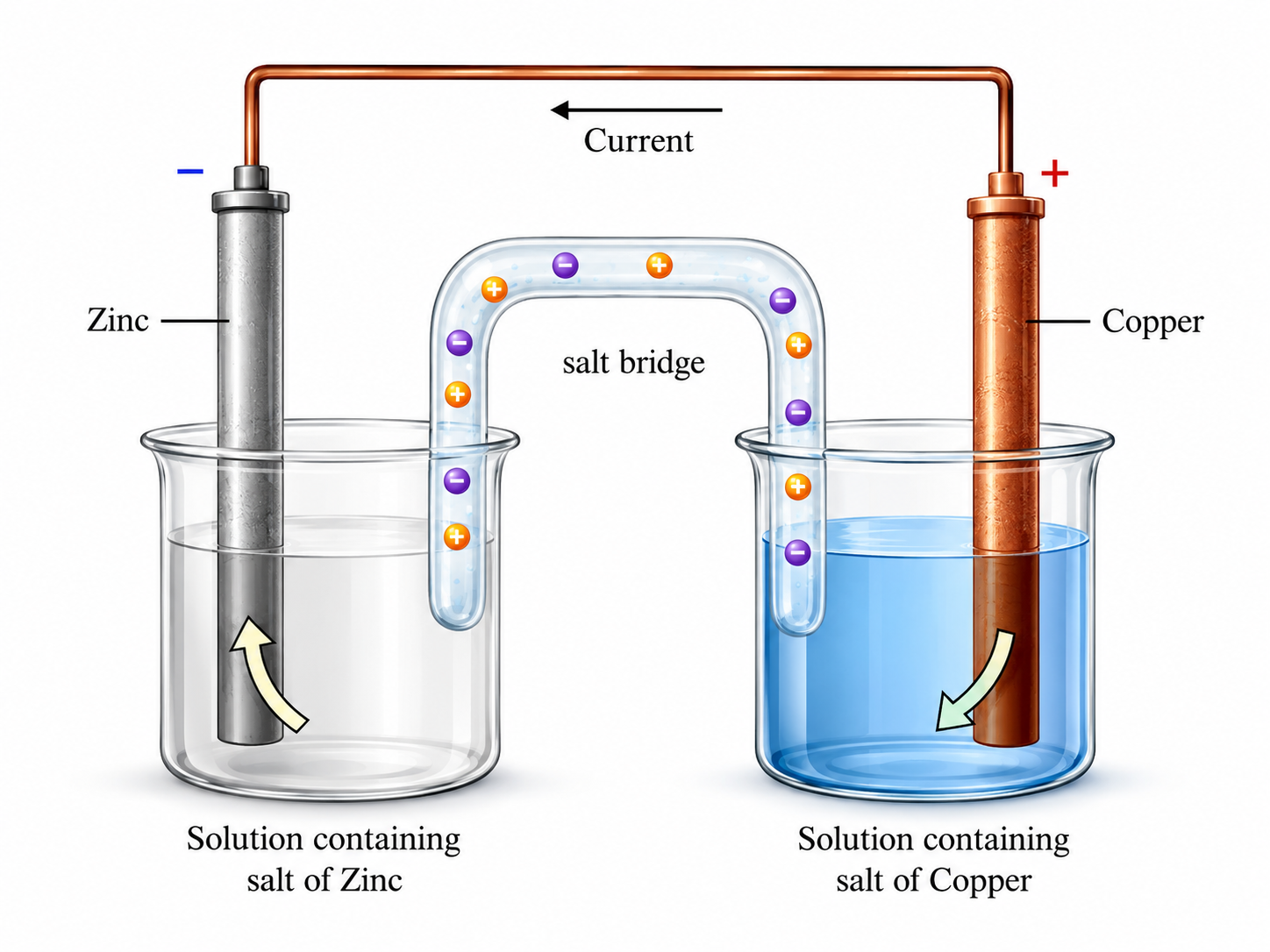
Galvanic (Voltaic) Cell
Converts chemical energy of a spontaneous redox reaction ($\Delta G < 0$) into electrical energy. (e.g. Daniell Cell).
$$\text{Zn}(s) + \text{Cu}^{2+}(aq) \longrightarrow \text{Zn}^{2+}(aq) + \text{Cu}(s)$$
The "LOAN" Trick
- Left side
- Oxidation occurs (Loss of $e^-$)
- Anode
- Negative terminal
Salt Bridge & SHE
Salt Bridge Functions
- Completes the inner electrical circuit.
- Maintains electrical neutrality in both half-cells.
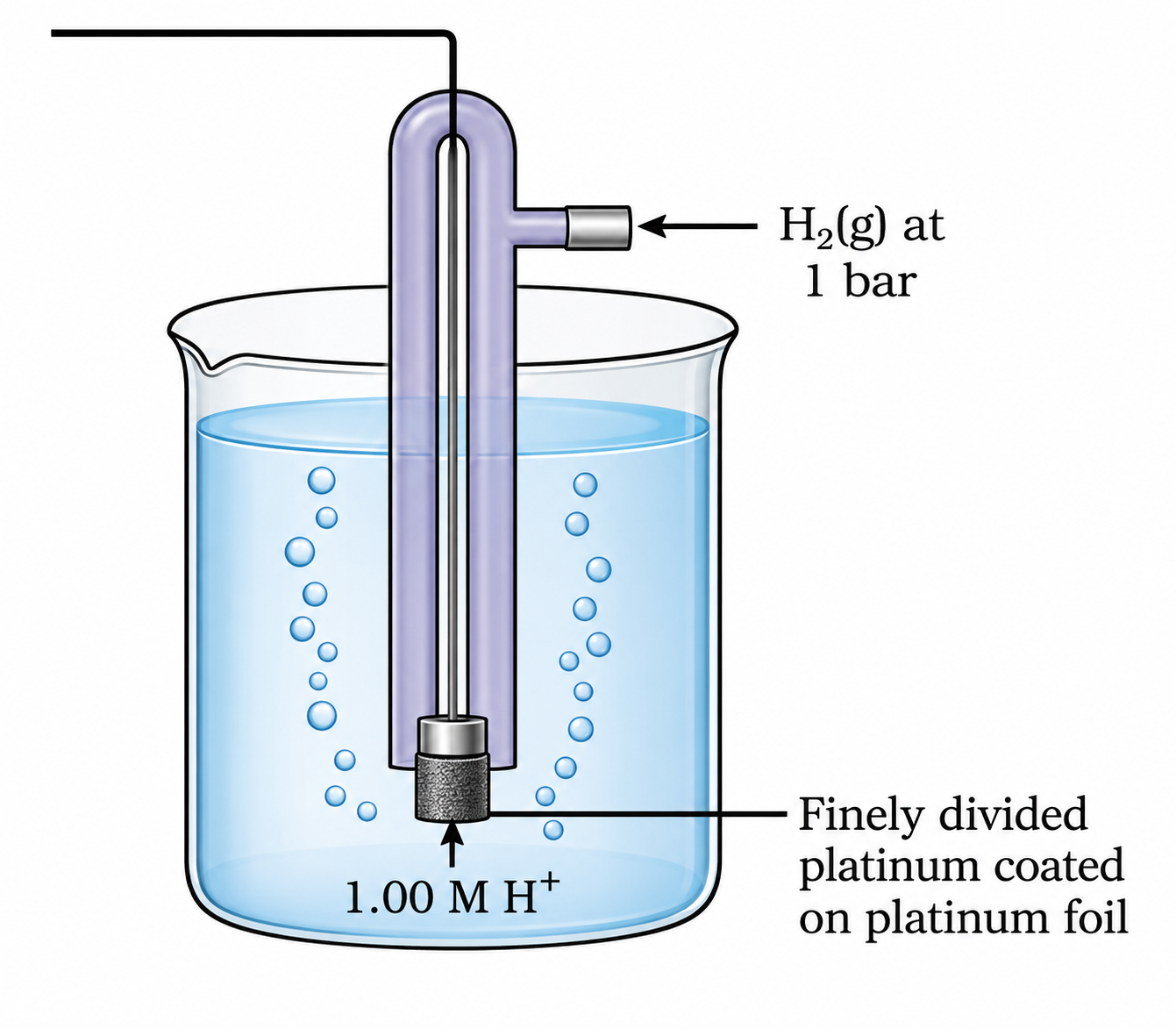
Standard Hydrogen Electrode (SHE)
Used as primary reference electrode. Assigned potential is exactly $0.00\text{ V}$ at all temperatures.
Reaction: $\text{H}^+(aq) + e^- \rightleftharpoons \frac{1}{2} \text{H}_2(g)$
Dilution Effects
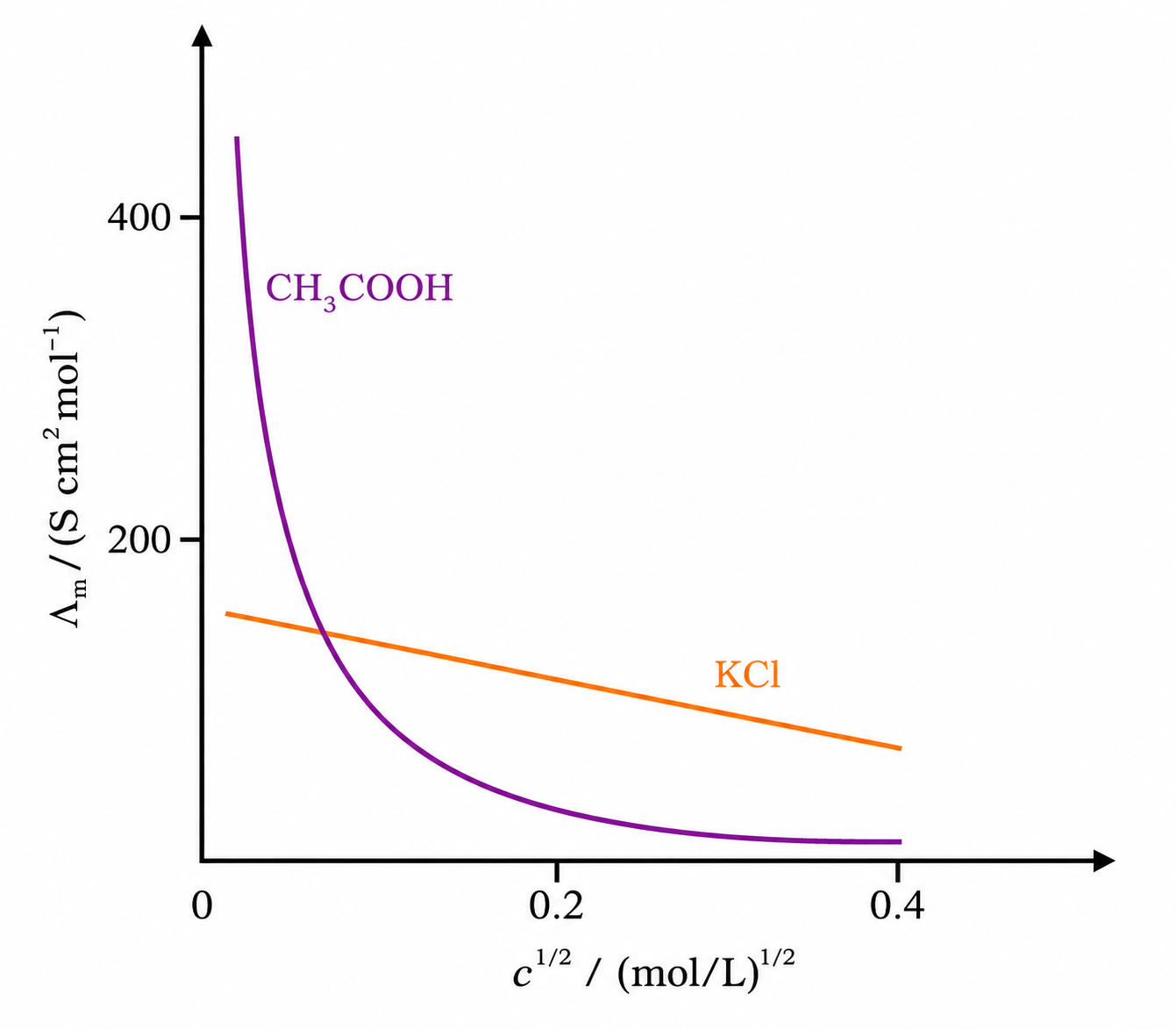
Conductivity ($\kappa$): Always decreases with dilution (fewer ions per unit volume).
Molar Conductivity ($\Lambda_m$): Always increases with dilution.
Strong vs Weak Electrolytes
- Strong: Modest increase. Debye-Hückel-Onsager equation: $\Lambda_m = \Lambda_m^\circ - A \sqrt{c}$
- Weak: Steep increase. Degree of dissociation ($\alpha$) shoots up on dilution. Cannot find $\Lambda_m^\circ$ graphically.
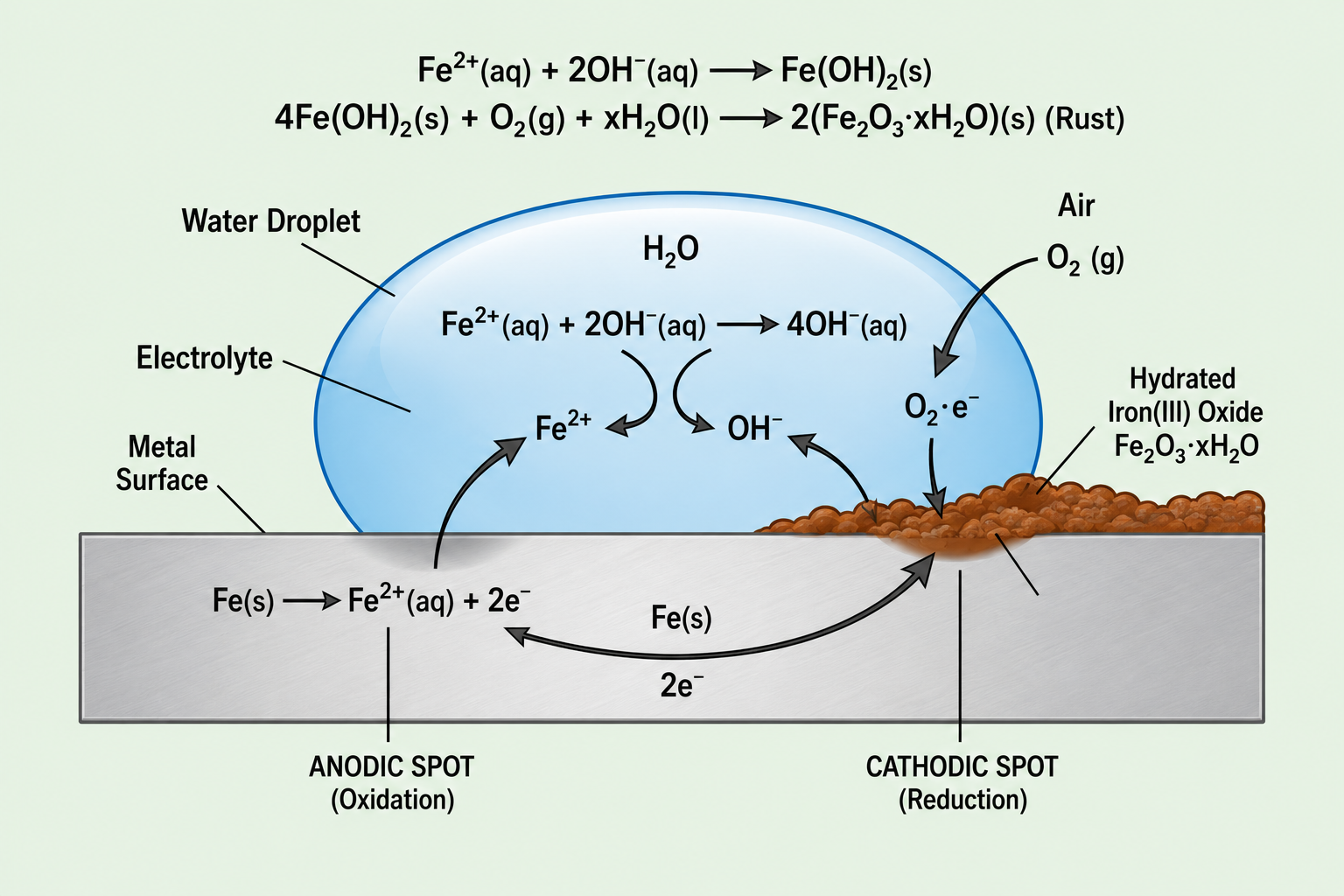
Corrosion
Electrochemical degradation of metals.
Mechanism of Rusting
Anode: $2\text{Fe} \rightarrow 2\text{Fe}^{2+} + 4e^-$
Cathode: $\text{O}_2 + 4\text{H}^+ + 4e^- \rightarrow 2\text{H}_2\text{O}$
Rust: $\text{Fe}_2\text{O}_3 \cdot x\text{H}_2\text{O}$
Prevention Methods
- Barrier: Paint, oil, grease.
- Galvanization: Coating iron with Zinc (more active, sacrifices itself).
- Cathodic Protection: Connecting underground pipes to Mg blocks.