Vardaan Learning Institute
Class 12 Chemistry • Comprehensive Chapter Notes
🌐 vardaanlearning.com📞 9508841336
Chapter 2: Electrochemistry
Dear Class 12 Student! Electrochemistry is the magnificent study of the relationship between electrical
energy and chemical changes. It bridges the gap between spontaneous chemical reactions (batteries) and
forcing non-spontaneous reactions using electricity (electrolysis). The Nernst Equation and Kohlrausch's
Law are the heart of this chapter, guaranteeing high-weightage numericals in both the CBSE Boards and
JEE Mains. Let's master the flow of electrons!
1. Electrochemical Cells (Galvanic / Voltaic Cells)
Concept
An Electrochemical Cell (Galvanic or Voltaic Cell) is a device that converts the chemical
energy of a spontaneous redox reaction ($\Delta G < 0$) into electrical energy.
A classic example is the Daniell Cell, which utilizes the redox reaction between Zinc
and Copper:
$$\text{Zn}(s) + \text{Cu}^{2+}(aq) \longrightarrow \text{Zn}^{2+}(aq) + \text{Cu}(s)$$
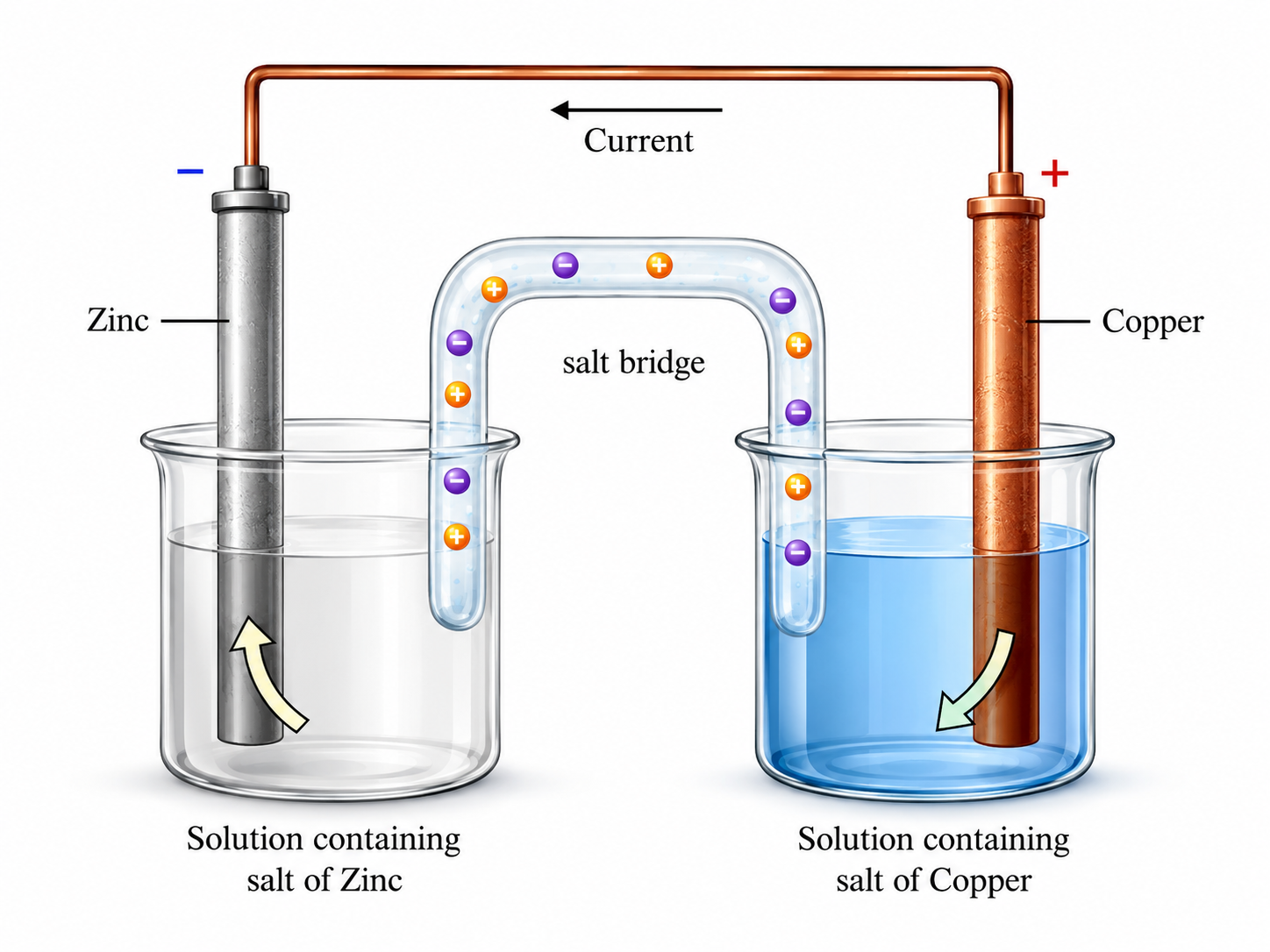
Fig. 2.1: Daniell cell
NCERT Concept: External Opposing Potential ($E_{ext}$)
What happens if we apply an external opposing potential to a Galvanic cell and slowly increase it?
- When $E_{ext} < 1.1\text{ V}$: The cell functions normally as a Galvanic cell.
Electrons flow from Zn to Cu, and current flows from Cu to Zn. Zinc dissolves at the anode,
Copper deposits at the cathode.
- When $E_{ext} = 1.1\text{ V}$: The opposing potential exactly balances the cell
potential. No flow of electrons or current. Chemical reactions stop completely.
- When $E_{ext} > 1.1\text{ V}$: The external potential overcomes the cell potential.
The cell starts functioning as an Electrolytic Cell, forcing the non-spontaneous
reverse reaction. Electrons flow from Cu to Zn, and current flows from Zn to Cu. Zinc is deposited
at the zinc electrode, and copper dissolves at the copper electrode.
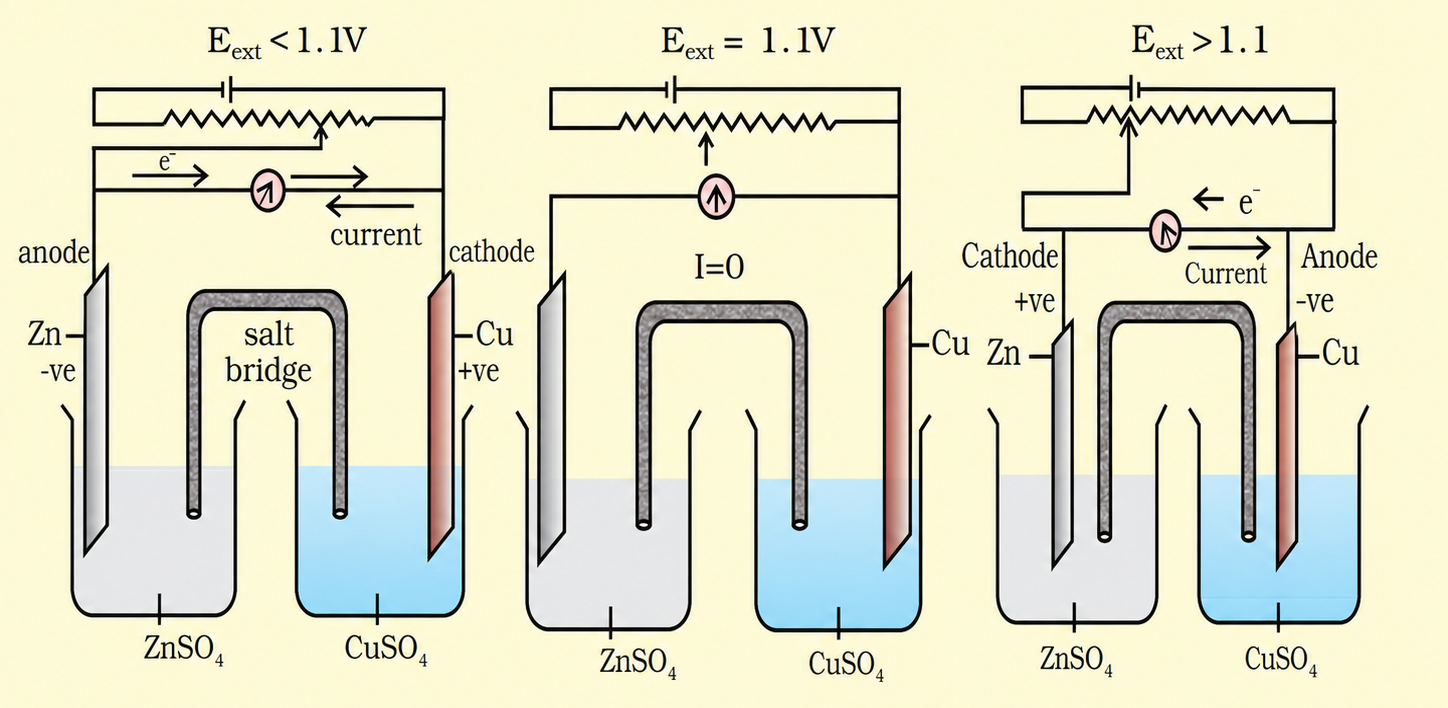
Fig. 2.2: Functioning of Daniell cell when external voltage is applied
Anode vs. Cathode & The "LOAN" Trick
To easily remember the conventions for a Galvanic Cell, use the acronym LOAN:
- Left side
- Oxidation occurs here (Loss of electrons)
- Anode
- Negative terminal
Consequently, the Cathode is on the Right, Reduction occurs there (Gain of electrons), and
it is the Positive terminal.
The Salt Bridge and Its Functions
A salt bridge is an inverted U-tube containing a paste of an inert electrolyte (like $\text{KCl},
\text{KNO}_3$, or $\text{NH}_4\text{NO}_3$) in agar-agar gel.
- Function 1: It completes the inner electrical circuit by allowing the flow of ions
between the two half-cells without mixing the solutions.
- Function 2: It maintains electrical neutrality in both half-cells. (If it weren't
there, the accumulation of $\text{Zn}^{2+}$ at the anode and loss of $\text{Cu}^{2+}$ at the cathode
would instantly stop the flow of electrons).
Representation of an Electrochemical Cell (IUPAC Convention)
A cell is represented by writing the Anode (Oxidation half) on the left and the Cathode (Reduction half) on
the right, separated by a double vertical line ($||$) representing the salt bridge.
$$\text{Zn}(s) | \text{Zn}^{2+}(aq) || \text{Cu}^{2+}(aq) | \text{Cu}(s)$$
Practice Problem 1
Question: Represent the cell in which the following reaction takes place: $\text{Mg}(s) +
2\text{Ag}^+(aq) \rightarrow \text{Mg}^{2+}(aq) + 2\text{Ag}(s)$. Identify the anode and cathode.
Solution:
1. Identify Oxidation: $\text{Mg}$ goes from $0$ to $+2$ state. So, $\text{Mg}$ undergoes oxidation.
(Anode).
2. Identify Reduction: $\text{Ag}^+$ goes from $+1$ to $0$ state. So, $\text{Ag}^+$ undergoes reduction.
(Cathode).
3. Cell Representation: $$\text{Mg}(s) | \text{Mg}^{2+}(aq) || \text{Ag}^+(aq) |
\text{Ag}(s)$$
2. Electrode Potential and Standard Hydrogen Electrode (SHE)
Electrode Potential ($E$): When a metal is placed in a solution of its own ions, a potential
difference develops between the metal and the solution. This is called electrode potential.
Standard Electrode Potential ($E^\circ$): The potential measured when the concentration of
all species involved is unity ($1\text{ M}$), pressure of gases is $1\text{ atm}$ ($1\text{ bar}$), and
temperature is $298\text{ K}$.
According to IUPAC convention, standard reduction potentials are
accepted as standard electrode potentials.
Standard Hydrogen Electrode (SHE)
We cannot measure the absolute potential of a single half-cell. We can only measure the difference
between two half-cells. Therefore, we need a reference electrode. The SHE is chosen as the primary
reference.
- Construction: A platinum wire coated with finely divided platinum black, dipped in a
$1\text{ M}$ $\text{H}^+$ solution (e.g., $1\text{ M HCl}$). Pure $\text{H}_2$ gas at $1\text{ atm}$
pressure is bubbled through it.
- Reaction: $\text{H}^+(aq) + e^- \rightleftharpoons \frac{1}{2} \text{H}_2(g)$
- Assigned Value: By international agreement, the $E^\circ$ of SHE is exactly
$0.00\text{ V}$ at all temperatures.
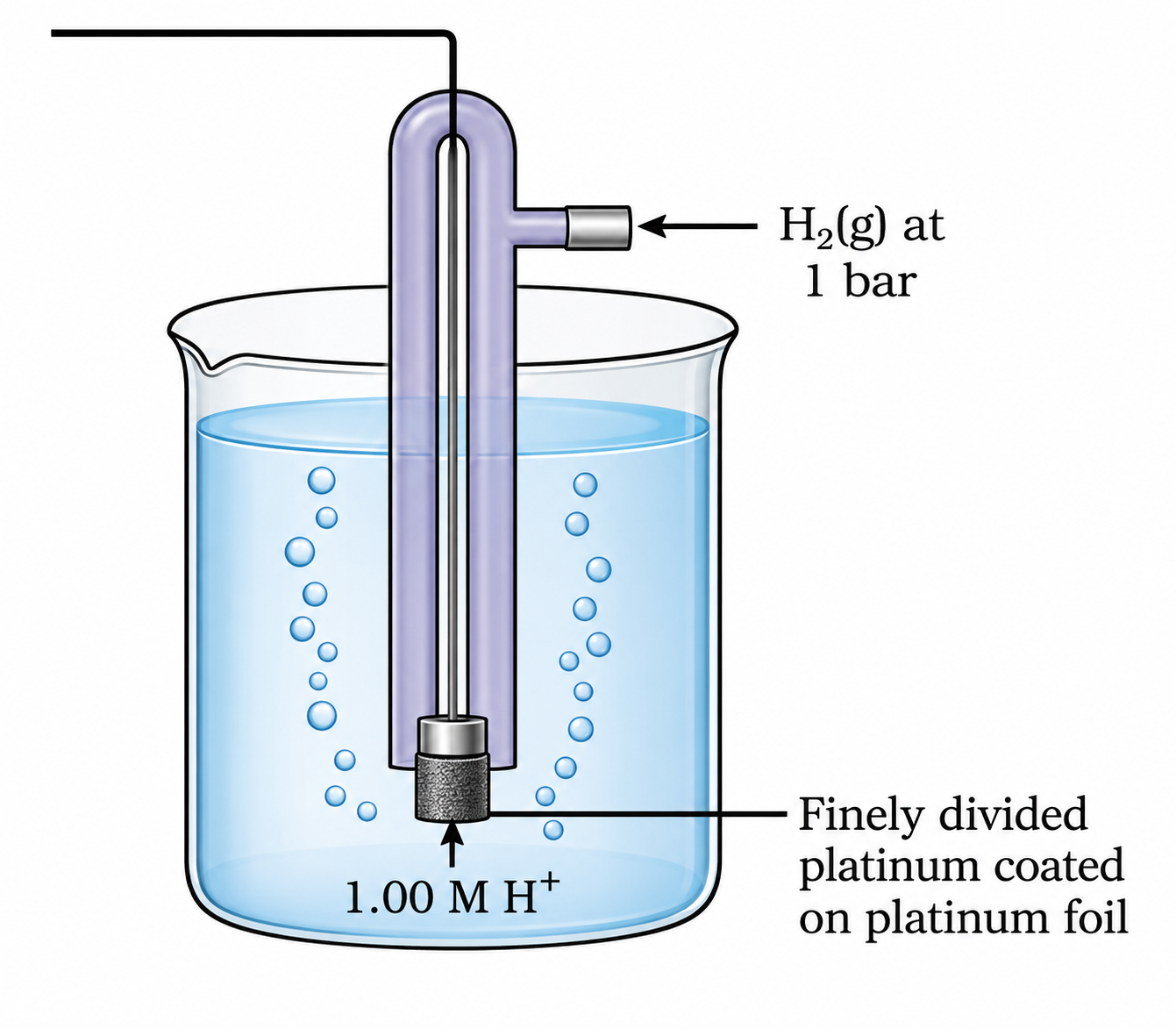
Fig. 2.3: Standard Hydrogen Electrode
Standard Cell Potential ($E^\circ_{cell}$)
The electromotive force (EMF) of a cell under standard conditions is the difference between the standard
reduction potentials of the cathode and the anode.
$$E^\circ_{cell} = E^\circ_{cathode} - E^\circ_{anode}$$
$$E^\circ_{cell} = E^\circ_{Right} - E^\circ_{Left}$$
Electrochemical Series
It is the arrangement of various elements in order of their increasing standard reduction potentials.
- Substances with higher (more positive) reduction potentials (like $\text{F}_2, \text{Au}, \text{Ag}$)
have a strong tendency to get reduced. They are powerful oxidizing agents.
- Substances with lower (more negative) reduction potentials (like $\text{Li}, \text{K}, \text{Zn}$) have
a strong tendency to get oxidized. They are powerful reducing agents.
- Predicting Spontaneity: A redox reaction is feasible only if the calculated
$E^\circ_{cell}$ is positive ($> 0$).
Practice Problem 2
Question: Given $E^\circ_{\text{Zn}^{2+}/\text{Zn}} = -0.76\text{ V}$ and
$E^\circ_{\text{Cu}^{2+}/\text{Cu}} = +0.34\text{ V}$. Calculate the standard EMF of the Daniell cell.
Solution:
1. Zinc has a lower reduction potential, so it acts as the Anode.
2. Copper has a higher reduction potential, so it acts as the Cathode.
3. Formula: $E^\circ_{cell} = E^\circ_{cathode} - E^\circ_{anode}$
4. $E^\circ_{cell} = (+0.34\text{ V}) - (-0.76\text{ V}) = \mathbf{1.10\text{ V}}$.
3. Nernst Equation (Crucial for Numericals)
The standard cell potential ($E^\circ$) is only valid at standard conditions ($1\text{ M}$, $1\text{ atm}$,
$298\text{ K}$). Walther Nernst gave an equation to calculate the electrode potential and EMF of a cell at
any concentration and temperature.
Nernst Equation for a Single Electrode
For a general reduction reaction: $M^{n+}(aq) + ne^- \rightarrow M(s)$
$$E = E^\circ - \frac{RT}{nF} \ln \frac{[\text{M}(s)]}{[\text{M}^{n+}(aq)]}$$
Converting natural log ($\ln$) to base 10 ($\log$) by multiplying by $2.303$, and knowing the concentration
of a pure solid $[\text{M}(s)] = 1$:
$$E = E^\circ - \frac{2.303 RT}{nF} \log \frac{1}{[\text{M}^{n+}]}$$
At $298\text{ K} (25^\circ\text{C})$, substituting $R = 8.314\text{ J K}^{-1}
\text{mol}^{-1}$, $F = 96487\text{ C}$, and $T = 298\text{ K}$:
$$E = E^\circ - \frac{0.0591}{n} \log \frac{1}{[\text{M}^{n+}]}$$
Nernst Equation for a Complete Cell
For a general cell reaction: $aA + bB \rightarrow cC + dD$
$$E_{cell} = E^\circ_{cell} - \frac{RT}{nF} \ln Q$$
Where $Q$ is the Reaction Quotient ($Q = \frac{[C]^c [D]^d}{[A]^a [B]^b}$).
At $298\text{ K}$ (Crucial Formula):
$$E_{cell} = E^\circ_{cell} - \frac{0.0591}{n} \log
\frac{[\text{Products}]}{[\text{Reactants}]}$$
Equilibrium Constant from Nernst Equation
As the cell reaction proceeds, the concentration of reactants decreases and products increases. Eventually,
the cell reaches equilibrium, and the voltmeter reads zero ($E_{cell} = 0$). At equilibrium, the reaction
quotient $Q$ becomes the equilibrium constant $K_c$.
$$0 = E^\circ_{cell} - \frac{0.0591}{n} \log K_c$$
$$\log K_c = \frac{n \times E^\circ_{cell}}{0.0591}$$
Electrochemical Cell and Gibbs Energy ($\Delta G$)
Electrical work done in one second is equal to electrical potential multiplied by total charge passed. The
reversible work done by a galvanic cell is equal to the decrease in its Gibbs energy and therefore, if the
emf of the cell is $E_{cell}$ and $nF$ is the amount of charge passed, then:
$$\Delta_r G = -nFE_{cell}$$
Note: It may be remembered that $E_{cell}$ is an intensive parameter but $\Delta_r G$ is an extensive
thermodynamic property and its value depends on $n$. Therefore, $\Delta_r G$ represents the
maximum useful (non-expansion) work that can be obtained from a Galvanic cell.
For standard conditions:
$$\Delta_r G^\circ = -nFE^\circ_{cell}$$
Relating standard free energy to equilibrium constant:
$$\Delta_r G^\circ = -2.303 RT \log K_c$$
JEE Main Note: Nernst for Hydrogen Electrode
For a Standard Hydrogen Electrode (SHE), or any hydrogen electrode dipping in an acidic solution at
$298\text{ K}$, the electrode potential depends directly on the $\text{pH}$ of the solution.
Reaction: $\text{H}^+(aq) + e^- \rightleftharpoons \frac{1}{2} \text{H}_2(g)$ ($1\text{ atm}$)
Using Nernst: $E = E^\circ - 0.0591 \log \frac{1}{[\text{H}^+]}$
Since $E^\circ = 0$ and $-\log [\text{H}^+] = \text{pH}$:
$$E_{\text{H}^+/\text{H}_2} = -0.0591 \times \text{pH}$$
JEE Main Transition: Concentration Cells
A cell in which both the anode and cathode are made of the exact same material, but the electrolyte
concentrations in the two half-cells are different.
Because the electrodes are identical, $E^\circ_{cell} = 0$.
The EMF is generated purely by the concentration gradient. For example: $\text{Cu} | \text{Cu}^{2+}(C_1) ||
\text{Cu}^{2+}(C_2) | \text{Cu}$
Using Nernst: $E_{cell} = 0 - \frac{0.0591}{n} \log \left(\frac{C_1}{C_2}\right)$. For the cell to be
spontaneous ($E_{cell} > 0$), $C_2$ must be $> C_1$.
Practice Problem 3
Question: Calculate the EMF of the cell in which the following reaction takes place:
$\text{Ni}(s) + 2\text{Ag}^+(0.002\text{ M}) \rightarrow \text{Ni}^{2+}(0.160\text{ M}) + 2\text{Ag}(s)$.
Given that $E^\circ_{cell} = 1.05\text{ V}$.
Solution:
1. The reaction transfers 2 electrons ($n = 2$).
2. Apply Nernst equation for the complete cell at 298 K:
$$E_{cell} = E^\circ_{cell} - \frac{0.0591}{n} \log \frac{[\text{Products}]}{[\text{Reactants}]}$$
3. The solid states [Ni] and [Ag] are taken as 1. So, $Q =
\frac{[\text{Ni}^{2+}]}{[\text{Ag}^+]^2}$.
4. $E_{cell} = 1.05 - \frac{0.0591}{2} \log \frac{0.160}{(0.002)^2}$
5. Calculate log term: $\frac{0.160}{(2 \times 10^{-3})^2} = \frac{0.160}{4 \times 10^{-6}} =
\frac{160000}{4} = 40000 = 4 \times 10^4$.
6. $\log(4 \times 10^4) = \log 4 + 4\log 10 = 0.6021 + 4 = 4.6021$.
7. $E_{cell} = 1.05 - (0.02955 \times 4.6021) = 1.05 - 0.136 = \mathbf{0.914\text{ V}}$.
Practice Problem 4
Question: Calculate the standard Gibbs free energy ($\Delta G^\circ$) and equilibrium
constant ($K_c$) for the Daniell cell at 298 K. Given $E^\circ_{cell} = 1.1\text{ V}$, $1\text{ F} =
96487\text{ C mol}^{-1}$.
Solution:
Part 1: $\Delta G^\circ$
1. For Daniell cell, $n = 2$ (transfer of 2 electrons).
2. Formula: $\Delta G^\circ = -nFE^\circ_{cell}$.
3. $\Delta G^\circ = -2 \times 96487 \times 1.1 = -212,271.4\text{ J mol}^{-1} = \mathbf{-212.27\text{
kJ mol}^{-1}}$.
Part 2: $K_c$
1. Formula: $\log K_c = \frac{n \times E^\circ_{cell}}{0.0591}$.
2. $\log K_c = \frac{2 \times 1.1}{0.0591} = \frac{2.2}{0.0591} = 37.225$.
3. Taking antilog: $K_c = \text{antilog}(37.225) = \mathbf{1.68 \times 10^{37}}$.
4. Conductance of Electrolytic Solutions
- Resistance ($R$): The obstruction to the flow of current. $R = \rho \frac{l}{A}$. Unit:
Ohm ($\Omega$).
- Conductance ($G$): The ease with which current flows. Reciprocal of resistance. $G =
\frac{1}{R}$. Unit: Siemens (S) or $\Omega^{-1}$ or mho.
- Resistivity / Specific Resistance ($\rho$): Resistance of a conductor of unit length
and unit area of cross-section. Unit: $\Omega \text{ cm}$ or $\Omega \text{ m}$.
- Conductivity / Specific Conductance ($\kappa$, kappa): The reciprocal of resistivity.
It is the conductance of exactly $1\text{ cm}^3$ of the solution.
$\kappa = \frac{1}{\rho} = G \times \frac{l}{A}$. Unit: $\text{S cm}^{-1}$ or $\text{S m}^{-1}$.
Measurement of Conductivity of Ionic Solutions
Measuring the resistance of an ionic solution using a Wheatstone bridge faces two main practical
difficulties:
- Passing a direct current (DC) through the solution causes electrolysis (polarization of
the electrodes), changing the composition of the solution.
- A solution of unknown resistance cannot be connected to the bridge like a solid metallic wire.
Solutions: The first difficulty is resolved by using an alternating current
(AC) source of audio frequency ($550 - 5000\text{ Hz}$). The second difficulty is resolved by
using a specially designed vessel called a conductivity cell, which contains two platinum
electrodes coated with platinum black.
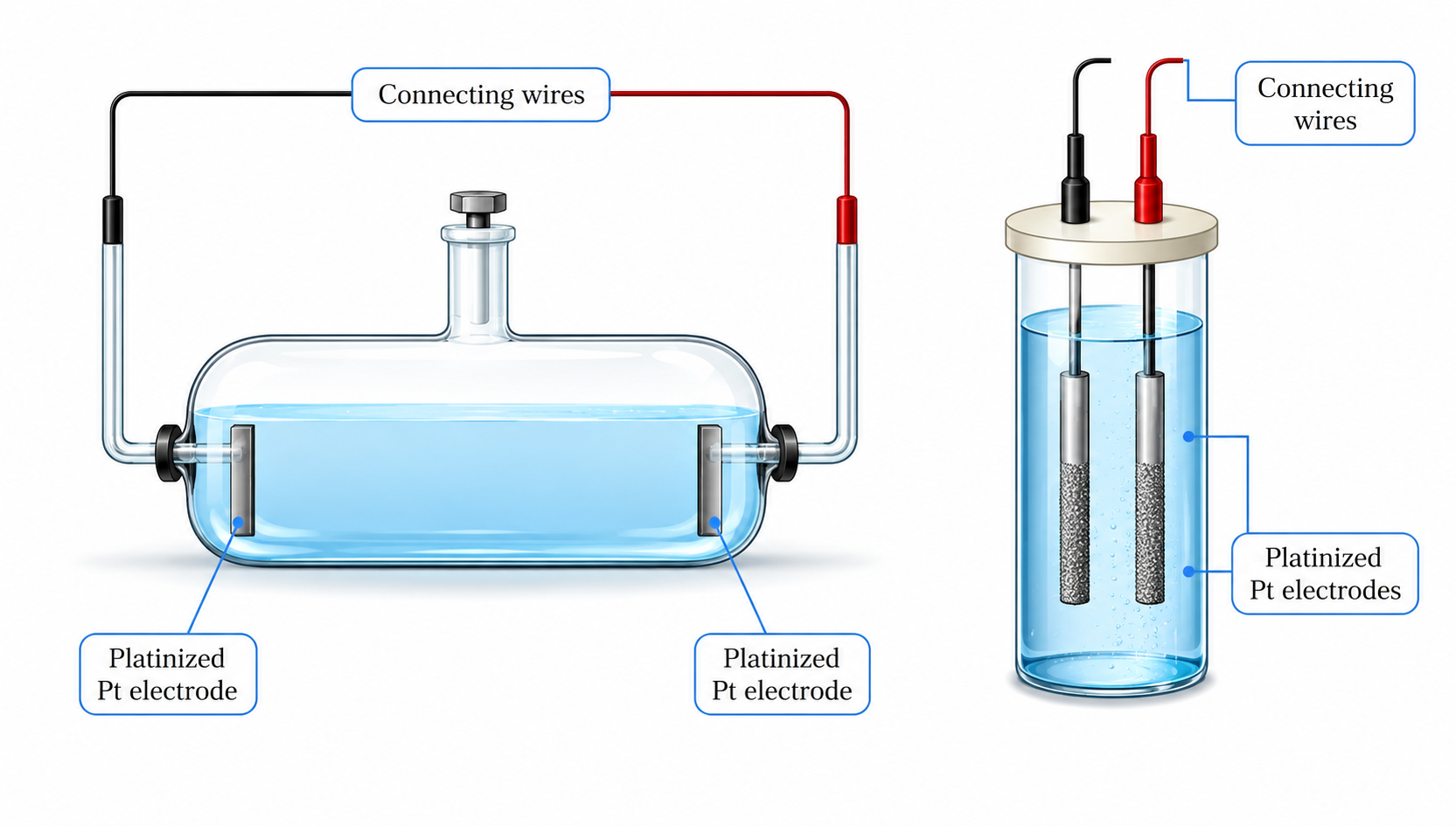
Fig. 2.4: Two different types of conductivity cells
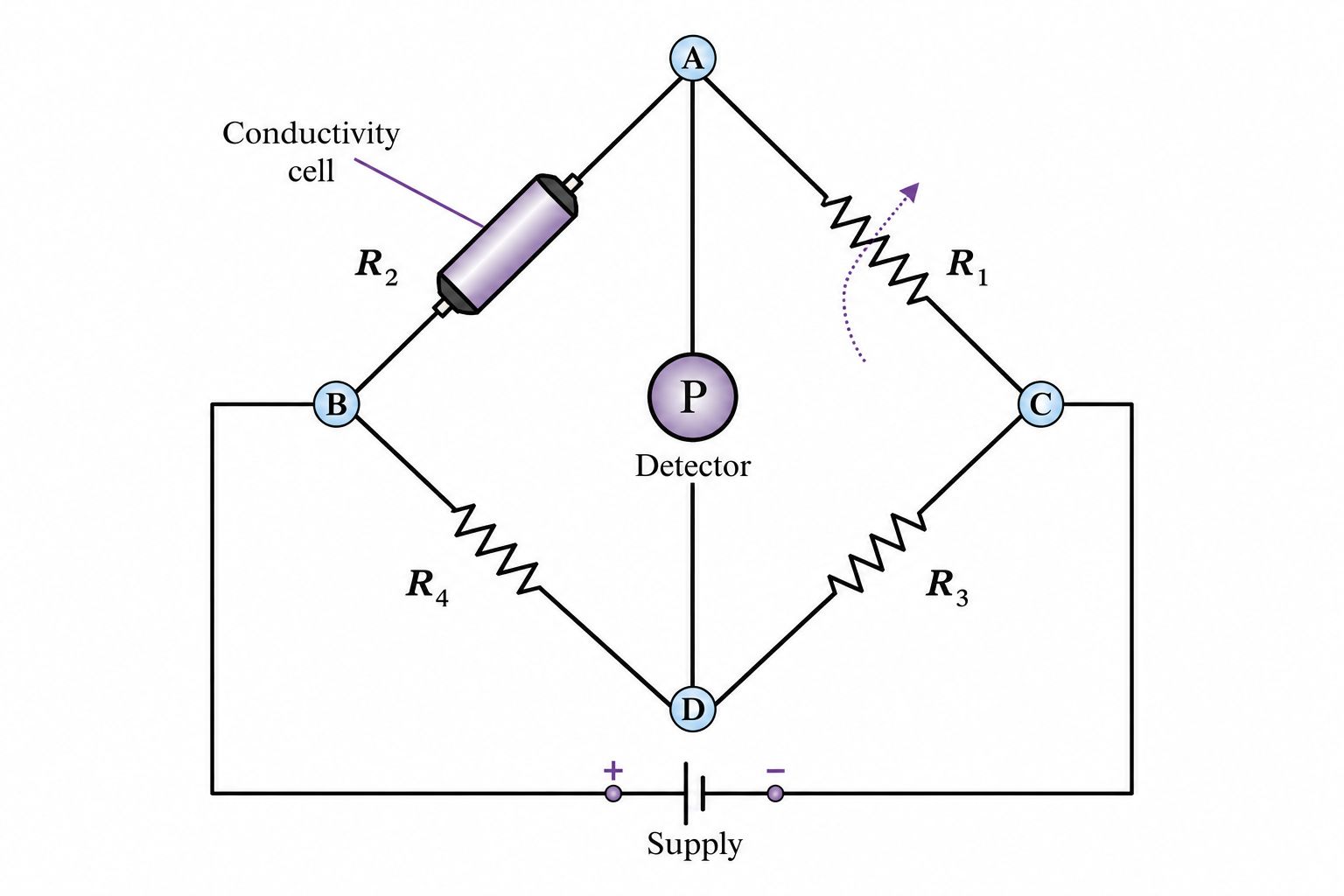
Fig. 2.5: Arrangement for measurement of resistance of a solution of an electrolyte
Cell Constant ($G^*$) & Molar Conductivity ($\Lambda_m$)
Cell Constant ($G^*$): For any given conductivity cell, the ratio of distance between
electrodes ($l$) to the area of cross-section ($A$) is constant.
$$G^* = \frac{l}{A}$$
Thus, Conductivity = Conductance $\times$ Cell Constant $\implies \mathbf{\kappa = G \times G^*}$.
Molar Conductivity ($\Lambda_m$): The total conducting power of all the ions produced by
dissolving exactly 1 mole of an electrolyte in a solution.
$$\Lambda_m = \frac{\kappa \times 1000}{M}$$
Where $M$ is Molarity, and $\kappa$ is in $\text{S cm}^{-1}$. The unit of $\Lambda_m$ is $\text{S
cm}^2 \text{ mol}^{-1}$.
Practice Problem 5
Question: Resistance of a conductivity cell filled with $0.1\text{ M KCl}$ solution is
$100\text{ }\Omega$. If the resistance of the same cell when filled with $0.02\text{ M KCl}$ solution is
$520\text{ }\Omega$, calculate the conductivity and molar conductivity of $0.02\text{ M KCl}$ solution. The
conductivity of $0.1\text{ M KCl}$ solution is $1.29\text{ S/m}$.
Solution:
Step 1: Find the Cell Constant using the first solution.
1. $\kappa_1 = 1.29\text{ S/m} = 0.0129\text{ S cm}^{-1}$.
2. $R_1 = 100\text{ }\Omega$.
3. Cell Constant $G^* = \kappa_1 \times R_1 = 0.0129 \times 100 = 1.29\text{ cm}^{-1}$.
Step 2: Find Conductivity ($\kappa_2$) for the second solution.
1. The cell constant $G^*$ remains the same for the same cell ($1.29\text{ cm}^{-1}$).
2. $R_2 = 520\text{ }\Omega$.
3. $\kappa_2 = \frac{G^*}{R_2} = \frac{1.29}{520} = \mathbf{2.48 \times 10^{-3}\text{ S
cm}^{-1}}$.
Step 3: Find Molar Conductivity ($\Lambda_m$) for the second solution.
1. $M = 0.02\text{ M}$.
2. $\Lambda_m = \frac{\kappa_2 \times 1000}{M} = \frac{2.48 \times 10^{-3} \times 1000}{0.02} =
\frac{2.48}{0.02} = \mathbf{124\text{ S cm}^2\text{ mol}^{-1}}$.
5. Variation of Conductivity and Molar Conductivity with Concentration
1. Variation of Conductivity ($\kappa$)
Conductivity always decreases with a decrease in concentration (i.e., decreases with
dilution) for both strong and weak electrolytes.
Reason: Conductivity is the conductance of exactly $1\text{ cm}^3$ of solution. Upon dilution, the
number of ions per unit volume decreases, thereby decreasing the conductivity.
2. Variation of Molar Conductivity ($\Lambda_m$)
Molar conductivity always increases with a decrease in concentration (i.e., increases with
dilution). This is because the total volume $V$ containing 1 mole of electrolyte increases more rapidly than
$\kappa$ decreases.
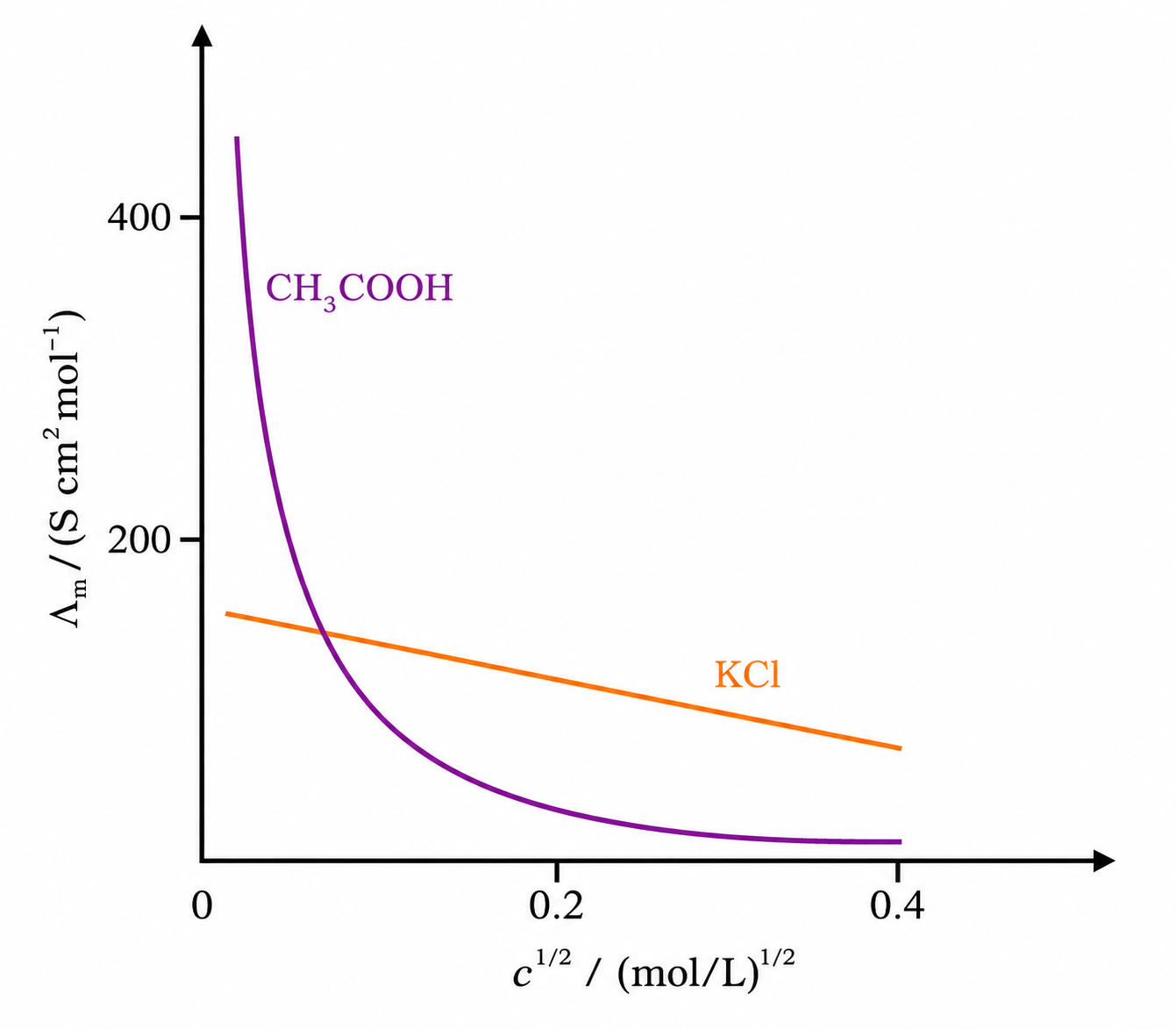
Fig. 2.6: Molar conductivity versus c½ graph
- For Strong Electrolytes (e.g., KCl, NaCl): They are completely dissociated at all
concentrations. The increase in $\Lambda_m$ upon dilution is modest. It is due to the fact that as
concentration decreases, ions move further apart, reducing interionic attractive forces, allowing ions
to move faster. It follows the Debye-Hückel-Onsager equation:
$$\Lambda_m = \Lambda_m^\circ - A \sqrt{c}$$
(Where $\Lambda_m^\circ$ is the Limiting Molar Conductivity at infinite dilution. The value of constant
$A$ depends on the type of electrolyte, i.e., the charges on the cation and anion. For example,
$\text{NaCl}$ is a 1-1 electrolyte, $\text{CaCl}_2$ is a 2-1
electrolyte, and $\text{MgSO}_4$ is a 2-2 electrolyte. All electrolytes of
a particular type have the same value for $A$).
- For Weak Electrolytes (e.g., CH3COOH): They are only partially dissociated. As
concentration decreases (dilution increases), the degree of dissociation ($\alpha$) increases
drastically, generating vastly more ions. Hence, $\Lambda_m$ increases steeply on dilution. Because the
curve shoots upward parallel to the y-axis, we cannot determine its $\Lambda_m^\circ$ by simple
graphical extrapolation.
Practice Problem 5A
Question: At the same concentration, why does $0.01\text{ M}$ acetic acid show much lower
conductivity ($\kappa$) but much higher increase in molar conductivity ($\Lambda_m$) on dilution compared to
$0.01\text{ M}$ KCl?
Solution:
1. KCl is a strong electrolyte; it is almost fully dissociated even before dilution. So
dilution mainly reduces ion-ion interactions, causing only a small rise in $\Lambda_m$.
2. Acetic acid is a weak electrolyte; initially very few ions are present, so $\kappa$
is low.
3. On dilution, its degree of dissociation ($\alpha$) increases significantly, creating many more ions,
so $\Lambda_m$ rises sharply.
4. Therefore, weak electrolytes have low $\kappa$ at a given concentration but a very steep increase of
$\Lambda_m$ with dilution.
6. Kohlrausch's Law of Independent Migration of Ions
Because graphical extrapolation fails for weak electrolytes, Friedrich Kohlrausch formulated a law based on
experimental observations to calculate their limiting molar conductivity.
Kohlrausch's Law
Statement: The limiting molar conductivity of an electrolyte at infinite dilution can be
represented as the sum of the individual contributions of the anion and the cation of the electrolyte. At
infinite dilution, interionic attractions are zero, and each ion migrates independently.
$$\Lambda_m^\circ = \nu_+ \lambda_+^\circ + \nu_- \lambda_-^\circ$$
Where $\lambda_+^\circ$ and $\lambda_-^\circ$ are the limiting molar conductivities of the cation and anion
respectively, and $\nu_+$ and $\nu_-$ are the number of cations and anions generated per formula unit.
Applications of Kohlrausch's Law (Extremely Important for Boards)
1. Calculation of $\Lambda_m^\circ$ for Weak Electrolytes: We use algebraic manipulation of
strong electrolytes to find the value for a weak electrolyte.
Example: To find $\Lambda_m^\circ(\text{CH}_3\text{COOH})$:
$\Lambda_m^\circ(\text{CH}_3\text{COOH}) = \Lambda_m^\circ(\text{CH}_3\text{COONa}) +
\Lambda_m^\circ(\text{HCl}) - \Lambda_m^\circ(\text{NaCl})$
2. Calculation of Degree of Dissociation ($\alpha$):
$$\alpha = \frac{\Lambda_m^c}{\Lambda_m^\circ}$$
3. Calculation of Dissociation Constant ($K_a$):
$$K_a = \frac{c \alpha^2}{1 - \alpha}$$
4. Calculation of Solubility and Solubility Product ($K_{sp}$) of Sparingly Soluble
Salts:
For a salt like $\text{AgCl}(s) \rightleftharpoons \text{Ag}^+(aq) + \text{Cl}^-(aq)$, if solubility is
$S\text{ mol L}^{-1}$, then:
$$K_{sp} = [\text{Ag}^+][\text{Cl}^-] = S^2$$
We find $S$ from conductivity of saturated solution using ion conductances at infinite dilution.
Practice Problem 6
Question: Calculate $\Lambda_m^\circ$ for acetic acid. Given that $\Lambda_m^\circ$ for
$\text{HCl}$, $\text{NaCl}$, and $\text{CH}_3\text{COONa}$ are $426.0$, $126.0$, and $91.0 \text{ S cm}^2
\text{ mol}^{-1}$ respectively.
Solution:
1. We need $\Lambda_m^\circ(\text{CH}_3\text{COOH})$, which is composed of
$\lambda^\circ(\text{CH}_3\text{COO}^-) + \lambda^\circ(\text{H}^+)$.
2. Using Kohlrausch's Law:
$\Lambda_m^\circ(\text{CH}_3\text{COOH}) = \Lambda_m^\circ(\text{CH}_3\text{COONa}) +
\Lambda_m^\circ(\text{HCl}) - \Lambda_m^\circ(\text{NaCl})$
3. $\Lambda_m^\circ(\text{CH}_3\text{COOH}) = 91.0 + 426.0 - 126.0$
4. $\Lambda_m^\circ(\text{CH}_3\text{COOH}) = 517.0 - 126.0 = \mathbf{391.0\text{ S cm}^2\text{
mol}^{-1}}$.
Practice Problem 7
Question: The conductivity of $0.001028\text{ M}$ acetic acid is $4.95 \times 10^{-5}\text{
S cm}^{-1}$. Calculate its dissociation constant ($K_a$) if $\Lambda_m^\circ$ for acetic acid is
$390.5\text{ S cm}^2\text{ mol}^{-1}$.
Solution:
1. Find $\Lambda_m^c$: $\Lambda_m^c = \frac{\kappa \times 1000}{M} = \frac{4.95 \times
10^{-5} \times 1000}{0.001028} = \frac{0.0495}{0.001028} = 48.15\text{ S cm}^2\text{ mol}^{-1}$.
2. Find Degree of Dissociation ($\alpha$): $\alpha =
\frac{\Lambda_m^c}{\Lambda_m^\circ} = \frac{48.15}{390.5} \approx 0.1233$.
3. Find Dissociation Constant ($K_a$):
$K_a = \frac{c \alpha^2}{1 - \alpha} = \frac{0.001028 \times (0.1233)^2}{1 - 0.1233} = \frac{0.001028
\times 0.0152}{0.8767} = \mathbf{1.78 \times 10^{-5}}$.
Practice Problem 7A
Question: At $25^\circ\text{C}$, conductivity of saturated $\text{AgCl}$ solution is $3.41
\times 10^{-6}\text{ S cm}^{-1}$. Given $\Lambda_m^\circ(\text{AgCl}) = 138.6\text{ S cm}^2\text{
mol}^{-1}$, calculate its solubility and $K_{sp}$.
Solution:
1. Use $\Lambda_m = \dfrac{\kappa \times 1000}{c}$. For very dilute saturated solution, $\Lambda_m
\approx \Lambda_m^\circ$.
2. So, $c = \dfrac{\kappa \times 1000}{\Lambda_m^\circ} = \dfrac{3.41 \times 10^{-6} \times 1000}{138.6}
= 2.46 \times 10^{-5}\text{ mol L}^{-1}$.
3. Hence, solubility $S = \mathbf{2.46 \times 10^{-5}\text{ mol L}^{-1}}$.
4. For $\text{AgCl} \rightleftharpoons \text{Ag}^+ + \text{Cl}^-$, $K_{sp} = S^2$.
5. $K_{sp} = (2.46 \times 10^{-5})^2 = \mathbf{6.05 \times 10^{-10}}$.
7. Electrolytic Cells and Electrolysis
Electrolysis is the process of chemical decomposition of an electrolyte by the passage of
direct electric current. Unlike a Galvanic cell, an Electrolytic cell forces a non-spontaneous reaction to
occur by inputting electrical energy.
Products of Electrolysis (Preferential Discharge Theory)
If an aqueous solution contains multiple types of cations and anions, which one gets discharged at the
electrodes?
- At the Cathode (Reduction): The ion with the higher standard reduction potential
gets discharged first.
- At the Anode (Oxidation): The ion with the lower standard reduction potential
gets discharged first.
1. Electrolysis of Sodium Chloride ($\text{NaCl}$)
A. Molten $\text{NaCl}$ (Only $\text{Na}^+$ and $\text{Cl}^-$ ions are present):
•
At Cathode (Reduction):
$\text{Na}^+ + e^- \rightarrow \text{Na}(s)$
•
At Anode (Oxidation):
$\text{Cl}^- \rightarrow \frac{1}{2}\text{Cl}_2(g) + e^-$
•
At Cathode: Both $\text{Na}^+$ and $\text{H}_2\text{O}$ compete. Since the reduction potential of water is higher ($E^\circ = -0.83\text{ V}$) than that of sodium ($E^\circ = -2.71\text{ V}$), water is preferentially reduced:
$\text{H}_2\text{O}(l) + e^- \rightarrow \frac{1}{2}\text{H}_2(g) + \text{OH}^-(aq)$
•
At Anode: Both $\text{Cl}^-$ and $\text{H}_2\text{O}$ compete. Theoretically, oxidation of water ($E^\circ = 1.23\text{ V}$) should happen before chloride ($E^\circ = 1.36\text{ V}$). However, due to
Overpotential (the kinetic slowness of liberating oxygen gas), chloride is oxidized:
$\text{Cl}^- \rightarrow \frac{1}{2}\text{Cl}_2(g) + e^-$
•
Overall Aqueous Reaction:
$\text{NaCl}(aq) + \text{H}_2\text{O}(l) \rightarrow \text{Na}^+(aq) + \text{OH}^-(aq) + \frac{1}{2}\text{H}_2(g) + \frac{1}{2}\text{Cl}_2(g)$
2. Electrolysis of Sulphuric Acid ($\text{H}_2\text{SO}_4$)
A. Dilute $\text{H}_2\text{SO}_4$ (Oxidation of water is preferred at the anode):
•
At Anode (Oxidation):
$2\text{H}_2\text{O}(l) \rightarrow \text{O}_2(g) + 4\text{H}^+(aq) + 4e^-$
•
At Anode (Oxidation):
$2\text{SO}_4^{2-}(aq) \rightarrow \text{S}_2\text{O}_8^{2-}(aq) + 2e^-$
*(Liberating the **Peroxodisulphate** ion)*
Faraday's Laws of Electrolysis
First Law: The mass of substance ($w$) deposited or liberated at any electrode is directly
proportional to the quantity of electricity ($Q = I \times t$) passed through the electrolyte.
$$w \propto Q \implies w = Z \cdot I \cdot t$$
Where $Z$ is the electrochemical equivalent. It relates to equivalent mass ($E$) by $Z =
\frac{E}{96500}$.
Second Law: When the exact same quantity of electricity is passed through different
electrolytes connected in series, the masses of substances produced ($w$) are directly proportional to their
equivalent weights ($E$).
$$\frac{w_1}{w_2} = \frac{E_1}{E_2}$$
Charge of 1 mole of electrons = 1 Faraday (F) = 96487 C (approximated as 96500 C).
Practice Problem 8
Question: A solution of $\text{CuSO}_4$ is electrolysed for 10 minutes with a current of
$1.5\text{ A}$. What is the mass of copper deposited at the cathode? (Atomic mass of $\text{Cu} = 63.5\text{
g/mol}$).
Solution:
1. Calculate total charge passed ($Q$): $Q = I \times t = 1.5\text{ A} \times (10 \times 60)\text{ s} =
1.5 \times 600 = 900\text{ C}$.
2. Reaction at cathode: $\text{Cu}^{2+} + 2e^- \rightarrow \text{Cu}(s)$.
3. This means 2 moles of electrons ($2\text{ F} = 2 \times 96500\text{ C}$) are required to deposit 1
mole of $\text{Cu}$ ($63.5\text{ g}$).
4. So, $2 \times 96500\text{ C}$ deposits $63.5\text{ g}$ of $\text{Cu}$.
5. Therefore, $900\text{ C}$ deposits: $\frac{63.5}{2 \times 96500} \times 900 = \frac{63.5 \times
900}{193000} \approx \mathbf{0.296\text{ g}}$.
Practice Problem 9
Question: How many coulombs of charge are required for the reduction of $1\text{ mole}$ of
$\text{MnO}_4^-$ to $\text{Mn}^{2+}$?
Solution:
1. Identify the oxidation states: In $\text{MnO}_4^-$, $\text{Mn}$ is in the $+7$ state. It reduces to
$\text{Mn}^{2+}$ ($+2$ state).
2. Change in oxidation state $= +7 \rightarrow +2 = 5$ electrons transferred per molecule.
3. Reaction: $\text{MnO}_4^- + 8\text{H}^+ + 5e^- \rightarrow \text{Mn}^{2+} + 4\text{H}_2\text{O}$.
4. Therefore, 1 mole of $\text{MnO}_4^-$ requires 5 moles of electrons.
5. Charge $= 5 \text{ Faradays} = 5 \times 96500\text{ C} = \mathbf{4.825 \times 10^5\text{ C}}$.
8. Batteries and Commercial Cells
A battery is essentially one or more galvanic cells connected in series. They are broadly classified into
Primary and Secondary cells.
A. Primary Cells
In primary cells, the reaction occurs only once. They become dead after some time and cannot be recharged or
reused.
B. Secondary Cells
Secondary cells can be recharged by passing a direct current in the opposite direction. A good secondary cell
can undergo numerous discharging and charging cycles.
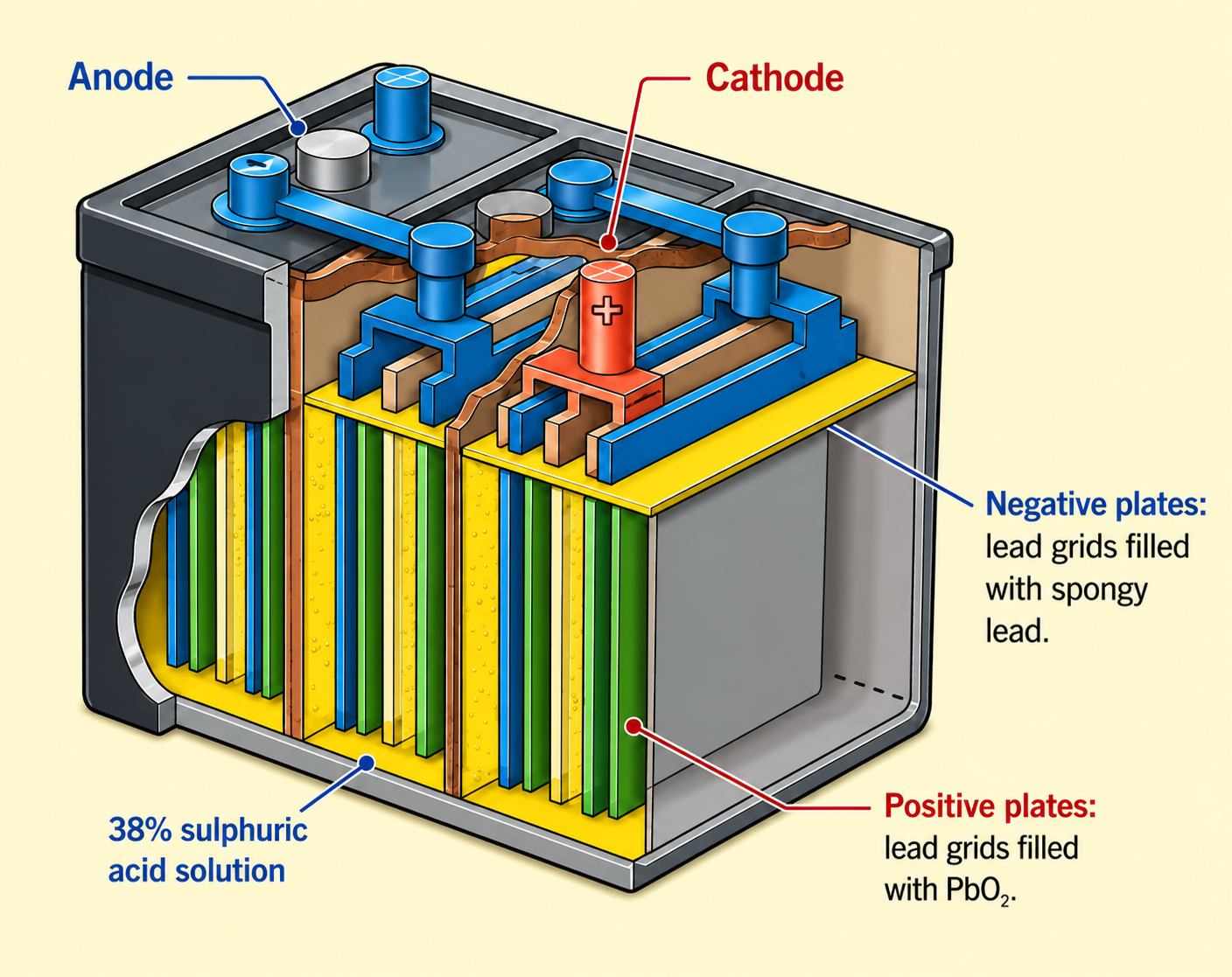 Fig. 2.10: The Lead storage battery
Lead Storage Battery
Highly used in automobiles and inverters.
•
Anode: Spongy Lead ($\text{Pb}$) grid.
•
Cathode: A grid of lead packed with Lead dioxide ($\text{PbO}_2$).
•
Electrolyte: $38\%$ solution of sulfuric acid ($\text{H}_2\text{SO}_4$).
Discharging Reactions (acting as Galvanic cell):
•
At Anode (Oxidation):
$\text{Pb}(s) + \text{SO}_4^{2-}(aq) \rightarrow \text{PbSO}_4(s) + 2e^-$
•
At Cathode (Reduction):
$\text{PbO}_2(s) + \text{SO}_4^{2-}(aq) + 4\text{H}^+(aq) + 2e^- \rightarrow \text{PbSO}_4(s) + 2\text{H}_2\text{O}(l)$
•
Overall Cell Reaction during Discharge:
$\text{Pb}(s) + \text{PbO}_2(s) + 2\text{H}_2\text{SO}_4(aq) \rightarrow 2\text{PbSO}_4(s) + 2\text{H}_2\text{O}(l)$
During charging, an external voltage is applied, turning it into an electrolytic cell. The reactions are perfectly reversed, restoring $\text{Pb}$, $\text{PbO}_2$, and $\text{H}_2\text{SO}_4$.
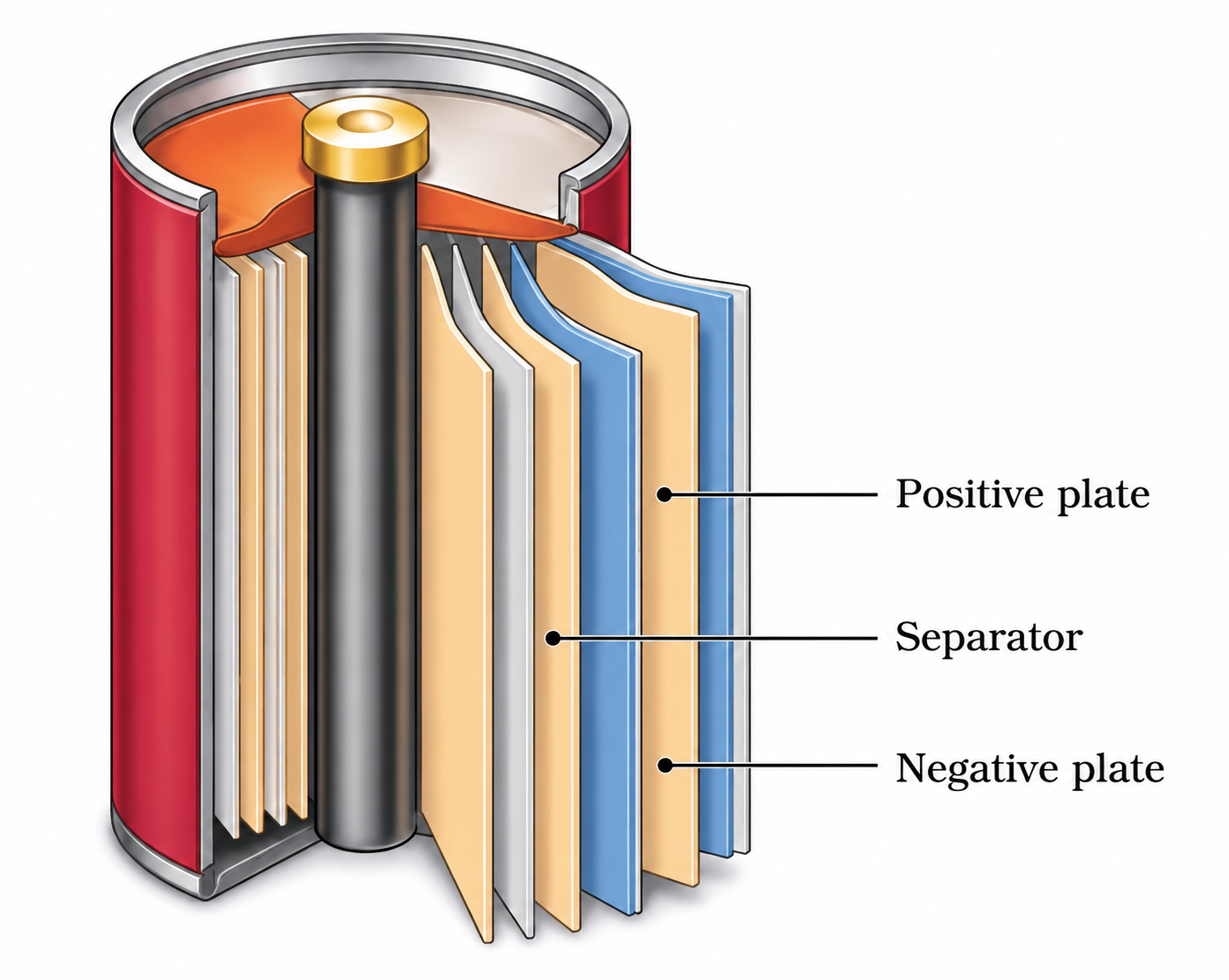 Fig. 2.11: Nickel-cadmium cell
Nickel-Cadmium Cell
• Another secondary cell. It has a longer life than the lead storage battery but is more expensive to manufacture.
•
Overall Reaction during Discharge:
$\text{Cd}(s) + 2\text{Ni(OH)}_3(s) \rightarrow \text{CdO}(s) + 2\text{Ni(OH)}_2(s) + \text{H}_2\text{O}(l)$
Practice Problem 9A
Question: Why does a mercury cell maintain nearly constant potential during its working
life, while a dry cell voltage drops continuously?
Solution:
1. In mercury cell, the overall reaction does not significantly change ionic concentrations in the
electrolyte; therefore, concentration terms in Nernst expression stay almost constant.
2. Hence, cell potential remains nearly constant (~$1.35\text{ V}$).
3. In a dry cell, composition of reacting paste changes continuously during discharge, so reaction
quotient changes markedly.
4. Therefore, EMF decreases gradually with usage.
9. Fuel Cells and Corrosion
A. Fuel Cells
Galvanic cells that are designed to convert the energy of combustion of fuels like hydrogen, methane,
methanol, etc., directly into electrical energy are called fuel cells.
Hydrogen-Oxygen ($\text{H}_2-\text{O}_2$) Fuel Cell
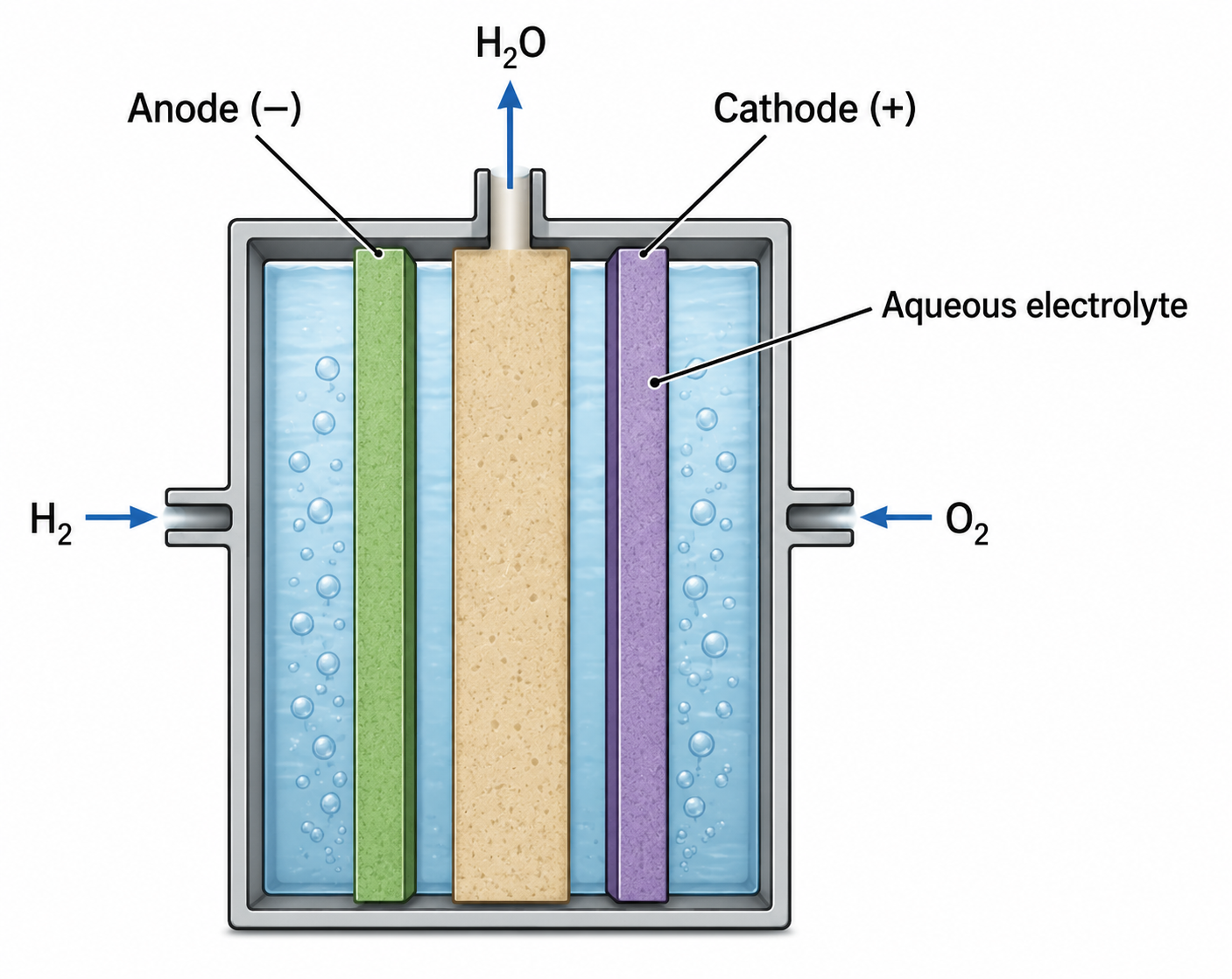 Fig. 2.12: Fuel cell
•
Application: Used famously in the Apollo space program.
•
Setup: Hydrogen and Oxygen gases are bubbled through porous carbon electrodes into a concentrated aqueous $\text{NaOH}$ solution.
Electrode Reactions:
•
At Anode (Oxidation):
$2\text{H}_2(g) + 4\text{OH}^-(aq) \rightarrow 4\text{H}_2\text{O}(l) + 4e^-$
•
At Cathode (Reduction):
$\text{O}_2(g) + 2\text{H}_2\text{O}(l) + 4e^- \rightarrow 4\text{OH}^-(aq)$
•
Overall Reaction:
$2\text{H}_2(g) + \text{O}_2(g) \rightarrow 2\text{H}_2\text{O}(l)$
•
Key Advantages:
- High Efficiency: Operates at $\sim 70\%$ efficiency, which is much better than conventional thermal power plants ($\approx 40\%$).
- Eco-Friendly & Pure: Entirely pollution-free; the only byproduct is pure water (condensed and drank by astronauts).
B. Corrosion
Corrosion is an electrochemical phenomenon wherein metals are slowly degraded by the reaction of moisture and
other gases in the atmosphere. The most common example is the rusting of iron.
Electrochemical Mechanism of Rusting
A miniature electrochemical cell forms on the surface of the iron droplet.
Anode (Oxidation of Iron):
$2\text{Fe}(s) \rightarrow 2\text{Fe}^{2+}(aq) + 4e^-$
Cathode (Reduction of Oxygen): Electrons travel through the metal to another spot where
oxygen is reduced in the presence of $\text{H}^+$ ions (from carbonic acid formed by $\text{CO}_2$ and water).
$\text{O}_2(g) + 4\text{H}^+(aq) + 4e^- \rightarrow 2\text{H}_2\text{O}(l)$
The $\text{Fe}^{2+}$ ions are further oxidized by atmospheric oxygen to $\text{Fe}^{3+}$, forming rust:
$\text{Fe}_2\text{O}_3 \cdot x\text{H}_2\text{O}$.
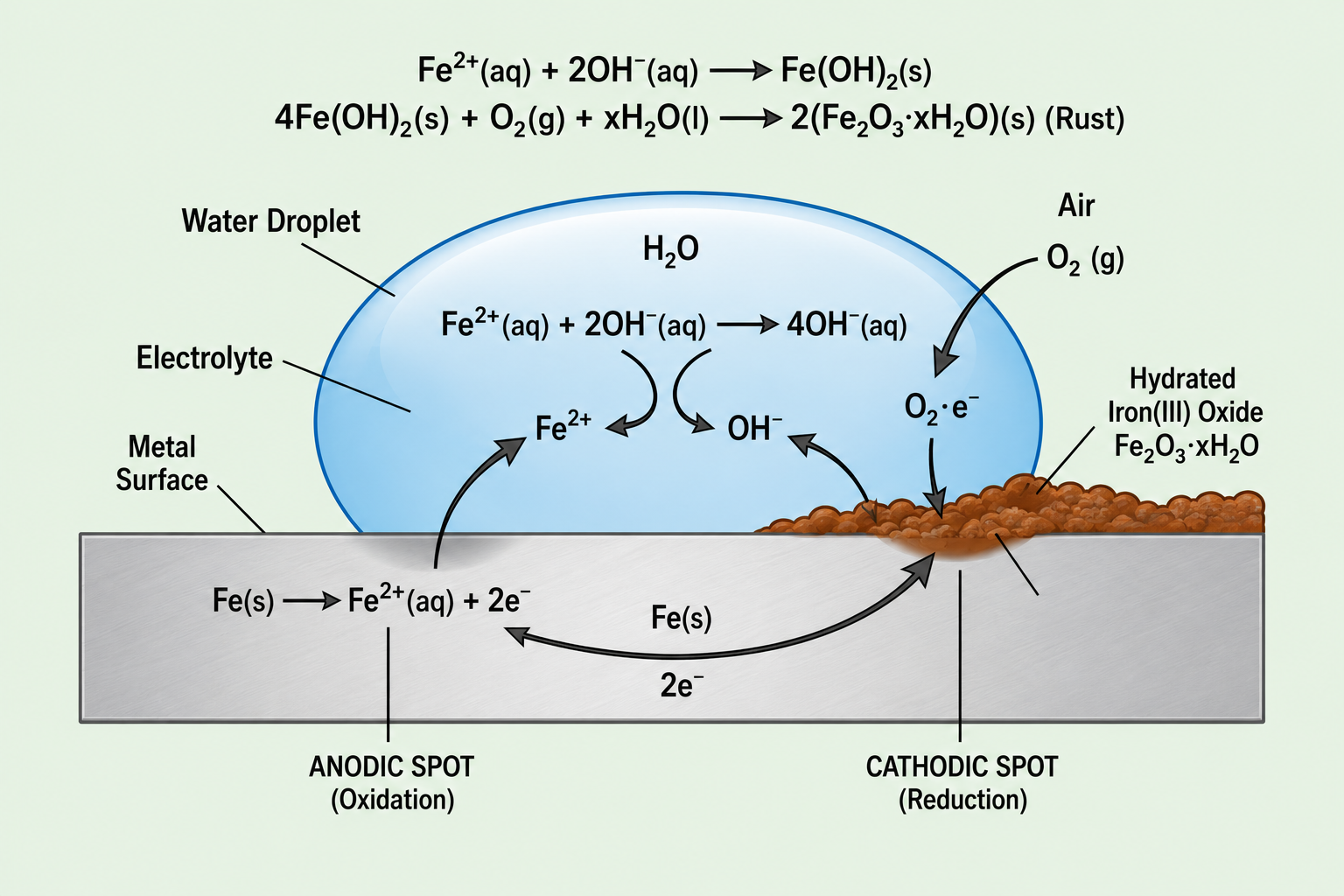
Fig. 2.13: Corrosion of iron in atmosphere
Prevention of Corrosion:
- Barrier Protection: Coating the surface with paint, oil, or grease to prevent contact
with air/water.
- Sacrificial Protection (Galvanization): Covering iron with a layer of a more active
metal (e.g., Zinc). Since Zinc has a lower reduction potential than Iron, Zinc acts as the anode and
corrodes, sacrificing itself to save the Iron.
- Cathodic Protection: Connecting the iron object (like an underground pipe) to a highly
electropositive metal block (like Magnesium). The active metal acts as an anode and provides electrons,
forcing the iron pipe to become a cathode, thus preventing its oxidation.
Practice Problem 10
Question: Why does rusting of iron occur more rapidly in saline water (sea water) than in
ordinary distilled water?
Solution:
Rusting is an electrochemical process. The presence of dissolved salts (ions like $\text{Na}^+$ and
$\text{Cl}^-$) in saline water vastly increases the electrical conductivity of the water drop. The
enhanced electrolyte allows the flow of current between the anodic and cathodic microscopic regions on
the iron surface to occur much more rapidly, thereby drastically increasing the rate of corrosion.
Practice Problem 11 (Comprehensive Nernst)
Question: Determine the cell potential for the following cell at 298 K: $\text{Pt}(s) |
\text{Fe}^{2+}(0.1\text{ M}), \text{Fe}^{3+}(0.01\text{ M}) || \text{Ag}^+(0.1\text{ M}) |
\text{Ag}(s)$.
Given $E^\circ_{\text{Fe}^{3+}/\text{Fe}^{2+}} = 0.77\text{ V}$ and $E^\circ_{\text{Ag}^+/\text{Ag}} =
0.80\text{ V}$.
Solution:
1. Identify Anode and Cathode from cell representation:
- Anode (Left): $\text{Fe}^{2+} \rightarrow \text{Fe}^{3+} + e^-$.
- Cathode (Right): $\text{Ag}^+ + e^- \rightarrow \text{Ag}$.
2. Calculate Standard EMF ($E^\circ_{cell}$):
$E^\circ_{cell} = E^\circ_{\text{cathode}} - E^\circ_{\text{anode}} = 0.80 - 0.77 = \mathbf{0.03\text{
V}}$.
3. Net Cell Reaction: $\text{Fe}^{2+} + \text{Ag}^+ \rightarrow \text{Fe}^{3+} + \text{Ag}(s)$. Number
of electrons transferred $n = 1$.
4. Reaction Quotient $Q$: $Q = \frac{[\text{Fe}^{3+}]}{[\text{Fe}^{2+}][\text{Ag}^+]}$. (Solid Ag is
1).
5. Calculate $Q$: $Q = \frac{0.01}{(0.1)(0.1)} = \frac{0.01}{0.01} = 1$.
6. Apply Nernst Equation:
$E_{cell} = E^\circ_{cell} - \frac{0.0591}{1} \log Q$
$E_{cell} = 0.03 - 0.0591 \times \log(1)$
7. Since $\log(1) = 0$, the non-standard term vanishes.
8. $E_{cell} = \mathbf{0.03\text{ V}}$.
Practice Problem 12 (Electrolysis Molar Relation)
Question: How many moles of mercury will be produced by electrolyzing $1.0\text{ M }
\text{Hg}(\text{NO}_3)_2$ solution with a current of $2.00\text{ A}$ for 3 hours?
Solution:
1. Total charge passed ($Q$): $Q = I \times t = 2.00\text{ A} \times (3 \times 60 \times 60)\text{ s} =
21,600\text{ C}$.
2. Mercury salt is $\text{Hg}(\text{NO}_3)_2$, meaning Mercury is in the $+2$ state
($\text{Hg}^{2+}$).
3. Cathode reaction: $\text{Hg}^{2+} + 2e^- \rightarrow \text{Hg}(l)$.
4. This means 2 moles of electrons ($2\text{ Faradays} = 2 \times 96500 = 193,000\text{ C}$) are needed
to produce exactly 1 mole of Mercury.
5. Moles of Mercury produced $= \frac{Q}{2F} = \frac{21,600\text{ C}}{193,000\text{ C/mol}}$.
6. Moles $= \mathbf{0.112\text{ moles}}$.