
Vardaan Watermark

Solutions

Class 12 • Chapter 1
👈
👉

Types of Solutions

Binary Solution Components

Solvent: Largest quantity; determines physical state.
Solute: Lesser quantity; dissolved in solvent.

9 Types by Physical State

  • Gaseous: Solute (Gas, Liq, or Sol) + Gas Solvent (e.g. Air, Humidity)
  • Liquid: Solute (Gas, Liq, or Sol) + Liquid Solvent (e.g. Soda water, Ethanol in water)
  • Solid: Solute (Gas, Liq, or Sol) + Solid Solvent (e.g. Alloys like Brass, Amalgams)
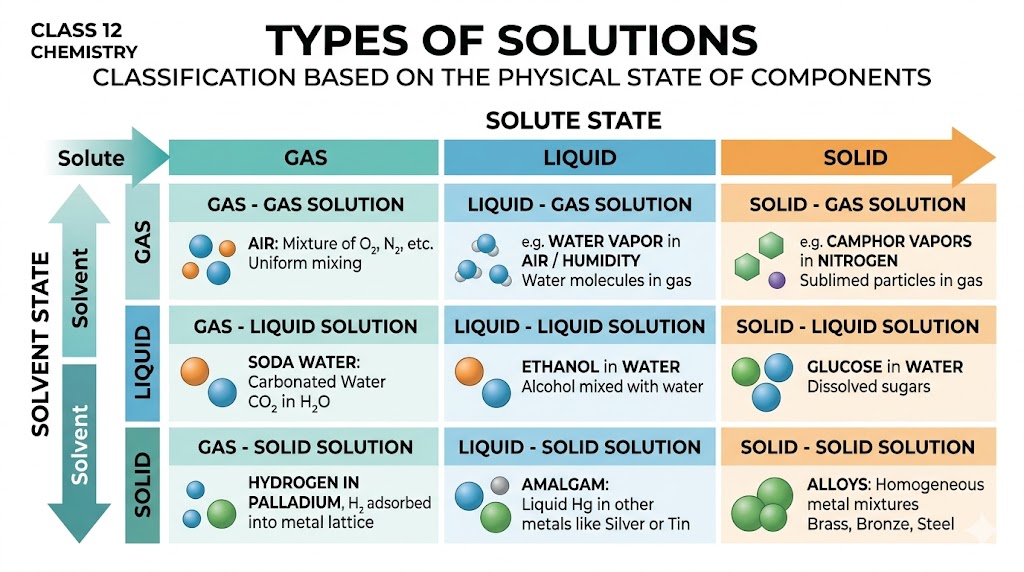
Types of Solutions Matrix

Concentration Terms

  • Mass % (w/w): (Mass of solute / Total mass) $\times 100$
  • ppm: (Mass of component / Total mass) $\times 10^6$
  • Mole Fraction ($x_A$): $n_A / (n_A + n_B)$

Molarity vs Molality

Molarity ($M$): Moles of solute per Litre of solution.
Molality ($m$): Moles of solute per kg of solvent.

Temperature Effect: Molarity changes with temp (volume dependent). Molality and Mole Fraction are independent of temp (mass dependent).

Interconversion

$$ m = \frac{1000 \times M}{(1000 \times d) - (M \times M_2)} $$

Solubility & Henry's Law

Solid in Liquid

"Like dissolves like." Temp effect depends on Le Chatelier's principle: solubility increases if endothermic, decreases if exothermic.

Henry's Law (Gas in Liquid)

Partial pressure of gas in vapour phase is directly proportional to its mole fraction in solution.

$$ p = K_H \cdot x $$
  • Higher $K_H$ means lower solubility.
  • $K_H$ increases with Temp $\implies$ Solubility decreases with Temp.

Applications

  • Soda bottles sealed at high pressure.
  • Scuba divers use He-diluted air to avoid "The Bends".
  • Low $O_2$ pressure at high altitudes causes Anoxia.

Raoult's Law

For a solution of volatile liquids, the partial vapour pressure of each component is directly proportional to its mole fraction.

$$ p_1 = p_1^0 x_1 \quad \text{and} \quad p_2 = p_2^0 x_2 $$ $$ P_{total} = p_1 + p_2 = p_1^0 x_1 + p_2^0 x_2 $$

Raoult's vs Henry's Law

Raoult's law is a special case of Henry's law where $K_H$ becomes strictly equal to $p_i^0$.

Non-Volatile Solute

Adding a non-volatile solute (e.g., salt) to a volatile solvent lowers the vapour pressure of the solution.
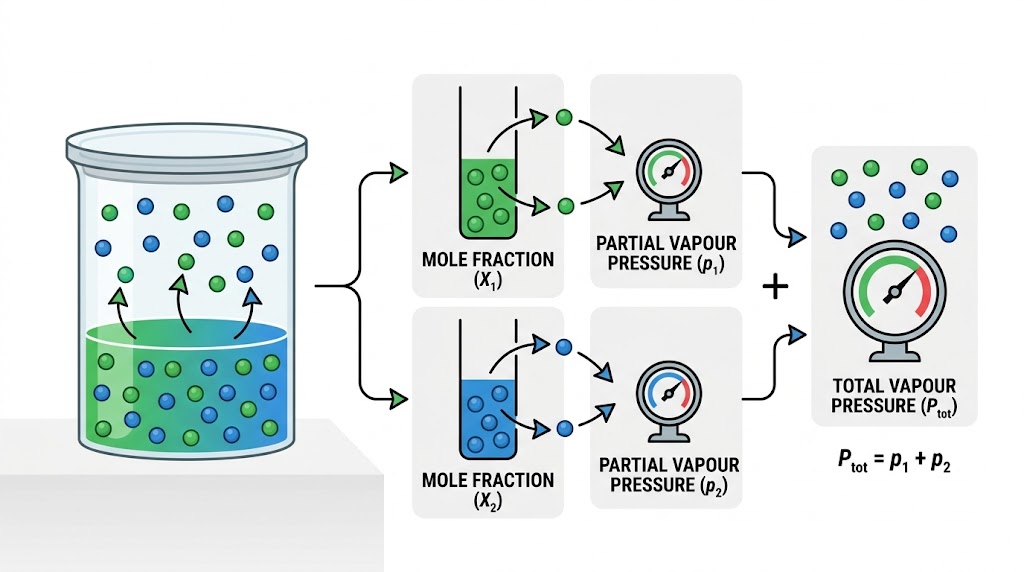
Raoult's Law

Ideal & Non-Ideal

Ideal Solutions

Obey Raoult's law perfectly. A-B interactions = A-A and B-B interactions.
$\Delta H_{mix} = 0$, $\Delta V_{mix} = 0$. (e.g. n-hexane + n-heptane)

Non-Ideal: Positive Deviation

A-B interactions weaker than pure. Vapour pressure is higher.
$\Delta H_{mix} > 0$, $\Delta V_{mix} > 0$. Forms Minimum Boiling Azeotrope.
(e.g. Ethanol + Acetone)

Non-Ideal: Negative Deviation

A-B interactions stronger than pure. Vapour pressure is lower.
$\Delta H_{mix} < 0$, $\Delta V_{mix} < 0$. Forms Maximum Boiling Azeotrope.
(e.g. Chloroform + Acetone)
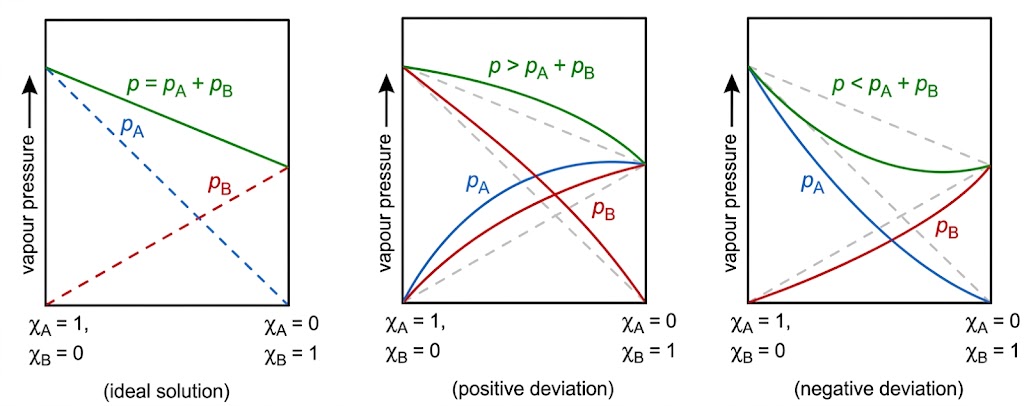
Ideal/Non-Ideal Graphs

Colligative Props (1)

Properties that depend only on the number of solute particles, not their nature.

1. RLVP

Relative Lowering of Vapour Pressure is equal to the mole fraction of the solute.

$$ \frac{p_1^0 - p_1}{p_1^0} = x_2 = \frac{n_2}{n_1 + n_2} $$

2. Elevation of Boiling Point

Adding non-volatile solute lowers VP, so solution must be heated more to boil.

$$ \Delta T_b = K_b \cdot m $$

$K_b$ = Ebullioscopic constant. $m$ = molality.
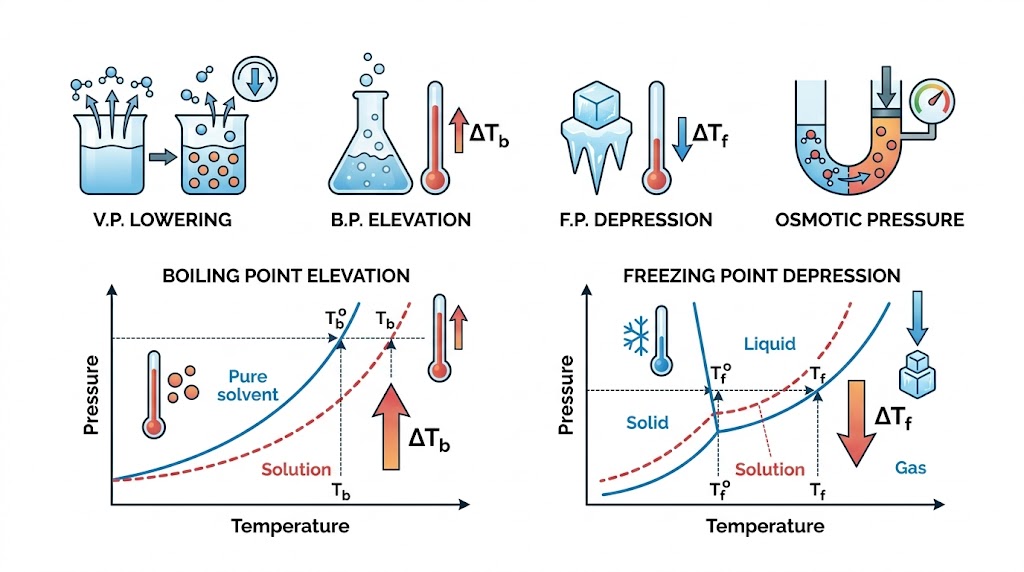
Colligative Graphs

Colligative Props (2)

3. Depression of Freezing Point

Solution's lower VP curve intersects solid solvent curve at a lower temperature.

$$ \Delta T_f = K_f \cdot m $$

$K_f$ = Cryoscopic constant.

4. Osmotic Pressure ($\pi$)

Excess pressure applied to solution side to stop osmosis (flow of solvent via SPM).

$$ \pi = C R T = \frac{n_2}{V} R T $$

Best for Polymers

Osmotic pressure is ideal for proteins/polymers because it is measured at room temp (prevents denaturation) and uses Molarity.

Abnormal Molar Mass

If solute undergoes dissociation or association, colligative property values deviate from expected.

van't Hoff Factor ($i$)

$$ i = \frac{\text{Observed Colligative Property}}{\text{Calculated Colligative Property}} $$ $$ i = \frac{\text{Normal Molar Mass}}{\text{Abnormal Molar Mass}} $$
  • $i > 1$: Dissociation (e.g., NaCl $\to$ $Na^+$ + $Cl^-$)
  • $i < 1$: Association (e.g., Acetic acid dimerizing)
  • $i = 1$: No association/dissociation

Degree of Dissociation / Association

  • Dissociation ($\alpha$): $\alpha = \frac{i - 1}{n - 1}$
  • Association ($\alpha$): $\alpha = \frac{1 - i}{1 - 1/n}$