Vardaan Learning Institute
Class 12 Chemistry • Comprehensive Chapter Notes
🌐 vardaanlearning.com📞 9508841336
Chapter 1: Solutions
Dear Class 12 Student! Physical Chemistry begins here. This chapter is the backbone of analytical chemistry, focusing heavily on how we measure concentration, how substances dissolve, and how dissolved particles alter the physical properties of a liquid (Colligative Properties). Colligative properties and the Van't Hoff factor are absolute guarantees in both the CBSE Boards and JEE Mains. Master the formulas and let's conquer the numericals!
1. Introduction and Types of Solutions
Concept
Solution: A homogeneous mixture of two or more chemically non-reacting substances whose composition can be varied within certain limits. Homogeneous means its composition and properties are uniform throughout the mixture.
Components of a Binary Solution:
- Solvent: The component present in the largest quantity. It determines the physical state of the solution.
- Solute: The component(s) present in a lesser quantity, dissolved in the solvent.
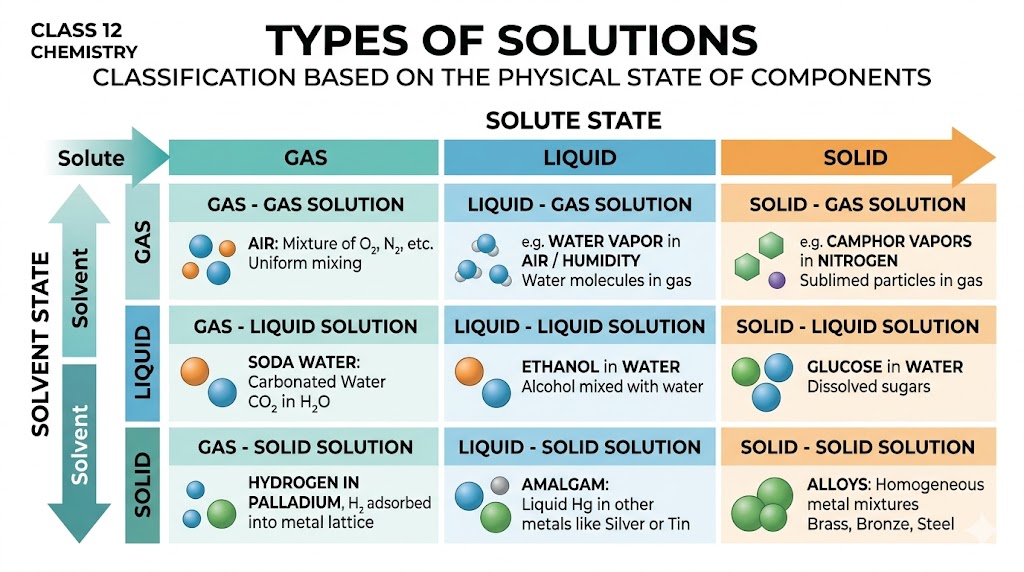
Types of Solutions
Based on the physical state of the solvent, solutions are classified into three broad categories, making a total of 9 types:
| Types of Solution |
Solute |
Solvent |
Common Examples |
| Gaseous Solutions |
Gas |
Gas |
Mixture of oxygen and nitrogen (Air) |
| Liquid |
Gas |
Chloroform mixed with nitrogen gas; Humidity |
| Solid |
Gas |
Camphor in nitrogen gas |
| Liquid Solutions |
Gas |
Liquid |
Oxygen dissolved in water; Soda water ($CO_2$ in water) |
| Liquid |
Liquid |
Ethanol dissolved in water |
| Solid |
Liquid |
Glucose or Sugar dissolved in water |
| Solid Solutions |
Gas |
Solid |
Solution of hydrogen in palladium |
| Liquid |
Solid |
Amalgam of mercury with sodium |
| Solid |
Solid |
Copper dissolved in gold; Alloys like Brass |
Practice Problem 1
Question: In an amalgam of mercury with sodium, which substance is the solute and which is the solvent? What type of solution is this?
Solution:
An amalgam is a mixture where mercury (a liquid) is dissolved in another metal (like sodium, a solid).
Since the final state of the mixture is solid, the solid metal (Sodium) is the solvent, and the liquid metal (Mercury) is the solute.
Type of solution: Liquid in Solid (Solid Solution).
2. Expressing Concentration of Solutions (Crucial for Numericals)
The concentration of a solution is the amount of solute present in a given quantity of solvent or solution.
- Mass Percentage (w/w): The mass of the component per 100 grams of the solution.
$$ \text{Mass \% of A} = \frac{\text{Mass of component A in solution}}{\text{Total mass of the solution}} \times 100 $$
- Volume Percentage (v/v): Volume of the component per 100 parts by volume of the solution. (e.g., $10\% \text{ v/v}$ ethanol means $10\text{ mL}$ ethanol dissolved in $90\text{ mL}$ water to make $100\text{ mL}$ solution).
$$ \text{Volume \% of A} = \frac{\text{Volume of component A}}{\text{Total volume of solution}} \times 100 $$
- Mass by Volume Percentage (w/v): Mass of solute dissolved in $100\text{ mL}$ of the solution. Highly used in medicine and pharmacy.
- Parts Per Million (ppm): Used when a solute is present in trace quantities (e.g., pollutants in air/water).
$$ \text{ppm} = \frac{\text{Number of parts of component}}{\text{Total number of parts of all components}} \times 10^6 $$
Mole Fraction, Molarity & Molality
1. Mole Fraction ($x$): The ratio of the number of moles of one component to the total number of moles in the solution.
For a binary mixture of A and B:
$$ x_A = \frac{n_A}{n_A + n_B} \quad \text{and} \quad x_B = \frac{n_B}{n_A + n_B} $$
Note: The sum of mole fractions of all components is always 1 ($x_A + x_B = 1$). It is dimensionless and independent of temperature.
2. Molarity ($M$): Number of moles of solute dissolved in exactly 1 Litre ($1 \text{ dm}^3$) of solution.
$$ M = \frac{\text{Moles of solute } (n)}{\text{Volume of solution in Litres } (V)} = \frac{w_2 \times 1000}{M_2 \times V(\text{in mL})} $$
Unit: $\text{mol L}^{-1}$ or $M$.
3. Molality ($m$): Number of moles of solute dissolved in 1 kg ($1000\text{ g}$) of the solvent.
$$ m = \frac{\text{Moles of solute } (n)}{\text{Mass of solvent in kg } (W_1)} = \frac{w_2 \times 1000}{M_2 \times W_1(\text{in grams})} $$
Unit: $\text{mol kg}^{-1}$ or $m$.
JEE Main Transition: Temperature Dependence & Interconversion
Temperature Effect (Board Favorite): Molarity ($M$), Volume %, and Mass/Volume % depend on the volume of the solution. Since liquids expand/contract with temperature, Molarity changes with temperature. Conversely, Molality ($m$), Mass %, and Mole Fraction depend only on masses, making them independent of temperature. This is why Molality is preferred in precise scientific calculations.
Interconversion Formula (Molarity to Molality):
If $M$ is molarity, $m$ is molality, $d$ is density of solution in $\text{g/mL}$, and $M_2$ is molar mass of solute:
$$ m = \frac{1000 \times M}{(1000 \times d) - (M \times M_2)} $$
Practice Problem 2
Question: Calculate the mole fraction of ethylene glycol ($\text{C}_2\text{H}_6\text{O}_2$) in a solution containing $20\%$ of $\text{C}_2\text{H}_6\text{O}_2$ by mass in water.
Solution:
1. Assume $100\text{ g}$ of solution. Mass of solute ($\text{C}_2\text{H}_6\text{O}_2$, $w_2$) $= 20\text{ g}$. Mass of solvent ($\text{H}_2\text{O}$, $w_1$) $= 100 - 20 = 80\text{ g}$.
2. Molar mass of $\text{C}_2\text{H}_6\text{O}_2$ ($M_2$) $= (12 \times 2) + (1 \times 6) + (16 \times 2) = 24 + 6 + 32 = 62\text{ g/mol}$.
3. Molar mass of $\text{H}_2\text{O}$ ($M_1$) $= 18\text{ g/mol}$.
4. Moles of solute ($n_2$) $= \frac{20}{62} \approx 0.322\text{ mol}$.
5. Moles of solvent ($n_1$) $= \frac{80}{18} \approx 4.444\text{ mol}$.
6. Total moles $= n_1 + n_2 = 4.444 + 0.322 = 4.766\text{ mol}$.
7. Mole fraction of glycol ($x_2$) $= \frac{n_2}{n_1 + n_2} = \frac{0.322}{4.766} \approx \mathbf{0.068}$.
Practice Problem 3
Question: The density of $3\text{ M}$ solution of $\text{NaCl}$ is $1.25\text{ g mL}^{-1}$. Calculate the molality of the solution.
Solution:
1. Molarity $M = 3\text{ mol L}^{-1}$. This means $3\text{ moles}$ of $\text{NaCl}$ are in $1\text{ Litre}$ ($1000\text{ mL}$) of solution.
2. Mass of $1\text{ L}$ solution $= \text{Volume} \times \text{Density} = 1000\text{ mL} \times 1.25\text{ g/mL} = 1250\text{ g}$.
3. Molar mass of $\text{NaCl}$ ($M_2$) $= 23 + 35.5 = 58.5\text{ g/mol}$.
4. Mass of solute ($\text{NaCl}$) $= \text{moles} \times \text{molar mass} = 3 \times 58.5 = 175.5\text{ g}$.
5. Mass of solvent (Water) $= \text{Mass of solution} - \text{Mass of solute} = 1250 - 175.5 = 1074.5\text{ g} = 1.0745\text{ kg}$.
6. Molality ($m$) $= \frac{\text{moles of solute}}{\text{mass of solvent in kg}} = \frac{3}{1.0745} \approx \mathbf{2.79\text{ m}}$.
Topic 2 Quick Solved Drill
Q1: A solution has 15 g NaCl in 85 g water. Find mass percentage of NaCl.
Answer: Total mass $=100\text{ g}$, so mass % $=\frac{15}{100}\times100=\mathbf{15\%}$.
Q2: Find ppm when $2.5\text{ mg}$ solute is present in $1\text{ L}$ water.
Answer: For dilute aqueous solutions, $\text{ppm}\approx\text{mg/L}$, so $\mathbf{2.5\ ppm}$.
Q3: Why is molality preferred in colligative properties?
Answer: It is mass-based and hence temperature independent.
3. Solubility
Solubility is defined as the maximum amount of a substance that can be dissolved in a specified amount of solvent at a specific temperature to form a saturated solution.
Solubility of a Solid in a Liquid
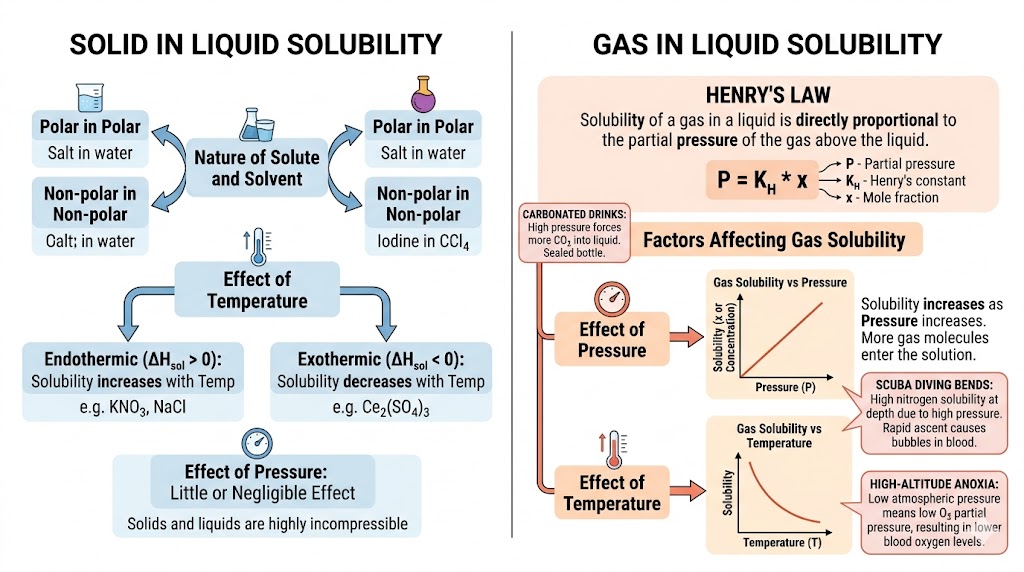
- Nature of Solute and Solvent: Follows the principle "Like dissolves like". Polar solutes (like $\text{NaCl}$) dissolve in polar solvents (like Water). Non-polar solutes (like Naphthalene/Iodine) dissolve in non-polar solvents (like Benzene/Carbon tetrachloride).
- Effect of Temperature (Le Chatelier’s Principle):
- If the dissolution process is endothermic ($\Delta H_{sol} > 0$), solubility increases with a rise in temperature.
- If the dissolution process is exothermic ($\Delta H_{sol} < 0$), solubility decreases with a rise in temperature.
- Effect of Pressure: Pressure has practically no effect on the solubility of solids in liquids because solids and liquids are highly incompressible.
Solubility of a Gas in a Liquid (Henry's Law - High Priority)
Unlike solids, gases are highly compressible. Therefore, pressure profoundly affects the solubility of a gas in a liquid. The solubility of a gas increases as the pressure of the gas above the liquid increases.
Henry's Law
Statement: At a constant temperature, the partial pressure of the gas in the vapour phase ($p$) is directly proportional to the mole fraction of the gas ($x$) in the solution.
$$ p = K_H \cdot x $$
Where $K_H$ is the Henry's law constant.
Crucial Conceptual Deductions:
1. At a given pressure, a higher value of $K_H$ implies a lower solubility (lower $x$) of the gas in the liquid.
2. $K_H$ increases with an increase in temperature. Therefore, solubility of gases in liquids decreases with an increase in temperature.
(Board Favorite Reason: This is why aquatic species are more comfortable in cold water rather than warm water—cold water holds more dissolved oxygen!).
Applications of Henry's Law
- Carbonated Beverages: To increase the solubility of $CO_2$ in soft drinks and soda water, the bottles are sealed under very high pressure.
- Scuba Diving: Underwater, high pressure increases the solubility of atmospheric gases in blood. When a diver ascends rapidly, pressure drops, and dissolved nitrogen comes out as bubbles in the blood, blocking capillaries and causing a painful, life-threatening condition called "The Bends". To prevent this, scuba tanks are diluted with Helium ($11.7\% \text{ He}, 56.2\% \text{ N}_2, 32.1\% \text{ O}_2$) because Helium has low solubility in blood even at high pressure.
- High Altitudes: At high altitudes, the partial pressure of oxygen is less than at ground level. This leads to low concentrations of oxygen in the blood and tissues of climbers, causing weakness and inability to think clearly—a condition known as Anoxia.
Practice Problem 4
Question: If $N_2$ gas is bubbled through water at $293\text{ K}$, how many millimoles of $N_2$ gas would dissolve in $1\text{ litre}$ of water? Assume that $N_2$ exerts a partial pressure of $0.987\text{ bar}$. Given that Henry's law constant for $N_2$ at $293\text{ K}$ is $76.48\text{ kbar}$.
Solution:
1. Convert $K_H$ to bar: $K_H = 76.48\text{ kbar} = 76,480\text{ bar}$.
2. Apply Henry's Law: $p = K_H \cdot x \implies x = \frac{p}{K_H} = \frac{0.987}{76480} = 1.29 \times 10^{-5}$.
3. We know $1\text{ L}$ of water contains exactly $55.5\text{ moles}$ of water ($1000\text{ g} / 18\text{ g/mol}$). So $n_{\text{water}} = 55.5\text{ mol}$.
4. Mole fraction $x = \frac{n_{N_2}}{n_{N_2} + n_{\text{water}}}$. Since $N_2$ solubility is very low, $n_{N_2} \ll n_{\text{water}}$.
5. So, $x \approx \frac{n_{N_2}}{n_{\text{water}}} \implies 1.29 \times 10^{-5} = \frac{n_{N_2}}{55.5}$.
6. $n_{N_2} = 1.29 \times 10^{-5} \times 55.5 = 7.16 \times 10^{-4}\text{ mol}$.
7. In millimoles: $7.16 \times 10^{-4} \times 1000 = \mathbf{0.716\text{ mmol}}$.
Topic 3 Quick Solved Drill
Q1: If pressure of gas over solution is halved at constant temperature, what happens to dissolved mole fraction?
Answer: By Henry's law, $x=\frac{p}{K_H}$, so dissolved mole fraction is also halved.
Q2: Why does warm lake water hold less oxygen?
Answer: Gas solubility decreases with increase in temperature ($K_H$ increases).
4. Vapour Pressure of Liquid Solutions
Vapour Pressure: The pressure exerted by the vapour in thermodynamic equilibrium with its liquid phase at a constant temperature in a closed container.
Vapour Pressure of Liquid-Liquid Solutions (Raoult's Law)
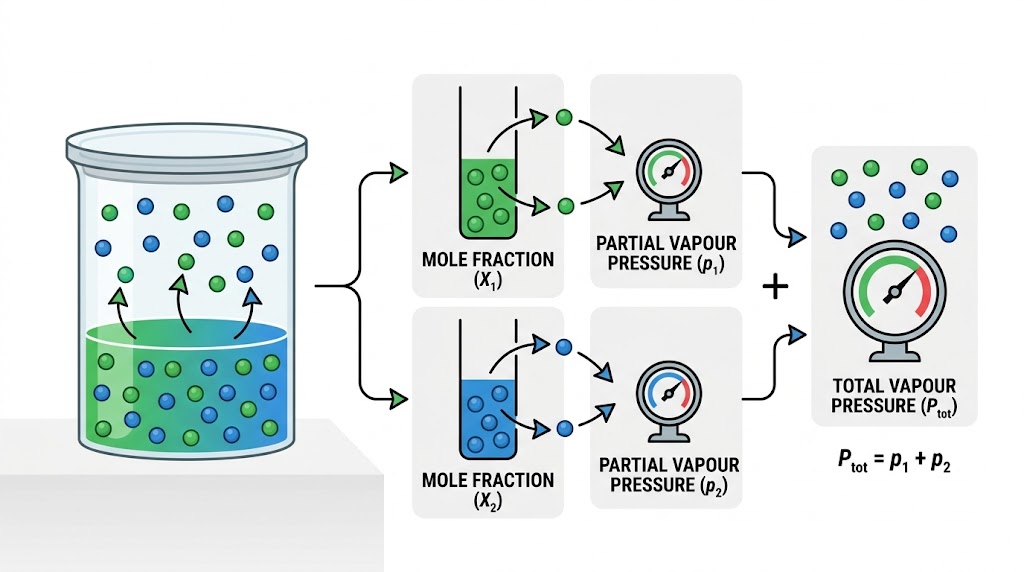
Consider a binary solution of two volatile liquids, 1 and 2. Both will evaporate and contribute to the total vapour pressure.
Raoult's Law
Statement: For a solution of volatile liquids, the partial vapour pressure of each component in the solution is directly proportional to its mole fraction present in solution.
$$ p_1 \propto x_1 \implies p_1 = p_1^0 x_1 $$
$$ p_2 \propto x_2 \implies p_2 = p_2^0 x_2 $$
Where $p_1^0$ and $p_2^0$ are the vapour pressures of pure components 1 and 2 respectively at the same temperature.
According to Dalton's Law of Partial Pressures, the total pressure ($P_{total}$) over the solution is the sum of the partial pressures:
$$ P_{total} = p_1 + p_2 = p_1^0 x_1 + p_2^0 x_2 $$
Since $x_1 + x_2 = 1 \implies x_1 = 1 - x_2$, we can write:
$$ P_{total} = p_1^0 + (p_2^0 - p_1^0)x_2 $$
Mole Fraction in Vapour Phase ($y$): If $y_1$ and $y_2$ are the mole fractions of components 1 and 2 in the vapour phase respectively, using Dalton's law:
$$ y_1 = \frac{p_1}{P_{total}} \quad \text{and} \quad y_2 = \frac{p_2}{P_{total}} $$
Raoult's Law as a Special Case of Henry's Law
According to Raoult's law, for a volatile component: $p_i = p_i^0 x_i$.
According to Henry's law, for a gas dissolved in liquid: $p = K_H x$.
If we compare them, they are identical in form. Raoult's law becomes a special case of Henry's law where the proportionality constant $K_H$ becomes strictly equal to the vapour pressure of the pure component ($p_i^0$).
Vapour Pressure of Solutions of Solids in Liquids
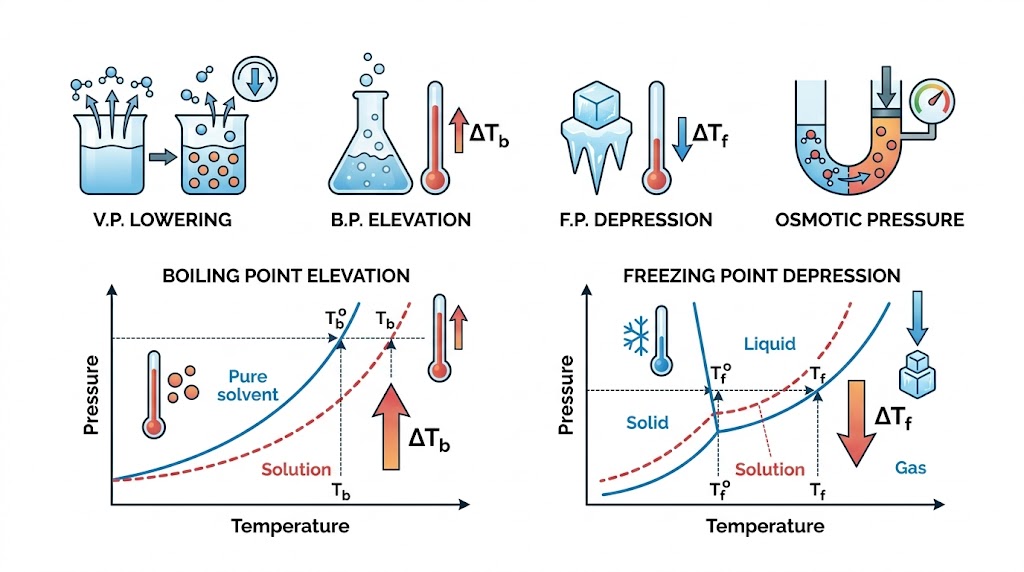
When a non-volatile solute (like salt or sugar) is added to a pure volatile solvent (like water), the vapour pressure of the solution is always lower than that of the pure solvent.
Reason: The solute particles occupy some of the surface area of the liquid, reducing the number of volatile solvent molecules available to escape into the vapor phase.
Practice Problem 5
Question: Vapour pressure of chloroform ($\text{CHCl}_3$) and dichloromethane ($\text{CH}_2\text{Cl}_2$) at $298\text{ K}$ are $200\text{ mm Hg}$ and $415\text{ mm Hg}$ respectively. Calculate the vapour pressure of the solution prepared by mixing $25.5\text{ g}$ of $\text{CHCl}_3$ and $40\text{ g}$ of $\text{CH}_2\text{Cl}_2$ at $298\text{ K}$.
Solution:
1. Molar mass of $\text{CHCl}_3$ ($M_1$) $= 12 + 1 + (3 \times 35.5) = 119.5\text{ g/mol}$.
2. Molar mass of $\text{CH}_2\text{Cl}_2$ ($M_2$) $= 12 + 2 + (2 \times 35.5) = 85\text{ g/mol}$.
3. Moles of $\text{CHCl}_3$ ($n_1$) $= \frac{25.5}{119.5} = 0.213\text{ mol}$.
4. Moles of $\text{CH}_2\text{Cl}_2$ ($n_2$) $= \frac{40}{85} = 0.470\text{ mol}$.
5. Total moles $= 0.213 + 0.470 = 0.683\text{ mol}$.
6. Mole fraction of $\text{CH}_2\text{Cl}_2$ ($x_2$) $= \frac{0.470}{0.683} = 0.688$.
7. Mole fraction of $\text{CHCl}_3$ ($x_1$) $= 1 - 0.688 = 0.312$.
8. Using Raoult's Law: $P_{total} = p_1^0 x_1 + p_2^0 x_2 = (200 \times 0.312) + (415 \times 0.688) = 62.4 + 285.5 = \mathbf{347.9\text{ mm Hg}}$.
Topic 4 Quick Solved Drill
Q1: Write total vapour pressure of ideal binary solution.
Answer: $P_{total}=p_A^0x_A+p_B^0x_B$.
Q2: Why does adding non-volatile solute lower vapour pressure?
Answer: Surface mole fraction of volatile solvent decreases, so fewer solvent molecules escape.
Q3: RLVP if $p_1^0=31.8\text{ mmHg}$ and $p_1=31.0\text{ mmHg}$.
Answer: $\frac{31.8-31.0}{31.8}=\mathbf{0.0252}$.
5. Ideal and Non-Ideal Solutions
Ideal Solutions
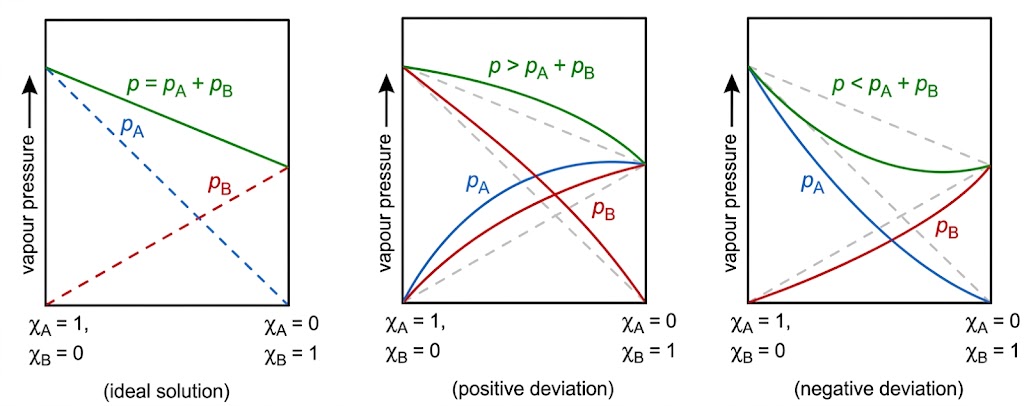
Solutions which obey Raoult's law precisely over the entire range of concentration are called Ideal Solutions.
- Conditions: $\Delta H_{mix} = 0$ (no heat absorbed or released) and $\Delta V_{mix} = 0$ (no volume change upon mixing).
- Molecular Reason: The intermolecular attractive forces between solute-solvent (A-B) are exactly identical to those between pure solvent-solvent (A-A) and pure solute-solute (B-B).
- Examples: n-hexane and n-heptane; bromoethane and chloroethane; benzene and toluene. (Note: They must be chemically very similar).
Non-Ideal Solutions
Solutions that do not obey Raoult's law over the entire range of concentration. The vapour pressure is either higher or lower than predicted.
1. Positive Deviation:
- The vapour pressure of the mixture is higher than expected from Raoult's law.
- Reason: The new A-B interactions are weaker than the original A-A or B-B interactions. Molecules find it easier to escape into the vapor phase.
- Thermodynamics: $\Delta H_{mix} > 0$ (Endothermic) and $\Delta V_{mix} > 0$ (Expansion).
- Examples: Ethanol + Acetone (Acetone breaks the strong H-bonds between ethanol molecules); Carbon disulfide + Acetone.
2. Negative Deviation:
- The vapour pressure of the mixture is lower than expected from Raoult's law.
- Reason: The new A-B interactions are stronger than the original A-A or B-B interactions. Molecules are held back from escaping into the vapor phase.
- Thermodynamics: $\Delta H_{mix} < 0$ (Exothermic) and $\Delta V_{mix} < 0$ (Contraction).
- Examples: Chloroform + Acetone (A strong new Hydrogen bond forms between them); Phenol + Aniline; Nitric Acid + Water.
Azeotropes (Constant Boiling Mixtures)
Some liquid mixtures have the exact same composition in the liquid phase as they do in the vapor phase. They boil at a single, constant temperature and act like a pure liquid. They cannot be separated by fractional distillation.
- Minimum Boiling Azeotrope: Formed by non-ideal solutions showing large positive deviation. Since vapour pressure is very high, the boiling point is lower than either pure component. (e.g., $95.5\%$ Ethanol + $4.5\%$ Water).
- Maximum Boiling Azeotrope: Formed by non-ideal solutions showing large negative deviation. Since vapour pressure is very low, the boiling point is higher than either pure component. (e.g., $68\%$ Nitric acid + $32\%$ Water).
Practice Problem 6
Question: When 50 mL of liquid A and 50 mL of liquid B are mixed, the volume of the resulting solution is found to be 99 mL. What type of deviation from Raoult's law does this solution show?
Solution:
1. Expected volume = $50 + 50 = 100\text{ mL}$.
2. Actual volume = $99\text{ mL}$.
3. $\Delta V_{mix} = 99 - 100 = -1\text{ mL}$.
4. Since $\Delta V_{mix} < 0$, it indicates that the new A-B interactions are stronger than the pure interactions, pulling the molecules closer together.
5. Therefore, the solution shows a Negative Deviation from Raoult's law.
Topic 5 Quick Solved Drill
Q1: If $\Delta H_{mix}>0$ and $\Delta V_{mix}>0$, what deviation occurs?
Answer: Positive deviation from Raoult's law.
Q2: Why cannot ethanol-water be completely separated by fractional distillation?
Answer: It forms a minimum boiling azeotrope.
6. Colligative Properties and Determination of Molar Mass (5-Mark Guarantee)
Colligative Properties are properties of dilute solutions that depend strictly on the number of solute particles (molecules or ions) present in the solution, and are completely independent of their nature or chemical identity.
1. Relative Lowering of Vapour Pressure (RLVP)
When a non-volatile solute is added to a solvent, the vapour pressure lowers. Raoult's law states $p_1 = p_1^0 x_1$.
Lowering of VP: $\Delta p = p_1^0 - p_1 = p_1^0 - p_1^0 x_1 = p_1^0(1 - x_1)$.
Since $x_1 + x_2 = 1 \implies 1 - x_1 = x_2$, we get $\Delta p = p_1^0 x_2$.
RLVP Formula
$$ \frac{p_1^0 - p_1}{p_1^0} = x_2 = \frac{n_2}{n_1 + n_2} $$
For dilute solutions, the moles of solute are negligible compared to solvent ($n_2 \ll n_1$). Thus $n_1 + n_2 \approx n_1$.
The formula simplifies extensively for calculating molar mass of solute ($M_2$):
$$ \frac{p_1^0 - p_1}{p_1^0} = \frac{n_2}{n_1} = \frac{w_2 \times M_1}{M_2 \times w_1} $$
2. Elevation of Boiling Point ($\Delta T_b$)
A liquid boils when its vapour pressure becomes equal to atmospheric pressure. Since adding a non-volatile solute lowers the vapour pressure, the solution must be heated to a higher temperature to reach atmospheric pressure. Hence, boiling point elevates.
$$ \Delta T_b = T_b - T_b^0 = K_b \cdot m $$
Where $m$ is the molality of the solution. $K_b$ is the Ebullioscopic constant or Molal elevation constant. (Unit of $K_b$: $\text{K kg mol}^{-1}$).
To find molar mass ($M_2$): $\Delta T_b = \frac{K_b \times w_2 \times 1000}{M_2 \times w_1}$.
3. Depression of Freezing Point ($\Delta T_f$)
Freezing point is the temperature at which the solid phase and liquid phase have the exact same vapour pressure. Because a solution has a lower vapour pressure than the pure liquid, the solution's curve intersects the solid solvent's curve at a lower temperature.
$$ \Delta T_f = T_f^0 - T_f = K_f \cdot m $$
Where $K_f$ is the Cryoscopic constant or Molal depression constant.
Practice Problem 7
Question: Boiling point of water at $750\text{ mm Hg}$ is $99.63^\circ\text{C}$. How much sucrose ($\text{C}_{12}\text{H}_{22}\text{O}_{11}$) is to be added to $500\text{ g}$ of water such that it boils at $100^\circ\text{C}$? ($K_b$ for water is $0.52\text{ K kg mol}^{-1}$).
Solution:
1. Elevation required ($\Delta T_b$) $= 100 - 99.63 = 0.37^\circ\text{C} = 0.37\text{ K}$.
2. Mass of solvent water ($w_1$) $= 500\text{ g}$.
3. Molar mass of sucrose ($M_2$) $= (12\times 12) + (22\times 1) + (11\times 16) = 342\text{ g/mol}$.
4. Formula: $\Delta T_b = \frac{K_b \times w_2 \times 1000}{M_2 \times w_1}$.
5. $0.37 = \frac{0.52 \times w_2 \times 1000}{342 \times 500}$.
6. $0.37 = \frac{0.52 \times w_2 \times 2}{342} \implies w_2 = \frac{0.37 \times 342}{1.04} \approx \mathbf{121.67\text{ g}}$.
4. Osmosis and Osmotic Pressure ($\pi$)
Osmosis: The spontaneous flow of solvent molecules through a Semi-Permeable Membrane (SPM) from a pure solvent to a solution (or from a dilute solution to a concentrated solution).
Osmotic Pressure ($\pi$): The excess external pressure that must be applied directly to the solution side to exactly stop the flow of solvent via osmosis.
Osmotic Pressure Formula
Osmotic pressure is proportional to the Molarity ($C$) of the solution at a given temperature ($T$).
$$ \pi = C R T = \left(\frac{n_2}{V}\right) R T = \frac{w_2 R T}{M_2 V} $$
Where $R$ is the universal gas constant ($0.0821\text{ L atm K}^{-1}\text{mol}^{-1}$ or $0.083\text{ L bar K}^{-1}\text{mol}^{-1}$).
Why Osmotic Pressure is the Best Method for Polymers
Calculating the molar mass of biomolecules (proteins/polymers) using osmotic pressure is highly preferred over other colligative properties because:
1. It is measured at room temperature (proteins denature at boiling point, preventing use of $\Delta T_b$).
2. It uses Molarity instead of molality.
3. Its magnitude is significant and easily measurable even for extremely dilute solutions of macromolecules, unlike $\Delta T_b$ or $\Delta T_f$ which would yield unmeasurably tiny differences.
Biological Importance:
- Isotonic Solutions: Two solutions having the exact same osmotic pressure at a given temperature. Cells placed in them neither shrink nor swell (e.g., $0.9\% \text{ w/v}$ $\text{NaCl}$ solution is isotonic with human blood).
- Hypertonic Solutions: A solution with a higher concentration. A cell placed inside will lose water and shrink (Plasmolysis).
- Hypotonic Solutions: A solution with a lower concentration. A cell placed inside will absorb water and swell/burst (Hemolysis).
- Reverse Osmosis (RO): If a pressure larger than the osmotic pressure is applied to the solution side, pure solvent is forced out of the solution through the SPM. Used globally for the desalination of seawater.
Practice Problem 8
Question: $200\text{ cm}^3$ of an aqueous solution of a protein contains $1.26\text{ g}$ of the protein. The osmotic pressure of such a solution at $300\text{ K}$ is found to be $2.57 \times 10^{-3}\text{ bar}$. Calculate the molar mass of the protein. ($R = 0.083\text{ L bar K}^{-1}\text{mol}^{-1}$).
Solution:
1. Given: $\pi = 2.57 \times 10^{-3}\text{ bar}$, $V = 200\text{ cm}^3 = 0.200\text{ L}$, $T = 300\text{ K}$, $w_2 = 1.26\text{ g}$.
2. Formula: $M_2 = \frac{w_2 R T}{\pi V}$.
3. $M_2 = \frac{1.26 \times 0.083 \times 300}{2.57 \times 10^{-3} \times 0.200}$.
4. $M_2 = \frac{31.374}{5.14 \times 10^{-4}} = \mathbf{61,038\text{ g/mol}}$. (Notice how large polymer molar masses are!).
Topic 6 Quick Solved Drill
Q1: If $\Delta T_b=0.26\text{ K}$ and $K_b=0.52\text{ K kg mol}^{-1}$, find molality.
Answer: $m=\frac{\Delta T_b}{K_b}=\frac{0.26}{0.52}=\mathbf{0.50\,m}$.
Q2: If $\Delta T_f=1.86\text{ K}$ for water ($K_f=1.86$), find molality.
Answer: $m=\frac{1.86}{1.86}=\mathbf{1.0\,m}$.
Q3: State osmotic pressure relation in molarity form.
Answer: $\pi=CRT$.
7. Abnormal Molar Masses and Van't Hoff Factor (Crucial for JEE & Boards)
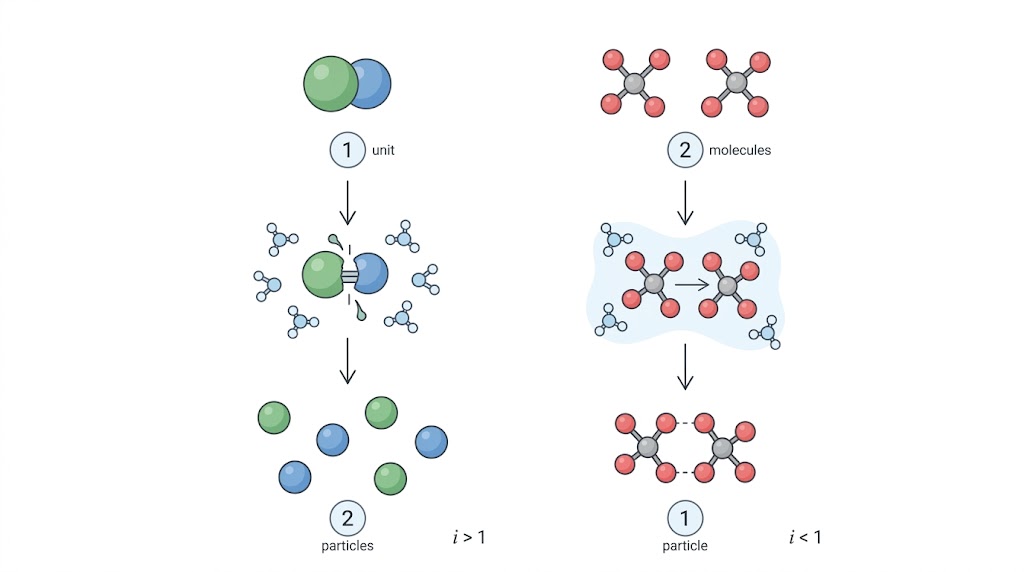
The colligative property formulas derived above assume the solute particles do not interact. However, in reality, ionic compounds dissociate (split) into multiple ions in water, and some organic molecules associate (dimerize) due to hydrogen bonding in non-polar solvents. This changes the actual number of particles, causing the calculated molar mass to be "abnormal".
Van't Hoff Factor ($i$)
To account for the extent of dissociation or association, Jacobus Henricus van 't Hoff introduced factor $i$.
$$ i = \frac{\text{Normal molar mass}}{\text{Abnormal (calculated) molar mass}} $$
$$ i = \frac{\text{Observed Colligative Property}}{\text{Calculated Colligative Property}} $$
$$ i = \frac{\text{Total moles of particles after association/dissociation}}{\text{Total moles of particles before association/dissociation}} $$
- For Dissociation (e.g., $\text{NaCl} \rightarrow \text{Na}^+ + \text{Cl}^-$): $i > 1$. Calculated molar mass is lower than true value.
- For Association (e.g., 2 Acetic acid molecules forming a dimer in benzene): $i < 1$. Calculated molar mass is higher than true value.
- For Non-electrolytes (e.g., Glucose, Urea, Sucrose): $i = 1$. They do not split or join.
Modified Colligative Property Formulas
Every colligative property formula MUST be multiplied by $i$ when dealing with electrolytes.
- RLVP: $\frac{p_1^0 - p_1}{p_1^0} = \mathbf{i} \cdot x_2$
- Elevation of BP: $\Delta T_b = \mathbf{i} \cdot K_b \cdot m$
- Depression of FP: $\Delta T_f = \mathbf{i} \cdot K_f \cdot m$
- Osmotic Pressure: $\pi = \mathbf{i} \cdot C \cdot R \cdot T$
Degree of Dissociation and Association ($\alpha$)
Weak electrolytes don't dissociate completely. Their $i$ value depends on their degree of dissociation ($\alpha$).
- For Dissociation: $\alpha = \frac{i - 1}{n - 1}$ (where $n$ is the total number of ions one molecule forms. E.g., for $\text{K}_2\text{SO}_4 \rightarrow 2\text{K}^+ + \text{SO}_4^{2-}$, $n=3$).
- For Association: $\alpha = \frac{1 - i}{1 - 1/n}$ (where $n$ is the number of molecules joining together. E.g., for dimerization, $n=2$).
Practice Problem 9
Question: A $0.5\% \text{ w/w}$ aqueous solution of $\text{KCl}$ was found to freeze at $-0.24^\circ\text{C}$. Calculate the Van't Hoff factor and degree of dissociation of $\text{KCl}$ at this concentration. ($K_f \text{ for water} = 1.86\text{ K kg mol}^{-1}$).
Solution:
1. Mass of solute $\text{KCl}$ ($w_2$) $= 0.5\text{ g}$. Mass of solvent water ($w_1$) $= 100 - 0.5 = 99.5\text{ g}$.
2. Molar mass of $\text{KCl}$ ($M_2$) $= 39 + 35.5 = 74.5\text{ g/mol}$.
3. Calculate molality ($m$) $= \frac{w_2 \times 1000}{M_2 \times w_1} = \frac{0.5 \times 1000}{74.5 \times 99.5} = \frac{500}{7412.75} \approx 0.0674\text{ m}$.
4. Calculated $\Delta T_f$ (assuming no dissociation) $= K_f \times m = 1.86 \times 0.0674 = 0.125^\circ\text{C}$.
5. Observed $\Delta T_f = 0.24^\circ\text{C}$ (given).
6. Van't Hoff factor ($i$) $= \frac{\text{Observed } \Delta T_f}{\text{Calculated } \Delta T_f} = \frac{0.24}{0.125} = \mathbf{1.92}$.
7. $\text{KCl}$ dissociates into 2 ions ($\text{K}^+$ and $\text{Cl}^-$), so $n = 2$.
8. Degree of dissociation ($\alpha$) $= \frac{i - 1}{n - 1} = \frac{1.92 - 1}{2 - 1} = 0.92 = \mathbf{92\%}$.
Practice Problem 10
Question: $2\text{ g}$ of benzoic acid ($\text{C}_6\text{H}_5\text{COOH}$) dissolved in $25\text{ g}$ of benzene shows a depression in freezing point equal to $1.62\text{ K}$. Molal depression constant for benzene is $4.9\text{ K kg mol}^{-1}$. What is the percentage association of acid if it forms a dimer in solution?
Solution:
1. Given: $w_2 = 2\text{ g}$, $w_1 = 25\text{ g}$, $\Delta T_f = 1.62\text{ K}$, $K_f = 4.9\text{ K kg mol}^{-1}$.
2. Normal molar mass of benzoic acid ($M_2$) $= 122\text{ g/mol}$.
3. Calculate Abnormal Molar mass from formula: $M_{2(abnormal)} = \frac{K_f \times w_2 \times 1000}{\Delta T_f \times w_1}$.
4. $M_{2(abnormal)} = \frac{4.9 \times 2 \times 1000}{1.62 \times 25} = \frac{9800}{40.5} \approx 241.98\text{ g/mol}$.
5. Van't Hoff factor $i = \frac{Normal M_2}{Abnormal M_2} = \frac{122}{241.98} \approx 0.504$.
6. It forms a dimer, so $n = 2$.
7. Degree of association $\alpha = \frac{1 - i}{1 - 1/n} = \frac{1 - 0.504}{1 - 1/2} = \frac{0.496}{0.5} = 0.992$.
8. Percentage association $= 0.992 \times 100 = \mathbf{99.2\%}$.
Topic 7 Quick Solved Drill
Q1: A salt gives 3 ions on complete dissociation and has $i=2.2$. Find $\alpha$.
Answer: $\alpha=\frac{i-1}{n-1}=\frac{2.2-1}{3-1}=\mathbf{0.60}$.
Q2: For dimerization with $i=0.80$, find degree of association.
Answer: $\alpha=\frac{1-i}{1-1/2}=\frac{0.20}{0.5}=\mathbf{0.40}$.
Q3: Explain isotonic saline in one line.
Answer: Its osmotic pressure matches blood, so RBC shape remains unchanged.
8. NCERT Deep-Dive Additions (High-Scoring Theory + Numericals)
Must Know
Saturated, Unsaturated and Supersaturated Solutions:
- Unsaturated: Contains less solute than the maximum solubility at given $T$.
- Saturated: Contains maximum amount of solute possible at that $T$; dynamic equilibrium exists between dissolution and crystallization.
- Supersaturated: Contains more solute than saturated solution at same $T$; metastable and crystallizes on seeding/shaking.
NCERT idea: Solubility is always quoted with temperature, and sometimes pressure (for gases).
Important Distinction
Ideal vs Ideal Dilute Solution:
Ideal solution: Both components obey Raoult's law at all compositions.
Ideal dilute solution: Solvent obeys Raoult's law and solute obeys Henry's law.
This distinction is frequently asked as an assertion-reason concept in boards and entrance tests.
Formula Bridge
Useful concentration relations:
- $w/w\% = \dfrac{\text{mass of solute}}{\text{mass of solution}} \times 100$
- $M = \dfrac{w_2\times 1000}{M_2\times V(\text{mL})}$
- $m = \dfrac{w_2\times 1000}{M_2\times w_1(\text{g})}$
- $x_2 = \dfrac{n_2}{n_1+n_2}$
- For dilute aqueous solution: $\text{ppm} \approx \text{mg/L}$
Quick caution: Molarity changes with temperature, molality does not.
Practice Problem 11
Question: A solution contains $10\text{ g}$ glucose in $90\text{ g}$ water. Find mass percentage of glucose.
Solution: Total mass $= 10+90 = 100\text{ g}$.
$w/w\% = \dfrac{10}{100}\times 100 = \mathbf{10\%}$.
Practice Problem 12
Question: Calculate molarity of a solution containing $4.9\text{ g}$ $\text{H}_2\text{SO}_4$ in $250\text{ mL}$ solution.
Solution: $M_2(\text{H}_2\text{SO}_4)=98\text{ g/mol}$, moles $=4.9/98=0.05$.
Volume $=0.250\text{ L}$. So $M=0.05/0.25=\mathbf{0.20\,M}$.
Practice Problem 13
Question: Find molality of a solution prepared by dissolving $9.2\text{ g}$ ethanol ($M=46$) in $200\text{ g}$ water.
Solution: Moles of ethanol $=9.2/46=0.2$ mol.
Mass of solvent $=0.200\text{ kg}$.
$m=0.2/0.2=\mathbf{1.0\,m}$.
Practice Problem 14
Question: State whether each statement is True/False: (i) Molarity decreases on heating. (ii) Molality decreases on heating.
Solution:
(i) True (volume increases, so $M$ decreases).
(ii) False (mass-based quantity, temperature independent).
Practice Problem 15
Question: At constant pressure, if Henry constant for a gas doubles with temperature, what happens to its solubility (qualitatively)?
Solution: Since $x=\dfrac{p}{K_H}$, higher $K_H$ means lower $x$.
So solubility decreases.
Practice Problem 16
Question: For a binary ideal solution at $300\text{ K}$, $p_A^0=300\text{ mmHg}$, $p_B^0=150\text{ mmHg}$ and $x_A=0.40$. Find total vapour pressure.
Solution: $x_B=0.60$.
$P_{total}=p_A^0x_A+p_B^0x_B=300(0.4)+150(0.6)=120+90=\mathbf{210\text{ mmHg}}$.
Practice Problem 17
Question: A solution shows $\Delta H_{mix}<0$ and $\Delta V_{mix}<0$. Predict deviation from Raoult's law.
Solution: Stronger A-B interactions lead to negative deviation.
Practice Problem 18
Question: Why can ethanol-water mixture not be fully separated by fractional distillation?
Solution: Because it forms a minimum boiling azeotrope with liquid and vapour of same composition at azeotropic point.
Practice Problem 19
Question: Calculate RLVP when vapour pressure of pure water is $31.8\text{ mmHg}$ and that of solution is $31.0\text{ mmHg}$.
Solution:
$$\frac{p_1^0-p_1}{p_1^0}=\frac{31.8-31.0}{31.8}=\frac{0.8}{31.8}=\mathbf{0.0252}$$
Practice Problem 20
Question: $\Delta T_f$ of a solution is $0.93\text{ K}$ in water ($K_f=1.86$). Find molality.
Solution: $m=\Delta T_f/K_f=0.93/1.86=\mathbf{0.50\,m}$.
Practice Problem 21
Question: A 0.01 M nonelectrolyte solution at $300\text{ K}$ has osmotic pressure ? ($R=0.083\text{ L bar mol}^{-1}\text{K}^{-1}$)
Solution: $\pi=CRT=0.01\times0.083\times300=\mathbf{0.249\text{ bar}}$.
Practice Problem 22
Question: If observed colligative property is 2.7 times theoretical value for $\text{AlCl}_3$, estimate van't Hoff factor and infer dissociation behavior.
Solution: $i=\dfrac{\text{observed}}{\text{calculated}}=2.7$. Since $i>1$, solute undergoes dissociation (strongly, though not 100%).
Practice Problem 23
Question: For a salt that gives 3 ions on complete dissociation, derive $\alpha$ if van't Hoff factor is 2.2.
Solution: For dissociation, $\alpha=\dfrac{i-1}{n-1}=\dfrac{2.2-1}{3-1}=\dfrac{1.2}{2}=\mathbf{0.60}$ (60%).
Practice Problem 24
Question: For dimerization, if $i=0.80$, find degree of association.
Solution: For association with $n=2$,
$$\alpha=\frac{1-i}{1-1/2}=\frac{1-0.80}{0.5}=\frac{0.20}{0.5}=\mathbf{0.40}$$
So association = $40\%$.
Practice Problem 25
Question: Explain why saline solution is given in hospitals as isotonic fluid.
Solution: Isotonic solution has same osmotic pressure as blood plasma, so RBCs neither shrink (crenation) nor burst (hemolysis).
9. Last-Minute Revision Sheet
One-Page Recall
- Most asked formulas: Henry, Raoult, RLVP, $\Delta T_b=K_bm$, $\Delta T_f=K_fm$, $\pi=CRT$, van't Hoff factor.
- Temperature dependence: $M$ changes, $m$ and $x$ do not.
- Gas solubility: increases with pressure, decreases with temperature.
- Positive deviation: weaker A-B, higher VP, lower BP azeotrope.
- Negative deviation: stronger A-B, lower VP, higher BP azeotrope.
- Colligative properties depend on number of particles, not identity.