VARDAAN LEARNING INSTITUTE | POWERED BY VARDAAN COMET
Our Environment
Created by Team Vardaan with ❤️
1. Ecosystem and its Components
Ecosystem: A self-sustaining system where biotic (living) and abiotic (non-living)
components interact with each other. (e.g., Garden, Forest, Pond).
| Component |
Examples & Role |
| Abiotic |
Temperature, Rainfall, Soil, Air, Light. |
| Biotic |
1. Producers: Green plants/Blue-green algae (Make food).
2. Consumers: Herbivores, Carnivores, Omnivores, Parasites.
3. Decomposers: Bacteria, Fungi (Break down dead matter).
|
What is the role of Decomposers?
They break down complex organic matter (dead plants/animals) into simple inorganic substances that go
into
the soil and are used up once more by the plants. They act as natural cleansing agents
of
the environment.
2. Food Chain & Energy Flow
Food Chain: A series of organisms where one eats another to transfer energy. (Grass →
Deer →
Tiger).
Food Web vs Food Chain:
In nature, food chains are not isolated. One organism may be eaten by many others (e.g., a Frog eaten by
Snake or Bird). This interconnected network is a Food Web. It provides stability to the
ecosystem.
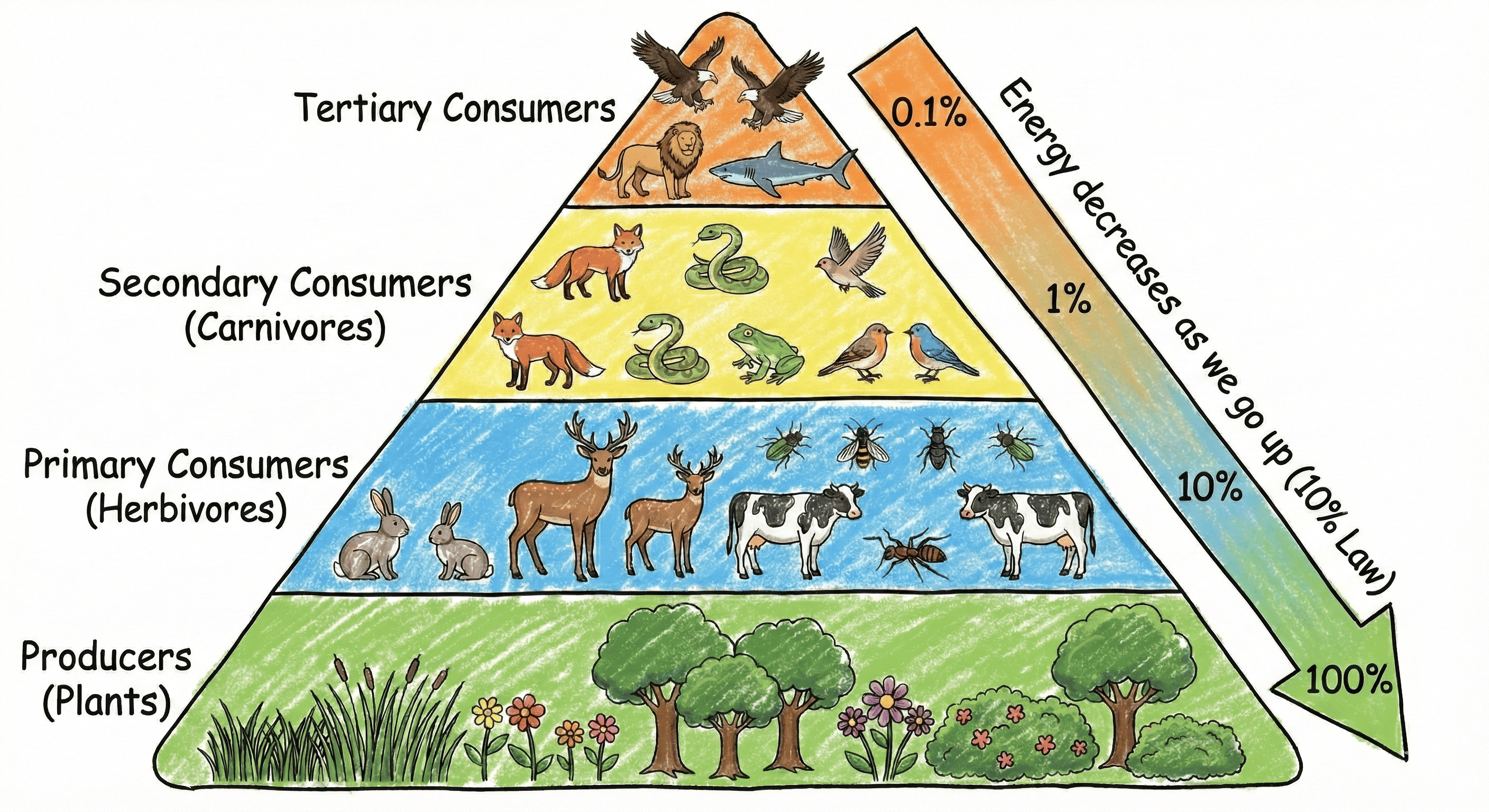
A. The 10% Law (Lindeman)
Statement: Only 10% of energy entering a particular trophic level is
available for transfer to the next higher trophic level. The remaining 90% is lost as
heat/digestion/growth.
*Note: Plants capture only 1% of Solar Energy.
Numerical Example (PYQ):
Sun (100,000 J) → Plant (1% = 1000 J) → Deer (10% = 100 J) → Lion (10% = 10 J).
Conclusion: Food chains generally consist of only 3 or 4 steps because very little energy is
left
for a 5th level.
B. Flow of Energy is Unidirectional
Energy captured by autotrophs does not revert back to the sun. Energy passed to herbivores does not come
back
to autotrophs. It moves progressively through trophic levels.
Figure 5.1: Trophic Levels Pyramid
3. Biological Magnification
Mechanism:
1. Harmful chemicals (Pesticides/DDT) are sprayed on crops.
2. They enter the soil/water bodies.
3. Absorbed by plants (Producers).
4. Passed on to Herbivores and then Carnivores.
5. Since these are non-biodegradable, they accumulate at each level.
Result: Concentration is maximum in Humans (Top level).
4. Ozone Layer Depletion
Ozone (O3): A deadly poison at ground level, but a shield in the
stratosphere. It
protects earth from harmful UV radiation (causes skin cancer, cataracts).
A. Formation of Ozone
- UV splits Oxygen molecule: O2 —(UV)→ O + O
- Free oxygen combines with Oxygen molecule: O + O2 → O3
(Ozone)
B. Depletion Cause
Synthetic chemicals like CFCs (Chlorofluorocarbons) used in Refrigerators and Fire
Extinguishers reach the upper atmosphere and break down Ozone.
UNEP (1987): Forged an agreement to freeze CFC production at 1986 levels (Montreal
Protocol).
5. Managing Garbage
| Biodegradable |
Non-Biodegradable |
| Broken down by biological processes (Bacteria/Enzymes). |
Cannot be broken down biologically. Persist for long. |
| Example: Fruit peels, Paper, Wood, Cotton. |
Example: Plastic, Glass, Metals, DDT. |
Why replaced plastic cups with Kulhads (Clay cups) and then Paper cups?
• Plastic: Non-biodegradable waste.
• Kulhads: Biodegradable, but caused loss of fertile topsoil (to make clay).
• Paper Cups: Biodegradable and can be recycled. Best option.
-
Calculate the energy available to the Tiger if the Plants absorb 20,000 J of energy from the
Sun.
Hint: Don't forget Plants take only 1% from Sun (200 J), then 10% passes
to
Deer (20 J), then 10% to Tiger (2 J).
-
Why do we find maximum chemical accumulation in Humans in a food chain?
Hint: Humans are at the top trophic level. Chemicals are
non-biodegradable
and accumulate at every step (Biomagnification).
-
"Damage to the Ozone layer is a cause for concern." Justify this statement.
Hint: Ozone protects from UV rays. UV rays cause Skin Cancer, Cataracts
in
humans, and damage to crops/ecosystems.
Powered by Vardaan Comet 🚀