
Board Exam 2025
5 Marks
Q34. (a) The given figure shows the current
passing through the straight conductor XY.
(i) Copy the diagram and draw the magnetic field lines when current flows from conductor X to Y.
(ii) Name and state the rule used in determining the direction of the magnetic field lines in the situation given above.
(iii) State Fleming�s left hand rule. Using this rule, determine the direction of force applied on an electron entering a uniform magnetic field as shown in the figure.
OR
(b) (i) Define the term solenoid. Draw the pattern of the magnetic field lines in and around a current carrying straight solenoid. Mark on the pattern the (i) direction of current, (ii) direction of field lines near the ends of the solenoid, and (iii) region where the magnetic field is uniform.
(ii) How would you make an electromagnet using a current carrying solenoid ?
(i) Copy the diagram and draw the magnetic field lines when current flows from conductor X to Y.
(ii) Name and state the rule used in determining the direction of the magnetic field lines in the situation given above.
(iii) State Fleming�s left hand rule. Using this rule, determine the direction of force applied on an electron entering a uniform magnetic field as shown in the figure.
OR
(b) (i) Define the term solenoid. Draw the pattern of the magnetic field lines in and around a current carrying straight solenoid. Mark on the pattern the (i) direction of current, (ii) direction of field lines near the ends of the solenoid, and (iii) region where the magnetic field is uniform.
(ii) How would you make an electromagnet using a current carrying solenoid ?
(a) (i) Magnetic Field Lines:
Concentric circles around the conductor XY. Since current is X to Y (Downwards), field is Clockwise.
(a) (ii) Rule: Right-Hand Thumb Rule.
Imagine holding the current-carrying conductor in your right hand such that the thumb points in the direction of current. Then your fingers will wrap around the conductor in the direction of the magnetic field lines.
(a) (iii) Fleming's Left Hand Rule:
Stretch the forefinger, central finger and thumb of left hand mutually perpendicular. If forefinger points to field, central finger to current, then thumb points to force.
Application:
- Field: Right (-->).
- Electron moves Right (-->). Current is opposite to Electron motion (<-- Left).
- Field Right, Current Left? Angle is 180 degrees. Force is Zero (parallel motion).
Note: If the diagram shows electron moving perpendicular (e.g., Up), force would be Into Page. But "entering field as shown"... usually implies perpendicular. Looking at standard diagrams, if e move right parallel to field, F=0.
(b) (i) Solenoid:
A coil of many circular turns of insulated copper wire wrapped closely in the shape of a cylinder.
(Diagram: Similar to Bar Magnet).
- Uniform field: Inside the solenoid (parallel straight lines).
(b) (ii) Electromagnet:
By placing a soft iron core inside the current-carrying solenoid, the magnetic field is significantly increased, creating an electromagnet.
Concentric circles around the conductor XY. Since current is X to Y (Downwards), field is Clockwise.
(a) (ii) Rule: Right-Hand Thumb Rule.
Imagine holding the current-carrying conductor in your right hand such that the thumb points in the direction of current. Then your fingers will wrap around the conductor in the direction of the magnetic field lines.
(a) (iii) Fleming's Left Hand Rule:
Stretch the forefinger, central finger and thumb of left hand mutually perpendicular. If forefinger points to field, central finger to current, then thumb points to force.
Application:
- Field: Right (-->).
- Electron moves Right (-->). Current is opposite to Electron motion (<-- Left).
- Field Right, Current Left? Angle is 180 degrees. Force is Zero (parallel motion).
Note: If the diagram shows electron moving perpendicular (e.g., Up), force would be Into Page. But "entering field as shown"... usually implies perpendicular. Looking at standard diagrams, if e move right parallel to field, F=0.
(b) (i) Solenoid:
A coil of many circular turns of insulated copper wire wrapped closely in the shape of a cylinder.
(Diagram: Similar to Bar Magnet).
- Uniform field: Inside the solenoid (parallel straight lines).
(b) (ii) Electromagnet:
By placing a soft iron core inside the current-carrying solenoid, the magnetic field is significantly increased, creating an electromagnet.
4 Marks
Q37. Case Study: In our
homes, we receive the supply of electric power through a main supply also called mains, either
supported through overhead electric poles or by underground cables. In our country the potential
difference between the two wires (live wire and neutral wire) of this supply is 220 V.
(a) Write the colours of the insulation covers of the line wires through which supply comes to our homes.
(b) What should be the current rating of the electric circuit (220 V) so that an electric iron of 1 kW power rating can be operated ?
(c) (i) What is the function of the earth wire ? State the advantage of the earth wire in domestic electric appliances such as electric iron.
OR
(c) (ii) List two precautions to be taken to avoid electrical accidents. State how these precautions prevent possible damage to the circuit/appliance.
(a) Write the colours of the insulation covers of the line wires through which supply comes to our homes.
(b) What should be the current rating of the electric circuit (220 V) so that an electric iron of 1 kW power rating can be operated ?
(c) (i) What is the function of the earth wire ? State the advantage of the earth wire in domestic electric appliances such as electric iron.
OR
(c) (ii) List two precautions to be taken to avoid electrical accidents. State how these precautions prevent possible damage to the circuit/appliance.
(a) Wire Colours:
- Live Wire: Red (or Brown).
- Neutral Wire: Black (or Blue).
(b) Current Rating:
Power \(P = 1 \text{ kW} = 1000 \text{ W}\). Voltage \(V = 220 \text{ V}\).
Current \(I = \frac{P}{V} = \frac{1000}{220} \approx 4.54 \text{ A}\).
The rating should be 5 A (next standard rating).
(c) (i) Earth Wire:
Function: Provides a low-resistance path to the ground for leakage current.
Advantage: Prevents electric shock to the user if the live wire touches the metallic body of the appliance.
(c) (ii) Precautions:
1. Use of Fuse/MCB: Breaks circuit during overloading/short-circuit, preventing fire/damage.
2. Proper Earthing: Prevents shock from metallic appliances.
(Also: Use of good quality insulation, Avoid touching switches with wet hands).
- Live Wire: Red (or Brown).
- Neutral Wire: Black (or Blue).
(b) Current Rating:
Power \(P = 1 \text{ kW} = 1000 \text{ W}\). Voltage \(V = 220 \text{ V}\).
Current \(I = \frac{P}{V} = \frac{1000}{220} \approx 4.54 \text{ A}\).
The rating should be 5 A (next standard rating).
(c) (i) Earth Wire:
Function: Provides a low-resistance path to the ground for leakage current.
Advantage: Prevents electric shock to the user if the live wire touches the metallic body of the appliance.
(c) (ii) Precautions:
1. Use of Fuse/MCB: Breaks circuit during overloading/short-circuit, preventing fire/damage.
2. Proper Earthing: Prevents shock from metallic appliances.
(Also: Use of good quality insulation, Avoid touching switches with wet hands).
1 Mark
Q12. The strength of the magnetic field
inside a current carrying long straight solenoid is :
Inside a long straight solenoid, the magnetic field lines are parallel
straight
lines, indicating that the field is uniform at all points.
Correct Option: (D)
Correct Option: (D)
1 Mark
Q17. Assertion (A): In our
homes we receive supply of electric power through a main supply. One of the wires in this supply,
usually with red insulation, is called live wire and another wire with green insulation is called
neutral wire.
Reason (R): In our country, the potential difference between the live wire and the neutral wire is 220 volts.
Reason (R): In our country, the potential difference between the live wire and the neutral wire is 220 volts.
Assertion (A): False. Live wire is red (or brown), but
Neutral
wire is Black (or Blue). Green is Earth wire.
Reason (R): True. The standard voltage is 220V.
Correct Option: (D) A is false, but R is true. (Note: Question text says 'green insulation is called neutral'. This is factually incorrect).
Reason (R): True. The standard voltage is 220V.
Correct Option: (D) A is false, but R is true. (Note: Question text says 'green insulation is called neutral'. This is factually incorrect).
3 Marks
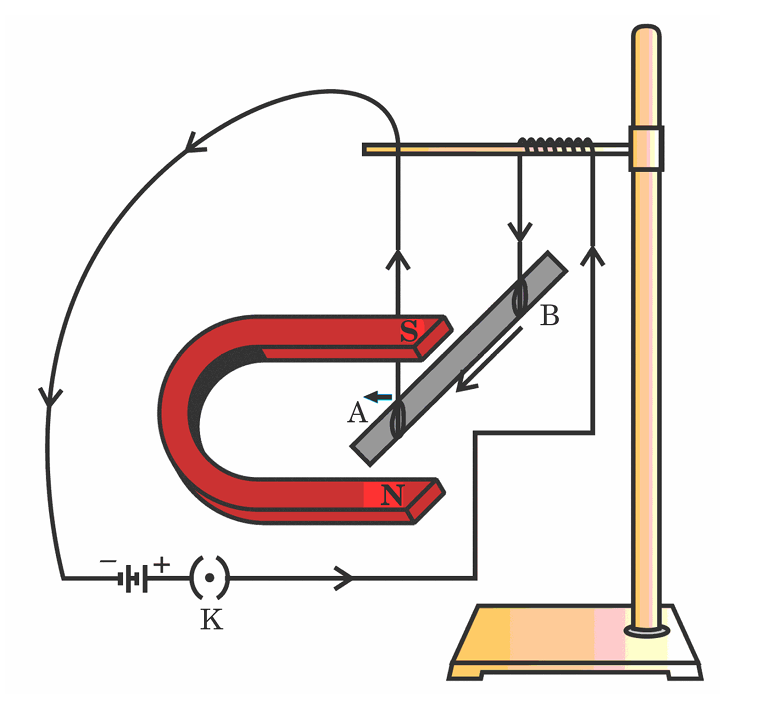
Q33. As shown in the figure a small aluminum
rod
AB is suspended horizontally between the poles of a strong horseshoe magnet. This rod is also
connected
with a battery and a key. Study the arrangement shown.

(a) State Fleming�s left-hand rule.
(b) Apply Fleming�s left-hand rule to determine :
(i) What is observed when a current is passed from B to A in the rod ?
(ii) What is observed when a current is passed from A to B in the rod ?
(iii) What is observed when the rod AB is aligned parallel to the magnetic field and current is passed through it from B to A ? Justify your answer in this case.
(a) State Fleming�s left-hand rule.
(b) Apply Fleming�s left-hand rule to determine :
(i) What is observed when a current is passed from B to A in the rod ?
(ii) What is observed when a current is passed from A to B in the rod ?
(iii) What is observed when the rod AB is aligned parallel to the magnetic field and current is passed through it from B to A ? Justify your answer in this case.
(a) Fleming's Left-Hand Rule: Stretch the thumb, forefinger and
middle finger of your left hand such that they are mutually perpendicular. If the First finger
points in
the direction of magnetic Field, and the middle finger in the direction of
Current, then the Thumb will point in the direction of Motion
(Force).
(b) Application:
(i) Current B to A: Rod moves to the Left (away from magnet U-bend) / or moves Up/Down depending on pole orientation (Assuming N is bottom, S is top?). The rod is displaced.
(ii) Current A to B: The direction of force reverses. Rod moves in the opposite direction.
(iii) Parallel: No motion is observed.
Justification: The force on a current carrying conductor is \(F = ILB \sin\theta\). If
(b) Application:
(i) Current B to A: Rod moves to the Left (away from magnet U-bend) / or moves Up/Down depending on pole orientation (Assuming N is bottom, S is top?). The rod is displaced.
(ii) Current A to B: The direction of force reverses. Rod moves in the opposite direction.
(iii) Parallel: No motion is observed.
Justification: The force on a current carrying conductor is \(F = ILB \sin\theta\). If
Q15. Which of the following statements is
true
about magnetic field lines ?
Statements Analysis:
(A) They never cross (False).
(B) Emerge from North and merge at South outside magnet (False).
(C) Relatve strength is shown by closeness (True). Crowded lines = Strong field.
(D) They form closed curves (False).
Correct Option: (C)
(A) They never cross (False).
(B) Emerge from North and merge at South outside magnet (False).
(C) Relatve strength is shown by closeness (True). Crowded lines = Strong field.
(D) They form closed curves (False).
Correct Option: (C)
1 Mark
Q16. A constant current flows in a horizontal
wire in the plane of the paper from East to West as shown in figure. The direction of the magnetic field
will be North to South at a point :
2025-31-2-QuestionNumber16
Right Hand Thumb Rule:
Thumb points West (Current direction).
Fingers curl around the wire.
- Above the wire: Fingers curl towards South (North to South? No, fingers curl from North side *towards* South side? Let's check).
Thumb West.
Fingers curl: Enter from South, Exit from North? Wait.
Imagine wire West (Left). Thumb Left.
Fingers curl: Down into paper on the South side? Up out of paper on North side? No.
Let's use specific points.
Below wire: Fingers point Towards You (South? No, depends on orientation).
Actually, standard convention: N, S, E, W plane.
Current East to West.
Below wire: Magnetic field is South to North? Or North to South?
Let's trace.
Thumb West.
Fingers at a point Below the wire will point towards East? No.
Let's visualize perpendicular plane.
At a point Directly Below the wire: The tangent to the circle points South? No.
Thumb West. Fingers curl such that at bottom they go from North to South? Or South to North?
Let's try "Clockwise from East view".
If current is away (West), field is Clockwise.
Below wire: Left to Right? No.
Let's simplify: Maxwell's Corkscrew Rule.
Current Left (West).
Top of wire: Into page?
Bottom of wire: Out of page?
If "North to South" refers to geographic direction in the horizontal plane...
The question likely implies 3D space. "Below wire" means vertically below.
If current is East to West along paper.
Directly Below wire, field is North to South? Or South to North?
Let's check: Thumb West. Fingers curl: In front of wire -> Down. Behind wire -> Up. Below wire -> ?
Let's assume "Plane of paper is horizontal".
Wire is on paper. Current E -> W.
Field lines are vertical loops.
Below the wire (inside the table?): Field is South -> North? Or North -> South?
Actually, if wire is in plane, "Below" means under the paper. "Above" means over the paper.
Thumb West.
Fingers Below the wire point North? Wait.
Let's use standard rule.
Current: West.
Field Below: Points to the Left (South)? No.
Let's try: Hold wire. Thumb West.
Fingers under the wire point towards South? No, they point towards Left (if facing West). Left of West is South.
Yes. If you face West, Left is South. Right is North.
At point below wire, fingers point Left (South).
So, direction is North to South? It points *towards* South.
So at a point directly below the wire, direction is North to South.
Let's check "Directly Above". Fingers point North.
So likely answer is (B) directly below the wire.
Correct Option: (B)
Thumb points West (Current direction).
Fingers curl around the wire.
- Above the wire: Fingers curl towards South (North to South? No, fingers curl from North side *towards* South side? Let's check).
Thumb West.
Fingers curl: Enter from South, Exit from North? Wait.
Imagine wire West (Left). Thumb Left.
Fingers curl: Down into paper on the South side? Up out of paper on North side? No.
Let's use specific points.
Below wire: Fingers point Towards You (South? No, depends on orientation).
Actually, standard convention: N, S, E, W plane.
Current East to West.
Below wire: Magnetic field is South to North? Or North to South?
Let's trace.
Thumb West.
Fingers at a point Below the wire will point towards East? No.
Let's visualize perpendicular plane.
At a point Directly Below the wire: The tangent to the circle points South? No.
Thumb West. Fingers curl such that at bottom they go from North to South? Or South to North?
Let's try "Clockwise from East view".
If current is away (West), field is Clockwise.
Below wire: Left to Right? No.
Let's simplify: Maxwell's Corkscrew Rule.
Current Left (West).
Top of wire: Into page?
Bottom of wire: Out of page?
If "North to South" refers to geographic direction in the horizontal plane...
The question likely implies 3D space. "Below wire" means vertically below.
If current is East to West along paper.
Directly Below wire, field is North to South? Or South to North?
Let's check: Thumb West. Fingers curl: In front of wire -> Down. Behind wire -> Up. Below wire -> ?
Let's assume "Plane of paper is horizontal".
Wire is on paper. Current E -> W.
Field lines are vertical loops.
Below the wire (inside the table?): Field is South -> North? Or North -> South?
Actually, if wire is in plane, "Below" means under the paper. "Above" means over the paper.
Thumb West.
Fingers Below the wire point North? Wait.
Let's use standard rule.
Current: West.
Field Below: Points to the Left (South)? No.
Let's try: Hold wire. Thumb West.
Fingers under the wire point towards South? No, they point towards Left (if facing West). Left of West is South.
Yes. If you face West, Left is South. Right is North.
At point below wire, fingers point Left (South).
So, direction is North to South? It points *towards* South.
So at a point directly below the wire, direction is North to South.
Let's check "Directly Above". Fingers point North.
So likely answer is (B) directly below the wire.
Correct Option: (B)
3 Marks
Q26. State the rule used to find the direction of
force experienced by a current carrying conductor placed in a magnetic field. Under which condition is
this force maximum ? (ii) An electron enters a uniform magnetic field at right angles to it as shown in
figure.
Find the direction of force acting on the electron. Justify your answer.
2025-31-2-QuestionNumber26
Find the direction of force acting on the electron. Justify your answer.
Rule: Fleming's Left Hand Rule.
Stretch thumb, forefinger and middle finger of left hand mutually perpendicular.
- Forefinger: Magnetic Field.
- Middle Finger: Current.
- Thumb: Force/Motion.
Maximum Force: When current is perpendicular (\(90^\circ\)) to the magnetic field.
(ii) Direction on Electron:
- Electron moves (say) Right. So Current is Left (Opposite to electron).
- Field is (say) Into Paper / Down (Depending on figure).
Assuming standard figure: Field perpendicular.
Apply Left Hand Rule with Current opposite to Electron motion.
(If Electron moves Right, Current is Left. If Field is Into page, Force is Down).
(Needs visual confirmation of figure, but standard answer is: Direction of force is perpendicular to both current and field).
Justification: Current direction is taken opposite to flow of electrons. Apply Fleming's Left Hand Rule.
Stretch thumb, forefinger and middle finger of left hand mutually perpendicular.
- Forefinger: Magnetic Field.
- Middle Finger: Current.
- Thumb: Force/Motion.
Maximum Force: When current is perpendicular (\(90^\circ\)) to the magnetic field.
(ii) Direction on Electron:
- Electron moves (say) Right. So Current is Left (Opposite to electron).
- Field is (say) Into Paper / Down (Depending on figure).
Assuming standard figure: Field perpendicular.
Apply Left Hand Rule with Current opposite to Electron motion.
(If Electron moves Right, Current is Left. If Field is Into page, Force is Down).
(Needs visual confirmation of figure, but standard answer is: Direction of force is perpendicular to both current and field).
Justification: Current direction is taken opposite to flow of electrons. Apply Fleming's Left Hand Rule.
1 Mark
Q13. In domestic electric circuits, the colour of
insulation covers of wires in the cables of electric iron/electric toaster is generally :
Insulation Colors (Old Convention):
Live: Red.
Neutral: Black.
Earth: Green.
Correct Option: (B)
Live: Red.
Neutral: Black.
Earth: Green.
Correct Option: (B)
1 Mark
Q14. The strength of magnetic field produced
inside a long straight current carrying solenoid does not depend upon :
Factors affecting B inside Solenoid (\(B = \mu_0 n I\)):
1. Current (\(I\)).
2. Number of turns per unit length (\(n\)). (Hence A is a factor).
3. Nature of Core material (\(\mu_r\)). (Hence C is a factor).
Does NOT depend on:
- Direction of current (changes direction of field, not strength).
- Radius (for a long ideal solenoid, B is uniform and independent of radius).
Comparing (B) and (D): While direction strictly doesn't change strength, it is a property of the flow. Radius is a geometric property not in the ideal formula.
However, usually "Radius" is the intended answer for "Not dependent on geometry".
Correct Option: (D)
1. Current (\(I\)).
2. Number of turns per unit length (\(n\)). (Hence A is a factor).
3. Nature of Core material (\(\mu_r\)). (Hence C is a factor).
Does NOT depend on:
- Direction of current (changes direction of field, not strength).
- Radius (for a long ideal solenoid, B is uniform and independent of radius).
Comparing (B) and (D): While direction strictly doesn't change strength, it is a property of the flow. Radius is a geometric property not in the ideal formula.
However, usually "Radius" is the intended answer for "Not dependent on geometry".
Correct Option: (D)
1 Mark
Q15. Which one of the following statements is
not true about a bar magnet ?
Analysis:
(A) True.
(B) True.
(C) True.
(D) False. Inside a magnet, field lines go from South to North.
Correct Option: (D)
(A) True.
(B) True.
(C) True.
(D) False. Inside a magnet, field lines go from South to North.
Correct Option: (D)
1 Mark
Q20. Assertion (A): Magnetic
field lines around a bar magnet never intersect each other.
Reason (R): Magnetic field produced by a bar magnet is a quantity that has both magnitude and direction.
Reason (R): Magnetic field produced by a bar magnet is a quantity that has both magnitude and direction.
Assertion (A): True.
Reason (R): True (Vector quantity).
Explanation: Because the magnetic field has a unique direction at any point (vector property), two lines cannot intersect (as that would imply two directions at one point). Thus, the vector nature (having direction) is the fundamental reason.
Correct Option: (A)
Reason (R): True (Vector quantity).
Explanation: Because the magnetic field has a unique direction at any point (vector property), two lines cannot intersect (as that would imply two directions at one point). Thus, the vector nature (having direction) is the fundamental reason.
Correct Option: (A)
1 Mark
Q18. In the event of short circuit, the current
in the circuit :
In a short circuit, the resistance of the circuit becomes extremely low (virtually
zero). According to Ohm's Law (\(I = V/R\)), the current increases heavily
(abruptly).
Correct Option: (C)
Correct Option: (C)
3 Marks
Q29. Draw a diagram to show the pattern of
magnetic field lines around a straight current carrying conductor. Mark the direction of current in the
conductor and the direction of magnetic field lines.
(a) Name the rule to find the direction of magnetic field lines.
(b) State the relation between the strength of magnetic field and (i) Current in conductor, (ii) Distance from conductor.
(b) State the relation between the strength of magnetic field and (i) Current in conductor, (ii) Distance from conductor.
Diagram:
(Concentric circles around wire. Direction by Right Hand Thumb Rule).
(a) Rule: Right-Hand Thumb Rule.
(b) Relation:
(i) Current (I): Directly proportional ($B \propto I$).
(ii) Distance (r): Inversely proportional ($B \propto 1/r$).
Straight Conductor Field Pattern
(Concentric circles around wire. Direction by Right Hand Thumb Rule).
(a) Rule: Right-Hand Thumb Rule.
(b) Relation:
(i) Current (I): Directly proportional ($B \propto I$).
(ii) Distance (r): Inversely proportional ($B \propto 1/r$).
3 Marks
Q32. (a) Name and state the rule which determines
the force on a current carrying conductor placed in a uniform magnetic field.
(b)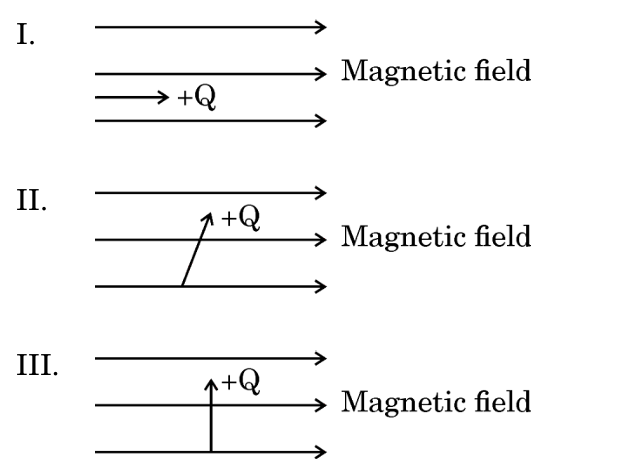 Consider the following three diagrams in which the entry of a positive charge (+Q) in a magnetic
field is shown. Identify giving reason the case in which the force experienced by the charge is (i)
maximum, and (ii) minimum.
Consider the following three diagrams in which the entry of a positive charge (+Q) in a magnetic
field is shown. Identify giving reason the case in which the force experienced by the charge is (i)
maximum, and (ii) minimum.
I. v parallel to B.
II. v at an angle (perpendicular?) to B.
III. v perpendicular to B.
(Diagrams: I. Parallel. II. Angle. III. Perpendicular).
(b)
Consider the following three diagrams in which the entry of a positive charge (+Q) in a magnetic
field is shown. Identify giving reason the case in which the force experienced by the charge is (i)
maximum, and (ii) minimum.
2025-31-3-QuestionNumber32
(I. Charge moves parallel to B but opposite? No, arrow -> Charge direction vs B direction).I. v parallel to B.
II. v at an angle (perpendicular?) to B.
III. v perpendicular to B.
(Diagrams: I. Parallel. II. Angle. III. Perpendicular).
(a) Fleming's Left Hand Rule:
Stretch the forefinger, central finger, and thumb of the left hand mutually perpendicular to each other.
- If the Forefinger points in the direction of the Magnetic Field,
- The Central Finger points in the direction of the Current,
- Then the Thumb points in the direction of the Force (Motion) on the conductor.
(b) Force \( F = Bqv \sin \theta \):
(i) Maximum Force: When charge moves perpendicular to the magnetic field (\( \theta = 90^\circ \)).
Case III (or II depending on diagram). Usually III is shown as perpendicular.
(ii) Minimum Force (Zero): When charge moves parallel or anti-parallel to the magnetic field (\( \theta = 0^\circ \) or \( 180^\circ \)).
Case I (Parallel). Force is Zero.
Stretch the forefinger, central finger, and thumb of the left hand mutually perpendicular to each other.
- If the Forefinger points in the direction of the Magnetic Field,
- The Central Finger points in the direction of the Current,
- Then the Thumb points in the direction of the Force (Motion) on the conductor.
(b) Force \( F = Bqv \sin \theta \):
(i) Maximum Force: When charge moves perpendicular to the magnetic field (\( \theta = 90^\circ \)).
Case III (or II depending on diagram). Usually III is shown as perpendicular.
(ii) Minimum Force (Zero): When charge moves parallel or anti-parallel to the magnetic field (\( \theta = 0^\circ \) or \( 180^\circ \)).
Case I (Parallel). Force is Zero.
2 Marks
Q26. Draw the pattern of magnetic field lines due
to a current carrying straight conductor. Mark on it the direction of current in the conductor and the
direction of the magnetic field developed. Name the rule that helps us to determine the direction of
magnetic field lines in this case.
Pattern: Concentric circles centered around the wire.
 Rule: Right-Hand Thumb Rule.
(If thumb points in direction of current, curled fingers show direction of magnetic field).
Rule: Right-Hand Thumb Rule.(If thumb points in direction of current, curled fingers show direction of magnetic field).
5 Marks
Q34. (A) (i) Draw the pattern of the magnetic
field lines for the two parallel straight conductors carrying current of same magnitude 'I' in opposite
directions as shown. Show the direction of magnetic field at a point O which is equidistant from the two
conductors. (Consider that the conductors are inserted normal to the plane of a rectangular
cardboard.)

(ii) In our houses we receive A.C. electric power of 220 V. In electric iron or electric heater cables having three wires with insulation of three different colours - red, black and green are used to draw current from the mains.
(a) What are these three different wires called? Name them colourwise.
(b) What is the potential difference between the red wire and the black wire?
(c) What is the role of the wire with green insulation in case of accidental leakage of electric current to the metallic body of an electrical appliance?

(a) a force is exerted on the current-carrying conductor AB when it is placed in a magnetic field.
(b) the direction of force can be reversed in two ways.
(ii) When will the magnitude of the force be highest?
(iii) State Fleming\u2019s left hand rule..png)
.png)
(ii) In our houses we receive A.C. electric power of 220 V. In electric iron or electric heater cables having three wires with insulation of three different colours - red, black and green are used to draw current from the mains.
(a) What are these three different wires called? Name them colourwise.
(b) What is the potential difference between the red wire and the black wire?
(c) What is the role of the wire with green insulation in case of accidental leakage of electric current to the metallic body of an electrical appliance?
OR
(B) (i) By using the given experimental set-up. How can it be shown that :(a) a force is exerted on the current-carrying conductor AB when it is placed in a magnetic field.
(b) the direction of force can be reversed in two ways.
(ii) When will the magnitude of the force be highest?
(iii) State Fleming\u2019s left hand rule.
(A):
(i)
[Diagram: Magnetic field lines repel each other between conductors carrying opposite currents]. At O, fields add up/constructive interference (depends on direction relative to observer).
(ii) (a) Red: Live Wire. Black: Neutral Wire. Green: Earth Wire.
(b) 220 Volts.
(c) The green (earth) wire provides a low resistance path to the ground, preventing electric shock by ensuring the metallic body stays at zero potential.
(B):
(i) (a) When current is passed (key K closed), the rod AB gets displaced/moves.
(b) Reverse direction of current OR Reverse direction of magnetic field (swap poles).
(ii) When current is perpendicular to the magnetic field (\(90^\circ\)).
(iii) Fleming's Left Hand Rule: Stretch thumb, forefinger, and middle finger of left hand mutually perpendicular. If Forefinger points to Magnetic Field, Middle finger to Current, then Thumb points to Force/Motion.
(i)
[Diagram: Magnetic field lines repel each other between conductors carrying opposite currents]. At O, fields add up/constructive interference (depends on direction relative to observer).
(ii) (a) Red: Live Wire. Black: Neutral Wire. Green: Earth Wire.
(b) 220 Volts.
(c) The green (earth) wire provides a low resistance path to the ground, preventing electric shock by ensuring the metallic body stays at zero potential.
(B):
(i) (a) When current is passed (key K closed), the rod AB gets displaced/moves.
(b) Reverse direction of current OR Reverse direction of magnetic field (swap poles).
(ii) When current is perpendicular to the magnetic field (\(90^\circ\)).
(iii) Fleming's Left Hand Rule: Stretch thumb, forefinger, and middle finger of left hand mutually perpendicular. If Forefinger points to Magnetic Field, Middle finger to Current, then Thumb points to Force/Motion.
1 Mark
Q18. Assertion (A): The pattern
of the magnetic field of a solenoid carrying a current is similar to that of a bar magnet.
Reason (R): The pattern of the magnetic field around a current carrying conductor is independent of the shape of the conductor.
Reason (R): The pattern of the magnetic field around a current carrying conductor is independent of the shape of the conductor.
Analysis:
Assertion (A): True. Solenoid field resembles bar magnet.
Reason (R): "Independent of shape". False. Field pattern depends entirely on shape (straight wire = circles, loop = distorted circles, solenoid = parallel lines inside).
Correct Option: (C)
Assertion (A): True. Solenoid field resembles bar magnet.
Reason (R): "Independent of shape". False. Field pattern depends entirely on shape (straight wire = circles, loop = distorted circles, solenoid = parallel lines inside).
Correct Option: (C)
3 Marks
Q27. Answer the following questions for a case in
which a current carrying conductor is placed in a uniform magnetic field :
(a) List three factors on which the magnitude of the force acting on the conductor depends.
(b) When is the magnitude of force on the conductor maximum ?
(c) Name the rule which helps in determining the direction of force on the conductor and give its one application.
(a) List three factors on which the magnitude of the force acting on the conductor depends.
(b) When is the magnitude of force on the conductor maximum ?
(c) Name the rule which helps in determining the direction of force on the conductor and give its one application.
(a) Factors (from \(F = BIL \sin\theta\)):
1. Strength of Magnetic Field (B).
2. Strength of Current (I).
3. Length of conductor (L).
(b) Maximum when conductor is perpendicular (\(90^\circ\)) to magnetic field.
(c) Fleming's Left Hand Rule.
Application: Electric Motor.
1. Strength of Magnetic Field (B).
2. Strength of Current (I).
3. Length of conductor (L).
(b) Maximum when conductor is perpendicular (\(90^\circ\)) to magnetic field.
(c) Fleming's Left Hand Rule.
Application: Electric Motor.
4 Marks
Q37. In order to obtain magnetic field lines
around a bar magnet, a student performed an experiment using a magnetic compass and a bar magnet. The
magnet was placed on a sheet of white paper fixed on a drawing board. Using magnetic needle he obtained
on the paper a pattern of magnetic field lines (as shown below) around the bar magnet.

(a) By convention, the field lines emerge from north pole and merge at south pole. Why ? Give reason.
(b) State the relationship between strength of the magnetic field and the degree of closeness of the field lines.
(c) (A) (i) No two field lines can ever intersect each other. Give reason.
(ii) The magnetic field in a given region is uniform. Draw a diagram to represent it.
OR
(c) (B) Draw the pattern of the magnetic field lines through and around a current carrying solenoid. What does the pattern of field lines inside the solenoid represent ?
(a) By convention, the field lines emerge from north pole and merge at south pole. Why ? Give reason.
(b) State the relationship between strength of the magnetic field and the degree of closeness of the field lines.
(c) (A) (i) No two field lines can ever intersect each other. Give reason.
(ii) The magnetic field in a given region is uniform. Draw a diagram to represent it.
OR
(c) (B) Draw the pattern of the magnetic field lines through and around a current carrying solenoid. What does the pattern of field lines inside the solenoid represent ?
(a) Convention is based on the direction a North pole of a compass needle points. Outside magnet,
N-pole is repelled by N and attracted by S, moving N \(\rightarrow\) S.
(b) Closeness (Density) of lines \(\propto\) Strength of field. Closer lines = Stronger field.
(c) (A) (i) If they intersect, there would be two directions of magnetic field at the point of intersection, which is impossible.
(ii) Uniform Field Diagram:

OR
(B) Solenoid Diagram:

Inside pattern: Parallel straight lines indicate a Uniform Magnetic Field.
(b) Closeness (Density) of lines \(\propto\) Strength of field. Closer lines = Stronger field.
(c) (A) (i) If they intersect, there would be two directions of magnetic field at the point of intersection, which is impossible.
(ii) Uniform Field Diagram:
OR
(B) Solenoid Diagram:
Inside pattern: Parallel straight lines indicate a Uniform Magnetic Field.
1 Mark
Q20. Assertion (A): In the
common domestic circuits the earth wire is connected to a metallic plate buried deep inside the
earth.
Reason (R): Earth wire ensures that any leakage of current to the metallic body of the appliance keeps its potential to that of the earth, so the user may not get a severe electric shock.
Reason (R): Earth wire ensures that any leakage of current to the metallic body of the appliance keeps its potential to that of the earth, so the user may not get a severe electric shock.
Assertion (A): True. This is standard grounding procedure.
Reason (R): True. Low resistance path prevents shock.
Explanation: R correctly explains why A is done (Safety).
Correct Option: (A)
Reason (R): True. Low resistance path prevents shock.
Explanation: R correctly explains why A is done (Safety).
Correct Option: (A)
5 Marks
Q34. (a) What are magnetic field lines ? How is
the direction of magnetic field at a point determined ? Draw the pattern of magnetic field lines of the
magnetic field produced by a current carrying circular loop. Mark on it the direction of (i) current and
(ii) magnetic field lines.
Name the two factors on which the magnitude of the magnetic field due to a current carrying coil depends.
OR
(b) Why can't two magnetic field lines cross each other ? Draw magnetic field lines showing the direction of the magnetic field due to a current carrying long straight solenoid. State the conclusion which can be drawn from the pattern of magnetic field lines inside the solenoid.
Name any two factors on which the magnitude of the magnetic field due to this solenoid depends.
Name the two factors on which the magnitude of the magnetic field due to a current carrying coil depends.
OR
(b) Why can't two magnetic field lines cross each other ? Draw magnetic field lines showing the direction of the magnetic field due to a current carrying long straight solenoid. State the conclusion which can be drawn from the pattern of magnetic field lines inside the solenoid.
Name any two factors on which the magnitude of the magnetic field due to this solenoid depends.
(a) Lines representing the magnetic field. Direction determined by compass N-pole or Right Hand
Thumb Rule derivative.
Factors: 1. Current (I). 2. Number of turns (n). 3. Radius (inversely).
(b) Intersection: If they cross, compass would point two directions at one point, which is impossible.
Conclusion inside: Field lines are parallel straight lines, indicating uniform field.
Factors: 1. Current (I). 2. Turn density (n). 3. Core material (Soft iron).
Circular Loop Diagram
Factors: 1. Current (I). 2. Number of turns (n). 3. Radius (inversely).
(b) Intersection: If they cross, compass would point two directions at one point, which is impossible.
Solenoid Diagram
Conclusion inside: Field lines are parallel straight lines, indicating uniform field.
Factors: 1. Current (I). 2. Turn density (n). 3. Core material (Soft iron).
Board Exam 2024
Content coming soon for 2024...
Board Exam 2023
Content coming soon for 2023...
Board Exam 2022
Content coming soon for 2022...