Vardaan Learning Institute
Electricity
1. Electric Charge and Current
Electric Charge (Q): A fundamental property of matter. There are two types: positive
(protons) and negative (electrons). Like charges repel, unlike charges attract.
- SI unit: Coulomb (C)
- Charge of 1 electron $= 1.6 \times 10^{-19}$ C
- $1 \text{ C} = \frac{1}{1.6 \times 10^{-19}}$ electrons $\approx 6.25 \times 10^{18}$ electrons
- Charge is always conserved (cannot be created or destroyed, only transferred).
 and on the right side the positive term.png)
Electric Current (I): The net amount of charge flowing through any cross-section of a
conductor per unit time.
- SI Unit: Ampere (A) — named after the French scientist Andre-Marie Ampere.
- Definition of 1 Ampere: When 1 Coulomb of charge flows through a conductor in 1 second,
the current is said to be 1 Ampere. ($1 \text{ A} = 1 \text{ C/s}$)
- Small units: $1 \text{ milliampere (m²)} = 10^{-3}$ A; $1 \text{ microampere (μA)} = 10^{-6}$ A.
- Conventional Current Direction: From positive (+) to negative (–) terminal externally
(opposite to electron flow).
- Electron Flow Direction: From negative (–) to positive (+) terminal externally.
Ammeter: Device used to measure electric current.
- Always connected in series in a circuit.
- Has very low (ideally zero) resistance so it does not affect the current it measures.
2. Electric Potential and Potential Difference
Why does current flow? Current flows because there is a difference in electric potential
between two points. Charge always flows from a point of higher potential to a point of lower potential (like
water flowing downhill).
Electric Potential Difference (V): The work done per unit positive charge to move it
from one point to another in an electric field.
FORMULA: POTENTIAL DIFFERENCE
$$ V = \frac{W}{Q} $$
- $W$ = Work done (Joules), $Q$ = Charge (Coulombs), $V$ = Potential difference (Volts).
- SI Unit: Volt (V) — named after Alessandro Volta.
- Definition of 1 Volt: The potential difference between two points is 1 Volt if 1
Joule of work is done to move 1 Coulomb of charge from one point to the other. ($1 \text{ V} = 1
\text{ J/C}$)
Voltmeter: Device used to measure potential difference (voltage).
- Always connected in parallel across the two points where V is to be measured.
- Has very high (ideally infinite) resistance so negligible current passes through it,
not disturbing the circuit.
Battery (Cell): A source of potential difference. It converts chemical energy into
electrical energy. The EMF (Electromotive Force) of a cell is the work done per unit charge within the cell
to maintain the potential difference.
Q. How much work is done in moving a charge of 2 Coulombs from a point at 118 V to a
point
at 128 V?
Given: $Q = 2$ C, $V_1 = 118$ V, $V_2 = 128$ V
Potential Difference: $V = V_2 - V_1 = 128 - 118 = 10$ V
Formula: $V = W/Q \implies W = VQ$
Answer: $W = 10 \times 2 = \mathbf{20 \text{ J}}$
Q. An electric bulb is rated 220 V and 100 W. When it is operated on 110 V, what will
be
the power consumed?
Step 1 — Find resistance of bulb (constant): $R = V^2/P =
220^2/100 = 484 \, \Omega$
Step 2 — Find new power at 110 V (R unchanged): $P' = V'^2/R
=
110^2/484 = 12100/484 = \mathbf{25 \text{ W}}$
Note: Power becomes 1/4 when voltage is halved — since P ∝ V².
3. Circuit Diagrams and Standard Symbols
An electric circuit is a continuous and closed conducting path through which electric
current can flow. A circuit is represented using standardized symbols. Key components and their symbols:
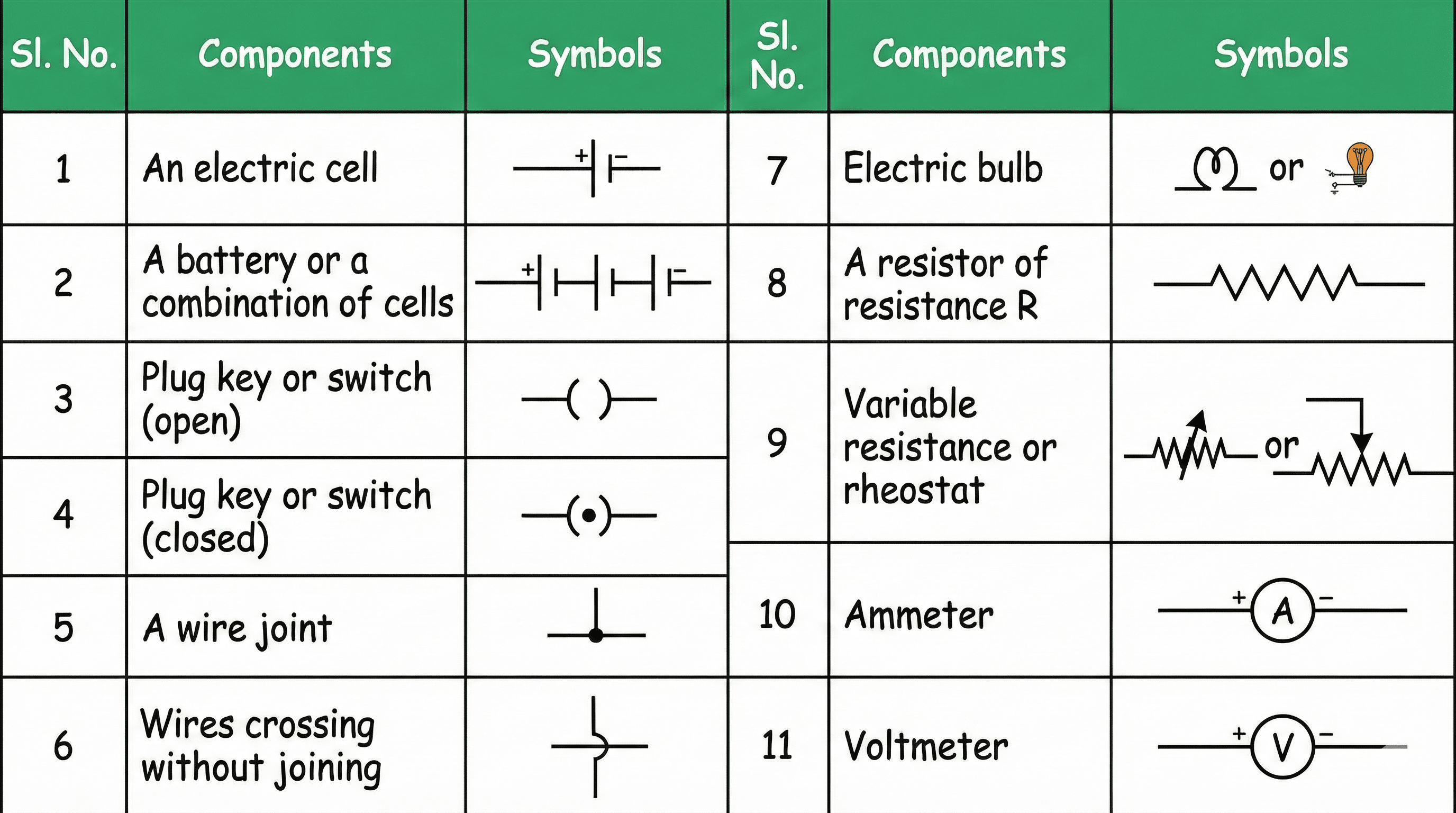 Standard Electric Circuit Symbols (as per NCERT): Cell, Battery, Open Key (Switch),
Closed Key, Wire, Wire Joint, Resistor, Rheostat (Variable Resistor), Ammeter, Voltmeter, Galvanometer,
Electric Bulb
Standard Electric Circuit Symbols (as per NCERT): Cell, Battery, Open Key (Switch),
Closed Key, Wire, Wire Joint, Resistor, Rheostat (Variable Resistor), Ammeter, Voltmeter, Galvanometer,
Electric Bulb
- Open Circuit: A circuit with a break — no current flows.
- Closed Circuit: A complete circuit — current flows continuously.
- Short Circuit: When live and neutral wires touch directly (very high current flows,
dangerous).
4. Ohm's Law
A. Verification of Ohm's Law (Experiment)
Circuit for
Verifying Ohm's Law
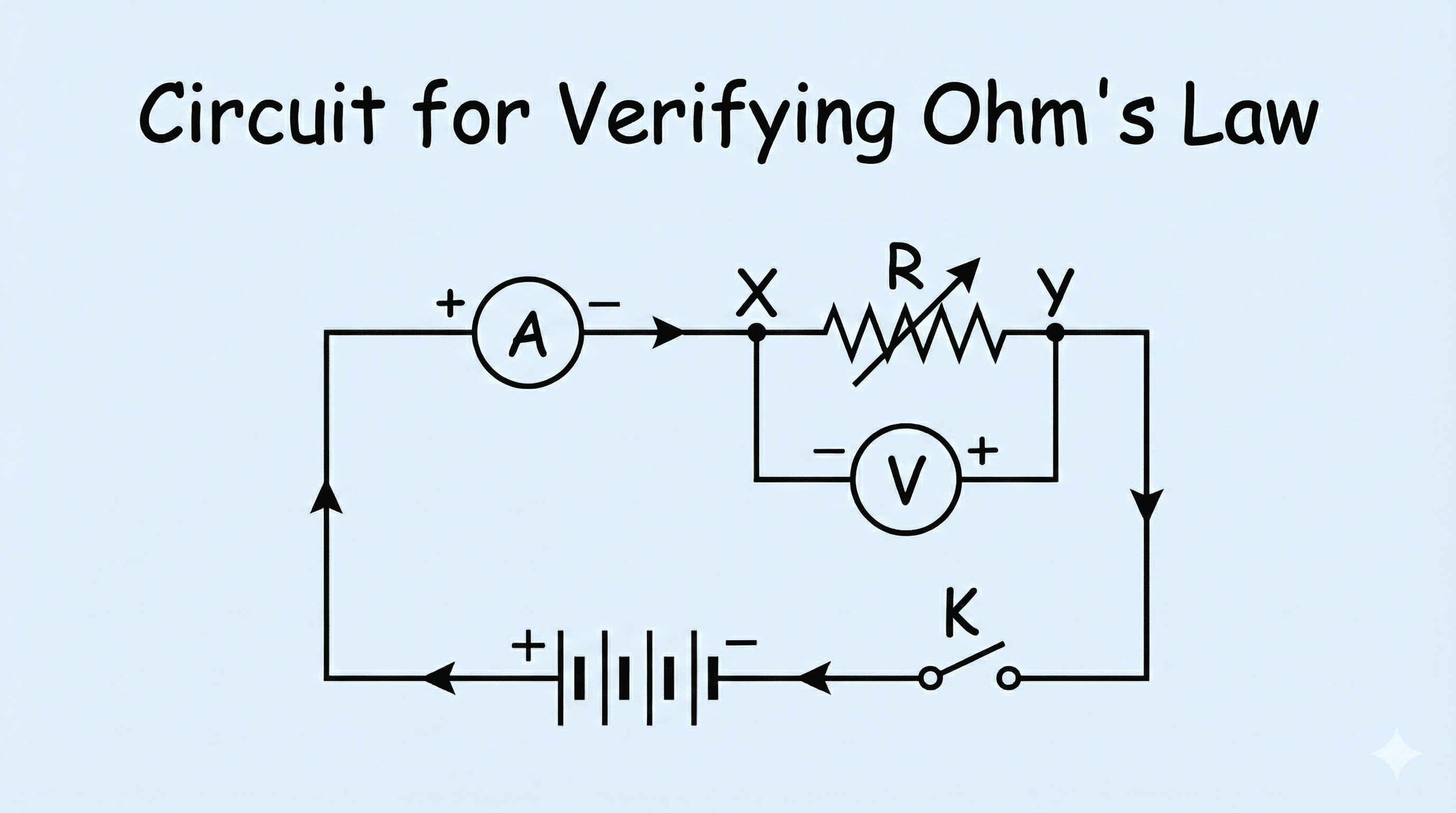
Figure 3.2: Circuit for Ohm's Law
- Aim: To verify V ∝ I for a resistor.
- Setup: Connect Resistor, Ammeter (Series), Voltmeter (Parallel), Battery, and
Rheostat.
- Procedure: Vary current using Rheostat. Note V and I readings. Calculate V/I ratio
(It remains constant).
- Observation: V-I Graph is a straight line passing through origin.
Resistance (R): The property of a conductor to oppose the flow of electric current through
it.
- SI unit: Ohm (Ω) — named after Georg Simon Ohm.
- Definition of 1 Ohm: The resistance of a conductor is 1 Ω if a potential difference of
1 V across its ends causes a current of 1 A to flow through it. ($1 \Omega = 1 \text{ V/A}$)
V-I Graph Analysis (Very Important for CBSE)
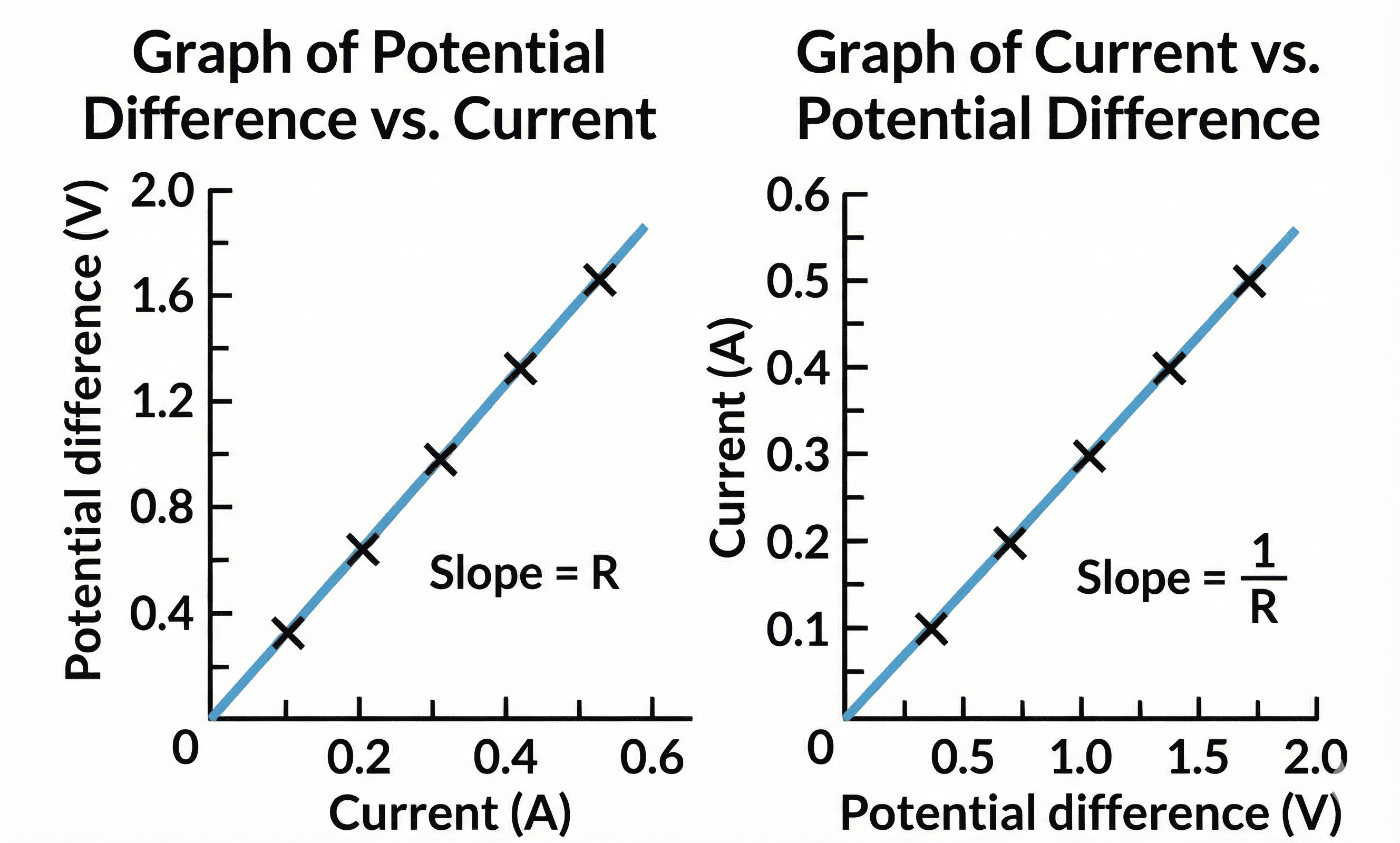 Left: V-I graph (Voltage on Y-axis, Current on X-axis). The slope = R. Right: I-V
graph (Current on Y-axis). Slope = 1/R.
Left: V-I graph (Voltage on Y-axis, Current on X-axis). The slope = R. Right: I-V
graph (Current on Y-axis). Slope = 1/R.
Key Conclusions from V-I Graph:
- The graph is a straight line passing through the origin → verifies Ohm's Law (V ∝
I).
- Slope of V-I graph = Resistance (R). A steeper slope means higher resistance.
- Slope of I-V graph = 1/R (conductance). A steeper slope means lower resistance.
- If two wires A and B are shown: whichever has a higher slope on V-I graph has greater
resistance.
- Ohmic conductor: Strictly follows Ohm's law (e.g., metals at constant temperature)
— straight line graph.
- Non-Ohmic conductor: Does NOT follow Ohm's law (e.g., diode, transistor,
electrolyte) — curved/non-linear graph.
If a V-I graph for a resistor shows a curve (not straight line), it means the
temperature is changing as current flows. For metallic conductors, resistance increases
with temperature. So if the curve bends upward (slope increases), resistance is increasing due to
heating. This is a common HOTS question!
Q. A wire of resistance 8 Ω is bent in the form of a closed circle. What is the
effective
resistance between the two ends of a diameter?
Step 1: When bent into a circle and we take ends of a
diameter,
the wire is split into two equal halves. Each half has resistance $= 8/2 = 4 \, \Omega$.
Step 2: These two halves are connected in
parallel between the two ends of the diameter.
Step 3: $R_p = \dfrac{R_1 \times R_2}{R_1 + R_2} = \dfrac{4
\times 4}{4 + 4} = \dfrac{16}{8} = \mathbf{2 \, \Omega}$
Q. The V-I graph for two wires A and B are given (wire A has a steeper slope). Which
wire
has greater resistance? Which has greater resistivity if their lengths are the same?
Resistance from V-I graph: Slope = $V/I = R$. Steeper slope =
higher R.
∴ Wire A has greater resistance (steeper slope on V-I graph).
Resistivity: $R = \rho l/A$. If same length and
cross-section,
higher R means higher ρ. So Wire A has greater resistivity.
5. Resistance: Factors Affecting and Resistivity
Experiments show that resistance of a uniform metallic conductor depends on:
- Length (l): $R \propto l$ (Longer wire → more resistance. Doubling length
doubles resistance.)
- Area of Cross-Section (A): $R \propto \dfrac{1}{A}$ (Thicker wire → less
resistance. Doubling area halves resistance.)
- Nature of Material (Resistivity ρ): Different materials have different inherent
resistances.
- Temperature: For metals, resistance increases with temperature. For semiconductors
and insulators, resistance decreases with temperature.
Resistivity Values (NCERT Table — Must Know for MCQs)
| Material |
Resistivity (Ω·m) at 20°C |
Type |
| Silver |
$1.60 \times 10^{-8}$ |
Best conductor |
| Copper |
$1.62 \times 10^{-8}$ |
Conductor (wires) |
| Aluminium |
$2.63 \times 10^{-8}$ |
Conductor (overhead lines) |
| Tungsten |
$5.20 \times 10^{-8}$ |
Bulb filament |
| Nichrome |
$1.00 \times 10^{-6}$ |
Heating elements |
| Glass |
$10^{10}$ – $10^{14}$ |
Insulator |
| Rubber |
$10^{13}$ – $10^{16}$ |
Best insulator |
- Resistivity of alloys > Pure metals (e.g., Nichrome > Copper). That's why alloys
are used in heating elements.
- Nichrome: High resistivity + does not oxidize at high temperatures → used in
electric irons, geysers, toasters.
- Tungsten: Very high melting point (~3380°C) + high resistivity → used in bulb
filaments.
- Copper & Aluminium: Very low resistivity → used in electrical wires and cables.
Wire Stretching / Folding — Classic PYQ Topic
Core Principle: When a wire is stretched or compressed, its Volume remains
constant.
Volume = Length × Area = $l \times A = $ constant
- Wire stretched to n times its length:
New length $l' = nl$ → New area $A' = A/n$ (volume constant)
$R' = \rho \dfrac{nl}{A/n} = n^2 \rho \dfrac{l}{A} = n^2 R$
∴ New Resistance = $n^2 R$ (increases by factor of $n^2$)
- Wire folded in half (halved length):
New length $l' = l/2$ → New area $A' = 2A$ (two wires in parallel)
$R' = \rho \dfrac{l/2}{2A} = \dfrac{R}{4}$
∴ New Resistance = R/4 (decreases to one-fourth)
Q. A wire of resistivity $\rho$ is stretched to double its length. How does its
resistance
change?
Let original: Length $= l$, Area $= A$, Volume $= V = lA$
After stretching to 2l: Volume is constant → $A' \times 2l =
lA
\implies A' = A/2$
New Resistance: $R' = \rho \dfrac{2l}{A/2} = \rho \dfrac{2l
\times 2}{A} = 4\rho\dfrac{l}{A} = 4R$
∴ Resistance becomes 4 times the original ($n=2, R' = n^2 R =
4R$)
Q. A wire has a resistance of 16 Ω. It is folded in half (bent to half its length).
What is
its new resistance?
Folding in half: Two pieces each of length $l/2$ and area $A$
are
placed side by side → effective area = $2A$.
New Resistance (one folded wire): $R' = \rho \dfrac{l/2}{2A}
=
\dfrac{1}{4}\rho\dfrac{l}{A} = \dfrac{R}{4} = \dfrac{16}{4} = \mathbf{4 \, \Omega}$
Alternatively: Two pieces of $R_1 = R_2 = 8\,\Omega$ in parallel: $R_p = (8 \times 8)/(8+8) =
4\,\Omega$ ✓
6. Combination of Resistors
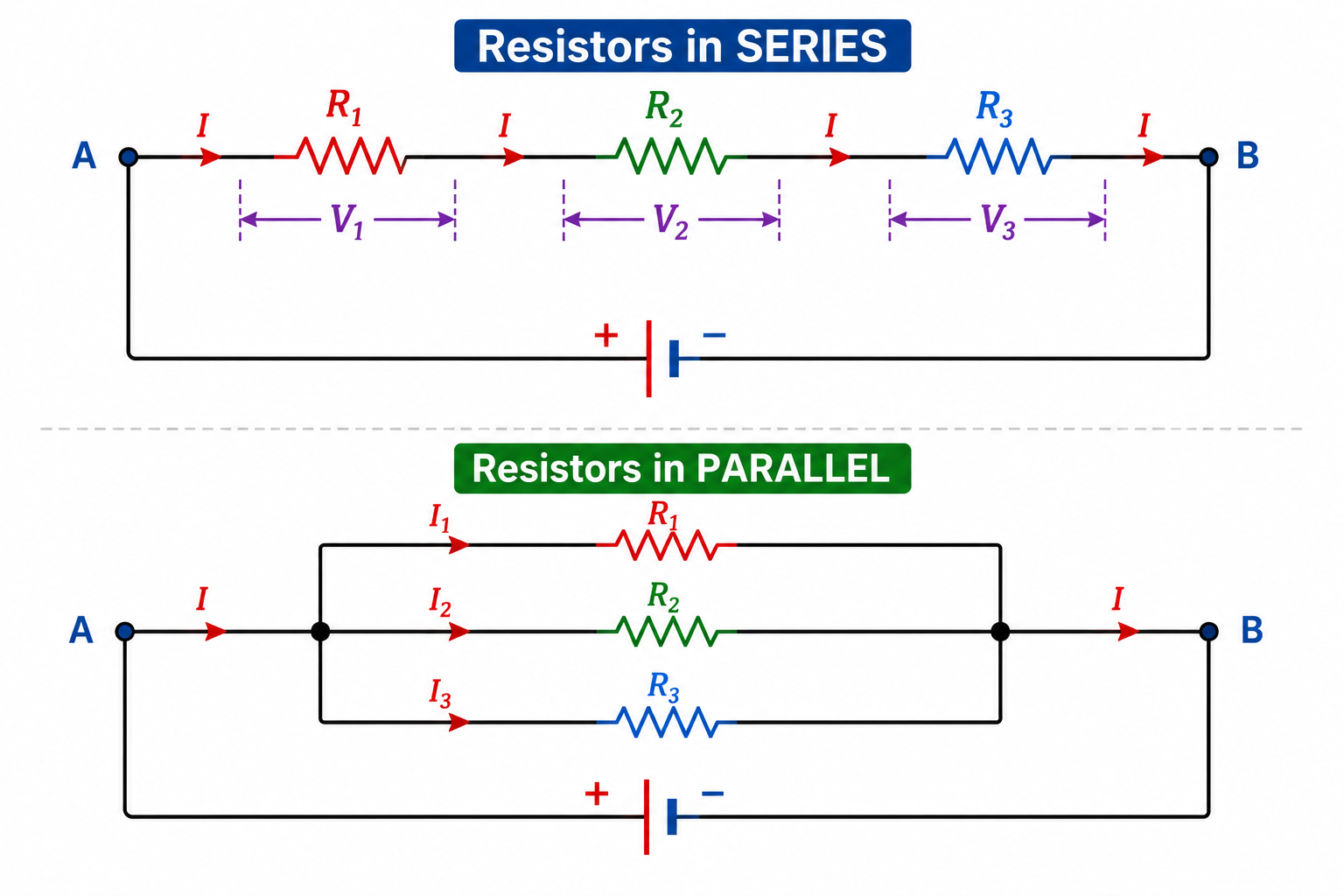
A. Series Combination
Resistors are connected end-to-end so that the same current flows through all of them.
| Quantity |
Behaviour in Series |
| Current (I) |
Same through every resistor: $I = I_1 = I_2 = I_3$ |
| Voltage (V) |
Divides: $V = V_1 + V_2 + V_3$ |
| Equivalent Resistance |
$R_s = R_1 + R_2 + R_3 + \ldots$ (Always greater than the largest individual R) |
DERIVATION: SERIES
$$ V = V_1 + V_2 + V_3 $$
$$ IR_s = IR_1 + IR_2 + IR_3 \quad (\text{since I is same, cancel I}) $$
$$ \boxed{R_s = R_1 + R_2 + R_3} $$
Key Properties of Series Circuit:
- Adding more resistors in series increases total resistance → current decreases.
- If one component breaks (open), the entire circuit is broken — all components stop working.
- Voltage across each resistor: $V_1 = \dfrac{R_1}{R_s} \times V_{total}$ (Voltage divider rule)
B. Parallel Combination
Resistors are connected between the same two points (nodes) so that the same voltage appears
across all of them.
| Quantity |
Behaviour in Parallel |
| Voltage (V) |
Same across every resistor: $V = V_1 = V_2 = V_3$ |
| Current (I) |
Divides: $I = I_1 + I_2 + I_3$ |
| Equivalent Resistance |
$\frac{1}{R_p} = \frac{1}{R_1} + \frac{1}{R_2} + \frac{1}{R_3}$ (Always LESS than the smallest
individual R) |
DERIVATION: PARALLEL
$$ I = I_1 + I_2 + I_3 $$
$$ \frac{V}{R_p} = \frac{V}{R_1} + \frac{V}{R_2} + \frac{V}{R_3} \quad (\text{cancel V}) $$
$$ \boxed{\frac{1}{R_p} = \frac{1}{R_1} + \frac{1}{R_2} + \frac{1}{R_3}} $$
Special Case — Two resistors in parallel:
$$ R_p = \frac{R_1 \times R_2}{R_1 + R_2} \quad \text{(Product over Sum)} $$
Key Properties of Parallel Circuit:
- Adding more resistors in parallel decreases total resistance → total current drawn from battery
increases.
- If one component breaks, other components continue to work.
- Each branch gets the full supply voltage — hence household circuits use parallel connections.
- Current in each branch: $I_1 = \dfrac{V}{R_1},\ I_2 = \dfrac{V}{R_2}$ (smaller R → more current)
C. Series vs Parallel — Complete Comparison Table
| Feature |
Series |
Parallel |
| Current |
Same through all |
Divides among branches |
| Voltage |
Divides across components |
Same across all |
| Equivalent R |
$R_s = R_1 + R_2 + \ldots$ (always > largest R) |
$\frac{1}{R_p}$ sum of reciprocals (always < smallest R) |
| One component fails |
All stop working |
Others continue |
| Household use |
Not suitable (voltage drops) |
Used (same voltage to all) |
| Example |
Decorative string lights (old) |
Room lights, fans, appliances |
Q. Three resistors of 5 Ω, 10 Ω, and 15 Ω are connected in series to a 12 V battery.
Find:
(a) total resistance, (b) current through the circuit, (c) voltage across the 10 Ω resistor.
(a) Total Resistance: $R_s = 5 + 10 + 15 = \mathbf{30 \,
\Omega}$
(b) Current: $I = V/R_s = 12/30 = \mathbf{0.4 \text{ A}}$
(c) Voltage across 10 Ω: $V_{10} = I \times R_{10} = 0.4
\times
10 = \mathbf{4 \text{ V}}$
Q. Three resistors of 6 Ω, 10 Ω, and 15 Ω are connected in parallel to a 6 V battery.
Find:
(a) equivalent resistance, (b) total current from battery, (c) current through each resistor.
(a) Equivalent Resistance:
$\dfrac{1}{R_p} = \dfrac{1}{6} + \dfrac{1}{10} + \dfrac{1}{15} = \dfrac{5 + 3 + 2}{30} =
\dfrac{10}{30} = \dfrac{1}{3}$
$\therefore R_p = \mathbf{3 \, \Omega}$
(b) Total Current: $I = V/R_p = 6/3 = \mathbf{2 \text{ A}}$
(c) Current through each:
$I_1 = V/R_1 = 6/6 = 1 \text{ A}$
$I_2 = V/R_2 = 6/10 = 0.6 \text{ A}$
$I_3 = V/R_3 = 6/15 = 0.4 \text{ A}$
Check: $1 + 0.6 + 0.4 = 2$ A ✓
7. Heating Effect of Electric Current (Joule's Law)
When a current flows through a resistor, the electrons collide with atoms/ions of the conductor, and their
kinetic energy gets converted into heat energy. This is the Heating Effect of
Electric Current.
Practical Applications of Heating Effect
| Device |
Material |
Reason for Choice |
| Electric Iron, Toaster, Heater |
Nichrome |
High resistivity, high melting point, does not oxidize |
| Electric Bulb Filament |
Tungsten |
Very high melting point (~3380°C), glows white-hot |
| Electric Fuse |
Lead-Tin alloy or Al/Cu |
Low melting point — melts and breaks circuit on overload |
| Connecting Wires |
Copper/Aluminium |
Very low resistivity — minimum heat loss, maximum current |
Electric Fuse — Detailed
- It is a safety device that protects circuits and appliances from excess current.
- Made of an alloy (e.g., Lead-Tin, Al, Cu) with a low melting point.
- Connected in series with the circuit (in the live wire).
- When current exceeds the rated value (due to short circuit or overload), the fuse wire heats
up and melts, breaking the circuit.
- A fuse is rated by the maximum current it can safely carry (e.g., 5A, 15A fuse).
- Modern replacement: MCB (Miniature Circuit Breaker) — trips and can be reset.
Electric Bulb — Detailed
- Filament made of Tungsten (melting point ~3380°C).
- Filament is coiled to increase its effective length (and hence resistance) in a small space.
- The bulb glass is evacuated (no air) or filled with inert gases (Argon/Nitrogen) to
prevent the tungsten filament from burning (oxidizing) at high temperatures.
- Energy conversion: Electrical energy → Heat (most) + Light (small fraction). This makes bulbs
inefficient.
Q. An electric iron of resistance 20 Ω takes a current of 5 A. Calculate the heat
developed
in 30 seconds.
Formula: $H = I^2 R t$
Answer: $H = (5)^2 \times 20 \times 30 = 25 \times 20 \times
30 =
\mathbf{15000 \text{ J} = 15 \text{ kJ}}$
Q. Two resistors R₁ = 5 Ω and R₂ = 10 Ω are connected (i) in series and (ii) in
parallel.
In which case is more heat generated, and in which resistor? Given current $I = 2$ A in series.
Case (i) — Series (same I = 2A):
$H_1 = I^2 R_1 t = 4 \times 5 \times t = 20t$
$H_2 = I^2 R_2 t = 4 \times 10 \times t = 40t$
More heat in R₂ (higher R). Total = 60t J.
Case (ii) — Parallel (same V, say 10V):
$H_1 = (V^2/R_1)t = (100/5)t = 20t$
$H_2 = (V^2/R_2)t = (100/10)t = 10t$
More heat in R₁ (lower R). Total = 30t J.
Conclusion: Series connection generates more total heat (60t vs
30t).
8. Electric Power
Rated Power and Resistance of a Bulb
Every electrical device has a power rating (e.g., 100W, 60W) and a voltage
rating (e.g., 220V). These tell you the normal operating conditions.
- From the rating, the resistance of the device can be found: $R = \dfrac{V^2}{P}$
- A 100W, 220V bulb has resistance: $R = \dfrac{220^2}{100} = 484 \, \Omega$
- A 60W, 220V bulb has resistance: $R = \dfrac{220^2}{60} = 806.7 \, \Omega$
- Therefore, the 60W bulb has higher resistance than the 100W bulb.
| Connection |
Brighter Bulb |
Formula Used |
Reason |
| Series |
Higher Resistance
(Low Watt rating) |
$P = I^2 R$
(I same) |
More R → more heat/light |
| Parallel |
Lower Resistance
(High Watt rating) |
$P = V^2/R$
(V same) |
Less R → more current → more power |
Q. Two bulbs are rated 60W, 220V and 100W, 220V respectively. Which bulb has higher
resistance? When connected in series to 220V, which bulb will glow brighter?
Resistance: $R = V^2/P$
$R_{60} = 220^2/60 = 807 \, \Omega$
$R_{100} = 220^2/100 = 484 \, \Omega$
∴ The 60W bulb has higher resistance.
In Series: Same current flows. Power = $I^2 R$. Higher R →
more
power → brighter.
∴ The 60W bulb glows brighter in series.
Q. An electric motor takes 5 A from a 220 V line. Determine the power of the motor and
the
energy consumed in 2 hours.
Power: $P = VI = 220 \times 5 = \mathbf{1100 \text{ W} = 1.1
\text{ kW}}$
Energy in 2 hours: $E = P \times t = 1.1 \text{ kW} \times 2
\text{ h} = \mathbf{2.2 \text{ kWh}} = 2.2 \text{ units}$
In Joules: $E = 2.2 \times 3.6 \times 10^6 = 7.92 \times 10^6 \text{ J}$
9. Commercial Unit of Electrical Energy
The SI unit of energy (Joule) is very small for commercial/household use. The commercial unit is the
kilowatt-hour (kWh), also called a "unit" on your electricity bill.
1 kWh = ?
$$ 1 \text{ kWh} = 1 \text{ kW} \times 1 \text{ hour} = 1000 \text{ W} \times 3600 \text{ s} $$
$$ \boxed{1 \text{ kWh} = 3.6 \times 10^6 \text{ J} = 3,600,000 \text{ J}} $$
Energy consumed formula:
$$ \text{Energy (kWh)} = \text{Power (kW)} \times \text{Time (hours)} $$
Q. A household has the following appliances: (i) 5 LED bulbs of 10W each, used 6
hours/day,
(ii) a refrigerator of 200W used 24 hours/day, (iii) a TV of 100W used 4 hours/day. Calculate the
total
energy consumed in 30 days and the monthly bill at ₹6 per unit.
Energy by LED bulbs (30 days):
$E_1 = 5 \times 0.01 \text{ kW} \times 6 \text{ h} \times 30 = 0.05 \times 180 = 9 \text{ kWh}$
Energy by Refrigerator (30 days):
$E_2 = 0.2 \text{ kW} \times 24 \text{ h} \times 30 = 144 \text{ kWh}$
Energy by TV (30 days):
$E_3 = 0.1 \text{ kW} \times 4 \text{ h} \times 30 = 12 \text{ kWh}$
Total Energy: $E = 9 + 144 + 12 = \mathbf{165 \text{ kWh
(units)}}$
Monthly Bill: Cost $= 165 \times 6 =$ ₹990

 VARDAAN COMET