
Board Exam 2025
1 Mark
Q19. Assertion (A): Due to
scattering of sunlight, the clear sky predominantly appears blue.
Reason (R): The wavelength of blue light is nearly 1.8 times the wavelength of red light.
Reason (R): The wavelength of blue light is nearly 1.8 times the wavelength of red light.
Assertion (A): True. Blue light scatters more (Rayleigh
scattering \(I \propto 1/\lambda^4\)).
Reason (R): False. Red wavelength (\(\approx 700\) nm) is about 1.8 times Blue wavelength (\(\approx 400\) nm). The reason statement claims Blue is 1.8x Red, which is wrong.
Correct Option: (C) A is true, but R is false.
Reason (R): False. Red wavelength (\(\approx 700\) nm) is about 1.8 times Blue wavelength (\(\approx 400\) nm). The reason statement claims Blue is 1.8x Red, which is wrong.
Correct Option: (C) A is true, but R is false.
2 Marks
Q21. Draw a ray diagram to show the path of a
ray
of light which falls obliquely on one of the faces of an equilateral triangular prism made of glass
and
mark on it the angle of incidence (\(\angle i\)) and the angle of deviation (\(\angle D\)).
Image: 2025-31-S-Solution21
Ray Diagram Description:1. Incident Ray (PE): Traverses through air and strikes the first face (AB) at angle \(i\).
2. Refracted Ray (EF): Bends towards the normal inside the prism (Glass).
3. Emergent Ray (FS): Bends away from the normal as it exits face AC at angle \(e\).
4. Angle of Deviation (\(\angle D\)): The angle between the extended incident ray and the extended emergent ray.
5 Marks
Q35. (a) (i) Define the term power of
accommodation of human eye. What happens to the image distance in the eyes when the distance of an
object is increased gradually from about 5 m to 500 m from our eyes? Name and explain the role of the
part of human eye responsible for it in this case.
(ii) A person is unable to see distinctly the objects placed beyond 2 m from his eyes. Name the defect of vision the person is suffering from. List two possible causes of this defect and write the type of lenses used for the correction of this defect.
OR
(b) (i) Name and explain the phenomenon of light responsible to make the path of a beam of light visible when it enters a smoke/dust-filled room through a small hole. Also state the dependence of the colour of the light we receive on the size of the particles of the medium through which the light passes.
(ii) A person suffering from presbyopia needs spectacles having bifocal lenses. If the power of two lenses used in his spectacles is + 2.0 D and � 0.5 D, which one of the two lenses is for the correction of his distant vision and what is its focal length?
(ii) A person is unable to see distinctly the objects placed beyond 2 m from his eyes. Name the defect of vision the person is suffering from. List two possible causes of this defect and write the type of lenses used for the correction of this defect.
OR
(b) (i) Name and explain the phenomenon of light responsible to make the path of a beam of light visible when it enters a smoke/dust-filled room through a small hole. Also state the dependence of the colour of the light we receive on the size of the particles of the medium through which the light passes.
(ii) A person suffering from presbyopia needs spectacles having bifocal lenses. If the power of two lenses used in his spectacles is + 2.0 D and � 0.5 D, which one of the two lenses is for the correction of his distant vision and what is its focal length?
(a) (i) Power of Accommodation:
The ability of the eye lens to adjust its focal length to see both near and distant objects clearly is called power of accommodation.
Image Distance: It remains constant (distance between lens and retina). The eye lens becomes thinner to increase focal length.
Role of Ciliary Muscles: They relax to make the lens thinner, increasing its focal length to focus on distant objects.
(a) (ii) Defect: Myopia (Near-sightedness).
Causes:
1. Excessive curvature of the eye lens.
2. Elongation of the eyeball.
Correction: Concave lens.
OR
(b) (i) Tyndall Effect:
The scattering of light by particles in a colloid or suspension (like dust/smoke in air) which makes the path of light visible.
Dependence (Scattering):
- Very fine particles scatter mainly blue light (shorter wavelength).
- Larger particles scatter light of longer wavelengths (red).
- If particles are large enough, the scattered light may appear white.
(b) (ii) Bifocal Lenses:
- Upper part: Concave lens (Negative power) for Distant Vision.
- Lower part: Convex lens (Positive power) for Near Vision.
Correction for Distance: Power = -0.5 D.
Focal Length: \( f = \frac{1}{P} = \frac{1}{-0.5} = -2 \text{ m} = -200 \text{ cm} \).
The ability of the eye lens to adjust its focal length to see both near and distant objects clearly is called power of accommodation.
Image Distance: It remains constant (distance between lens and retina). The eye lens becomes thinner to increase focal length.
Role of Ciliary Muscles: They relax to make the lens thinner, increasing its focal length to focus on distant objects.
(a) (ii) Defect: Myopia (Near-sightedness).
Causes:
1. Excessive curvature of the eye lens.
2. Elongation of the eyeball.
Correction: Concave lens.
OR
(b) (i) Tyndall Effect:
The scattering of light by particles in a colloid or suspension (like dust/smoke in air) which makes the path of light visible.
Dependence (Scattering):
- Very fine particles scatter mainly blue light (shorter wavelength).
- Larger particles scatter light of longer wavelengths (red).
- If particles are large enough, the scattered light may appear white.
(b) (ii) Bifocal Lenses:
- Upper part: Concave lens (Negative power) for Distant Vision.
- Lower part: Convex lens (Positive power) for Near Vision.
Correction for Distance: Power = -0.5 D.
Focal Length: \( f = \frac{1}{P} = \frac{1}{-0.5} = -2 \text{ m} = -200 \text{ cm} \).
The visibility of smoke particles (colloidal particles) when a beam of light passes
through them is due to the scattering of light, known as the Tyndall
effect.
Correct Option: (A)
Correct Option: (A)
1 Mark
Q13. The part of the human eye which can modify
the curvature of the eye lens to some extent is :
Ciliary Muscles contract or relax to change the curvature (and
hence focal length) of the eye lens to focus on near or distant objects (Accommodation).
Correct Option: (C)
Correct Option: (C)
4 Marks
Q38. Case Study: A person
allowed a narrow beam of white light from the sun to enter a dark room through a small aperture and
placed a glass prism in its path in such a manner that the beam falls on the face AB of the prism as
shown in the figure.
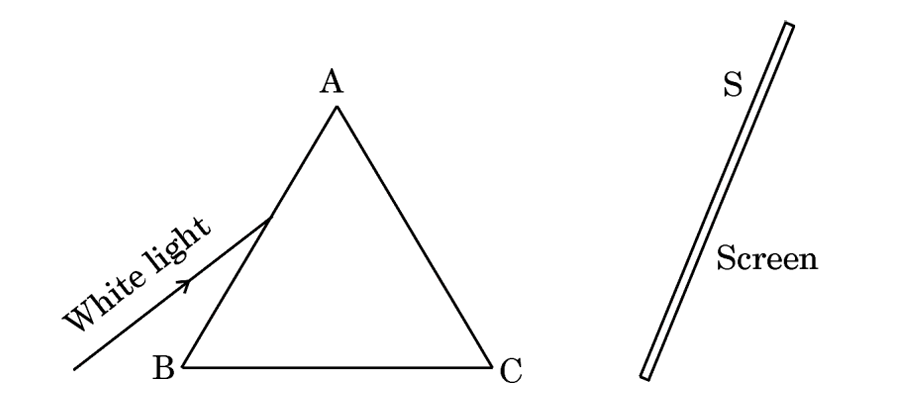
A screen S is placed on the other side of the prism, facing AC. On turning the prism slowly, a beautiful band of colours is obtained on the screen. It is the spectrum of sunlight.
(a) Name the phenomenon due to which a prism splits the incident white light into a band of colours.
(b) State the reason of getting a band of seven colours in the above case.
(c) (i) Explain with the help of a labelled ray diagram, an experimental arrangement to show the recombination of the spectrum of white light.
OR
(c) (ii) Draw a labelled ray diagram to show the formation of a rainbow.
A screen S is placed on the other side of the prism, facing AC. On turning the prism slowly, a beautiful band of colours is obtained on the screen. It is the spectrum of sunlight.
(a) Name the phenomenon due to which a prism splits the incident white light into a band of colours.
(b) State the reason of getting a band of seven colours in the above case.
(c) (i) Explain with the help of a labelled ray diagram, an experimental arrangement to show the recombination of the spectrum of white light.
OR
(c) (ii) Draw a labelled ray diagram to show the formation of a rainbow.
(a) Phenomenon: Dispersion of Light.
(b) Reason: Different colours of light bend through different angles with respect to the incident ray, as they pass through a prism. (Speed of different colours is different in glass).
(c) (i) Recombination:
Arrangement: Two identical prisms are placed in inverted position with respect to each other.
Diagram: First prism splits white light into spectrum. Second inverted prism recombines spectrum to white light.

(c) (ii) Rainbow Formation:
Diagram showing:
1. Sunlight entering water droplet.
2. Refraction and Dispersion.
3. Total Internal Reflection.
4. Refraction out of droplet.

(b) Reason: Different colours of light bend through different angles with respect to the incident ray, as they pass through a prism. (Speed of different colours is different in glass).
(c) (i) Recombination:
Arrangement: Two identical prisms are placed in inverted position with respect to each other.
Diagram: First prism splits white light into spectrum. Second inverted prism recombines spectrum to white light.
(c) (ii) Rainbow Formation:
Diagram showing:
1. Sunlight entering water droplet.
2. Refraction and Dispersion.
3. Total Internal Reflection.
4. Refraction out of droplet.
1 Mark
Q15. The phenomenon of light responsible for
making the path of smoke particles visible is :
The visibility of the path of light through smoke/dust is due to the
Scattering of light (Tyndall Effect) by the colloidal particles.
Correct Option: (A)
Correct Option: (A)
1 Mark
Q11. The twinkling of stars is due to :
Twinkling of Stars:
It is caused by the atmospheric refraction of star light.
The refractive index of the different layers of the atmosphere keeps changing continuously (due to temperature/density difference).
Correct Option: (C)
It is caused by the atmospheric refraction of star light.
The refractive index of the different layers of the atmosphere keeps changing continuously (due to temperature/density difference).
Correct Option: (C)
3 Marks
Q25. (a) Draw a neat diagram to show the
refraction of a light ray through a glass prism, and label angle of incidence and angle of
deviation.
(b) What is a rainbow? How is it formed?
(b) What is a rainbow? How is it formed?
(a) Refraction through Prism:
(Diagram showing incident ray, refracted ray, emergent ray, angle \(i\), and angle \(D\)).
(b) Rainbow:
A natural spectrum appearing in the sky after a rain shower.
Formation: It is caused by dispersion of sunlight by tiny water droplets, present in the atmosphere.
The water droplets act like small prisms. They refract and disperse the incident sunlight, then reflect it internally (Total Internal Reflection), and finally refract it again when it comes out of the raindrop.
2025-31-2-Solution25-a
(Diagram showing incident ray, refracted ray, emergent ray, angle \(i\), and angle \(D\)).
(b) Rainbow:
A natural spectrum appearing in the sky after a rain shower.
Formation: It is caused by dispersion of sunlight by tiny water droplets, present in the atmosphere.
The water droplets act like small prisms. They refract and disperse the incident sunlight, then reflect it internally (Total Internal Reflection), and finally refract it again when it comes out of the raindrop.
1 Mark
Q4. The splitting of white light into its
component colours is called :
The phenomenon of splitting of white light into its constituent seven colours is
called Dispersion.
Correct Option: (B)
Correct Option: (B)
1 Mark
Q12. Select the correct statement from the
following :
Analysis:
(A) False. Air molecules are usually smaller, leading to Rayleigh scattering.
(B) False. Red wavelength (~700nm) > Blue wavelength (~450nm).
(C) True. According to Rayleigh scattering (\(I \propto 1/\lambda^4\)), shorter wavelengths (Blue) scatter more than longer wavelengths (Red).
(D) False. Red is scattered the least (which is why danger signals are red).
Correct Option: (C)
(A) False. Air molecules are usually smaller, leading to Rayleigh scattering.
(B) False. Red wavelength (~700nm) > Blue wavelength (~450nm).
(C) True. According to Rayleigh scattering (\(I \propto 1/\lambda^4\)), shorter wavelengths (Blue) scatter more than longer wavelengths (Red).
(D) False. Red is scattered the least (which is why danger signals are red).
Correct Option: (C)
2 Marks
Q25. (a) A student has difficulty in reading his
textbooks but can read the blackboard clearly while sitting in the last row. Name the defect of vision
the student is suffering from. List two reasons due to which this defect arises. Write the nature of the
lenses required to correct this defect.
OR
(b) Draw a ray diagram to show the path of a ray of light falling obliquely on one of the refracting faces of a triangular glass prism and mark the angle of deviation on it.
OR
(b) Draw a ray diagram to show the path of a ray of light falling obliquely on one of the refracting faces of a triangular glass prism and mark the angle of deviation on it.
(a) Defect:
The student can see far objects (blackboard) clearly but not near objects (textbook).
Defect is Hypermetropia (Long-sightedness).
Reasons:
1. Focal length of eye lens is too long.
2. Eyeball has become too small.
Correction: Convex Lens.
(b) Prism Diagram:
(Diagram should show Incident ray, Refracted ray, Emergent ray, Angle of Incidence \(i\), Angle of Emergence \(e\), Angle of Prism \(A\), Angle of Deviation \(D\)).
The student can see far objects (blackboard) clearly but not near objects (textbook).
Defect is Hypermetropia (Long-sightedness).
Reasons:
1. Focal length of eye lens is too long.
2. Eyeball has become too small.
Correction: Convex Lens.
(b) Prism Diagram:
Image: Prism Refraction Diagram
(Diagram should show Incident ray, Refracted ray, Emergent ray, Angle of Incidence \(i\), Angle of Emergence \(e\), Angle of Prism \(A\), Angle of Deviation \(D\)).
3 Marks
Q31. A person is suffering from an eye defect in
which the far point of the eye is much nearer than infinity. Name the defect of vision the person is
suffering from. List two main causes of this defect. Write the type of the corrective lens and draw a
ray diagram to show the function of the corrective lens.
Defect:
Far point is nearer than infinity (cannot see far objects).
Defect is Myopia (Near-sightedness).
Causes:
1. Excessive curvature of the eye lens (High converging power).
2. Elongation of the eyeball.
Corrective Lens: Concave Lens.
Ray Diagram:
(Diagram shows parallel rays from infinity diverging by concave lens and then focusing on Retina).
Far point is nearer than infinity (cannot see far objects).
Defect is Myopia (Near-sightedness).
Causes:
1. Excessive curvature of the eye lens (High converging power).
2. Elongation of the eyeball.
Corrective Lens: Concave Lens.
Ray Diagram:
Image: Myopia Correction
(Diagram shows parallel rays from infinity diverging by concave lens and then focusing on Retina).
3 Marks
Q32. State the reason why the sun appears reddish
during sunrise/sunset. Explain.
Reddish Appearance of Sun:
1. During sunrise/sunset, sunlight travels a longer distance through the atmosphere to reach our eyes.
2. Due to Rayleigh Scattering, shorter wavelengths (Blue/Violet) are scattered away by atmospheric particles.
3. Longer wavelengths (Red/Orange) scatter the least and reach our eyes.
4. Hence, the sun and the surrounding sky appear reddish.
1. During sunrise/sunset, sunlight travels a longer distance through the atmosphere to reach our eyes.
2. Due to Rayleigh Scattering, shorter wavelengths (Blue/Violet) are scattered away by atmospheric particles.
3. Longer wavelengths (Red/Orange) scatter the least and reach our eyes.
4. Hence, the sun and the surrounding sky appear reddish.
1 Mark
Q20. Assertion (A): White light
is dispersed by a glass prism into seven colours.
Reason (R): The red light bends the least while the violet the most when a beam of white light passes through a glass prism.
Reason (R): The red light bends the least while the violet the most when a beam of white light passes through a glass prism.
Dispersion: Splitting of light due to different speeds/bending of
colours.
A is True. R is True and explains the cause of dispersion (differential bending).
Correct Option: (a)
A is True. R is True and explains the cause of dispersion (differential bending).
Correct Option: (a)
2 Marks
Q24. (A) Draw a ray diagram to show the
refraction of a ray of light passing through an equilateral glass prism. Mark the angle through which
the emergent ray bends from the direction of the incident ray and also name it.
OR
(B) Name the type of lenses required by the persons for the correction of their defect of vision called
presbyopia. Write the structure of the lenses commonly used for the correction of this defect giving
reason for such designs.
(A):

[Diagram Required: Refraction through Prism showing \(\angle i, \angle e, \angle D\) (Angle of Deviation)].
Angle to mark: Angle of Deviation (\(\delta\) or \(D\)). It is the angle between the direction of the incident ray and the emergent ray.
(B):
Lens: Bifocal Lens (containing both concave and convex).
Structure: Upper part is concave (for distance vision), lower part is convex (for reading/near vision).
Reason: Presbyopic persons suffer from both myopia (or lack of accommodation for distance) and hypermetropia (lack of accommodation for near objects) due to aging/weakening ciliary muscles.
[Diagram Required: Refraction through Prism showing \(\angle i, \angle e, \angle D\) (Angle of Deviation)].
Angle to mark: Angle of Deviation (\(\delta\) or \(D\)). It is the angle between the direction of the incident ray and the emergent ray.
(B):
Lens: Bifocal Lens (containing both concave and convex).
Structure: Upper part is concave (for distance vision), lower part is convex (for reading/near vision).
Reason: Presbyopic persons suffer from both myopia (or lack of accommodation for distance) and hypermetropia (lack of accommodation for near objects) due to aging/weakening ciliary muscles.
4 Marks
Q37. The students in a class took a thick sheet
of cardboard and made a small hole in its centre. Sunlight was allowed to fall on this small hole and
they obtained a narrow beam of white light. A glass prism was taken and this white light was allowed to
fall on one of its faces. The prism was turned slowly until the light that comes out of the opposite
face of the prism appeared on the nearby screen. They studied this beautiful band of light and concluded
that it is a spectrum of white light.
(i) Give any one more instance in which this type of spectrum is observed.
(ii) What happens to white light in the above case?
(iii) (A) List two conditions necessary to observe a rainbow.
OR
(iii) (B) Draw a ray diagram to show the formation of a rainbow. Mark on it, points (a), (b) and (c) as given below :
(a) Where dispersion of light occurs.
(b) Where light gets reflected internally.
(c) Where final refraction occurs.
(i) Give any one more instance in which this type of spectrum is observed.
(ii) What happens to white light in the above case?
(iii) (A) List two conditions necessary to observe a rainbow.
OR
(iii) (B) Draw a ray diagram to show the formation of a rainbow. Mark on it, points (a), (b) and (c) as given below :
(a) Where dispersion of light occurs.
(b) Where light gets reflected internally.
(c) Where final refraction occurs.
(i): Rainbow formation in the sky.
(ii): White light splits into its constituent seven colours (Dispersion).
(iii) (A):
1. Presence of water droplets (rain) in the atmosphere.
2. Sun must be behind the observer.
(iii) (B):

[Diagram Required: Rainbow formation in water droplet].
(a) Refraction and Dispersion at the first surface (entry).
(b) Total Internal Reflection at the back surface.
(c) Refraction at the exit surface.
(ii): White light splits into its constituent seven colours (Dispersion).
(iii) (A):
1. Presence of water droplets (rain) in the atmosphere.
2. Sun must be behind the observer.
(iii) (B):
[Diagram Required: Rainbow formation in water droplet].
(a) Refraction and Dispersion at the first surface (entry).
(b) Total Internal Reflection at the back surface.
(c) Refraction at the exit surface.
1 Mark
Q15. Consider the following ray diagram :

Here, the angle of incidence and angle of deviation respectively are
Here, the angle of incidence and angle of deviation respectively are
Diagram Analysis:
- Angle between incident ray and normal = Angle of Incidence = a.
- Angle between extended incident ray and emergent ray = Angle of Deviation = d (or f? Look closely at image. 'd' is usually deviation).
- Looking at crop: 'd' is exterior angle. 'f' is likely emergence?
- Standard notation: i (incidence), e (emergence), D (deviation).
- In image: 'a' is incidence. 'd' is deviation.
- Let's assume option (D) 'a and f' implies f is deviation? Or B 'b and d'?
- Wait, usually Deviation is marked 'D' or '\(\delta\)'.
- Let's look at option list again.
- (A) a and e. (e is prism angle usually? or emergence?).
- If diagram follows standard: a=i, b=r1, c=r2, d=e? or d=D?
- Let's use the provided image context. - Usually deviation is angle between incident and emergent.
- In standard diagrams, 'd' is deviation.
- Wait, option (D) is 'a and f'. If 'f' is deviation.
- Option (B) is 'b and d'.
- Let's assume standard labelling: a=i, d=D? Or d=e?
- If d=e (emergence), then deviation is f?
- Let's re-read the likely pattern.
- Identify Incidence: 'a'. Answers starting with 'a': (A), (D).
- So it's either e or f for deviation.
- Usually e stands for emergence. So remaining variable 'f' must be Deviation.
- Correct Option: (D) (a and f) (Assuming f is the label for deviation).
- Angle between incident ray and normal = Angle of Incidence = a.
- Angle between extended incident ray and emergent ray = Angle of Deviation = d (or f? Look closely at image. 'd' is usually deviation).
- Looking at crop: 'd' is exterior angle. 'f' is likely emergence?
- Standard notation: i (incidence), e (emergence), D (deviation).
- In image: 'a' is incidence. 'd' is deviation.
- Let's assume option (D) 'a and f' implies f is deviation? Or B 'b and d'?
- Wait, usually Deviation is marked 'D' or '\(\delta\)'.
- Let's look at option list again.
- (A) a and e. (e is prism angle usually? or emergence?).
- If diagram follows standard: a=i, b=r1, c=r2, d=e? or d=D?
- Let's use the provided image context. - Usually deviation is angle between incident and emergent.
- In standard diagrams, 'd' is deviation.
- Wait, option (D) is 'a and f'. If 'f' is deviation.
- Option (B) is 'b and d'.
- Let's assume standard labelling: a=i, d=D? Or d=e?
- If d=e (emergence), then deviation is f?
- Let's re-read the likely pattern.
- Identify Incidence: 'a'. Answers starting with 'a': (A), (D).
- So it's either e or f for deviation.
- Usually e stands for emergence. So remaining variable 'f' must be Deviation.
- Correct Option: (D) (a and f) (Assuming f is the label for deviation).
1 Mark
Q13. The curvature of eye lens of human eye
The curvature of the eye lens is modified by the ciliary muscles (Accommodation) to focus on near or
distant objects. It can be increased (for near objects) or decreased (for distant objects).
Correct Option: (D)
Correct Option: (D)
2 Marks
Q23. (a) Give reasons :
(i) The sky appears dark to passengers flying at very high altitude.
(ii) 'Danger' signal lights are red in colour.
OR
(b) What is a rainbow ? "We see a rainbow in the sky only after the rainfall." Why ?
(i) The sky appears dark to passengers flying at very high altitude.
(ii) 'Danger' signal lights are red in colour.
OR
(b) What is a rainbow ? "We see a rainbow in the sky only after the rainfall." Why ?
(a) (i) No atmosphere/scattering at high altitudes.
(ii) Red scatters the least by fog/smoke due to longer wavelength, visible from distance.
(b) Rainbow: Natural spectrum caused by dispersion of sunlight by raindrops.
Why: Raindrops act as tiny prisms. Sunlight enters, refracts, disperses, reflects internally, and refracts out. Needs sun behind and rain in front.
(ii) Red scatters the least by fog/smoke due to longer wavelength, visible from distance.
(b) Rainbow: Natural spectrum caused by dispersion of sunlight by raindrops.
Why: Raindrops act as tiny prisms. Sunlight enters, refracts, disperses, reflects internally, and refracts out. Needs sun behind and rain in front.
3 Marks
Q32. A person uses lenses of power \(-0.5\text{
D}\) in his spectacles for the correction of his vision.
(a) Name the defect of vision the person is suffering from.
(b) List two causes of this defect.
(c) Determine the focal length of the lenses used in the spectacles.
(a) Name the defect of vision the person is suffering from.
(b) List two causes of this defect.
(c) Determine the focal length of the lenses used in the spectacles.
(a) Negative power indicates Concave Lens. Used for Myopia (Near-sightedness).
(b) Causes: 1. Elongation of eyeball. 2. Excessive curvature of eye lens.
(c) Focal length \(f = \frac{1}{P} = \frac{1}{-0.5} = -2\text{ m}\) or \(-200\text{ cm}\).
(b) Causes: 1. Elongation of eyeball. 2. Excessive curvature of eye lens.
(c) Focal length \(f = \frac{1}{P} = \frac{1}{-0.5} = -2\text{ m}\) or \(-200\text{ cm}\).
Board Exam 2024
Content coming soon for 2024...
Board Exam 2023
Content coming soon for 2023...
Board Exam 2022
Content coming soon for 2022...