 ← Back to Practice Arena
Vardaan Learning Institute
vardaanlearning.com | 9508841336
Detailed Solutions: Heredity (Class 10 Biology)
Topic 1: Accumulation of Variation during Reproduction
1.
Ans: Sexual reproduction generates much more significant and viable variations compared to asexual reproduction because:
- Two Parents: It involves the fusion of gametes from two genetically distinct parents.
- Meiotic Recombination: During gamete formation, homologous chromosomes undergo crossing over (swapping segments) in Prophase-I of meiosis, creating entirely new gene combinations.
- Independent Assortment: Chromosomes separate and distribute randomly into gametes, adding to the diversity.
2.
Ans: Trait B (60% of the population) is likely to have arisen earlier.
Explanation: In an asexually reproducing bacterial population, offspring are near-clones. A mutation (variation) that arises in a single bacterium will replicate over generations. For a trait to reach 60% of the population, it must have been copied and accumulated through many generations over a long period. A trait present in only 10% is relatively new and has not had enough time to replicate and distribute as widely.
Explanation: In an asexually reproducing bacterial population, offspring are near-clones. A mutation (variation) that arises in a single bacterium will replicate over generations. For a trait to reach 60% of the population, it must have been copied and accumulated through many generations over a long period. A trait present in only 10% is relatively new and has not had enough time to replicate and distribute as widely.
3.
Ans: No, not all variations have equal chances of surviving.
Determining Factor: The nature of the environmental selection forces determines their survival. If a variation provides an adaptive advantage in the current environmental conditions (e.g., heat resistance during a temperature rise), the organism will survive and reproduce. If the variation is disadvantageous or neutral under the prevailing conditions, it may die out or remain rare.
Determining Factor: The nature of the environmental selection forces determines their survival. If a variation provides an adaptive advantage in the current environmental conditions (e.g., heat resistance during a temperature rise), the organism will survive and reproduce. If the variation is disadvantageous or neutral under the prevailing conditions, it may die out or remain rare.
4.
Ans: Accumulation of variations is the basis of organic evolution because:
Every reproduction cycle introduces small genetic variations. Over generations, these minor changes accumulate in the gene pool. When environmental selection pressures act, only individuals with beneficial accumulated variations survive. Over hundreds of years, the accumulation of these selected variations alters the genetic structure of the population so extensively that it leads to the formation of new species.
Every reproduction cycle introduces small genetic variations. Over generations, these minor changes accumulate in the gene pool. When environmental selection pressures act, only individuals with beneficial accumulated variations survive. Over hundreds of years, the accumulation of these selected variations alters the genetic structure of the population so extensively that it leads to the formation of new species.
5.
Ans: The differences are:
- Somatic (Acquired) Variations: Structural or physiological changes in somatic (body) cells caused by environmental influences or use/disuse (e.g., calluses on fingers, weight gain). They do not affect the DNA of germ cells and cannot be inherited.
- Germinal (Inherited) Variations: Changes in the DNA of germ cells (sperm/egg) caused by mutations or crossing over. They are carried by gametes and are successfully transmitted to the progeny.
Topic 2: Heredity and Mendel's Laws of Inheritance
6.
Ans: Heredity is the transmission of genetic traits from parents to offspring.
Definitions:
Definitions:
- Gene: A segment of DNA on a chromosome that acts as the basic unit of heredity, coding for a specific functional protein (trait).
- Allele: An alternative form of a gene that codes for a contrasting trait (e.g., T and t for height).
- Locus: The specific physical position of a gene on a chromosome.
- Genome: The complete set of genetic material (DNA) present in an organism.
7.
Ans: Mendel selected the garden pea plant (Pisum sativum) because:
- It has clear, well-defined, and easily distinguishable contrasting traits (e.g., tall vs dwarf, yellow vs green seeds).
- It is naturally self-pollinating, making it easy to raise true-breeding pure lines.
- It can be easily cross-pollinated manually by emasculating the flowers.
- It has a short life cycle and produces a large number of offspring seeds in a single generation, providing statistically reliable data.
8.
Ans: Mendel's seven contrasting traits:
- Stem Height: Tall (Dominant) vs Dwarf (Recessive)
- Flower Colour: Violet (Dominant) vs White (Recessive)
- Flower Position: Axial (Dominant) vs Terminal (Recessive)
- Pod Shape: Inflated (Dominant) vs Constricted (Recessive)
- Pod Colour: Green (Dominant) vs Yellow (Recessive)
- Seed Shape: Round (Dominant) vs Wrinkled (Recessive)
- Seed Colour: Yellow (Dominant) vs Green (Recessive)
9.
Ans: A monohybrid cross is a hybridization experiment that tracks the inheritance of a single pair of contrasting traits.
Cross: Tall (TT) x Dwarf (tt) → All F1 are Tt (Tall).
Selfing F1: Tt x Tt.
Phenotypic Ratio: 3 Tall : 1 Dwarf (3:1)
Genotypic Ratio: 1 TT : 2 Tt : 1 tt (1:2:1)
Cross: Tall (TT) x Dwarf (tt) → All F1 are Tt (Tall).
Selfing F1: Tt x Tt.
| T | t | |
|---|---|---|
| T | TT (Tall) | Tt (Tall) |
| t | Tt (Tall) | tt (Dwarf) |
Genotypic Ratio: 1 TT : 2 Tt : 1 tt (1:2:1)
10.
Ans: Mendel's Law of Dominance states:
When parents with contrasting traits are crossed, only one form of the trait (the dominant allele) is expressed in the F1 generation. The other form (the recessive allele) remains hidden but is not lost.
In the F1 generation (Tt), the dominant allele 'T' expresses itself, producing a tall plant, while the recessive allele 't' is completely masked by the presence of 'T'. Thus, dwarfism is hidden in F1.
When parents with contrasting traits are crossed, only one form of the trait (the dominant allele) is expressed in the F1 generation. The other form (the recessive allele) remains hidden but is not lost.
In the F1 generation (Tt), the dominant allele 'T' expresses itself, producing a tall plant, while the recessive allele 't' is completely masked by the presence of 'T'. Thus, dwarfism is hidden in F1.
11.
Ans: Mendel's Law of Segregation states:
During the formation of gametes (meiosis), the two alleles of a gene pair separate (segregate) from each other, so that each gamete receives only one allele with equal probability.
A gamete is always pure because homologous chromosomes separate during meiosis-I, ensuring only one chromosome (and thus one allele) enters each gamete.
During the formation of gametes (meiosis), the two alleles of a gene pair separate (segregate) from each other, so that each gamete receives only one allele with equal probability.
A gamete is always pure because homologous chromosomes separate during meiosis-I, ensuring only one chromosome (and thus one allele) enters each gamete.
12.
Ans: A test cross is a cross between an individual showing the dominant phenotype (but unknown genotype, e.g., T_) and a homozygous recessive individual (tt).
Mendel's execution:
Mendel's execution:
- If the tall plant is homozygous (TT): TT x tt → 100% tall plants in the progeny (all Tt).
- If the tall plant is heterozygous (Tt): Tt x tt → 50% tall (Tt) and 50% dwarf (tt) plants (1:1 ratio).
13.
Ans: A dihybrid cross tracks the inheritance of two pairs of contrasting traits simultaneously.
Cross: Round-Yellow (RRYY) x Wrinkled-Green (rryy) → All F1 are RrYy (Round-Yellow).
Selfing F1: RrYy x RrYy. Gametes: RY, Ry, rY, ry.
Cross: Round-Yellow (RRYY) x Wrinkled-Green (rryy) → All F1 are RrYy (Round-Yellow).
Selfing F1: RrYy x RrYy. Gametes: RY, Ry, rY, ry.
| RY | Ry | rY | ry | |
|---|---|---|---|---|
| RY | RRYY | RRYy | RrYY | RrYy |
| Ry | RRYy | RRyy | RrYy | Rryy |
| rY | RrYY | RrYy | rrYY | rrYy |
| ry | RrYy | Rryy | rrYy | rryy |
14.
Ans: The $F_2$ phenotypic ratio is:
9 Round-Yellow : 3 Round-Green : 3 Wrinkled-Yellow : 1 Wrinkled-Green (9:3:3:1).
New combinations (Recombinants): Round-Green and Wrinkled-Yellow. They arise because the alleles for seed shape (R/r) separate and assort completely independently from the alleles for seed colour (Y/y) during meiosis, leading to new genetic combinations not present in either parent.
9 Round-Yellow : 3 Round-Green : 3 Wrinkled-Yellow : 1 Wrinkled-Green (9:3:3:1).
New combinations (Recombinants): Round-Green and Wrinkled-Yellow. They arise because the alleles for seed shape (R/r) separate and assort completely independently from the alleles for seed colour (Y/y) during meiosis, leading to new genetic combinations not present in either parent.
15.
Ans: Mendel's Law of Independent Assortment states:
When two pairs of contrasting traits are combined in a hybrid, the inheritance of one pair of characters is completely independent of the inheritance of the other pair of characters.
This happens because the genes for these traits are located on separate homologous chromosomes. During Metaphase-I, the homologous pairs align randomly at the equator, so their separation is independent.
When two pairs of contrasting traits are combined in a hybrid, the inheritance of one pair of characters is completely independent of the inheritance of the other pair of characters.
This happens because the genes for these traits are located on separate homologous chromosomes. During Metaphase-I, the homologous pairs align randomly at the equator, so their separation is independent.
16.
Ans: The differences are:
- Homozygous: An individual possessing identical alleles for a particular gene (e.g., TT for pure tall, tt for pure dwarf). It breeds true.
- Heterozygous: An individual possessing different alleles for a particular gene (e.g., Tt for hybrid tall). It does not breed true and produces diverse offspring.
17.
Ans: The differences are:
- Phenotype: The physical, observable traits of an organism (e.g., tall stem, violet flowers).
- Genotype: The genetic makeup or allelic composition of an organism (e.g., TT, Tt).
18.
Ans: Traits are expressed through a biochemical pathway controlled by enzymes:
Gene → Protein (Enzyme) → Metabolic Action → Trait Expression
Example (Stem Height): - The gene for tallness contains the DNA code to synthesize a highly efficient enzyme. - This enzyme catalyzes the production of a plant growth hormone (gibberellin). - If a plant has the dominant alleles (TT or Tt), it produces a large amount of the hormone, leading to rapid cell elongation and a tall stem. - If it has homozygous recessive alleles (tt), it produces a non-functional enzyme, leading to low hormone levels and a dwarf stem.
Gene → Protein (Enzyme) → Metabolic Action → Trait Expression
Example (Stem Height): - The gene for tallness contains the DNA code to synthesize a highly efficient enzyme. - This enzyme catalyzes the production of a plant growth hormone (gibberellin). - If a plant has the dominant alleles (TT or Tt), it produces a large amount of the hormone, leading to rapid cell elongation and a tall stem. - If it has homozygous recessive alleles (tt), it produces a non-functional enzyme, leading to low hormone levels and a dwarf stem.
19.
Ans: Eukaryotic cells organize their vast genetic code on discrete, separate structures called chromosomes rather than a single DNA thread.
Importance of Pairing: Chromosomes exist in homologous pairs (one from mother, one from father). If a gene on one chromosome is mutated or non-functional, the paired chromosome provides a functional copy of the gene, protecting the cell's biochemistry and allowing survival.
Importance of Pairing: Chromosomes exist in homologous pairs (one from mother, one from father). If a gene on one chromosome is mutated or non-functional, the paired chromosome provides a functional copy of the gene, protecting the cell's biochemistry and allowing survival.
20.
Ans: The Chromosomal Theory states that genes are located at specific positions on chromosomes, and it is the chromosomes that segregate and assort independently during meiosis.
Restoration: Somatic cells are diploid ($2n$). During gametogenesis, meiosis halves the chromosome set to haploid ($n$). When a haploid sperm ($n$) fertilizes a haploid egg ($n$), their fusion creates a diploid zygote ($2n$), restoring the complete parental chromosome number.
Restoration: Somatic cells are diploid ($2n$). During gametogenesis, meiosis halves the chromosome set to haploid ($n$). When a haploid sperm ($n$) fertilizes a haploid egg ($n$), their fusion creates a diploid zygote ($2n$), restoring the complete parental chromosome number.
Topic 3: Sex Determination in Humans and Animals
21.
Ans: Sex determination is the biological process that establishes the sexual characteristics (male or female) of an individual.
Mechanisms:
Mechanisms:
- Environmental Sex Determination: The sex of the offspring is determined by environmental factors like temperature during embryonic development. E.g., in turtles and crocodiles.
- Genetic Sex Determination: The sex of the offspring is determined by the specific combination of sex chromosomes inherited at the moment of fertilisation. E.g., in humans ($XX/XY$) and birds ($ZZ/ZW$).
22.
Ans: Human sex is determined genetically:
- Females have two identical sex chromosomes: XX (homogametic). - Males have mismatched sex chromosomes: XY (heterogametic).
Cross:
Mother (XX) x Father (XY)
Gametes: Mother produces only X eggs; Father produces 50% X sperm and 50% Y sperm.
The fusion of an X sperm with an X egg yields a girl (XX), while a Y sperm with an X egg yields a boy (XY).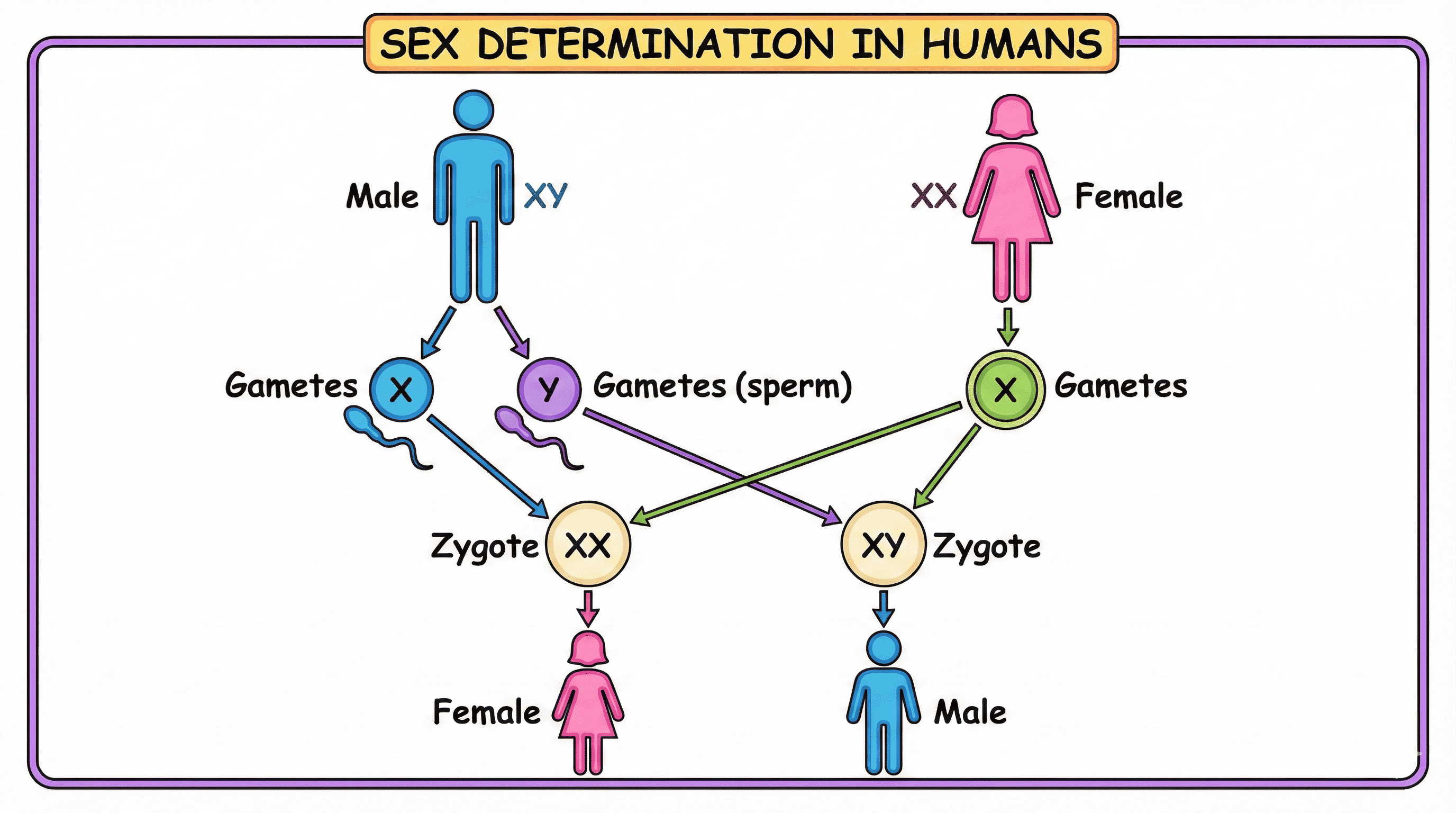
- Females have two identical sex chromosomes: XX (homogametic). - Males have mismatched sex chromosomes: XY (heterogametic).
Cross:
Mother (XX) x Father (XY)
Gametes: Mother produces only X eggs; Father produces 50% X sperm and 50% Y sperm.
| X (Egg) | X (Egg) | |
|---|---|---|
| X (Sperm) | XX (Female) | XX (Female) |
| Y (Sperm) | XY (Male) | XY (Male) |
23.
Ans: The probability is always exactly 50% because the male parent is heterogametic. The father produces two types of sperm in equal numbers (50% containing the X chromosome and 50% containing the Y chromosome) due to the equal segregation of chromosomes during meiosis. Since fertilization is completely random, there is a 1:1 probability of an X-sperm or a Y-sperm fertilizing the egg.
24.
Ans: Mistreating women for giving birth to girls is scientifically incorrect.
Reason: A mother possesses only XX chromosomes and can only contribute an X chromosome to her eggs. The father possesses XY chromosomes and produces two types of sperm: X-bearing and Y-bearing. If the sperm that fertilizes the egg carries an X, the child is a girl (XX); if it carries a Y, the child is a boy (XY). Therefore, the sex of the child is genetically determined entirely by the paternal sperm, not the mother.
Reason: A mother possesses only XX chromosomes and can only contribute an X chromosome to her eggs. The father possesses XY chromosomes and produces two types of sperm: X-bearing and Y-bearing. If the sperm that fertilizes the egg carries an X, the child is a girl (XX); if it carries a Y, the child is a boy (XY). Therefore, the sex of the child is genetically determined entirely by the paternal sperm, not the mother.
25.
Ans: In many reptiles, sex is determined by incubation temperature rather than chromosomes:
- In green sea turtles, high incubation temperatures ($>30\text{ �C}$) produce exclusively female hatchlings.
- In many lizards and crocodiles, high incubation temperatures produce male hatchlings.
In humans, sex is fixed by chromosomes at fertilisation and is unaffected by temperature.
26.
Ans: Snails can change their sex during their lifetime based on social and environmental needs. If a snail is isolated or in a population with a sex imbalance, it can switch its sex. This indicates that sex determination in lower animals is not always genetically fixed and can be highly flexible.
27.
Ans: The differences are:
- Autosomes: Chromosomes that control somatic body traits and are identical in both males and females. Humans have 22 pairs (44 autosomes).
- Sex Chromosomes: The pair of chromosomes that determine the sex of the individual. Humans have 1 pair (2 sex chromosomes, XX in females, XY in males).
28.
Ans: A human male has a mismatched pair (XY). The X chromosome is much larger, contains approximately 900�1000 functional genes, and is essential for survival.
The Y chromosome is small (about one-third the size of X), contains only around 70�80 genes, and carries the SRY gene which initiates male embryonic development.
The Y chromosome is small (about one-third the size of X), contains only around 70�80 genes, and carries the SRY gene which initiates male embryonic development.
Topic 4: Competency-Based Case Studies & Integrated Questions
Case Study 1: The Monohybrid Pea Experiment
29.
Ans:
- F1 Genotype: Vv (heterozygous violet). They produce only violet flowers because the violet allele 'V' is dominant over the white allele 'v'.
- F2 Calculations: F2 ratio is 3 violet : 1 white.
- Violet plants: $\frac{3}{4} \times 400 = 300$ plants.
- White plants: $\frac{1}{4} \times 400 = 100$ plants.
- Genotypic Ratio: 1 VV : 2 Vv : 1 vv (1:2:1).
Case Study 2: The Dihybrid Seed Shape & Colour Cross
30.
Ans:
- The four phenotypes are: (1) Round-Yellow, (2) Round-Green, (3) Wrinkled-Yellow, and (4) Wrinkled-Green.
- Punnett Square (RrYy x rryy):
Ratio: 1:1:1:1 genotypic and phenotypic ratio.RY Ry rY ry ry RrYy (Round-Yellow) Rryy (Round-Green) rrYy (Wrinkled-Yellow) rryy (Wrinkled-Green) - Yes, it supports the law of independent assortment. The equal occurrence of recombinant phenotypes (Round-Green and Wrinkled-Yellow) shows that seed shape and seed colour alleles separated independently during meiosis.
Case Study 3: The Human Blood Group Puzzle
31.
Ans:
- The mother must have genotype $I^A i$ (heterozygous A) and the father must have genotype $I^B i$ (heterozygous B).
- Cross: $I^A i$ x $I^B i$.
The probability of having a child with blood group O ($ii$) is $\frac{1}{4}$ or 25%. This proves the child was not swapped.$I^B$ $i$ $I^A$ $I^A I^B$ (AB) $I^A i$ (A) $i$ $I^B i$ (B) $ii$ (O) - The phenomenon is co-dominance, where both alleles $I^A$ and $I^B$ express themselves fully to produce the AB blood type.
Case Study 4: The Reptilian Nest Temperature Study
32.
Ans:
- Crocodiles exhibit environmental (temperature-dependent) sex determination, whereas humans use genetic sex determination ($XX/XY$).
- In reptile eggs, the temperature regulates the activity of the enzyme aromatase, which converts male androgens into female estrogens. At specific high temperatures, enzyme activity is suppressed, producing only males.
- Global warming poses a severe threat. Persistent high temperatures could cause all crocodile and turtle populations to produce only single-sex hatchlings, preventing future mating and driving the species to extinction.
Competency Check: The Tall and Dwarf Stem Challenge
33.
Ans:
- The student cannot distinguish them because the allele for tallness 'T' is dominant over 't', making both homozygous tall (TT) and heterozygous tall (Tt) plants physically identical.
- She can perform a test cross by crossing the selected tall plant with a homozygous recessive dwarf plant (tt).
- Crosses:
- If the plant is homozygous (TT): TT x tt → 100% tall offspring.
- If the plant is heterozygous (Tt): Tt x tt → 50% tall and 50% dwarf offspring.
Integrated Puzzle: The Mystery Seed Case
34.
Ans:
- The genotype of 'S' is RRYY (homozygous round-yellow), as crossing with rryy yields 100% RrYy (round-yellow).
- The genotype of 'S' is RrYY. Crossing RrYY x rryy yields RrYy (round-yellow) and rrYy (wrinkled-yellow) in a 1:1 ratio.
- The genotype of 'S' is RrYy (heterozygous round-yellow), as crossing RrYy x rryy yields a 1:1:1:1 test cross ratio.
35.
Ans: An individual with a cold-water sensitivity mutation may suffer or die, which is a disadvantage for that individual.
However, if the environment changes (e.g., water warms up due to geothermal activity), other members with heat-resistant variations will survive, preventing the entire species from going extinct. Thus, variation benefits the species' survival but can be neutral or harmful for individuals.
However, if the environment changes (e.g., water warms up due to geothermal activity), other members with heat-resistant variations will survive, preventing the entire species from going extinct. Thus, variation benefits the species' survival but can be neutral or harmful for individuals.
36.
Ans:
- Dominant Trait: The trait that expresses itself in both homozygous and heterozygous states (e.g., tallness).
- Recessive Trait: The trait that expresses itself only in the homozygous state and is masked in the heterozygous state (e.g., dwarfness).
Mendel's F1 generation (Tt) plants inherited the 't' allele from the dwarf parent but did not show dwarfism. Dwarfism only reappeared in the F2 generation (tt), proving that traits can be inherited without being expressed.
Mendel's F1 generation (Tt) plants inherited the 't' allele from the dwarf parent but did not show dwarfism. Dwarfism only reappeared in the F2 generation (tt), proving that traits can be inherited without being expressed.
37.
Ans: Mendel's dihybrid cross between RRYY (Round-Yellow) and rryy (Wrinkled-Green) yielded four phenotypes in the F2 generation in a 9:3:3:1 ratio.
The occurrence of two new recombinant combinations�Round-Green (3) and Wrinkled-Yellow (3)�proves that seed shape and seed colour are inherited completely independently, which supports the Law of Independent Assortment.
The occurrence of two new recombinant combinations�Round-Green (3) and Wrinkled-Yellow (3)�proves that seed shape and seed colour are inherited completely independently, which supports the Law of Independent Assortment.
38.
Ans: Crossing TT x tt yields only Tt (tall) plants in F1 because the dominant 'T' masks 't'.
When F1 (Tt) plants are self-pollinated, the alleles segregate during gametogenesis. The Punnett square shows that 25% of the F2 offspring receive the recessive 't' allele from both gametes, yielding a homozygous recessive genotype (tt) which expresses dwarfism, causing the trait to reappear.
When F1 (Tt) plants are self-pollinated, the alleles segregate during gametogenesis. The Punnett square shows that 25% of the F2 offspring receive the recessive 't' allele from both gametes, yielding a homozygous recessive genotype (tt) which expresses dwarfism, causing the trait to reappear.
39.
Ans: Females have identical sex chromosomes (XX) and undergo meiosis to produce eggs that always carry a single X chromosome.
Males have mismatched sex chromosomes (XY) and undergo meiosis to produce two types of sperm in equal numbers: 50% containing an X chromosome and 50% containing a Y chromosome. This male heterogamety dictates human sex determination.
Males have mismatched sex chromosomes (XY) and undergo meiosis to produce two types of sperm in equal numbers: 50% containing an X chromosome and 50% containing a Y chromosome. This male heterogamety dictates human sex determination.
40.
Ans: In a monohybrid cross, F1 selfing (Tt x Tt) involves two heterozygous parents. Each parent produces tall (T) and dwarf (t) gametes in equal proportions (0.5 probability).
During fertilization, the random combining of gametes yields four outcomes: TT, Tt, tT, tt. Since 'T' is dominant, the first three outcomes express tallness (75% probability), and only 'tt' expresses dwarfness (25% probability), resulting in a 3:1 phenotypic ratio.
During fertilization, the random combining of gametes yields four outcomes: TT, Tt, tT, tt. Since 'T' is dominant, the first three outcomes express tallness (75% probability), and only 'tt' expresses dwarfness (25% probability), resulting in a 3:1 phenotypic ratio.
41.
Ans: A homozygous recessive dwarf plant is represented by lowercase letters: tt.
We write alleles in pairs because somatic cells are diploid and contain pairs of homologous chromosomes, with one allele inherited from the mother and one from the father.
We write alleles in pairs because somatic cells are diploid and contain pairs of homologous chromosomes, with one allele inherited from the mother and one from the father.
42.
Ans:
- Multiple Allelism: A gene is controlled by more than two alleles. Human ABO blood groups are controlled by three alleles: $I^A$, $I^B$, and $i$.
- Co-dominance: Both alleles are fully expressed in the heterozygote. Alleles $I^A$ and $I^B$ are co-dominant, producing blood group AB ($I^A I^B$).
43.
Ans: DNA contains the code to synthesize specific proteins.
If a gene is functional, it transcribes mRNA to synthesize an active enzyme. This enzyme catalyzes a specific chemical reaction, producing a hormone or pigment that expresses a physical trait. If the DNA sequence is mutated, it produces a non-functional enzyme, preventing trait expression.
If a gene is functional, it transcribes mRNA to synthesize an active enzyme. This enzyme catalyzes a specific chemical reaction, producing a hormone or pigment that expresses a physical trait. If the DNA sequence is mutated, it produces a non-functional enzyme, preventing trait expression.
44.
Ans: Heterozygous tall (Tt) x Homozygous tall (TT):
Phenotypic Ratio: 100% Tall.
Genotypic Ratio: 1 TT : 1 Tt (1:1).
| T | T | |
|---|---|---|
| T | TT (Tall) | TT (Tall) |
| t | Tt (Tall) | Tt (Tall) |
Genotypic Ratio: 1 TT : 1 Tt (1:1).
45.
Ans:
- F1 Genotype: RrYy (Round-Yellow).
- F2 Phenotypes: Round-Yellow, Round-Green, Wrinkled-Yellow, and Wrinkled-Green in a 9:3:3:1 ratio.
46.
Ans: Acquired traits affect only non-reproductive somatic body tissues (like muscles or skin cells).
Because somatic cells do not form gametes, any structural changes in their DNA are not passed to sperm or eggs, preventing the trait from being inherited by offspring. Only changes in the DNA of germline cells can be inherited.
Because somatic cells do not form gametes, any structural changes in their DNA are not passed to sperm or eggs, preventing the trait from being inherited by offspring. Only changes in the DNA of germline cells can be inherited.
47.
Ans: Gregor Mendel is called the "Father of Genetics" because he was the first to study heredity mathematically. He formulated the fundamental Laws of Inheritance (Dominance, Segregation, and Independent Assortment) that established genetics as a modern science.
48.
Ans: The daughter has blood group O ($ii$) and must have inherited one 'i' allele from each parent.
Since the father is blood group A, his genotype must be heterozygous ($I^A i$). The mother has blood group O ($ii$). This shows that the 'i' allele is recessive, and the $I^A$ allele is dominant.
Since the father is blood group A, his genotype must be heterozygous ($I^A i$). The mother has blood group O ($ii$). This shows that the 'i' allele is recessive, and the $I^A$ allele is dominant.
49.
Ans: Genetic drift is the change in the frequency of an existing gene variant (allele) in a population due to random chance events (like floods, fires, or natural disasters) rather than natural selection. It has a significant impact on small populations.
50.
Ans: During Anaphase-I of meiosis, homologous chromosomes separate and pull apart to opposite poles.
This ensures that each gamete receives only one chromosome from each homologous pair, halfing the genetic content to maintain species stability after fertilisation.
This ensures that each gamete receives only one chromosome from each homologous pair, halfing the genetic content to maintain species stability after fertilisation.
51.
Ans:
- Self-cross: Mating between F1 individuals ($Tt \times Tt$).
- Back-cross: Mating an F1 hybrid with one of its homozygous parental genotypes ($Tt \times TT$). It helps plant breeders introduce and stabilize desirable parental traits in hybrids.
52.
Ans: Environmental sex determination is common in primitive reptiles, where temperature-sensitive enzymes regulate sex.
Genetic sex determination evolved later in birds and mammals, providing a stable, temperature-independent 1:1 sex ratio that protects populations from fluctuating climates.
Genetic sex determination evolved later in birds and mammals, providing a stable, temperature-independent 1:1 sex ratio that protects populations from fluctuating climates.
53.
Ans: The SRY (Sex-determining Region Y) gene initiates testis development.
If SRY is mutated or inactive, the embryonic gonads will naturally develop into ovaries. Despite having an XY genotype, the child will develop female physical characteristics.
If SRY is mutated or inactive, the embryonic gonads will naturally develop into ovaries. Despite having an XY genotype, the child will develop female physical characteristics.
54.
Ans: Mendel ensured true-breeding by self-pollinating pea plants for several generations, selecting only those lines that consistently produced identical traits (e.g., only tall plants from tall parents).
55.
Ans: The phenomenon is incomplete dominance.
Neither allele is completely dominant. The heterozygous state ($Rr$) produces a blended intermediate phenotype (pink flowers) from the red ($RR$) and white ($rr$) alleles, yielding a 1 red : 2 pink : 1 white ratio in F2.
Neither allele is completely dominant. The heterozygous state ($Rr$) produces a blended intermediate phenotype (pink flowers) from the red ($RR$) and white ($rr$) alleles, yielding a 1 red : 2 pink : 1 white ratio in F2.
56.
Ans: A human male produces X-bearing and Y-bearing sperm in a 1:1 ratio.
The mathematical probability of fertilization is: $$P(\text{boy}) = P(\text{Y-sperm}) \times P(\text{egg}) = 0.5 \times 1.0 = 0.5$$ $$P(\text{girl}) = P(\text{X-sperm}) \times P(\text{egg}) = 0.5 \times 1.0 = 0.5$$ This random probability maintains a 1:1 sex ratio in large populations.
The mathematical probability of fertilization is: $$P(\text{boy}) = P(\text{Y-sperm}) \times P(\text{egg}) = 0.5 \times 1.0 = 0.5$$ $$P(\text{girl}) = P(\text{X-sperm}) \times P(\text{egg}) = 0.5 \times 1.0 = 0.5$$ This random probability maintains a 1:1 sex ratio in large populations.
57.
Ans: In a heterozygote (Tt), the alleles remain together without blending.
During gamete formation, the alleles segregate cleanly. The recessive 't' allele remains physically unchanged and reappears in the homozygous state (tt) in the next generation, proving that alleles do not blend.
During gamete formation, the alleles segregate cleanly. The recessive 't' allele remains physically unchanged and reappears in the homozygous state (tt) in the next generation, proving that alleles do not blend.
58.
Ans:
- F1 Genotype: TtRr (Tall-Round).
- Gametes: TR, Tr, tR, and tr.
59.
Ans: No, mutations in somatic body cells cannot be inherited because somatic cells do not contribute to gamete formation. Only mutations in germline cells are passed to the offspring.
60.
Ans: Meiosis halves the chromosome number from diploid ($2n$) to haploid ($n$) in gametes.
During fertilization, the fusion of haploid sperm ($n$) and haploid egg ($n$) restores the diploid number ($2n$) in the zygote, maintaining a constant chromosome count across generations.
During fertilization, the fusion of haploid sperm ($n$) and haploid egg ($n$) restores the diploid number ($2n$) in the zygote, maintaining a constant chromosome count across generations.